2025 Volkswagen Golf GTI Review: Car of the Year


PROS:


  • Exceptionally balanced chassis favors control over spectacle

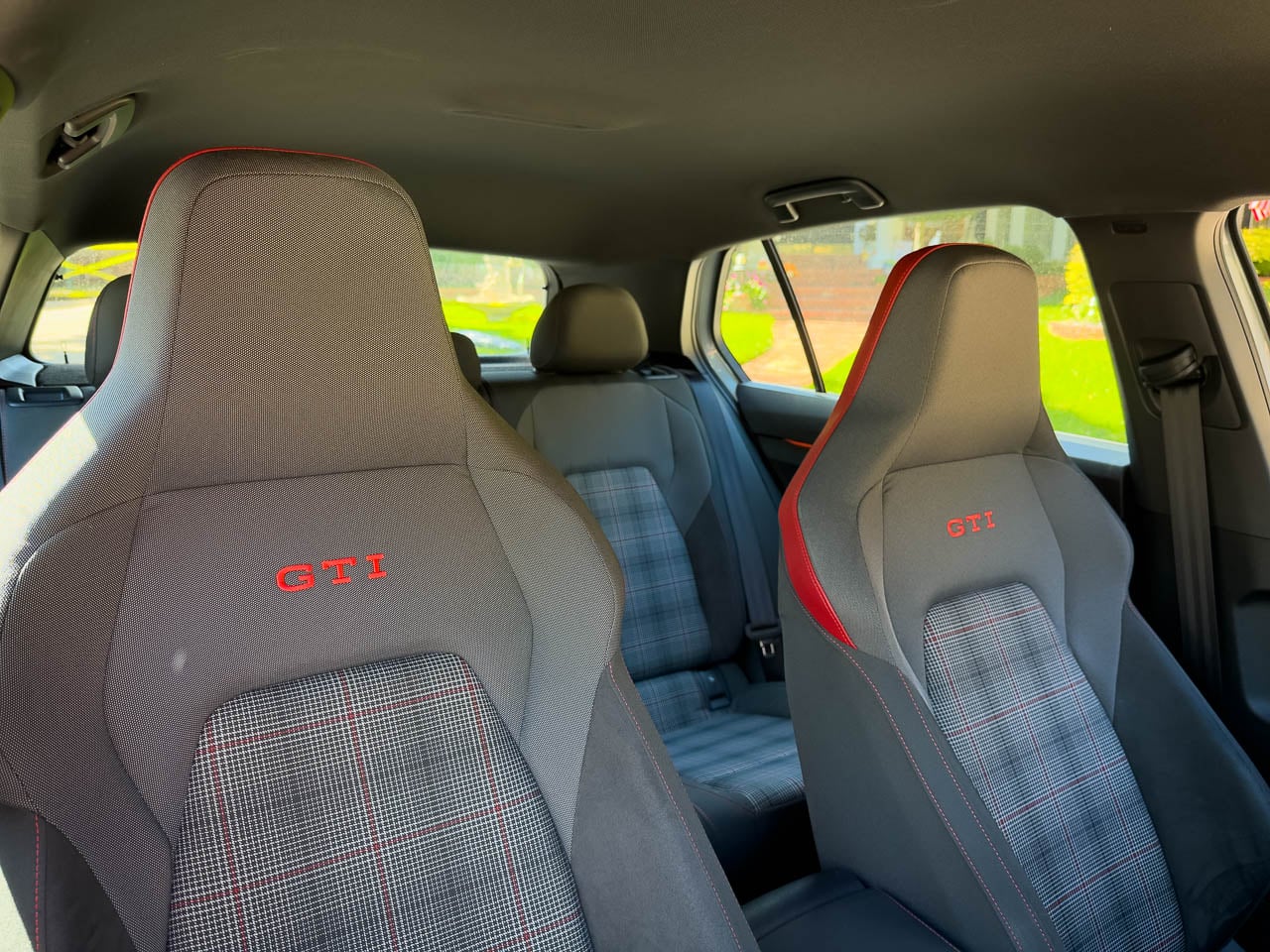
  • Clark Plaid seating blends comfort, grip, and heritage

  • Torque rich powerband rewards real world driving

  • Daily usability achieved without sacrificing design intent

  • Restraint driven design feels complete and confident

CONS:


  • Touch sensitive controls reduce tactile certainty

  • Front wheel drive limits ultimate track theatrics

RATINGS:

AESTHETICS
ERGONOMICS
PERFORMANCE
SUSTAINABILITY / REPAIRABILITY
VALUE FOR MONEY

EDITOR'S QUOTE:

The GTI wins not by doing more, but by knowing when to stop.

award-icon

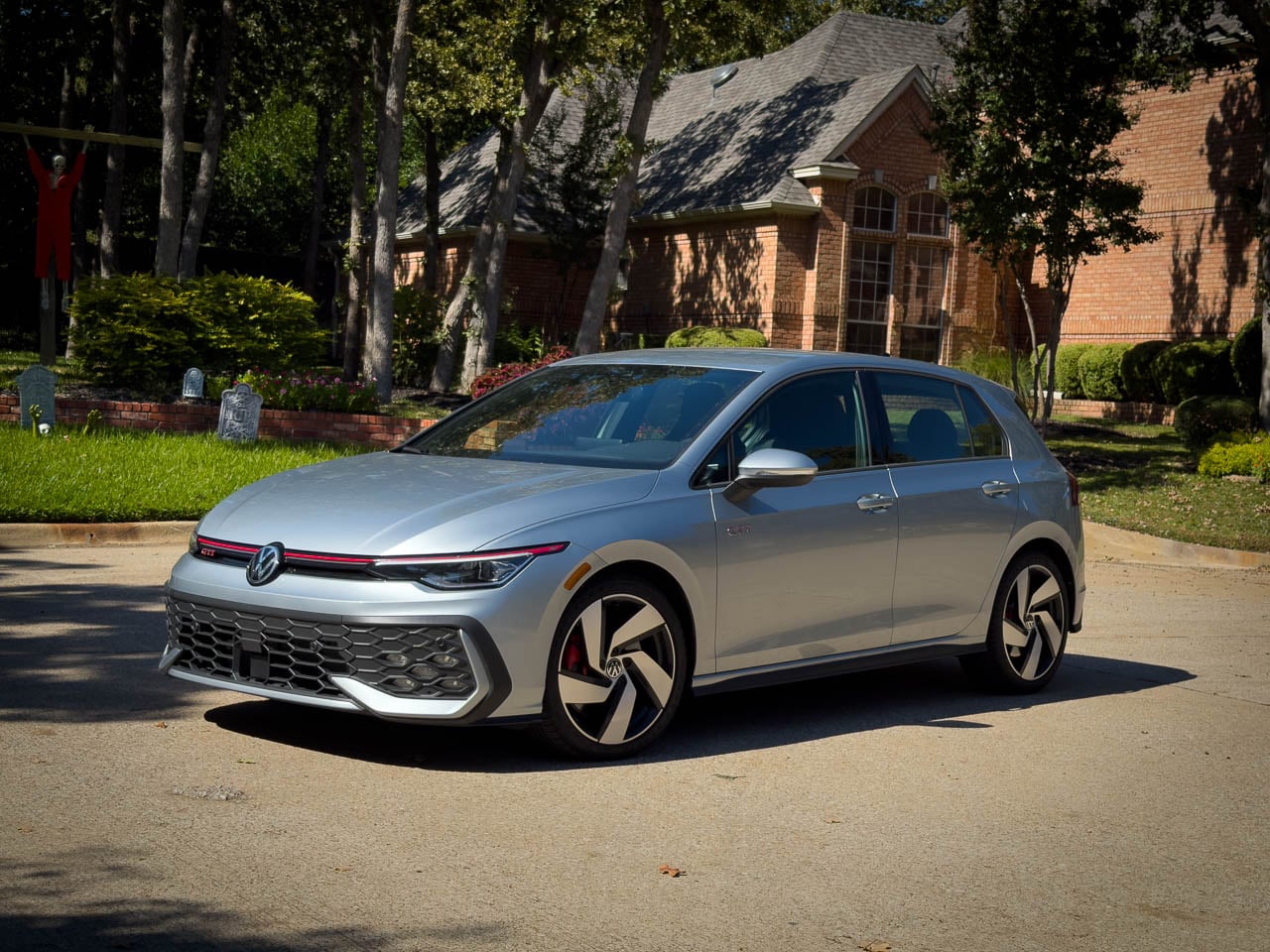
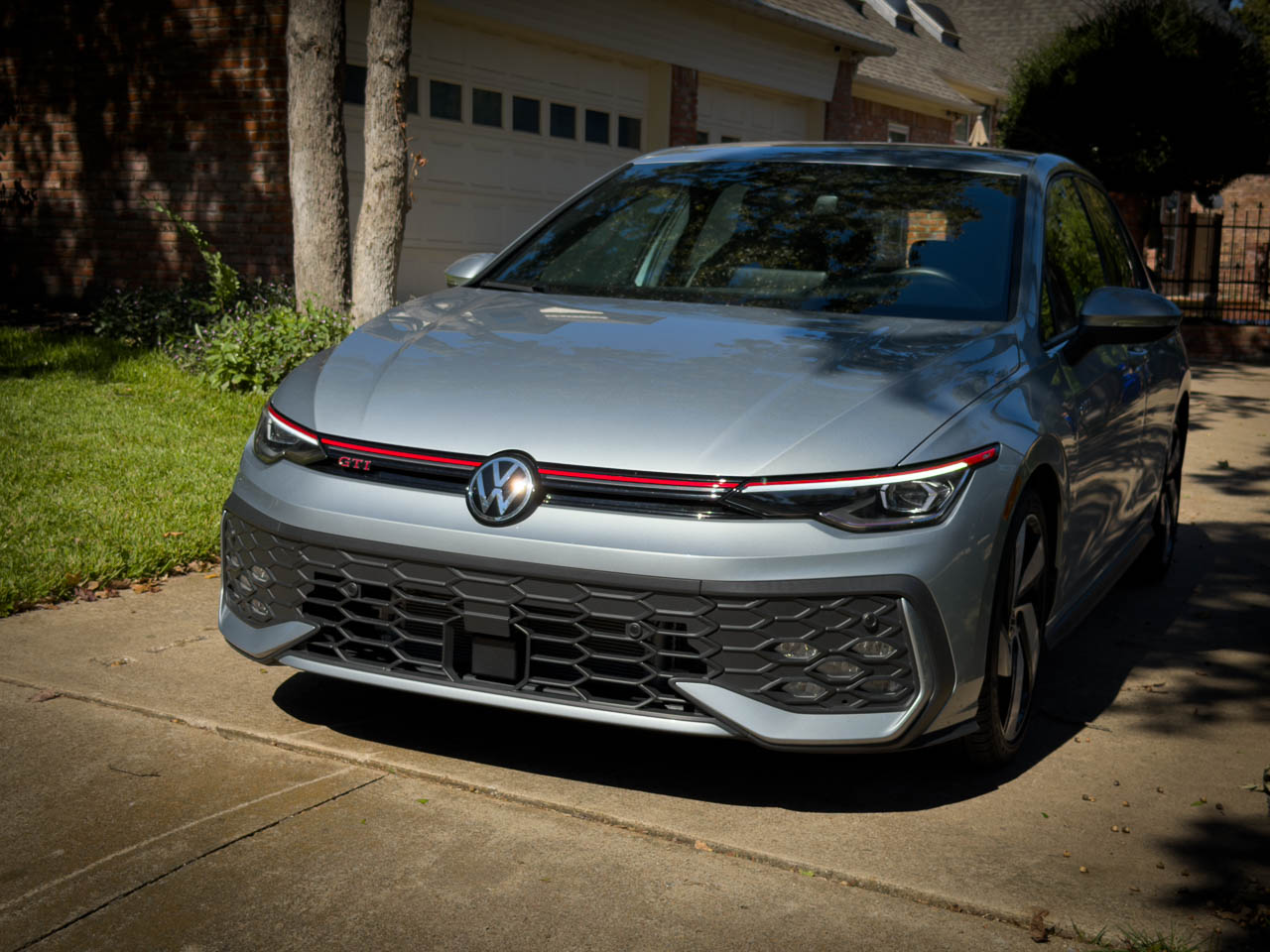
Forty years into its production run, the Volkswagen Golf GTI faces a question most performance cars never survive long enough to answer: what happens when the formula is complete? The 2025 model responds not with reinvention but with refinement so deliberate it borders on philosophical. Look at the grille: a single red line, unbroken, tracing the car’s width before disappearing into the headlight housings. No additional accent. No secondary flourish. That line is the thesis statement. Where competitors chase headline numbers and aggressive styling cues, the GTI presents something rarer in automotive design: the confidence to stop adding.
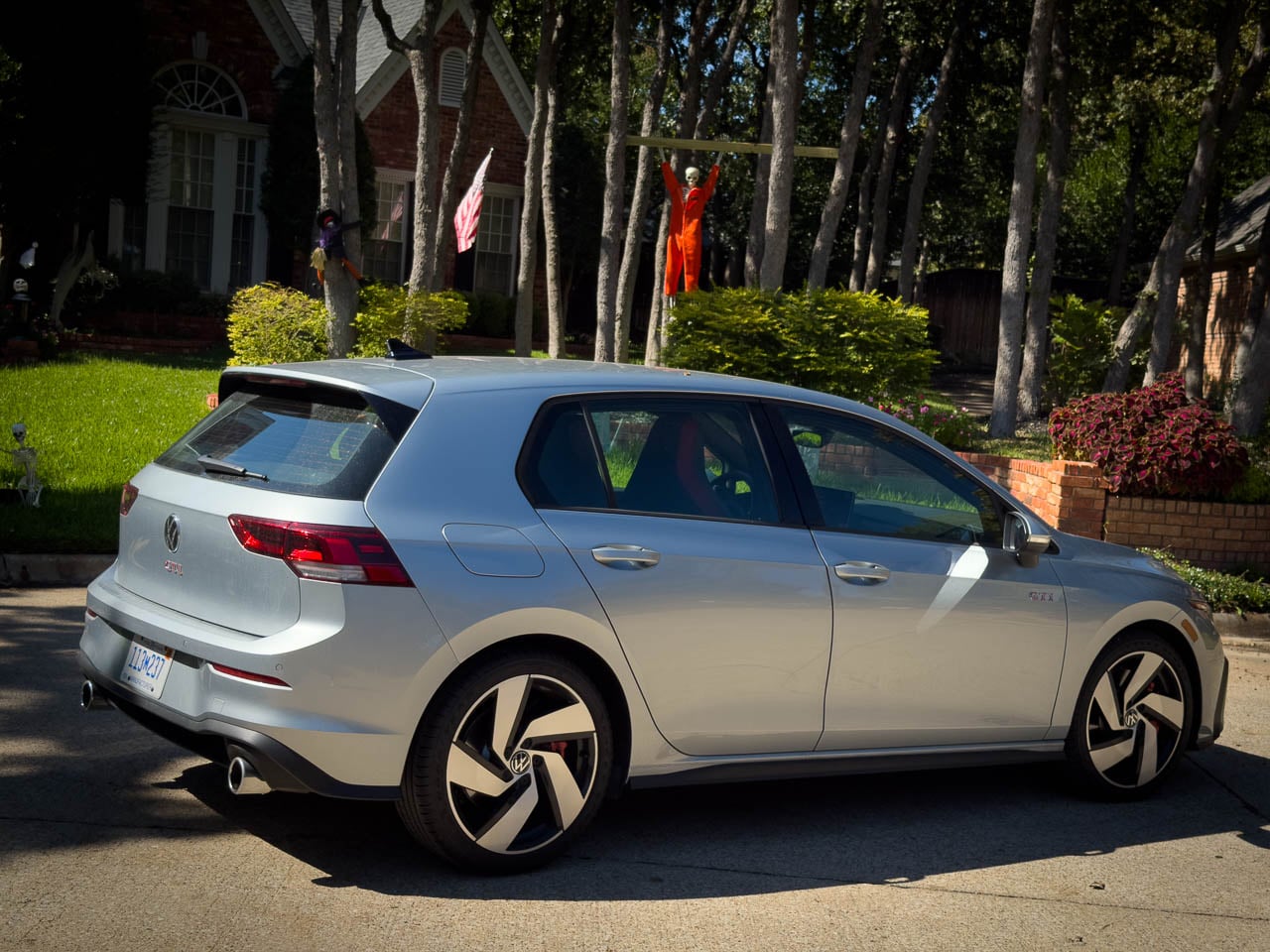
The exterior reads as studied understatement. Body lines remain clean, uninterrupted by vents or scoops that would suggest performance requiring constant explanation. The silhouette sits low without crouching, planted without posturing. In Alpine Silver Metallic, our test vehicle demonstrated how surface finish interacts with the car’s subtle curves, catching light across hood creases that reveal themselves gradually rather than announcing their presence.

Material Language

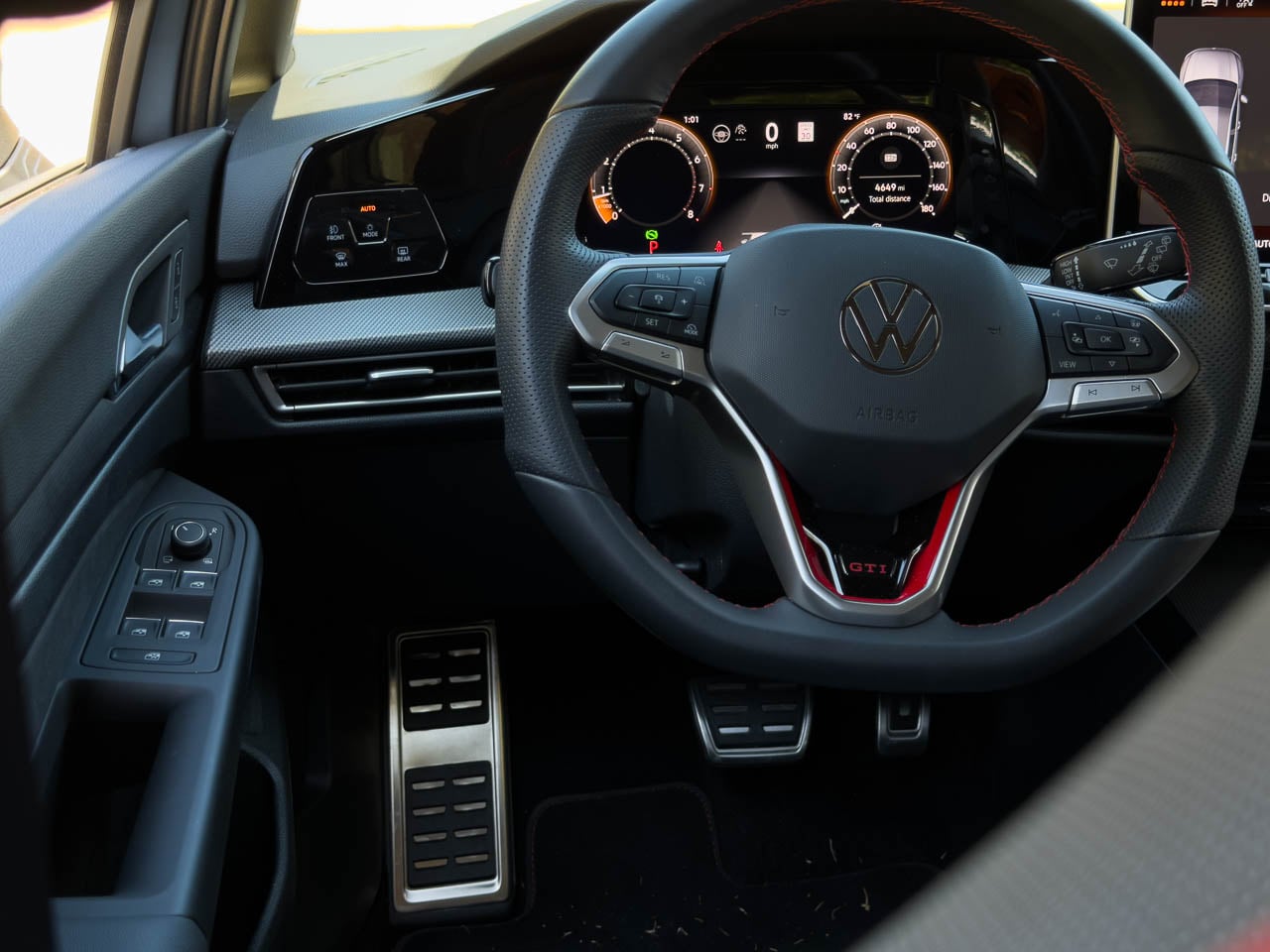
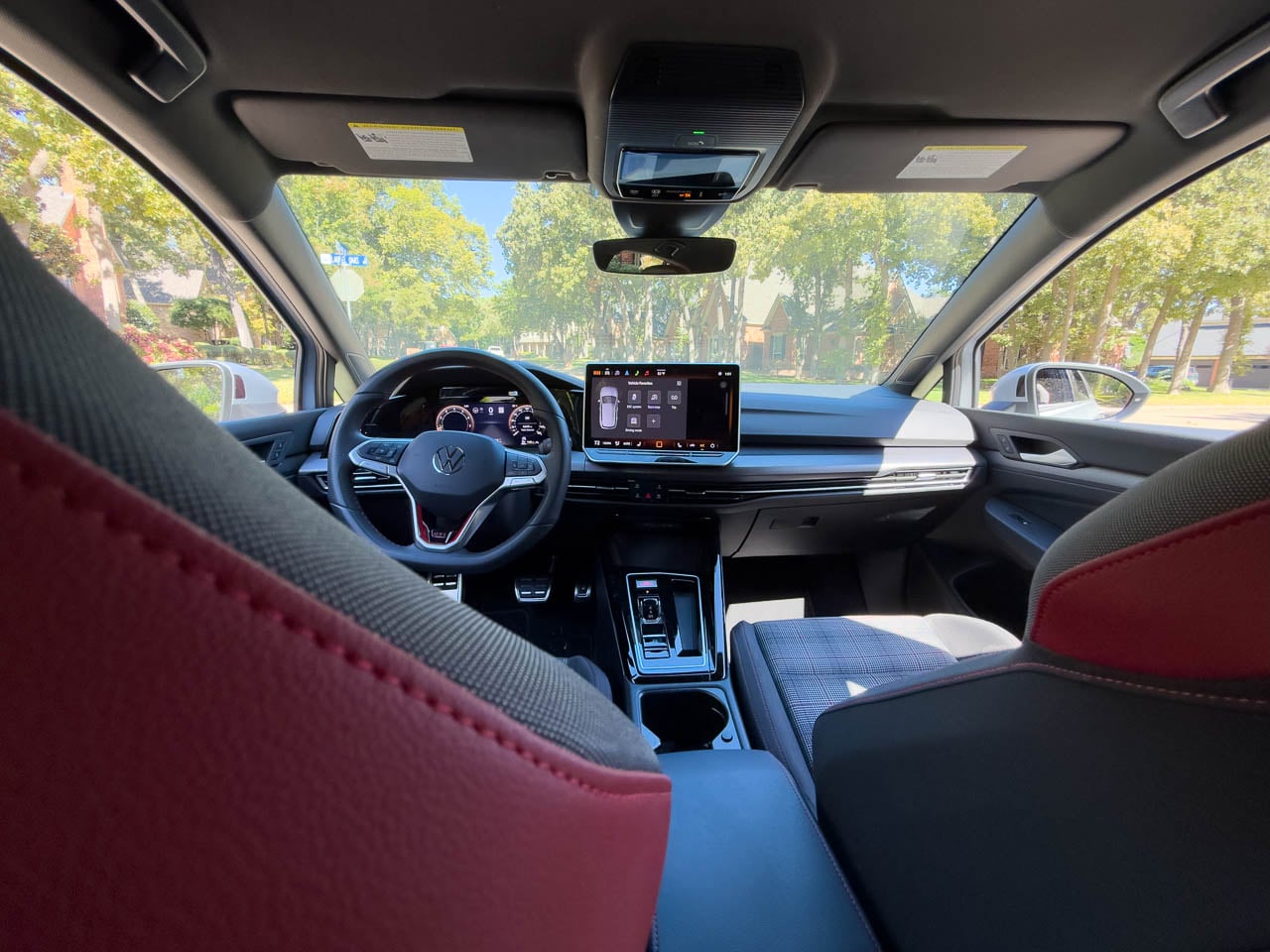
Inside, the cabin architecture prioritizes tactile hierarchy over visual spectacle. The flat-bottom steering wheel occupies the central position in this material conversation, wrapped in leather that wears smooth at the nine-and-three positions within the first few hundred miles of use. Stainless steel pedals catch light from the footwell, their brushed finish contrasting with the matte black plastic surrounds. Red ambient lighting threads through the dashboard at night, the only concession to interior theater.

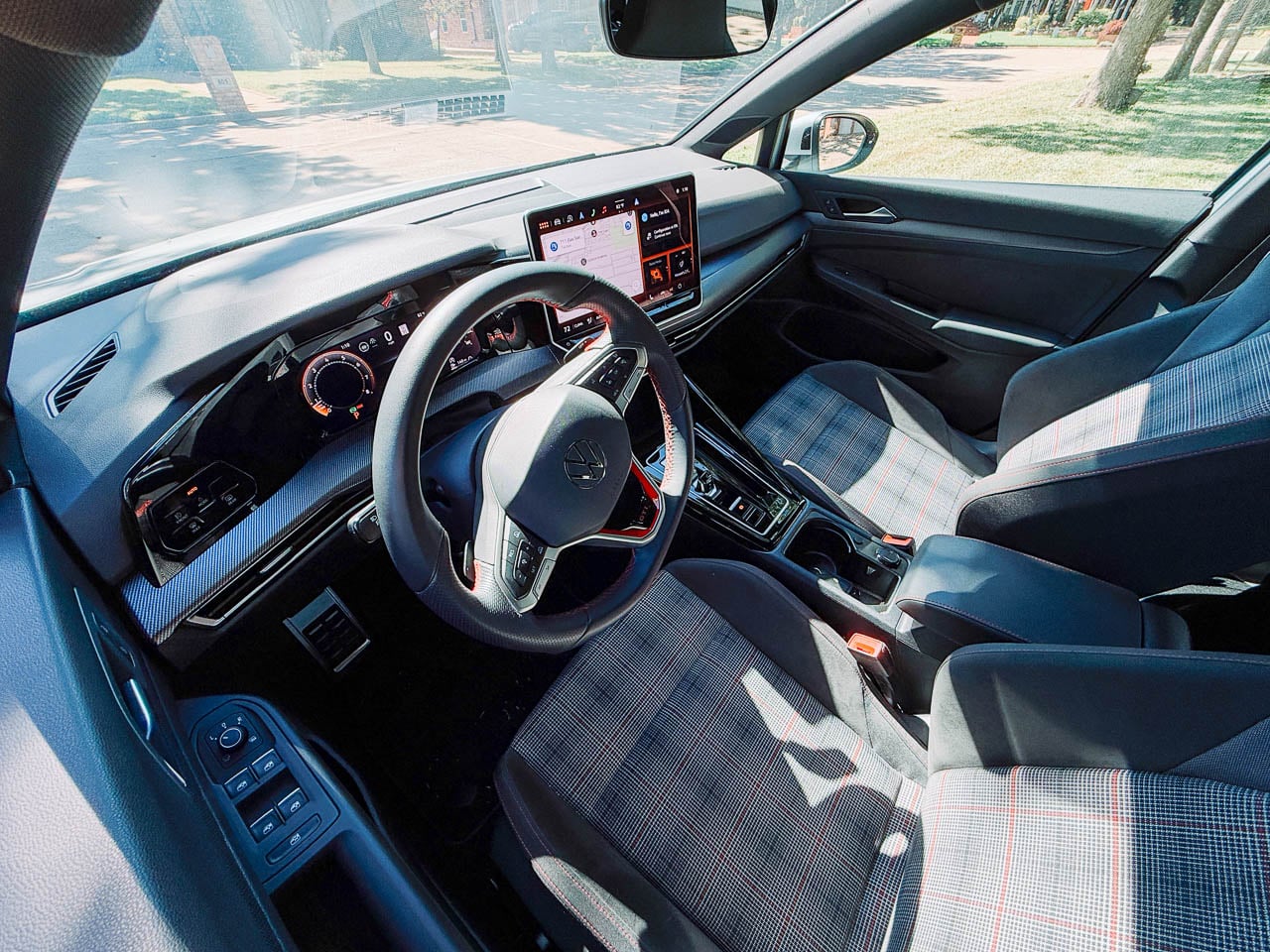
The Clark Plaid seats deserve separate consideration. This textile pattern has appeared in every GTI generation since 1976, and its persistence represents something beyond brand consistency. The weave itself tells a story about Volkswagen’s understanding of what performance seating actually requires: grip during lateral loading, breathability across temperature changes, durability that improves rather than degrades with use. Bolster foam density sits firmer than typical sport cloth, shaped to contain rather than squeeze the occupant. The fabric’s black and gray threads intersect at angles that catch cabin light differently depending on sun position, creating visual movement even when the car sits still. After a four-hour highway stint from Dallas to Austin, the seats demonstrated no pressure point fatigue, a claim many leather-wrapped alternatives cannot make. This is functional heritage, not nostalgia. The plaid works because the problem it solves has not changed.
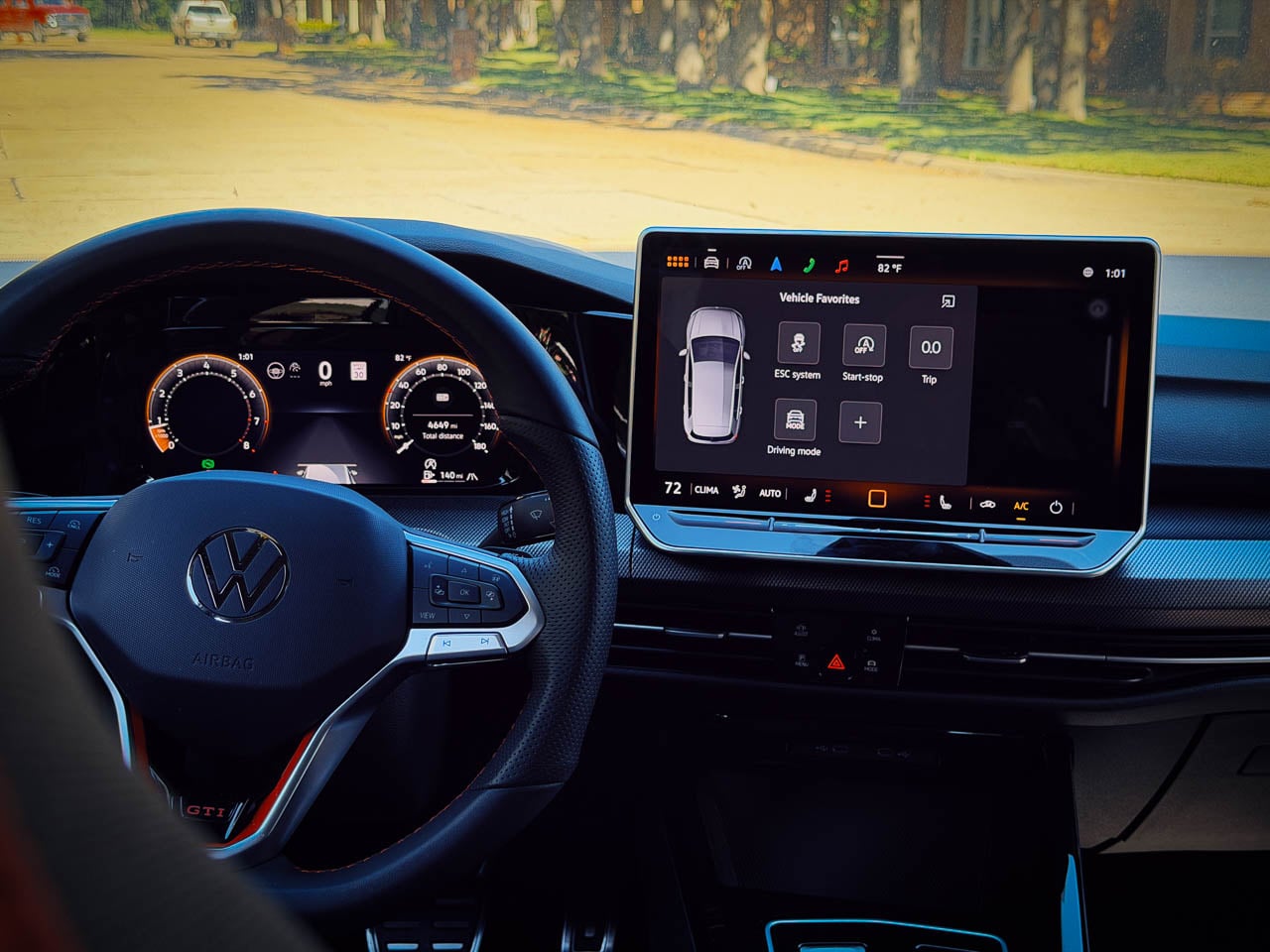
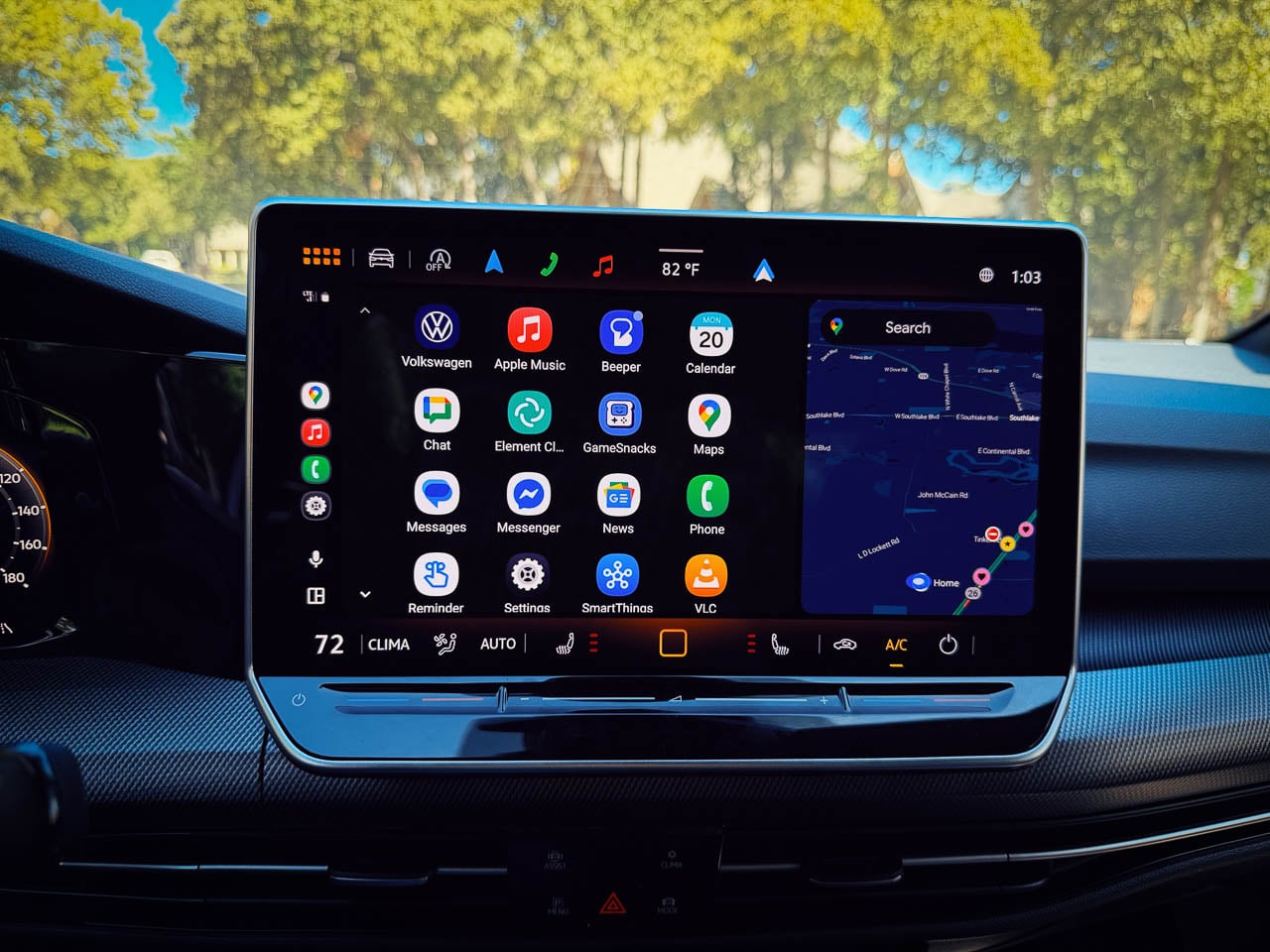
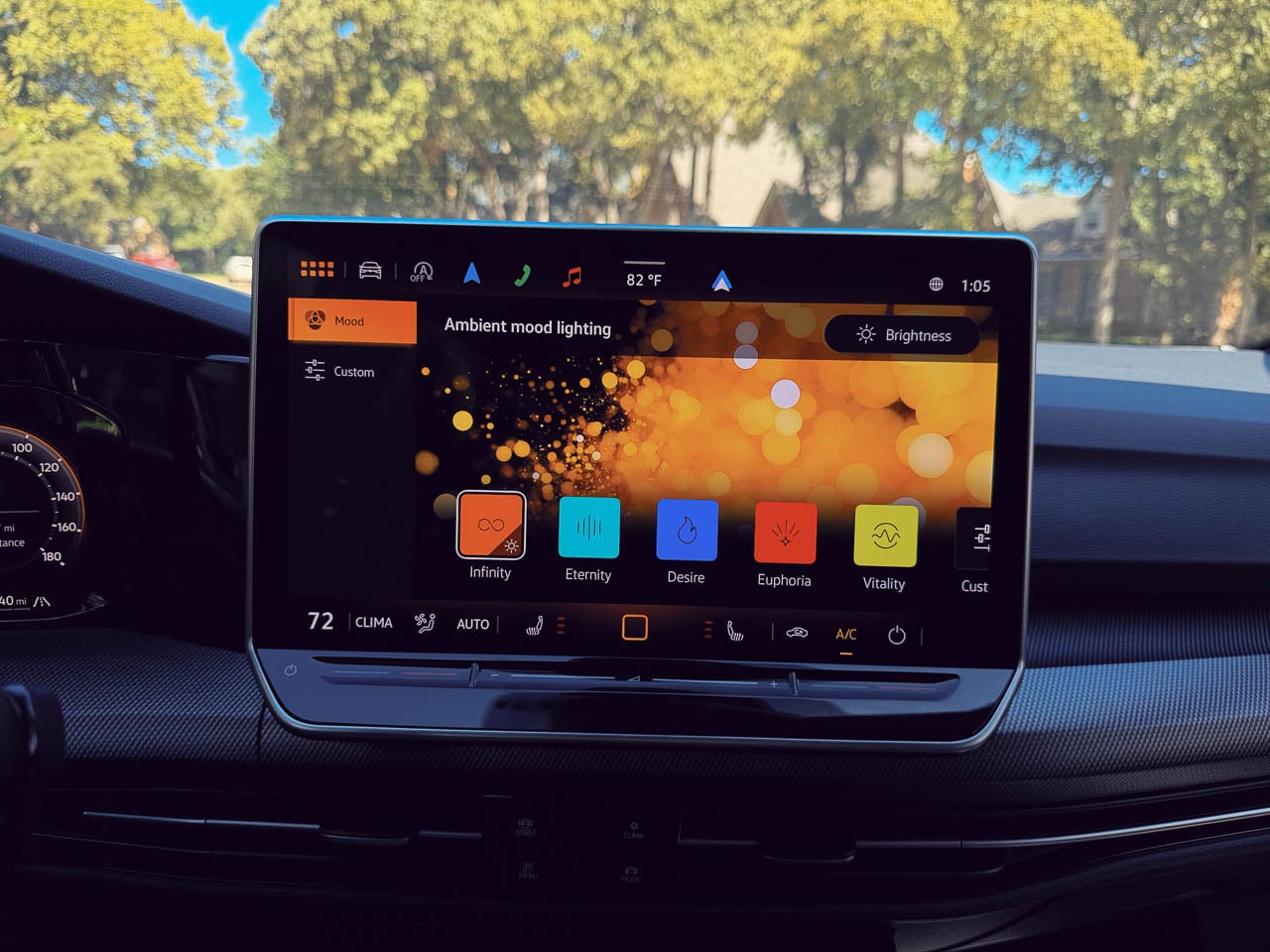
Dual 10.25-inch displays span the dashboard width, their bezels thin enough to suggest a single continuous surface interrupted only by the steering column. Touch-sensitive sliders for climate and volume occupy positions along the center console where physical controls once lived. This represents the GTI’s single visible concession to interface trends over tactile tradition, a trade that prioritizes visual continuity at a modest ergonomic cost. The adjustment period is real but brief.
Chassis Philosophy

The mechanical architecture beneath reveals Volkswagen’s approach to performance engineering. The 2.0-liter EA888 engine produces 241 horsepower and 273 pound-feet of torque, figures that appear conservative against current competition. These numbers obscure the delivery character. Torque arrives at 1,600 rpm and sustains through 4,300 rpm, creating a powerband that rewards partial throttle exploration rather than demanding full commitment.

Our test vehicle carried the seven-speed DSG dual-clutch transmission, a choice that alters the car’s personality without diminishing it. Upshifts compress into moments brief enough to feel like hesitations rather than events. Downshifts arrive with rev-matching that sounds intentional, the exhaust note rising through an acoustic signature tuned to communicate engagement without theater.

The VAQ electronic limited-slip differential manages front-wheel traction with intervention subtle enough to require attention to notice. Corner exit acceleration produces no wheel scrabble, no steering correction, no sense of mechanical systems working to contain mechanical excess. The differential’s operation suggests integration rather than intervention, a chassis behaving as a single coordinated system rather than independent components managed by software.
Dynamic Chassis Control adaptive dampers present a genuine choice rather than a marketing checkbox. Comfort mode absorbs expansion joints and surface imperfections with compliance that transforms the GTI into a credible highway cruiser. Sport mode firms the response enough to communicate surface texture through the steering rim and seat cushion. Steering weight builds progressively from center, carrying none of the artificial resistance that plagues many electronically assisted systems. Brake pedal travel follows the same logic: firm initial resistance, progressive bite, linear relationship between input and outcome. The spread between these settings covers sufficient range that drivers will likely settle into a preference rather than toggle constantly. These are not remarkable specifications. They are evidence of calibration discipline.

The Architecture of Usefulness

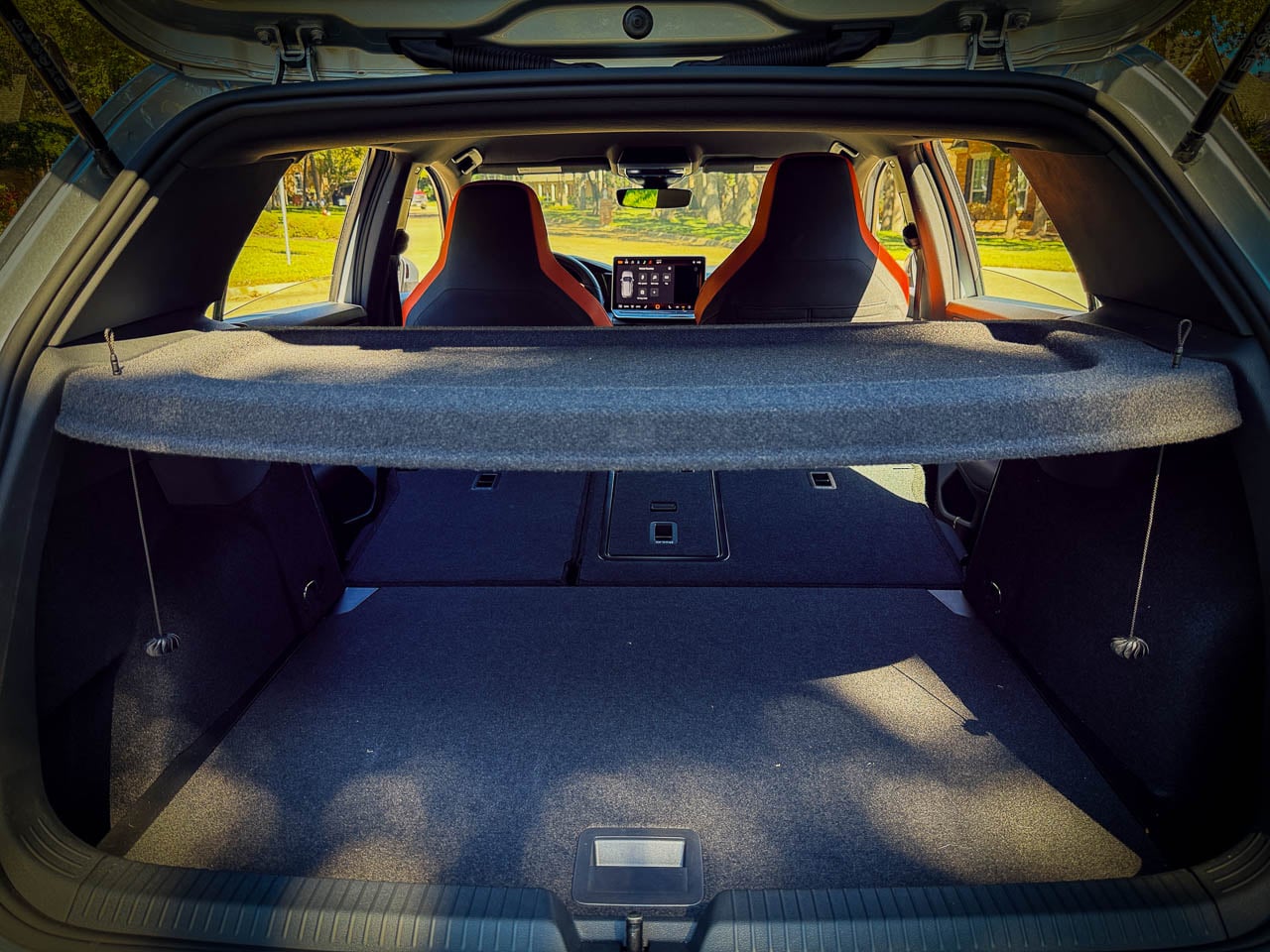
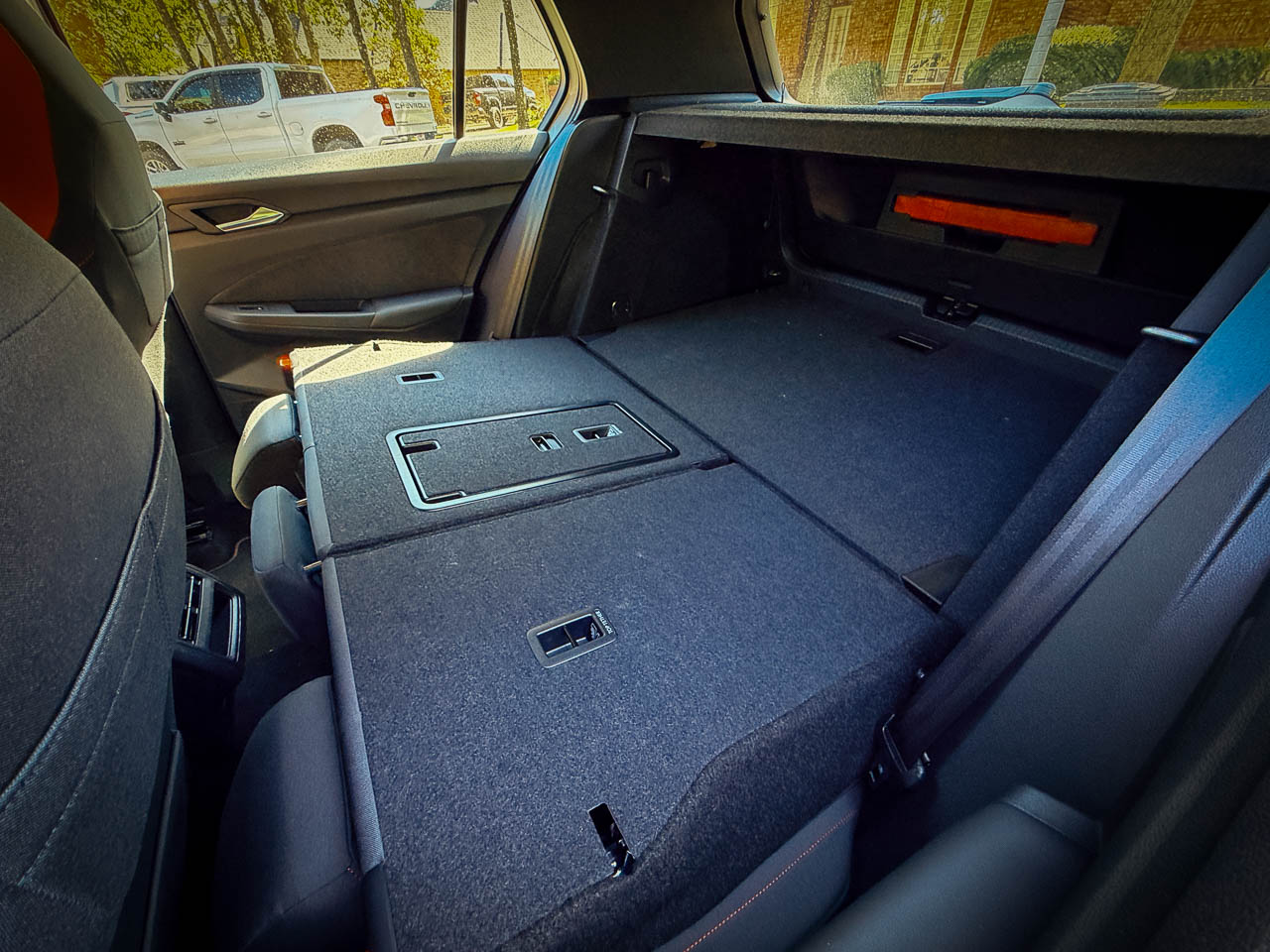
The hatchback form factor delivers practicality the GTI’s sedan competitors cannot match. Rear cargo volume expands from 22.8 cubic feet with seats upright to 52.7 cubic feet with the rear bench folded, the rear seatbacks folding via a single pull lever that releases with satisfying mechanical precision. The load floor sits level with the rear bumper height, its carpeted surface firm enough to slide boxes across without catching. This utility exists without visual compromise, the roofline maintaining its sporting rake while enclosing genuinely useful interior volume.
Rear passenger space accommodates adults across moderate distances. Legroom measures adequate for passengers under six feet, though knee contact with front seatbacks remains possible depending on front occupant positioning. Headroom proves more generous than the roofline suggests, the seating position dropping occupants low enough to clear the tapering roof glass.
The rear door apertures open wide enough for easy entry, their weatherstripping creating a soft thud on close that communicates build quality without conscious attention. Small storage solutions appear throughout: door pockets sized for water bottles, a center console bin deep enough for phones and wallets, map pockets behind the front seats. For a vehicle this compact, the packaging efficiency represents thoughtful spatial engineering.

The Value Proposition

At $33,860 as tested, the GTI positions itself not against the Civic Type R or GR Corolla but adjacent to them. This is strategic design territory. Volkswagen occupies the space where daily usability and driving engagement overlap, ceding the performance margins to competitors who build cars requiring accommodation. The Type R demands you rise to its level. The GR Corolla rewards commitment with drama. The GTI meets you where you already are.

2025 Toyota GR Corolla Premium Manual Review

The four-year bumper-to-bumper warranty and two years of included maintenance read as confidence in the object’s longevity, not as purchase incentives. This is the rarest positioning in contemporary automotive design: a performance car priced for accessibility that does not apologize for what it excludes. The GTI excludes excess. That exclusion is the product.

Resolution: Why This Is Our Car of the Year

The 2025 Golf GTI represents something increasingly rare in automotive design: a product that knows what it is and refuses to pretend otherwise. The chassis does not apologize for being front-wheel drive. The power figures do not strain toward competition with larger engines. The interior does not disguise its price point behind aggressive styling that overpromises.
What remains is a vehicle that executes its intended purpose with precision that approaches elegance. The hot hatch formula, refined across four decades, arrives here in what may be its final evolved form before electrification rewrites the category’s rules entirely. For drivers seeking performance that integrates into daily life rather than demanding accommodation from it, the GTI presents an argument for restraint that carries more conviction than any competitor’s argument for excess.
The 2025 Volkswagen Golf GTI is Yanko Design’s 2025 Car of the Year and earns our Editor’s Choice Award because it answers the question that matters: can a performance car be finished?
Yes. This is what finished looks like. Not the absence of ambition, but the presence of conviction. Volkswagen built the GTI they intended to build: complete, coherent, and resolved. In the final years before electrification rewrites every assumption about what a driver’s car can be, this is the closing argument for internal combustion restraint.

The award goes to the car that knew when to stop.

The post 2025 Volkswagen Golf GTI Review: Car of the Year first appeared on Yanko Design.

Nintendo has huge discounts on Switch 2 games in its holiday sale

Nintendo is in a giving state of mind this season, offering some holiday deals on games in the eShop, including a few recent Switch 2 titles. For instance, the Switch 2 version of Ball x Pit, which was one of our staff's favorite games of 2025, is 20 percent off at $12. Final Fantasy Tactics: The Ivalice Chronicles is $40, down from the usual $50 on Switch 2, which is about as good a deal as you’ll get for a current-year game release.

There are also a few older games that have gotten even steeper discounts. The Witcher 3: Wild Hunt Complete Edition for the Nintendo Switch 2 is a whopping 75 percent off, so load it onto your new console for $15.Cyberpunk 2077: Ultimate Edition for the Nintendo Switch 2 is down to $40. At about $33, Cult of the Lamb: Unholy Edition is half off for the original Switch. No Man's Sky is also 50 percent off, so you can grab it for either Switch console for just $24. Star Wars: Outlaws is down to $40, which is $20 off, and Nier: Automata is $16, compared with its usual $40 price tag.

Those are just a few that caught our eye. The discounts will run until January 4, so you can make purchases as a last-minute gift or load up your own Switch in case nobody gifts you with a game you've been eyeing.

Update, December 23, 6:50PM ET: CD Projekt RED has adjusted the price of Cyberpunk 2077 up from $17.49 to $39.99 and The Witcher 3: Wild Hunt down from $34.49 to $14.49. The company said the discounts were “a result of an error we made when submitting,” the error clearly being that they attached the “75 percent off” and “42 percent off” to the wrong games. Congratulations if you were able to buy Cyberpunk 2077 for $17.49. Commiserations if you just paid $34.49 for The Witcher 3. We updated the article after publish to reflect the above changes.

This article originally appeared on Engadget at https://www.engadget.com/gaming/nintendo/nintendo-has-huge-discounts-on-switch-2-games-in-its-holiday-sale-220058951.html?src=rss

Pirate group Anna’s Archive says it has scraped Spotify in its entirety

Anna's Archive, the open-source search engine for shadow libraries, says it scraped Spotify's entire library of music. The group acquired metadata for around 256 million tracks, with 86 million actual songs, and is just under 300TB in total size.

"A while ago, we discovered a way to scrape Spotify at scale. We saw a role for us here to build a music archive primarily aimed at preservation," the group said in a blog post. The pirated treasure trove of music represents over 15 million artists with over 58 million albums.

The group intends to make all files available for download for anyone with the available disk space. "This Spotify scrape is our humble attempt to start such a “preservation archive” for music. Of course Spotify doesn’t have all the music in the world, but it’s a great start," the group wrote. The 86 million songs that the group has archived so far represent about 99.6 percent of listens on the platform. This only represents about 37 percent of the total and the group still has millions left to be archived.

The open-source site is normally focused on text like books and papers, which it says offers the highest information density. The group says its goal of "preserving humanity's knowledge and culture" doesn't distinguish between media types. Of course none of this is exactly legal, and the sharing or downloading of all these files is flagrantly in violation of IP protection laws.

Anna's Archive contends that current collections of music, both physical and digital, are over-indexed to the most popular artists or composed of unnecessarily large file sizes due to collectors' focus on fidelity. The group says that what it's amassed is by far the largest music metadata database publicly available. The music files will be released in order of popularity in stages.

“Spotify has identified and disabled the nefarious user accounts that engaged in unlawful scraping,” a spokesperson told Engadget in a statement. “We've implemented new safeguards for these types of anti-copyright attacks and are actively monitoring for suspicious behavior. Since day one, we have stood with the artist community against piracy, and we are actively working with our industry partners to protect creators and defend their rights.”

Update, December 22, 2025, 10:45PM ET: This story has been updated to add Spotify’s statement.

This article originally appeared on Engadget at https://www.engadget.com/entertainment/streaming/pirate-group-annas-archive-says-it-has-scraped-spotify-in-its-entirety-211914755.html?src=rss

Call of Duty co-creator Vince Zampella killed in a car crash

Game developer Vince Zampella, known for his work on many popular first-person shooter franchises, has died. According to Los Angeles news channel NBC4, Zampella was killed in a single-vehicle car crash on Sunday along with one other unnamed person. He was 55.

Zampella has helmed several well-known first-person shooter titles. He was a founder of Infinity Ward, where he was a creator of the Call of Duty series. Zampella remained at the company for the launch of the hugely popular franchise's first few installments. In 2010, he co-founded Respawn Entertainment, the studio behind Titanfall, Titanfall 2 and Apex Legends. Respawn was acquired by EA, and most recently, Zampella was leading DICE's studio in Los Angeles and headed up the Battlefield franchise, another FPS series that just saw the launch of Battlefield 6 earlier this year.

EA shared the following statement about Zampella's death: “This is an unimaginable loss, and our hearts are with Vince’s family, his loved ones and all those touched by his work. Vince’s influence on the video game industry was profound and far-reaching. A friend, colleague, leader and visionary creator, his work helped shape modern interactive entertainment and inspired millions of players and developers around the world. His legacy will continue to shape how games are made and how players connect for generations to come.”

Update, December 22, 2025, 3:53PM ET: Added statement from EA.

This article originally appeared on Engadget at https://www.engadget.com/gaming/call-of-duty-co-creator-vince-zampella-killed-in-a-car-crash-204046354.html?src=rss

Tech-savvy YouTuber builds a cardboard airplane with detachable landing gear

The Wright Brothers changed the course of history when they took the first ever flight on December 1903. Their biplane, crafted from wood and fabric, had a rudder for yaw control, wing warping for roll control, and front elevators for pitch control. The first flight lasted for just 12 seconds, driven by the custom 12-horsepower engine and propellers.

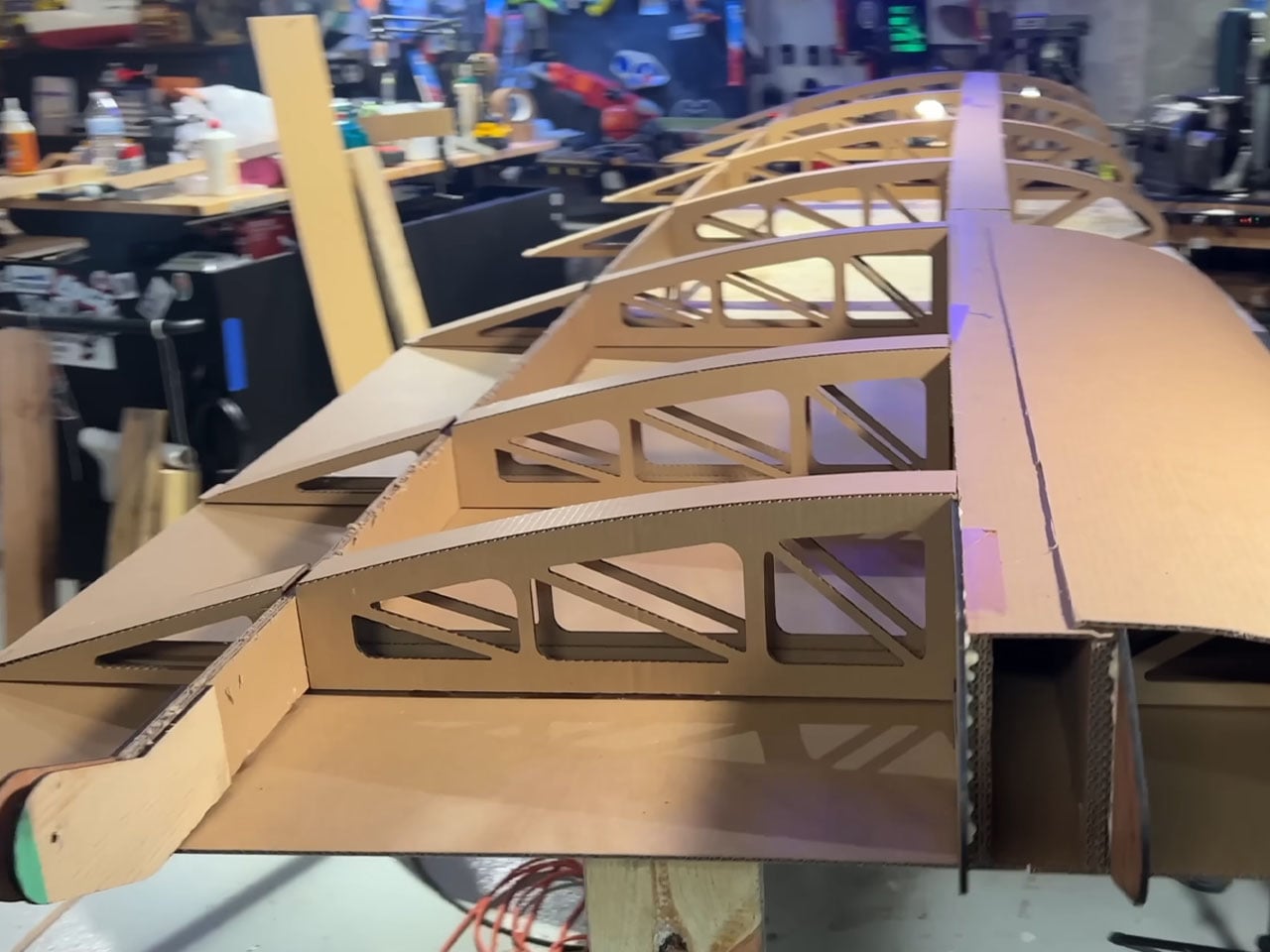
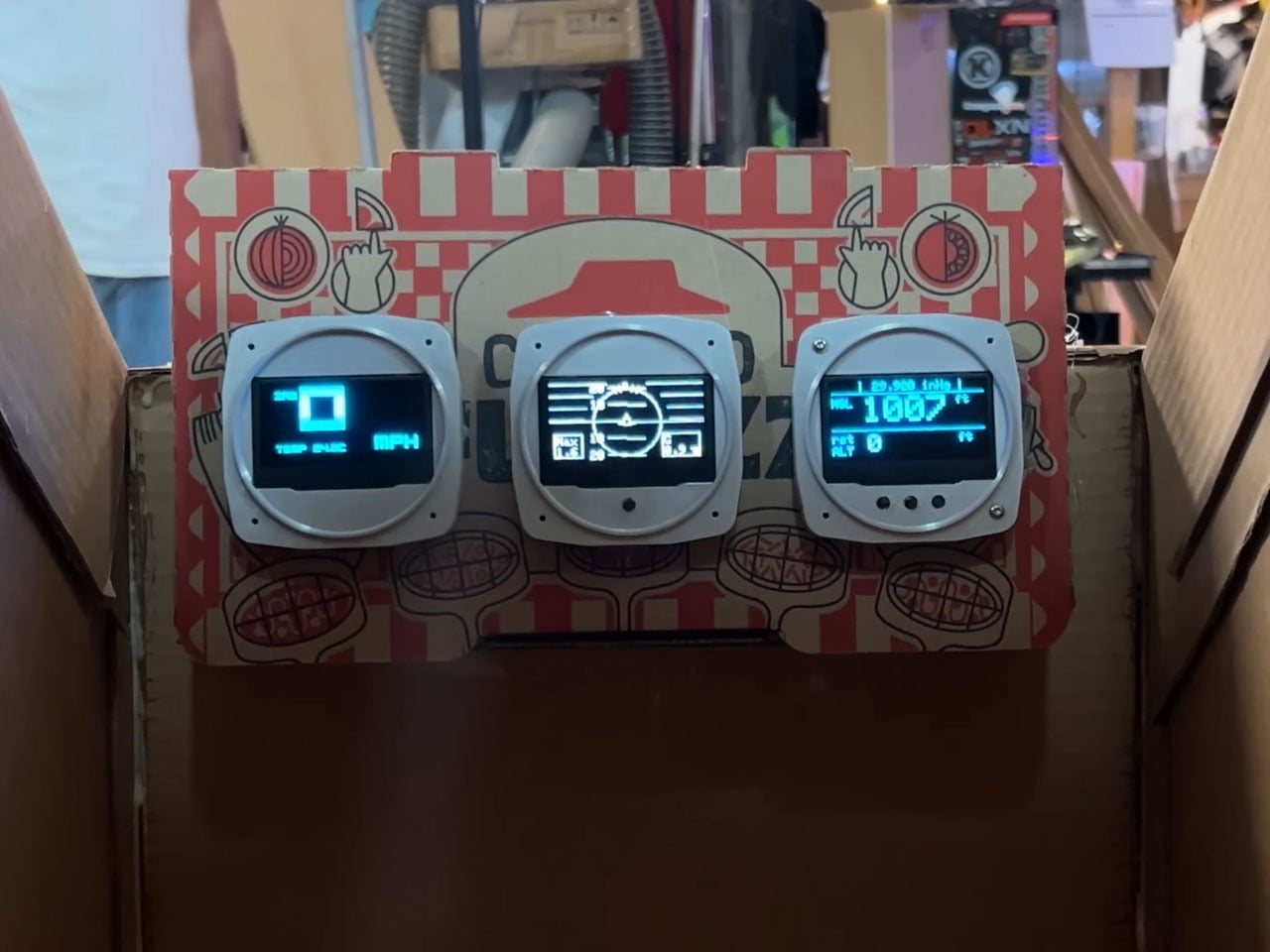
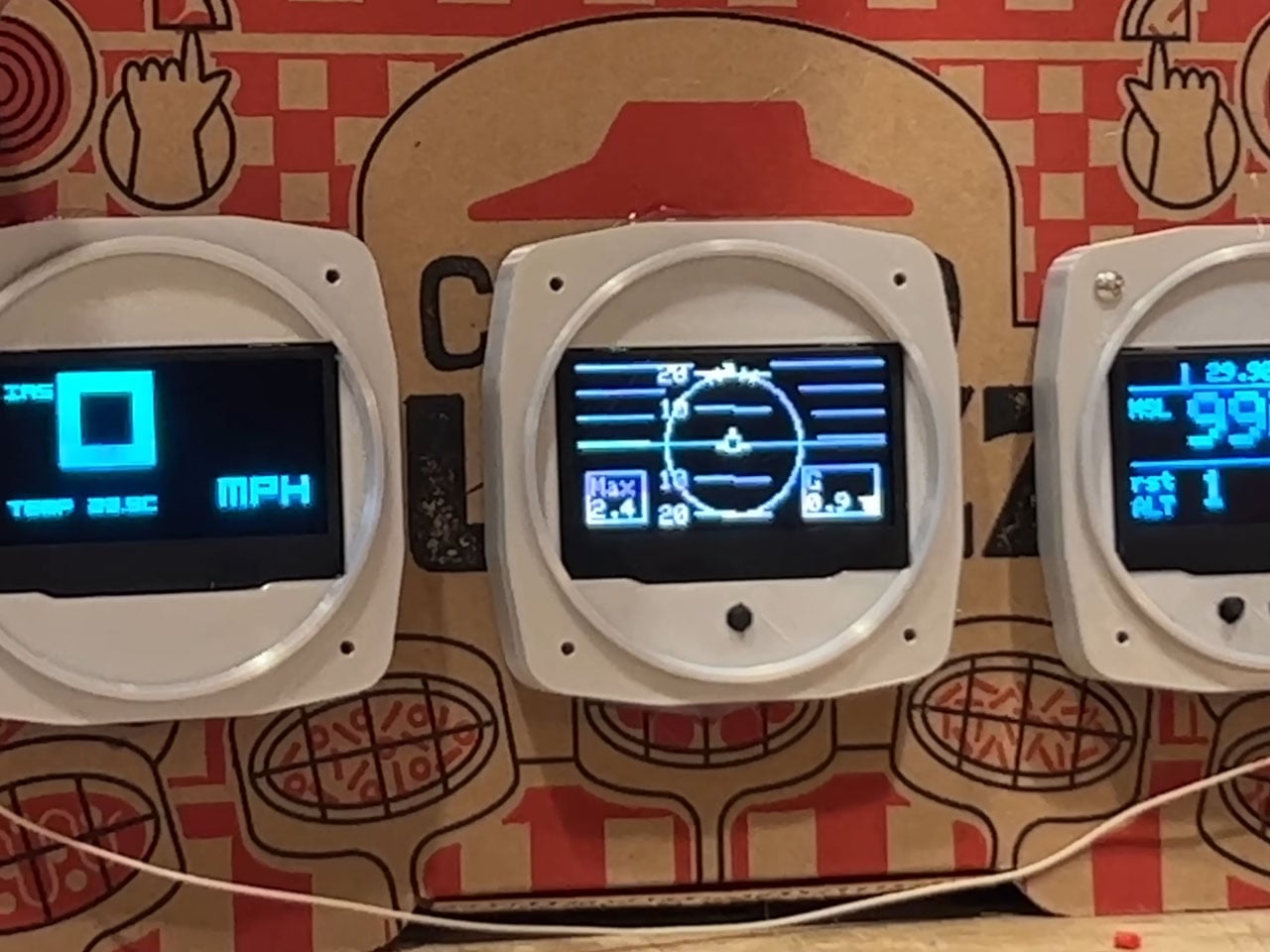
The aviation industry has come a long way since that decisive event, and it’s always good to have a similar nostalgic feel again. Peter Sripol, along with his team, has built a cardboard airplane that has plywood-structured wings (just like the Wright Brothers’ airplane) and is capable of flying one person with ease. Interestingly, the DIYer uses a Pizza box to fit in the altimeter, air speed gauge, and the attitude indicator. According to his estimation, the plane is a giant shipping box, given that it has around 95 percent cardboard parts, which in itself is a feat.

Designer: Peter Sripol

The shape of the fully assembled airplane is just like any other double-propeller plane that’s commercially produced. It is narrower on the tail end and wider near the seating section for aerodynamic efficiency. Just that it’s not as polished and fine-tuned since it is just a prototype for now. After putting together the fuselage, wings, and the custom-made wheel assembly that ejects once the thing is airborne to shed extra weight, Peter drove around the plane in taxing mode to check if all the basics are working fine. The wheels seemed to drag a little, and the batteries powering the thing were not enough for the flight speed.

After fixing the initial kinks, he managed to get off the ground a few feet, but as soon as the landing gear assembly detached, the cardboard airplane flew for a few feet and veered off course to land abruptly. Coming back to the design, the corrugated cardboard parts of the plane are glued together for structural integrity. There are small cutouts on the sides and on the front to have a clear view. The DIY project is in work, and the maker plans to install the controls on the sides and the rudder pedals on the floor. For now, Peter uses the wireless controller to actuate the inputs for the drive and flight tests. Fitting the flight controls inside is going to be touch-and-go, given that there is only one entry and exit opening on the plane from the front. The tail section has folded cardboard skins that take the shape of the stabilizers, elevator, and rudder.

The wing is the most challenging section to build, as during flight, cardboard is not the most ideal material due to its low compression tolerance, hence the small plywood plates embedded inside the wing structure. For a secure embodiment, the wings are attached to the fuselage with bolts and reinforced cardboard doublers. The electric motors for propulsion are mounted on the reinforced cardboard structure, while the batteries, speed controls, and the messy wiring are housed inside the fuselage. We’ll have to wait for a few weeks, when the next video arrives, and hopefully Peter will take flight in this DIY cardboard airplane.

The post Tech-savvy YouTuber builds a cardboard airplane with detachable landing gear first appeared on Yanko Design.

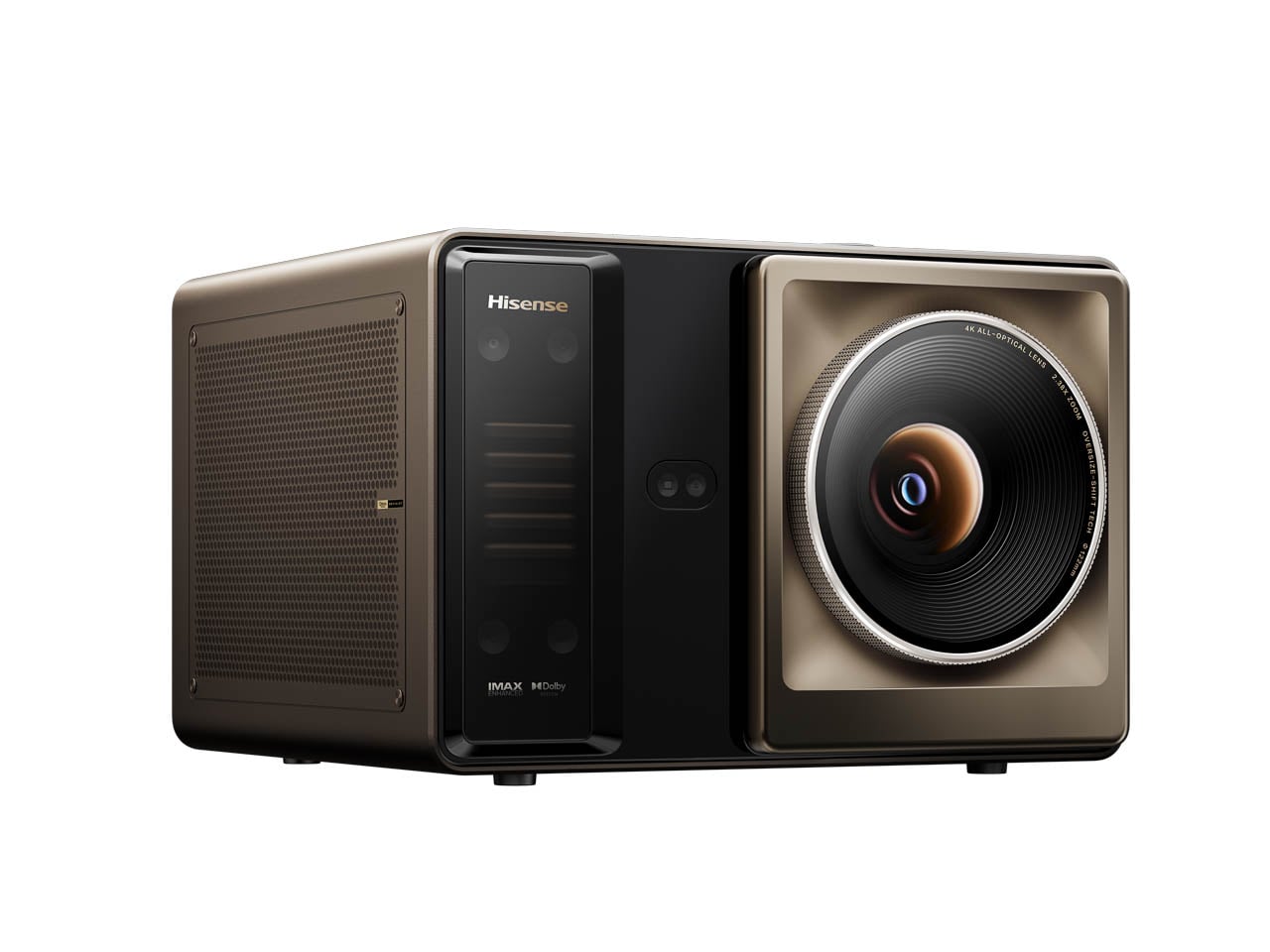
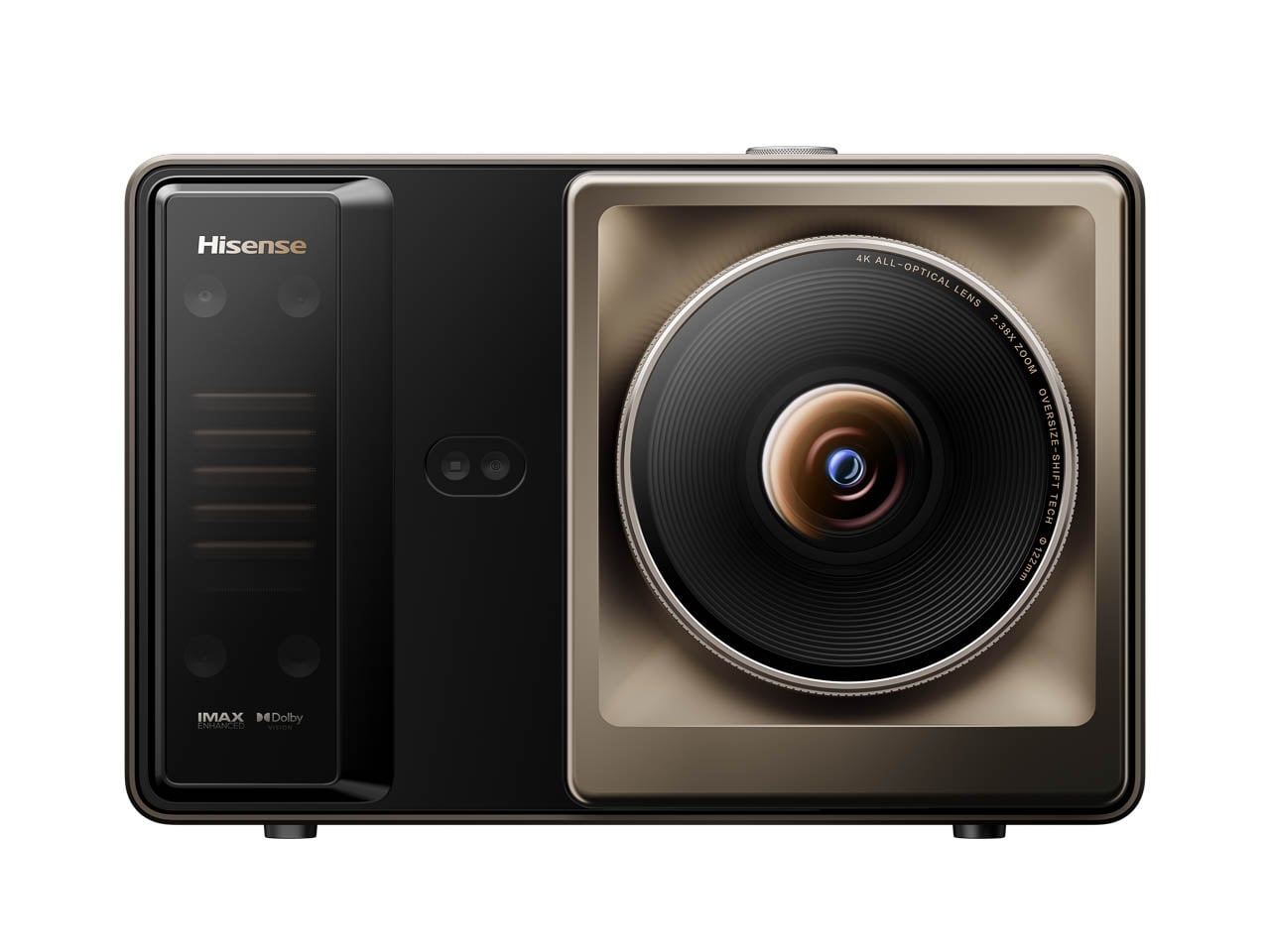
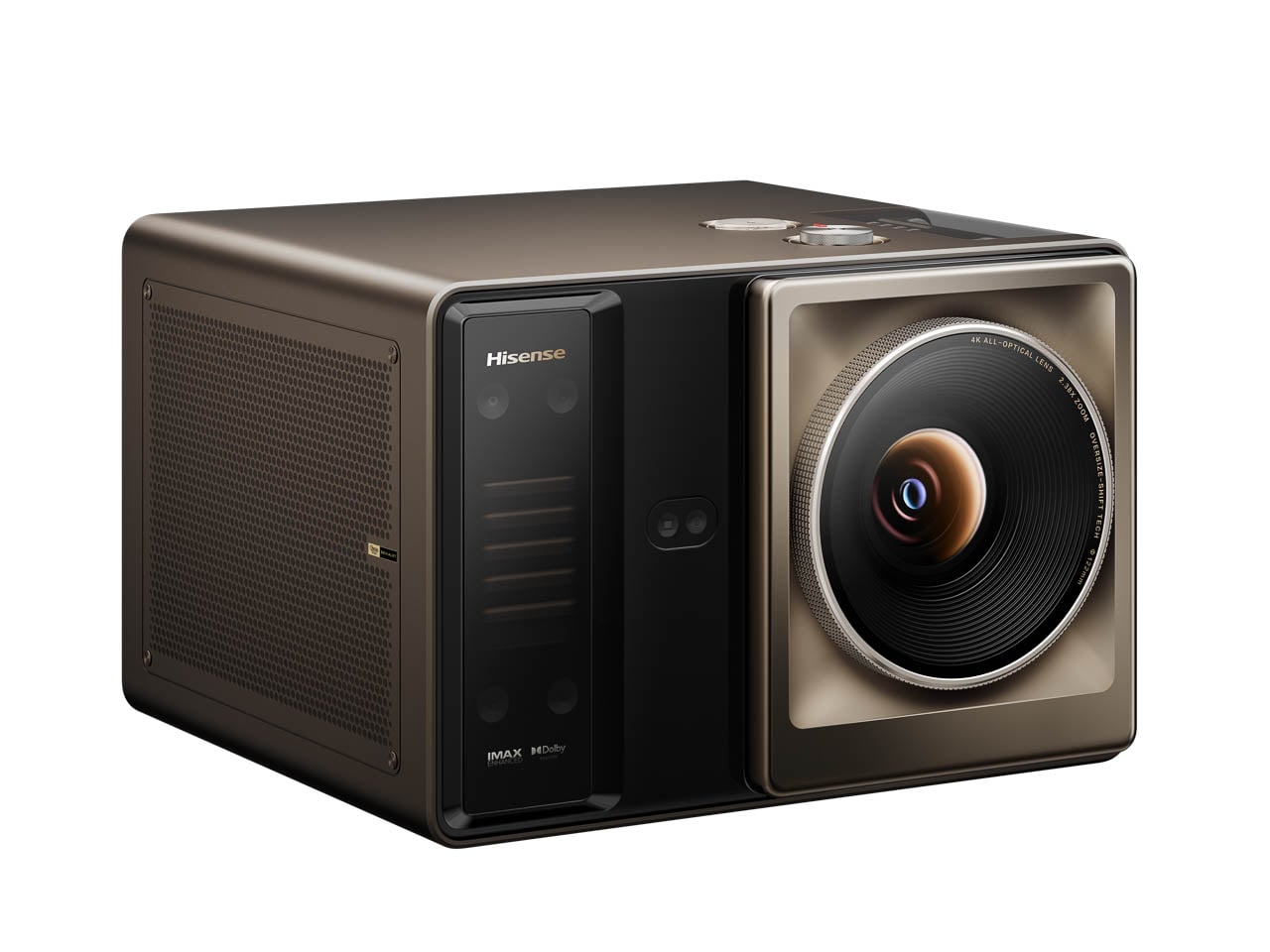
Hisense XR10 Laser Projector and the Case for Flexible Scale at CES 2026

Large-format displays have always posed a spatial question that brightness alone cannot answer: how much permanence does a room owe to its screen? The Hisense 100U8QG, reviewed earlier this year, represented one answer. At 100 diagonal inches of Mini-LED panel, it demanded architectural consideration. Wall reinforcement, viewing distance calculations, furniture subordination. The display became a fixture in the truest sense, its physical presence reshaping the room around it.

Designer: Hisense

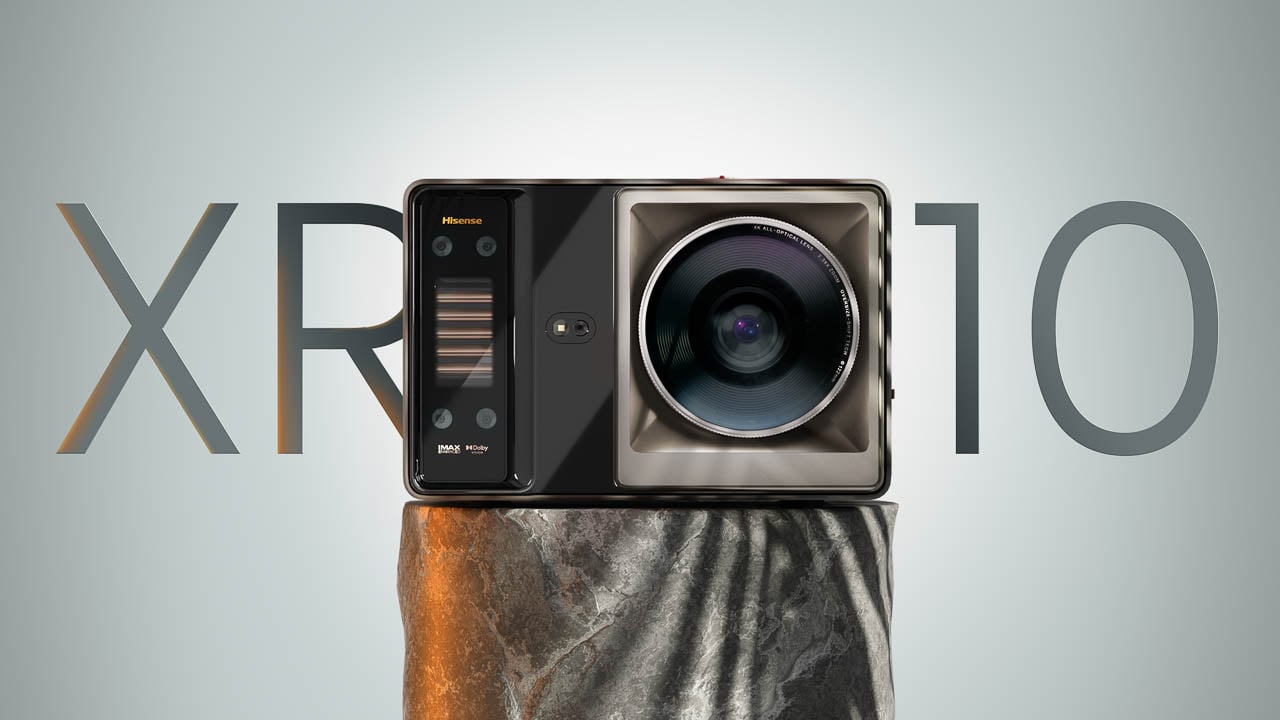
The XR10 Laser TV, unveiled ahead of CES 2026, proposes a different relationship between image and architecture. Where the 100U8QG commits, the XR10 suggests. Where fixed panels dictate, projection negotiates.

Scale Without Permanence

The fundamental distinction lies not in image quality but in spatial philosophy. A 100-inch television is a decision. Once mounted, its presence organizes the room. Seating angles become fixed. Wall treatments become irrelevant behind the panel. The display asserts dominance over its environment, requiring the space to accommodate its permanence.

Projection operates under different constraints. The XR10 can scale from 65 to 300 inches depending on throw distance and surface availability. This variability represents more than convenience. It represents a fundamentally reversible intervention. The wall remains a wall. The room retains its capacity to be something other than a viewing space. When the projector powers down, the architecture reasserts itself in ways that a mounted 100-inch panel never permits.

This reversibility carries design implications that extend beyond flexibility for its own sake. Spaces increasingly serve multiple functions. A wall that hosts a 200-inch projection in the evening might face windows in the morning, hang artwork during gatherings, or simply recede into architectural neutrality when entertainment is not the room’s purpose. Fixed ultra-large displays foreclose these possibilities. Projection preserves them.

Brightness as Spatial Liberation

The XR10’s triple-laser light engine achieves output levels that shift the traditional projector calculus. Where previous generations required environmental control, darkened rooms, managed window treatments, controlled artificial lighting, the XR10 can hold its image against ambient conditions that would have dissolved earlier projectors into washed abstraction.

This capability reframes brightness not as a specification but as a design constraint relaxed. The 100U8QG demanded nothing from its environment beyond structural support. It generated its own light, controlled its own contrast, existed independently of the room’s luminous conditions. Projection historically asked more: cooperation from windows, deference from overhead fixtures, submission from the broader lighting design.

The XR10 narrows this gap without eliminating it entirely. Ambient light remains a factor. Surface reflectivity still matters. But the threshold of environmental accommodation drops substantially. A room need not transform itself into a theater to achieve cinematic scale. The projection can coexist with the space rather than demanding its temporary transformation.

Material Presence and Absence

The physical footprint of these technologies tells its own story. The 100U8QG, despite remarkably thin bezels and careful industrial design, remains an object of substantial material presence. Its glass surface catches light. Its chassis occupies wall space whether active or dormant. The panel exists as an architectural element even when displaying nothing.

The XR10 operates on different terms. As an ultra-short-throw system, it sits near the projection surface rather than across the room, typically on furniture or a low console beneath the image. The projector itself occupies space, but that space bears no fixed relationship to the image’s scale. A 300-inch projection does not require a 300-inch object. The image and its source decouple in ways that fixed displays cannot replicate.

This decoupling creates interesting possibilities for spatial hierarchy. The 100U8QG is always the most visually dominant element in any room it inhabits. The XR10 can be subordinate, tucked below sightlines, present but not assertive. The image appears and disappears. The hardware remains modest.

The Engineering of Environmental Tolerance

Achieving brightness sufficient for ambient operation requires addressing thermal and optical challenges that compound at high output levels. The XR10 employs a sealed microchannel liquid cooling system, an approach that maintains laser stability without exposing internal optics to environmental contamination. Traditional air-cooled projectors draw dust through their optical paths over time, degrading image quality incrementally. Sealed liquid cooling preserves performance across years of operation rather than months.

The optical system centers on a 16-element all-glass lens array with dynamic aperture control. Glass elements maintain dimensional stability under thermal stress better than polymer alternatives, reducing the subtle warping that can soften images at extreme scales. The IRIS system adjusts light transmission in real time to preserve contrast across varying scene brightness, a capability that becomes more critical as ambient light levels rise.

Speckle suppression addresses the last major optical distinction between projection and panel display. The grainy texture that coherent laser light can produce against reflective surfaces has historically marked projection as visually different from emissive displays. The XR10’s suppression system reduces this artifact to the threshold of perception, bringing projected images closer to the smooth, grain-free character of LED and OLED panels.

Commitment and Its Alternatives

The choice between fixed ultra-large display and high-brightness projection ultimately reflects a stance on commitment. The 100U8QG rewards commitment. Once installed, calibrated, and integrated, it delivers consistent, environmentally independent performance. The room becomes better at being a viewing room. The display improves through permanence.

The XR10 rewards flexibility. It achieves similar or greater scale while preserving the room’s capacity for other identities. The wall can be a screen, then not a screen. The space can host cinema, then release it. The architectural intervention remains reversible in ways that panel installation does not.

Neither approach is superior in absolute terms. The design question centers on what a space is asked to become and for how long. Dedicated viewing environments favor the commitment model. Multi-use spaces, rooms with competing functions, and architectures that resist permanent visual dominance may find the projection model more sympathetic to their broader purposes.

Positioning in the Display Landscape

Hisense will demonstrate the XR10 at CES 2026, booth 17704 in Central Hall. The company has spent a decade developing laser projection technology, introducing its first laser TV in 2014 and pioneering triple-laser color architecture in 2019. The XR10 represents the current limit of that trajectory: maximum brightness, maximum scale, minimum environmental demand.

Pricing and availability remain unannounced. The competitive landscape has expanded considerably since Hisense established the ultra-short-throw category, with Samsung, LG, and numerous manufacturers offering alternatives. How the XR10 positions against both competing projectors and the fixed ultra-large panels it philosophically challenges will determine its market reception.

The more interesting question may be conceptual rather than commercial. As display technology continues pushing scale boundaries, the tension between permanence and adaptability becomes more acute. The XR10 and the 100U8QG occupy different points on that spectrum, offering different answers to the same fundamental question: what does a room owe to its screen, and what does a screen owe to its room?

The post Hisense XR10 Laser Projector and the Case for Flexible Scale at CES 2026 first appeared on Yanko Design.
The Indie Game Awards snatches back two trophies from Clair Obscur over its use of generative AI

The Indie Game Awards has stripped Clair Obscur: Expedition 33 of two major awards, including Game of the Year and Debut Game. This is due to developer Sandfall Interactive's use of generative AI, as reported by Mashable.

This looks to be fairly cut and dry. The awards ceremony clearly states in its FAQ that any game that uses generative AI in the development process would be "strictly ineligible" for nominations. It was recently revealed that Sandfall did indeed use generative AI while making Clair Obscur.

The company says it was only for placeholder textures that were later removed, but a few squeezed past the QA process and made their way to the final game and, as such, the internet. The Indie Game Awards is clear about disallowing any use of generative AI and, so, here we are.

"In light of Sandfall Interactive confirming the use of gen AI art in production on the day of the Indie Game Awards 2025 premiere, this does disqualify Clair Obscur: Expedition 33 from its nomination," the organization wrote. "While the assets in question were patched out and it is a wonderful game, it does go against the regulations we have in place."

Six One Indie, the company behind the ceremony, deserves a smidge of the blame here. These awards were initially handed out last week and we've known about the whole Clair Obscur AI thing for months. It says it didn't discover Sandfall's use of AI until December 18, the day the winners were announced. A Google search on December 17 likely would've helped. It is worth noting, however, that Sandfall did previously agree that no generative AI was used during development as part of the submission process. 

In any event, the second-highest scoring titles in each category now gets the award. This means that Blue Prince is now Game of the Year and Sorry We're Closed snags Debut Game.

Despite this AI controversy, Clair Obscur had a record-setting night at this month's The Game Awards. It won just about everything it was put up for, including Game of the Year. It also made our list of the best games of 2025. The developer announced that it had sold 5 million copies back in October. That number is surely much higher by now.

This article originally appeared on Engadget at https://www.engadget.com/gaming/the-indie-game-awards-snatches-back-two-trophies-from-clair-obscur-over-its-use-of-generative-ai-164730842.html?src=rss

Uber allows violent felons to drive on its platform, investigation finds

An investigation by the New York Times into Uber's background checks and safety procedures for its drivers found a patchwork approach that opens the door for violent felons to drive for the ride-hailing platform.

Uber outright rejects applicants convicted of murder, sexual assault, kidnapping and terrorism. However, in 22 states, the Times found Uber can approve applicants convicted of many other offenses including child abuse, assault and stalking, if the convictions are at least seven years old. The extensive investigation also found that in 35 states, these checks are based largely on where someone has lived in those seven years, meaning convictions from other locations could be missed.

In 2017, Massachusetts conducted an audit of ride-hailing drivers in the state and ended up banning more than 8,000 drivers (about 11 percent) who were previously approved. Lyft, for its part, does not allow drivers with previous violent felony convictions regardless of how long ago the conviction was.

In a document from 2015 reviewed by the Times, Uber executives discussed a strategy to "shift the conversation about safety from background checks to [less costly] initiatives proven to reduce incidents." A 2018 email from Uber’s then head of safety communications described the company's background check policy as "a bare minimum."

The Times compiled half a dozen examples of serious cases where Uber drivers with past violent convictions were later accused by passengers of sexual assault or rape. Two of those cases resulted in criminal convictions.

Between 2017 and 2022, Uber's US operations received a report of sexual assault or sexual misconduct among almost every eight minutes, according to the company's own internal data. Uber said 75 percent of these reports were for "less serious" incidents such as flirting or making comments about a rider's appearance, and claimed that 99.9 percent of its rides take place without incident.

This article originally appeared on Engadget at https://www.engadget.com/big-tech/uber-allows-violent-felons-to-drive-on-its-platform-investigation-finds-162721155.html?src=rss

Apple Just Leaked the M4 iPad Air in Their Own Code

Apple Just Leaked the M4 iPad Air in Their Own Code

A recent discovery in Apple’s internal code has confirmed the development of the M4 iPad Air, marking the next step in Apple’s mid-range tablet lineup. Expected to launch in early 2026, this device will feature incremental upgrades, including the M4 chip and enhanced connectivity options. However, significant design overhauls and advanced features, such as OLED […]

The post Apple Just Leaked the M4 iPad Air in Their Own Code appeared first on Geeky Gadgets.

Posted in Uncategorized

Smart Fixes & Teamwork That Saved the ISS Mission Timeline

Smart Fixes & Teamwork That Saved the ISS Mission Timeline

What happens when the most ambitious engineering project in human history faces a crisis that threatens its very existence? The International Space Station (ISS), a marvel of global collaboration and scientific ingenuity, found itself at such a crossroads in 2003 after the tragic Columbia disaster. Below, Real Engineering breaks down how this catastrophic event grounded […]

The post Smart Fixes & Teamwork That Saved the ISS Mission Timeline appeared first on Geeky Gadgets.

Posted in Uncategorized