The best cheap phones for 2026

A few years ago, it may have been fashionable to spend $1,000 on the latest flagship smartphone, but for most people, that’s neither practical nor necessary. You don't even have to spend $500 today to get a decent handset, whether it’s a refurbished iPhone or an affordable Android phone, as there are plenty of decent options as low as $160.

However, navigating the budget phone market can be tricky; options that look good on paper may not be in practice, and some devices will end up costing you more when you consider many come with restrictive storage. While we spend most of our time reviewing mid- to high-end handsets at Engadget, we've tested a number of the latest budget-friendly phones on the market to see cut it as the best cheap phones you can get right now.

For this guide, our top picks cost between $100 and $300. Anything less and you might as well go buy a dumb phone instead. Since they’re meant to be more affordable than flagship phones and even midrange handsets, budget smartphones involve compromises; the cheaper a device, the lower your expectations around specs, performance and experience should be. For that reason, the best advice I can give is to spend as much as you can afford. In this price range, even $50 or $100 more can get you a dramatically better product.

Second, you should know what you want most from a phone. When buying a budget smartphone, you may need to sacrifice a decent main camera for long battery life, or trade a high-resolution display for a faster CPU. That’s just what comes with the territory, but knowing your priorities will make it easier to find the right phone.

It’s also worth noting some features can be hard to find on cheaper handsets. For instance, you won’t need to search far for a device with all-day battery life — but if you want a phone with excellent camera quality, you’re better off shelling out for one of the recommendations in our midrange smartphone guide, which all come in at $600 or less.

Wireless charging and waterproofing also aren’t easy to find in this price range and forget about the fastest chipset. On the bright side, most of our recommendations come with headphone jacks, so you won’t need to buy wireless headphones.

iOS is also off the table, since, following the discontinuation of the iPhone SE, the $599 iPhone 16e is now the most affordable offering from Apple. That leaves Android as the only option in the under-$300 price range. Thankfully today, there’s little to complain about Google’s operating system – and you may even prefer it to iOS.

Lastly, keep in mind most Android manufacturers typically offer far less robust software features and support for their budget devices. In some cases, your new phone may only receive one major software update and a year or two of security patches beyond that. That applies to the OnePlus and Motorola recommendations on our list.

If you’d like to keep your phone for as long as possible, Samsung has the best software policy of any Android manufacturer in the budget space, offering at least four years of security updates on all of its devices. Recently, it even began offering six years of support on the $200 A16 5G, which we recommend below. That said, if software support (or device longevity overall) is your main focus, consider spending a bit more on the $500 Google Pixel 9a, or even the previous-gen Pixel 8a, which has planned software updates through mid-2031.

This article originally appeared on Engadget at https://www.engadget.com/mobile/smartphones/best-cheap-phones-130017793.html?src=rss
The best cheap phones for 2026

A few years ago, it may have been fashionable to spend $1,000 on the latest flagship smartphone, but for most people, that’s neither practical nor necessary. You don't even have to spend $500 today to get a decent handset, whether it’s a refurbished iPhone or an affordable Android phone, as there are plenty of decent options as low as $160.

However, navigating the budget phone market can be tricky; options that look good on paper may not be in practice, and some devices will end up costing you more when you consider many come with restrictive storage. While we spend most of our time reviewing mid- to high-end handsets at Engadget, we've tested a number of the latest budget-friendly phones on the market to see cut it as the best cheap phones you can get right now.

For this guide, our top picks cost between $100 and $300. Anything less and you might as well go buy a dumb phone instead. Since they’re meant to be more affordable than flagship phones and even midrange handsets, budget smartphones involve compromises; the cheaper a device, the lower your expectations around specs, performance and experience should be. For that reason, the best advice I can give is to spend as much as you can afford. In this price range, even $50 or $100 more can get you a dramatically better product.

Second, you should know what you want most from a phone. When buying a budget smartphone, you may need to sacrifice a decent main camera for long battery life, or trade a high-resolution display for a faster CPU. That’s just what comes with the territory, but knowing your priorities will make it easier to find the right phone.

It’s also worth noting some features can be hard to find on cheaper handsets. For instance, you won’t need to search far for a device with all-day battery life — but if you want a phone with excellent camera quality, you’re better off shelling out for one of the recommendations in our midrange smartphone guide, which all come in at $600 or less.

Wireless charging and waterproofing also aren’t easy to find in this price range and forget about the fastest chipset. On the bright side, most of our recommendations come with headphone jacks, so you won’t need to buy wireless headphones.

iOS is also off the table, since, following the discontinuation of the iPhone SE, the $599 iPhone 16e is now the most affordable offering from Apple. That leaves Android as the only option in the under-$300 price range. Thankfully today, there’s little to complain about Google’s operating system – and you may even prefer it to iOS.

Lastly, keep in mind most Android manufacturers typically offer far less robust software features and support for their budget devices. In some cases, your new phone may only receive one major software update and a year or two of security patches beyond that. That applies to the OnePlus and Motorola recommendations on our list.

If you’d like to keep your phone for as long as possible, Samsung has the best software policy of any Android manufacturer in the budget space, offering at least four years of security updates on all of its devices. Recently, it even began offering six years of support on the $200 A16 5G, which we recommend below. That said, if software support (or device longevity overall) is your main focus, consider spending a bit more on the $500 Google Pixel 9a, or even the previous-gen Pixel 8a, which has planned software updates through mid-2031.

This article originally appeared on Engadget at https://www.engadget.com/mobile/smartphones/best-cheap-phones-130017793.html?src=rss

Is macOS 26.3 Safe to Install? Everything You Need to Know Before Updating

Is macOS 26.3 Safe to Install? Everything You Need to Know Before Updating Overview of macOS 26.3 Tahoe update features and improvements

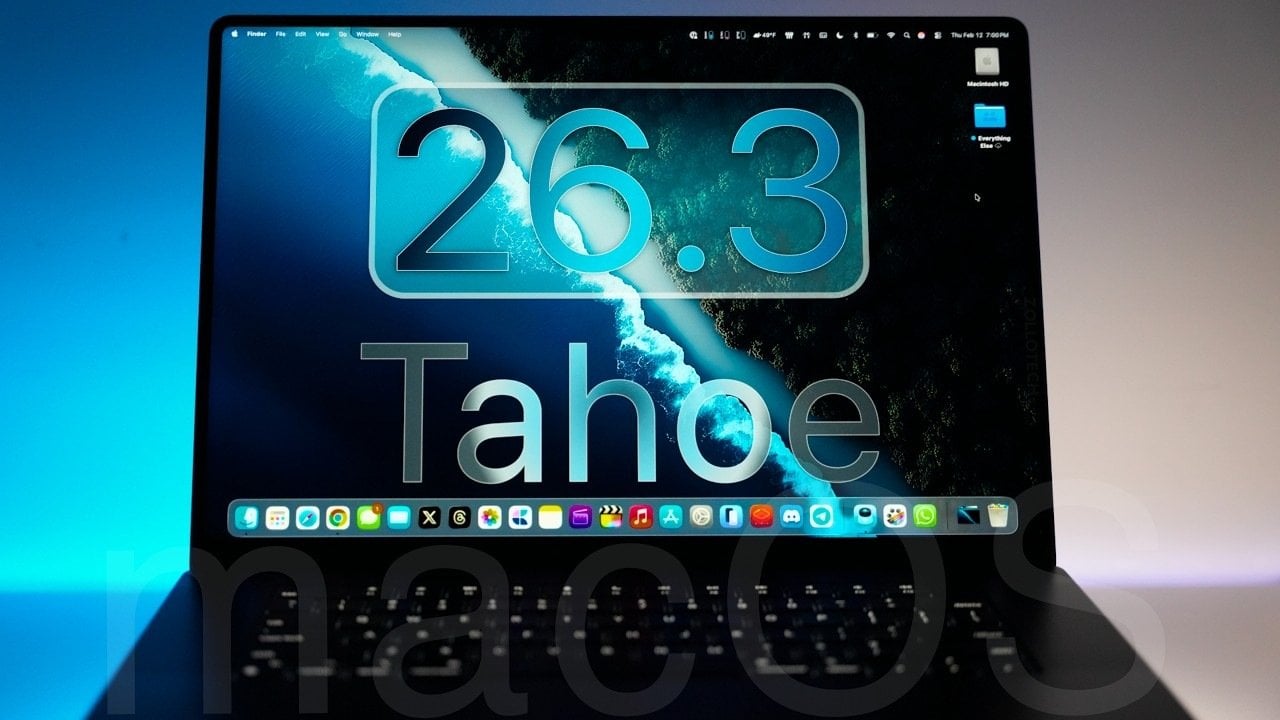
Apple has officially released macOS 26.3 Tahoe, a significant update aimed at improving system reliability, security, and overall performance. While it does not introduce major new features, it focuses on resolving critical issues and refining the user experience. If your device is compatible with macOS 26, installing this update is highly recommended to ensure your […]

The post Is macOS 26.3 Safe to Install? Everything You Need to Know Before Updating appeared first on Geeky Gadgets.

Posted in Uncategorized

Is macOS 26.3 Safe to Install? Everything You Need to Know Before Updating

Is macOS 26.3 Safe to Install? Everything You Need to Know Before Updating Overview of macOS 26.3 Tahoe update features and improvements

Apple has officially released macOS 26.3 Tahoe, a significant update aimed at improving system reliability, security, and overall performance. While it does not introduce major new features, it focuses on resolving critical issues and refining the user experience. If your device is compatible with macOS 26, installing this update is highly recommended to ensure your […]

The post Is macOS 26.3 Safe to Install? Everything You Need to Know Before Updating appeared first on Geeky Gadgets.

Posted in Uncategorized

Should You Switch? iPhone vs Android for Business and Productivity in 2026

Should You Switch? iPhone vs Android for Business and Productivity in 2026 Comparison of iPhone and Android smartphones in 2026

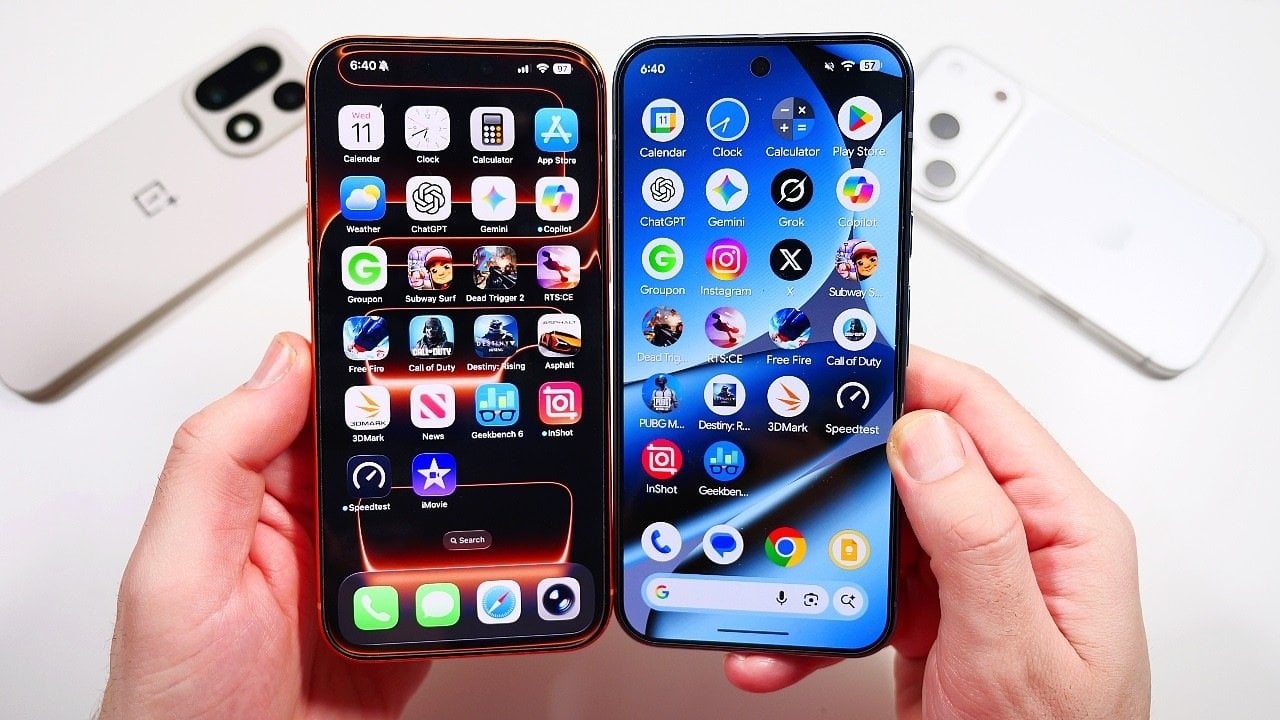
The smartphone market in 2026 remains a dynamic arena, with iPhones and Android devices competing fiercely for consumer attention. While iPhones continue to uphold their reputation for premium quality and brand prestige, Android devices have made significant strides in innovation, affordability, and performance. The video below from Nick Ackerman provides more insights into the key […]

The post Should You Switch? iPhone vs Android for Business and Productivity in 2026 appeared first on Geeky Gadgets.

Posted in Uncategorized

Should You Switch? iPhone vs Android for Business and Productivity in 2026

Should You Switch? iPhone vs Android for Business and Productivity in 2026 Comparison of iPhone and Android smartphones in 2026

The smartphone market in 2026 remains a dynamic arena, with iPhones and Android devices competing fiercely for consumer attention. While iPhones continue to uphold their reputation for premium quality and brand prestige, Android devices have made significant strides in innovation, affordability, and performance. The video below from Nick Ackerman provides more insights into the key […]

The post Should You Switch? iPhone vs Android for Business and Productivity in 2026 appeared first on Geeky Gadgets.

Posted in Uncategorized

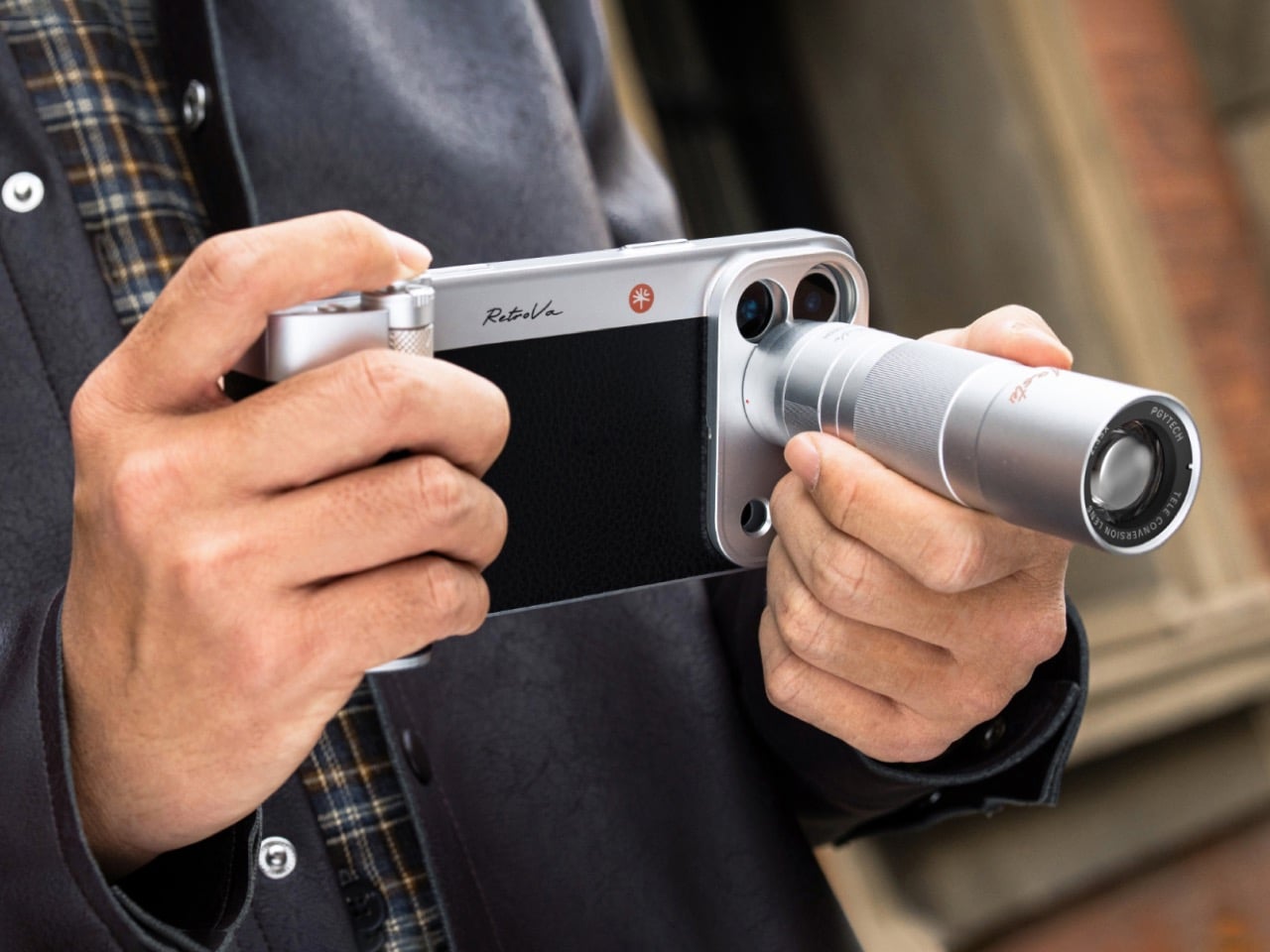
The “Shot On iPhone” Lifehack: This 235mm Telephoto Case Packs Manual Controls + MicroSD Storage

Every time you see “Shot on iPhone” superimposed over a stunning image, ask yourself what’s just outside the frame. Chances are good there’s a telephoto adapter screwed onto the phone, a stabilizing rig keeping it steady, professional lighting bouncing off reflectors, and maybe even an external monitor for the director to watch. Apple loves to showcase the iPhone’s camera prowess, but conveniently omits the ecosystem of professional gear that makes those shots possible. The phone is capable, sure, but it’s getting significant help from its friends.

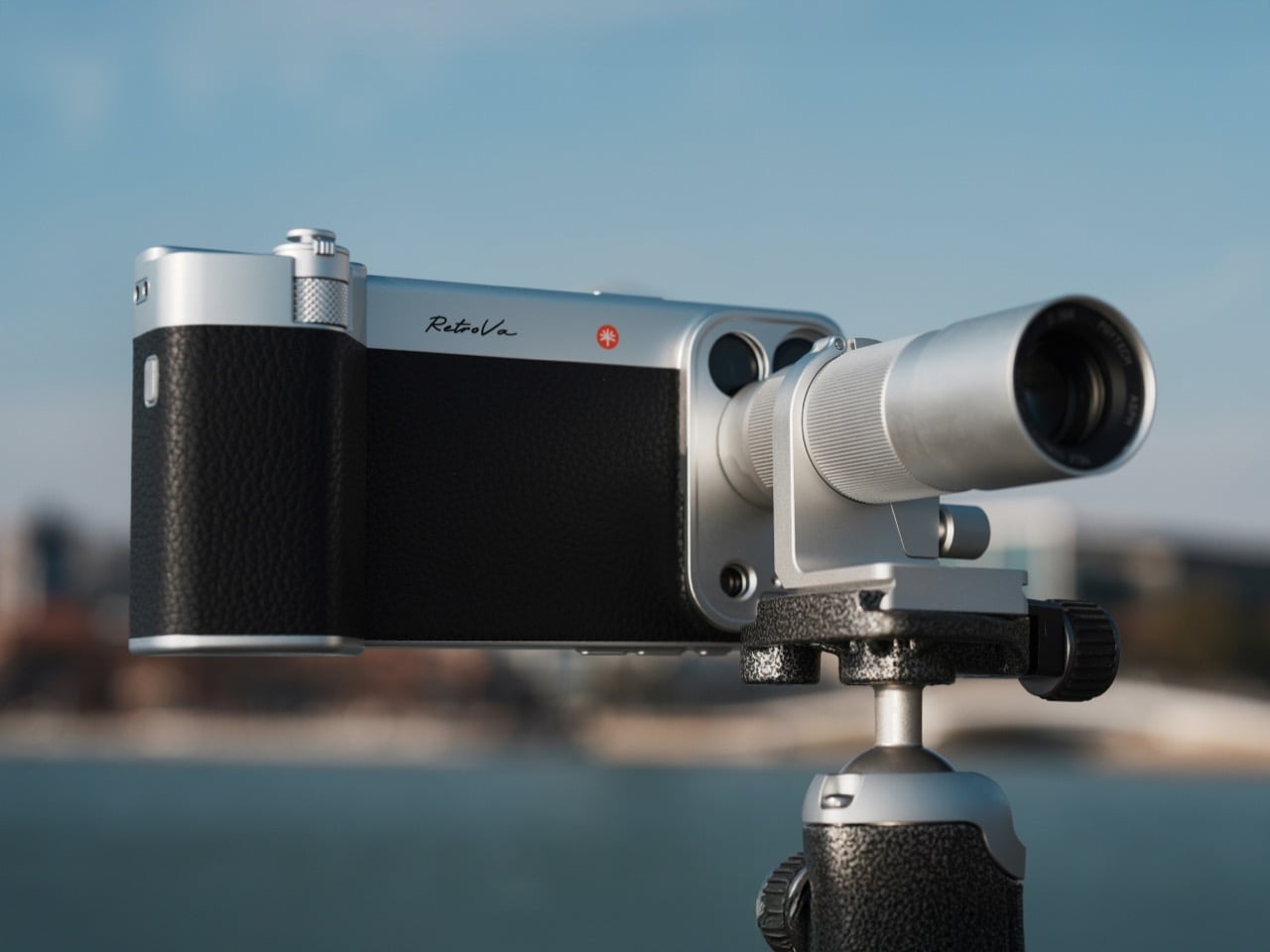
That’s exactly the gap PGYTECH’s RetroVa Vintage Imaging Kit fills, except it doesn’t hide what it’s doing. The system gives your iPhone 16 or 17 Pro a camera-inspired grip with actual tactile controls, a 13-element optical telephoto system that brings you to 235mm equivalent focal length, external storage support via microSD, and a companion app that offers film-style rendering straight out of camera. Sandmarc and Moment have been in the iPhone lens game for years, but RetroVa takes a more holistic approach by addressing not just optics, but the entire shooting experience.

Designer: PGYTECH

Click Here to Buy Now: $72 $89.95 (20% off) Hurry! Only 192 left of 300. Raised over $157,000

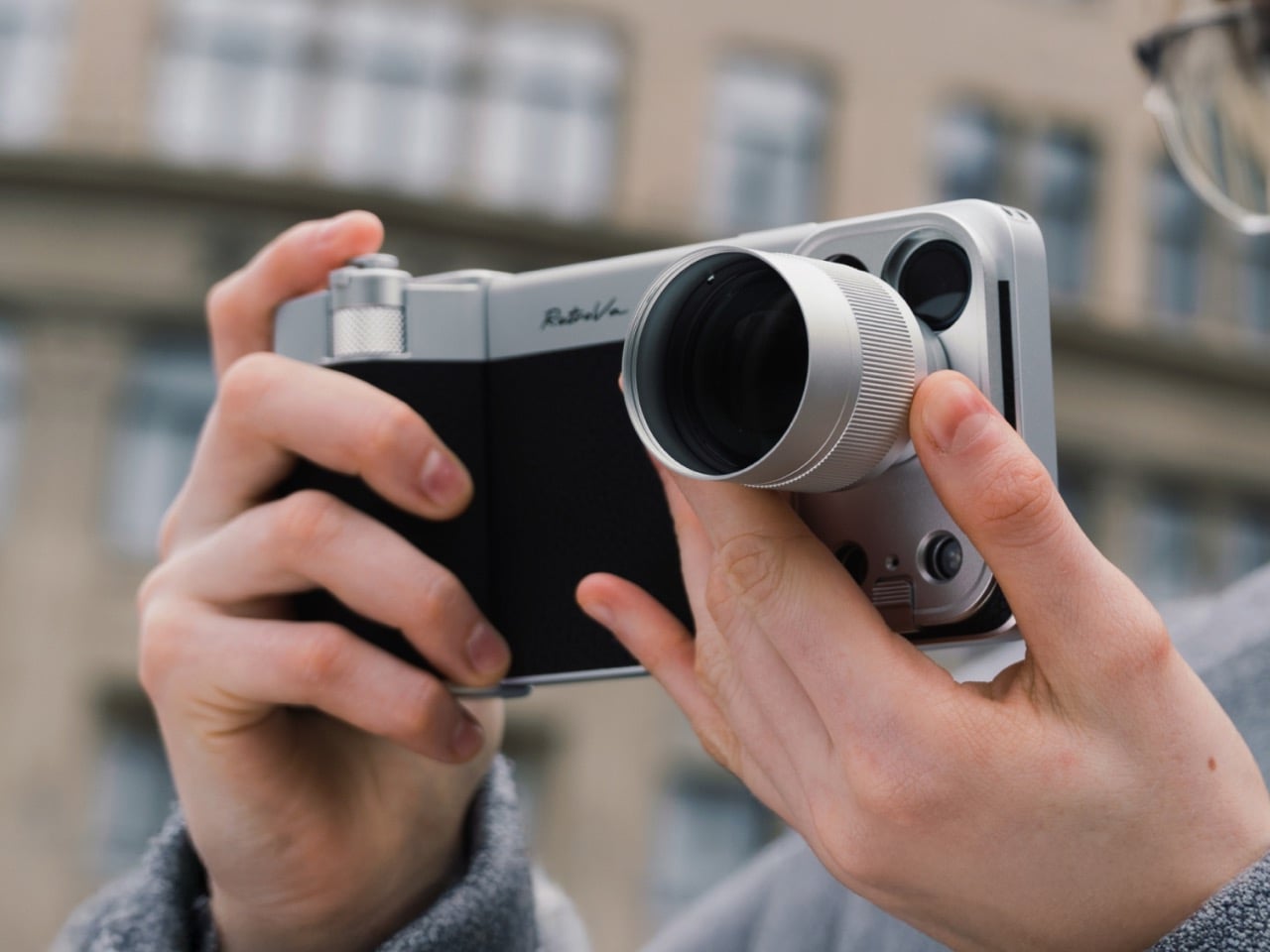
PGYTECH have played this game before. They’re the same company that builds the telephoto extenders for Vivo and Oppo’s flagship phones in China, smartphones that rank second and third in that market behind Apple. The 2.35X telephoto uses a professional 13-element, 3-group optical system crafted from premium ED glass, optimized specifically for the iPhone’s F2.8 aperture. Distortion sits at just 2%, which is impressive for a clip-on system. The optical design delivers razor-sharp clarity and organic bokeh without the digital noise that comes from cranking up your phone’s native zoom. Real glass doing real optical work makes a difference you can see in the final image, especially when you’re shooting wildlife, concerts, or anything else where you need serious reach without turning your photo into a pixelated mess.

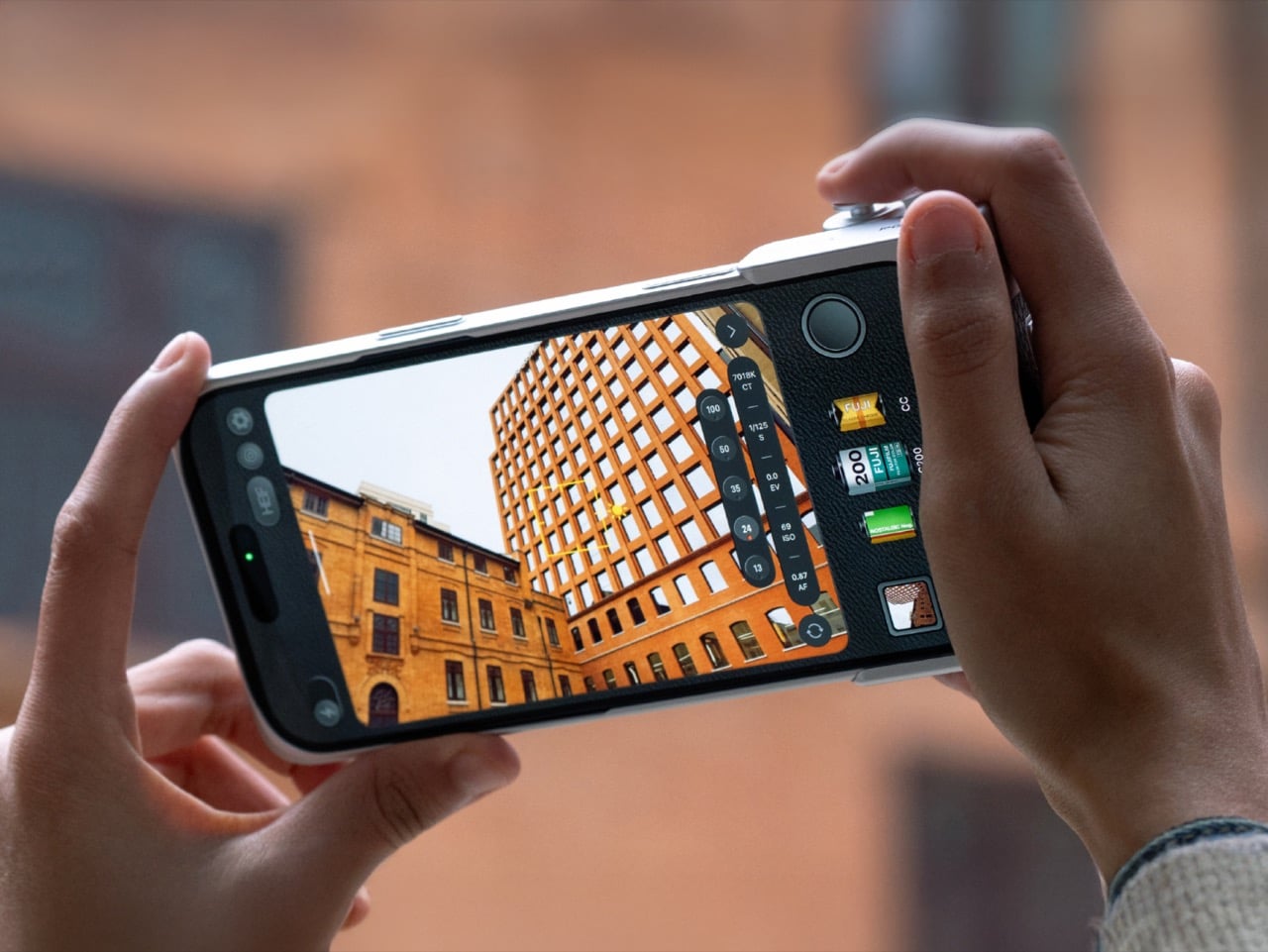
The grip changes everything about how you hold and shoot with your iPhone… way more than the ‘Camera Control’ does. Physical buttons include a shutter release that half-presses to focus, just like a real camera. Control dials let you adjust ISO, white balance, and exposure value without tapping through menus on a touchscreen. A zoom lever switches focal lengths in the companion app’s vintage mode, letting you freely adjust zoom in standard shooting. There’s a multi-function button that handles power, quick start, mode switching, camera flips, and Bluetooth pairing. The whole thing weighs between 63 and 65.4 grams depending on your iPhone model, wrapped in classic black pebbled leather with a premium grip that feels like you’re holding a vintage Leica instead of a slab of glass and aluminum.

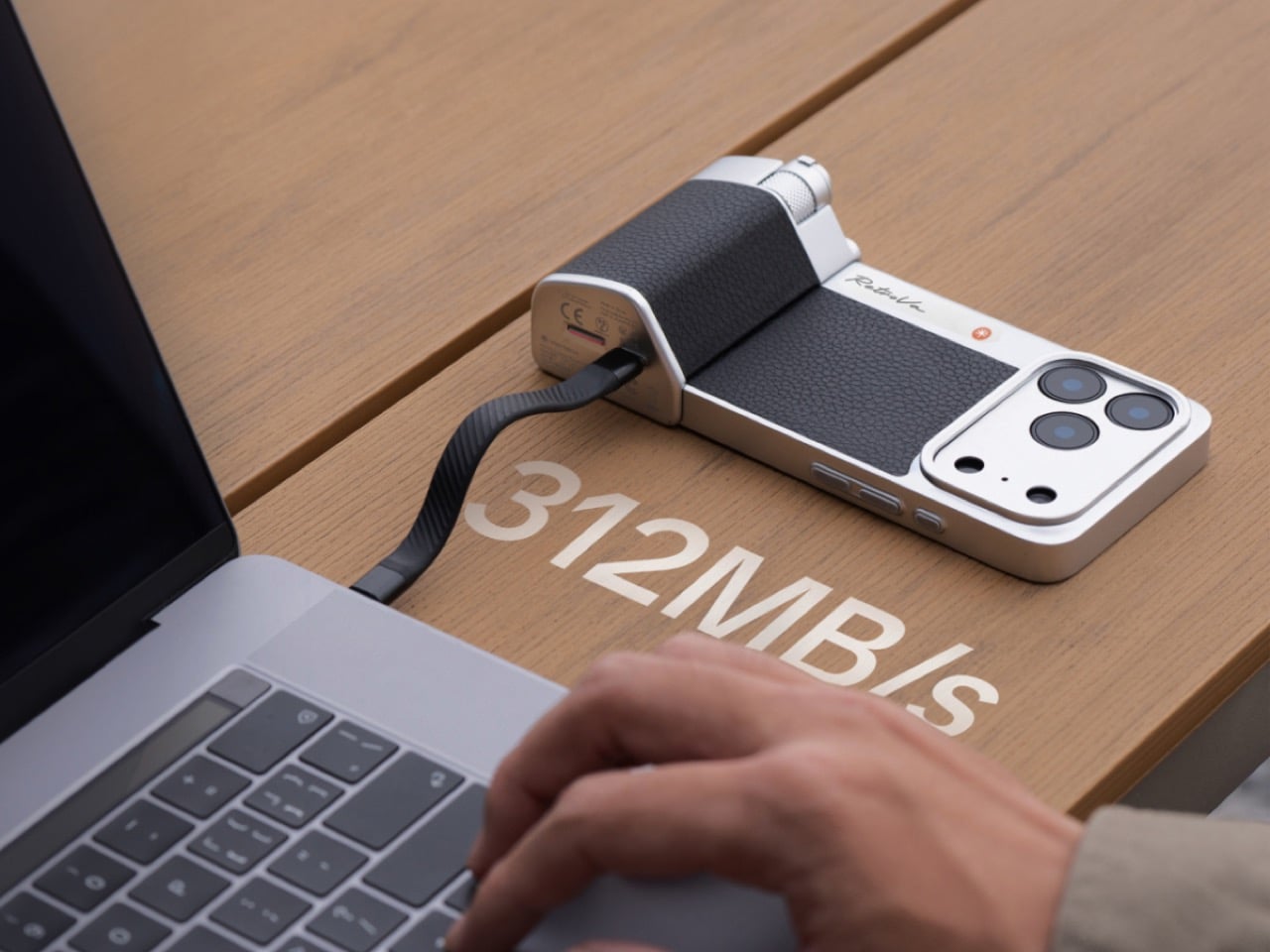
The grip also packs a built-in microSD slot to offset any storage woes you’d have from saving everything to your iPhone’s camera roll. Imagine this – you’re shooting 4K ProRes video and suddenly your phone throws up a “Storage Almost Full” warning, forcing you to stop everything and start deleting apps or old photos. An independent microSD slot avoids this problem entirely. You can record high-bitrate ProRes and RAW files directly to the card, completely bypassing your iPhone’s internal storage. The USB 3.1 connectivity delivers transfer speeds up to 312MB/s, so offloading footage to your tablet or computer takes seconds instead of the eternity you spend waiting for wireless transfers or slow card readers. The system supports external recording for ProRes, HEVC, and more formats, though 4K60+ ProRes external recording isn’t supported yet.

RetroVa’s companion app delivers film camera texture and mood straight out of the sensor. You get full manual control over shutter speed, ISO, and white balance, creating with the precision of a dedicated camera. The app suppresses iPhone’s built-in sharpening and algorithm processing for a more natural look, avoiding those over-sharpened phone images that scream “shot on smartphone.” You can stamp shots with instant-style watermarks and custom frames for each creation, adding your personal mark before the image even leaves the camera. Vintage film presets give you that classic camera aesthetic without needing to run everything through post-processing filters later.

PGYTECH offers the RetroVa in two distinct tiers to cover different photography styles. The Grip Kit runs $72 for street and everyday shooters who want mechanical controls and external recording support. The Ultimate Kit at $184 adds the 2.35X telephoto extender, tripod collar, lens adapter ring, photography strap, and lens pouch, building a complete creator ecosystem for street, travel, portraits, and long-distance photography. Both kits work with iPhone 16 Pro, 16 Pro Max, 17 Pro, and 17 Pro Max. First units ship globally starting this month, with future iPhone 18 Pro compatibility requiring only a case swap while the grip continues working.

Click Here to Buy Now: $72 $89.95 (20% off) Hurry! Only 192 left of 300. Raised over $157,000

The post The “Shot On iPhone” Lifehack: This 235mm Telephoto Case Packs Manual Controls + MicroSD Storage first appeared on Yanko Design.

The Mile-High Tower That Grows Food, Harvests Clouds, and Heals Chicago

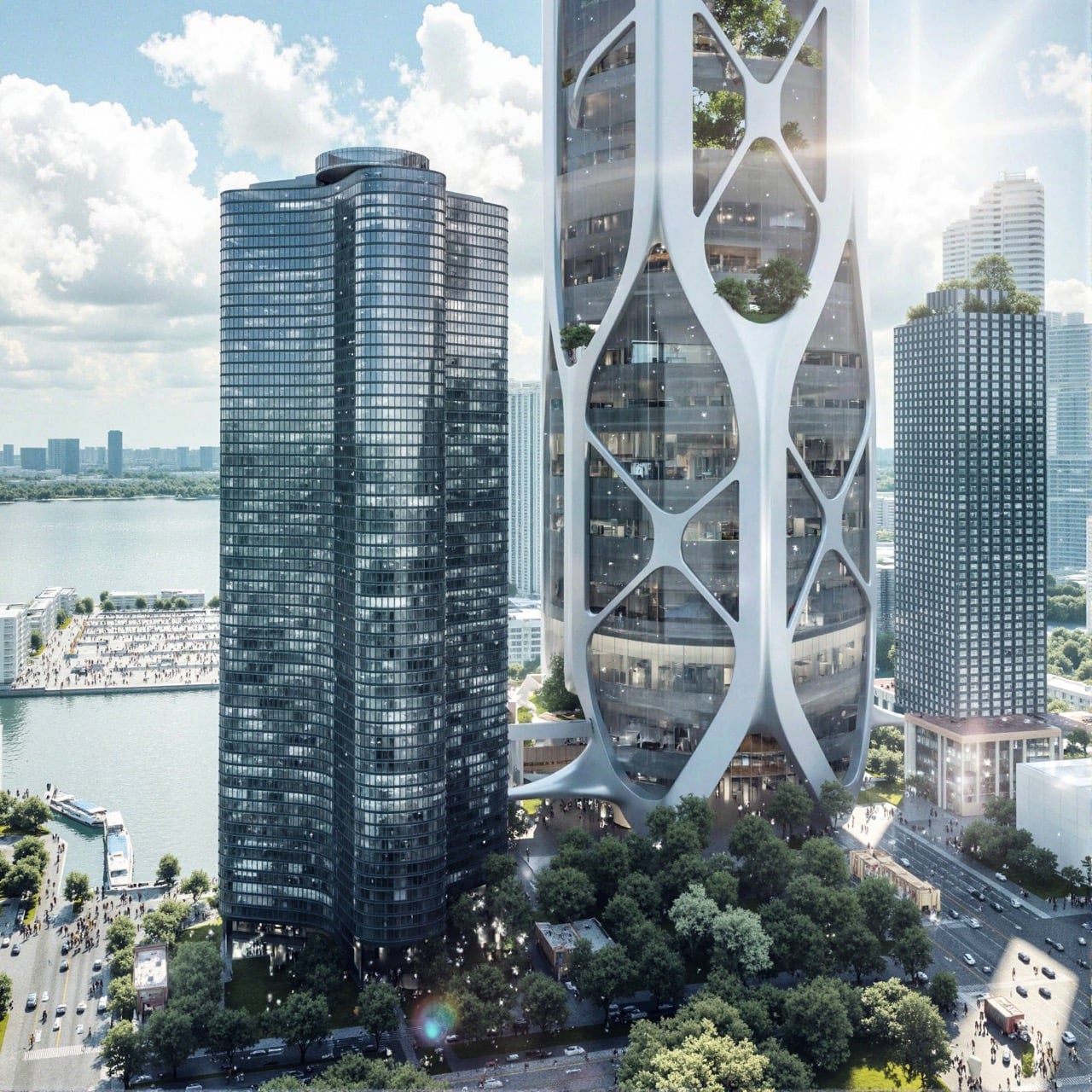
Imagine looking up at a city skyline and knowing that inside those towers, food is growing, water is being harvested from clouds, and entire communities are thriving in harmony with nature. The Eden Rise Vertical Eco Living Community is not just a building proposal. It is a bold reimagining of what a city can be when architecture becomes an ecosystem rather than an object.

The project tackles one of Chicago’s most urgent urban challenges: food deserts. In many neighborhoods, especially low-income ones, access to fresh and nutritious food is limited. Grocery stores are scarce, healthy options are expensive, and residents often rely on convenience stores or fast food. Eden Rise flips this reality by embedding vertical farms directly into a mile-high tower, allowing fresh produce to be grown where people live. Food no longer travels miles to reach a plate. It moves floors.

Designer: Yuhan Zhang and Dreama Simeng Lin

The tower’s design is as poetic as its purpose. Inspired by the fluid form of a water droplet, its organic silhouette reflects Chicago’s relationship with water while symbolizing life, renewal, and sustainability. This fusion of natural inspiration and urban ambition transforms the structure into a vertical extension of the city’s green belt, suggesting a future where skylines are defined not just by height but by ecological intelligence.

Inside, Eden Rise functions like a city stacked vertically. Homes sit alongside offices, hotels, schools, and recreational spaces, creating a complete lifestyle environment within a single structure. Residents can wake up, work, learn, relax, and socialize without ever needing to commute across town. Schools integrated throughout the tower ensure education is woven into everyday life, while hotels welcome visitors to experience this futuristic ecosystem from panoramic heights. It is urban life condensed, connected, and reimagined.

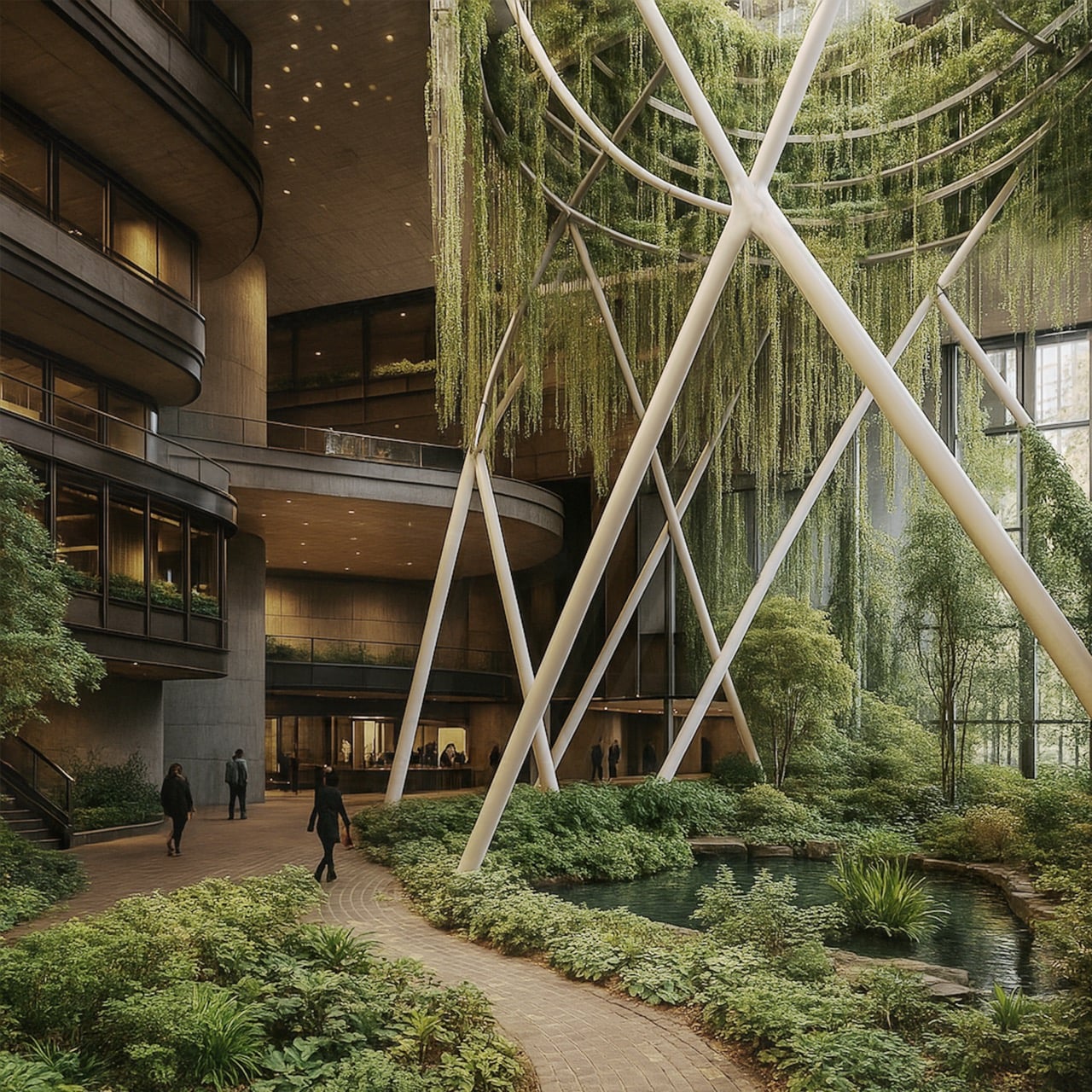
Scattered throughout the structure are sky terraces that act as elevated parks in the clouds. These lush communal spaces give residents places to gather, breathe, and reconnect with nature despite living in a dense vertical environment. They are not decorative add-ons but essential social and environmental anchors that support well-being and community interaction.

What truly sets Eden Rise apart is its seamless integration of advanced green technologies. Vertical farms in the core supply fresh food. Rainwater collection and cloud harvesting systems recycle water efficiently. Wind turbines built into the exoskeleton generate renewable energy. Natural ventilation and a breathable atrium maximize airflow and daylight, reducing energy use while improving indoor comfort. Each system works together like organs in a living body, turning the tower into a self-sustaining organism.

The engineering behind this vision is equally striking. Four conjoined towers are reinforced by layered bracing systems that provide structural depth and stability. A diagrid pattern spans multiple stories, weaving a network of structural lines that balance strength with elegance. Within this framework, an inner void allows light and air to travel deep into the building, ensuring that even its core feels open and alive.

Eden Rise is more than an architectural proposal. It is a manifesto for the future of cities. It shows how design can confront inequality, reduce environmental impact, and restore the relationship between urban life and nature. In this vision, skyscrapers no longer dominate the landscape. They nourish it.

If realized, the Chicago skyline would no longer be just a symbol of economic power. It would become a symbol of sustainability, equity, and imagination rising together.

The post The Mile-High Tower That Grows Food, Harvests Clouds, and Heals Chicago first appeared on Yanko Design.

The Mile-High Tower That Grows Food, Harvests Clouds, and Heals Chicago

Imagine looking up at a city skyline and knowing that inside those towers, food is growing, water is being harvested from clouds, and entire communities are thriving in harmony with nature. The Eden Rise Vertical Eco Living Community is not just a building proposal. It is a bold reimagining of what a city can be when architecture becomes an ecosystem rather than an object.

The project tackles one of Chicago’s most urgent urban challenges: food deserts. In many neighborhoods, especially low-income ones, access to fresh and nutritious food is limited. Grocery stores are scarce, healthy options are expensive, and residents often rely on convenience stores or fast food. Eden Rise flips this reality by embedding vertical farms directly into a mile-high tower, allowing fresh produce to be grown where people live. Food no longer travels miles to reach a plate. It moves floors.

Designer: Yuhan Zhang and Dreama Simeng Lin

The tower’s design is as poetic as its purpose. Inspired by the fluid form of a water droplet, its organic silhouette reflects Chicago’s relationship with water while symbolizing life, renewal, and sustainability. This fusion of natural inspiration and urban ambition transforms the structure into a vertical extension of the city’s green belt, suggesting a future where skylines are defined not just by height but by ecological intelligence.

Inside, Eden Rise functions like a city stacked vertically. Homes sit alongside offices, hotels, schools, and recreational spaces, creating a complete lifestyle environment within a single structure. Residents can wake up, work, learn, relax, and socialize without ever needing to commute across town. Schools integrated throughout the tower ensure education is woven into everyday life, while hotels welcome visitors to experience this futuristic ecosystem from panoramic heights. It is urban life condensed, connected, and reimagined.

Scattered throughout the structure are sky terraces that act as elevated parks in the clouds. These lush communal spaces give residents places to gather, breathe, and reconnect with nature despite living in a dense vertical environment. They are not decorative add-ons but essential social and environmental anchors that support well-being and community interaction.

What truly sets Eden Rise apart is its seamless integration of advanced green technologies. Vertical farms in the core supply fresh food. Rainwater collection and cloud harvesting systems recycle water efficiently. Wind turbines built into the exoskeleton generate renewable energy. Natural ventilation and a breathable atrium maximize airflow and daylight, reducing energy use while improving indoor comfort. Each system works together like organs in a living body, turning the tower into a self-sustaining organism.

The engineering behind this vision is equally striking. Four conjoined towers are reinforced by layered bracing systems that provide structural depth and stability. A diagrid pattern spans multiple stories, weaving a network of structural lines that balance strength with elegance. Within this framework, an inner void allows light and air to travel deep into the building, ensuring that even its core feels open and alive.

Eden Rise is more than an architectural proposal. It is a manifesto for the future of cities. It shows how design can confront inequality, reduce environmental impact, and restore the relationship between urban life and nature. In this vision, skyscrapers no longer dominate the landscape. They nourish it.

If realized, the Chicago skyline would no longer be just a symbol of economic power. It would become a symbol of sustainability, equity, and imagination rising together.

The post The Mile-High Tower That Grows Food, Harvests Clouds, and Heals Chicago first appeared on Yanko Design.