Ingrid Tiny House Packs Two Bedrooms and Brilliant Storage into 26 Feet

When it comes to tiny houses, smart storage isn’t just a bonus; it’s essential. In a home where every square meter counts, thoughtful design must go beyond accommodating the obvious necessities and instead make clever use of every nook, drawer, and corner. The Ingrid tiny house does exactly that, delivering an impressive blend of storage capacity and spatial flexibility within a compact, towable footprint.

Designed and built by Polish firm Tiny Smart House, the same makers behind the striking Dark Vader model, the Ingrid offers a refreshing contrast in both mood and materiality. While Dark Vader embraced a dark, minimalist aesthetic, Ingrid leans into a light and colorful interior that feels open, cheerful, and highly livable. Despite its relatively modest 8 m 26 ft length, which places it slightly longer than some European tiny houses yet still smaller than many North American counterparts, the home manages to incorporate two bedrooms and an abundance of built-in storage.

Designer: Tiny Smart House

The Ingrid is based on a triple axle trailer, ensuring stability and roadworthiness for transport. Externally, it is finished in engineered-wood cladding, complemented by a sloping metal roof and crisp white-framed windows. The clean exterior lines suggest modern simplicity, while the interior reveals a more layered and dynamic approach to design.

The living room is undoubtedly one of the highlights of the home. Rather than treating it as a minimal seating nook, the designers have integrated a substantial entertainment center with extensive shelving, transforming the wall into both a focal point and a highly functional storage hub. The space includes a large L-shaped sofa and a television, creating a comfortable area for relaxation without sacrificing practicality. The shelving system ensures that books, décor, electronics, and everyday essentials all have designated places, reducing clutter and reinforcing the home’s organized ethos.
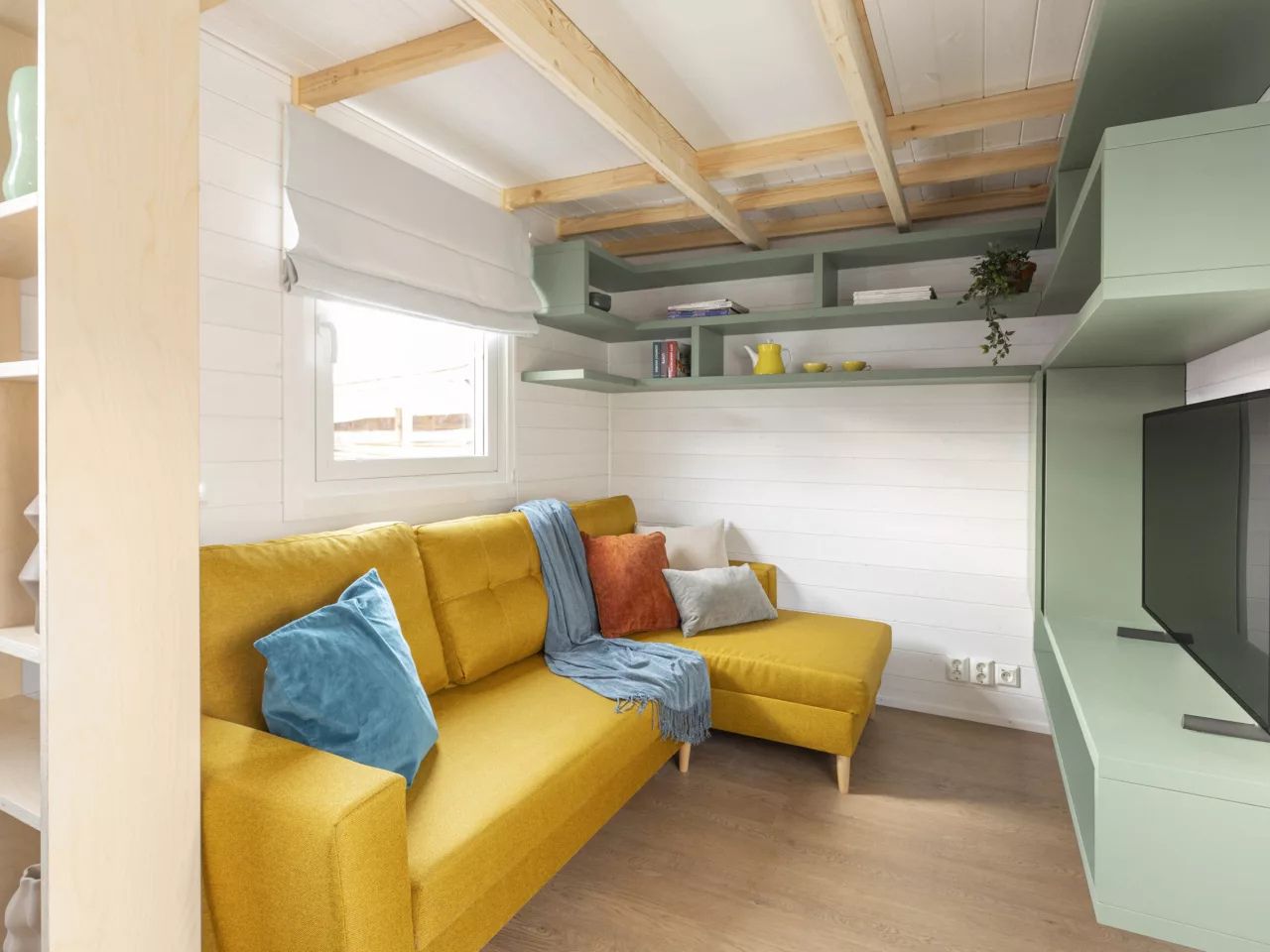
Adjacent to the living area is a drop-down dining table mounted to the wall. Designed for two, it can easily double as a work desk, an increasingly valuable feature in compact homes. One standard chair accompanies the table, while another seat is cleverly integrated into the kitchen unit itself. This kind of multifunctionality exemplifies how Ingrid maximizes usability without expanding its footprint.

The kitchen continues the theme of efficiency paired with charm. It features a farmhouse-style sink, a propane-powered stove, an oven, and a fridge freezer, providing everything needed for full-time living. Storage is thoughtfully distributed throughout cabinetry and shelving, ensuring that cooking tools and pantry items remain neatly tucked away.
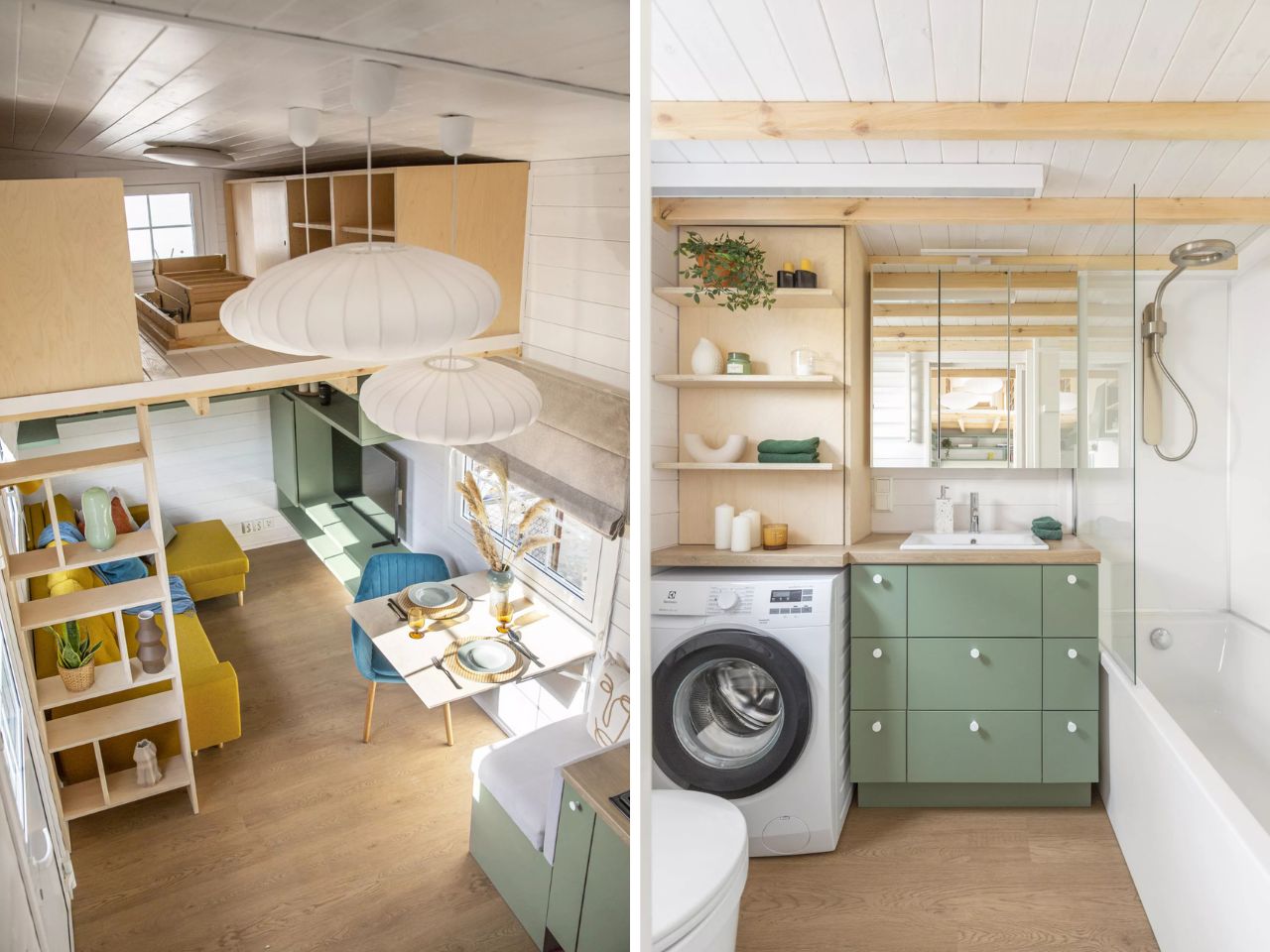
At the opposite end of the home lies the bathroom, and here Ingrid offers an unexpected luxury. Rather than opting for a compact shower stall, the designers included a regular-sized bathtub with a shower, a rare and welcome feature in tiny house design. The bathroom also contains a vanity sink, a flushing toilet, a washer-dryer unit, and additional storage, proving that comfort need not be sacrificed in small-scale living.

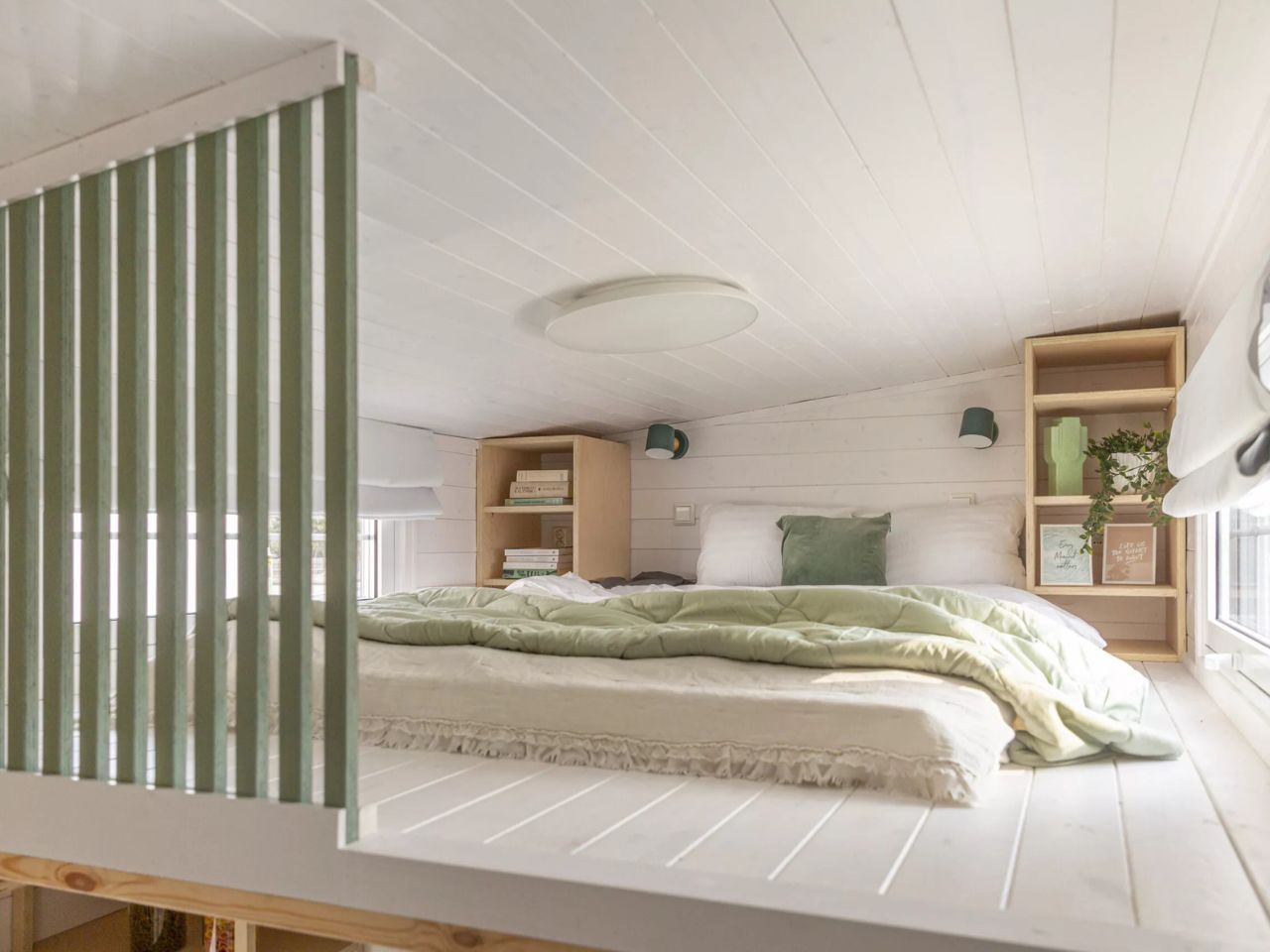
The Ingrid includes two loft-style bedrooms, both with low ceilings typical of tiny homes. The primary bedroom sits above the kitchen and bathroom and is accessed via a staircase with integrated storage, another smart solution that turns circulation space into usable storage. This loft accommodates a double bed and additional cabinetry. The secondary bedroom is positioned above the living room and accessed by a removable ladder. It offers generous storage and can serve as either a guest room or a more conventional second bedroom.

Already delivered to its owner, the showcased Ingrid demonstrates how intelligent design can transform a compact structure into a fully equipped, flexible home. While pricing details have not been disclosed, the model stands as a compelling example of how thoughtful architecture can make small-scale living both practical and genuinely comfortable.
The post Ingrid Tiny House Packs Two Bedrooms and Brilliant Storage into 26 Feet first appeared on Yanko Design.

God of War is getting a remake trilogy, and a new retro-inspired action game is out today

Last year marked 20 years since God of War hit the PlayStation 2 and kicked off one of gaming biggest franchises. Now, at the tail end of that 20th anniversary celebration, Sony’s Santa Monica Studio has announced two new project. First, and most significantly, the original God of War trilogy from the PS2 and PS3 is being remade for the modern era.

There’s no footage of it yet — the developer says that they’re “very early in development,” so we likely won’t see or hear much about this for a while. But given renewed interest in God of War thanks to the excellent two Norse games from 2018 and 2022 (not to mention the upcoming Amazon series), it makes sense to revisit these classics.

God of War and God of War II were released for Playstation 2 in 2005 and 2007, respectively, while the third of the Greek trilogy hit PlayStation 3 in 2010. The third game was also remastered for the PS4. But it’s safe to say that while the first two games are classics for their era, they also really show their age in some gameplay spots. Hopefully the remake will smooth out those rough edges. (Who else has nightmares in the Hades level near the end of the first game? Not just me, right?)

While we won’t see the remakes for a while, there is a new God of War-inspired game out right now: God of War Sons of Sparta. It was developed by Mega Cat Studios, a developer known for its love of retro games — it even still releases games for the SNES and Genesis.

Given their pedigree, it’s no surprise that Sons of Sparta has vibes of classic 2D action/platformer games. It’s apparently canon for the series and takes place in Kratos’ youth while he trains with his brother. It obviously looks nothing like the other God of War games — but the combat and monsters shown off in the trailer definitely feel right at home in the series.

Perhaps the most fun part of all this is that it’s available today for $30. While Sons of Sparta looks like a fun curio for God of War fans, it’ll only go so far towards whetting our appetite for that remake series. Might I suggest binging some Valhalla in the meantime?

This article originally appeared on Engadget at https://www.engadget.com/gaming/playstation/god-of-war-is-getting-a-remake-trilogy-and-a-new-retro-inspired-action-game-is-out-today-234056618.html?src=rss

Silent Hill: Townfall takes the series’ trademark fog to an eerie coastal community

Coming off the success of Slient Hill f, which moved the series’ psychological horror to the Japanese countryside, Konami, Annapurna Interactive and developer Screen Burn Interactive have chosen a foggy island as the setting for Silent Hill: Townfall.

The first gameplay trailer for Townfall, introduced during Sony’s latest State of Play, follows Simon Ordell, a man who keeps mysteriously waking up in the water off the coast of the empty island town of St. Amelia. In the trailer, Simon hides from monsters, peers at a portable television, swings a fire axe, and deals with the psychological turmoil typical of a Silent Hill protagonist, all in first person, one of the unique twists of this new game.

Silent Hill: Townfall was originally announced alongside Silent Hill f and the remake of Silent Hill 2 in 2022. The game is developed by Screen Burn Interactive (formerly known as No Code), the creators of Observation and Stories Untold. Konami will share more details about Townfall’s gameplay and story in an upcoming Silent Hill Transmission presentation later today.

Silent Hill: Townfall is coming to PlayStation 5 in 2026.

This article originally appeared on Engadget at https://www.engadget.com/gaming/playstation/silent-hill-townfall-takes-the-series-trademark-fog-to-an-eerie-coastal-community-233324897.html?src=rss

3 Designers Built the Knee Recovery Tool 40% of Seniors Need

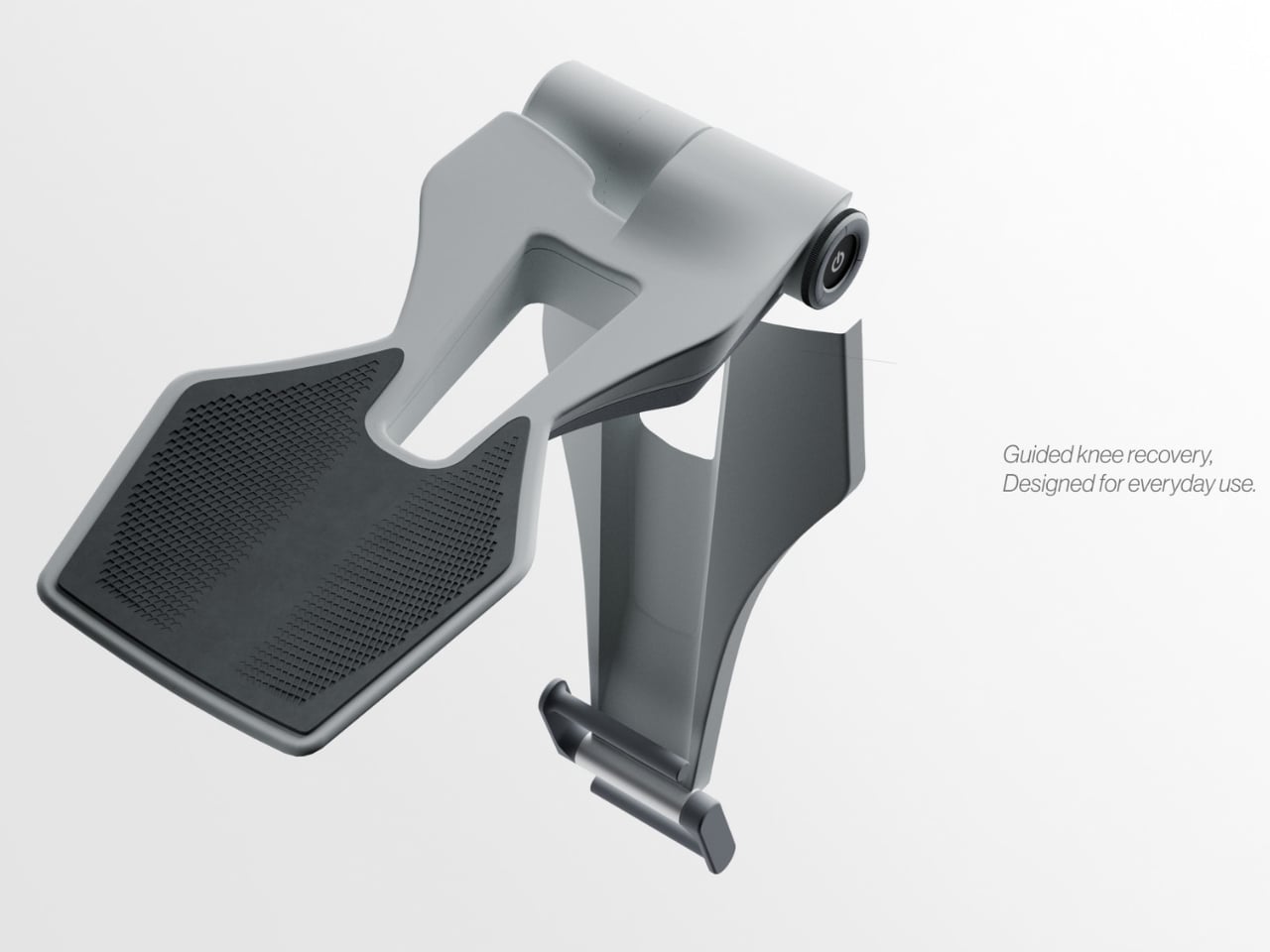
There’s something quietly radical about designing for pain. Not the dramatic, cinematic kind, but the daily grind of chronic discomfort that shapes how millions of people move through their lives. That’s exactly what Madhav Binu, Kriti V, and Himvall Sindhu set out to tackle with Revive, a home-based rehabilitation device for knee osteoarthritis patients.

The numbers tell a sobering story. Forty percent of India’s elderly population lives with knee osteoarthritis, a condition that doesn’t just hurt but fundamentally changes how people interact with their own bodies. Between 1990 and 2019, cases in India jumped from 23.46 million to 62.35 million. Even more striking? The prevalence is 15 times higher than in Western nations, driven by lifestyle and genetic factors that make this a uniquely urgent problem.

Designers: Madhav Binu, Kriti V, Himvall Sindhu

What really caught my attention about this project isn’t just the statistics, though. It’s how the design team approached the psychology of recovery. When you dig into their research, you see they identified three core issues: limited mobility, fear of movement, and reduced independence. That fear piece is crucial. When your knee hurts, your instinct is to protect it, to move less, to withdraw. But that’s exactly what makes recovery harder.

The team didn’t just sketch concepts in a studio and call it a day. They conducted hands-on primary research, interviewing patients, observing clinical sessions, and spending time with physiotherapists. This grounded approach shows in every aspect of the final design. You can see the wall of sketched ideas in their process documentation, hundreds of concepts systematically mapped and filtered based on technical feasibility, user practicality, and rehabilitation relevance. It’s the kind of rigorous ideation that separates student work from genuinely thoughtful design.

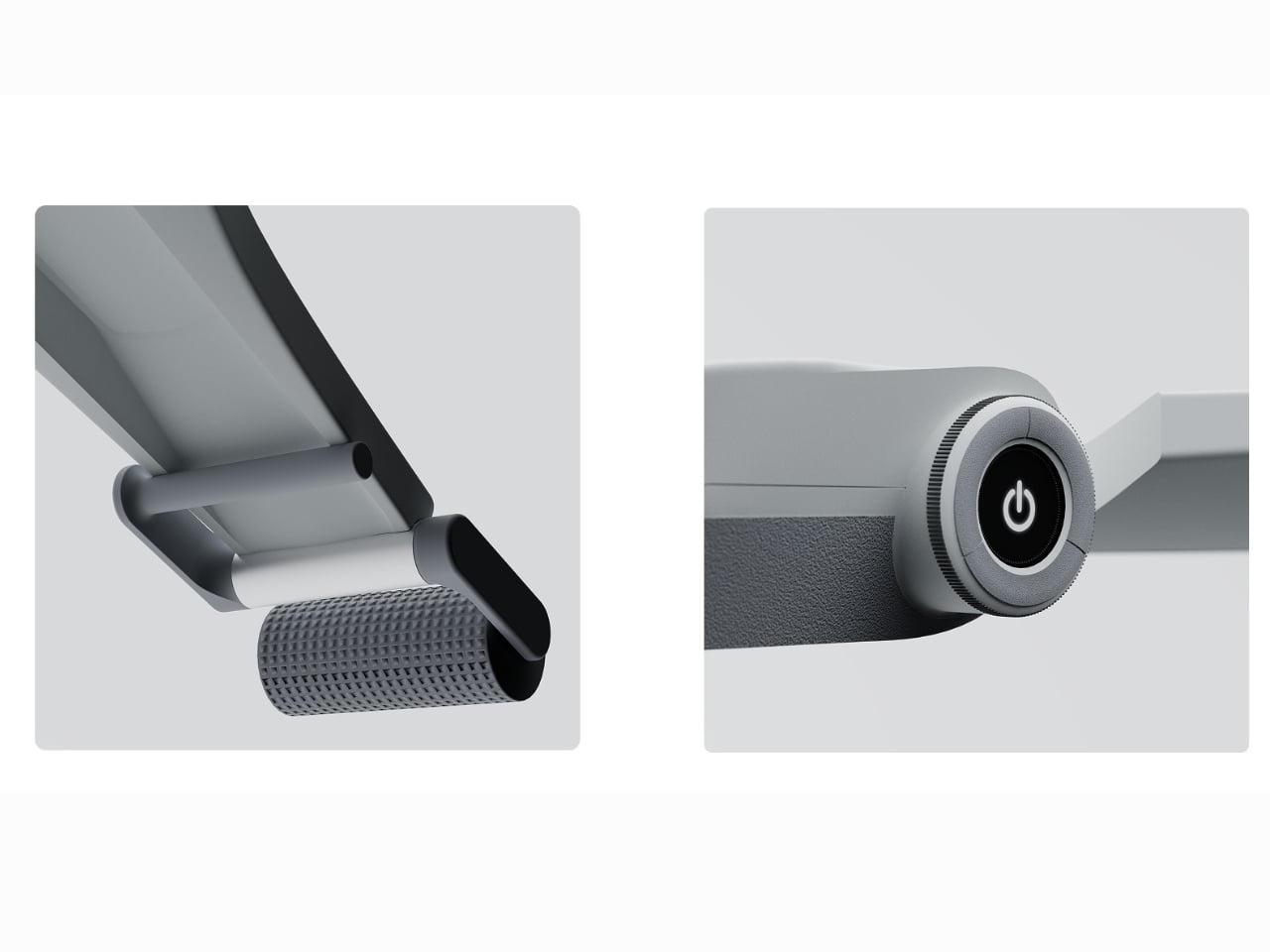
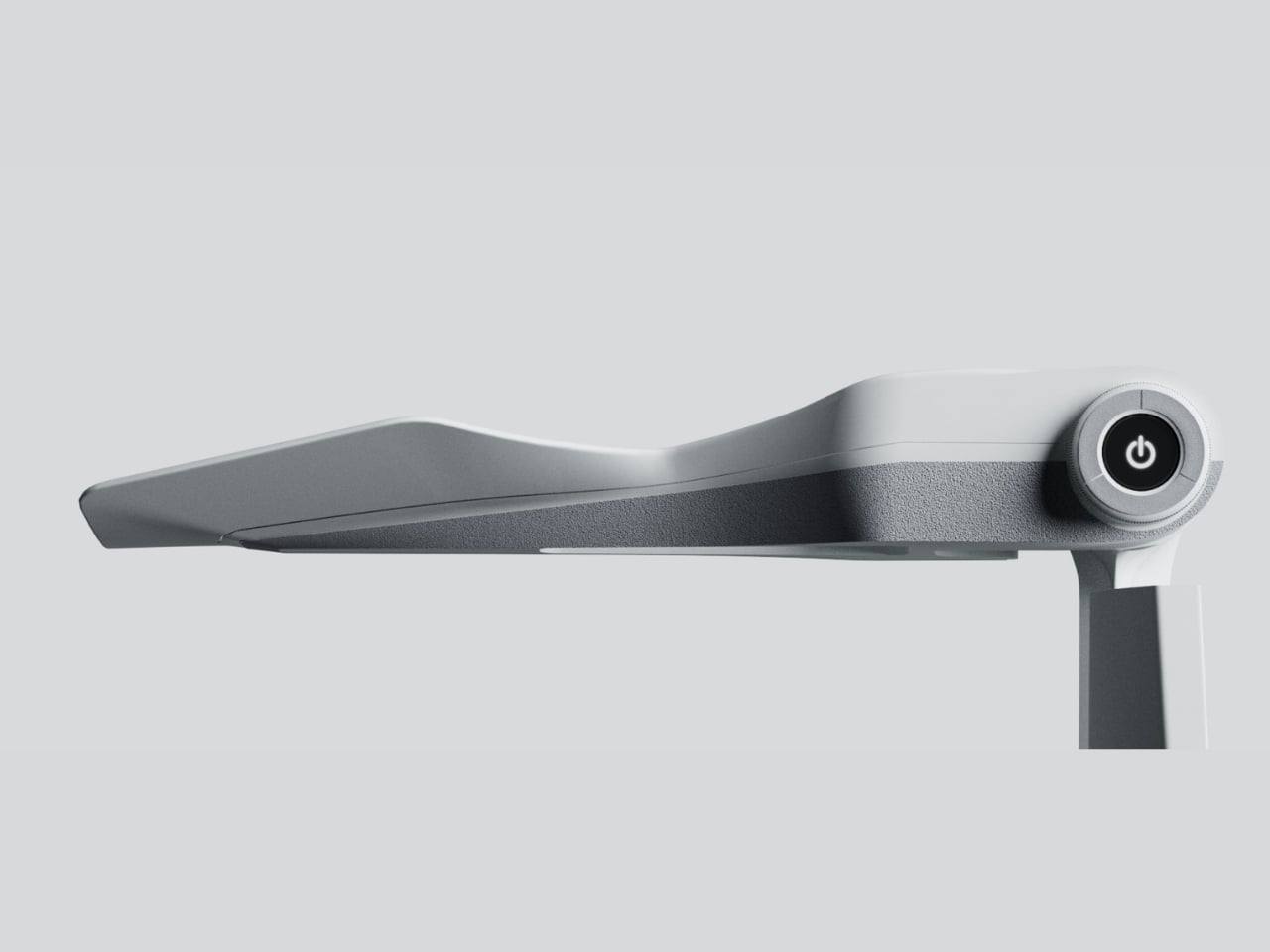
What emerged from all that research is a sleek, minimalist device that looks more like a piece of modern home tech than medical equipment. The form factor matters here. Recovery is already mentally taxing without having intimidating, clinical-looking equipment staring at you from the corner of your bedroom. Revive’s understated aesthetic makes it feel less like a constant reminder of limitation and more like a tool for progress.

The real intelligence of the project lies in how it positions itself within the rehabilitation landscape. The team’s market research revealed a clear gap: most existing solutions are either completely automatic (requiring minimal user effort but offering less engagement) or fully manual (demanding too much from people already dealing with pain). Revive sits in the guided category, balancing lower operational effort with higher product intelligence. It’s smart enough to direct your recovery without making you feel like a passive participant in your own healing.

Working with physiotherapists Dr. Ankit Patel and Dr. Hetal Patel from Ahmedabad, the designers refined the concept through multiple iterations. The collaboration brought professional credibility to the project while keeping it grounded in real therapeutic needs. As Dr. Hetal Patel noted, the strength of the product lies in its flexibility for different stages of therapy. That adaptability is key for a four-week rehabilitation program where needs change as patients progress.

The core insight driving Revive is deceptively simple: recovery happens when users relearn movement by starting small, increasing load gradually, and engaging consistently in daily life. Long-term improvement depends on integrating these movements into everyday routines. It’s not about heroic physiotherapy sessions twice a week. It’s about making rehabilitation feel manageable enough that people actually do it.

The design process itself reflects contemporary product development at its best. Prototype, share, gather feedback, refine, repeat. Ideas were continuously tested against real use, refined through iteration, and grounded in feasibility. The final form exploration shows dozens of variations, each tweaking the relationship between the device and the human body it’s meant to support. What makes this project particularly relevant right now is how it addresses home healthcare. As medical care increasingly shifts toward decentralized, patient-directed models, products like Revive become essential infrastructure. The device offers intelligent guidance while allowing people to maintain independence and dignity in their own space.

Revive represents the kind of design work that doesn’t just solve problems but fundamentally reframes them. Instead of asking how to make physiotherapy more effective in clinical settings, the team asked how to make recovery feel less isolating and more integrated into normal life. That shift in perspective, backed by rigorous research and thoughtful iteration, is what transforms a good concept into genuinely impactful design.

The post 3 Designers Built the Knee Recovery Tool 40% of Seniors Need first appeared on Yanko Design.

The PS Plus Game Catalog additions for February include Marvel’s Spider-Man 2

During its State of Play livestream on Thursday, Sony revealed the first PlayStation Plus Game Catalog addition for February and it's a doozy. Marvel’s Spider-Man 2 (PS5) will finally websling its way onto the Game Catalog on February 17.

Marvel’s Spider-Man 2 was released in October 2023, and Insomniac's third Spidey game is the the best of the bunch. You can play as both Peter Parker and his protégé Miles Morales. Each Spidey has his own skill tree and moveset to master.

Traversing New York (with a lot more of it explorable than in previous entries) has never felt better thanks to the addition of the wingsuit, while the set pieces are frequently breathtaking. Marvel’s Spider-Man 2 remains one of the PS5’s flagship games, and with Marvel’s Spider-Man: Remastered and Miles Morales already on the Game Catalog, Extra and Premium subscribers can now play the whole series while they wait for Insomniac's Wolverine game to arrive later this year.

Sony later revealed the full PS Plus Game Catalog lineup for February on the PlayStation Blog. It includes Neva (PS4 and PS5), a stunning 2D platformer that's pretty much an interactive fairytale. Engadget’s Jessica Conditt opened her review of the game by saying she had "absolutely nothing negative to say" about it, which is surely about as effusive as a recommendation can get. (A paid expansion that acts as a prequel is on the way next week too.)

The other titles coming to the PS Plus Game Catalog on February 17 are:

  • Test Drive Unlimited Solar Crown (PS5)

  • Season: A Letter to the Future (PS4 and PS5)

  • Monster Hunter Stories 2: Wings of Ruin (PS4)

  • Monster Hunter Stories (PS4)

  • Venba (PS5)

  • Echoes of the End: Enhanced Edition (PS5)

  • Rugby 25 (PS4 and PS5)

PS Plus Premium members will have an extra game to play on PS4 and PS5 in the form of Disney Pixar Wall-E. This version was originally released in 2008 for the PlayStation 2.

Looking further ahead, Tekken Dark Resurrection will be available to Premium subscribers in March. Premium members will be able to play the original Time Crisis on their PS5 with gyro controls in May, which sounds fun. Also, Big Walk, a multiplayer game from Untitled Goose Game developer House House, will be available on all three PS Plus tiers when it debuts later this year.

Update February 12, 6:43PM ET: Added the full list of PS Plus Game Catalog titles for February.

This article originally appeared on Engadget at https://www.engadget.com/gaming/playstation/the-ps-plus-game-catalog-additions-for-february-include-marvels-spider-man-2-232459779.html?src=rss

The next Metal Gear Solid remaster collection arrives this summer

Volume two of the Metal Gear Solid: Master Collection will arrive on August 27, publisher Konami announced today during Sony’s latest State of Play presentation. The bundle will feature 2008’s Metal Gear Solid 4: Guns of the Patriots, the HD remaster of 2010’s Metal Gear Solid: Peace Walker and a selection of bonus content, including Metal Gear: Ghost Babel, which was originally released for Game Boy Color in 2000. All told, that’s a smaller selection of games than Konami made available with Vol. 1 of the Master Collection, but Metal Gear fans will be excited nonetheless, if only for the fact it will mark the first time MGS4 will be officially playable on a platform other than the PlayStation 3.

That it has taken Konami nearly two decades to release the conclusion of Solid Snake’s story on more systems has to do with the nature of the game as a PS3 exclusive. MGS4 took extensive advantage of the console’s unique Cell architecture, a fact that made it difficult (and expensive) proposition to port to more recent x86-based systems. In recent years, it’s been possible to emulate the game on a powerful PC, but not everyone has that kind of hardware.

Metal Gear Solid: Master Collection Vol.2 will be available on PS5, Xbox Series X/S, PC, Nintendo Switch and Nintendo Switch 2.

Update, February 12, 6:30PM ET: This story was updated after publish to add details about Metal Gear Solid: Master Collection Vol.2’s launch platforms.

This article originally appeared on Engadget at https://www.engadget.com/gaming/playstation/the-next-metal-gear-solid-remaster-collection-arrives-this-summer-231711005.html?src=rss

The first Control Resonant gameplay trailer shows Dylan defying physics in a sideways NYC

It’s been less than three months since we got our first look at Control Resonant, the sequel to Remedy’s mind-bending, third-person adventure that introduced us to Jesse Faden and the Federal Bureau of Control. At today’s State of Play event, we got to see the first extended bit of gameplay from Control Resonant — and the combat looks as inspired as ever, though the setting is completely new.

As we learned in December, the next Control games doesn’t focus on Jesse Faden; instead, you’ll primarily play as her brother Dylan who Jesse was trying to find for much of the first game. Dylan’s out in a warped version of New York City trying to track the game’s Resonant creatures that are responsible for whatever calamity has taken place. We knew this already, but the change of setting from the Bureau of Control building into the more open city setting should go a long way towards making this game feel fresh.

Dylan’s capabilities are also completely different than what we saw from Jesse in the original. There’s a much bigger emphasis on melee combat, as Dylan has a shapeshifting weapon called the Aberrant. You can switch from hammer to blades to other various forms, much in the way that Jesse’s firearm in the first game could morph between different types of guns.

But the thing that stood out the most to me in the brief preview was the way that NYC completely disobeyed the laws of physics. Buildings and streets would just head into the sky at 90-degree angles — and Dylan’s powers let him completely which surface is the “ground” for him.

There’s still no firm release date for Control Resonant, but that’s not unreasonable — the game was only announced a few months ago. Remedy says they’re still on target to launch in 2026. And, at the end of today’s PlayStation blog post, they promise that “things are going to get weirder.” Just what I was hoping for!

This article originally appeared on Engadget at https://www.engadget.com/gaming/playstation/the-first-control-resonant-gameplay-trailer-shows-dylan-defying-physics-in-a-sideways-nyc-224746545.html?src=rss

Mina the Hollower resurfaces with a spring 2026 release window

Sony’s first State of Play stream of the year included an update on Mina the Hollower, the latest title from Shovel Knight studio Yacht Club Games. It’s now slated to arrive sometime this spring. The developer initially planned to release the retro-style action-adventure platformer on Halloween last year, but delayed it to “to apply some final polish and balancing to make the game truly shine.”

While Mina the Hollower didn’t make its original Halloween release date, at least the new demo, which will be available for a limited time, is getting a eerily timed debut. It’ll hit PS5 tomorrow i.e. Friday, February 13. Y’know… Friday the 13th?

This article originally appeared on Engadget at https://www.engadget.com/gaming/playstation/mina-the-hollower-resurfaces-with-a-spring-2026-release-window-224327165.html?src=rss

Kena: Scars of Kosmora is coming out later this year

When it launched in 2021, Kena: Bridge of Spirits was an early example of the graphical power of the PS5 thanks to its Pixar-adjacent animation and over-the-top effects. Based on a surprise trailer at Sony's latest State of Play, it seems like its sequel, Kena: Scars of Kosmora, could up the ante when it launches later this year.

Scars of Kosmora follows spirit guide Kena to a mysterious island called Kosmora, where a powerful spirit breaks her staff and forces her to embrace a new style of spirit guiding (and presumably a collection of new game mechanics). Like the first game, Scars of Kosmora looks to be filled with lush visuals and cute Spirit Companions, but also a surprising amount of boss battles. Developer Ember Lab's new trailer heavily emphasizes the game's updated combat, which seems like it'll play a big role in the sequel.

According to a post on the PlayStation Blog, it sounds like manipulating the elements will also be a major focus. "We’ve added new elemental gameplay to bring strategy and depth when facing the threats of Kosmora," developer Ember Lab says. "These new combat skills, elemental infusions and use of your Spirit Companions will be key to overcoming challenging encounters and epic boss fights."

Kena: Scars of Kosmora is coming to PlayStation 5 and PC in 2026.

This article originally appeared on Engadget at https://www.engadget.com/gaming/playstation/kena-scars-of-kosmora-is-coming-out-later-this-year-224006963.html?src=rss

Ghost of Yotei’s multiplayer expansion arrives March 10

Ghost of Yotei’s forthcoming Legends multiplayer expansion will arrive early next month, Sony announced today during its latest State of Play presentation. As in Ghost of Tsushima, you’ll be able to play the mode with up to three other people online. Players can each choose from one of four classes — samurai, archer, mercenary and shinobi — who excel in different combat scenarios. All four classes can wield a katana and bow, but then they also have access to special weapons and skills. For example, the samurai can wield the odachi, giving them a sweeping move set against groups of enemies. You’ll need to use teamwork and your class’s abilities to take down demonic versions of the Yotei Six.

The mode will arrive alongside the game’s 1.5 patch, and will be free for all Ghost of Yotei owners. At launch, players can look forward to three different mission types. In survival, you’ll be tasked with fighting off increasingly difficult enemies. In story mode, meanwhile, you and one other player will need to complete a series of 12 missions to unlock the expansion’s incursion mode, which will see you siege a fortress belonging to a member of Yotei Six. At first, there will be four strongholds for players to conquer, with a later April patch adding the final bosses.

This article originally appeared on Engadget at https://www.engadget.com/gaming/playstation/ghost-of-yoteis-multiplayer-expansion-arrives-march-10-223842684.html?src=rss