Claude Dispatch offers a fresh approach to managing tasks and automating workflows, combining advanced AI capabilities with practical features to streamline operations. Jannis Moore highlights how this platform simplifies complex processes by centralizing task management and allowing local execution directly on your device. For example, its ability to execute tasks without relying on cloud services […]
Furniture rarely makes me stop scrolling. Most of what cycles through my feed either looks too clinical to feel livable or too trendy to last past next season. But when I came across Macarons, a modular furniture system by Taiwanese designers HanYi Huang and Fong-Yi Liou, I actually paused. Not because it was trying too hard, but because it wasn’t.
The name gives it away, and that’s the point. Macarons draws its visual language directly from the French confection, right down to the rounded forms, the layered silhouette, and that quietly playful quality that makes you smile before you even understand why. The design came from 03 Design Ltd. in Taiwan and was created for longtime furniture manufacturer Shiang Ye Industrial Co. It picked up a double win at the 2025 European Product Design Award, taking home recognition in both Home Furniture and Eco Design, which tells you this isn’t just a pretty concept piece.
Designers: HanYi Huang
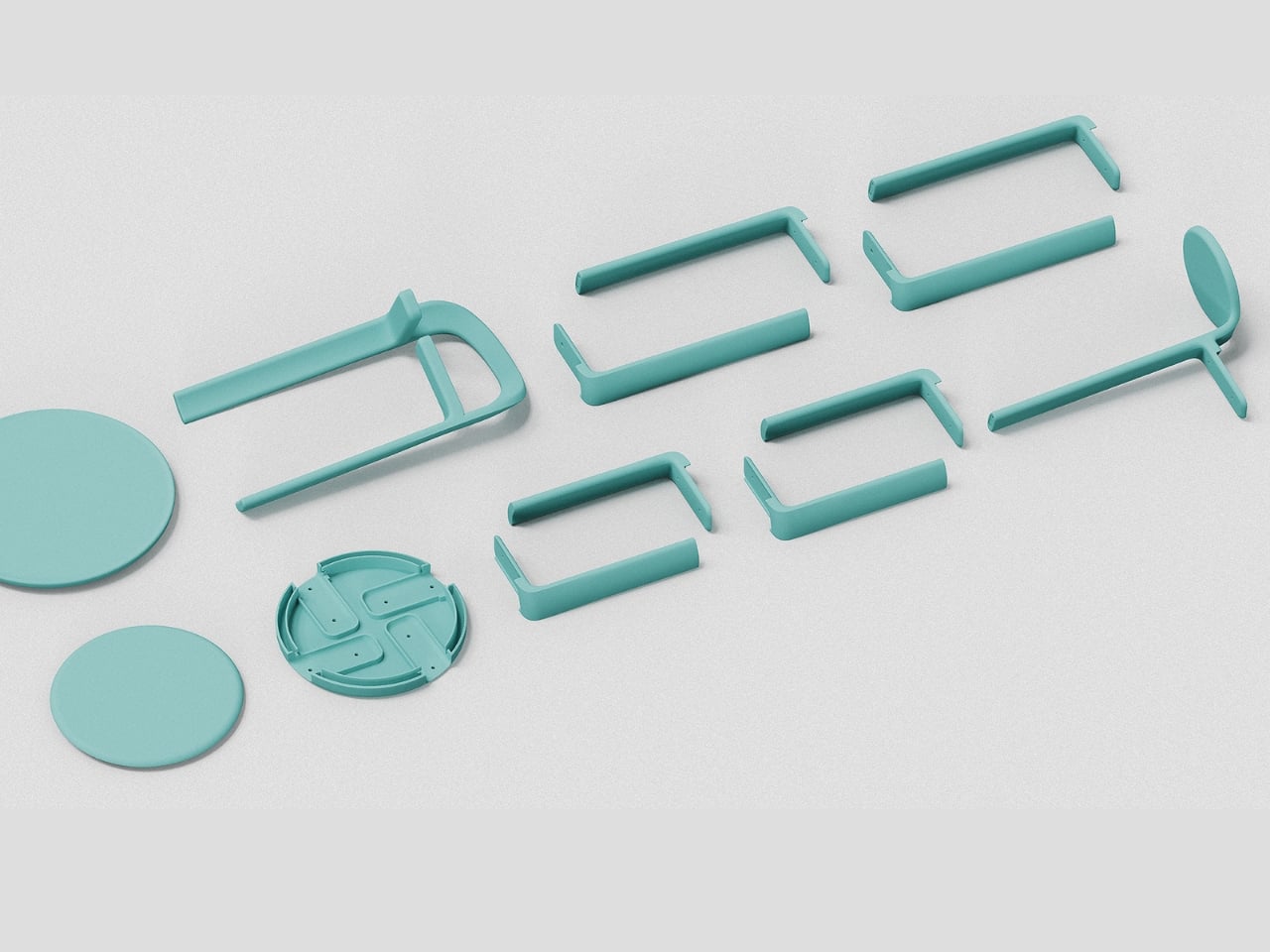
What actually makes Macarons interesting as a furniture system is the modularity. You get a configurable set of stools, chairs, and side tables built around a simple logic: swap the legs, change the seat, add on what you need. The components connect through a rotational seat mechanism that makes assembly genuinely easy and, more importantly, makes repair possible. That second part tends to get glossed over in product launches, but it matters a lot. A piece of furniture you can actually fix is one you’ll keep for a decade. That’s the quiet kind of sustainability nobody puts in the headline.
The structural engineering behind the legs is where things get clever. Huang and Liou designed an off-centered, cloverleaf knot leg structure that improves both strength and comfort simultaneously. That’s a harder problem to solve than it sounds. Most furniture designers pick one or the other and call it a day. The fact that the leg geometry does both while also contributing to the visual identity of the product is the kind of decision that separates designers who think holistically from those who think in silos.
The material choice is equally deliberate. The entire system is made from post-consumer recycled polypropylene, which cuts down on waste and makes the pieces lighter to ship. Shipping weight is one of those sustainability factors that rarely gets talked about in design discourse, but it compounds fast. Lighter furniture means lower emissions per unit moved, and when you’re thinking about a modular system that’s meant to scale, that math matters.
I’ll be upfront about what I find genuinely compelling here: this isn’t sustainability as aesthetic, which is a trend I find exhausting. You know the type, raw edges, reclaimed wood, a beige palette that wants you to feel virtuous for just looking at it. Macarons doesn’t do that. It leans into color, playfulness, and modularity first, and builds the sustainability into the structure and material rather than the surface. That’s the right order of operations.
HanYi Huang brings a sharp design background to this. Her postgraduate work in Italy earned her a Red Dot Design award, and she’s been leading the design team at Shiang Ye as Creative Director, steering a traditional B2B furniture manufacturer toward work that competes internationally. That kind of trajectory, from a classic manufacturing context to award-winning modular systems with a global footprint, is worth paying attention to.
What Macarons ultimately argues is that modular, repairable, and recyclable furniture doesn’t have to feel like a compromise or a lecture. It can feel light, joyful, and considered. It can look like something you’d actually want in your home rather than something you bought to feel better about your carbon footprint. That’s a harder balance to strike than most people realize, and Huang and Liou struck it. Design that makes you feel good and does good at the same time is still the rarest kind. Macarons comes close.
Google’s latest Stitch update, featuring the Gemini Vibe Design framework, introduces a host of AI-driven enhancements aimed at streamlining creative workflows. As highlighted by Sam Witteveen, one of the standout features is the integration of agentic systems, which allow multiple AI agents to handle tasks like typography optimization, color scheme refinement and placeholder image generation […]
iPhones are celebrated for their sleek design and intuitive interface, but even the most advanced devices come with their share of challenges. From accidental camera activations to cluttered photo libraries, these small inconveniences can disrupt your experience. The video below from iReviews explores ten common iPhone annoyances and provides practical solutions to help you customize […]
Apple Notes is a versatile application for organizing ideas, managing tasks and storing information, offering a balance of simplicity and functionality. According to Paperlike, features like smart folders allow users to automatically sort notes using hashtags and filters, while nested folders, supporting up to five levels, enable detailed organization for complex projects. Additional options, such […]
Following discussions first reported on earlier this year, ByteDance has agreed to sell its games unit Moonton to Savvy Games Group for $6 billion. Moonton is known for mobile titles popular in Asia like Mobile Legends: Bang Bang, which has been downloaded 1.5 billion times. The transaction is set to be finalized in the "near future," according to an internal memo from Moonton's CEO seen by Bloomberg.
ByteDance has been winding down its gaming arm and shopping Moonton since 2023, just two years after it first acquired the developer. Around that same period, the TikTok parent was shuttering its Nuverse gaming arm, which published notable titles like Marvel Snap and Ragnarok X: Next Generation. The company has since shifted its focus to AI, competing with Chinese rivals to develop chatbots and foundational models.
Savvy Games, which is owned by Saudi Arabia's Public Investment Fund (PIF), has been going in the opposite direction. Last year the company (via its subsidiary Scopely) acquired Pokémon Go developer Niantic for $3.5 billion. PIF was also among the key investors that purchased Electronic Arts in a blockbuster $55 billion deal last year. The Saudi fund holds a 7.5 percent stake in Nintendo as well.
The sale is the latest chapter in the recent gaming industry consolidation that saw around 45,000 jobs lost in a brutal three-year period between 2022 and 2025. According to a recent GDC study, one-third of US video game industry workers were laid off over the last two years.
This article originally appeared on Engadget at https://www.engadget.com/gaming/bytedance-is-selling-its-moonton-game-unit-to-savvy-games-for-a-cool-6-billion-124131595.html?src=rss
NVIDIA started an online firestorm this week when it announced DLSS 5 at its GTC conference. The company claims it's meant to deliver "photorealistic" lighting and materials in games by using neural processing. But it differs considerably from previous versions of DLSS, which were focused on using machine learning to upscale lower resolutions and generate additional frames, and gamers online aren’t too happy. To help us break this down, Anshel Sag, VP and principal analyst at Moor Insights and Strategy joins us to discuss his experience with NVIDIA's DLSS 5 demos. Also, we dive into what's next for Xbox with Project Helix.
NVIDIA announced DLSS 5, the disgust was immediate (with Anshel Sag from Moor Insights & Strategy) – 0:51
Arizona attorney general sues Kalshi for operating an illegal gambling business – 36:22
Polymarket users threaten the life of a reporter at The Times of Israel over accurate reporting – 36:59
Apple announces AirPods Max 2 with improved noise cancellation – 44:33
Elon Musk’s xAI faces class action suit over facilitating CSAM dsitribution – 47:38
Samsung stops selling Galaxy Z TriFold after 3 months because components got too expensive – 51:22
Around Engadget: Apple Studio XDR review, Dell XPS 16 review – 53:49.346
Listener Mail: Stick with iPhone on Linux? And are there any good Android tablets? – 55:41
Pop culture picks – 58:46
Credits
Hosts: Devindra Hardawar Guest: Anshel Sag Producer: Ben Ellman Music: Dale North and Terrence O’Brien
This article originally appeared on Engadget at https://www.engadget.com/gaming/pc/engadget-podcast-why-does-everyone-hate-nvidias-dlss-5-ai-upscaling-121335918.html?src=rss
Are you frequently interrupted by calls from unknown numbers? With iOS 26, Apple has introduced the “Silence Unknown Callers” feature, a practical solution to minimize distractions by automatically silencing calls from numbers not saved in your contacts. This guide provides a detailed explanation of how to enable this feature, how it functions and alternative methods […]
If you're like me, you've absolutely had enough of winter and you're hoping warm weather is right around the corner. When it's finally more enjoyable to spend time outside, you're likely going to be cooking on the grill, so now is a great time to give everything a deep clean to prepare for your upcoming culinary adventures.
I don’t blame you if you opted to let your grill hibernate during the winter months, but if that’s the case, it’ll probably need a tune-up before spring arrives. If you did keep the grill in working order over the last few months, this is a good time for a scrub and polish before warmer temperatures inspire heavy use. Here are a few tips and tricks that will hopefully make things easier.
Disassemble, scrub, reassemble
Billy Steele for Engadget
A good rule of thumb when it comes to cleaning anything you haven’t used in a while is to take it apart as much as you feel comfortable and give it a thorough wipe down. For grills, this means removing the grates and any bars or burner covers – basically, anything you can take out that’s not the heating element. This gives you a chance to inspect the burners of your gas grill or the fire pot of a pellet model for any unsightly wear and tear. If those components are worn out or overly rusted, most companies offer replacements that you can easily swap out with a few basic tools.
Once all the pieces are out, start by scraping excess debris off all sides of the interior – with the help of some cleaner if needed. For a gas grill, this likely means pushing everything out through the grease trap. On a pellet grill, you’ll want to scrape the grease chute clear and out into the catch can, but you’ll also need to vacuum the interior with a shop vac – just like you would after every few hours of use. And while you’re at it, go ahead and empty the hopper of any old pellets that have been sitting since Labor Day. Fuel that’s been sitting in the grill for months won’t give you the best results when it comes time to cook so you might as well start fresh.
Thankfully, pellet grill companies have made easy cleaning a key part of their designs. Weber’s Searwood, for example, has minimal internal parts that need to be removed to open up the bottom of the chamber. This is also a design feature of the company’s gas grills. Simply vacuum or push the debris out the grease chute. The catch pan where all of the garbage ends up is also easy to access from the front of the grill, and you can remove the aluminum liner and replace it with a new one in seconds.
Traeger’s most recent pellet grills were also redesigned to improve cleaning. Most notably, grease and ash end up in the same “keg” that’s easy to detach from the front of the grill. The company also allows you to quickly remove all of the interior components, though they’re larger than what you find on the SmokeFire. Lastly, Traeger moved the pellet chute to the front of the Timberline and Ironwood, making it a lot more convenient to swap out wood varieties or empty an old supply.
You’ll want to get as much of the food leftovers out of your grill as possible for a few reasons. First, that stuff is old and lots of build-up over time can hinder cooking performance and might impact flavor. The last thing you want is old food or grease burning off right under an expensive ribeye. Second, in the case of pellet grills, not properly clearing out grease and dust can be dangerous. It’s easy for grease fires to start at searing temperatures and if there’s enough pellet dust in the bottom of your grill, it can actually ignite or explode. That’s why companies tell you to vacuum it out after every few hours of use.
All of that dust, grease and debris should be removed before you fire the grill back up.
Billy Steele/Engadget
To actually clean the surfaces, you’ll want to get an all-natural grill cleaner. There are tons of options here, and it may take some time to find one you like. I typically use Traeger’s formula since it’s readily available at the places I buy pellets and I’ve found it works well cutting through stuck-on muck. You want an all-natural grill cleaner over a regular household product as it’s safe to use on surfaces that will touch your food. They’re also safe to use on the exterior of your grill without doing any damage to chrome, stainless steel or any other materials.
Spray down the inside and give things a few minutes to work. Wipe it all clean and go back over any super dirty spots as needed. Ditto for the grates, bars and any other pieces you removed. I like to lay these out on a yard waste trash bag (they’re bigger than kitchen bags) so all the stuff I scrape or clean off doesn’t get all over my deck. You can use shop towels if you want to recycle or paper towels if not, but just know whatever you choose will be covered in nasty black grime so you won’t want to just toss them in the clothes washer when you’re done. A pre-wash in a bucket or sink is needed to make sure you don’t transfer gunk from your grill to your business casuals.
In terms of tools, you don’t need much. I’ve tried that grill robot that claims to do the job for you, but I’ve found sticking to the basics is more efficient. And honestly, when you get the hang of it, it doesn’t take all that long. It’s a good idea to have a wire brush specifically for the grates that you don’t use to clean anything else. After all, this will be touching the same surfaces you put food on. I recommend another, smaller wire brush – the ones that look like big toothbrushes – for cleaning the burners on a gas grill. If you notice the flame isn’t firing through one of the holes, you can use this to clean the pathway. Lastly, plastic is the way to go for a scraper, anything else and you risk scratching the surfaces of your grill. Sure, any damage done would be on the inside, but it’s still not a great feeling to knick up your previous investment.
Check for updates before your first cook
Traeger
If you have a smart grill from the likes of Traeger, Weber or another company, you’ll want to plug it in and check for software updates well in advance of your first grilling session. Chances are you haven’t cooked much since last fall, which means companies have had months to push updates to their devices. Trust me, there’s nothing worse than spending an hour trimming and seasoning a brisket only to walk outside to start the grill and it immediately launches into the update process. This could extend the whole cooking time significantly depending on the extent of the firmware additions and strength of your WiFi.
Thankfully, checking for updates is quick and easy. All you need to do is turn on your grill and open up the company’s app on your phone. If there’s a download ready for your model, the mobile software will let you know and it’s usually quite prominent. If there’s not a pop-up alert that displays immediately, you can check the settings menu just to make sure. Sometimes for smaller updates, a company might not beat you over the head to refresh. However, starting a fresh slate of firmware is always a safe bet and will ensure your grill is running at its best when it comes time to cook.
For a good time every time, clean after each use
Billy Steele for Engadget
I’ll be the first to admit I don’t adhere to my own advice here, but it’s nice to have goals. I will also be the first to tell you every single time I smoke a Boston Butt or some other super fatty cut of meat that I wish I would’ve done at least a quick cleaning right after the meal. Grease buildup is not only highly flammable but it’s much harder to clean once it cools and solidifies. Ditto for stuck-on sauce or cheese that’s left on your grates after chicken or burgers. It’s best to attack these things while the grill is still warm, but cooled down from the cook.
You don’t necessarily have to break out the shop vac each time for your pellet grill or empty the grease bin. But you’ll want to make sure that stuff is away from the main cooking area for safety and so any burn off won’t impact the flavor of your food. A few cups of hot water can cleanse the grease run-off while that wire brush I mentioned is best for the grates. It also doesn’t hurt to do a light wipe down with an all-natural cleaner so everything is ready to go when you want to cook again.
New grills for 2026
If you're looking for something brand new this spring, Weber is the only big grill company that has announced its 2026 lineup thus far. That collection of new models includes the Performer Smart Charcoal Grill, the company's first Wi-Fi-enabled charcoal grill, that offers automatic temperature control and remote monitoring via the Weber Connect app. There are twooptions which vary based on how big of a cart/storage space you need. The company will also sell non-smart versions that are more in line with previous Performer offerings.
If you already have a Weber Kettle, the upcoming Kettle Smart Ring adds a touch of Wi-Fi and automation for $280. It too works with the Weber Connect app and supports two food probes. Plus, there's the basic LCD display and knob-based navigation for ease of use. Lastly, both the Genesis and Spirit gas grill lines have been updated with the display from the Weber Slate Griddle and side shelves that accommodate handy Weber Works accessories.
Notable smart grills that debuted late last year include the X-Fire Pro and Flagship 1600 from Recteq. The former is a dual-mode pellet grill with options for smoking and searing. It functions like a traditional pellet grill for low-and-slow cooking and then the controls are more like a gas grill for high-heat grilling. The Flagship 1600 is an updated version of "the grill that built the brand" with 1,667 square inches of cooking space. Both models sync with the Recteq app for monitoring and controls. I should have a full review of the X-Fire Pro in the coming weeks.
Both Kamado Joe and Masterbuilt won't be unveiling any new models this year. Traeger hasn't announced anything new for 2026 yet either, but the company is currently facing both a financial crisis and a class-action lawsuit from former brand ambassadors over employment terms. As part of the so-called Project Gravity restructuring, Traeger no longer hosts its roadshow program at Costco and points would-be buyers to retail partners (Ace Hardware, etc.) rather than facilitating direct sales through its website.
This article originally appeared on Engadget at https://www.engadget.com/home/kitchen-tech/how-to-clean-your-grill-for-summer-outdoor-season-spring-cleaning-140040826.html?src=rss
Blue Origin has revealed its plans for an orbital AI data center system in a new filing with the Federal Communications Commission. The company has asked the agency for permission to deploy 51,600 satellites, as reported by the Wall Street Journaland SpaceNews. Called Project Sunrise, the initiative aims to launch and operate a constellation of satellites that can deliver computing capacity for artificial intelligence uses.
Project Sunrise’s satellites will be placed in sun-synchronous orbits at altitudes between 311 and 1,118 miles. Each layer in the constellation will have between 300 to 1,000 satellites and will be approximately 3 to 6 miles apart. In its filing, Blue Origin said the constellation would complement terrestrial data centers.
The satellites will, of course, will be fitted with solar panels to be able to gather energy from the sun. Blue Origin explained that the orbital AI data center will lower the “marginal cost of compute capacity compared to terrestrial alternatives,” because the satellites will be powered by the sun, won’t need land and won’t need grid infrastructure. Project Sunrise will “enable US companies developing and using AI to flourish, accelerating breakthroughs in machine learning, autonomous systems and predictive analytics,” Blue Origin added.
By filing its request with the FCC, Blue Origin has officially joined SpaceX in the list of companies looking to build an AI data center in space. In January, SpaceX asked the FCC for permission to deploy 1 million satellites for its constellation. The company justified at the time that “orbital data centers are the most efficient way to meet the accelerating demand for AI computing power.”
This article originally appeared on Engadget at https://www.engadget.com/science/space/blue-origin-also-wants-to-put-ai-data-centers-in-space-115614142.html?src=rss