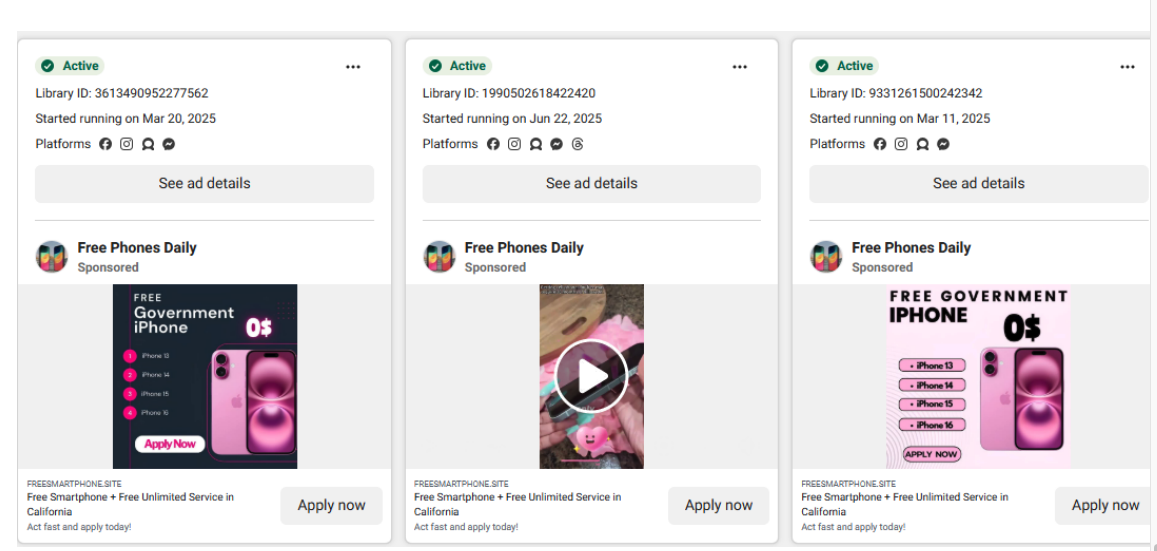
Meta is facing a new lawsuit over its advertising practices. The nonprofit group Consumer Federation of America (CFA) has filed a proposed class-action suit against Meta for "failing to protect users" from scam ads on Facebook and Instagram.
The lawsuit, which was first reported by Wired, alleges that Meta has run afoul of consumer protection laws in Washington D.C. for misleading Facebook and Instagram users about scams on its apps and that the company has "chased profits rather than protecting its users." The filing includes numerous examples of alleged scam ads that CFA says it found in Meta's ad library. These include ads promoting a "free government iPhone," as well as those claiming to offer $1,400 checks to people born in certain years. Many of the ads use AI videos, according to CFA.
Some of examples of alleged scam ads CFA includes in its lawsuit.
CFA
Meta's advertising practices have been in the spotlight since last year when Reuters reported on internal documents that indicated the company was making billions of dollars from ads promoting scams and banned goods. The report also highlighted how Meta's own processes have at times made it harder for its own employees to fight malicious advertisers.
"Meta claims it is doing all it can to crack down on scam advertising on its platforms," CFA's lawsuit states. "But in reality, Meta has knowingly taken steps and adopted policies that pad its bottom line at the expense of its users’ safety and well-being. In fact, rather than prohibiting advertisers who the company itself has determined pose a higher risk to its users (as other tech companies like Google have), Meta just charges these advertisers more. The perverse result is that the riskier the advertiser, the more money Meta makes."
CFA's allegations "misrepresent the reality of our work and we will fight them," a Meta spokesperson said in a statement. "We aggressively combat scams across our platforms to protect people and businesses — last year alone, we removed over 159 million scam ads, 92% of which we took down before anyone reported them, and took down 10.9 million accounts on Facebook and Instagram associated with criminal scam centers. We fight scams because they are bad for business — people don't want them, advertisers don't want them, and we don't want them either.”
This article originally appeared on Engadget at https://www.engadget.com/social-media/meta-has-misled-users-about-scam-ads-on-facebook-and-instagram-lawsuit-says-193220235.html?src=rss
New York is the latest state to take a stand against prediction markets. Attorney General Letitia James has sued Coinbase Financial Markets and Gemini Titan on charges that both are illegally running unlicensed gambling operations. The suit also claims that these prediction markets violate state laws that prevent betting on games involving New York college sports teams.
"Gambling by another name is still gambling, and it is not exempt from regulation under our state laws and Constitution," James said. "Gemini and Coinbase’s so-called prediction markets are just illegal gambling operations, exposing young people to addictive platforms that lack the necessary guardrails."
Multiple states have taken similar actions over the proliferation of prediction markets, but they may face a new roadblock at the federal level. Earlier this month, the US Commodity Futures Trading Commission sued three of the states that have charged prediction markets with running unlicensed gambling. The CFTC claimed that it should be the sole regulator for prediction markets and called the efforts by Arizona, Connecticut and Illinois an overreach of authority.
This article originally appeared on Engadget at https://www.engadget.com/big-tech/new-york-attorney-general-sues-two-prediction-markets-on-illegal-gambling-allegations-192012225.html?src=rss
Florida Attorney General James Ulthmeier has announced that the state's Office of Statewide Prosecution has opened a criminal investigation into OpenAI and ChatGPT. The investigation was opened because the suspect in a mass shooting at Florida State University in 2025 reportedly used ChatGPT in the lead up to the shooting.
Per Uthmeier, "Florida law states that anyone who aids, abets, or counsels someone in the commission of a crime, and that crime is committed or attempted, may be considered a principal to the crime." That means that the responses provided by ChatGPT to the shooter could be interpreted as the AI assistant aiding and abetting his actions. Or at least that's what Florida seems interested in arguing.
OpenAI provided the following statement when asked to comment on the Florida investigation:
Last year's mass shooting at Florida State University was a tragedy, but ChatGPT is not responsible for this terrible crime. After learning of the incident, we identified a ChatGPT account believed to be associated with the suspect and proactively shared this information with law enforcement. We continue to cooperate with authorities. In this case, ChatGPT provided factual responses to questions with information that could be found broadly across public sources on the internet, and it did not encourage or promote illegal or harmful activity. ChatGPT is a general-purpose tool used by hundreds of millions of people every day for legitimate purposes. We work continuously to strengthen our safeguards to detect harmful intent, limit misuse, and respond appropriately when safety risks arise.
As part of the investigation, Florida has subpoenaed OpenAI for information on "all policies and internal training materials" related to how the company handles things like users threatening to harm others, threatening to harm themselves and how OpenAI responds to law enforcement. The state is also asking OpenAI to share its organizational chart and any publicly released statements on the shooting.
"Florida is leading the way in cracking down on AI's use in criminal behavior, and if ChatGPT were a person, it would be facing charges for murder," Attorney General James Uthmeier said. "This criminal investigation will determine whether OpenAI bears criminal responsibility for ChatGPT's actions in the shooting at Florida State University last year."
Florida’s investigation isn’t the first time OpenAI has been connected to a mass shooting. Canadian regulators called for OpenAI to change how it approaches threats of harm following a Wall Street Journal report that claimed the company flagged the account of a Canadian shooting suspect in 2025 but failed to bring their threats to law enforcement. The company agreed to new policies around how it works with Canadian law enforcement in March. Separately, OpenAI is still in the midst of a wrongful death lawsuit from 2025 for the role it may have played in the suicide of a teenage user.
This article originally appeared on Engadget at https://www.engadget.com/ai/florida-ag-opens-criminal-investigation-into-openai-and-chatgpt-190200227.html?src=rss
A little more than a year after OpenAI gave ChatGPT users the option to create images and designs directly from its chatbot, it's now releasing ChatGPT Images 2.0. OpenAI describes the new system as a “step change” for image generation models, particularly when it comes to the tool’s ability to follow instructions in detail, render dense text and place and relate objects in a scene. For the first time, OpenAI has also built an image model with reasoning capabilities, giving the system the ability to do things like search the web and verify its outputs. According to the company, those capabilities should translate to a tool that's more reliable when accuracy, consistency and visual cohesion are essential.
An example of ChatGPT's new non-Latin rendering abilities.
OpenAI
OpenAI says it has also put in a lot of work to make Images 2.0 better at understanding and rendering non-Latin text, with "significant gains" when it comes to the model's ability to handle Japanese, Korean, Chinese, Hindi and Bengali. At the same time, the company claims the new model is better at faithfully recreating the specific characteristics of different visual languages. On this point, OpenAI says that makes Images 2.0 more useful for tasks like game prototyping and storyboarding. Outside of those features, the new model is more flexible when it comes to aspect ratios, allowing it to generate images that are as wide as 3:1 and as tall as 1:3. It can also produce designs at resolutions of up to 2K, and even generate up to eight outputs in one go.
A tortoiseshell cat in the style of Pokemon's third generation of games.
ChatGPT
I got a chance to preview Images 2.0 ahead of its public release. For my first prompt, I asked ChatGPT to generate an image of a tortoiseshell cat in the pixel art style of Pokémon's third generation. I thought this would be a good test because AI models typically struggle with pixel art, and the Game Boy Advance Pokémon games are iconic for their art style, so much so that if ChatGPT merely approximated that style, it wouldn't do. The result is the image you see above, and I think ChatGPT did a commendable job there. I then tasked the new model with converting that image into a transparent PNG. For one last test, I asked ChatGPT to create a four-page manga about my cat enjoying a sunny day by an idyllic city stream.
Notice how the cat isn't render exactly like the one above it.
ChatGPT
Of those three tests, ChatGPT spent the most time on the second one and the output there was slightly different from the first image it generated, which I felt deviated from my prompt. Still, it managed to generate a proper transparent image, which is something other image models can struggle to do properly. Once more people have a chance to put the model through its paces, we’ll have a better idea of how it compares to Google’s Nano Banana 2, and where OpenAI can make additional improvements.
A manga generated by ChatGPT about a cat enjoying a sunny day.
ChatGPT
Images 2.0 is available starting today for all ChatGPT users, including those on the company's Free and Go tiers. Plus and Pro subscribers get access to more advanced outputs. OpenAI is also making the model available through its API service and Codex coding app, which just last week it updated to offer built-in image generation. Notably, Images 2.0 arrives just days after Anthropic waded into the visual design market with its own design assistant.
This article originally appeared on Engadget at https://www.engadget.com/ai/chatgpt-images-20-is-better-at-rendering-non-latin-text-190000153.html?src=rss
The new footage promises plenty of action and franchise fans will note that protagonist Dante now looks extremely similar to his counterpart from the games. This tracks with what series creator Adi Shankar said last year, when he promised that season two would show the character "embrace more of the iconic badassery fans of the game expect."
The show, and the games, follow a half-demon demon hunter as he fights to prevent the gates of Hell from opening. The first season was a gigantic hit for the platform, racking up more than 5 million views in its first four days of release.
Showrunner Shankar was heavily involved with the animated Castlevania adaptation, also for Netflix. Studio Mir is once again handling the animation, which is always great to see. This is the studio behind The Legend of Korra, X-Men '97, Kipo and the Age of Wonderbeasts and My Adventures with Superman, among others. The first season of Devil May Cry looked gorgeous, so season two should follow suit.
This article originally appeared on Engadget at https://www.engadget.com/entertainment/tv-movies/netflixs-devil-may-cry-animated-adaptation-returns-for-a-second-season-on-may-12-184003226.html?src=rss
Framework’s Laptop 13 Pro may be the star of today’s launch, but it is by no means the only product the company is unveiling. We’re also seeing some quality-of-life upgrades for the Laptop 16, a new wireless keyboard and a carrying case. Plus, it’s addressing something a vast number of its own users have demanded for a while: A 10GB Ethernet expansion card.
Laptop 16
Framework
The top deck of the Laptop 16 is sufficiently customizable that you can cram in any number of modules alongside the keyboard and trackpad. If you want an area blank, then you can just put in the requisite spacer, but that creates an unintended problem for some users. CEO Nirav Patel admitted the areas where the modules sit side-by-side can trap some people’s arm hairs, leading to some unplanned depilations when they move away from the deck. To solve this, the company is releasing a new all-in-one trackpad and all-in-one keyboard cover. The trackpad has also been updated to the same haptic model found in the 13 Pro. Plus, it’s now available with a lower-end Ryzen 5 340 mainboard as a more affordable entry level model.
OCuLink Dev kit
At the back of the Laptop 16 is an expansion module slot that either holds a blank unit or the discrete graphics hardware. Last year, the company launched a module with an RTX 5070 inside and, now, it’s started thinking about using it for eGPUs as well. The OCuLink Dev Kit (pictured, above) is a prototype board using OCuLink 8i which can connect directly to your mainboard over its native PCIe lanes.
If you already own a blank module, you won’t need to buy a replacement either. Framework has ensured you can simply drop the OCuLink board into the slots of your existing one. As well as the board, the kit includes an OCuLink Dock that’ll let you slot in any off-the-shelf PCIe card — including GPUs, 100Gb Ethernet and video capture — and run it as if you had your very own desktop.
Sadly, it’s not yet ready for prime time and so far all the company has said is we’ll see more about the hardware “later this year.”
Wireless Touchpad Keyboard
Framework
“There’s one living room keyboard that everyone owns, that Logitech keyboard they haven’t updated in 15 years,” said Patel. “I’ve got two of them, polled the team, and a bunch of them all have the same keyboard,” he added. But Patel’s frustration drove him and his team to build their own, better model, which has been an idea since development work started on the Framework Desktop. It was only when the team learned that the Desktop was being used as a living room PC, however, that they actually brought it to market. It is, in fact, using the same excellent keyboard hardware as found on the Framework Laptop 12, repackaged for its all-in-one form.
Laptop Sleeve
Framework
Framework’s built a laptop sleeve containing extra pockets for your spare expansion cards and screwdriver. Patel said that the real focus was on ensuring the materials used had as small a carbon footprint as possible.
10Gb Ethernet Expansion Card
Framework / WisdPi
Rounding out the announcements is a 10Gb Ethernet expansion card for users who want a faster wired internet experience than the current 2.5Gb model. But this isn’t a Framework product per-se, but was designed and developed by hardware makers Wisdpi. Patel said the community is so passionate that they’re constantly looking at new chip and hardware announcements. They then head to the company’s forums to ask “Hey, like, can we get a Framework version of this?” he explained. The advent of a slender 10Gb Ethernet chip was enough to inspire one third-party developer to build an Expansion Card module to harness it. “Basically, we got in contact with them,” said Patel and offered some guidance to help build the module. And once it was finished, Framework is now acting as a reseller to enable the whole community to easily buy it. Patel admitted that a 10Gb Ethernet Card would inevitably cater to a fairly niche customer, but “love to see a third party come in and fill that gap.”
This article originally appeared on Engadget at https://www.engadget.com/computing/laptops/framework-is-building-an-egpu-kit-for-its-laptop-16-181516238.html?src=rss
Framework’s lineup of modular, repairable laptops has seen the company grow from a niche to the mainstream. Now, the company is launching a pro version of its 13-inch laptop, but it’s still held close to all of its principles. Because while this all-new version has plenty of bells and whistles, almost all of its components are still instantly compatible with the rest of the range. You can take a part from this new 13 Pro, and install it into the first-generation 13 launched back in 2021 without much fuss.
Framework Laptop 13 Pro is touted as a “ground up redesign” of the existing 13, taking into account feedback from its dedicated and passionate users. That includes a far bigger battery, new chassis, new memory, haptic trackpad and a custom touch display. It also comes in black and, even in the press images, it’s immediately clear it’s a better color for the company’s austere industrial design. CEO Nirav Patel smiled knowingly when I said it’s immediately evocative of a ThinkPad, and I mean that in the most complimentary way.
Framework
The biggest change has been to boost the battery to 74Wh to address gripes about longevity. It’s the second time Framework has boosted the cell size, which started at 55Wh and presently runs to 61Wh. To make the battery fit, the bottom of the chassis has been redesigned, filling out the chamfers present on the existing 13. Framework says the Pro’s lifespan will hit 20 hours of uptime while streaming Netflix in 4K, and says it’ll post the videos to YouTube to prove it.
Given the redesigned lower chassis, the new battery is the one part you can’t simply drop into an older machine. “You’ll need the new bottom cover to fit,” explained Patel, “but because we’ve also increased the thickness of the battery, you have to switch over to the new input cover that has the haptic trackpad.” Patel added while you may need to pair up some parts from upgrades, there’s no component that you can’t retrofit. The new chassis means the speakers are now side-firing, and are now Dolby Atmos-certified.
The bigger battery is working in tandem with Intel’s new Core Ultra Series 3 chips which promise to be incredibly efficient. Both Intel and Framework are sure the Panther Lake silicon is going to sip at that beefy battery, but with enough grunt to play AAA games. Users will get the pick of a Core Ultra 5, X7 or X9, with the promise all of them will be able to eat a game like Cyberpunk 2077 for breakfast, lunch and dinner. At the same time, the Pro will also launch with an AMD Ryzen AI 300 series mainboard option, which are the same mainboards found on the 2025 Laptop 13.
Framework
The last major shift has been in the RAM, going from regular SO-DIMMs to LPCAMM2. The newer hardware design enables the use of LPDDR5X RAM with its better power efficiency and faster memory bandwidth. And it’s not soldered to the board, so you can add in more at some unspecified future date. Which is important if, I dunno, for some reason the global RAM market suddenly crunches and you need to mortgage a kidney for a single stick.
Naturally, I wanted to know how this would impact the laptop’s thermals, Framework’s weak spot. Patel said the mainboard’s cooling has been tweaked (once again), this time with some extra help from Intel. He added the Pro he was using to run our call hadn’t spun up its fans in half an hour which, for a Framework, is a big deal. As always, I’ll reserve judgment until I’ve seen the thing in person.
The Pro is also a way for Patel to fix some of the compromises the company had to make at its genesis. “As a startup six years ago, we just didn’t have access,” said Patel, “when we go to a display vendor [now] and say ‘we want a custom panel’ they say ‘okay, let’s talk specs’ rather than ‘who are you?”’ The 13 Pro ships with a 13.5-inch, 3:2, 2,880 x 1,920 touch display with a variable refresh rate between 30 and 120Hz. Its backlight pushes all the way to 700nits, it has a 1800:1 contrast ratio and per-unit color calibration.
I was surprised the 13 Pro has touch given it’s still a 13-inch productivity notebook without a wraparound hinge. “All the way back in 2021, when we first launched, we were getting asked for touch support,” said Patel. But the company was naturally resistant, assuming touch was an unnecessary addition for a machine of this class. It was only when building the Laptop 12 did the team find it to be quite useful. “It was a slam dunk. We know people want it, we used it on the 12, we like it and it doesn’t actually cost that much. Let’s just add it in,” said Patel.
Framework
Framework knows touchpads are a weak spot for Windows laptops when compared to those made by Apple. Consequently, the Pro 13 has a haptic touchpad with four piezo elements that, it’s hoped, will stand shoulder-to-shoulder with a MacBook Pro. The new input cover keeps the came keyboard and fingerprint sensor, wisely not touching a feature that isn’t broken and doesn’t need fixing. What is cool, however, is the more punky gray and black aesthetic on the keyboard that splits the difference between a ThinkPad and a cyberdeck. “A big part of this goes back to the idea to build the ultimate developer laptop,” said Patel.
Existing Framework owners may be concerned about how this will affect their machine’s longevity. The company might not like me saying, but to me, the Pro name is only meaningful if you’re buying a new machine off the shelf with the new features in one package. There’s nothing stopping you from upgrading your existing machine to match the pro in one go, or as your needs evolve. That’s fundamentally the company’s greatest strength, since it has committed to bringing every single one of its existing users along. But doesn’t make for the splashiest headlines when it comes to debut a new product.
Framework Laptop 13 Pro is available to pre-order today, with the first shipments due to start in June. The base-model pre-built Windows system will start at $1,699, while the DIY model will set you back $1,199.
This article originally appeared on Engadget at https://www.engadget.com/computing/laptops/framework-launches-the-laptop-13-pro-with-intels-new-panther-lake-chips-181503934.html?src=rss
Monterey Park's city council has moved to ban construction of any data centers within its borders. The California city's leaders placed a permanent ban on these buildings, labelling them a public nuisance. A proposed plan to construct a 250,000 square foot data center was stopped after residents and advocates pushed back against the project.
Tech journalist Brian Merchant reported on the public comment phase of the city council meeting where residents spoke decisively about data centers. "I can tell you that this issue has brought left, right and center together. It’s a quality of life issue," one commenter said. "Don’t let the rich steal our future."
Monterey Park may be the first US city to lay down the law blocking data center projects, but others are primed to follow suit. New York's state leadership is working on legislation that would prevent data center construction for three years. Maine has a similar bill that has already made it to the governor's desk. At the federal level, Rep. Alexandria Ocasio-Cortez (D-NY) and Senator Bernie Sanders (I-VT) have proposed a ban on building new data centers until there are more guardrails in place for AI development and environmental security.
Existing facilities have also faced some pushback. For instance, the NAACP is suing xAI for alleged violations of the Clean Air Act at its data center in South Memphis.
This article originally appeared on Engadget at https://www.engadget.com/ai/monterey-park-california-has-banned-any-data-centers-within-its-city-limits-180426656.html?src=rss
The search for signs of life on Mars continues to yield promising data. A first-of-its-kind wet chemistry experiment, published Tuesday in Nature, confirmed the presence of essential ingredients of life preserved in ancient Martian sandstones.
The molecules were found inside 3.5-billion-year-old sandstone. NASA's Curiosity rover collected the clay-filled rocks from an area called Glen Torridon, inside Mars' enormous Gale Crater. The rover's Sample Analysis at Mars (SAM) mobile instrument suite analyzed the data.
The experiment was unique as the first off-Earth study to use the chemical tetramethylammonium hydroxide (TMAH). The reagent allows Curiosity to break down larger organic molecules on the Martian surface, reducing them to something the rover's instruments can read.
It revealed the presence of over 20 different organic molecules. Among the data was confirmation of naphthalene and benzothiophene, some of the largest and most complex organic compounds discovered on the Red Planet. The experiment also yielded the first detection of a possible N-heterocycles, which DNA and RNA are built upon.
<p></p>
NASA
“That detection is pretty profound because these structures can be chemical precursors to more complex nitrogen-bearing molecules,” the paper’s lead author, Amy Williams, wrote in NASA’s announcement. “Nitrogen heterocycles have never been found before on the Martian surface or confirmed in Martian meteorites.”
As with previous discoveries of organic material on Mars, this one is not yet the smoking gun we've been waiting for. But it adds to a growing body of evidence that, at a minimum, the foundations of life as we know it were present on an ancient version of the planet. The study also confirms that organic material can survive on Mars for billions of years, which will encourage future experiments.
The paper's authors say the data will help NASA to optimize its second (and final) TMAH experiment on Curiosity. It also opens the door to future TMAH tests on the Rosalind Franklin Mars rover and the Dragonfly mission to Saturn's moon, Titan. Both missions are scheduled for 2028 at the earliest.
This article originally appeared on Engadget at https://www.engadget.com/science/space/nasas-curiosity-rover-found-promising-organic-chemicals-on-mars-174514375.html?src=rss
The relatively long wait for the third season of Silo is nearly over. Apple TV just announced the dystopian sci-fi hit returns on July 3, with episodes airing each Friday until September 4. We have long championed this show, calling it "another gem" for the platform.
The streamer has dropped a short teaser for the upcoming season and it confirms rumors of an increased focus on the "before times" via a storyline that was introduced in the finale of season two. The trailer depicts scenes from both time periods, as protagonist Juliette, played by Rebecca Ferguson, speaks in voiceover.
"Before we can know why we’re here. Before we can know everything is as it is. Before we know how it all will end, we need to understand how it all began,” she says, alluding to the creation of the various bunkers littered throughout the post-apocalyptic wasteland.
For the uninitiated, Silo is an adaptation of Hugh Howey's Wool series of books. It's primarily set in the titular silo, a society of around 10,000 people living deep underground. The show is sort of like Fallout, but without the radioactive monsters and nihilistic sense of humor.
Silo stars Ferguson, along with Tim Robbins, Common and Steve Zahn. Cast members joining the show for season three include Colin Hanks, Jessica Henwick and Ashley Zukerman. The show has already been renewed for a fourth and final season.
This is a busy summer for sci-fi on Apple TV. The second season of Dark Matter premieres on August 28, which is uncharted territory as the first season was based on a book that doesn't have a sequel. Star City, a spinoff of For All Mankind, premieres on May 29. This is the same day that For All Mankind concludes its fifth and penultimate season.
This article originally appeared on Engadget at https://www.engadget.com/entertainment/tv-movies/silos-season-3-trailer-takes-us-back-to-how-it-all-began-171033410.html?src=rss