Urwerk Built a Hand-Carved Pocket Watch That Tracks Time for 1,000 Years

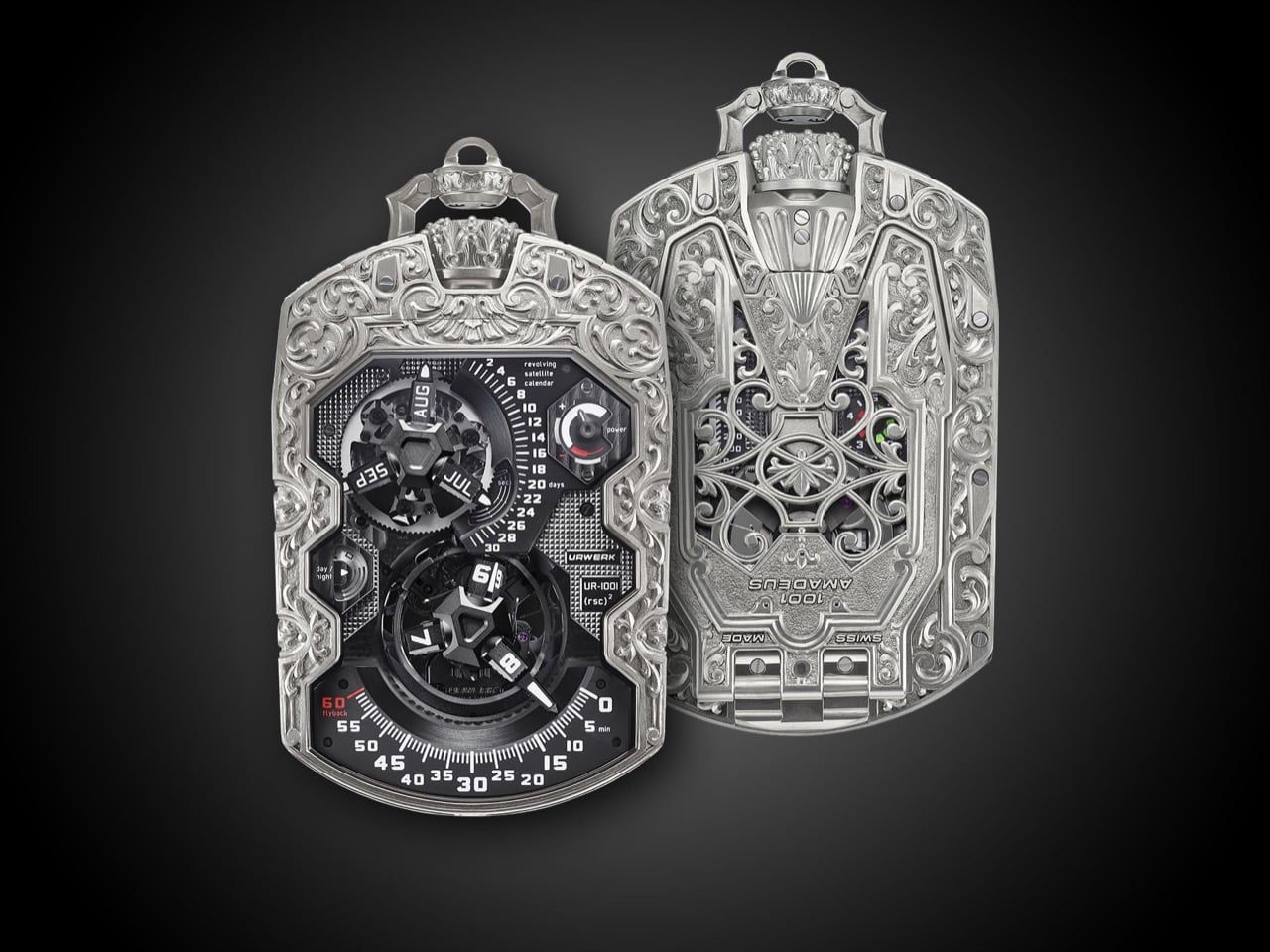
Florian Güllert spends most of his working life engraving shotguns. His bench sits in Klagenfurt, in Carinthia, an Austrian province with zero watchmaking history and a four-century run of decorating hunting weapons. Urwerk handed him a raw titanium blank and asked him to bury the most sci-fi pocket watch ever built under Baroque ornament. He said yes, spent roughly 500 hours over three months, and produced the UR-1001 Amadeus, a piece unique that looks like a cathedral swallowed a computer. Gun engraving exists because a tool meant to outlive its owner gets decorated, which turns out to be this watch’s entire argument.

The Amadeus measures 106 by 62 by 23mm and shows satellite hours, retrograde minutes, an annual calendar, day and night, and a 39-hour power reserve on the front. The hinged caseback adds an oil-change indicator that turns red through years four and five, a counter tracking 100 years of running time, and a linear scale that climbs to 1,000. Güllert laser-cut the contours before touching it by hand, since titanium galls and work-hardens under a graver in ways precious metal does not. Every engraved surface stops at the sapphire. Inside, Urwerk’s matte black instrument panel carries on as though the ornament never happened.

Designers: Martin Frei and Florian Güllert for Urwerk
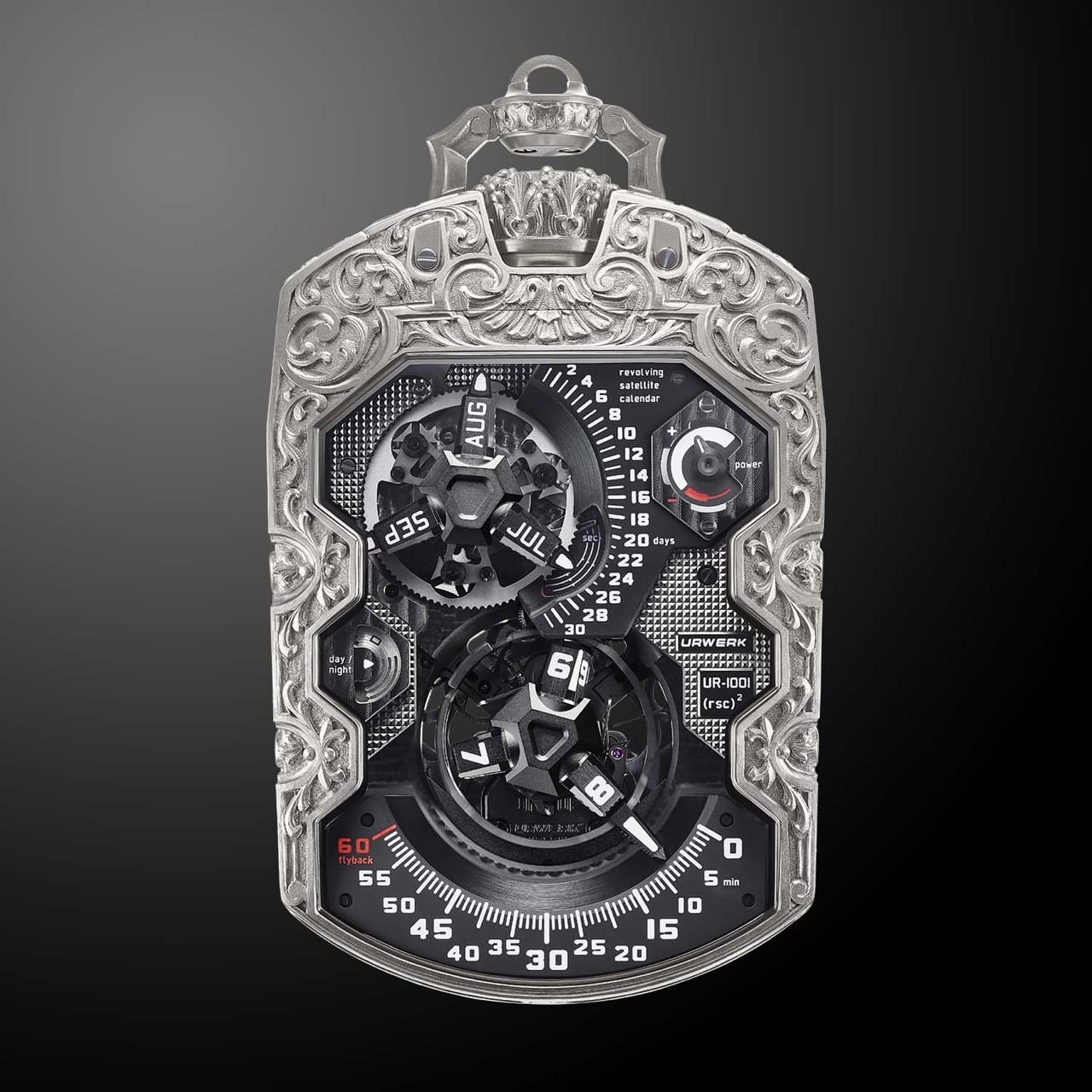
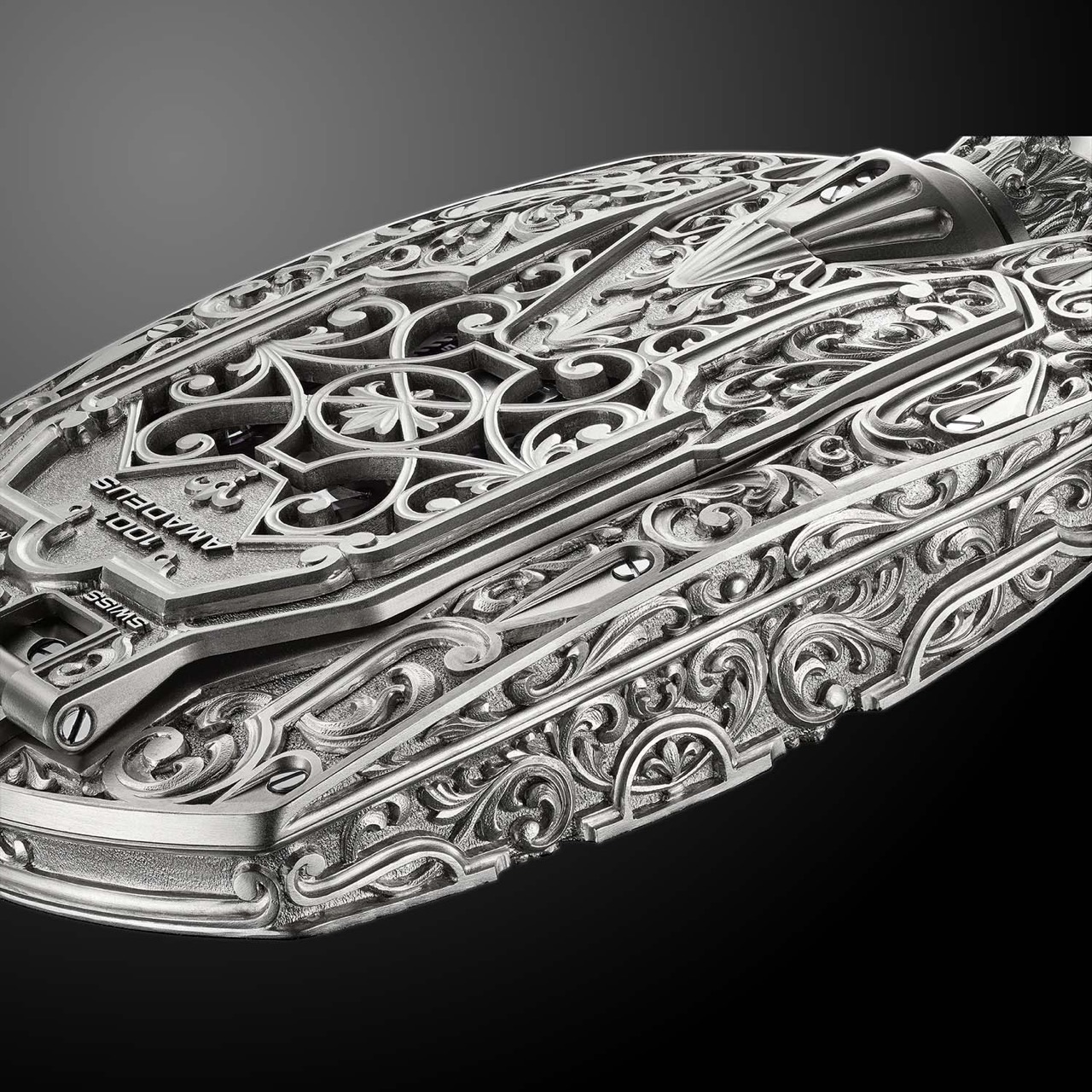
Titanium punishes a graver the way a stubborn hinge punishes a screwdriver, so Güllert’s first move was unfamiliar territory for a man used to steel. He rough-cut the relief with a laser, then went back in by hand with pneumatic chisels and files, balancing thick strokes against thin ones until the pattern read as depth rather than line. Backgrounds got textured, dotted, satin-brushed, or left matte depending on how he wanted light to catch each panel. Every edge was filed and rebalanced until the boundary between case and decoration effectively disappeared. That is a genuinely different skill set than cutting a scroll into a shotgun receiver, and it shows in how uneven the difficulty was across the piece.

The flanks and bezel run pure Baroque, scrolling acanthus leaves that could sit on an 18th century snuffbox. The caseback centerpiece is something else entirely, a quatrefoil rose-window panel with cusped Gothic arches framing the movement aperture, and the winding crown at 12 has been carved into an actual fluted coronet. Baroque excess on the outside, ecclesiastical stonework on the back, industrial sans-serif labeling the instruments inside. Three separate design languages sharing one case, none of them arguing with the others.

Three-armed satellite hours hand off to a retrograde minute display, three running-seconds hands split a minute into 20-second stretches, and a satellite annual calendar runs on three Maltese crosses riding a 93-tooth date wheel. Flip the watch over and the oil-change dial, calibrated for five-year service intervals, feeds a counter that advances in five-year steps toward a full century. Every hundred years, that counter sends a pulse to a linear scale on the caseback graduated all the way to 1,000. Yes, this pocket watch has a mechanical millennium indicator, and yes, it is exactly as absurd and wonderful as it sounds.
The UR-1001 has been Urwerk’s flagship strange object since 2011, when eight AlTiN-cased examples sold out at CHF 340,000 each, a number early buyers reportedly called cheap for what it did. We covered Urwerk’s other engraved oddities before, including the UR-210 Amadeus that first paired Güllert with the brand back in 2017, and the ambition here is visibly larger. Urwerk has not disclosed a price for this one, which tracks for a commissioned piece unique. Felix Baumgartner named it for Mozart, calling the composer a brilliant madman, and says he wanted a case as daring as the mechanics inside it.

Here is the part nobody selling this watch will say out loud. The 100-year and 1,000-year counters only advance while the movement is actually running, and a piece unique this expensive tends to spend its life in a safe rather than a pocket. Baumgartner’s own language calls the eventual buyer a custodian rather than an owner, which is a lovely way of admitting the millennium scale may never move past zero. A gunsmith spent 500 hours making sure it would look magnificent the whole time it doesn’t.

The post Urwerk Built a Hand-Carved Pocket Watch That Tracks Time for 1,000 Years first appeared on Yanko Design.


Urwerk Built a Hand-Carved Pocket Watch That Tracks Time for 1,000 Years

Florian Güllert spends most of his working life engraving shotguns. His bench sits in Klagenfurt, in Carinthia, an Austrian province with zero watchmaking history and a four-century run of decorating hunting weapons. Urwerk handed him a raw titanium blank and asked him to bury the most sci-fi pocket watch ever built under Baroque ornament. He said yes, spent roughly 500 hours over three months, and produced the UR-1001 Amadeus, a piece unique that looks like a cathedral swallowed a computer. Gun engraving exists because a tool meant to outlive its owner gets decorated, which turns out to be this watch’s entire argument.

The Amadeus measures 106 by 62 by 23mm and shows satellite hours, retrograde minutes, an annual calendar, day and night, and a 39-hour power reserve on the front. The hinged caseback adds an oil-change indicator that turns red through years four and five, a counter tracking 100 years of running time, and a linear scale that climbs to 1,000. Güllert laser-cut the contours before touching it by hand, since titanium galls and work-hardens under a graver in ways precious metal does not. Every engraved surface stops at the sapphire. Inside, Urwerk’s matte black instrument panel carries on as though the ornament never happened.

Designers: Martin Frei and Florian Güllert for Urwerk

Titanium punishes a graver the way a stubborn hinge punishes a screwdriver, so Güllert’s first move was unfamiliar territory for a man used to steel. He rough-cut the relief with a laser, then went back in by hand with pneumatic chisels and files, balancing thick strokes against thin ones until the pattern read as depth rather than line. Backgrounds got textured, dotted, satin-brushed, or left matte depending on how he wanted light to catch each panel. Every edge was filed and rebalanced until the boundary between case and decoration effectively disappeared. That is a genuinely different skill set than cutting a scroll into a shotgun receiver, and it shows in how uneven the difficulty was across the piece.

The flanks and bezel run pure Baroque, scrolling acanthus leaves that could sit on an 18th century snuffbox. The caseback centerpiece is something else entirely, a quatrefoil rose-window panel with cusped Gothic arches framing the movement aperture, and the winding crown at 12 has been carved into an actual fluted coronet. Baroque excess on the outside, ecclesiastical stonework on the back, industrial sans-serif labeling the instruments inside. Three separate design languages sharing one case, none of them arguing with the others.

Three-armed satellite hours hand off to a retrograde minute display, three running-seconds hands split a minute into 20-second stretches, and a satellite annual calendar runs on three Maltese crosses riding a 93-tooth date wheel. Flip the watch over and the oil-change dial, calibrated for five-year service intervals, feeds a counter that advances in five-year steps toward a full century. Every hundred years, that counter sends a pulse to a linear scale on the caseback graduated all the way to 1,000. Yes, this pocket watch has a mechanical millennium indicator, and yes, it is exactly as absurd and wonderful as it sounds.

The UR-1001 has been Urwerk’s flagship strange object since 2011, when eight AlTiN-cased examples sold out at CHF 340,000 each, a number early buyers reportedly called cheap for what it did. We covered Urwerk’s other engraved oddities before, including the UR-210 Amadeus that first paired Güllert with the brand back in 2017, and the ambition here is visibly larger. Urwerk has not disclosed a price for this one, which tracks for a commissioned piece unique. Felix Baumgartner named it for Mozart, calling the composer a brilliant madman, and says he wanted a case as daring as the mechanics inside it.

Here is the part nobody selling this watch will say out loud. The 100-year and 1,000-year counters only advance while the movement is actually running, and a piece unique this expensive tends to spend its life in a safe rather than a pocket. Baumgartner’s own language calls the eventual buyer a custodian rather than an owner, which is a lovely way of admitting the millennium scale may never move past zero. A gunsmith spent 500 hours making sure it would look magnificent the whole time it doesn’t.

The post Urwerk Built a Hand-Carved Pocket Watch That Tracks Time for 1,000 Years first appeared on Yanko Design.

Samsung Galaxy S27 Ultra: the Design Change Nobody Saw Coming

Samsung Galaxy S27 Ultra: the Design Change Nobody Saw Coming Render showing the rumored back panel of the Samsung Galaxy S27 Ultra.

The Samsung Galaxy S27 Ultra introduces a bold new chapter in smartphone design, showcasing a striking departure from its predecessors. Central to this transformation is the innovative horizontal camera bar, a feature that not only reimagines the device’s aesthetics but also hints at functional advancements. While the overall dimensions of the Galaxy S27 Ultra remain […]

The post Samsung Galaxy S27 Ultra: the Design Change Nobody Saw Coming appeared first on Geeky Gadgets.

Posted in Uncategorized

Indonesian Certification A05197 Hints at Garmin Enduro 4

Indonesian Certification A05197 Hints at Garmin Enduro 4 A person wearing a Garmin Enduro smartwatch on a hiking trail.

Garmin’s Enduro series has long been synonymous with durability and endurance, catering to outdoor enthusiasts who prioritize battery life and rugged performance over feature-packed versatility. In a recent release recap by TechAvid, attention shifts to the possibility of an Enduro 4 launch following the debut of the Fenix 9 series. A key detail fueling speculation […]

The post Indonesian Certification A05197 Hints at Garmin Enduro 4 appeared first on Geeky Gadgets.

Posted in Uncategorized

This 1,608-Piece LEGO David Comes with Its Own Historically Accurate ‘Detail’

Michelangelo never gave David a fig leaf. Prudish museum directors did that centuries later, and one particularly famous plaster cast fig leaf still exists today, hanging on removable hooks at the Victoria and Albert Museum, ready to be clipped on whenever Queen Victoria or her modern equivalents came through for a tour. It is one of art history’s great compromises. You cannot un-carve marble, but you absolutely can hang a strategically placed leaf on it and call the problem solved.

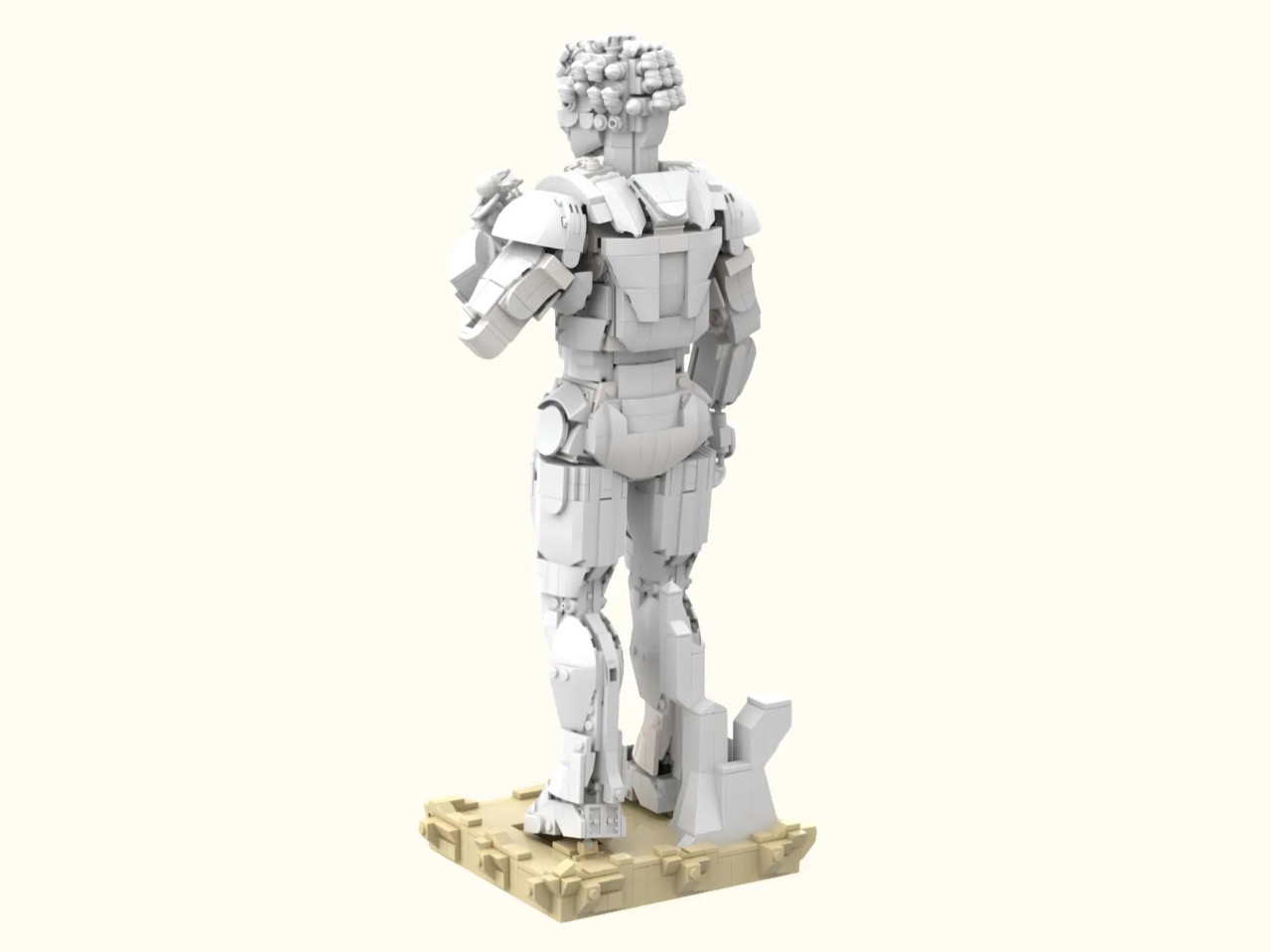
LEGO builder paaadilla.17 just pulled the same move, except this time the leaf is a single green element and the whole statue is made of ABS plastic. His Ideas submission recreates David in full, not just the bust, standing at nearly 41 centimeters tall across 1,608 pieces, fig leaf included as the build’s cheekiest and most historically accurate detail. It already has a Staff Pick badge, which tells you LEGO’s own team appreciated the joke too.

Designer: paaadilla.17

Michelangelo famously carved David before the fight rather than after it, weight shifted onto one leg, sling draped over the shoulder, torso twisted into that slight S-curve that makes the whole figure feel like it is about to move. Getting that tension across in interlocking plastic, without a single curved surface to cheat with, is genuinely hard, and paaadilla.17 leans on layered slopes and offset bricks to fake the contrapposto rather than flatten it into a stiff standing minifig pose. He also gave David a tan colored base instead of matching the white brickwork, a small choice that does the same job as gallery lighting, making the figure pop instead of blending into its own plinth.

My favorite detail, though, is the tiny Michelangelo minifigure standing beside his creation, mallet and chisel in hand, looking like he just stepped away for a coffee. It is a genuinely nice callback to LEGO’s Starry Night Ideas set from 2022, which shipped with its own Van Gogh minifig at an easel, and it suggests LEGO already knows this artist-plus-artwork formula sells. Scale wise, a true minifig-accurate David would only stand about 12 centimeters given the standard 1 to 42 ratio, so this one towers over its sculptor on purpose, which is oddly fitting since the real David was carved oversized to read correctly from 80 meters up on a cathedral roofline that never actually happened.

The build is currently sitting at 1,187 supporters and already picked up that Staff Pick badge, with 575 days left on the clock to hit the 5,000 mark before the real climb to 10,000 begins. If it gets there, LEGO’s review board takes over, and honestly, between the pose, the base, and that fig leaf doing its silent historical duty, this feels like exactly the kind of art-meets-brick submission that has a real shot. Head over to LEGO Ideas and give it your vote, David has waited five centuries for worse odds than this.

The post This 1,608-Piece LEGO David Comes with Its Own Historically Accurate ‘Detail’ first appeared on Yanko Design.
Apple’s $899 M6 Mac Mini Is Powerful, but Is It Still a Budget Champion?

Apple’s $899 M6 Mac Mini Is Powerful, but Is It Still a Budget Champion? Mac Mini

Apple’s latest updates to the Mac Mini and Mac Studio have ignited discussions across the tech community, particularly regarding pricing strategies and hardware configurations. The Mac Mini, once celebrated for its affordability, now starts at $899, marking a notable increase from its previous base price of $599. This $300 jump, combined with minimal hardware upgrades […]

The post Apple’s $899 M6 Mac Mini Is Powerful, but Is It Still a Budget Champion? appeared first on Geeky Gadgets.

Posted in Uncategorized