To comply with Australia's under-16 social media ban, Meta said on Medium that it has shut down nearly 550,00 accounts. That number includes 330,000 Instagram, 173,000 Facebook and 40,000 Threads accounts deemed to belong to children. "Ongoing compliance with the law will be a multi-layered process that we will continue to refine, though our concerns about determining age online without an industry standard remain," the company wrote.
Australia's minimum age social media ban, the first of its kind in the world for a democracy, went into effect on December 10. The ten platforms affected, including Facebook, Instagram, TikTok, Snapchat, X, Reddit and Twitch, must bar underage users or face a fine of up to $AUD 49.5 million ($33 million). Platforms are using a variety of means to determine age, including age inference based on activity and selfies.
Some of those platforms aren't taking the ban lying down. Reddit, which launched a lawsuit against the Australian government, argued that it shouldn't have been included in the ban since it isn't a social media site, while adding that it comes with some "serious privacy and political expression issues" for users.
Meta also expressed its opposition to the ban, citing a number of factors. It says taking social media out of the hands of teens can isolate them from getting support from online communities, and that the ban is only driving them to "less regulated parts of the internet." It also sites inconsistent age verification methods and a lack of interest in compliance from teens and parents.
However, the fact that Meta has removed almost 550,000 accounts just a month after the ban took affect shows that it is also affecting the company's bottom line. And Meta doesn't have a sterling record when it comes to teen safety, having previously downplayed the frequency of harm to children.
This article originally appeared on Engadget at https://www.engadget.com/social-media/meta-closes-550000-accounts-to-comply-with-australias-kids-social-media-ban-130041356.html?src=rss
Star Trek is in a weird place right now. Less than three years ago we were living in a golden age with five shows on the air, all with different styles and intended audiences. But the universe rapidly contracted, with Picard ending while four other shows were cut short. Strange New Worlds still has another two seasons left, sure, but even that final season got truncated. As it stands, there’s only one project with a firm future right now, and that’s a brand-new show, Starfleet Academy, premiering January 15 on Paramount+.
How this show is received could very well determine the future of Star Trek. That’s a lot to put on it, but there’s something very appropriate given the subject matter. Starfleet Academy takes place in the 32nd century, 900 years after the adventures of James T. Kirk and company, and it takes place at the titular academy, meaning its principal cast is a collection of teens representing the next generation of Starfleet officers. That focus on a younger cadre has led to fans online derisively calling the series “CW Trek” without seeing a single episode.
As Starfleet Academy is technically a Discovery spinoff, it picks up some of that series’ traits. The sleek, shiny sets are back, as well as a few plot threads originally set up in Discovery. The most notable is the collapse of the United Federation of Planets and the rebuilding of both the Federation and Starfleet. In fact, the series picks up on that as early as its second episode, with the Academy hosting a delegation from a once stalwart Federation planet that’s now gone isolationist.
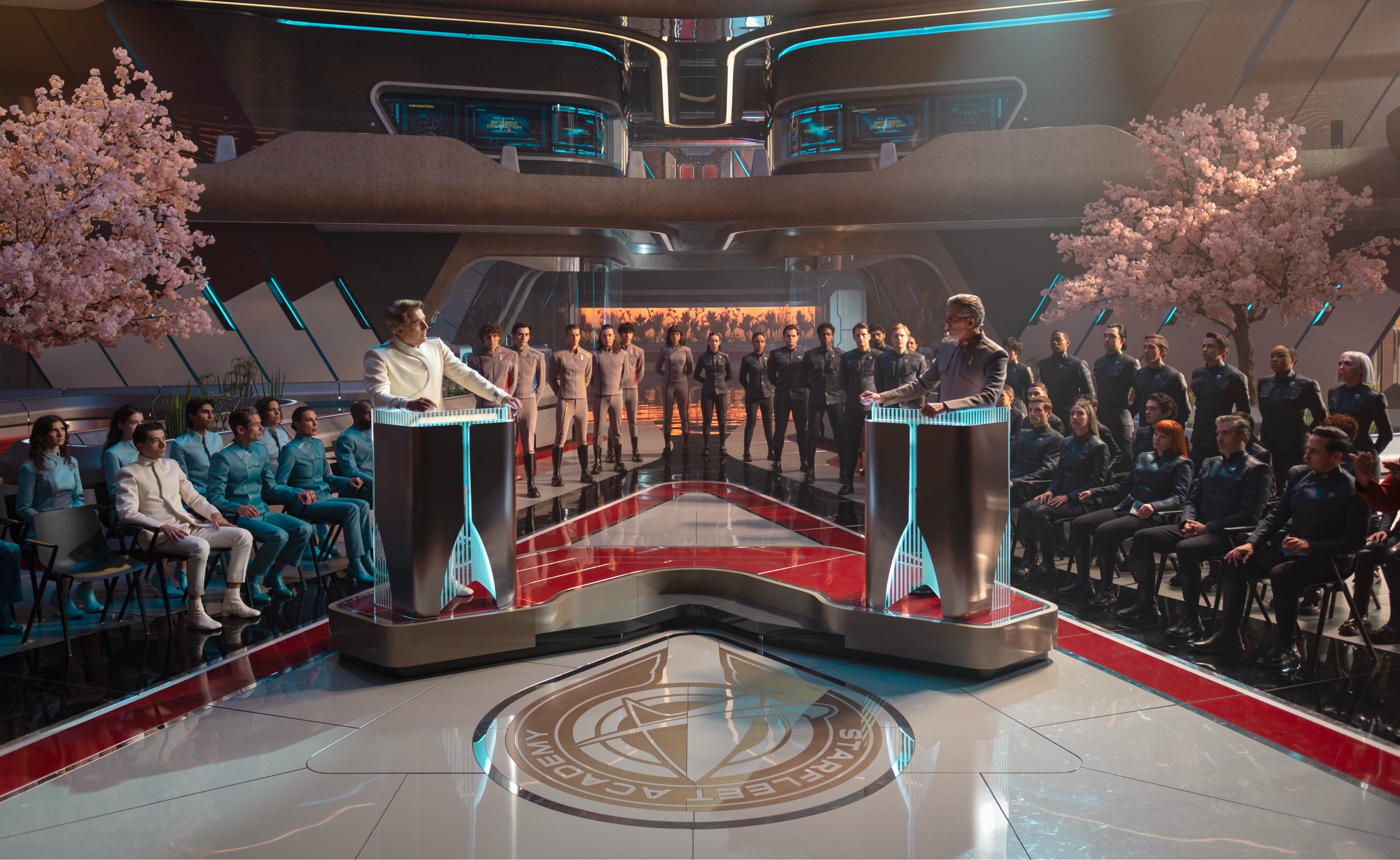
Scenes from Star Trek: Starfleet Academy
John Medland/Paramount+
While many complaints about the series have focused on how what fans wanted was an academy show set during the 24th century (the time of The Next Generation, Deep Space Nine, et al.), this particular episode plot works precisely because of the distant future in which it is set. In a fully-functioning galactic democracy like the United Federation of Planets, there’s no logical reason for the average 18-year-old college freshman to be involved in interplanetary diplomacy. But in the 32nd century, the Federation is a lot scrappier and the individuals involved might be asked to wear many hats. It’s a lot like an early-stage tech startup.
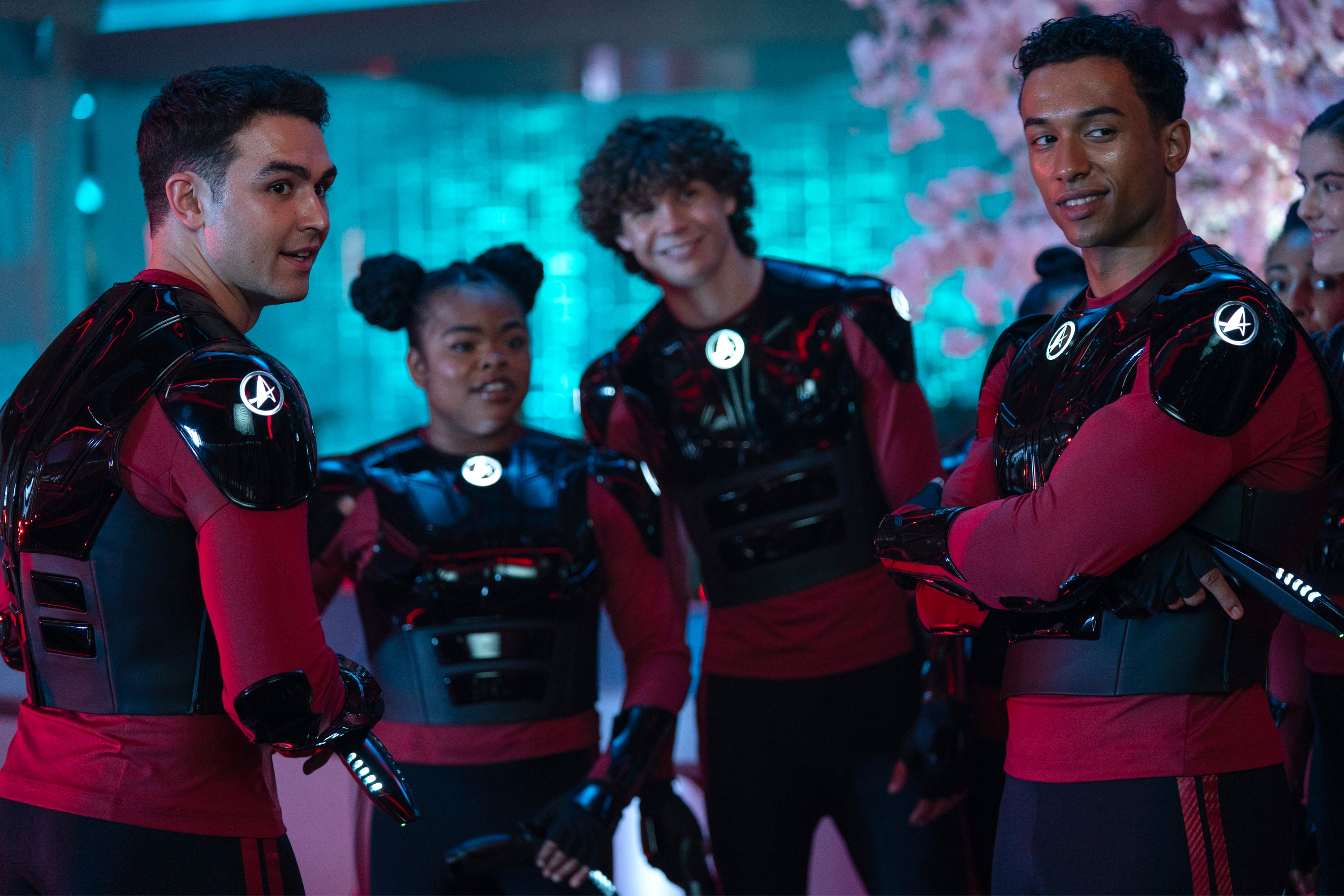
The setting also lets the show be a little more creative with its cast: where TNG featured the first Klingon in Starfleet (Worf), 900 years of progress have created a Starfleet where no one bats an eye when a Klingon cadet like Jay-Den Kraag (played by Karim Diané) shows up to study science. There’s also a holographic cadet, Sam, who is the first of her kind to attend the academy (and she’s super excited to do so). A few new species are present as well: Darem Reymi (George Hawkins) is a Khionian and Genesis Lythe (Bella Shepard) is a Dar-Sha, both aliens making their debut in the Star Trek universe.
The cast of Star Trek: Starfleet Academy
John Medland/Paramount+
However, the show does still lean on some Trek stalwarts, and it’s these characters that have gotten the most chatter from fans. Mary Weisman as Sylvia Tilly was originally slated for the cast, and there was even a backdoor pilot-esque episode of Discovery to tie her in to the new show, but she’s no longer a regular and is nowhere to be seen in the first two episodes. Instead, we have Jett Reno (played by the wonderful Tig Notaro) as supporting cast, and Admiral Vance (Oded Fehr) appearing in a few episodes. And old school fans have been abuzz by the inclusion of The Doctor, who first appeared on Voyager (and later Prodigy). As a hologram, he’s practically immortal so his presence doesn’t need any convoluted explanation, and after 800 years he’s still the same gregarious blowhard (and it’s delightful).
They’re joined by new characters like Lara Thok, a part Klingon, part Jem’Hadar security officer and a Lanthanite chancellor, Nahla Ake, played by Academy Award Winner Holly Hunter. And Hunter isn’t even the only Oscar winner on the cast, with a major villain, Nus Braka, being portrayed by Paul Giamatti.
It’s a stellar cast, and the show’s sets certainly rise up to meet the challenge. Like in the shows of old, a good portion of Starfleet Academy is clearly shot on location, though not in the familiar water reclamation plant that was used back during the TNG and DS9 era. This time it’s all being shot in Ontario, with the outdoor scenes in particular being filmed in Waterloo. Regardless of where it’s shot, it looks enough like sunny California to work.
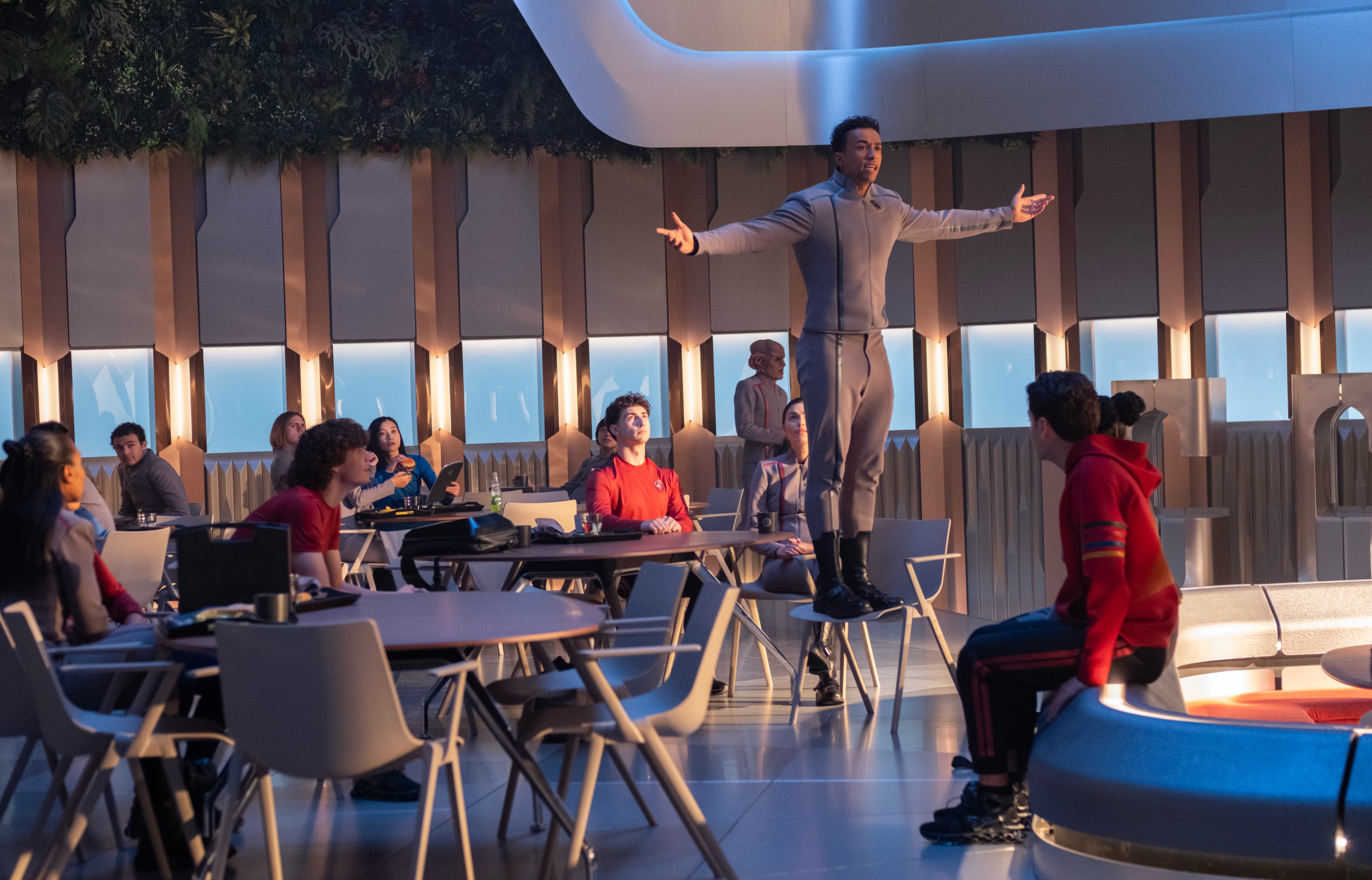
Scenes from Star Trek: Starfleet Academy
John Medland/Paramount+
The indoor scenes, shot at Toronto’s Pinewood Studios, have a pleasant convention center quality to them, with lots of wide hallways and large windows in contrast to Discovery’s cramped ship corridors. The hallways are full of students and teachers going to and fro, including some from species that would normally be off-limits to a show with a limited budget. But here robots and strange aliens roam freely in the background. The CGI can’t have been cheap.
And that’s ultimately my biggest question about Starfleet Academy. Exactly how much is this costing Paramount? So much of it is being shot on real sets instead of green screens, established actors like Hunter and Giamatti couldn’t have been cheap, and plentiful CG points to a robust special effects budget. Though Paramount doesn’t release official numbers, estimates have put an average episode of Strange New Worlds at $10 million, so it figures that Starfleet Academy is probably more than that, with some online estimates as high as $20 million per episode.
With 10 episodes scheduled, that’s on par with a major motion picture budget but without the promise of blockbuster box office returns. No wonder Paramount has been doing so much cost-cutting, which includes axing every other Star Trek show.
That said, Starfleet Academy is carrying a lot on its shoulders. Just as the success or failure of its class of Starfleet cadets will determine the future of Starfleet and the Federation, the success of the show may even affect whether this era of Star Trek continues. As a Star Trek fan, this can be nerve-wracking; no one wants the franchise to go dormant again. But Starfleet Academy has so far shown itself to be up to the challenge.
This article originally appeared on Engadget at https://www.engadget.com/entertainment/star-trek-starfleet-academy-deftly-balances-teen-drama-with-intergalactic-intrigue-170253808.html?src=rss
Xbox will kick off the fourth installment of its Developer Direct event on January 22 at 1PM ET. As usual, we'll get a glimpse at what the upcoming year has in store along with news, new gameplay footage and more directly from the teams behind this year's slate of games.
In a blog post announcing the event, Xbox Wire Editor-in-Chief Jon Skrebels said Xbox's 25-year anniversary will be marked by the return of some beloved franchises. Gamers will also get their first extended look at Fable, a reboot of the iconic series. The event will also be unveiling gameplay footage for Forza Horizon 6, the upcoming open-world racing game set in Japan. UK studio Playground Games is behind both titles.
The showcase will also include new details and gameplay from Beast of Reincarnation, the "one-person, one-dog" role-playing game. The game is being developed by Game Freak, the studio best known for its series of Pokémon games, and follows protagonist Emma and her canine companion in post-apocalyptic Japan.
This article originally appeared on Engadget at https://www.engadget.com/gaming/xbox/the-next-xbox-developer-direct-showcase-is-on-january-22-154444166.html?src=rss
Character.AI and Google have reportedly agreed to settle multiple lawsuits regarding teen suicide and self-harm. According to The Wall Street Journal, the victims' families and the companies are working to finalize the settlement terms.
The families of several teens sued the companies in Florida, Colorado, Texas and New York. The Orlando, FL, lawsuit was filed by the mother of 14-year-old Sewell Setzer III, who used a Character.AI chatbot tailored after Game of Thrones' Daenerys Targaryen. The teen reportedly exchanged sexualized messages with the chatbot and occasionally referred to it as "his baby sister." He eventually talked about joining "Daenerys" in a deeper way before taking his own life.
The Texas suit accused a Character.AI model of encouraging a teen to cut his arms. It also allegedly suggested that murdering his parents was a reasonable option. After the lawsuits were filed, the startup changed its policies and banned users under 18.
Character.AI is a role-playing chatbot platform that allows you to create custom characters and share them with other users. Many are based on celebrities or fictional pop culture figures. The company was founded in 2021 by two Google engineers, Noam Shazeer and Daniel de Freitas. In 2024, Google rehired the co-founders and struck a $2.7 billion deal to license the startup's technology.
On one hand, the settlements will likely compensate the victims' families handsomely. On the other hand, not going to trial means key details of the cases may never be made public. It's easy to imagine other AI companies facing similar suits, including OpenAI and Meta, viewing the settlements as a welcome development.
This article originally appeared on Engadget at https://www.engadget.com/ai/characterai-and-google-settle-with-families-in-teen-suicide-and-self-harm-lawsuits-201059912.html?src=rss
Ubisoft is closing a Canadian studio just over two weeks after it unionized. In a dizzying claim, the company toldGamesIndustry.biz that the closure of Ubisoft Halifax was part of "company-wide actions to streamline operations" and unrelated to the unionization.
On December 22, Ubisoft Halifax announced that 61 of its workers had joined the Game & Media Workers Guild of Canada. At the time, the studio's lead programmer, Jon Huffman, toldCTV News that 73.8 percent of employees voted in favor of unionizing. Ominously in hindsight, he had described the decision as a "huge relief." The studio was working on mobile titles within the Rainbow Six and Assassin's Creed franchises.
Ubisoft's official statement framed the shutdown as part of a broader pattern of financial belt-tightening. "Over the past 24 months, Ubisoft has undertaken company-wide actions to streamline operations, improve efficiency, and reduce costs," the company said. "As part of this, Ubisoft has made the difficult decision to close its Halifax studio. 71 positions will be affected. We are committed to supporting all impacted team members during this transition with resources, including comprehensive severance packages and additional career assistance."
In October, Ubisoft announced that Massive Entertainment, developer of The Division series, Star Wars Outlaws and Avatar: Frontiers of Pandora, was offering buyouts to some employees. The company framed that move as a "voluntary career transition program." Over the past few years, Ubisoft has closed offices and laid off workers in San Francisco, London and Leamington. In 2024, the company's headcount dropped by eight percent.
This article originally appeared on Engadget at https://www.engadget.com/gaming/ubisoft-is-shutting-down-a-studio-16-days-after-it-unionized-183000983.html?src=rss
Spotify is rolling out more social features to keep people on the platform. It's adding a new tool to its messaging platform that lets users see what their friends and family members are listening to in real time.
Once activated, a user's listening activity will be displayed at the top of the chat. The other person in the chat can tap the bar to play a particular track, save it or react with an emoji. People can also, of course, comment directly to either praise or rag on the song selection.
There's another little addition to Spotify's messaging system. Users will now be able to invite chat participants to start a Jam, which is the app's collaborative listening feature. Premium users will find a "Jam" button in the top right corner, which sends an invite. This lets two people add tracks to a shared queue and listen together. Free users can join one of these sessions, but cannot initiate.
It's worth noting that the messaging platform is currently just a one-on-one affair. There's no option for a group chat, so users won't be able to spy on multiple people simultaneously. These tools are rolling out gradually for iOS and Android right now, but won't be broadly available for a few weeks.
This article originally appeared on Engadget at https://www.engadget.com/entertainment/music/spotify-now-lets-you-share-what-youre-listening-to-in-real-time-via-chat-173749120.html?src=rss
WhatsApp just rolled out some upgrades to group chats. Perhaps the most interesting is the addition of member tags, which lets users give themselves a tag that's customized for a specific group.
Meta gives examples of a user assigning themself the role of a dad in one chat and a soccer goalkeeper in another. This could actually be pretty useful to people who use WhatsApp group chats to role play as characters, organize fantasy sports leagues and other stuff like that.
The platform is also rolling out text stickers to group chats. This lets users turn just about any word into a sticker via an integrated search engine. Folks can gather their most-used stickers together for easy access.
Finally, there are event reminders. This is fairly self-explanatory. The tool lets people create early reminders for upcoming events. Meta says that "this helps everyone remember to commute to the party you're hosting or hop on the call at the right time."
This article originally appeared on Engadget at https://www.engadget.com/apps/whatsapp-upgrades-group-chats-with-member-tags-and-text-stickers-161420141.html?src=rss
MTV shut down its remaining 24/7 music channels in several countries, including the UK and Australia, at the end of 2025. The main MTV network shifted its focus to reality shows long ago and it occasionally dips back into music with things like the Video Music Awards, but this shutdown felt like the end of an era. If you yearn for the days when MTV actually played music videos, though, you might be in luck. A developer who goes by the name of Flexasaurus Rex has paid tribute to the MTV of old with a web app that has several channels of non-stop streaming music.
MTV Rewind has 11 channels at the time of writing, including one that features videos from the original channel’s first day of existence in 1981. There’s a channel dedicated to MTV Unplugged performances, a rap-focused stream, one for each decade from the ‘70s to the ‘20s and (my personal faves) 120 Minutes and Headbangers Ball options. MTV Rewind has so far pulled in more than 33,000 music videos. That’s over two months worth of music, as Loudwire notes.
"MTV was a cultural institution that changed music, fashion and youth culture. Then they stopped showing music videos and became reality TV,” Flexasaurus Rex said. “I felt a wave of sadness when the announcement hit. Nothing felt like it could fill that void. So I started coding. Built it in 48 hours: MTV Rewind."
Each channel plays videos in a random order and there’s a shuffle all option if you can’t decide which stream to watch. If a song isn’t hitting for you, just tap the skip button. There are some era-appropriate ads too. For instance, I hadn’t seen this one from the Got Milk? campaign before it popped up. It reminded me of the J. Walter Weatherman gag from Arrested Development:
The app’s database is powered by IMVDb (The Internet Music Video Database). The videos are all pulled from YouTube, one of the things that helped spell the demise of MTV’s 24/7 music channels. There wasn’t exactly a strong case for Total Request Live to stay on the air, for instance, when we have access to practically every music video ever at our fingertips.
One of my favorite things about MTV Rewind is that it has a hit counter like the Geocities of old. So very ‘90s. In fact, the whole thing is rad. Tubular, some might say.
MTV Rewind isn’t associated with MTV or its parent company. However, it does use MTV’s name. Here’s hoping Paramount’s lawyers don’t crack down on this. It’s nice to have fun things on the internet.
This article originally appeared on Engadget at https://www.engadget.com/entertainment/music/mtv-rewind-is-a-developers-tribute-to-247-music-video-channels-120000424.html?src=rss
In addition to huge TVs, compact projectors, Trifolds and more, Samsung announced a new family of laptops at CES called the Galaxy Book 6 series. The company says it’s focused on what matters and on what you, hopefully, want in your next laptop. That means Intel’s latest chips, a cleaner design and battery life that lasts longer than a day. They’re really thin, too.
Timed alongside Intel’s CES announcements, the whole Galaxy Book 6 series features new Panther Lake chips, optimized by Samsung for three new laptops: The Galaxy Book 6 Ultra, Galaxy Book 6 Pro and Galaxy Book 6.
The 16-inch Galaxy Book 6 Ultra can be equipped with up to Core Ultra X9 processors and promises significant performance improvements, with a new 5th-generation MPU, Intel Arc graphics and NVIDIA’s RTX 50 series GPUs (with RTX 5070 and 5060 options). That package leads Samsung to promise up to 1.6x greater CPU power and 1.7x improved graphics performance compared to the last Galaxy Book series. (It’s worth noting that Samsung skipped an Ultra configuration of the Galaxy Book 5 series.)
All the laptops feature improved heat-management architecture, with a wider vapor chamber and re-engineered fans. At the same time, the Ultra features a new dual-path fan to cool the GPU even more efficiently and swiftly.
Mat Smith for Engadget
The Galaxy Book 6 Pro will come in 14- and 16-inch versions, with up to Core Ultra X7 processors and Intel Arc graphics. Both the Book 6 Ultra and Pro have improved AMOLED 2X (2,880 x 1,800) displays with touch, reaching up to 1000 nits of peak brightness — twice the brightness of the Book 5 Pro. Both models support adaptive refresh rates too, going up to 120Hz.
The Book 6 Ultra has a more typical laptop shape, while the Book 6 Pro has a teardrop profile, made famous by the MacBook Air. Even if there’s some Apple inspiration, the Samsung laptops look great. Samsung has removed many unnecessary design elements. Although the Book 6 Ultra clings onto a USB-A port, it now (finally) has a full-size SD card reader, the lack of which was a major oversight on previous laptops.
Mat Smith for Engadget
Samsung has also tweaked the keyboard layout, though it’s too early to say whether it offers a significant improvement to the typing experience. It has added haptic trackpads to the Galaxy Book series for the first time too, although I found the one on my demo unit a little too hair-trigger sensitive to my touch. Thankfully, that’s something that can be addressed in the settings.
As you might notice from the photos, there are upward-firing speakers on either side of the keyboard. The Book 6 Ultra has six built-in speakers (four woofers, two tweeters) and has apparently balanced them symmetrically to reduce noise distortion.
Both laptops are slimmer than their predecessors, too. The Galaxy Book 6 Ultra is 15.4mm thick, while the Book 6 Pro is a svelte 11.9mm. Inside, Samsung has also enhanced heat management, including a wider vapour chamber and re-engineered fans, to ensure optimal performance during intensive tasks – apparently another priority for the Book 6 Series. Likewise, battery enclosures and placements have been re-engineered, and Samsung claims the new Book 6 Ultra and Pro can each deliver up to 30 hours of video playback. The Book 6 Ultra has the extra benefit of faster charging, reaching 63% in 30 minutes.
It wouldn't be a laptop launch in 2026 without AI features. Alongside the Book 6 series, Samsung highlighted a tool that uses AI to help create cut-outs of images for copy-and-pasting across devices, as well as a Note Assist feature to help collate and summarize your notes.
As is often the case at CES, Samsung hasn’t yet shared pricing or release dates for the Galaxy Book 6 series, so expect to hear more in the coming months.
This article originally appeared on Engadget at https://www.engadget.com/computing/laptops/samsungs-galaxy-book-6-series-ces-2026-intel-panther-lake-230010324.html?src=rss
I met up with a few people from Google at the Encore Villas during CES (which is just 2,500 feet from my hotel but took 28 minutes to walk to, thanks to Vegas’s pedestrian-averse design [also I got lost]). Once there, I saw what “more Gemini” will mean for people with a Google TV.
The AI integration ranged from useful to probably unnecessary. The most useful bit, for me at least, came at the end. It’s admittedly a boring, but now you an adjust your TV’s settings just by talking. In the demo, Salahuddin Choudhary, Google’s Gemini for Android product lead said, “Can you boost the dialogue?” and Gemini changed the mode accordingly, without leaving the golf game he was watching. I asked if it could turn off motion smoothing, the first thing I adjust on a new TV (and sometimes other people’s). Yes, it can.
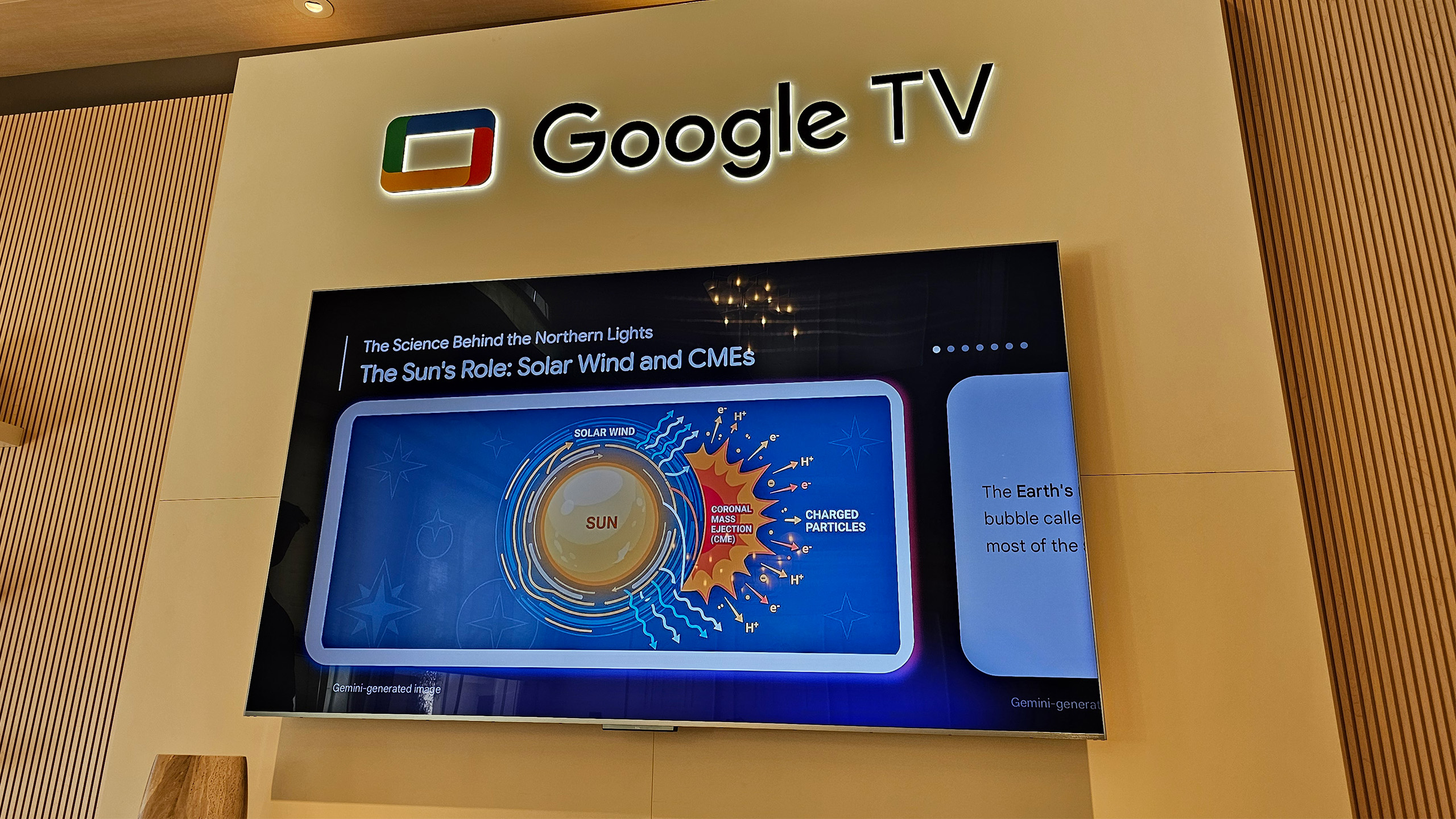
The “deep dive” Gemini feature could prove fairly useful, too. With it, asking for general information turns into a mini lesson on the subject, complete with generated images and narration. When Choudhary asked Gemini to “explain the Northern Lights to [his] eighth grader,” the screen filled with the standard Gemini answer: a brief definition and images and video tiles for further exploration. But a small Dive deeper button on the screen led to a narrated and illustrated tour of the science behind the phenomenon. My kid is at the age where he asks me questions I can’t answer about the fundamental makeup of the universe — maybe this could help.
The Google TV demo at CES showed an answer on the science behind how the northern lights are created
Amy Skorheim for Engadget
Google Photos is getting a much deeper integration with Google TVs, too. Choudhary asked for pics from a trip to the beach and snapshots of happy people amongst the sea and sand popped up on the screen. One particular shot would make a nice screen saver, I was told, and he asked Gemini to give the photo an oil painting makeover using the Remix feature.
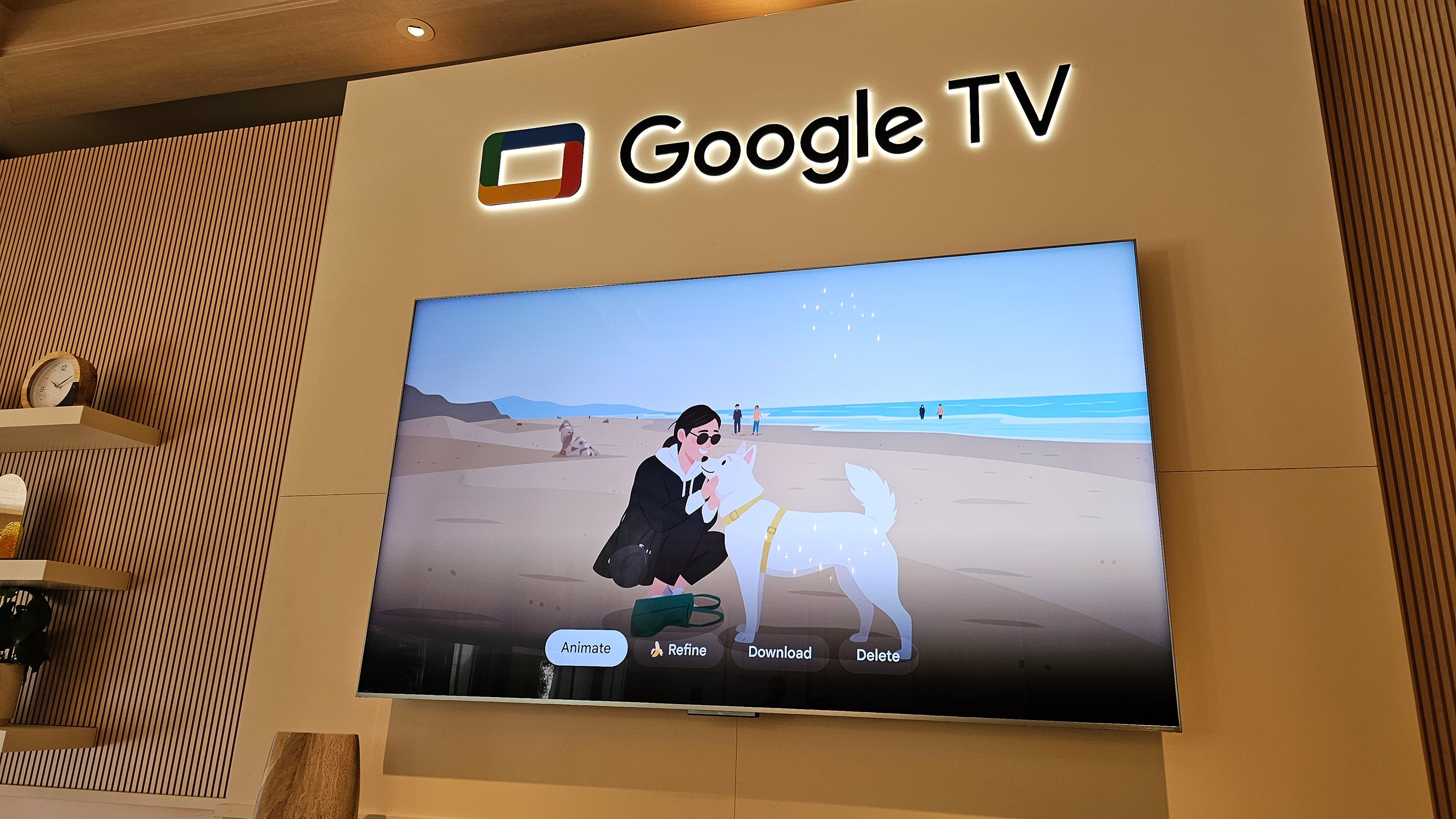
However, if you want your photo recast in a way not offered with Remix, you can use Nano Banana. Choudhary turned one of the personal photos into a cartoon just by asking. Using Veo turned the same image into an short (if slightly glitchy) animation of a person playing fetch with the dog in the photo.
Google TV used Neo to recast a picture as a cartoon.
Amy Skorheim for Engadget
Your ability to generate video will depend on your Gemini subscription tier, but I was told a purchase of a Google TV device would include most of the other AI capabilities that I saw demonstrated.
I’d classify the photo manipulation and video generation as decidedly less useful that the other features, but my kid would probably get a kick out of messing with them for a while. For people who use Gemini a lot, being able to do so on the biggest screen in the house may appeal. Ditto for those who like seeing your Google Photos in a giant format. Some folks will appreciate the AI image manipulation and generation, I’m sure, but I’m mostly excited about the admittedly boring part of not having to leave a show to boost the brightness of a scene.
This article originally appeared on Engadget at https://www.engadget.com/home/home-theater/google-tvs-new-gemini-features-range-from-useful-to-unnecessary-222900001.html?src=rss