The streamer has dropped a trailer for season four and it looks promising. The tone looks slightly darker when compared to season three, which was maligned for being a bit too silly and uneven. The trailer is narrated by Anson Mount's Captain Christopher Pike, who discusses the "terror" of space as a planet explodes.
This is still Strange New Worlds, so it won't be all doom and gloom. The trailer shows us a screeching alien dinosaur, which is pretty fun. There have also been reports that season four will feature a puppet episode with involvement from Jim Henson's Creature Shop.
This new batch of episodes will lean even heavier into connections to the original Star Trek show from the 1960s. Paul Wesley's version of Captain Kirk features prominently in several scenes, with one looking like a direct callback to Star Trek II: The Wrath of Khan. A younger Scotty also makes an appearance.
For the uninitiated, Star Trek: Strange New Worlds is a prequel to the first show and starts several years before Kirk takes over as captain of the Enterprise. It's been said that the series will end with Kirk taking the big chair. It's also primarily an episodic series, with no real serialized season-long arcs. It's pretty good!
It's also ending in the near future. Season five will presumably premiere next year and will include just six episodes. As a matter of fact, it looks like the modern incarnation of Star Trek is ending in totality. Sets are being taken down and there are currently no new shows in production for the first time in a decade.
This is a bummer, even if I didn't always love some of the newer content. The upcoming second season of Starfleet Academy will be its last, which is exceptionally sad because it was really beginning to fire on all cylinders. It was 12 years between the final episode of Star Trek: Enterprise and the first episode of Star Trek: Discovery, which kicked off the modern era. Who knows how long we'll have to wait this time.
This article originally appeared on Engadget at https://www.engadget.com/entertainment/tv-movies/star-trek-strange-new-worlds-returns-for-its-penultimate-season-on-july-23-170946603.html?src=rss
Valve's Steam Controller will hit the market on Monday, May 4, for a going price of $99 in the United States. The Steam Controller does precisely what it says: It communicates with anything running Steam or the Steam Link app, so this includes PCs, Macs, mobile devices and the Steam Deck.
Eventually, the Steam Controller will connect to the new Steam Machine console and Steam Frame VR headset, but neither of these products have solid release dates just yet. They were originally slated to come out in early 2026 alongside the Steam Controller, but we're nearly five months into the year and only a third of that promise is poised to be fulfilled. Valve in March said it hopes to ship in 2026, dropping the "early" bit.
As noted in our review, the Steam Controller is a solid gamepad, especially for the price. It feels and looks a lot like a Steam Deck, complete with two trackpads beneath a pair of TMR thumbsticks and a standard face array. It's reactive, ergonomic, and comes with a cute little charging and connection puck that snaps onto the bottom of the gamepad. Just note that the Steam Controller is not a PC controller: It works with Steam, and only Steam. You'll have to add games with their own launchers like Overwatch, Valorant, Minecraft or Fortnite to your Steam library before playing them with Valve's proprietary controller. How convenient — for Valve, at least.
Valve
Worldwide, Steam Controller prices are as follows:
US: $99
Canada: $149 CAD
EU: €99
UK: £85
AUD: 149
PLN: 419
This article originally appeared on Engadget at https://www.engadget.com/gaming/valves-steam-controller-costs-99-and-arrives-may-4-170058529.html?src=rss
Don’t mistake the Steam Controller for a PC controller. Even though its main function is to play PC games, Valve’s new gamepad communicates with Steam, and only Steam. This is not a general controller for your PC, Android or iOS devices, and it’s certainly not compatible with any console on the market today, unless you count the handheld Steam Deck. In order to play a game with the Steam Controller, you have to boot it up through Steam. (More on this later).
Valve’s end goal for the Steam Controller is compatibility with the Steam Machine, a console that doesn’t yet have a public release date or price point. The Steam Machine will support 4K gaming at 60 fps with FSR, it’ll come with 512GB or 2TB of SSD storage, and it’ll work with the Steam Frame VR headset, as will the Controller. The new Steam Machine was supposed to drop early this year, fulfilling a long-promised dream of PC gaming by moving your entire Steam library to the couch in a compact but powerful box. Due to the memory shortages plaguing the tech industry, the Machine and Frame aren't here yet, so the Steam Controller is the first step in Valve’s hardware takeover of living room territory. It’s due to come out on May 4, priced at $99.
The Steam Controller represents roughly 13 years of R&D, from its first iteration announced in 2013 to the debut of the Steam Deck in 2022, and the refinement period clearly paid off.
The Steam Controller is a tidy chonker of a gamepad with a broad, Duke-like face holding two square trackpads beneath the standard analog sticks and face buttons. Despite its extra girth, the Steam Controller feels light, slim and balanced, even in my smaller-than-average hands. The grips are slender and have four circular rear buttons, two per side, that are super satisfying to click even when they don’t do anything in-game. The bumpers, triggers, D-pad and face buttons are shiny black plastic, and all of the controller’s edges are rounded, allowing for a smooth glide between the bumpers and triggers especially. The trackpads don’t get in the way when you don’t need them, but in-use, they’re incredibly sensitive and kind of mesmerizing. They look and feel just like the trackpads on the Steam Deck, following the trails of your thumbs with miniature popping bubbles.
The Steam Controller uses tunnel magnetoresistance (TMR) joysticks, which are a leveled-up version of Hall effect sticks, offering ultimate precision and long-term stability with no chance of drift. After a few days of use across a range of game genres, including competitive first-person shooters, they’ve proven to be reliable and accurate. In terms of stick precision and feel, I find the Steam Controller is comparable to the Razer Wolverine V3 Pro, my PC gamepad of choice. I otherwise much prefer the swappability, rubberized microswitches and crisp clickiness of Razer’s gamepad — but the Wolverine also costs about $100 more and doesn’t come with trackpad capabilities, so we’ll call it a wash.
Sam Rutherford for Engadget
One of the neatest aspects of the Steam Controller is its charging and connection puck, which plugs into your PC or Steam Deck through a USB cable and enables stable wireless play. The puck snaps onto the belly of the controller for charging, and when you hover the gamepad’s connection point over it, it jumps up and latches on like a cute little sucker fish. I don’t know if this behavior is an intentional selling point, but it certainly is for me. The Steam Controller also connects to devices via Bluetooth or with a cable, and in all configurations it’s performed without issue for me. Of course, Bluetooth mode has the highest latency, so that’s mainly for phones and Steam Link play. The puck can support two Steam Controllers at once. Swapping between Puck and Bluetooth mode is a simple matter of holding the right bumper and A or B, respectively, when you turn the controller on.
Pressing the power button with the Steam logo wakes up the gamepad, and pressing it twice when you’re connected to a PC launches Steam in Big Picture mode. The Steam Controller feels like a natural extension of Valve’s storefront, and with its matte black finish and bubbled edges, it’ll be familiar to anyone who’s fallen in love with a Steam Deck these past few years.
I tested out the controller on my PC with Steam games and non-Steam games (added to my Steam library first, of course — seriously, more on that later), and in my living room with my Steam Deck acting as a makeshift, low-powered Steam Machine. On PC I played The Seance of Blake Manor, Creature Kitchen and Overwatch, and on Steam Deck I played Blake Manor, Demonschool and Balatro. Whether connected with Bluetooth, the puck or USB, the Steam Controller provided seamless play and no noticeable latency. The distance from my couch to the puck nestled behind my Steam Deck is about eight feet, and I didn’t feel a frame drop while cosplaying as a Steam Machine owner. I also never ran into battery issues, but that’s not shocking considering Valve’s claim that the gamepad has more than 35 hours on a single charge. In my testing, the battery barely registered a drop after multiple hours of playtime, and I was happy to snap on the charging puck whenever I wanted to set the controller down.
Sam Rutherford for Engadget
Valve notes the battery life may be lower if playing with the Steam Frame. The Steam Controller has infrared LEDs for tracking, which will obviously drain the battery a little faster. Some VR games may have you waving your controller, as there are gyroscopic sensors in there as well. As the Steam Frame isn’t out, I wasn’t able to test some of the controller’s more interesting features.
Even against players using a keyboard and mouse in competitive Overwatch matches, I won games and earned awards, passing my personal ultimate test of a controller’s capabilities. When it comes to Overwatch, I’m mostly comparing the Steam Controller to Sony’s DualSense, and it feels surprisingly similar. I enjoy the Steam Controller’s smooth slide between the bumpers and triggers, though its haptic feedback is more subtle than the DualSense’s, lacking in the analog sticks particularly. Much like with the Steam Deck, I haven’t found a consistent use case for the trackpads on the Steam Controller, but I appreciate their inclusion, the accessibility factor, and the fact that they aren’t otherwise intrusive. Now, just add a Playdate crank and I’m really sold.
The Steam Controller is a clear and unmistakable signal that Valve is joining the console wars, and perhaps by patient and diligent design, it’s appearing at a vulnerable time. Xbox is fumbling the current generation and attempting to redefine its place in the console market amid a significant leadership shakeup, while Sony and Nintendo are carrying on with standard hardware upgrade cycles in a landscape that’s based less on platform exclusivity every day. Right now there’s room for a robust PC-based storefront to stake its claim on couch gaming, and voila, here’s Valve with the Steam Machine and Steam Controller.
Sam Rutherford for Engadget
Similarly to the way Valve used Half-Life 2 to get people to download Steam in 2004, the Steam Controller pushes players to fully consolidate their PC libraries in its own ecosystem. You’ll have to add games with their own launchers like Overwatch, Valorant, Minecraft and Fortnite to your Steam library before you can play them using Valve’s controller. This is a small inconvenience, since it takes just a few clicks to add a non-Steam game to your profile.
(Welcome to later). However, I don’t enjoy doing it. As I was browsing through files to add Overwatch to my Steam library, I couldn’t help thinking that it would have been pretty easy for Valve to add a switch that would let the Steam Controller communicate with any PC game. Maybe it's a touch of oppositional defiant disorder, but I despise being coerced into behaviors that are designed to serve a corporation’s market control over my own workflow, especially in my personal spaces.
Now more than ever, I value my ability to choose — which businesses I work with, where I store my software, how I play — and the Steam launcher requirement is another small expansion of Valve’s incredible power in the PC games industry. It’s too easy to say, most of my games are already on Steam, no big deal, and use the Controller as an excuse to consolidate them all on Valve’s launcher. Suddenly, Steam is where you begin and end every gaming session, rather than just most. Obviously and especially with the coming rollout of the Steam Machine, this is the reality that Valve wants: a rich industry utterly reliant on its platform of DRM, shitty revenue splits and random opaque censorship. It’s the situation that Microsoft, Apple or Epic also want for themselves, but the main difference is that this future is actually in reach for Valve, and the Steam Controller is a tiny part of the plan. If willing and unforced support of a monopoly makes you bristle as well, feel free to stick with 8BitDo.
Sam Rutherford for Engadget
Truly though, I get it. The Steam Controller doesn’t come with a PC switch because it’s not a PC controller. It’s for controlling Steam, a service that’s become synonymous with PC and handheld gaming, and is now creeping onto the living-room scene. The Steam Controller is designed to follow you everywhere Steam is, for all your gaming needs across every screen forever and always — and there is something soothing about that idea in a Brave New World Soma kind of way. A PC controller? That’s far too limited, from Valve’s perspective.
Encroaching corporate dystopia aside, the Steam Controller is a sturdy and sleek gamepad that stands up to the competition. It’s for Valve diehards, trackpad fanatics and anyone whose main gaming hub is Steam. Which, to be clear, is a massive market that’s only poised to grow.
This article originally appeared on Engadget at https://www.engadget.com/gaming/valve-steam-controller-review-a-gamepad-in-search-of-a-console-170054068.html?src=rss
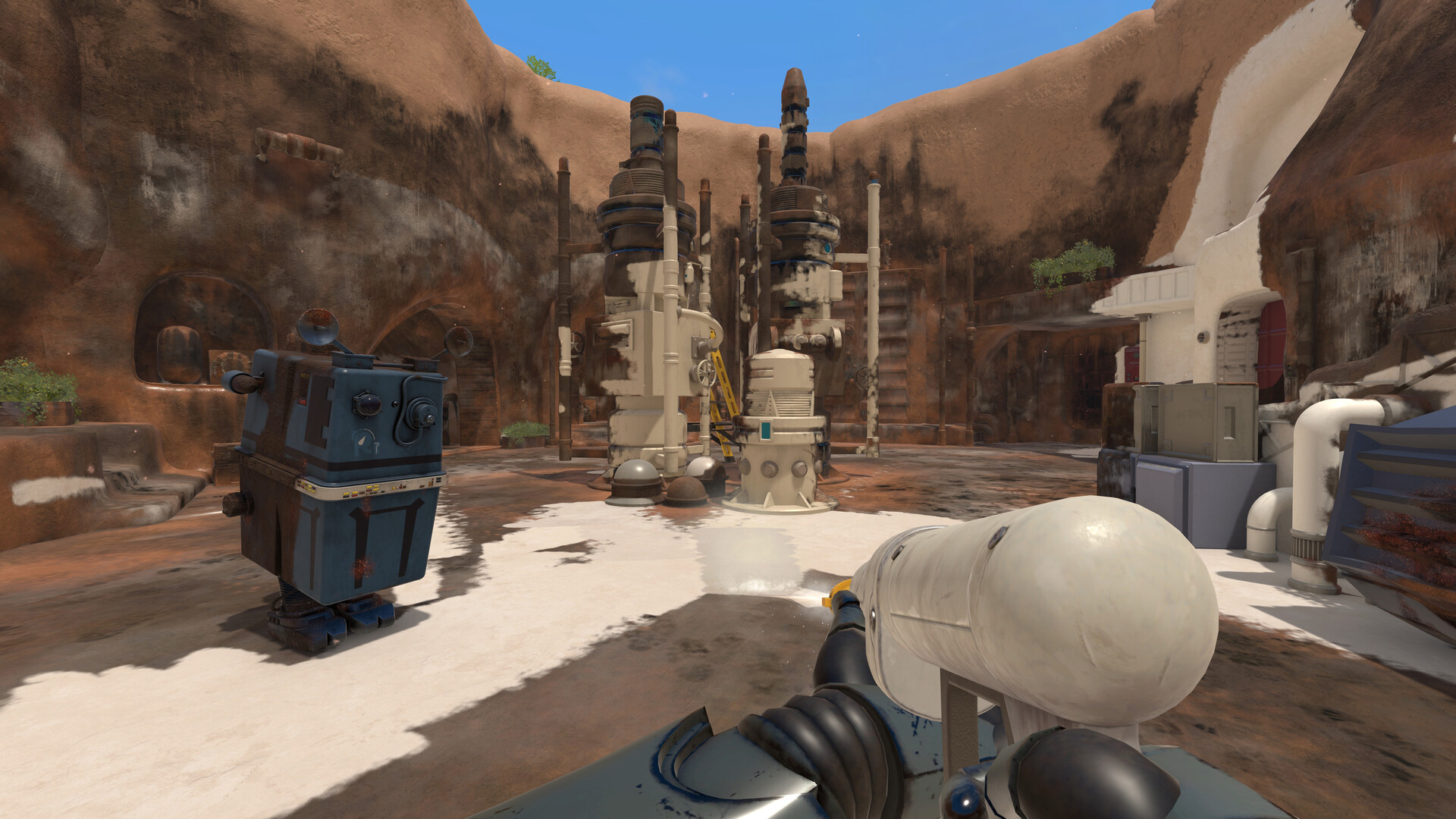
There's something deeply relaxing about chucking on a solid pair of headphones, listening to some good music and cleaning muck off structures and vehicles. Not in real life, though. Heavens, no. PowerWash Simulator 2 lets you do that without having to deal with any actual muck — as long as you're regularly cleaning your keyboard or controller, anyway.
You'll soon be able to carry out powerwashing jobs in six more locations, all of which are in a galaxy far, far away. In the game's upcoming Star Wars expansion, you can visit the likes of Tatooine and Hoth to clean the Lars homestead, an X-wing and a Star Destroyer bridge.
Lars homestead in PowerWash Simulator 2
FuturLab
Developer FuturLab has created an exclusive powerwasher for these levels, in which you'll play as a labor droid called P0-W2. You can take on the jobs with up to four friends. Expect a bunch of Easter eggs too.
FuturLab says the expansion is set during the original Star Wars trilogy. You'll first be taking on work for the Galactic Empire before defecting to the Rebel Alliance (so you'll literally be dealing with Rebel scum).
The studio has previously brought other franchises into the fold. Those who own the first PowerWash Simulator can snag the Final Fantasy and Tomb Raider expansions for free before they’re delisted at 10AM ET on May 19. There are also Back to the Future and Shrek expansions for the original game.
The Star Wars expansion is coming to PowerWash Simulator 2 on PC, PS5, Xbox Series X/S and Nintendo Switch 2 this summer. It'll cost $10. In the meantime, spare a thought for those poor contractors whose jobs the P0-W2 droids are taking:
This article originally appeared on Engadget at https://www.engadget.com/gaming/a-star-wars-expansion-is-coming-to-powerwash-simulator-2-162946670.html?src=rss
OpenAI is opening up its partnership with Microsoft in the latest amendment to the major multi-year collaboration between the tech giants. The latest changes allow OpenAI to offer its latest AI models to other companies and through other cloud providers, stripping Microsoft of its exclusivity rights.
In a joint announcement posted on OpenAI and Microsoft's websites, Microsoft will still be OpenAI's primary cloud partner with the latest products shipping first on Azure, but OpenAI is now allowed to use any cloud provider. Sam Altman, OpenAI's CEO, posted on X that the company is "now able to make our products and services available across all clouds."
On top of that, Microsoft will still have a license for OpenAI's models and products through to 2032, but the license will no longer be exclusive. On the business side, Microsoft will no longer pay a revenue share to OpenAI, but OpenAI would still make revenue share payments to Microsoft until 2030, which will now be subject to a total cap.
The two companies have worked closely together since announcing a multiyear partnership in 2019. Microsoft and OpenAI have gone through several phases for its collaboration, but the two put out a joint statement in February of this year that still mentioned the exclusivity agreements. However, the latest update confirms that OpenAI can break exclusivity, with the companies arguing these changes are for "flexibility, certainty, and a focus on delivering the benefits of AI broadly."
This article originally appeared on Engadget at https://www.engadget.com/big-tech/openai-breaks-out-of-exclusivity-agreements-in-its-partnership-with-microsoft-162829584.html?src=rss
In its quest to become an all-in-one app, Spotify is now breaking into the fitness app world by offering "guided workout experiences" and on-demand Peloton classes. Premium subscribers will get access to Peloton's library of more than 1,400 classes in the app, while both Free and Premium can browse curated playlists (they're listed under the genre "fitness.")
Spotify
Spotify said the classes are primarily in English, but there are some options in Spanish and German. Like music and podcasts, Spotify lets you bounce between different devices for its fitness media, so you can start a video workout on your TV and switch to an audio-only version on your phone or smart speaker. Users can even download the classes for offline use.
The fitness category may feel like a sharp turn for Spotify, but the company said that nearly 70 percent of its Premium subscribers work out monthly and that fitness and workout content was one of the top use cases for its Prompted Playlist feature. Spotify has long been expanding its offerings outside of music, with its latest efforts giving users a way to buy physical books or create group chats.
This article originally appeared on Engadget at https://www.engadget.com/apps/spotify-is-now-a-fitness-app-too-144037057.html?src=rss
Amazon has brought another high-profile podcasting name into its fold after agreeing to a multiyear licensing deal with Oprah Winfrey. Her podcast will expand to two episodes a week starting in July and it will be available across the likes of Prime Video, Amazon Music, Fire TV channels and Audible. New episodes will still hit YouTube and other podcast platforms, according to Variety.
Winfrey will stick to the same format she's been using on YouTube since starting a podcast channel there at the end of 2024. It will feature interviews with authors, celebrities and others in the public eye.
In addition, Winfrey will create specials based on her Oprah's Favorite Things and Oprah’s Book Club franchises for Amazon. The company is also licensing all 25 seasons of The Oprah Winfrey Show but Winfrey and Amazon haven't figured out exactly how to repurpose the long-running talk show as yet.
Last year, Amazon split its Wondery podcast company in two, with a team focusing on narrative podcasts merging with Amazon’s Audible team and a crew that handles celebrity-hosted shows forming a new division called Creator Services. That group promotes podcasts like New Heights with Jason and Travis Kelce and Armchair Expert with Dax Shepard across Amazon's various properties, as The New York Times notes.
Oprah's Book Club will tie into Audible, Kindle, Goodreads and the Amazon storefront. Products featured in the annual Oprah's Favorite Things holiday list will be highlighted on the latter as well. Winfrey and Amazon will split sales and ad revenue.
It’s become common for major media companies to make a play for popular podcasts over the last several years. As video podcasts have grown, the likes of Netflix have gotten in on the action too. Some people play these as background noise and Winfrey's podcast might be particularly appealing to fans of her TV show, which ended in 2011.
This article originally appeared on Engadget at https://www.engadget.com/entertainment/oprah-brings-her-podcast-to-amazons-streaming-services-142846445.html?src=rss
Somehow, ZSNES has returned after laying dormant for 20 years. The developers of the iconic Super Nintendo emulator, which originally debuted in 1997 for DOS (something I distinctly remember trying to install on my ancient Intel 486 Packard Bell), are back with a sequel release dubbed Super ZSNES. And really, what else would they call it?
Developers zsKnight and Demosay that Super ZSNES has been rewritten from scratch with a focus on a GPU-powered “Super Enhancement Engine,” which allows for high resolution playback, overclocking (which could help with games notorious for slowdown), widescreen support, uncompressed audio and 3D height maps for Mode 7 graphics. Purists, of course, can turn all of these extra features off if they want.
Super ZSNES is built on “far more accurate CPU and Audio cores” than the original emulator, according to the developers, as well as the usual fast forward/rewind save states and a higher-resolution version of the original ZSNES UI. And as a cherry on top, they promise there’s “No Vibe Coding.”
There’s no shortage of SNES emulators out there today, but it warms my gaming heart to see ZSNES completely revived. And while I still need to play with its enhancement features to truly judge them, the early footage from Modern Vintage Gamer looks very sharp without losing the SNES charm. There’s no replacement for playing the original console on a CRT, but the GPU upgrades in Super ZSNES seem to do a great job of modernizing classic games like Super Mario World for modern displays.
Super ZSNES is currently available as an early build for Windows, Mac and Android. An iOS release is coming soon, according to the emulator’s website.
This article originally appeared on Engadget at https://www.engadget.com/gaming/nintendo/the-sequel-to-the-iconic-emulator-zsnes-is-called-super-zsnes-of-course-135203417.html?src=rss
Ford Racing's Mustang Cobra Jet 2200 just ran a quarter mile in 6.87 seconds at 221 mph at an NHRA event in Charlotte, setting a new world record for an EV. The run smashed Ford's own previous EV record of 7.62 seconds, set by the Cobra Jet 1800 last September, by an impressive 0.75 seconds.
As the name suggests, Ford's Cobra Jet 2200 puts a massive 2,200 horsepower to the wheels thanks to a newly designed electric motor and inverter combo. Ford elected to use two motors and inverters instead of four of each as before to reduce complexity and boost efficiency to 98 percent. Overall power is up by 600 horsepower, but the motors and inverters weigh half as much as before. Everything runs on a 900-volt architecture and 32 kWh battery that charges in 20 minutes, easily enough for the NHRA's 45-minute turnaround rule.
It's official: The Ford Racing Mustang Cobra Jet 2200 has clocked a new record time of 6.87 at 221 mph - now the quickest electric car on the planet.#FordRacingpic.twitter.com/drmvH2XRp6
The car has some unusual features for an EV like a clutch that lets the driver dump all the power to the road instantly for maximum acceleration. It also uses a multi-speed transmission that allows the car to run in its ideal power band through the duration of the run — reducing the quarter-mile time by up to a second, according to Ford. The battery design also allowed the team to tune weight distribution for optimal traction. Another racing touch is a pyrotechnic circuit breaker that can instantly break the high-voltage connection via a small explosive charge to align with NHRA safety rules.
Some of this tech, like the high-efficiency motors and 900 volt system, could conceivably trickle down to consumer vehicles. Unfortunately, Ford and other US automakers have significantly reduced their investment in BEV technology of late. Ford recently announced that it would reboot the F-150 Lightning as an EREV with a gas generator, while last week GM delayed its next-gen full-size EV pickups and SUVs — all in the face of rapidly rising gasoline prices.
This article originally appeared on Engadget at https://www.engadget.com/transportation/evs/fords-mustang-cobra-jet-sets-a-new-ev-quarter-mile-record-at-687-seconds-112259793.html?src=rss
No more getting caught by a forced Windows 11 update while you're in the middle of a meeting or a match. Microsoft announced some major changes coming to Windows Update on its blog, including the ability to indefinitely pause Windows updates, 35 days at a time.
To give users more control, Windows Update introduced the option to extend update pauses as much as users want. Once you opted to pause updates for Windows 11, you won't be disturbed for 35 days at a time, but you can now reset this 35-day limit for as long as you want. You should eventually install these updates, as most of them are usually related to security upgrades and only sometimes require emergency fixes, but Microsoft is letting users decide when to do so. Microsoft's Aria Hanson wrote in the blog that these changes were a result of feedback that consistently mentioned "disruption caused by untimely updates and not enough control over when updates happen."
Beyond the update pauses, Microsoft is ensuring Windows 11 users always have the option to shut down or restart their devices without updating. These quality-of-life upgrades build on another recent change that allowed users to skip updates while setting up their new Windows devices. According to Microsoft, the latest Windows Updates features are currently rolling out to those enrolled in the Windows Insider program, specifically users in the Dev and Experimental Channels.
This article originally appeared on Engadget at https://www.engadget.com/computing/forced-windows-updates-can-now-be-paused-forever-200338487.html?src=rss