Here's some good news for the "Han shot first" crowd. The original cut of Star Wars (1977), the film known today as A New Hope, is coming back to theaters. We first learned in August that some version of the film would be screened again in 2027 for its 50th anniversary. But we know now this will indeed be the version everyone saw before George Lucas made those questionable, CGI-heavy changes in the 1997 Special Editions. The re-release arrives in theaters on February 19, 2027.
In a short update posted Friday on the official Star Wars website, Lucasfilm all but clarified that this will be the original cut. It described it as "a newly restored version of the classic Star Wars (1977) theatrical release." Gizmodoreported that it received further clarification that this will indeed be the OG one, before those "improvements” in the Special Edition (and subsequent re-releases).
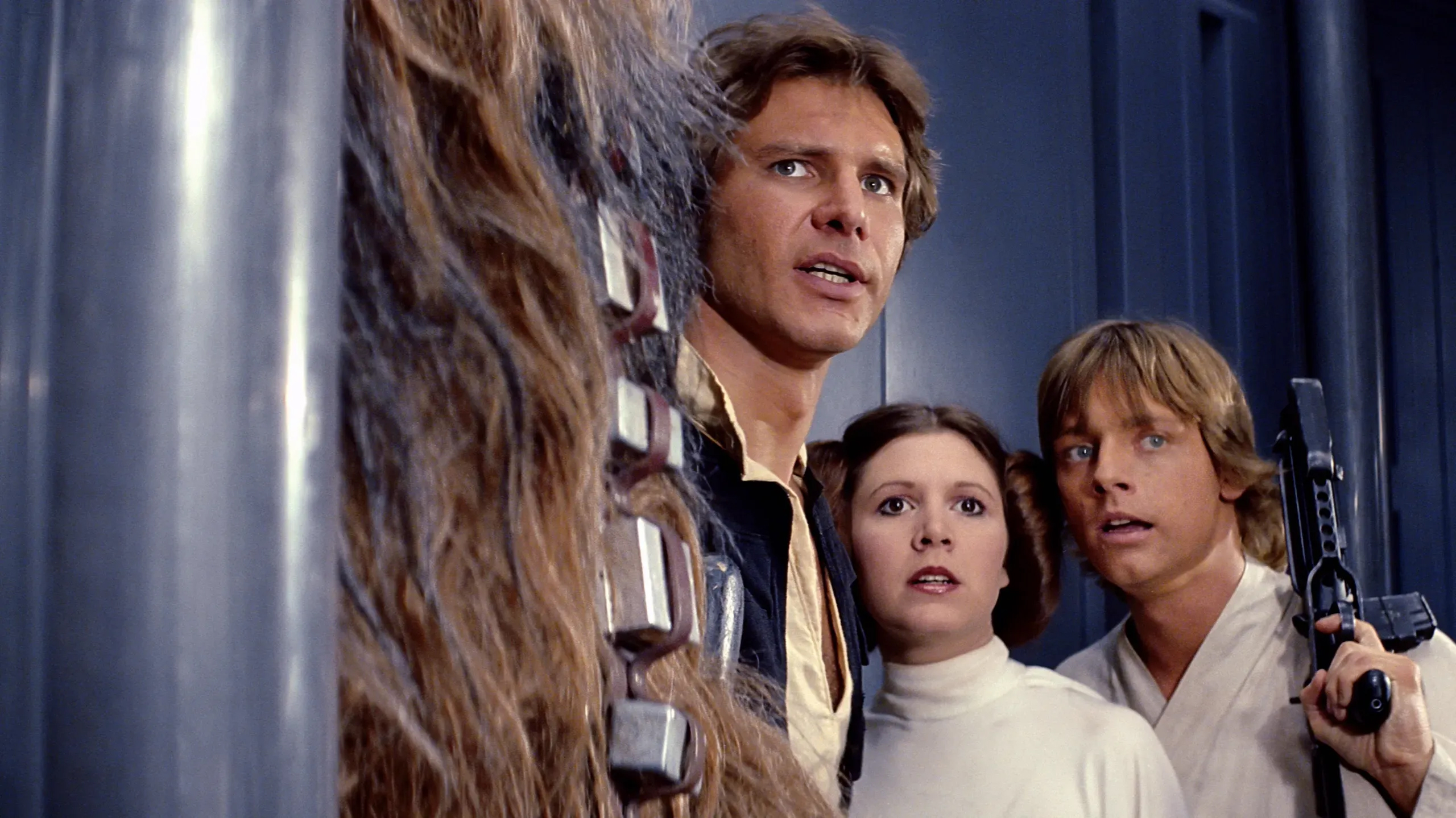
Han Solo (Harrison Ford), Princess Leia (Carrie Fisher) and Luke Skywalker (Mark Hamill) in a scene from Star Wars: A New Hope.
Disney Plus
Those mid-'90s edits included early CGI effects that essentially served as a testing ground before Lucas moved on to the Prequel Trilogy. It also added a CG Jabba the Hutt / Han Solo scene (originally shot with actor Thomas Declan Mulholland as Jabba) that was cut from the original version.
Perhaps most infamously, Lucas made Greedo shoot first at Han in the canteen scene. Hardcore fans hated the change. It smoothed some of the rough edges of Han's start. It gave him a shorter, less dramatic journey into the reluctant hero he grew into as the story progressed. It's as if Lucas was signaling, "Okay, Han may have started as kind of a jerk, but he wouldn't shoot a bounty hunter in cold blood! Think of the children watching!"
But in my view, Return of the Jedi had the worst changes in 1997 and later. Although I didn't mind the new celebration music and location montage at the end (others disagree), it also added that cringey and out-of-place musical number in Jabba's palace. But I despised the change Lucas made for the film’s 2011 Blu-ray release: Darth Vader's overly telegraphed "Nooooooo…" as he makes the climactic decision to chuck the Emperor into the Death Star's reactor shaft. C’mon, George: It’s so more powerful for the audience to project Vader’s thought process onto his silent helmet. But if Disney sticks with the 50th Anniversary scheme, we'll have to wait until 2033 to see the untainted version of that movie in theaters again.
This article originally appeared on Engadget at https://www.engadget.com/entertainment/the-1977-cut-of-star-wars-will-return-to-theaters-in-2027-221113091.html?src=rss
How can a troubled media company survive today? The answer seems to be further consolidation. Amazon's $8.45 billion MGM takeover in 2022 heralded future deals, like Skydance's $8 billion acquisition of Paramount . But Netflix's WB deal goes even further: It could fundamentally reshape the media industry as we know it, from theatrical movie-going to the existence of physical media.
What will the Netflix and Warner Bros. deal include?
After next year's already-announced separation of Warner Bros. and Discovery, Netflix says it plans to acquire all of Warner Bros. remaining assets — including its film and TV studios, HBO Max and HBO — for $82.7 billion. According to Game Developer, representatives also say Warner Bros. Games, which includes Mortal Kombat developers NetherRealm, will also be part of the deal.
Will the Netflix and Warner Bros. deal be approved by regulators?
Even before the deal was formally announced, it was clear that whoever bought WB would be facing government opposition from every side. Yesterday, Paramount sent WB a letter questioning the "fairness and adequacy" of the acquisition bidding process (which also included Comcast as a potential buyer). Afterwards, the New York Post reported that Paramount CEO David Ellison, son of the Trump-boosting Oracle CEO Larry Ellison, met with administration officials to make his case for buying Netflix. As of this morning, the Trump administration views the Netflix/WB deal with "heavy skepticism," an official tells CNBC.
On the other side of the aisle, Senator Elizabeth Warren (D-MA) has called the Netflix/WB deal an "anti-monopoly nightmare." She added, "A Netflix-Warner Bros. would create one massive media giant with control of close to half of the streaming market. It could force you into higher prices, fewer choices over what and how you watch, and may put American workers at risk."
At this point, it's too early to tell if the Netflix/WB deal will make it past regulators, but it's clear that both companies should prepare for a rocky approval process.
What does the Netflix and Warner Bros. deal mean for streaming video?
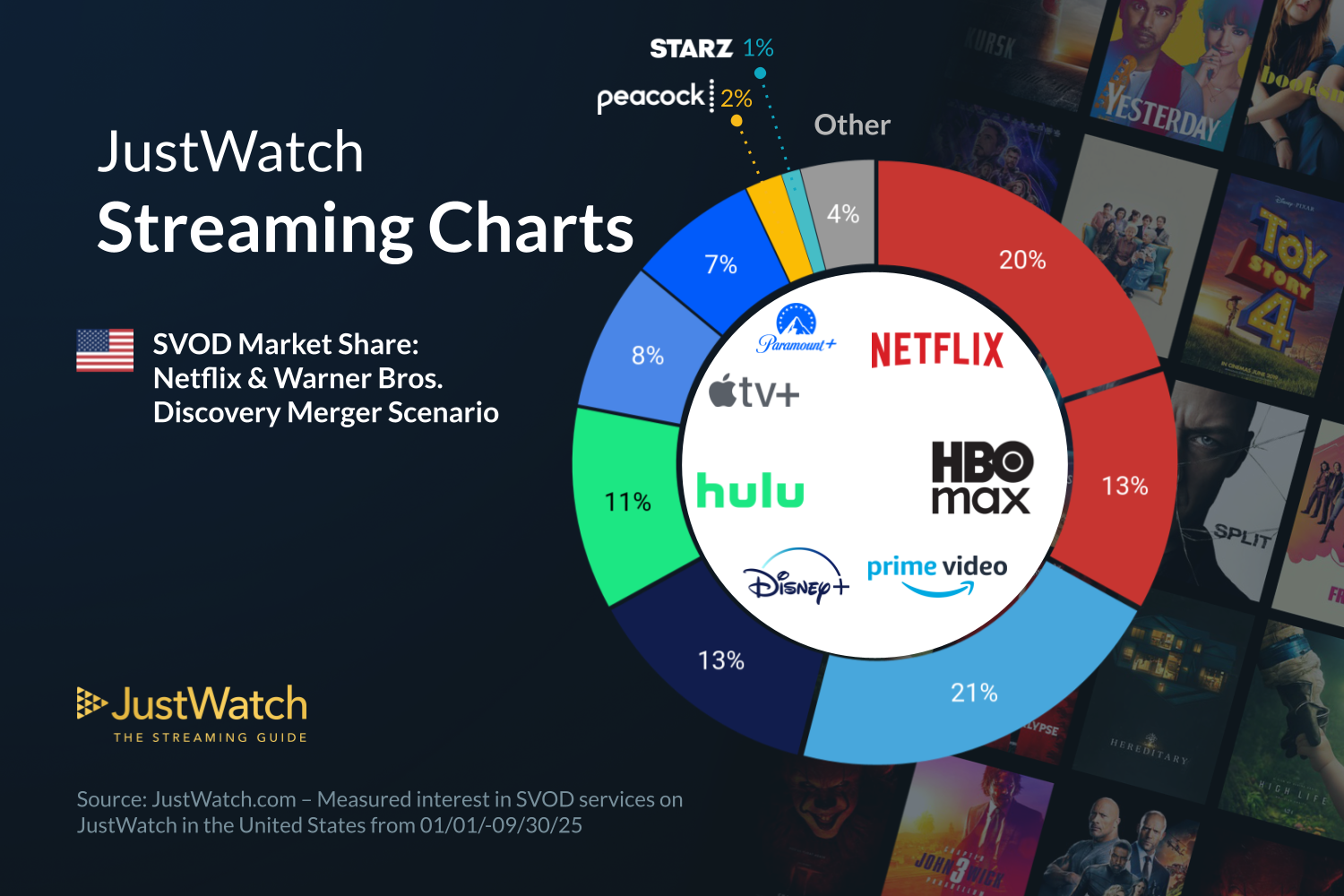
According to data from JustWatch, a combined Netflix and HBO would account for 33 percent of the US streaming video market, putting it ahead of Prime Video's 21 percent share. As for how the two media companies would co-exist, Netflix says it will "maintain Warner Bros. current businesses," which includes HBO Max and HBO, theatrical releases for films and well as movie and TV studio operations.
JustWatch streaming video market stats.
JustWatch
"We think it’s too early to talk specifics about how we’re going to tailor this offering for consumers," Netflix co-CEO Greg Peters said in an investor call this morning, when asked if HBO would remain a separate service. "Needless to say, we think the HBO brand is very powerful, and would constitute part of our plan for consumers. That then gives us a lot of options to figure out how to package things to offer the best options for consumers."
At the very least, we can expect increased prices across the board for HBO and Netflix. There's also potential for the company to offer combination subscriptions, similar to how Disney juggles Disney+, Hulu and ESPN.
What does the Netflix and Warner Bros. deal mean for theaters?
In short, a combined Netflix/WB wouldn't be great for theaters. Previous mergers, like Disney and Fox's union, led to fewer theatrical releases, not more. Since its transformation into a streaming-first company, Netflix has also been primarily focused on increasing subscriptions and engagement, with theatrical releases of its original content treated as an afterthought.
"We’ve released about 30 films into theaters this year, so it’s not like we have opposition to theatrical release," Netflix Co-CEO Ted Sarandos said in the investor call (without specifying how short some of those theatrical releases were). "It’s the longer windows that aren’t consumer friendly. Life cycle that starts in the movie theater, we’ll continue that. Over time, the windows will evolve to be much more consumer friendly, to meet the audience where we are."
He added: "All things that are going to theaters through WB will continue to do so. Our primary goal is to bring first-run movies to consumers, and we intend to continue with that." In an April interview at the Time100 Summit, Sarandos also famously called the theatrical model "outdated," since most people in the US can't easily walk to a multiplex.
Cinema United, a trade group representing over 30,000 movie theater screens in the US, is unsurprisingly against the entire deal. “The proposed acquisition of Warner Bros. by Netflix poses an unprecedented threat to the global exhibition business. The negative impact of this acquisition will impact theatres from the biggest circuits to one-screen independents in small towns in the United States and around the world,” Cinema United President and CEO Michael O’Leary said in a statement.
“Cinema United stands ready to support industry changes that lead to increased movie production and give consumers more opportunities to enjoy a day at the local theatre,” he added. “But Netflix’s stated business model does not support theatrical exhibition. In fact, it is the opposite. Regulators must look closely at the specifics of this proposed transaction and understand the negative impact it will have on consumers, exhibition and the entertainment industry.”
What do artists think of the Netflix and WB deal?
Writers, directors and producers are already having a tough time getting projects off the ground, so having one less place to pitch isn't going to help. There are also a handful of artists, including former WB darling Christopher Nolan, who have refused to work with Netflix entirely.
"The end goal of these consolidations is to limit choices in entertainment to a select handful of providers, so they can capture our whole attention, and thus our every available dollar," C. Robert Cargill, the screenwriter behind Doctor Strange and The Black Phone, said in a statement to Engadget. "The result will be a gutting of diversity and fresh voices in the industry, sending thousands, if not tens of thousands, of people back to their home towns to start their lives over, as there simply isn't a place for them in Hollywood any more, while homogenizing film and television into the "content" word we all grumble about hearing."
"WB has made so many daring choices this year, with executives taking big risks that made real cultural and financial impacts at the box office," he added. "And HBO, constant name changes be damned, is still making some of the best television there is, bar none. Will those creative environments survive the merger, or will many of those brilliant execs be sent packing along with the writers, directors, and crews?"
"In short, it's a very scary and heartbreaking time to be a filmmaker. No shade on Netflix and the people that work there; it's just that less choice in entertainment always makes for fewer winners and more people on the outside looking in."
What about physical media?
Other than noting that Netflix used to be a DVD-by-mail company, there was no mention of physical media on the acquisition's press release or investor call. That’s not too surprising, as physical releases have always been an afterthought for Netflix. A few of its films, like Roma and Frances Ha, are available as discs through the Criterion Collection, and some shows like Stranger Things are also on DVD and Blu-ray.
Netflix claims it'll continue to run WB's businesses as usual if the deal goes through, which should include physical media, but those sorts of pre-acquisition promises rarely last for long. WB's home video business isn't entirely its own, either: In 2020, it formed the joint venture Studio Distribution Services with Universal, which also handles physical media distribution for Sony Pictures, PBS and Neon.
Given the slowing demand for physical media, it’s likely one of the first things a combined Netflix/WB would eventually drop. But there’s also been a resurgence of premium physical releases from distributors like Arrow Video, so there’s a chance Netflix may want to keep it around for special releases.
Steve Dent contributed to this report.
This article originally appeared on Engadget at https://www.engadget.com/entertainment/streaming/the-netflix-and-warner-bros-deal-might-be-great-for-shareholders-but-not-for-anyone-else-183000247.html?src=rss
IMAX and animation distributor GKids are bringing more 4K Studio Ghibli restorations to the largest screens in 2026. The announcement follows the IMAX release of Princess Mononoke this year, with the ongoing restorations being directly supervised by Studio Ghibli’s Atsushi Okui, who’s been with the company since 1993.
Okui was the Director of Digital Imaging on 2023’s The Boy and the Heron, which was also the first Ghibli picture to get the IMAX treatment. The likes of My Neighbour Totoro and Spirited Away have also had theatrical re-releases in recent years. GKids heads up distribution in North America for the Japanese animation giant’s films across all platforms, and has been working with IMAX on various projects since 2021.
It sounds like the remaining Ghibli titles set for theatrical IMAX releases in the US will arrive one at a time, and GKids is not saying how many we can expect, or what it’s following Princess Mononoke with next year. I did a quick check for notable upcoming anniversaries, and 2026 does mark 40 years of Castle in the Sky, but one of the studio’s newer films might be a more obvious guess for a 4K refurb. Time will tell.
This article originally appeared on Engadget at https://www.engadget.com/entertainment/tv-movies/more-studio-ghibli-4k-restorations-are-coming-to-imax-in-2026-174508476.html?src=rss
Meta has cut several deals with news publishers to help provide real-time data for its AI chatbot services, as reported by Axios. The commercial agreements will allow its Meta AI chatbots to better answer user queries about news and current events.
These are multiyear deals where publishers will be compensated for the use of their content, but we don't have any monetary specifics. The contracts do stipulate that Meta's chatbots will link out to articles when answering news queries, potentially offering a slight traffic boost to publishers.
The news partners include USA Today, People, Le Monde and CNN. However, there are also a whole lot of conservative outlets included in today's announcement, such as Fox News, The Daily Caller and Washington Examiner. It's a good thing Meta's AI will provide the aforementioned links, just in case a chatbot says something crazy about whatever nonsense culture war topic is going on that day.
This article originally appeared on Engadget at https://www.engadget.com/big-tech/meta-cuts-deals-with-several-news-publishers-for-ai-use-163404107.html?src=rss
In a statement, Netflix said it expects to "maintain" Warner Bros. current operations, as well as its policy of theatrical releases for its films. But the deal may spell the end for HBO Max as its own product in the longer term, as the statement also says "by adding the deep film and TV libraries and HBO and HBO Max programming, Netflix members will have even more high-quality titles from which to choose."
Naturally, the deal will see Netflix become one of the biggest players in global media, combining its global reach with some of the most recognizable names in entertainment. That includes HBO, DC Studios, Cartoon Network, its game development studios and TCM, as well as the chunks of TNT not cast adrift with Discovery.
It's likely the deal will not go ahead without a lot of objections from other buyers, as well as the government itself. Yesterday, Paramount Skydance said (via the Hollywood Reporter) any deal between WB and Netflix would be the result of an "unfair" process. Given the close ties between Paramount's new owners and the administration, it's likely any deal will be subject to scrutiny as well as the usual questions around the size of the combined operation.
Since the announcement was made, Engadget senior reporter Devindra Hardawar has spoken with Hollywood players and collated studies and statements to answer any burning questions you might have on what this deal means for you. He also answers questions about the likelihood of regulatory approval, theatrical releases and physical media. Catch up on all that in his piece titled “The Netflix and Warner Bros. deal might be great for shareholders, but not for anyone else.”
Update, December 5 2025, 1:45PM ET: This story has been updated to add a paragraph and link to a new article we’ve published that contains deeper analysis and more information about the Netflix/Warner Bros. deal and what that might mean for streaming, movies, TV and shareholders.
This article originally appeared on Engadget at https://www.engadget.com/entertainment/netflix-to-buy-warner-bros-for-827-billion-120836295.html?src=rss
Netflix is in exclusive talks to acquire Warner Bros. Discovery's film and TV studios and HBO Max streaming service, according to sources from Bloomberg. That suggests Netflix submitted a superior offer to rivals including Paramount Skydance Corp (owned by billionaire Larry Ellison) and Comcast, which owns NBCUniversal. The deal could be consummated within days and, if approved, would change the landscape of Hollywood and the streaming market.
Warner Bros. Discovery's cable channels including CNN, TBS and TNT, valued at more than $60 billion, would not be part of the deal and spun off prior to the closing. However, Netflix would become the owner of the HBO network and its library of series (The Sopranos, Game of Thrones, etc.), along with its Burbank studios and massive film and TV archive consisting of 12,500 feature films and 2,400 TV series, including properties like Batman, Lord of the Rings and Friends.
A big sweetener offered by Netflix was a $5 billion breakup fee if the deal isn't approved by regulators, according to people familiar with the discussions. That's a considerable risk on Netflix's part, as the acquisition is likely to be closely scrutinized by the FCC and even President Trump himself, who reportedly has close ties to Ellison. It would also need to pass muster with regulators from other nations, considering the wide reach of WBD and Netflix.
After multiple suitors, including Paramount Skydance expressed interest in buying Warner Bros. Discovery, CEO David Zaslav put the company up for sale in October. The bidding process has been heated, with Paramount's lawyers complaining that WBD "embarked on a myopic process with a predetermined outcome that favors a single bidder," namely Netflix. Paramount argued that its deal would be more palatable to regulators around the world.
However, Zaslav's camp has said that it would achieve the best value in a sale by splitting off its cable assets and doing two separate deals, CNN reported. Both Paramount Skydance and Comcast submitted deals to buy all of WBD's assets.
Netflix offered around $28 a share for WBD minus the cable assets, according to Deadline. Shares were as low as $7.50 earlier this year. The acquisition would be far and away the largest for Netflix, which has historically favored organic growth.
An acquisition could have a huge impact on streaming customers and filmgoers. Would Netflix merge its catalog with HBO Max or continue to run the latter as a separate service? It's also not clear if Netflix would honor Warner Bros.' commitment to theatrical releases, considering that Netflix CEO Ted Sarandos has called movie theatres an "outdated concept."
This article originally appeared on Engadget at https://www.engadget.com/entertainment/streaming/netflix-is-reportedly-in-exclusive-talks-to-acquire-warner-bros-and-hbo-082233278.html?src=rss
We've been monitoring the upcoming rock climbing game Cairn for several months, as have the many folks who've already enjoyed the demo — which has an impressive 99 percent rating on Steam. In September, developer The Game Bakers pushed back the game's planned 2025 debut to give some extra time for polish. Today, the team dropped a fresh trailer announcing the revised launch date for the project. Cairn will be available on January 29, 2026 for Steam and PlayStation 5 for $30.
The Game Bakers have a solid track record of indie gems, often with a strong, unique sense of place and character. The survival-climbing experience seems like an excellent new topic for the team behind games including Haven and Furi. Cairn captures the intensity of winding your way up a mountain and paints a psychological portrait of the people who are drawn to tackling that mental and physical challenge. And if you find the basic gameplay isn't difficult enough, there will also be a free solo mode for channelling your inner daredevil without ropes.
This article originally appeared on Engadget at https://www.engadget.com/gaming/cairns-new-release-date-is-january-29-2026-211508330.html?src=rss
If you've ever had something go wrong with your Facebook or Instagram account, then you probably have a good idea of just how frustrating the support process can be. The company's automated processes are so broken that some people have found that suing Meta in small claims court can be a more reliable way of getting help from the company.
Now, Meta says it's trying to address some of these longstanding issues. In an update, the company acknowledged that its "support hasn’t always met expectations" but that a series of AI-powered updates should make it easier for people to get help.
The company is rolling out a new "support hub" on Facebook and Instagram that is meant to bring all of its support features into one place. The hub will also have a new AI chat feature so users can ask questions about account issues or Meta's policies. An in-app support hub might not be that helpful if you can't access your account, though. A Meta spokesperson pointed to its external account recovery tool, which is meant to help people get back into their accounts.
Recovering hacked accounts has long been a pain point for Facebook and Instagram users. But Meta says that it's now improved the process with better email and text alerts. AI has also helped the company's systems detect devices and locations you've frequently used in the past. "Our new account recovery experience adjusts to your particular situation with clearer guidance and simpler verification," Meta writes. "We’ve also expanded recovery methods to include taking an optional selfie video to further verify your identity."
Meta is also starting to test a new "AI support assistant" on Facebook that can provide "instant, personalized help" for issues like account recovery or managing your profile. It's not clear how this will work, or if it will enable people to talk to an actual person who works for Meta. For now, the most reliable way to access live support is via a Meta Verified subscription, though many users report that the chat-based service isn't able to help with more complex issues.
A Meta spokesperson said that the assistant is in the "early stages of testing" and is currently only available to some Facebook users globally. Those who are part of the test can find it via the app's new support hub.
According to Meta, these improvements have already shown some success in helping people get back into hacked accounts. The company says that this year it has "increased the relative success rate of hacked account recovery by more than 30% in the US and Canada."
This article originally appeared on Engadget at https://www.engadget.com/social-media/meta-says-its-fixing-its-broken-support-system-with-the-help-of-ai-185348328.html?src=rss
Bungie and Sony Interactive Entertainment appear to have settled the plagiarism scandal that rocked Marathon before the game was indefinitely delayed in June 2025. Fern Hook, an artist who goes by the name “Antireal” online, posted on X that her issues with Bungie using her work without credit in Marathon have been resolved to her "satisfaction."
Marathon's distinct art style is one of its charms, but as Hook claimed on X and Bungie later confirmed, a portion of the assets and textures featured in the game's alpha were lifted from Hook's work. At the time, Bungie announced that it was conducting an investigation and hoped to discuss the issue with Hook. It's not clear what kind of agreement Bungie, Sony and Hook came to, but it appears to have solved any outstanding issues.
The Marathon art issue has been resolved with Bungie and Sony Interactive Entertainment to my satisfaction.
Bungie delayed Marathon from its original September 2025 launch date in June, and more recently ran closed playtests of an updated version of the game in October. As of Sony's November earnings report, the company now says Marathon will launch by March 2026. Marathon is a reimagining of an older Bungie franchise, but more importantly, it's also the developer's first new game since Destiny 2 was released in 2017. Considering Sony's increased scrutiny of Bungie's performance, settling this issue and hopefully setting up Marathon for a smoother launch is definitely a good thing.
This article originally appeared on Engadget at https://www.engadget.com/gaming/artist-bungie-plagiarized-for-marathon-alpha-says-the-issue-has-been-resolved-223901094.html?src=rss
Bungie and Sony Interactive Entertainment appear to have settled the plagiarism scandal that rocked Marathon before the game was indefinitely delayed in June 2025. Fern Hook, an artist who goes by the name “Antireal” online, posted on X that her issues with Bungie using her work without credit in Marathon have been resolved to her "satisfaction."
Marathon's distinct art style is one of its charms, but as Hook claimed on X and Bungie later confirmed, a portion of the assets and textures featured in the game's alpha were lifted from Hook's work. At the time, Bungie announced that it was conducting an investigation and hoped to discuss the issue with Hook. It's not clear what kind of agreement Bungie, Sony and Hook came to, but it appears to have solved any outstanding issues.
The Marathon art issue has been resolved with Bungie and Sony Interactive Entertainment to my satisfaction.
Bungie delayed Marathon from its original September 2025 launch date in June, and more recently ran closed playtests of an updated version of the game in October. As of Sony's November earnings report, the company now says Marathon will launch by March 2026. Marathon is a reimagining of an older Bungie franchise, but more importantly, it's also the developer's first new game since Destiny 2 was released in 2017. Considering Sony's increased scrutiny of Bungie's performance, settling this issue and hopefully setting up Marathon for a smoother launch is definitely a good thing.
This article originally appeared on Engadget at https://www.engadget.com/gaming/artist-bungie-plagiarized-for-marathon-alpha-says-the-issue-has-been-resolved-223901094.html?src=rss