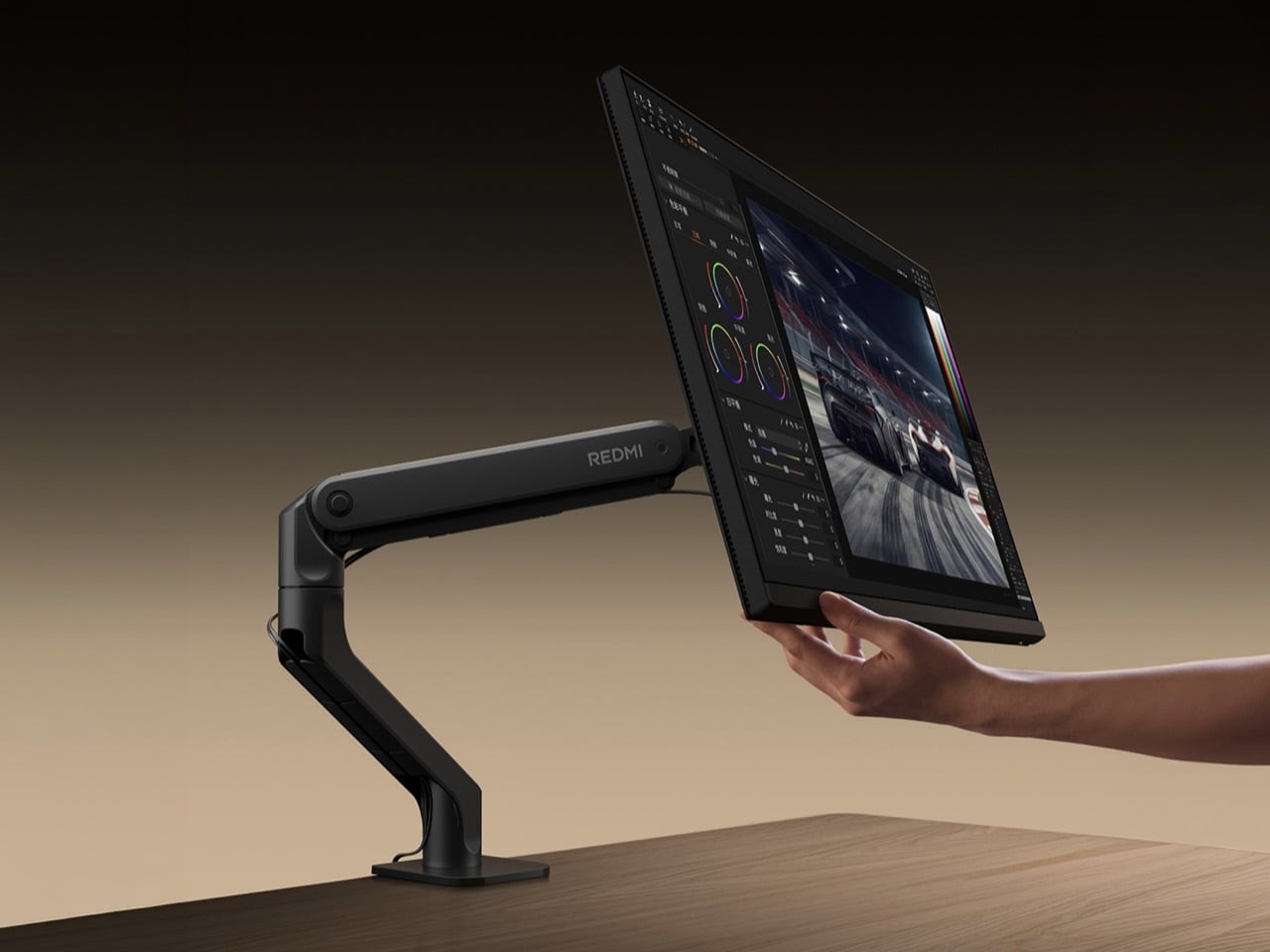
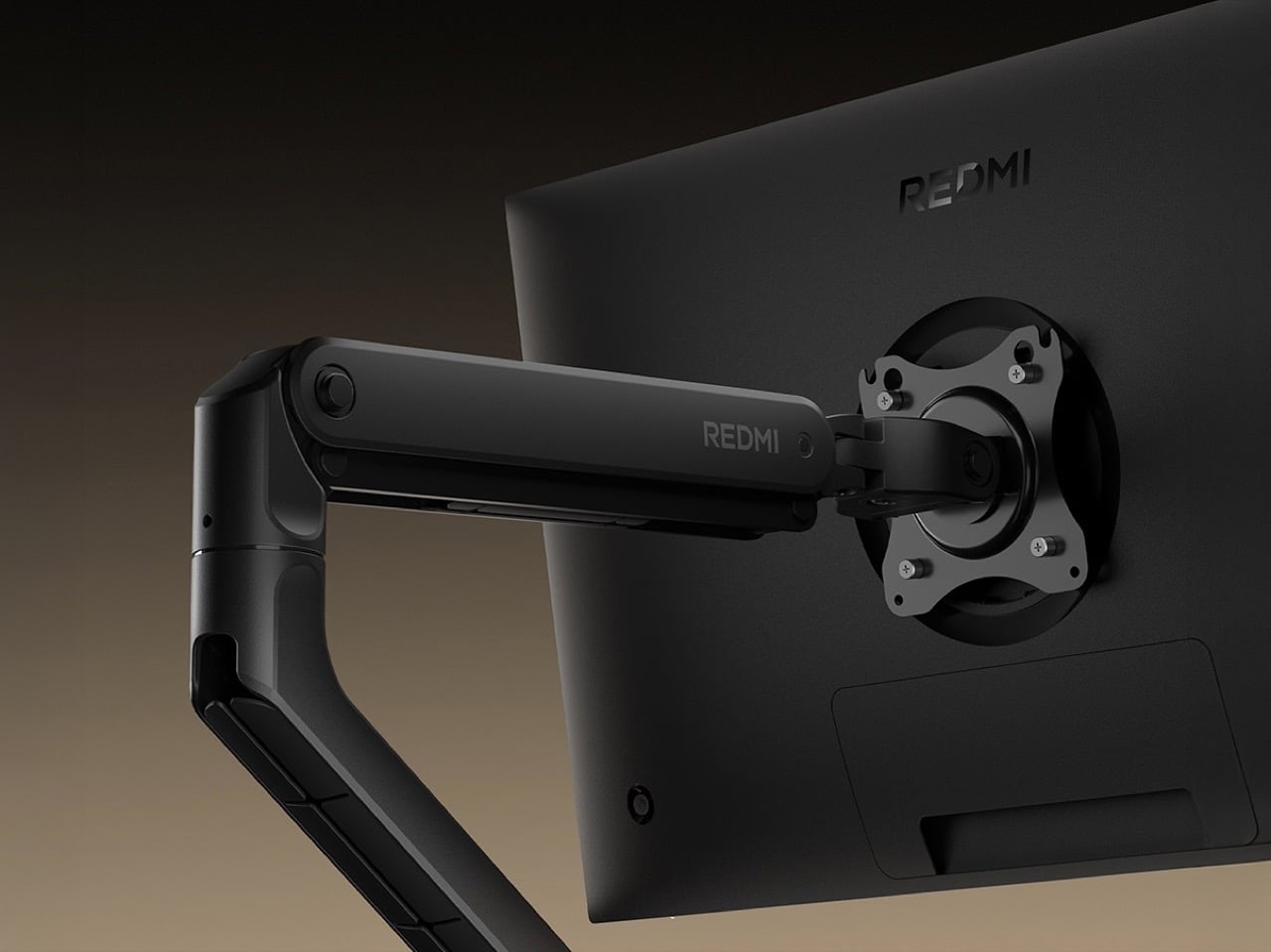
Xiaomi is assembling your desk one cheap piece at a time. First came the monitors, from 24-inch office panels to 4K gaming screens. In July, the Mijia Monitor Light Bar 2 arrived to perch on top of them for about $39. Now Redmi, Xiaomi’s budget sub-brand, has launched the piece that holds the whole thing up, a monitor arm with a hidden cable channel for roughly $42. At this rate, a Xiaomi standing desk is probably already sitting in a spreadsheet somewhere.
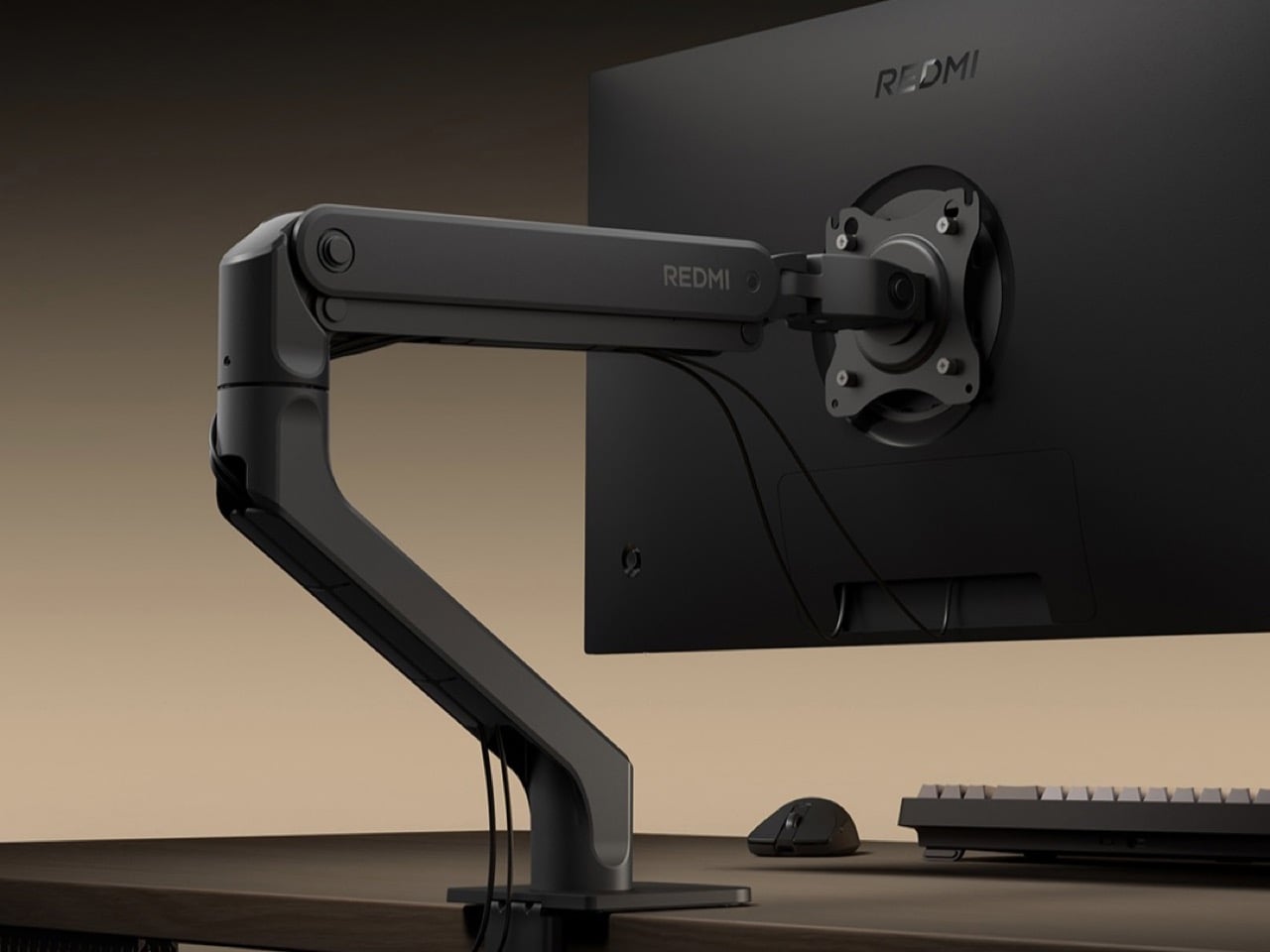
The Redmi Monitor Arm went on sale October 12 on Xiaomi Youpin for ¥299 (about $42), and Xiaomi has not announced a US release. It holds screens up to 34 inches, and the body is 3mm aluminum alloy. Xiaomi’s pitch is that cables tuck inside the arm, so your desk shows a single post. A five-year replacement guarantee comes along for the ride, which is a lot of faith at this price. If you have ever fought a monitor arm and zip ties in the same evening, you can see the appeal.
A load range that starts at 4.2 pounds
Redmi rates the arm for 4.2 to 19.8 pounds (1.9 to 9 kg), and the low end is the interesting part. An arm tuned for a heavy screen will push a light one skyward, so a 1.9 kg floor suits the featherweight office panels Xiaomi itself sells. At the other end, 17173 notes a loaded 34-inch ultrawide lands around 8 kg, so the 9 kg ceiling has room. Anything heavier, or anything past 34 inches, needs a different arm. Check your panel’s spec sheet before you click buy.
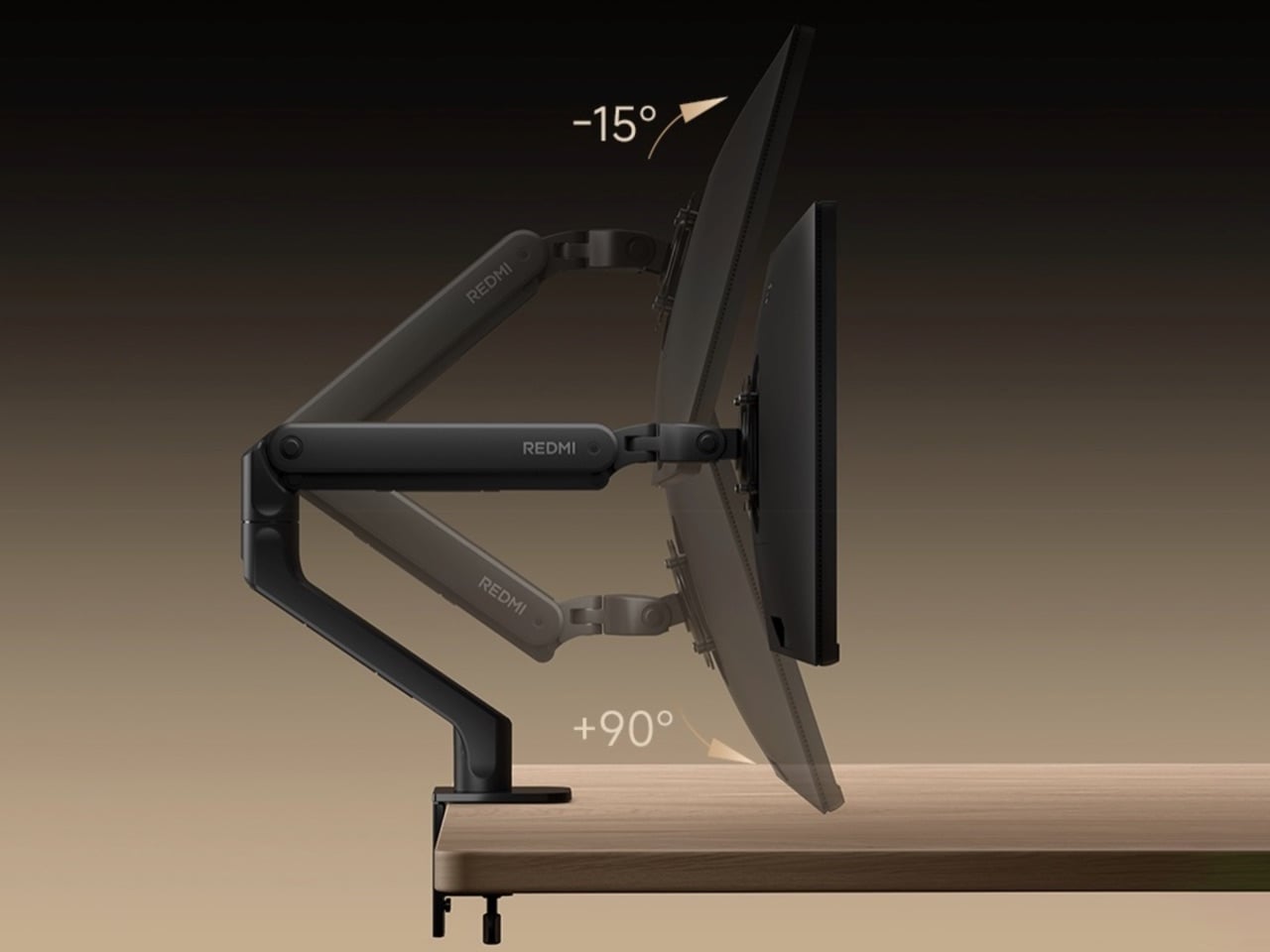
The lift comes from a dual-spring design, with springs on both sides firing together so the force stays even through the whole 11.8 inches (30 cm) of height travel. Xiaomi says it survived 30,000 test cycles. Chinese outlet Kuai Keji worked that out to about 20 years of use at four adjustments a day, which is a lot of standing up and sitting down. The listing cites a Chinese utility model patent, a lighter registration than a full invention patent. Redmi adds a separate tilt-force adjustment at the VESA head to go after screen sag
Cable routing that hides the mess, mostly
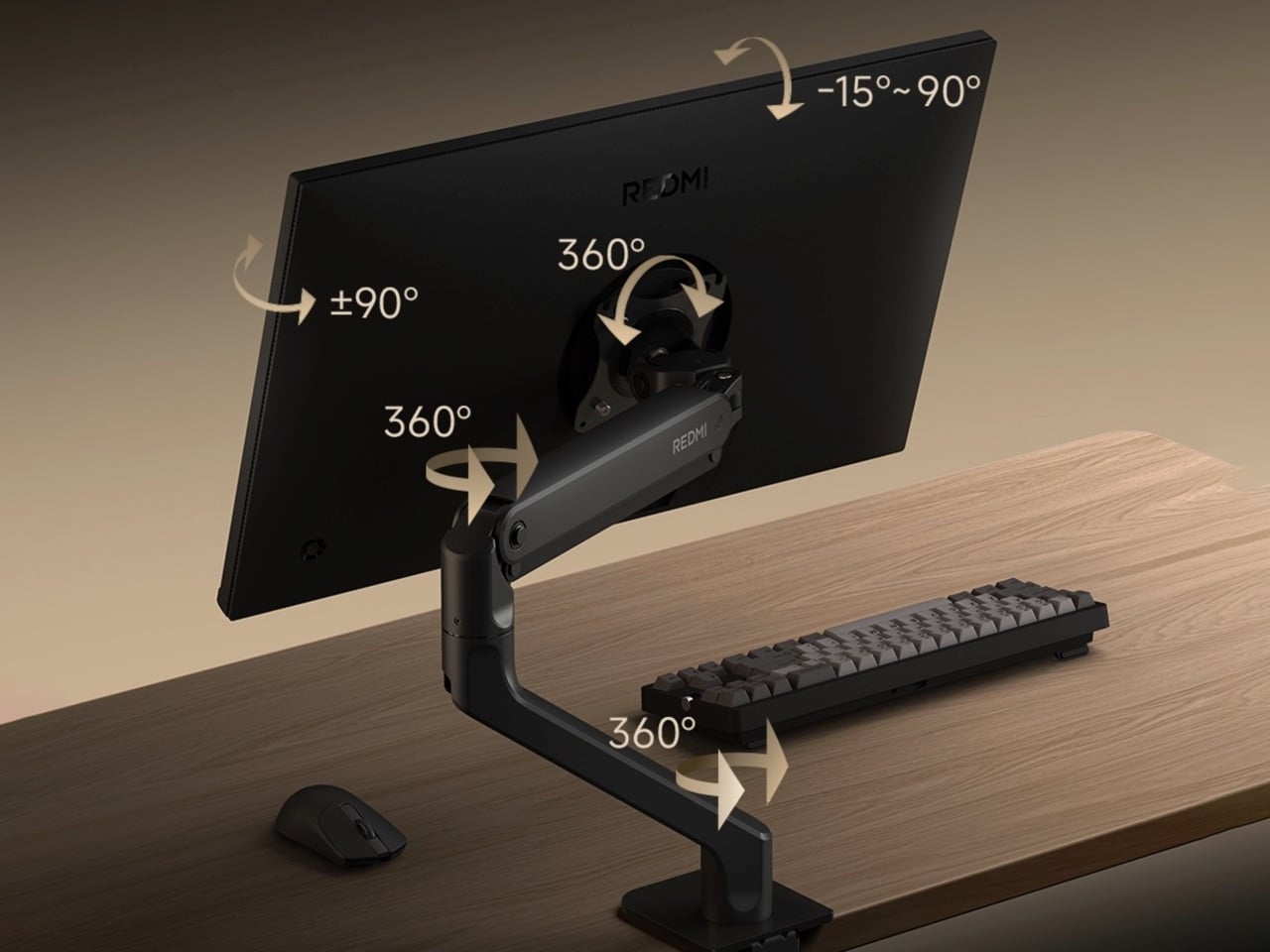
Redmi’s renders show cables running through a channel beneath the arm and down the riser. Only the clamp stays visible on the desk. It echoes the trick behind Calvin Lien’s Console Desk concept, which hid its cabling inside the desk’s spine so the surface stayed clean. The arm adds reach to that job, with 17.1 inches (43.5 cm) of front-to-back travel and a 360-degree screen rotation. The promo shots still show a little cable curling out near the VESA plate, which is fair, because a moving screen needs slack somewhere.
Six years ago, Redmi’s first PC monitor, the Display 1A, launched with nothing to hide its cables, a gap a Polish review called out at the time. Concealed routing is now a headline feature on the company’s own product page. That tells you where desk setups have gone. A channel in the arm means the monitor’s cables follow one path instead of dangling in every direction. Redmi’s version is far simpler than a full desk rebuild, and it only has to live inside one arm.
The ¥299 price and China-only availability
The arm costs ¥299 in China (about $42) and went on sale October 12 through Xiaomi Youpin. The listing shows a struck-through ¥499, but Youpin’s fine print calls that a reference price, so read ¥299 as a launch price rather than a markdown. Notebookcheck points out that pricier ergonomic arms can run up to $350 in the US, which makes $42 look like a typo. A five-year replace-instead-of-repair guarantee comes with it, though the full terms are not spelled out on the page. The currency conversion is approximate.
Compatibility looks friendly, since the VESA plate takes the 75x75mm and 100x100mm patterns that most monitors use. That is the same pair CORSAIR’s Platform:6 desk specs for the arms it ships with, so most panels should line up. Xiaomi has not published a clamp thickness range, so measure your desk edge before you get excited. There is no word on a global release, but Xiaomi often sends its accessories abroad later, sometimes wearing the Xiaomi name. The part holding your screen up has never been the exciting purchase, which is exactly why a $42 version is worth watching.
+Four Android upgrades and security patches until 2032
+Matte back and bundled case both shrug off fingerprints
What doesn't
–Screen readability dips in direct sunlight
–Haptics are softer than on premium phones
–No ultra-wide or telephoto cameras
–Video recording tops out at 1080p
The Redmi Note 17 5G spends its budget on what people actually run out of, battery and years of support, and asks for a calmer chip in return.
Phone prices went up this year, and not because phones got dramatically better. Memory and storage cost more, so every brand had to decide what to keep and what to cut. Some raised the price. Others trimmed the camera or the chip to hold it. Xiaomi made a very clear choice with the Redmi Note 17 5G, and you can feel it the moment you pick the phone up.
On paper, the whole phone is built around one number: a 7,700mAh silicon-carbon battery. Around it sit a 6.99-inch AMOLED screen, a Snapdragon 4 Gen 4 chip, a single 50MP camera, IP65 protection, and security updates until 2032. I used the 6GB and 256GB version for about two weeks to see whether a phone designed for endurance is also a phone you actually enjoy using.
Designer: Xiaomi
Aesthetics
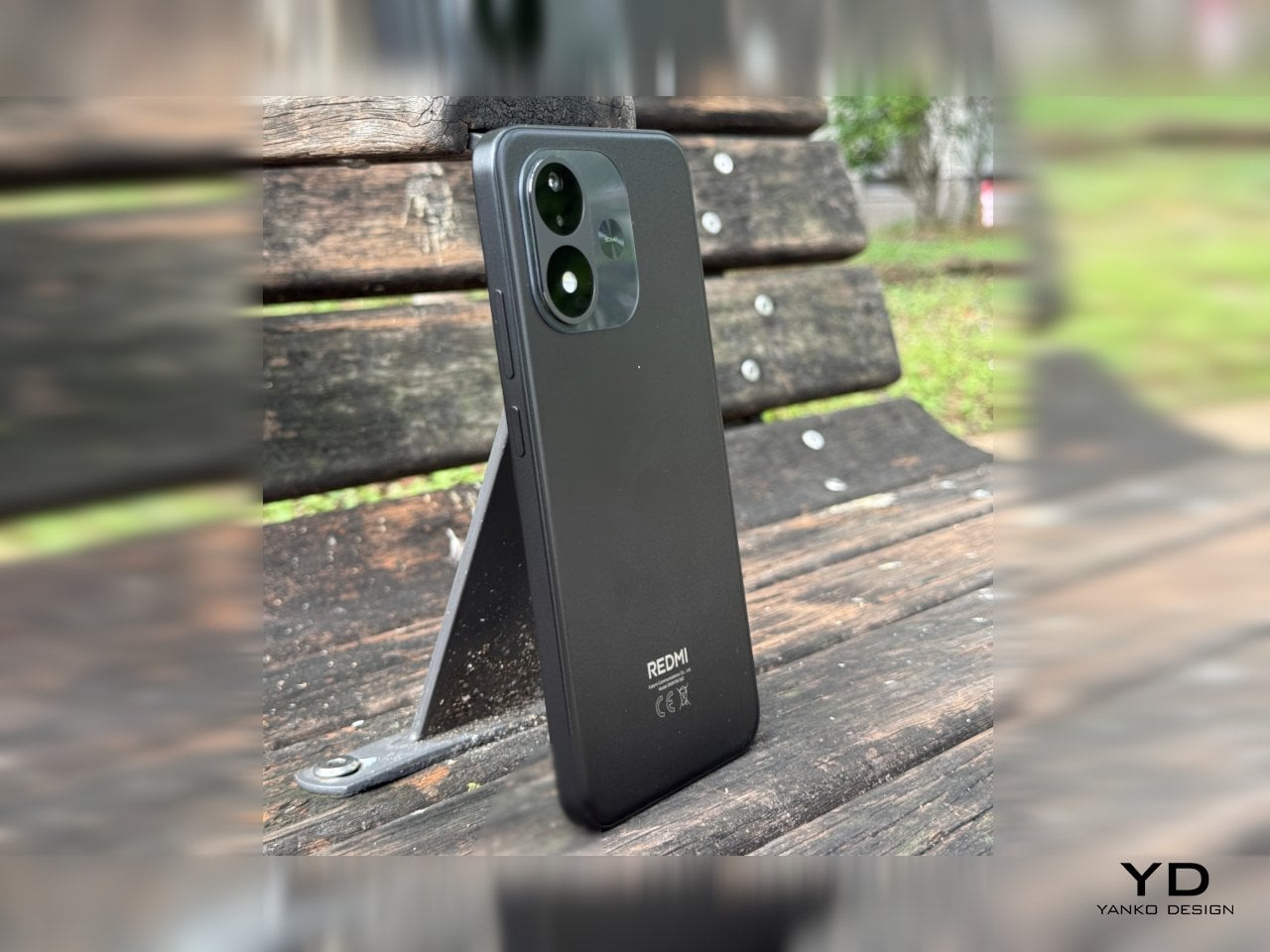
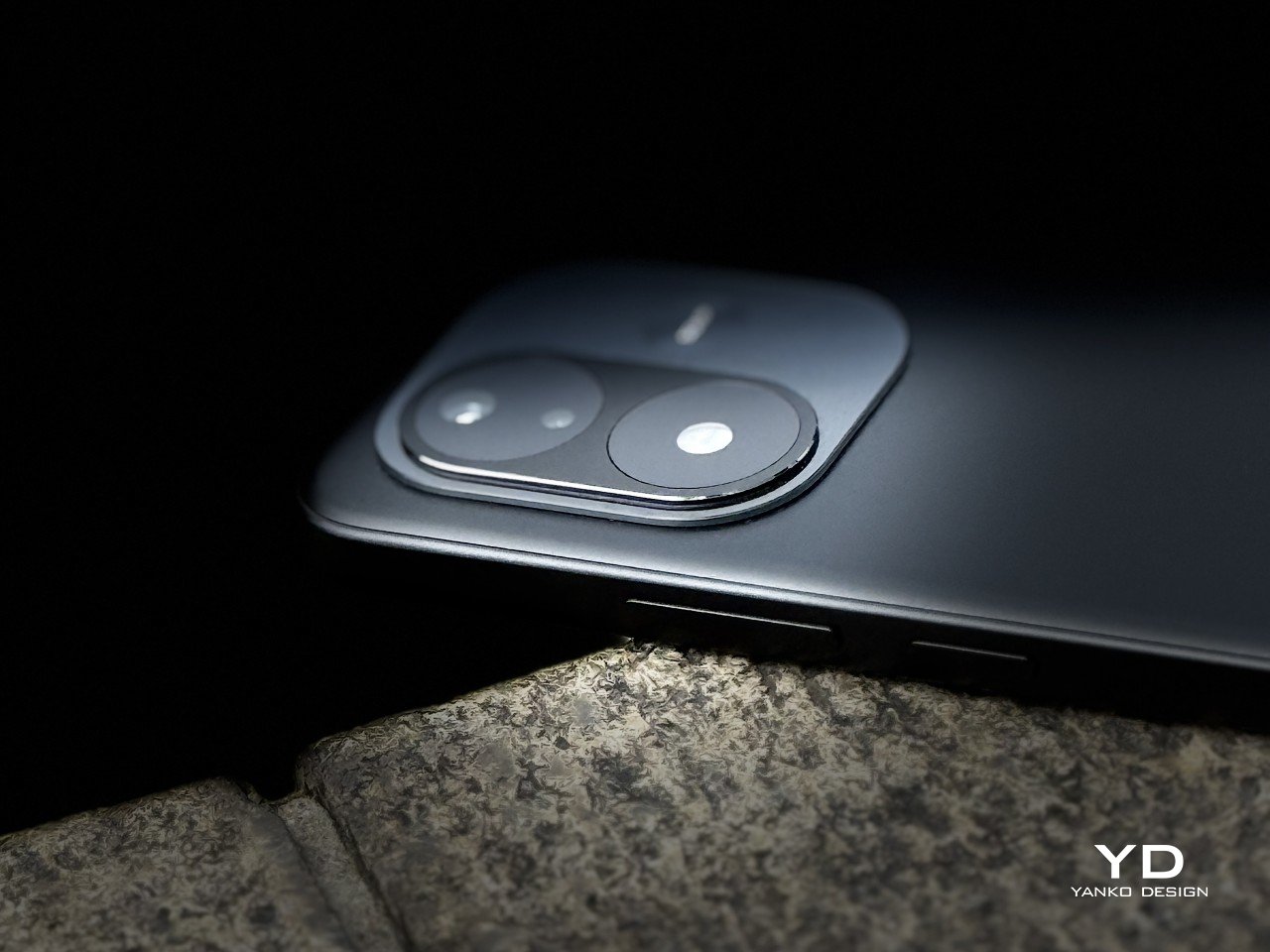
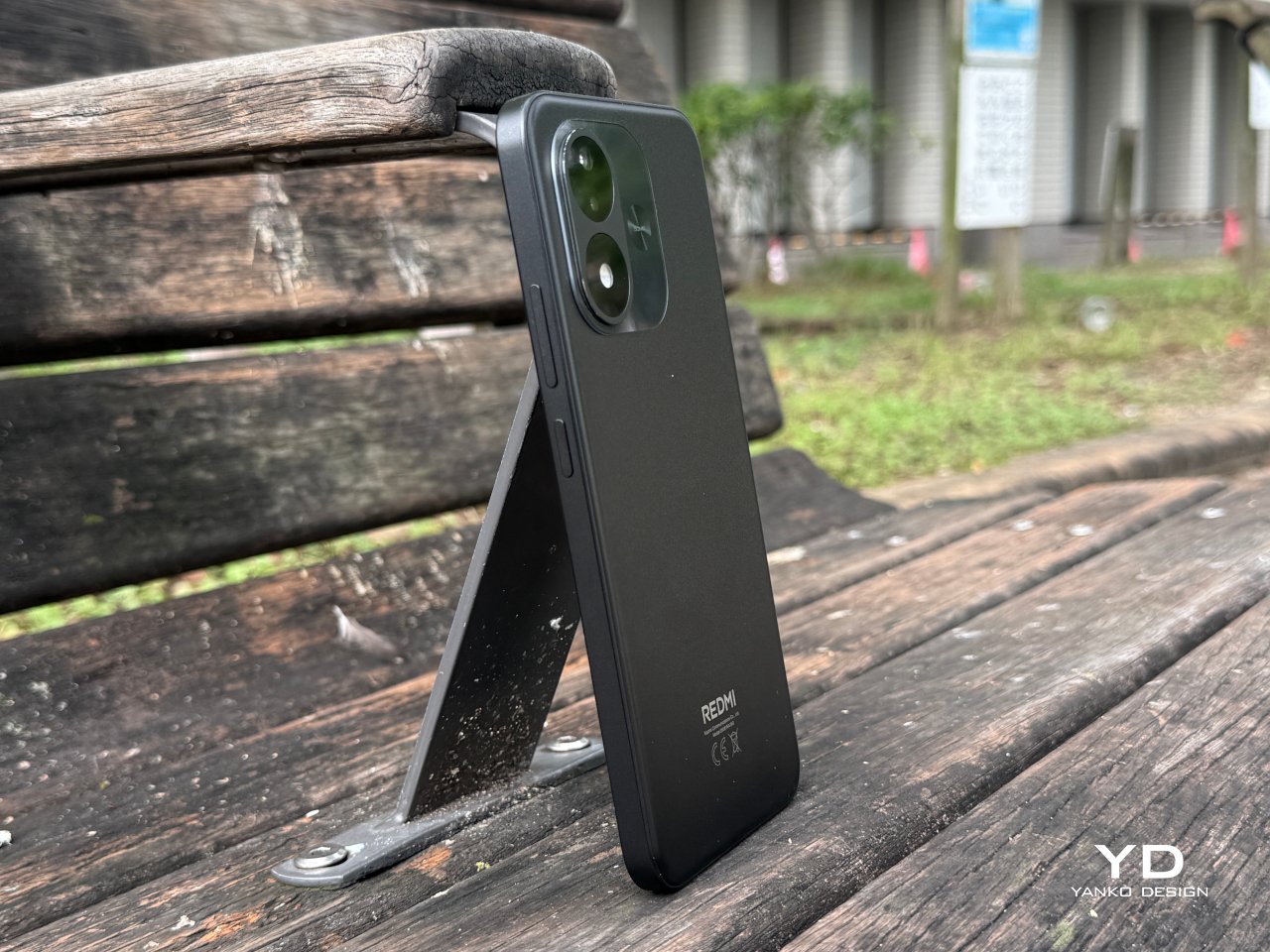
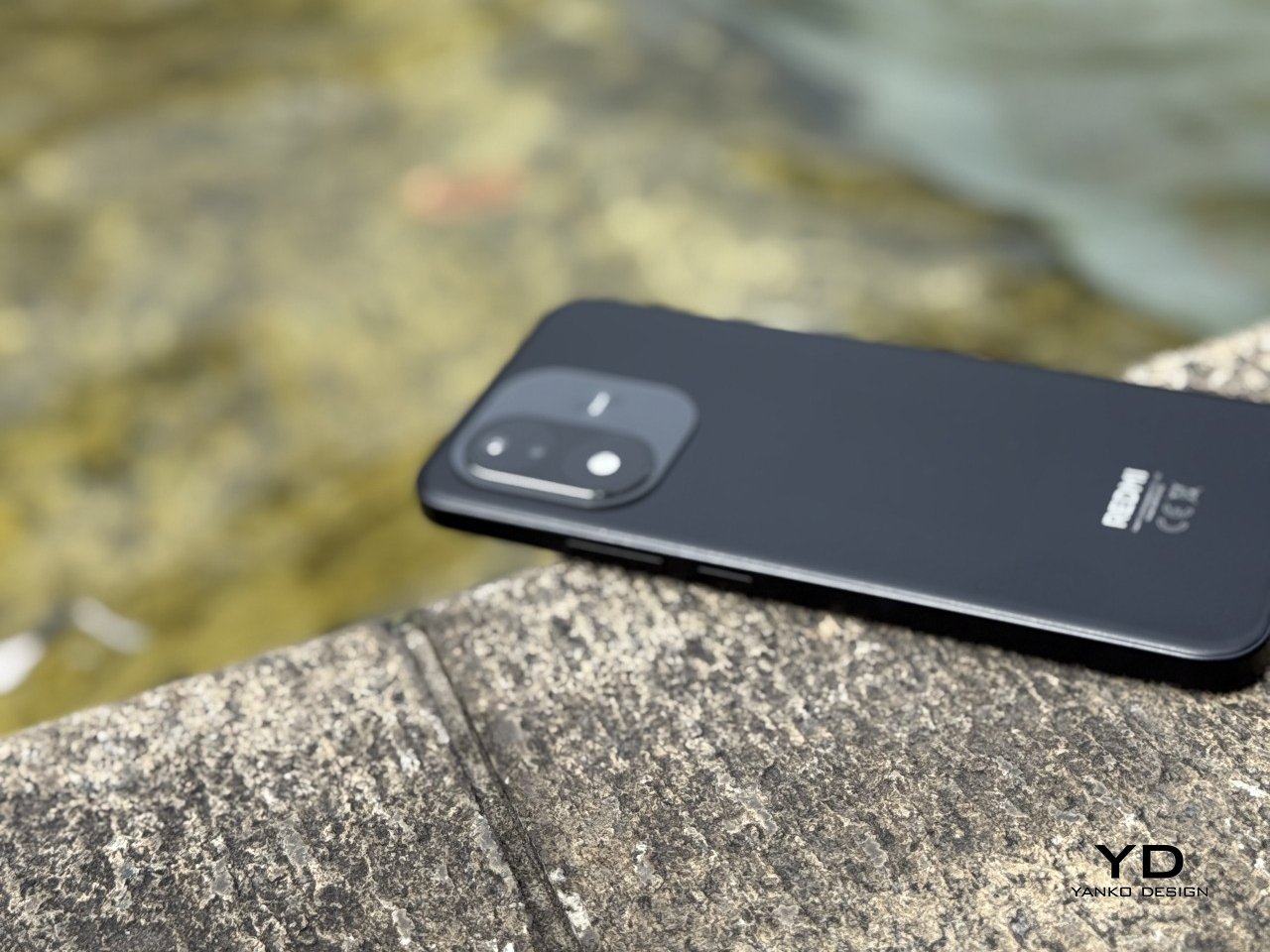
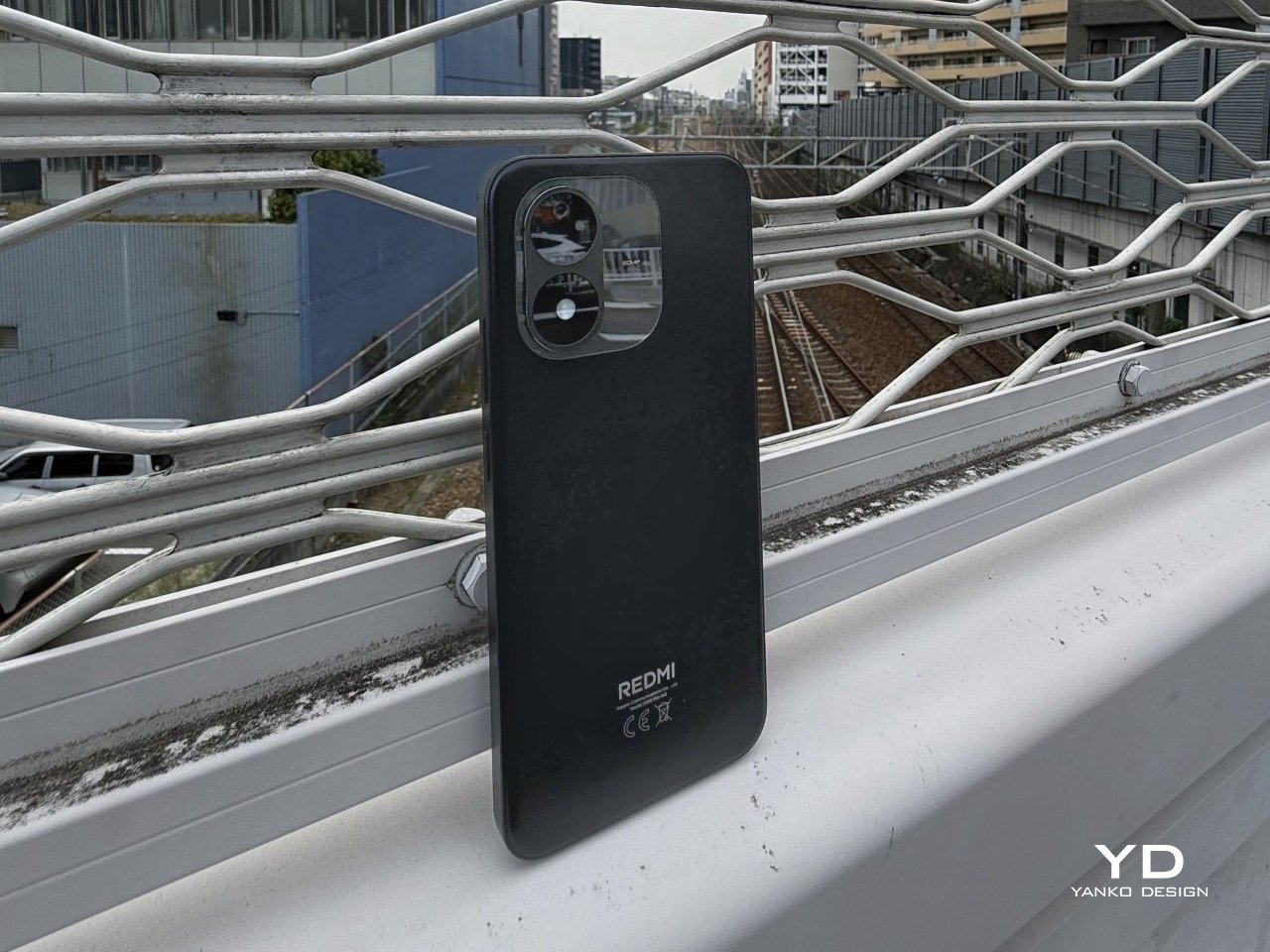
The Redmi Note 17 5G doesn’t try to shout, and that works in its favor. I received the Black version, and the interest is in the details. Xiaomi describes the back as a dual finish, which means the panel and the camera plate are treated very differently. The panel is a fine matte that turns almost graphite in low light, while the camera plate is glossy.
That plate is where the design gets its character. It’s a rounded square in the top left corner with a glossy, pill-shaped module holding two circles: the 50MP camera and a small second lens above and the flash below, plus a small brushed disc with “50MP” printed on it. The arrangement is balanced and calm, and it makes a single-camera phone look complete. The matte back stays clean through daily handling, and only the glossy plate picks up the odd fingerprint.
The frame is flat with rounded corners and a metallic-look finish, and the front is just as simple: a flat 6.99-inch screen with a small punch-hole camera. It’s a tidy, well-proportioned design that favors restraint over flash, and in black it keeps a low profile. If you want more personality, Xiaomi also sells it in Sky Teal and Celestial Purple.
Ergonomics
The numbers tell most of the story. The Redmi Note 17 5G measures 169.7 x 79.14 x 8.45mm and weighs 225g. It’s a substantial phone, and the weight is the first thing you notice when you pick it up. That’s the fair price of fitting a 7,700mAh battery into a body under 9mm thick.
The flat sides and rounded corners make that size easy to live with, and the matte back isn’t slippery. The power button and volume rocker sit on the right edge, and the fingerprint reader is an optical one under the display. Xiaomi’s Wet Touch 2.0 keeps the screen usable with damp fingers, which is handy in humid weather. At almost 80mm wide, it’s most comfortable in two hands, which suits the large screen for reading and video.
Haptics are the one area where the price shows. The vibration motor’s feedback is softer and less precise than on flagship phones. It’s a small detail, yet it’s the kind that reminds you how much good haptics add to everyday use.
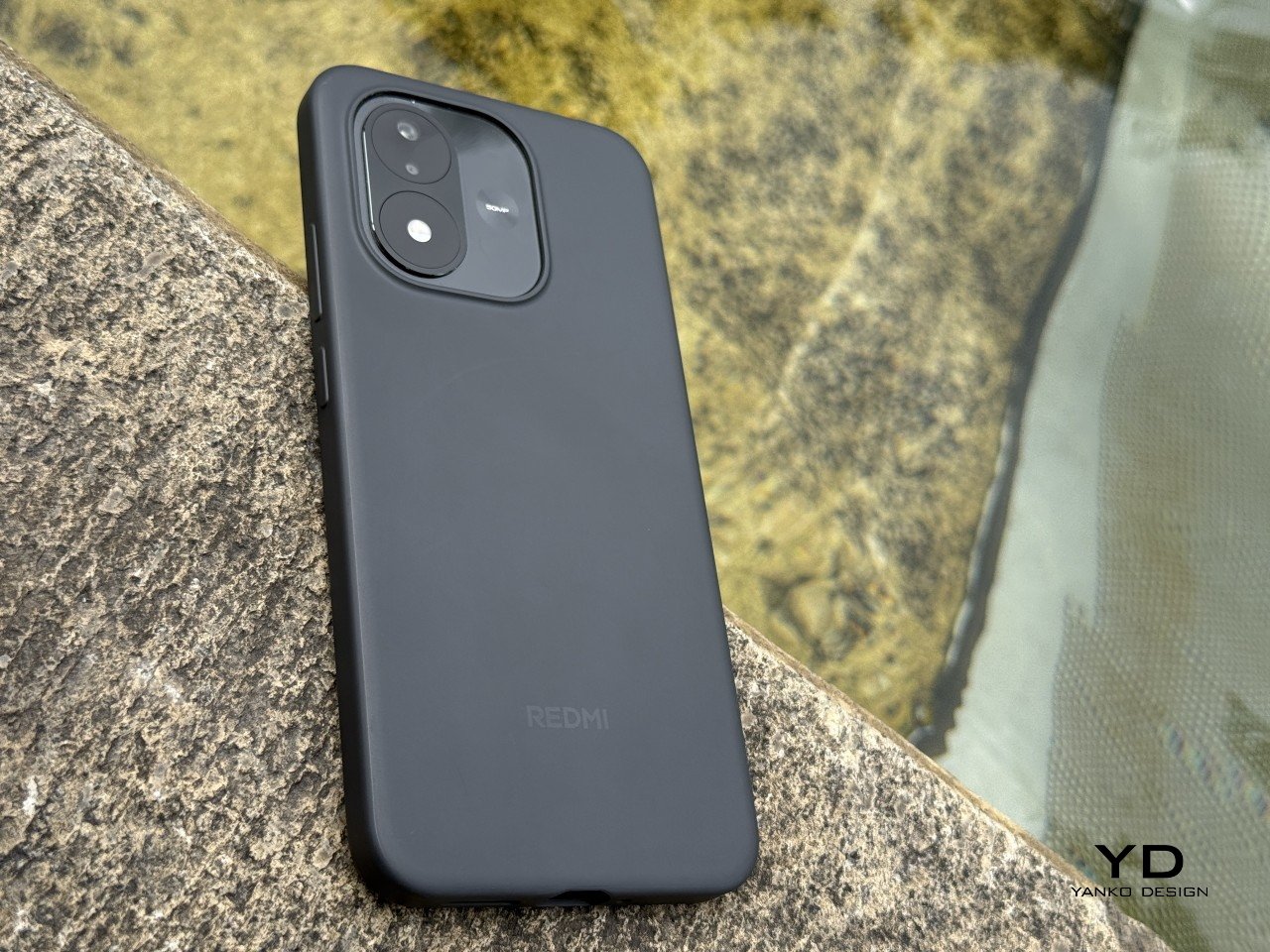
Xiaomi includes a case in the box, and it’s better than the usual clear plastic shell. It’s a soft, matte silicone case in dark gray with a raised lip around the camera, and it doesn’t pick up fingerprints either. On a phone of this weight, the extra grip is welcome, and the phone is protected from day one.
Performance
Snapdragon 4 Gen 4 and HyperOS 3
Inside is a Snapdragon 4 Gen 4, made on a 4nm process, with Adreno 613 graphics, 6GB of LPDDR4X memory and UFS 2.2 storage. It’s a chip built for efficiency over outright speed, and that efficiency is what lets such a large battery fit in a body this thin. Messaging, maps, browsing, streaming, and photos run comfortably, and demanding 3D games run best at lower settings.
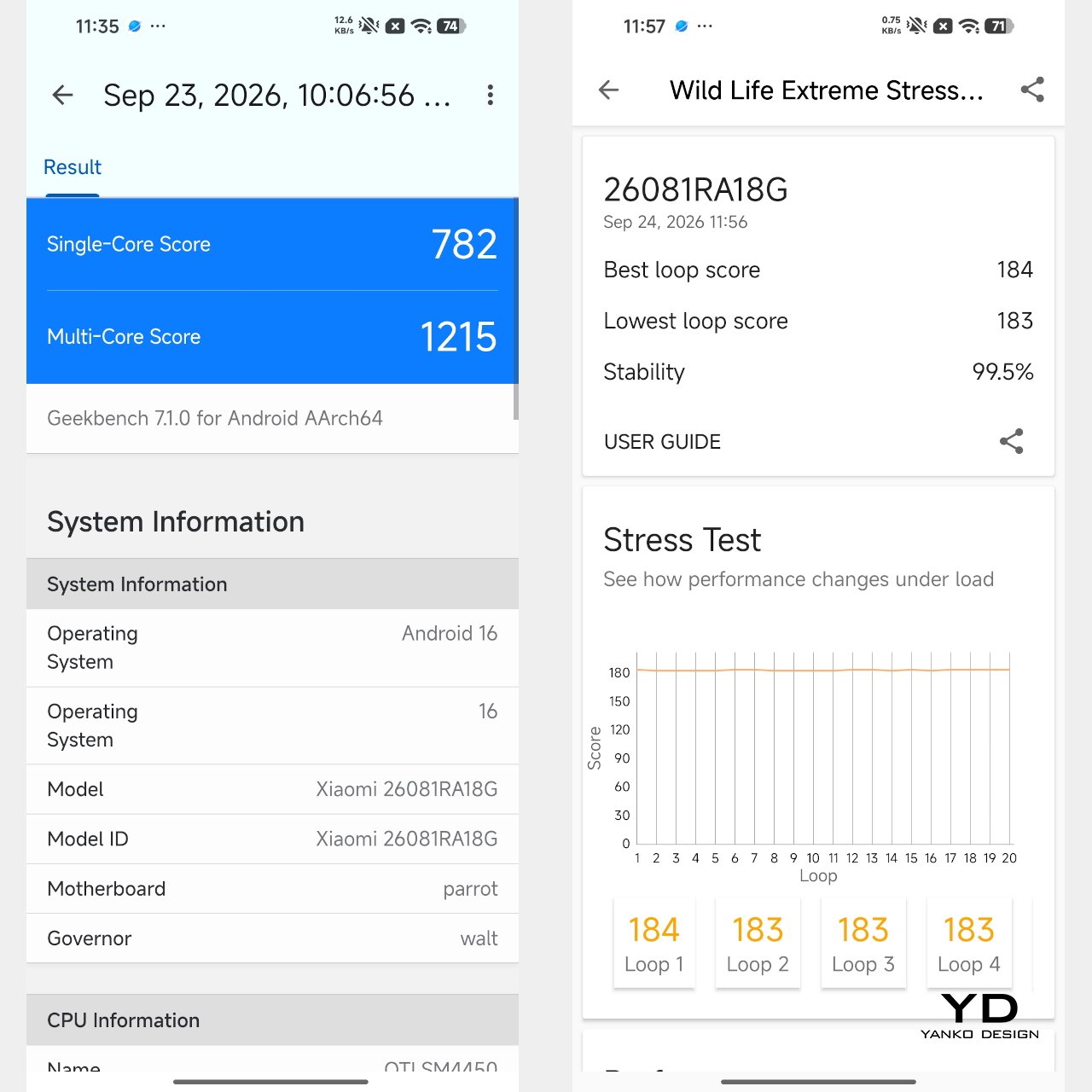
3DMark’s Wild Life Extreme stress test shows where the chip’s strength lies. The headline scores sit where you’d expect for this class, but the consistency stands out. Over 20 minutes of full graphics load, the phone held 99.5 percent stability across all 20 loops, and its temperature only rose from 33°C to 35°C. It stays cool and steady when pushed.
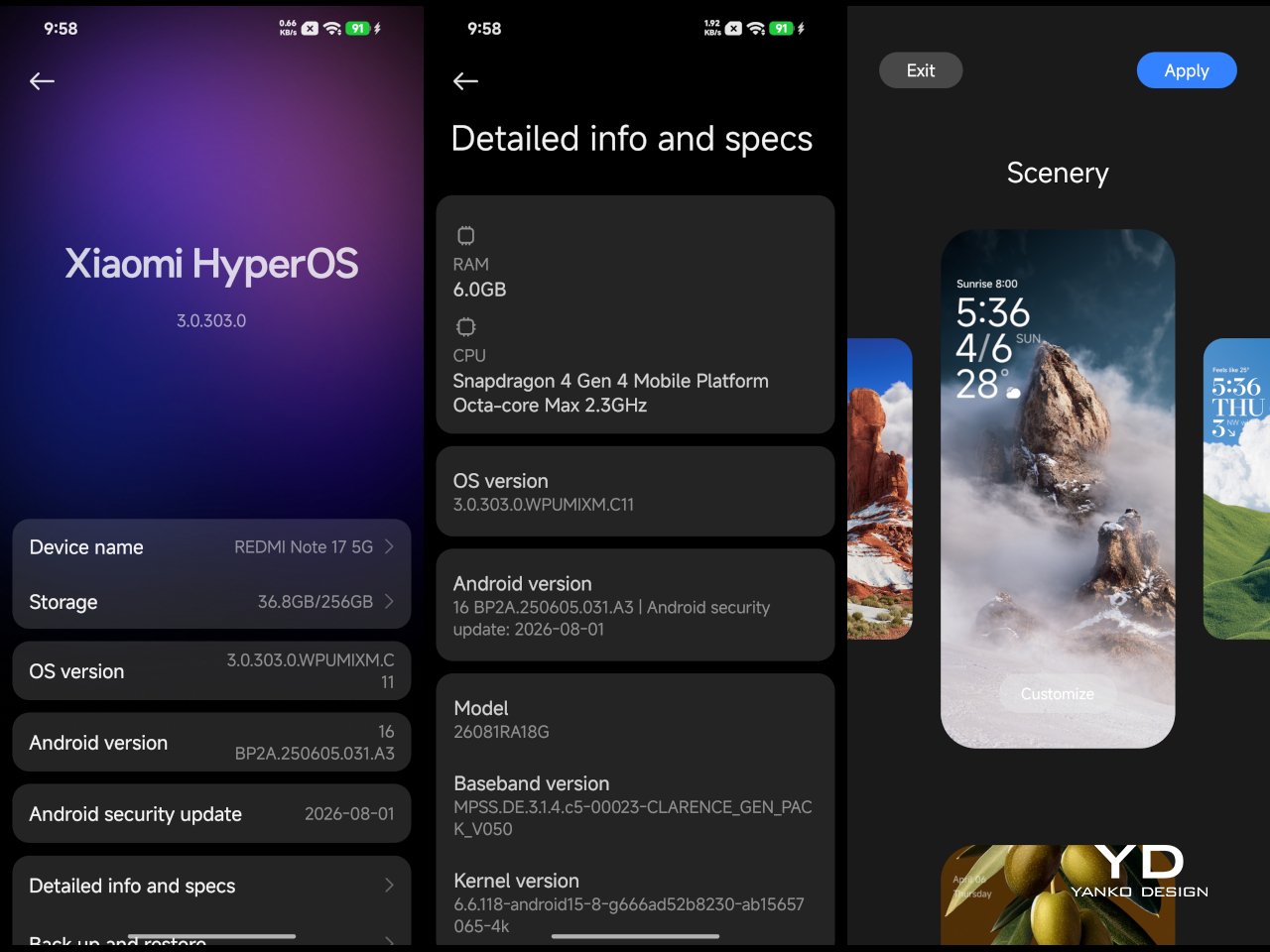
It runs Xiaomi HyperOS 3 on Android 16, with Google’s Circle to Search and Gemini, Xiaomi’s HyperIsland for live notifications, and AI Erase Pro promised in a later update. It’s pretty much Xiaomi’s whole UX experience, crammed into a lower mid-tier phone.
Display and Sound
The 6.99-inch flat AMOLED has a 2,396 x 1,080 resolution and a 1,800-nit peak. There’s no option to lock the refresh rate. The panel adjusts itself up to 120Hz, so scrolling stays smooth and the phone saves power when the image is still. Indoors and in shade, it looks great, and TÜV Rheinland certifies it for low blue light and circadian-friendly viewing. Direct sunlight is the one condition where it struggles to keep up.
Audio comes from a single speaker on the bottom edge, tuned for calls, alarms, and spoken content. For music, earbuds bring out more, and since there’s no headphone jack, Bluetooth or USB-C is the way to go. Two useful extras round things out: an infrared blaster for TVs and air conditioners, and NFC for contactless payments.
Main Camera, 1xMain Camera, 1x, EveningMain Camera, 1x, Human Skin
50MP Camera
Main Camera, 1xMain Camera, 2xMain Camera, 10x
The single 50MP main camera has an f/1.8 lens, and in good light it does a good job. Photos come out bright and clean, greens are punchy, and skies lean towards a deeper blue. Dynamic range holds up well too. Shooting up a dark underground stairway into a bright sky, it kept both the tiled mural and the clouds. The 2x option is a crop from the main sensor and stays sharp in daylight. Beyond that, the zoom is digital, and at 10x a group of turtles on a rock took on an almost watercolor softness, so 1x and 2x are where this camera does its best work.
For designers, it’s a handy reference camera. The 50MP and Ultra HD modes save files of around 48 million pixels, which leaves room to crop into textures like bark, stone, or lacquered wood later. It won’t replace a proper camera, but for collecting material and color references, it does the job.
Night IndoorNight DefaultNight Mode
Night mode is worth using. On a street corner at night, the normal shot used ISO 250 at 1/100s, while Night mode chose ISO 400 at 1/50s and brought the lanterns and shopfronts out of the dark without blowing out the lights. In very dim restaurants, around ISO 2000, the processing leans on noise reduction for a cleaner image at the cost of some fine detail. The 16MP front camera gives natural skin tones in daylight, and both cameras record video at up to 1080p and 30fps.
Battery Life and Charging
This is where the design pays off. Xiaomi rates the battery for more than two days of moderate use, and the EU energy label’s standard test puts it at 68 and a half hours on a charge. My own testing points the same way. The 20-minute 3DMark stress run, with the graphics chip working flat out the whole time, used just 3 percent of the battery.
My unit came with a 45W charger in the box, though that varies by market. Independent tests put a full charge at about an hour and a half, which is reasonable for a battery this size. Charging is wired only, and wired reverse charging at up to 22.5W lets the phone top up earbuds, a watch, or a friend’s phone.
50MP ModeUltra HD ModeSelfie Camera
Sustainability
The strongest sustainability point is software support. Xiaomi promises four major Android upgrades, up to Android 20, and six years of security updates, which means patches until 2032. The updates are already arriving. During my time with the phone, it received a 295MB system update that moved its security patch from June to August 2026. A phone that stays safe to use for that long doesn’t need replacing after two years.
The EU energy label adds useful detail, because it uses the same tests for every brand. It rates the battery for at least 1,000 full cycles before it drops to 80 percent capacity, lists it as user-replaceable, and records 90 drops without a defect in its repeated fall test. Xiaomi’s own lab claims 1,600 cycles, or about six years of normal use.
iFixit hasn’t published a teardown of this model yet. In the meantime, where the program runs, Xiaomi offers one free screen replacement and one free back cover replacement within 24 months, plus one free battery replacement within 36 months. The phone is IP65 rated against dust and water jets, the screen uses Corning Gorilla Glass 7i, and the case covers the back from the start. Recycled materials aren’t part of Xiaomi’s story for this model yet, which leaves room for the next generation to go further.
Value
In Europe, the Redmi Note 17 5G launched at 379.90 euros for the 6GB and 256GB version I tested. With the case, a USB-C cable and, in many markets, a 45W charger in the box, it’s a generous package for the price.
Its own predecessor is the most useful comparison. The Redmi Note 15 5G spread its budget across a faster chip, a 108MP camera and 4K video. The Note 17 5G concentrates on a much bigger battery and a longer support period. Most phones still carry batteries in the 5,000 to 6,000mAh range, so that focus gives it a clear identity in its class.
Xiaomi is betting that battery life and years of updates matter more, and for a lot of buyers, I think that’s the right bet. If 4K video, long zoom, and high-end gaming aren’t part of your routine, this phone gives you a lot for the money.
Verdict
The Redmi Note 17 5G is easy to sum up with one number, but the battery is only the starting point. The weight, the flat and grippy frame, the case in the box, the efficient chip, and the self-adjusting refresh rate all follow from it. It feels like one clear decision carried through the whole product.
Speed seekers and heavy video shooters will find better matches elsewhere. But if you keep your phones for years and care more about something that lasts than something that wins spec comparisons, the Redmi Note 17 5G was made for you. Buy it for the battery, and keep it for the years of updates.
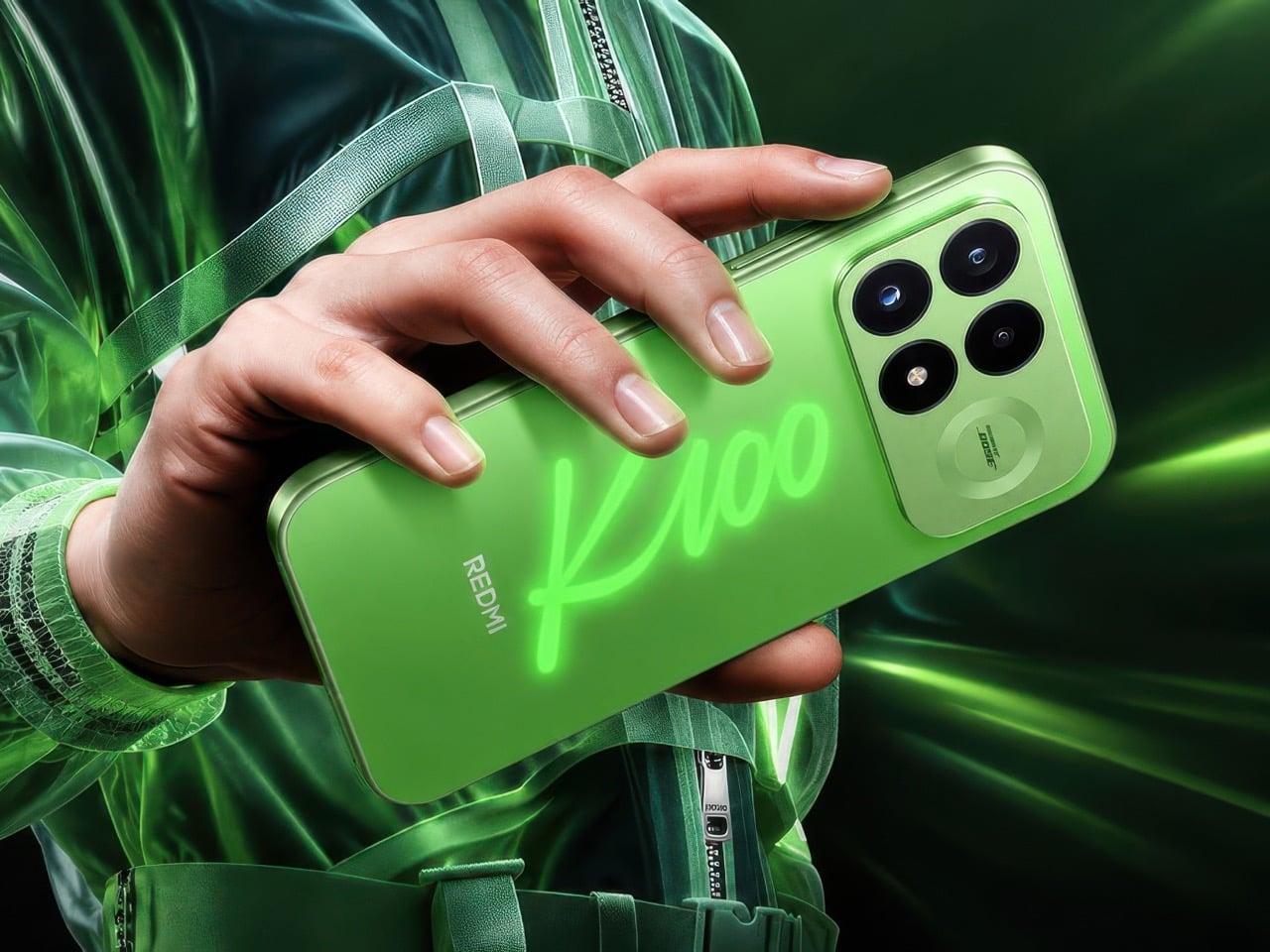
Photoluminescent material is not new. It is the stuff in your kid’s ceiling stars, in old wristwatch dials, in every glow stick you have ever cracked at a concert. What is new is putting that decades old chemistry on the back of a flagship smartphone and letting the owner become the artist instead of the factory. That is exactly what Redmi did with the K100 Pro, and it might be the single most fun thing to happen to phone design all year, mostly because it does not take itself too seriously.
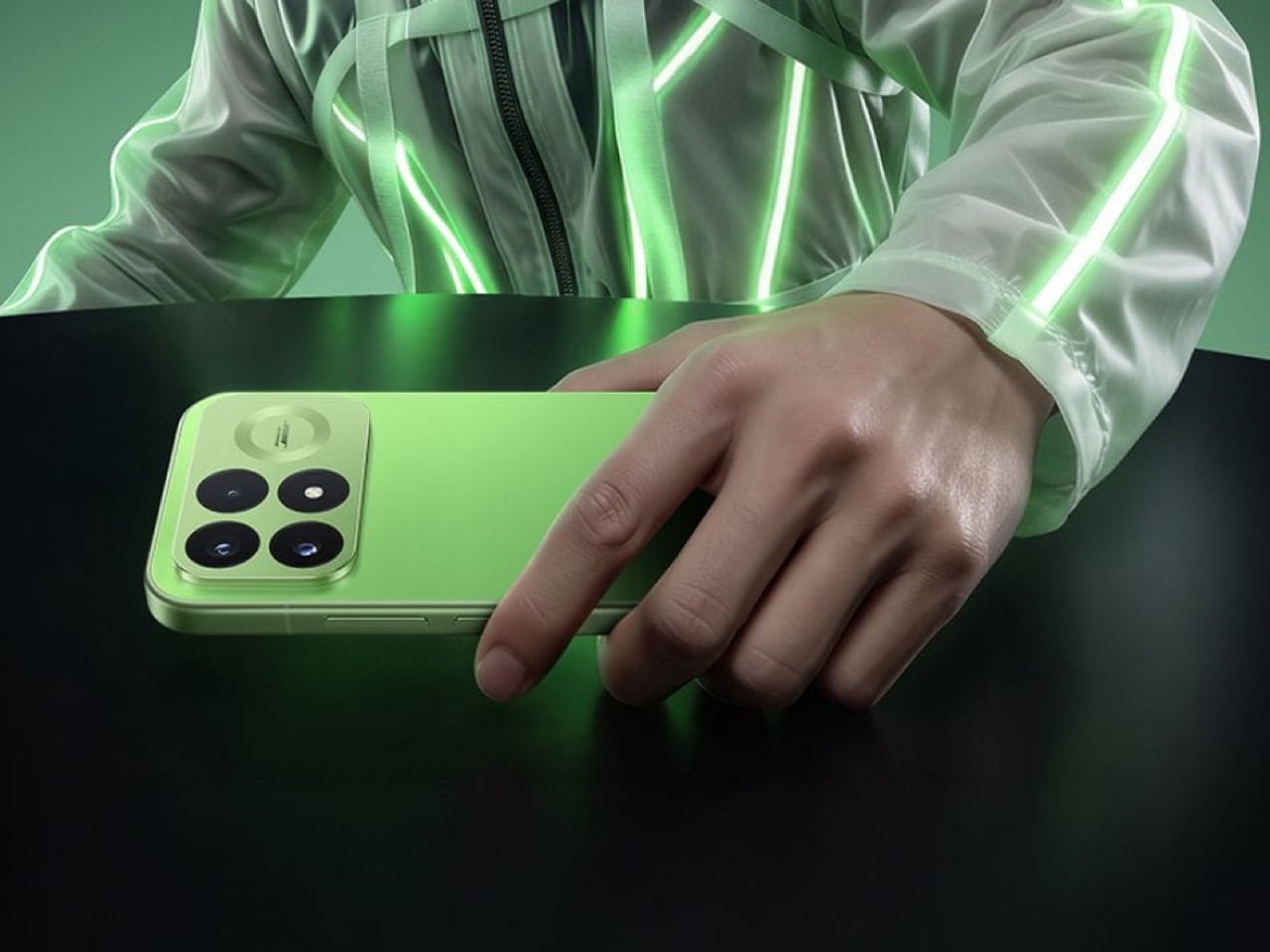
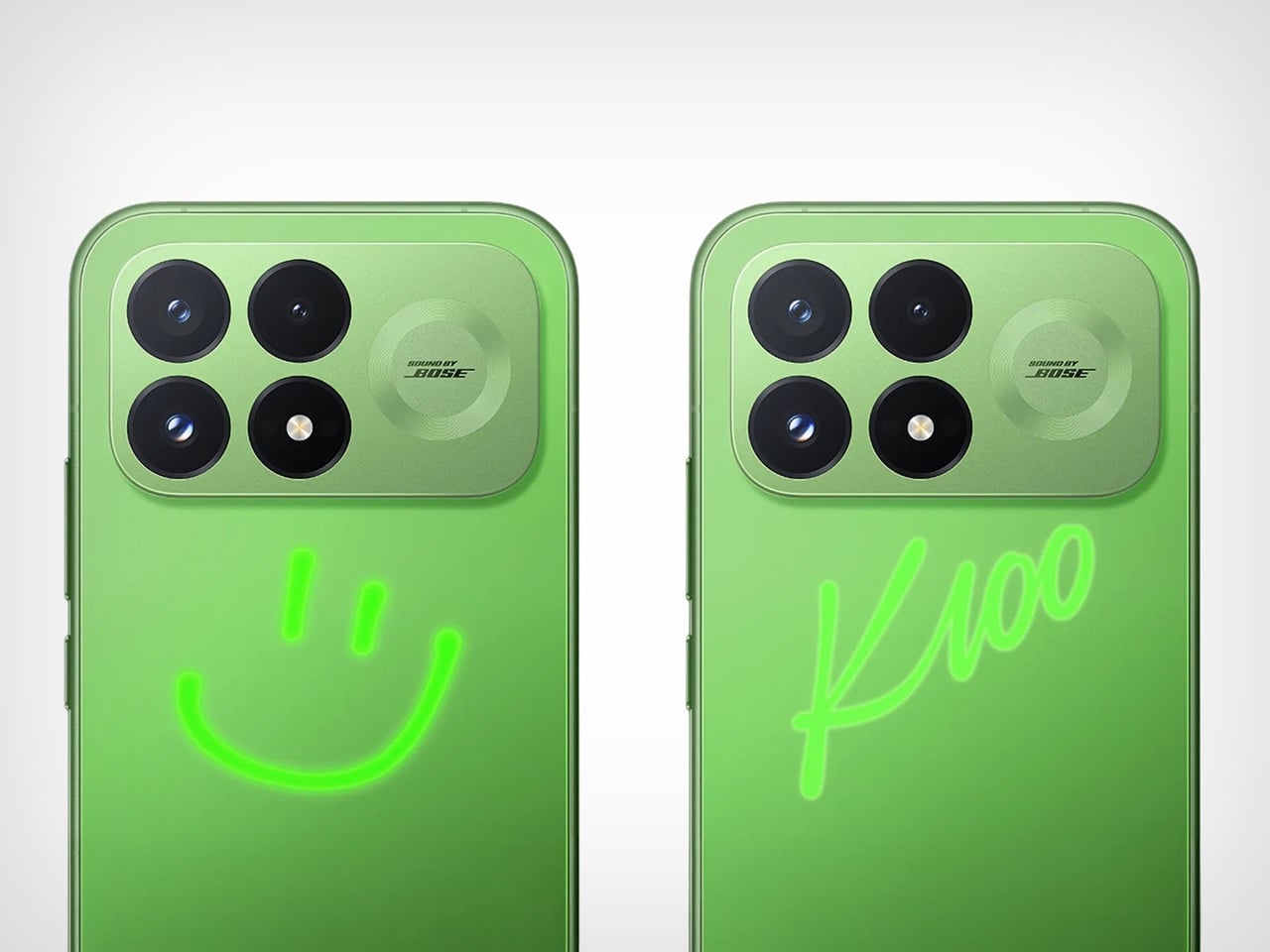
The finish is called Glowing Firefly, and it works by hiding a luminescent layer between the phone’s glass back and its green ink coating, invisible in daylight and glowing wherever you point a flashlight or light pen after dark. Redmi launched the K100 Pro in China on August 11, pairing the party trick with a legitimately serious spec sheet that includes a 185Hz OLED, a Snapdragon 8 Elite Gen 5 V Series chip, and a 200MP camera. The phone can keep up with any flagship on paper. It just also happens to double as a doodle pad.
Designer: Xiaomi
Redmi’s own language calls the back panel a light painting canvas, and that description holds up better than most marketing copy tends to. Point a flashlight, a laser pointer, or a dedicated light pen at the glass and the material soaks up the energy along the exact path the light traveled, then releases it slowly as a glowing outline. Write your name, sketch a smiley face, sign the thing like a yearbook, and watch it fade out over the following minutes. There is no chip involved, no battery drain, nothing to charge separately. It is closer to a Lite Brite than to anything Qualcomm builds, which is honestly the charm of it.
Nothing tried something adjacent with the Phone 2a Plus Community Edition, and I still think about that phone. It used a green phosphorescent coating along the ribbon cables and camera trim, charged by ambient light and glowing softly on its own without any input from you. It was quiet, tasteful, very on brand for a company obsessed with making internals look intentional. Redmi took that same chemistry and handed the pen to the user instead of the factory. One phone glows because the designers told it to. The other glows because you told it to, and that distinction matters more than it sounds.
None of this changes what the K100 Pro is underneath the finish, a genuinely stacked gaming flagship with an 8,580mAh battery, 100W charging, and a cooling system built for long sessions. But the spec sheet was never going to be the reason anyone remembers this phone. The reason is a green slab that lets you leave a temporary signature in light, fading like sidewalk chalk, gone by morning, ready for you to draw on it again tomorrow.
Responsive touch controls with the slide for volume
CONS:
Not integrated with Google Find My Device
RATINGS:
AESTHETICS
ERGONOMICS
PERFORMANCE
SUSTAINABILITY / REPAIRABILITY
VALUE FOR MONEY
EDITOR'S QUOTE:
At this price, the combination of triple drivers, solid ANC, and excellent fit makes the Redmi Buds 8 Pro hard to beat.
Redmi Buds 8 Pro arrives as Redmi’s more ambitious take on everyday wireless earbuds. They aim to combine punchy sound, serious noise cancellation, and gaming-friendly latency in a package that still feels relatively affordable. This is not a basic budget pair built only for casual background listening, and it clearly wants to feel like a step up the moment you start using it.
What makes them interesting is how they chase premium style features without making the experience feel intimidating. The triple driver setup is the headline, but the real promise is a well-rounded daily companion that can handle commuting, workouts, and long listening sessions with minimal fuss. At 399 CNY in China, the value story is hard to ignore, and the key question is whether the real-world experience matches that strong first impression.
Designer: Xiaomi
Aesthetics
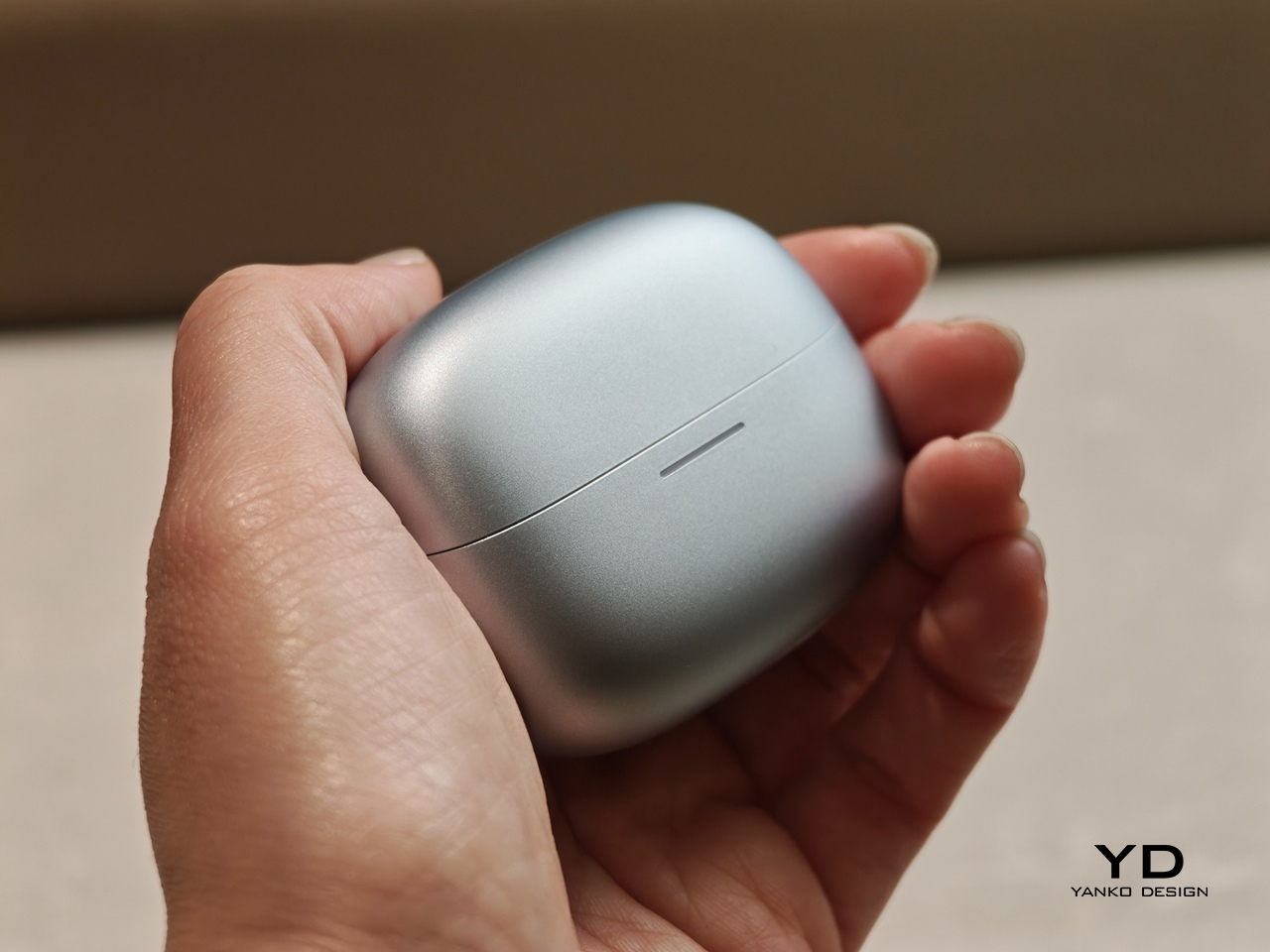
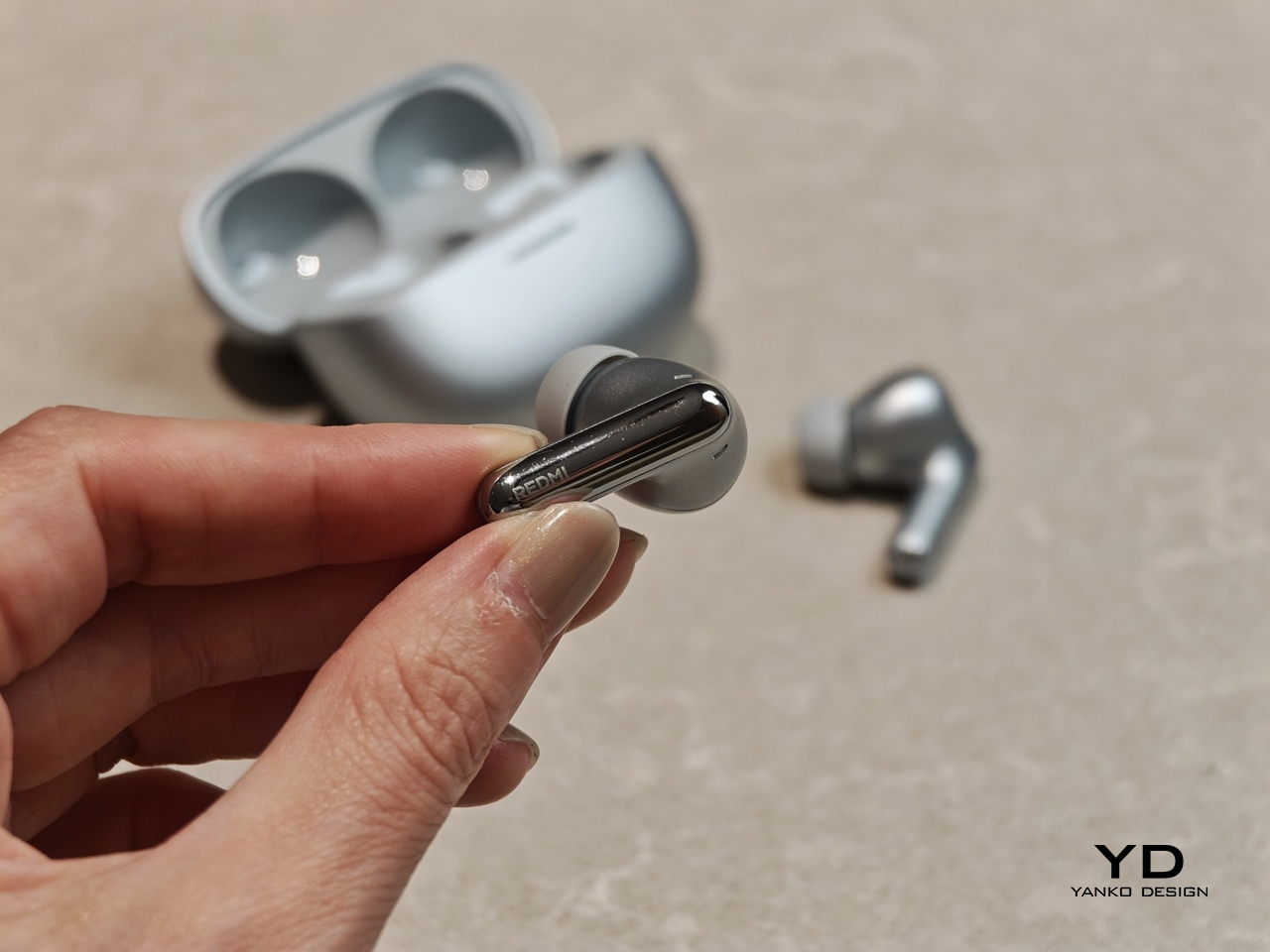
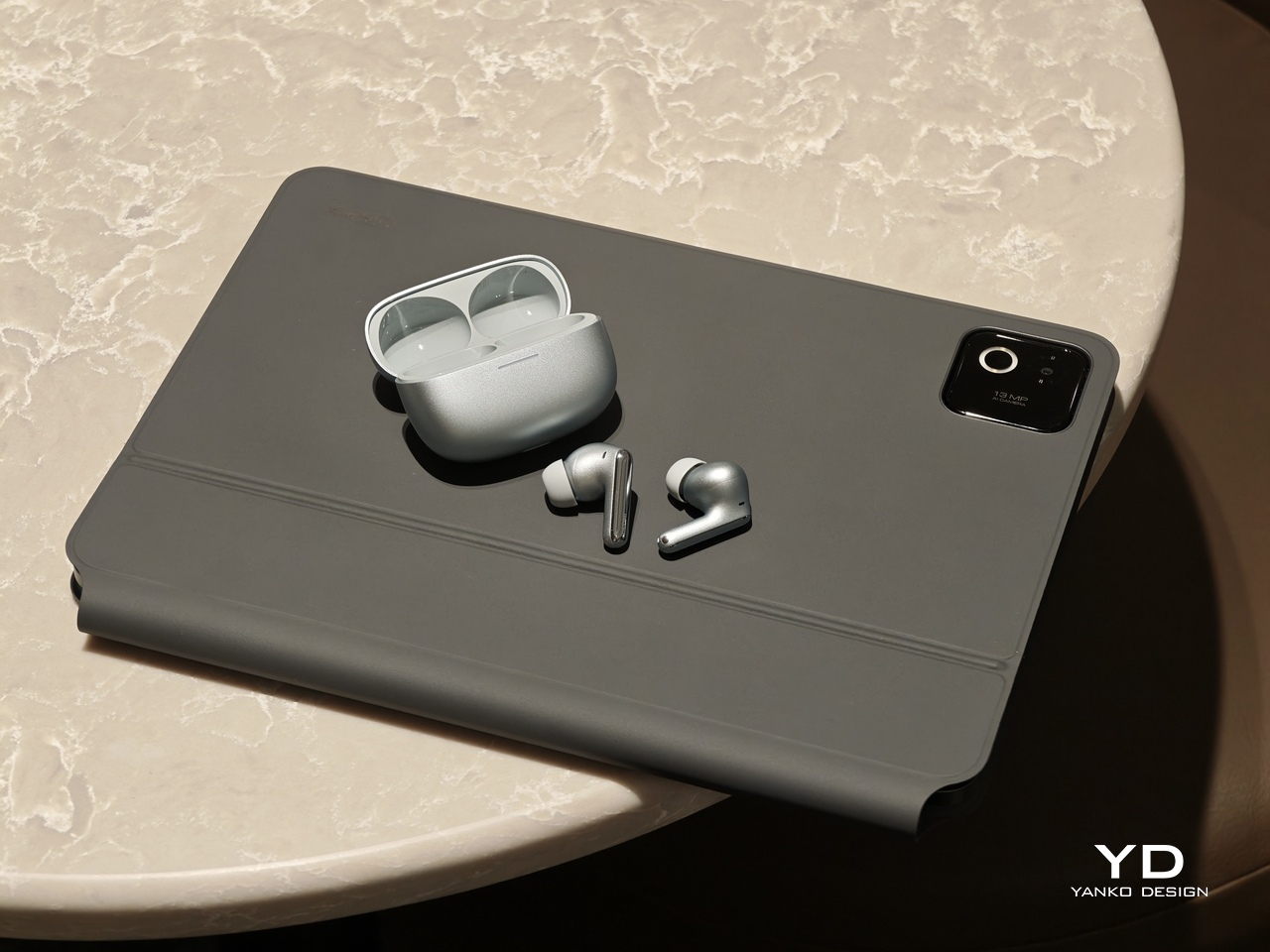
Redmi Buds 8 Pro follows a familiar stem style layout, but the visual language leans clean and modern rather than flashy. The earbuds have smooth, flowing lines, with a compact in-ear body that blends into a slim, rounded stem. Most of the earbud surface is finished in a soft matte texture that hides fingerprints and keeps the look understated. On the outside-facing side of each stem, Redmi adds a shiny strip that catches the light, with a small Redmi logo at the bottom as a neat visual anchor. This contrast between matte and gloss gives the buds a touch of sophistication while still keeping them low-key.
The charging case continues that restrained approach with a compact, pebble-like shape that slips easily into a pocket or bag. Its semi-matte shell feels smooth and resists smudges, while a subtle Redmi logo and “triple driver sound” text on the back quietly nod to the hardware inside. On the front, a slim bar of LEDs offers at a glance battery and pairing information but remains discreet when off, so the case still looks clean.
Color options and small accents may vary by region, yet the overall design clearly targets a wide audience. These are earbuds you can wear at the office, on public transport, or at the gym without drawing much attention. If you like bold, statement-making designs, they may feel a bit too reserved, but if you prefer tech that looks tidy and well finished, Redmi Buds 8 Pro sit in a very comfortable sweet spot.
Ergonomics
While the design focuses on clean lines and visual calm, the build of Redmi Buds 8 Pro focuses on comfort and practicality. Each earbud weighs about five point three grams, which helps them feel light enough for long listening sessions without that dragging sensation some heavier buds can cause. Of course, fit and comfort are different from person to person, but Redmi Buds 8 Pro fit my ears very well and never felt like they were about to fall out.
The medium-sized silicone tips come preinstalled, and Redmi also includes small and large tips in the box so you can fine-tune the seal. I usually go with medium-sized tips and sometimes switch to small tips on certain earbuds, but with Redmi Buds 8 Pro, the medium size worked best for me. Some earbuds struggle to stay put even when I am not moving or talking, yet here I had no problem with fit or comfort, even when I talked, ate, did yoga, or went for a jog with the earbuds in.
The charging case weighs about 47 grams, which keeps the full kit small and light enough to disappear into a jeans pocket or a slim sling bag. The rounded shape and smooth finish make it easy to grip and open, and the lid snaps shut with a reassuring click. Magnets inside guide the earbuds into place so they line up with the charging contacts without much effort. In everyday use, that means you can carry the case all day and quickly pop the buds in or out whenever you need them, without really noticing the extra bulk.
Performance
Redmi Buds 8 Pro pack impressive specifications for their price range, and the audio hardware is the main reason why. They use a coaxial triple driver configuration that combines an 11 mm driver with a titanium diaphragm and twin 6.7 mm PZT ceramic tweeters. In listening, the sound comes across as clear and nicely balanced, with bass that feels full and satisfying without overpowering vocals or detail.
Redmi Buds 8 Pro carry Hi-Res Audio Wireless certification and support codecs such as LDAC, but in day-to-day use, the bigger story is simply that the tuning feels well judged. Dolby Audio and Xiaomi Dimensional Audio are also supported, giving you extra options to change the sense of space and presentation, especially for movies and shows.
Active Noise Cancellation works great overall, especially considering the price. It does not completely block out train noise or airplane engine rumble, but it comes close, which makes music and podcasts easier to enjoy at lower volumes. With higher-pitched sounds like a baby crying, it still does not fully cancel everything out, yet it reduces the sharpness enough that you are less likely to get distracted from what you are doing.
One comfort note is heat. I felt the earbuds get slightly warm at first when ANC was on, but it did not seem to build up over time. It is also possible I simply got used to the sensation after wearing them for a while, so I would not call it a major issue, but it is worth mentioning if you are sensitive to heat on hot days.
Battery life is solid on paper and practical in daily use. Each earbud houses a 54 mAh battery, with rated playback of up to about eight hours on a single charge when ANC is off. Turn ANC on and use higher volumes, and actual listening time will drop somewhat, which is typical for this type of product, while the 480 mAh charging case extends total listening time up to roughly 33 hours across multiple top-ups.
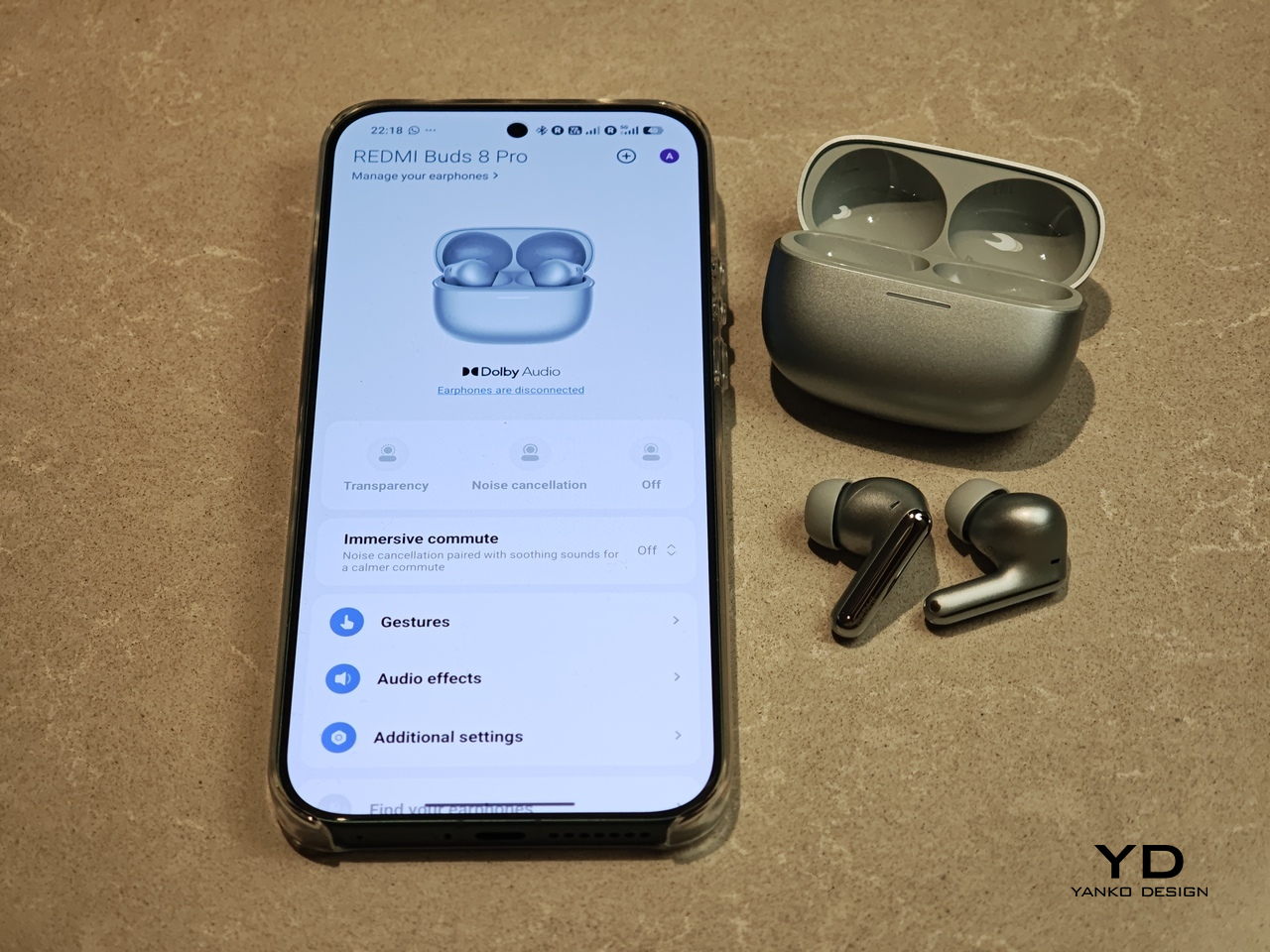
Touch controls on the stems worked great in my use, and the biggest usability upgrade is that volume control is supported via sliding on the stem. The controls support single tap, double tap, triple tap, press and hold, and swipe, which gives you a lot of flexibility without needing to reach for your phone. You can customize these gestures in the Xiaomi Earbuds app, so the controls can match your habits instead of forcing you into a fixed layout.
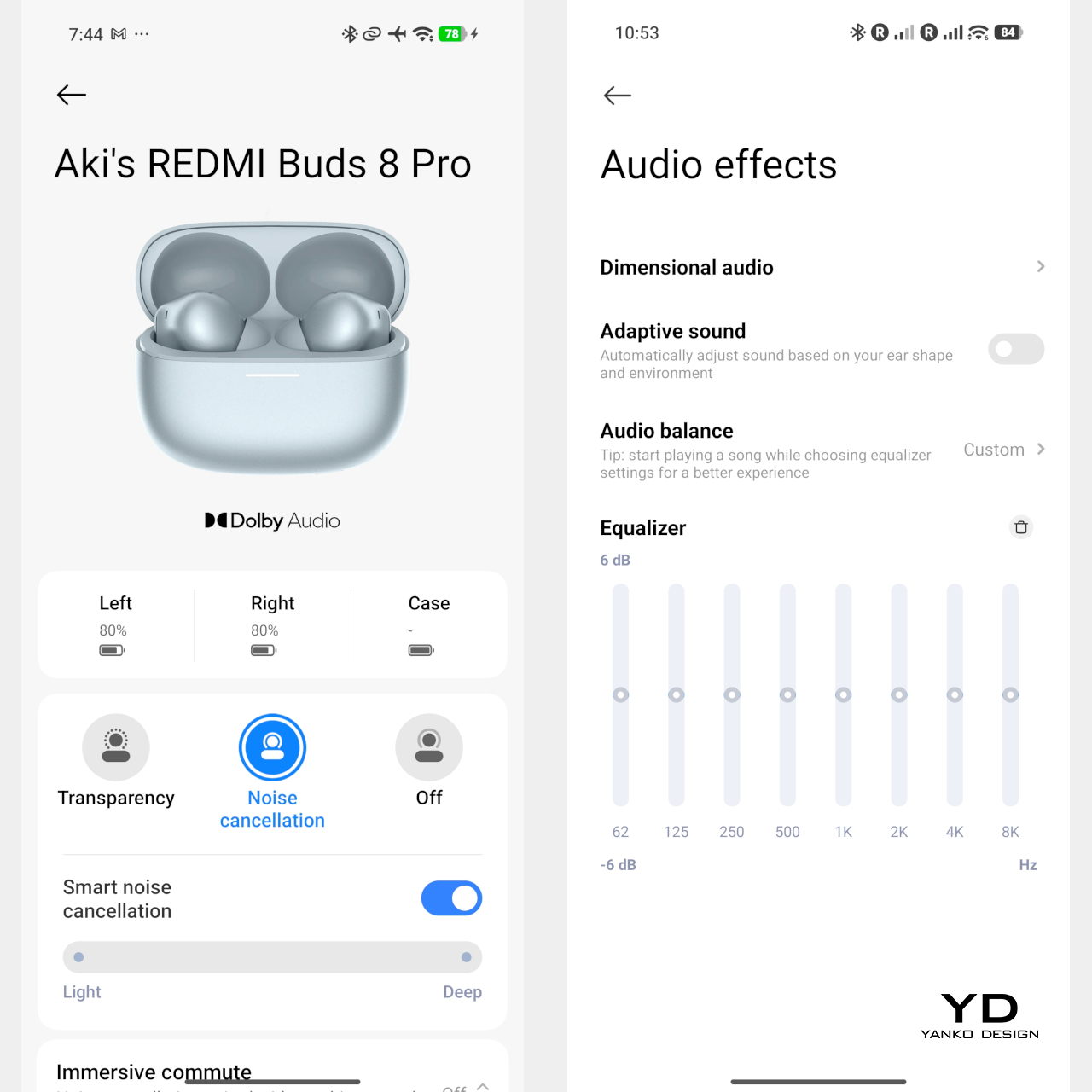
The app also gives you practical sound tuning options without making things feel overly technical. You can pick from preset audio profiles like Balanced sound, Enhanced bass, Enhanced treble, and Enhanced voice, depending on what you are listening to. If you want more control, there is also a custom EQ option that lets you adjust eight separate bands, with each slider running from plus six to minus six, so you can fine-tune the sound without guessing too much.
Sustainability
For a product category like true wireless earbuds, sustainability is rarely a strong point, and Redmi Buds 8 Pro are no exception. The compact, sealed design means the internal batteries are not user-replaceable, so once overall battery health drops, most people will end up replacing the whole set rather than repairing it. That pattern is common across almost all TWS earbuds today, but it still makes this a product that is easier to discard than to keep alive for many years.
The IP54 rating does offer a small positive by protecting against dust and splashes, which can reduce early failures from sweat, light rain, or accidental spills. One small feature that nudges in a better direction is the “find your earphones” function, which lets you play a tone from the left, right, or both earbuds via the app to help you track them down when they go missing. It is not a full integration with Google Find My Device, yet anything that helps you avoid losing a bud and replacing the whole set still counts as a quiet step toward better longevity.
Value
Redmi Buds 8 Pro is priced at 69.90 Euros, which works out to roughly $83. That puts them in the affordable end of the true wireless market. They still cost more than the absolute cheapest buds, but remain very accessible for anyone looking to step up from basic or bundled earphones.
From a value perspective, they make the most sense if you care about sound quality and noise cancellation more than simply paying the lowest possible price. Cheaper options can handle calls and casual listening, but usually lack the triple driver setup, stronger ANC, and more polished overall experience you get here. For many buyers, Redmi Buds 8 Pro will feel like a worthwhile upgrade that adds clear benefits without demanding a luxury-level budget.
Verdict
Redmi Buds 8 Pro is an easy recommendation if you want strong everyday performance without paying flagship prices. The triple driver setup delivers clear, balanced sound with bass that feels full but controlled, and the ANC is effective enough to make commutes and busy spaces noticeably calmer. Touch controls are reliable, and the volume slide gesture is a genuinely useful upgrade that makes daily listening feel smoother.
They are not perfect, with ANC that cannot fully erase the loudest train or plane noise and weaker results on some high-pitched sounds, plus the usual sealed battery limitations for sustainability. Still, the fit was excellent in my ears, the case is easy to carry, and the “find your earphones” tone feature helps prevent frustrating losses. If you care most about sound quality, noise cancelling, and a polished experience at a very competitive price, Redmi Buds 8 Pro hit a sweet spot.
The Olive Green Redmi Note 13 Pro 5G brings a new aesthetic to the series without compromising on the advanced features that users have come to expect.