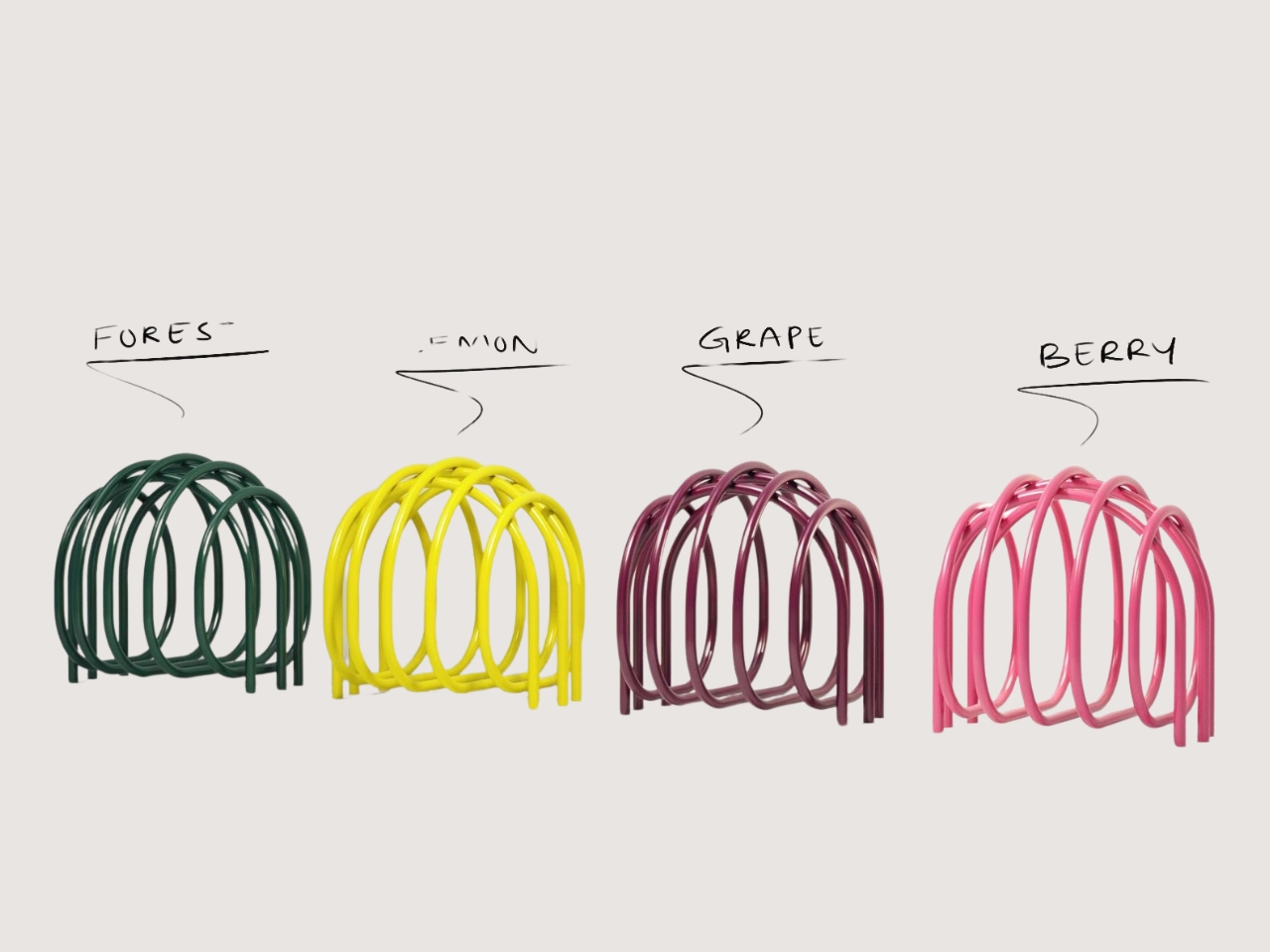
There’s something quietly revolutionary happening in the world of everyday objects, and it starts with something as humble as where you put your umbrella. Arihant Israni and Anoushka Braganza have created InBetween, a piece that challenges our assumptions about what functional design can be. It’s not just a place to stash wet umbrellas. It’s a whole vibe.
Let’s be honest: most umbrella stands are afterthoughts. They’re plastic cylinders hiding in corners, collecting dust and forgotten receipts. But what if that neglected corner could hold something beautiful? What if the act of coming home on a rainy day could feel a little more intentional, a little more like a ritual worth noticing?
Designers: Arihant Israni and Anoushka Braganza
That’s where InBetween comes in. The design is built around flowing loops that curve and connect, creating this continuous rhythm that feels almost hypnotic. It’s sculptural in a way that makes you stop and look twice. The loops aren’t just aesthetic choices, they’re functional, too, each one cradling an umbrella while creating negative space that gives the whole piece a sense of movement. Even when it’s sitting still, it feels alive.
The designers say the form is inspired by the idea of transitions, those moments between leaving and arriving, between chaos and calm. And honestly? You can see it. There’s something about the way the curves flow into each other that captures that feeling of moving through your day, of pausing to shake off the rain before stepping into your space. It’s design that understands that our homes aren’t just backdrops. They’re where we reset, where we breathe.
Now let’s talk about the base, because this is where things get really interesting. It’s made from Diatomaceous Earth, which sounds incredibly science-y but is actually just fossilized algae. And here’s the genius part: it’s naturally porous and absorbent, which means it soaks up all that rainwater dripping off your umbrella without you having to do anything. No puddles, no mess, no gross waterlogged mats that smell like mildew after a week. The material is also antimicrobial, so it resists mold and odor naturally. It dries fast, stays clean, and if it ever needs refreshing, you just give it a light wipe or a gentle sanding. That’s it. In a world where everything seems to require constant maintenance and upkeep, there’s something deeply satisfying about a product that just works quietly in the background.
But beyond the practical magic, there’s a conceptual layer here that makes InBetween feel special. The base becomes this mediator between outside and inside, between the storm you just walked through and the calm you’re entering. It’s material intelligence meeting emotional design, and it works on both levels.
Visually, the stand fits into almost any space. The minimalist aesthetic and organic geometry mean it doesn’t scream for attention, but it definitely holds its own. Whether you’re living in a sleek modern apartment, a cozy studio, or something in between (pun intended), it adapts. The deep, muted burgundy tones in the images give it warmth without being loud. It’s the kind of piece that elevates a space just by existing in it.
What really gets me about InBetween is how it reframes something we barely think about. We’re so used to design being about big statements, about the couch or the coffee table or the art on the wall. But what about all the little moments? What about the act of setting down your umbrella when you get home, shaking off the rain, taking a breath before you move further into your day? InBetween turns that mundane gesture into something worth noticing. It’s a reminder that thoughtful design doesn’t have to be loud or expensive or complicated. Sometimes it’s just about paying attention to the details, about understanding that every object in our lives has the potential to be more than just functional.
In a culture obsessed with productivity and optimization, there’s something radical about slowing down enough to appreciate the poetry of an umbrella stand. InBetween proves that even the most ordinary objects can become opportunities for beauty, mindfulness, and a little bit of wonder. And honestly? We could all use more of that.
The esports partnership between the International Olympic Committee (IOC) and Saudi Arabia is no more. On Thursday, the IOC said that it and the Saudi Olympic and Paralympic Committee (SOPC) have "mutually agreed" to part ways. The breakup comes weeks after Saudi Arabia's sovereign wealth fund and other investors bought EA for $55 billion.
The IOC and SOPC agreed on a 12-year esports partnership in 2024. At the time, the IOC was reportedly in talks with publishers of Rocket League, Street Fighter and League of Legends. The two sides discussed holding the Olympic Esports Games every two years. (The first games were initially scheduled for this year, but were pushed back to 2027.) Potential hosts for later installments were said to include South Korea and the US.
Instead, the two sides are now "committed to pursuing their own esports ambitions on separate paths," according to the IOC. The organization now plans to "spread the opportunities presented by the Olympic Esports Games more widely." It still wants the inaugural games to happen "as soon as possible."
The APnotes that the dissolution comes seven months into Kristy Coventry's IOC presidency. We don't know the details of how the deal came apart. However, the IOC wants to connect with younger fans through esports, but in a way that "Olympic values are respected." Saudi Arabia's Esports World Cup features MOBAs, shooters and fighting games.
If the IOC wants to project a squeaky-clean image while connecting with young gamers, it may have an uphill battle. (For the record, games don't lead to violence.)
This article originally appeared on Engadget at https://www.engadget.com/gaming/the-ioc-and-saudi-arabia-call-it-quits-on-their-olympic-esports-partnership-163148341.html?src=rss
You know that feeling when you sit down at your desk and immediately feel overwhelmed? It’s not you. It’s your desk. More specifically, it’s the fact that modern desks have basically turned into minimalist slabs with zero storage solutions. Sure, they look sleek in furniture showrooms, but try working on one every day and you’ll quickly realize something crucial is missing.
Enter Tidy Desk and their Desk Dock System, a collection of add-on storage solutions that feel less like accessories and more like the missing pieces modern workspaces desperately need. The brand has essentially created what I’d call “remedial design” for the era of beautiful but impractical furniture. And honestly, it’s about time someone did.
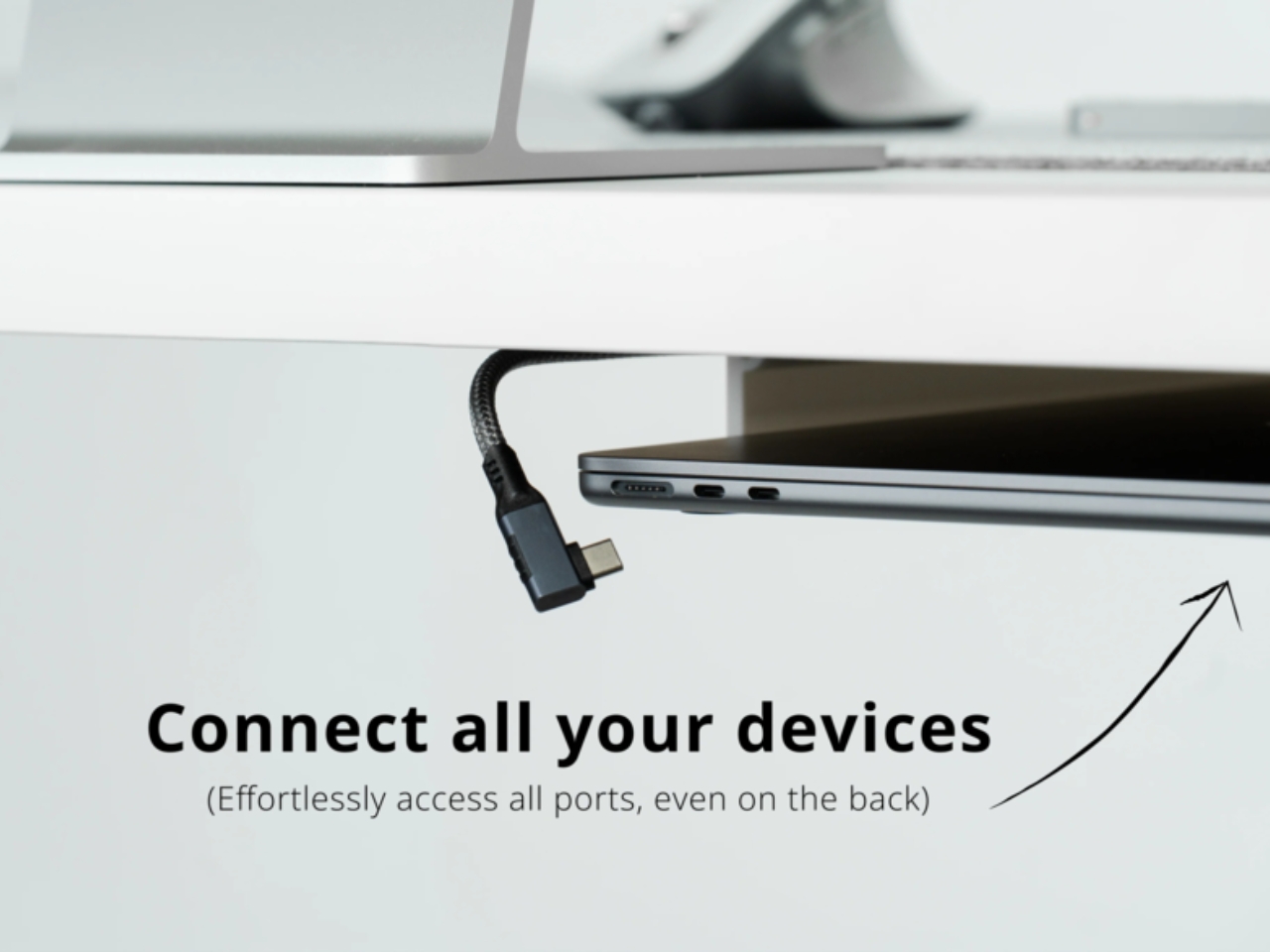
The star of the show is the Invisible Laptop Dock, which does exactly what the name suggests. It hides your laptop under your desk while keeping it accessible and properly ventilated. Think about it: your laptop just sits there taking up premium real estate on your desk surface, surrounded by a tangle of charging cables and dongles. The Invisible Laptop Dock mounts underneath, giving you full access to all ports from both sides, so whether you’re using a single USB-C dock or plugging in multiple cables, everything stays organized and out of sight. What makes this particularly clever is that it doesn’t just hide your laptop. It actually improves your workflow. One customer put it perfectly when they said, “Finally got my laptop out of the way. Desk looks cleaner and somehow I just focus better now.” That connection between visual clutter and mental clarity isn’t just aesthetic preference. It’s psychology at work.
But Tidy Desk didn’t stop at laptops. They’ve expanded the Desk Dock System to include custom solutions for specific tech gear. The Focusrite 2i2 Dock is designed specifically for the popular audio interface, keeping it locked in place and accessible without eating up desk space. There’s also a Fast Connect LaCie Dock for external hard drives, featuring USB-C with 10 Gbps data transfer speeds and multiple ports. These aren’t generic cable management clips. They’re thoughtfully designed docks that treat each piece of equipment as if it deserves its own intentional home.
The whole system operates on a simple premise: why should we adapt to poorly designed furniture when we can just fix the problem? The rise of sit-stand desks and aesthetic-focused workspace design has given us gorgeous offices, but at the cost of practicality. Drawers disappeared. Cable management became an afterthought. And suddenly everyone was posting photos of their “clean desk setup” while their actual workspace looked like a rat’s nest of wires and adapters. What Tidy Desk understands is that minimalism isn’t about having less stuff. It’s about having the right systems to manage your stuff invisibly. Their tagline says it all: “Craft Your Perfect Workspace.” From cable management to laptop docks, the system aims to keep you focused, organized, and actually proud of your setup.
The products are surprisingly affordable too, with most items ranging from $35 to $37. That’s less than what many people spend on decorative desk accessories that don’t actually solve any problems. And the modular approach means you only buy what you need. Got a laptop and a Focusrite interface? Get those two docks. Just need cable management? Grab that piece. The system grows with your needs.
There’s something refreshing about design that acknowledges real-world messiness instead of pretending we all live in impossibly tidy showrooms. Another user review captures this perfectly: “Didn’t think hiding a few cables would do much, but damn it actually helps. Feels like my mind’s clearer when my desk is too.” Since we’re living at a time where we’re obsessed with standing desks, ergonomic chairs, and expensive monitors, it’s oddly satisfying to see someone focus on the unglamorous stuff that actually makes daily work better. Because at the end of the day, your desk should work for you, not against you.
The iPad, of course, isn't the only tablet computer out there — it wasn't even the first — but Apple's version redefined the category. In our opinion, it's the best tablet you can buy and these slates consistently earn highscores in our reviews. That doesn't mean you should have to pay full price for your next iPad. We are continually on the hunt for good deals on iPads (and other Apple gear while we're at it) and each week, we round them up right there.
Current discounts include the iPad mini and the 11-inch iPad Pro, each for $100 off the list price. Beyond iPads, are a few other Apple deals are going around, such as the latest AirPods Pro 3 for the lowest price yet at $199 and certain colors of the Apple Watch Series 11 for $299. Here are the best Apple deals we found this week.
Best iPad deals
Apple iPad Air (M3, 11-inch) for $499 ($100 off): The iPad Air is the top overall pick in our guide to the best iPads. Yes, it’s pricier than the entry-level iPad (A16), but its faster chip, extra RAM, laminated and more color-rich display, better speakers and superior accessory support add up to a more pleasant experience in day-to-day use. This isn't the lowest price we've tracked — the price went as low as $450 just after Black Friday, but this is still $100 cheaper than buying directly from Apple.
Apple iPad Pro (11-inch, M5) for $899 ($100 off): The latest iPad Pro is still more tablet than most people will ever need, but its class-leading OLED display, impressively thin design and super-powerful M5 chip make it a luxury experience for those who can afford it. The device was only released in October, so this deal ties its lowest price to date. Also at Best Buy and B&H.
Apple iPad Pro (13-inch, M5) for $1,199 ($100 off): It’s not a massive discount, but this matches the lowest price so far for the larger iPad Pro, which may be worthwhile if you’ve got cash to burn and want to use an iPad as your main computer. We gave it a score of 85 in our review. Also at B&H.
Best Apple deals
Apple AirTags (4-pack) for $65 ($34 off): These are the best Bluetooth trackers for iPhone users thanks to their vast finding network and accurate ultra-wideband features for locating your things when they’re close by. Just attach them to your keys, wallet or bag with the right AirTag holder and keep track of everything in the Find My app.
Apple AirPods 4 for $74 ($55 off): If you don't need active noise cancellation and hate the feeling of headphones that just into your ear canal, the standard AirPods 4 remain a good buy. They lack built-in volume controls, and no open-style earbuds can produce the same level of bass as typical in-ear headphones, but they generally sound more pleasant than most pairs along these lines and still offer the usual array of Apple-friendly features. This discount is only $5 more than the all-time low we saw around Black Friday. Also at Best Buy for $85 if that runs out of stock.
Apple Watch SE 3 for $199 ($50 off): This discount has been around for a few weeks, but it’s the lowest price to date for Apple’s newest entry-level smartwatch. We gave the SE 3 a score of 90 in our review last month: The big upgrade is an always-on display, which makes it so you no longer have to wake the watch to check the time or notifications. It still includes most of the essential health and fitness features beyond that, plus it now runs on the same chipset as the higher-end Apple Watch Series 11. Also at Walmart.
Apple Pencil Pro for $95 ($34 off): The Pencil Pro is Apple’s most feature-rich stylus, offering pressure sensitivity, wireless charging, haptic feedback and unique gesture controls compared to the standard USB-C model (which isn’t significantly discounted). Just note that it’s not compatible with the entry-level iPad and other older models. While this discount is only $5 below the device’s usual street price, it’s still the largest discount we’ve seen this year. Also at Walmart.
Apple MacBook Air (15-inch, M4) for $949 ($250 off): The 15-inch MacBook Air is nearly identical to the smaller version; apart from its roomier display, it adds better speakers and a more spacious trackpad. This deal matches the all-time low, and other configurations are similarly discounted.
Apple MacBook Pro (M5, 14-inch, 512GB) for $1,350 ($249 off): Apple’s most recent M-series chip is the M5, and only comes equipped on the 14-inch MacBook Pro and the iPad Pro. When the M5 MacBook Pro M5 came out in October, we promptly reviewed it and awarded it a 92. The new chip gives the laptop an impressive graphics upgrade, which only adds to the Pro's known qualities: a sturdy build, excellent trackpad and speakser paired with an impressively long battery life — we clocked 34 hours in a video run-down test. Also at Walmart. It's $1,399 at Best Buy and B&H.
Apple Mac mini (M4) for $479 ($120 off): The latest iteration of Apple’s tiny desktop PC has a smaller footprint, a faster M4 chip, 16GB of RAM by default, two front-facing USB-C ports and an extra Thunderbolt 4 port. It can also drive three external displays, though it lacks USB-A ports entirely. We gave a higher-end model with Apple’s M4 Pro chip a score of 90 in our review. This deal on the base model with an M4 chip, 16GB of RAM and 256GB of storage is $10 more than the best deal we've seen but $20 less than the config's typical street price.
Apple MagSafe cable 25W for $24 ($15 off): With this puck, the iPhone 17 can wirelessly recharge at 25-watt speeds. You can also get those speeds with iPhone 16 handsets that have updated to the latest OS 26 version. Just note that you’ll need to plug it into at least a 30 watt adapter, which isn’t included. This is the lowest price we've tracked.
Apple USB-C Magic Mouse for $68 ($11 off): This isn't a record-low price for Apple's popular mouse — it went for $60 in October. It's lightweight, supports multi-touch features including scroll and the battery life is fairly long — just note that the charging port is on the bottom so you can't use it while it refills. The discount only applies to the white model.
This article originally appeared on Engadget at https://www.engadget.com/deals/the-best-ipad-deals-this-week-include-the-ipad-mini-for-100-off-150020342.html?src=rss
Creative Labs, the maker of Sound Blaster audio cards, has launched a Kickstarter for a modular audio hub called Sound Blaster Re:Imagine. The universal hub, which is reminiscent of Elgato's Stream Deck, is meant to allow routing from any input to any output with the press of a button. Users can connect their gaming consoles, PC and musical instruments to the Re:Imagine, as well as speakers, wired headsets and wireless headphones, transitioning seamlessly between them.
The system uses magnetic modules including a 3-inch smart screen, four-button pad, rotary knob and dual sliders that can all be rearranged on the base unit. The Horizon base with five slots is the default design for the Kickstarter project, with an expanded six-slot Vertex base listed as a stretch goal.
Re:Imagine sports an octa-core ARM processor with a small NPU, 8GB of RAM, 16GB of flash storage and is expandable thanks to a microSD card slot. The hub's audio prowess is powered by a high-resolution 32-bit digital-to-analog converter (DAC), and it supports Wi-Fi and Bluetooth. The hub runs on Linux and can be used in a standalone setup, or as a PC-tethered audio hub.
The Re:Imagine also comes with an AI DJ that can generate music, a built-in DOS emulator for retro gaming, one-tap audio recording and more. The modular hub is also developer-friendly, with an included SDK and sample source code that encourage users to build their own custom apps and then share them with the Creative Labs community.
The Kickstarter campaign will run through December and lists an estimated shipping date of July 2026.
This article originally appeared on Engadget at https://www.engadget.com/audio/creative-labs-is-crowdfunding-a-modular-sound-blaster-audio-hub-161957129.html?src=rss
The Republican-led FCC has voted on and approved a proposal that would make it harder for consumers to receive itemized bills with accurate information from their ISPs, as originally spotted by CNET. This proposal revises previous "unnecessary" requirements on the grounds that a fact-based list of charges "may confuse customers."
These changes would minimize the benefit of the so-called "nutrition labels" which are otherwise known as Broadband Facts labels. You've likely run into these simple itemized labels when shopping for a broadband plan. They tell consumers exactly what we are paying for, even if it may "confuse" our fragile little minds.
The FCC passed a notice of proposed rulemaking (NPRM) on October 28 that would significantly scale back the Broadband Facts label. ISPs have been required to publish these labels since April, 2024. All Republican commission members voted to approve the change, while the lone Democrat dissented.
As previously noted, this is technically just an NPRM. So it's not a done deal just yet. There will be a final vote in the near future, but it's expected to pass given the political makeup of the commission.
Once passed, ISPs will no longer be required to read these labels over the phone to customers, make them available in account portals or give a complete accounting of fees to customers. The FCC previously stated that these transparency requirements are "unduly burdensome and provide minimal benefit to consumers." I happen to think that knowing what I'm shelling $100 out for each month to be of maximal benefit. Maybe that's just me.
These labels were initially proposed all the way back in 2016, before being implemented by the Biden administration in 2024. They offer a breakdown of every little thing that goes into a bill for a service plan, including many "hidden fees" that ISPs don't include in advertised plan prices.
It's worth noting that the labels will technically still exist, they will just be harder to find and won't be all that useful. Raza Panjwani, senior policy counsel at New America’s Open Technology Institute, refers to this as a political "two-step." He told CNET that the modus operandi here is to make the labels "less useful" and then say "Oh, look, it's not that useful. We should get rid of it."
Anna Gomez, the only Democrat on the commission, called the proposal "one of the most anti-consumer items I have seen" and expressed extreme displeasure with the results of the vote. “What adds insult to injury is that the FCC does not even explain why this proposal is necessary,” she said. “Make it make sense.”
Despite claims to the contrary by Brendan Carr and the current FCC, consumers actually like these labels. A 2024 study of nearly 5,000 broadband customers found an 85 percent satisfaction rate.
As an aside, Americans pay a lot for internet service when compared to many other countries throughout the world. We pay around twice as much as customers in Europe and most of Asia.
This article originally appeared on Engadget at https://www.engadget.com/big-tech/trumps-fcc-is-officially-moving-to-make-it-easier-for-internet-companies-to-charge-hidden-fees-155004909.html?src=rss
Perplexity AI has agreed to a multi-year licensing partnership with Getty Images that will allow its users to access the latter’s extensive library of images. Leveraging Getty’s API, Perplexity will integrate the visual media distributor’s huge collection of stock and editorial imagery within its AI search and discovery tools, with correct attribution being a key part of the agreement.
In a press release, Getty said that Perplexity will be "making improvements on how it displays imagery, including image credit with link to source, to better educate users on how to use licensed imagery legally." As generative AI tools become more widely accessible, thorny issues around copyright and attribution have been the source of a number of lawsuits, no shortage of which have been targeted at Perplexity.
In August, the company was sued by two Japanese media groups, Nikkei and Asahi Shimbun, for allegedly copying and storing article content from the pair’s servers illicitly, as well as crediting them with inaccurate information Perplexity supplied. It was also one of four companies sued by Reddit earlier this month for allegedly using scraped data without the correct license. Even the dictionary has taken the AI company to court.
Getty itself has bumped up against AI many times on the road to its new deal with Perplexity. Back in 2022 the company outright banned AI-generated art on its platform due the legal murkiness around copyright, and it later sued the AI art tool Stable Diffusion over for allegedly copying and processing millions of protected images from its collection.
On the Perplexity agreement, Getty Images’ Vice President Strategic Development, Nick Unsworth, said that "partnerships such as this support AI platforms to increase the quality and accuracy of information delivered to consumers, ultimately building a more engaging and reliable experience."
This article originally appeared on Engadget at https://www.engadget.com/ai/perplexity-signs-deal-to-use-getty-images-152343900.html?src=rss
Honda has just teased a glimpse of the future of the brand’s two-wheeler electric vision at the Japan Mobility Show. The future-forward ride showcased at the auto show evokes typical Akira vibes with a long-slung profile and was most likely inspired by the 80s anime movie.
Dubbed the EV Outlier Concept, the motorcycle is a sneak peek into the brand’s gradual detour from internal-combustion heritage. Its most striking feature is the installation of electric motors directly in the front and rear wheels, eliminating the conventional chain or belt drive and enabling truly free packaging around the chassis. By placing the propulsion at the wheels, Honda frees up space in the frame for batteries and centralizes weight for improved balance.
From the styling perspective, the concept is both minimalist and arresting. Honda describes key design cues as “Gliding, Ecstasy and Low.” Gliding refers to the smooth, quiet roll of an EV; ecstasy to the instant-on torque and responsiveness of electric drive; and low to the dramatically lowered seat and rider eye-line that give a new posture and presence. The front fascia features a continuous LED light band, the tail is tightly integrated into the form, and foot-pegs are set further forward than typical road bikes to establish a relaxed yet futuristic riding stance.
Mechanically, the EV Outlier Concept also deviates from the norm: at the front, instead of conventional telescopic forks, it uses a double-wishbone arrangement; at the rear, a low-mounted mono-shock linkage further centralizes mass. The open-center frame design offers structural freedom and better packaging of the battery pack, while the in-wheel motor layout allows Honda to adjust torque distribution between front and rear, supporting an all-wheel drive possibility.
However, Honda has not yet released detailed technical specifications such as battery capacity, motor output, range, or pricing. This is a concept designed to explore future design and engineering directions rather than an imminent production model. The company emphasizes that this vehicle is aligned with its broader goal of achieving full carbon-neutral products and operations by 2050.
The EV Outlier brings together design daring and engineering boldness: a low-slung, mono-spine form that feels part sci-fi, part high-performance machine; in-wheel motors that break the chain drive tradition; torque vectoring capability; and a riding experience re-imagined for electric propulsion. More than anything else, the bike looks absolutely gorgeous.
Apple is reportedly preparing a significant update to its iMac lineup, with the 24-inch model expected to debut in mid to late 2026. This refresh is set to feature the highly anticipated M5 chip, promising substantial performance improvements and enhanced storage options. Simultaneously, rumors of a larger 32-inch iMac Pro aimed at creative professionals continue […]
Some of the most successful creators on Facebook aren't names you'd ever recognize. In fact, many of their pages don't have a face or recognizable persona attached. Instead, they run pages dedicated to memes, animal videos and yes, AI-generated photos and videos.
The people behind these pages are experts at creating content that can catch Facebook's algorithm and go viral. Successful pages can generate tens of thousands of dollars a month from performance bonuses, revenue-sharing and other monetization programs that pay Facebook creators for popular content.
For years, Meta fostered this industry of viral content on Facebook. As the company transformed Facebook's main feed into a "discovery engine" of recommended posts from random pages and accounts, creators supplied a stream of content crafted for the algorithm. But over the last year, some creators say this dynamic has broken down. Meta has penalized creators for the very same content it once rewarded. Other creators have seen Facebook's payment systems break down due to glitches and other errors.
One creator has become so frustrated, he's filed dozens of lawsuits in small claims court against Meta over the last year. Some of those lawsuits are related to missing payments and account issues he's experienced, but he's also brought 23 cases related to other creators' Facebook pages. As several of those cases are now winding their way through small claims court, he hopes his actions will bring attention to what he says is a wider breakdown in Meta's relationship with Facebook creators.
The cases shine a light on how Meta's lack of human-centered customer service can impact creators who rely on the platform. But it also offers a glimpse into the volatile dynamics of viral Facebook content.
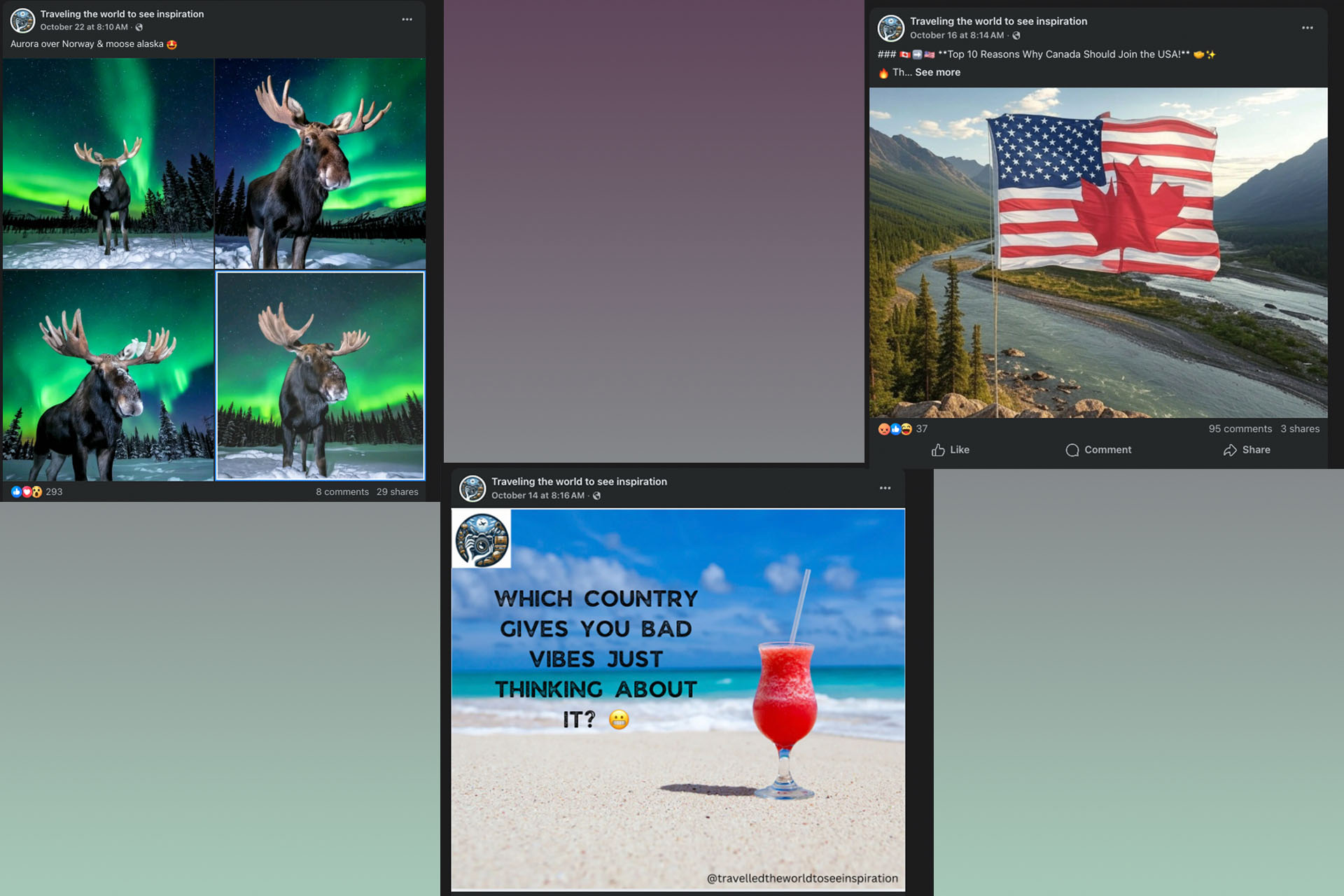
Mel Bouzad is a former photojournalist for Getty Images who for the past eight years has made his living running popular Facebook pages with names like "The Meme Bros" and "FunkiestShitEver." He posts memes, travel content and AI-generated videos. Over the years, he's become an expert at figuring out what type of content is most likely to rack up views and comments on Facebook.
"It's basically jumping on the trends as they're happening," he explains. "If you can jump on the trending topics right at the beginning, then you get the momentum, it kicks in the algorithm, and it sends your content viral. And if one post goes viral, the algorithm is going to send the next post viral, because it thinks the next post is going to get the same type of engagement." He's also learned little tricks for drawing more Facebook comments: adding a small error in a travel-focused listicle, or asking questions like "what's the most boring state in America?"
Example of recent posts from one of Bouzad's travel-themed pages on Facebook.
He estimates that at their peak, his pages collectively earned between $10,000 to $20,000 a month — primarily from performance bonuses and in-stream video ads — though they sometimes earned much more than that. Last September, 12 of his pages earned more than $68,0000 combined in performance bonuses, according to documents viewed by Engadget.
But last year, five of his meme and travel pages were suddenly demonetized. The pages received a "monetization policy violation," a vague, catch-all term that can describe many supposed infractions. After some digging, he discovered they had been flagged for allegedly operating in a country ineligible for Meta's monetization programs. "To monetize, you must reside in an eligible country where the product or feature is available," a notice in the Facebook app said. "You may lose your ability to monetize if you move to an ineligible location or if Facebook changes product eligibility." Bouzad, who lives in the United States, assumed it was a misunderstanding and would be an easy fix.
But, like so many others, he quickly found that getting help from Meta was far from straightforward. "Despite 20+ support tickets and using paid support, I receive only automated replies," he later wrote in his first filing in small claims court last November.
Bouzad had heard of people using small claims court to get Meta's attention and decided to try it for himself. "I thought, I'm going to go in and sue for only one page … something small, just to get in the door [and] speak to somebody." At that point, Meta was withholding $2,498 in payments from the page called "Man Cave USA," according to court documents. He requested Meta pay the outstanding balance, along with $409 to cover court fees and interest.
His filing succeeded in getting a response from Meta. Bouzad said that about three weeks later he received a call from a law firm representing the social media company. After an extended back and forth, Meta eventually restored the page's ability to earn money. By February he officially dropped the case, telling the court that the company had "corrected the issue and remitted the payments owed."
Meta's conflicting explanations
While he was dealing with that case, he tried to resolve the issues related to his other pages. Since he was still in mediation with Meta for his "Man Cave USA" page, he asked Meta's representatives if they could help with his other pages. He says that during a mediation session over Zoom, Meta's legal reps told him they wouldn't help with other pages unless they were tied to a lawsuit.
So in February he opened six new small claims court cases against the company. At the time, he said, Meta owed him more than $40,000 in unpaid invoices from accounts that had been wrongfully flagged; $15,000 of which were earnings from a single Facebook page. Because small claims court limits damages to $10,000 per case, he could only sue for a combined $35,000, but hoped that Meta would reinstate the payments if it were to re-examine his accounts.
In the meantime, Bouzad continued to try to resolve his account issues through Meta's official support channels and received confusing, and sometimes downright conflicting, information. In one email, Meta support told him he had been flagged for "limited originality of content," but didn't explain. He also, again, received notifications saying that he was in a country that was "ineligible" for Meta's monetization programs.
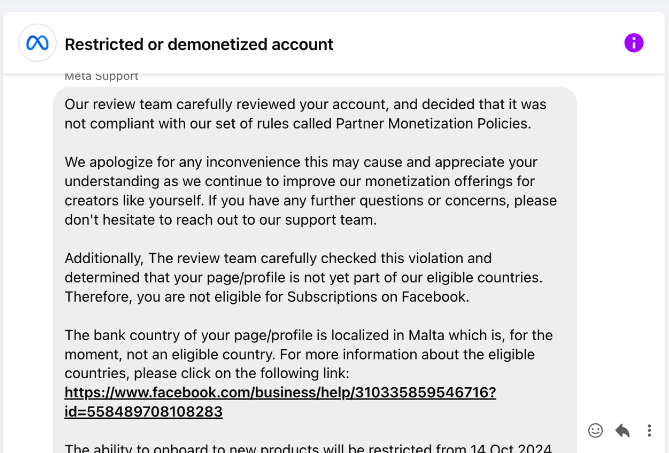
In two separate chats with Meta Verified, the social network's paid subscription service for customer support, he was informed that he was ineligible because his page was linked to a bank account in Malta. The representatives then closed the chats without giving him an opportunity to respond, according to screenshots viewed by Engadget. Bouzad was getting more and more frustrated. "One, I've never been to Malta, two, my bank is Wells Fargo and three, I live in Oregon," he says.
A chat with Meta Verified support in which Bouzad was told his accounts were demonetized because his bank was based in Malta. Bouzad says he's only ever banked with Wells Fargo.
He now sees his issues as part of a wider pattern from Meta. While the company had once provided him with a partner manager — a Facebook employee who could help sort out issues and provide advice — he hasn't had a dedicated contact at the company since 2020.
To him, the problem is twofold: Meta has become overly reliant on artificial intelligence for content moderation, which results in too many errors. At the same time, he claims Meta has largely outsourced the customer service it does offer — like through Meta Verified — and these workers aren't able to handle the types of issues he and other creators increasingly encounter.
Some creators who Bouzad has named in his lawsuits claim to have missed out on tens of thousands of dollars in payments for what they describe as glitches in Meta's processes. Brent, a creator who asked to be identified by his first name only, was running a successful Facebook page that posts history-themed AI-generated videos. One recent clip features a group of supposed German prisoners-of-war walking through the snow, accompanied by a caption claiming that some POWs chose to immigrate to Canada following the war after experiencing "humane treatment" from their captors.
The page was doing well for a few months until April, when Meta asked Brent to verify his identity in order to keep receiving payments. His account had more than $11,000 in unpaid earnings at the time, according to documents reviewed by Engadget.
Several months later, Brent has been unable to complete this seemingly mundane step, despite repeatedly providing Meta a copy of his ID. Brent says that the issue stems from Meta mistakenly classifying his payout account as a "private corporation" rather than a "personal account." He says he has spent thousands of dollars on Meta Verified (the highest tier costs $500 a month) and has opened numerous support cases but has not been able to get the issue resolved.
Another creator is stuck after encountering a similar issue that prevented him from confirming the tax information associated with his payout account on Facebook. "My payout earnings were locked due to non editable 'greyed out' details when it came to entering tax information and other fields," the creator explained. "After about a year of trying to get support Meta finally came back with an archaic form to transfer the payout account to a new one associated with my page." But, after filling out the form for the transfer, Meta informed him that the more than $16,000 in unpaid earnings from his page were unable to be transferred to a new account.
The creator, who asked to remain anonymous, has spent more than a decade running music-related pages championing independent artists on the platform. "We're collectively sick of how Meta treats everyone, failing to provide adequate support, reasoning, reports and outcomes for content creators," he told Engadget. "There's little to no consistency or confidence in their ability to fairly reward creators." He's also battling stage 4 cancer, and says the missing funds have interfered with his treatment, and added to the stress he's already facing. His doctors recently informed him he likely has only a few months left to live; he's still hoping to recover the missing funds.
Gaps in support
Social media is filled with numerous complaints about the ineffectiveness of Facebook's support tools, including Meta Verified. Daniel Abas, the president and founder of the Creators Guild of America, a nonprofit organization that advocates for creators, says that demonetization is a "chronic issue" affecting creators on many platforms, including Meta's. "What's really difficult is not having consistency in terms of the enforcement and having policies that are opaque, having appeals processes that are inconsistent," he said.
Abas says that creators, especially high-earning ones, should have more resources to get support from companies like Meta. "Working with a web chat to get something resolved, or submitting an email to get something resolved, and not having that human touch is a major gap, and contributes to a lot of stress and a lot of uncertainty when you're trying to build a company."
Meta has seemingly been changing some of the standards it has for creators on Facebook over the last year. The company in recent months began to crack down on creators sharing spammy and "low quality" content, though it only described a few specific examples of such activity, like pages that share posts with "long, distracting captions." The company does not prohibit creators from monetizing AI-generated content. In fact, Mark Zuckerberg recently said that Meta plans to add a "huge corpus" of AI content to its systems.
Meta declined to provide a comment for this story. The company maintains Bouzad has violated its policies, and has argued his court cases involving other Facebook users should be dismissed.
Bouzad insists that he has never intentionally violated Facebook's rules, and has grown frustrated with the company's changing explanations for why his pages have been demonetized. In an email with Meta Verified support, a customer service rep told him a recent violation for one of his travel pages was due to "Limited Originality of Contents," but didn't point to a specific post. During mediation, though, Meta's legal team claimed the same page had been generating views via "inauthentic engagement," according to documents reviewed by Engadget. Bouzad pushed back. "This wasn’t manipulation — it was performance-based exposure … we’re being punished for the very behavior the system rewarded," he wrote in an email to Meta's legal team.
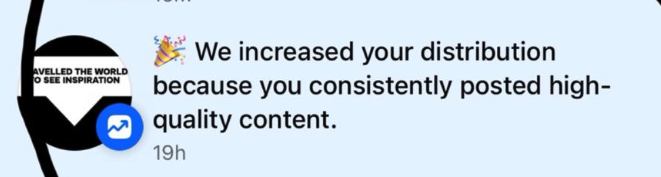
Bouzad says that Facebook consistently rewarded his posts with higher reach before it accused him of manipulating views.
In documents reviewed by Engadget, Meta doesn't explain its allegation of inauthentic engagement. But the company did tell Bouzad it would be willing to pay him $5,000 — a fraction of what he claims to be owed — to settle the cases even though it was standing by its decision to demonetize his pages. Bouzad declined. He believes that Meta is unfairly targeting him and other creators who run high-earning Facebook pages.
Bouzad says he's heard countless stories from other creators who have also been hit with vague "monetization page violations" that have stalled their payments. Much like he experienced, these account flags don't describe the supposed infraction and don't give an opportunity for an appeal. This, he says, leaves creators with few options outside of the legal system.
An unusual legal maneuver
After filing his second batch of small claims court cases in February, he began to reach out to his network and started filing more cases. Bouzad is not a lawyer and has no legal training; he's relied on ChatGPT and Gemini to guide his legal strategy. Much of that strategy relies on showing that other creators have allowed him to sue on their behalf through a process known as an assignment of claims. He filed 25 such cases in 2025.
Becoming a legal assignee is at best an unusual move for small claims court. Multiple legal experts contacted by Engadget said they had never heard of anyone doing so. "Normally, I don't think you see assigned claims in small claims [court]," Richard Slottee, a retired Oregon-based attorney, who has previously advised clients on small claims court cases. He said he was unsure of the legality of the move.
Marion County Circuit Court Judge Lindsay Partridge, who is presiding over Bouzad's small claims court case, seems similarly perplexed by the issue. In an October 23 hearing, he said that "there are some type of claims that under Oregon law, an anti-assignment clause would not be enforceable" but that he was unsure if the statute would apply in this particular case. "I tried to do a bunch of research on this," he said "I just can't find an answer to it."
Meta, on the other hand, has argued that its terms of service clearly prohibit users from transferring their rights to other parties without its consent. "Based on the No Transfer Clause, this Court should not permit Mr. Bouzad to continue recruiting Facebook users from all over the world and flooding its docket with cases where he claims standing based on an invalid assignment," a Meta project manager wrote in a letter to the judge. During the hearing, Judge Partridge said he was "concerned" that "what I have is essentially a very technical legal issue that's being presented by two non-attorneys." He said he would need "a little bit more time" to make a decision on whether Bouzad could move forward as an assignee.
The group Bouzad is helping consists mainly of colleagues, friends and friends-of-friends who had heard about his small claims cases. And though a few of the individuals are people he's partnered with in the past, he says he has no financial stake in the success of their pages. "It's power in numbers, we felt the more people, the more noise we could make, the better the chances of getting issues resolved," Bouzad says. "They gave me their cases to try and get that help [to] force Facebook to fix their pages." But there's also a potentially lucrative payday for him if he succeeds. As an assignee, he has the sole right to collect any judgment that ultimately comes out of the other creator's claims.
This Court should not permit Mr. Bouzad to continue recruiting Facebook users from all over the world and flooding its docket with cases where he claims standing based on an invalid assignment.A Meta project manager who is representing the company in small claims court
For some of the creators involved, the amount at stake is far higher than what Bouzad has claimed in his flings. One UK-based creator who has assigned their claim to Bouzad runs a dog-themed Facebook page that generated more than $60,000 from in-stream video ads during a one-month period last year, according to documents seen by Engadget. Like Bouzad, their page was hit with an unexplained "MPV" violation that has affected their reach. "Due to its original content and niche audience, the Facebook algorithm regularly rewards it with high reach and frequent placement in the recommendation feed," Bouzad wrote in a small claims court filing that claimed $1,000 in damages. "This natural visibility has now been unfairly disabled by Meta."
Another creator, who asked not to be identified out of fear of retaliation from Meta, asked him to look into three of his Facebook pages, which collectively have more than 1.5 million followers. All three had been demonetized by Meta and, like Bouzad, the creator received conflicting explanations about why.
He was told two of the pages were flagged for "limited originality" even though he told Engadget he only posts videos that are scripted and filmed by him and his business partners. His pages are dedicated to scripted sketches filmed to look like real-life encounters. They often show people in seemingly mundane situations becoming inexplicably angry, with descriptions like "Teacher Karen Demands to Know Why I’m Picking Up My Kid," or "I Gave Candy to Kids and Apparently That’s 'Wrong' Now."
The third page was hit with a "monetization page violation" for residing in an "ineligible country," despite the fact that, according to the creator, it was managed from the United States and the EU, both of which are eligible to participate in Meta's programs. Engadget has also verified the page manager locations using Facebook's page transparency information.
Bouzad filed two small claims court cases related to these three pages. The two that had been flagged for limited originality eventually had their monetization restored and the case was dismissed. "I think Mel's helping immensely," he told Engadget. "The fact that he got us the two pages back helped us as a business a lot."
The second case, related to the page with the "MPV" flag, is still pending. The creator, who has worked with Bouzad in the past, says he's grateful for the legal help, but increasingly frustrated with Meta. The demonetized page was his highest-earning page, making between $3,000 - $5,000 a month from video ads on Facebook, according to documents filed as part of the small claims lawsuit. He doesn't understand why Meta continues to penalize it when the page posts similar content as his other accounts. "We've always been following the rules, because this is our business, it's how we pay the bills," he says. But, he says that Facebook's continued errors has made it "extremely difficult" to maintain a business as a creator.
What's next
Of the 32 cases Bouzad has filed, eight were resolved after Meta addressed the underlying issue. Nine cases were dismissed by Bouzad as the creators chose to pursue legal action in other states. Fifteen cases, including six related to Bouzad's own pages, are still open. In July, a judge consolidated Bouzad's remaining cases into a single claim, despite a motion from Bouzad to keep the cases separate. "The cases affected by this order involve identical parties, raise substantially similar claims, and collectively seek damages that exceed the jurisdictional limits of the small claims court," a judge wrote. Bouzad is currently seeking more than $115,0000 in damages, $35,000 of which are from his own pages, over unpaid invoices, filing fees and other expenses related to his months-long battle over Facebook's monetization practices.
According to Bouzad, the actual amount owed to him and the other creators is far higher. "Actual unpaid earnings exceed $220,000," he wrote in a filing, "but amounts have been capped in accordance with small claims jurisdictional limits."
For now, Bouzad's claims can't move forward until the judge rules on whether Bouzad can proceed as an assignee. If the judge decides in his favor, he will be able to make his arguments to the circuit court judge overseeing the case. If the judge rules in Meta's favor, he will only be able to move forward with the claims pertaining to his own Facebook pages.
Bouzad says he is prepared for the fight. He has painstakingly compiled more than 1,000 pages of court documents, screenshots and news clippings for his case. In his filing, he alleges Meta is in breach of contract over the missing payments. He says Meta has consistently flagged creators' accounts with vague "MPV" violations, made enforcement errors, delayed payments and ignored appeals. He acknowledges that his months-long legal battle, and his reduced earnings, have taken a toll on his personal life. "Taking on Facebook, it's not like you're suing a mom and pop shop," he says. "You're suing one of the largest businesses in the world, and it has caused a lot of stress."
His goal is still to get the monetization restrictions lifted from the Facebook pages and for Meta to resume its payments to him and the other creators. "I just want the pages fixed and the money paid that's owed," he said. He has hundreds of travel videos saved and ready to post on his Facebook pages if and when his monetization is restored.
Have a tip for Karissa? You can reach her by email, on X, Bluesky, Threads, or send a message to @karissabe.51 to chat confidentially on Signal.
This article originally appeared on Engadget at https://www.engadget.com/social-media/how-an-oregon-court-became-the-stage-for-a-115000-showdown-between-meta-and-facebook-creators-150000952.html?src=rss