New Kindle vs Paperwhite vs Colorsoft: Specs and Price
Amazon's 2026 Kindle lineup compared: the $149.99 Kindle, $199.99 Paperwhite and $289.99 Colorsoft differ in screen size, battery, waterproofing and color.

Apple’s HomeView represents a significant step in the evolution of smart home technology, designed to enhance home management, communication, and entertainment. With its sleek, compact design and seamless integration into the Apple ecosystem, it aims to simplify daily routines while offering a centralized hub for smart home control. However, while the device introduces several noteworthy […]
The post Is Apple HomeView the Smart Display We’ve All Been Waiting For? appeared first on Geeky Gadgets.


The iPhone Duo introduces new possibilities for watching content, multitasking, and staying connected on a larger display. However, making the most of a foldable smartphone also means choosing accessories that complement its unique design while providing reliable everyday protection. A kickstand case adds another layer of convenience, allowing users to position their device for hands-free […]
The post Best iPhone Duo Kickstand Cases for Versatile, Hands-Free Viewing appeared first on Geeky Gadgets.

Grade 5 titanium (Ti-6Al-4V) is the alloy of jet engine compressor blades, surgical implants, and aerospace fasteners. It has a tensile strength of nearly 1000 MPa and weighs about half as much as stainless steel. COMANDI-Corres decided to use it for a tape measure. Bold move, honestly. But the logic tracks: if something is going to live permanently in your coin pocket, the material really can’t be the thing that fails first. And there’s something deeply satisfying about carrying a piece of aerospace hardware in your jeans while you’re measuring whether a new couch fits through your front door.
The RolTine 2.0 is that piece of hardware, coin-sized at 46mm wide and 18mm thick, machined from solid Grade 5 titanium by COMANDI-Corres out of Kowloon. Inside, a 150cm retractable flexible tape measure automatically retracts after use, offering convenient, hands-free measuring whenever you need it. On the surface, a precision rolling wheel with micro-ball bearings features a fixed 150mm circumference, allowing you to measure continuously along curves, irregular contours, and complex surfaces where rigid rulers fall short. That bearing assembly is also where the fidget magic lives; spin it between your fingers and it hums with a satisfying smoothness that’s genuinely hard to put down. CNC-engraved markings go straight into the metal, an N52 neodymium magnet docks it to steel surfaces, and optional tritium vials in six colors keep it glowing in the dark.
Designer: COMANDI-Corres
Click Here to Buy Now: $75 $130 (42% off). Hurry, only 25/300 left! Raised over $115,000.

COMANDI eliminated the manual retraction button for version 2.0, replacing it with an internal spring mechanism and tuned damping that snaps the tape back smooth and hands-free. In the original RolTine, retracting required a manual button press. Version 2.0 eliminates the button entirely, engineering an internal spring-loaded mechanism that snaps back smooth and hands-free. The spring is calibrated specifically to avoid the violent, finger-catching snapback of a standard steel contractor tape, which sounds minor until one of those things whips across your knuckle. The tape packs a full 150cm (60 inches) into an ultra-compact body, easily covering all your daily measurement needs. It’s laser-etched with metric on one side and imperial on the other, so you switch seamlessly between measurement systems with a simple flip. Zero math required.
Side A of the chassis is a precision rolling ruler with a fixed 150mm circumference wheel, upgraded from the spring-detent of V1.0 to high-precision miniature rolling bearings that eliminate friction and gritty drag, allowing the wheel to glide across any surface like ice. Roll it along a contour, count your full rotations, add the partial dial reading, and you have an exact measurement of a curved surface that would otherwise require a sewing tape and a lot of hopeful optimism. Woodworkers, architects, model makers, and fashion designers are the obvious audience, but anyone who has tried to measure a cylindrical object with a rigid ruler will get it immediately. The formula stays intuitive: total length equals full rotations multiplied by the base circumference, plus the partial dial reading. The rolling dial comes metric by default, with an imperial version available as a $1 add-on.


The micro-ball bearing assembly that enables smooth curve rolling also makes RolTine 2.0 one of the most satisfying objects to spin between your fingers. Tuned with high-precision miniature ball bearings, the core spins effortlessly with a faint, crisp mechanical hum. The outer edge is CNC-machined with deeply engraved aggressive micro-knurling that provides maximum mechanical traction, ensuring a rock-solid, zero-slip grip even when working with oily hands or wearing gloves. When COMANDI first put the original RolTine into people’s hands, something unexpected happened. They didn’t just use it to measure; they kept reaching for it. The smooth pull. The controlled retraction. The satisfying mechanical motion. People found themselves pulling it out, letting it retract, and doing it again simply because it felt good.
Precision 5-axis CNC cutouts shed unnecessary chassis weight while exposing the mechanical core beneath, and the open-frame architecture prevents debris buildup while catching ambient light as it spins, delivering raw, uncompromised industrial aesthetics. As you pull the tape, the inner liner spins in perfect sync with the internal spindle, and light refracts through the hollow frame, creating a mesmerizing fluid light effect. COMANDI built this skeleton architecture to be functional first, but the visual result reads more like a mechanical watch movement than a tape measure. The inner liner comes in Glacial Blue or Electric Yellow, anodized to perfection, adding a vivid contrast to the raw Grade 5 Titanium shell.


The N52 neodymium magnet embedded on Side B is a detail I appreciate more the longer I think about it. Embedded with an industrial-grade N52 Neodymium Magnet, RolTine 2.0 delivers a crisp, tactile snap and powerful holding force, locking firmly onto any ferrous surface and staying rock-solid without sliding, even under heavy workshop vibrations. Toolboxes, machinery, cabinet walls, car chassis, PC cases: it holds across all of them. Unlike conventional tape measures with printed or painted scales that rub off over time, all skeletonized cutouts and measurement scales are CNC-machined directly into the titanium chassis, with markings integrated into the metal itself, guaranteeing lifetime readability. Optional tritium vials, self-powered by continuous tritium decay with zero batteries and 24/7 perpetual glow for 10-plus years, or luminous vials that absorb ambient light for a brilliant night glow, are both available in six colors.
RolTine 2.0 sits at approximately $69 for a single unit, discounted heavily from its $130 MSRP. The rolling dial comes metric by default, with an imperial upgrade available for a single dollar if you prefer inches throughout. Tritium and luminous vials are optional add-ons, self-installable into the pre-machined chassis slots. RolTine 2.0 ships globally starting February 2027, and once the campaign is over, the tape measure will be available on the comandi.us website for its $130 MSRP.
Click Here to Buy Now: $75 $130 (42% off). Hurry, only 25/300 left! Raised over $115,000.
The post This coin-sized titanium tape measure handles straight lines, curves, and looks like jet-engine stock first appeared on Yanko Design.

Every October I do the same thing. I open Red Dot’s concept winners, grab a snack, and brace myself to fall in love with something that doesn’t exist yet. It works every time, and this year was no exception. The Red Dot Award: Design Concept has been celebrating unbuilt ideas since 2005, which makes it the closest thing design has to a crystal ball. Sometimes the ball shows you a gadget you’ll want next year, and sometimes it shows you something wonderfully ridiculous.
Best of the Best is the tier just below the Luminary, the award’s top prize, which has its own article. So everything below earned a standing ovation from a very picky jury. I’ve rounded up the winners that stuck with me, along with some opinions nobody asked for. Think of it as the pre-game and the post-game rolled into one. Settle in, because the lineup is a lot.

Hyundai’s MobED began as a flat, four-wheeled robot platform with a clever self-leveling trick, built to haul cargo and follow people around. These two concepts put a rider on that idea instead. Hyundai Genesis Global Design, the in-house team, shaped them around what Red Dot calls a compact robotic mobility platform with multi-directional driving and modular applications. In the lead image, a slim upright column carries a handlebar and a glowing round headlight, perched on four chunky wheels like a very polite scooter. It looks friendlier than most robots I’ve met, which is a low bar, but a cute one.
The Urban Hopper handles city trips, while MobED Golf takes the same base onto the fairway, and the thumbnails show it carrying a golf bag. A soccer ball rolls through another frame, so Hyundai clearly wants this thing at play as well as at work. Modular applications are how one chassis stretches across all of that. Hyundai says the pair also picked up a nomination for the Luminary, the competition’s top prize. The real MobED is already pitched at business customers, and I’d happily see a rideable cousin parked outside my apartment.
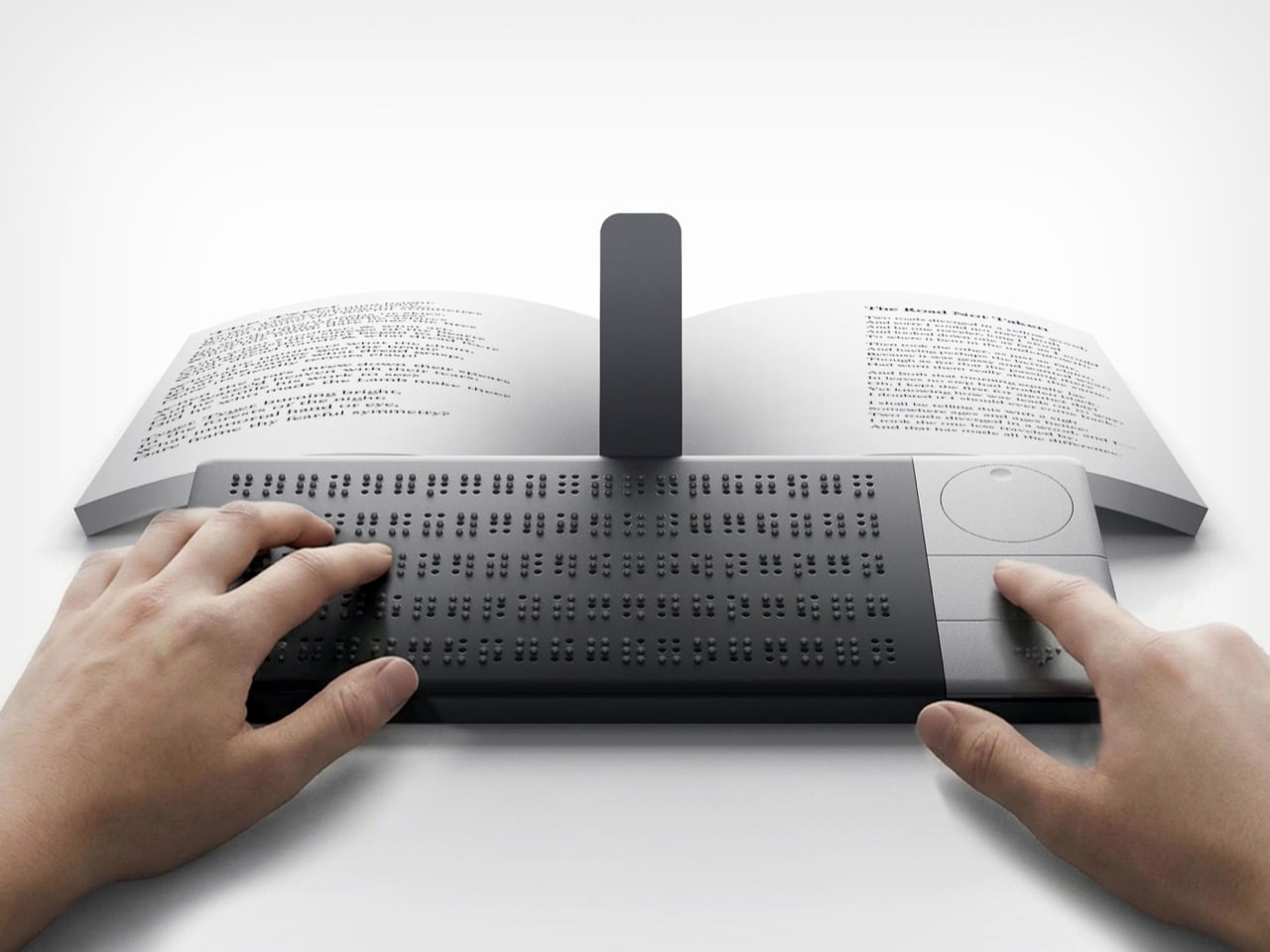
Only a small fraction of printed books ever get a Braille edition, which leaves blind readers waiting on someone else to decide what they can read. Tangibook skips the waiting. It’s a portable, refreshable Braille reader that turns printed text into real-time tactile output, so a visually impaired user can pick up a book and read it independently, accurately, and privately. TRIZID Industrial Design in Ningbo built it with Ningbo University, and seven designers are credited on the project. In the main image, an upright post stands behind the display while a book lies open in the background.
The slab carries rows of Braille cells under both hands, with a dial and a few buttons on the right. Reading looks closer to running your fingers down a page than poking at a gadget. The thumbnails show it propped on a folding stand and tucked under an arm like a slim clutch, which suits something meant to leave the house. Refreshable Braille displays often cost thousands of dollars and usually depend on a phone or computer for their content. Tangibook goes straight to the paper, which cuts out the middleman and the waiting list, and I love a design whose best feature is letting you read whatever you want, whenever you want.

Flying cars have been “five years away” for about seventy years, so I’m trained to roll my eyes at them. Then Xpeng’s Aridge unit shows up with the A868, a six-seat hybrid-electric tilt-rotor, and I’m only rolling one eye. Red Dot describes it as a full tilt-rotor flying car built for efficient regional air mobility, mixing vertical takeoff, long range, and comfort for premium travel. Aridge, the flying car unit Xpeng rebranded from Aeroht, led the design with JuanMa Lopez and Wang Tan, plus a dozen more designers. Fourteen names on the credit list suggests nobody got to design the rotors alone.
In the top-down render, the A868 shows a white fuselage with a black belly, ARIDGE lettered across the wings, and six rotor pods spread over a forested coastline. Aridge claims a range above 500 km (310 miles) and a top speed over 360 km/h (224 mph), thanks to a hybrid-electric powertrain. Joby’s S4 seats five, so the extra seat here is a flex. Xpeng says the prototype has entered test flights, which puts it ahead of most renders in this lineup. Flying cars still run on promises, but a six-seater that actually leaves the ground wins back some of my eye-roll.

Superbikes have spent two decades growing winglets, stickers, and creases until they look like fighter jets that lost a bet. Norton went the other way with the Manx R, a wingless, decal-free V4 superbike from the British marque, now owned by India’s TVS Motor Company. Head of Design Simon Skinner led the project, with Gerry McGovern, known for his Jaguar Land Rover work, advising as Norton’s chief creative advisor. Red Dot calls it a modern, reductive take on the superbike, free from racing regulations and built around the road rider. That freedom shows in the silver-white bodywork, which sweeps nose to tail without a single decorative line shouting for attention.
Underneath sits an all-new 1,200cc V4 making roughly 200 horsepower, backed by semi-active suspension, Brembo brakes, and an 8-inch TFT touchscreen. Fixings stay hidden while the mechanical bits stay on show, so the machinery does the decorating. The slatted tail with its glowing taillight looks more like a luxury coupe than a motorcycle, which fits the McGovern influence. It also took Bronze at this year’s IDEA Awards, the first combustion-engined production sports motorcycle to do so. Most superbikes want you to love the spec sheet, and this one wants you to look first, which suits a very old brand starting over.
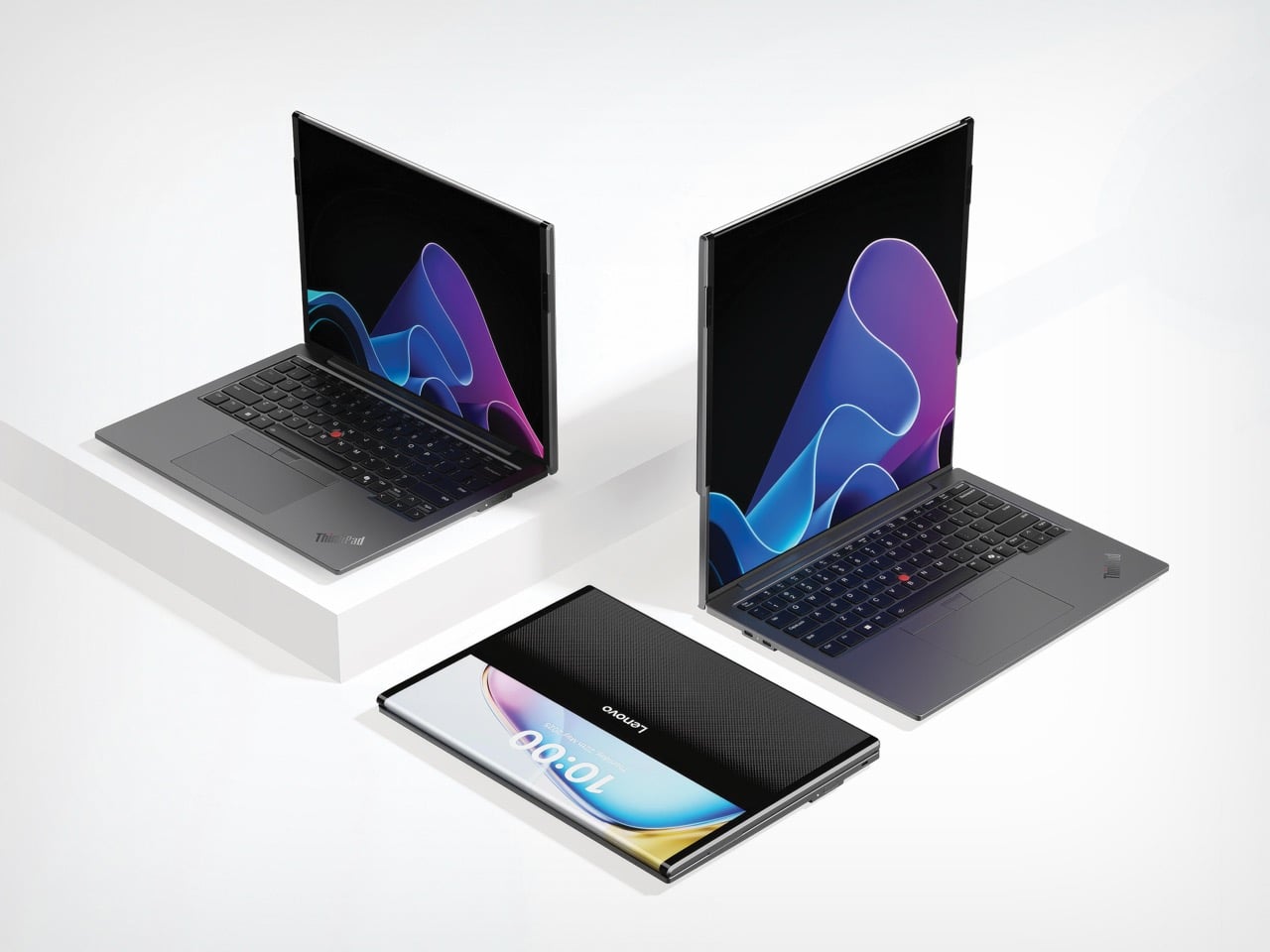
Lenovo has a habit of turning concept laptops into real ones, and its vertical rollable is the proof. The ThinkBook Plus Gen 6 Rollable used a pair of motors to stretch a 14-inch screen up to 16.7 inches, and it launched from $3,499. MaxArt is the sequel, billed by Red Dot as Lenovo’s second-generation rollable laptop, led by designer Yang Peiyin with a nine-person design team. The brief pairs AI-powered productivity with expandable display technology and a transparent design that shows off the engineering. In the renders, the screen climbs out of the base like a periscope and leaves a tall, portrait-shaped canvas behind.
The closed laptop is the sneaky part, since its lid hints at a bright strip of screen showing the time. Open it up and you still get a ThinkPad-style keyboard with the red TrackPoint nub intact, which tells me Lenovo knows which details its fans would riot over. Anyone who has ever wished for just a few more lines of code or one more document window will see the appeal right away. The first generation proved the idea could survive a production line, so a second pass is a fair bet to sharpen it. MaxArt is still a concept, but it already has a shipping older sibling to vouch for it.

Tattoo machines have buzzed the same way for over a century, and the sound alone keeps plenty of people out of the chair. Ferdinand Kohle, who has a needle phobia himself, founded London startup CipherX to fix that. The CX Microdot Tattoo Applicator is the handheld tool behind it, designed under Kohle with Shaoyu Wang and Hemal Dias. Red Dot says it enables precise, pain-free application while making tattoo creation more accessible, safe, and inclusive. Instead of a needle gun, a single-use patch of dissolving microneedles carries the pigment, and the applicator presses it into the skin.
In the photo, the applicator is a matte black grip shaped a bit like a flashlight, pressed against an upper arm while the other hand steadies it. Dutch microneedle specialist uPATCH built the internals, and CipherX shaped the exterior and the overall experience, so it looks calm rather than clinical. The patch stays on for about 15 minutes, then peels away, leaving a permanent tattoo behind. CipherX says the tiny needles don’t reach as deep as a traditional tattoo needle, which is why it doesn’t hurt. For now it’s a London affair, with trained staff applying small designs, so American needle-phobes are waiting on an expansion.
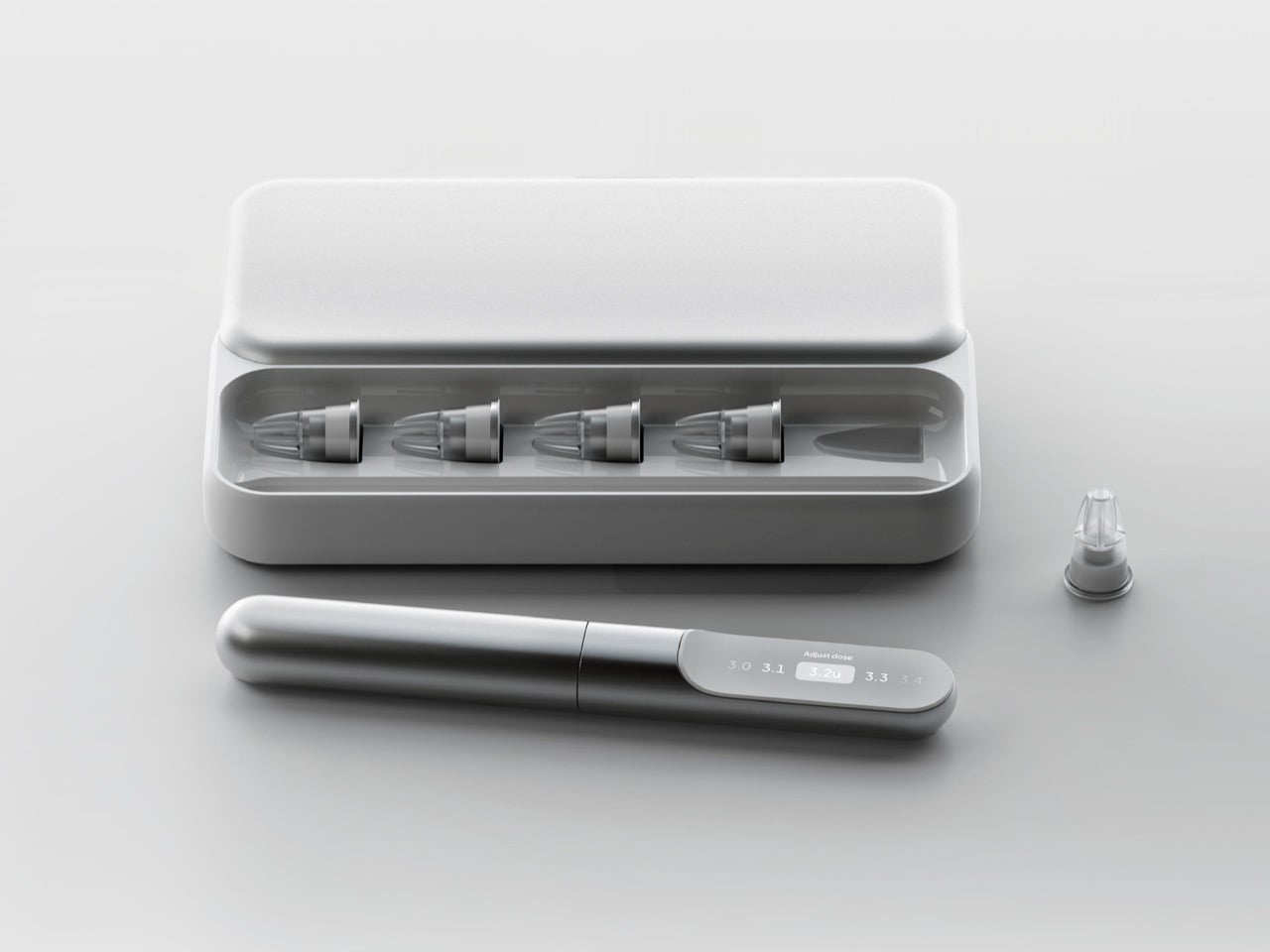
Just before this, a tattoo applicator promises to take the sting out of needles, and the Smart Insulin Kit goes after the daily routine around them. People who take insulin often repeat that routine several times a day, usually with gear that looks like it escaped from a clinic. BLOND, the London studio founded by James Melia, set out to make something calmer. Red Dot calls it a connected insulin management system, pairing a smart pen, a multifunctional storage case, and an AI-enabled app to simplify dosing, treatment administration, and diabetes care. It’s still a concept, so nothing here is on a shelf yet.
Smart pens already exist, with the InPen launching in the US in 2017 to log doses and send reminders, but many still look like medical gadgets with an app bolted on. BLOND, ranked the top design consultancy in Europe and the Americas by Red Dot, treats pen, case, and app as one family. The render shows a brushed metal pen with a slim dose display next to a pale case holding four small tips, all in matching soft gray. The thumbnails add a charging tray and a hand pressing the pen to skin. It reads like a fountain pen set, which is a lovely way to carry a daily routine into public.

Somewhere in a craft aisle, a row of yarn skeins has been handed waffle cones and told to look delicious. ShenZhen YUTO Packaging, led by Li Xingguo and Ding Zhiyong, turned ordinary balls of yarn into scoops of lemon, blueberry, and strawberry, and honestly, I want a double. Red Dot says the design pairs playful aesthetics with practical function, thanks to one-sheet forming construction that gives you tangle-free dispensing, secure storage, and sustainable packaging in one integrated design. Yarn’s biggest crime is turning into a bird’s nest the moment you look away, and this cone politely refuses to let that happen.
Each cone wears a waffle diamond pattern, and a little paper band arches over the scoop like a handle, with lettering running along it. The kraft brown with pastel yarn is the exact color pairing of a summer afternoon, minus the sticky fingers. Everything folds from a single sheet, which is a very tidy way to be eco-friendly. The thumbnails show the cones lying down with bright stitch markers spilling out, so the cone keeps doing its job long after the yarn is gone. Soft serve for knitters has no calories and no brain freeze, and I’m already picking a flavor.
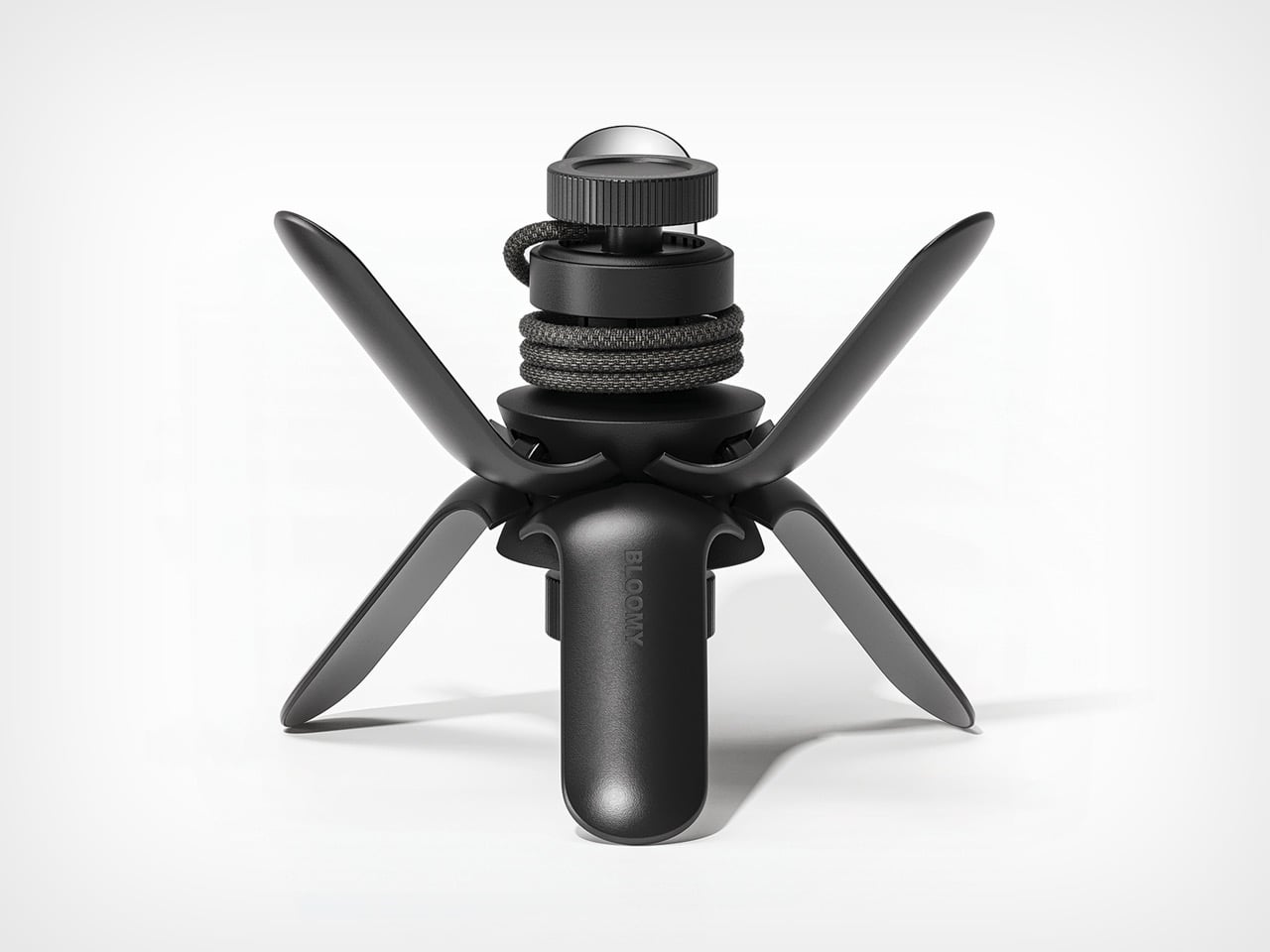
The Red Dot: Peter Zec Prize honors designers under 30, and this year it went to a camping stove shaped like a flower. Bloomy comes from a student team at Dalian Minzu University and Beijing City University, led by Qiu Qi with faculty advisor Kong Hao. Red Dot describes a portable stove inspired by a blooming flower, with a modular design that shifts between compact storage and stable cooking configurations. In the lead image, four black petals splay from a central stem topped with a knurled knob, like a flower that learned to hold a pot. I did not expect to call a camp stove pretty.
Camp stoves live with a permanent trade-off, because packing small wants everything folded and stable cooking wants everything sprawled. Bloomy settles it with petals that fold in until the whole thing becomes a smooth capsule, then open out into a wide, steady base. A woven cord wraps the stem for texture, and the matte black finish gives it the look of a gadget a gear nerd would keep on a desk. The Peter Zec Prize is the Luminary’s counterpart for young designers, which makes Bloomy the top Next Gen concept of the year. Next time my ramen goes wrong outdoors, I’ll blame the chef instead of the flower.
The post Rollable laptops, painless tattoos, and a flying car: Red Dot’s 2026 Best of the Best has range first appeared on Yanko Design.

A bed on wheels is the defining feature of the Atlas, a park model tiny home by Zook Cabins. Open its glass garage door, roll the sleeping platform onto the deck, and the bedroom becomes an outdoor sleeping spot. It’s an unusually literal approach to connecting a small interior with its surroundings, without asking occupants to settle for a view through glass.
The dimensions deserve a closer look. Atlas measures 12 feet wide and 32 feet long overall, but that includes the deck and roof overhangs. Its finished interior occupies 233 square feet, with a separate 10-by-12-foot deck. That distinction matters: a substantial portion of this tiny home’s footprint is deliberately given over to outdoor living.
Designer: Zook Cabins


In Zook’s published imagery, vertical timber cladding wraps a compact volume beneath a gently sloping roof. Black window frames and the gridded garage door punctuate the wood exterior. The deck sits directly in front of that glazed opening, making it integral to the layout rather than a porch attached wherever space allows.
The garage door measures eight feet wide and seven feet six inches high. Manual operation comes standard; Zook provides space and an outlet for a side-mounted opener. Raising it creates the opening needed to move the bed outside. The mechanism also introduces a conspicuous piece of garage hardware into an otherwise restrained, wood-lined room.

Inside, the single-level arrangement keeps sleeping and everyday activities in one main space. The bed doubles as a daybed, while a small table is attached to its rear. A fold-up dining table seats two, with folding canvas stools stored near the entrance. These choices suggest a retreat for short stays, where furniture can accommodate different activities without requiring separate rooms.
Clear-coated birch plywood finishes the walls and ceiling, paired with vinyl plank flooring. The kitchenette includes flat-panel cabinets, a laminate countertop, a black granite sink, and a four-cubic-foot refrigerator with freezer. The bathroom gets a five-foot shower base, glass shower door, vessel sink, and toilet. The shower’s specified length is worth noting in such a small interior, where the practical necessities could easily have been squeezed into leftover corners.

Atlas belongs to Zook’s park model range, which the manufacturer positions for campgrounds, retreats, and getaway cabins. Buyers still need to prepare the site and arrange utility connections. Zook offers these homes through a quotation process, so the model’s appeal shouldn’t be confused with a complete, ready-to-occupy property purchase.
The strongest design decision is giving the bed somewhere else to go. Outdoor sleeping will depend on weather, insects, and privacy, but the option changes how the deck can be used. For a small getaway, that’s a more specific proposition than simply adding another oversized window.

The post This Tiny Home’s Bed Rolls Onto the Deck So You Can Sleep Outside first appeared on Yanko Design.