Kalshi, one of several online prediction markets that have exploded in popularity in the last few years, has suspended one of YouTube MrBeast's video editors for insider trading, NPR reports. Besides being suspended from the platform for two years, Kalshi says the editor will also be required to pay a financial penalty that's five times his initial trade size.
The editor, Artem Kaptur, traded in markets related to YouTube and specifically, MrBeast. Kalshi says his transactions were initially flagged because of his "near-perfect trading success on markets with low odds, which were statistically anomalous." Because trades are public on Kalshi, multiple users also flagged the trades as suspicious. Kalshi learned Kaptur was an employee of MrBeast during its investigation and determined he "likely had access to material non-public information connected to his trading." Perhaps unsurprisingly, trading with insider information violates Kalshi's rules.
Kalshi says that it reported the insider trading to the Commodity Futures Trading Commission (CFTC) and plans to donate the over $20,000 Kaptur has been fined to "a non-profit that provides consumer education on derivatives markets." In a statement provided to NPR, Beast Industries, MrBeast's production company, said it has a zero-tolerance policy for insider trading. "We have a longstanding policy in place against employees using proprietary company information in order to safeguard the highest standards and ethics throughout our organization," Beast Industries said.
Separately, Kalshi has also suspended and fined a politician who was running to be Governor of California. "In May, our Surveillance Department saw an online video by a candidate for Governor of California that appeared to show him trading on his own candidacy," Kalshi says. "We immediately froze his account and opened an investigation. The candidate was initially cooperative and acknowledged that this violated the exchange rules. As a candidate in a race, you can (and probably should) follow and use Kalshi’s market forecast, but you should not trade on it."
Like other prediction markets, Kalshi lets users make trades based on a variety of different subjects and events. For example, you could participate in a market focused on the results of a basketball game, or something more unusual, like who'll win the current season of Survivor. Despite resembling gambling, online predictive markets aren't currently regulated by state gambling laws, and instead classify bets as a type of futures contract, placing them under the purview of the CFTC. That hasn't stopped states from trying to regulate prediction markets anyway. For example, Nevada sued Kalshi for operating a sports gambling market without a permit earlier in February.
This article originally appeared on Engadget at https://www.engadget.com/big-tech/kalshi-fined-a-mrbeast-editor-for-insider-trading-191027814.html?src=rss
Two stories about the Claude maker Anthropic broke on Tuesday that, when combined, arguably paint a chilling picture. First, US Defense Secretary Pete Hegseth is reportedly pressuring Anthropic to yield its AI safeguards and give the military unrestrained access to its Claude AI chatbot. The company then chose the same day that the Hegseth news broke to drop its centerpiece safety pledge.
On Tuesday, Anthropic said it was modifying its Responsible Scaling Policy (RSP) to lower safety guardrails. Up until now, the company's core pledge has been to stop training new AI models unless specific safety guidelines can be guaranteed in advance. This policy, which set hard tripwires to halt development, was a big part of Anthropic's pitch to businesses and consumers.
“Two and a half years later, our honest assessment is that some parts of this theory of change have played out as we hoped, but others have not,” Anthropic wrote. Now, its updated policy approaches safety relatively, rather than with strict red lines.
Anthropic's quotes in an interview with Time sound reasonable enough in a vacuum. "We felt that it wouldn't actually help anyone for us to stop training AI models," Jared Kaplan, Anthropic's chief science officer, told Time. "We didn't really feel, with the rapid advance of AI, that it made sense for us to make unilateral commitments… if competitors are blazing ahead."
Anthropic CEO Dario Amodei (Photo by David Dee Delgado/Getty Images for The New York Times)
David Dee Delgado via Getty Images
But you could also read those quotes as the latest example of a hot startup’s ethics becoming grayer as its valuation rises. (Remember Google’s old “Don’t be evil” mantra that it later removed from its code of conduct?) The latest versions of Claude have drawn widespread praise, especially in coding. In February, Anthropic raised $30 billion in new investments. It now has a valuation of $380 billion. (Speaking of the competition Kaplan referred to, rival OpenAI is currently valued at over $850 billion.)
In place of Anthropic's previous tripwires, it will implement new "Risk Reports" and "Frontier Safety Roadmaps." These disclosure models are designed to provide transparency to the public in place of those hard lines in the sand.
Anthropic says the change was motivated by a "collective action problem" stemming from the competitive AI landscape and the US's anti-regulatory approach. "If one AI developer paused development to implement safety measures while others moved forward training and deploying AI systems without strong mitigations, that could result in a world that is less safe," the new RSP reads. "The developers with the weakest protections would set the pace, and responsible developers would lose their ability to do safety research and advance the public benefit."
Defense Secretary Pete Hegseth (Photo by AAron Ontiveroz/The Denver Post)
AAron Ontiveroz via Getty Images
Neither Anthropic's announcement nor the Time exclusive mentions the elephant in the room: the Pentagon's pressure campaign. On Tuesday, Axiosreported that Hegseth told Anthropic CEO Dario Amodei that the company has until Friday to give the military unfettered access to its AI model or face penalties. The company has reportedly offered to adopt its usage policies for the Pentagon. However, it wouldn't allow its model to be used for the mass surveillance of Americans or weapons that fire without human involvement.
If Anthropic doesn't relent, experts say its best bet would be legal action. But will the Pentagon's proposed penalties be enough to scare a profit-driven startup into compliance? Hegseths' threats reportedly include invoking the Defense Production Act, which gives the president authority to direct private companies prioritize certain contracts in the name of national defense. The military could also sever its contract with Anthropic and designate it as a supply chain risk. That would force other companies working with the Pentagon to certify that Claude isn't included in their workflows.
Claude is the only AI model currently used for the military's most sensitive work. "The only reason we're still talking to these people is we need them and we need them now,” a defense official told Axios. “The problem for these guys is they are that good." Claude was reportedly used in the Maduro raid in Venezuela, a topic Amodei is said to have raised with its partner Palantir.
Time's story about the new RSP included reactions from a nonprofit director focused on AI risks. Chris Painter, director of METR, described the changes as both understandable and perhaps an ill omen. "I like the emphasis on transparent risk reporting and publicly verifiable safety roadmaps," he said. However, he also raised concerns that the more flexible RSP could lead to a "frog-boiling" effect. In other words, when safety becomes a gray area, a seemingly never-ending series of rationalizations could take the company down the very dark path it once condemned.
Painter said the new RSP shows that Anthropic "believes it needs to shift into triage mode with its safety plans, because methods to assess and mitigate risk are not keeping up with the pace of capabilities. This is more evidence that society is not prepared for the potential catastrophic risks posed by AI."
This article originally appeared on Engadget at https://www.engadget.com/ai/anthropic-weakens-its-safety-pledge-in-the-wake-of-the-pentagons-pressure-campaign-183436413.html?src=rss
Sony just divulged the list of PlayStation Plus Monthly Games for March, and there's a little something for everybody. These will all be playable on March 3 for subscribers on any tier. After downloading, the games will stay in a player's library as long as the subscription remains active.
First up, there's Monster Hunter Rise. This was initially a Nintendo Switch exclusive before making the jump to other platforms. This is a decent Monster Hunter game with a focus on verticality. There are tools to quickly scale large cliffs and engage in aerial combat. It can be played solo or via a four-person squad. The gameplay loop is as addictive here as ever. Fight monsters. Gather materials. Upgrade weapons and armor. Rinse and repeat.
Slime Rancher 2 just hit consoles last year, after some time in early access. This sequel improves upon everything that made the first game great, which included capturing and farming various slimes. There's a fresh location to explore and an absolute boatload of new slimes to capture. Sucking up dozens of slimes at once is a simple pleasure akin to completing a level in PowerWash Simulator.
The Elder Scrolls Online Collection: Gold Road is the definitive version of the game, offering access to all zones, biomes and quest arcs. This online game can be played cooperatively, but there's also a lot of PvP content. It's set 1,000 years before Skyrim, but there are many iconic locations from that game to explore.
Finally, PGA Tour 2K25 is the latest entry in 2K's long-running golf sim. This one has an expanded solo mode, in addition to a course designer tool. It's also cross-platform.
As new games enter the catalog, old titles vanish. Subscribers have until March 2 to download Undisputed, Subnautica: Below Zero, Ultros and Ace Combat 7: Skies Unknown.
This article originally appeared on Engadget at https://www.engadget.com/gaming/playstation/marchs-ps-plus-monthly-games-include-monster-hunter-rise-and-slime-rancher-2-182644562.html?src=rss
Following Samsung’s Unpacked event, the Samsung Galaxy S26 is available for pre-order, and it looks very familiar. That is not necessarily a bad thing. Like recent updates in the Galaxy S line, Samsung is refining its flagship rather than dramatically reinventing it.
Both phones share a lot of core DNA, including compact designs, high-refresh AMOLED displays and similar camera hardware. The S26 does introduce a handful of meaningful updates, however, including a slightly larger battery and newer software out of the box. Those changes also come with a higher starting price: the Galaxy S26 begins at $899.99 compared to the S25’s $799.99 launch price. The entry model now includes 256GB of storage instead of the S25’s base 128GB. Here's how the Galaxy S26 compares with last year’s Galaxy S25 on paper and whether the newer model is worth your attention.
Galaxy S26 vs. Galaxy S25: Design, display and performance
Physically, the Galaxy S26 stays very close to the design Samsung established with the S25. You still get a compact handset with flat edges, an aluminum frame and IP68 water and dust resistance. The overall look and feel should be immediately familiar to anyone who used last year’s phone.
The display story is similarly steady. Both phones use Samsung’s Dynamic AMOLED 2X panels with adaptive refresh rates up to 120Hz, and the S25 is rated for peak brightness of up to 2,600 nits. In everyday use, whether you are scrolling, gaming or watching video, the viewing experience should feel broadly similar between the two devices.
Under the hood, the Galaxy S25 is powered globally by Qualcomm’s Snapdragon 8 Elite for Galaxy chipset paired with 12GB of RAM. The Galaxy S26 continues to target flagship-class performance. While Samsung has made internal refinements, overall speed should remain firmly in high-end territory for routine tasks, multitasking and mobile gaming.
On the software front, the S25 launched with Android 15 and One UI 7, while the Galaxy S26 ships with a newer version of Samsung’s software out of the box. As usual, the older model is expected to receive updates over time, which may narrow the long-term software gap.
Galaxy S26 vs. Galaxy S25: Cameras
Samsung has not dramatically reshuffled the base Galaxy camera hardware. The Galaxy S25 features a triple-camera setup built around a 50-megapixel main sensor, a 12MP ultrawide and a 10MP telephoto with 3x optical zoom, along with a 12MP front camera.
The Galaxy S26 largely sticks with the same proven approach, which suggests image quality should remain broadly consistent in good lighting. As is often the case with Samsung’s year-to-year updates, any meaningful gains are likely to come from image processing improvements rather than brand-new sensors.
For most people, that means the S26 should deliver the punchy, reliable photos Samsung flagships are known for, but Galaxy S25 owners should not expect a dramatic leap in camera hardware.
Galaxy S26 vs. Galaxy S25: Battery life and charging
Battery capacity is one area where the Galaxy S26 makes a measurable change. The Galaxy S25 uses a 4,000mAh battery, while the Galaxy S26 increases that to 4,300mAh. That modest bump should translate into slightly longer endurance in day-to-day use, though real-world gains will depend on efficiency improvements and individual usage patterns.
Charging speeds remain largely unchanged. The Galaxy S25 supports up to 25W wired charging, up to 15W wireless charging and 4.5W reverse wireless charging, and the Galaxy S26 stays in the same general range.
Galaxy S26 vs. Galaxy S25: Software and AI
This year, Samsung is putting more emphasis on Galaxy AI, even on the base Galaxy S26. While many of the headline features are aimed at the Ultra and Plus models, the standard S26 still picks up several practical upgrades.
One of the more useful additions is Document Scan, which uses AI to clean up scans by automatically removing distortions, fingers and creases. It can also bundle multiple images into a single PDF, making it easier to digitize receipts, notes or forms without extra editing.
Samsung is also expanding its proactive assistant features. Now Brief becomes more personalized on the S26, surfacing reminders and updates based on your activity throughout the day, while the new Now Nudge system can suggest relevant content at the right moment. For example, if someone asks for photos from a recent trip, the phone can proactively surface matching images from your gallery instead of making you search manually.
Search is getting smarter as well. Circle to Search with Google now supports enhanced multi-object recognition, allowing you to identify several items in an image at once. Samsung is also upgrading Bixby into a more conversational assistant, and the S26 supports third-party agents such as Gemini and Perplexity for handling more complex, multi-step tasks through voice commands.
Security and privacy features are expanding in the background too. The Galaxy S26 introduces AI-powered Call Screening to summarize unknown callers, along with new Privacy Alerts that warn when apps request sensitive permissions. Samsung is also extending its post-quantum cryptography protections deeper into the system, backed by the company’s Knox security platform and seven years of promised security updates.
Galaxy S26 vs. Galaxy S25: How to choose
If you already own a Galaxy S25, the Galaxy S26 looks like a fairly iterative update. The core experience, including performance, display quality and camera hardware, remains very similar.
The main tangible upgrade is the slightly larger battery, along with newer software out of the box. For most S25 owners, that alone probably is not a compelling reason to upgrade. However, if you are coming from an older Galaxy phone or buying fresh, the Galaxy S26 is the more future-proof pick simply because it starts one generation ahead in Samsung’s update cycle and packs the larger battery.
As usual with Samsung’s yearly refreshes, the real decision may come down to pricing and discounts. If the Galaxy S25 sees significant price cuts, it could remain the better value. But at similar prices, the Galaxy S26 is the safer long-term buy.
Galaxy S26 vs. Galaxy S25: Specs at a glance
Specs
Samsung Galaxy S26
Samsung Galaxy S25
Price (MSRP)
$899.99
$799.99 (128GB), $859.99 (256GB)
Dimensions
5.88 x 2.82 x 0.28 inches
5.78 x 2.78 x 0.28 inches
Weight
5.9 ounces
5.7 ounces
Screen size
6.3 inches (FHD+)
6.2 inches (FHD+)
Screen resolution
2,340 x 1,080
2,340 x 1,080
Screen type
Dynamic AMOLED 2X, 120Hz adaptive refresh (1–120Hz), Up to 2,600 nits peak brightness, Corning Gorilla Glass Victus 3
Dynamic AMOLED 2X, 120Hz adaptive refresh (1–120Hz), Up to 2,600 nits peak brightness, Corning Gorilla Glass Victus 2
This article originally appeared on Engadget at https://www.engadget.com/mobile/smartphones/samsung-galaxy-s26-vs-galaxy-s25-whats-changed-and-which-one-should-you-buy-181515367.html?src=rss
Samsung has officially unveiled the Galaxy S26, Galaxy S26+ and Galaxy S26 Ultra, and the company is once again leaning heavily on AI, camera upgrades and refined hardware to move the lineup forward. While the overall design remains familiar, there are some meaningful differences between the three models, particularly when it comes to display tech, charging speeds and camera hardware.
Across the board, the S26 family is powered by Qualcomm’s Snapdragon 8 Elite Gen 5 for Galaxy chip and runs Android 16 with One UI 8.5. Samsung is also doubling down on Galaxy AI features like Now Brief, Now Nudge and upgraded Circle to Search, positioning the new phones as more proactive assistants than before.
As usual, though, the Ultra model is where Samsung is pushing the envelope the furthest. It gains the most advanced camera system, faster wired and wireless charging and the company’s new built-in Privacy Display tech. Pre-orders are available now, with official sales starting on March 11. If you’re trying to decide which model makes the most sense for your needs (and budget), here’s how the three devices stack up on paper.
Samsung Galaxy S26 vs. S26+ vs. S26 Ultra: Specs compared
Specs
Samsung Galaxy S26
Samsung Galaxy S26+
Samsung Galaxy S26 Ultra
Price (MSRP)
$899.99
$1,099.99
$1,299.99
Dimensions
71.7 x 149.6 x 7.2 mm
71.7 x 149.6 x 7.2 mm
78.1 x 163.6 x 7.9 mm
Weight
167g
190g
214g
Screen size
6.3 inches (FHD+)
6.7 inches (QHD+)
6.9 inches (QHD+)
Screen resolution
2340 x 1080
3120 x 1440
3120 x 1440
Screen type
Dynamic AMOLED 2X, 120Hz adaptive refresh (1–120Hz), Up to 2,600 nits peak brightness
Dynamic AMOLED 2X, 120Hz adaptive refresh (1–120Hz), Up to 2,600 nits peak brightness
Dynamic AMOLED 2X, 120Hz adaptive refresh (1–120Hz), Up to 2,600 nits peak brightness
Cobalt Violet, White, Black, and Sky Blue / Pink Gold and Silver Shadow (Samsung exclusive)
Cobalt Violet, White, Black, and Sky Blue / Pink Gold and Silver Shadow (Samsung exclusive)
Cobalt Violet, White, Black, and Sky Blue / Pink Gold and Silver Shadow (Samsung exclusive)
This article originally appeared on Engadget at https://www.engadget.com/mobile/smartphones/samsung-galaxy-s26-vs-s26-vs-s26-ultra-comparing-the-three-new-phones-181047172.html?src=rss
During its Unpacked event today, Samsung announced three new Galaxy S-series phones as well as the latest generation of its earbuds, the Galaxy Buds 4 and Galaxy Buds 4 Pro. Pre-orders are now open and the new devices are set to ship March 11. As expected, this year’s models aren’t drastically different from last year’s, but all the phones are equipped to better handle the Galaxy AI experiences such as Now Nudge that offers suggestions based on your activities and a more conversational assitant in Bixby (or Gemini or Perplexity depending on your preferance).
Engadget’s own Sam Rutherford is on-site in San Francisco for the new hardware launch and will have hands-on impressions. We’ll follow that up with official reviews in the next week. But if you can’t wait for our final verdict, here’s how to pre-order Samsung’s Galaxy S26 phones and the Galaxy Buds 4 today.
This article originally appeared on Engadget at https://www.engadget.com/mobile/smartphones/how-to-pre-order-the-samsung-galaxy-s26-phones-and-galaxy-buds-4-180500976.html?src=rss
Google unveiled a new batch of Android updates, including more Gemini-powered tools and improved scam detection features at Samsung’s Galaxy S26 launch on Wednesday.
A new feature in the Gemini app will let users hand off multi-step tasks, like ordering a rideshare or building a grocery cart. The feature, which will first arrive in beta, runs in the background while users perform other tasks. Gemini's progress can be monitored live via notifications, so users can see what it's doing and jump in at any time.
Google
Google says this feature will initially be limited to certain food, grocery or rideshare apps. It will be available first on select devices, including the Galaxy S26 and Pixel 10, in the US and Korea.
Android is also getting an upgrade for Circle to Search, enabling it to search for multiple objects seen on screen at once. One implementation of this is full-outfit searches using "find the look." Once the app has found all the individual pieces of the circled outfit, users can try them on virtually. This will be available on Galaxy S26 and Pixel 10 devices. The beefed-up feature can also be used to gain insights into multiple objects in an image.
Google
The company is also using Gemini to bring on-device Scam Detection for calls to Samsung’s Phone app. The tool alerts users if someone on their call is using speech patterns commonly heard from scammers. Google says the feature is never used while on a call with someone in your contacts and is off by default.
Google
The same technology and approach will also be used to detect scams in Google Messages. For now, scam detection on phone calls is only available on the Galaxy S26 in English in the US, while detection in messages is supported across various markets.
All of these new features are available now on the Pixel 10 and Galaxy S26 lineups, with availability in select markets varying by feature.
This article originally appeared on Engadget at https://www.engadget.com/ai/google-announces-new-android-ai-features-coming-to-the-galaxy-s26-and-pixel-10-series-180039674.html?src=rss
As we prepare to leave the winter months, Samsung announced another family of Galaxy S flagships for those looking to upgrade. As usual, the company put its best components and features into the Galaxy S26 Ultra, but it also added more to the base S26 and S26+. The company has hit its groove with its smaller (and cheaper) flagships, delivering solid devices with increasingly better cameras, occasionally even offering feature parity with its most expensive smartphone.
In 2026, that’s what we’re getting, with the 6.3-inch S26 ($899) and 6.7-inch S26+ ($1,099). Both phones are more expensive than last year, and it’s often a game of spot-the-difference when it comes to showing what’s new.
Fortunately, the best parts have been retained, too. Samsung has unified the design style across the entire S26 series, with the same corner ratios, curved edges and other design touches. While I tested both phones, I’ll focus on the S26. Barring screen differences and battery size, they’re identically specced.
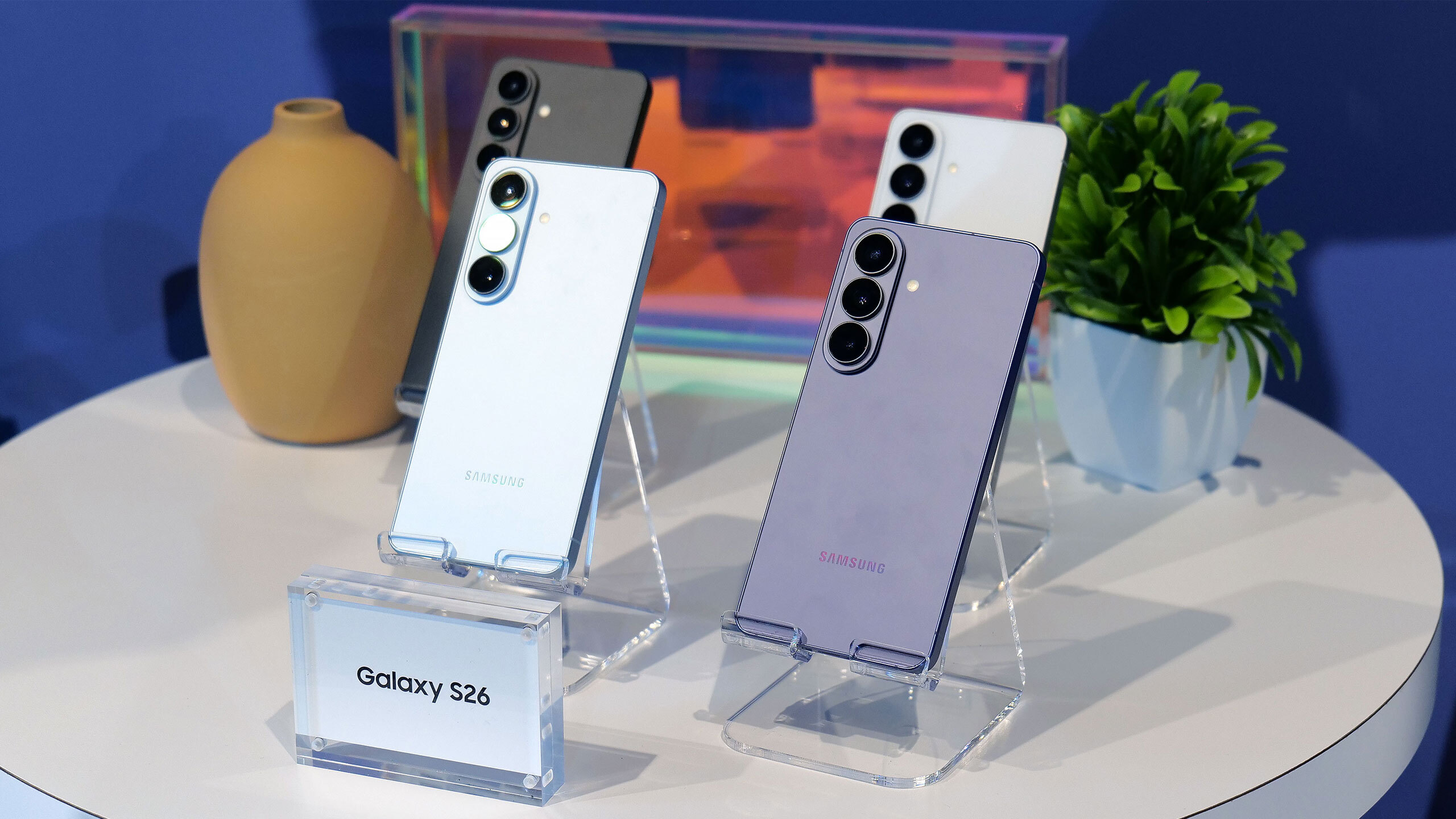
This year’s S26 color selection has a premium Samsung ‘mood’ to it that I can’t quite explain. Does purple mean Samsung to my brain? Maybe. Cobalt Violet is the particular shade I’m talking about, but there are also blue, black and white colors. Additional silver and pink-gold options will be available as online exclusives. There’s not much else to say about the design: it’s another Galaxy S flagship, and if it ain’t broke…
Mat Smith for Engadget
Samsung has increased the battery capacity to 4,300 mAh on the S26, while somehow maintaining the same thickness as last year’s S25. However, the S26+ has the same 4,900mAH battery as its predecessor. All S26 devices will launch with 256GB of storage and 12GB of RAM, with bigger storage options available. With the S26, Samsung has slightly increased the screen size to 6.3 inches, up from last year's 6.2-inch S25.
The S26 comes with a familiar camera trio: a 50-megapixel main sensor, 12MP ultrawide, and 10MP telephoto with up to 3x optical zoom. On paper, that’s identical to last year’s base S25. However, Samsung has improved performance with its ProScaler technology for upscaling images and an MDNIe chip, which the company says provides four times the color precision compared to previous devices.
There are software improvements too, with video features being the most tangible upgrade, among more AI-assisted photo editing tools. Super Steady video has been upgraded to a 360-degree horizontal lock. This camera mode uses the S26’s gyroscopes to maintain a consistent horizon even as you rush to chase a pet or family member while recording, or to capture snowboarding buddies. (There’s always a snowboarding example when a company mentions horizontal lock.) It’s nice to see a feature we’re used to finding on gimbals and action cams built into an unashamedly mainstream phone like the S26.
Auto Framing is another new feature coming to both 4K and 8K video capture. It uses AI to lock onto subjects and automatically tighten framing to what you want to capture. Even during brief testing, I was intrigued and liked the dramatic punch-in effect as I recorded nearby people. It creates a faux-panning effect as it tracks moving subjects, something you might have experienced with Center Stage on Apple devices.
Samsung has also upgraded image processing on its front-facing cameras with a new Object Aware Engine for improved portrait mode shots, hair textures and more accurate skin tones. Based on my early testing, images seemed sharper than on my older Samsung devices, even though this is (again) largely the same 12MP camera as last year.
With processors, it's getting a little more complicated. In the US, Samsung's entire S26 series will use the Snapdragon 8 Elite Gen 5 for Galaxy, but in Europe, both the S26 and S26+ will be powered by the company’s own Exynos 2600, apparently the world’s first 2nm chipset. Comparing it to Snapdragon’s top mobile processor, however, will have to wait until review time.
With more power for AI functions, Samsung has continued to evolve and expand its AI software, although it seems less of a priority this year. Only one AI feature stood out during my briefing: Audio Eraser. While this launched on the S25, it only worked on audio and video you captured yourself. Now, Samsung expanded it to most major video platforms, including Netflix, Instagram and YouTube, adding the ability to strip out noise and distractions and amplify the volume of voices. It was especially effective with a rowdy replay of an Arsenal football soccer match, and sounded like I was listening to a dedicated commentary channel. Interestingly, unlike many sound editing apps and features, it will work on downloaded videos on those platforms without an internet connection.
Elsewhere, Now Nudge will attempt to suggest actions based on what’s happening onscreen, such as sharing contact numbers with someone or suggesting calendar times while dealing with work emails. Samsung’s Now Brief can pull information and notifications from a wider array of apps and sources to deliver in its daily briefings. However, again, that’s hard to assess at this early stage.
There are several more quality–of-life software updates, too, like the ability to sift through all those screenshots after they’ve been automatically categorized into sections like barcodes, events and more. If you can’t get enough AI image generation, you can now use Photo Assist to edit your photos using descriptive prompts. Elsewhere, Circle-to-Search now supports multiple, well, circles, if you’re looking to tag and search for multiple objects at once.
Mat Smith for Engadget
It’s not the most exciting year for Samsung’s smaller flagship phones. While the S26 Ultra can boast a new Privacy Display that’s the first of its kind, the rest of the S26 family have a little too much in common with their predecessors. The new video features seem useful and intuitive, so there’s more to explore there. We’ll have more to say in our full reviews soon.
Both the Galaxy S26 and S26+ launch on March 11th and are available to preorder now.
This article originally appeared on Engadget at https://www.engadget.com/mobile/smartphones/samsung-galaxy-s26-hands-on-launch-date-price-180005654.html?src=rss
Mobile World Congress is right around the corner, but Samsung got out ahead of many rivals that will be showing off new handsets at that event by running the latest edition of Unpacked on Wednesday. At its event in San Francisco’s Palace of Fine Arts, the company revealed the Galaxy S26 lineup, which includes the base S26, the S26+ and the S26 Ultra. We've got some hands-on time with all three handsets as well, and you can read about our in-person experience with the Galaxy S26 Ultra, as well as our S26 and S26+ impressions in those articles.
In addition to those, Samsung announced the Galaxy Buds 4 along with (you guessed it) some AI updates. All the devices unveiled today are already available for pre-order, should you already be dying to get your hands on them. Here's a look at everything Samsung announced at the latest Unpacked:
Galaxy S26 and S26+
Sam Rutherford for Engadget
New-ish year, new Samsung phones. Let's deal with the out-and-out bad news first. The S26 and S26+ are each $100 more expensive than their predecessors (the RAM shortage isn't exactly helping to keep prices down). They start at $900 and $1,100, respectively, for variants with 256GB of storage.
Samsung has tweaked the design a bit this time by rounding the corners to align them more with the S26 Ultra's look. The base model has a slightly larger display than the S25 at 6.3 inches, though the S26+ still has a 6.7-inch screen (albeit with a higher resolution than the S26 can handle). The S26 has a larger battery capacity than the S25 too at 4,300mAh.
In North America, China and Japan, Samsung is sticking with Qualcomm chips rather than using its own Exynos 2600. If you pick up an S26 or S26+ in those markets, it will run on the Snapdragon 8 Elite Gen 5 chipset.
The camera modules are the same as last year, but Samsung is aiming to supercharge them with upgrades elsewhere, such as ProScaler image upscaling and an MDNIe chip that's said to greatly improve color precision. There's also a video stabilization feature that tries to keep the horizon level while you're following a moving person or pet, which sounds useful for action shots. The new Object Aware Engine is said to better render skin tones and hair textures to make your selfies look better. Samsung has reworked some AI features too, such as making Now Brief and Auto Eraser compatible with more apps.
Pre-orders for the S26 and S26+ are open today, and they'll be available on March 11. The phones will be available in purple, blue, black, white, silver and rose gold, though the latter two are online exclusives.
Galaxy S26 Ultra
The Galaxy S26 Ultra will be available in the same colorways and on the same date as its smaller siblings. It starts at $1,300, so there’s no price increase from the S25 Ultra. Preorders open today.
The S26 Ultra has a 6.9-inch AMOLED display with a QHD+ resolution of 3120 x 1440 and a 120Hz refresh rate. That's all well and good, but the display is hiding (that being the key word) what's perhaps the Galaxy S26 Ultra's most interesting feature.
The device has a Privacy Display that’s said to be the first of its kind on a smartphone. The idea here is to prevent people around from seeing what’s on the screen from acute angles. There's a small decrease in brightness when Privacy Display is active, and there are lots of customization options.
You can set up Privacy Display to activate when you're asked for a password or PIN, or when you get a notification or open certain apps. So if (for instance) you tend to look at your banking apps when you’re on public transit and don’t want other passengers to see how much moolah you have, Privacy Display seems like a very handy feature.
Elsewhere, the S26 Ultra runs on the same chipset as its smaller siblings. It comes with 12 or 16GB of RAM and 256GB, 512GB or 1TB of storage. The battery is larger than the ones in the other S26 models, as the Ultra has a 5,000 mAh capacity. There's support for Super Fast Charging 3.0 as well. Alas, Samsung still hasn't seen fit to offer built-in Qi2 charging magnets in the S26 lineup, which seems like a wild oversight in the year 2026.
The selfie camera is the same as on the S26 and S26+. The S26 Ultra has 50MP ultrawide and 200MP wide lenses, along with dual 10MP 3x and 50MP 5x telephoto sensors. The resolutions of those cameras are the same as on the S25 Ultra, but the main 200M and 5x telephoto sensors now have wider apertures to let in more light. The S26 Ultra of course has the camera software features (and other AI features) found in the S26 and S26+.
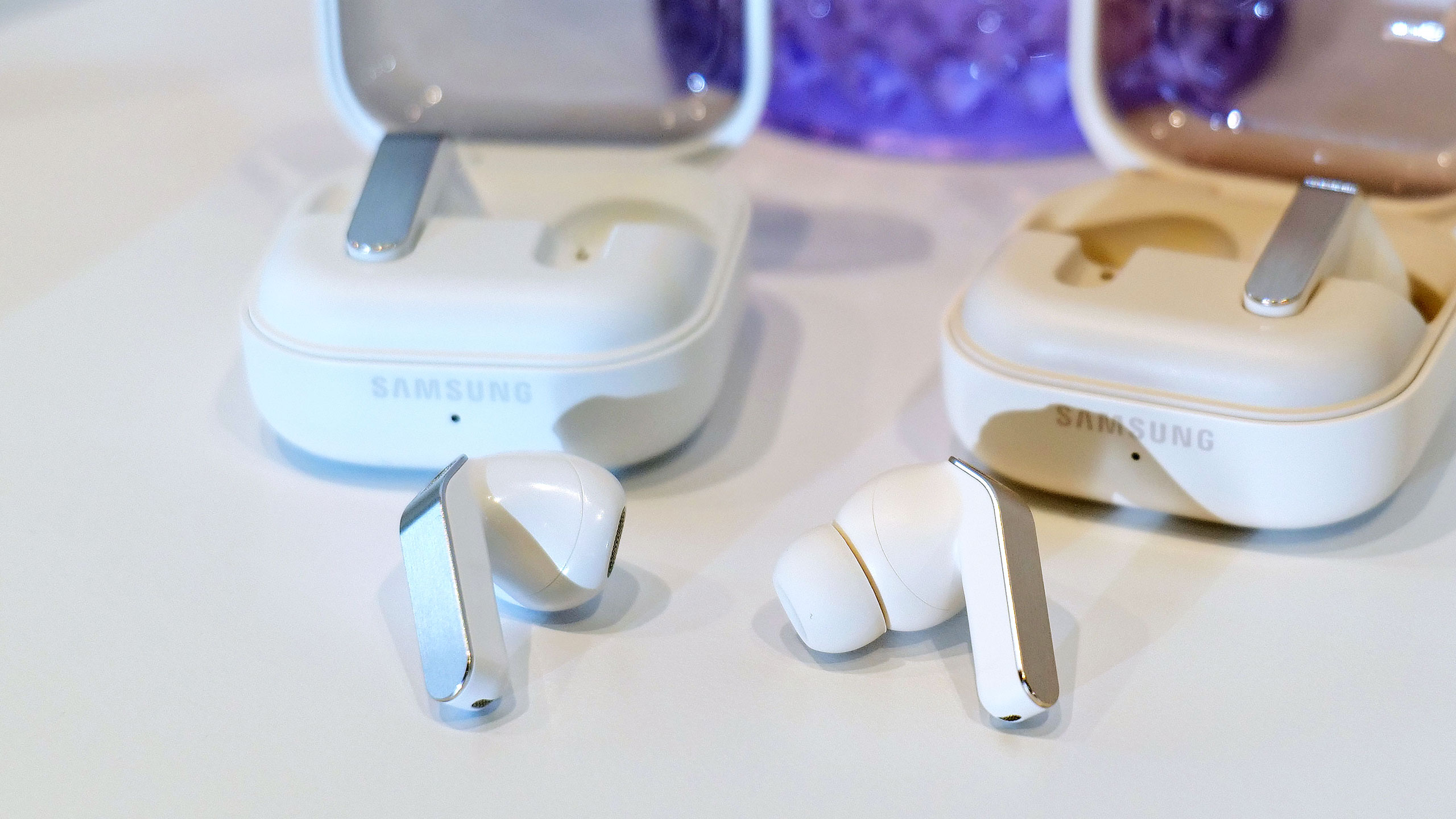
While the S26 phones are more iterative updates this year, Samsung has given its Galaxy Buds a proper refresh. It revamped the design and shape of the Galaxy Buds 4 and Galaxy Buds 4 Pro to do away with the angular look of the stems and remove the lights from them.
The earbuds have a "more refined, computationally designed fit" too, according to Samsung. The company claims the latest earbuds have smaller earbud heads that allow for a better, more secure fit and a more "comfortable experience during all-day wear." The Galaxy Buds 4 remain in an open-fit format while the Buds Pro 4 have a canal-fit design.
The latest earbuds are said to offer improved audio quality and active noise cancellation (ANC), with an ambient sound mode, adaptive EQ and adaptive ANC. On Buds 4 Pro, there's a siren detection feature that enables ambient sound to let you hear things like alarms or emergency vehicle warnings.
The Buds 4 Pro have a wide woofer that increases the effective speaker area by nearly 20 percent compared with the previous gen earbuds, Samsung said. They support 24-bit/96kHz audio.
If you're using Galaxy Buds 4 or Buds 4 Pro with a Galaxy device, you'll be able to use Bixby, Google Gemini and Perplexity with hands-free voice controls (though the "hey, Plex" command for the latter might be a tad confusing for folks who use a certain media server app). The Buds 4 Pro support head gesture controls for managing calls and Bixby interactions as well.
As with the S26 phones, pre-orders for the earbuds open today and they'll hit shelves on March 11. The Galaxy Buds 4 cost $180 and Galaxy Buds 4 Pro will run you $250. Both models are available in white and black with a matte finish. There's an online-exclusive pink option for Buds 4 Pro as well.
Android AI features
Ahead of Unpacked, Samsung confirmed that it would offer Perplexity as an AI agent option in Galaxy AI on the S26 lineup. As part of that update, it shared that the S26 series would respond to the “Hey Plex” wake phrase, and that Perplexity’s features would also be embedded in the Samsung Browser app. The company also recently updated Bixby to make its own virtual assistant more conversational.
On top of that news, Google had announcements of its own to make at Unpacked regarding new Android AI features, which will of course be available on S26 devices. On those handsets and the Pixel 10 lineup, the Gemini app will soon have a feature (in beta) that enables you to offload multi-step tasks, such as booking a ride or putting a grocery order together, to AI. It sure sounds like an attempt to build out agentic AI features on mobile devices.
Launching soon as a beta feature in the Gemini app for #Pixel10, Pixel 10 Pro, and Samsung Galaxy S26 series, you can offload multi-step tasks directly to Gemini.
Starting this week on Pixel 10 devices (and soon on S26 phones), Circle to Search will offer the ability to find details about multiple objects at once, such as entire outfits instead of single pieces. Moreover, Gemini-powered, on-device Scam Detection for phone calls will be available for S26 devices in English in the US.
Try Galaxy relaunches for the S26 series
The day after Unpacked, Samsung shared a press release on its newsroom that encouraged users to check out its Try Galaxy experience on their devices. By scanning a QR code, users can launch the Galaxy UI and check out apps, photo editing tools, AI features and more. Managing editor Cherlynn Low checked it out on her iPhone 17 Pro and found the whole setup trippy but fascinating. You can also use Try Galaxy to check out the company’s foldable phones’ software on your main device. As our editor in chief Aaron Souppouris pointed out, this isn’t the first time Samsung has made it possible to emulate a Galaxy phone on your own handset, but the new iteration for Galaxy S26 certainly is new this year.
Update, February 25 2026, 4:35PM ET: This story has been updated to include more details on the Perplexity AI integration, as well as include mentions in the intro of our hands-on and pre-order articles.
Update, February 26 2026, 12:49PM ET: This story has been updated to include the new Try Galaxy experience that Samsung announced today.
This article originally appeared on Engadget at https://www.engadget.com/mobile/everything-announced-at-samsung-unpacked-the-galaxy-s26-ultra-galaxy-buds-4-and-more-180000530.html?src=rss
To coincide with the release of Samsung's new Galaxy S26 family of phones, Google is pushing out a small but meaningful update to Circle to Search. As a reminder, Circle to Search allows you to carry out a Google Search from almost anywhere on your phone. Just tap and hold your device's home button, and then circle the passage or image you want to know more about.
With previous iterations of Circle to Search, the tool's underlying AI system was limited to searching against a single object in an image. Now, thanks to Gemini 3, it can scan and identify multiple objects at the same time. Naturally, Google is quick to point out the boon this represents for shopaholics. If you see a fit you like on Instagram, you can circle an entire person and the tool will attempt to find a match for each item they're wearing, including any shoes and accessories. At the same time, Google has made it easier to see how those clothes might look on you by bringing its virtual try on feature directly inside of Circle to Search.
The benefits of the new model aren't only limited to shopping queries. Building on a search technique Google debuted with AI Mode, Circle to Search can now also reason through the relationship between different objects in an image. So say you see a photo of a coral reef and want to know how all the different pictured fish live together, Circle to Search will not only be able to identify the different species shown but also explain how they coexist with one another.
Google is bringing the new and improved Circle to Search to Galaxy S26 and Pixel 10 phones first before rolling it out to more Android devices soon.
This article originally appeared on Engadget at https://www.engadget.com/mobile/smartphones/googles-circle-to-search-can-now-identify-multiple-objects-in-an-image-180000385.html?src=rss