Panic, the company behind the tiny and excellent Playdate console, is taking a stand on generative AI. The company has published an AI disclosure that says as of this month, the Playdate Catalog “will no longer accept titles that use ‘Generative AI’ for art, audio, music, text, or dialog.” Panic does allow for developers to use AI assistance for coding, but also says that “we will flag any title as such and specify the extent that it was used (for example, “Lua debugging”) so the customer can decide whether to support it or not.”
This comes a day after Panic announced that Playdate season three was happening and would arrive later this year. For those who don’t recall, the Playdate includes a “season” worth of games when you buy it, 24 titles in total with two revealed every week. Season two came out last year with 12 games — but, as Game Developer notes, one of those games used generative AI for writing and coding. On Bluesky, someone asked Panic if it would disclose what games in season three used AI, and the company confirmed that it was a requirement for season three that developers not use AI for art, music, writing or coding.
Specifically, Panic says you can’t use large language models like ChatGPT or Google Gemini, AI image generators like Stable Diffusion or audio generators like MuseNet and Suno. Previously-approved games with generative AI will be allowed to stay on the catalog with a disclosure that indicates what exactly AI was used for. The company says these guidelines are “under constant discussion and is subject to change at any time.”
I recall seeing AI disclosures on games in the Playdate Catalog in the past, but it makes sense to be up-front and clear on exactly what Panic allows and what it will reject. That said, it’s fairly easy to sideload games onto a Playdate, so anyone who wants to use generative AI to make a game isn’t entirely out of luck — though distribution and discovery for Playdate owners will obviously be harder.
This article originally appeared on Engadget at https://www.engadget.com/gaming/panic-says-the-playdate-catalog-wont-accept-games-made-with-generative-ai-160615022.html?src=rss
The rules of Exit 8, both the cult indie game and the recent film adaptation, are simple: You're stuck in a subway station that loops around endlessly. If you notice any anomalies on your current loop, you turn around. If everything is the same, you keep going forward. Each successful guess takes you to a new entrance where the loop recurs, until you reach the end of the labyrinth, Exit 8 itself.
It's a setup that perfectly suits a first-person video game, where you can fully control where your character looks and moves. And it's also something director Genki Kawamura deftly replicates in the film through long tracking shots and sweeping camera movements. Even without a controller, or a keyboard and mouse, the viewer remains immersed, looking and listening for any minor changes. Within just a few minutes, the film makes it clear it's not just another thoughtless video game adaptation like The Mario Galaxy Movie — it's an attempt to translate the experience of the game to an entirely new medium.
That's a daunting challenge for most artists, but Kawamura is no stranger to jumping between formats. He's known for producing popular anime films from the likes of Makoto Shinkai and Mamoru Hosoda, including Your Name and Belle. He's also made a name for himself as a best-selling author, with books including the novelization of Exit 8.
Kawamura's perspective for the film came from a conversation with Nintendo's legendary game designer Shigeru Miyamoto, who had mentioned that the greatest games are both fun for the players and people watching them. "So what I tried to do in the film is to really place the audience in the shoes of the player in certain shots... almost like they were watching a live stream of a video game in other scenes," he said in an interview with Engadget (via a translator). "That's kind of structurally the through-line of the film."
The Exit 8 adaptation balances that sense of immersion with a more traditional narrative structure, something the game lacked entirely. As the film begins, we're introduced to a young man standing in a crowded train. A drunken businessman shouts at a mother to quiet crying baby down. Instead of telling the belligerent salaryman to fuck off, the young man plugs in his earbuds and tries to ignore the situation, just like everyone else. He eventually steps off, while the tearful mother suffers through the verbal assault.
It's a scene that anyone who's lived in a crowded city can relate to — the moments where you know you should try to help a stranger, but fear, cowardice or embarrassment hold you back.
Exit 8
NEON
Shortly after receiving a call from his ex-girlfriend, who reveals that she's pregnant, the young man stumbles into the Exit 8 loop. At first, it's just a normal subway station, with large poster ads, a photo booth and random maintenance doors. But he quickly notices that the room repeats itself. Thanks to a helpful set of instructions on the wall, he learns that his only way out is to start tracking anomalies, like slight changes in text, or the way a robotic businessman walks past him. And yes, things get freaky quickly.
Kawamura points to his experience working in animation as a major influence for Exit 8. In particular, the works of Satoshi Kon and Katsuhiro Otomo influenced how he externalized what characters were thinking and feeling, as well as how he depicted the interaction of dream and real worlds.
" When we were filming, I told my DP [director of photography] that the main character of this film is the corridor," he said. "And all of our human characters, they have no names, so therefore they're NPCs in this corridor, which is the main character. So I wanted the corridor to almost evoke this feeling in the audience that it has a will of its own. And this yellow Exit 8 sign is almost like this divine God-like being."
Kawamura says he personally views it as the corridor challenging humans who have a guilty conscience, but you can easily read in other meanings. More importantly, Exit 8 isn't merely a faithful recreation of the source material — it adds enough to make a case for existing a separate medium, a challenge many video game adaptations fumble.
This article originally appeared on Engadget at https://www.engadget.com/entertainment/tv-movies/exit-8-is-cinema-for-the-livestreaming-era-151112907.html?src=rss
In hindsight, I suppose it was only a matter of time after Anthropic made Claude capable of generating charts and diagrams that the company would then begin offering a more robust image editor. Now, a little more than a month after that release, Anthropic has announced Claude Design, a new research preview that allows subscribers to use Claude to generate designs, prototypes, slides and more.
"Claude Design gives designers room to explore widely and everyone else a way to produce visual work," Anthropic says of its newest product. As with its previous forays into image generation, the company isn't calling this, well, an image generator. Instead, Anthropic describes Opus 4.7, the system powering the app, as its most capable vision model to date. In other words, you won't be using Claude Design to whip up a picture of a cat in space eating a lasagna.
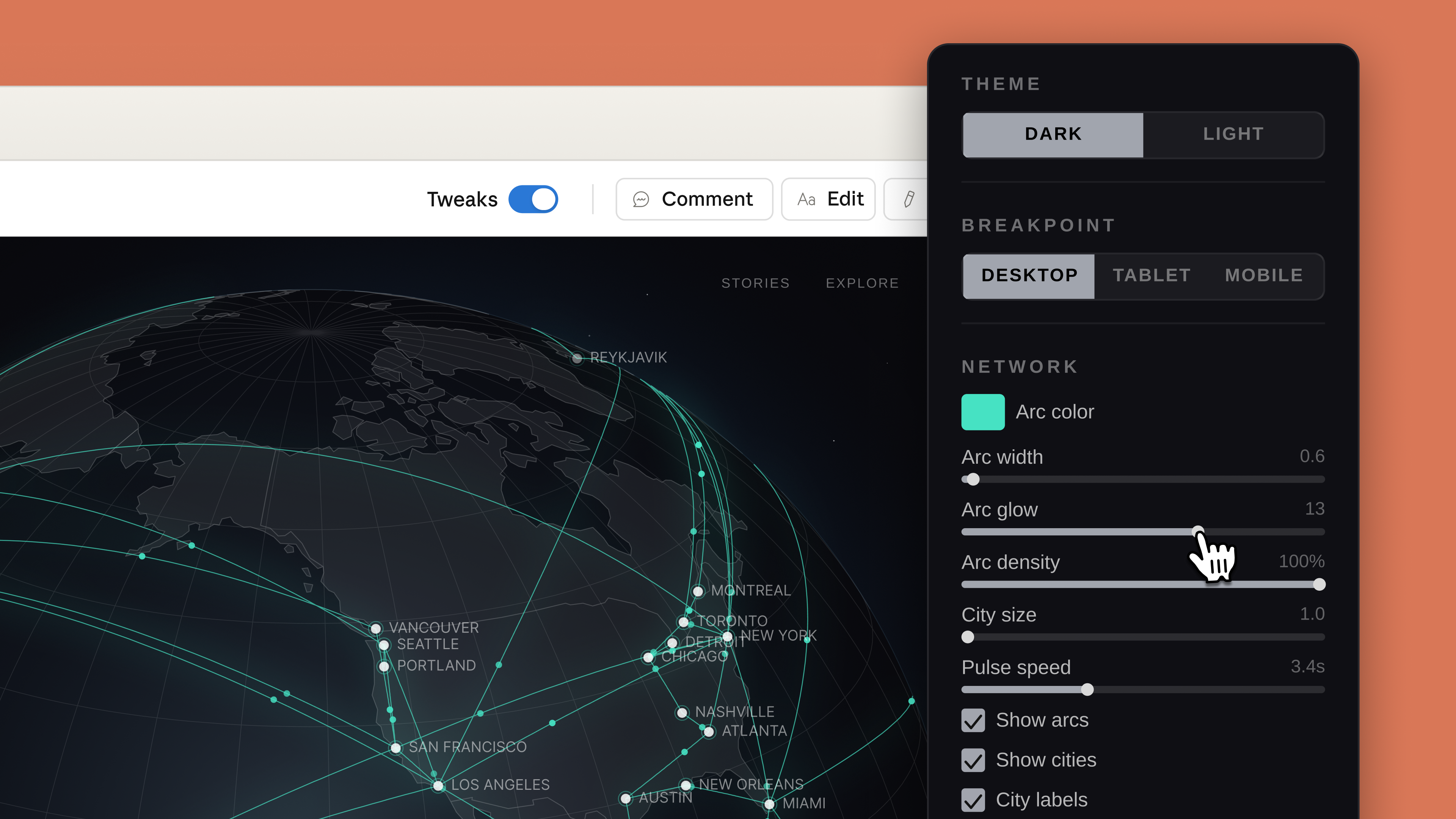
As you might expect, every project in Claude Design starts with a prompt. From there, Anthropic notes users can refine Claude's outputs through conversation, inline comments and direct edits. Like Adobe's recently announced AI assistant, Claude will also generate custom sliders that correspond to specific elements in a design, which the user can push and pull to modify those elements. For instance, in the screenshot below, you can see how Claude has tweaked the interface to allow the user to adjust the glow and density of arcs it used to illustrate a connected network.
Claude Design will generate custom sliders you can use to adjust specific visual elements.
Anthropic
Anthropic has also built an onboarding process that allows Claude to build an internal visual language after reading your organization's codebase and existing design documents. "Every project after that uses your colors, typography, and comments automatically," according to the company. Outside of text prompts, there's also support for image and document uploads, and Anthropic has even included a web capture tool so enterprise customers can snapshot elements from their company's website. There's also built-in sharing, and you can export a design directly to Claude Code. In the coming weeks, Anthropic has promised to make it easier to build integrations with its new app.
Claude Design arrives in the same week that both Adobe and Canva released their own visual AI assistants. If Anthropic is preparing to eat Canva’s lunch, it's doing so in a strange way given that you can export your Claude Design projects to Canva. If you want to try the new app for yourself, it's available as part of Anthropic's Pro, Max, Team and Enterprise subscriptions, with usage running up against your usage limits.
This article originally appeared on Engadget at https://www.engadget.com/ai/anthropic-now-has-a-design-assistant-too-150000903.html?src=rss
Following the agreement, Nevada Attorney General Aaron Ford said "this settlement will create a safer environment for our children online, and I hope that it will serve as a bellwether for how online interactive platforms allow our state's youth to use their products." As part of the deal, Roblox has agreed to give $10 million over three years to local children's support programs like the Boys and Girls Club and other nondigital groups while spending another $2.5 million to fund a law enforcement liaison position and awareness campaigns regarding online safety.
Additionally, Roblox will also implement more rigorous safety protocols including an age verification system that combines a facial age estimation system with government-issued IDs that will only allow children to talk with other players of a similar age. Furthermore, users under 16 will not be allowed to message adults unless they have been designated as a "trusted friend," which can be assigned via QR code. This is intended to ensure that any adults who talk to minors on the platform have an existing relationship with the child.
Parental controls will be available for accounts of users up to 16 years old (previously the limit was 13). The company says it will also create children's accounts for anyone under 16 that will restrict access to adult content and provide a list of games that have been vetted to be appropriate for younger players. These changes come after a recent update that established new guidelines for Roblox Kids accounts (for children between five and eight years old) and Roblox Select accounts (for children between nine and 15), which come with varying content and chat restrictions.
However, while Roblox has settled with Nevada, the company is still facing a number of lawsuits from other parties and states including Kentucky, Iowa, Louisiana, Texas and more, regarding claims that the platform has knowingly facilitated child sexual exploitation.
This article originally appeared on Engadget at https://www.engadget.com/gaming/roblox-agrees-to-a-12-million-settlement-with-nevada-142842421.html?src=rss
Startup Donut Lab made a splash at the start of the year with some astonishing — and suspicious — claims about its solid state batteries. Now Finnish newspaper Helsingin Sanomat reports an individual has filed a criminal whistleblower complaint against the company over those claims.
Until recently, Lauri Peltola was listed as the Chief Commercial Officer at Nordic Nano — the firm reportedly contracted to handle portions of the manufacturing on Donut's behalf, and which Donut Lab has invested in. He reportedly filed a criminal complaint that Donut Lab’s promises of energy density and longevity have been overstated and that the company lacks the production capacity previously claimed.
HS suggests it has seen copies of internal communications between Donut Lab and two partner companies, CT-Coating and Nordic Nano. The paper says that CT-Coating’s first-generation battery is the one that Donut Lab has been advertising, and is the model it handed to Finnish national lab VTT to test. But, according to the emails viewed by HS, CT-Coating had abandoned development on that cell in favor of a one still in early development, despite Donut Lab’s claim in January that it had a technology ready to enter mass production.
Donut Lab CEO Marko Lehtimäki reportedly told HS he had no knowledge of Peltola’s complaint. Nordic Nano CEO Esa Parjanen, meanwhile, denied Peltola’s accusations, saying that his views were not shared by the company and that Peltola had no involvement with Nordic’s battery project. In a joint public statement Donut Lab and Nordic Nano stated they "do not know the exact nature of the complaint" but denied "having committed any crime or misleading investors." They also describe the complainant (presumably Peltola, though the statement does not name him) as not having "the necessary knowledge of battery technology or the overall picture of the development work."
This article originally appeared on Engadget at https://www.engadget.com/transportation/donut-labs-battery-claims-reportedly-subject-of-whistleblower-complaint-142133269.html?src=rss
TCL introduced its new flagship X11L SQD-Mini LED TV at CES 2026, and now a few months later, the company is ready to expand its lineup with more SQD-Mini LED models and its first RGB-Mini LED TV. All sizes of the TCL QM8L SQD-Mini LED TV are available now. Meanwhile, both the TCL QM7L SQD-Mini LED TVs and the RM9L RGB-Mini LED TVs are available to pre-order.
SQD-Mini LED panels are TCL's latest iteration of its Mini LED display technology, where "SQD" stands for "Super Quantum Dot," a layer of tiny crystal dots that help filter the light from the LEDs in the company's panels. TCL claims its SQD-Mini LED screens are more color accurate than its previous models without losing out on HDR contrast. The TCL QM8L has an anti-reflective SQD-Mini LED panel, up to 4,000 discrete dimming zones, up to 6,000 nits of peak brightness and support for Dolby Vision 2 Max after a software update. The TCL QM7L also has an anti-reflective SQD-Mini LED panel, up to 2,100 discrete dimming zones, up to 3,000 nights of peak brightness and support for Dolby Vision IQ. Both TVs feature Audio by Bang & Olufsen and run the latest version of Google TV with support for Gemini.
TCL
Like other TV makers at CES 2026, TCL also capitalized on the growing trend of Micro RGB or RGB Mini LED panels. Rather than use a layer of white or blue LEDs that are transformed with quantum dots and color filters, TCL's RGB-Mini LED starts with discrete red, green and blue LEDs to produce richer color. The TCL RM9L features the company's new RGB-Mini LED display with an anti-reflective layer, over 3,800 discrete local dimming zones, up to 6,000 nits of peak brightness and support for Dolby Vision 2 after a software update. The TV also features Bang & Olufsen audio and Google TV with Gemini support.
TCL says the QM8L is available to order now starting at $2,500 for the 65-inch model, $3,000 for the 75-inch model, $4,000 for the 85-inch model and $6,000 for the 98-inch model. The TCL QM7L, meanwhile, is available to pre-order starting at $1,200 for the 55-inch model and goes as high as $4,000 for the 98-inch model. If you're curious about TCL's new RGB-Mini LED displays, the TCL RM9L is available to pre-order starting at $8,000 for the 85-inch model and up to an eye-popping $30,000 for a 115-inch model.
This article originally appeared on Engadget at https://www.engadget.com/home/home-theater/tcls-rgb-mini-led-tvs-will-start-at-8000-130000543.html?src=rss
So a shoe company turned into an AI company…. That’s it, that’s the joke. In this episode, Devindra chats with Engadget’s Daniel Cooper about Allbirds’ sudden transformation and what it says about the AI economy. Also, they chat about the Artemis II moon mission, Meta being warned about the dangers of facial recognition (again) and how teens think social media is really shaping them.
You’ve probably seen DJI’s stick vlogging cameras everywhere. At trade shows and tech events I’ve attended, it’s often the de facto video camera used by reporters and influencers alike. The Osmo Pocket 3 was easy to use, had sharp focus, potent image stabilization and handled vertical and horizontal video recording with minimal compromises.
That was two years ago, so naturally it’s time for an update. According to our review by James Trew, the Osmo Pocket 4 is the one to beat. It’s still incredibly easy to record with, whether you’re doing talk-to-camera vlogs or ambitious, more cinematic-quality videos. With a new 1-inch sensor, improved framerate capture and an extended battery, it’s better than its predecessor in every way. (Except the $605 price.)
There’s a new dedicated zoom button, and you can assign up to three controls to this button through single, double and triple clicks. There’s also 107GB of internal storage, so you don’t need to add storage — that’s plenty to get started with.
There are some things on our wishlist: we’d love some optical zoom, and the lack of dust- and water-protection might give you pause before more ambitious video shoots.
You can ditch the barrage of short-form videos from your YouTube feed if you don’t want to see them. YouTube has rolled out the capability to set your Shorts feed limit to zero minutes. The video-sharing platform originally launched a Shorts feed limit back in October last year, but the lowest option you could choose was 15 minutes. The priority placement of shorts I didn’t want to watch has rankled me for a while — this could be the solution.
After a short teaser dropped last year, we’ve finally got a full trailer for the newest attempt to bring Street Fighter to cinemas. The good news, to me, is that it’s going to be silly, fun and high camp. Ken and Ryu are squabbling, and M. Bison is still, bafflingly, a head of an international crime org. And Chun-Li plans to take him down. Jason Momoa is playing Blanka and Curtis ‘50 Cent’ Jackson is portraying Balrog, while mask-toting Orville Peck will don another mask as Vega.
Casely has reannounced a recall of its Power Pods 5,000mAh MagSafe E33A charger after dozens of people were injured and one even killed by the defective devices, the US Consumer Product Safety Commission (USCPSC) announced. It's recommended that you stop using the devices immediately, dispose of them safely and seek a replacement from the manufacturer.
A year ago, Casely and the USPSC published a recall of 429,000 units of the power bank with the model number E33A. That followed 51 incidents of the devices "overheating, expanding or catching fire" and burning users in multiple cases.
However, many of the devices have remained in use and are even more dangerous than initially thought. "In August 2024, a 75-year-old woman from New Jersey, was charging her cell phone with the power bank on her lap when it caught on fire and exploded," the USCPSC reported. "The victim suffered second and third degree burns and later passed away from complications from her injuries." In another incident this year, a 47-year-old woman was charging her phone on a plane when it caught on fire and exploded, giving her first degree burns.
As a result, the recall has been reissued due to "a risk of serious injury or death from fire and burn hazards to consumers," according to the Commission.
The defective Casely Power Pods 5,000mAh charger is identifiable by the Casely embossed logo on the front and model number E33A on the back. It was sold at various online retailers including getcasely.com and Amazon between 2022 and 2024.
Casely is offering free replacement units as a remedy (it's not clear if you can get a full refund). Those seeking one should write "recalled" on the battery pack in permanent marker and submit a photo, along with a second photo showing the E33A model number as pictured above. Owners are instructed to dispose of them by contacting a facility that handles lithium-ion batteries. Do NOT throw them away with regular household waste, recycling, or standard battery disposal bins due to the risk of fire and explosion.
This article originally appeared on Engadget at https://www.engadget.com/general/psa-stop-using-your-casely-power-pods-wireless-charger-immediately-062120825.html?src=rss
Netflix co-founder and current chairman Reed Hastings is leaving the streaming company’s board in June to focus on "his philanthropy and other pursuits," according to a shareholder letter released alongside Netflix's Q1 earnings. Hastings has served as chairman of Netflix's board since 2023, a role he assumed after stepping down as co-CEO and promoting Greg Peters in his place.
"Netflix changed my life in so many ways, and my all‑time favorite memory was January 2016, when we enabled nearly the entire planet to enjoy our service," Hastings said in a statement. "My real contribution at Netflix wasn’t a single decision; it was a focus on member joy, building a culture that others could inherit and improve, and building a company that could be both beloved by members and wildly successful for generations to come. A special thanks to Greg and Ted, whose commitment to Netflix’s greatness is so strong that I can now focus on new things."
Hastings founded Netflix in 1997 as a DVD-by-mail rental service with his co-founder and the company's first CEO Marc Randolph. In 1999, Hastings became CEO, and eventually led the company through its transformation into a streaming service in 2007. Netflix started producing its own television series and movies in 2013, and in 2020, the company's board named Ted Sarandos as Hasting's co-CEO, in part to oversee its growing production business. Hastings stepped down as co-CEO in 2023 to become Netflix’s executive chairman, as then COO Greg Peters was promoted to co-CEO. Among his other contributions, Hasting is also the architect of Netflix's infamous "culture memo," which codified the company's high-performance culture.
While he'll no longer be on Netflix's board, Hastings still has a seat on the board of AI startup Anthropic and media and financial software company Bloomberg. Netflix, for its part, is continuing to expand outside of the television and film business Hastings helped build, by offering a selection of curated party games, a growing library of video podcasts and live sports.
This article originally appeared on Engadget at https://www.engadget.com/entertainment/streaming/reed-hastings-is-leaving-netflix-after-29-years-213136444.html?src=rss