What if the power of a full-fledged workstation could fit in the palm of your hand? In a world where bulky desktops have long been synonymous with high performance, the Minisforum MS02 is rewriting the rules. With its Intel Core Ultra 285HX CPU and Intel Arc Pro B50 GPU, this small form factor machine delivers […]
If you share your home with a dog or cat, you already know the routine: endless hair on the couch, dust drifting into corners, odors that appear out of nowhere, and an air purifier that can’t quite keep up. Dreame Technology, long known for its high-performance vacuums and robotic cleaners, is now bringing its engineering […]
Imagine a web browser that doesn’t just help you surf the internet but actively works to simplify your life, protect your privacy, and supercharge your productivity. Bold claim? Perhaps. But that’s exactly what Neo, the AI-powered browser by Norton, promises to deliver. In a world where traditional browsers often feel bloated with ads, trackers, and […]
Apple’s M5 MacBook Pro represents a significant step forward in its professional laptop lineup, blending innovative performance with the familiar design language of the 2021 MacBook Pro. Powered by the advanced M5 chip, this device delivers notable improvements in speed, efficiency, and overall functionality. Whether you’re a creative professional tackling demanding projects or a […]
NVIDIA is now allowed to sell its second-best H200 processors to China, rather than just the sanction-approved H20 model that China had previously declined to buy, President Trump wrote on Truth Social. The United States will collect a 25 percent tariff on those sales, the Commerce Department confirmed yesterday.
Trump said that he informed China's President Xi Jinping of the decision and that he "responded positively." The Commerce Department is finalizing details and the administration will take the same approach with AMD, Intel and other US companies. He added that the administration would "protect National Security," so the latest Blackwell and upcoming Rubin chips are not part of the deal. The 25 percent tariff would be higher than the 15 percent the White House suggested in August.
Though the administration won't allow NVIDIA to send its latest high-end chips, it was reportedly concerned that the company would lose business to Huawei if it was completely shut out of China's market, according to Reuters. No details about the number of H200 chips or which companies would be eligible to buy them were released. "Offering H200 to approved commercial customers, vetted by the Department of Commerce, strikes a thoughtful balance that is great for America," NVIDIA said in a statement.
The decision is not without controversy, though. Several Democratic US senators called it a "colossal economic and national security failure" that will aid China's industry and military. Republican representative John Mollenaar put it in even starker terms. "NVIDIA should be under no illusions — China will rip off its technology, mass-produce it themselves and seek to end NVIDIA as a competitor," he said.
Despite the current restriction on Blackwell B200 processors, $1 billion worth of those and other high-end NVIDIA chips have made their way to China via black market sales, according to previous reports. That model, along with the H100 and H200, is far more capable than the H20 chip, which was designed to comply with export restrictions for sale to China. NVIDIA has said that the B200 chip is almost ten times faster than the H200 for some jobs, and the H200 is six times faster than the H20.
Washington's approval doesn't mean that China will purchase NVIDIA's chips, as Beijing has previously told companies not to use US technology. Huawei is currently the most advanced company in that regard and recently unveiled a three-year plan to catch up with NVIDIA and AMD. However, AI chip experts like Richard Windsor have said NVIDIA's tech is still far ahead of anything that Huawei or other Chinese companies can currently produce.
This article originally appeared on Engadget at https://www.engadget.com/big-tech/nvidia-can-now-sell-its-high-end-ai-chips-to-approved-customers-in-china-trump-says-130007458.html?src=rss
We’ve all been there: You can’t (or won’t) get help when something breaks, but the YouTube clip doesn’t cover your specific issue. It’s what repair gurus at iFixit want to solve with FixBot, an AI-enabled app that talks you through whatever repair you’re doing. The chatbot will help you diagnose the problem and then walk you step-by-step through the fix. Plus, it’s voice-enabled so you won’t have to get your phone all smeary when you’re elbows-deep in a job. After all, iFixit’s guides don’t just cover fixing your electronics, but everything you might fancy doing yourself, from appliances through to cars and trucks.
Unlike traditional AIs, FixBot has been trained on iFixit’s library of 125,000 guides, its forum and database of repair manuals. The company says there’s less risk of hallucination as it pulls from and shows you the schematics it’s referencing to ensure you don’t order the wrong gear. Users can even upload images from their phone, so the app can point out which bit is which. The company is open about its limitations: It’s an AI, so it’s not bulletproof, and its knowledge only runs as far as its library. It can hunt elsewhere for manufacturer data and on other repair forums but you’ll be warned about the information it pulls from it.
In addition, FixBot will keep an eye on your phone’s battery health in real time to tell you when it’s time to get a replacement. The tool is, for now, in beta, thanks to the fuzzy way some companies track their battery health, but iFixit is promising greater detail than what you currently get. Plus, when it is time to swap out your battery, you can order the parts and kit all within the app.
FixBot is launching for free on both the App Store and Google Play but it won’t remain that way forever. At some point, free users will switch to a version with access limits, and will be prompted to upgrade to the paid tier for $4.99 a month or $50 a year.
This article originally appeared on Engadget at https://www.engadget.com/general/ifixits-new-app-uses-ai-to-help-you-repair-your-stuff-130000091.html?src=rss
When the nonprofit Freedom House recently published its annual report, it noted that 2025 marked the 15th straight year of decline for global internet freedom. The biggest decline, after Georgia and Germany, came within the United States.
Among the culprits cited in the report: age verification laws, dozens of which have come into effect over the last year. "Online anonymity, an essential enabler for freedom of expression, is entering a period of crisis as policymakers in free and autocratic countries alike mandate the use of identity verification technology for certain websites or platforms, motivated in some cases by the legitimate aim of protecting children," the report warns.
Age verification laws are, in some ways, part of a years-long reckoning over child safety online, as tech companies have shown themselves unable to prevent serious harms to their most vulnerable users. Lawmakers, who have failed to pass data privacy regulations, Section 230 reform or any other meaningful legislation that would thoughtfully reimagine what responsibilities tech companies owe their users, have instead turned to the blunt tool of age-based restrictions — and with much greater success.
Over the last two years, 25 states have passed laws requiring some kind of age verification to access adult content online. This year, the Supreme Court delivered a major victory to backers of age verification standards when it upheld a Texas law requiring sites hosting adult content to check the ages of their users.
Age checks have also expanded to social media and online platforms more broadly. Sixteen states now have laws requiring parental controls or other age-based restrictions for social media services. (Six of these measures are currently in limbo due to court challenges.) A federal bill to ban kids younger than 13 from social media has gained bipartisan support in Congress. Utah, Texas and Louisiana passed laws requiring app stores to check the ages of their users, all of which are set to go into effect next year. California plans to enact age-based rules for app stores in 2027.
These laws have started to fragment the internet. Smaller platforms and websites that don't have the resources to pay for third-party verification services may have no choice but to exit markets where age checks are required. Blogging service Dreamwidth pulled out of Mississippi after its age verification laws went into effect, saying that the $10,000 per user fines it could face were an "existential threat" to the company. Bluesky also opted to go dark in Mississippi rather than comply. (The service has complied with age verification laws in South Dakota and Wyoming, as well as the UK.) Pornhub, which has called existing age verification laws "haphazard and dangerous," has blocked access in 23 states.
Pornhub is not an outlier in its assessment. Privacy advocates have long warned that age verification laws put everyone's privacy at risk. Practically, there's no way to limit age verification standards only to minors. Confirming the ages of everyone under 18 means you have to confirm the ages of everyone. In practice, this often means submitting a government-issued ID or allowing an app to scan your face. Both are problematic and we don't need to look far to see how these methods can go wrong.
Discord recently revealed that around 70,000 users "may" have had their government IDs leaked due to an "incident" involving a third-party vendor the company contracts with to provide customer service related to age verification. Last year, another third-party identity provider that had worked with TikTok, Uber and other services exposed drivers' licenses. As a growing number of platforms require us to hand over an ID, these kinds of incidents will likely become even more common.
Similar risks exist for face scans. Because most minors don't have official IDs, platforms often rely on AI-based tools that can guess users' ages. A face scan may seem more private than handing over a social security number, but we could be turning over far more information than we realize, according to experts at the Electronic Frontier Foundation (EFF).
"When we submit to a face scan to estimate our age, a less scrupulous company could flip a switch and use the same face scan, plus a slightly different algorithm, to guess our name or other demographics," the organization notes. "A poorly designed system might store this personal data, and even correlate it to the online content that we look at. In the hands of an adversary, and cross-referenced to other readily available information, this information can expose intimate details about us."
These issues aren't limited to the United States. Australia, Denmark and Malaysia have taken steps to ban younger teens from social media entirely. Officials in France are pushing for a similar ban, as well as a "curfew" for older teens. These measures would also necessitate some form of age verification in order to block the intended users. In the UK, where the Online Safety Act went into effect earlier this year, we've already seen how well-intentioned efforts to protect teens from supposedly harmful content can end up making large swaths of the internet more difficult to access.
The law is ostensibly meant to "prevent young people from encountering harmful content relating to suicide, self-harm, eating disorders and pornography," according to the BBC. But the law has also resulted in age checks that reach far beyond porn sites. Age verification is required, in some cases, to access music videos and other content on Spotify. It will soon be required for Xbox accounts. On X, videos of protests have been blocked. Redditors have reported being blocked from a lengthy number of subreddits that are marked NSFW but don't actually host porn, including those related to menstruation, news and addiction recovery. Wikipedia, which recently lost a challenge to be excluded from the law's strictest requirements, is facing the prospect of being forced to verify the ages of its UK contributors, which the organization has said could have disastrous consequences.
The UK law has also shown how ineffective existing age verification methods are. Users have been able to circumvent the checks by using selfies of video game characters, AI-generated images of ID documents and, of course, Virtual Private Networks (VPNs).
As the EFF notes, VPNs are incredibly widely used. The software allows people to browse the internet while masking their actual location. They're used by activists and students and people who want to get around geoblocks built into streaming services. Many universities and businesses (including Engadget parent company Yahoo) require their students and workers to use VPNs in order to access certain information. Blocking VPNs would have serious repercussions for all of these groups.
The makers of several popular VPN services reported major spikes in the UK following the Online Safety Act going into effect this summer, with ProtonVPN reporting a 1,400 percent surge in sign-ups. That's also led to fears of a renewed crackdown on VPNs. Ofcom, the regulator tasked with enforcing the law, told TechRadar it was "monitoring" VPN usage, which has further fueled speculation it could try to ban or restrict their use. And here in the States, lawmakers in Wisconsin have proposed an age verification law that would require sites that host "harmful" content to also block VPNs.
While restrictions on VPNs are, for now, mostly theoretical, the fact that such measures are even being considered is alarming. Up to now, VPN bans are more closely associated with authoritarian countries without an open internet, like Russia and China. If we continue down a path of trying to put age gates up around every piece of potentially objectionable content, the internet could get a lot worse for everyone.
Correction, December 9, 2025, 11:23AM PT: A previous version of this story stated that Spotify requires age checks to access music in the UK. The service requires some users to complete age verification in order to access music videos tagged 18+ and messaging. We apologize for the error.
This article originally appeared on Engadget at https://www.engadget.com/big-tech/the-year-age-verification-laws-came-for-the-open-internet-130000979.html?src=rss
Generic wireless earbuds arrive in identical white plastic shells with forgettable names and indistinguishable sound profiles. Smart speakers reduce albums to voice commands and invisible algorithms. Mass-produced audio gear does the job, but it does nothing for the soul. The following collection rejects that sameness entirely. These seven designs treat sound as something worth seeing, touching, and displaying. They transform listening from background noise into intentional ritual, proving that audio equipment can spark conversation, elevate spaces, and reconnect us with the physical pleasure of music.
Each piece here champions visibility over invisibility. Whether through kinetic wooden tiles that dance with your vinyl, transparent frames that showcase spinning CDs, or cassette-shaped speakers that resurrect mixtape culture, these gifts refuse to disappear into pockets and smart home ecosystems. They’re designed for people who curate rather than consume, who value craftsmanship over convenience, and who believe technology should enhance spaces rather than colonize them. For anyone exhausted by tech that looks and feels like everything else, these selections offer genuine alternatives.
1. Orbit Kinetic Turntable
Lillian Brown’s Orbit Kinetic Turntable makes music visible. Thirty-nine handcrafted wooden tiles surround the record platter in concentric circles, flipping and rotating as your album plays. Every bassline triggers motion. Every cymbal crash shifts the pattern. What started as Brown’s senior thesis at the Savannah College of Art and Design became a sculptural performance piece that translates sound waves into physical movement. The tiles respond to frequency and amplitude, creating hypnotic displays unique to whatever you’re spinning.
This isn’t gear that fades into the background. Friends will gather around this turntable to watch music unfold, seeing frequencies become choreographed motion. The wood construction fits contemporary interiors while bridging generations—showing younger listeners that sound once demanded full attention. Brown created something between a turntable and a kinetic sculpture, resurrecting the ritual of intentional listening. It proves music’s physical dimension extends beyond grooves pressed into wax. For collectors ready to showcase vinyl as living art, this is it.
What we like
The handcrafted wooden tiles create mesmerizing visual patterns synchronized to your music’s actual frequency and amplitude.
The kinetic sculpture element transforms passive listening into an active sensory experience worth gathering around.
What we dislike
Availability remains uncertain as the design may still be in concept or a limited production phase.
The complex mechanical system likely requires more maintenance than standard plug-and-play turntables.
2. Portable CD Cover Player
The Portable CD Cover Player brings album artwork back from digital exile. A transparent pocket displays your CD jacket prominently while the disc spins behind it. Built-in dual stereo speakers mean no external equipment, while the rechargeable battery lets you mount it anywhere—kitchen walls, bedroom shelves, wherever. It’s for people who kept their CD collections when everyone said physical media was dead. Who remembers studying liner notes and album photography instead of scrolling past thumbnail images?
You can rotate it between rooms or bring it to gatherings where tangible music matters. The minimalist design keeps focus on your collection rather than technology. Streaming services show cover art optimized for phone screens. This player presents it at the proper scale where typography and photography get the prominence the artists intended. It suits anyone rebuilding relationships with albums they once owned, anyone tired of faceless playlists. Physical formats offer something algorithms can’t replicate—the complete artistic statement combining sound, image, and object.
The transparent jacket pocket prominently displays album artwork at the proper scale, where design details become visible.
Wall-mounting capability combined with built-in speakers and a rechargeable battery provides genuine placement flexibility without wire management struggles.
What we dislike
The price point may feel substantial for those with extensive CD libraries expecting to use the player daily across their entire collection.
Built-in speaker sound quality likely cannot match dedicated external audio systems preferred by serious audiophiles.
3. ClearFrame CD Player
ClearFrame strips away every opaque surface to expose what’s usually hidden. Crystal-clear polycarbonate reveals spinning discs, visible circuitry, and mechanical processes typically concealed behind plastic shells. Black circuit boards become part of the aesthetic rather than hidden components. The design philosophy is simple—technology shouldn’t hide its engineering. Bluetooth connectivity, seven to eight hours of battery, and multiple outputs balance vintage format with modern convenience. Position it on desks, mount it to walls, or prop it on shelves where it catches light.
The transparency transforms electronics into a conversation-starting sculpture for minimalist spaces. Three playback modes paired with one-touch controls make operation intuitive despite visual complexity. Built-in shock protection handles standard CDs, mini discs, and MP3 formats. It works for people who view possessions as curated statements, who want technology that enhances spaces rather than clutters them. The visible mechanics remind you that playback involves real physical processes. Each session feels more intentional than streaming’s invisible delivery. For anyone reconnecting with albums they meant to revisit, this frames them beautifully.
The fully transparent acrylic construction showcases internal components and spinning discs, turning consumer electronics into a visible kinetic sculpture.
Multiple placement options, including optional wall mounting and a desk stand, offer versatile display configurations for varied interior aesthetics.
What we dislike
The exposed circuitry and transparent surfaces collect dust and fingerprints more readily than enclosed traditional players.
Maintaining the pristine, transparent aesthetic requires frequent cleaning to prevent smudges from diminishing the visual impact.
4. Side A Cassette Speaker
Side A Cassette Speaker looks exactly like a mixtape from 1985. Transparent shell, Side A label, authentic dimensions—then you realize it’s hiding Bluetooth 5.3, microSD playback, and six-hour battery life beneath that analog disguise. At just 80 grams with its clear case, it slips into pockets for music anywhere while delivering warm sound tuned to echo tape-era audio. The included case doubles as a display stand, transforming portable audio into shelf decoration that broadcasts your retro credentials.
This design resurrects the emotional weight mixtapes once carried. Modern playlists offer infinite choice but lack the physical presence and intentional curation that cassettes demanded. Creating a tape meant selecting every track with purpose. Giving someone a mixtape meant something. The microSD support enables offline listening without Wi-Fi dependency, while Bluetooth bridges analog aesthetics with contemporary devices. It suits people who appreciate character in their audio gear, who value objects that tell stories beyond specifications, who find joy in designs that refuse sameness.
The faithful cassette styling with transparent shell and authentic labeling creates immediate nostalgic recognition while hiding modern Bluetooth technology.
The included clear case transforms into a hands-free display stand, elevating portable audio into shelf-worthy decoration.
What we dislike
The compact size inherently limits sound quality and volume compared to larger dedicated speakers.
The nostalgic aesthetic may not resonate with younger recipients who lack personal memories of cassette culture.
5. Battery-Free Amplifying iSpeakers
Battery-Free Amplifying iSpeakers need nothing. No electricity, no batteries, no charging cables. Crafted from aerospace-grade Duralumin metal using golden ratio proportions, this passive amplifier channels your smartphone’s sound through acoustic chambers that fill rooms. Slot your phone into the metal frame and watch vibration-resistant construction transform tinny device speakers into genuine audio using pure physics. The minimalist metal sculpture enhances desk aesthetics while remaining portable enough to carry anywhere outlets don’t exist.
This philosophy rejects planned obsolescence entirely. Nothing to charge, sync, or update. The Duralumin construction offers durability like vinyl records once provided—objects built for decades, not seasons. Optional Bloom and Jet mods allow sound direction control. It suits minimalists exhausted by tech demanding constant feeding, environmentalists seeking sustainable alternatives to disposable Bluetooth speakers, and anyone appreciating elegant solutions. The visible craftsmanship makes a statement about valuing quality over connectivity. While Bluetooth speakers race toward feature bloat, these iSpeakers prove the best technology is sometimes no technology—just intelligent design exploiting acoustic principles.
The completely battery-free passive amplification eliminates charging anxiety and planned obsolescence inherent in electronic speakers.
Aerospace-grade Duralumin construction designed using golden ratio principles provides both acoustic performance and lasting sculptural desk presence.
What we dislike
Acoustic amplification cannot match the volume and sound quality of powered Bluetooth speakers in larger spaces.
Compatibility depends on phone size and case thickness, potentially limiting use with certain devices or protective cases.
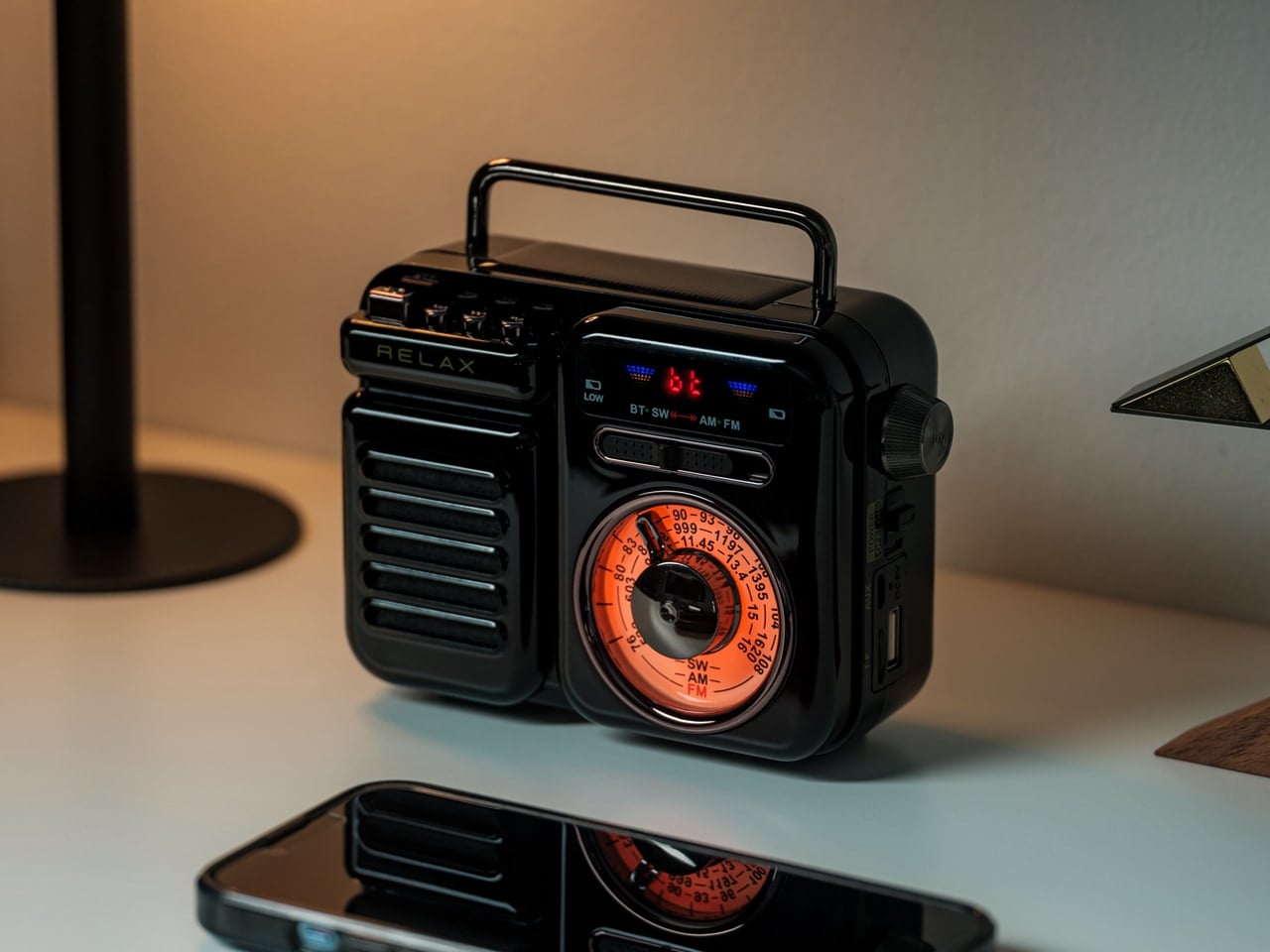
6. RetroWave 7-in-1 Radio
Behind its retro Japanese-inspired design and tactile tuning dial, the RetroWave packs seven functions into one compact unit. Speaker, MP3 player, FM/AM/SW radio, LED flashlight, clock, power bank, and SOS alarm—all wrapped in nostalgic packaging that works on kitchen shelves or emergency kits. Stream Bluetooth during normal times. Hand-crank or solar charge when power fails. The 2000mAh battery delivers up to twenty hours of radio time or six hours of emergency lighting while also charging your phone during blackouts.
This isn’t nostalgic cosplay. The RetroWave addresses genuine preparedness needs while remaining functional daily. Some mornings, it plays jazz stations during coffee, dial glowing softly on countertops. Other days, it’s charging phones during outages, flashlight guiding hallways, and SOS alarm signaling for help. AM/FM/SW radio provides access when internet infrastructure fails, while USB and microSD enable offline music. It suits design lovers wanting gear that looks as good as it performs, preparedness people building resilient systems, and travelers heading off-grid. Multi-functionality means fewer devices cluttering spaces. Equally suited to counters and disaster caches.
The seven-in-one functionality consolidates speaker, radio, flashlight, power bank, and emergency features into one versatile unit.
Hand-crank and solar charging provide genuine off-grid power independence when electrical infrastructure fails, or outdoor adventures demand self-sufficiency.
What we dislike
The retro aesthetic and multi-function design add bulk compared to specialized single-purpose devices.
Audio quality from the built-in speaker likely trails dedicated Bluetooth speakers focused solely on sound performance.
7. StillFrame Headphones
StillFrame Headphones sit somewhere between earbuds and over-ear cans, offering a middle ground between intimacy and openness. Transparent construction exposes internal circuitry and 40mm drivers that shape wide, open soundstages. At just 103 grams, they feel nearly weightless across 24-hour battery life, carrying you from morning routines through late-night sessions. Adaptive noise cancelling silences distractions when needed. Transparency mode maintains environmental awareness when circumstances demand it. Bluetooth provides wireless freedom, while a USB-C cable enables high-resolution wired playback for latency-sensitive work.
The design deliberately references the ClearFrame CD Player, creating visual dialogue between devices sharing a transparent philosophy. These suit people seeking the middle ground, listeners wanting presence without pressure. Exposed components make technology visible rather than hidden, turning electronics into statement pieces broadcasting your design sensibility. Dual mics with noise-cancelling maintain voice clarity during calls. The 40mm drivers deliver melodic textures and spatial detail that cheap earbuds compress into flat sound. For anyone exhausted by identical white plastic buds, anyone building intentional audio ecosystems prioritizing lasting design over disposable convenience, these fit.
The transparent construction and exposed circuitry create a distinctive visual identity that references classic CD-era design language.
The lightweight 103-gram build, combined with 24-hour battery life, provides all-day comfort without constant recharging interruptions.
What we dislike
The transparent materials and exposed components may show dust and require more frequent cleaning than opaque enclosed designs.
The on-ear positioning sacrifices some noise isolation compared to over-ear designs for listeners seeking complete acoustic separation.
Sound Worth Seeing
Generic tech hides itself, disappearing into pockets and blending into walls until nothing distinguishes one device from another. These seven designs take the opposite approach, making audio equipment worth displaying, worth discussing, and worth choosing deliberately. They prove that sound can be visual, that nostalgia can coexist with modern functionality, and that rejecting disposable uniformity doesn’t require sacrificing convenience. From kinetic turntables that dance with your vinyl to transparent players that frame your CDs as art, each piece here elevates listening from background activity into an intentional ritual that engages multiple senses.
The common thread isn’t retro fetishism but honest design that respects both materials and listeners. Whether through battery-free acoustic amplification, emergency-ready multi-function radios, or transparent headphones that expose their engineering, these gifts champion lasting value over planned obsolescence. They suit anyone exhausted by identical tech, anyone rebuilding physical music collections, anyone who believes possessions should spark joy rather than fade into forgettable functionality. For music lovers, design enthusiasts, and anyone shopping for people who seem to have everything, these unique audio pieces offer something genuinely different from what everyone else is giving.
Imagine sitting down to tackle an important project, only to be interrupted by a flood of notifications, emails, and Slack messages. By the time you refocus, another distraction pulls you away. Sound familiar? You’re not alone. Research shows that it takes an average of 23 minutes and 15 seconds to regain focus after an interruption. […]
Apple has officially rolled out iOS 26.2 RC 2 to developers and public beta testers, marking the final step before the public release scheduled for December 10, 2025. This update emphasizes backend improvements, critical bug fixes, and enhanced system stability, making sure a polished experience for users. While it does not introduce major visual overhauls […]