Stay Classy, San Diego: This LEGO Anchorman Set Recreates the Entire Channel 4 Newsroom in 1,500 Bricks

Anchorman: The Legend of Ron Burgundy turned twenty in 2024, and somehow, the film has only gotten funnier with age. What started as a Will Ferrell comedy about a hilariously fragile male ego navigating the very real 1970s newsroom gender wars became one of the most quoted, most meme’d, most endlessly rewatchable comedies in modern American film history. “I’m kind of a big deal,” “I love lamp,” “60% of the time it works every time” – the lines are so deeply embedded in pop culture at this point that people quote them without even knowing where they came from. San Diego’s most legendary fictional anchor deserves better than a passing reference in a listicle, and LEGO Ideas builder footonabrick clearly agrees.

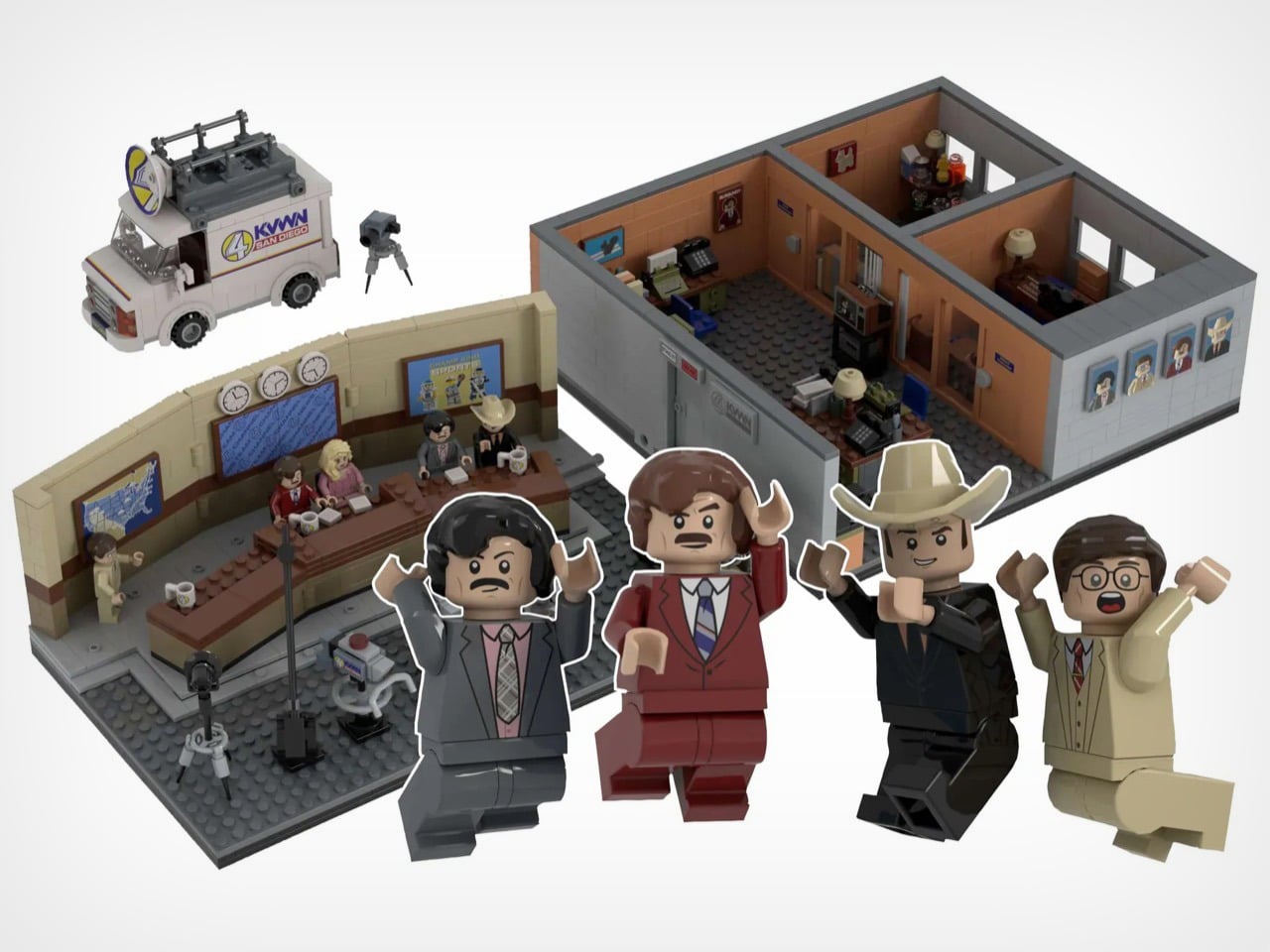
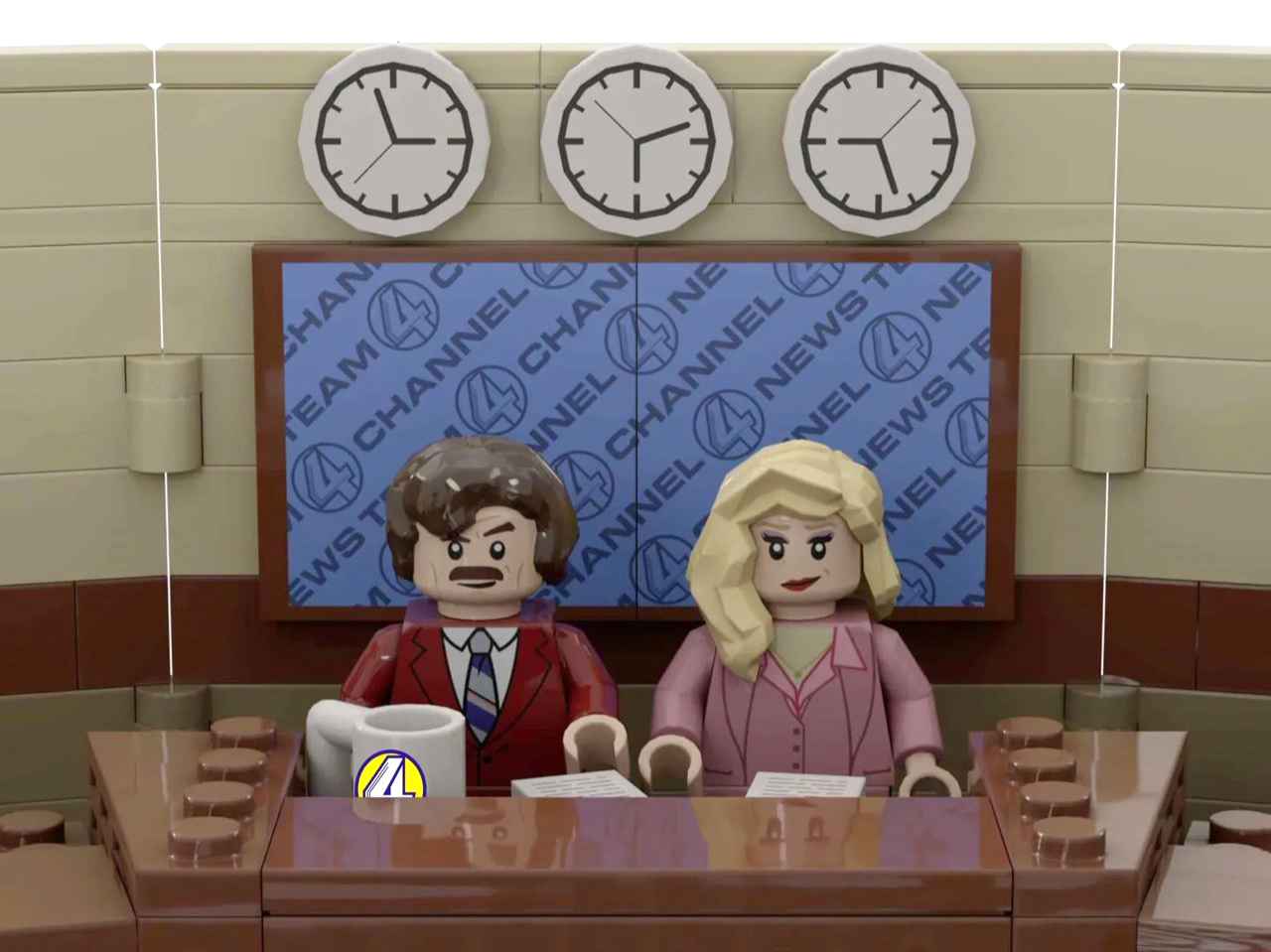
The result is a just-over-1,500-piece MOC (My Own Creation) that reconstructs the Channel 4 News Team’s world with an almost obsessive attention to detail, covering the broadcast studio, the newsroom offices, and even the KVWN news van parked out front. The studio section is immediately recognizable: a curved tan backdrop wall, three wall clocks ticking away above the anchor desk, dual blue Channel 4 News Team screens flanking the set, and the full team seated behind that iconic brown desk with their Channel 4 mugs. It looks like a freeze-frame from the film, and that’s entirely the point.

Designer: footonabrick
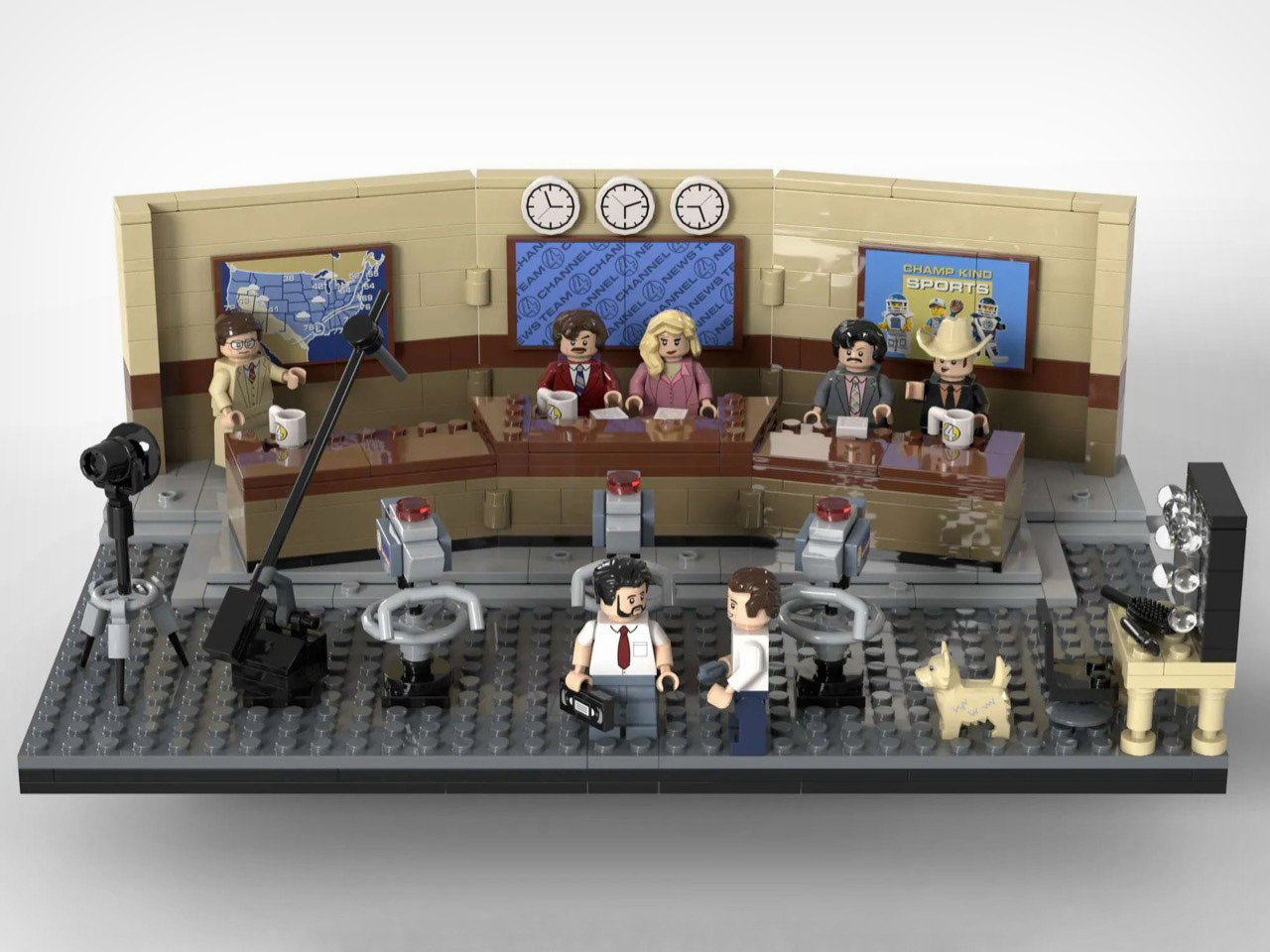
The broadcast desk is the centerpiece, and footonabrick nails the warm tan-and-brown palette of that gloriously dated 70s newsroom aesthetic. Ron and Veronica sit front and center behind their Channel 4 mugs, with Brian Fantana, Champ Kind, and Brick Tamland flanking them across the curved desk. The curved wall behind them is one of the trickier builds to pull off cleanly in LEGO, and the segmented panel construction keeps it looking smooth without losing the layered depth of the real set. Camera equipment on the studio floor, a boom-arm mic stand, and a vanity mirror station on the side round out the production floor detail beautifully.
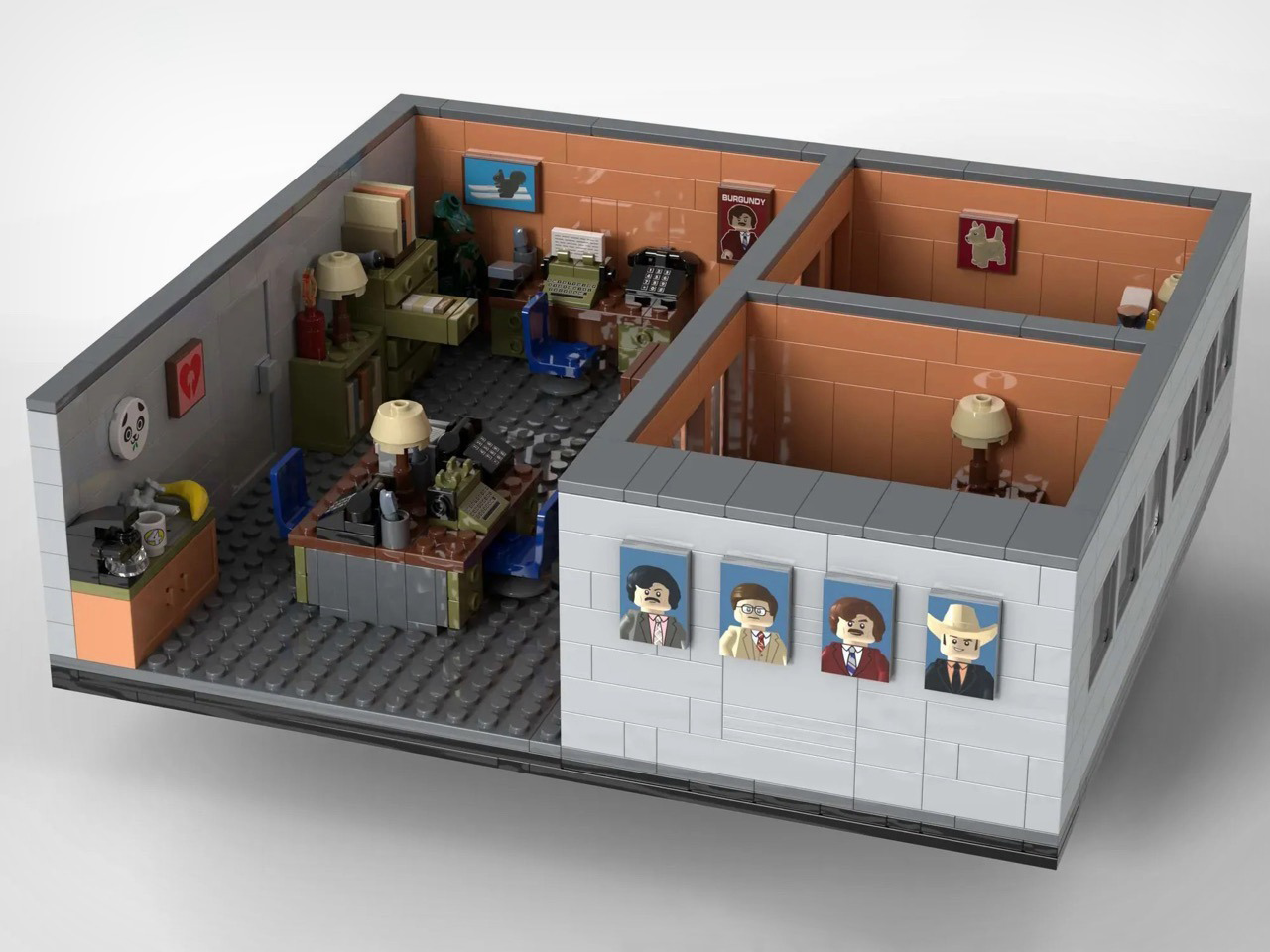
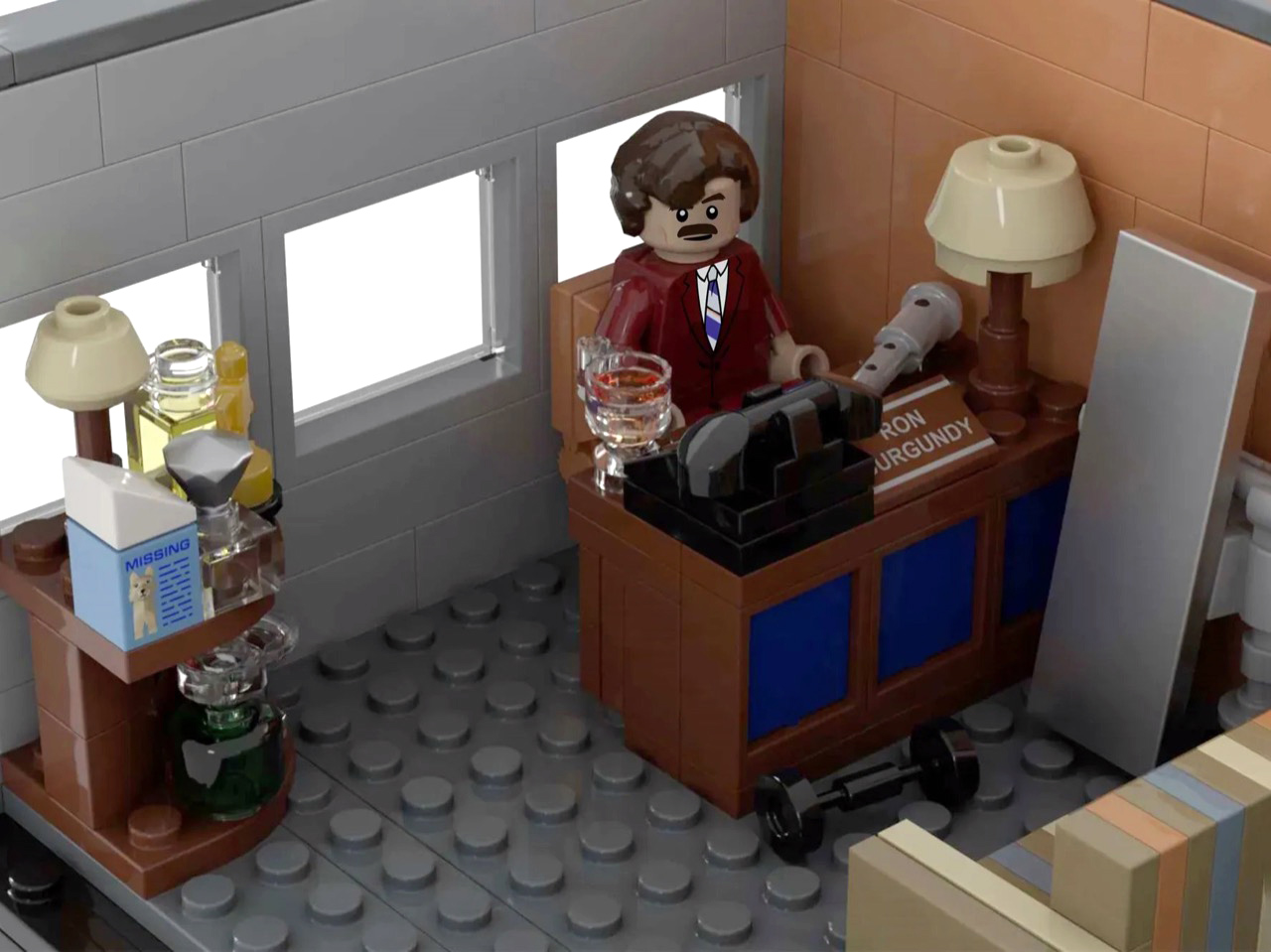
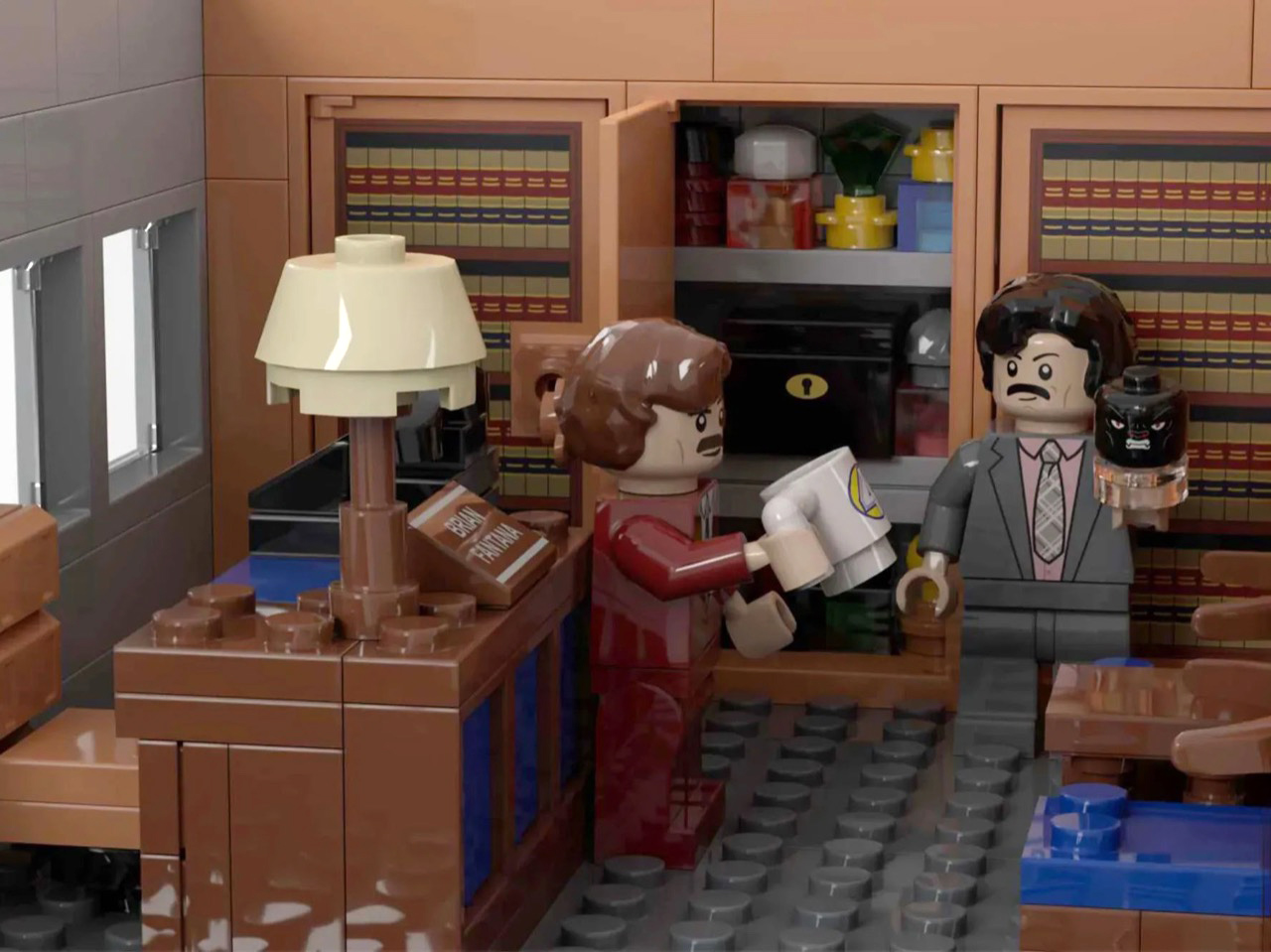
Turn to the office areas and you’ll find a bunch of details and easter eggs. Ron’s private office has his nameplate desk, a glass of scotch rendered in a transparent amber round piece, and a “Missing” poster for Baxter tucked onto a side shelf. Brian Fantana’s cologne closet, one of the film’s most beloved gags, is recreated with an open cabinet stocked with colourful brick-built bottles, with a “Brian Fantana” book sitting on his desk for good measure. The hallway outside features a glass-panel wall looking into Ron’s office, and a Ron Burgundy door nameplate that even Veronica would have to respect. My favorite detail, though, is the row of four team portrait tiles mounted on the exterior office wall, each one a miniature LEGO-art-style illustration of the Channel 4 crew. Tiny, considered, and completely unnecessary in the best way.
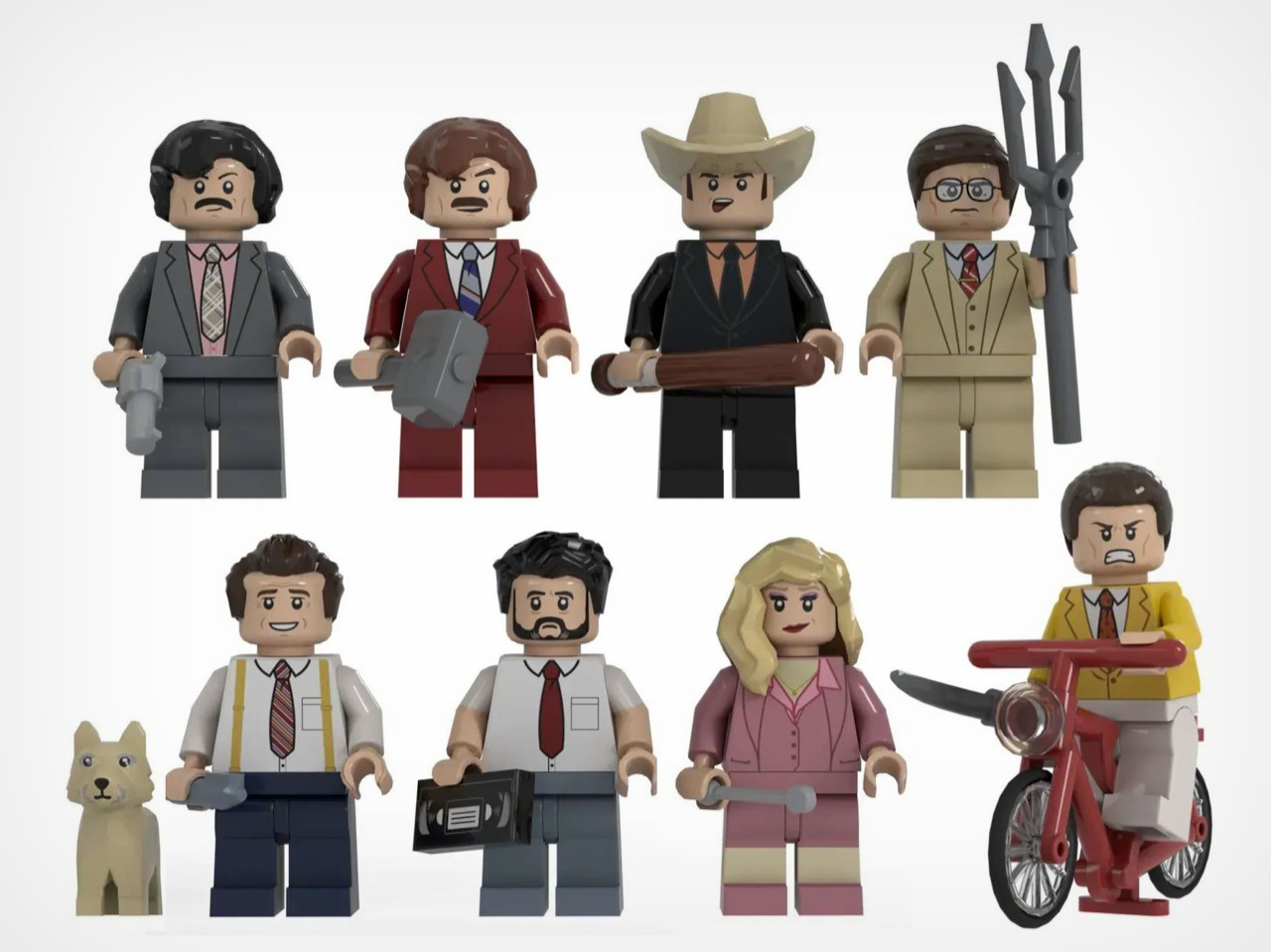
The eight minifigures are pitch-perfect. Ron arrives in his burgundy suit with a jazz flute and a scowl that says “I have many leather-bound books.” Brick Tamland, naturally, comes with his trident. Champ has his signature cowboy hat, Fantana carries what appears to be a cologne bottle, and Veronica is rendered in her pink suit with that particular expression of someone perpetually tolerating Ron’s nonsense. Baxter the dog is included as a separate figure, and there’s even a bonus Ron on a tiny red bicycle, which is exactly the kind of specific deep-cut that separates a good MOC from a great one.
footonabrick’s Anchorman set is currently gathering votes on LEGO Ideas, the community platform where fan-created MOCs (My Own Creations) need 10,000 supporters to trigger an official LEGO review and potential retail production. With 344 votes on the board and 421 days left on the clock, there’s plenty of runway. If you want to see this land on store shelves, head to the LEGO Ideas page and cast your vote. You stay classy.

The post Stay Classy, San Diego: This LEGO Anchorman Set Recreates the Entire Channel 4 Newsroom in 1,500 Bricks first appeared on Yanko Design.
Legendary 3,424-Brick Michael Jordan LEGO Poster Actually Bursts Out of Its Own Frame

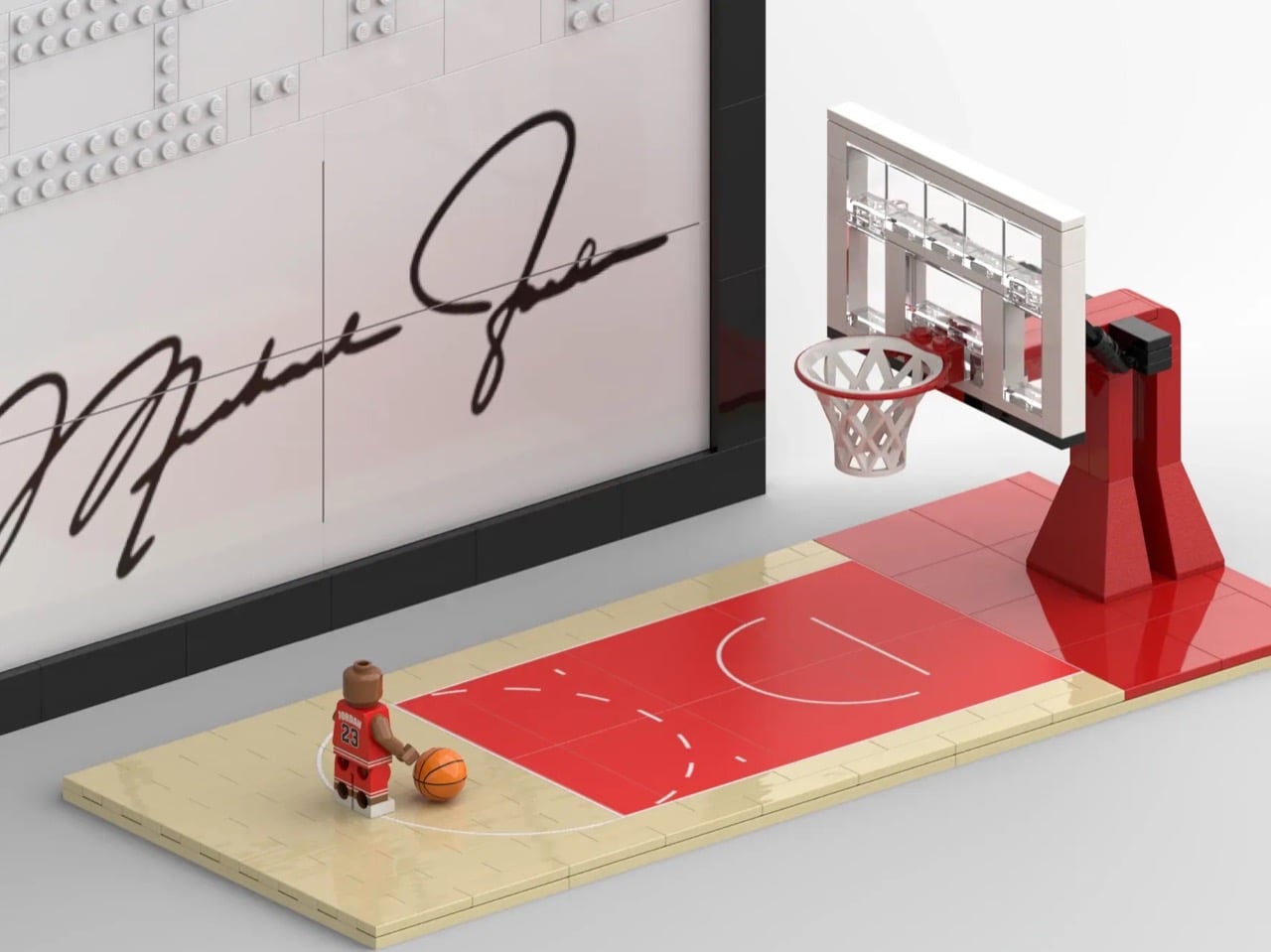
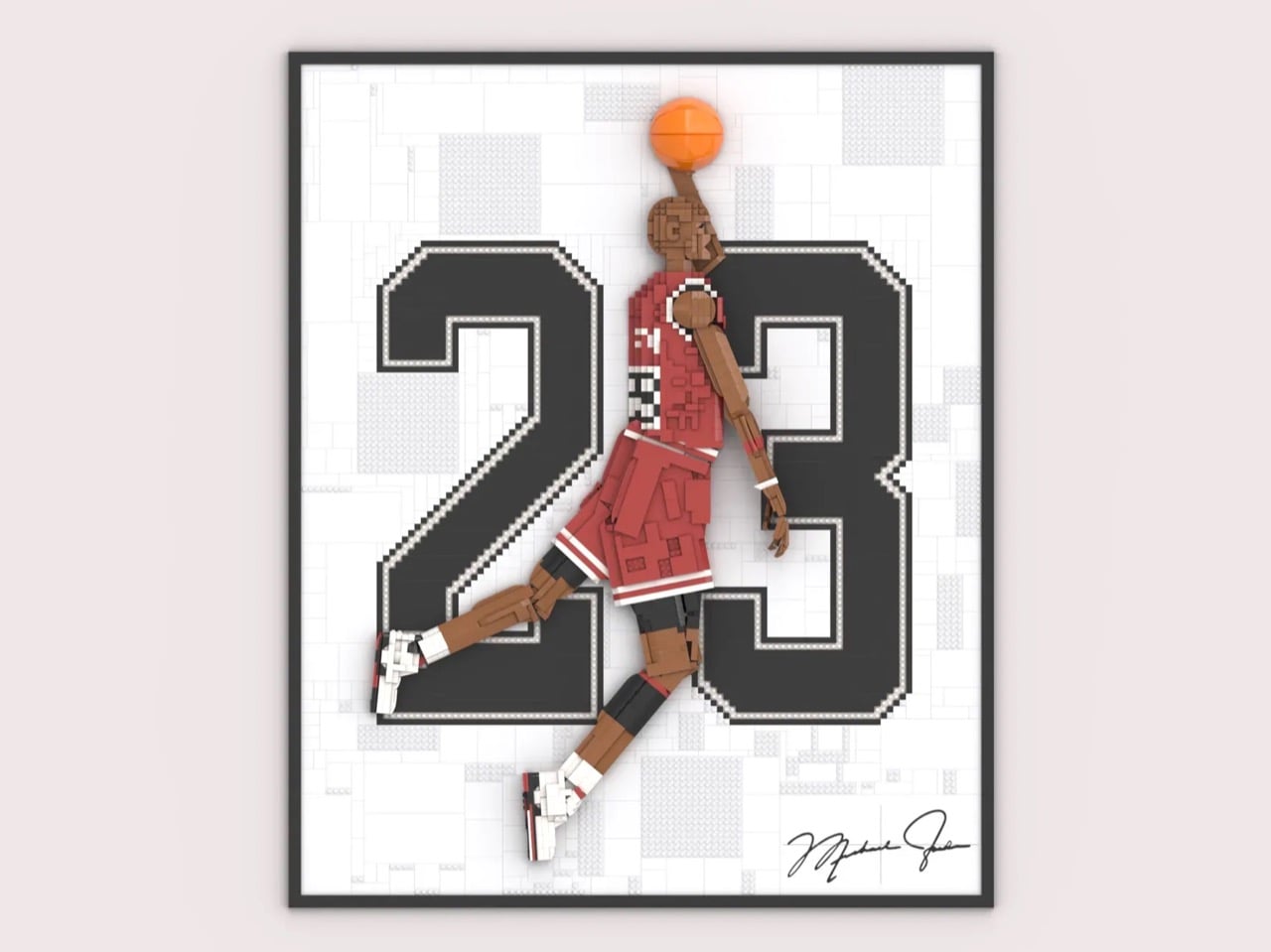
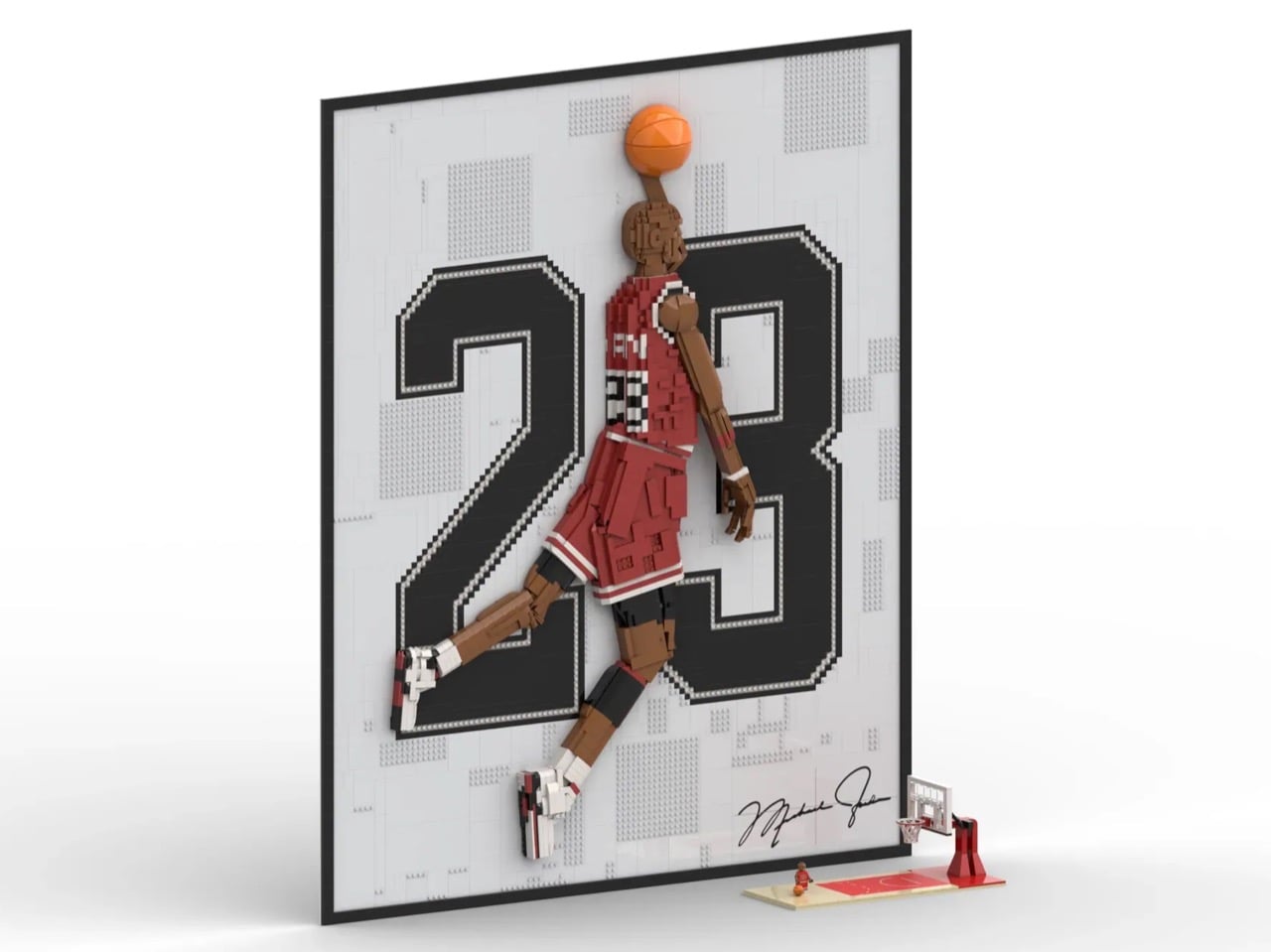
There’s a photograph that has lived rent-free in the collective memory of sports culture for nearly four decades. Michael Jordan, ball palmed in his right hand, left arm trailing, legs split mid-air, frozen somewhere between the free-throw line and the rim during the 1988 Slam Dunk Contest. Nike turned it into a logo. Sneakerheads turned it into a religion. And somewhere along the way, the Jumpman silhouette stopped being a basketball image and became something closer to a universal symbol of human ambition, the visual shorthand for defying what should be physically possible. We’ve seen it screenprinted, embroidered, laser-cut, and tattooed. But rendered in 3,424 LEGO bricks, jutting out of a framed mosaic canvas at nearly 107 centimeters tall? This one has the visual authority of a gallery piece.

LEGO Ideas is the fan-driven platform where builders submit their own creations (MOCs, or My Own Creations, in the community’s vernacular) and the public votes on which ones deserve to become real retail sets. Hit 10,000 votes, and LEGO’s internal team formally reviews the submission for potential production. The community has produced some genuinely remarkable work over the years, but every so often something surfaces that feels less like a toy pitch and more like a legitimate design object. LAFS85’s Michael Jordan tribute is exactly that. It’s a relief sculpture, a mosaic, a framed poster, and a courtside diorama all collapsed into a single build, and it’s currently gathering momentum on the platform with a Staff Pick designation already in hand.

Designer: LAFS85

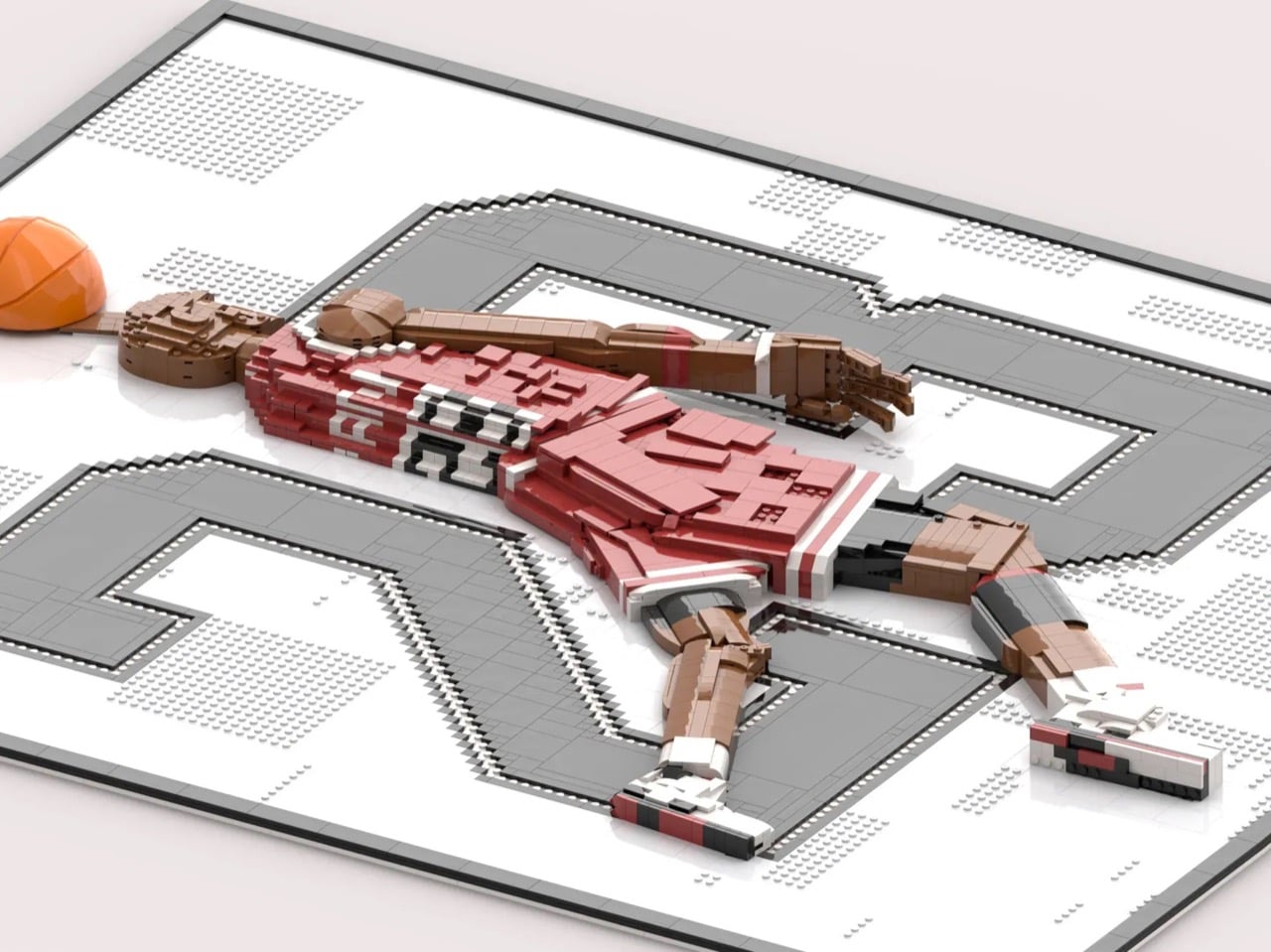
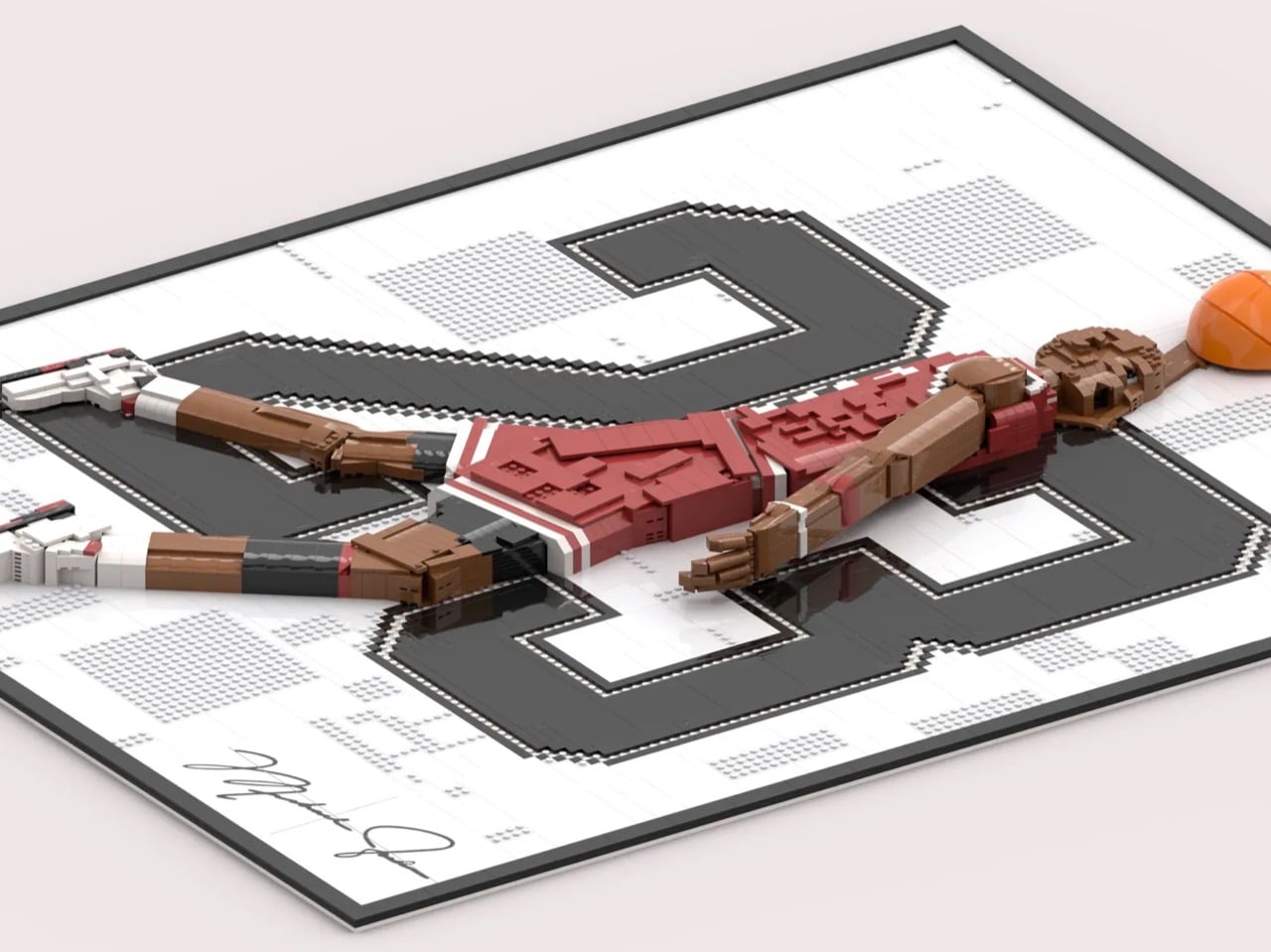
The central concept here is a relief sculpture mounted on a brick-built canvas, and the execution is what separates this from a standard LEGO Art mosaic. Rather than keeping everything flush and flat, LAFS85 has pushed Jordan’s figure forward off the background plane using layered brickwork, so the figure genuinely protrudes from the frame. The effect, especially in the front-facing renders, is arresting. Jordan looks like he’s mid-flight toward you, ball raised, and the bold pixelated “23” dominating the dark background behind him only amplifies the drama. The builder used SNOT (Studs Not On Top) techniques throughout the figure to capture the flow of the jersey fabric and the muscular geometry of the legs, which is exactly the kind of decision that an industrial designer notices and appreciates. Flat tile surfaces read as smooth fabric. Angled plates suggest tension in the limbs. The red and white of the Chicago Bulls uniform pops hard against the dark grey background bricks, and the brick-built recreation of Jordan’s signature in the lower corner is a genuinely lovely finishing touch.

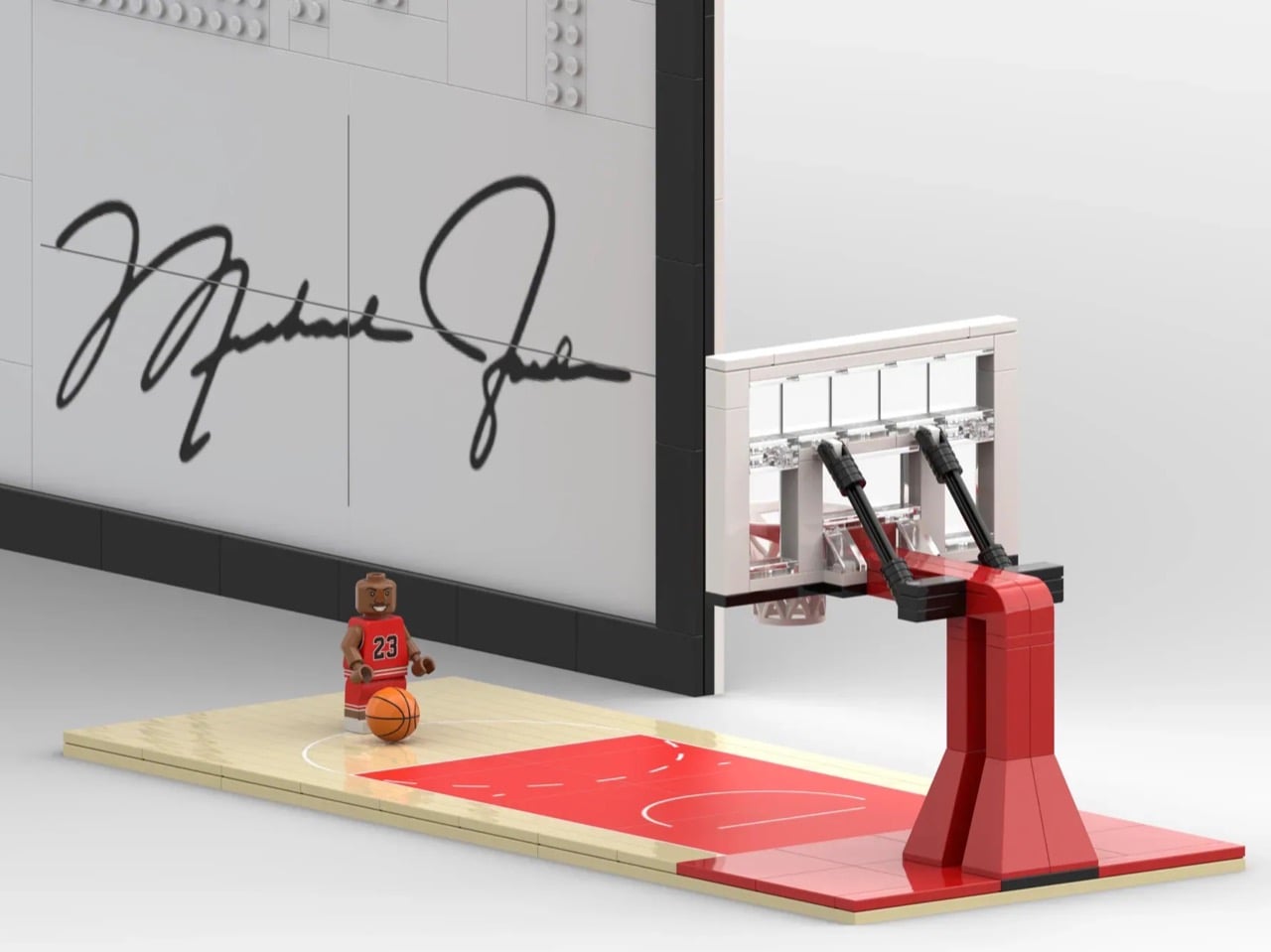
My favorite detail, though, is the tiny courtside diorama that sits at the base of the frame. It’s a micro-scale hardwood court complete with the painted free-throw area in Bulls red, a custom Jordan minifigure dribbling on the baseline, and a beautifully proportioned basketball hoop with a transparent backboard and a weighted red stanchion. The scale contrast between the enormous relief portrait looming above and this tiny matchbook-sized court below is genuinely witty, and it gives the whole piece a kind of narrative arc. The legend on the wall, the player on the court, the moment suspended between the two. At approximately 89.6 centimeters wide, the full assembly is a serious statement piece, the kind of thing you’d actually want above your desk rather than tucked in a display cabinet.

LAFS85 describes the project as a fusion of 2D art and 3D sculpture, a tribute to the Jumpman spirit that honors the greatness of the player without leaning on external logos or licensed branding. That restraint is smart, both practically for LEGO Ideas approval purposes, and aesthetically because it keeps the focus on the craftsmanship rather than the IP. The build has already earned a Staff Pick designation from the LEGO Ideas team, which is a meaningful signal of quality, and it’s sitting at just over 2,059 supporters with 564 days remaining to reach the 5K milestone on the way to the full 10,000 votes needed for an official LEGO review. The only thing I’d wish for in a retail version is an alternate colorway, a black and pinstripe away-jersey variant would make this an absolute must-buy twice over. Until then, head to the LEGO Ideas page and cast your vote here.

The post Legendary 3,424-Brick Michael Jordan LEGO Poster Actually Bursts Out of Its Own Frame first appeared on Yanko Design.

This LEGO Tiramisu Might Be the Most Realistic LEGO Food Set Anyone Has Ever Built

Tiramisu has a strong claim to being the world’s most universally loved dessert. It crossed out of northeastern Italy sometime in the late 1960s, hit restaurant menus across Europe and America through the 80s and 90s, and somewhere along the way became the default “fancy dessert” of the home cook who wanted to impress without turning on the oven. The name translates roughly to “pick me up,” which is exactly what a shot of espresso-soaked ladyfingers and mascarpone cream does. LEGO Ideas creator Micdud has now built one out of 1,106 bricks, nearly at 1:1 scale, and the result is the kind of MOC that makes you do a double-take.

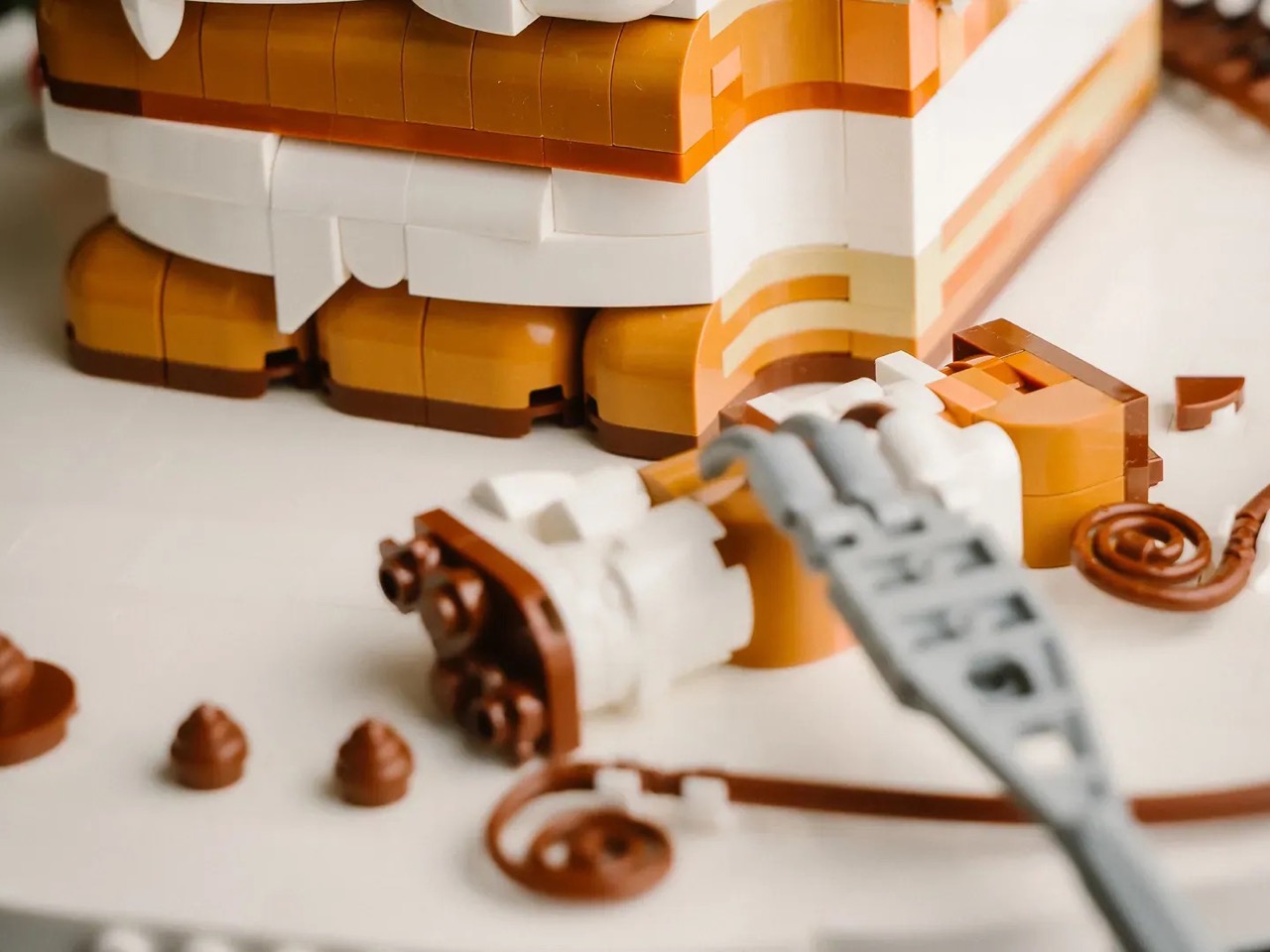
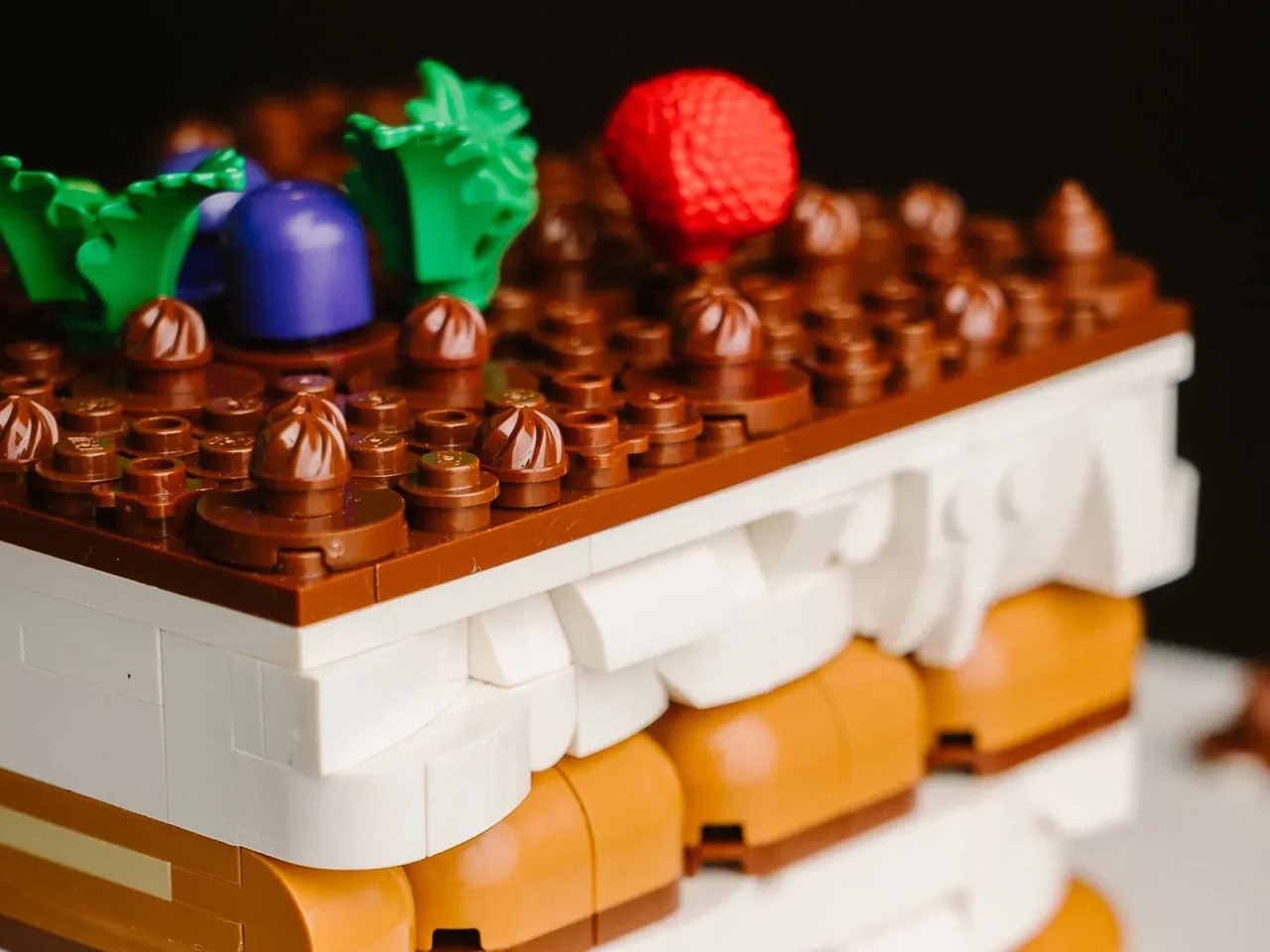
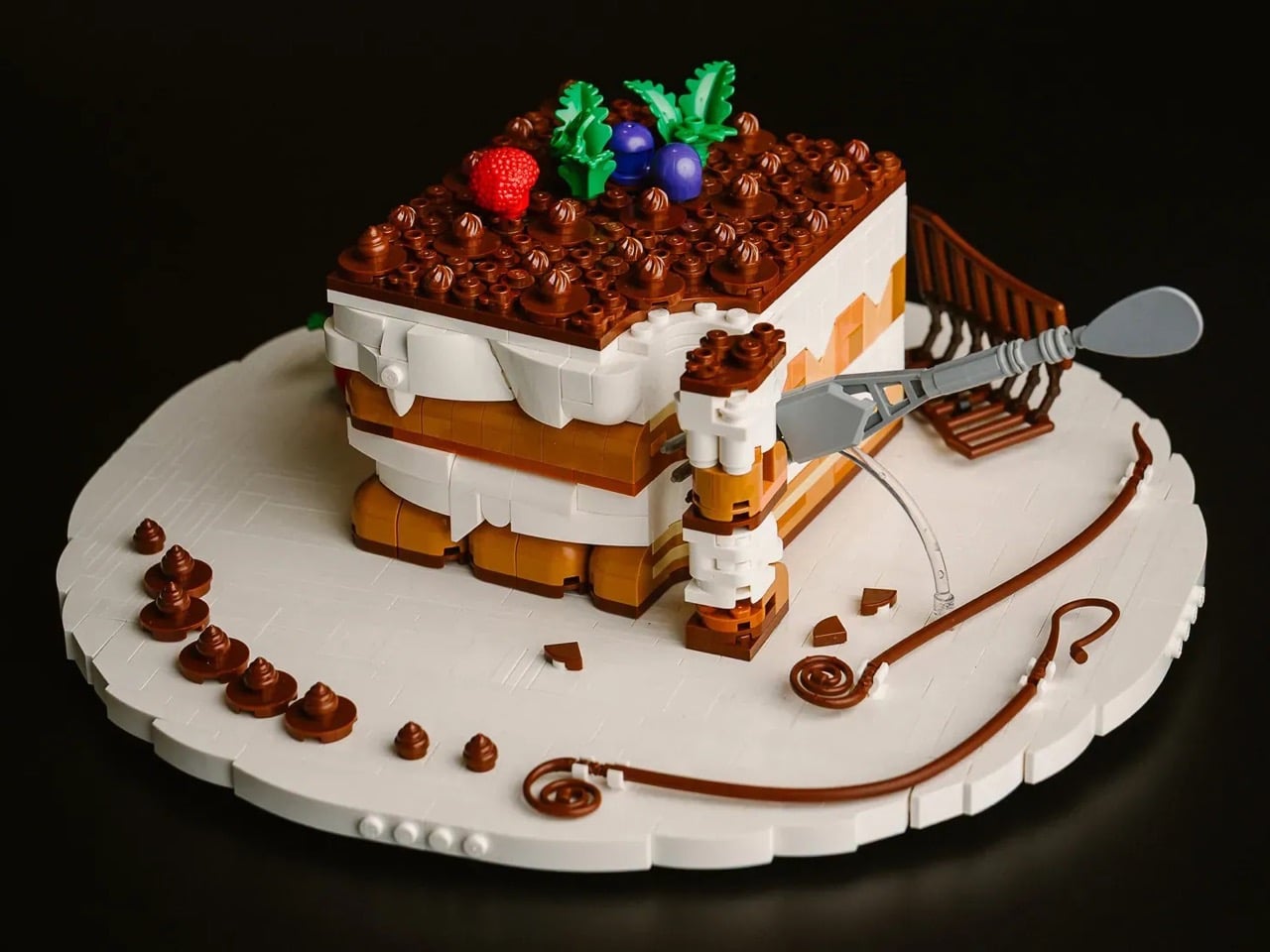
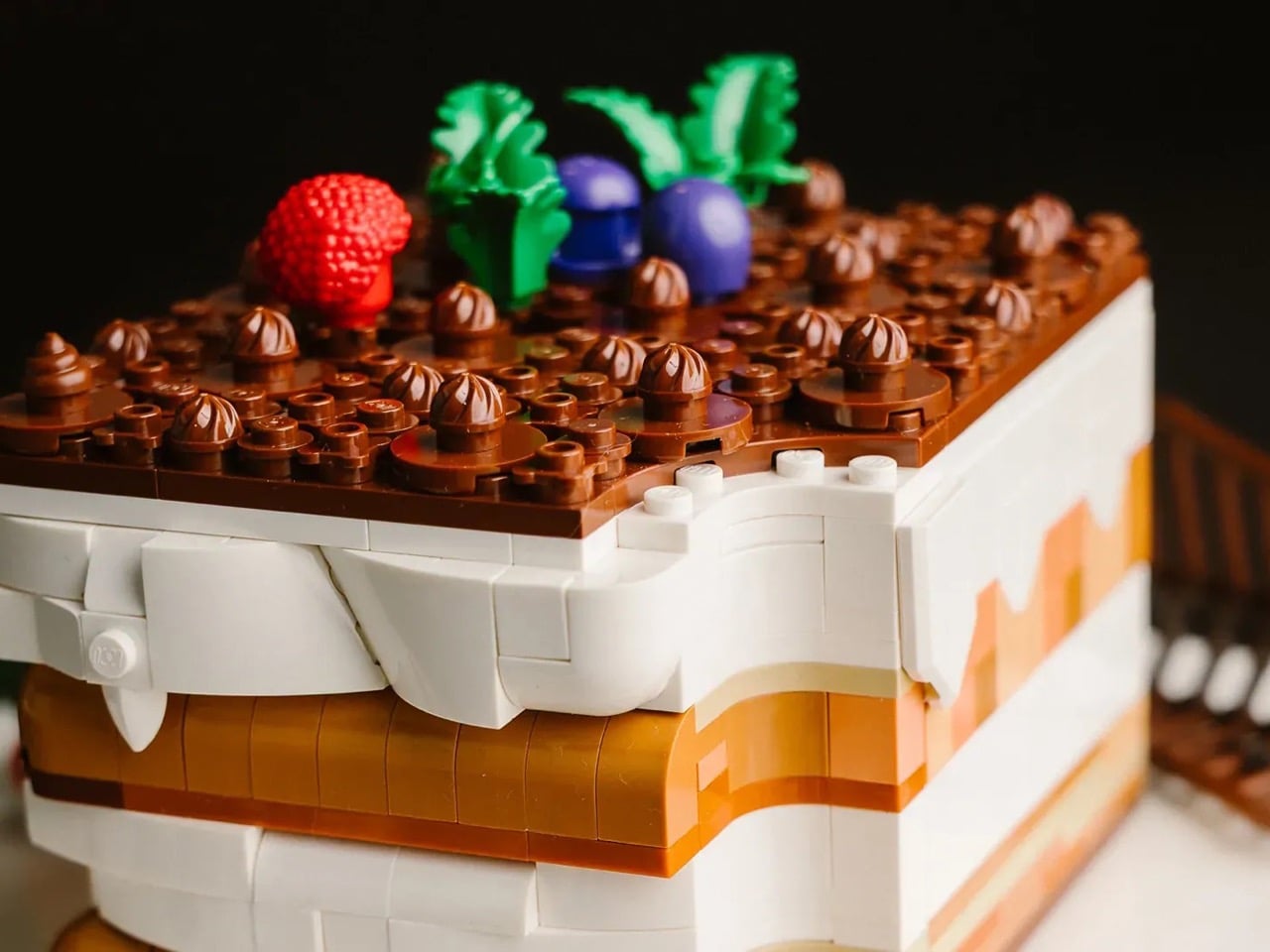
The build is a corner slice served on a decorative round plate, complete with chocolate drizzle, cream dollops, and a fork mid-bite suspended in the air on a transparent support. The cocoa topping alone is a masterclass in using disparate brown elements to simulate an organic, dusty texture. Micdud even hid a raspberry made from a red clown hairpiece and blueberries built from purple astronaut helmets under the garnish. Food MOCs live and die by their surface detail, and this one gets every layer right.

Designer: Micdud

The corner piece allows you to see the full lady-fingers without their cross-sections. There’s just so much detail that it’s easy to get lost focusing on just one part. Although that’s exactly what makes this ‘dish’ such a winner. It triggers a primordial response of hunger the minute you see it. The colors are perfect, the cross section is gorgeous, and the details even on the plate WILL make your mouth water. Cutting two faces open lets those layers read in amber and white bricks, while the outer two faces show the savoiardi as rounded bumps with cream spilling over them. The build is doing two different surface textures at once, and pulling both off cleanly at 27 by 27 centimeters is no small thing for a 1,106-piece model.

The MOC (My Own Creation) is presented on a round plate, adding to its flair. The chocolate scroll work and cream rosettes ringing the edge give the whole scene a plated, restaurant-ready quality that keeps it from reading as a lone brick sculpture sitting on a flat disc. The suspended fork is the finishing touch, a freshly cut bite floating mid-air on a transparent support brick, the kind of detail that commits fully to the storytelling and makes the whole thing feel like a frozen moment rather than a display piece.

Unlike most LEGO Ideas submissions, this one isn’t rendered. From the looks of it, and just the imprefections in the detail, Micdud already built the design out. That’s impressive on its own, because it shows exactly what the Tiramisu would look like. For the uninitiated, LEGO Ideas is the company’s portal for fan-made submissions, allowing enthusiasts to create their own LEGO builds and vote for their favorite ones. Any MOC that crosses the 10,000 vote mark gets reviewed by LEGO’s internal team and then potentially turned into a box set. Micdud’s Tiramisu is just mere days old on the platform and it’s already amassed 240 votes (including my own). If you want to have it hit that 10k mark, head down to the LEGO Ideas forum and cast your vote (it’s free!) Let’s get this MOC produced before October this year so we can enroll it in the Tiramisu World Cum in Italy this year!

The post This LEGO Tiramisu Might Be the Most Realistic LEGO Food Set Anyone Has Ever Built first appeared on Yanko Design.

Someone Built a True-Scale LEGO Velociraptor Skeleton and I Can’t Wait To Buy One

Jurassic Park lied to you. The velociraptors that terrorized a kitchen full of children and hunted Jeff Goldblum through tall grass were modeled after Deinonychus, a considerably larger North American cousin, because the filmmakers thought the real animal’s name sounded cooler than its actual dimensions warranted. The real Velociraptor mongoliensis stood about 1.6 feet at the hip and weighed roughly as much as a medium-sized dog. Formidable, certainly, but built to the scale of a farmyard bird rather than an apex predator capable of coordinated ambushes.

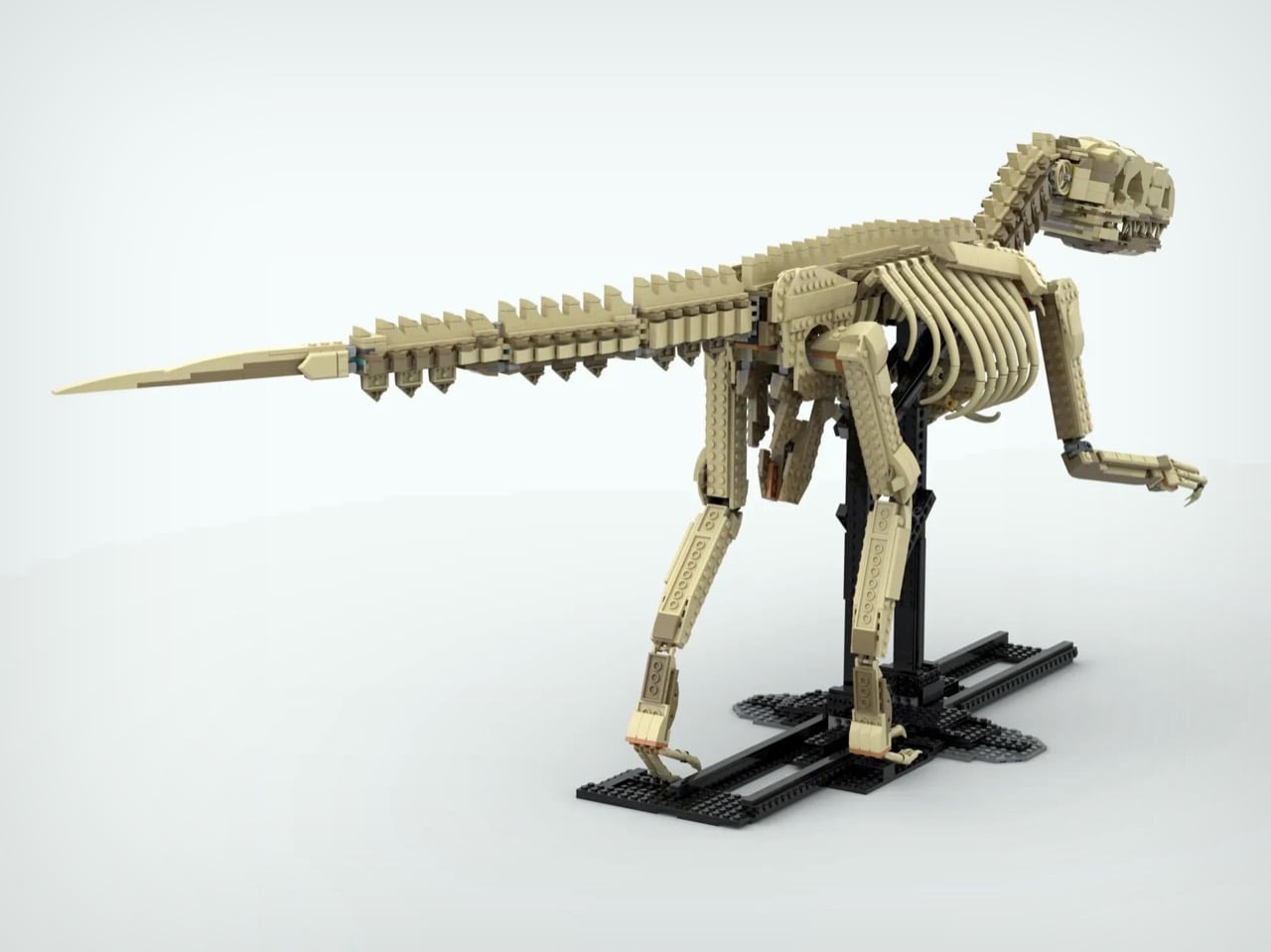
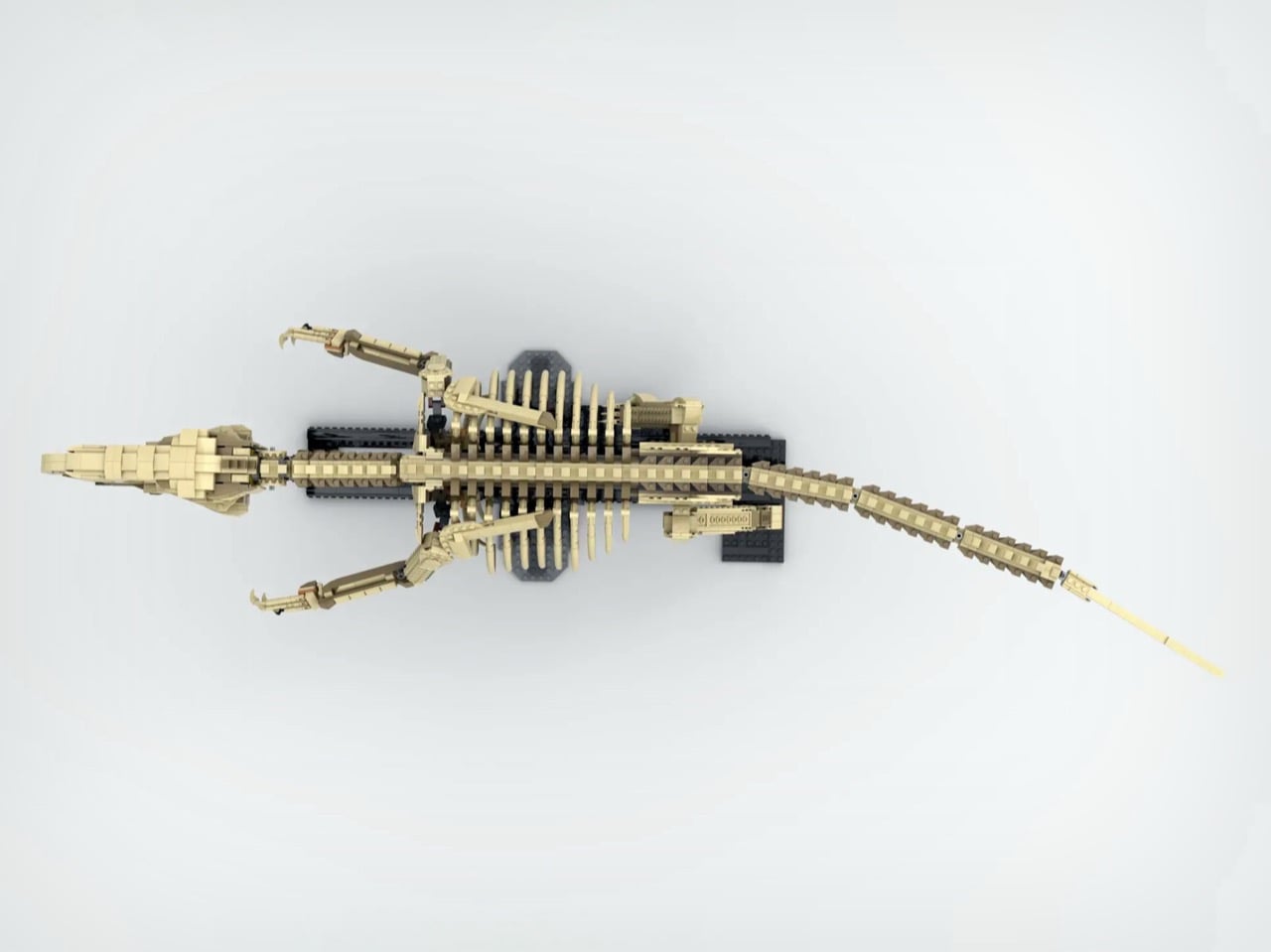
Which is exactly what makes this LEGO Ideas submission by creator Terraxz so interesting. Built to true scale from paleontological measurements of a juvenile V. mongoliensis specimen, the model sits at approximately 120 cm long and 40 cm tall on a museum-style display stand. It has the ribcage, the vertebrae, the sickle claw, the whole skeleton rendered in tan brick. LEGO has been on a fossil skeleton tear lately, but nobody has attempted one at actual 1:1 scale until now.

Designer: Terraxz

LEGO’s Dinosaur Fossils line began as a fan submission that became the 910-piece Ideas set 21320, featuring T. rex, Triceratops, and Pteranodon skeletons at 1:32 scale. LEGO then escalated with the Jurassic World set 76968, a 3,145-piece T. rex skeleton stretching over 105 cm at 1:12 scale, which launched in March 2025 and immediately became the largest Jurassic World set the company had ever produced. Every iteration in this lineage has been a scaled-down representation, a display piece calibrated for shelf real estate rather than scientific fidelity. Terraxz is doing something structurally different: the model matches the actual size of the animal it depicts, which reframes the whole exercise from decorative object to physical argument about what the creature actually was.

Look at the skull closeup and you can see individual tooth rows built from stacked brick elements, fenestrae represented as open negative space through clever plate offsetting, and a jawline that actually captures the elongated low-profile snout that distinguishes V. mongoliensis from the broader-headed Hollywood version. The spine runs in a proper S-curve, the tail extends horizontally as it should for a bipedal theropod using it as a counterbalance, and the legs are proportioned correctly for an animal that stood 0.5 meters at the hip rather than eye level. The black display armature borrows the same museum-mount language as LEGO’s official sets, with cross-braced vertical supports that would look at home in any natural history gallery.

A fully adult V. mongoliensis reaches around 1.8 to 2 meters in length, which would push this build into genuinely unwieldy display territory. Choosing a juvenile specimen is a calibrated decision that keeps the model physically manageable while maintaining the true-scale claim, and it maps to real fossil record data: a complete juvenile skeleton described from the Djadochta Formation gives the builder a legitimate scientific reference point rather than an averaged extrapolation. Terraxz has a catalog of related MOCs on Rebrickable, including a true-scale V. mongoliensis skull, so this submission is the culmination of an ongoing paleontology project rather than a standalone pitch.

LEGO Ideas requires 10,000 supporter votes within the submission window for a design to enter official review, and Terraxz currently sits at just over 1,000 with 605 days remaining. That’s enough time to accrue the votes needed to turn this into a retail set. I’m pretty sure that a whole bunch of people beyond
paleontologists would like a to-scale velociraptor skeleton adorning their bedroom or hallway. The submission is live on the LEGO Ideas website, and it takes about thirty seconds to cast your vote, so what exactly are you waiting for?

The post Someone Built a True-Scale LEGO Velociraptor Skeleton and I Can’t Wait To Buy One first appeared on Yanko Design.

The Vintage Apple Computer That Belongs on Every Tech Lover’s Shelf, in LEGO Form

In 1977, Steve Jobs walked through the kitchen appliance section of a Macy’s department store and came away with a vision for what a personal computer should look like. The result, shaped by industrial designer Jerry Manock and powered by Wozniak’s engineering genius, was the Apple II: a smooth, warm-beige enclosure that suggested domesticity rather than machinery. It belonged on a desk the way a telephone did. That calculated approachability helped sell millions of units across sixteen years of production.

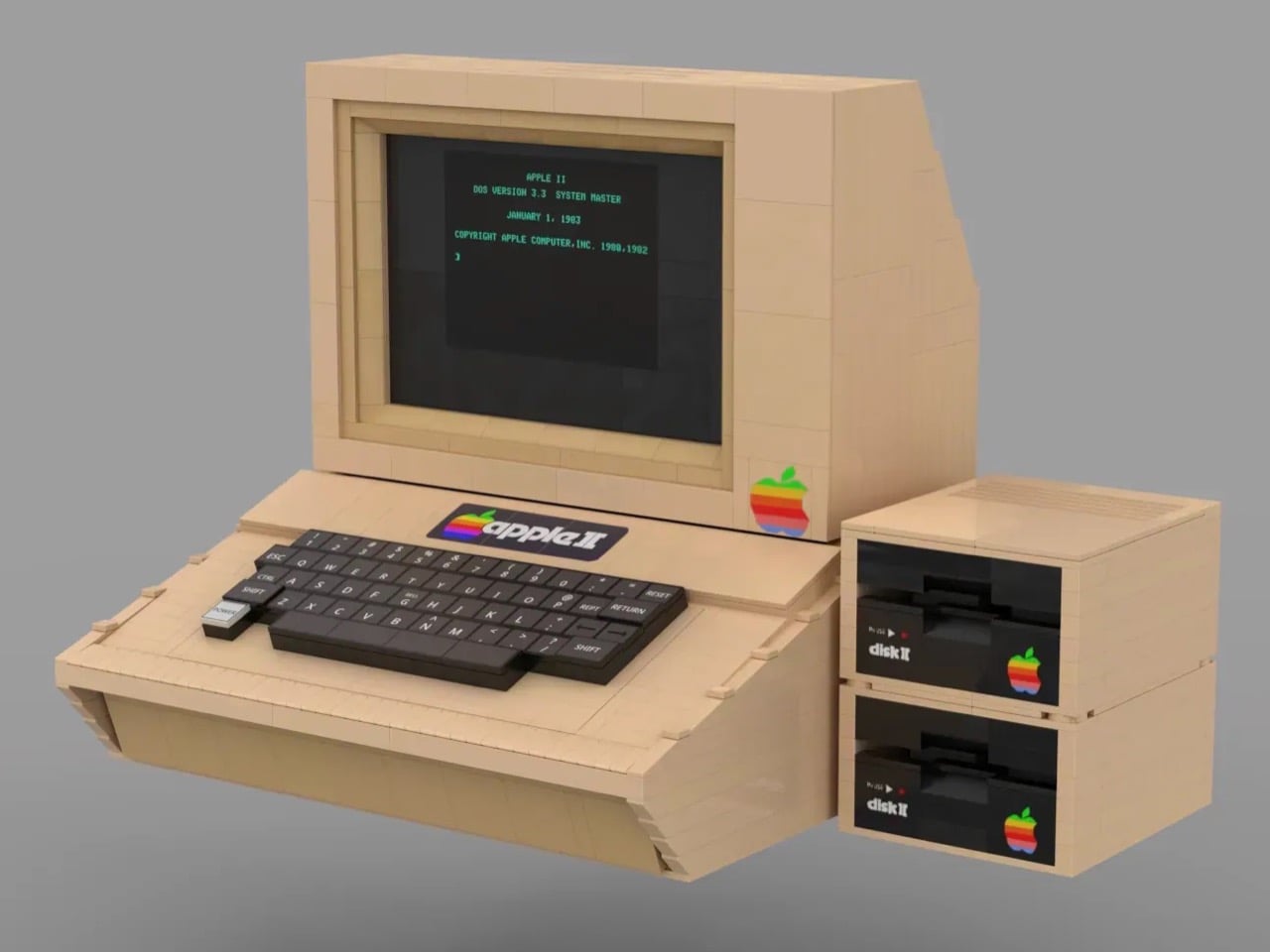
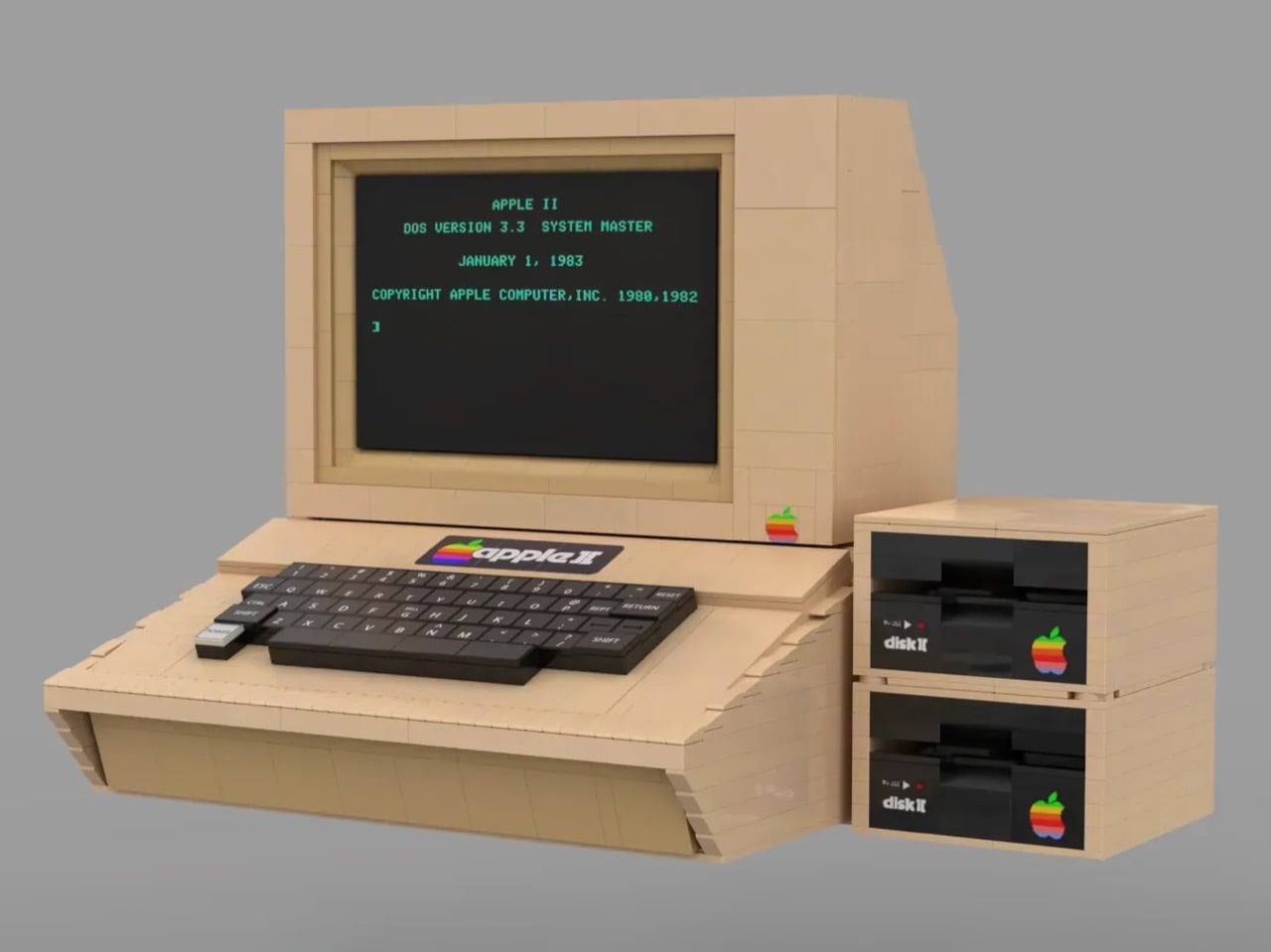
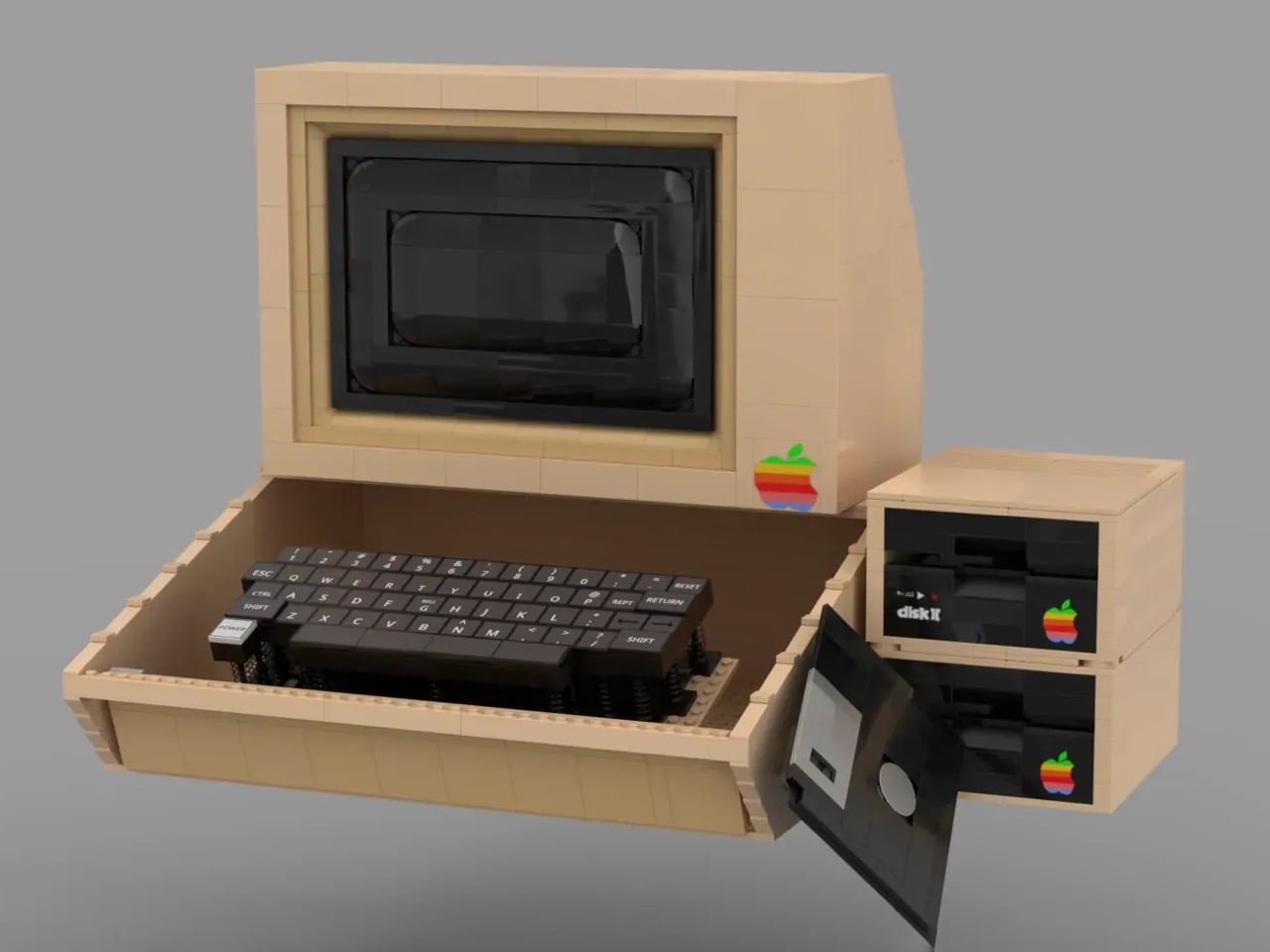
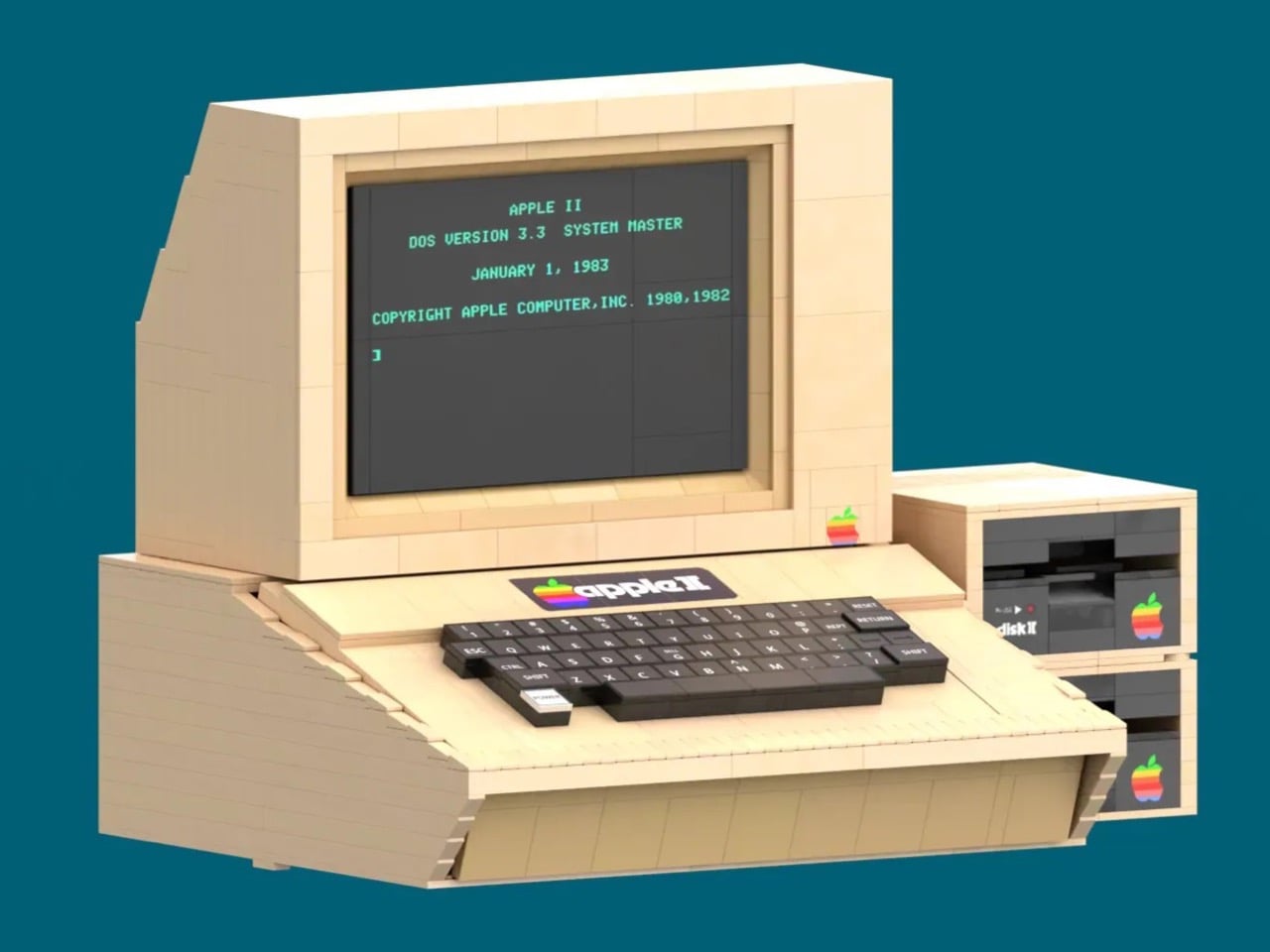
LEGO Ideas builder BrickMechanic57 has translated that design philosophy into 1,772 pieces, and the attention to detail rewards anyone familiar with the original. The signature Pantone beige carries across the computer body, monitor, and dual Disk II drives. The rainbow Apple II badge sits front and center above the keyboard. Pull out the monitor screen and you get two display states: the authentic green-on-black DOS boot screen or a clean, powered-off black panel.

Designer: BrickMechanic57

Wozniak designed the Disk II floppy controller over the 1977 Christmas holidays and reduced the chip count from the industry standard of dozens down to six. Competing controllers from the same era used 50-plus chips and cost significantly more. Apple sold the Disk II for $495 in 1978, and the engineering inside that price point was borderline absurd. BrickMechanic57 stacks two of them beside the main unit, exactly as they appeared on real desks, and a brick-built floppy disk element actually inserts into the lower drive.

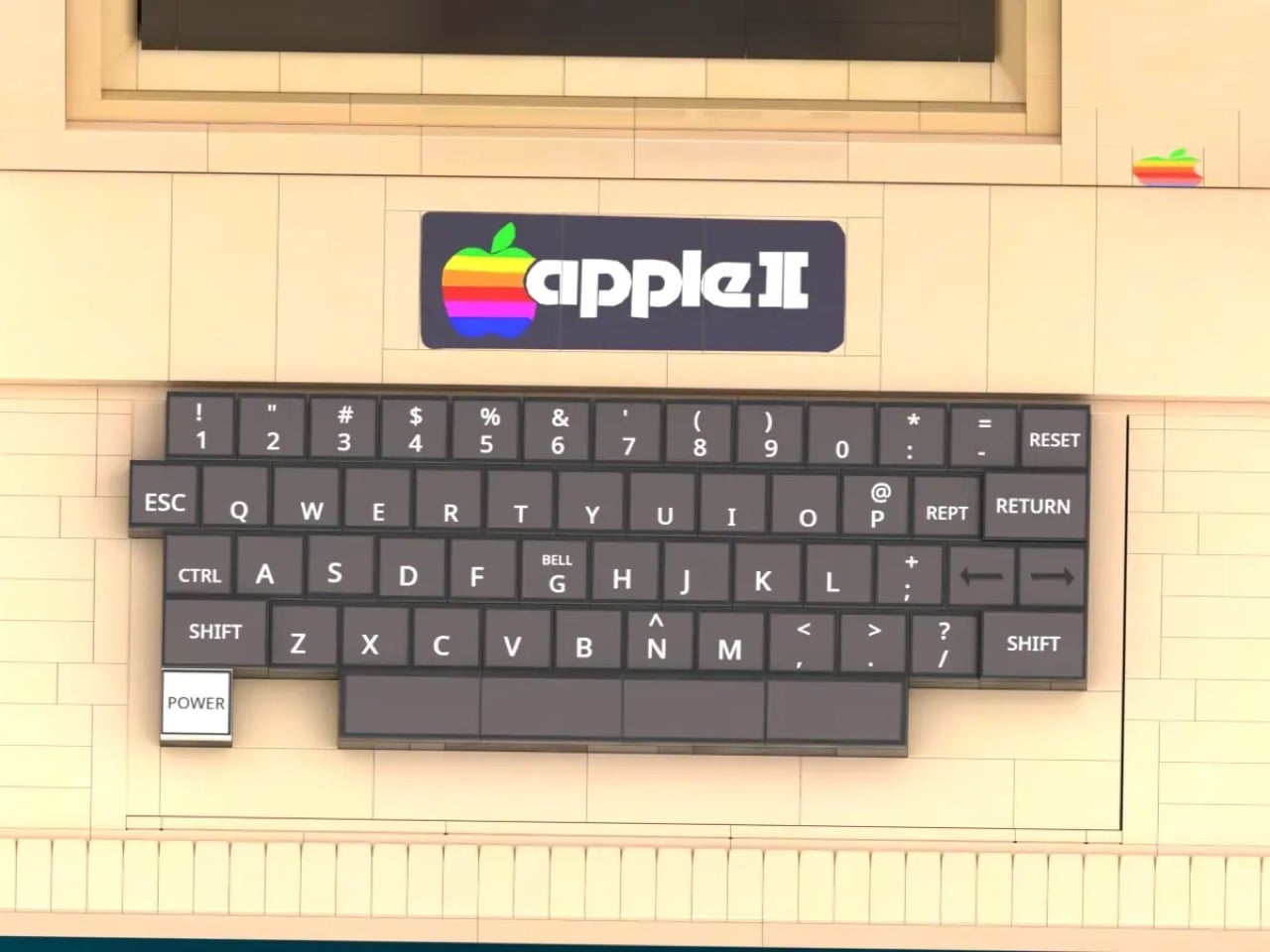
The real Apple II keyboard had no cursor keys in its original 1977 configuration, a REPT key for repeating characters, and RESET sitting exposed and dangerous in the top-right corner like a trap for clumsy typists. The close-up render of this build shows every one of those details reproduced faithfully, including the staggered layout, the CTRL and ESC placement, and the POWER button isolated at the lower left. The rainbow Apple II badge above it is sharp enough to make a vintage collector emotional.

The swappable monitor screen states are what separate a good LEGO set from a great one. The LEGO NES set had the working cartridge slot. The LEGO Atari 2600 had the joystick. This build has a DOS boot screen reading “APPLE II / DOS VERSION 3.3 SYSTEM MASTER / JANUARY 1, 1983” in green phosphor text, and that alone justifies the piece count. The monitor face pulls out cleanly, the off-state panel drops in, and suddenly you have two different display moments from the same machine’s life.

LEGO Ideas is the platform where fan-designed builds compete to become official retail sets. Any project that hits 10,000 supporter votes within its window gets reviewed by LEGO’s own designers, and the strongest candidates go into production. Previous successes include the NES, the Polaroid OneStep SX-70, and the Atari 2600. BrickMechanic57’s Apple II has 587 days left on the clock. Voting is free on the LEGO Ideas website, and if this one makes it to shelves, it will be because enough people who care about this history showed up.

The post The Vintage Apple Computer That Belongs on Every Tech Lover’s Shelf, in LEGO Form first appeared on Yanko Design.

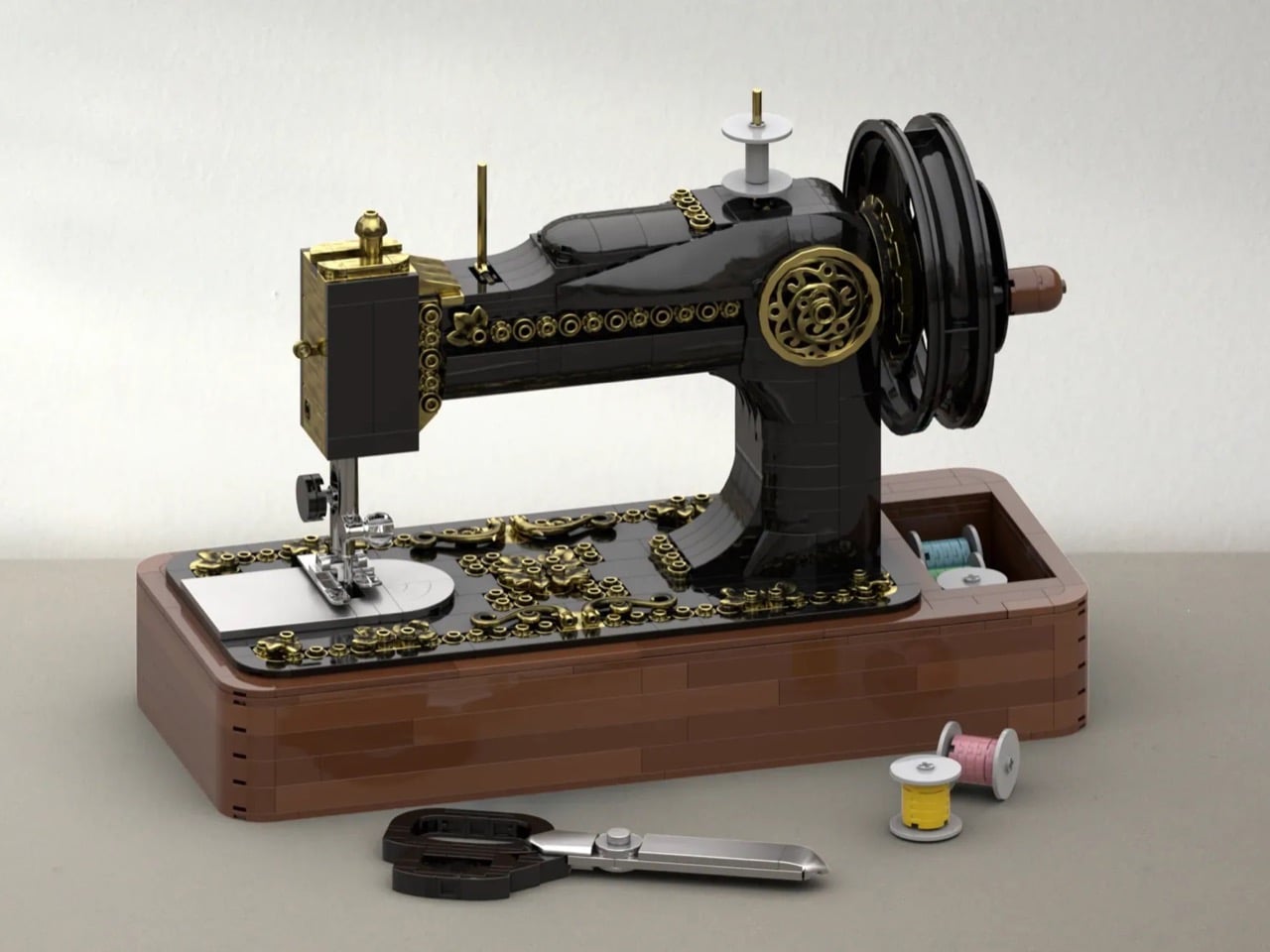
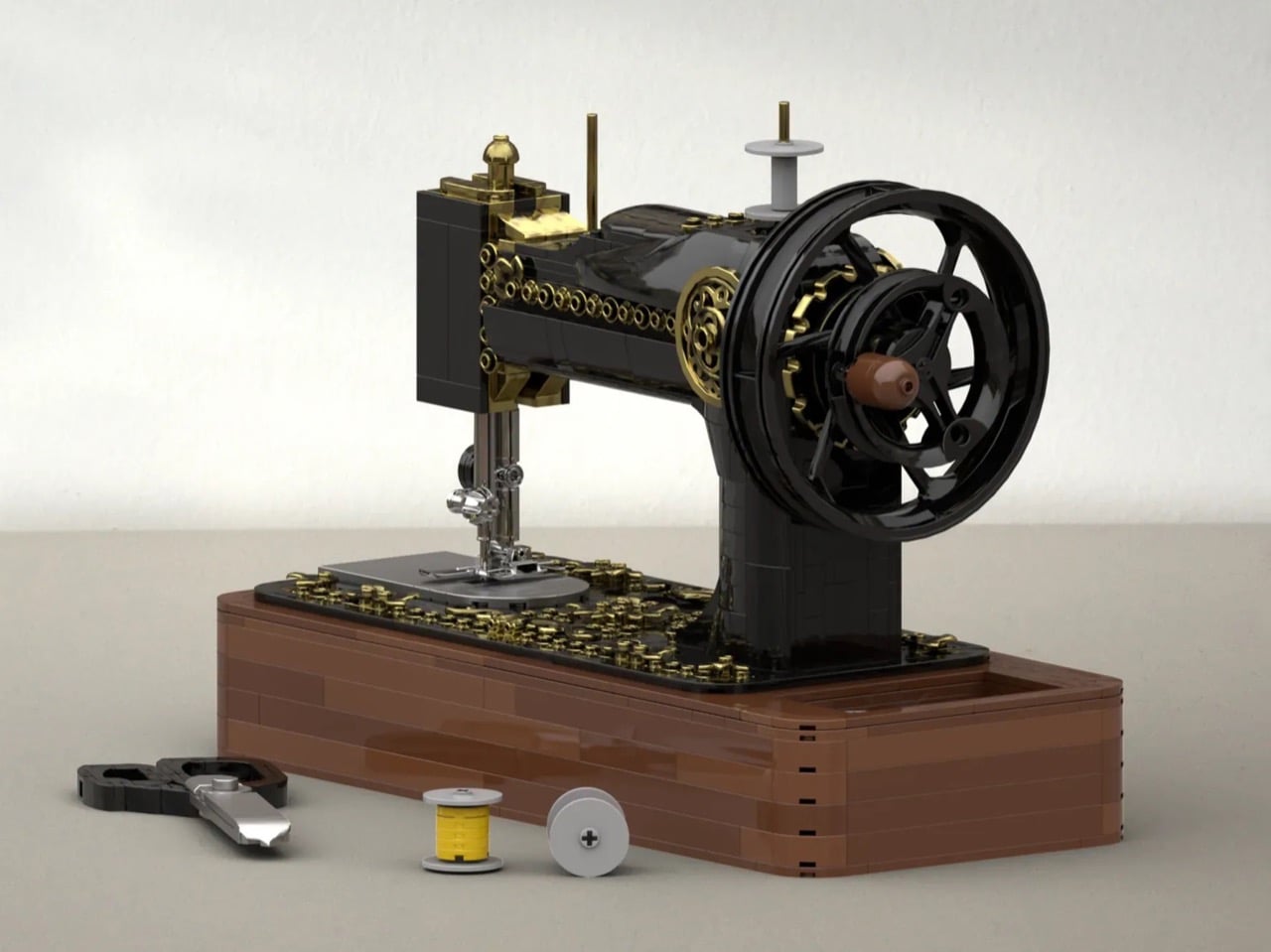
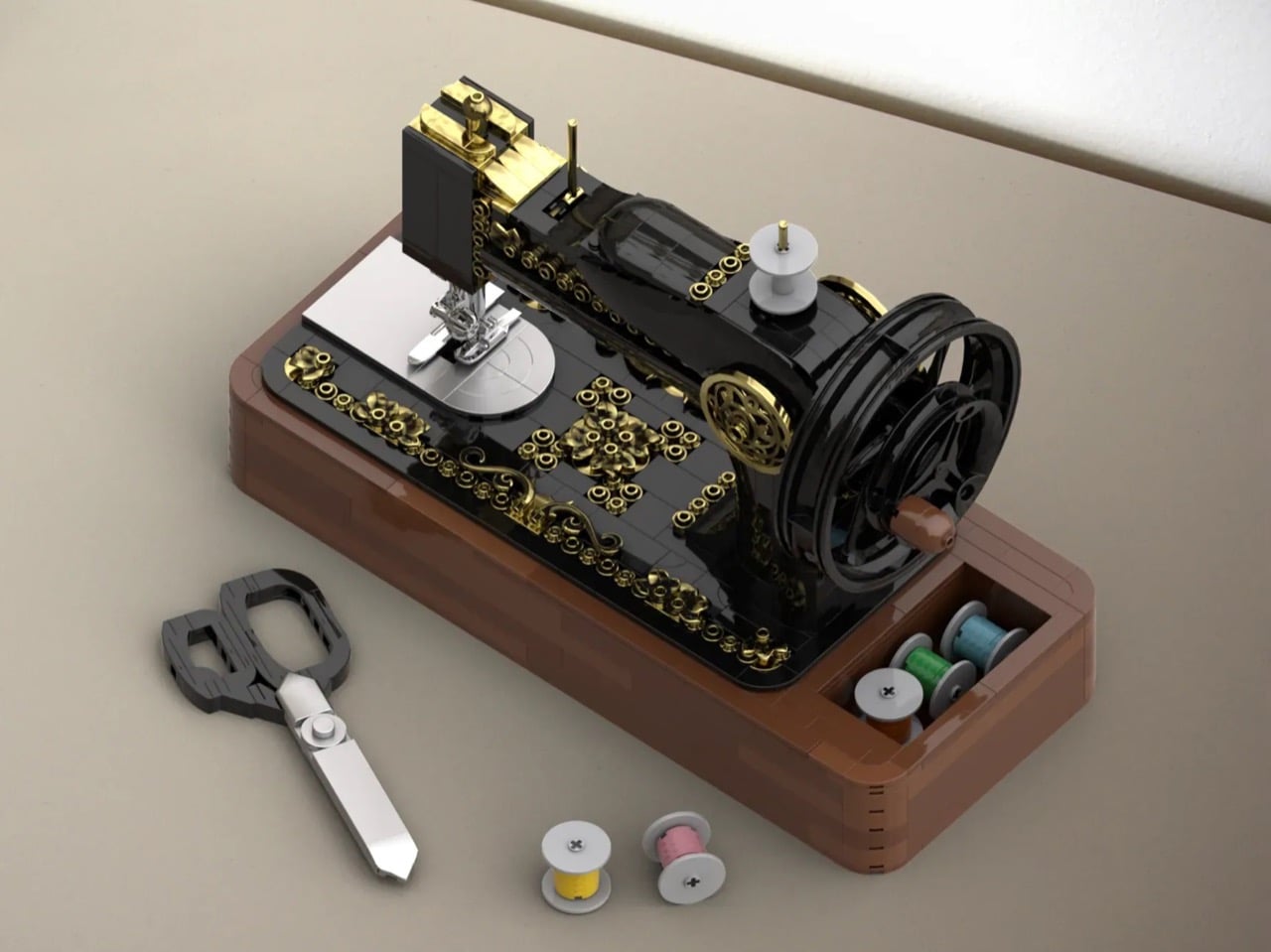
Functional LEGO Sewing Machine actually moves a needle up and down when cranked

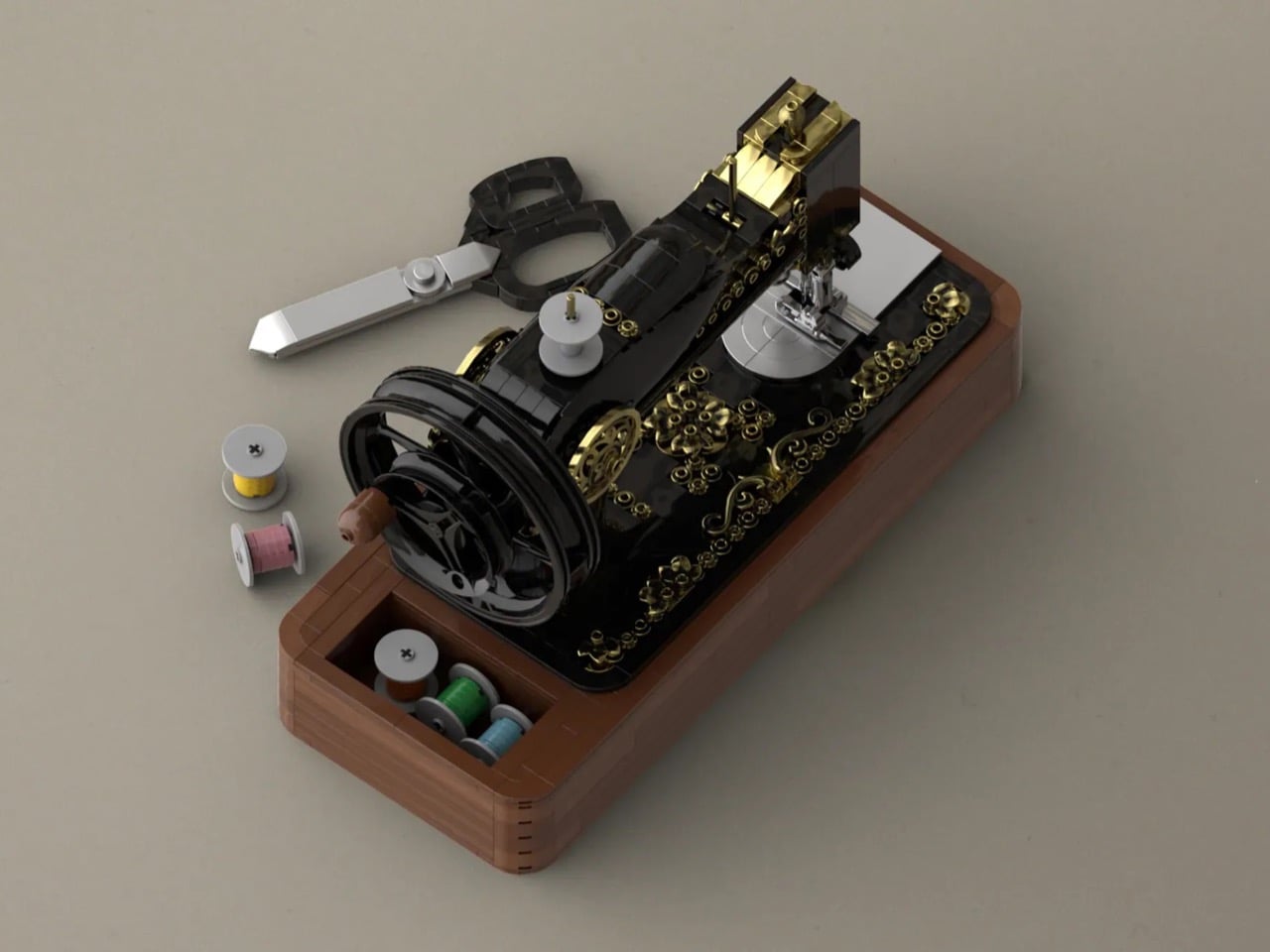
There’s nothing from stopping this LEGO machine from actually sewing clothes, apart from the fact that attaching a real needle to it would make it an ‘illegal’ build. Illegal builds in LEGO are when you use bricks in unauthorized ways (wedging them, gluing them, using them upside down), or using non-brick parts in a LEGO build. Sadly, this rather outdated law is the only thing preventing BrickStability’s Sewing Machine from letting you stitch clothes, kerchiefs, and quilts together.

What I love about LEGO MOCs (My Own Creations) is that some people try to achieve aesthetic perfection, while others try to actually make LEGO builds functional. There’s a LEGO lawnmower that cuts grass, a LEGO Typewriter that types, and even a functional LEGO Turing Machine that ‘computes’. Add this sewing machine to that list because it isn’t just a visual masterpiece, it’s complicated, intricate, and to a great extent, functional.

Designer: BrickStability

It’s true that nobody can agree who first invented the ‘sewing machine’. Elias Howe is credited with the version we popularly use today, although Thomas Saint, Barthelemy Thimonnier, and Isaac Singer are all also attributed as key figures in helping create some version of the modern-day sewing machine. This particular version, the lockstitch sewing machine, was patented in 1846 by Elias Howe, and while the LEGO MOC isn’t exactly Howe’s patented design, it’s an antique machine that takes that lockstitch technology and packages it into a form factor a lot of us recognize even today.

There are multiple YouTube shorts and GIFs on how these machines actually ‘stitch’ clothes, but the simple explanation is that a rotating element (powered by a crank on the side or a foot-pedal at the bottom) moves a special needle up and down, while a spool feeds continuous thread directly to the needle. As you stitch, the machine creates that rhythmic noise associated with tailoring shops, while the spool gradually rotates too, feeding thread into the ever-hungry machine.

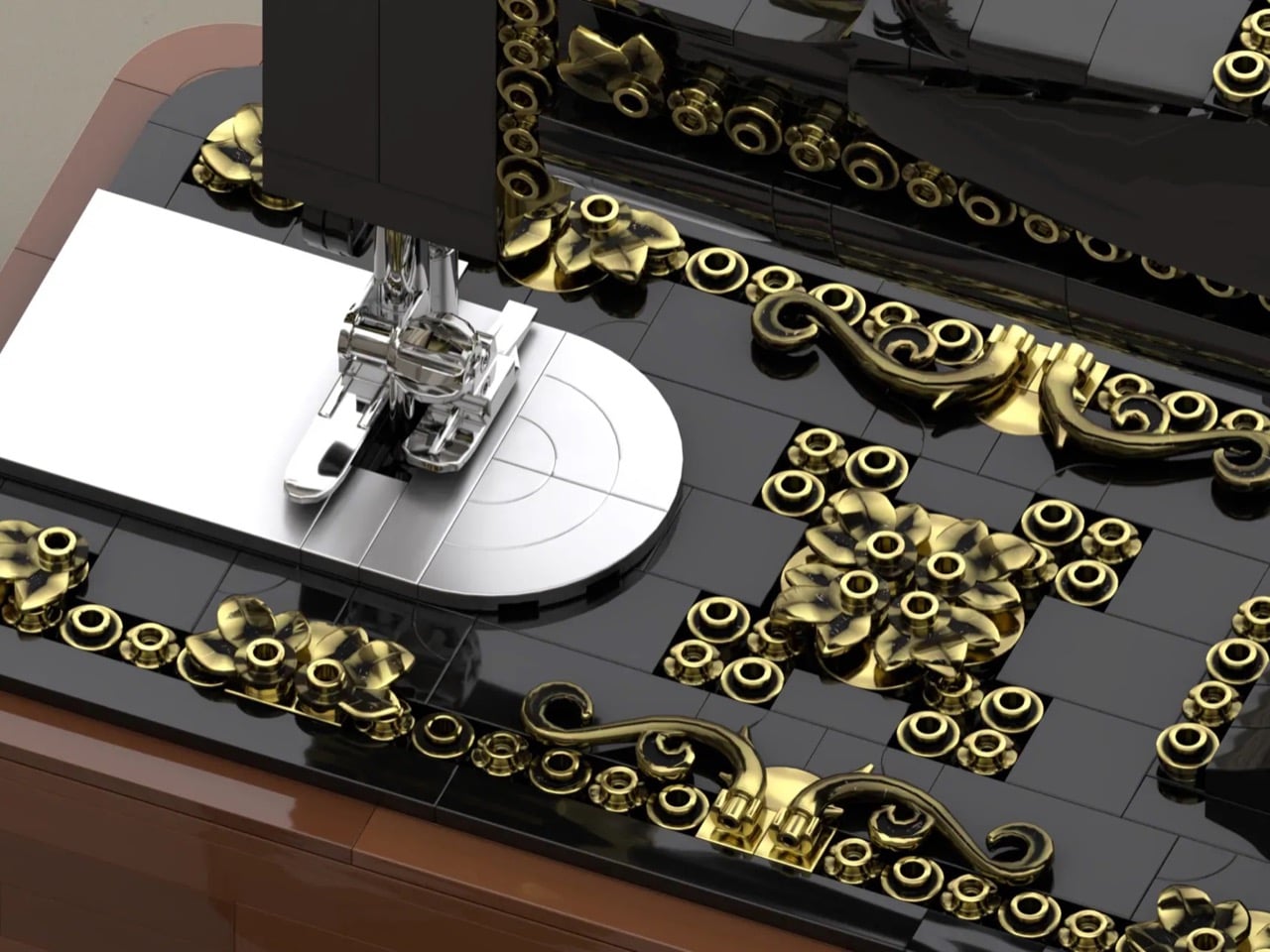
BrickStability’s version is gorgeously accurate. Not only is it functional (the crank rotates and the needle element moves up and down), it also comes with LEGO spools of colored thread, along with a tailoring scissor made from LEGO bricks too. The machine is black, just like almost every machine in that time (funnily enough I only remember the motorized ones as being white in color), and comes with some ornate gold brickwork, reminiscent of the detailing seen on vintage machines.

This MOC is different from the usual ones we feature on the website. It wasn’t created for LEGO Ideas the way we know it, but rather, was designed as a submission for a challenge hosted by LEGO on its Ideas website. Needless to say, it took home the grand prize, and one can only hope LEGO actually turns this build into a real retail box set!

The post Functional LEGO Sewing Machine actually moves a needle up and down when cranked first appeared on Yanko Design.

Cessna 172 (The Most Manufactured Plane in History) Just Got Immortalized in 2,000 LEGO Bricks

The Cessna 172 has logged more flight hours than any other powered aircraft in history. Since its debut in 1956, it has carried student pilots over Kansas wheat fields, bush flyers above the Canadian tundra, and island-hoppers between Greek archipelagos. It is the plane that taught the world to fly.

Now, LEGO Ideas builder Mike_the_Brickanic has translated that enduring icon into approximately 2,000 bricks, capturing the 172’s distinctive high-wing silhouette, its trademark strut-braced wings, and a cockpit detailed down to the dual yokes and instrument panel. The result is a faithful tribute to one of aviation’s most beloved machines, rendered in a striking dark blue and curry yellow livery that feels every bit as purposeful as the real thing.

Designer: Mike_the_Brickanic

The real Cessna 172 Skyhawk sits at about 8.28 meters long with a wingspan of 11 meters, cruises at 226 km/h, and has a service ceiling of 4,300 meters. It weighs just 767 kg empty. That power-to-weight ratio combined with forgiving low-speed handling is why flight schools worldwide still default to it after nearly 70 years. Over 44,000 units have been produced. When Mike_the_Brickanic chose this as his subject, he picked something with real cultural weight, not just a recognizable shape, but a machine with a documented, measurable legacy in aviation history.

Building aircraft in LEGO is genuinely hard. Appliances have flat surfaces, buildings have right angles, but planes demand curves that flow into each other without telegraphing the underlying geometry. The 172’s fuselage is particularly tricky because it tapers toward the tail while simultaneously curving downward, and the wing root blends into the cabin in a way that feels almost organic. Mike solved this with a combination of curved slopes, ball joints at the wing sides, and clip connections at the cabin top, which is clever because it distributes structural load while preserving that smooth visual transition from windscreen to wing.

The ailerons, elevator, and rudder all move. The flaps extend to 40 degrees, which is accurate to the real 172’s full-flap configuration used during short-field landings. The propeller spins, the wheels roll and steer, and the nose gear is mounted on Technic axles for structural integrity. Those aren’t decoration, they’re engineering decisions that required real thought about how LEGO geometry intersects with aeronautical geometry. The “Remove Before Flight” tags on the pitot cover and control locks are a nerdy touch that actual pilots will absolutely clock.

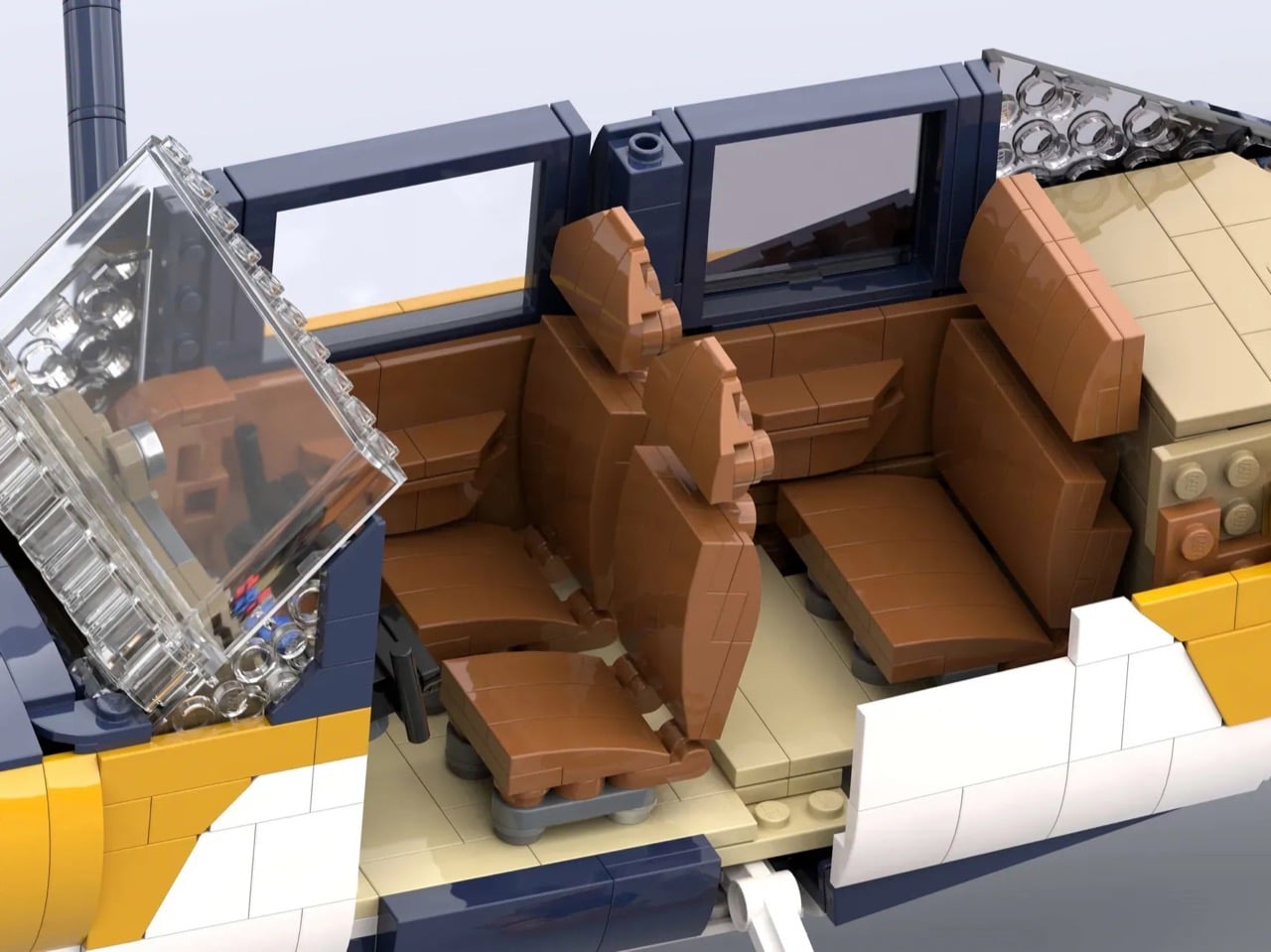
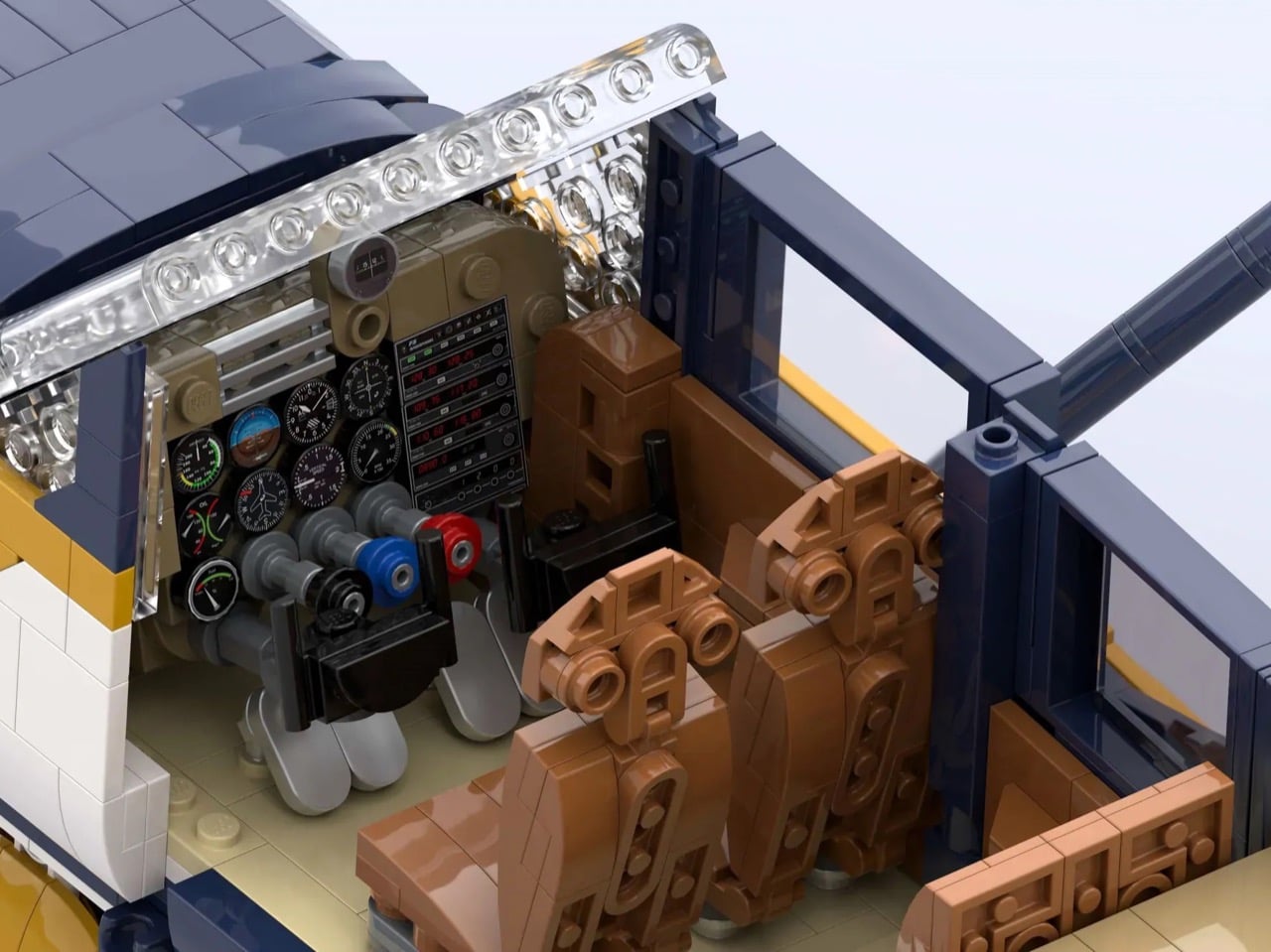
Open the door and the interior holds up. Two adjustable front seats rendered in medium brown, a rear bench, tinted rear windows, and a cockpit panel dense enough with sticker detail that you can actually identify individual instruments. The dual yokes are there. The throttle quadrant is there. This is the kind of interior work that separates builders who understand their subject from builders who are approximating it. The 172’s cockpit is famously approachable and uncluttered, and the model reflects that without oversimplifying.

The color choice is just *chef’s kiss*. Dark blue over dark yellow (curry) with white accents is not a scheme you see constantly in LEGO aviation MOCs, which tend toward red-white or military grey. It gives the model a particular visual weight, something that reads as contemporary but grounded. The way the curry stripe flows along the fuselage and up into the tail mirrors how real-world livery designers think about visual continuity across an airframe. Whether intentional or instinctive, it works.

LEGO Ideas is the official platform where fan-designed sets get a shot at becoming real retail products. Submissions need 10,000 supporters to trigger an official LEGO review, after which the company decides whether to produce it commercially. Mike’s Cessna 172 is currently sitting at just over 1,000 supporters with 598 days left on the clock, which means there is runway to work with. If you have any appreciation for aviation, precision building, or just want to see more interesting things on toy store shelves, head to the LEGO Ideas page and give it a vote.

The post Cessna 172 (The Most Manufactured Plane in History) Just Got Immortalized in 2,000 LEGO Bricks first appeared on Yanko Design.
Stunning LEGO Sony Walkman Replica Features a Dockable Cassettes and Wearable Headphones

It’s weird to think that Walkmans were literally in my lifetime but if I were to give one to a kid born after 2000, they’d wonder what the hell they’re staring at. Sure, an iPod still feels intuitive because it’s still a relatively digital interface, and MP3 files are still a thing. But a cassette? Having to rewind and fast forward? They’re all relics of an age youngsters wouldn’t even recognize anymore!

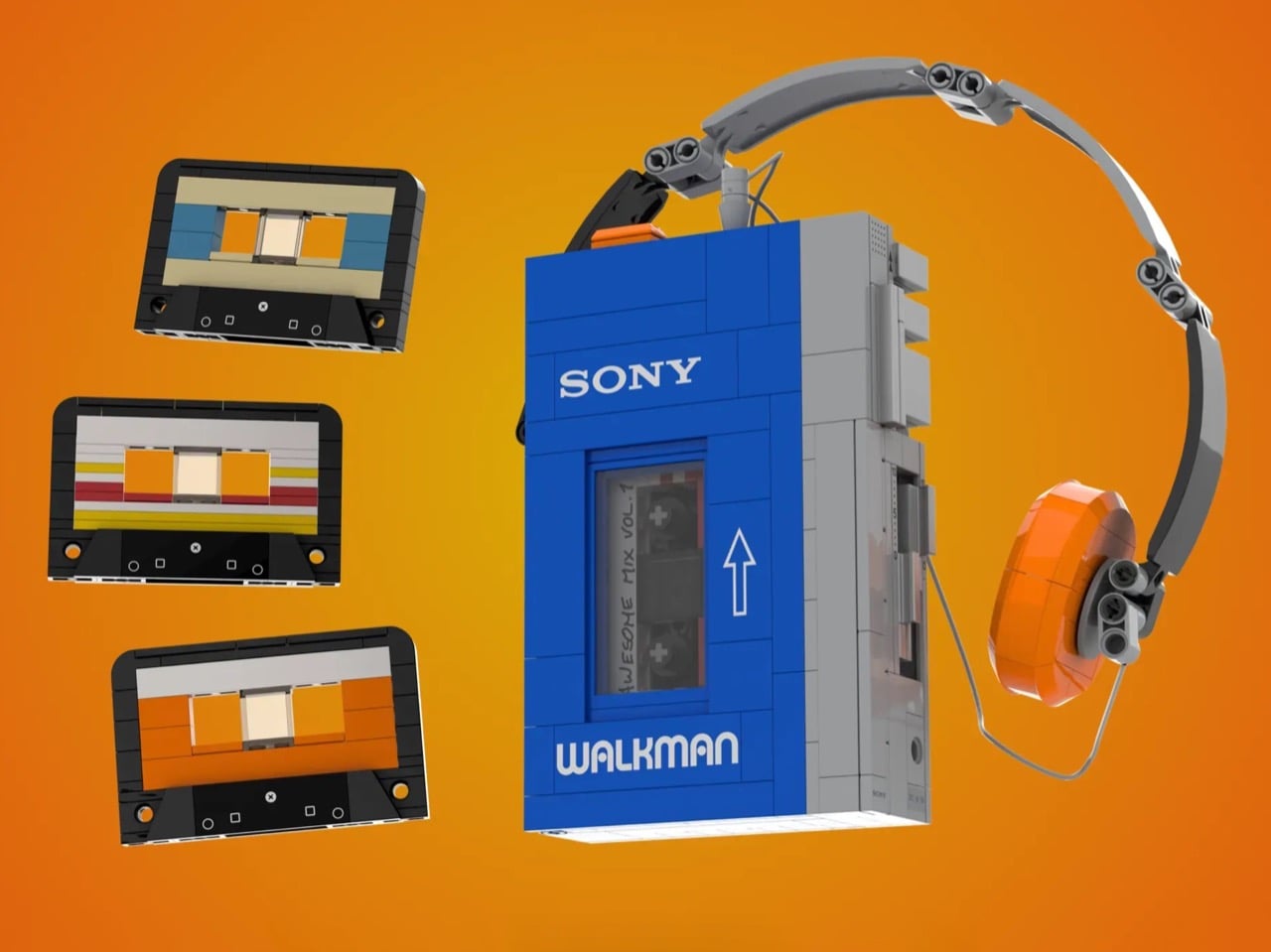
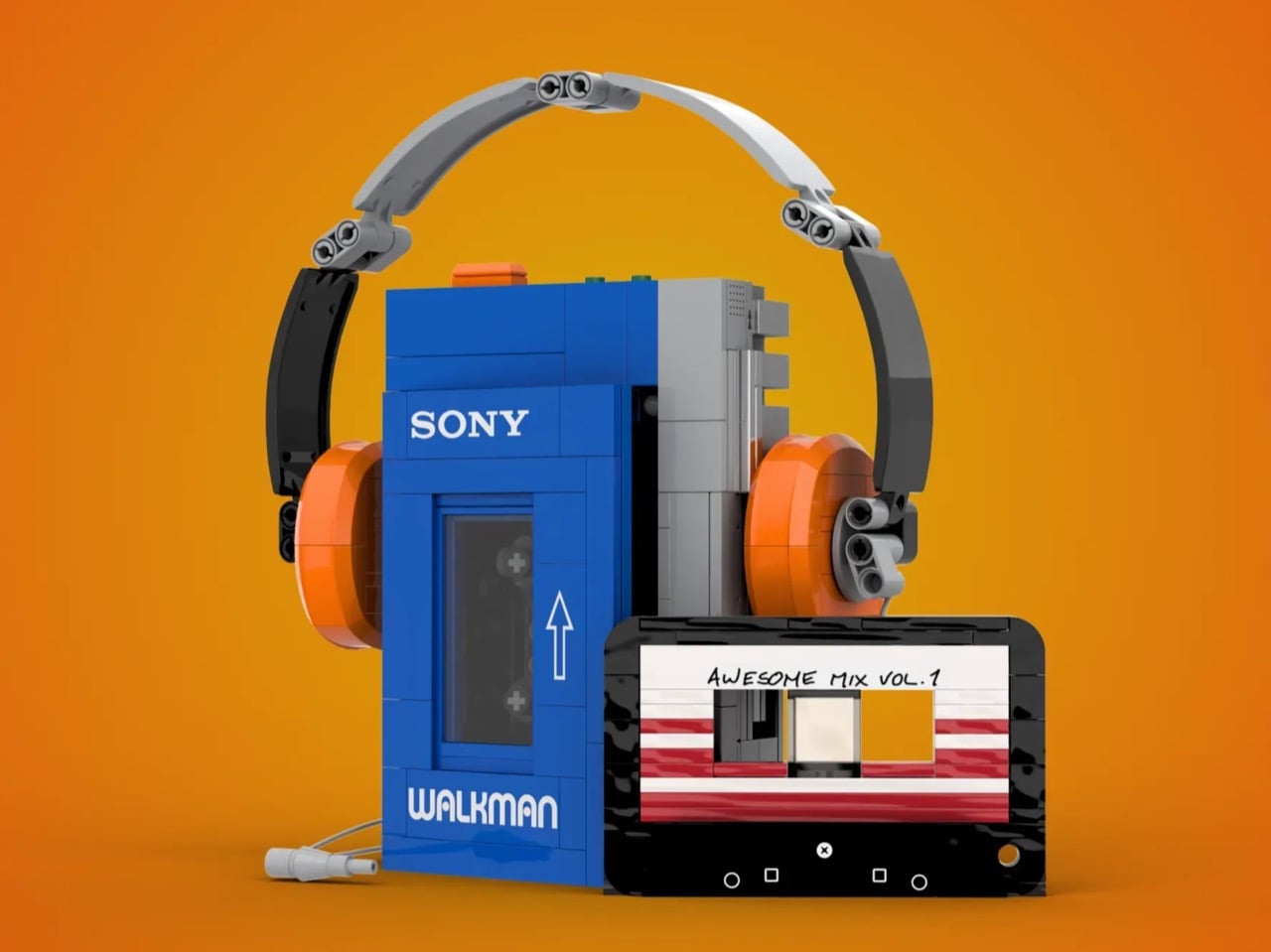
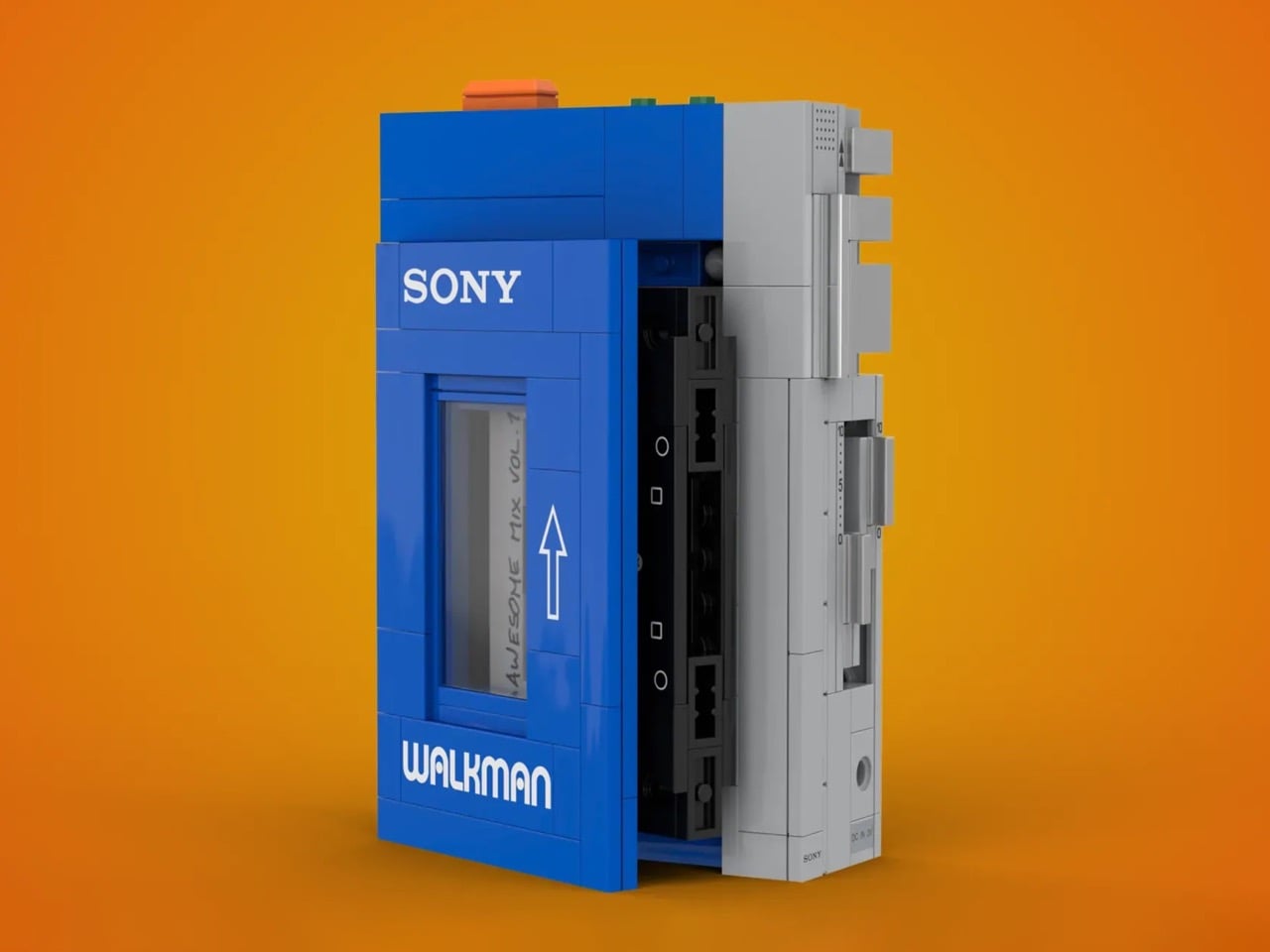
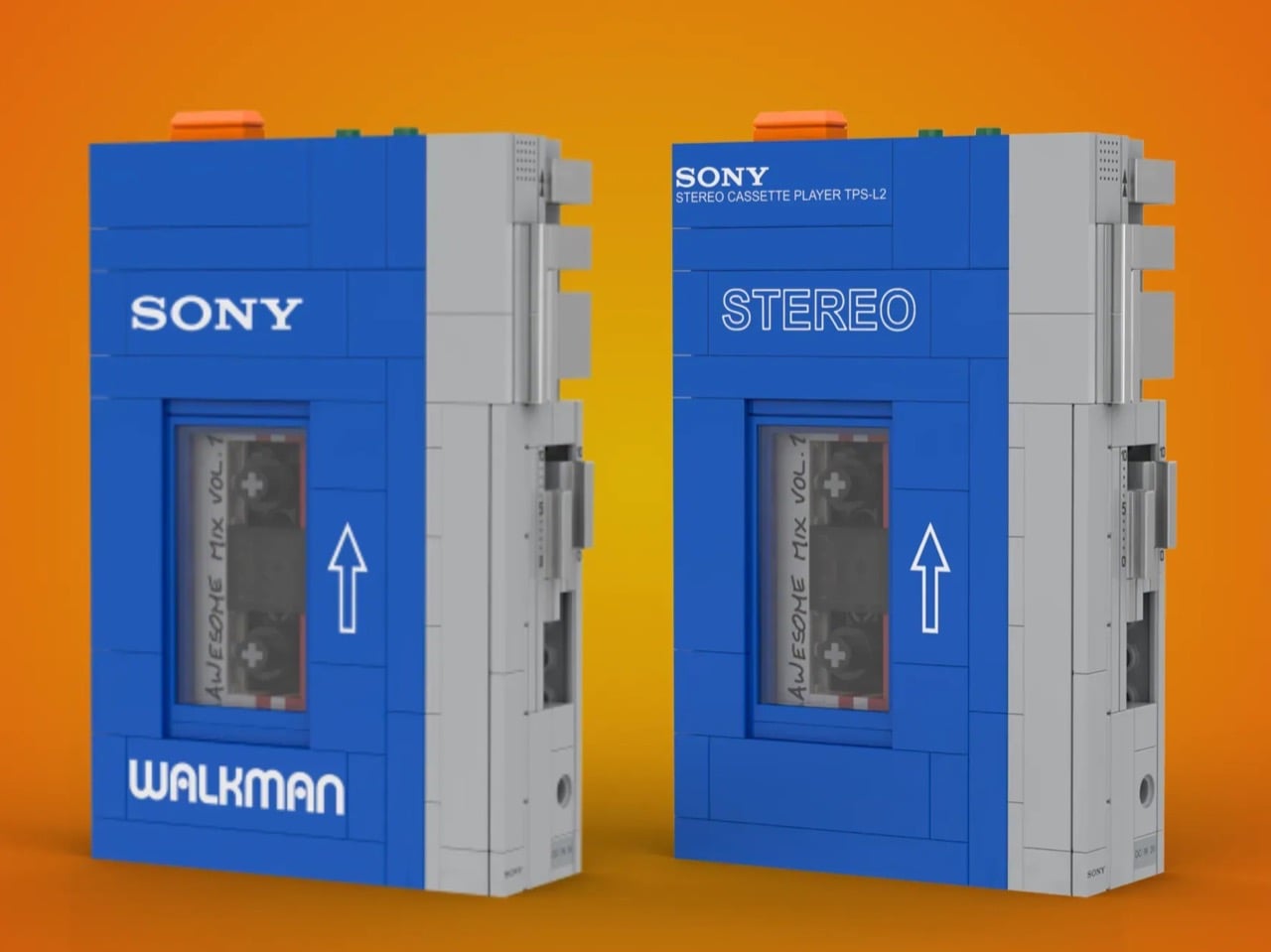
If anything, there’s hope that a kid who’s seen Guardians of the Galaxy would recognize this particular model of cassette player. Featured in the movie as the device that Star Lord operated to play his legendary mixtapes, the Sony Walkman TPS-L2 achieved something remarkable: it made cassette technology cool again for people who’d never touched magnetic tape. Enter Headlight Bricks, a creator who channeled that same Marvel-inspired obsession into a breathtaking LEGO Ideas project. Their 520-piece homage recreates every iconic element from the transparent cassette window to the individually adjustable volume controls, all wrapped in that unmistakable Sony blue. Three buildable cassette tapes let you craft your own mini mixtapes, while the poseable orange headphones complete the authentic 1979 experience.

Designer: Headlight Bricks

Each cassette measures maybe an inch and a half across but manages to pack in customizable label areas where you can swap colored tiles to create different “album art.” One of them references Awesome Mix Vol. 1 from Guardians, probably the one piece of pop culture that did more for cassettes than anything else in the past decade. The cassettes made from LEGO don’t look entirely like you’d expect. They’re missing the gears on the middle that are characteristic of a cassette tape. The reason is simple – making that out of LEGO is a headache, and it does little to add to the original build, which is the player itself. The cassette does its role of fitting into the player, and Headlight Bricks did detail spindles on the inside to complete the illusion. If you want impressive detailing, however, look at that headphone strap, which uses a LEGO Technic part to enable flexibility and movement.

That specific shade of blue paired with light gray side panels captures exactly what Sony’s industrial designers were going for in 1979. They weren’t chasing premium materials or trying to make the TPS-L2 look like jewelry you wore on your belt. It had this utilitarian confidence that said “I do one thing, I do it perfectly, and I don’t apologize for looking like a piece of equipment.” The LEGO version gets that completely right by keeping the form clean and the details purposeful. Besides, everything is perfectly to 1:1 scale, which means this MOC (My Own Creation) accurately captures every single aspect of the Walkman TPS-L2… including even functional buttons.

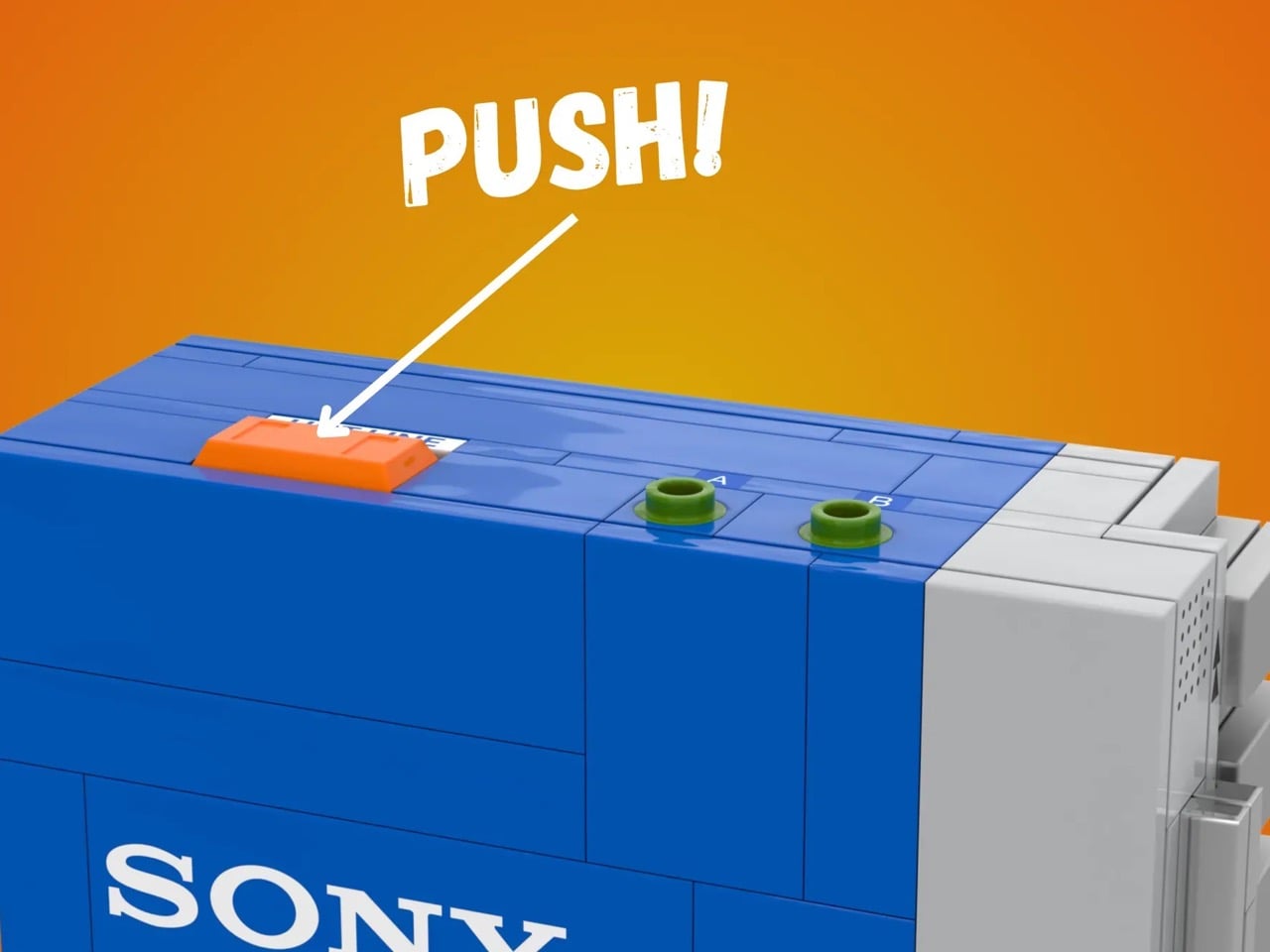
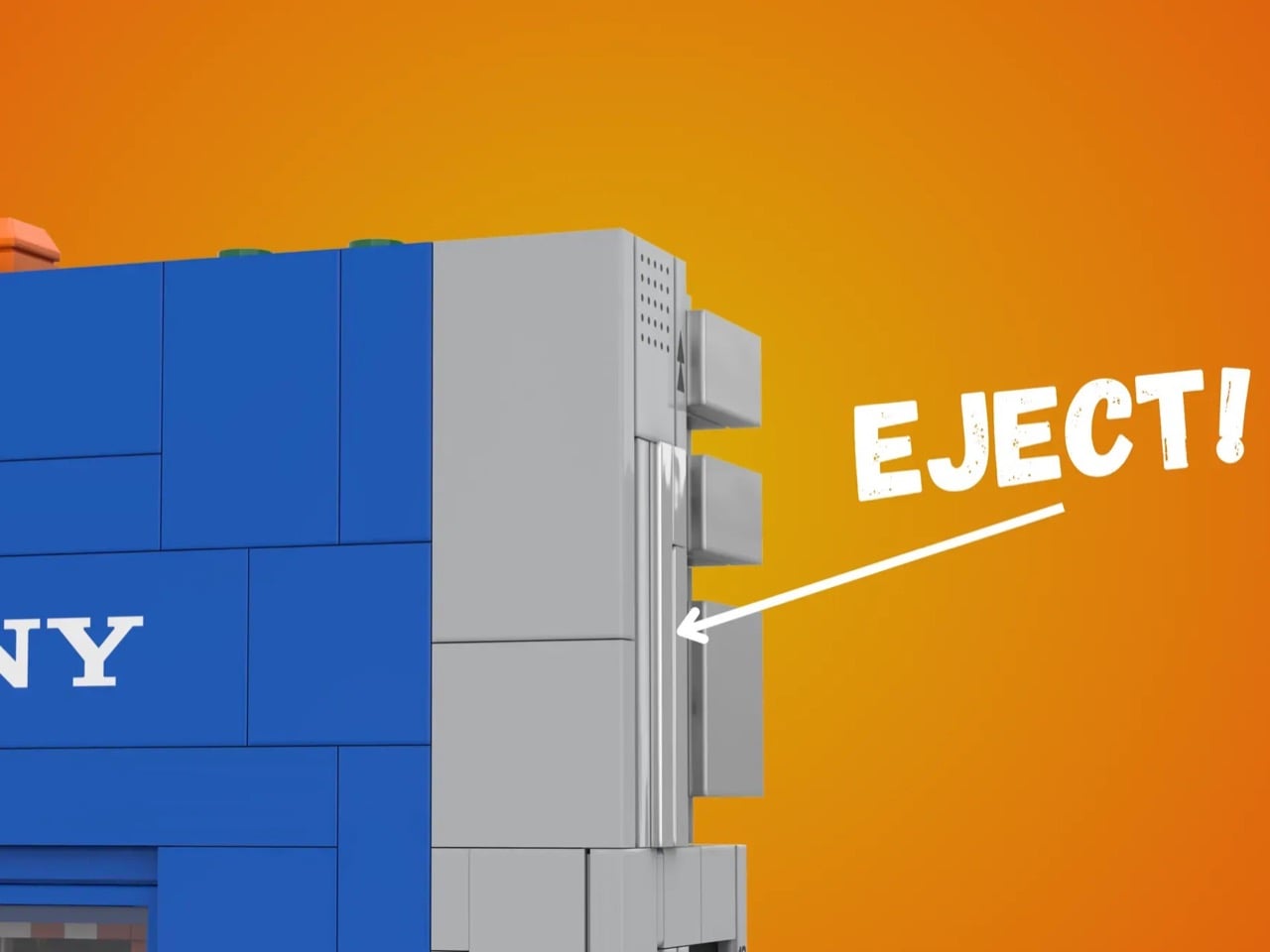
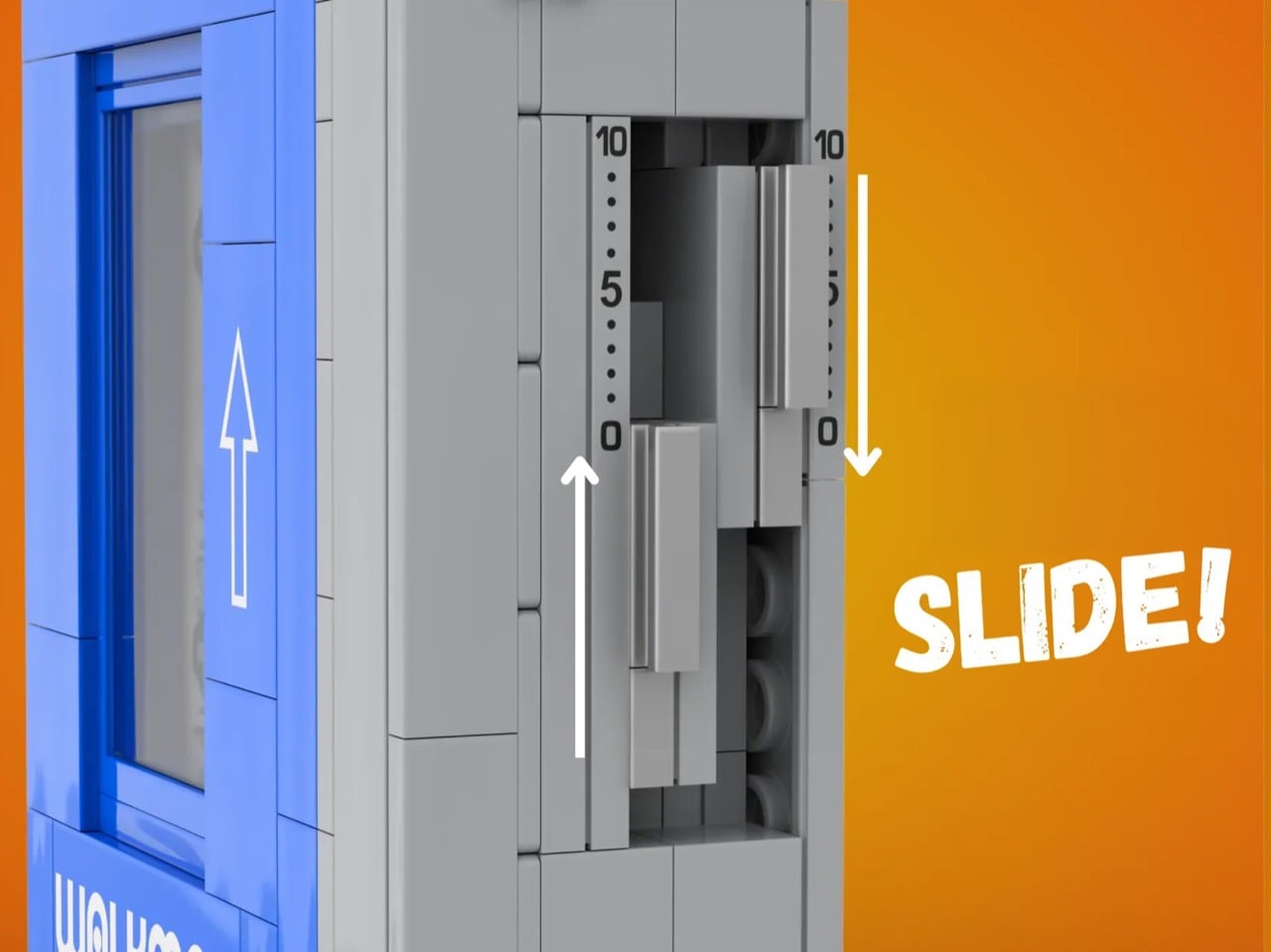
Volume buttons move independently, which means Headlight Bricks had to engineer two separate mechanical systems in a space probably no bigger than a couple of studs wide. The cassette compartment opens with a pressable eject button, and the spindles inside actually rotate when you turn them. Most builders would’ve faked it with printed tiles or stickers, called it close enough, and collected their upvotes. Instead, this thing functions like you could actually thread magnetic tape through it if you were small enough and patient enough.

Right now the project has 4,735 supporters on LEGO Ideas with 445 days left to hit 10,000 votes. Ideas works on a threshold system where fan designs need 10K supporters to get reviewed by LEGO’s actual product team. Getting reviewed doesn’t guarantee production, but it gets your build in front of the people making those calls. They evaluate marketability, licensing complexity, manufacturing feasibility, whether it fits the brand… which this one surely does, with its iconic, retro-throwback fun design. Whether Sony agrees to comply is an entirely separate issue.

You want to see this become a real product you can order? Go to the LEGO Ideas Website and hit the Support Idea button!. You need a free LEGO account to vote, takes maybe thirty seconds to set up if you don’t have one already. Hit the support button, leave a comment if you feel like it, and you’re done. At 4,738 supporters (me included), this build is inching towards the 10,000 vote mark needed to put this build into the ‘Review’ phase. LEGO managed to produce a working typewriter you can buy. A Walkman with rotating cassette mechanisms and pressable buttons feels like the obvious next move in that category.

The post Stunning LEGO Sony Walkman Replica Features a Dockable Cassettes and Wearable Headphones first appeared on Yanko Design.
LEGO Shrek’s Swamp Build Captures What the Official Set Missed Entirely

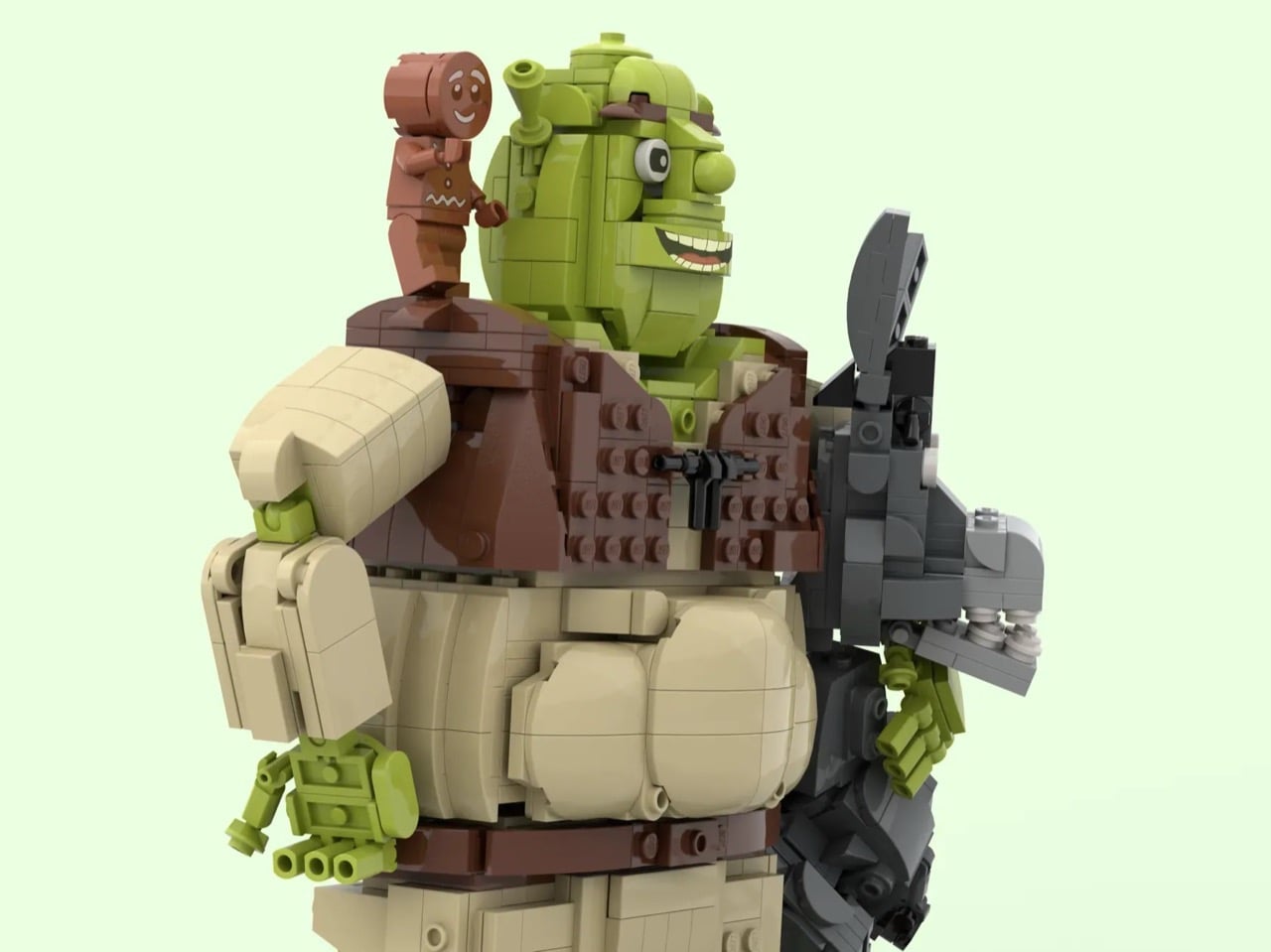
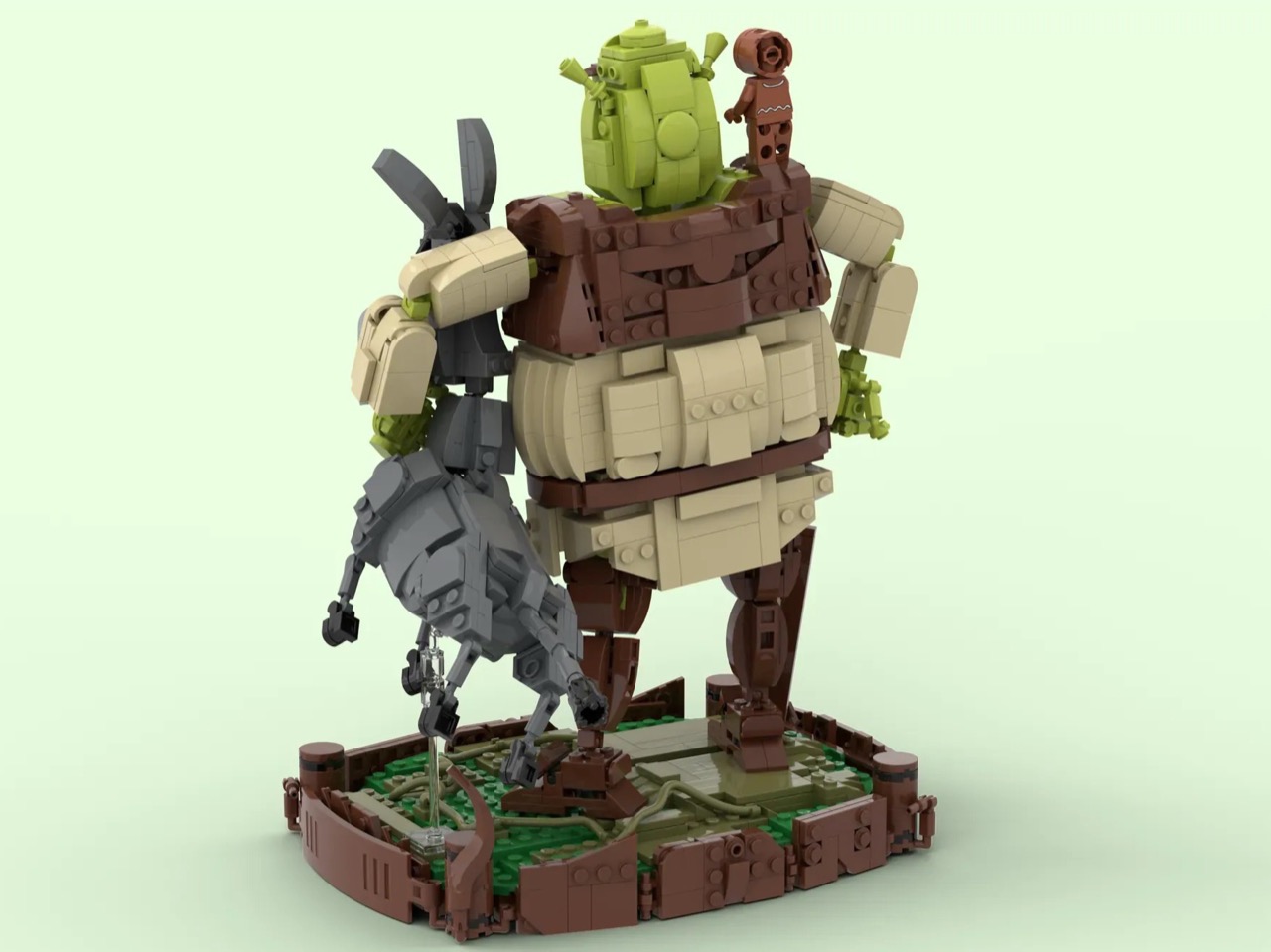
Layers. Ogres have them, onions have them, and now this remarkable LEGO Shrek build has approximately 1,300 of them stacked into one of the most charming character tributes currently seeking support on LEGO Ideas. While collectors can already buy Shrek minifigures, this project offers something entirely different: a fully brick-built display model that brings sculptural ambition to Far Far Away’s most famous resident.

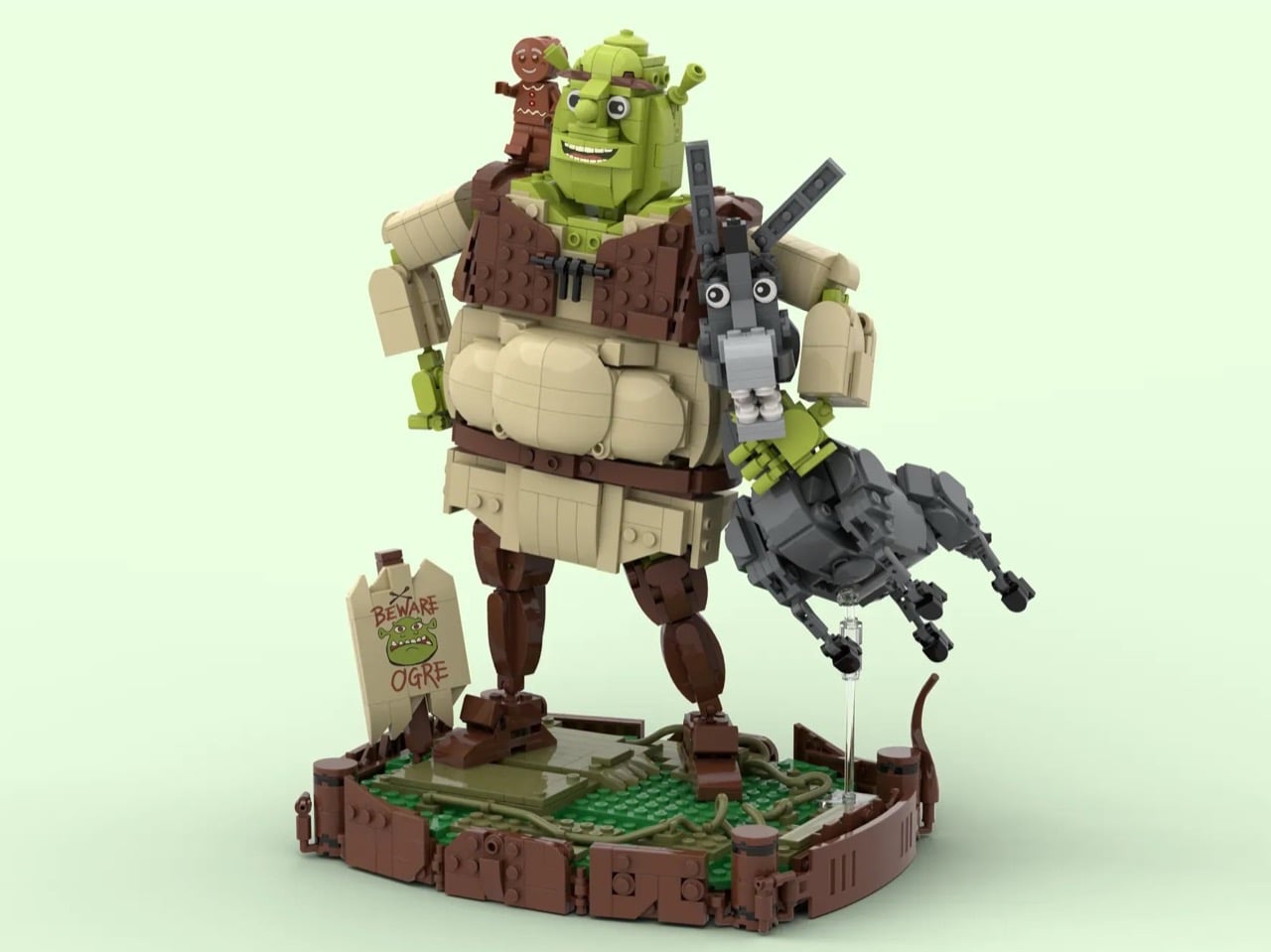
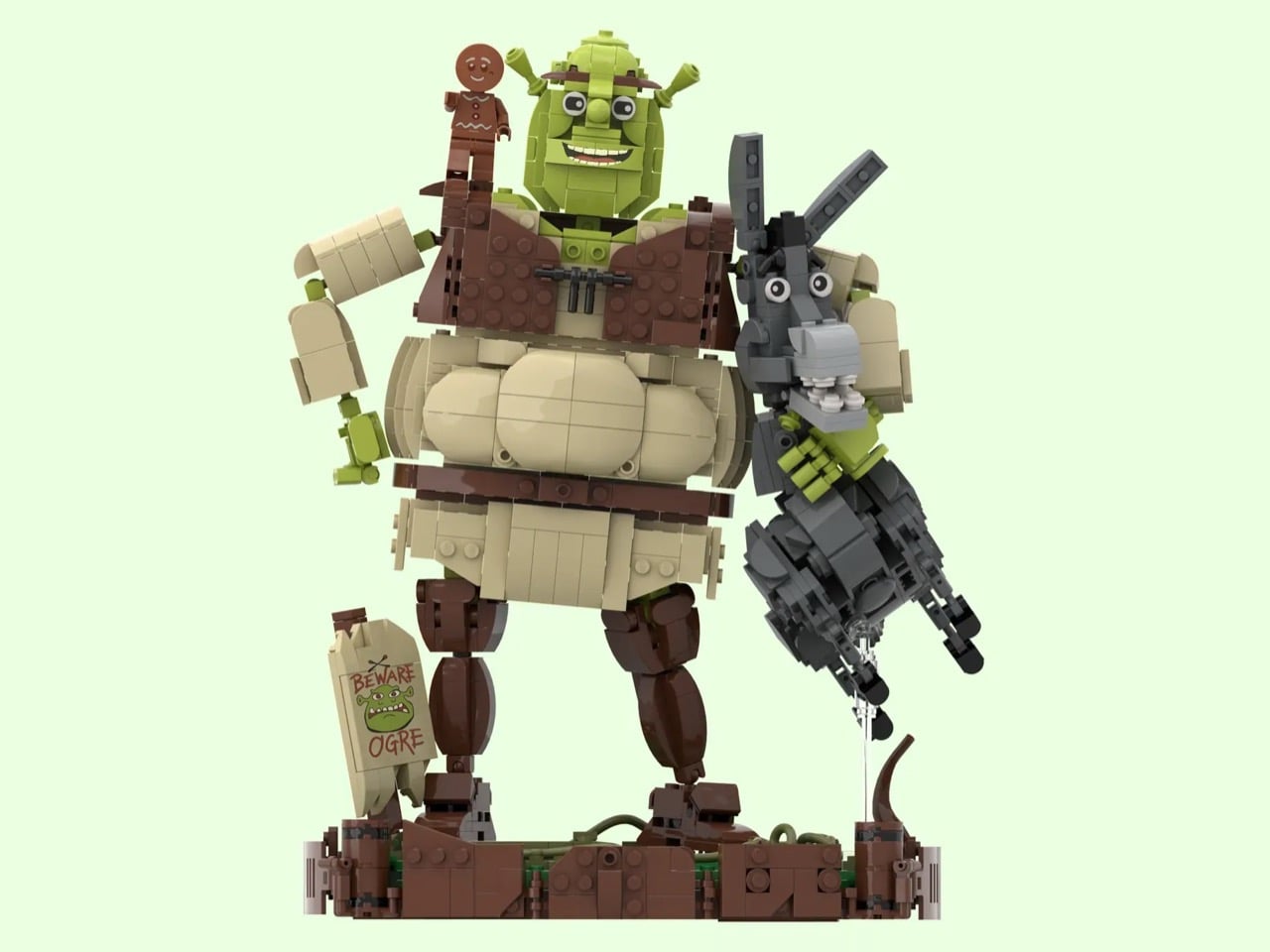
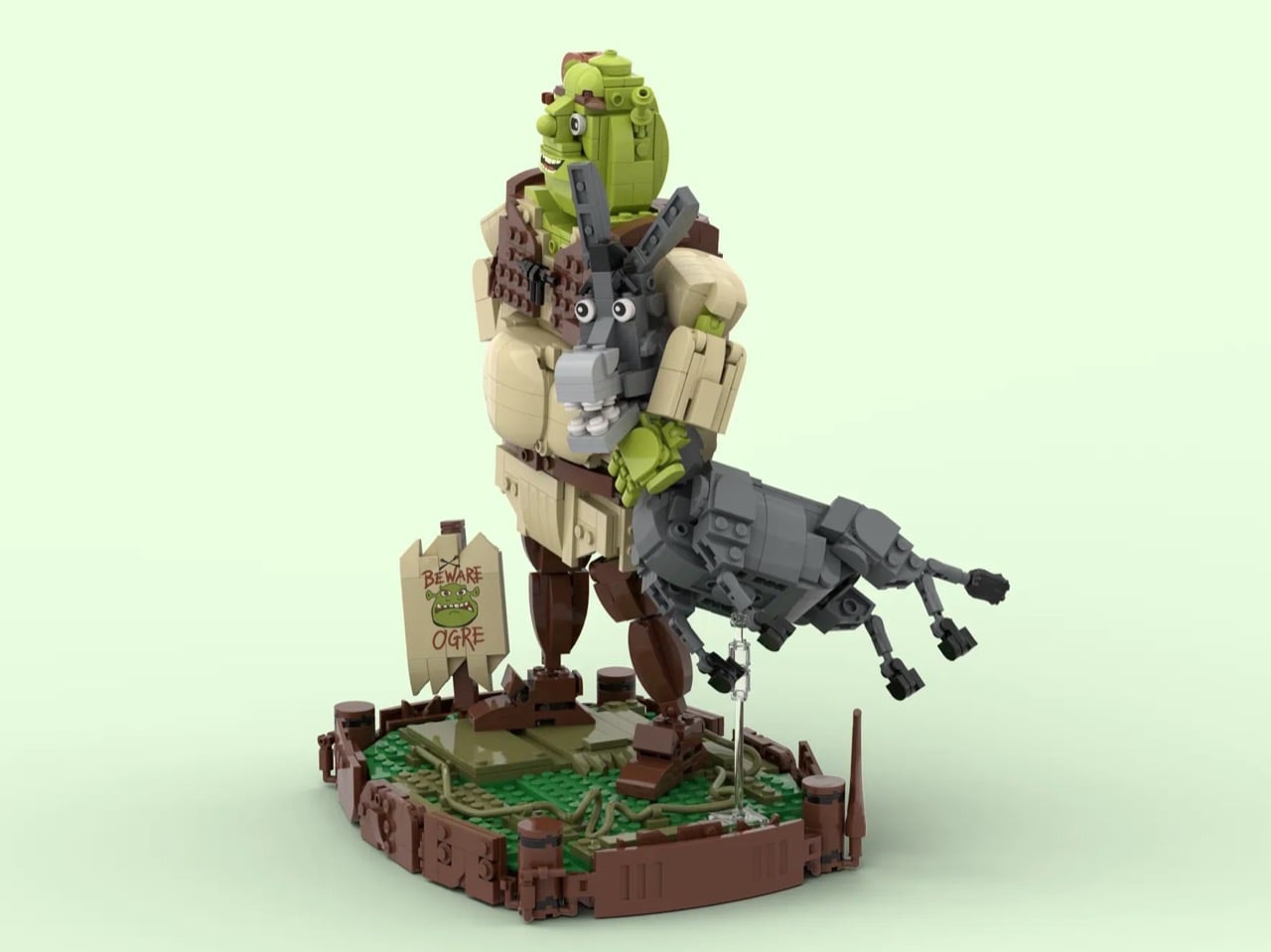
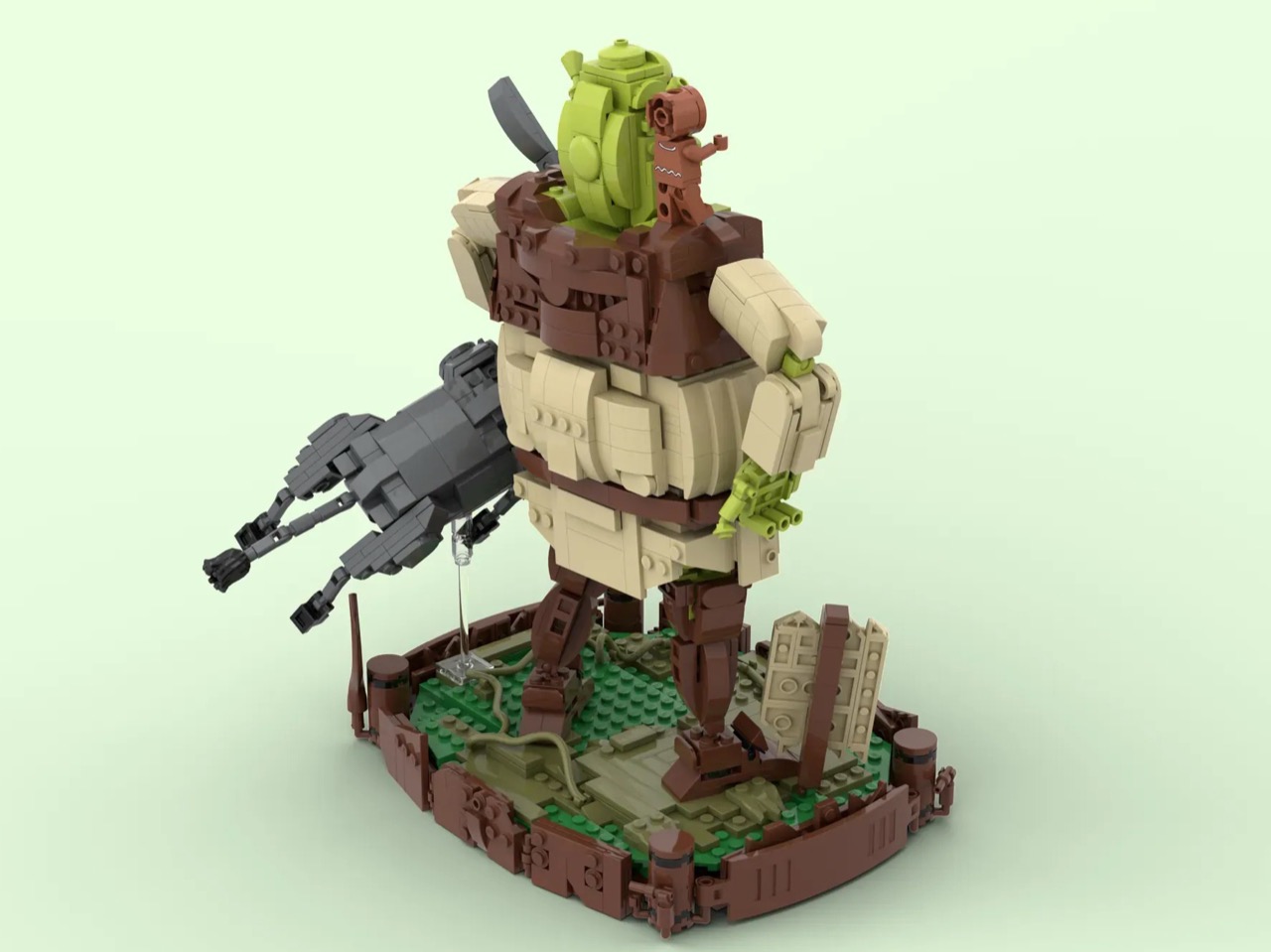
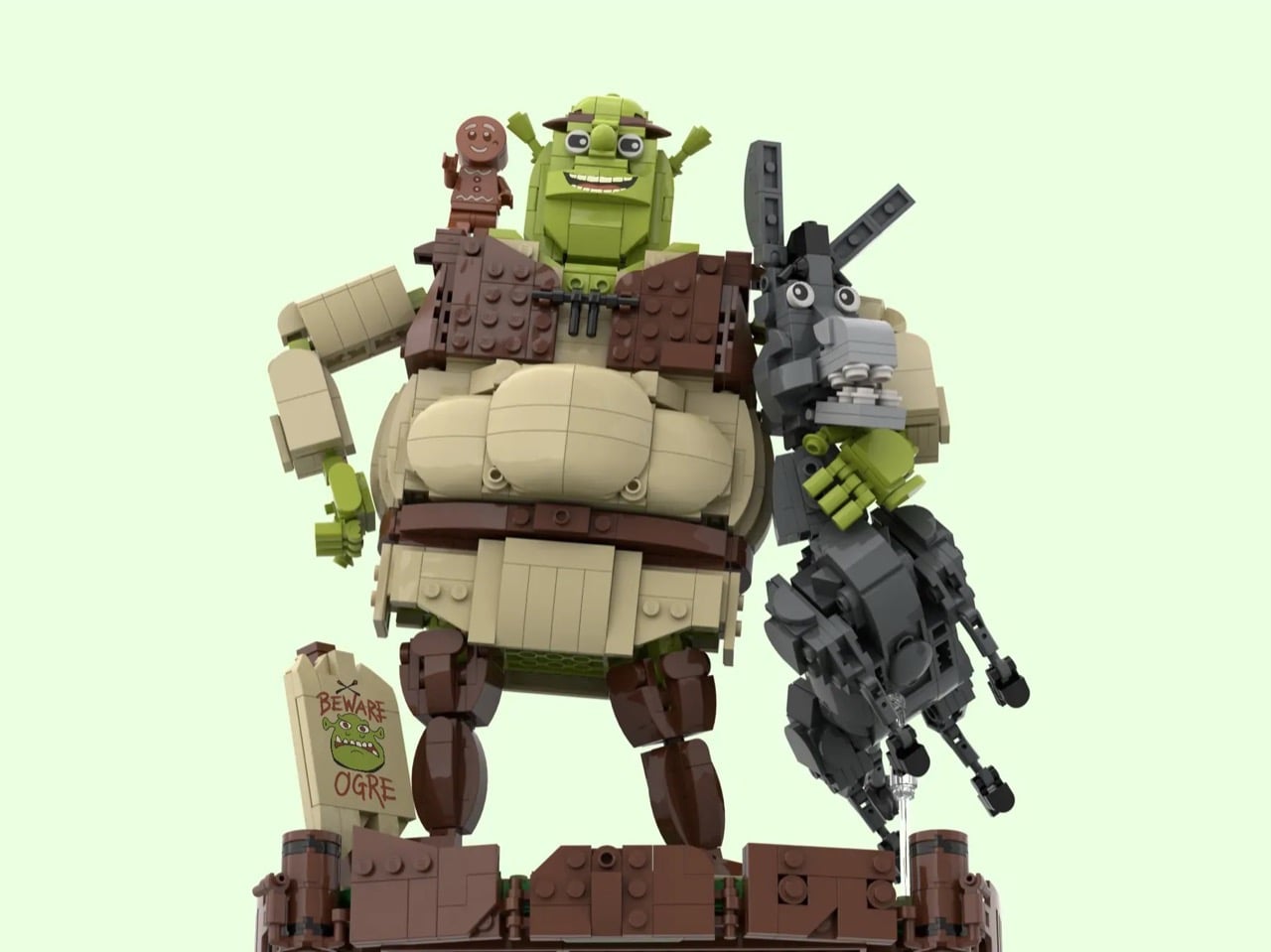
Creator Memorph has transformed roughly 1,300 LEGO pieces into a display model that perfectly balances character accuracy with structural ingenuity. Donkey finds himself in a friendly headlock while the Gingerbread Man perches on Shrek’s shoulder, both built at smaller scales to create a dynamic composition. The swamp base completes the scene with textured vegetation and the iconic “BEWARE OGRE” warning sign, making this a love letter to DreamWorks’ beloved franchise that goes far beyond what traditional minifigure sets can achieve.

Designer: Memorph

Shrek hit theaters in 2001 and immediately became the anti-Disney fairy tale everyone didn’t know they needed. DreamWorks took every princess trope, dunked it in swamp water, and gave us an ogre who just wanted to be left alone with his layers of emotional complexity. The film spawned three sequels, became a meme goldmine decades later, and somehow made Rufus Wainwright’s cover of “Hallelujah” the definitive version for an entire generation who’ll fight you about Leonard Cohen’s original.

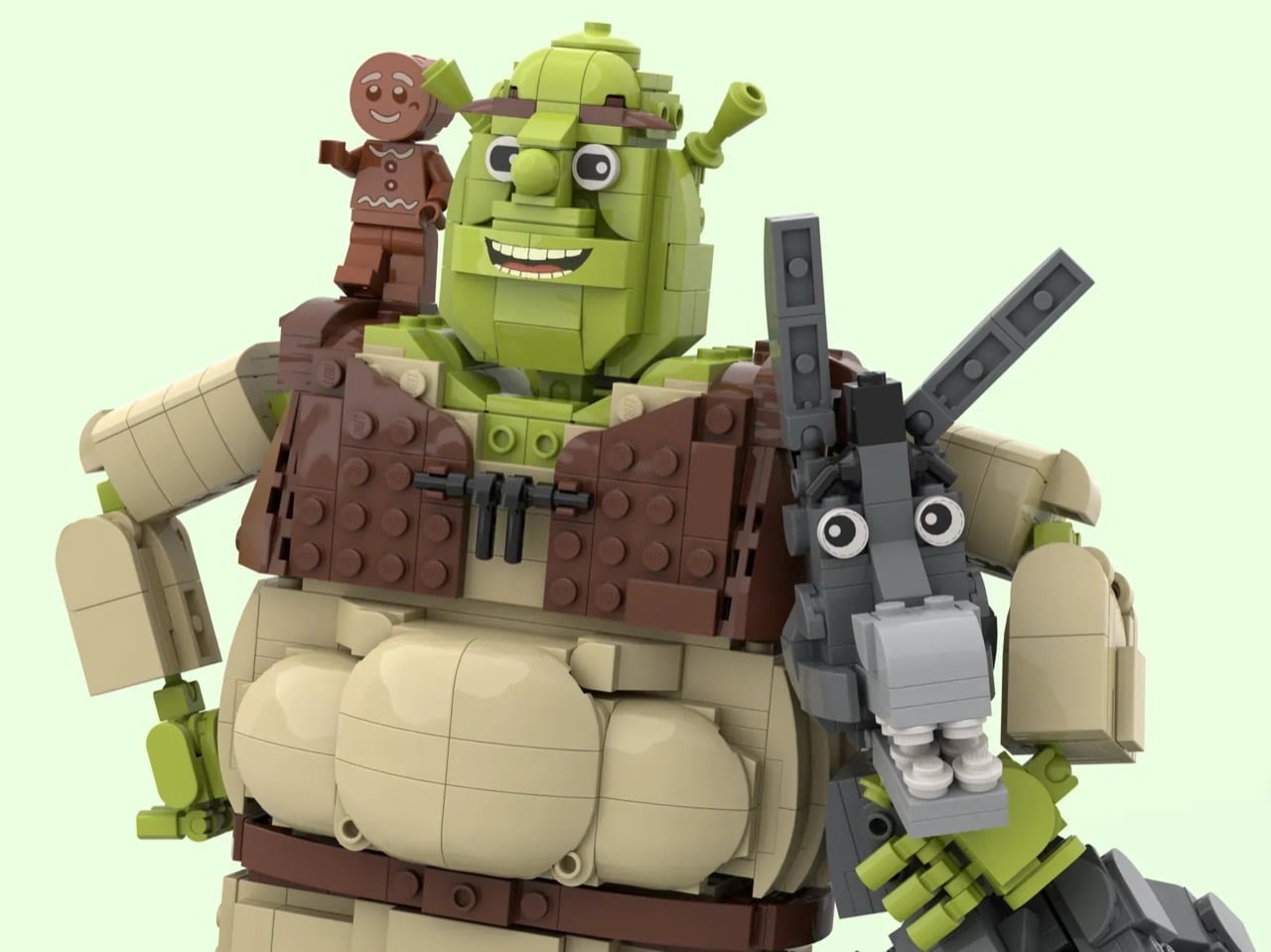
Twenty-plus years later, people still quote the movie constantly, still reference the swamp aesthetic, and still have strong opinions about which sequel actually holds up. Memorph nailed this perfectly, with a build that accurately captures Shrek’s personality through curved slope pieces that form his rounded belly, strategic color blocking that transitions seamlessly from green torso to tan skin, and that trademark smirk with eyebrows raised in perpetual annoyance. His stubby fingers articulate, the arms have decent range of motion, and the vest sits with a slight rumple that makes him look lived-in rather than rigidly geometric.

Donkey stands at roughly a third of Shrek’s height, and the scale difference creates visual hierarchy that keeps your eye moving around the whole composition. Those big eyes and articulated legs pack surprising detail into a much smaller footprint. You can immediately tell it’s the motor-mouthed sidekick even without color cues. The Gingerbread Man perched up on Shrek’s shoulder is actually a modified minifigure, fitting the scene’s scale perfectly. The swamp base uses textured green plates and brown borders to ground everything, plus that warning sign with the printed “BEWARE OGRE” text. Yeah, it’s a sticker or print, but building those letters from bricks would have looked like garbage.

LEGO already makes a Shrek set with standard minifigures, the kind kids bash together during playtime. This exists in an entirely different category. You wouldn’t compare buying an action figure to commissioning a sculpture, right? Brick-built character models target adult collectors who want both the building experience and something shelf-worthy when they’re done. The brick-built Mickey Mouse sold well, BrickHeadz became an entire product line, and there’s clearly appetite for display pieces that require actual building skill. At 1,300 pieces, this hits that zone where the construction feels substantial without demanding you clear an entire weekend. You could knock this out over a few evenings and actually enjoy the process instead of grinding through repetitive sections.

Memorph submitted this through LEGO Ideas, which operates as crowdsourced product development. Projects need 10,000 supporters within a set timeframe to trigger an official review by LEGO’s team. Right now this Shrek build has 187 supporters with 425 days left on the clock. Hitting 10K doesn’t guarantee production since LEGO still evaluates manufacturing viability, licensing agreements with DreamWorks, and whether it fits their current lineup. Plenty of projects reach the threshold and still get rejected. But it’s literally the only mechanism for turning a fan concept into something you can buy at a store.

You want this on your shelf? Go to the LEGO Ideas page and click support. Takes thirty seconds if you have an account, maybe two minutes to create one if you don’t. The platform costs nothing, you’re just registering interest in the concept. We could use more brick-built character models that actually capture personality instead of looking like someone’s first attempt at geometric abstraction. Shrek proves organic curves and expressive faces work when the builder genuinely understands how LEGO pieces interact. Plus, any excuse to get Donkey in a headlock is worth supporting.

The post LEGO Shrek’s Swamp Build Captures What the Official Set Missed Entirely first appeared on Yanko Design.
LEGO Just Released a $120 Sea Otter Set That Connects So They Can Hold Paws

Sea otters hold hands when they sleep. It’s one of those facts that makes you stop scrolling and smile, the kind of detail that feels almost too charming to be true. But it is true, and now it’s immortalized in LEGO form.

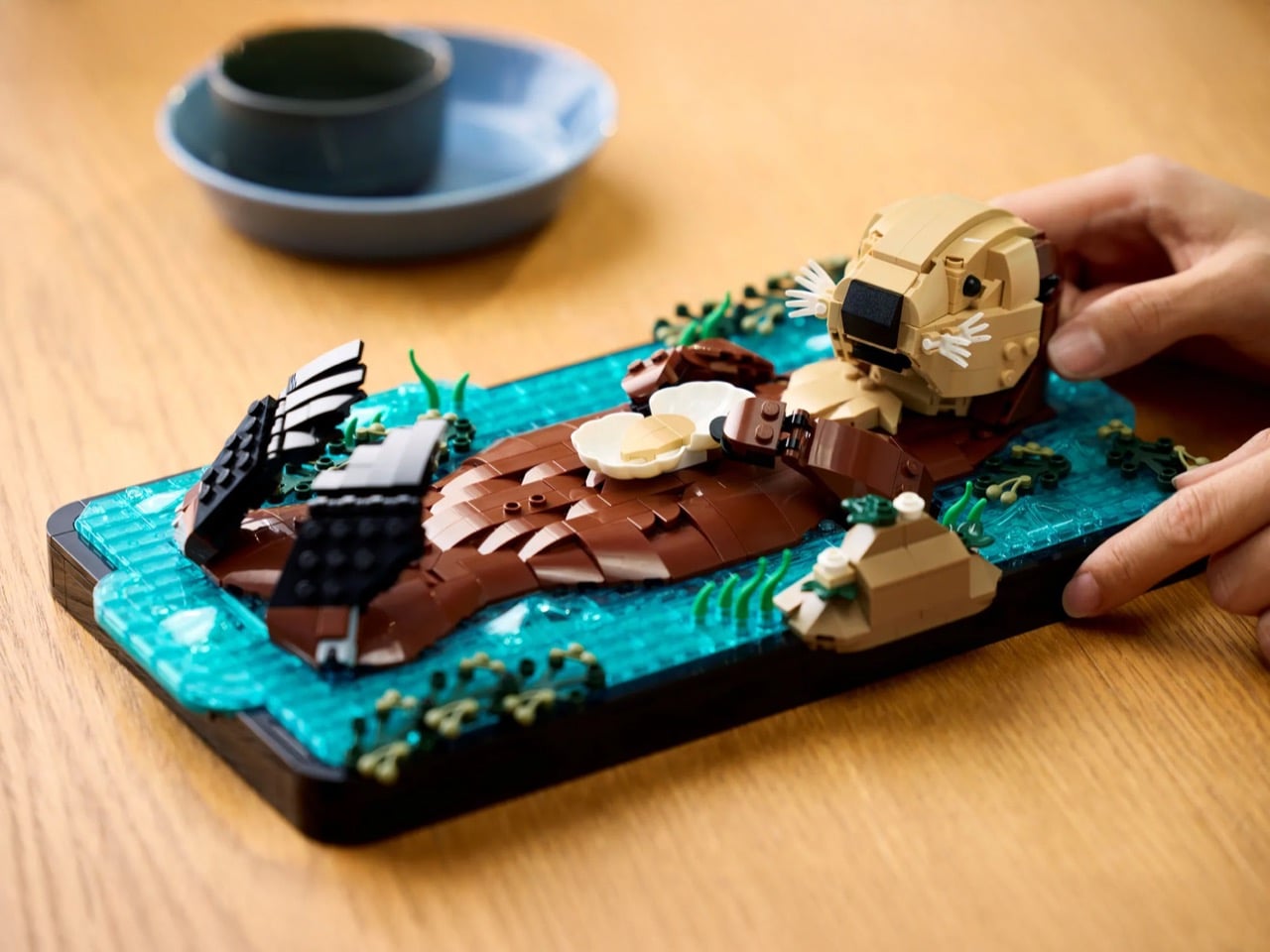
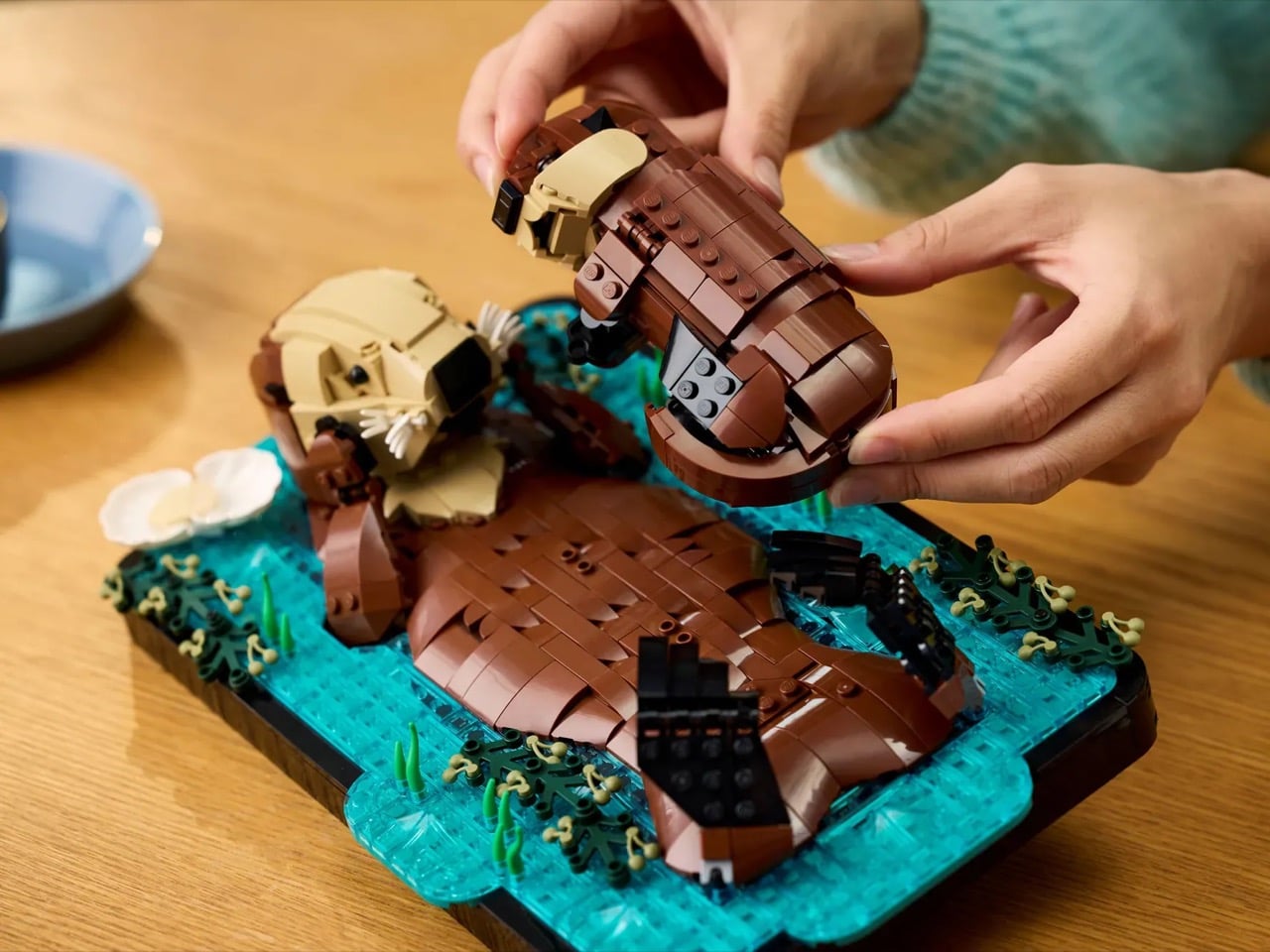
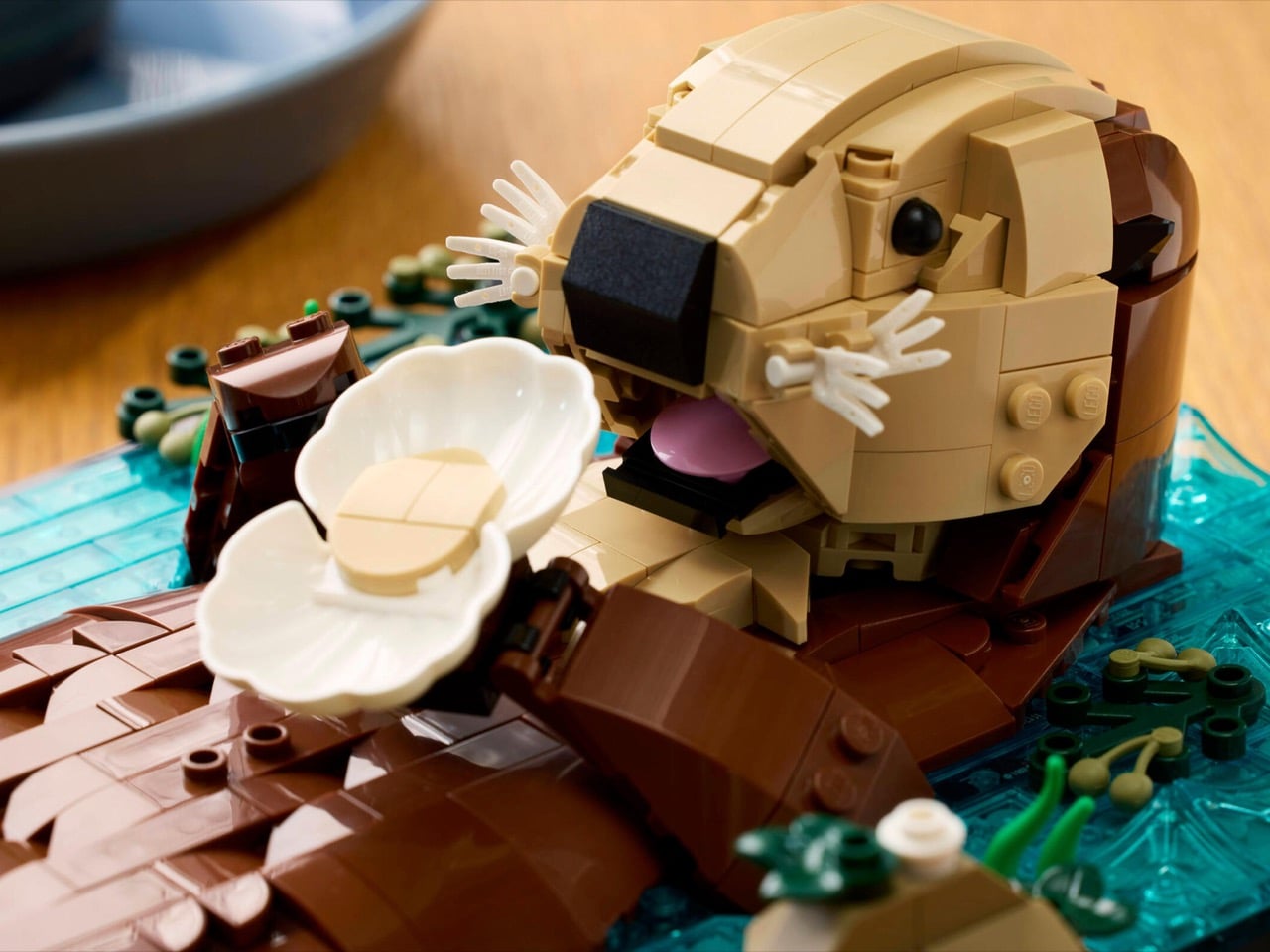
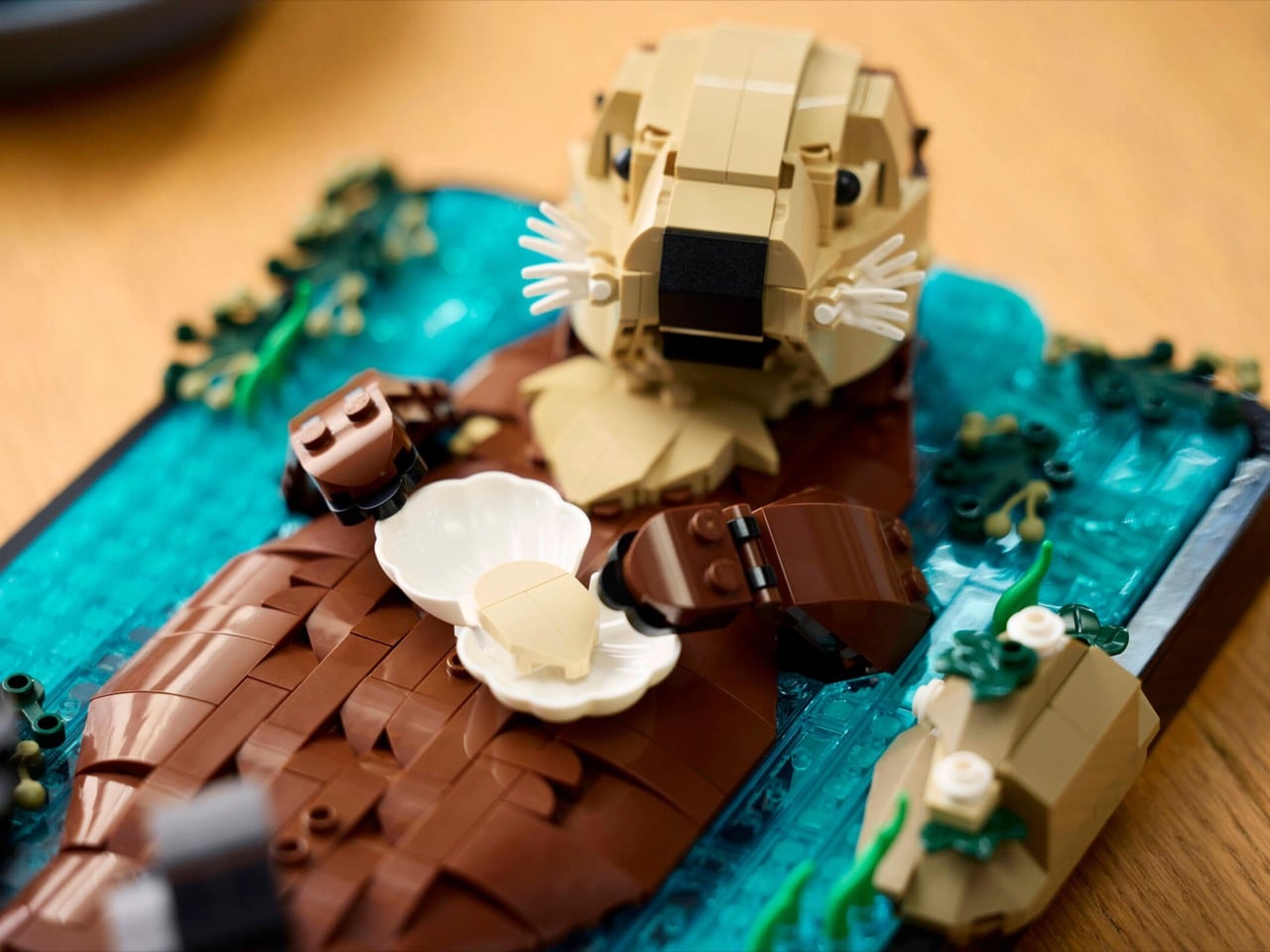
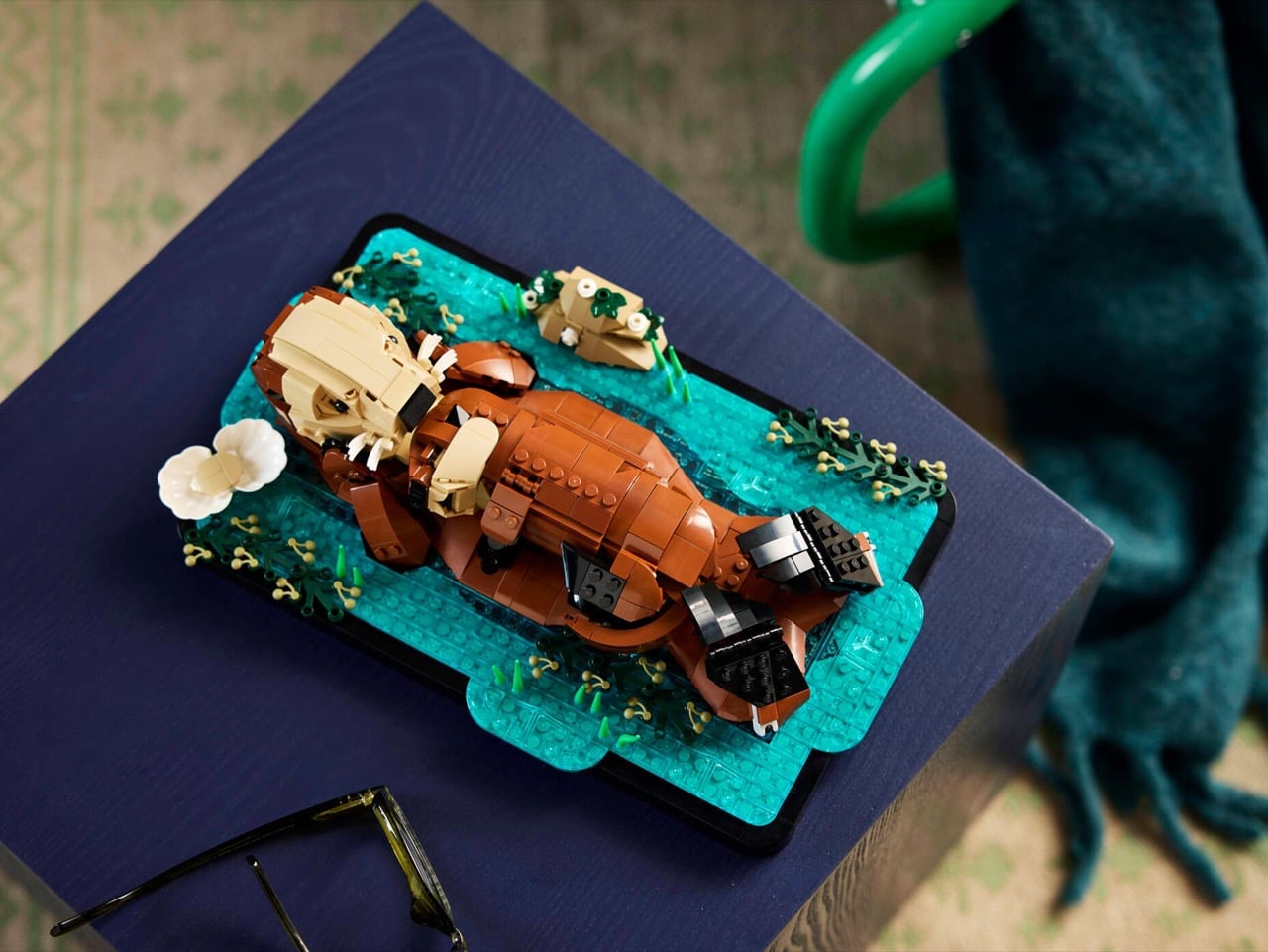
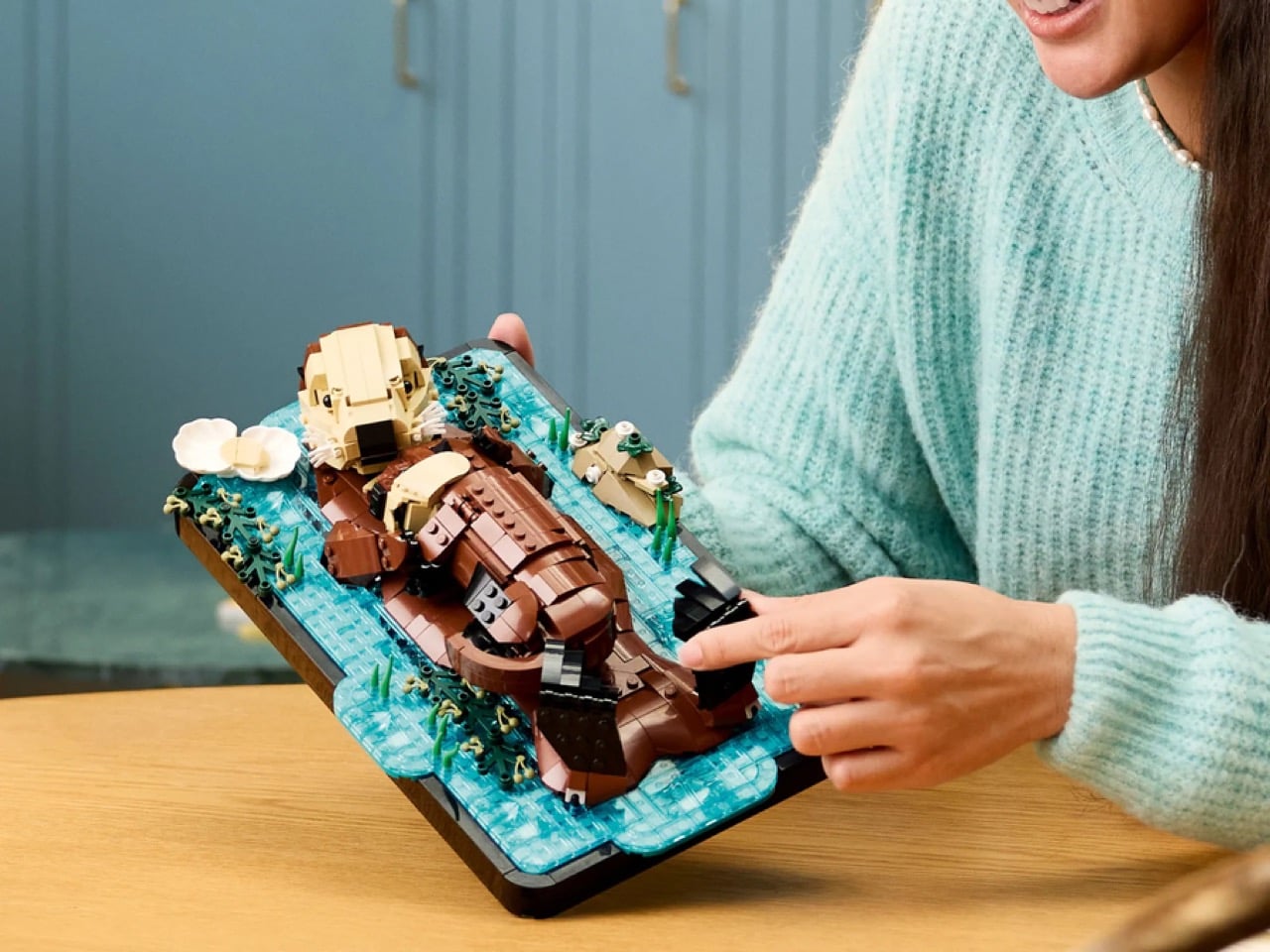
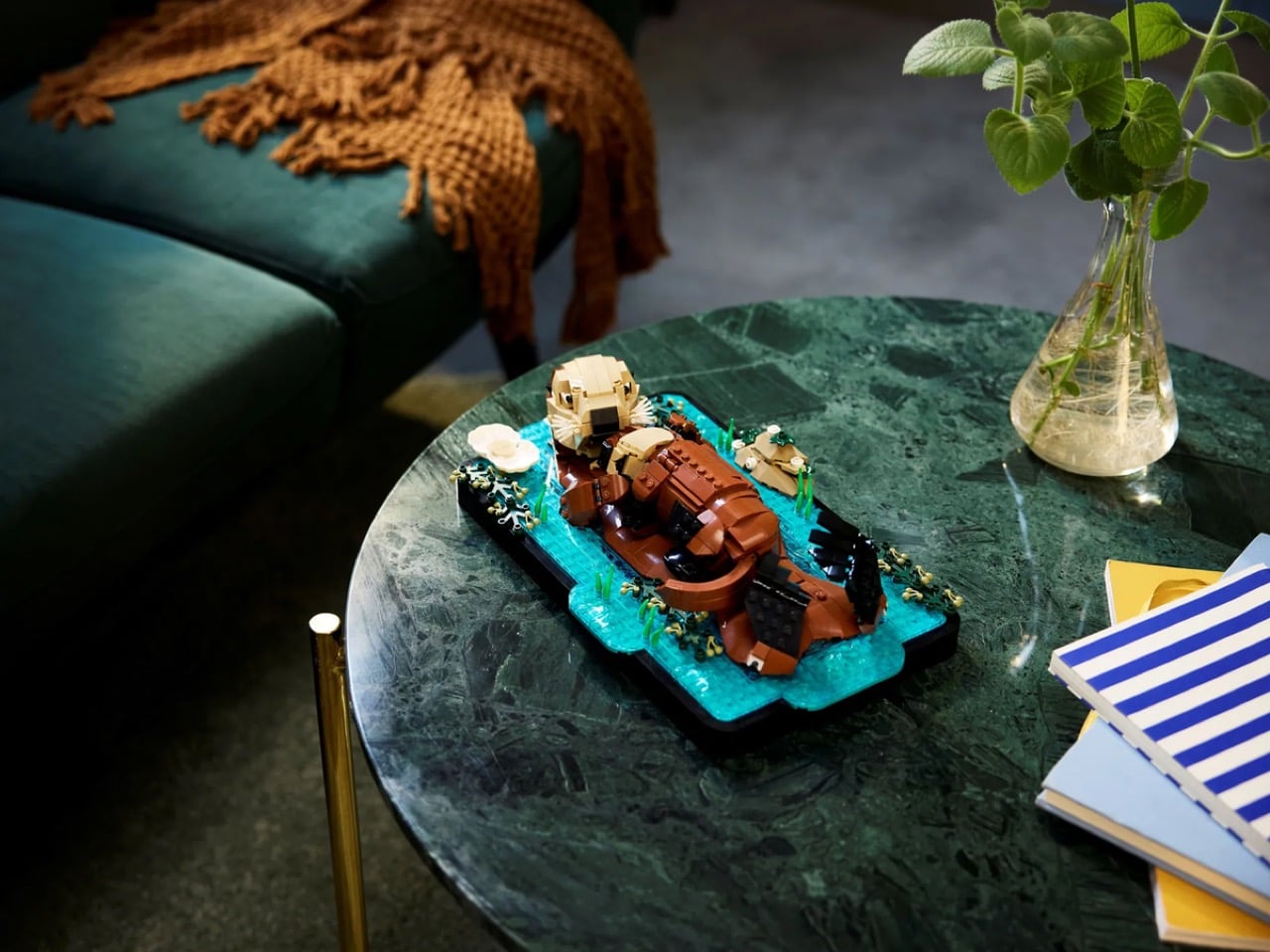
The Floating Sea Otters set (21366) started as a fan submission by Maximilian Lambrecht and evolved into something even more endearing than the original design. What began as a single otter floating in kelp became a mother cradling her pup, complete with articulated arms and a secret feature that lets two sets connect so the otters can hold hands. The LEGO designers didn’t just approve the concept. They found ways to make it cuter.

Designers: LEGO & Maximilian Lambrecht

LEGO Ideas has always been the platform’s most interesting experiment in crowdsourced design, and this set demonstrates why the model works when it actually works. Lambrecht submitted his original concept in April 2024 after spending two months researching sea otter ecology and visiting the Berlin Zoo to nail the anatomical details. His submission hit 10,000 supporters, clearing the first hurdle, and then LEGO Designer Chris McVeigh got his hands on it. The transformation between fan concept and retail product tells you everything about how professional iteration elevates good ideas into genuinely compelling builds.

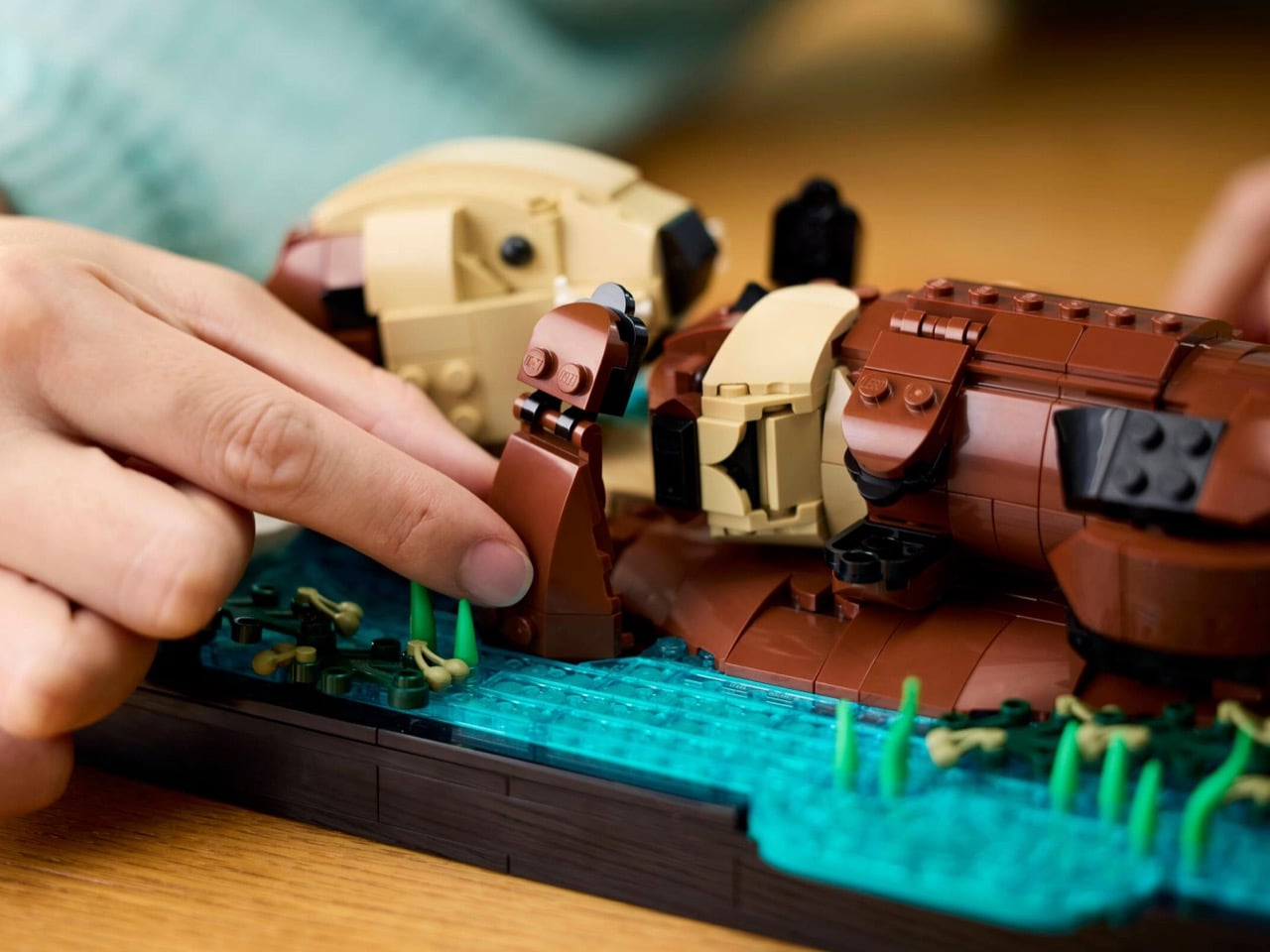
Lambrecht’s original design featured a single otter with movable paws, head, and mouth. Solid foundation, but McVeigh saw room to amplify the emotional hook. Adding the pup required rethinking the entire structural approach. The mother needed to be fully reclined rather than partially upright, which meant her arms had to articulate underwater to cradle the baby. That change cascaded into making the base thicker to accommodate the elbow joints, then extending the water elements over the edge of the base to maintain visual balance. Each decision triggered the next, the kind of iterative refinement that separates amateur builds from retail products.

Clear blue tiles layered over teal plates create the water surface, and the effect punches well above its complexity. You get depth and shimmer without overcomplicating the build or inflating the piece count. LEGO hasn’t released official specs yet, but based on the photos this looks like a 400 to 500 piece range, putting it in that sweet spot for display sets: complex enough to be satisfying, simple enough to finish in an evening. The technique isn’t revolutionary, but the execution nails the balance between realism and LEGO’s inherent abstraction. Sometimes the best design choices are the ones that don’t call attention to themselves.
Two sets can connect so the otters hold hands while floating. Real sea otters do this to avoid drifting apart while sleeping, and McVeigh could have easily skipped this feature in favor of simpler construction. But keeping that behavioral detail intact means the set works as both a display piece and an actual reflection of sea otter ecology. Lambrecht wanted the educational angle from the start. “The sea otter plays a key factor in maintaining and nurturing kelp forests as well as affecting rocky ecosystems,” he explained during development. “It was important to me to implement those aspects into my build as well.” McVeigh honored that intent instead of stripping it away for mass market appeal, which is rarer than you’d think in licensed product development.

Curved brown plates stack to suggest the otter’s rounded body, white shell pieces become claws, and the head construction uses enough articulation to give each build a slightly different personality. Lambrecht mentioned that “getting the head right was definitely a tough shell to crack,” which makes sense when you’re trying to capture organic shapes with rectangular bricks. The retail version keeps that challenge visible in a good way. You can see the construction technique, understand how it works, and still read it as unmistakably otter. Lambrecht’s kayaking encounter with a river otter stuck with him. “For me, this experience was truly magical. It’s a memory I wanted to cherish, brick by brick.” That kind of personal connection to source material shows up in the final product, which is probably why McVeigh’s team worked to preserve it rather than homogenize it.

The set is up for pre-order now at $119.99 and ships March 1, 2026. That’s steeper than I expected for the piece count, but Ideas sets have been creeping up in price across the board lately. You’re paying partly for the articulation engineering, partly for the fan designer royalty structure, and partly because LEGO knows people will pay premium for cute animal builds. If you want the hand-holding feature to actually work, you’re looking at nearly $240 for two sets, which is a tough sell unless you’re really committed to the bit. Still, for a single display piece with actual ecological messaging baked in, it’s competitive with other recent Ideas releases. Pre-orders tend to sell through fast on these, so if you’re interested, don’t sleep on it.

The post LEGO Just Released a $120 Sea Otter Set That Connects So They Can Hold Paws first appeared on Yanko Design.