OpenAI has been hit with another lawsuit. This time, Encyclopedia Britannica took legal action against OpenAI, accusing the company of copyright and trademark infringements, as first reported by Reuters. More specifically, Britannica alleged that OpenAI illegally used its "copyrighted content at a massive scale" when training its AI models. Not just with training, the encyclopedia company claimed that ChatGPT's responses to user queries sometimes contain "full or partial verbatim reproductions of [Britannica's] copyright articles."
Along with claims of copyright violations, Britannica argued that OpenAI was also responsible for trademark infringement. According to the lawsuit, ChatGPT generates "made-up content or 'hallucinations' and falsely attributes them" to Encyclopedia Britannica. The lawsuit doesn't specify an amount for monetary damages, but Britannica is also seeking an injunction to prevent OpenAI from repeating these accusations.
When reached out for comment, a spokesperson for OpenAI told Engadget that, "ChatGPT helps enhance human creativity, advance scientific discovery and medical research, and enable hundreds of millions of people to improve their daily lives. Our models empower innovation, and are trained on publicly available data and grounded in fair use."
It's not the first time that Britannica has filed a lawsuit against an AI company. In September, the company, which owns Merriam-Webster, also sued Perplexity for similar reasons. On the other side, OpenAI is still embroiled in a legal battle with The New York Times, which also sued the AI giant for copyright infringement.
This article originally appeared on Engadget at https://www.engadget.com/ai/encyclopedia-britannica-sues-openai-for-copyright-and-trademark-infringement-164747991.html?src=rss
OpenAI's forthcoming "adult mode" will allow users to engage in lewd conversations with ChatGPT, but not use the chatbot to generate explicit images, audio or video. In response to reporting from The Wall Street Journal, an OpenAI spokesperson characterized the upcoming release as capable of producing smut rather than pornography.
OpenAI CEO Sam Altman first floated the idea of allowing people to use ChatGPT for erotica last October, saying the company wanted to "treat adult users like adults." OpenAI originally planned to release adult mode at the start of 2026. Since then, the company has pushed back the feature a handful of times, with the most recent delay coming at the start of March so that OpenAI could "focus on work that is a higher priority for more users."
Through The Journal's reporting, we're learning OpenAI forged ahead with work on adult mode despite reservations from its council on wellbeing and AI. The group of eight researchers and experts were reportedly unanimous in warning the company AI-generated erotica could lead to people developing an unhealthy emotional dependence on ChatGPT, and that underage users would almost certainly find ways to access the feature. According to The Journal, one council member, citing cases where people have taken their own lives after becoming attached to ChatGPT, said the company was at risk of creating a "sexy suicide coach."
Those concerns appear to have been well-founded. At one point, the company's age verification technology was misidentifying underage users as adults about 12 percent of the time, according to The Journal. At OpenAI's scale, with around 100 million teens using ChatGPT every week, that error rate would have translated to millions of minors accessing erotic chats. OpenAI told The Journal its prediction algorithm performs to industry standards, adding no such system will ever be completely foolproof.
This article originally appeared on Engadget at https://www.engadget.com/ai/openais-adult-mode-reportedly-wont-generate-pornographic-audio-images-or-video-150744035.html?src=rss
Subscriptions are out of control. I can remember a time when the monthly payouts were few: just Netflix, a couple of magazines and a mobile plan. Now we have subscriptions for music, security cameras, cloud gaming, AI chatbots, meal kits, LinkedIn, DoorDash, Uber, Photoshop — the list is long. Basically, if there’s an app for something, there’s likely an associated subscription available, too. This guide was put together to help you locate and cancel the subscriptions that are no longer serving you. That way, you won’t end up paying for something you don’t use. Every time I go through this process, I’m always amazed at what random stuff I’ve signed up for — and cancelling always feels good.
It’s true that signing up for something is far easier than canceling — that’s by design. The FTC tried to pass a rule requiring companies to make cancelling a subscription as easy as it was to sign up for it. But that solution died before it ever went into effect.
That means it will still take some effort to get rid of the services you don’t use, but there are a couple of tactics that might make your efforts more effective. Here’s our advice on finding and cancelling your unneeded subscriptions.
First things first: Find out what subscriptions you have
Before putting this post together, I had no idea how many subscriptions I was paying for. Surprises included a coding game for my kid (that he no longer plays) and a British streaming app I’d gotten for one show (that I finished nearly a year ago). You, too, may not know what subscriptions are stealthily subtracting dollars from your accounts. One of the most comprehensive ways to see what you’re paying for is to look at your bank and credit card transactions, generating a search that includes every transaction in the previous full month. It may be a lot to scroll through, but each monthly subscription will appear at least once in that time frame.
Annual subscriptions can be tricker to track down. I was able to find most by searching for introductory emails, since most services send out an initial message confirming a new subscription. You can use the advanced search with the words “welcome” or “thank you” in the subject field, plus variations on the words “annual” “subscribing” and “membership” in the general or keyword search fields. You should get a decent idea of the things you’ve signed up for, but may have to wade through lots of promotional emails before you find the services you actually subscribed to. It could save you some time over searching through a year of bank statements.
Sometimes it’s helpful to simply see a list of common subscriptions people pay for (and often forget about). Here are a few:
For the most part, the way you sign up for a subscription is the way you’ll cancel it. If you signed up for Strava or Minecraft Realms from your iOS device, you’ll need to cancel it through your Apple account. If you signed up for Netflix through its website, you’ll cancel there. Sometimes even the device you use matters. For example, if you signed up for Paramount Plus via your Fire TV Stick, you’ll go through your TV to cancel instead of through the Amazon mobile app.
Once you’ve determined where to go, the cancellation processes will nearly always involve logging in to your account and navigating to your profile, then your account settings so you can view and end your subscription.
Here are steps to cancel a few of the most popular subs.
From the Apple App Store or Google Play Store
When you pay for a subscription through an app store, the transaction will likely be listed as a payment to either Apple or Google, so it’s harder to see what you’re paying for using the banking suggestion above. Here’s how to see what you’ve subscribed to using the two major app marketplaces, plus how to cancel.
How to cancel subscriptions through Apple’s App Store 1. Open the Settings app on your iPhone or iPad. 2. Tap your profile box at the top. 3. Tap on Subscriptions. Here, you’ll see your active and inactive subscriptions listed. 4. Tap the one you want to cancel and follow the prompts.
How to cancel subscriptions through Google’s Play Store 1. Open the Google Play app. 2. Tap your profile circle in the upper right. 3. Tap on Payments & Subscriptions. 4. Tap on Subscriptions. 4. You’ll see your active subscriptions and can decide which ones you no longer want.
How to cancel Amazon Prime
Amazon
Amazon most recently raised the price of a Prime membership in 2022, bringing it to $15 per month or $139 per year. A membership gets you things like free shipping and access to Prime Video — though as of 2024, you’ll pay an additional $3 per month if you want to stream ad-free. If Prime isn’t worth it for you any longer, here’s how to cancel.
Through the Amazon app: 1. Tap the person icon at the bottom of the screen. 2. Tap on the Your Account button at the top of the screen. 3. Scroll down to and tap Memberships and Subscriptions. 4. You’ll be taken to a Prime page; tap Manage Membership in the drop-down menu at the top. 5. Select the Update, Cancel and More option, and tap End Membership. Here, you can also opt for a reminder to be sent three days before your next renewal if you don’t want to cancel right away.
Via a web browser: 1. Sign in to Amazon. 2. Hover over Accounts & Lists to the right of the search bar up top. 3. Click on Memberships & Subscriptions under Your Account. 4. Click the Cancel Subscription button.
How to cancel Paramount Plus
Paramount Plus is one of the cheaper video streaming subscriptions out there, going for $9 per month for the ad-supported version or $14 monthly for the ad-free version with Showtime. But if you finished Starfleet Academyand want to cancel, here’s how. Remember, if you signed up for Paramount Plus through Prime Video or through the App Store, you’ll need to cancel through the same platform.
1. Log in to your Paramount Plus account on a web browser. 2. Select the username in the upper right corner. 3. Click on Account and scroll down to Cancel Subscription. 4. Click on Cancel Subscription.
How to cancel Apple TV
Apple
Probably the best thing about Apple TV is how lean it is. Sure, you may not want to watch everything on there, but the ratio of really good stuff to so-so fluff is far better than on most other services. But once you’ve gotten through Severance and Pluribus you may decide to save yourself the $13 per month.
Apple TV + requires an Apple ID to sign up, so the easiest way to cancel is through the Settings app on your Apple device. If you didn’t sign up through a Mac, iPad or iPhone or don’t have an Apple TV box, follow the PC instructions.
On an iPhone or iPad: 1. Open the Settings app. 2. Tap your profile box at the top. 3. Tap on Subscriptions. 4. Tap either Apple TV+ or Apple One membership, depending on how you first signed up. 5. Select the subscription you want to cancel, then click the Cancel Subscription button.
On a Mac: 1. Open the App Store app. 2. Click on your name and profile image at the bottom left. 3. Click on Account Settings at the top of the screen. 4. In the pop-up window, scroll down to the Manage section and click the Manage link to the right of the word Subscriptions. 5. Select the Edit link next to the subscription you want to cancel, then click the Cancel Subscription button.
On an Apple TV box: 1. Open the Settings app from the home page. 2. Click on Users & Accounts. 3. Click on Subscriptions. 4. Find the subscription you want to cancel and follow the prompts.
On a PC: 1. Go to tv.apple.com and sign in. 2. Click on the account icon at the top of the page. 3. Click on Settings and scroll down to Subscriptions, then click Manage 4. Choose Cancel Subscription.
How to cancel an Audible membership
If you downloaded Audible as part of a free trial or grabbed it for a 12-hour road trip but haven’t used it much since, here’s how to stop paying $15 per month. If you didn’t sign up via Amazon or Audible and instead went through Apple’s App Store or Google Play, follow the instructions for how to cancel subscriptions through Apple’s App Store or Google’s Play store above.
Through Amazon: 1. Sign in to your Amazon account. 2. Hover over Accounts & Lists to the right of the search bar. 3. Click on Memberships & Subscriptions under YourAccount. 4. You’ll see your Audible membership listed; click the Audible Settings button. 5. Scroll down to Membership Options & Help and click on Cancel Membership.
Through Audible (on a browser): 1. Sign in to your Audible account. 2. Hover over the link that says Hi [your name] and select Account Details from the menu. 3. You’ll see a box with your membership details; click on Cancel Membership. 4. Answer the “reason for canceling” question and follow the prompts.
How to cancel Spotify Premium
Spotify
Spotify only gets more expensive. If you just want to go back to the free version, here's how. You can change which tier you pay for through the app. But to cancel, you’ll need to go through a web browser. You can technically cancel through the app, but that involves deleting your account and all its data. If you want to preserve your playlists and just switch to the free version, do so with a mobile or desktop browser.
1. Head to Spotify on a web browser and log in. 2. If you haven’t logged in via the web before, you’ll see a button for Web Player or Account Overview; select Account Overview. 3. If you’re already in the Web Player, click either the gear icon (mobile browser) or your profile image (desktop browser) in the upper right corner and select Account. 4. Your subscription will appear in a box labeled Your Plan; click that box or scroll down to Manage Your Plan and click. 5. You’ll see your plan details, click the Cancel subscription button.
How to cancel YouTube TV
Pretty much every live TV streaming service has raised its prices over the past couple years. YouTube TV is no different. After starting at $35 per month at launch, it went up nearly every year to finally land at $83 with the latest price hike in December of 2024. If that’s edging too close to cable pricing, you can always cancel (after all, not requiring a contract is still one of streaming’s major advantages). And YouTube TV actually lets you cancel through the app.
On an Android device: 1. Open the YouTube TV app. 2. Tap your profile circle at the top right. 3. Tap on Settings, then tap on Membership. 4. Under your membership details, tap Manage. 5. Click on Cancel Membership and follow the prompts.
Via a web browser: 1. Head to YouTubeTV. 2. Log in and click your profile circle in the top right. 3. Tap on Settings, then tap on Membership. 4. Under your membership details, tap on Manage next to Base Plan. 5. Click on Cancel Membership and follow the prompts.
Apps that can help
Some finance apps will track and manage your subscriptions for you. We looked into the bigger ones to see how they can help. One of our previous recommendations, Mint, shut down, but ones from Experian and Monarch Money have cropped up to take its pace. We tried out Rocket Money to see how the process works and detailed it below.
Just note that these apps cost money to handle subscription cancellation on your behalf — and adding another paid service to your life can feel absurd when you’re trying to do the opposite. You’ll also need to give the apps your banking information and your data may, in turn, be sold or shared with third parties for marketing.
A couple of other apps we tried don’t ask for your banking info. Instead you manually enter your subscription details. That’s certainly more private, but might not be saving you much effort in the long run.
Rocket Money
Owned by the same company as Rocket Mortgages, Rocket Money is a finance app that connects with your bank account and offers to help you budget and track your overall spending, in addition to managing your subscriptions. You’ll pay for the app using a sliding scale from $3 to $14 per month for the premium version, which includes automated cancellation and other features. To access the free version at sign-up, move the slider to the left until you reach $0.
Once you’ve linked your account, navigating to the Recurring tab gives you an overview of your subscriptions. I liked that you can access this using either the mobile or desktop app. After linking my accounts, it reminded me of an upcoming renewal for a magazine I don’t read and hosting fees for a website I no longer need. Canceling both of those would save me nearly $200 in a year. Unfortunately, my monthly Apple One payment and the Max access that I pay for through my Samsung TV didn’t show up as recurring subscriptions. That could be due to how my bank lists the transaction, but I’d like to have seen those on the list, too.
Next to each transaction is a three dot menu, which includes an option to “cancel this for me” for Premium subscribers. Click and you’ll see contact methods to handle it yourself or a button to have Rocket Money do it. After you provide your username and password for the service, you’ll get an email confirmation that tells you the process could take up to ten days to complete. When I had Rocket Money cancel Paramount Plus for me, I got an email later that night saying the cancellation was complete.
While it’s not a magic program that zaps your subscriptions away, Rocket Money could save you a few steps. Seeing (most of) your recurring charges together is also helpful for staying on top of things. It’s up to you whether the Premium charge (and taking on another subscription) is worth the cancellation service.
Reminder apps
There are other apps, like Bobby (iOS) and Tilla (Android), that don’t connect with your bank account. Instead, you enter the details of the subscriptions you already have and add new ones as you go. The apps will remind you about upcoming renewals and let you quickly see what you’re paying for, all in one place. Both are free to use but limit the number of subscriptions you can track until you upgrade, which costs a flat $4 for Bobby and $2 for Tilla. I feel like if you possess the diligence to keep apps like these up to date, you could just as easily use a spreadsheet or native apps like Apple or Google’s Reminders, though these are more colorful.
A coalition of Big Tech companies is working on a more comprehensive solution to combat online scams. As first reported by Axios, Google, Microsoft, LinkedIn, Meta, Amazon, OpenAI, Adobe, Levi Strauss & Co, Target, Pinterest and Match Group announced the signing of the Industry Accord Against Online Scams and Fraud. The new agreement is meant to put up a united industry-wide front against online fraud and scams, particularly those from sophisticated criminal networks that use multiple platforms.
According to the Axios report, the measures will include adding fraud detection tools, introducing new user security features, and requiring more robust verification for financial transactions. The agreement will also set up best practices for scam detection, prevention and reporting, while encouraging the sharing of information between companies and law enforcement. On the policy side, the coalition will call on the governments to "declare scam prevention a national priority," according to Axios. While these measures are extensive, the report noted that they're all voluntary since the accord doesn't mention any penalties if the companies don't follow through.
Many of the companies involved in the new accord already have experience in dealing with scams found on their own platforms. Earlier this month, Meta announced several new features across Facebook, Messenger and WhatsApp that would alert users about suspicious friend requests or accounts. Last year, LinkedIn introduced a new verification requirement for company recruiters or executives to address scams targeting job seekers on its platform.
Update, March 18, 2026, 9:40AM: This article has been updated to add additional members of the accord and to include its full name, the Industry Accord Against Online Scams and Fraud.
This article originally appeared on Engadget at https://www.engadget.com/cybersecurity/tech-companies-are-teaming-up-to-combat-scammers-144616545.html?src=rss
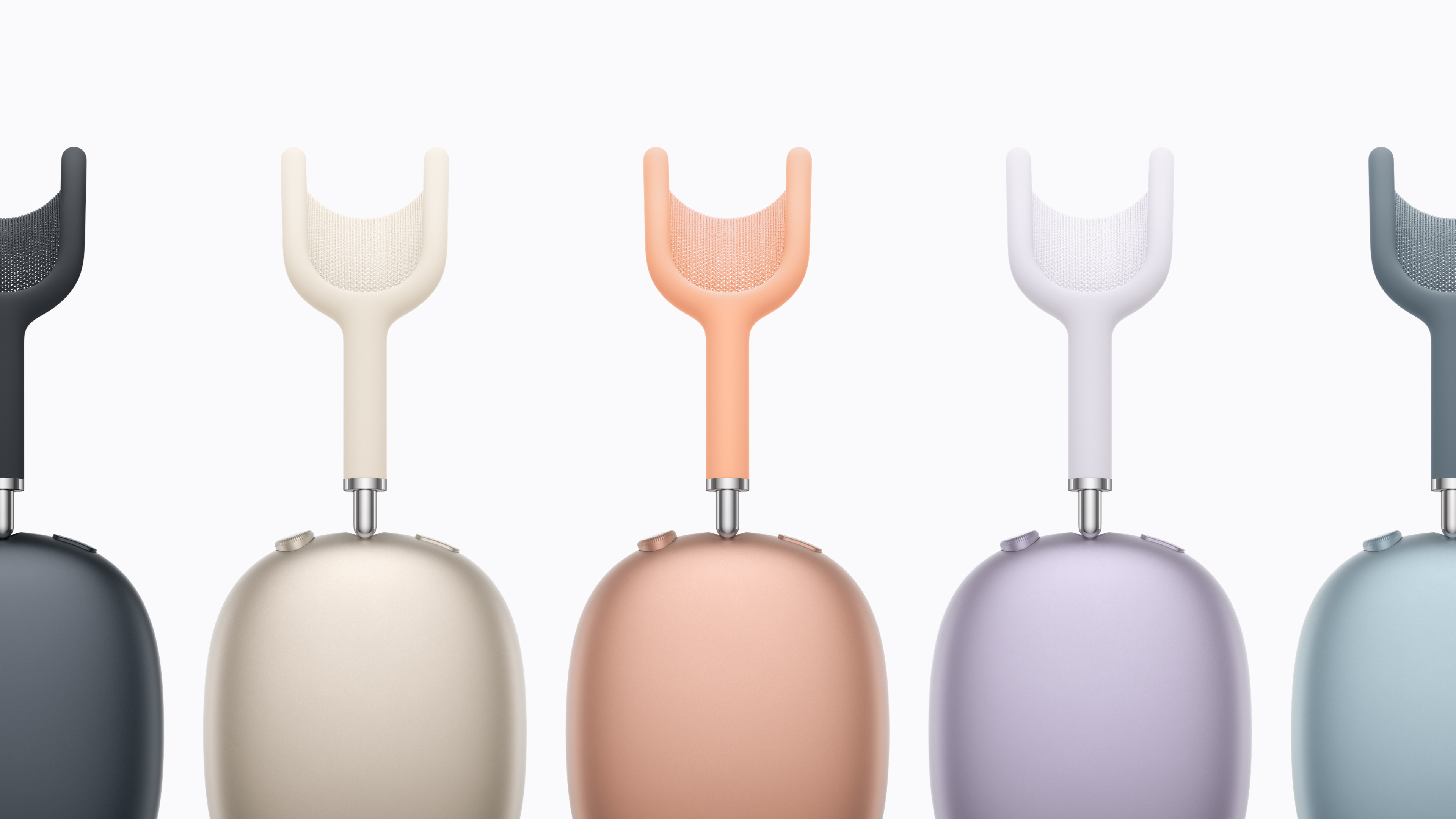
The AirPods Max 2 are almost here. Apple announced this morning that the first true update to its over-hear phones are up for pre-order on March 25 and will be shipping in early April. They look identical to the predecessor, with large, colorful earcups and a matching headband. But inside is the H2 chip that Apple first introduced with the AirPods Pro 2, which enables a host of new features. Chief among those is improved noise cancelation — Apple says with the H2 and improved audio algorithms, the AirPods Max 2 are 1.5 times more effective at reducing noise than the old model.
From an audio perspective, there’s a new amplifier on board here as well for clearer music and improved spatial audio performance. If you want lossless music, you can get that by using the included USB-C cable.
There are also a host of new features for the AirPods Max 2 enabled by the H2. These include an “Adaptive Audio” mode that balances between transparency and ANC modes depending on the environment so you can hear things when you need to while still blocking extraneous noise. Similarly, the conversation awareness features lower the volume of your content and increase transparency when your’e speaking. Live Translation comes to the AirPods Max 2 as well, a feature that uses your AirPods and iPhone to translate incoming speech to and from the language of your choosing.
Apple AirPods Max 2 colors
Apple
Essentially, the AirPods Max 2 now have almost all the features you’ll find in the AirPods Pro 3, just in an over-ear design. What hasn’t changed is the price — AirPods Max 2 still cost $549, notably more than most of the competition. Despite the high price, the first AirPods Max did sound exceptional — they’ve just been hard to recommend for years because of the aging feature set and cost.
Given that the first AirPods Max were released in 2020, these new headphones are long overdue and are probably what we should have got in 2024 when Apple added USB-C but otherwise didn’t change anything besides refreshing the colors.
This article originally appeared on Engadget at https://www.engadget.com/audio/headphones/apple-announces-the-airpods-max-2-with-improved-noise-cancelation-and-h2-chip-133319594.html?src=rss
Firefly aired for just one season in 2002 before Fox canceled it. In the 24 years since, the sci-fi show has skyrocketed in popularity and now fans are finally getting more. Nathan Fillion has announced that an animated Firefly series is currently in advanced development, Deadline first reported.
Fillion shared the news at AwesomeCon during a live taping of his podcast Once We Were Spacemen with his Firefly co-stars Gina Torres, Morena Baccarin, Summer Glau, Sean Maher, Jewel Staite and Alan Tudyk. Tudyk co-hosts the podcast, in which the duo look back at their careers and interview past coworkers. Each of the actors present at AwesomeCon are expected to voice the animated versions of their characters.
This isn't one of those maybe one day it will happen announcements, with many steps already being taken. The animated reboot is under the direction of showrunners Tara Butters (Agent Carter, Reaper) and Marc Guggenheim (DC's Legends of Tomorrow, Arrow) — original creator Joss Whedon is not involved, but has given his blessing. It has early concept art from ShadowMachine, an Oscar- and Emmy-winning animation studio. Fillion is producing the show through Collision33, his production company, and with 20th Television Animation. There's even already a script in place.
According to Fillion, the one thing left is a home for the series. He and his co-stars took to Once We Were Spacemen's Instagram to provide more details and implore FireFly fans to show demand for the reboot.
Firefly took place in 2517, centuries after a universal civil war. It followed a group of people living aboard a transport ship, Serenity, flying through the galaxy. In 2005, the show got a sequel in the form of a movie, Serenity.
This article originally appeared on Engadget at https://www.engadget.com/entertainment/tv-movies/firefly-is-getting-rebooted-as-an-animated-series-120604649.html?src=rss
In good news for our wallets and the environment at large, many electronic devices like phones and tablets last longer now than they once did. That means refurbished gadgets can have more life than ever before. There are no laws governing the terms, but refurbished or renewed devices tend to be a level above just plain “used.” At minimum, refurbished tech should have undergone cleaning and diagnostic testing. Some sellers also replace components like batteries and screens. Once ready for sale, these devices should operate as if they were new, with only minor scuffs indicating their history.
Refurbished devices not only save you a bit of cash, they have a drastically lower carbon footprint since most environmental impact comes from manufacturing. It’s more efficient than recycling and helps keep e-waste out of landfills. But there are better places to shop refurbished tech than others. We’ve gathered /a few recommendations, along with our advice on what to look for when you start shopping for refurbished gear.
What to consider when buying refurbished devices
Refurbished vs used
Refurbished is not the same as used. Used items tend to be sold “as-is,'' which means you’re simply inheriting whatever mileage and quirks a device had when the previous owner said goodbye to it. It’s true that most refurbished items were previously owned, and many are a result of the growing trend of trading in your old device when you upgrade. But others were hardly used at all and are one of the millions of returns generated each year. Either way, a properly refurbished item has undergone testing to verify that it works, along with cleaning, repairs and parts replacement as needed.
Since there are no government regulations for renewed items, it’s up to the sellers to define what steps they take to ready a device for sale. And it’s up to the buyer to find out what those steps are before taking the plunge. The processes for refurbishing devices from Apple, Bose, Microsoft, Google Pixels and Samsung, for example, include cleaning, inspection, parts replacement as needed and shipment in a new box with the originally supplied accessories. They also all provide a one-year warranty.
Warranties and returns
A refurbished device should perform as well as its new counterpart, but the only way to guarantee that’s the case is to make sure it comes with a warranty. All of the sites we recommend below include a warranty with the products they sell. If you see something labeled as refurbished, but doesn’t include some sort of guarantee as to its reliability – shop elsewhere.
Also, a good return policy will let you send the item back (preferably with the same free shipping a new item gets) for any reason — including that you just changed your mind. That way if a refurbished product doesn’t look as good as you thought it would, you can send it back without having to prove there’s something wrong with it.
Sanitation
Most refurbished tech was used before it made its way back on the market. And while renewed items are cleaned, you’ll still need to consider your comfort with sanitation issues when buying things like headphones and earbuds.
Polina Lebed via Getty Images
Where to buy refurbished tech
We recommend going directly to the manufacturer whenever possible, especially for more technical items like smartphones and laptops. If you need a new MacBook, check out Apple’s refurbished stock first; if you want a new Galaxy phone, hit up Samsung before anyone else. Repairs will be handled using genuine parts and you’re far more likely to get items that were properly unpaired from the original owner and all data wiped.
Retailers like Amazon, Walmart, and Best Buy are decent options if you’re on a tighter budget or if you’re looking for gadgets from a manufacturer that may not have its own refurbished outlet. Refurbished marketplaces like BackMarket can be useful if you’re looking for older, more specific items, or if price is the number one factor for your purchase.
Other retailers
Some smaller manufacturers like Dyson, Vitamix, Nintendo and JBL offer their own refurbished products, but for many other brands, you may need to head to a retailer.
This generation of MacBook Pro might just be the last gasp of the 2021 remodel. It's still an incredibly powerful machine that's been honed to near-perfection, but if you're looking for something that feels truly new, it may be worth waiting several months.
It's not too surprising to see the M5 Pro and Max MacBook Pros be relatively low-key efforts. Apple launched the M5 14-inch MacBook last fall with a mere press release. But at least that model delivered a noticeable leap in graphics performance. The new M5 Pro and Max chips are a bit faster than before, but they don't really have any major features to call out. (Unless you're super excited about Neural Accelerators for AI work.)
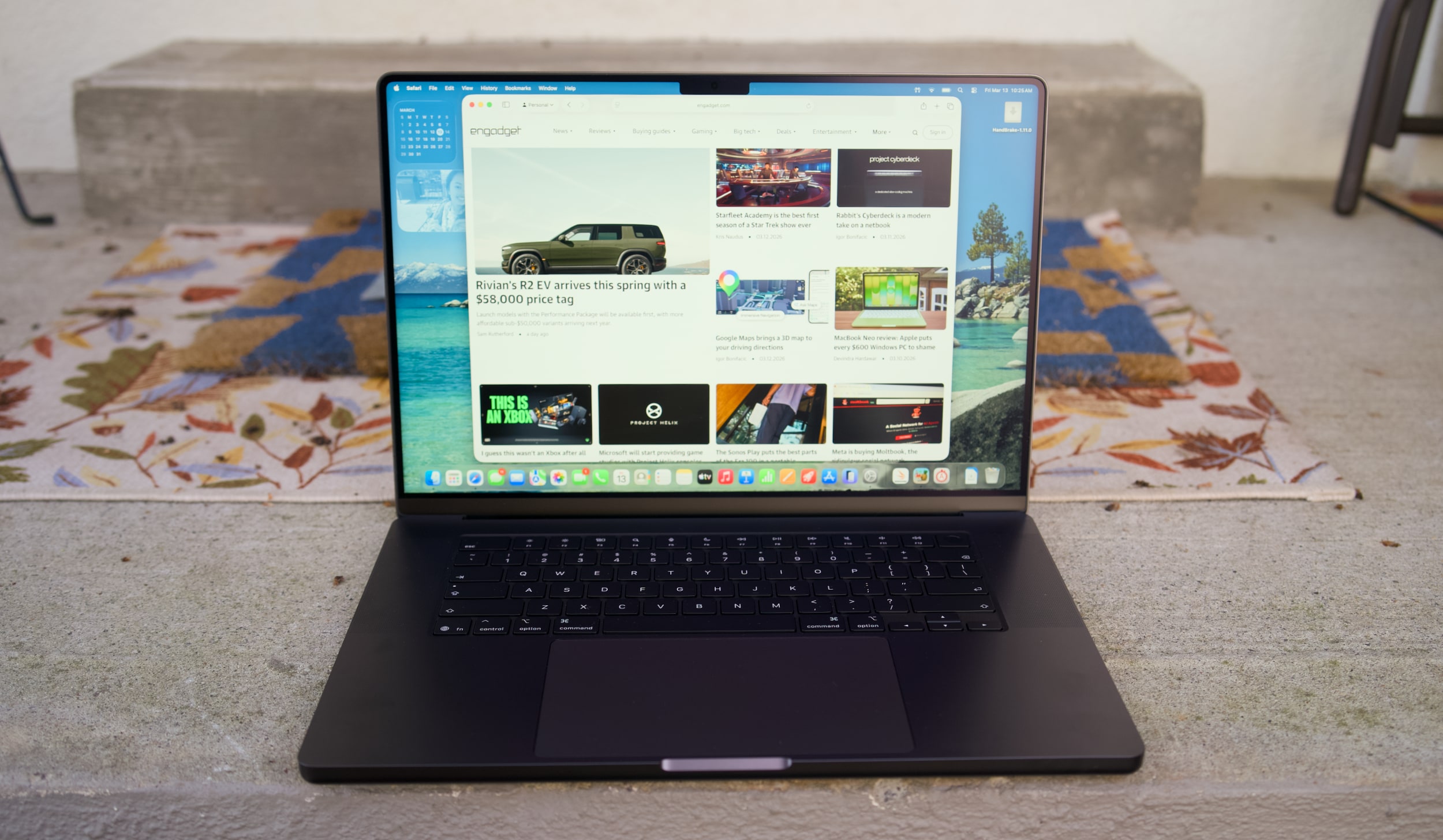
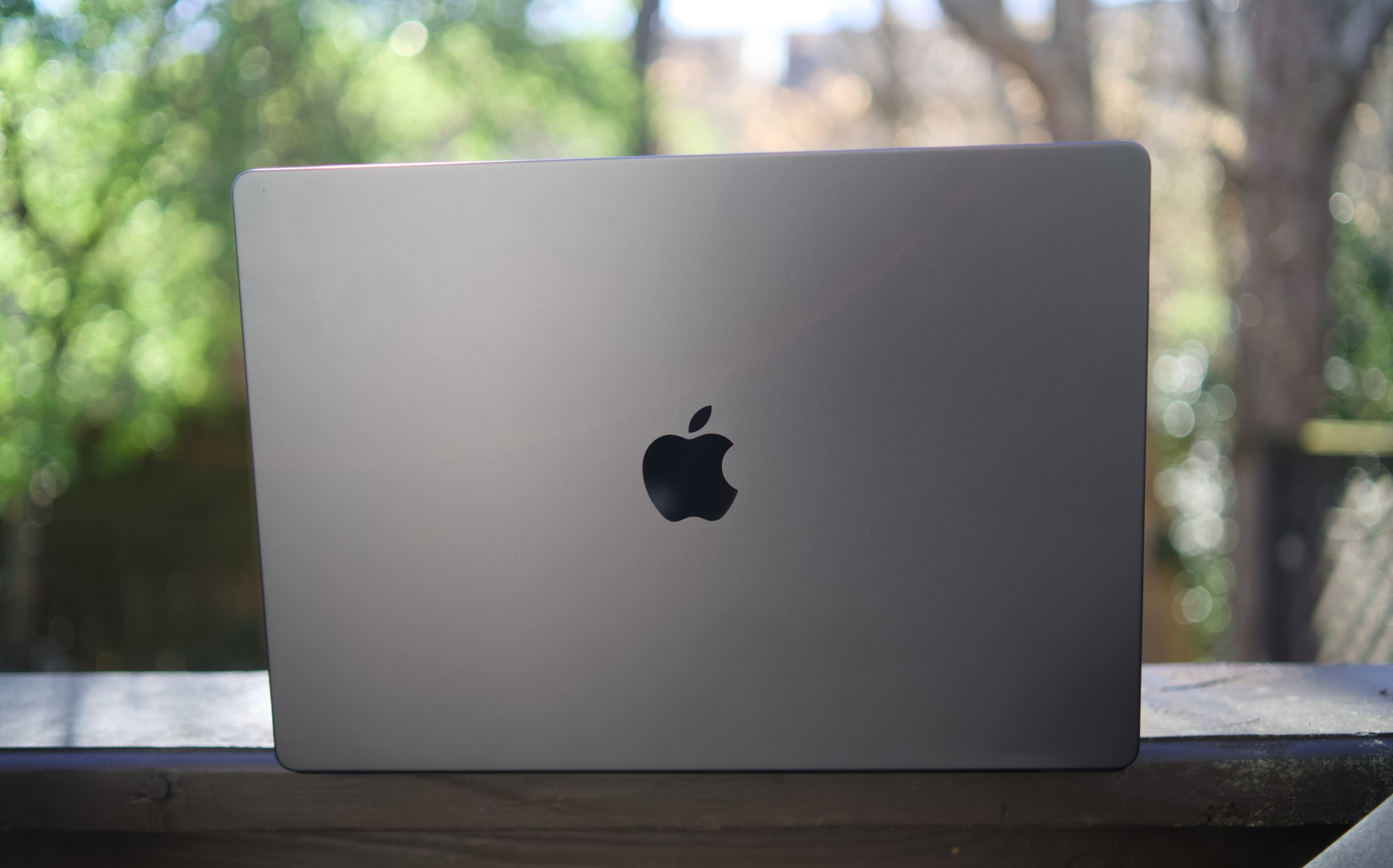
I don't want to sound like I'm complaining too much, though. The 16-inch M5 Max MacBook Pro I'm reviewing is still a gorgeous laptop, with an overall design that most premium Windows PC makers are still trying to copy. Apple's unibody metal frame design still feels rock solid. There's a generous amount of ports, including three Thunderbolt 5 USB-C connections, HDMI, a headphone jack and a SD card reader. Its 16-inch Liquid RetinaXDR screen also looks incredible, thanks to its bright Mini LED backlighting, and there's once again a nano-texture option to reduce glare.
What else could you want in a laptop? I suppose there's the lingering feeling that an OLED screen would look better, with sharper contrast and pure black levels. But you'd be hard pressed to find much else to complain about with the MacBook Pro's screen. I'm also intrigued to see how Apple implements a touchscreen interface alongside macOS in upcoming MacBook Pros, but I'll admit, I haven't really been compelled to touch this laptop's display much.
Touchscreens always seemed like a quixotic effort for laptops — they're nice to have, but Microsoft has been trying to shove them into PCs for 15 years now. The addition of touchscreens really didn't improve the overall Windows experience much. So I wasn't surprised to see Apple take its time bringing the technology to macOS — if you really want to swipe around screens, just get an iPad.
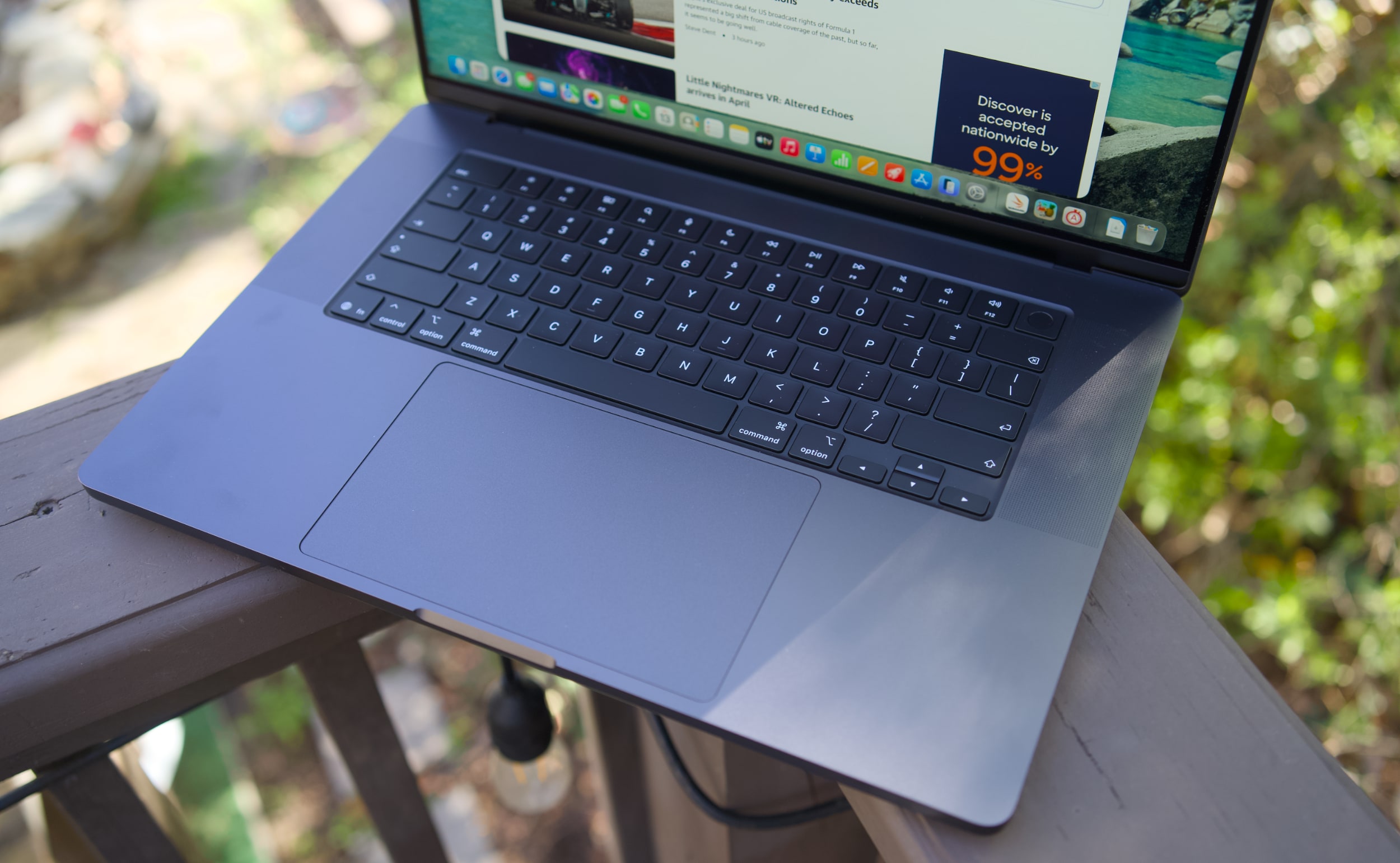
MacBook Pro 16-inch (2026, M5 Max) keyboard and trackpad
Devindra Hardawar for Engadget
But back to this MacBook Pro: I still love everything about Apple's current design. Sure, the keyboard could have a bit more depth, but it withstood my furious typing like a champ. (Unlike Dell's XPS 14, which tried so hard to be a MacBook Pro-killer.) And the MacBook Pro's glass touchpad is still one of the best I've ever seen in a laptop.
Our review unit was also equipped with 32GB of RAM, a 4TB SSD, a 40-core GPU and Apple’s $150 nano-texture display upgrade, bringing the total for this M5 Max system to a whopping $6,149. That may seem excessive to most consumers, but for creative professionals who actually need the power of the M5 Max chip, it’s not that unusual. You can also save over $1,000 by opting for the M5 Pro chip instead.
So what does the M5 Max bring to the party? Obviously, it's speedier than the M4 Max. Our review unit was 30 percent faster than the M4 Max-equipped MacBook Studio in the Geekbench 6 multi-threaded CPU benchmark. It's only 10 percent faster in Geekbench's single-threaded test, but that still gives Apple room to claim that it has the fastest chip core around. If you've got an M4 Max machine, you certainly don't need to dump it for this lineup. But if you've been hammering on an M1 Max or M2 Max system for years, you'll see some meaningful benefits from upgrading now.
Computer
Geekbench 6
Geekbench 6 GPU
Cinebench 2024
Apple MacBook Pro 16-inch (M5 Max, 2026)
4,338/ 29,261
145,309
192/2,150 | GPU: 22,374
Apple MacBook Pro 14-inch (M5, 2025)
4,310/18,003
48,840
197/1,034 | GPU: 6,143
Apple MacBook Pro 16-inch (M4 Pro, 2026)
3,925/22,456
70,197
178/1,689 GPU 9,295
Apple MacBook Pro 16-inch (M3 Max, 2024)
3,202/21,312
92,344
143/1,686 GPU 13,182
Apple says this new line of MacBook Pros also feature its latest SSD technology, which is up to twice as fast as before. Our review unit reached 13.8 GB/s write speeds and 13 GB/s read speeds in the ATTO disk speed test, whereas previous MacBook Pros hovered around 6 GB/s for read/write speeds. If you're working with huge data files every day, you'll likely notice the difference. Another benefit to the new hardware? Apple is now equipping every MacBook Pro with 1TB of storage by default.
All of the M5 chips feature faster GPUs than before, but that's less noticeable on the M5 Max. I've never had trouble running a high-end game like Lies of P on the M2, M3 or M4 Max hardware, and once again it still runs incredibly well with the M5 Max in its native resolution, and with all of the graphics settings cranked up. All I'm looking for is a smooth 60 fps frame rate, and the MacBook Pros have delivered on that for years. macOS isn't the sort of platform where you'll be playing many high fps games, but the MacBook Pro's 120Hz refresh rate is equipped to handle them.
MacBook Pro 16-inch (2026, M5 Max) on a doorstep.
Devindra Hardawar for Engadget
Beyond raw performance, the MacBook Pro continues to be a joy to use. Its screen is gloriously bright, and its smooth refresh rate makes scrolling through documents and websites easy on the eyes. Its six-speaker setup remains the best audio experience I've ever heard on a laptop, allowing for crisp, detailed and surprisingly dynamic bass. When I'm too lazy to cast music to my Sonos speakers, I can still have a decent jam session on the MacBook Pro's built-in setup.
It's hard to improve much on the 30 hours and 16 minutes of battery life we saw on last year's 16-inch MacBook Pro, but the M5 Max model managed to beat that by 30 minutes. Realistically, it means you can likely use the MacBook Pro for a few days without needing to recharge, assuming you're not doing heavy-duty work the entire time.
MacBook Pro 16-inch (2026, M5 Max)
Devindra Hardawar for Engadget
You don't need me to sell you on the MacBook Pro; all you need to know is that the M5 Max actually delivers. Given how well the standard M5 14-inch MacBook Pro performed, I'd also expect a decent speed bump from the M5 Pro model. The only downside to the M5 systems is that they'll feel out of date quickly if the rumored OLED and touchscreen models arrive later this year. But if you need the best performance now, it's hard to go wrong with any MacBook Pro.
This article originally appeared on Engadget at https://www.engadget.com/computing/laptops/macbook-pro-m5-max-16-inch-review-still-the-pinnacle-120000325.html?src=rss
Ahead of its acquisition by Paramount Skydance, Warner Bros. dominated the 2026 Oscars with 11 wins primarily for Ryan Coogler's Sinners and Paul Thomas Anderson's One Battle After Another. Netflix also put in a strong showing with seven Academy Awards, including two for KPop Demon Hunters and three for Guillermo Del Toro's Frankenstein.
All told, dedicated streaming services chalked up eight awards, but were shut out of the major prizes. Frankenstein took the trophies for for Best Production Design, Best Costume Design and Best Makeup and Hairstyling, while KPop Demon Hunters took Best Animated Feature and Best original Song. Netflix also took prizes for All The Empty Rooms (Best Documentary Short Film) and The Singers (Best Live Action Short Film). Apple TV garnered the other streaming service Oscar for F1 (Best Sound).
Warner Bros. dominated the more prestigious awards. The studio took its first Oscar for Best Picture (One Battle After Another) since Argo won in 2012, while also winning Anderson the prizes for Best Director and Best Adapted Screenplay, and giving Sean Penn the Best Supporting Actor Oscar. Sinners, meanwhile, won for Best Cinematography, giving Autumn Durald Arkapaw the first ever win for a woman and woman of color in that category. Michael B. Jordan took the Best Actor prize for that film, while Director Ryan Coogler won for Best Original Screenplay.
Other notable acting prizes were won by Jessie Buckley (Best Actress, Hamnet) and Amy Madigan (Best Support Actress, Weapons).
Host Conan O'Brien joked that it was the "first time in a theater" for Netflix CEO Ted Sarandos. It remains to be seen, however, whether Netflix losing out to Paramount Skydance on the Warner Bros. acquisition will be to the film industry's benefit or detriment. One clear loser of late is broadcast television as the 2026 Oscars will be the third-to-last aired by Walt Disney's ABC, with YouTube set to stream the ceremony exclusively starting in 2029.
This article originally appeared on Engadget at https://www.engadget.com/entertainment/warner-bros-dominates-oscars-with-11-wins-ahead-of-its-acquisition-by-paramount-093916527.html?src=rss
In an unexpected twist, humans have taken some jobs back from AI. Embark Studios' CEO Patrick Söderlund recently told GamesIndustry.biz that the studio "re-recorded" some of the AI-generated voice lines in Arc Raiders with human voices, only after its successful launch in October.
"There is a quality difference," Söderlund told GamesIndustry.biz. "A real professional actor is better than AI; that's just how it is."
With Arc Raiders' player count peaking at nearly half a million users on Steam, the game's breakout success was still marred by its use of text-to-speech AI. While there was no generative AI used for the visuals of the extraction shooter, Embark Studios paid its actors for approval to license their voices for text-to-speech AI, according to Söderlund. Even though Söderlund said that the text-to-speech AI was reserved for lines "that aren't as essential to the immersion of the experience," many players weren't happy with this creative decision.
Responding to the criticism, Embark Studios is seemingly reversing course and relying more on its voice actors. Söderlund said that the studio pays its voice actors for their time in the recording booth and will "continue to bring many of them back as we carry on updating the game." However, it's important to note that Söderlund told GamesIndustry.biz that "some" of the AI-generated lines were replaced by voice actors, which could indicate that the studio isn't looking to completely ditch its text-to-speech AI anytime soon.
This article originally appeared on Engadget at https://www.engadget.com/gaming/arc-raiders-replaced-some-of-its-ai-generated-voice-lines-with-professional-actors-184915627.html?src=rss