With countries banning social media for kids left and right, Meta is trying different things to convince parents that its platforms are safe for teens. In its latest effort, the company will start showing parents the topics their teens have discussed with Meta AI over the previous seven days.
"Parents will be able to see the topics their teen has been asking Meta AI about in [Facebook, Messenger or Instagram] over the past week," Meta explained in a blog post. "Topics can range from School, Entertainment, and Lifestyle to Travel, Writing, and Health and Wellbeing, among others."
For parents overseeing Meta's teen accounts, the feature will appear in a new Insights tab within supervision, both in-app and on web. Parents can tap on a topic to see the different categories within each: for instance, sub-categories within Lifestyle include fashion, food and holidays, while fitness, physical health and mental health are part of the Health and Wellbeing topic.
Meta
Meta also worked with the Cyberbullying Research Center to develop what it calls "conversation starters," or open-ended conversations about their experience with AI. It provides detail about what the questions are designed to address, and can be found on the Family Center website or through a link in the new Insights tab.
Finally, Meta revealed more detail about its AI Wellbeing Expert Council, who will provide "ongoing input on our AI experience for teens." It will be made up of three existing advisory groups as well as new members with special expertise in responsible and ethical AI, who are affiliated with the National Council of Suicide Prevention and multiple universities. It's worth noting that Meta has a separate oversight board that deals with subjects ranging from AI to moderation.
Offboarding moderation chores to busy parents appears to be par for the course for Meta these days. The company has recently cut back on the use of third-party vendors that help with content moderation, shifting responsibility instead to advanced AI systems, according to recent reports.
The dangers of AI for teens have been one of multiple reasons countries like Spain have banned social media platforms for kids. One of the most recent and tragic cases was in Canada, where a teen was provided specific details by OpenAI's ChatGPT about how to carry out a school shooting. Another such case is under investigation in Florida, and AI's have been implicated in multiple teen suicides as well.
In the US, the National Suicide Prevention Lifeline is 1-800-273-8255 or you can simply dial 988. Crisis Text Line can be reached by texting HOME to 741741 (US), 686868 (Canada), or 85258 (UK). Wikipedia maintains a list of crisis lines for people outside of those countries.
This article originally appeared on Engadget at https://www.engadget.com/ai/meta-will-show-parents-the-topics-of-their-teens-ai-conversations-123119624.html?src=rss
Big, fancy executive sedans are a dying breed, especially when it comes to EVs. With the Tesla Model S and Mercedes' EQ line on their way out, pickings are slim. Aside from the upcoming S-Class, there's the Lucid Air, Cadillac Celestiq and maybe the Porsche Taycan, depending on how far you're willing to stretch the definition. But as the market leader in luxury sedans, BMW isn't giving up yet. With the arrival of the new 7-series, the company has made a car — with a complete range of gas, hybrid and fully electric options — that truly embraces modern gadgetry.
Overview
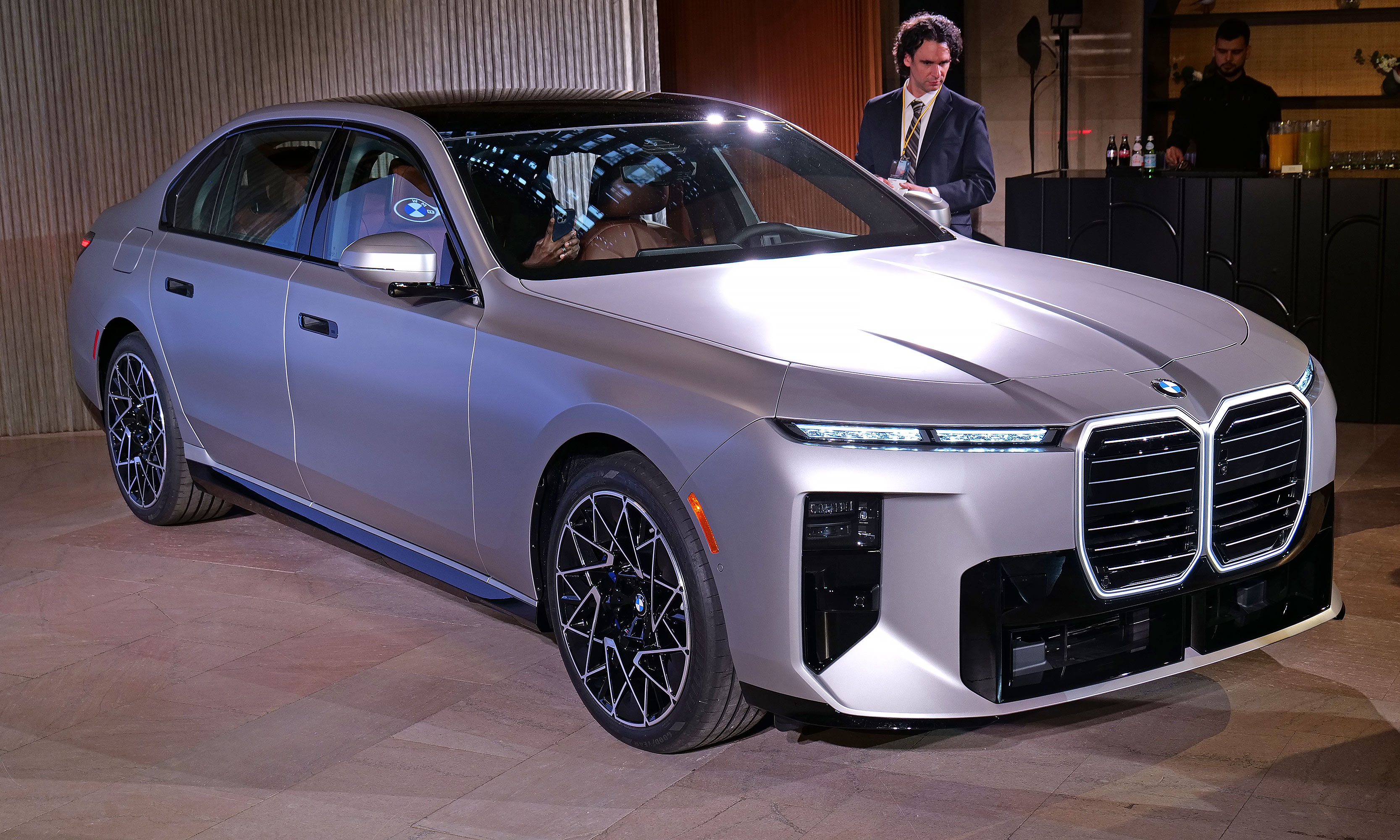
Because we're EV enthusiasts here at Engadget, we're primarily going to talk about the new i7, which is the battery-powered version of the new 7 series. Unfortunately, due to building regulations at Grand Central Station in NYC where BMW's reveal was held, the company was only allowed to showcase a gas-powered car, so this story features photos of the 740. However, company representatives told me that there are mostly only minor cosmetic differences between the ICE and EV models (powertrains aside), so feel free to compare my shots with the official press images to see if you can spot any changes.
Between things like its grille and recessed door handles, the new 7-series looks more like an EV than a gas car.
Sam Rutherford for Engadget
As for the i7 itself, it will be available in three main trims: the i750 xDrive, the i760 xDrive and the i7 M70 xDrive, the latter of which is the fastest and most powerful of the bunch. Pricing starts at $105,750 for the i750 and $126,250 for the i760, both of which will be available at launch sometime later this year. The i7 M70 will come later, most likely in 2027, with pricing still TBD.
Every model will come standard with a dual-motor AWD drivetrain with the base i750 offering 455 horsepower or 544hp on the i760, before going all the way up to a whopping 680hp on the i7 M70. Compared to the outgoing models, the new 2027 i7 also features a significantly larger power pack (112.4kWh, up from 105.7kWh) composed of BMW's new sixth-gen battery cells. This helps support faster charging speeds of 250kW (up from 195kW) along with a native NACS port and a 400-volt architecture, which is good enough to take the car from 10 to 80 percent in around 28 minutes. The upgraded batteries should also translate into longer range, with BMW claiming the i760 will deliver more than 350 miles on a single charge, based on internal metrics using EPA testing procedures.
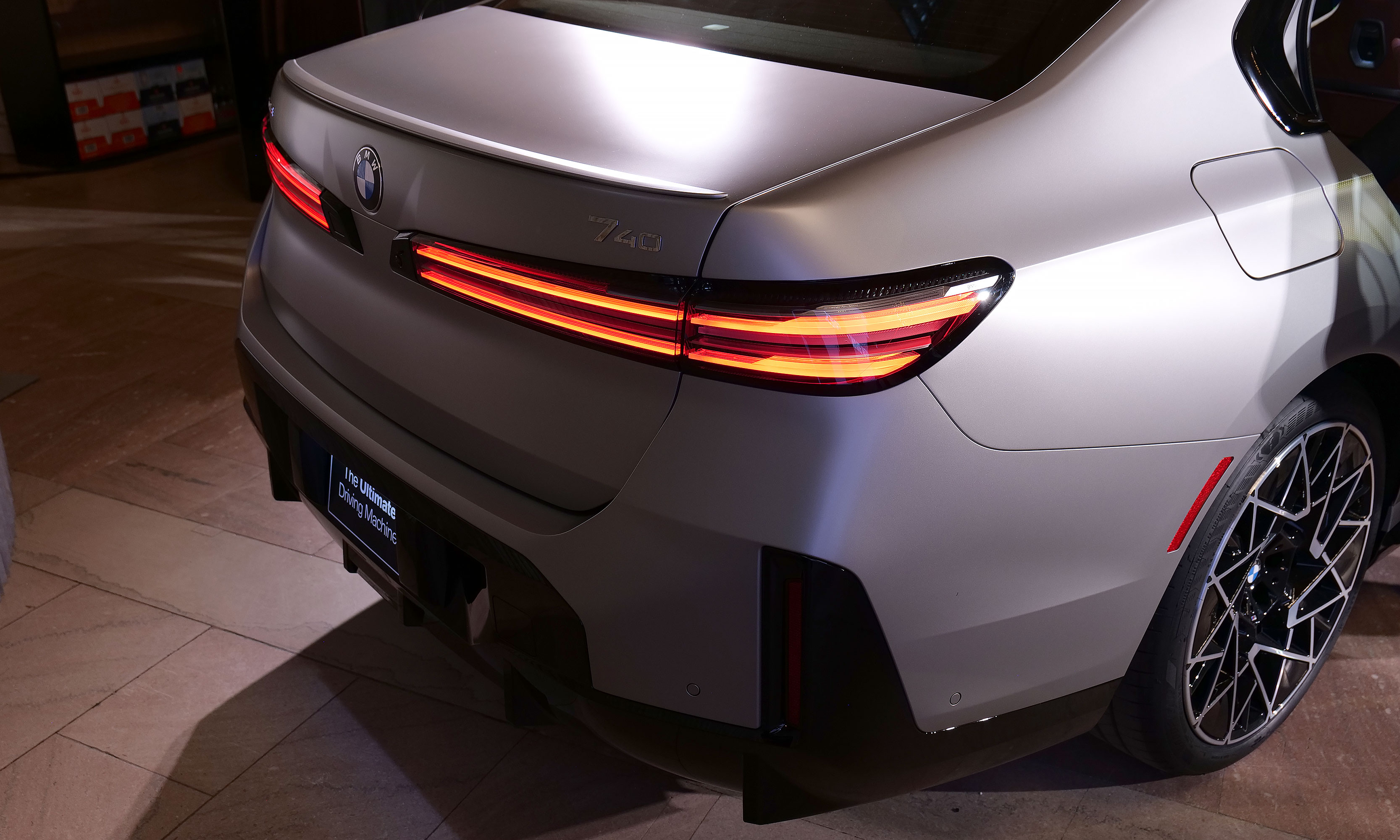
On the new 2027 models, BMW extended the 7-series' taillights to give its rear a more distinctive appearance.
Sam Rutherford for Engadget
Finally, as we're still waiting for the iX3 to make its official debut in the US market, the new 7-series is also BMW's first car for the States to feature the company's Neue Klasse design language, which features a massively upgraded collection of tech on the inside. More on that when we get to the interior.
Exterior
One of the most interesting things about the new 7-series is that it was designed to have essentially the same exterior regardless of which powertrain each individual model has. BMW claims this not only makes it easier for customers to choose if they want a gas, hybrid or electric car, it also presents a more unified look across the family. That said, there are a number of features like the grille and recessed door handles that make BMW's latest luxury sedan look more like an electric car than a traditional ICE vehicle. I even noticed that on the gas-powered 740 BMW had on display, its tail pipes were pointed down and hidden away behind the car's rear bumper, which plays into the various models' shared identity. That said, on M Sport models and the M Performance variant due out next year, things like tailpipes will be much more prominent to help assuage the kind of enthusiasts who aren't ready for the transition to electrification.
Up front, BMW ditched the stacked headlights found on the previous model in favor of a new razor-thin design that features 24 crystal LEDs that create a neat gem-like appearance. Meanwhile, the company's signature kidney-shaped grille has been given a thoroughly futuristic update, complete with built-in lighting (including programmable Welcome and Goodbye patterns) and active aero. Around back, the 7-series' taillights have been extended to nearly the entire width of the vehicle, creating a more distinctive look.
Interior
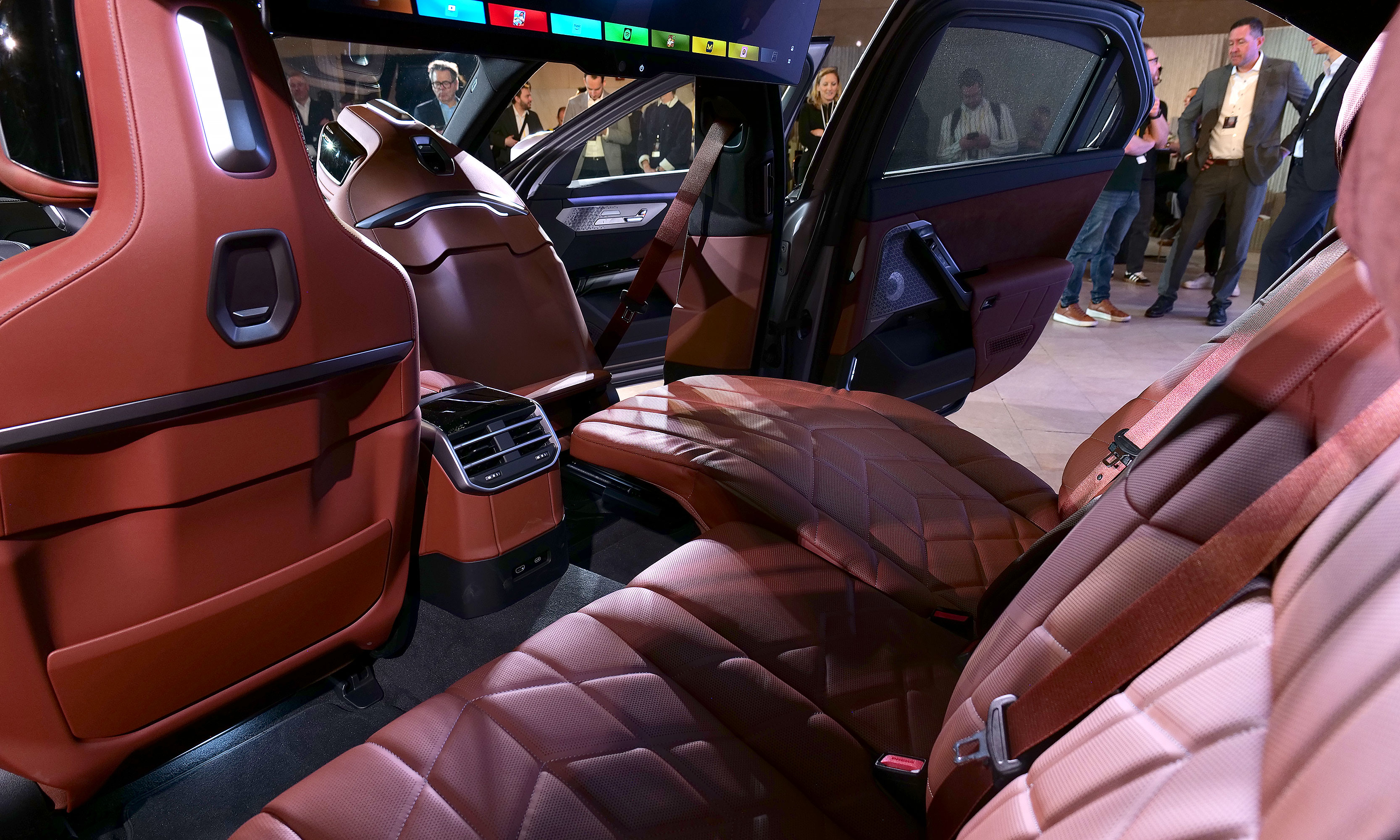
For tech enthusiasts, the inside of the new 7-series is a real marvel of engineering and gadgetry, headlined by BMW's Neue Klasse design language. Depending on how you're counting, there are between five and seven different displays. In the center, there's the 17.9-inch main screen (which supports both Android Auto and CarPlay), plus the company's Panoramic Vision (which is actually a projector) that adds another thin display across the entire bottom of the windshield. Panoramic Vision also provides a more traditional 3D HUD for things like turn-by-turn navigation while driving.
For the driver, BMW also updated the i7's steering wheel with what the company is calling "shy tech." This means controls are only illuminated when a specific feature is available, while also providing haptic feedback for additional tactile response. And although I didn't get to drive the car myself, BMW reps told me that the car's assisted driving tech has been updated so that it's more accommodating to small, manual adjustments. On other cars, this might disable hands-free driving entirely or force you to wrestle with a robo-controlled steering wheel.
For the first time on any of its vehicles, BMW is including a 14.6-inch Passenger Screen that can be used to stream movies, music and more, completely independent of what's on the main display. Then there are two small panels mounted on the doors for rear seat passengers to control things like climate settings and more. And with a Bowers and Wilkins sound system comprising 36 speakers and 4,000 watts of output, audio certainly hasn't been neglected.
However, the real showpiece of the entire vehicle is arguably the optional 31-inch 8K Theater Screen, which BMW claims is the largest display in any production car today. It's mounted on a motorized frame that lowers itself down from the ceiling and it's simply massive. Gadget nerds will appreciate that it comes with an onboard webcam, so you can use it for video calls. And when you're not working, you can even pair accessories like Bluetooth controllers with the screen to play games. There are even woofers mounted below the rear seat to provide what BMW says is a 4D sound experience.
My favorite part of this ensemble is the full-size HDMI jack that’s located next to the USB-C port on the back of the center console. This will allow you to hook up pretty much anything you want and enjoy it on that huge 31-inch display. And similar to previous 7-series models, the i7 still features BMW's executive seating mode, which pushes the front passenger seat up an extra 20cm while reclining the rear, providing a truly luxurious way to enjoy a car ride (there's even a little built-in footrest). Another small thing that potential buyers will surely appreciate is that BMW is also providing four years of data and access to its Digital Premium service as standard on every vehicle.
Initial thoughts
The lap of luxury.
Sam Rutherford for Engadget
With all of these changes, BMW is calling this the new 7-series, but it's actually closer to a mid-cycle refresh following a total overhaul back in 2023. For people who can never get enough screen space, the i7 and its gas-powered siblings are practically overflowing with displays. Plus, I really love BMW's attention to detail that allows users to pair peripherals like game controllers to the onboard displays or plug in external devices via HDMI. As someone who likes the more futuristic, streamlined exterior you see on a lot of EVs, I think BMW has done a great job of striking a middle ground that works for both gas and electric powertrains.
Even the i7’s base specs have gotten some big bumps, both in terms of range and charging speeds, though at some point, BMW will need to upgrade its 400-volt architecture to something beefier. In a lot of ways, i7's starting price of $105,750 is its biggest hurdle, because for tech lovers, it feels like BMW has covered all the bases and then some. On the bright side, if you can afford one, you can probably also afford to hire a driver every now and then so you can take advantage of the 7-series' executive seating mode.
This article originally appeared on Engadget at https://www.engadget.com/transportation/evs/2027-bmw-i7-first-look-a-fantastically-techy-car-for-the-1-percent-123000364.html?src=rss
After seeing the runaway success of its Neo lineup, DJI is taking another stab at the budget drone market with the new Lito series. The Lito 1 and Lito X1 are both under $400 and weigh less than 249 grams — they’re ideal for beginners. Both are designed to replace DJI’s Mini series, but they offer things that those models lacked like LiDAR and 360-degree obstacle avoidance.
In terms of video quality, they’re similar to DJI’s Neo 2 and Flip drones. Unlike those models, which are safe to use indoors and around people, the open-prop Lito drones are designed to fly outside at high speeds and high altitudes. This makes them well-suited for filming activities like surfing or dirt bike riding. After testing both models, I believe they offer unbeatable value and performance at these prices, by a long shot. Of course, the drawback for American buyers is that neither is expected to launch in the US.
Design and features
The Lito models are now the entry level open-prop models in DJI’s lineup (the Mini series will no longer be updated). Both have identical folding designs, with optional, removable propeller shrouds that offer some additional obstacle protection. Given the light weight, novice pilots can fly them without a permit.
Steve Dent for Engadget
Both have omni sensors on the top and bottom that protect them from obstacles on all sides. The Lito X1 adds a forward-facing LiDAR sensor for extra tracking precision. That kind of additional accuracy is nice to have and it’s unusual on drones in this price range. Built-in storage is also rare on cheap drones, but the Lito X1 has that going for it as well. There’s 42GB on tap, along with microSD card support for additional capacity. The Lito 1 only offers a microSD slot and no internal storage.
They come with an Intelligent Flight Battery that offers up to 36 minutes of flying time. That can be extended to about 52 minutes with the Intelligent Flight Battery Plus, though that model isn’t available in the EU or UK. As with every other DJI drone I’ve tested, real-world flight times are about 30 percent less than the company promises. I got about 25 minutes of use on a charge — still not bad for a sub-$400 drone.
The Lito line has all the FocusTrack features you’d expect in a DJI drone, like 360 degree ActiveTrack subject tracking with full manual control and obstacle detection. It also supports DJI’s Quickshots including Dronie, Rocket and others, all of which make it easy to capture aerial clips for social media. However, you won’t find certain Neo 2 features on the Lito series, like gestures, smartphone control and palm takeoffs.
The Lito drones work with multiple controllers, including the RC-N3 that requires a smartphone or the RC 2 with a built-in screen. Both Lito models transmit 1080p 60 fps video to a range of up to 10 miles via DJI’s Occusync 4 system. That’s a scary distance for a beginner drone. Luckily, both models also offer DJI’s return to home (RTH) with battery warning and other safety features that should prevent lost drones or accidents.
Performance
Steve Dent for Engadget
Both Lito drones are relatively fast at about 26 mph in normal mode with obstacle detection, or 40 mph in sport mode. That kind of speed allows creators to track bikers, skiers or vehicles. Each can also fly in relatively strong winds up to about 21 mph. They lack the maneuverability and acrobatics available on the Neo 2 though, and don't offer an FPV mode with DJI’s Goggles.
With open propellers that can catch on a twig and cause a crash, the Lito drones depend heavily on obstacle detection for protection. That’s particularly important since the ActiveTrack follow feature is a key selling point for novice creators. With all that in mind, I wanted to put them through their paces tracking me on a bicycle and even while driving a car, forcing the drones to navigate around trees and bamboo with fine branches.
To start, I used ActiveTrack and the Trace “steering wheel” mode to follow me from the front, sides and back. Both Lito models can avoid obstacles using either the “braking” mode that stops the drone or “bypass” that simply maneuvers around them. I mostly used bypass mode to see if the drone could continue to track me if something got in the way.
When flying forward, the Lito X1 avoided all obstacles using its LiDAR, while swooping smoothly around trees and branches. Only once did it fail to detect a small twig, which caused a slight bobble, but fortunately, no crash. Thanks to that built-in LiDAR, the Lito X1 model is a bit more adept than the Lito 1 at dodging fine obstacles when flying forward. Overall, the X1’s avoidance in all directions was shockingly good for a drone under $400.
DJI's Lito models offer excellent tracking and obstacle detection for the price.
Steve Dent for Engadget
The Lito X1’s LiDAR is also very helpful when flying in low-light conditions, and even at night. If you go on a long flight and miscalculate the sunset, you’ll still be able to get the drone back safely in RTH mode without much fear of crashing, as long as you fly forward. It also helps keep the Lito X1 more stable in dim light than the Lito 1.
The Lito 1 isn’t as adept at following and obstacle detection at night due to the lack of LiDAR, but again, it avoided danger surprisingly well considering the price. Buyers can still be confident that it will stay out of trouble when tracking subjects in most conditions — just be careful when flying in forested areas with fine branches.
If you’re planning on flying far from your location to capture remote aerial views, DJI’s Occusync 4 system is highly reliable. I only saw video dropouts when flying the drone behind buildings and out of my line of sight, something that I wouldn’t advise anyway. As long as there’s nothing between you and the drone, you’ll maintain a clear video view and full control.
As with other drones in the Mini and Mini Pro series, the Lito models are whisper quiet in flight, with noise levels well under 70 db. The pitch is also low and not shrieking like the Neo models, so it shouldn’t disturb people or animals.
Video and photo quality
Video quality is where the Lito 1 and Lito X1 differ the most. The latter is equipped with a 40-megapixel 1/1.3-inch sensor with f/1.7 aperture (same as the Mini 4 Pro) and offers up 4K 60 fps video with 4K 100 fps slow-mo along with D-LogM and HDR recording. The Lito 1, meanwhile, has a 48MP 1/2-inch sensor (12MP for video) like the one on the Neo 2, with an f/1.8 aperture, 4K 60 fps video (4K 100 fps slow-mo) and no D-LogM or HDR capabilities.
That’s a pretty big gap in specs considering the relatively meager price difference of around $80. As such, the Lito X1 offers significantly better video quality, particularly in low light and high-contrast conditions.
The smaller sensor means the Lito 1 has mediocre low-light capability, with pronounced grain at the maximum ISO 12,800 rating. The drop in quality is even noticeable at ISO 3,200. Unlike the $400 Flip, the lack of 10-bit D-LogM capability also means that over- or underexposed video is hard to correct.
With those issues, video and photos from the Lito 1 aren't good enough for professional work. However, it’s excellent for social media users, hobbyists and content creators, delivering smartphone-quality aerial shots and more detail than any other drone at this price (except the Neo 2, of course).
The Lito X1, on the other hand, does offer video that’s good enough for some professional use. While not as noise-free as the 1-inch sensor-equipped Mini 5 Pro or Micro Four Thirds Mavic 4 Pro, video quality for nighttime cityscapes and other dim scenes is decently clean. In daylight, video is surprisingly sharp and color accurate. The 10-bit D-LogM setting also lets you capture sufficient dynamic range for tricky scenarios like a forest path dappled with sunlight and shadows
Stabilization on both models is excellent, so you’re sure to capture smooth, cinematic video, even with relatively slow shutter speeds down to 1/30th of a second. Photos are more detailed on the Lito X1 due to the higher resolution, even though both models can capture RAW DNG files to maximize dynamic range. That makes the drones ideal for taking aerial pictures of your property, for instance, or checking a hornet’s nest or hole on your roof.
Wrap-up
Steve Dent for Engadget
The Lito series shows that DJI is intent on dominating every drone price range and category, including the bottom end. Despite their low prices, the new drones don’t skimp on features, offering full obstacle protection, ActiveTrack subject tracking, relatively high speeds and sharp 4K video quality — just like models that cost a lot more.
At these prices, the Lito drones don’t have any real rivals other than themselves and other DJI drones, particularly the Neo 2 and Flip. Choose the Lito 1 only if you can’t swing the extra money for the Lito X1, as video quality on the latter is significantly higher. Both drones are best for outdoor adventures, including high-altitude aerial shooting, while Neo 2 and Flip excel inside or around people.
The Lito 1 and Lito X1 are now available in the UK and EU for £299/€309 and £369/€379 respectively with one battery and the RC-N3 controller that requires a smartphone. You can also get them in Fly More combos, with the Lito 1 priced at £429/€439 with an RC-N3 controller, three batteries, a charger and a shoulder bag. The Lito X1 Fly More Combo with an RC 2 screen controller, three batteries, a charger and a shoulder bag is £599/€619. The drones aren’t on sale yet in the US, but may arrive later on.
This article originally appeared on Engadget at https://www.engadget.com/cameras/dji-lito-1-and-lito-x1-drone-review-high-quality-aerial-video-at-its-most-affordable-120024032.html?src=rss
Tesla still doesn’t have a solid pathway for how to give Hardware 3 cars Full Self-Driving (FSD) capabilities, based on what Elon Musk said during the company’s latest earnings call. The automaker has known for quite a while that its vehicles equipped with Hardware 3 aren’t capable of unsupervised FSD, even though the company built the system specifically to give its cars the ability. Tesla used Hardware 3 on cars manufactured from 2019 until early 2023 before Hardware 4 shipped.
During an earlier earnings call back in January 2025, Musk admitted that the company was “going to have to upgrade people’s Hardware 3 computer for those that have bought Full Self-Driving.” At Tesla’s latest earnings call, Musk said that Hardware 3 “simply does not have the capability to achieve unsupervised FSD.” Tesla thought it would be able to at one point, but Hardware 3 apparently has 1/8th the memory bandwidth of Hardware 4. Musk explained that memory bandwidth is “one of the key elements” needed for unsupervised FSD.
Tesla will be offering to upgrade and replace the computers and cameras on older vehicles, but it doesn’t have a concrete plan in place yet. “I do think over time it’s going to make sense for us to convert all Hardware 3 cars to Hardware 4,” he said. To do so at service centers would be extremely slow, Musk has admitted. Around 4 million cars or so have Hardware 3, though not everyone has paid for FSD. Still, to be able to replace its vehicles’ hardware efficiently, Musk said Tesla is going to have to set up “microfactories or small factories in major metropolitan areas.” He didn’t give any indication that Tesla has already started building those microfactories, though, or even that construction is already scheduled to begin. He did say that in the meantime, the company is going to be releasing FSD version 14 for Hardware 3 around the end of June.
Musk also said during the same earnings call that Tesla’s Fremont factory will start manufacturing the company’s humanoid Optimus robots in late July or August. The Tesla CEO is known for announcing highly optimistic and aggressive timelines. Tesla made the decision to kill off its Model X and S cars earlier this year, so that it can convert its Fremont facility into an Optimus factory. The last Model S and X vehicles will be rolling off the production line in May, which gives the company just a few months to dismantle the facility’s current equipment and put new ones in place.
This article originally appeared on Engadget at https://www.engadget.com/transportation/evs/musk-pledges-to-fix-2019-2023-teslas-that-cant-fully-self-drive-095002120.html?src=rss
Prediction market Kalshi has taken action against three political candidates, alleging that each was engaged with insider trading of information about their campaigns. The company implemented new rules last month aimed at preventing politicians and athletes from placing bets on events they can control, and it said those guardrails helped to flag this trio of cases.
The three candidates are Mark Moran of Virginia, Matt Klein of Minnesota and Ezekiel Enriquez of Texas. Kalshi reached settlements with Klein and Enriquez, both of whom cooperated in the platform's investigations. Each will face a fine of less than $1,000 and suspensions of up to five years. Moran's case has resulted in a disciplinary action, with a five year suspension and a fine of more than $6,000. He posted on X about the situation and claimed this was essentially a stunt to see if he'd be caught and "to highlight how this company is destroying young men."
Kalshi and other prediction markets have been the subject of several lawsuits by state attorneys general that are attempting to regulate the sector as gambling. Nevada, Arizona and New York have cases underway, but the state-level attempts are not looking promising. An appeals court ruled against New Jersey's effort to govern this industry, and the US Commodity Futures Trading Commission has launched a lawsuit of its own in an effort to ensure it will be the only party to regulate prediction markets.
This article originally appeared on Engadget at https://www.engadget.com/big-tech/kalshi-suspended-three-political-candidates-from-its-platform-for-insider-trading-222433937.html?src=rss
Last year, Ecco the Dolphin creator Ed Annunizata teased plans to remaster the first two games in the series and create an entirely new sequel. Ecco the Dolphin: Complete, announced by Annunziata's studio A&R Atelier, appears to be the result of that work. The game doesn't have a release date yet, but A&R Atelier says it combines the planned remasters and third title into "the complete, definitive Ecco the Dolphin experience, created by the people who made the originals."
Complete includes "all versions of Ecco the Dolphin and Ecco: The Tides of Time," according to the developer, alongside "a brand-new contemporary Ecco game." Besides graphical improvements, A&E Atelier says the game will introduce "built-in speedrunning support, achievements and leaderboards," and things like the ability to create custom courses from existing levels. And while A&R Atelier's announcement doesn't include footage of the new game or the platforms it'll release on, the official Ecco the Dolphin website has a countdown clock that could point to when more information will be released.
Annunziata sued Sega to try and win the rights to the Ecco the Dolphin IP in 2013, the same year he failed to get The Big Blue, a spiritual sequel to Ecco the Dolphin, fully funded on Kickstarter. Sega and Annunziata ultimately settled their lawsuit in 2016, which may have laid the groundwork for Ecco the Dolphin: Complete to happen.
This article originally appeared on Engadget at https://www.engadget.com/gaming/ecco-the-dolphin-complete-will-combine-remasters-and-a-sequel-into-one-package-222020243.html?src=rss
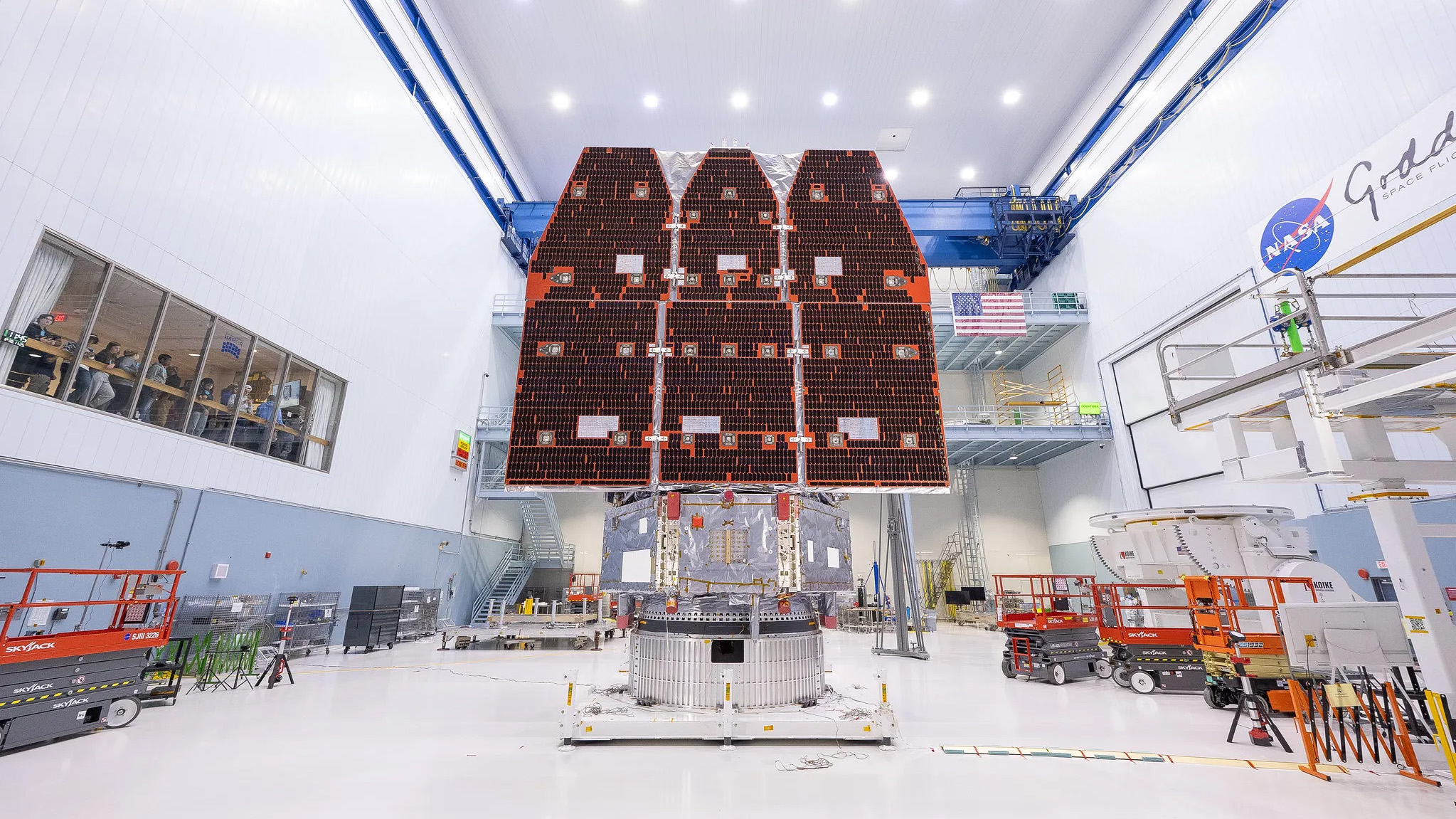
NASA's next eye into the cosmos is due to leave our planet later this year. The agency says it's targeting an early September launch for the Nancy Grace Roman Space Telescope. Roman (for short) has a field of view 100 times larger than Hubble's.
The September date is the earliest possible launch for Roman. NASA says it will go up (aboard a SpaceX Falcon Heavy rocket) no later than May 2027.
"Roman will work in tandem with NASA observatories such as the James Webb Space Telescope and Chandra X-ray Observatory, which are designed to zoom in on rare transient objects once they've been identified, but seldom if ever discover them," Julie McEnery, Roman's senior project scientist, said in 2023. "Roman's much larger field of view will reveal many such objects that were previously unknown. And since we've never had an observatory like this scanning the cosmos before, we could even find entirely new classes of objects and events."
After leaving our atmosphere, Roman will set course for a vantage point nearly 1 million miles from Earth. There, it will rely on a pair of instruments to study space. The first is a 300.8-megapixel camera that captures light from visible to near-infrared. There's also a high-contrast coronagraph that will allow it to capture exoplanets that would otherwise be blocked by starlight.
Roman’s mission: "to settle essential questions in the areas of dark energy, exoplanets and astrophysics." Despite decades of study, astronomers know surprisingly little about dark energy, which makes up about 68 percent of the universe’s contents. And while scientific discoveries are cool and all, you’ll be pleased to know that Roman is also sure to beam back more dazzling pictures of our cosmos.
This article originally appeared on Engadget at https://www.engadget.com/science/space/nasa-targets-a-september-launch-for-its-next-big-space-telescope-204140176.html?src=rss
The French government confirmed that France Titres, also known as Agence nationale des titres sécurisés (ANTS), experienced a security breach last week. France Titres disclosed that it detected a data breach on April 15. The next day, a hacker claimed responsibility for the breach and claimed to have up to 19 million records that they are attempting to sell. According to Bleeping Computer, the data does not appear to have been widely leaked yet.
France Titres is responsible for the country's identification and registration materials, including driver’s licenses, national ID cards, passports and immigration documents. The compromised data includes full names, email addresses, dates of birth, account identifiers, login IDs, phone numbers and mailing addresses. The department said that while the breach did not permit access to its portals, the exposed information could be used for phishing attacks or other illicit actions. The announcement advised caution regarding any suspicious communications claiming to be from the agency.
This article originally appeared on Engadget at https://www.engadget.com/cybersecurity/frances-national-agency-for-managing-ids-and-passports-suffered-a-data-breach-last-week-201432189.html?src=rss
Apple's latest iOS update fixes a flaw in its notification database that made it possible for law enforcement to view deleted push notifications on a person's iPhone or iPad. The security flaw was one way law enforcement agencies like the FBI could circumvent Apple's strict stance towards user privacy, the Electronic Frontier Foundation writes, particularly since the company has required a court order to share notification data since 2023.
According to Apple's update notes, iOS 26.4.2 introduces "improved data redaction" to address an issue where "notifications marked for deletion could be unexpectedly retained on the device." The update is available now on "iPhone 11 and later, iPad Pro 12.9-inch 3rd generation and later, iPad Pro 11-inch 1st generation and later, iPad Air 3rd generation and later, iPad 8th generation and later and iPad mini 5th generation and later," Apple says.
The FBI's use of this particular iOS notification flaw was first reported on by 404 Media, who learned the agency used a tool to access Signal notification data stored locally on an iPhone even after it was deleted. Signal CEO Meredith Whitaker later acknowledged the issue on Bluesky, writing that "notifications for deleted [messages] shouldn't remain in any OS notification database, and we've asked Apple to address this." At the time, Whitaker directed Signal users to adjust their settings so that push notifications from the app didn’t include the name of the messenger or message content. In reaction to today’s news, Signal said on Bluesky that it is “very happy that today Apple issued a patch and a security advisory.”
The privacy of your notifications is vulnerable in at least two places, according to the EFF. In the cloud, where they get routed through a company's servers and likely partially logged in metadata, and on the local storage of the phone where they're received. Apple's update should ideally make deleted notifications appropriately inaccessible, but limiting what's actually visible in notifications in the first place is also worth considering.
Update, April 22, 6:40PM ET: This story was updated after publish to include comment from Signal.
This article originally appeared on Engadget at https://www.engadget.com/cybersecurity/apple-rolls-out-ios-2642-to-fix-a-flaw-that-allowed-the-fbi-to-access-push-notifications-201153603.html?src=rss
LG has announced the pricing and availability of its Micro RGB evo, the company's first take on a TV display trend that kicked off in earnest at CES 2026. The LG Micro RGB evo is available to pre-order today starting at $5,000, and follows the recent release of the ultra-thin LG Wallpaper.
The Micro RGB evo represents the top of the line of a new class of display at LG that directly builds on the company's work with Mini LED technology. The new TV features LG's Micro RGB panel and its Alpha A11 AI processor, which runs the TV's webOS software, and perhaps more importantly, powers the "Micro RGB Engine" that controls the TVs individual LEDs. LG says the Micro RGB evo offers full gamut coverage across DCI-P3, BT.2020 and Adobe RGB, along with "enhanced contrast and refined detail" from the TV's over a thousand dimming zones.
While Micro RGB should offer better color representation than OLED, LG's OLED TVs still have their share of benefits, especially in things like contrast and dimming. Micro RGB panels are similar to the company's Mini LED ones, but rather than using all blue or white LEDs, the Micro RGB evo has individually controlled red, green and blue LEDs. The new style of display is also being explored by companies like TCL and Samsung, and at least for now, it's not as affordable as some QD-OLED or OLED TVs can be.
The LG Micro RGB evo is available to pre-order today from LG's website in 75, 86 and 100-inch screen sizes. The TV starts at $5,000 for the smallest 75-inch model and goes up from there.
This article originally appeared on Engadget at https://www.engadget.com/home/home-theater/lgs-first-rgb-tv-starts-at-5000-and-is-available-to-pre-order-today-185159193.html?src=rss