Nissan has unveiled the new Ariya NISMO in Japan, the car was made official at the Tokyo Auto Sakon 2024 and this is the company’s new flagship Electric Vehicle, the car gets several upgrades over the Ariya e-4ORCE which it is based on. Performance that’s extremely dynamic yet smooth and easy to control is produced […]
In 2023, passkeys popped up all over the place. Big tech companies embraced them, which trickled down to smaller firms, until passkeys became a ubiquitous part of any security conversation. To give passkeys the credit they deserve, top security experts agree that the new way of logging in comes with greater security. Like every other security advancement from SMS-based multifactor authentication to hardware authentication keys, however, adoption lags because people still hesitate to make the leap.
Passkeys let you log in without a password. Instead, it creates a digital authentication credential, or a "key," between your device and where you want to login to verify your identity. In practice, this usually looks like a fingerprint or face scan to prove that its really you, and the rest happens on the cryptographic backend. Support for the new way of logging in skyrocketed in 2023, going from “a handful of sites with no users to hundreds of sites with billions of accounts” that could potentially log in using passkeys, according to Andrew Shikiar, executive director of the FIDO Alliance, one of the organizations driving passkey adoption.
To understand the scope of end user passkey adoption, I asked around a bit. Companies that touted passkey compliance, like password manager Bitwarden, declined to share specific figures about adoption. Competitor Dashlane’s chief product officer Donald Hasson shared that the company is seeing about 20,000 passkey-based sign-ins per month, “with growth doubling quarter over quarter.” It’s impressive, but worth noting that it still appears to be a small fraction of actual Dashlane users.
Travel company Kayak told Engadget that it switched completely over to passkeys at the end of last year, which is certainly one way to push people on board. Users can either use single-sign on, passkeys or an email to log on. There are still some legacy password users, but they’re being fazed out by being pushed to switch to the other options when they attempt to log on, said Matthias Keller, chief scientist and senior vice president of technology at KAYAK. “Sign in with Google and sign in with Apple are very popular because they're probably still the easiest experience if you're already logged into these systems,” Keller said. “For new account creation, we see, I would say, around two-thirds of users taking the passkey option.” Still, he declined to share specific login figures. We reached out to Adobe, Apple, GitHub, LinkedIn, Nintendo, PayPal, Roblox, Robinhood, TikTok, and Uber about passkey implementation, but none have responded by time of publication.
Shikiar sees the switch to passkeys playing out like biometrics (e.g. fingerprint and face ID). Switching to passkeys aligns more with the seamless single action you get from just looking at your phone to unlock it, not the clunky steps of MFA that involve another device or extra time to access an account, Shikiar said. The problem, in short, is that we’re stuck in our ways. We love our passwords, no matter how many times we’re told that they’re fallible. The username and password combination has been our comfort zone for logging in since the dawn of computer accounts, and users will drag their heels to avoid any change. We saw this with the slow adoption of multifactor authentication that still falls behind today.
Users are slow to adopt passkeys, and companies are still catching up, too. It is getting easier for smaller companies to adopt passkeys because they no longer need to build out support in-house. For example, password manager 1Password launched Passage last year as a way for businesses to support passkey authentication without having to DIY the infrastructure. But while passkeys have caught on in principle, a year of transformative passkey adoption is still far away.
Security analyst and consultant Cole Grolmus detailed why consumers have been slow to adopt passkeys in October. He set out to change as many logins as possible from passwords to passkeys and, despite being all in on passkeys in principle, ran into roadblock after roadblock. Out of the 374 apps Grolmus uses, only 17 supported passkeys, which led him to conclude we’ll be stuck with passwords for the foreseeable future. “The hype is very well merited,” Grolmus told Engadget. “At the same time, I think you just have to be realistic about the amount of time that it takes for any technological change, particularly ones involving consumer adoption, to play out.”
Still, passkeys could mark a shift in personal security if we give it time to play out. New ways of doing things often struggle to replace the entrenched patterns we’ve gotten used to, even if the new paradigm is superior on paper. At least passkeys smooth out the login experience, as opposed to adding another security hurdle like we saw with MFA. Once people see that passkeys can be a “wonderful experience,” they’ll make the switch, said Grolmus.
If you have the chance to switch to passkeys, it's worth a shot. If you use PayPal, Shopify, Uber, Roblox or other big name companies (the list goes way on), you can get it set up today, but keep in mind, most services probably don't have the option, and might not for a while.
This article originally appeared on Engadget at https://www.engadget.com/the-year-of-the-passkey-is-still-far-away-153022511.html?src=rss
If you are travelling traveling, working remotely, or simply enjoying entertainment at home, you need of a stable, high-speed internet connection. The ASUS RT-AX57 Go travel router has been specifically designed to provide reliable connectivity, promising to keep you online with the latest WiFi 6 technology, boasting speeds that can reach up to 3,000 Mbps. […]
POCO has added two new Android smartphones to its range with the launch of the new POCO X6 Pro and POCO X6, the handset comes with some impressive specifications and both devices feature a 6.67-inch AMOLED display with a resolution of 2712 x 1220 pixels. The POCO X6 Pro comes with a Dimensity Ultra mobile […]
The technology industry loves to breathlessly sell you its latest and greatest and best-est new idea. Pitches have to be fast and aggressive because if you took more than a second to think about what they were selling, you might not reach for your wallet. As flashy as the products at CES 2024 in Las Vegas can be, they often have one fatal weakness. Which is to not have any sort of answer to the most important question of them all: “y tho?”
LG came to CES showing off a 77-inch wireless 4K OLED TV that is transparent for some reason. You can play footage of a singer, or an aquarium, or other screensaver-y type things as a talking piece in your home. But it turns out, being transparent isn’t great for actually watching TV, so it ships with a roll-out black background to make your transparent TV no longer transparent. I can imagine this used as an advertising screen or as an installation in a museum or corporate office. But why would you spend so much money on a TV where its key feature is an impediment to its proper function?
It’s important that devices are designed with accessibility as a primary concern, rather than tacked on at the end. Nobody would hate on a voice-activated toilet that could help folks with access needs get through their day. But Kohler’s bidet seat is deeply integrated with Alexa or Google Home. Why on earth would you spend more than two grand to give Amazon or Google detailed insights into your bathroom habits?
Lockly’s Visage smart lock uses facial recognition to allow access to your home, opening the door if it spots you approaching. Setting aside the hideous privacy and security implications of smart locks, a thing you should never connect to the internet, this is a mad idea. Why would you leave something as important as access to your home at the whims of a sensor or some unproven gadget?
The Urtopia Fusion is an e-bike equipped with a 540Wh battery promising 75 miles of range, a beefy mid-drive motor and air suspension forks. It is also, for some godforsaken reason, equipped with ChatGPT which, the company says will enable you to “talk” to your bike. Its custom assistant will, when asked, help you “explore new routes,” “get real-time information” and even “engage in entertaining conversations.” Why on earth would you want to have a conversation with your bicycle when you should be focusing on literally anything else.
Hyundai showed off a new VTOL air taxi concept that, it’s hoped, would take people on short hops of up to 40 miles. It can reach a top speed of 120 miles per hour and will probably never ever come to the real world. After all, why would you go to the trouble of reengineering the whole world to accommodate this disaster waiting to happen?
We're reporting live from CES 2024 in Las Vegas from January 6-12. Keep up with all the latest news from the show here.
This article originally appeared on Engadget at https://www.engadget.com/five-ces-products-that-make-you-ask-but-why-150010098.html?src=rss
Nissan has unveiled its latest Nismo electric vehicle. The Ariya Nismo is based on the Ariya e-4orce and it's scheduled to be available in two trims. The B6 has a 66kWh battery, while the B9 has a 91kWh version. With Nismo being Nissan's performance division, it's no real surprise that the EV will offer a little more power than other Ariyas. The B6 model will have 362 hp and 413 lb-ft while the B9 is set to have 429 hp and 443 lb-ft, though Road and Track points out that these figures might change before the electric SUV hits the road.
The Nismo team is said to have tuned the acceleration and added an exclusive driving mode that aims to maximize response. Nissan claims that the tuning, combined with the four-wheel-control tech of e-4orce and tires mounted on rigid 20-inch aluminum wheels, will help deliver "superior stability and turn-in ability as well as better line-tracing and enhanced cornering ability at high speeds."
Nismo also added an optional Formula E-esque sound to the Ariya Nismo for additional "excitement," Nissan said. The automaker added that the cabin has a premium feel with specially designed Nismo seats and trim.
This isn't quite the first Nissan EV that the Nismo team has worked on. It debuted the Leaf Nismo RC concept at the 2011 New York Auto Show. A second-gen model went into production in Japan in 2018. Nissan has yet to announce pricing and a release window for Nismo's new flagship EV.
This article originally appeared on Engadget at https://www.engadget.com/nissan-unveils-its-latest-nismo-enhanced-ev-145655707.html?src=rss
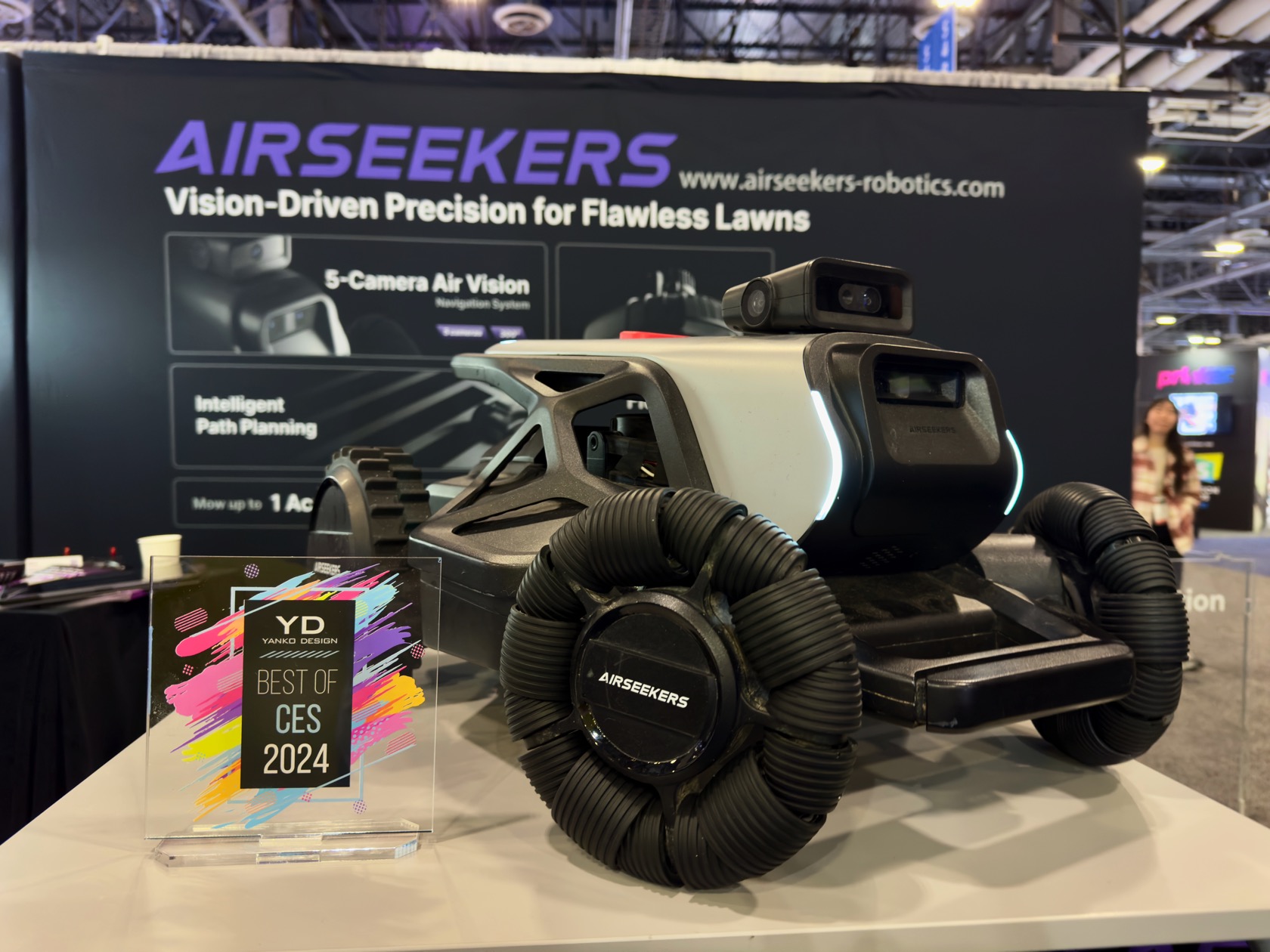
A quick search on Amazon for a robotic lawn mower will net countless results, but will I buy one right now? The short answer is no. Continue reading for the long answer and why I’m leaning towards the ultimate robotic mulch and lawn mower from Airseekers. To understand why, we need to break down key components: vision, wheels, blades, and the AI brain powering the Airseekers.
One of the biggest issues I’ve experienced with other robotic lawnmowers is how the mower has to be set up with an antenna base station that requires a direct line of sight to satellites orbiting above our planet. It depends on the brand, so each implements different technologies, allowing the robotic lawn mower to track its position. This pain point is a showstopper for me. My yard isn’t massive, but it’s big enough, and the complications compound with any robotic mowers I’ve tested – it has to do with the thirty-three oak trees spanning across a corner lot.
AI and cameras together solve the unreliable navigation systems used by others
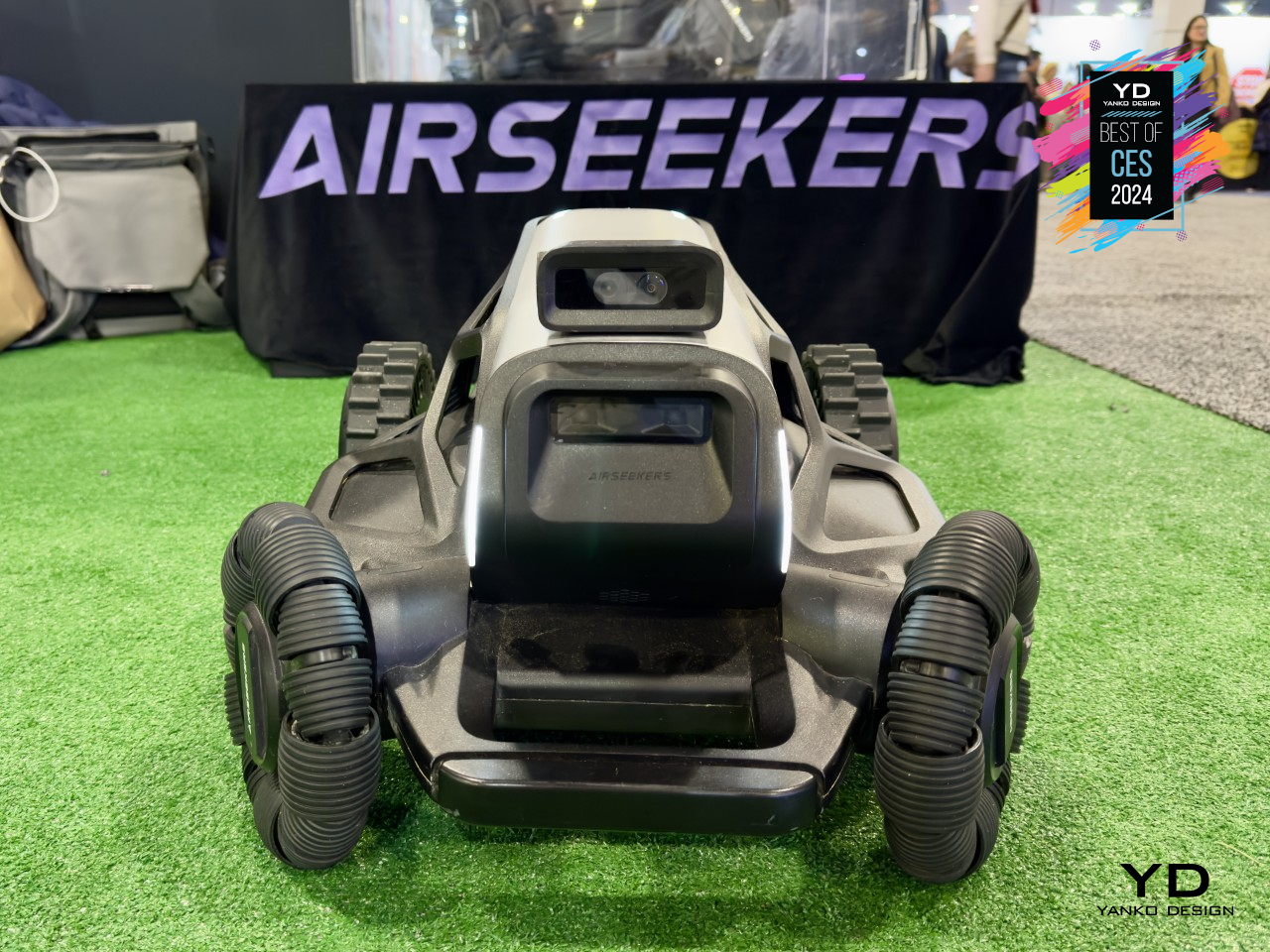
So, how has Yue Hu, the founder of Airseekers, solved this problem? By eliminating the need for an antenna altogether. The unit is truly autonomous to move about thanks to the 5-camera Air Vision. The navigation system consists of three panoramic lenses and dual depth-perception cameras.
The three panoramic cameras function similarly to how we use our eyes to see. The left and right cameras allow Airseekers to see both sides, similar to how we turn our heads left and right. The system as a whole works together in conjunction with the AI engine to determine the current position and identify obstacles, people, and pets, which it will automatically navigate to avoid hitting.
Moreover, the Air Vision system captures extensive visual data from various angles for precise, centimeter-level positioning. This reduces errors from weak satellite signals and continuously processes environmental data, even in areas with dense foliage or under eaves. Its stability is maintained on uneven terrain and is resilient to lens obstruction caused by dirt or camera movement.
Smooth operator
My robotic vacuum cleaner remembers the precise location where it stopped cleaning when the battery runs low, runs back to the base to charge up and then resumes cleaning at the very spot it was in previously. That’s exactly what Airseekers is capable of, using the navigation system and countless images that it takes and stores in the memory bank. Speaking of images, you can even submit pictures of you, your pet, and anyone else to the system via the app on your phone. This is a significant feature, in my opinion, due to theft prevention. If the system identifies a person it doesn’t recognize, it notifies you via the app and automatically shuts down and locks up. This same safety feature also kicks in when it’s removed from the invisible geofence you set up during your initial setup.
There’s also the option to use your cellular SIM card to track the positioning if you want peace of mind. Otherwise, if your wifi signal is strong enough, it should also do the job, according to Hu. Note that using your cellular sim card is only an option, not a requirement, since many of us don’t have an extra active sim card lying around.
The AI has been fed with countless images of everything that it could potentially encounter. So, circling back to the cameras, it can identify the edge of your yard, preventing itself from veering off course and slamming into the pavement. Hu assured me that there shouldn’t be any training required at all when you first use Airseekers, but if it makes you feel better, you can walk it around the edge of the yard, around trees and bushes once, and it’ll commit the pattern to memory.
Airseekers’ AI self-mapping technology streamlines lawn care by eliminating the need for perimeter wires, manual controls, and RTK base stations. Utilizing panoramic perception and Vslam technology, it generates a detailed 3D map of your yard. The intelligent app automatically defines lawn boundaries and cutting zones, simplifying mowing.
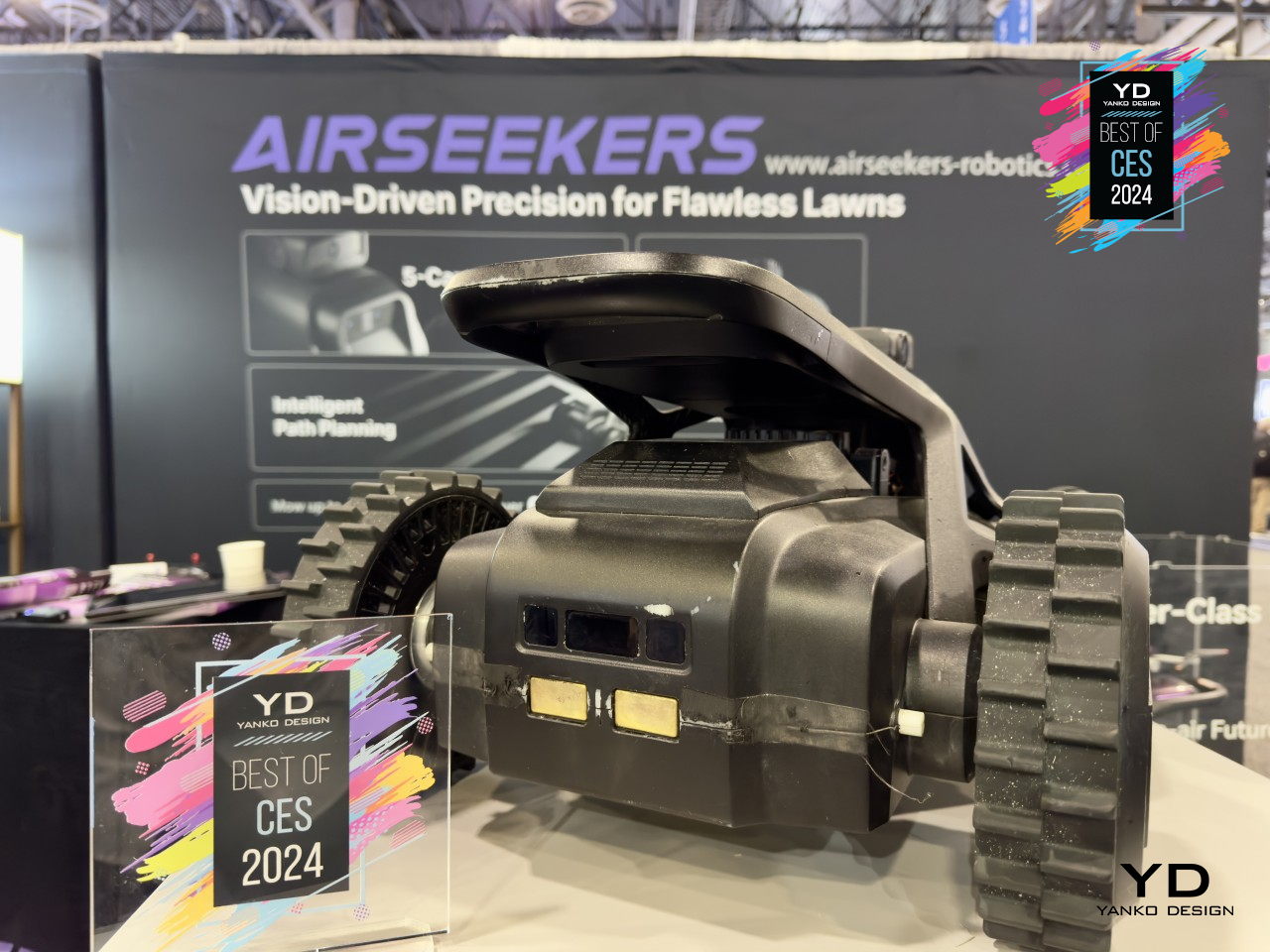
For added security measures, there’s a sensor or “bumper” located in the front to sense objects with which it comes in contact.
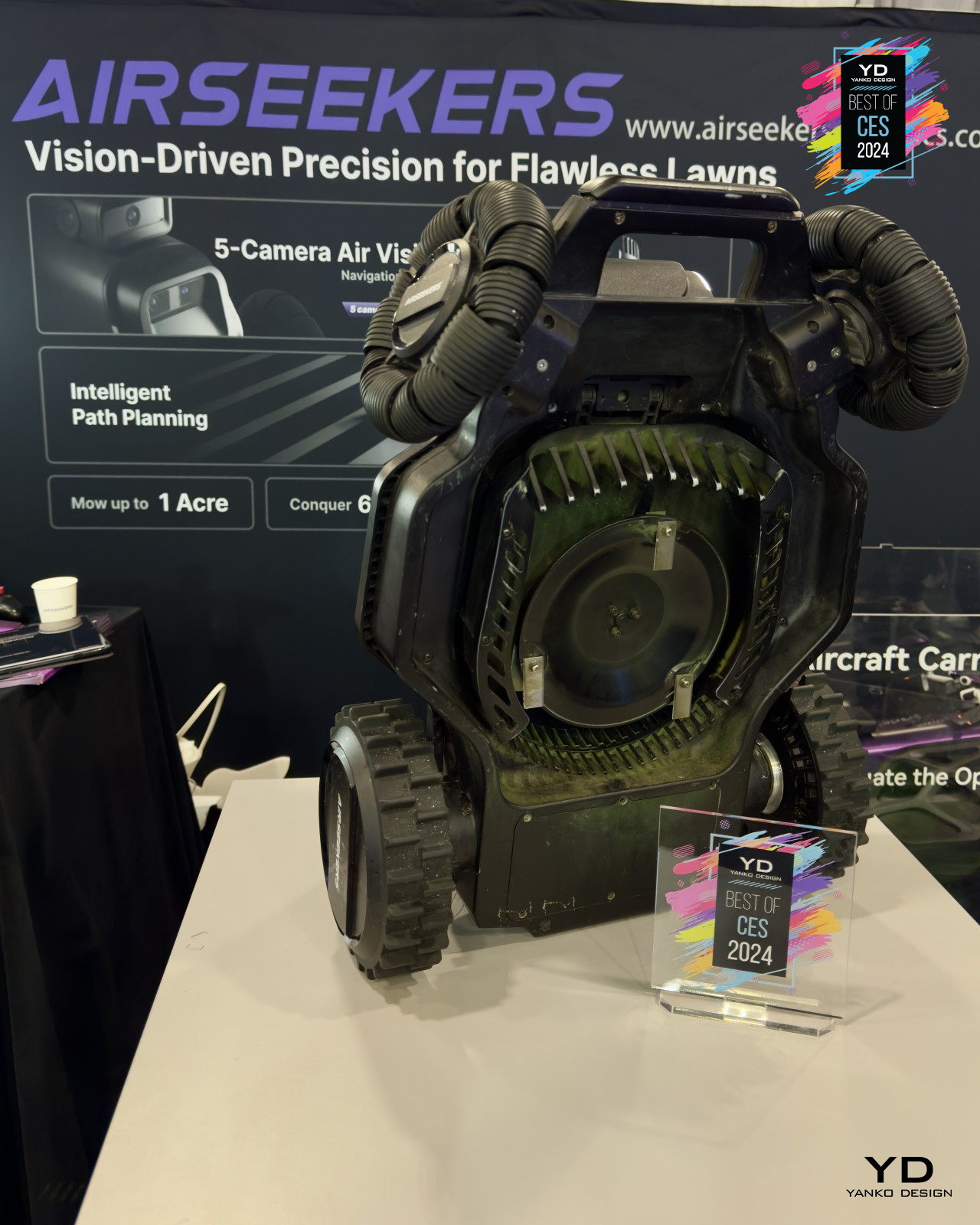
The Airseekers comes equipped with a motor powerful enough to allow it to climb hills up to a 65% slope and effortlessly traverse uneven terrain. This feature is essential for maintaining a lawn with varying elevation degrees. Its high-torque motors and the 30-degree inward design of its omnidirectional wheels facilitate smooth turns and confident movement in any terrain, so there’s no need to worry about the mower getting stuck – now I wish I could say the same for my robotic vacuum cleaner.
The Airseekers have a special feature called the FlowCut Mowing System. This system ensures your grass has neat edges. It does this by sucking the grass up straight, then cutting it inside a U-shaped chamber. This incredible Vacuum-Cut-Mulch system and double mowing power chops up the grass clippings into tiny pieces. These pieces then go into the ground and act as fertilizer. This process keeps your lawn looking tidy and also helps the soil by adding natural nutrients.
Other notable features include Automated Lawn Maintenance, Rainfall Auto-Detecting, and Real-Time Monitoring and alerts. The Automated Lawn Maintenance ensures your lawn is consistently taken care of, whereas the Rainfall Auto-Detecting feature prevents the mower from operating under unfavorable weather conditions. I wouldn’t say I like to mow the grass when it’s wet; I do it more to protect the grass blades. The Real-Time Monitoring and alerts inform you about the mower’s operational status.
Lastly, Hu shared with Yanko Design that in the next near final prototype, Airseekers should have a user-replaceable battery which is located in the bottom rear. For someone with a larger yard, being able to replace the battery immediately is priceless. However, if you’re like me and just too lazy and want the Airseekers to do all the work, it’s smart enough to know when to return to the base station and charge up before running out of juice. After sufficient charge, it resumes for another three hours of mowing away.
I’m impressed with the design elements and advanced technology, especially the custom-shaped blades that allow a clean cut. I can’t wait to have this impressive machine roaming my yard.
Effortlessly glide through the bustling city streets, weaving past traffic jams, and arriving at your destination with ease. This vision is now a reality with the introduction of the Arma Scooter, a sleek and innovative e-scooter that’s transforming the way urbanites navigate their concrete jungles. With its unparalleled compactness, folding down to the size of […]
The latest ZenBook 14 OLED from ASUS has most of the hardware we'd want in a modern ultraportable: Intel's new Core Ultra chips, a gorgeous OLED screen and a decent number of ports. But after testing ASUS's laptops for years, and seeing how much progress it's made with the Zephyrus G gaming line, it's surprising that the company's premium Zenbook hasn't evolved much lately.
While it's a solid step into the "AI PC" era, thanks to its NPU for accelerating AI tasks, the new ZenBook 14 is also a reminder that ASUS is lagging behind Apple and Microsoft when it comes to premium design. It doesn't feel nearly as sturdy or sleek as the redesigned MacBook Air, and it lacks the refinement of the Surface Laptop. The ZenBook 14 OLED looks fine — it’s as if you asked an AI to generate an image of a generic ultraportable.
On the plus side, ASUS is delivering far more bang for the computing buck than Apple and most other competitors. You can snag the ZenBook 14 OLED with a Core Ultra 7 155H chip, 32GB of RAM and 1TB SSD for $1,300 at Best Buy. An M2 MacBook Air for the same price comes with 16GB of RAM and a 256GB SSD (and it can only be upgraded to a maximum of 24GB of RAM). ASUS also includes a decent selection of ports, including a USB-A connection, two USB-C Thunderbolt ports, an HDMI socket and a microSD card slot. You'd have to step up to the pricier 14-inch MacBook Pro to get some of those ports on a Mac.
While ASUS is touting the Core Ultra's AI capabilities as the big upgrade this year, I'm still far more compelled by the Zenbook 14's glorious 14-inch 3K OLED screen. It's wonderfully bright and colorful when it needs to be, and it can hit those inky dark blacks that we love from OLED displays. This year the Zenbook's OLED screen can also reach a 120Hz refresh rate for smoother scrolling, which is practically a requirement for premium laptops these days.
Images and video practically leap off of the ZenBook 14's OLED screen, which makes it ideal for binging Netflix or catching up on your YouTube queue. And thanks to the laptop's incredibly thin bezels, it's almost as if the display is floating in the air — so much so, I stopped noticing how dull the rest of the ZenBook's design feels. I also wish there was a bit more spring and depth to its keyboard, and that its trackpad didn’t feel so stiff.
But back to Intel's Core Ultra chip. Our review unit, which was equipped with a Core Ultra 7 155H, 32GB of RAM and Intel Arc graphics, delivered some healthy gains over ultraportables running Intel's 13th-gen chips. It scored 1,000 points higher in PCMark 10 compared to the ZenBook S 13 running a Core i7-1355U, and its Arc graphics were almost twice as fast as the S 13's Intel Xe graphics in the 3DMark Wildlife Extreme benchmark.
None
Geekbench 6 CPU
PCMark 10
Cinebench R23
3DMark Wildlife Extreme
ASUS ZenBook 14 OLED (Intel Core Ultra 7, 2023)
2,240/10,298
6,170
1,599/7,569
4,827
ASUS ZenBook S 13 (Intel i7-13700H, 2023)
2,479/13,367
5,165
N/A
2,784
Apple MacBook Pro 14-inch (Apple M3, 2023)
3142/11,902
N/A
1,932/10,159
8,139
While it's far from a gaming machine, the ZenBook 14 OLED's Arc graphics also reached between 30fps to 49fps while playing Halo Infinite in 1080p with low graphics. Streaming games over Xbox cloud gaming delivered far better results: Halo Infinite and Forza Motorsport played like a dream over Wi-Fi in my office. Of course, that's more a testament to the ZenBook's wireless hardware than its graphics.
Photo by Devindra Hardawar/Engadget
Intel's Core Ultra chips are also focused on a lot more than just raw horsepower (Intel's internal benchmarks even show it getting bested by a 13th-gen chip in some single-threaded tasks, a trade-off it made to deliver better AI and graphics performance). The addition of an NPU means the ZenBook 14 OLED can handle AI workloads in the future; developers like Adobe and Audacity have announced they're working on AI-powered features in their apps. If you're not using those apps, there's not much to do with an NPU in Windows yet except for Microsoft's Studio Effects, which lets you blur backgrounds and automatically keep yourself in frame during video chats. And notably, Studio Effects delivers far better background diffusion and person detection than the built-in alternatives in Zoom and Google Hangouts.
Buying an AI PC like the ZenBook 14 OLED is more a bet on the future rather than an immediate speed upgrade. But based on the industry support we've seen from Microsoft and other big tech firms, having an NPU-equipped PC could pay off soon. Just imagine Microsoft giving Copilot offline capabilities to make it more responsive, similar to Apple's push to make Siri available offline (something also powered by the company's Neural Engine). Eventually, you may be able to speak aloud to Copilot and have it instantly find files or locate a specific setting on your PC.
I won't blame you if you're not excited by the future of AI PCs. When Macs switched over to Apple Silicon chips, there were dramatic performance improvements over Intel's older hardware, along with the additional benefits of the Neural Engine and far better battery life. Windows users, instead, can only hope and pray that developers actually tap into NPUs.
Photo by Devindra Hardawar/Engadget
For now, though, you can look forward to some decent battery life from Intel's Core Ultra chips. The ZenBook 14 OLED lasted 12 hours and 43 minutes in the PCMark 10 Modern Office battery benchmark, which was longer than any other PC we've tested. During a recent trip, it held up for around a day and a half for general productivity work (lots of web browsing, writing, photo editing and a few video chats). ASUS is still lagging behind Apple, though — the M2 MacBook Air lasted 16 hours and 30 minutes in our benchmark. Fan noise also remains a problem: Its fans spun up noticeably during a podcast recording, whereas the fan-less MacBook Air is completely silent even under heavy workloads.
After spending a few weeks with the ZenBook 14 OLED, I’ve grown to love its OLED display and I’m intrigued by the possibilities of the Core Ultra chip’s NPU. It’s just a shame to see those features stuck in a relatively humdrum package. If you care more about getting a good deal than style, though, this ZenBook is tough to beat.
This article originally appeared on Engadget at https://www.engadget.com/asus-zenbook-14-oled-review-ai-pc-143054247.html?src=rss
Step into a world where every sound is crystal clear and every moment is captured with precision. The ROG Cetra True Wireless SpeedNova gaming headphones are here to transform your gaming sessions into a deeply immersive experience. These headphones are not just another accessory; they are a powerful tool designed to give gamers an edge. […]