Smart TVs are the default option for the largest display in the home (unless you have a projector, that is). Their operating systems can be hit or miss, but thankfully there are other options available in the form of dedicated streaming devices. For those heavily invested in the Apple ecosystem, the Apple TV 4K is perhaps the best option of the bunch. The third-gen version is currently on sale at Verizon, where the 64GB model has dropped by $40 to $90. That's the best price we've seen for this variant to date.
The third-gen Apple TV 4K is our pick for the best premium streaming device and we gave it a score of 94 in our review. It's very fast as it runs on an A15 Bionic chip — the same hardware that powers the iPhone 14. It takes barely any time at all to load or switch between apps. With the help of the Siri remote's touch-sensitive directional pad, you can quickly skip to a certain point of an episode or movie. The box (which has a smaller, fan-less design than previous generations) also delivers great picture quality and it has 4K Dolby Vision and HDR10+ support.
Setting up the Apple TV 4K is a cinch if you have an iPhone, but you don't need to have other Apple products to get a lot out of the device (even if the Apple TV app does skew toward Apple TV+ content). Those who are embedded in the Apple ecosystem though will likely appreciate being able to use Apple Fitness+ and Apple Arcade on a big screen.
The Audi Q6 SUV e-tron Performance is a remarkable addition to the electric vehicle market, boasting an impressive 392-mile range that sets it apart from its competitors. This groundbreaking model is designed to cater to the needs of those who prioritize efficiency, performance, and practicality in their electric vehicles. With its innovative technology and sleek […]
Skydance Games is best known for The Walking Dead: Saints and Sinners, one of the most popular, games on the original PlayStation VR. Combining visceral fights with TWD’s usual dramatic twists, turns and zombies, it felt like a proper VR game.
Skydance's Behemoth is an action-adventure game that draws on the combat and physics of The Walking Dead games but focuses more on fighting and less on survival. Like Saints and Sinners, there’s still a crafting system, but it’s a lot simpler, reinforcing the action-adventure slant here. I got to play a slice of the game, which combined early tutorial snippets outlining controls and mechanics with more thrilling set pieces and exploration segments – oh, and a battle with the behemoth itself.
Shawn Kittelsen, vice president of Creative, says Behemoth has a more sophisticated combat system. You will have to observe enemies, time your counterattacks and generally think a little more about your strategy instead of just waving your weapons around in virtual space. Doing that will drain your stamina bar, leaving you unable to dodge or block if you’re not careful. While combat feels weighty, you can still flail around with weapons and do damage — limitations are translating the swing of a plastic PSVR controller to a massive four-pound broadsword. This stamina system does help keep that in check, at least a little.
Kittelsen says the game lightly draws inspiration from Dark Souls for battle dynamics. At the same time, the most compelling part — a brief fight with the giant — reminded me of Shadow of the Colossus… from a completely different perspective.
You could split my demo into two halves. The initial chunk of the demo introduces control systems, traversal techniques and how to fight other human foes. Like a lot of VR games, it takes a moment to get up to speed. Fortunately, Skydance equipped my character with a magical sword that I could throw and resummon, Thor hammer-style. That, however, didn’t fix my habit of dropping my shield immediately after battles.
I tried out bows, an ax and other weapons dropped by human enemies as I traversed the early parts of the game. I swung across monkey bars and climbed vertical rock faces and ropes, and I felt more than a little self-conscious doing so in a room of game developers and PRs. A wrist-mounted grappling hook adds a bit of speed to exploration, but all these systems together (plus not playing VR on the reg) did make me feel a little queasy. The creators have added the ability to reduce your field of view to lessen the effect, but I did break into a cold sweat during my demo. However, it didn’t reach the levels of Resident Evil 7’s notorious nausea-causing demo.
Mark Robinson
I went into the second part of my demo, a brief skirmish with a behemoth called Seal, with some trepidation. Would running and evading a colossal monster make me feel even more VR-sick? Not the case. Maybe because I focused on a single objective — the giant monster — as I swung around on my grapple hook, fired arrows at his weak points, dodged foot stomps and more, I felt… fine. That’s a great sign, as my brief tussle with the giant was the standout moment of the demo. I did, however, die a few times.
Like SatC and recent Zelda games, you can scale this behemoth (if there’s the right texture of climbable surface). You can also use your grappling hook to launch yourself towards Seal's knee. You can’t simply cling on, though, as your stamina meter will burn away as you inch toward the giant’s weak spots. In a somewhat misguided approach, I tried to use arrows to hit the creature but would inevitably drop the bow rather than release the arrow. That was due to my skill, not the control system.
Like Horizon Call of the Mountain, climbing and traversing with your hands in Behemoth is fun, but that PSVR2 exclusive is a prettier game. However, the good news is Behemoth is coming to almost all contemporary VR headsets, from Meta’s Quest 2 and upwards, as well as PC headsets and PSVR2.
The creators say the primary campaign will last around 12 hours, with an additional arena mode to fight more enemies — or, hopefully, offer a quick shortcut to battle the behemoth. I can’t wait to get squashed again.
Skydance’s Behemoth launches in fall 2024.
This article originally appeared on Engadget at https://www.engadget.com/skydances-behemoth-brings-giant-climbable-monster-fights-to-vr-140057216.html?src=rss
Meta’s rolling out a small spring/summer update for the Quest 2 and Quest 3 headsets. There’s nothing too major here, but there are some small improvements for regular users.
The biggest news is a new and better way to watch Netflix content. There’s long been a standalone Netflix app available for Quest headsets, but it maxes out at 480p and is generally considered to be, well, crappy. Once updated, you’ll be able to watch Netflix directly from the built-in browser. This offers a much-improved experience, with the option to view content in high resolution.
This browser-based version of Netflix isn’t just for better-looking content. The web app also offers the choice between a flat 2D virtual screen and a simulated theater view. Fake movie theaters are one of the best parts about VR, so this is welcome news.
Meta
Meta announced a dedicated travel mode a few weeks back, but the update brings it to everyone. This is a system mode primarily for air travel, as it tunes the headset’s algorithms to adjust for airplane jostling. The headset will automatically connect to in-flight Wi-Fi and will be available to play anything stored on the device, in addition to movies and TV shows offered by the airline.
The company has entered into a partnership with Lufthansa to offer Quest 3 headsets to people on select business class flights. Of course, you’ll have to be comfortable wearing a giant thing on your face while surrounded by strangers, but you do you.
The rest of the update pertains to existing apps. Beat Saber is getting five free new tracks and the fitness app Supernatural is getting a mixed-reality mode, but only on Quest 3 (for obvious reasons.) Meta has also announced that another trailer for the Quest 3 exclusive Batman: Arkham Shadow will drop on June 7 as part of Summer Game Fest.
This article originally appeared on Engadget at https://www.engadget.com/meta-quest-software-update-adds-a-better-way-to-watch-netflix-and-a-travel-mode-140034768.html?src=rss
After getting officially announced way back at CES 2024, all of Samsung’s new 2024 gaming monitors are finally available for pre-order today. However, while the massive 49-inch Odyssey G9 (G95SD) garnered most of the attention when initial details came out in January, I recently had a chance to check out its smaller siblings in person (plus one of Samsung’s new smart monitors), which are just as impressive due to their lower prices and more-practical screen sizes.
Similar to the Alienware AW3225QF and HP Omen Transcend 32, the 2024 Odyssey G8 OLED (G80SD) and Odyssey G6 OLED (G60SD) are based on Samsung’s third-gen QD-OLED tech. That means you get rich colors and deep blacks along with support for AMD FreeSync Premium Pro and increased brightness compared to traditional OLED displays. But from there, the two monitors diverge slightly with the 32-inch G8 being more of an all-rounder thanks to its 4K resolution and 240Hz refresh rate. Meanwhile, the smaller G6 is better suited for competitive gaming with its 2,560 x 1,440 resolution and 360Hz refresh rate.
Photo by Sam Rutherford/Engadget
My favorite of the two is the G8, as it features a flat display (not curved like the Alienware) with an anti-reflective matte coating and an extremely sleek design that lets you appreciate its super-thin 0.15-inch panel. Meanwhile, Samsung has equipped both the G8 and G6 with a dynamic cooling system that better reduces temperatures and can even preemptively control brightness if needed. And, for the first time, Samsung is offering a three-year warranty in case the monitor succumbs to burn-in.
I also appreciate that even though it’s a relatively large monitor, the G8 supports height adjustment and the ability to rotate into portrait mode. As a nod towards convenience, it comes with built-in stereo speakers and a solar remote (similar to what you get from Samsung’s flagship TVs), so you can easily connect it to gaming consoles alongside a traditional PC. And in case that’s not enough, the G8 also features Samsung’s Gaming Hub, which allows you to access streaming services like NVIDIA GeForce Now and Xbox Cloud Gaming without needing to connect to another device.
Photo by Sam Rutherford/Engadget
Alternatively, for more hardcore gamers, the G6 packs almost all of the same tech (including the remote and matte coating) into an even more practical 27-inch display. You still get Samsung’s CoreLighting+ module in back to supply some ambient RGB hues and a similarly sleek metal design. Samsung even redesigned the G8 and G6’s feet to give people with unusual gaming setups more flexibility and room to position their mouse and keyboard.
Finally, while it’s neither OLED nor a gaming display, Samsung’s M80D Smart Monitor is a neat take on 4K office productivity. It features a magnetic mount for a detachable webcam, so you can easily position it without the need for a tripod or quickly remove it at the end of a video call. You can also pair it over Wi-Fi with other Samsung devices, allowing you to easily move images or files from one to another. Just like the G8 and G6, it supports Samsung’s Gaming Hub and the ability to stream shows from apps like Netflix natively on the monitor.
Photo by Sam Rutherford/Engadget
The G9 remains the true flagship of Samsung’s gaming monitors, but the company has now made great options at smaller sizes too. The Odyssey G8 and G6 will start at $1,300 and $900, respectively, while the M80D Smart Monitor will go for $700. Pre-orders go live today and will come with a $300 discount for anyone who makes an early purchase before official sales begin later this month.
This article originally appeared on Engadget at https://www.engadget.com/samsungs-odyssey-g8-might-be-the-best-32-inch-gaming-monitor-of-the-year-140026504.html?src=rss
When embarking on the journey to transform your home into a smart living environment, careful selection of the right hardware for Home Assistant (HA) is crucial. For those new to home automation, starting with entry-level hardware like the Raspberry Pi is advisable. Known for its affordability and straightforward setup, the Raspberry Pi is sufficient for […]
Samsung has unveiled its latest lineup of Smart Monitors for 2024, featuring the M8, M7, and M5 models. These monitors are designed to provide a comprehensive multi-device experience, blending smarter entertainment options with enhanced productivity features. The flagship model, the 32” 4K UHD Smart Monitor M8, is powered by the NQM AI processor, which introduces […]
In the modern era, where data reigns supreme, the importance of business intelligence (BI) cannot be overstated. BI tools are essential for organizations seeking to make strategic decisions based on comprehensive data analysis. The emergence of generative AI is poised to transform these tools, making data-driven decision-making more efficient and effective than ever before. Below […]
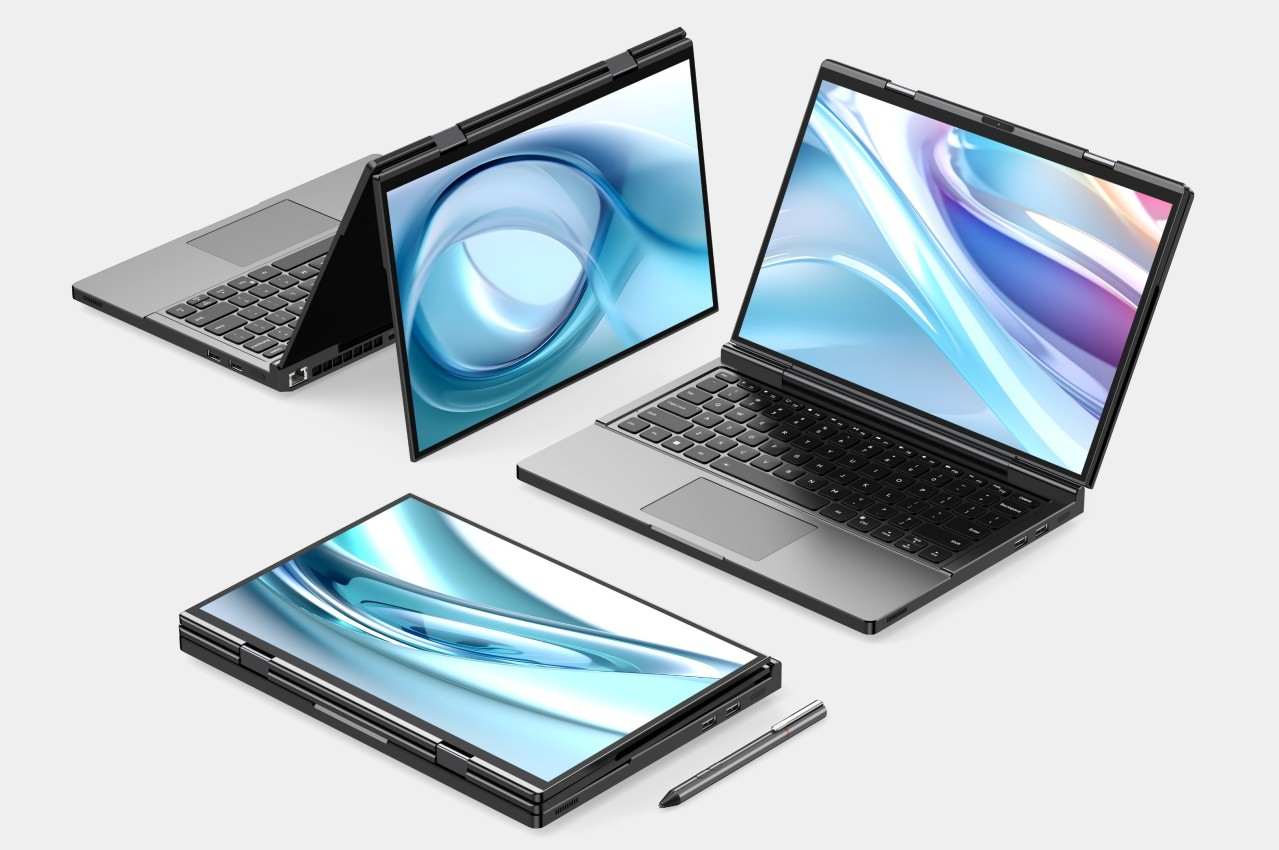
In exchange for portability and mobility, laptops give up some power and flexibility, especially when it comes to things you can connect to. Sure, you can still connect plenty of peripherals, but you’re limited not only by the amount of ports available but also by the space you have around your laptop. A dual monitor laptop, for example, is inconvenient and even impossible in some circumstances, so a few solutions have been designed to address that limitation, from portable monitors to laptops that are just two screens and nothing else. The latter has been billed as “dual laptops,” though their appearance and use are far from what most people expect from laptops. This “true dual screen laptop” wants to fix that problem with a design that is both intriguing but perhaps also questionable at the same time.
You can’t change a laptop’s screen after the fact, so you can only expand it with an external portable monitor that adds yet another thing to your bag. Dual-screen laptops like the ASUS ZenBook Duo and Lenovo Yoga Book 9i are actually more like two monitors with integrated computer hardware rather than like a laptop with two screens. One of the biggest problems is requiring the use of a Bluetooth keyboard in ways that are unfamiliar to most laptop users.
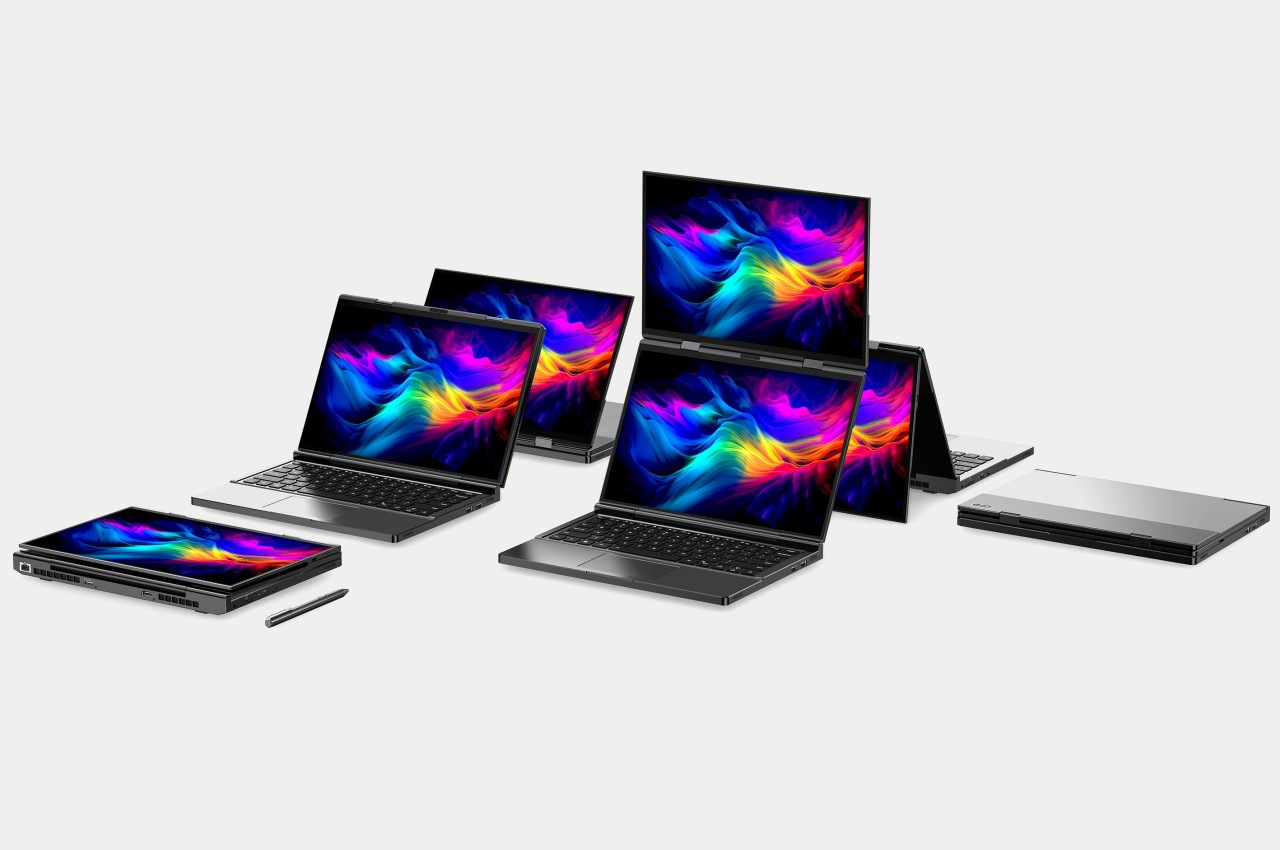
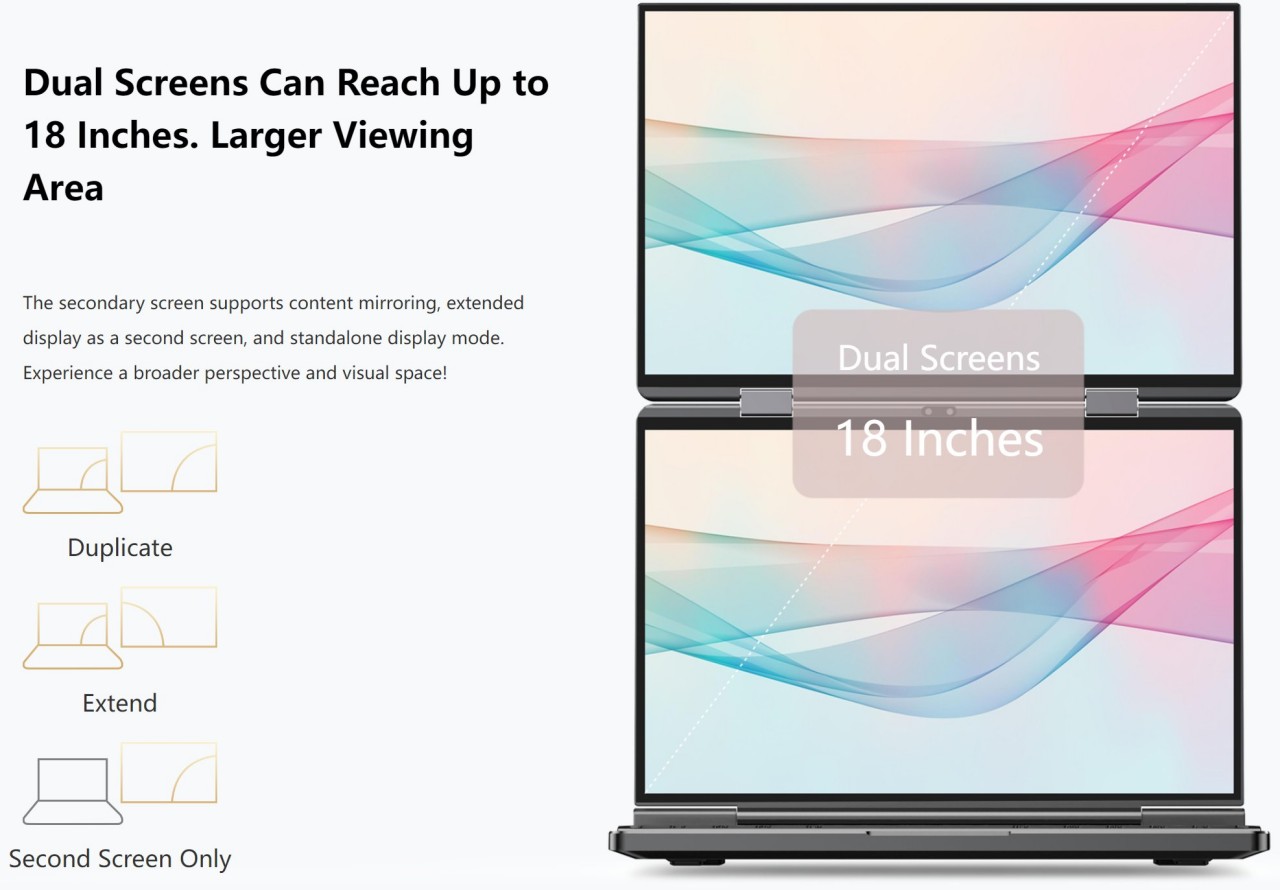
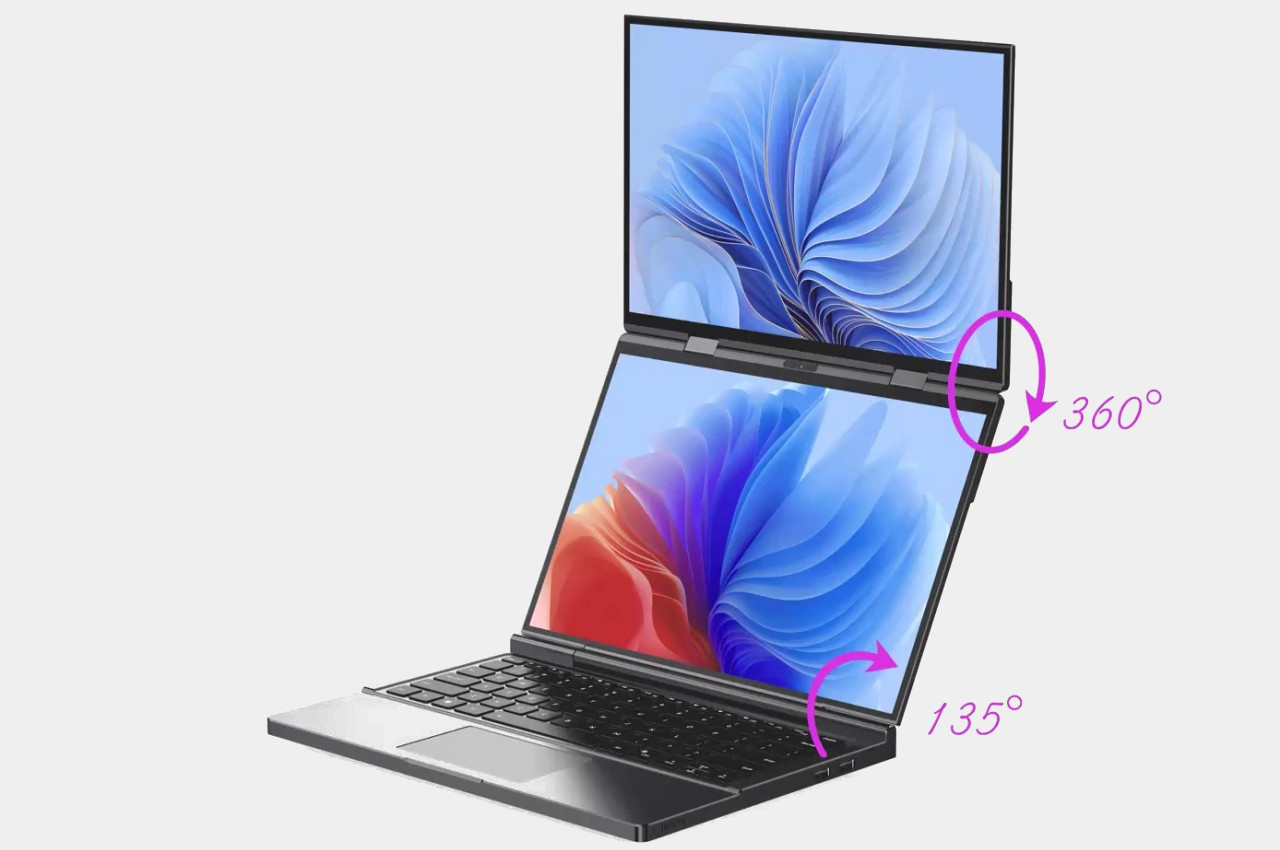
The GPD DUO’s solution is to combine all these parts into a single whole, delivering a completely traditional laptop experience when needed and a dual-screen or even tablet when wanted. It does this by actually having two folds, one with a traditional laptop hinge that can fold open up to 135 degrees, and another for the second monitor that can fully swing 360 degrees. This second screen is permanently attached to the top of the first, creating a vertically stacked dual-screen setup when unfolded. But unlike ASUS’s and Lenovo’s designs, the keyboard is still attached to the primary screen and functions as expected.
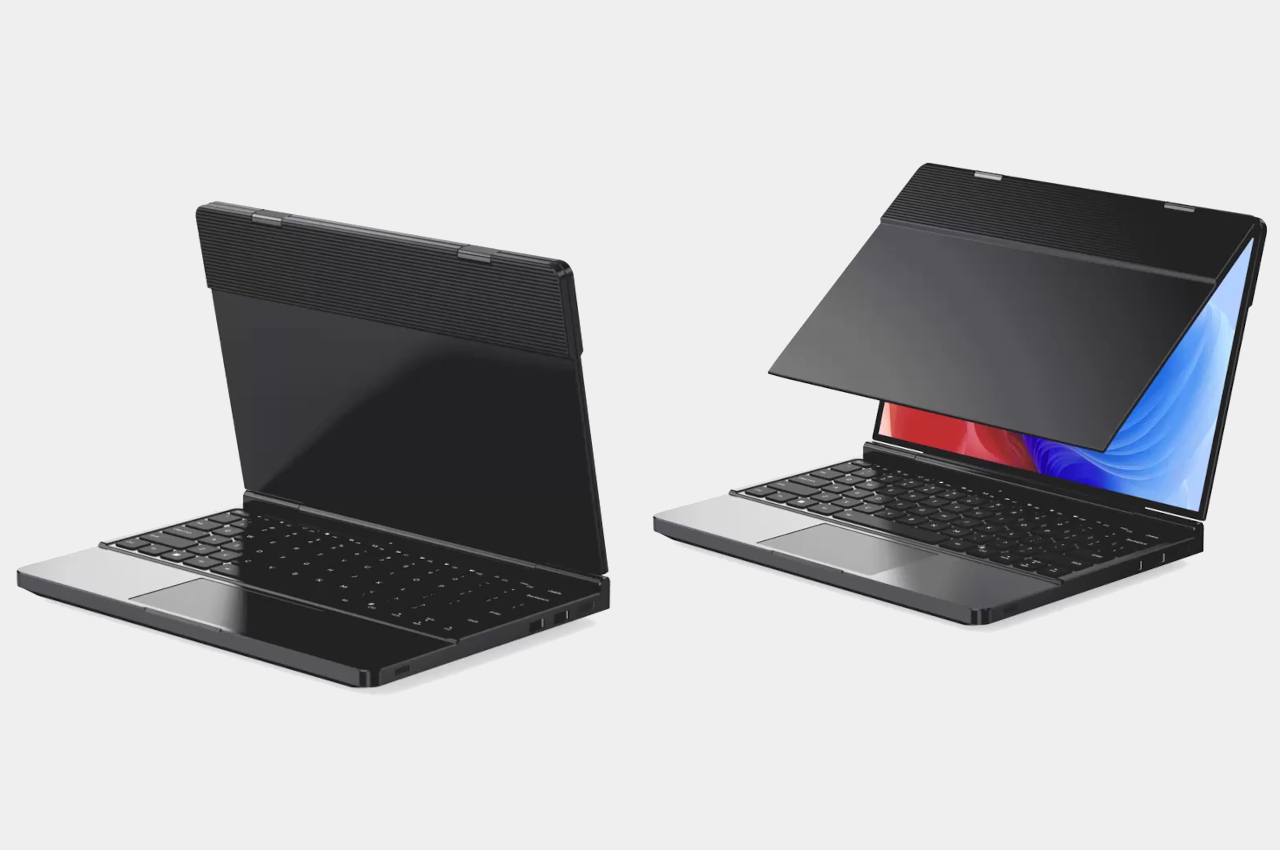
This rather unconventional design means that, if you don’t want or can’t use a tall dual-screen setup, you can simply fold back the second screen and use the GPD DUO as a regular laptop. That said, the second screen in that position could actually still be used to present content to people in front of the user, sort of like the “tent mode” of some 360-degree laptops. And when you close the laptop down in this configuration, you get a tablet that you can draw on.
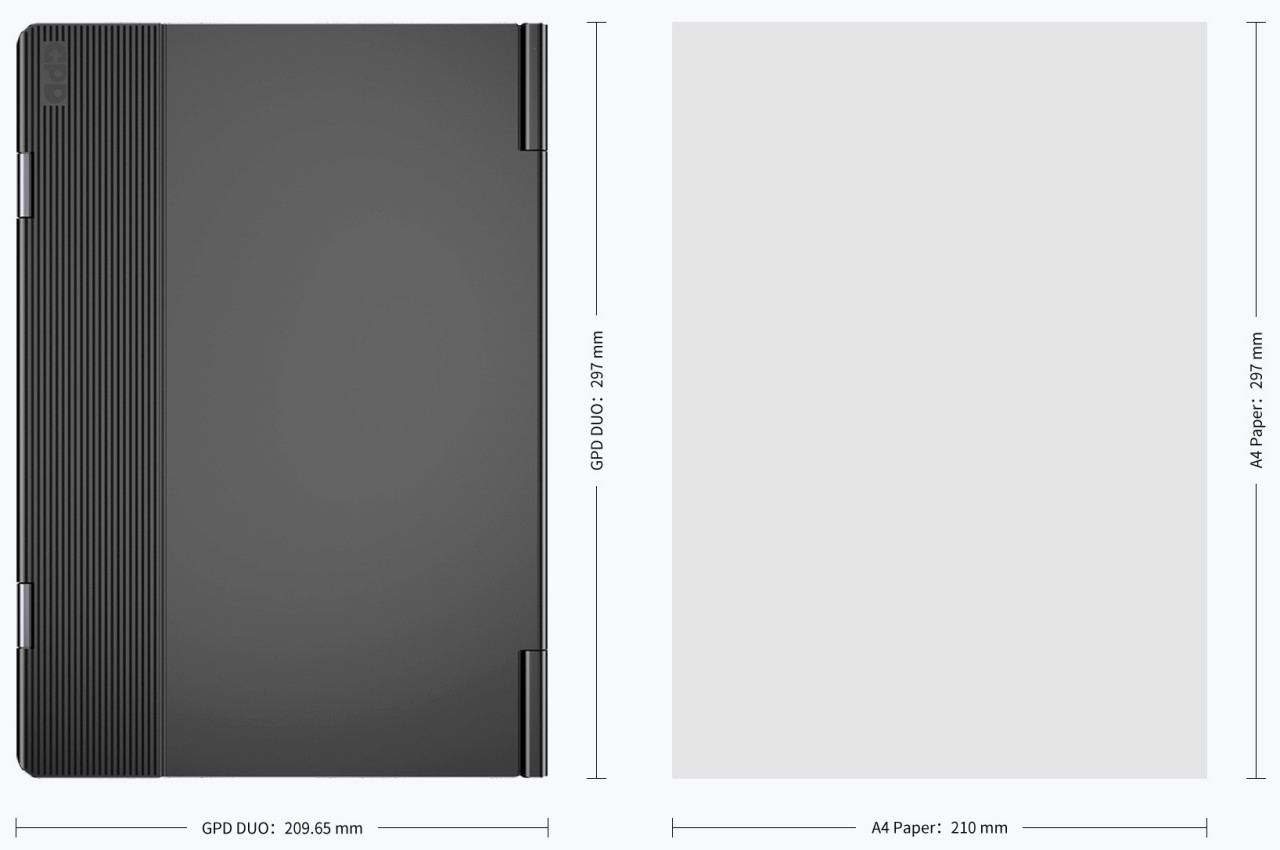
While the design of the GPD DUO sounds reasonable, it does raise a few concerns, especially in terms of the weight and bulk of the laptop. Although GPD claims that the 13.3-inch laptop is only the size of an A4 paper when folded, it hasn’t yet revealed the thickness or weight of the device. The design also forces the dual screen orientation to only be vertical, and you have no other option on how to use or position the screens. It does seem that the GPD DUO trades one feature for another, so it remains to be seen how this design will resonate with laptop users.
Meta Connect 2024 will take place on September 25 and 26 and "explore the future of AI and mixed reality," the company announced on X. Last year, Meta used the event to launch its latest Quest 3 headset, Ray-Ban Meta smart glasses and more.
This year may be even busier. In April, Meta teased a limited-edition Xbox-inspired Quest headset and announced that it was rebranding Quest OS to Meta Horizon OS. It also opened up the OS to third parties and said that both Lenovo and ASUS were working on AR devices. Meta could also reveal a more affordable "Quest 3S" headset, according to a recent store listing leak.
🗓️ Mark your calendars 🗓️ Meta Connect 2024 will be September 25 + 26 where we'll explore the future of AI and mixed reality and share progress on our long-term vision to help build the metaverse.
On a dedicated page, Meta offered a signup portal "for a sneak peak at this year's speakers, sessions and featured technology." As before, the keynote is likely to feature Mark Zuckerberg outlining his vision for Meta over the next year. This could be telling as the company appears to be shifting its focus from mixed reality to AI, despite having "metaverse" right there in the name.
This article originally appeared on Engadget at https://www.engadget.com/meta-connect-2024-will-take-place-on-september-25-and-26-132041893.html?src=rss