This $39 Pill Organizer Is Designed to Stay Out, Not Hide in Drawers

Most pill organizers still look like something from a hospital drawer, translucent plastic strips with tiny lids that feel clinical and easy to hide. That aesthetic does not help when you are trying to build a daily wellness routine around vitamins, supplements, or medication. Maybe the problem is not people forgetting, but tools that feel like they belong in a cabinet instead of in everyday life, making it harder to stay consistent.

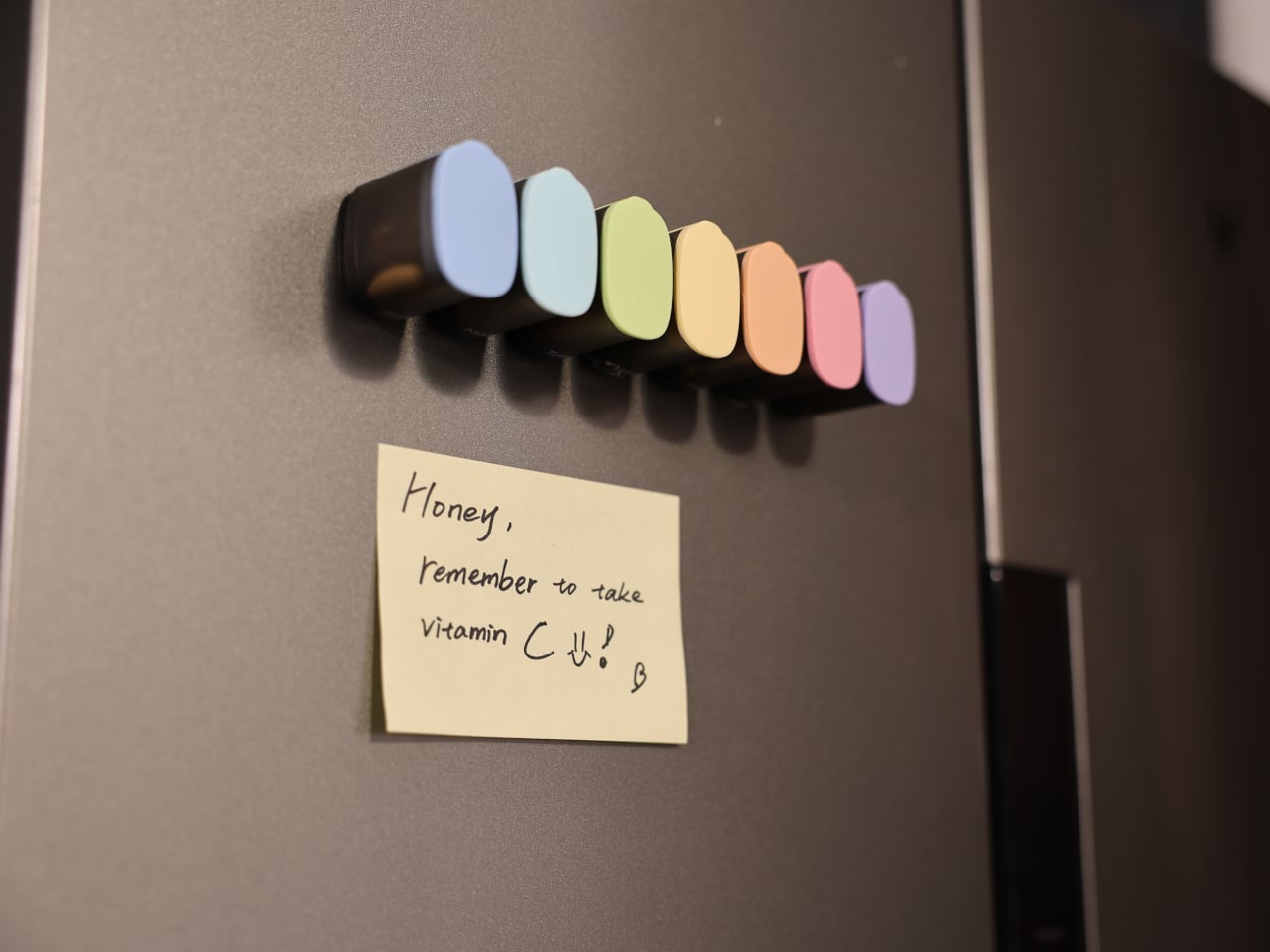
The modobloom M7 pill organizer is a weekly system designed for vitamins, supplements, and meds that is meant to live where you actually are, on a counter, desk, or nightstand. It uses seven magnetic Tritan tubes, one for each day, and a compact foldable case that can display them or tuck them away. The goal is to make your routine visible and calm, not something you only interact with when you are already stressed or running late.

Designer: modobloom

Click Here to Buy Now: $39 $59 (34% off). Hurry, 57/1600 left! Raised over $196,000.
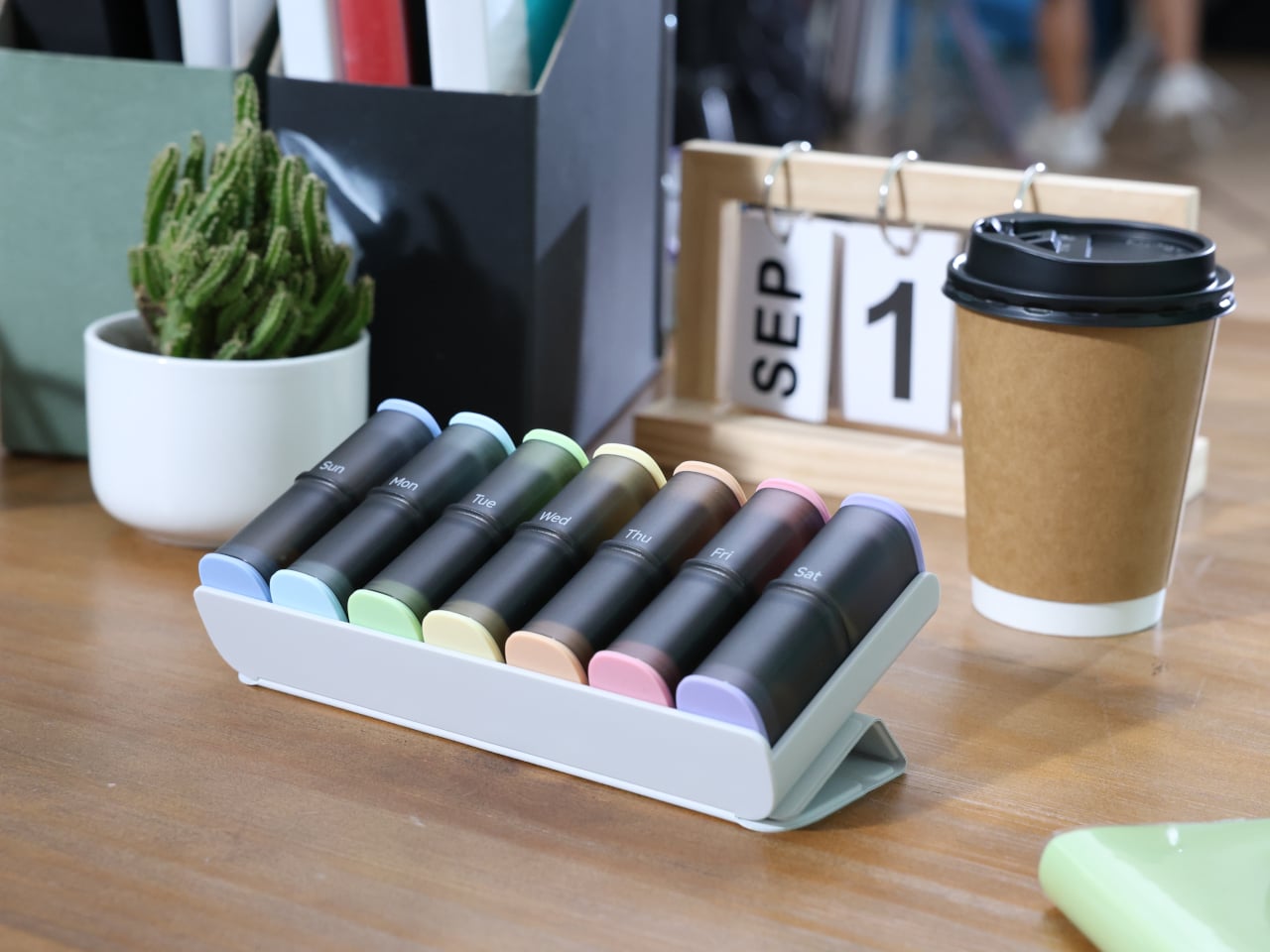
The modobloom M7 is designed to stay in sight, because out of sight often means out of mind. You fill the tubes once at the start of the week, then let them sit in the foldable case where you will see them, simplifying your daily rhythm. The internal compartments are sized for real supplement routines, not just a couple of tiny tablets, so you are not fighting the container every time you add a new capsule to your stack.

1

The seven tubes work as a modular set at home and as individual pieces when you leave. The embedded magnets let them snap together in a neat row, then detach smoothly when you want to take a single day with you. A tube can slip into a work bag, gym tote, or carry-on without rattling around, so your bedside routine and your on-the-go life share the same system instead of needing separate containers.

1

1

The material choices are Tritan from Eastman USA for the tube bodies, a BPA-free, FDA-compliant plastic used in premium water bottles and baby products, and food-grade silicone for the soft caps. The matte privacy finish keeps contents discreet, while color-coded lids and day labels keep things clear. The silicone cap opens to about 90 degrees and is tuned for one-hand operation, making it easy to open, pour, and close even when you are half-awake.

The modobloom M7 might sit next to a coffee machine as you take morning vitamins, or a single tube might live in a gym bag holding pre- and post-workout supplements. Another could be on an office desk as a quiet reminder in the middle of a busy day. The organizer becomes part of your daily rhythm, not a separate chore, and its soft-touch finishes and curated colors help it blend into a home rather than stand out like medical gear that you would rather not advertise.

A weekly pill organizer might seem like a small thing until you need it every day. When the object you rely on feels cold or embarrassing, it is easy to shove it in a drawer and forget. When it feels considered, safe, and a little bit warm, it is easier to keep it in view and let it support the habits that keep you well. The modobloom M7 treats wellness as something you live with, not something you hide, turning a mundane task into a small, calm ritual that quietly earns its place on your counter.

Click Here to Buy Now: $39 $59 (34% off). Hurry, 57/1600 left! Raised over $196,000.

The post This $39 Pill Organizer Is Designed to Stay Out, Not Hide in Drawers first appeared on Yanko Design.


This $350 Dyson Air Purifier Borrowed Tech From Jet Engines

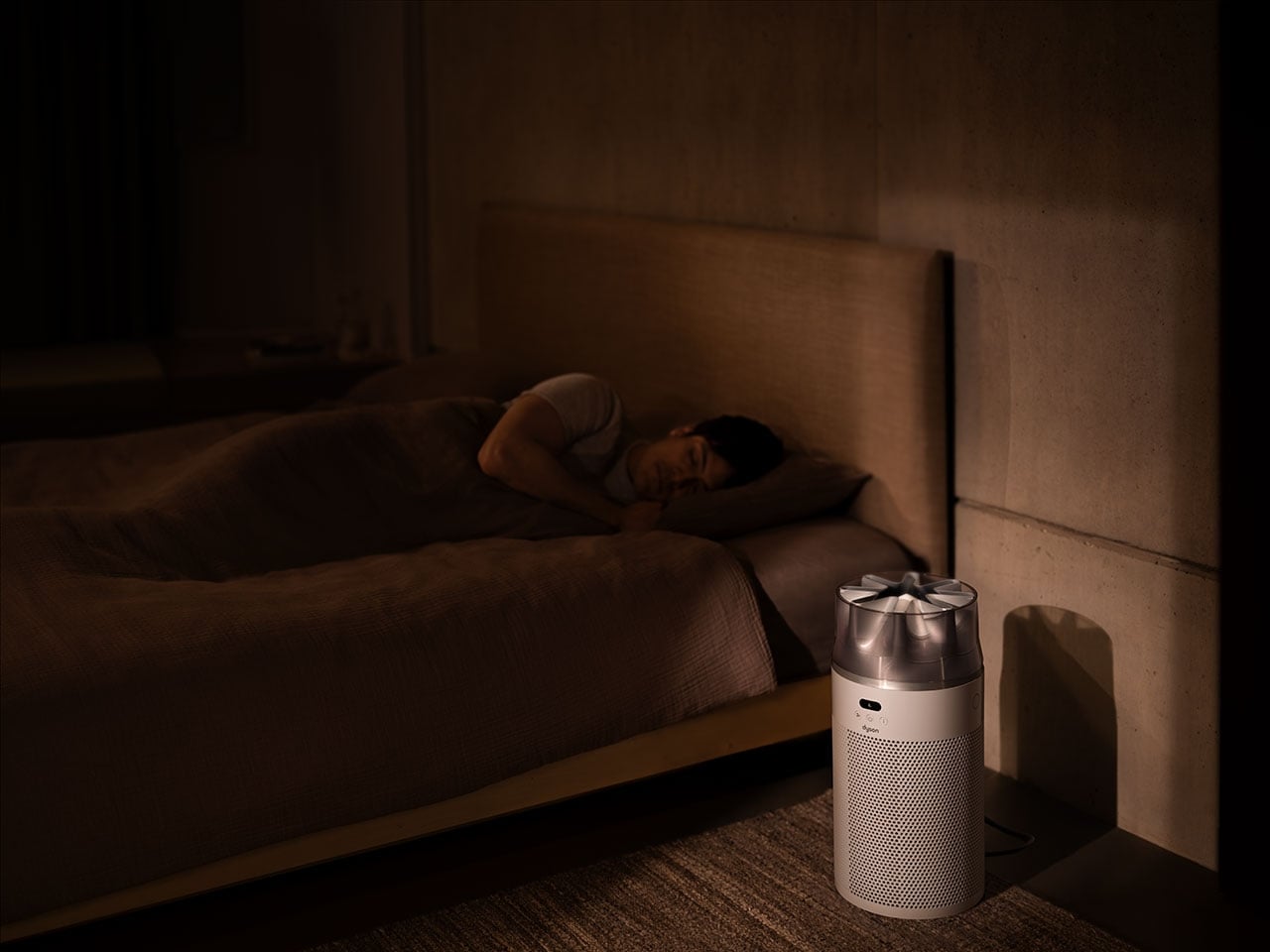
There’s something oddly satisfying about watching a company completely reinvent its own playbook. Dyson has built its reputation on that bladeless Air Multiplier technology, the kind of innovation that made you stop and think, “Wait, how does that even work?” But with the HushJet Compact Purifier, the brand is taking a totally different approach, drawing inspiration from an unexpected source: jet engines.

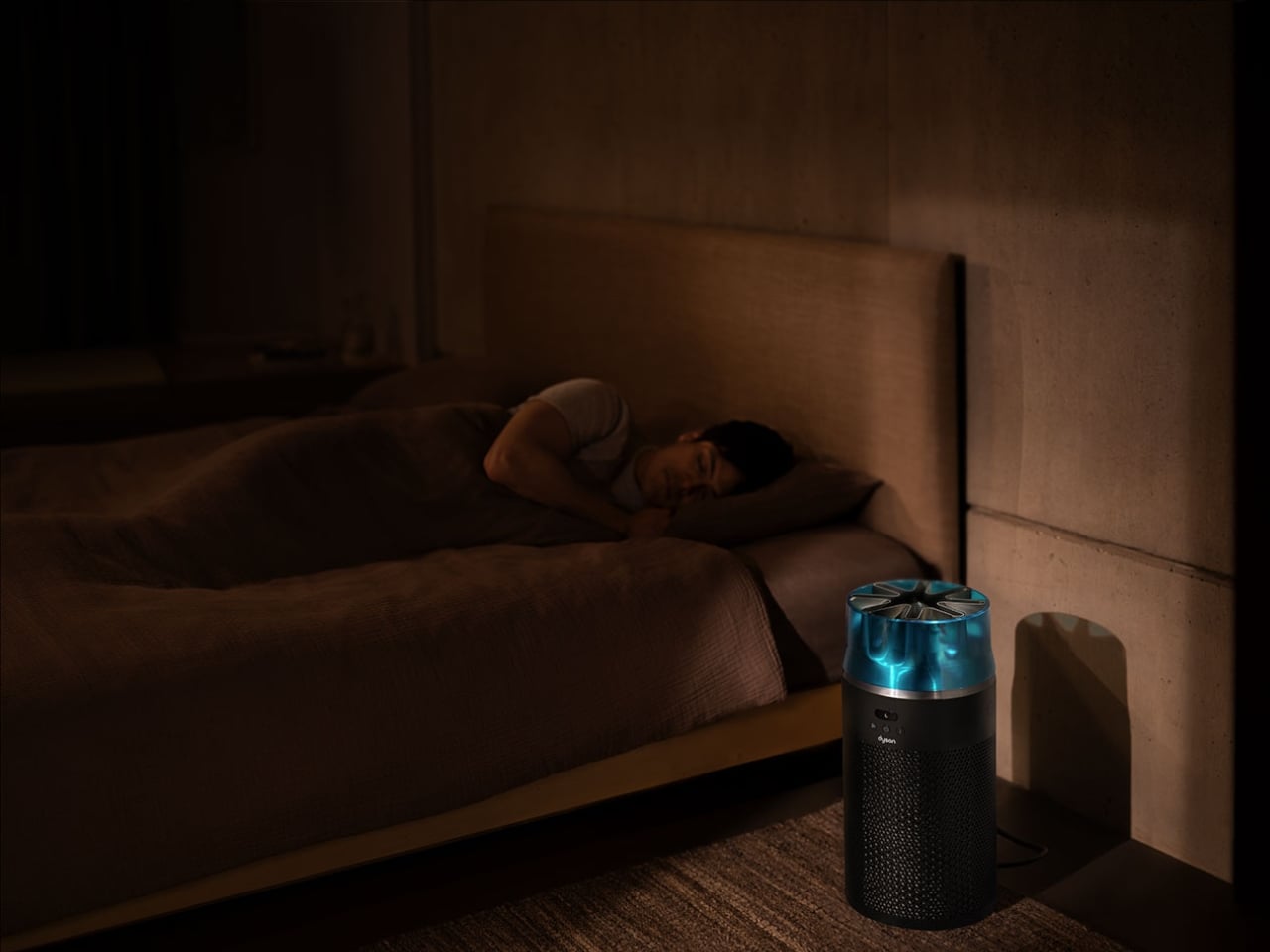
This little machine marks a departure from what we’ve come to expect from Dyson’s air purifiers. Instead of that signature circular opening, you get a star-shaped nozzle that looks like it belongs in an aerospace engineering lab. It’s not just for show, though. That unique design channels high-velocity airflow while keeping things whisper-quiet, hitting just 24 decibels in night mode. For context, that’s quieter than your average library and about the same volume as someone whispering sweet nothings into your ear.

Designer: Dyson

The HushJet measures 18.5 inches tall and just over 9 inches in diameter, weighing in at a manageable 7 pounds. It’s genuinely compact, the kind of appliance that can slip into a corner of your bedroom or perch on a kitchen counter without demanding attention. But don’t let the small footprint fool you. This purifier can handle rooms up to 203 square feet, making it perfectly suited for bedrooms, home offices, or cozy apartments.

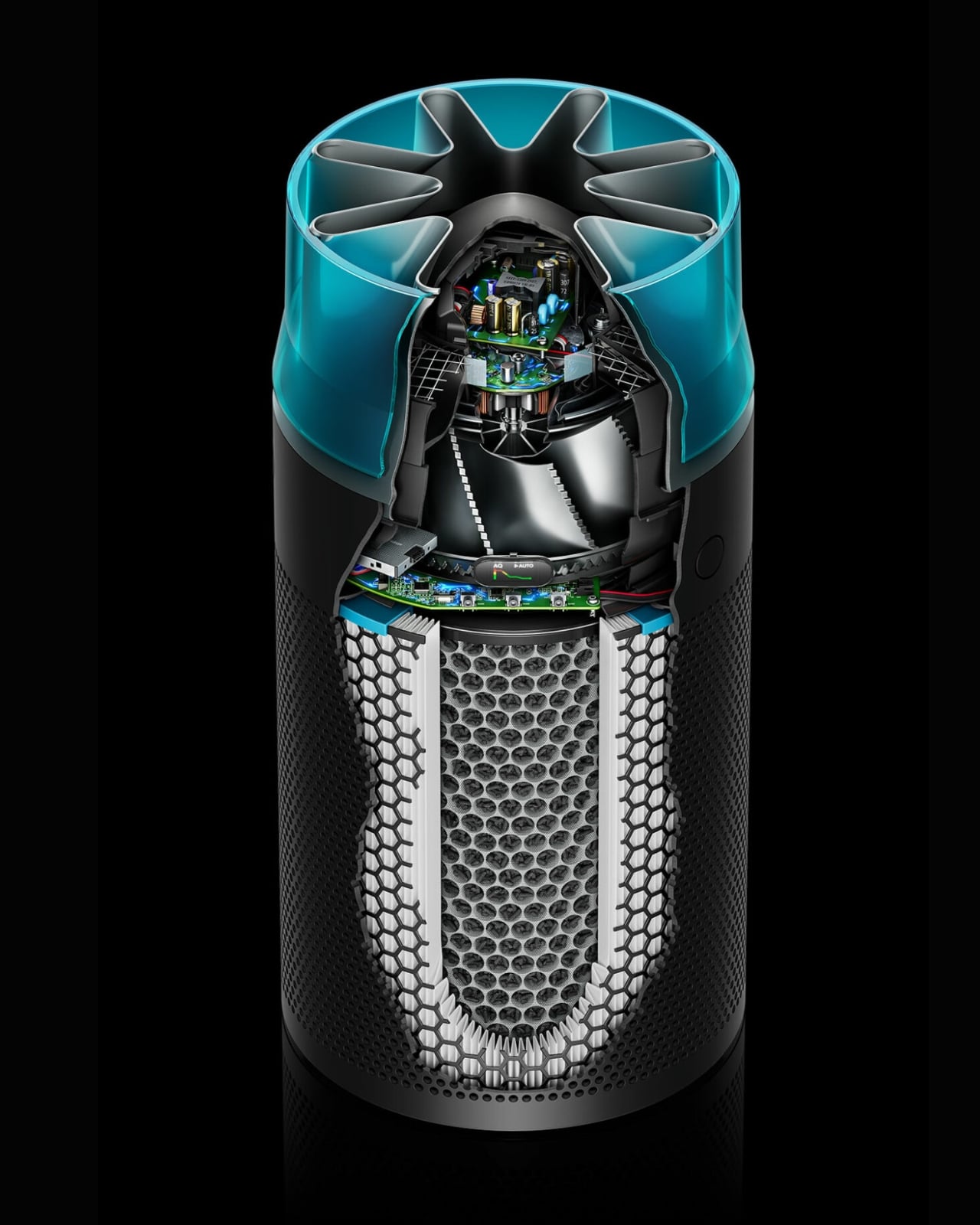
What really sets the HushJet apart is its new filtration system. The electrostatic filter captures 99.97% of particles as small as 0.3 microns, including the usual suspects like pollen, dust, and pet dander. If you’ve got pets at home, this matters more than you might think. Those microscopic skin cells and protein particles from Fluffy’s grooming sessions become airborne allergens, and the HushJet’s activated carbon layer tackles both the dander and the inevitable pet odors.

Here’s where things get interesting from a sustainability standpoint. The electrostatic filter lasts up to five years, which is five times longer than previous Dyson filters. That means fewer replacements, less waste, and one less thing to remember on your shopping list. The filter uses less material while being more energy efficient, a win across the board for anyone trying to lighten their environmental footprint.

The technology powering this thing is genuinely clever. Dyson’s engineers borrowed aerodynamic principles from jet engines to create that focused stream of purified air. The star-shaped nozzle reduces turbulence and attenuates sound waves from the high-speed compressor, which is how they achieved that library-quiet operation. The whole system is fully sealed, meaning the nasty stuff it captures stays trapped inside rather than escaping back into your breathing space.

Smart features come standard. The built-in sensors monitor air quality in real time, automatically adjusting performance based on what’s floating around your room. You can also control everything through the MyDyson app, tweaking settings from your phone or setting schedules so the purifier runs only when you need it. That auto mode is particularly useful for energy efficiency, since the machine only kicks into gear when pollution levels actually warrant it.

The HushJet comes in two color options: Black/Teal and White/Silver. Both have that sleek, minimalist aesthetic Dyson is known for, the kind of design that doesn’t scream “appliance” but instead quietly complements your space. At $349.99, it sits at the higher end of the compact purifier market, though the combination of performance, filter longevity, and that jet-engine-inspired engineering might justify the price tag for air quality enthusiasts.

For anyone dealing with allergies, the HushJet makes a solid case for itself. By pulling pollen, dust, and other allergens out of circulation, it can help reduce those annoying symptoms like sniffles, scratchy throats, and itchy eyes that tend to worsen at night. Better air quality translates to better sleep, which is something most of us could use more of.

What Dyson has done here is take everything they learned from years of air purification technology and compress it into a surprisingly powerful package. The jet engine inspiration isn’t just a marketing gimmick. It’s a fundamental rethinking of how to move air efficiently and quietly in a small space. Whether you’re sensitive to noise, short on square footage, or just appreciate clever engineering, the HushJet Compact Purifier delivers on its promise to be small but mighty.

The post This $350 Dyson Air Purifier Borrowed Tech From Jet Engines first appeared on Yanko Design.

This €43,000 Tiny House Fits Two Bedrooms Into Just 20 Feet

The tiny house movement continues to evolve with innovative designs that maximize every inch of space, and the Tiny Rubik by Romania’s Eco Tiny House stands as a remarkable example of what’s possible within just 6 meters of length. This compact dwelling proves that downsizing doesn’t mean sacrificing comfort or style, offering an eco-friendly solution for those seeking simplicity and financial freedom.

Measuring just 20 feet long and built on a double-axle trailer, the Tiny Rubik provides 16 square meters of thoughtfully designed living space that can accommodate up to three people. The exterior features engineered wood siding paired with a metal roof, creating a modern aesthetic that’s both durable and environmentally conscious. What sets this tiny house apart is its ability to incorporate two separate sleeping areas despite its modest footprint, a feat that requires clever spatial planning and design ingenuity.

Designer: Eco Tiny House

The interior layout revolves around a centrally positioned kitchen that serves as the home’s functional heart. This strategic placement maximizes efficiency while maintaining an open feel throughout the space. The kitchen comes fully equipped with an electric induction cooktop, a built-in sink, and both upper and lower cabinetry for storage. A built-in refrigerator ensures all essential appliances are included without cluttering the limited square footage.

One of the Tiny Rubik’s most impressive features is its dual sleeping arrangement. The main bedroom occupies the ground floor, offering easy accessibility and convenience for everyday living. A loft bedroom sits above, protected by wooden railings and accessible via a ladder. When not needed for sleeping, this upper level transforms into a versatile reading nook or additional storage space, demonstrating the multifunctional approach necessary in compact living.

Climate control hasn’t been overlooked either. The Tiny Rubik includes a Samsung air conditioning unit, ensuring year-round comfort regardless of the season. For those seeking complete independence from traditional utilities, off-grid capabilities are available through optional solar panels and off-grid systems. An innovative storage box integrated into the trailer tongue provides additional space for outdoor gear or seasonal items.

Since its founding in 2017, Eco Tiny House has built a reputation for delivering beautiful, comfortable, and sustainable tiny homes to clients across Europe. The company was established by tiny house owners and enthusiasts who understand the practical needs and desires of the tiny living community. The Tiny Rubik starts at approximately 43,378 euros, positioning it as an accessible entry point for those ready to embrace minimalist living. This meticulously crafted dwelling represents more than just a place to sleep. It’s a lifestyle choice for eco-conscious individuals, adventurers seeking mobility without sacrificing comfort, and anyone looking to reduce their environmental footprint while maintaining quality of life. The Tiny Rubik proves that thoughtful design can create a fully functional home in even the most compact dimensions.

The post This €43,000 Tiny House Fits Two Bedrooms Into Just 20 Feet first appeared on Yanko Design.

Apple just reported its best-ever quarter for iPhone sales

Apple shared its latest quarterly financial results today and the news is once again very, very good for the Cupertino company. The quarter ending December 27, 2025 marked "the best-ever quarter" for iPhones, which generated a record high revenue of nearly $85.27 billion for the business. Apple doesn't disclose the number of devices sold any more, but even with the prices for many of its latest generation of smartphones surpassing $1,000 a pop, that's still got to be a heck of a lot of iPhones. 

"The demand for iPhone was simply staggering," CEO Tim Cook said on the conference call to discuss the results. "This is the strongest iPhone lineup we've ever had and by far the most popular."

That wasn't the only massive number in the earnings report. Services revenue also logged its biggest quarter yet, growing 14 percent over the same period last year to reach just over $30 billion. It was also Apple's biggest quarter to date for total revenue, which was nearly $143.76 billion for the already fabulously wealthy company.

This article originally appeared on Engadget at https://www.engadget.com/mobile/smartphones/apple-just-reported-its-best-ever-quarter-for-iphone-sales-234135513.html?src=rss

This LEGO Hula Girl Actually Dances When You Crank It

The dashboard hula dancer has been swaying her way through American car culture since the 1960s. Perched on dashboards from coast to coast, these spring-mounted figurines became synonymous with road trips, Hawaiian kitsch, and carefree summer drives. Their hypnotic hip movements, triggered by every bump and turn, transformed them into beloved symbols of vintage Americana.

LEGO builder SuperDuperD has now brought this nostalgic icon into the world of bricks with a stunning mechanical recreation. The Dancing Hula Girl is not just a static display piece. Through an ingenious crank mechanism hidden in the base, this 1,070-piece MOC captures the authentic swaying motion of the original dashboard dolls, complete with a flowing chain-link grass skirt that moves naturally with each turn.

Designer: SuperDuperD

The real genius here lives in the skirt. SuperDuperD used tan LEGO chain links to recreate the grass skirt, and this decision alone elevates the entire build from clever homage to genuinely impressive engineering. Chain pieces provide the draping, the texture, the flow, and critically, the flexibility needed for the mechanism to actually work. You could have built a rigid skirt from standard bricks, sure, but then you’d lose the entire essence of what makes a hula dancer’s movements captivating. The chains move independently yet cohesively, mimicking real fabric behavior in a way that feels almost organic for a plastic brick construction.

The mechanism itself relies on beautiful simplicity. A hand crank at the rear rotates an axle beneath the skirt, topped with a technic wheel sporting a single offset pin. That pin creates the up and down motion as the wheel spins, translating rotational movement into the characteristic hip sway. SuperDuperD mentions the trickiest part was connecting the upper and lower body while maintaining stability, which makes complete sense when you consider the forces at play. You’re essentially asking a static torso to remain balanced while the entire lower half oscillates beneath it. The solution required careful weight distribution and structural reinforcement that isn’t immediately visible in the final build, which is exactly how good engineering should work.

At 1,070 pieces and 450 grams, you’re looking at maybe a weekend build, which feels appropriate for something that’s half display model, half kinetic toy. The functional crank changes how you interact with this compared to a static build. Display models get built, photographed, then slowly fade into your peripheral vision until you stop noticing them entirely. Kinetic sculptures stay relevant because they invite interaction. You walk past your shelf, give the crank a few turns, watch the hips sway, then continue with your day with a smile on your face.

This MOC is live on LEGO Ideas right now, currently sitting at around 100 supporters with 59 days left to hit the first milestone of 10,000 votes. Reaching that threshold gets it in front of LEGO’s review board, where they decide which fan designs become official retail sets. If you think a mechanical dashboard hula dancer belongs in LEGO’s catalog, the voting process takes half a minute. All you need to do is go to the LEGO Ideas website hit the vote button!

The post This LEGO Hula Girl Actually Dances When You Crank It first appeared on Yanko Design.

This LEGO Hula Girl Actually Dances When You Crank It

The dashboard hula dancer has been swaying her way through American car culture since the 1960s. Perched on dashboards from coast to coast, these spring-mounted figurines became synonymous with road trips, Hawaiian kitsch, and carefree summer drives. Their hypnotic hip movements, triggered by every bump and turn, transformed them into beloved symbols of vintage Americana.

LEGO builder SuperDuperD has now brought this nostalgic icon into the world of bricks with a stunning mechanical recreation. The Dancing Hula Girl is not just a static display piece. Through an ingenious crank mechanism hidden in the base, this 1,070-piece MOC captures the authentic swaying motion of the original dashboard dolls, complete with a flowing chain-link grass skirt that moves naturally with each turn.

Designer: SuperDuperD

The real genius here lives in the skirt. SuperDuperD used tan LEGO chain links to recreate the grass skirt, and this decision alone elevates the entire build from clever homage to genuinely impressive engineering. Chain pieces provide the draping, the texture, the flow, and critically, the flexibility needed for the mechanism to actually work. You could have built a rigid skirt from standard bricks, sure, but then you’d lose the entire essence of what makes a hula dancer’s movements captivating. The chains move independently yet cohesively, mimicking real fabric behavior in a way that feels almost organic for a plastic brick construction.

The mechanism itself relies on beautiful simplicity. A hand crank at the rear rotates an axle beneath the skirt, topped with a technic wheel sporting a single offset pin. That pin creates the up and down motion as the wheel spins, translating rotational movement into the characteristic hip sway. SuperDuperD mentions the trickiest part was connecting the upper and lower body while maintaining stability, which makes complete sense when you consider the forces at play. You’re essentially asking a static torso to remain balanced while the entire lower half oscillates beneath it. The solution required careful weight distribution and structural reinforcement that isn’t immediately visible in the final build, which is exactly how good engineering should work.

At 1,070 pieces and 450 grams, you’re looking at maybe a weekend build, which feels appropriate for something that’s half display model, half kinetic toy. The functional crank changes how you interact with this compared to a static build. Display models get built, photographed, then slowly fade into your peripheral vision until you stop noticing them entirely. Kinetic sculptures stay relevant because they invite interaction. You walk past your shelf, give the crank a few turns, watch the hips sway, then continue with your day with a smile on your face.

This MOC is live on LEGO Ideas right now, currently sitting at around 100 supporters with 59 days left to hit the first milestone of 10,000 votes. Reaching that threshold gets it in front of LEGO’s review board, where they decide which fan designs become official retail sets. If you think a mechanical dashboard hula dancer belongs in LEGO’s catalog, the voting process takes half a minute. All you need to do is go to the LEGO Ideas website hit the vote button!

The post This LEGO Hula Girl Actually Dances When You Crank It first appeared on Yanko Design.

This LEGO Hula Girl Actually Dances When You Crank It

The dashboard hula dancer has been swaying her way through American car culture since the 1960s. Perched on dashboards from coast to coast, these spring-mounted figurines became synonymous with road trips, Hawaiian kitsch, and carefree summer drives. Their hypnotic hip movements, triggered by every bump and turn, transformed them into beloved symbols of vintage Americana.

LEGO builder SuperDuperD has now brought this nostalgic icon into the world of bricks with a stunning mechanical recreation. The Dancing Hula Girl is not just a static display piece. Through an ingenious crank mechanism hidden in the base, this 1,070-piece MOC captures the authentic swaying motion of the original dashboard dolls, complete with a flowing chain-link grass skirt that moves naturally with each turn.

Designer: SuperDuperD

The real genius here lives in the skirt. SuperDuperD used tan LEGO chain links to recreate the grass skirt, and this decision alone elevates the entire build from clever homage to genuinely impressive engineering. Chain pieces provide the draping, the texture, the flow, and critically, the flexibility needed for the mechanism to actually work. You could have built a rigid skirt from standard bricks, sure, but then you’d lose the entire essence of what makes a hula dancer’s movements captivating. The chains move independently yet cohesively, mimicking real fabric behavior in a way that feels almost organic for a plastic brick construction.

The mechanism itself relies on beautiful simplicity. A hand crank at the rear rotates an axle beneath the skirt, topped with a technic wheel sporting a single offset pin. That pin creates the up and down motion as the wheel spins, translating rotational movement into the characteristic hip sway. SuperDuperD mentions the trickiest part was connecting the upper and lower body while maintaining stability, which makes complete sense when you consider the forces at play. You’re essentially asking a static torso to remain balanced while the entire lower half oscillates beneath it. The solution required careful weight distribution and structural reinforcement that isn’t immediately visible in the final build, which is exactly how good engineering should work.

At 1,070 pieces and 450 grams, you’re looking at maybe a weekend build, which feels appropriate for something that’s half display model, half kinetic toy. The functional crank changes how you interact with this compared to a static build. Display models get built, photographed, then slowly fade into your peripheral vision until you stop noticing them entirely. Kinetic sculptures stay relevant because they invite interaction. You walk past your shelf, give the crank a few turns, watch the hips sway, then continue with your day with a smile on your face.

This MOC is live on LEGO Ideas right now, currently sitting at around 100 supporters with 59 days left to hit the first milestone of 10,000 votes. Reaching that threshold gets it in front of LEGO’s review board, where they decide which fan designs become official retail sets. If you think a mechanical dashboard hula dancer belongs in LEGO’s catalog, the voting process takes half a minute. All you need to do is go to the LEGO Ideas website hit the vote button!

The post This LEGO Hula Girl Actually Dances When You Crank It first appeared on Yanko Design.

This LEGO Hula Girl Actually Dances When You Crank It

The dashboard hula dancer has been swaying her way through American car culture since the 1960s. Perched on dashboards from coast to coast, these spring-mounted figurines became synonymous with road trips, Hawaiian kitsch, and carefree summer drives. Their hypnotic hip movements, triggered by every bump and turn, transformed them into beloved symbols of vintage Americana.

LEGO builder SuperDuperD has now brought this nostalgic icon into the world of bricks with a stunning mechanical recreation. The Dancing Hula Girl is not just a static display piece. Through an ingenious crank mechanism hidden in the base, this 1,070-piece MOC captures the authentic swaying motion of the original dashboard dolls, complete with a flowing chain-link grass skirt that moves naturally with each turn.

Designer: SuperDuperD

The real genius here lives in the skirt. SuperDuperD used tan LEGO chain links to recreate the grass skirt, and this decision alone elevates the entire build from clever homage to genuinely impressive engineering. Chain pieces provide the draping, the texture, the flow, and critically, the flexibility needed for the mechanism to actually work. You could have built a rigid skirt from standard bricks, sure, but then you’d lose the entire essence of what makes a hula dancer’s movements captivating. The chains move independently yet cohesively, mimicking real fabric behavior in a way that feels almost organic for a plastic brick construction.

The mechanism itself relies on beautiful simplicity. A hand crank at the rear rotates an axle beneath the skirt, topped with a technic wheel sporting a single offset pin. That pin creates the up and down motion as the wheel spins, translating rotational movement into the characteristic hip sway. SuperDuperD mentions the trickiest part was connecting the upper and lower body while maintaining stability, which makes complete sense when you consider the forces at play. You’re essentially asking a static torso to remain balanced while the entire lower half oscillates beneath it. The solution required careful weight distribution and structural reinforcement that isn’t immediately visible in the final build, which is exactly how good engineering should work.

At 1,070 pieces and 450 grams, you’re looking at maybe a weekend build, which feels appropriate for something that’s half display model, half kinetic toy. The functional crank changes how you interact with this compared to a static build. Display models get built, photographed, then slowly fade into your peripheral vision until you stop noticing them entirely. Kinetic sculptures stay relevant because they invite interaction. You walk past your shelf, give the crank a few turns, watch the hips sway, then continue with your day with a smile on your face.

This MOC is live on LEGO Ideas right now, currently sitting at around 100 supporters with 59 days left to hit the first milestone of 10,000 votes. Reaching that threshold gets it in front of LEGO’s review board, where they decide which fan designs become official retail sets. If you think a mechanical dashboard hula dancer belongs in LEGO’s catalog, the voting process takes half a minute. All you need to do is go to the LEGO Ideas website hit the vote button!

The post This LEGO Hula Girl Actually Dances When You Crank It first appeared on Yanko Design.
This LEGO Hula Girl Actually Dances When You Crank It

The dashboard hula dancer has been swaying her way through American car culture since the 1960s. Perched on dashboards from coast to coast, these spring-mounted figurines became synonymous with road trips, Hawaiian kitsch, and carefree summer drives. Their hypnotic hip movements, triggered by every bump and turn, transformed them into beloved symbols of vintage Americana.

LEGO builder SuperDuperD has now brought this nostalgic icon into the world of bricks with a stunning mechanical recreation. The Dancing Hula Girl is not just a static display piece. Through an ingenious crank mechanism hidden in the base, this 1,070-piece MOC captures the authentic swaying motion of the original dashboard dolls, complete with a flowing chain-link grass skirt that moves naturally with each turn.

Designer: SuperDuperD

The real genius here lives in the skirt. SuperDuperD used tan LEGO chain links to recreate the grass skirt, and this decision alone elevates the entire build from clever homage to genuinely impressive engineering. Chain pieces provide the draping, the texture, the flow, and critically, the flexibility needed for the mechanism to actually work. You could have built a rigid skirt from standard bricks, sure, but then you’d lose the entire essence of what makes a hula dancer’s movements captivating. The chains move independently yet cohesively, mimicking real fabric behavior in a way that feels almost organic for a plastic brick construction.

The mechanism itself relies on beautiful simplicity. A hand crank at the rear rotates an axle beneath the skirt, topped with a technic wheel sporting a single offset pin. That pin creates the up and down motion as the wheel spins, translating rotational movement into the characteristic hip sway. SuperDuperD mentions the trickiest part was connecting the upper and lower body while maintaining stability, which makes complete sense when you consider the forces at play. You’re essentially asking a static torso to remain balanced while the entire lower half oscillates beneath it. The solution required careful weight distribution and structural reinforcement that isn’t immediately visible in the final build, which is exactly how good engineering should work.

At 1,070 pieces and 450 grams, you’re looking at maybe a weekend build, which feels appropriate for something that’s half display model, half kinetic toy. The functional crank changes how you interact with this compared to a static build. Display models get built, photographed, then slowly fade into your peripheral vision until you stop noticing them entirely. Kinetic sculptures stay relevant because they invite interaction. You walk past your shelf, give the crank a few turns, watch the hips sway, then continue with your day with a smile on your face.

This MOC is live on LEGO Ideas right now, currently sitting at around 100 supporters with 59 days left to hit the first milestone of 10,000 votes. Reaching that threshold gets it in front of LEGO’s review board, where they decide which fan designs become official retail sets. If you think a mechanical dashboard hula dancer belongs in LEGO’s catalog, the voting process takes half a minute. All you need to do is go to the LEGO Ideas website hit the vote button!

The post This LEGO Hula Girl Actually Dances When You Crank It first appeared on Yanko Design.

This LEGO Hula Girl Actually Dances When You Crank It

The dashboard hula dancer has been swaying her way through American car culture since the 1960s. Perched on dashboards from coast to coast, these spring-mounted figurines became synonymous with road trips, Hawaiian kitsch, and carefree summer drives. Their hypnotic hip movements, triggered by every bump and turn, transformed them into beloved symbols of vintage Americana.

LEGO builder SuperDuperD has now brought this nostalgic icon into the world of bricks with a stunning mechanical recreation. The Dancing Hula Girl is not just a static display piece. Through an ingenious crank mechanism hidden in the base, this 1,070-piece MOC captures the authentic swaying motion of the original dashboard dolls, complete with a flowing chain-link grass skirt that moves naturally with each turn.

Designer: SuperDuperD

The real genius here lives in the skirt. SuperDuperD used tan LEGO chain links to recreate the grass skirt, and this decision alone elevates the entire build from clever homage to genuinely impressive engineering. Chain pieces provide the draping, the texture, the flow, and critically, the flexibility needed for the mechanism to actually work. You could have built a rigid skirt from standard bricks, sure, but then you’d lose the entire essence of what makes a hula dancer’s movements captivating. The chains move independently yet cohesively, mimicking real fabric behavior in a way that feels almost organic for a plastic brick construction.

The mechanism itself relies on beautiful simplicity. A hand crank at the rear rotates an axle beneath the skirt, topped with a technic wheel sporting a single offset pin. That pin creates the up and down motion as the wheel spins, translating rotational movement into the characteristic hip sway. SuperDuperD mentions the trickiest part was connecting the upper and lower body while maintaining stability, which makes complete sense when you consider the forces at play. You’re essentially asking a static torso to remain balanced while the entire lower half oscillates beneath it. The solution required careful weight distribution and structural reinforcement that isn’t immediately visible in the final build, which is exactly how good engineering should work.

At 1,070 pieces and 450 grams, you’re looking at maybe a weekend build, which feels appropriate for something that’s half display model, half kinetic toy. The functional crank changes how you interact with this compared to a static build. Display models get built, photographed, then slowly fade into your peripheral vision until you stop noticing them entirely. Kinetic sculptures stay relevant because they invite interaction. You walk past your shelf, give the crank a few turns, watch the hips sway, then continue with your day with a smile on your face.

This MOC is live on LEGO Ideas right now, currently sitting at around 100 supporters with 59 days left to hit the first milestone of 10,000 votes. Reaching that threshold gets it in front of LEGO’s review board, where they decide which fan designs become official retail sets. If you think a mechanical dashboard hula dancer belongs in LEGO’s catalog, the voting process takes half a minute. All you need to do is go to the LEGO Ideas website hit the vote button!

The post This LEGO Hula Girl Actually Dances When You Crank It first appeared on Yanko Design.