Homing Compass Lets a Single Red Arrow Always Point the Way Back Home

There is a tension in families where someone loves to walk but sometimes forgets the way back, especially in the context of early dementia. Smartphones, maps, and tracking apps can feel overwhelming or unfamiliar, and that often leads to staying indoors instead of going out. A simpler, more tangible way to get home could unlock a lot of small, everyday adventures again, turning a daily walk from a risk into something safe and normal.

The Homing Compass by Aumens is a small wooden device with a single red arrow that always points toward a predefined home location. It looks and behaves like a stripped-down compass, no maps, no text, no menus, just one arrow with one meaning. The promise is straightforward, follow the arrow and you will get back to the place you set as home. It trades complexity for clarity, betting that radical simplicity matters more than features.

Designer: Rens Brankaert (Aumens)

Setup happens once. You press a recessed button near your front door, the compass remembers that location as home, and from then on the arrow always points back there. There is no need to pair it with a phone every time or scroll through options. For the person carrying it, the interaction is reduced to glancing at the arrow and choosing a direction, turning a potentially frightening moment of disorientation into a quick compass check.

Behind that simple arrow is a full stack of GPS, internet, cloud, and an app, constantly updating the compass’s position. For caregivers, the app shows where the compass is on a map, offering reassurance without demanding constant check-ins. The complexity lives in the background, so the person walking only ever deals with the most basic navigation cue, a red line pointing home like magnetic north.

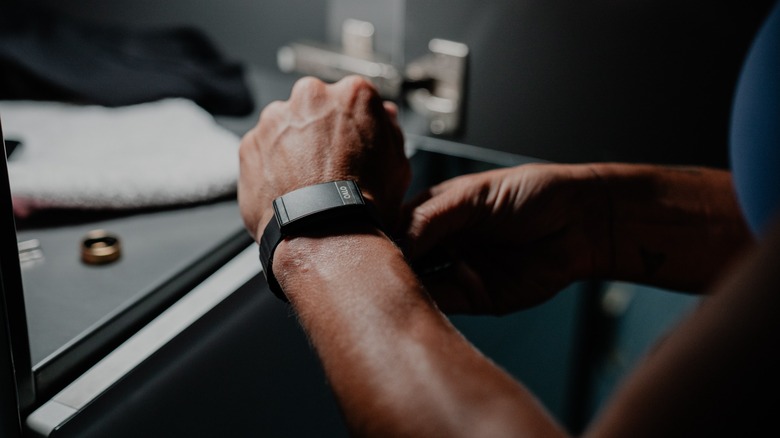
The compass can optionally vibrate or make a sound to remind someone it is there, reducing the chance it gets forgotten in a coat pocket. Accessories help keep it in view at home, so picking it up becomes part of the leaving-the-house routine. The goal is to make carrying it feel as natural as taking keys, not like strapping on a medical device or announcing a limitation to the neighborhood every time you walk outside.

The choice of a wooden housing and analog-style arrow instead of a glossy gadget with icons makes it feel familiar and non-threatening, more like a small object you might already own than a piece of assistive technology. It sidesteps some of the stigma that can come with devices labeled for dementia, framing it instead as faithful equipment for everyday adventures, which is the language Aumens uses to describe both the device and the people who carry it.

The Homing Compass aims for an emotional shift, the person who can go for a walk in the forest or around the neighborhood without carrying a mental map, and the partner at home who can relax instead of worrying. A single arrow that always points home sounds almost too simple, but that is the point. It turns getting lost from a constant fear into a manageable, designed-for scenario, letting people reclaim the small joy of just being outside.

The post Homing Compass Lets a Single Red Arrow Always Point the Way Back Home first appeared on Yanko Design.

Build a AI Trading Desk That Debates Signals, Risk & Timing

Build a AI Trading Desk That Debates Signals, Risk & Timing

What if artificial intelligence didn’t just give you answers but actually debated them? Imagine a system where AI agents argue over investment strategies, challenge each other’s assumptions, and collaboratively decide on the best course of action, just like a human trading team. Below, Better Stack breaks down how the open source Python project “Trading Agents” […]

The post Build a AI Trading Desk That Debates Signals, Risk & Timing appeared first on Geeky Gadgets.

Posted in Uncategorized

The best smart scales for 2026

If you are trying to stay on top of your health this year, a smart scale can make the process feel more manageable. These devices log details like body fat, muscle mass and water levels, then sync everything to your phone so you can see patterns instead of guessing. It is an easy way to track changes and stay motivated between workouts or check-ins with your doctor.

Some smart scales keep things simple and focus on just your data, while others tie into big fitness platforms or support multiple users under one roof. With so many choices, we pulled together the best smart scales to help you find one that fits your goals and your budget.

There are valid reasons to weigh yourself but your self-worth shouldn’t be defined by what number shows up between your feet. If you’re looking to alter your body shape, that figure could go up as your waistline goes down since muscle weighs more than fat.

Some scales go further by providing additional metrics like visceral fat levels, giving you a more comprehensive picture of your health. Dr. Anne Swift, Director of Public Health teaching at the University of Cambridge, said “weighing yourself too often can result in [you] becoming fixated on small fluctuations day-to-day rather than the overall trend over time.” Swift added “it’s sometimes better to focus on how clothes fit, or how you feel, rather than your weight.”

A meta-analysis from 2016 found there may be some negative psychological impact from self weighing. A 2018 study, however, said there may be a positive correlation between regular weigh-ins and accelerated weight loss. It can be a minefield and I’d urge you to take real care of yourself and remember success won’t happen overnight.

A scale that measures weight is probably the top requirement, right? Whether you're after a basic weight scale or a full-featured body fat scale, bear in mind, with all these measurements, the readings won’t be as accurate as a calibrated clinical scale. It’s better to focus on the overall trend, up or down over time, rather than a single measurement in isolation. Scales offering high-precision measurements can help, especially if you’re looking at the data to inform a specific health or fitness goal.

Before you buy your scale, work out how you’re planning on weighing yourself and when, as it is an issue. Some lower-end smart bathroom scales connect via Bluetooth and have no internal storage, so if you don’t have your phone to hand, it won’t record your weight. If your scale has Wi-Fi, then your scale can post the data to a server, letting you access them from any compatible device. Also, you should be mindful that some smart scales aren’t built with security in mind, so there’s a small risk to your privacy should your scale be compromised.

The stronger your bones are, the less risk you have of breaks and osteoporosis — common concerns as you get older. Clinical bone density tests use low-power x-rays and some scales can offer you an at-home approximation. These bone mass tests pass a small electrical current through your feet, measuring the resistance as it completes its journey. The resistance offered by bones, fat and muscle are all different, letting your scale identify the difference. A body composition monitor often includes this feature, too, providing a detailed breakdown of bone density, fat and muscle mass.

Fat and muscle are necessary parts of our makeup, but too much of either can be problematic. Much like bone density, a body composition measurement feature can monitor your body fat and muscle mass percentages using Bioelectrical Impedance Analysis (BIA). This measurement tests how well your body resists an electrical signal passing through your body. (It’s a rough rule of thumb you should have a 30/70 percent split between fat and muscle, but please consult a medical professional for figures specific to your own body and medical needs.) For those with specific athletic goals, smart scales offer an athlete mode to better tailor readings for accuracy. If body fat monitoring is a priority, look for a model marketed as a body fat scale.

A lot of scales offer a BMI calculation, and it’s easy to do since you just plot height and weight on a set graph line. Body Mass Index is, however, a problematic measurement that its critics say is both overly simplistic and often greatly misleading. Unfortunately, it’s also one of the most common clinical body metrics and medical professionals will use it to make judgements about your care.

French health-tech company Withings has offered Pulse Wave Velocity (PWV) on its flagship scale for some time, although regulatory concerns meant it was withdrawn for a period. It’s a measurement of arterial stiffness, which acts as a marker both of cardiovascular risk and other health conditions. For those looking for an even deeper understanding of their health, some scales now offer a body scan, which provides more advanced metrics such as segmental body composition and vascular health insights.

Pairing your smart scale with wearables like fitness trackers or smartwatches can further enhance your health-tracking ecosystem. Many smart scales sync directly with platforms like Fitbit or Apple Health, making it easier to track trends and analyze your data in one place.

Less a specification and more a note: Smart bathroom scales have displays ranging from pre-printed LCDs or digital dot matrix layouts through to color display screens. On the high end, your scale display can show you trending charts for your weight and other vital statistics, and can even tell you the day’s weather. If you are short-sighted, and plan on weighing yourself first thing in the morning, before you’ve found your glasses or contacts, opt for a big, clear, high-contrast display.

You’ll spend most of your time looking at your health data through its companion scales app, and it’s vital you get a good one. This includes a clear, clean layout with powerful tools to visualize your progress and analyze your data to look for places you can improve. Given that you often don’t need to buy anything before trying the app, it’s worth testing one or two to see if you vibe with it. It’s also important you check app compatibility before making your purchase. Some health apps will only work with iOS or Android — not both. Apple Watch connectivity can also be a bonus for tracking workouts and health metrics seamlessly. Several companies also offer premium subscriptions, unlocking other features – including insights and coaching – to go along with your hardware.

Using the same scale or app platform for years at a time means you’ll build up a massive trove of personal data. And it is (or should be), your right to take that data to another provider if you choose to move platforms in the future. Data portability is, however, a minefield, with different platforms offering wildly different options, making it easy (or hard) to go elsewhere.

All of the devices in this round-up will allow you to export your data to a .CSV file, which you can then do with as you wish. Importing this information is trickier, with Withings and Garmin allowing it, and Omron, Xiaomi, Eufy and Fitbit not making it that easy. (Apps that engage with Apple Health, meanwhile, can output all of your health data in a .XML file.)

It’s not a huge issue but one worth bearing in mind that each scale will either run disposable batteries (most commonly 4xAAA) or with its own, built-in battery pack. Either choice adds an environmental and financial cost to your scale’s life — either with regular purchases of fresh cells or the potential for the whole unit to become waste when the battery pack fails.

For this guide, I tested six scales from major manufacturers:

Our cheapest model, Xiaomi / Mi’s Body Composition Scale 2 is as bare-bones as you can get, and it shows. It often takes a long while to lock on to get your body weight, and when it does you’ll have to delve into the Zepp Life-branded scales app in order to look at your extra data. But you can’t fault it for the basics, offering limited (but accurate) weight measurements and body composition for less than the price of a McDonald’s for four.

Fitbit, now part of Google, is the household name for fitness trackers and smartwatches in the US, right? If not, then it must be at least halfway synonymous with it. The Aria Air is the company’s stripped-to-the-bare bones scale, offering your weight and a few other health metrics, but you can trust that Fitbit got the basics right. Not to mention that most of the reason for buying a Fitbit product is to leverage its fitness app anyway.

Eufy’s Smart Scale P2 Pro has plenty of things to commend it – the price, the overall look and feel (it’s a snazzy piece of kit) and what it offers. It offers a whole host of in-depth functionality, including Body Fat, Muscle Mass, Water Weight, Body Fat Mass and Bone Mass measurements, as well as calculating things like your Heart Rate and Basal Metabolic Rate (the amount of calories you need to eat a day to not change weight at all) all from inside its app. In fact, buried beneath the friendly graphic, the scale offers a big pile of stats and data that should, I think, give you more than a little coaching on how to improve your overall health.

It’s worth noting that Anker – Eufy’s parent company – was identified as having misled users, and the media, about the security of its products a few years back. Its Eufy-branded security cameras, which the company says does not broadcast video outside of your local network, was found to be allowing third parties to access streams online. Consequently, while we have praised the Eufy Smart Scale for its own features, we cannot recommend it without a big caveat.

Given its role in making actual medical devices, you know what you’re getting with an Omron product. A solid, reliable, sturdy, strong (checks the dictionary for more synonyms) dependable piece of kit. There’s no romance or excitement on show, but you can trust that however joyless it may be, it’ll do the job in question and will be user-friendly. The hardware is limited, the app is limited, but it certainly (checks synonyms again) is steady.

Joking aside, Omron’s Connect app is as bare-bones as you can get, since it acts as an interface for so many of its products. Scroll over to the Weight page, and you’ll get your weight and BMI reading, and if you’ve set a fitness goal, you can see how far you’ve got to go to reach it. You can also switch to seeing a trend graph which, again, offers the most basic visualization of your workouts and progress.

Garmin’s got a pretty massive fitness ecosystem of its own, so if you’re already part of that world, its smart scale is a no-brainer. On one hand, the scale is one of the easiest to use, and most luxurious of the bunch, with its color screen and sleek design. I’m also a big fan of the wealth of data and different metrics the scale throws at you – you can see a full color graph charting your weight measurements and goal progress, and the various metrics it tracks in good detail. If there’s a downside, it’s that Garmin’s setup won’t hold your hand, since it’s for serious fitness people, not newbies.

At the highest end, Withings’ flagship Body Comp is luxurious, and luxuriously priced, a figure I’d consider to be “too much” to spend on a bathroom scale. For your money, however, you’ll get a fairly comprehensive rundown of body composition metrics including your weight, body fat percentage, vascular age, pulse wave velocity and electrodermal activity. Its monochrome dot matrix display may not be as swish as the Garmin’s, but it refreshes pretty quickly and feels very in-keeping with the hardware’s overall sleek look.

If you want to flaunt your cash, you don’t buy a car, you buy a supercar, or a hypercar if you’re flush enough. What then, do we call Withings’ $400 Body Scan if not a super-smart scale, or a hyper-smart scale? As well as doing everything the Body Comp does, plus running a six-lead ECG, segmented body composition, and will even check for neuropathy in your feet. It is the best scale I’ve ever used, it is also the most expensive, and I suspect it’s too much device for almost everyone who’d consider buying one.

A regular scale is pretty straightforward — it tells you how much you weigh, and that’s usually it. A smart scale, on the other hand, does much more. Not only does it give you your weight measurements, but it can also track things like your body fat percentage, muscle mass, and even your BMI. Some smart scales even monitor more advanced metrics like bone density, depending on the model.

What’s even better is that smart scales sync with scales apps on your phone using Wi-Fi or Bluetooth, so you can see all your health data in one place. This lets you monitor trends over time, like if your muscle mass is increasing or your body fat percentage decreasing.

When more than one person in a household uses the smart scale, it usually recognizes each person by their weight range and other body measurements (like body fat percentage). Most smart scales allow you to set up individual profiles in the companion app, and once your profile is linked, the scale can automatically figure out who’s standing on it.

Let’s say you and a family member have fairly different weights — the scale will easily know who’s who based on that. But if you and someone else have similar weights, it might ask you to confirm the profile on your phone after the weigh-in. Some scales even let you assign a profile manually in the scales app if it’s not sure.

This article originally appeared on Engadget at https://www.engadget.com/home/smart-home/best-smart-scale-160033523.html?src=rss

The Galaxy Z Roll 5G: Samsung’s Boldest Move Yet

The Galaxy Z Roll 5G: Samsung’s Boldest Move Yet

The Samsung Galaxy Z Roll 5G is poised to reshape the smartphone landscape with its new rollable display, advanced hardware, and innovative features. Anticipated for release in late 2026, this device highlights Samsung’s dedication to advancing mobile technology. By integrating a rollable screen, AI-driven functionalities, and high-performance components, the Galaxy Z Roll 5G is expected […]

The post The Galaxy Z Roll 5G: Samsung’s Boldest Move Yet appeared first on Geeky Gadgets.

Posted in Uncategorized

How to Remember Everything in 2026 with Apple Reminders

How to Remember Everything in 2026 with Apple Reminders

What if you could turn your chaotic to-do list into a streamlined system that keeps you on top of everything, from work deadlines to personal errands? Peter Akkies walks through how Apple Reminders can transform the way you manage tasks in a recent YouTube video, showing how this often-overlooked app is far more powerful than […]

The post How to Remember Everything in 2026 with Apple Reminders appeared first on Geeky Gadgets.

Posted in Uncategorized

iOS 26.2 Features Apple Needs To Change

iOS 26.2 Features Apple Needs To Change

Apple’s iOS 26.2 update represents a pivotal moment for the company, particularly in Japan, where regulatory requirements have driven significant changes. These updates are not just about compliance; they reflect Apple’s broader strategy to balance innovation, user choice, and regulatory demands. With features such as third-party payment processing, the ability to set default apps, and […]

The post iOS 26.2 Features Apple Needs To Change appeared first on Geeky Gadgets.

Posted in Uncategorized

2026 AI Roadmap : From Strong Prompts to Agents, Use AI Better in 2026

2026 AI Roadmap : From Strong Prompts to Agents, Use AI Better in 2026

What if you could outperform 99% of people in using AI by 2026? It’s not just a bold claim, it’s an achievable reality for those willing to adapt and refine their approach. Grace Leung takes a closer look at how mastering AI communication, selecting the right systems, and fostering human-AI collaboration can transform the way […]

The post 2026 AI Roadmap : From Strong Prompts to Agents, Use AI Better in 2026 appeared first on Geeky Gadgets.

Posted in Uncategorized

iOS 26.3 Deep Dive: Every Hidden Feature Revealed

iOS 26.3 Deep Dive: Every Hidden Feature Revealed

Apple has introduced iOS 26.3 beta 1, a release designed to enhance functionality, improve performance, and address user concerns. This update not only resolves existing issues but also introduces new features that aim to streamline your experience across devices. By focusing on interoperability, customization, and security, Apple continues to refine its ecosystem while preparing for […]

The post iOS 26.3 Deep Dive: Every Hidden Feature Revealed appeared first on Geeky Gadgets.

Posted in Uncategorized

MeTool’s pendant-sized EDC is one of the smallest and most versatile multitools you can get

An everyday carry tool, colloquially EDC, is only useful and actually worth its weight in gold when the device is built to be convenient to carry and use. The Dark Fire 2.0 is easily the most apt to the idea. It is a pendent, a key chain, or a clip slightly more than the size of a coin, but versatile enough to put many more detailed, hefty and space-consuming EDCs to shame, which are yet to do half the tasks the Dark Fire’s second version is designed to fulfil.

MeTool, the team of creators behind the multitool, have designed the new pendant EDC based on the predecessor, which was a similar tool but with lesser versatility and a go-getter attitude. The idea of this concealed but useful device stands out primarily for two reasons: the tool remains unnoticed until the exact moment you need it, and when you do, it can transition from a simple pendant into four different tools including a pen, screw driver, prier, and a glow light.

Designer: MeTool

Click Here to Buy Now: $39 $55 (29% off). Hurry! Raised over $27,000 already.

Whether you want to mark out a window in the floor plan, tighten a screw you notice falling off your laptop, or want to flip open a can at the camp; the Dark Fire 2.0 has you covered. At the time of writing, it is not a full-fledged product, but it is seeking crowdfunding support to go out there and make a difference in the lives of those who need a dependable but compact tool for their liking.

To that accord, MeTool has packed functionality into the pendant-sized EDC. It is made from a solid one-piece of precision-machined titanium and features an interesting rotary quick-release structure with tritium slots. The Dark Fire 2.0 body when twisted, opens up to reveal its true worth which is more than a pendant. Inside its 4 mm bit storage cavity hides a screw driver, a pry bar and a pen tip. And when the quick-release top is twisted, you can install the pen tip or replace it with the screw driver and get the work done instantaneously.

Besides, the EDC is a titanium glow multitool. It measures 2.16 × 0.54-inches, weighs only 0.55 oz, and features a built-in light in the portable pendant design. The light, instead of residing within a glass tube – as in the Dark Fire 1.0 – is packed in a titanium hollow window which shields its against shattering, yet provides a clear sight for soft glow. The tube also features a floating shock-absorbing mount comprising dual rubber end-balls and an internal O-ring for protection against bumps and drops.

What really makes the Dark Fire 2.0 stand out in addition to the compact form factor and versatility, is its pen. It uses solid graphite rather than ink and is designed to never dry out or smudge. What you write with it stays there even through rain and regular wear. You can use the scribble of paper, wood, or leather, and the eco-friendly pen will do the writing without ink or cartridge. If the EDC has you intrigued, you can preorder it now on Kickstarter at a handsome super early bird discount.

Click Here to Buy Now: $39 $55 (29% off). Hurry! Raised over $27,000 already.

The post MeTool’s pendant-sized EDC is one of the smallest and most versatile multitools you can get first appeared on Yanko Design.

This LEGO Campbell’s Soup Can Opens to Reveal Andy Warhol’s Entire Factory Studio

In 1962, Andy Warhol turned a humble soup can into an art world phenomenon. Now, a LEGO Ideas submission is turning that same can into something equally revolutionary: a buildable gateway to understanding the artist himself. This isn’t just about stacking bricks into a cylindrical shape, though the technical achievement of creating such smooth curves at 24 studs diameter deserves recognition. This project represents months of research into Warhol’s working methods, his relationship with popular culture, and the visual language of The Factory that became synonymous with 1960s avant-garde creativity.

Open the can and the transformation is immediate. The metallic interior contrasts sharply with the familiar red and white exterior, creating an Alice-in-Wonderland moment where everyday packaging becomes an art studio. Printed artworks cover the walls and floor, reflecting Warhol’s habit of painting directly on the ground surrounded by his creations. The Andy Warhol minifigure with signature silver wig presides over a space filled with props from his actual studio: the disco ball, the motorcycle, the couch where celebrities and artists mingled. It’s both a display piece for design enthusiasts and an educational tool that makes pop art accessible, proving LEGO sets can be as culturally significant as they are fun to build.

Designer: HonorableImmenseWorriz

The build sits at 1,117 pieces and stretches to 32.6 centimeters tall, which sounds manageable until you realize the entire cylinder uses curved slope elements to achieve those smooth walls. Most builders avoid large-scale curves because getting a 24-stud diameter to look this polished requires serious geometric planning. The three-section hinge system adds another challenge since you need structural integrity while maintaining mechanical function. What separates this from typical pop culture tributes is the commitment to printed elements over stickers, with Campbell’s branding, artwork tiles, and even the gold medal seal all printed directly onto bricks. The Marilyn Monroe quad portrait, Flowers series, purple Cow prints, they’re all there on the metallic silver walls that reference The Factory’s legendary aluminum foil aesthetic.

HonorableImmenseWorriz , the builder, positions it as “a LEGO set for the kitchen,” which completes the conceptual loop Warhol started by elevating everyday consumer goods to fine art status. You build this, place it near your actual soup cans, and your kitchen becomes gallery space. The 32 stickers showing different Campbell’s soup flavors let you customize and swap variations, mirroring Warhol’s seriality philosophy from his original 1962 series that featured 32 different canvases. The father-son collaboration behind it shows in the prop selection too, each item chosen for historical accuracy rather than visual filler. That red couch, the orange motorcycle, the camera on tripod, they’re narrative anchors to The Factory’s actual chaos, not random accessories.

The project’s currently a fan submission on the LEGO Ideas website – an online forum where enthusiasts share their own creations and vote for favorites. MOCs (My Own Creations) that hit the 10,000 vote mark then get sent to LEGO’s team for approval before being turned into a retail box set that anyone can buy. If you fancy yourself a LEGO ode to Warhol (and Campbell), head down to the LEGO Ideas forum and cast your vote for this build! It’s free!

The post This LEGO Campbell’s Soup Can Opens to Reveal Andy Warhol’s Entire Factory Studio first appeared on Yanko Design.