Pebblebee Clip 5 Hot Coral and Subzero Trackers Won’t Be Restocked

Bluetooth trackers usually behave like small discs or tags you hide on keys and bags and forget about until something goes missing. They tend to come in grayscale, designed to disappear, even though they live on things you carry every day. There’s room for a tracker that feels more like a deliberate accessory choice instead of invisible insurance dangling off your keychain.

Pebblebee’s Evercolor program is a limited-edition color drop series for Clip 5, and Freeze Frame is the latest release. The brand launched two new colors, Subzero and Hot Coral, framed around temperature as “our first teacher.” The drop is time-limited, never repeated, and meant to make carrying a tracker feel personal and collectible rather than generic, more like picking a phone case than just buying another black tag.

Designer: Pebblebee
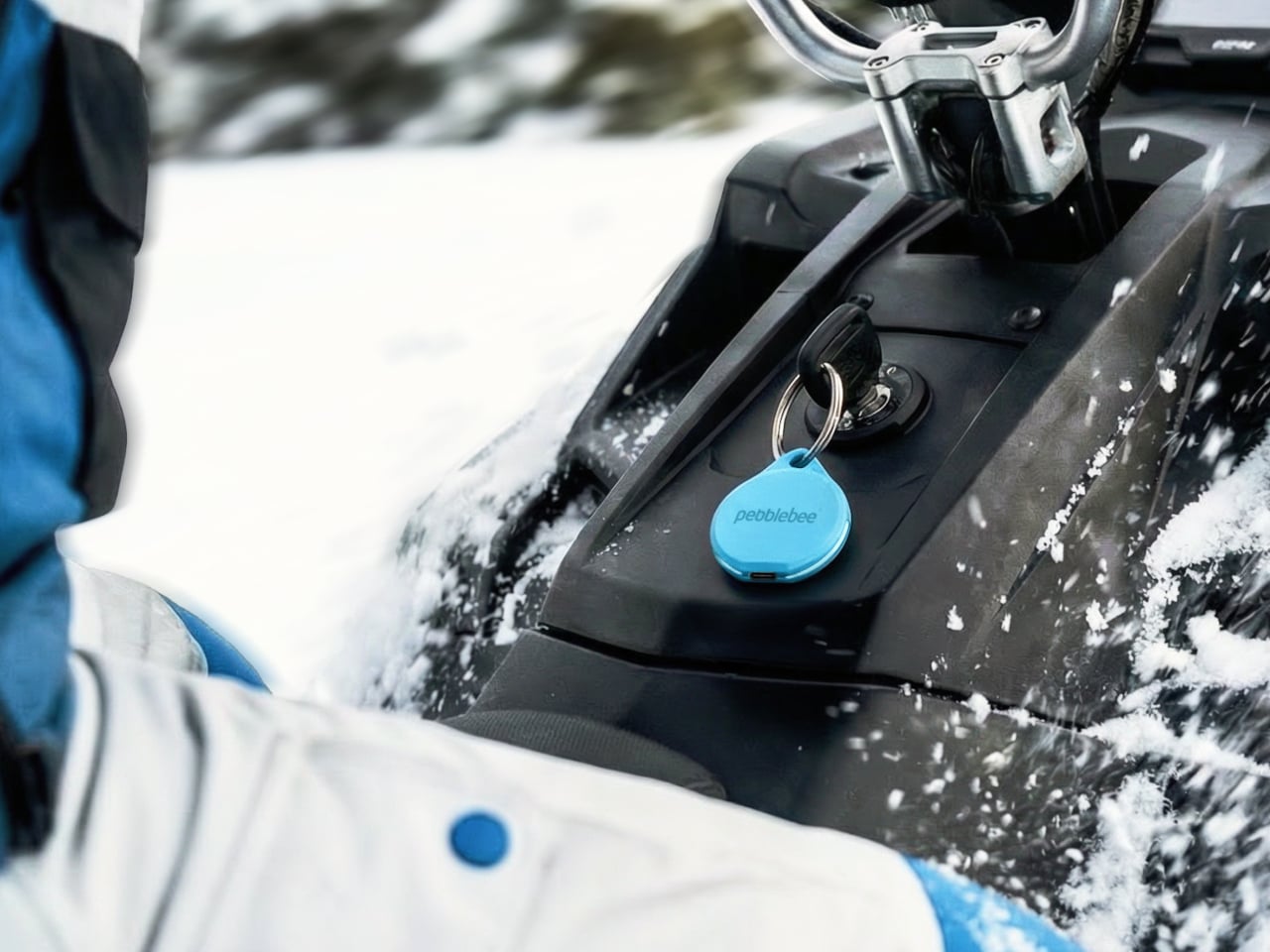
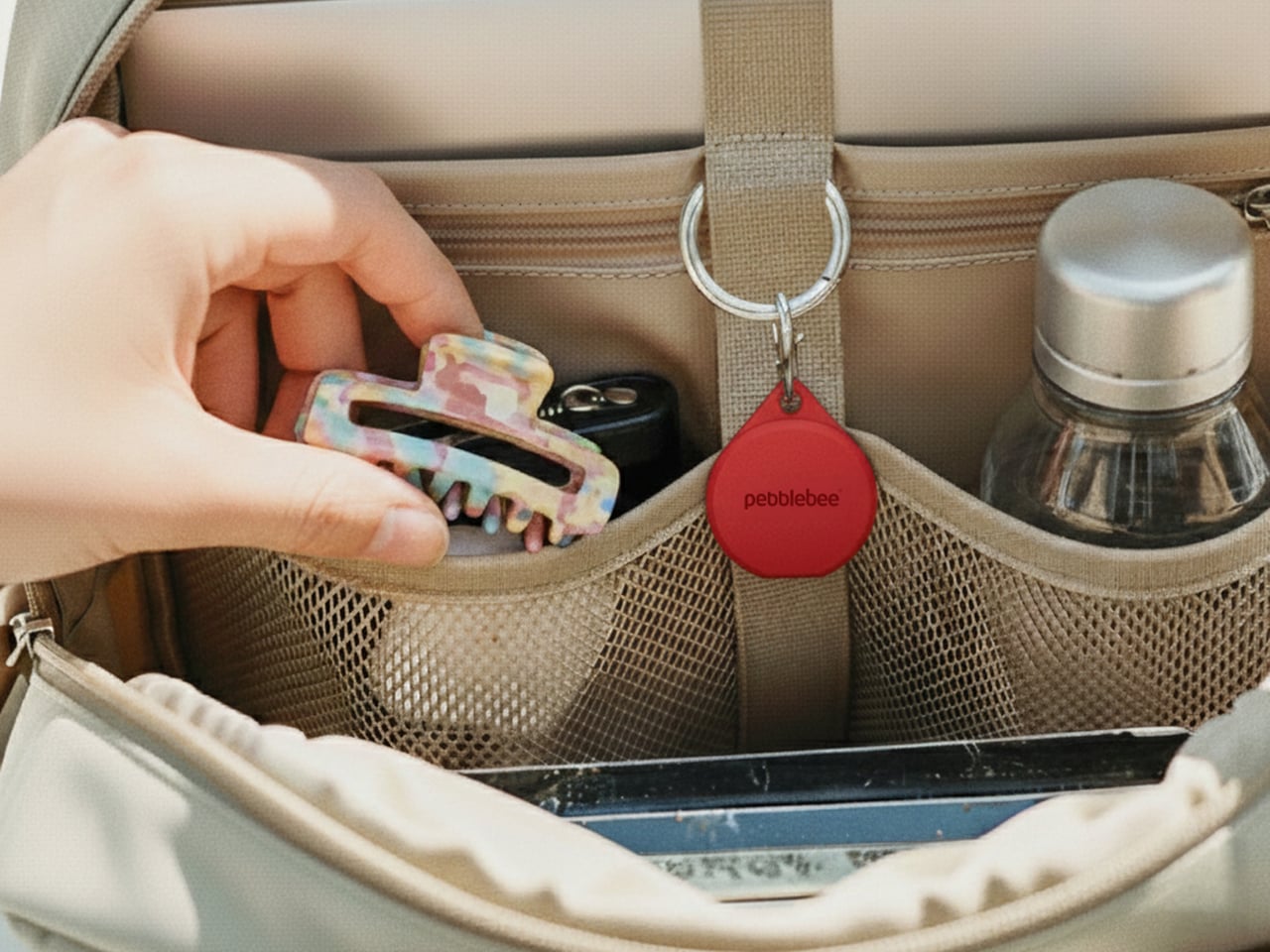
Pebblebee positions Subzero as a restrained, icy blue that reflects calm, control, and stillness, and Hot Coral as a warm, saturated coral red that signals energy, urgency, and action. The pair is meant to capture that early lesson of cold and heat, pause and response, turning the act of clipping a tag to your keys or bag into a small statement about how you relate to that item.
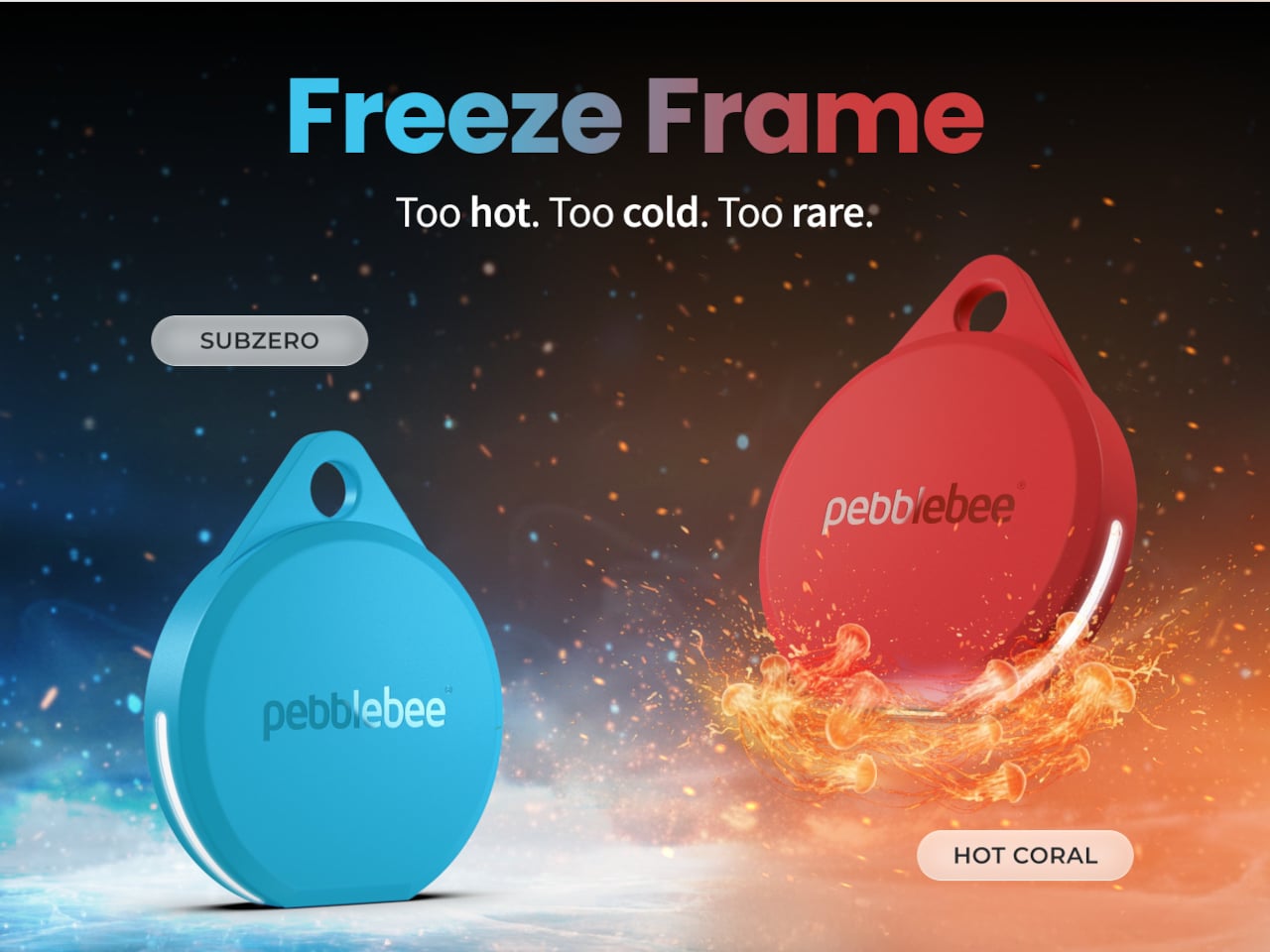
Under the new colors sits the same Clip 5 hardware. It’s Pebblebee’s latest item finder, with brighter LED strobes, a louder buzzer, and a more modern, rounded design. It runs for up to twelve months on a single USB-C charge, has an IP66 water resistance rating, and reaches up to 500 ft over Bluetooth. It’s built to be found by sound, by sight, and now by style.
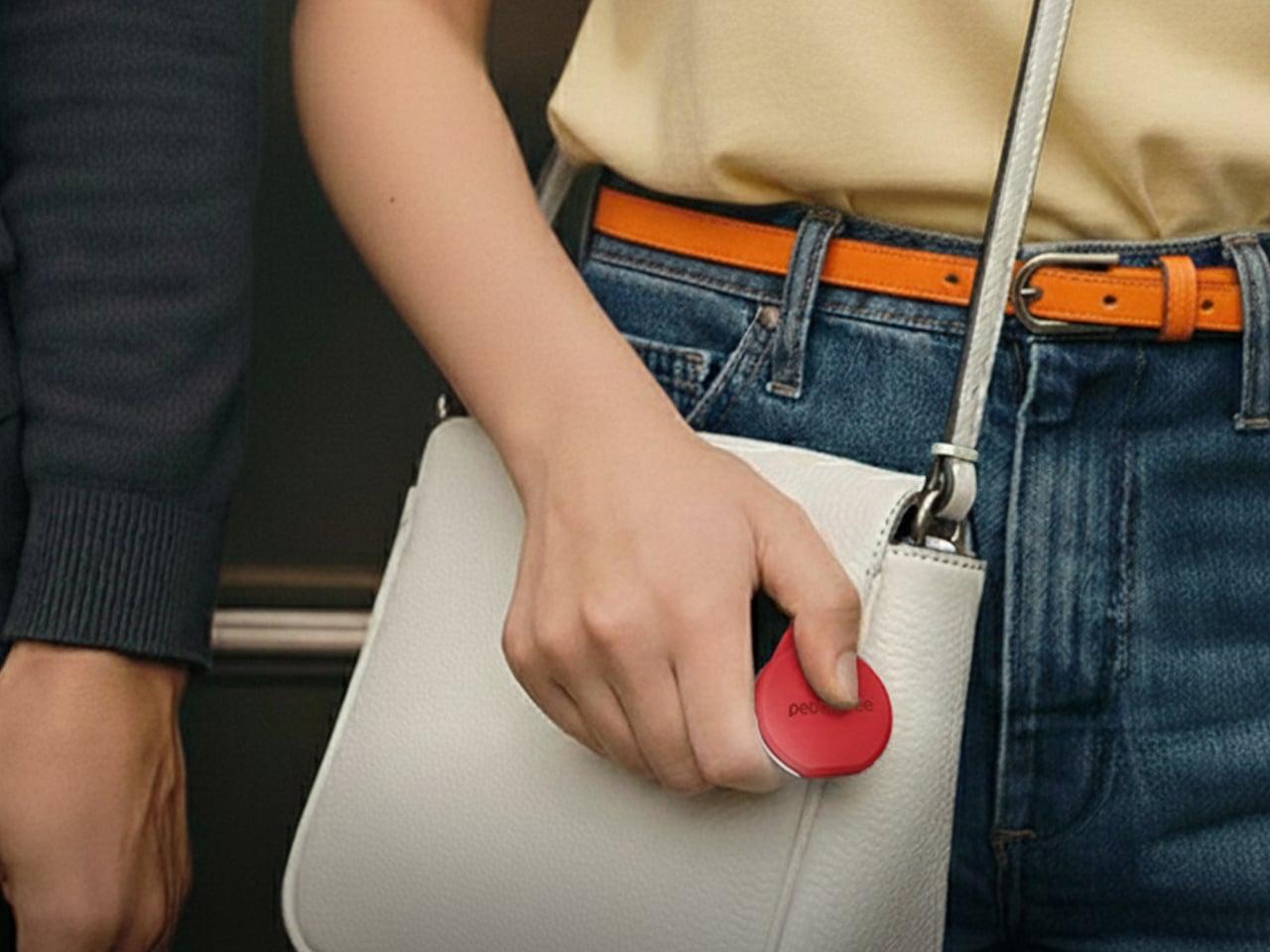
Clip 5 can join Apple’s Find My network on iOS or Google’s Find Hub on Android, so billions of devices quietly help you find lost items. There’s also a built-in Alert personal safety feature, where rapid presses trigger a siren, strobe, and SMS location ping to your chosen Safety Circle. That makes the color choice feel a bit more loaded when you think about where you clip it and when you might need it.
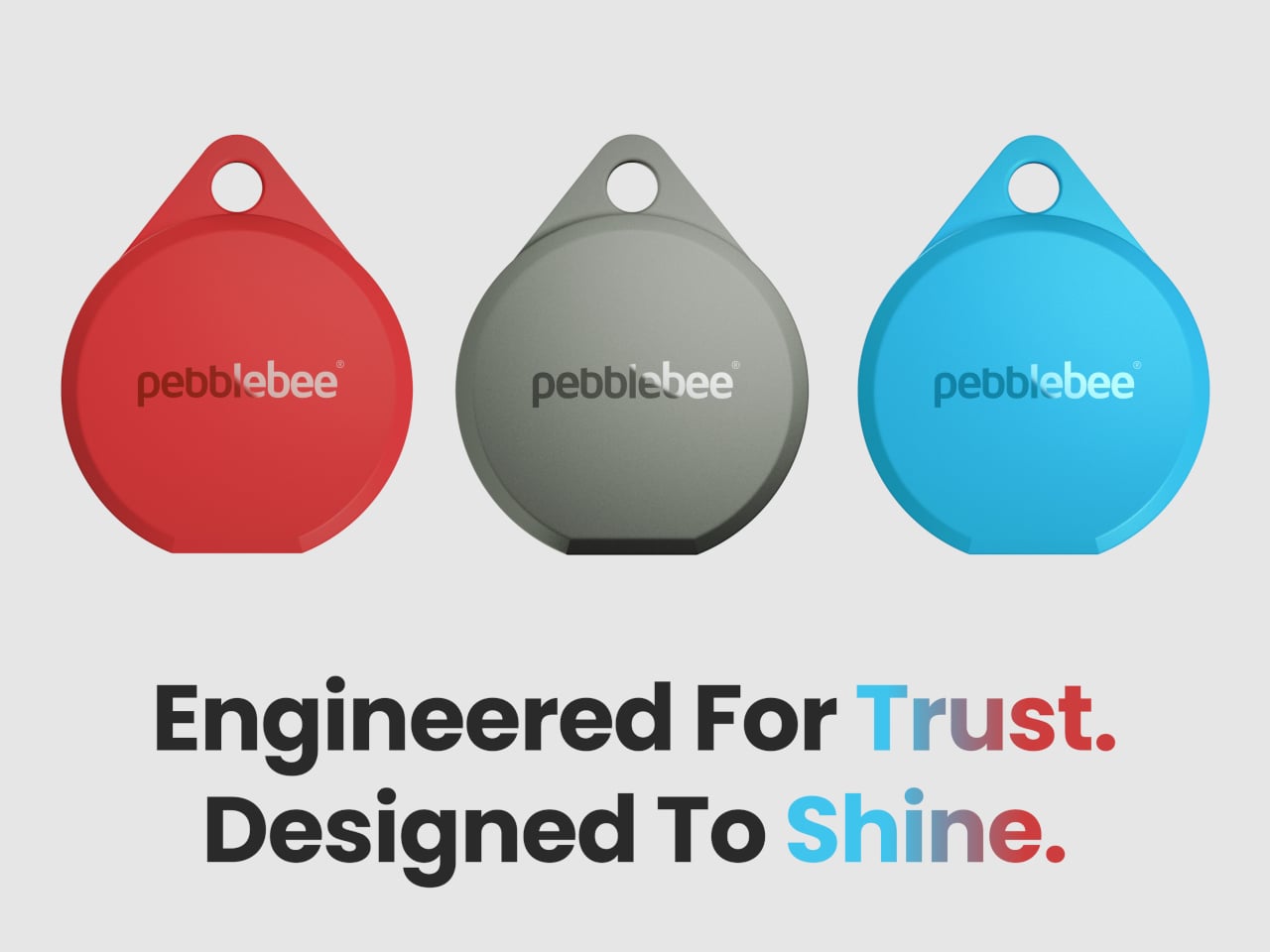
Evercolor drops are designed as moments, not permanent SKUs, and these shades won’t be restocked once they sell out. That scarcity nudges trackers into the same mental space as seasonal phone cases or watch bands, something you pick on purpose for a specific bag, coat, or set of keys instead of a default tag you never think about after you buy it.

Freeze Frame is less about changing what Clip 5 can do and more about changing how it feels to carry it. A Subzero tag on a camera bag or winter coat reads as calm and controlled, a Hot Coral one on keys or a gym bag feels like a bright “do not lose this” marker. When the whole point is not losing what matters, making it easier to care about the tag itself is smart design thinking most trackers skip entirely.

The post Pebblebee Clip 5 Hot Coral and Subzero Trackers Won’t Be Restocked first appeared on Yanko Design.
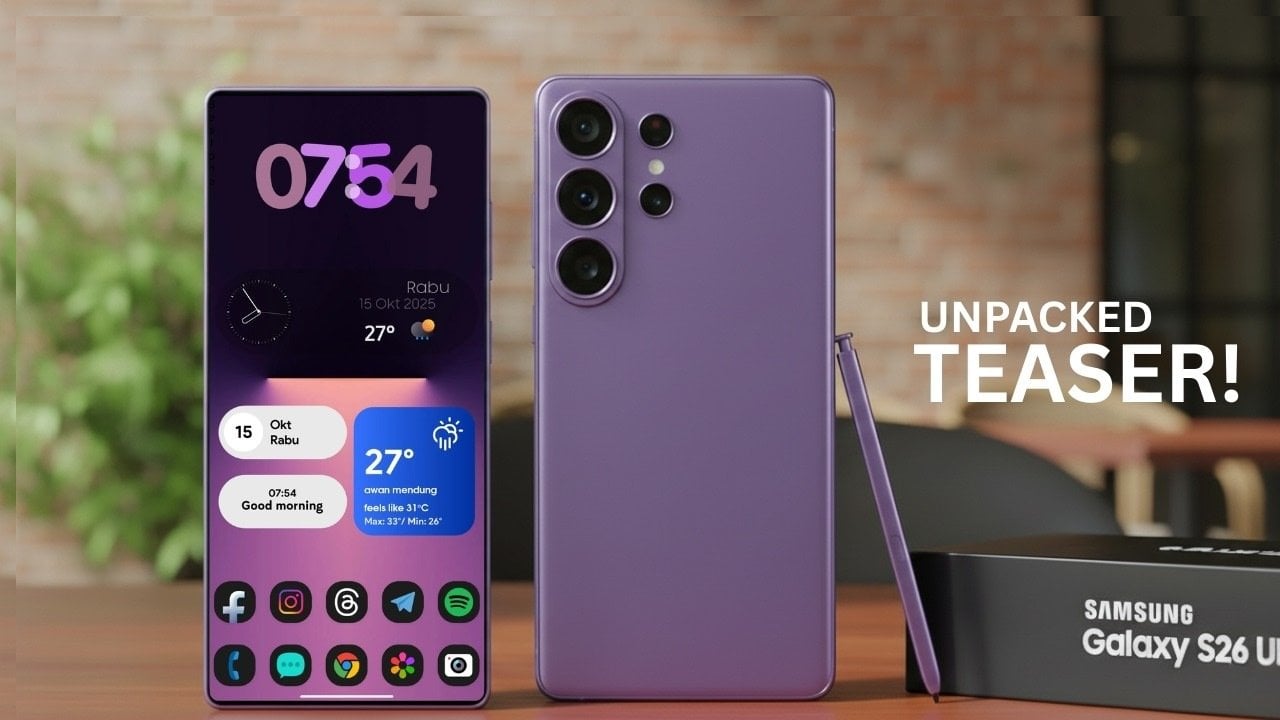
Is the Samsung Galaxy S26 Ultra Worth the Upgrade? Reasons to Wait for the Feb 25 Launch

Is the Samsung Galaxy S26 Ultra Worth the Upgrade? Reasons to Wait for the Feb 25 Launch Close-up of Samsung Galaxy S26 Ultra’s translucent camera module

Samsung has officially announced its Galaxy Unpacked event for February 25, 2026. This much-anticipated event will showcase the Galaxy S26 series, including the Galaxy S26, S26 Plus, and S26 Ultra. The event is set to take place in San Francisco at 10:00 a.m. Pacific Time and will be live-streamed globally, making sure you can witness […]

The post Is the Samsung Galaxy S26 Ultra Worth the Upgrade? Reasons to Wait for the Feb 25 Launch appeared first on Geeky Gadgets.

Posted in Uncategorized

Meta is reportedly working to bring facial recognition to its smart glasses

Meta has backed away from highly controversial facial recognition tech in its products and services before, but seemingly not so far that it isn’t willing to have another crack at it. A new report from The New York Times claims Mark Zuckerberg’s company wants to add facial recognition to its lineup of branded smart glasses at some point this year.

The NYT spoke to four anonymous people with knowledge of Meta’s plans, who told the publication that the feature is codenamed "Name Tag" internally. As you’d expect, it would let people wearing Meta-powered Oakley or Ray-Ban glasses identify people and "get information about them" using AI.

Such technology naturally carries huge privacy and ethical risks, which is reportedly why Meta was hesitant to unveil Name Tag at a conference for the blind last year. It also may have shelved plans to include facial recognition in the first version of its smart glasses, which launched in 2023.

In an internal memo from Meta’s Reality Labs viewed by the NYT, Meta said that the current political instability in the US presents a good opportunity for it to push ahead with its plans. "We will launch during a dynamic political environment where many civil society groups that we would expect to attack us would have their resources focused on other concerns," it said.

With the smart glasses market expected to become more competitive in the coming years, Meta seemingly believes facial recognition would give it an edge on rival products from the likes of OpenAI. As for how it would work, the company is considering its options. It could recognize people the wearer is already connected to via one of Meta’s apps, or potentially display information from public Instagram accounts. The NYT’s sources said that universal facial recognition, effectively allowing you to look up the identity of anyone you walked past, would not be possible.

Meta shut down Facebook’s Face Recognition system, used when tagging people in photos, in 2021, following widespread public backlash over privacy concerns. Three years later, it brought it back, this time as a tool for Instagram and Facebook designed to detect scam ads that use the faces of celebrities and other public figures. Last year Meta rolled out the feature beyond the US, so Facebook and later Instagram users in the UK, Europe and South Korea could also use it on their accounts.

This article originally appeared on Engadget at https://www.engadget.com/ai/meta-is-reportedly-working-to-bring-facial-recognition-to-its-smart-glasses-144721330.html?src=rss

This Aroma Diffuser Orb Floats Above Its Base and Glows at Your Touch

Most aroma diffusers behave like small plastic towers or pods that sit in a corner, quietly bubbling or misting away. They do their job, but they rarely feel like part of the room’s character, more like humidifiers with better marketing. It’s strange that scent and light are both mood tools, but the hardware behind them often looks forgettable enough to hide behind a plant or book.

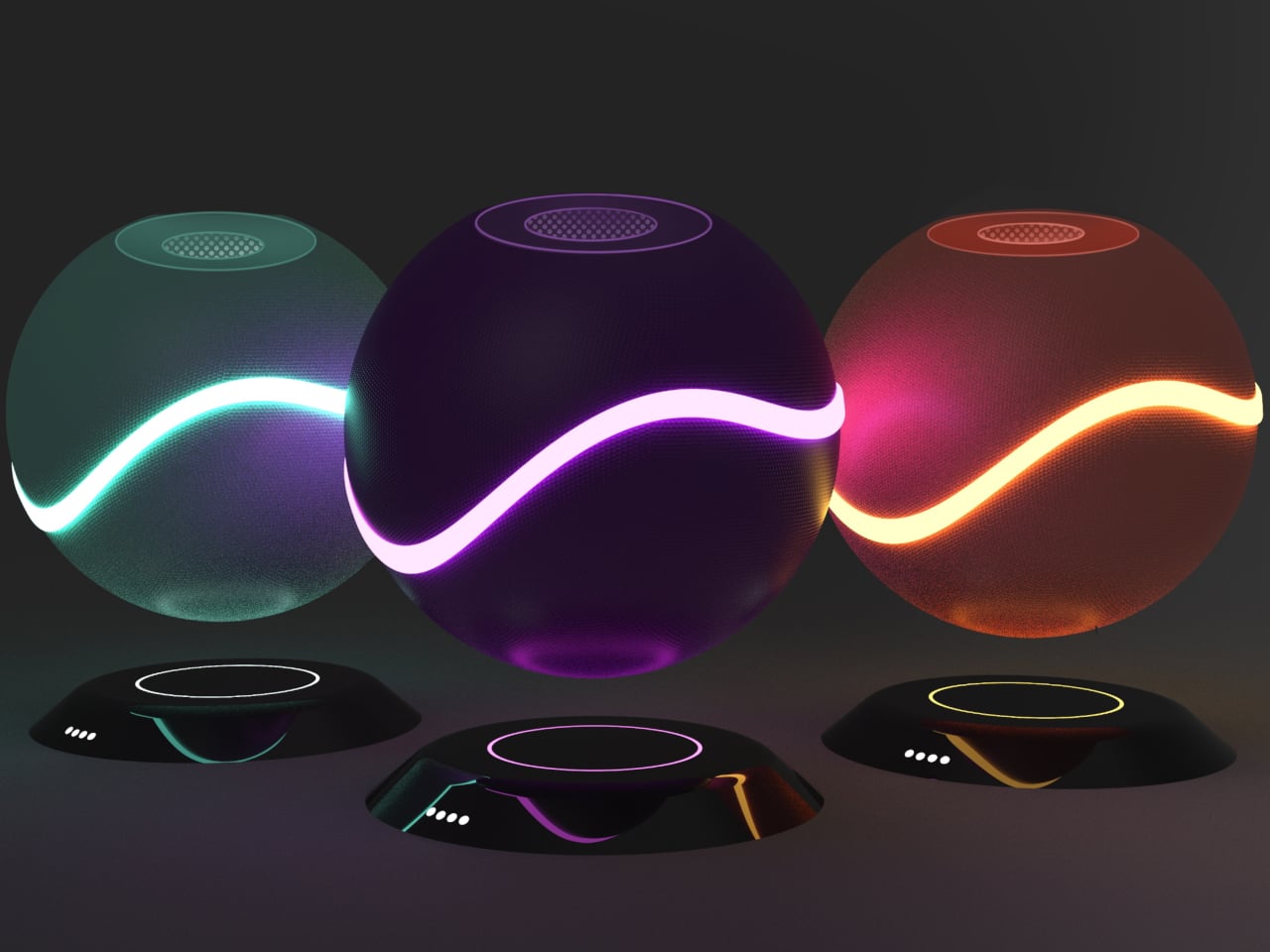
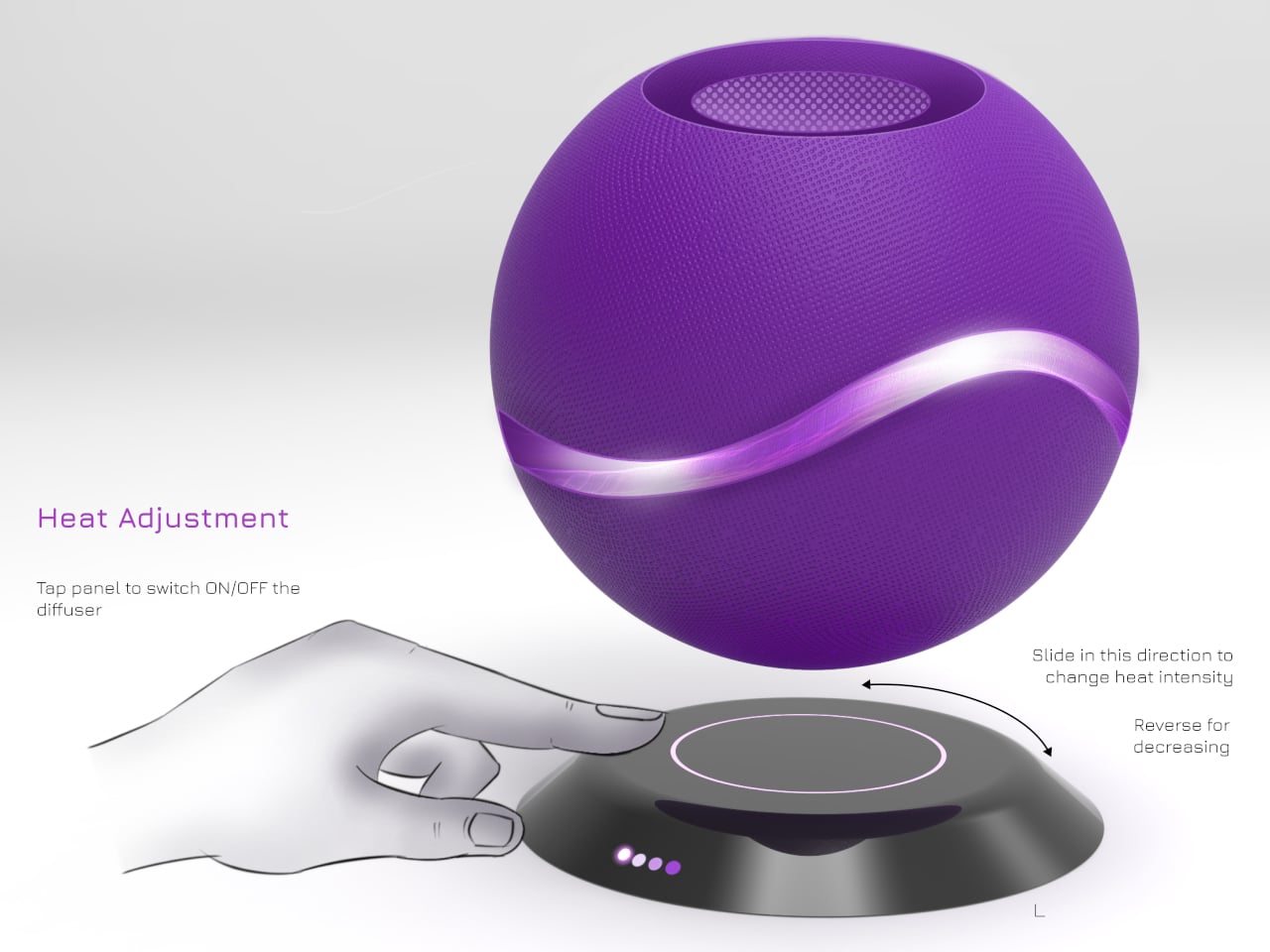
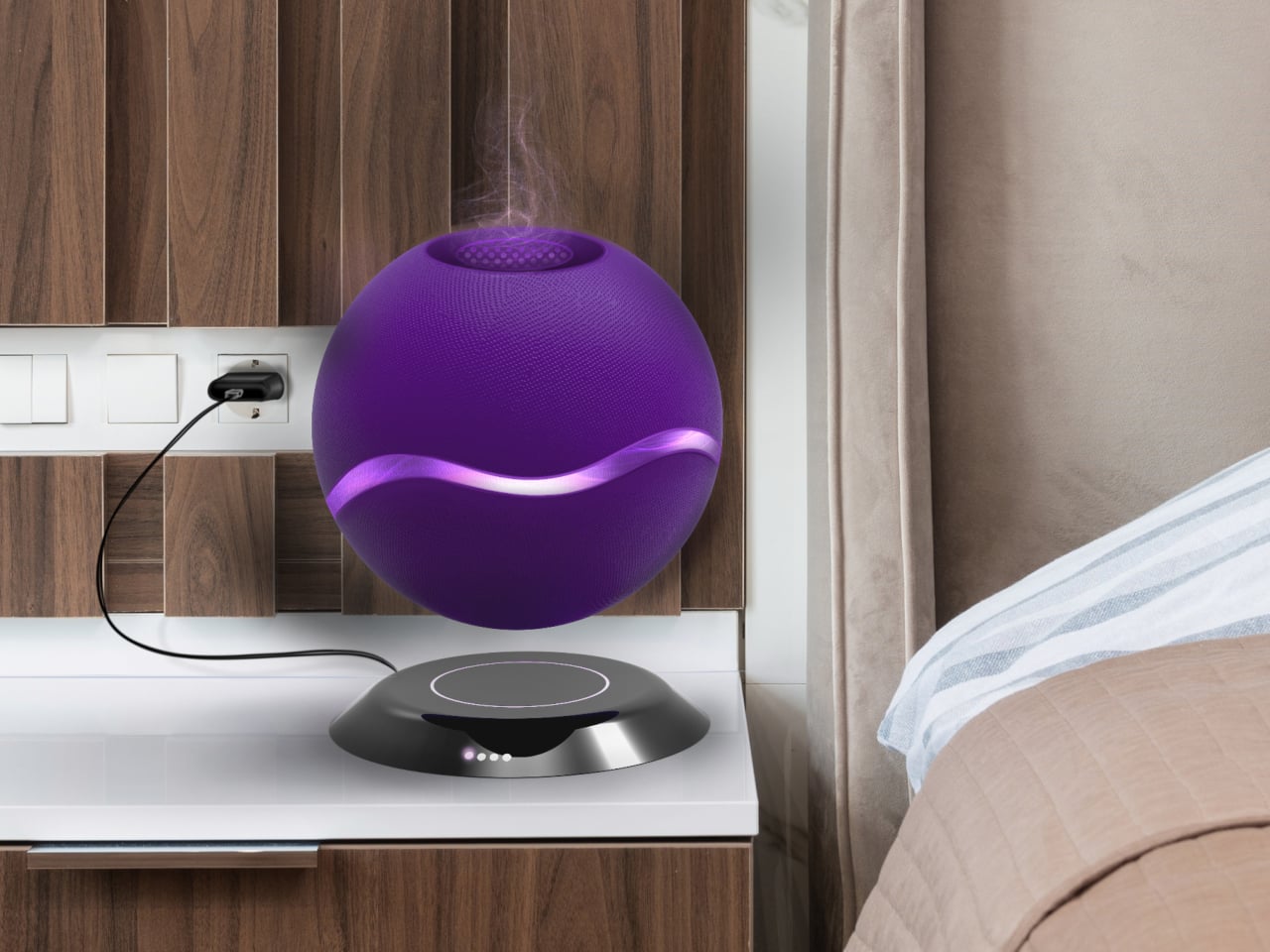
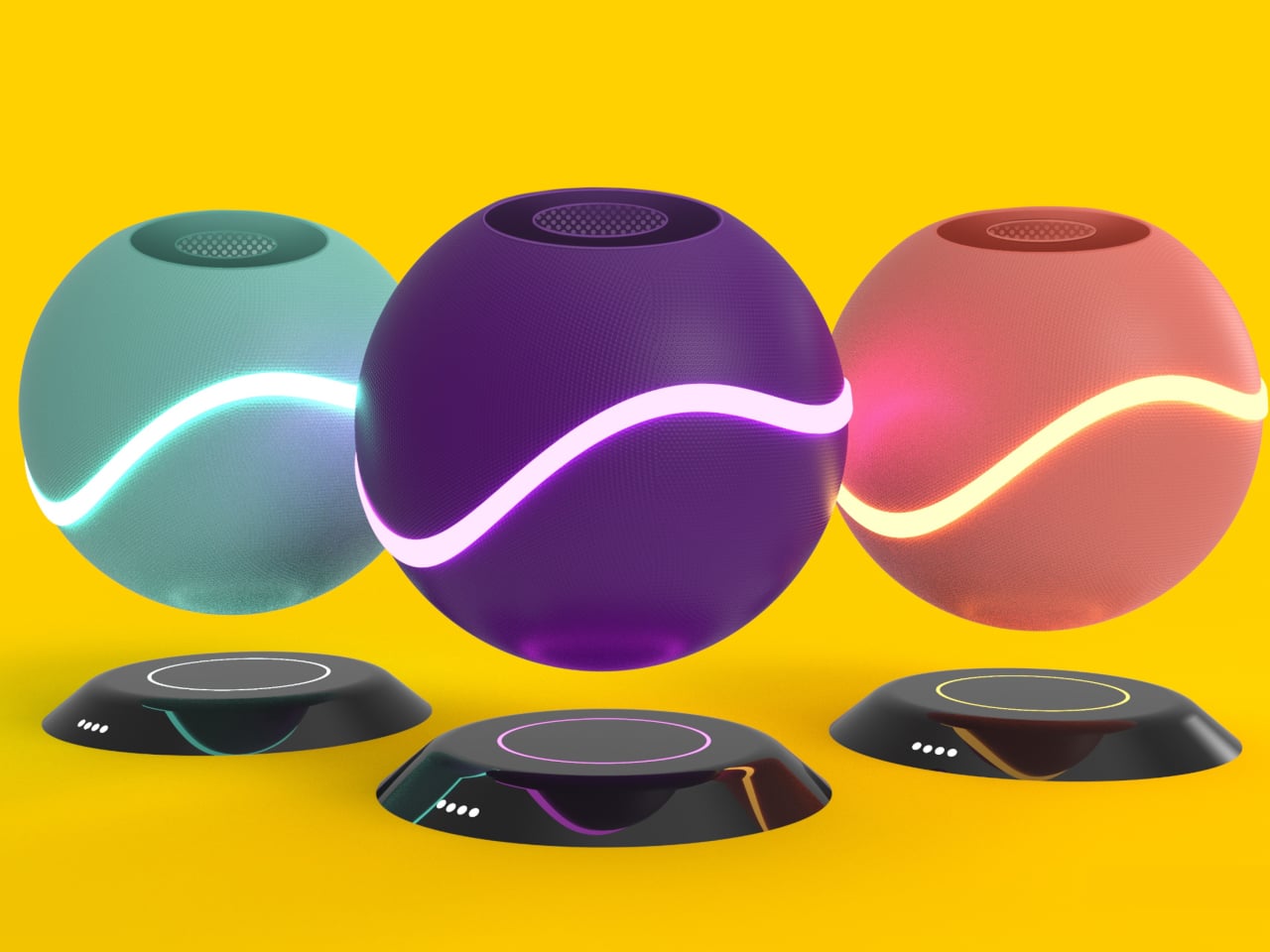
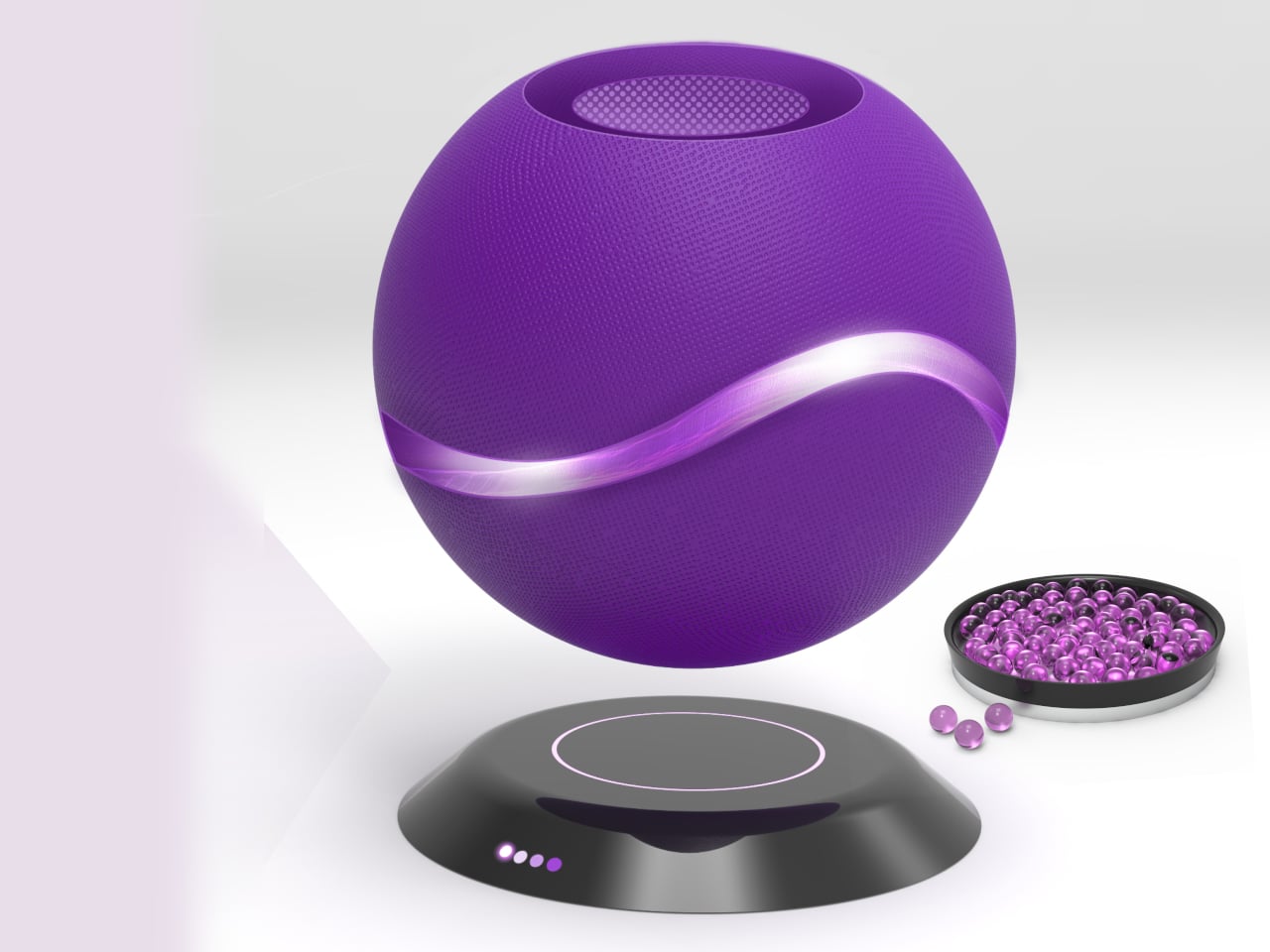
AER OMA is a magnetic levitating aroma diffuser concept that tries to make the act of scenting a room feel more deliberate. It uses a smooth spherical pod that hovers above a base, wrapped in a glowing band of light. The designer calls it a way to enhance room fragrance with a “futuristic feel,” which is rare copy that actually matches what the object looks like it wants to do.

Designer: Vedant Kore

Coming home in the evening, you tap the touch panel on the base to wake the diffuser, and the ring light comes up as the sphere steadies in mid-air. Sliding a finger along the control changes heat and aroma intensity, with the light ring quietly reflecting those changes. It feels less like fiddling with a dial and more like setting a scene before you sit down and let the day catch up.

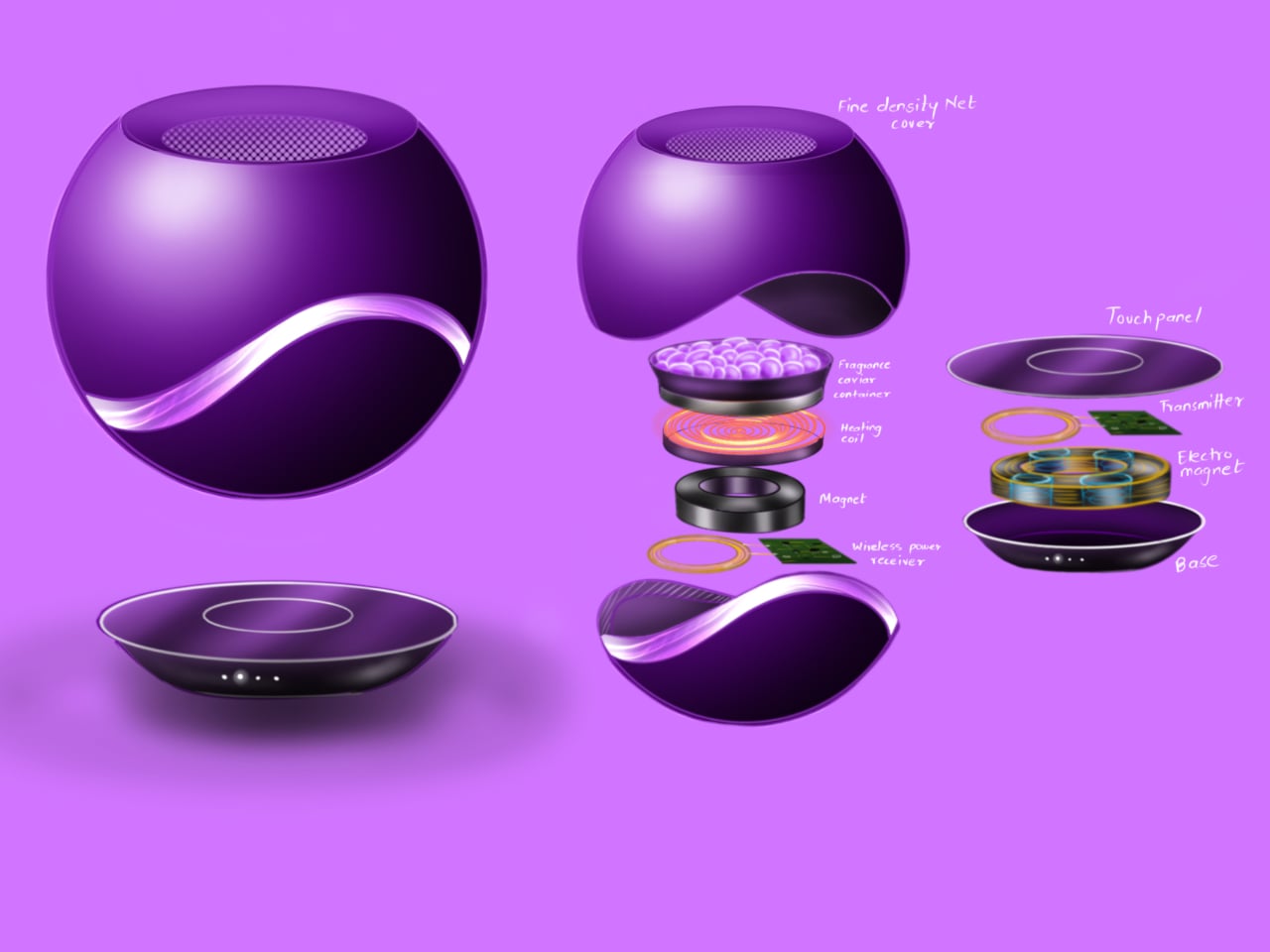
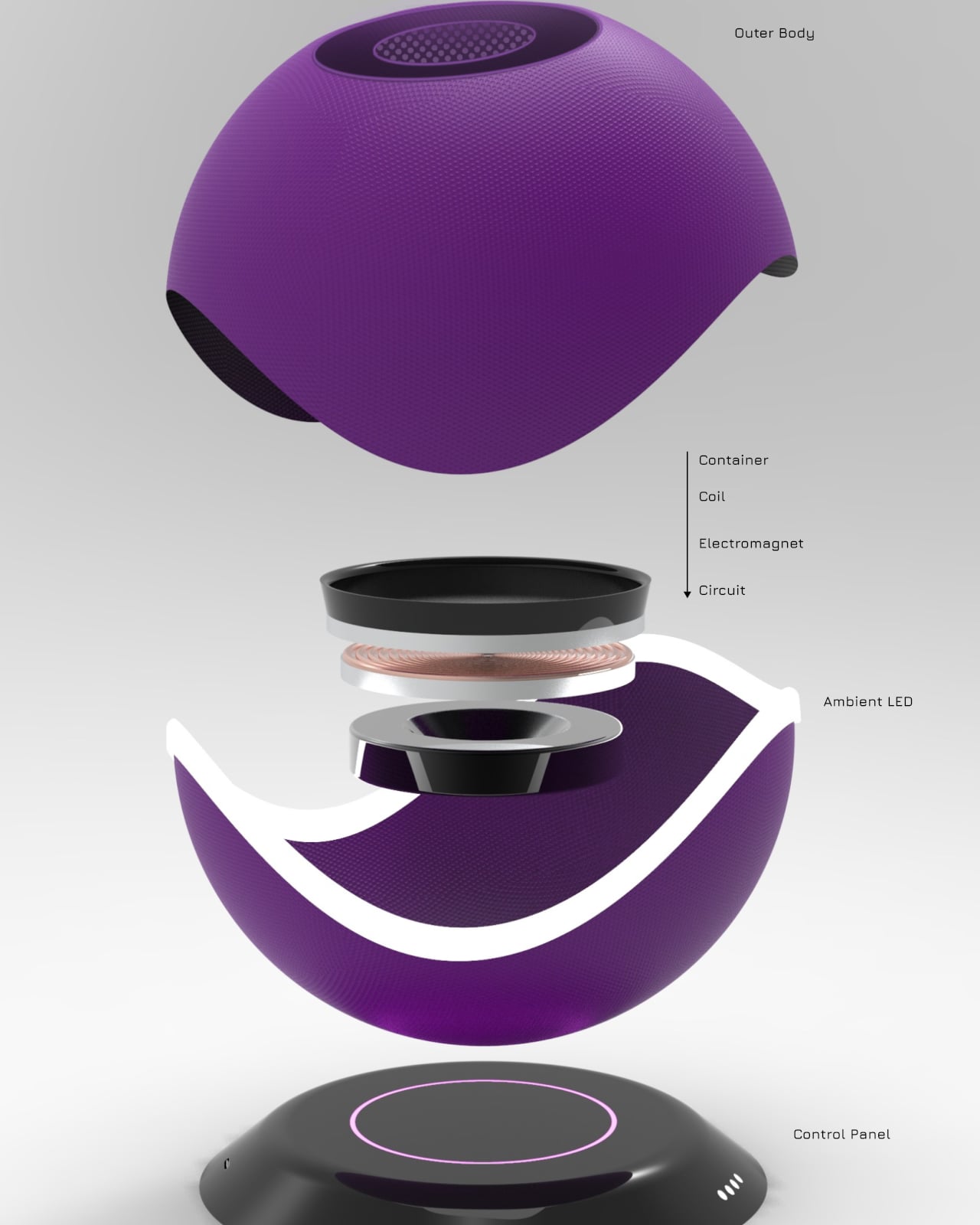
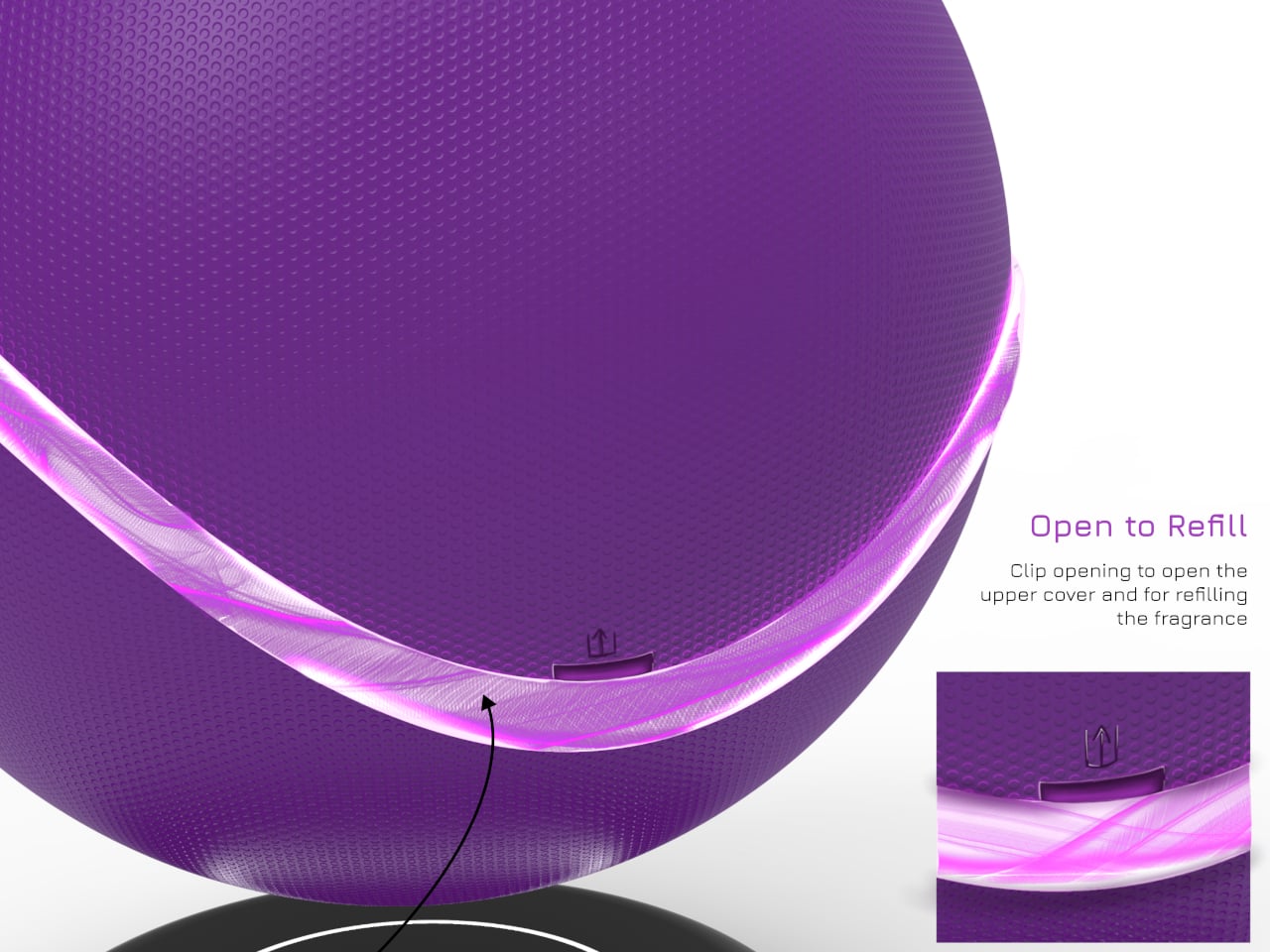
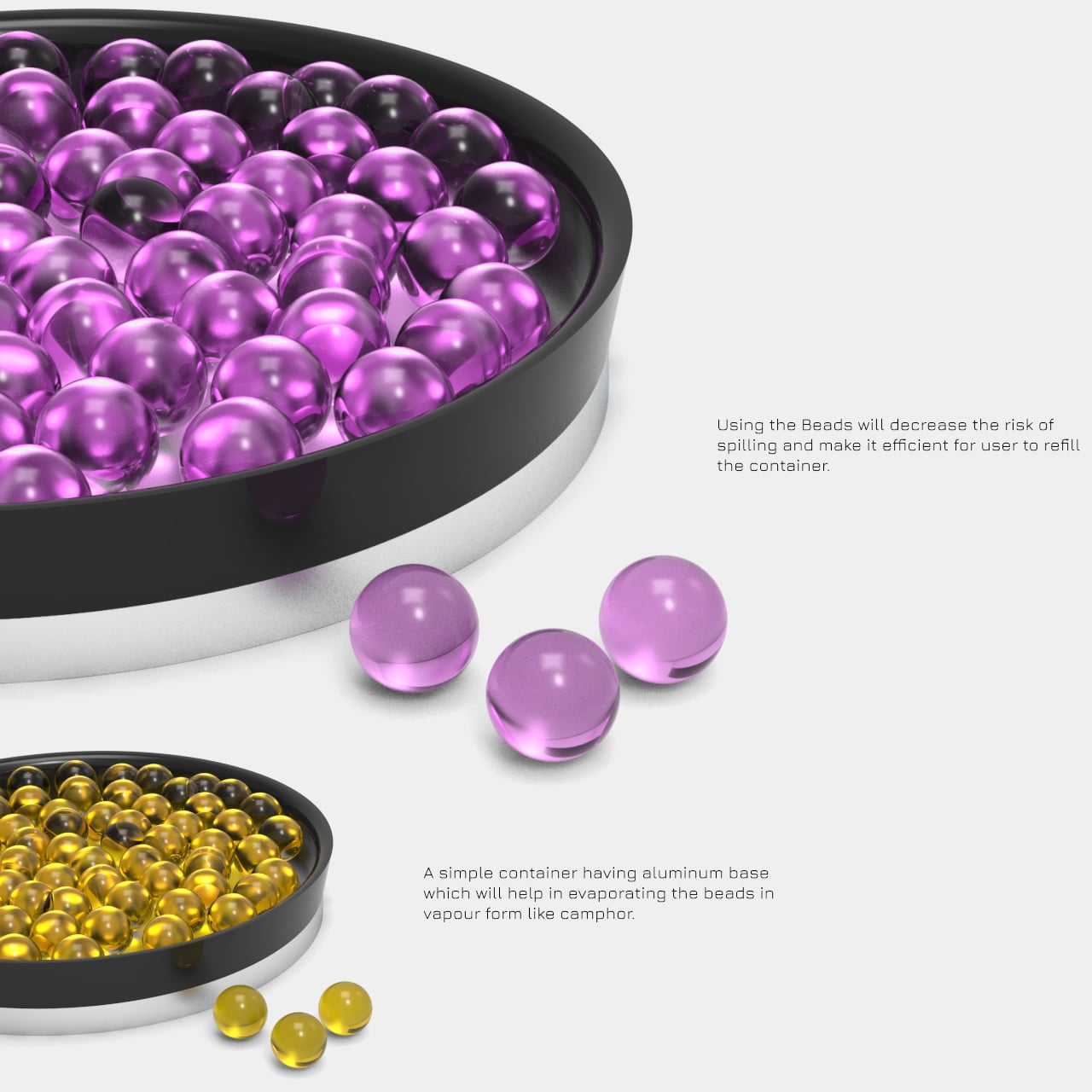
Instead of a water tank and essential oil puddles, AER OMA uses polymer aroma beads held in a small metal and mesh container. Heat from a roughly 12W element releases fragrance without spill risk, and refilling is as simple as swapping beads. You can choose a handful for a light scent or more for a stronger presence, making the ritual more tactile than just dripping liquid into a reservoir.

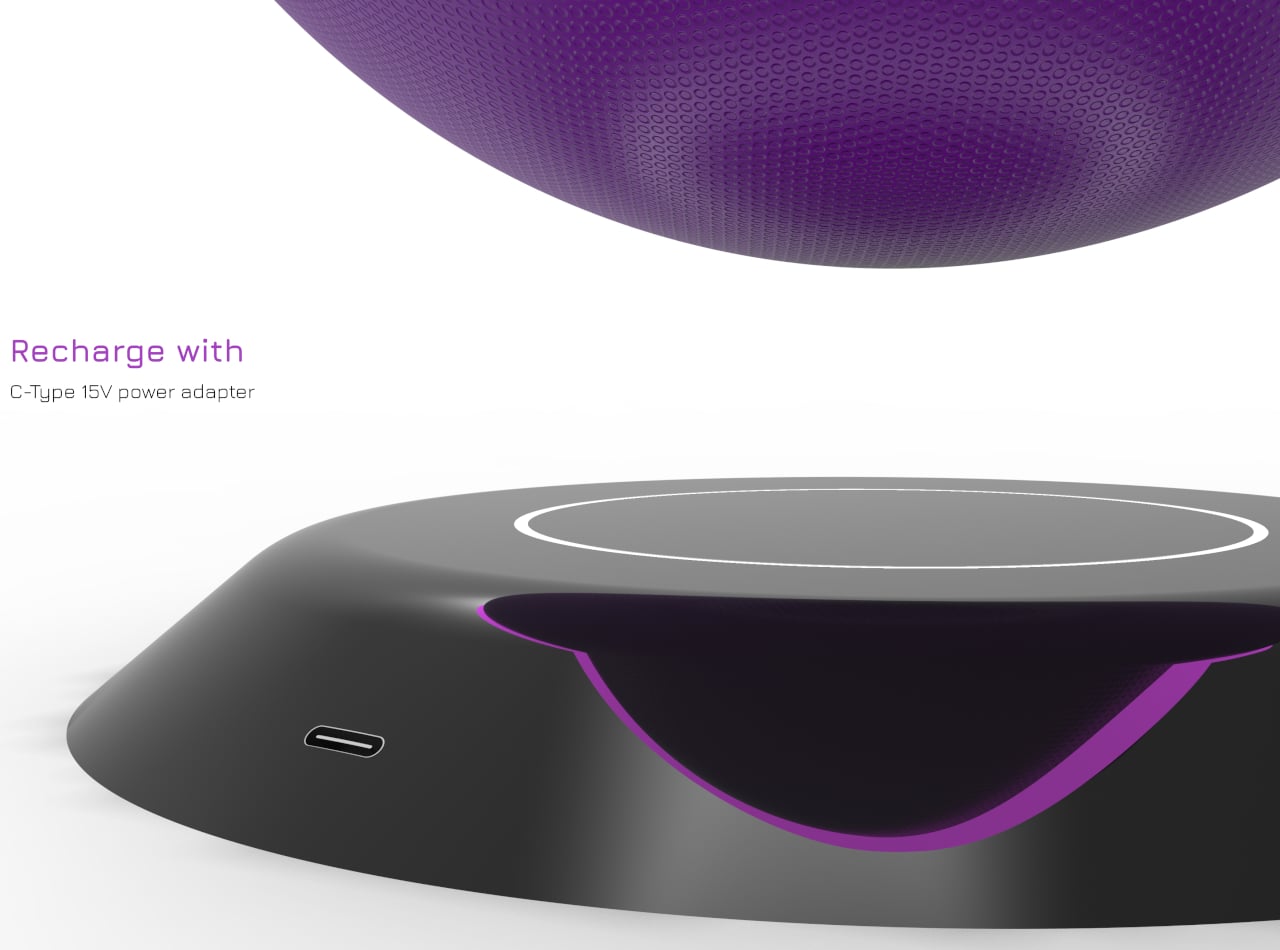
Magnets and coils in the base and sphere handle the hovering act, powered by a 12-15 V USB-C adapter, while ambient LEDs in the base ring and the band around the sphere handle the glow. The floating form and soft light sell the idea that scent is something weightless moving through the room, not just vapor coming out of a nozzle buried in plastic.

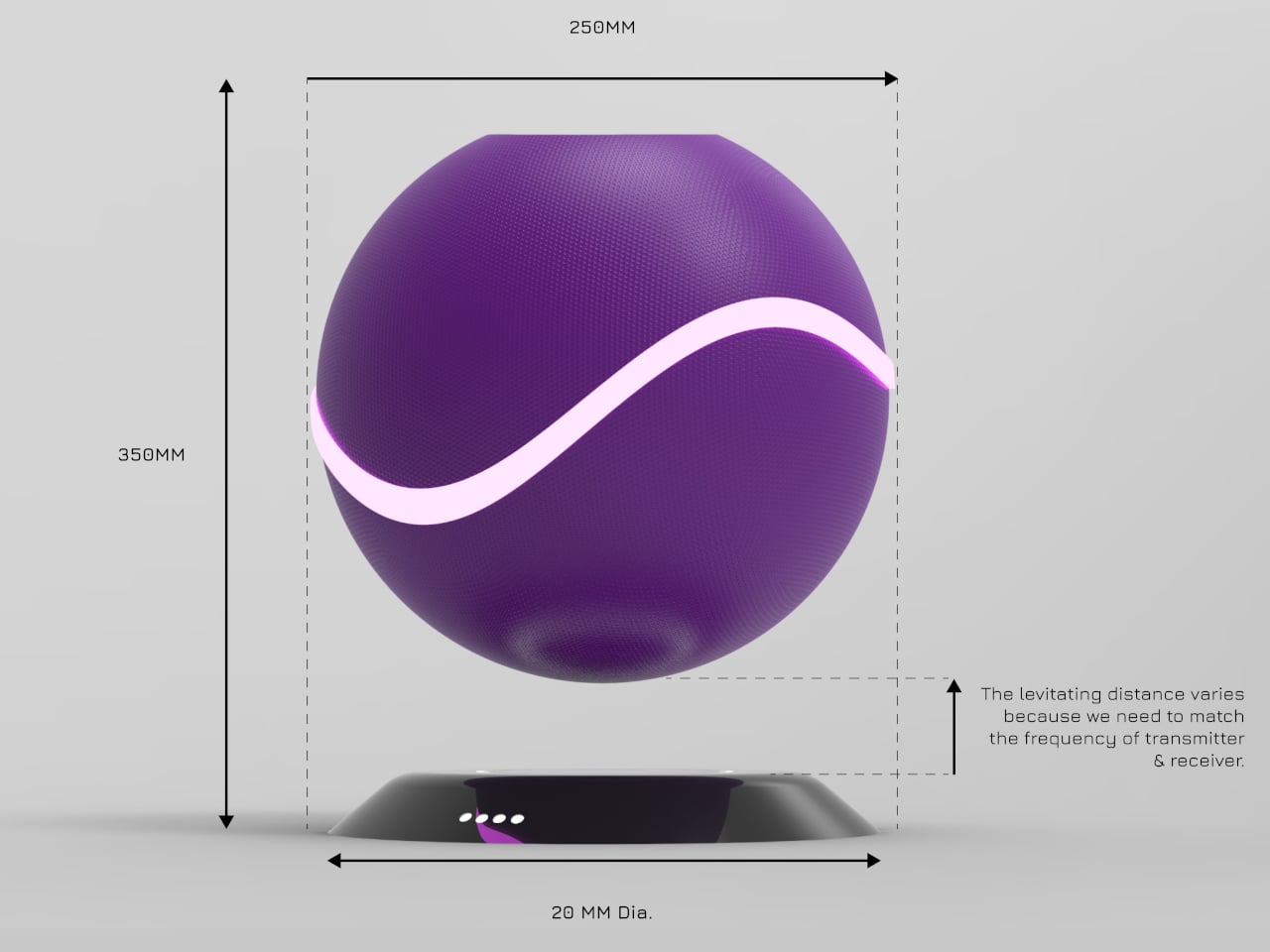
The sphere is about 250mm across, the base around 200mm, with a polypropylene or ABS shell molded into smooth curves. Color options range from deep purple to teal and warm orange, each with matching light accents. It’s big enough to be a focal object on a sideboard or bedside table, but still reads as a single, calm shape rather than tech bristling with vents.

AER OMA treats scent diffusion as a small performance instead of a background process. By floating the diffuser, hiding the mechanics, and giving you a simple touch strip and a bowl of beads to work with, it reframes a functional task as a quiet ritual. It’s a reminder that even making a room smell nice can feel different when the object doing it looks like it belongs in the future instead of the back corner of a shelf.

The post This Aroma Diffuser Orb Floats Above Its Base and Glows at Your Touch first appeared on Yanko Design.
Agentic Business Approach Replaces Scattered AI Tools

Agentic Business Approach Replaces Scattered AI Tools Flowchart showing the four stages: consolidate info, design workflows, activate AI agents, then automate routine operations.

Simon Pittman explores why adding more AI solutions often fails to deliver the scalability businesses seek. Instead of streamlining operations, an overload of disconnected systems can lead to inefficiencies like information silos and redundant workflows. Pittman introduces the concept of the “agentic business” model, which focuses on using context-driven AI agents and centralized systems to […]

The post Agentic Business Approach Replaces Scattered AI Tools appeared first on Geeky Gadgets.

Posted in Uncategorized

Samsung Galaxy Buds 4 Pro Leak: Game-Changing Features Revealed!

Samsung Galaxy Buds 4 Pro Leak: Game-Changing Features Revealed! Samsung Galaxy Buds 4 Pro leak reveals new design and features

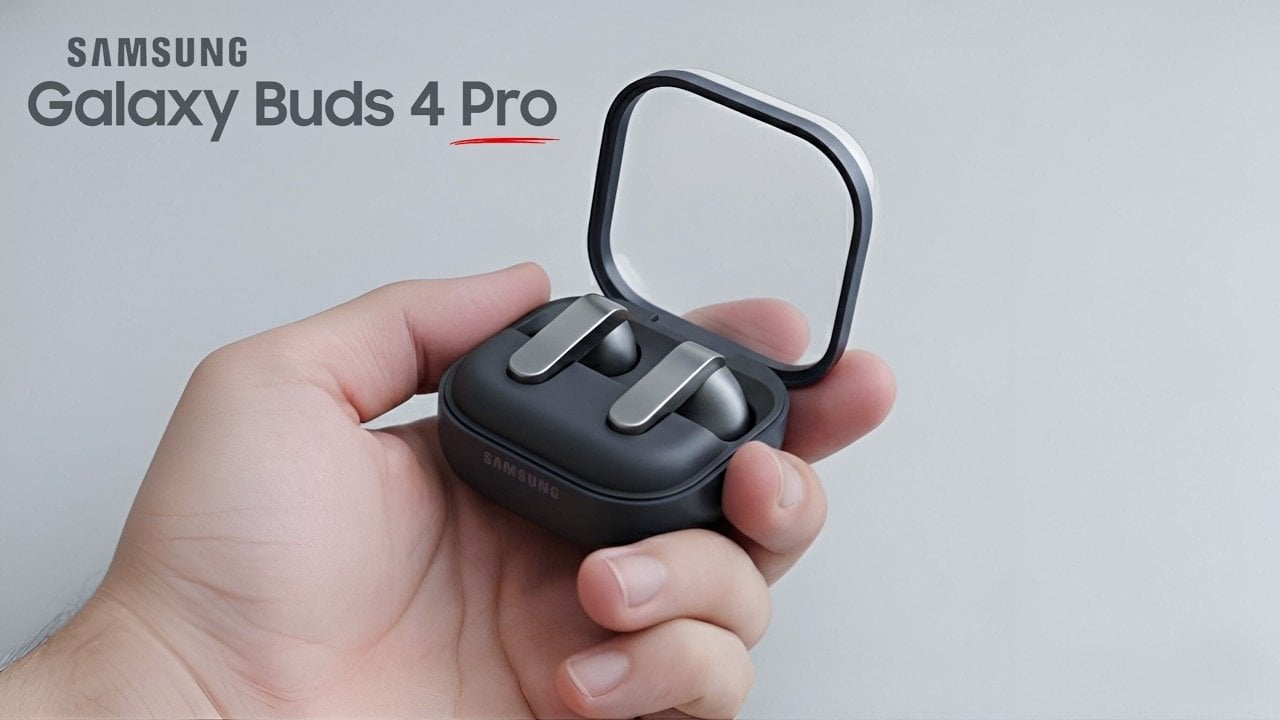
Samsung may have unintentionally revealed its upcoming wireless earbuds, the Galaxy Buds 4 and Galaxy Buds 4 Pro, through its Lockstar app within the Goodlock customization suite. This unexpected leak provides an early glimpse into the next generation of Samsung’s audio devices, which promise advancements in design, sound quality, and durability. The official launch is […]

The post Samsung Galaxy Buds 4 Pro Leak: Game-Changing Features Revealed! appeared first on Geeky Gadgets.

Posted in Uncategorized

The ridiculously tiny Kodak Charmera captured our hearts (and lots of shoddy pictures)

Every once in a while, a product comes along that sparks a bit of joy in our jaded hearts. This is what happened with the Kodak Charmera, a $30 tiny toy camera that was nearly impossible to get ahold of in the first couple of months after its release, selling out immediately over waves of blind box restocks. Despite the gimmick of it all, the Charmera was just too cute for some of us to resist, and we sprang when they finally started becoming more readily available. 

A few of us on the Engadget team have one now, and even with all of its shortcomings, we kind of love this thing. Here's what two of our writers think about it. 


Lately, it feels like a chore to carry around a full-frame mirrorless camera. My Nikon definitely feels like the right tool to precisely capture a moment in time with fast autofocus and plenty of image resolution. Other times, that perfect moment is more casual, like catching up with friends over dim sum or killing time while you're snowed in at a cabin in Vermont. In these cases, there's no reason to carry around a hulking camera and lens to snap a flawless photo that I have to edit later. Instead, something light, discreet and playful feels like the right tool for the occasion.

A low-res image of a tree standing in a snow-covered field, with other trees in the background
Jackson Chen for Engadget

That's where the Kodak Charmera comes in. It's a toy camera with a 35mm lens with a fixed f/2.4 aperture and a 1/4-inch sensor. In other words, the photos this thing takes are about equivalent to what you would get with a crappy flip phone from the 2000s that also plays Snake.

Kodak is clearly trying to wring out the longing for nostalgia within all of us, and has nailed it with the Charmera, which is even inspired by its old-school disposable Fling cameras. It's definitely not as good as the smartphone in your pocket, but there's something disarming about snapping a quick shot with a tiny block of plastic that's lighter than your keys.

Playing around with the Charmera for a few weeks gave me a healthy reminder that the sillier and more transient parts of life don't need the technical prowess of an expensive camera. Obviously, the Chamera produces photos of terrible quality at 1.6 megapixels and can't really capture anything fast-moving or in low light, but it's undeniably fun and hard to resist shooting with. And sometimes, you and your friends are just doing wildly unserious things and you want a camera that matches that energy.

Jackson Chen, Contributing Reporter


Every time I pull out the Kodak Charmera in public to snap a few pictures, I'm immediately met with a barrage of questions and squeals of delight from full-grown adults: "What is that?"; "Is that a camera?"; "Does it really take pictures?"; "Can I see it?" It is the kind of accessory that doubles as a conversation starter, an effect that's turned out to be as joyous as taking pictures with the camera itself. I've been trying really hard to spend less time on social media and my phone in general lately, and having a two-inch camera clipped to me has made for a pretty fun shift in how I document the day-to-day. 

As the resurgence of compact digital cameras has shown us, a lot of people are yearning for a time of simpler tech — when we had personal devices that could do useful things, like take decent photos and connect us to our friends, but didn't consume our lives entirely. Companies like Camp Snap have shaped their entire brands around recapturing that magic, and some consumers have shown that they're willing to sacrifice in areas like image quality in exchange for a taste of it, too. The Kodak Charmera isn't the kind of product you go into purchasing with high expectations. It is clearly a toy that is only going to be capable of so much. 

Two Sphynx cats, both dark gray with black ears and noses, sit close together cuddled under a light beige blanket, one looking straight at the camera and the other looking off to the side
Cheyenne MacDonald for Engadget

As Jackson noted, the low-resolution 1,440  x 1,080 pictures look about on par with those you'd have taken on a flip phone 15 or 20 years ago. In the right lighting conditions with a clearly defined subject, they're not so bad. But selfies, portraits and nature photos will generally look washed out. It can record videos too — and you should set similarly low expectations for these. 

Despite all that, I've been pleasantly surprised by how much I'm enjoying the Charmera experience. Its crunchy photos are just good enough to feel like they're successfully preserving a moment in time. And being so tiny, it's really convenient to bring everywhere. It even came with me to CES. The Charmera takes a microSD card (sold separately), allowing for tons of storage and easy transferring. There are a bunch of built-in filters you can apply, too, which have been fun to play around with.

If I want high-quality photos, this isn't the camera I'm going to reach for. But it's great for low-stakes situations when all I care about is taking some pictures I can look back on fondly later. Consider me charmed. — Cheyenne MacDonald, Weekend Editor


This article originally appeared on Engadget at https://www.engadget.com/cameras/the-ridiculously-tiny-kodak-charmera-captured-our-hearts-and-lots-of-shoddy-pictures-140000245.html?src=rss

Ex-OpenAI Researcher Links ChatGPT Ads to Weaker Ethical Safeguards

Ex-OpenAI Researcher Links ChatGPT Ads to Weaker Ethical Safeguards Diagram of an independent oversight board with legal authority to review AI company practices and protect users.

Zoë Hitzig, a former researcher at OpenAI, has publicly criticized the organization’s shift toward profit-driven strategies, citing ethical concerns as a key reason for her resignation. According to Hitzig, OpenAI’s recent decision to introduce advertisements in the free version of ChatGPT represents a significant departure from its original mission of ethical AI development. As highlighted […]

The post Ex-OpenAI Researcher Links ChatGPT Ads to Weaker Ethical Safeguards appeared first on Geeky Gadgets.

Posted in Uncategorized

iOS Secrets Revealed: 10 Tips to Maximize Your iPhone’s Potential

iOS Secrets Revealed: 10 Tips to Maximize Your iPhone’s Potential 10 iPhone Tips & Tricks

In 2026, iPhones have reached new heights of functionality and personalization, thanks to the advancements introduced with iOS 26. Whether you aim to simplify your daily routine, optimize your device’s performance, or tailor your experience to your preferences, these ten tips and tricks will help you unlock the full potential of your iPhone. Explore how […]

The post iOS Secrets Revealed: 10 Tips to Maximize Your iPhone’s Potential appeared first on Geeky Gadgets.

Posted in Uncategorized

Claude Cowork Easily Automates Local File & Folder Tasks on macOS

Claude Cowork Easily Automates Local File & Folder Tasks on macOS Price screen for the Claude Max plan showing the $100 per month subscription tied to research preview access.

Claude Cowork provides Mac users with a structured approach to managing files, as outlined by Tool Finder. Available through the Claude Max subscription, it includes features like automated file organization, renaming, and classification. Users can also work on documents, spreadsheets, and presentations within the same platform. Currently in its research preview, the system integrates with […]

The post Claude Cowork Easily Automates Local File & Folder Tasks on macOS appeared first on Geeky Gadgets.

Posted in Uncategorized