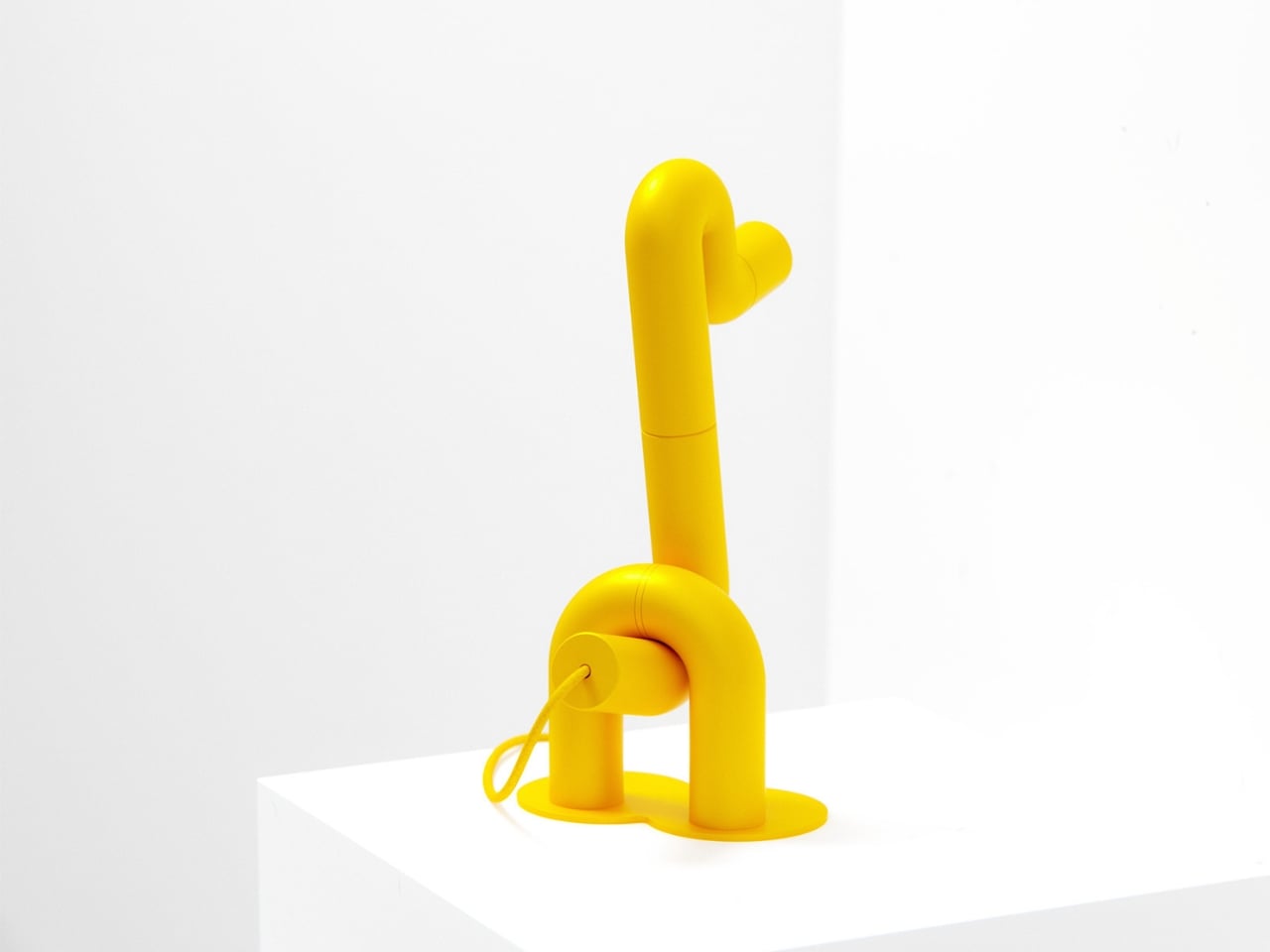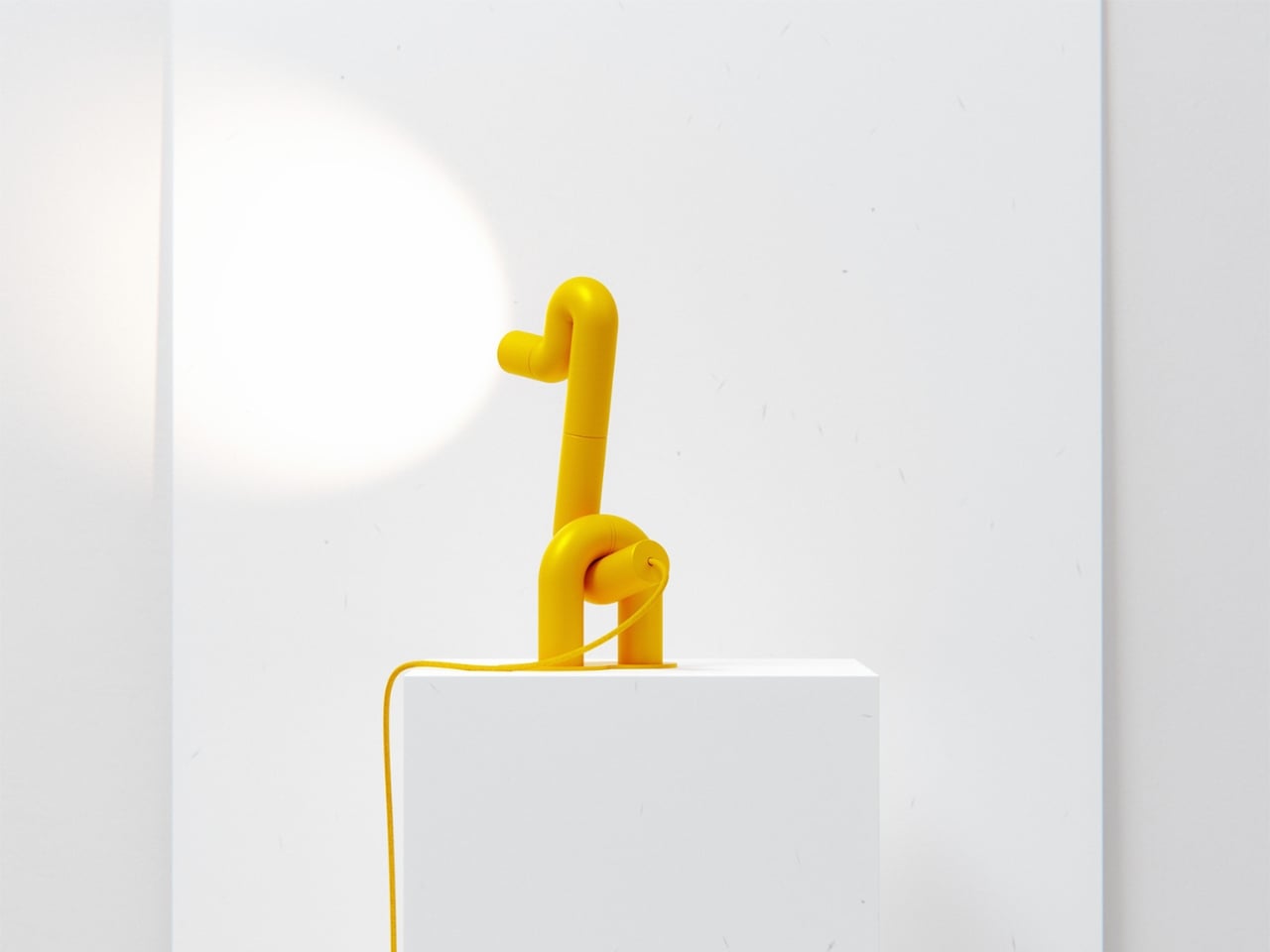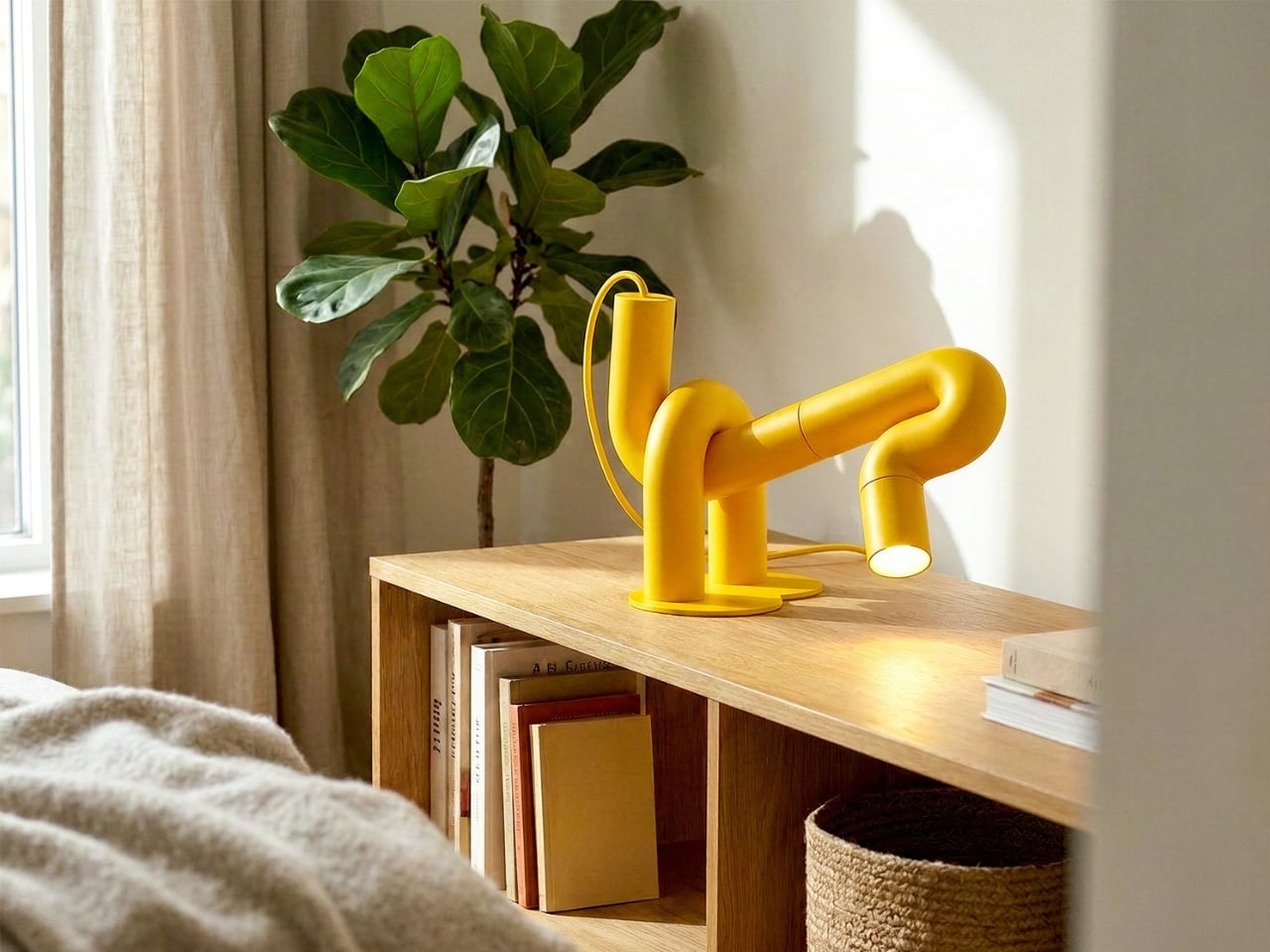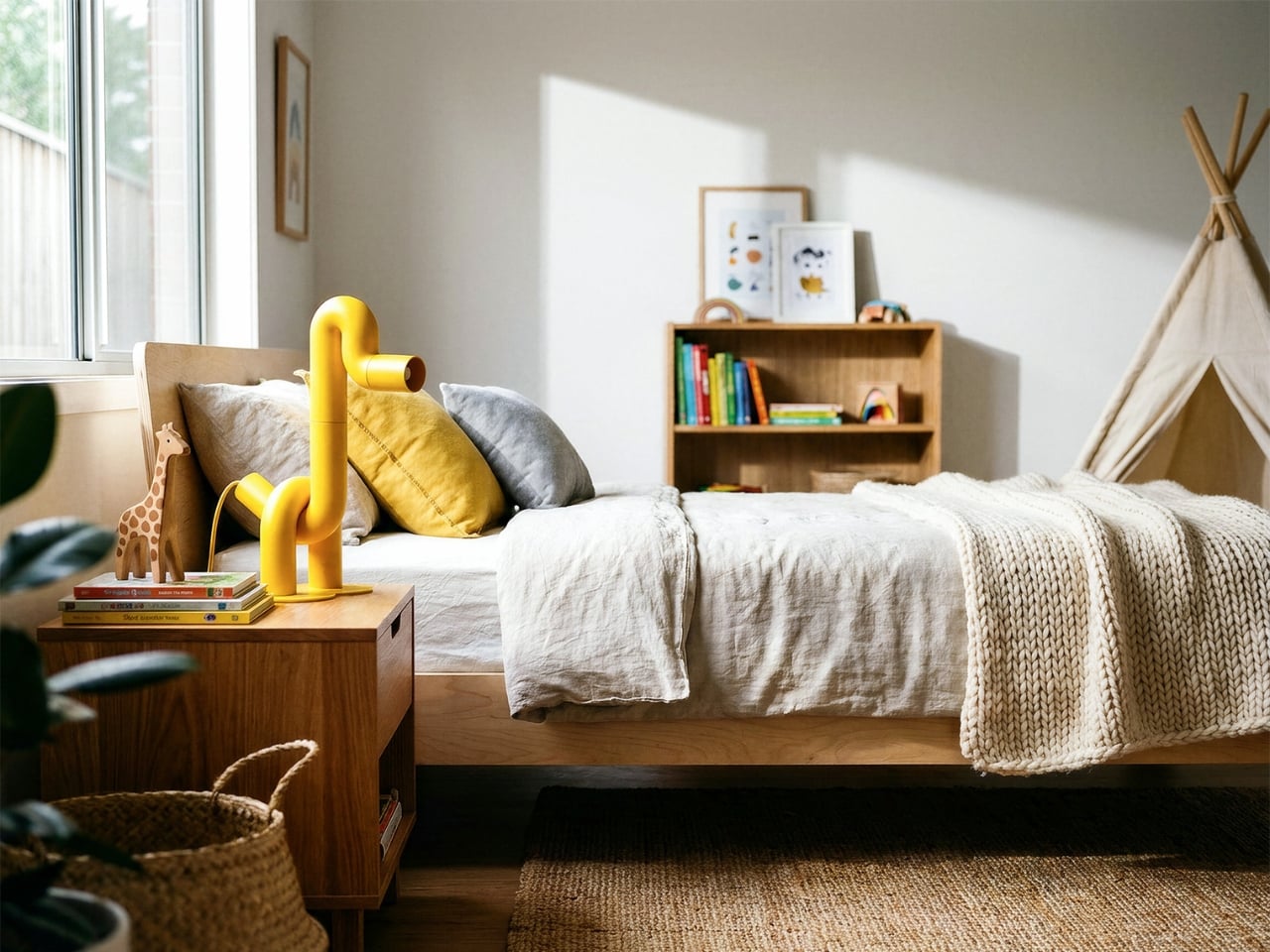
Fold the Corners of This Wooden Cube Lamp and Watch the Light Change

Most contemporary lamps are adjusted with a dimmer on the cord, a touch sensor on the base, or a slider in an app. That makes light feel like another setting in a menu, slightly detached from the object itself. There is something satisfying about changing light by physically moving parts, as if you are sculpting both the fixture and the atmosphere around it, which is what smart bulbs and app-controlled RGB strips quietly leave out.

Michael Jantzen’s Interactive Folding Lamp is a small, painted wooden cube that quietly invites that kind of interaction. Four corners of the cube have been cut into different geometric shapes and hinged, so they can swing open and closed. When you start to move them, you aren’t just revealing the light but also changing how much of it escapes. At the same time, you are also changing what the lamp looks like from every side, turning the adjustment into a compositional act.

Designer: Michael Jantzen

A single energy-efficient bulb sits at the center, wrapped in a light-diffusing shield and surrounded by six horizontal yellow planes, evenly spaced like a tiny louvered tower. As you open the hinged corners, more of those yellow planes come into view, catching the light and turning it into a warm, layered glow that spills out through the gaps you have created, contrasting with the cool white painted exterior.

This plays out over a day. The lamp closed down to a near-solid cube with just thin seams of light when you want a soft background presence. One corner folded out to throw a slice of light across a book or keyboard. Multiple panels opened wide when you want the object to become a small, glowing sculpture in the room. Each adjustment is a quick, tactile decision rather than a number on a scale, making the ritual feel manual and deliberate.

Jantzen sees the lamp as part of a larger exploration into re-inventing the built environment through unexpected interactivity. The cube can be read as a piece of micro-architecture, its hinged faces acting like tiny façades or shutters that you reposition to modulate light and form. It compresses the logic of folding pavilions and responsive buildings into something that fits on a side table or desk, letting you interact with architectural ideas at hand scale.

The Interactive Folding Lamp gives you a direct, analog way to tune your space, asking you to touch wood, feel hinges, and watch how light responds. It turns a basic act, turning on a lamp, into a small moment of play and composition. In a time when so much interaction is mediated by screens and voice commands, a lamp that responds only to your hands, opening and closing its own geometry to let light out or hold it in, feels like a quiet reset worth keeping in a corner.

The post Fold the Corners of This Wooden Cube Lamp and Watch the Light Change first appeared on Yanko Design.

This Award-Winning Lamp Is Made From Millions of Metal Threads

There’s something deeply poetic about borrowing from nature, especially when it comes to design. Tzuhsiang Lin’s Nest Lamp does exactly that, and the result is a lighting fixture that feels less like a product and more like a piece of quiet conversation. Drawing inspiration from bird nests, this award-winning lamp transforms the delicate chaos of intertwined twigs into something you can hang in your home.

Created during Lin’s studies at Pratt Institute, the Nest Lamp takes shape through millions of interwoven metal threads that form two organic sheets wrapped around a central light source. The technique is intricate, relying on advanced metalworking to achieve that natural, almost messy quality that makes real nests so captivating. But here’s where it gets interesting: this isn’t just visual trickery. Lin embedded layers of meaning into those twisted metal strands.

Designer: Tzuhsiang Lin

The lamp’s design intentionally echoes the bonds between family members. Each metal thread represents connection, support, and the tangled beauty of relationships that hold us together. There’s even a nod to Chinese culture woven in, where silk carries connotations of longing because of its pronunciation. While the lamp uses metal instead of silk, that cultural reference adds weight to what might otherwise be simply a pretty light.

When you look at the Nest Lamp from different angles, it shape-shifts. The two metal sheets create varying patterns and shadows depending on your perspective, making it a dynamic presence in a room rather than static decoration. Light filters through the woven threads, creating a soft, ambient glow that changes as you move around it. At the center sits a donut-shaped light tube, and the way illumination radiates through that circular opening adds another layer to the visual experience.

Let’s talk about sustainability for a second, because it matters here. In a market flooded with cheap plastic fixtures that barely last a season, Lin chose metal. It’s a deliberate decision that speaks to durability and environmental consciousness. Metal can be recycled, it ages gracefully, and it doesn’t contribute to the mountain of disposable lighting that ends up in landfills. The lamp isn’t just meant to look good; it’s built to stick around.

The design world has certainly noticed. The Nest Lamp has collected an impressive roster of accolades, including a Silver A’ Design Award in 2025, a Silver at the International Design Awards, recognition at the MUSE Design Awards, the NYCxDESIGN Awards, and a nod from the LIT Lighting Design Awards. That’s not a small feat for a design that originated as a student project.

What makes this lamp resonate beyond its trophy case is how it bridges the gap between nature and technology. Bird nests are engineering marvels in their own right, structures that balance weight, flexibility, and protection. Lin’s lamp captures that essence while introducing modern materials and manufacturing processes. It’s biomimicry with emotional intelligence.

The real magic happens when you place it in your home. Suspended from the ceiling, it becomes a focal point that shifts throughout the day. Morning light interacts with it differently than evening illumination. Shadows dance across walls. The space around it feels transformed, not just lit up. That’s the difference between functional lighting and thoughtful design, when an object contributes to the atmosphere rather than simply serving a purpose.

For anyone who appreciates when form and meaning align, the Nest Lamp offers that rare combination. It’s sculptural without being pretentious, functional without being boring, and meaningful without hitting you over the head with symbolism. Lin managed to create something that works on multiple levels: as art, as light, as metaphor, and as everyday object. It stands as proof that good design doesn’t need to choose between beauty, sustainability, and significance. Sometimes, if you look to nature and really pay attention, you can have all three.

The post This Award-Winning Lamp Is Made From Millions of Metal Threads first appeared on Yanko Design.

Nader Gammas’ Vessels Turns Light Into a Slow, Living Presence

The Vessels collection feels like a quiet confession from Nader Gammas. Known for lighting defined by brutalist strength and architectural discipline, Gammas takes an unexpected turn inward with this series. The sharp certainty that once shaped his work softens here, replaced by forms that feel grown rather than constructed. These lights do not announce themselves. They linger. They unfold slowly, like something discovered rather than designed.
The inspiration comes from cup fungi, a modest yet mesmerizing group of organisms that bloom close to the earth. Their clustered growth patterns and delicately rippled rims become the emotional backbone of the collection. Instead of rigid symmetry, the vessels curve and open organically, as if responding to an internal logic of growth. Light is not forced outward. It is held, filtered, and gently released, echoing the way fungi cradle moisture and air within their fragile structures.
Designer: Nader Gammas

This natural influence marks a clear departure from the heavy brass and assertive geometries that have long defined Gammas’ work. In Vessels, the language shifts toward softness and restraint. Ceramic takes center stage, valued for its warmth and sensitivity to touch. Its surface carries subtle variations in thickness and texture, details that only emerge through hand shaping. Brass remains present, but now it plays a supporting role, adding quiet warmth rather than visual weight.

Each piece is shaped entirely by hand, without molds or replication. This process ensures that every vessel is singular, carrying its own proportions, curves, and imperfections. The result is a collection that feels almost alive. As light passes through the ceramic forms, it creates a slow interplay of glow and shadow, giving the impression that the object itself is breathing. These are not fixtures designed to disappear into a ceiling or wall. They are characters within a space, each with its own presence and mood.

While the aesthetic has softened, the philosophy behind the work remains firmly rooted. Gammas has always believed that lighting is fundamental to how people experience a space emotionally. That belief traces back to his early life growing up in the United States with Syrian roots, where he developed an instinctive understanding of how form and function shape atmosphere. His academic path, from architecture at the University of Jordan to an MFA in Lighting Design at Parsons School of Design, refined that instinct with technical precision.
Today, with exclusive representation by STUDIOTWENTYSEVEN, Gammas stands confidently on the global design stage. Yet Vessels feels deeply personal, almost like a return to intuition. It is a collection that listens more than it declares, allowing nature to guide form and light to guide emotion.

Vessels is a lighting series, but with a meditation on growth, material, and restraint. Through handmade ceramic forms accented with brass, the collection transforms light into something felt rather than seen, shaping spaces with a quiet and lasting intimacy.

The post Nader Gammas’ Vessels Turns Light Into a Slow, Living Presence first appeared on Yanko Design.

Hourglass-like Lamp Changes Lighting When You Flip It Upside Down

Most table lamps quietly disappear into the background, doing their job without much thought. There is the usual formula: a base, a stem, a shade, and how they become part of the furniture, you stop noticing. JAL from Barcelona studio Som by Mos leans into that ordinariness on purpose, then uses a very small twist to make the everyday feel a bit more deliberate and less forgettable.

JAL is a table lamp built around two glass cones joined tip to tip, like a clear hourglass. The bulb sits inside this double cone so it appears to float in the air, and the whole piece is available in transparent or frosted glass. The only other visible element is the cable, which comes in different colors and quietly sets the tone.

Designer: SOM by MOS

Placing JAL with the bulb facing upward on a sideboard, it behaves like a familiar table lamp, throwing light onto the wall and ceiling. Flip it so the bulb points downward, and it turns into more of a glowing object that pools light on the surface below. That simple rotation changes how you use the lamp, from reading companion to ambient accent.

The clear-glass version makes the bulb and its reflections the main event, better suited to a living room corner or a shelf where you want a bit of sparkle. The frosted version softens everything, turning the hourglass into a diffuse glow that feels more at home on a bedside table or a quiet desk. The form stays the same, but the way it holds light shifts with the finish.

Som by Mos offers a selection of cable colors, so the one strong line cutting through the glass can either disappear or become a graphic detail. A neutral cable lets the lamp fade into a minimal setup, while a bolder color makes it feel more playful. Those small decisions, orientation, glass type, cable, are how the lamp becomes “whatever you want it to be.”

Som by Mos talks about objects that are not just used but experienced and interpreted. JAL fits that idea because it does not force a single reading. It is a lamp you can turn, soften, or sharpen with tiny choices, and over time, those choices are what give it personality. Loud lighting fills rooms with fixtures demanding attention, but a quiet hourglass of glass and light can feel like exactly the right kind of “just another lamp.”

The post Hourglass-like Lamp Changes Lighting When You Flip It Upside Down first appeared on Yanko Design.

These Steel Chairs and Lamps Look Like Sitting Inside a Pergola

Walking under a pergola or slatted canopy, sunlight breaks into stripes, and the structure feels more like a drawing in space than a solid roof. That rhythm of beams and shadows is both architectural and strangely calming, turning overhead shelter into something closer to a pattern you move through. Foln takes that outdoor language and shrinks it down into objects you can live with indoors.

Jiyun Lee’s Foln series is a family of three stainless-steel pieces: the Linear Chair, a floor lamp, and a wall lamp, all built from folded metal lines. Each element is made entirely of stainless steel, with dimensions that keep it slender and vertical. The project is less about adding another chair or lamp to the world and more about importing a structural idea into a domestic scale, treating furniture and lighting as small frameworks you inhabit or move around.

Designer: Jiyun Lee

Encountering the Linear Chair, you see a small framework first, a set of repeated uprights and crossbars that read like a fragment of pergola. Only when you get closer does the seat reveal itself as a crossing of beams, with the back continuing the same rhythm upward. It is clearly functional, but it also feels like sitting inside a drawing, surrounded by lines and the shadows they cast on the floor and wall behind you.

The floor and wall lamps extend the same language into light. The floor lamp becomes a vertical corridor where illumination travels up and down between nested frames, while the wall lamp compresses that idea into a compact cluster that hovers off the surface. In both cases, lighting is less about a glowing bulb and more about how brightness slips between the metal and onto nearby surfaces, treating the surrounding wall as part of the composition.

Foln changes as you move around it. From one angle, the lines stack and the pieces look dense, almost solid; from another, they open up and nearly disappear. The designer’s statement that shadows become architectural elements in their own right comes through when you realize the real composition includes the dark stripes on the floor and wall as much as the polished steel itself, rewriting the room with every shift in daylight.

Stainless steel, sharp geometry, and unpadded surfaces mean Foln is not chasing ergonomic softness or maximum light output. The chair will feel firm, and the lamps will behave more like ambient or accent pieces than task lights. That trade-off is intentional, prioritizing a contemplative, spatial experience over conventional comfort and placing the series closer to collectible design than everyday contract furniture you buy in bulk.

Foln reframes interiors as places where structure, light, and emptiness can be as present as color or texture. By borrowing the pergola’s rhythm and translating it into folded metal, the series turns a familiar outdoor gesture into a quiet indoor ritual. Rhythm is not only seen in the lines of steel but felt in the way light and shadow keep rewriting the room around them, turning simple objects into small, inhabitable frameworks that change how you read the space they sit in.

The post These Steel Chairs and Lamps Look Like Sitting Inside a Pergola first appeared on Yanko Design.

This Sliced Cylinder Lamp Turns One Cut Into Pure Design Magic

There’s something deeply satisfying about watching a designer take a basic shape and completely reimagine it. That’s exactly what Jisu Park has done with the Corte Lamp, a lighting design that proves sometimes the boldest move is a single, decisive cut.

At first glance, the Corte Lamp looks like a straightforward cylindrical floor lamp. Clean lines, matte finish, minimalist aesthetic. But then you notice the slash, a sweeping diagonal incision that slices through the form like someone took a giant blade to it. This isn’t just a decorative flourish. That cut becomes the lamp’s defining feature, transforming a simple tube into something that feels more like a sculptural installation than a functional light source.

Designer: Jisu Park

The genius here is in the restraint. Park didn’t overcomplicate things with multiple cutouts or elaborate patterns. Instead, there’s just one bold, confident gesture that creates an elliptical opening through the cylinder. When the lamp is off, you see the architectural drama of negative space. When it’s on, that void becomes a window into warm, glowing light that spills out at unexpected angles.

What makes the Corte Lamp particularly clever is how it plays with our expectations of what a lamp should be. We’re used to light coming from the top of a floor lamp, filtered through a shade or diffuser. But this design disrupts that convention. The cut section exposes the light source in the middle of the form, creating multiple lighting effects simultaneously. You get ambient uplight from the top, focused illumination from the opening, and subtle downlight at the base.

The color palette adds another layer of appeal. While the lamp comes in practical neutrals like black, white, and beige, it’s the pastel options that really shine. That peachy coral tone, in particular, transforms the lamp into something that feels current and Instagram-ready without trying too hard. The mint green offers a retro-futuristic vibe, while the soft pink brings a gentle warmth to any space. These aren’t just lamps. They’re statement pieces that happen to provide light.

From a technical perspective, the execution looks flawless. The matte finish gives each color depth and sophistication, while the precision of that diagonal cut suggests careful engineering. The edges are clean, the proportions are balanced, and despite its dramatic gesture, the lamp maintains stability with a circular base that echoes the cylindrical form. There’s also something intriguing about how the lamp changes depending on your viewing angle. Walk around it and the elliptical opening shifts in appearance, sometimes looking like a narrow slit, other times revealing the full depth of the cut. This kinetic quality, where the object seems to transform as you move through space, adds an interactive element that static lighting typically lacks.

The Corte Lamp fits into a larger trend we’re seeing in contemporary design where the line between furniture and art continues to blur. Young designers are increasingly rejecting the idea that functional objects need to disappear into the background. Instead, they’re creating pieces that demand attention, spark conversation, and challenge our assumptions about everyday items. Park’s design also reflects a particular aesthetic moment where maximalism isn’t about adding more, but about making more impact with less. One cut. One form. Multiple colors. That’s the entire concept, and it works because it’s executed with conviction and technical skill.

For anyone furnishing a space, the Corte Lamp offers versatility that’s hard to find in statement lighting. It’s bold enough to anchor a minimal room with dramatic flair, but simple enough not to clash with existing decor. It works in a modern apartment, a creative studio, or even a retail space looking for sculptural accents that serve a purpose.

The beauty of designs like this is they remind us that innovation doesn’t always mean reinventing everything from scratch. Sometimes it’s about looking at something familiar, like a cylindrical lamp, and asking what happens if you just take something away. In Park’s case, that subtraction became an addition, creating a lighting design that’s as much about shadow and void as it is about illumination. The Corte Lamp proves that great design can be a single idea executed perfectly.

The post This Sliced Cylinder Lamp Turns One Cut Into Pure Design Magic first appeared on Yanko Design.

This Sliced Cylinder Lamp Turns One Cut Into Pure Design Magic

There’s something deeply satisfying about watching a designer take a basic shape and completely reimagine it. That’s exactly what Jisu Park has done with the Corte Lamp, a lighting design that proves sometimes the boldest move is a single, decisive cut.

At first glance, the Corte Lamp looks like a straightforward cylindrical floor lamp. Clean lines, matte finish, minimalist aesthetic. But then you notice the slash, a sweeping diagonal incision that slices through the form like someone took a giant blade to it. This isn’t just a decorative flourish. That cut becomes the lamp’s defining feature, transforming a simple tube into something that feels more like a sculptural installation than a functional light source.

Designer: Jisu Park

The genius here is in the restraint. Park didn’t overcomplicate things with multiple cutouts or elaborate patterns. Instead, there’s just one bold, confident gesture that creates an elliptical opening through the cylinder. When the lamp is off, you see the architectural drama of negative space. When it’s on, that void becomes a window into warm, glowing light that spills out at unexpected angles.

What makes the Corte Lamp particularly clever is how it plays with our expectations of what a lamp should be. We’re used to light coming from the top of a floor lamp, filtered through a shade or diffuser. But this design disrupts that convention. The cut section exposes the light source in the middle of the form, creating multiple lighting effects simultaneously. You get ambient uplight from the top, focused illumination from the opening, and subtle downlight at the base.

The color palette adds another layer of appeal. While the lamp comes in practical neutrals like black, white, and beige, it’s the pastel options that really shine. That peachy coral tone, in particular, transforms the lamp into something that feels current and Instagram-ready without trying too hard. The mint green offers a retro-futuristic vibe, while the soft pink brings a gentle warmth to any space. These aren’t just lamps. They’re statement pieces that happen to provide light.

From a technical perspective, the execution looks flawless. The matte finish gives each color depth and sophistication, while the precision of that diagonal cut suggests careful engineering. The edges are clean, the proportions are balanced, and despite its dramatic gesture, the lamp maintains stability with a circular base that echoes the cylindrical form. There’s also something intriguing about how the lamp changes depending on your viewing angle. Walk around it and the elliptical opening shifts in appearance, sometimes looking like a narrow slit, other times revealing the full depth of the cut. This kinetic quality, where the object seems to transform as you move through space, adds an interactive element that static lighting typically lacks.

The Corte Lamp fits into a larger trend we’re seeing in contemporary design where the line between furniture and art continues to blur. Young designers are increasingly rejecting the idea that functional objects need to disappear into the background. Instead, they’re creating pieces that demand attention, spark conversation, and challenge our assumptions about everyday items. Park’s design also reflects a particular aesthetic moment where maximalism isn’t about adding more, but about making more impact with less. One cut. One form. Multiple colors. That’s the entire concept, and it works because it’s executed with conviction and technical skill.

For anyone furnishing a space, the Corte Lamp offers versatility that’s hard to find in statement lighting. It’s bold enough to anchor a minimal room with dramatic flair, but simple enough not to clash with existing decor. It works in a modern apartment, a creative studio, or even a retail space looking for sculptural accents that serve a purpose.

The beauty of designs like this is they remind us that innovation doesn’t always mean reinventing everything from scratch. Sometimes it’s about looking at something familiar, like a cylindrical lamp, and asking what happens if you just take something away. In Park’s case, that subtraction became an addition, creating a lighting design that’s as much about shadow and void as it is about illumination. The Corte Lamp proves that great design can be a single idea executed perfectly.

The post This Sliced Cylinder Lamp Turns One Cut Into Pure Design Magic first appeared on Yanko Design.

When Your Childhood Pen Becomes Your Living Room Centerpiece

You know that clear plastic pen you’ve chewed the cap off a hundred times? The one that’s probably rolling around in your junk drawer right now? Well, someone just turned it into a lamp and it’s kind of genius. Seeing design variations of products that are different from each other is a refreshing take especially if it’s done right.

Italian design brand Seletti teamed up with designer Mario Paroli to celebrate the 75th anniversary of the BIC Cristal pen in the most extra way possible. They blew it up to 12 times its original size and transformed it into a floor lamp, pendant light, and wall-mounted fixture. Because apparently, nothing says “happy birthday” quite like making something absurdly large and hanging it from your ceiling.

Designer: Mario Paroli for Seletti

The BIC Lamp debuted at Maison & Objet 2026, and it’s exactly what you’d imagine if you scaled up that iconic ballpoint pen you’ve been using since elementary school. The transparent barrel is there, the hexagonal body is there, and yes, the caps come in those three classic colors: black, blue, and red. The only thing missing is the mysterious teeth marks we all somehow ended up making during boring classes or meetings.

What makes this collaboration so charming is how it taps into universal nostalgia. The BIC Cristal isn’t just any pen. Since 1950, when French-Italian entrepreneur Marcel Bich acquired the patent for the ballpoint mechanism from Hungarian-Argentine inventor László Bíró, this little writing tool has lived in every pencil case, backpack, and desk drawer imaginable. It’s been clutched by artists and writers, and it’s earned spots in the permanent collections at New York’s Museum of Modern Art and Paris’s Centre Georges Pompidou. For something so ordinary, it’s surprisingly extraordinary.

Seletti’s art director Stefano Seletti explains their approach perfectly: “We transform a universally and instantly recognisable shape that lives in everyone’s memory, into something completely new”. And that’s the magic here. The lamp doesn’t reinvent the wheel or try too hard to be clever. It just takes something we all recognize and makes us see it differently. The design uses carefully selected materials that echo the original pen, but instead of ink flowing through that clear barrel, you get LED technology lighting up your space. It’s functional, playful, and surprisingly versatile. Whether you mount it on a wall, suspend it as a pendant, or place it as a floor lamp, the BIC Lamp brings that same pop-culture irreverence Seletti is known for.

The lamp works because it doesn’t take itself too seriously. It’s design with a wink, a nod to our shared experiences with this humble writing instrument. How many times have we frantically searched for a pen, only to find three BIC Cristals that may or may not work? How many have we borrowed and never returned? The pen is part of our daily rituals, so familiar we barely notice it anymore. By supersizing it and giving it a new function, Paroli and Seletti invite us to reconsider everyday objects around us. Good design doesn’t always mean creating something entirely new. Sometimes it means looking at what’s already there and asking, “What if?” What if the pen we’ve used for decades became something else? What if we celebrated its simplicity by making it impossible to ignore?

The BIC Lamp transforms a desktop essential into a domestic icon, proving that the best design ideas often come from the most unexpected places. It’s memory-driven design at its finest, taking something ordinary and making it extraordinary simply by changing its scale and purpose.

The post When Your Childhood Pen Becomes Your Living Room Centerpiece first appeared on Yanko Design.

This Brick Light Turns Travel Memories Into Glowing Cubes

There’s something beautifully honest about a designer who stops creating long enough to actually live. That’s the story behind the Brick Light from O_1 Design, a lamp that feels less like a product and more like a memento brought back from somewhere you can’t quite place on a map.

The designer’s journey reads like a poem. Golden sunlight threading through misty fields. Frost covering endless plains. The physical memory of wind while cycling, of rough rock under climbing fingertips. These weren’t just Instagram moments to be captured and forgotten. They became something tangible, something you can hold in your hand and turn on at night.

Designer: O_1 Design

What emerged from all those collected sensations is refreshingly simple: three brick-shaped blocks stacked together, glowing softly from within. It’s the kind of design that makes you wonder why no one thought of it before, which is usually the hallmark of something genuinely clever. The inspiration comes from architecture’s most fundamental building block. Not the sexy, swooping curves of modern design, but the humble brick. The kind of thing that’s built everything from ancient walls to corner shops you pass without noticing. There’s a democratic quality to that choice, a nod to the idea that extraordinary things can come from ordinary elements.

Each segment maintains perfect 1:1:1 proportions, creating a symmetry that feels almost meditative. The surface carries a subtle brick pattern, textured enough to catch your eye but not so literal that it becomes gimmicky. When the light filters through the flame-retardant PC material, it transforms into something between solid and ethereal, like a memory that’s both crystal clear and slightly hazy around the edges.

But here’s where things get interesting. This isn’t a lamp you just turn on and off with a boring switch. The Brick Light wants to play with you. Rotate it 90 degrees and you’re setting a sleep timer with options for 10, 25, 45, or 60 minutes. Flip it completely upside down and it begins a gentle fade to darkness, easing you into sleep like a bedtime story that knows exactly when to end. It’s this kind of thoughtful interaction design that separates memorable products from forgettable ones. Anyone can make a lamp. Making a lamp that invites touch, that rewards curiosity, that feels almost alive in its responsiveness? That takes actual imagination.

The technical details matter here too. This isn’t just about aesthetics. The patented internal structure uses a support and suspension system that allows the modular design to work as both form and function. The material choice prioritizes safety with flame-retardant certification, because beautiful things should also be responsible things.

What strikes me most about the Brick Light is how it manages to feel both playful and contemplative. The promotional photos tell this story perfectly. Tiny figurines interact with oversized glowing cubes in miniature worlds ranging from arctic landscapes to desert sunsets to lush green countryside. It’s whimsical without being childish, fantastical while remaining grounded in real materials and honest construction.

In a market saturated with smart home devices that require apps and WiFi and monthly subscriptions, there’s something genuinely refreshing about a light that just asks you to flip it. The analog nature of the interaction feels almost radical in 2026. No voice commands, no connectivity issues, no firmware updates. Just you, the lamp, and the simple pleasure of physical manipulation creating immediate response.

This is design that understands we’re all a little tired of being optimized and connected and notified. Sometimes you just want to hold something real, turn it in your hands, and watch what happens. The Brick Light offers that uncomplicated satisfaction while still delivering genuine innovation in how we interact with everyday objects. Whether it ends up on a nightstand helping you drift off to sleep or on a desk providing ambient lighting while you work, the Brick Light carries with it that original inspiration: the fragments of a journey, the rhythm of experience, quietly glowing.

The post This Brick Light Turns Travel Memories Into Glowing Cubes first appeared on Yanko Design.

Bird.zzz Turns Sleep Tracking into a Calm Earbud and Bedside Lamp Ritual

Most sleep gadgets feel like they belong in a gym or a lab: chunky watches, bright screens, and apps that want you to stare at charts before bed. There is a disconnect between wanting a soft, quiet bedroom and plugging in devices that blink, buzz, and look like mini computers parked on your nightstand. Sleep tech rarely starts from the mood of the room it lives in, focusing instead on metrics and dashboards that feel clinical.

Bird.zzz is a project from Jiyoun Kim Studio and LG Labs that begins with a softly lit, cozy bedroom. It is a sleep wellness earbud paired with a dome-shaped bedside cradle that doubles as a knock-on lamp. The earbuds measure sleep via EEG and physical data, then use that analysis to deliver sound designed to improve sleep quality, all while sitting on your nightstand like a small sculpture rather than a charging puck.

Designer: Jiyoun Kim

The design started from the cradle, imagined as a small object on a nightstand rather than a tech dock. It works as a bedside lamp using LG’s knock-on technology; a tap on the cover turns a warm, indirect LED halo on or off. The magnet-fixed top lifts to reveal the earbuds, and the weight is tuned so it feels stable and reassuring when you reach for it half-awake in the dark.

The earbuds had a specific challenge, needing skin contact for EEG sensing while staying loose enough for comfortable sleep. The team explored numerous forms and landed on a novel S-shaped ear tip, a hybrid of open and closed designs that keeps sensors in place without pressing hard into the ear canal. It borrows benefits from both types while avoiding the pressure points that make most in-ear devices unbearable after 20 minutes.

A typical evening means placing the earbuds in the cradle, tapping the dome to turn on a soft light, then lifting the lid to put the earbuds in as you settle into bed. As you fall asleep, the system reads brain activity and physical signals, adjusting soundscapes or audio cues based on your patterns. In the morning, the earbuds go back into their dome, and the object returns to being a quiet lamp.

The project covered product, packaging, and manual design, so the experience runs from unboxing to nightly use with consistent, minimal language. The warm white LED, indirect lighting, and knock-on interaction follow calm technology principles, asking for as little attention as possible. Bird.zzz launched after CES 2023, but it looks more like a small piece of bedroom architecture than a trade show gadget you plug in reluctantly.

Bird.zzz treats sleep as an environment to design for, not just a graph to optimize. The dome cradle, the S-shaped ear tip, and the soft interactions all point toward tech that respects the bedroom as a place to wind down. For anyone wary of strapping more screens to their body at night, an earbud and lamp combo that tries to disappear into the ritual of going to bed feels like a more thoughtful direction.

The post Bird.zzz Turns Sleep Tracking into a Calm Earbud and Bedside Lamp Ritual first appeared on Yanko Design.