As ever, Xbox is bringing a bunch of high-profile titles to Game Pass Ultimate and PC Game Pass this month, while adding several to the lower tiers of the service. There aren't too many surprises among this first wave of April newcomers, though. Many of these additions were previously confirmed, while EA Sports NHL 26 and Call of Duty: Modern Warfare (the remake) were always going to join Game Pass at some point.
Still, there's plenty to dive into on the service this month. April 14 is a particularly eye-catching day, with both Hades 2(which is debuting on Xbox Series X/S and PS5) and the long-awaited Replacedhitting Game Pass alongside the turn-based, character-driven RPG The Thaumaturge.
Here's a breakdown of everything coming to Game Pass over the next few weeks:
April 7
Final Fantasy IV — Cloud, Xbox Series X/S and PC on Game Pass Ultimate, Game Pass Premium and PC Game Pass
April 8
DayZ — PC on Game Pass Ultimate, Game Pass Premium, Game Pass Essential and PC Game Pass
Endless Legend 2 — PC game preview on Game Pass Premium (already on Game Pass Ultimate and PC Game Pass)
FBC: Firebreak — Cloud, Xbox Series X/S and PC on Game Pass Premium (already on Game Pass Ultimate and PC Game Pass)
Warhammer Vermintide 2 — Cloud and console on Game Pass Essential (already on Game Pass Ultimate and Game Pass Premium)
April 9
Planet Coaster 2 — Cloud, Xbox Series X/S and PC on Game Pass Ultimate, Game Pass Premium and PC Game Pass
April 10
Tiny Bookshop — Cloud, Xbox Series X/S, handheld and PC on Game Pass Ultimate, Game Pass Premium and PC Game Pass
April 13
Football Manager 26 — PC on Game Pass Premium (already on Game Pass Ultimate and PC Game Pass)
Football Manager 26 Console — Cloud, console and PC on Game Pass Premium (already on Game Pass Ultimate and PC Game Pass)
April 14
Hades 2 — Cloud, Xbox Series X/S, handheld and PC on Game Pass Ultimate, Game Pass Premium and PC Game Pass
Replaced — Cloud, Xbox Series X/S and PC on Game Pass Ultimate and PC Game Pass
The Thaumaturge — Cloud, Xbox Series X/S and PC on Game Pass Ultimate, Game Pass Premium and PC Game Pass
EA Sports NHL 26 — Cloud and Xbox Series X/S on Game Pass Ultimate and PC Game Pass
April 17
Call of Duty: Modern Warfare — Cloud, console and PC on Game Pass Ultimate, Game Pass Premium and PC Game Pass
April 21
Little Rocket Lab — Cloud, console and PC on Game Pass Premium (already on Game Pass Ultimate and PC Game Pass)
Sopa: Tale of the Stolen Potato — Cloud, console, handheld and PC on Game Pass Premium (already on Game Pass Ultimate and PC Game Pass)
Vampire Crawlers— Cloud, Xbox Series X/S, handheld, and PC on Game Pass Ultimate and PC Game Pass
April 23
Kiln— Cloud, Xbox Series X/S, handheld and PC on Game Pass Ultimate and PC Game Pass
As Xbox adds more titles to Game Pass, so too must it remove some. It's yet again erasing Grand Theft Auto V (Cloud, console and PC) from Game Pass, this time on April 15. The other games leaving the service on the same day are:
Ashen (Cloud, console and PC)
Eiyuden Chronicle: Hundred Heroes (Cloud, console and PC)
My Little Pony: A Zephyr Heights Mystery (Cloud, console and PC)
Terra Invicta (game preview on PC)
This article originally appeared on Engadget at https://www.engadget.com/gaming/xbox/xbox-game-pass-additions-for-april-include-hades-2-and-call-of-duty-modern-warfare-155130801.html?src=rss
Sony just announced a truly strange initiative called The Playerbase. This is a program to scan people's likenesses and pop them in PlayStation games. That's pretty wild, but potentially cool to those who have always wanted to become a weird humanoid version of Crash Bandicoot.
The program is ramping up slowly. Sony has announced a contest of sorts to place one lucky fan inside of Gran Turismo 7, though in a reduced fashion. The chosen player will get an image of their face placed inside the game as a character portrait and will get the chance to design a logo and the exterior of a vehicle.
Sony
This person will also get a trip to Los Angeles to participate in a full-body scan, but Sony hasn't said what, if anything, they'd do with this scan. After all, Gran Turismo 7 is a racing game without too many full-body models walking around.
Fans have a lot of hoops to jump through to be considered for placement. There's a traditional application process, but also video interviews and other stuff. The promotion is available to players in the Americas, Europe, Asia, South Africa and Australia.
This article originally appeared on Engadget at https://www.engadget.com/gaming/playstation/sony-is-starting-a-weird-service-that-scans-people-to-put-them-in-playstation-games-150130276.html?src=rss
The Artemis II crew made history as they traveled further from our planet than any other living humans. The astronauts and NASA are making the most of the trip, including by capturing some utterly stunning photos. The space agency shared some that were taken from the far side of the Moon, including the "Earthset" shown above.
This is a depiction of our planet setting behind the Moon, just as the sun sets over the horizon for us on terra firma every single night. "The image is reminiscent of the iconic Earthrise image taken by astronaut Bill Anders 58 years earlier as the Apollo 8 crew flew around the Moon," the NASA Artemis account on X noted.
The crew also witnessed a solar eclipse from the far side of the Moon, with the satellite totally blocking out the sun. This lasted for around 57 minutes as Orion travelled more than 4,000 miles beyond the Moon. You can see several photos of the eclipse and Earth from the lunar flyby in the slideshow above. (And yes, the astronauts used eclipse glasses to protect their eyes.)
While they were circling the Moon, the Artemis II crew discovered two new craters. The astronauts suggested names for them: Integrity (after the nickname for their spacecraft) and Carroll, after the late wife of Commander Reid Wiseman, describing the latter as a “bright spot on the Moon.”
The mission will last a few more days as the astronauts are now returning to Earth. Orion is scheduled to splash down in the Pacific Ocean near San Diego on April 10.
This article originally appeared on Engadget at https://www.engadget.com/science/space/nasa-shares-incredible-photos-from-the-far-side-of-the-moon-142355972.html?src=rss
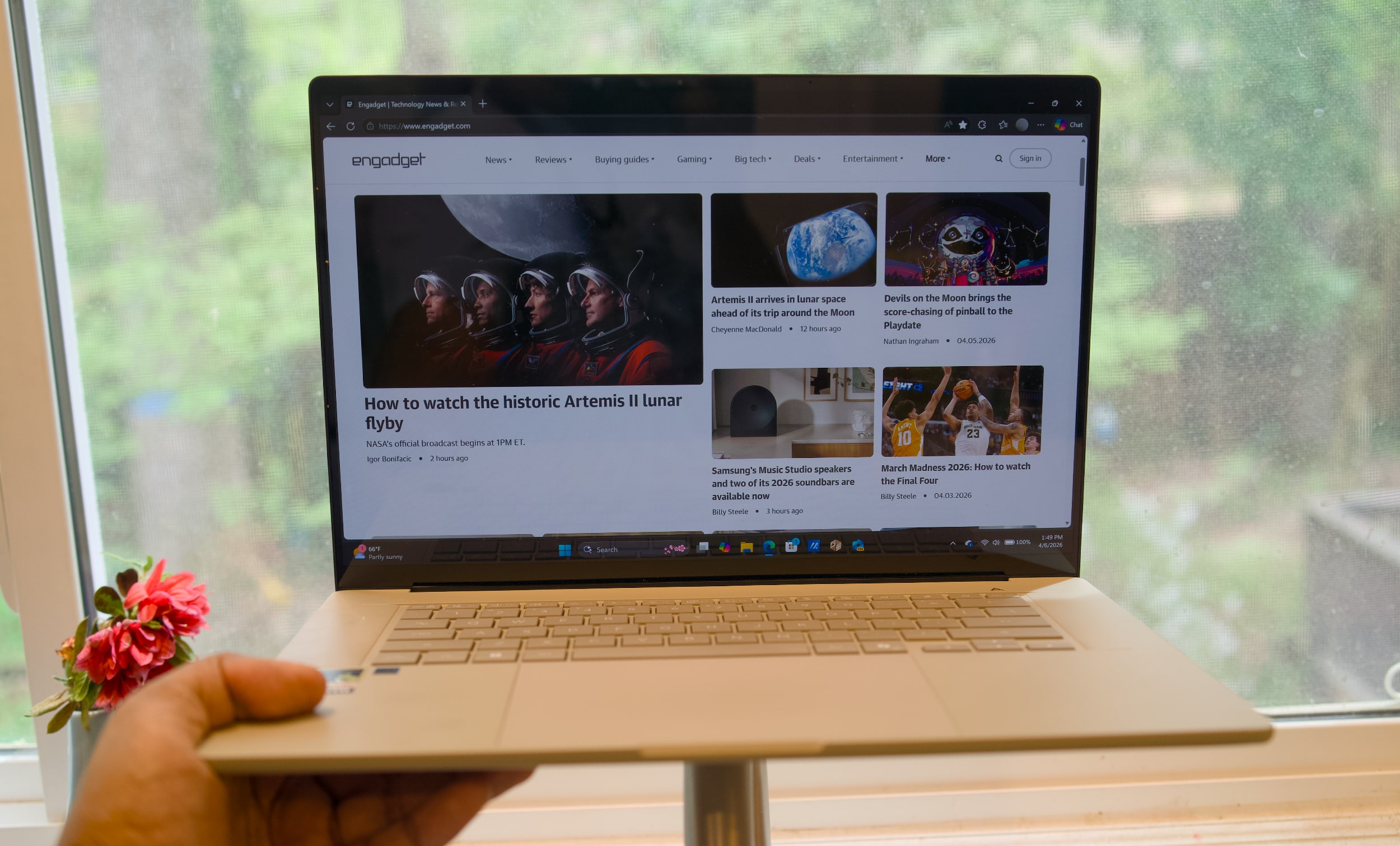
I went into 2025 incredibly amped to review ASUS's 2.2-pound ZenBook A14, only to be disappointed by the lackluster performance of its Snapdragon X chip. I'm still a bit heartbroken, to be honest. But now ASUS is back with a revamped A14 and a larger 16-inch ZenBook A16, both of which sport new Snapdragon X2 Elite Extreme chips. The A16 is slightly heavier at 2.6 pounds and 2.9 pounds, but it still competes with LG’s Gram Pro 16. And thanks to Qualcomm's new hardware, it's actually speedy enough to compete with Intel and AMD ultraportables.
Take everything I initially liked about the ZenBook A14 last year — its thin design and portability, its smooth "Ceraluminum" case and its bold OLED screen — stretch it out a bit, and you've got the ZenBook A16. There's an understated beauty to its design that's far more intriguing than ASUS's mainstream notebooks, like the ZenBook 14 OLED from a few years ago, and it's not trying as hard to impress as ASUS's typical gaming notebooks. It's similar to the company's gorgeous Zephyrus G14 and G16 machines, which feel high-end without needing too much gaming bling.
What struck me first about the A14 last year remains the most intriguing aspect of the A16: It just seems impossibly light for its size. The model I’m testing, which will also be sold at Best Buy, weighs 2.9 pounds due to its glass touchscreen cover. But you can also get a slimmer 2.6-pound version of the A16 at ASUS’s online store.
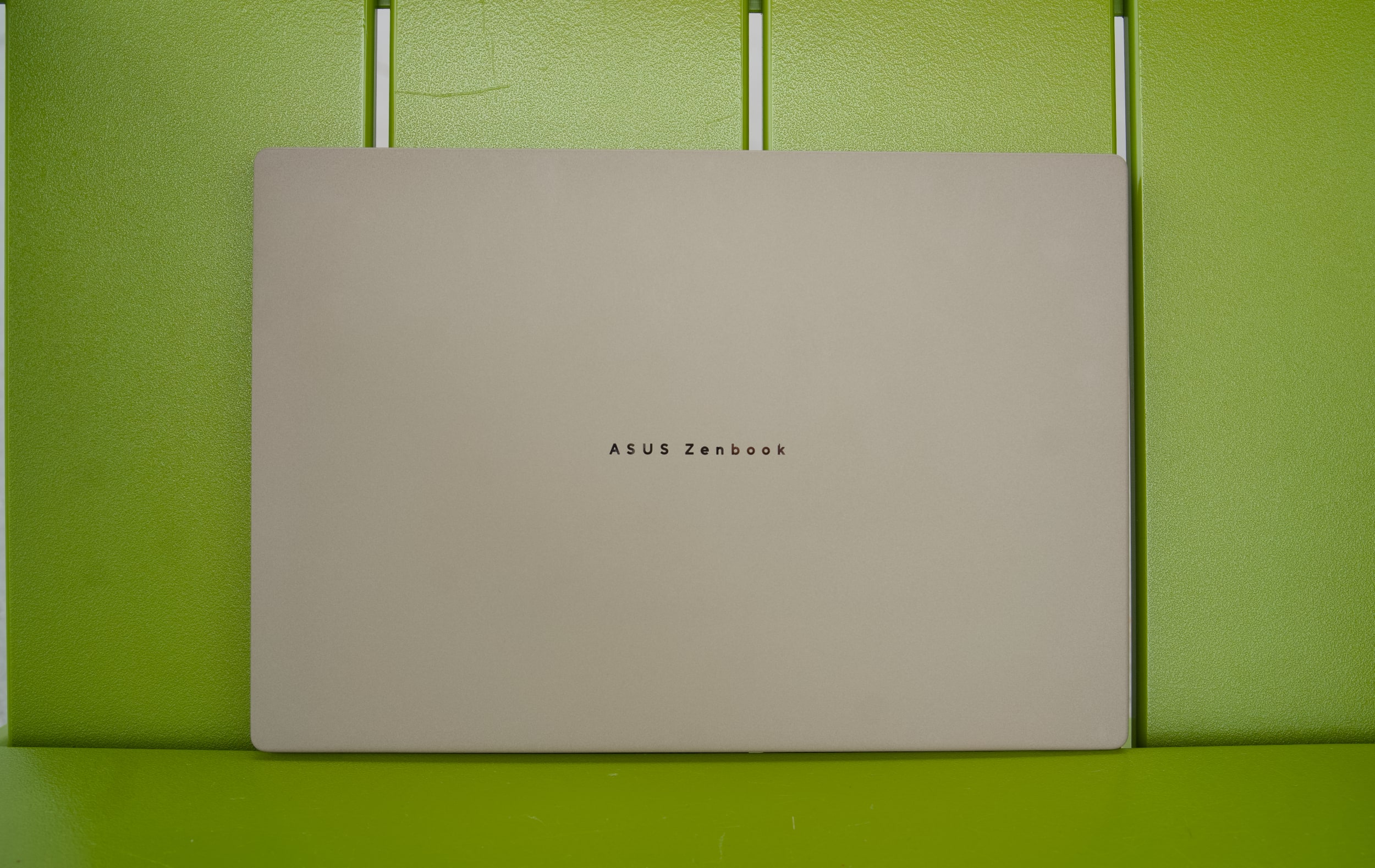
ASUS's Ceraluminum material, which feels like a blend of ceramic and metal, also exudes quality and warmth when you hold it. There's no shock of cold metal on your lap like you'll find with most premium laptops, including Apple's MacBook Pro. But it's also just as sturdy as those machines, with no discernible creaks or flex when stressed. ASUS claims its Ceraluminum cases are also scratch and fingerprint resistant, and so far that seems to be true of my review unit after a few weeks of testing.
ASUS Zenbook A16
Devindra Hardawar for Engadget
The ZenBook A16's stunning 16-inch 3K OLED screen is its defining feature, and it delivers everything you'd expect from OLED. Colors look bold and bright, and it offers inky dark black levels. It delivers an eye-popping sense of contrast you won't find on most LCD screens (unless they have Mini LED backlights, like the MacBook Pro). Text appears crisp and sharp, and the large screen size does a great job of making video playback feel immersive (especially if you're laying in bed, trying to catch up on The Pitt).
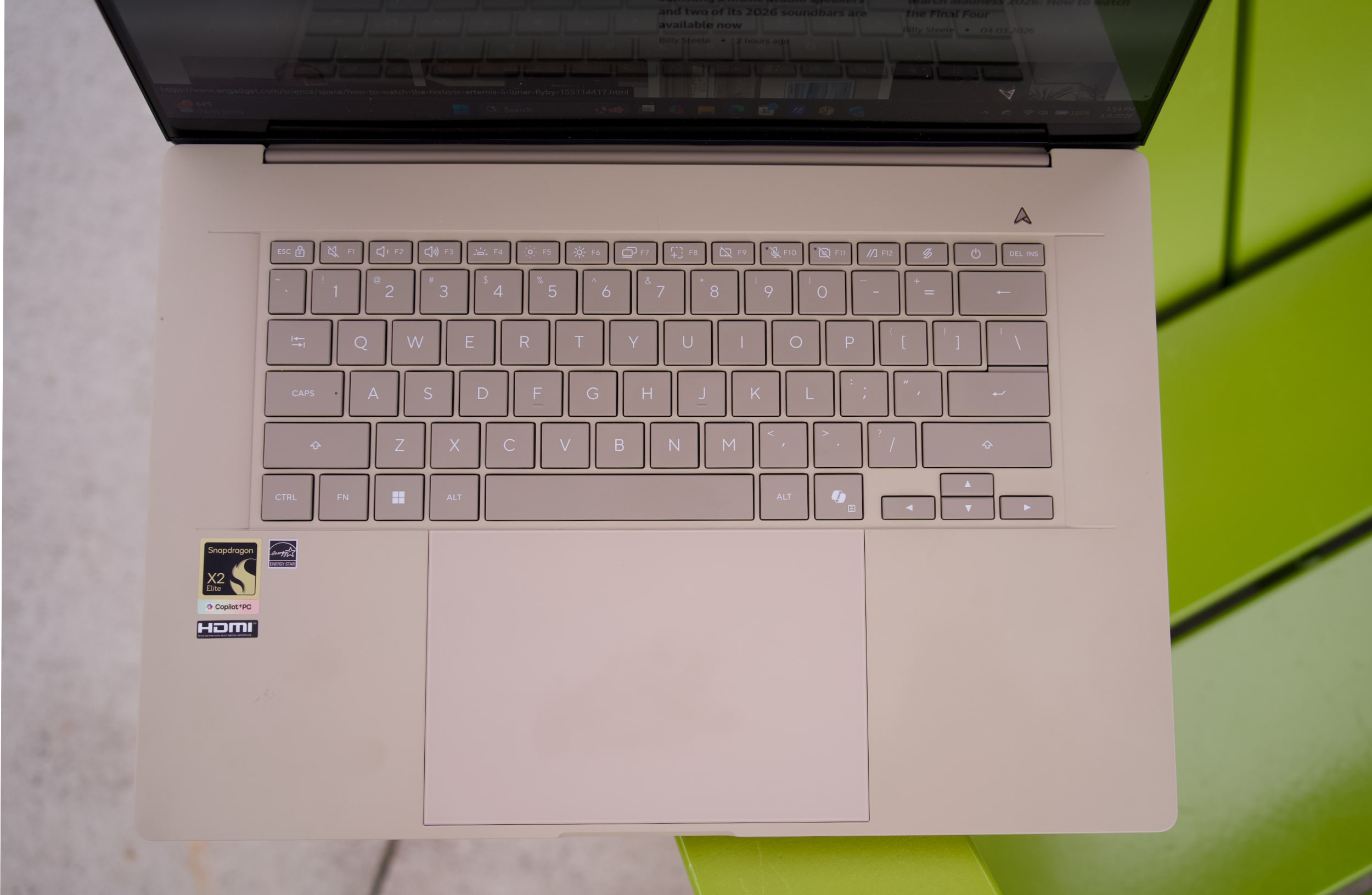
Personally, I'd still opt for the A14 because of the weight difference, but if you prefer big screens this is certainly one of the most intriguing options around. The A16 also has a full-sized SD card reader and HDMI connection, both of which the smaller model lacks entirely. ASUS also included a healthy amount of other ports, including two USB-C 4.0 connections, one USB Type A 3.2 port and a headphone jack. From a productivity perspective, you can certainly get a lot more done with the ZenBook A16's connectivity.
The same holds true for Qualcomm's new Snapdragon X2 Elite chips in the A16. Both the X2E94100and X2E96100 are 18-core chips with a single core boost speed of 4.7GHz, which is a big leap over the 8-core X1 chip in last year's A14. The X2 Elite-equipped A16 also comes with a whopping 48GB of RAM, which feels downright luxurious given our current RAM availability crisis, as well as a new 80-TOPS NPU for AI workloads.
Geekbench 6 CPU
Geekbench 6 GPU
Cinebench 2024
ASUS Zenbook A16 (Qualcomm Snapdragon X2 Elite X2E94100)
3,262/20,808
43,849
98/1,238
ASUS Zenbook A14 (2025, Qualcomm Snapdragon X1)
2,113/10,316
9,603
96/540
Apple MacBook Air (M5)
4,193/17,270
47,656
N/A
Microsoft Surface Laptop (2024, Qualcomm Snapdragon X Elite)
2,797/14,400
19,963
123/969
I immediately felt the difference in power when I booted up the ZenBook A16. The awkward sluggishness while browsing the web or perusing Evernote entries on the A14 was gone. Instead, the A16 always felt incredibly responsive and ready to work, like an eager puppy that never gets tired of playing fetch. Benchmarks also revealed the massive speed differences: The X2 Elite A16 scored 1,200 points higher in Geekbench 6's single-core CPU test, and its multi-core performance was twice as fast.
The comparison is a bit unfair, I'll admit, because the A14 I reviewed last year was stuck with the most basic X-series Snapdragon chip, whereas the A16 touts Qualcomm's latest and greatest hardware. That also makes the A16 a bit more expensive than last year's A14: Best Buy lists it at $1,600, whereas the A14 initially sold for $1,100.
ASUS Zenbook A16
Devindra Hardawar for Engadget
But at least the ZenBook A16 delivers the performance you'd expect for its price range. In the PCMark 10 Applications benchmark, it scored 17,264 points, which is 1,000 points higher than Dell's Premium 16 (aka last year's XPS 16) with Intel's Core Ultra 7 255H chip. It's also leagues ahead of the old ZenBook A14, which scored a meager 12,127 points.
Benchmarks never tell the whole story, of course, but those huge performance gaps are the sort of thing you immediately notice in everyday performance. I was able to load up the ZenBook A16 with dozens of tabs, Evernote, 4K YouTube video streams and large Audacity jobs, and it never broke a sweat. Since it's an ARM-based Snapdragon system, though, be aware older apps may run into issues, or fail to work entirely.
That Qualcomm hardware also made gaming a major problem for the first generation of Snapdragon X Elite chips, which didn't perform well and were also incompatible with games that required kernel-level anti-cheat. Updates to the Windows on Arm platform fixed the latter issue, and Qualcomm also launched its Snapdragon Control Panel to deliver faster driver updates. Now all Snapdragon X Elite chips can play Fortnite, Roblox and Tencent titles. Qualcomm claims that 90 percent of games will run on the Snapdragon Elite X2 chips.
ASUS Zenbook A16
Devindra Hardawar for Engadget
And that includes demanding titles like Cyberpunk 2077. I was able to reach 80 fps in that game, while playing with medium settings in 1080p, along with enabling AMD's FSR frame generation. This wouldn't be my ideal way to play Cyberpunk, but it's a sign that the ZenBook A16 can at least hold its own in gaming. Unfortunately, it wouldn't load Arc Raiders, because there's still no support for its anti-cheat tech. Fortnite launched just fine, though, and for some people that'll be enough.
But really, anyone buying the ZenBook A16 isn't doing it to play shooters, you're doing it to get one of the lightest productivity machines around. ASUS's keyboard was comfortable to type on, though I would have liked to see more key depth akin to the Surface Laptop. Its trackpad is large and responsive, but it's also mechanical, which means you can only click along the lower two-thirds. In this price range, I'd expect ASUS to use a haptic trackpad with full coverage.
The ZenBook A14's battery life (18 hours and 15 minutes) was one of its truly impressive features. ASUS repeats history here with the A16 clocking in 21 hours and 35 minutes in our rundown test. That's the immediate benefit of having a chip based on mobile ARM architecture. During my testing, the A16 drained down to 80 percent after around four hours of continuous work.
Compatibility issues aside, the ZenBook A16 delivers just about everything I want in an ultraportable. It’s got a gorgeous OLED screen and all of the ports you need. Qualcomm’s Snapdragon X2 Elite chips also give it a much-needed power boost. And best of all, it's one of the lightest and sleekest 16-inch Windows laptops I've come across. Just be prepared to pay a bit extra over other ultraportables for its slim size.
This article originally appeared on Engadget at https://www.engadget.com/computing/laptops/asus-zenbook-a16-review-a-surprisingly-light-and-powerful-16-inch-ultraportable-140000914.html?src=rss
Motorola has announced its two latest devices: the budget-friendly Moto G Stylus smartphone and the Moto Pad. The latter is a tablet and a new addition to the Motorola lineup with an 11-inch 2.5K display, compared to the 6.7-inch screen on the Moto G Stylus.
The Moto Pad offers a MediaTek D6300 5G processor and 5G connectivity. It also has quad speakers with Dolby technology, including Dolby Atmos capability on speakers or through headphones with using supporting platforms. The Moto Pad comes with a 7040mAh battery that can stream for 12 hours on one charge.
The new Moto Pad is available in Pantone's Bronze Green on April 30 from T-Mobile and Metro by T-Mobile. Motorola has yet to share an exact price, instead stating it will be "communicated by carrier upon availability."
Meanwhile, the 2026 Moto G Stylus is an upgrade of its predecessor, offering a built-in active stylus. Inside the Notes app, it offers Sketch to Image, an AI tool for polishing drawings, and Handwriting Calculator, a feature for solving handwritten equations without switching to a calculator.
The Moto G Stylus also has 100 hours of standby time. It only lasts four hours while continually writing, but Motorola claims it recharges in 15 minutes. It comes with a 50MP Ultra Pixel main camera, 13MP Ultrawide & Macro Vision camera and 32MP selfie camera. Plus, its 6.7-inch screen is an Extreme AMOLED display with a 1.5K super HD resolution and 120Hz refresh rate — the Moto Pad has a 90Hz refresh rate, in comparison.
Motorola is releasing the 2026 Moto G Stylus on April 16 and will start at $500. The 126GB option will initially come with four free Moto Tags, while the 256GB version will offer free Moto Buds Loop earbuds, a Moto Watch and a Moto Tag.
This article originally appeared on Engadget at https://www.engadget.com/mobile/motorola-announces-moto-pad-and-next-gen-moto-g-stylus-130014526.html?src=rss
Spotify's Prompted Playlist tool now works for podcasts, after launching the feature for music earlier this year. As the name suggests, this is an AI thing. It lets users use natural language, or prompts, to describe what they're looking for in a playlist and the algorithm does the rest.
The platform says the tool is a good match for podcasts, as listeners can use it to discover a new favorite show or "dive deeper into a topic or piece of culture." Spotify adds that the algorithm generates playlists based on both the prompt and a person's listening history, along with "what's happening in the world today."
Spotify
Spotify gives some examples of the kinds of prompts that could be used to generate podcast playlists, which include a user asking the bot to build a playlist "all about science and innovation" and another "with the biggest entertainment news from the past few days." It'll be interesting to see if the algorithm prioritizes podcasts from its ever-growing stable of in-house creators over third party releases.
Spotify says the tool "unlocks powerful new opportunities" for creators. This is because it can recommend older episodes from a back catalog, thus giving them a little boost.
The feature is rolling out now in a beta form to Premium users in the US, Canada, UK, Ireland, New Zealand and Sweden. It remains to be seen when Spotify will open up the tool to other languages.
This article originally appeared on Engadget at https://www.engadget.com/entertainment/music/spotifys-prompted-playlist-feature-now-works-for-podcasts-120006108.html?src=rss
The National Highway and Traffic Safety Administration has closed its investigation into Tesla’s remote parking features, after it found that previously reported incidents led to minor issues and happened in low speed. NHTSA’s Office of Defects Investigations opened an evaluation into incidents involving the company’s Actual Smart Summon feature in January 2025. It’s a level 2 automated driving feature meant for parking lots or private property, allowing Tesla owners to control their cars from an app within short distances.
Investigators said there were 159 incidents involving the feature overall, but those make up less than one percent of the millions of Summons sessions owners have done. Further, almost all of the incidents happened when users “did not have a complete 360-degree view of the surroundings in the app to assess situational awareness.”
In most of the incidents involving crashes, the vehicles hit parking gates, adjacently parked vehicles and short parking bollards. The investigators identified two incidents that happened because some of the vehicles’ cameras were blocked by snow, and the Summons feature didn’t detect the problem. In one other incident, the system didn’t identify a gate arm blocking a garage exit lane.
Tesla has since rolled out over-the-air updates improving the vehicles’ camera visibility checks and object detection capabilities. Since the reported crashes involved minor problems and didn’t lead to injuries, deaths or any major incidents that resulted in air bag deployment or in the vehicle being towed away, the agency has decided to shut down the probe altogether.
This article originally appeared on Engadget at https://www.engadget.com/transportation/evs/nhtsa-closes-probe-into-teslas-remote-parking-crashes-115511006.html?src=rss
Apple has run into “more issues than expected” with its foldable iPhone, which may delay its release, according to the Japanese business newspaper Nikkei. Multiple sources report issues that apparently occurred during early test production phases and may delay first shipments by months.
Component suppliers have supposedly been notified that the foldable iPhone’s production schedule will be delayedand Apple is working to address the problems. Apple was reportedly prioritizing the foldable iPhone and other premium models for its September event this year, due to constrained supplies — that whole RAMmaggedon thing. One fewer iPhone model might reduce the company’s demand for pricey components.
We’re still waiting: A foldable iPhone has been rumored since 201andd rival Samsung released its first one back in 2019. The Galaxy phone maker has faced its own struggles: The very cool Galaxy Z TriFold was pushed into early retirement, seemingly being sold at a loss after its launch late last year.
The federal government wants sole authority over prediction markets.
The US Commodity Futures Trading Commission is suing Illinois, Arizona and Connecticut for attempting to outlaw or regulate prediction markets like Kalshi and Polymarket. These markets allow people to bet on the outcomes of events (for example, who will be the Democratic nominee for president in 2028). There’s been some particularly dystopian bets on recent global military campaigns.
The CFTC believes it has sole jurisdiction to regulate these platforms and that states attempting to classify them as illegal gambling are overstepping their authority. “The CFTC will continue to safeguard its exclusive regulatory authority over these markets and defend market participants against overzealous state regulators,” CFTC chair Michael S. Selig said in a statement.
Mel Brooks, Rick Moranis and other original cast members are back.
Amazon MGM Studios announced the upcoming Spaceballs movie will hit theaters on April 23, 2027, right around the 40th anniversary of the first film. The movie is being directed by Josh Greenbaum and written by Josh Gad, Dan Hernandez and Benji Samit, according to Deadline.
On their way around the Moon, the Artemis II crew managed to grab a few photos.NASA has begun sharing the images, including the one above: Earth through the Orion capsule’s window. It kinda looks like the old iPhone wallpaper. Sorry, I just ruined it.
When NASA allowed Artemis II astronauts to take their smartphones with them, we already knew it could lead to some epic phone shots of the moon. NASA astronaut Reid Wiseman took one such photo on his iPhone, just as the Orion spacecraft his crew was on approached the moon for a lunar flyby. The astronauts turned off all the lights inside the cabin to be able to take better pictures. In the livestream, Wiseman showed the camera a photo he took on his iPhone 17 Pro.
As 9to5Mac notes, he said on the livestream that he took the picture on his iPhone camera with an 8x zoom. NASA reportedly said that the image showed the Chebyshev crater, a lunar impact sight located on the far side of the moon, or the side we don’t see from our planet. Artemis II launched on April 1 for a 10-day journey, with four astronauts onboard the mission’s Orion spacecraft. On April 6, it flew farther away from Earth than any mission before it after it arrived in lunar space, reaching a distance of 252,756 miles from our planet and breaking the record set by Apollo 13. The crew finished the lunar flyby at around 9:35PM on April 6 and is now making its way back to Earth.
We’ll likely see more images of the far side of the moon over the next few days as NASA releases them. The Artemis II crew is expected to splash down in the Pacific Ocean near San Diego on April 10.
Astronaut Reid Wiseman captured this stunning image of the Moon using nothing more than an iPhone 17 Pro.
This article originally appeared on Engadget at https://www.engadget.com/science/space/artemis-ii-astronaut-puts-all-of-our-iphone-moon-photos-to-shame-093740553.html?src=rss
Apple has run into "more issues than expected" with its foldable iPhone that may set back its release, according to Nikkei. The engineering problems reportedly cropped up during the device's early test production phase and may delay first shipments by months, according to multiple sources briefed on the matter. However, a separate report in Bloomberg refutes the gist of Nikkei's claims.
"The current situation could put the mass production timeline at risk," one of Nikkei's sources said. "April will mark a crucial stage of the engineering verification test, and this month till early may is extremely critical." Component suppliers have supposedly been notified that the foldable iPhone's production schedule will be delayed, and Apple is working to address the problems.
In a separate article inBloomberg, however, the usually reliable Apple reporter Mark Gurman wrote that the device is still on track for a September 2026 release. "The company is scheduled to introduce the foldable model in September alongside the iPhone 18 Pro and Pro Max, said the people, who asked not to be identified because the plans haven’t been announced," according to the report.
The complexity of the foldable iPhone's display and other components may "limit initial supply for several weeks," but Apple plans to put it on sale at the same time or shortly after the other non-foldable devices, Gurman wrote. That said, the timing isn't final and issues could still crop up ahead of production. Engadget has reached out to Apple, but so far the company has declined to comment on either the Bloomberg or Nikkei reports.
A foldable iPhone has been rumored since 2017, and Apple's biggest rival, Samsung, released its first one back in 2019. According to multiple sources, Apple was aiming to launch its debut foldable iPhone in fall 2026 alongside the iPhone 18. However, as we detailed in an explainer last month, "the project could slip into 2027 if Apple runs into manufacturing or durability issues, particularly around the hinge or display."
Apple was reportedly prioritizing the foldable iPhone and other premium models for its September event this year due to constrained supplies of components like memory chips. "Apple and the supply chain are working under a pressured timeline and the current solutions are not enough to completely solve the engineering challenge... more time is needed," Nikkei's source stated.
The problems reportedly arose during Apple's production verification tests. That's the fourth of six steps the company's new products must go through before shipping, prior to the key pilot production and mass production phases. Since the foldable would be an all-new design, it would likely need to pass each stage with flying colors before proceeding to the next.
Though likely to account for less than 10 percent of iPhone production, the foldable will be a key product for Apple designed to boost interest in iPhones across its range. Apple reportedly plans to produce seven to eight million of the devices initially, Nikkei reported. Apple has yet to announce the device.
Update April 7, 2026 at 3:02 PM ET: The article has been updated with information from Bloomberg's Mark Gurman stating that the foldable iPhone is still on schedule for a September 2026 launch.
This article originally appeared on Engadget at https://www.engadget.com/mobile/smartphones/apples-foldable-iphone-may-be-delayed-due-to-engineering-snags-073813890.html?src=rss