Adobe's long-time CEO has shared that he plans to step down. Shantanu Narayen has been the chief exec at the tech company for 18 years, a tenure where he led Adobe in the major shift to become a software-as-a-service provider. The exact timeline for his exit is still up in the air, as Narayen will depart when the board of directors names his successor. He will remain on the board as its chair after leaving the CEO post.
While Adobe was not the first to take the SaaS route, it was one of the first major tech operations to do so. Software such as Photoshop, Illustrator, Premiere and Lightroom from the brand have been mainstays in creative fields for years, so the launch of the Creative Suite subscription, which is now called Creative Cloud, was a pretty revolutionary change for its customers.
In an memo to employees, Narayen reflected on his nearly two decades at the helm. Adobe has grown from about 3,000 employees to more than 30,000, while its financial performance has leapt, revenue skyrocketing from less than $1 billion to more than $25 billion. He also looked toward the future and the seemingly-inevitable presence of artificial intelligence.
"The next era of creativity is being written right now — shaped by AI, by new workflows and by entirely new forms of expression," he wrote. "Adobe has never waited for the future to arrive. We’ve anticipated it. We’ve built it. And we’ve led it. What gives me the greatest confidence isn’t just our technology — it’s our people. Your ingenuity, resilience and commitment to customers are what will define this moment."
This article originally appeared on Engadget at https://www.engadget.com/big-tech/adobe-ceo-shantanu-narayen-plans-to-step-down-after-18-years-212705623.html?src=rss
NASA will soon give it another go on April Fools' Day. On Thursday, NASA said it's targeting April 1 at 6:24 PM ET for the Artemis II mission's next launch attempt.
In case that date doesn't pan out, NASA added April 2 at 7:22 PM as a secondary launch opportunity. If necessary, the agency foresees several more openings between April 1 and 6 to get the Orion rocket into space. "Within those six days between the first and the sixth, we can't always turn around every day for an attempt," NASA acting associate administrator Lori Glaze said at a press conference. "We would anticipate […] about four opportunities within that six-day period."
In preparation, NASA is targeting March 19 (a week from today) to roll Artemis II back out to the launch pad. However, it warned that further setbacks could occur. "While I am comfortable and the agency is comfortable with targeting April 1 as our first opportunity, just keep in mind we still have work to go," Glaze said. "There are still things that need to be done within the [Vehicle Assembly Building] and out at the pad. As always, we'll be guided by what the hardware is telling us, and we will launch when we're ready."
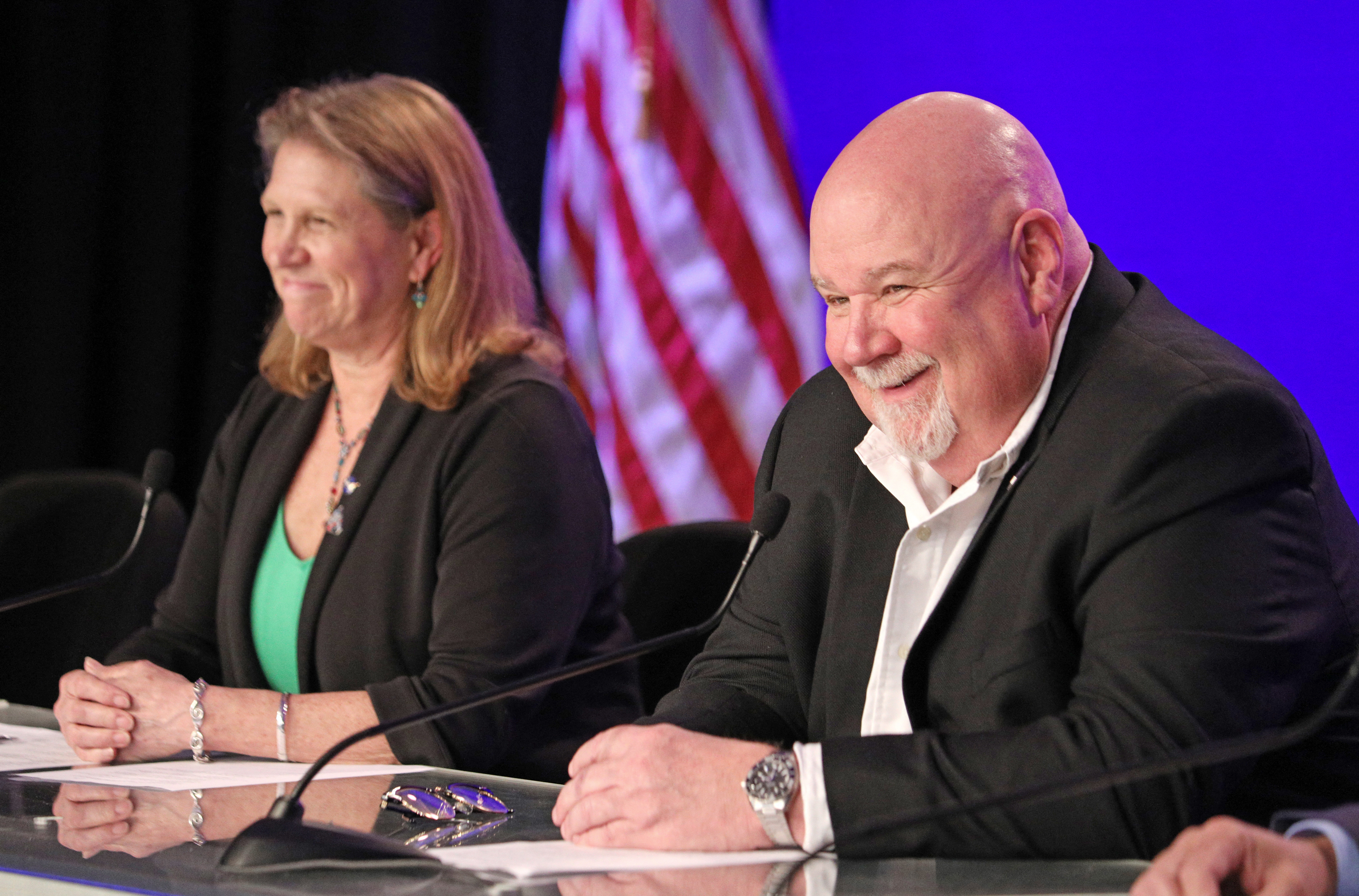
Lori Glaze, acting associate administrator, and John Honeycutt, Artemis II Mission Management Team chair (Photo by Gregg Newton / AFP via Getty Images)
GREGG NEWTON via Getty Images
Artemis II is set to be NASA's first crewed lunar mission since the early 1970s. The 10-day mission will carry four astronauts around the Moon and back to the Earth. It's set to be the first crewed mission of the Orion spacecraft, and an important step toward the ultimate goal of a Moon landing.
Initially targeted for early February, the launch was pushed back to March after several issues arose during a wet dress rehearsal. Then, 18 days later, it was delayed again (and moved off the launch pad) when NASA discovered a helium flow blockage in the rocket's upper stage. And it’s all happening against the backdrop of Administrator Jared Isaacman’s overhaul of the Artemis program, which includes postponing a scheduled Moon landing until 2028.
This article originally appeared on Engadget at https://www.engadget.com/science/space/nasa-will-try-its-artemis-ii-launch-again-in-early-april-205714288.html?src=rss
We've been seeing all sorts of warnings about how RAMaggedon is nigh. The latest horseman signalling a disaster is the International Data Corporation, which had already cautioned that things were looking bad at the end of 2025. Today, the organization further cut its forecasts for the PC market in 2026, anticipating that global shipments would fall 11.6 percent. The previous report projected that this year would see a falloff of up to 8.9 percent due to ongoing memory shortages. And the new figure was set before the escalation of conflicts in Iran and across the Middle East, which could further deflate computing and other industries.
"Memory shortages will persist well into 2027," Jitesh Ubrani, research manager for IDC’s Worldwide Mobile Device Trackers, said in the latest forecast. "While we anticipate some easing of prices beginning in 2028, the market is unlikely to return to the pricing levels seen in 2025."
This market report echoes price changes and official statements from all corners of the tech and computing sector. So far this year, we've already seen surging memory costs impacting HP, Samsung, Valve and Framework. Don't be surprised if many other major players follow suit.
This article originally appeared on Engadget at https://www.engadget.com/computing/ramaggedon-not-expected-to-ease-this-year-as-idc-cuts-2026-pc-market-forecast-again-200000498.html?src=rss
KPop Demon Hunters is getting a sequel, Netflix and Sony have announced. Sony Pictures Animation handed the rights to the film to Netflix in 2021 as part of a larger licensing deal, but neither company could have expected how much of a hit it would ultimately become. Besides being Netflix's "most-watched movie of all time,"KPop Demon Hunters is also nominated for Best Animated Feature and Best Original Song at the 98th Academy Awards, and stands a good chance of winning.
Maggie Kang and Chris Appelhans, the directors of the first film, are returning to direct the sequel. The project will be the first in the duo's new "exclusive multiyear writing and directing partnership" with Netflix, which is focused on animation. "I feel immense pride as a Korean filmmaker that the audience wants more from this Korean story and our Korean characters," Kang said in a statement. "There's so much more to this world we have built, and I'm excited to show you. This is only the beginning."
IT'S OFFICIAL HUNTERS 💫 KPOP DEMON HUNTERS will return for a sequel written and directed by Maggie Kang and Chris Appelhans.
“I feel immense pride as a Korean filmmaker that the audience wants more from this Korean story and our Korean characters. There’s so much more to this… pic.twitter.com/QjxD9CV4Hw
"These characters are like family to us, their world has become our second home," Appelhans said. "We're excited to write their next chapter, challenge them, and watch them evolve — and continue pushing the boundaries of how music, animation, and story can come together."
To put KPop Demon Hunters popularity into perspective, the film had such a wide reach that Netflix was willing to set aside its aversion to theatrical releases and put it in theaters after it premiered on streaming. KPop Demon Huntersreportedly made over $19 million during its initial two-day theatrical run in August 2025, and Netflix has brought it back to theaters multiple times since then. That's on top of the more than 500 million views the film racked up on Netflix itself. Not making a sequel would essentially be leaving money on the table.
According to Puck, the structure of Netflix's deal with Sony means it will likely be the only company directly profiting off a KPop Demon Hunters follow-up, however. "While Sony has the contractual right to produce any sequels or spinoffs," Puck reports, "it will make no additional money from the runaway success of the first film." Sweetening that deal could be one reason Netflix and Sony Pictures expanded their film licensing partnership in January, a deal that reportedly cost the streaming service over $7 billion to secure.
This article originally appeared on Engadget at https://www.engadget.com/entertainment/streaming/kpop-demon-hunters-is-officially-getting-a-sequel-195038954.html?src=rss
Instagram has long limited users' ability to share links, restricting link-sharing to Stories, Reels and user profiles. But that might now be changing. The company has started to test clickable links inside of post captions for subscribers to Meta Verified.
The new feature, which has been a long-requested update from creators, was spotted by blogger Andrea Valeria, who posted screenshots of a clickable Substack link she was able to add to an Instagram post. According to Valeria, an in-app message indicated she could share up to 10 links a month.
Meta confirmed to Engadget that it's testing links in captions for subscribers to Meta Verified, but didn't provide details on how many people have access to the feature or if it will be widely available. It does seem to be somewhat limited, however, as the link on Valeria's post appears on Instagram's mobile app, but now when viewing the same post on Instagram's website.
Instagram's restrictions on link-sharing have been a notable part of the platform since its early days. The limitation helped kickstart an entire industry of "link in bio" platforms like Linktree, which help creators direct followers to off-platform websites based on what they share on Instagram. If Meta begins implementing the feature widely, it could drastically change how creators are able to interact with their followers (although a 10-link per month limit would likely still require "link in bio" solutions).
The test is also the latest way that Meta has experimented with making link-sharing a paid feature. The company has also recently tested restricting creators' ability to share links on Facebook by requiring a Meta Verified subscription. Meta Verified for creators starts at $14.99 a month, with the most expensive plans costing $499.99 a month.
This article originally appeared on Engadget at https://www.engadget.com/social-media/meta-is-testing-clickable-links-in-instagram-captions-for-verified-subscribers-184555406.html?src=rss
European regulators are continuing to crack down on loot boxes and gaming features it classifies as "interactive risk categories." The Pan-European Game Information, better known as PEGI, is rolling out new rules that will apply age ratings based on the presence of loot boxes and other in-game purchases or systems that could be tied to gambling or addictive behavior. The exact policies are as follows:
Purchases of in-game content: games with time-limited or quantity-limited offers will be classified with a PEGI 12, games with NFTs or blockchain-related mechanisms will be PEGI 18.
Paid random items: the default rating will be PEGI 16 if the game contains paid random items (and in some cases they can be a PEGI 18).
Play-by-appointment: mechanisms that reward returning to the game (e.g. daily quests) will get a PEGI 7. If these mechanisms punish players for not returning (e.g. by losing content or reducing progress) they will become PEGI 12.
Safe online gameplay: if games contain entirely unrestricted communication features (e.g. no blocking or reporting), they will be PEGI 18.
These changes will apply to newly submitted games beginning in June 2026. The messaging from the ratings body is that these rules are aimed at helping parents direct their children's online safety. "With the updated set of age rating criteria, PEGI aims to make parents aware that certain features in games should be carefully assessed, and that parental tools can be a very helpful assistant when doing that," PEGI Council Chair Beate Våje said.
Many titles may see an impact from the new policy, some more drastic than others. Online shooters might seen a bump from PEGI 12 to PEGI 16, but a franchise like EA Sports FC would leap to at least PEGI 16 from its current installment’s rating of PEGI 3.
Loot boxes have a history of causing strife among regulators. In 2018, Belgium determined that loot boxes were a form of gambling and made them illegal. Other nations have taken similar measures to restrict or prohibit this game mechanic, which has already led some game studios to limit access to their titles. For instance, Blizzard's free-to-play Diablo Immortaldidn't launch in Belgium or the Netherlands due to their laws connecting loot boxes and gambling. Stateside, there has been a renewed push against the concept, with the New York attorney general suing Valve over loot boxes.
This article originally appeared on Engadget at https://www.engadget.com/gaming/pegi-ratings-for-game-releases-in-europe-will-be-age-restricted-if-they-contain-loot-boxes-184325819.html?src=rss
Bumble is testing an AI dating assistant called "Bee" that it hopes will get users on dates without them having to swipe through profiles, Bloomberg writes. The company announced the AI assistant during its fourth quarter earnings, and intends to use the AI in a new experience it calls "Dates."
When a user opts in to Bumble's Dates feature, Bee performs an onboarding chat where it learns about the users' "values, relationship goals, communications style, lifestyle and dating intentions," and then attempts to find other users who share some or all of those traits. Once Bee finds someone compatible, both users are notified in the app that they could be a great match, and receive a summary generated by Bee explaining why. From there, they can chat and see if things lead to a real-life date.
As is often the case with pie-in-the-sky AI features, Bumble has even bigger plans for how Bee could be used in its app, including as a tool for collecting anonymous feedback from user's previous matches or as a way to receive suggestions for dates ideas. AI will also apparently enable Bumble to move away from binary yes or no swipes on profiles and towards a system where users connect over "chapter-based" profiles that are more reflective of their life story.
Bumble is testing Bee internally and plans to launch the AI and its Dates feature in beta soon. The company is far from the only dating app experimenting with integrating AI recommendations and summaries. Tinder uses AI to recommend profile pictures to users, and now offers another feature called "Chemistry" that combines insights gained from personal questions and access to users' Camera Roll to make more informed matches. Meanwhile, Grindr's "Edge" subscription tier offers AI summaries of past chats and connections, and stats on whether a user is actually compatible with a new match.
It's too early to tell whether AI makes a meaningful difference in the dating experience for users, but if it keeps them using an app or paying for a subscription, it's likely a worthwhile experiment for Bumble, Tinder and Grindr.
This article originally appeared on Engadget at https://www.engadget.com/apps/bumble-is-the-latest-dating-app-to-add-an-ai-assistant-181729994.html?src=rss
Anker’s Soundcore projectors have become an attractive option for buyers thanks to models like the P1 and Nebula X1 that combine performance and portability. Now, the company has added "affordability" to that equation with its latest model, the $369 P1i. Instead of being detachable like on the P1, its speakers fold out toward listeners, promising better and louder sound than most cheap projectors.
The P1i also delivers 1080p video, Google TV for streaming and the same easy screen fit setup as other Anker projectors. However, unlike some portable models, it lacks a built-in battery for true portability. Overall brightness is lower as well at 380 lumens compared to 650 on the P1. Despite those issues, the P1i is an outstanding budget projector that’s ideal for impromptu indoor screenings and outdoor party use.
Features and design
With its relatively small size (8.9 x 7.2 x 8.0 inches) and slight five pound weight, the Soundcore Nebula P1i can be perched nearly anywhere and is easily toted around by the soft handle on top. It’s almost too light, as even a slight bump can displace it and ruin the picture. It does have a tripod mount, though, which makes it easy to set up outside or install on your ceiling.
Fortunately, the P1i is perhaps the easiest projector in this price range to align with your wall or screen. It has Anker’s Smart Instant Setup that automatically adjusts the autofocus, keystone correction, screen fit and obstacle avoidance. For my 120-inch roll down screen, I just had to set the P1i about 11 feet from the wall, make sure it was fairly level and then tilt the stand so it pointed at the screen. Then, I just ran the smart setup which instantly gave me a correctly set-up image.
The P1i is not a laser projector but its LED light source lasts even longer, rated for over 30,000 hours. It runs fairly cool compared to a bulb or laser model, but it still has a fan that kicks on from time to time. One annoyance is that the fan seemed to engage even when the projector was turned off, so I found I had to unplug it to stop that.
Steve Dent for Engadget
Connectivity-wise, the P1i has a single HDMI 2.0 port with ARC (Audio Return Channel), along with a USB-A port for external media and a 3.5mm auxiliary audio output. The projector allows for a maximum input of 4K at 60 fps (it outputs 1080p at 60 fps), so it’s only good for light gaming. Plus, you’ll want to keep in mind that if you do any keystone correction, gaming latency quadruples from 20ms to 80ms. It also supports Wi-Fi 5 for streaming and Bluetooth 5.1 to connect extra speakers.
Google TV is built in for streaming and projector control, which is a nice feature for a projector under $400. It provides a large library of apps via Google Play along with a familiar interface. You also get Netflix’s official application with support for 4K Dolby Vision without the need to plug in a streaming device, plus there’s Chromecast support and Google Assistant for voice control. The downside is that the interface can occasionally be sluggish. As for those foldable speakers, you can aim them up, down, forward or backwards, and they support Dolby Audio at 10 watts each.
Image quality
Image quality is decent but not outstanding, about what you’d expect for a projector at this price. While it’s very sharp in the center, the edges are fuzzier, particularly if you’re tilting the projector up or down and using plenty of keystone correction. With just 380 lumens of brightness (I measured it at just over 300 lumens in standard mode), it’s best to use the P1i in a dark room or at night — if there’s any ambient light, you won’t be able to see much detail.
The P1i offers multiple picture profiles, including Standard, Vivid, Sports, Movies and Games, along with a Conference mode for maximum brightness. I found that the “Vivid” setting gave me the best mix of color accuracy and brightness.
Steve Dent for Engadget
Color accuracy is a strong point, with natural looking, nicely saturated hues. Surprisingly, the P1i supports 10-bit HDR to help improve color accuracy and max out what little brightness there is, though it’s a gigantic stretch calling a 380 lumen image (around 50 nits) "HDR." I tested the P1i on my usual roster of content, including Once Upon a Time in Hollywood, Andor, Dune 2 and Spider-Man: No Way Home, and found the colors to be pleasing and realistic. If they’re not quite to your liking, you can make fine adjustments manually.
Sound
The primary selling point of the Nebula P1I is those fold out speakers. However, considering Soundcore’s reputation for solid audio performance (take the Nebula X1 Pro for example), sound quality was a bit disappointing. It’s relatively tinny with very little bass, providing a less-than-theatrical experience. Those speakers can go pretty loud, though, and midrange sounds like voices are very clear.
Fortunately, there are a couple of solutions. The P1i has multiple EQ settings, including Movies (with enhanced bass and treble), Music for the most natural sound and Outdoors to ensure clarity in open and noisy spaces. The best of those, I found, was Movies, as it mildly improves the lows and highs. There’s also a “custom” mode that lets you fine-tune the equalization. I was able to get acceptable sound quality when I boosted the bass to nearly the maximum level.
The other option, of course, is to pair the P1i to some Bluetooth speakers. I did just that with Soundcore’s external speakers sold as an option with the Nebula X1 and the sound quality was much improved. Of course, that would remove much of its convenience and increase the price for better sound.
Wrap-up
Steve Dent for Engadget
Anker’s $400 Soundcore Nebula P1i is an excellent option for buyers looking for a portable projector to use outdoors or in the place of a second TV, though it suffers from subpar sound and picture quality. Competitors like XGIMI’s MoGo 2 Pro offer similar brightness, built-in speakers and Google TV. And if you have a bit more in your budget, Anker’s $800 Nebula P1 is brighter and easier to set up. Finally, for those looking for battery portability for camping or other activities, take a look at XGIMI’s $500 Halo+ or the $530 Anker Nebula Capsule.
The P1i is great for simple nighttime movie screenings outdoors. If you feel like watching a movie or series in bed, you can bring it into your room, project the picture onto a wall and enjoy your streaming service of choice. You may not be disappointed with the overall picture quality, though you may wish for slightly better sound.
This article originally appeared on Engadget at https://www.engadget.com/home/home-theater/soundcore-nebula-p1i-projector-review-an-affordable-option-with-accurate-color-and-loud-sound-180034925.html?src=rss
It’s already been a busy year for high-profile Microsoft departures, with longtime Xbox chief Phil Spencer bowing out last month alongside his expected successor Sarah Bond. Today it’s the turn of Microsoft's head of Experiences + Devices, Rajesh Jha, who leaves after more than 35 years at the company.
Jha, who oversaw some of Microsoft’s most important products and services, including Windows, Office and Teams, said in a press release that he’s been planning for his succession alongside CEO Satya Nadella for a while. Rather than bringing in a direct replacement, four members of his team will be promoted to executive vice president and report directly to Nadella.
Taking up these new more senior roles are Office EVP and LinkedIn CEO Ryan Roslanksky, Windows and Surface president Pavan Davuluri, president of business and industry Copilot (BIC) Charles Lamanna, and Microsoft 365 Core chief Perry Clarke. The outgoing Jha, who said his long career at Microsoft had been "an incredible privilege," will officially transition out of Microsoft on July 1, after which he’ll remain in an advisory role.
"When I think about the pantheon of leaders who have truly shaped this company, Rajesh stands firmly among them," Nadella said in a statement, adding that Jha had been a "constant" during his own time at the company. "He embodies the commitment that helped build and transform Microsoft into the company it is today, and it is on the strength of that foundation that we will continue to move forward."
This article originally appeared on Engadget at https://www.engadget.com/computing/another-longtime-microsoft-executive-is-retiring-174453788.html?src=rss
Amazon just unveiled a new personality type for Alexa+. The "sassy" option is reserved for adults and the company claims it will throw out censored curse words from time to time. Amazon describes this option as a combination of "unfiltered personality" and "razor-sharp wit, playful sarcasm and occasional censored profanity."
We aren't yet sure how the chatbot handles the censoring. Does it use a garden variety bleep or a replacement word like fudge or something? I managed to get it to say "damn" and "hell", but couldn't force anything more profane than that.
In any event, adult users have to jump through a couple of hoops to activate this mode. It won't work if there's an enabled Amazon Kids profile on the account and it requires additional security checks, like face scans. The company also warns people upon being selected that the new tone could contain "mature subject matter." I'm more afraid of the bot using "clever comebacks" to absolutely shred my buying habits. Yes, I buy bagged popcorn when I have plenty of uncooked kernels in the pantry. I'm working on it.
This is just the latest personality type that the company has introduced for the chatbot. Users can also choose from sweet, brief or chill, with the last one resembling a surfer archetype. Alexa+ is an updated version of the company's long-standing chatbot that prioritizes natural-sounding conversation. It's fine, more or less, but I still use it primarily for alarms and weather.
This article originally appeared on Engadget at https://www.engadget.com/ai/alexa-can-now-swear-thanks-to-a-new-personality-style-172106310.html?src=rss