VW-inspired 10-ft towable camper pop-up roof increases standing headroom to 6 feet 4 inches

There are many hugely popular campervan base models around the world, but one that essentially overshadows them all, and has camping enthusiasts styling their own creations around it, is the Volkswagen van. VW-inspired campers have their takers in plenty thereof Type 2 founders, Hearth Gardella and Ryan Schassen, have created a VW-themed pop-up camping trailer from aircraft steel construction in a compact form factor that is faster to build.

The RV builders based in Woodburn, Oregon, Type 2, is hoping to create a sizable inroad in the expensive and heavier tow-campers with their T2.3 which thrives on its “lightweight, affordable, and timeless design.” Currently available for preorder for a non-refundable $1,000 deposit, T2.3 comes in three different variants with one classic pop-up roof that enhances the internal standing headroom to 6 feet 4 inches.

Designer: Type 2

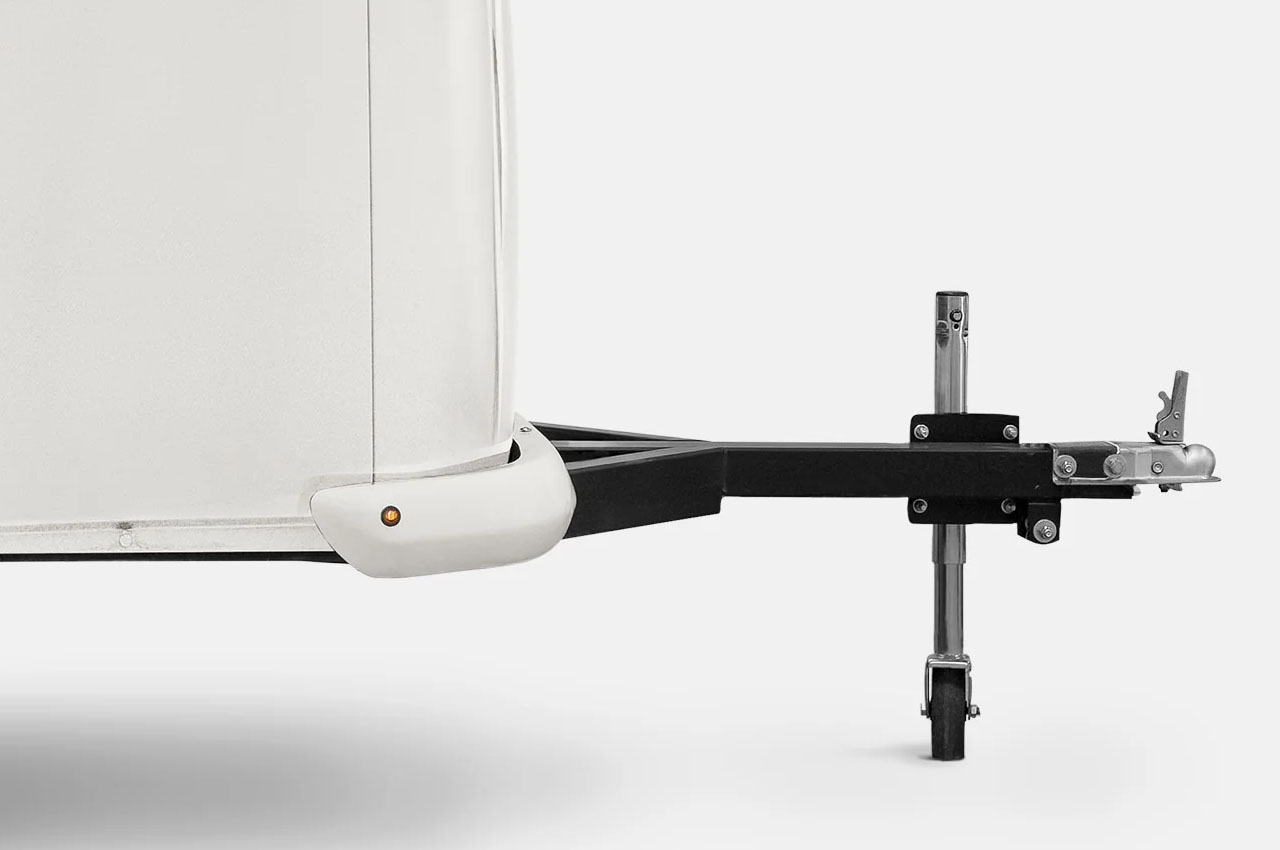
Modeled after the 1940s Volkswagen bus, the T2.3’s design replaces fiberglass construction with aero-grade steel panels. This keeps the camper lightweight and adds to its durability. With the use of steel panels, the camper with its pop-up roof is faster to manufacture and fairly easy to tow behind a small electric vehicle.

Measuring 9 feet 6 inches long and 5 feet wide, the camper weighs under 980 lbs in all three options (detailed below). Outfitted with three windows on each side, and a single door toward the back half, the camper has a liftgate hatch. For more space inside comprising a convertible U-shaped sofa, an expandable kitchen counter, and a rear window seat (in the entry-level Sleeper model), the T2.3’s entire roof rises above.


Adding an outdoor shower system and 1-gallon electric hot water heater to the Sleeper and we have the T2.3 Sleeper Plus. The most exciting option is the Kitchenette model. The rear window seat here is removed to accommodate a full L-shaped kitchen complete with a dining table, induction cooktop, and stainless-steel sink. Of course, the change in features makes for a change in the pricing structure as well. The Sleeper model starts at $29,950, the Sleeper Plus scales the figure to $35,000, while the one with a kitchenette will set you back $39,000.


 

The post VW-inspired 10-ft towable camper pop-up roof increases standing headroom to 6 feet 4 inches first appeared on Yanko Design.


Google is reportedly paying publishers thousands of dollars to use its AI to write stories

Google has been quietly striking deals with some publishers to use new generative AI tools to publish stories, according to a report in Adweek. The deals, reportedly worth tens of thousands of dollars a year, are apparently part of the Google News Initiative (GNI), a six-year-old program that funds media literacy projects, fact-checking tools, and other resources for newsrooms. But the move into generative AI publishing tools would be a new, and likely controversial, step for the company.

According to Adweek, the program is currently targeting a “handful” of smaller publishers. “The beta tools let under-resourced publishers create aggregated content more efficiently by indexing recently published reports generated by other organizations, like government agencies and neighboring news outlets, and then summarizing and publishing them as a new article,” Adweek reports.

In a statement to Engadget, a Google spokesperson denied the tools were used being used to "re-publish" the work of other publications. "This speculation about this tool being used to re-publish other outlets’ work is inaccurate," the spokesperson said. "The experimental tool is being responsibly designed to help small, local publishers produce high quality journalism using factual content from public data sources – like a local government’s public information office or health authority. Publishers remain in full editorial control of what is ultimately published on their site."

It’s not clear exactly how much publishers are being paid under the arrangement, though Adweek says it’s a “five-figure sum” per year. In exchange, media organizations reportedly agree to publish at least three articles a day, one weekly newsletter and one monthly marketing campaign using the tools.

Of note, publishers in the program are apparently not required to disclose their use of AI, nor are the aggregated websites informed that their content is being used to create AI-written stories on other sites. The AI-generated copy reportedly uses a color-coded system to indicate the reliability of each section of text to help human editors review the content before publishing. 

In a statement to Adweek Google said it was “in the early stages of exploring ideas to potentially provide AI-enabled tools to help journalists with their work.” The spokesperson added that the AI tools “are not intended to, and cannot, replace the essential role journalists have in reporting, creating and fact-checking their articles.”

It’s not clear what Google is getting out of the arrangement, though it wouldn’t be the first tech company to pay newsrooms to use proprietary tools. The arrangement bears some similarities to the deals Facebook once struck with publishers to create live video content in 2016. The social media company made headlines as it paid publishers millions of dollars to juice its nascent video platform and dozens of media outlets opted to “pivot to video” as a result.

Those deals later evaporated after Facebook discovered it had wildly miscalculated the number of views such content was getting. The social network ended its live video deals soon after and has since tweaked its algorithm to recommend less news content. The media industry’s “pivot to video” cost hundreds of journalists their jobs, by some estimates.

While the GNI program appears to be much smaller than what Facebook attempted nearly a decade ago with live video, it will likely raise fresh scrutiny over the use of generative AI tools by publishers. Publications like CNET and Sports Illustrated have been widely criticized for attempting to pass off AI-authored articles as written by human staffers.

Update February 28, 2024, 1:10 PM ET: This story has been edited to add additional information from a Google spokesperson. 

This article originally appeared on Engadget at https://www.engadget.com/google-is-reportedly-paying-publishers-thousands-of-dollars-to-use-its-ai-to-write-stories-215943624.html?src=rss

Google is reportedly paying publishers thousands of dollars to use its AI to write stories

Google has been quietly striking deals with some publishers to use new generative AI tools to publish stories, according to a report in Adweek. The deals, reportedly worth tens of thousands of dollars a year, are apparently part of the Google News Initiative (GNI), a six-year-old program that funds media literacy projects, fact-checking tools, and other resources for newsrooms. But the move into generative AI publishing tools would be a new, and likely controversial, step for the company.

According to Adweek, the program is currently targeting a “handful” of smaller publishers. “The beta tools let under-resourced publishers create aggregated content more efficiently by indexing recently published reports generated by other organizations, like government agencies and neighboring news outlets, and then summarizing and publishing them as a new article,” Adweek reports.

In a statement to Engadget, a Google spokesperson denied the tools were used being used to "re-publish" the work of other publications. "This speculation about this tool being used to re-publish other outlets’ work is inaccurate," the spokesperson said. "The experimental tool is being responsibly designed to help small, local publishers produce high quality journalism using factual content from public data sources – like a local government’s public information office or health authority. Publishers remain in full editorial control of what is ultimately published on their site."

It’s not clear exactly how much publishers are being paid under the arrangement, though Adweek says it’s a “five-figure sum” per year. In exchange, media organizations reportedly agree to publish at least three articles a day, one weekly newsletter and one monthly marketing campaign using the tools.

Of note, publishers in the program are apparently not required to disclose their use of AI, nor are the aggregated websites informed that their content is being used to create AI-written stories on other sites. The AI-generated copy reportedly uses a color-coded system to indicate the reliability of each section of text to help human editors review the content before publishing. 

In a statement to Adweek Google said it was “in the early stages of exploring ideas to potentially provide AI-enabled tools to help journalists with their work.” The spokesperson added that the AI tools “are not intended to, and cannot, replace the essential role journalists have in reporting, creating and fact-checking their articles.”

It’s not clear what Google is getting out of the arrangement, though it wouldn’t be the first tech company to pay newsrooms to use proprietary tools. The arrangement bears some similarities to the deals Facebook once struck with publishers to create live video content in 2016. The social media company made headlines as it paid publishers millions of dollars to juice its nascent video platform and dozens of media outlets opted to “pivot to video” as a result.

Those deals later evaporated after Facebook discovered it had wildly miscalculated the number of views such content was getting. The social network ended its live video deals soon after and has since tweaked its algorithm to recommend less news content. The media industry’s “pivot to video” cost hundreds of journalists their jobs, by some estimates.

While the GNI program appears to be much smaller than what Facebook attempted nearly a decade ago with live video, it will likely raise fresh scrutiny over the use of generative AI tools by publishers. Publications like CNET and Sports Illustrated have been widely criticized for attempting to pass off AI-authored articles as written by human staffers.

Update February 28, 2024, 1:10 PM ET: This story has been edited to add additional information from a Google spokesperson. 

This article originally appeared on Engadget at https://www.engadget.com/google-is-reportedly-paying-publishers-thousands-of-dollars-to-use-its-ai-to-write-stories-215943624.html?src=rss

Holobox hologram-in-a-box could supercharge meetings and presentations

Video meetings are becoming more and more common as time passes, even without travel restrictions. Work arrangements are changing and the world is suddenly a much bigger place, with people spread out all over. Those remote interactions, however, don’t just have the same effect as in-person meetings, especially when you lose certain contexts from body language. It just feels less personal and has less impact, especially if you’ll be using an avatar that looks more like a cartoon than a real representation of yourself. In science fiction, holograms try to bridge the gap between people across planets or even galaxies, but that kind of technology is actually available today in a less flashy but still mind-blowing way.

Designer: Holoconnects

Holograms are nothing new, but it has traditionally been difficult to implement them on a large, human-sized scale. Trying to project floating three-dimensional images of people is still a bit of a pipe dream, but if you’re fine with putting them in a box, then that dream has already become reality with Holoconnects’ Holobox. It is what its name sounds like, a way to have a holographic version of yourself or someone else projected inside a large box.

What makes the Holobox special beyond its amazing image fidelity is its ease of use. It needs only a power source and an Internet connection to operate because everything is built into the box. Of course, that’s only for actually projecting and playing the hologram. You’ll need a different set of equipment for actually capturing the video of a human, whether pre-recorded or in real-time. And it doesn’t even have to be human either since you can project anything that can fit inside the box’s 86-inch display. Actually, you can even connect several boxes together so that it can show a much bigger object, like a car, for example.

But what really is the point of having a life-sized hologram anyway? For one, it offers a new level of remote communication where you can fully see the person in 3D as if they were standing in front of you. It can also give a more personal touch to presentations, training, advertising, and more. Basically, anywhere that your real presence would have an impact, the Holobox can offer a stand-in that is both effective and human. Plus, it looks awesome to boot!

The post Holobox hologram-in-a-box could supercharge meetings and presentations first appeared on Yanko Design.

Tumblr and WordPress posts will reportedly be used for OpenAI and Midjourney training

Tumblr and WordPress are reportedly set to strike deals to sell user data to artificial intelligence companies OpenAI and Midjourney. 404 Media reports that the platforms’ parent company, Automattic, is nearing completion of an agreement to provide data to help train the AI companies’ models.

It isn’t clear which data will be included, but the report suggests Automattic may have overreached initially. An alleged internal post from Tumblr product manager Cyle Gage suggests Automattic prepared to send private or partner-related data that wasn’t supposed to be included in the deal. The questionable content reportedly included private posts on public blog posts, deleted or suspended blogs, unanswered (therefore, not publicly posted) questions, private answers, posts marked explicit and content from premium partner blogs (like Apple’s former music site).

The internal post suggests Automattic’s engineers are preparing a list of post IDs that should have been excluded. It isn’t clear whether the data had already been sent to the AI companies.

Engadget emailed Automattic to ask for comment on the report. The company replied with a published statement, claiming, “We will share only public content that’s hosted on WordPress.com and Tumblr from sites that haven’t opted out.” The statement notes that legal regulations don’t currently require AI companies’ web crawlers to abide by users’ opt-out preferences.

The final line of Automattic’s statement appears to align with the reported deals. “We are also working directly with select AI companies as long as their plans align with what our community cares about: attribution, opt-outs, and control,” Automattic wrote. “Our partnerships will respect all opt-out settings. We also plan to take that a step further and regularly update any partners about people who newly opt out and ask that their content be removed from past sources and future training.”

NEW YORK, NEW YORK - DECEMBER 12: Sam Altman speaks onstage during A Year In TIME at The Plaza Hotel on December 12, 2023 in New York City. (Photo by Mike Coppola/Getty Images for TIME)
OpenAI CEO Sam Altman
Mike Coppola via Getty Images

The company reportedly plans to launch a new opt-out tool on Wednesday that claims to allow users to block third parties — including AI companies — from training on their data. 404 Media reviewed an alleged internal FAQ Automattic prepared for the tool, which includes the answer, “If you opt out from the start, we will block crawlers from accessing your content by adding your site on a disallowed list. If you change your mind later, we also plan to update any partners about people who newly opt-out and ask that their content be removed from past sources and future training.”

The phrasing, describing it as “asking” the AI companies to remove the data, may be relevant.

An alleged internal document from Automattic’s AI head, Andrew Spittle, replying to a staff question about data-removal assurances when using the tool, explains, “We will notify existing partners on a regular basis about anyone who’s opted out since the last time we provided a list. I want this to be an ongoing process where we regularly advocate for past content to be excluded based on current preferences. We will ask that content be deleted and removed from any future training runs. I believe partners will honor this based on our conversations with them to this point. I don’t think they gain much overall by retaining it.”

So, if a Tumblr or WordPress user requests to opt out of AI training, Automattic will allegedly “ask” and “advocate for” their removal. And the company’s AI boss “believes” the AI companies will find it in their best interest to comply “based on our conversations.” (How’s that for reassurance!)

AI data training deals have become a lucrative opportunity for websites treading water in today’s slippery online publishing landscape. (Tumblr’s staff was reportedly reduced to a skeleton crew in late 2023.) Last week, Google struck a deal with Reddit (ahead of the latter’s IPO) to train on the platform’s vast knowledge base of user-created content. Meanwhile, OpenAI rolled out a partnership program last year to collect datasets from third parties to help train its AI models.

Update, February 27, 2024, 3:56 PM ET: This story has been updated to add a published statement from WordPress and Tumblr parent company Automattic.

This article originally appeared on Engadget at https://www.engadget.com/tumblr-and-wordpress-posts-will-reportedly-be-used-for-openai-and-midjourney-training-204425798.html?src=rss

Tumblr and WordPress posts will reportedly be used for OpenAI and Midjourney training

Tumblr and WordPress are reportedly set to strike deals to sell user data to artificial intelligence companies OpenAI and Midjourney. 404 Media reports that the platforms’ parent company, Automattic, is nearing completion of an agreement to provide data to help train the AI companies’ models.

It isn’t clear which data will be included, but the report suggests Automattic may have overreached initially. An alleged internal post from Tumblr product manager Cyle Gage suggests Automattic prepared to send private or partner-related data that wasn’t supposed to be included in the deal. The questionable content reportedly included private posts on public blog posts, deleted or suspended blogs, unanswered (therefore, not publicly posted) questions, private answers, posts marked explicit and content from premium partner blogs (like Apple’s former music site).

The internal post suggests Automattic’s engineers are preparing a list of post IDs that should have been excluded. It isn’t clear whether the data had already been sent to the AI companies.

Engadget emailed Automattic to ask for comment on the report. The company replied with a published statement, claiming, “We will share only public content that’s hosted on WordPress.com and Tumblr from sites that haven’t opted out.” The statement notes that legal regulations don’t currently require AI companies’ web crawlers to abide by users’ opt-out preferences.

The final line of Automattic’s statement appears to align with the reported deals. “We are also working directly with select AI companies as long as their plans align with what our community cares about: attribution, opt-outs, and control,” Automattic wrote. “Our partnerships will respect all opt-out settings. We also plan to take that a step further and regularly update any partners about people who newly opt out and ask that their content be removed from past sources and future training.”

NEW YORK, NEW YORK - DECEMBER 12: Sam Altman speaks onstage during A Year In TIME at The Plaza Hotel on December 12, 2023 in New York City. (Photo by Mike Coppola/Getty Images for TIME)
OpenAI CEO Sam Altman
Mike Coppola via Getty Images

The company reportedly plans to launch a new opt-out tool on Wednesday that claims to allow users to block third parties — including AI companies — from training on their data. 404 Media reviewed an alleged internal FAQ Automattic prepared for the tool, which includes the answer, “If you opt out from the start, we will block crawlers from accessing your content by adding your site on a disallowed list. If you change your mind later, we also plan to update any partners about people who newly opt-out and ask that their content be removed from past sources and future training.”

The phrasing, describing it as “asking” the AI companies to remove the data, may be relevant.

An alleged internal document from Automattic’s AI head, Andrew Spittle, replying to a staff question about data-removal assurances when using the tool, explains, “We will notify existing partners on a regular basis about anyone who’s opted out since the last time we provided a list. I want this to be an ongoing process where we regularly advocate for past content to be excluded based on current preferences. We will ask that content be deleted and removed from any future training runs. I believe partners will honor this based on our conversations with them to this point. I don’t think they gain much overall by retaining it.”

So, if a Tumblr or WordPress user requests to opt out of AI training, Automattic will allegedly “ask” and “advocate for” their removal. And the company’s AI boss “believes” the AI companies will find it in their best interest to comply “based on our conversations.” (How’s that for reassurance!)

AI data training deals have become a lucrative opportunity for websites treading water in today’s slippery online publishing landscape. (Tumblr’s staff was reportedly reduced to a skeleton crew in late 2023.) Last week, Google struck a deal with Reddit (ahead of the latter’s IPO) to train on the platform’s vast knowledge base of user-created content. Meanwhile, OpenAI rolled out a partnership program last year to collect datasets from third parties to help train its AI models.

Update, February 27, 2024, 3:56 PM ET: This story has been updated to add a published statement from WordPress and Tumblr parent company Automattic.

This article originally appeared on Engadget at https://www.engadget.com/tumblr-and-wordpress-posts-will-reportedly-be-used-for-openai-and-midjourney-training-204425798.html?src=rss

The Apple Car project is reportedly dead

Ten years, billions of dollars, multiple leadership changes, and dozens of rumors later, the Apple Car project is dead. A new report from Bloomberg’s Mark Gurman says that Apple has officially canceled the car, breaking the news to nearly 2,000 employees who had been working on it on Tuesday.

As part of the change, Apple will move “many employees working on the car” to the company’s artificial intelligence division where they will focus on generative AI projects, which Apple is expected to share more about later this year, according to a statement by CEO Tim Cook on the company’s earnings call earlier this month. But the car team also included hundreds of hardware engineers and car designers, some of who, Bloomberg reports, will be able to apply for jobs in other divisions of the company. The rest are likely to be laid off.

Apple has never spoken publicly about its efforts to build a vehicle, internally known as Project Titan. But a number of leaks over the years revealed the company’s ambitions to expand into a brand new product category it had no experience in. At the beginning of the project in 2014, Apple wanted to build fully self-driving car without pedals or a steering wheel with a remote command center ready to take over for a driver. But in recent years, Apple reportedly pared down its ambitions. As recently as last month, new reports suggested that Apple’s car, which could debut in 2028, would be an electric vehicle more akin to a Tesla than something completely new.

Project Titan also went through multiple leadership shakeups. In 2021, Apple appointed Kevin Lynch, the executive who previously oversaw Apple Watch development, to head the car division after Doug Field, Project Titan’s previous head, left for Ford.

Apple had reportedly considered pricing the car at around $100,000, in the ballpark of a high-end Tesla Model X. But Apple executives were reportedly concerned about profit margins at that price. The move is a rare setback for the company, which according to Bloomberg worked on “powertrains, self-driving hardware and software, car interiors and exteriors, and other key components” over the years.

This article originally appeared on Engadget at https://www.engadget.com/the-apple-car-project-is-reportedly-dead-203012885.html?src=rss

The Apple Car project is reportedly dead

Ten years, billions of dollars, multiple leadership changes, and dozens of rumors later, the Apple Car project is dead. A new report from Bloomberg’s Mark Gurman says that Apple has officially canceled the car, breaking the news to nearly 2,000 employees who had been working on it on Tuesday.

As part of the change, Apple will move “many employees working on the car” to the company’s artificial intelligence division where they will focus on generative AI projects, which Apple is expected to share more about later this year, according to a statement by CEO Tim Cook on the company’s earnings call earlier this month. But the car team also included hundreds of hardware engineers and car designers, some of who, Bloomberg reports, will be able to apply for jobs in other divisions of the company. The rest are likely to be laid off.

Apple has never spoken publicly about its efforts to build a vehicle, internally known as Project Titan. But a number of leaks over the years revealed the company’s ambitions to expand into a brand new product category it had no experience in. At the beginning of the project in 2014, Apple wanted to build fully self-driving car without pedals or a steering wheel with a remote command center ready to take over for a driver. But in recent years, Apple reportedly pared down its ambitions. As recently as last month, new reports suggested that Apple’s car, which could debut in 2028, would be an electric vehicle more akin to a Tesla than something completely new.

Project Titan also went through multiple leadership shakeups. In 2021, Apple appointed Kevin Lynch, the executive who previously oversaw Apple Watch development, to head the car division after Doug Field, Project Titan’s previous head, left for Ford.

Apple had reportedly considered pricing the car at around $100,000, in the ballpark of a high-end Tesla Model X. But Apple executives were reportedly concerned about profit margins at that price. The move is a rare setback for the company, which according to Bloomberg worked on “powertrains, self-driving hardware and software, car interiors and exteriors, and other key components” over the years.

This article originally appeared on Engadget at https://www.engadget.com/the-apple-car-project-is-reportedly-dead-203012885.html?src=rss

A Paranormal Activity game is coming in 2026 and it might actually be good

One of the most successful horror movie franchises of the last 20 years is coming to a gaming system near you. Paramount Game Studios has teamed up with DreadXP and DarkStone Digital (aka solo developer Brian Clarke) to create Paranormal Activity: Found Footage. The horror game is slated to hit multiple platforms in 2026.

Paranormal Activity: Found Footage will build on the lore and the world that was established in the seven-film series, which debuted in 2007. It will be the first non-virtual reality Paranormal Activity game.

As the title suggests, the game will use the found-footage format of the movies. Details are otherwise slim for now, though Paranormal Activity: Found Footage will feature what's said to be an advanced "haunt system" that will dynamically change the intensity and kinds of scares players will face based on their actions. Several other games have used a dynamic scare system, including Don't Scream (an early access title that picked up some buzz a few months ago), so it'll be interesting to see how DarkStone Digital uses that here.

Clarke previously created the well-reviewed first-person horror game The Mortuary Assistant. "My latest project is a Paranormal Activity game," Clarke, who is also a co-director of publisher DreadXP, wrote on X. "I am beyond excited to be doing this as I have loved this series from the very beginning and it heavily shaped my style of horror."

This article originally appeared on Engadget at https://www.engadget.com/a-paranormal-activity-game-is-coming-in-2026-and-it-might-actually-be-good-193120056.html?src=rss

A Paranormal Activity game is coming in 2026 and it might actually be good

One of the most successful horror movie franchises of the last 20 years is coming to a gaming system near you. Paramount Game Studios has teamed up with DreadXP and DarkStone Digital (aka solo developer Brian Clarke) to create Paranormal Activity: Found Footage. The horror game is slated to hit multiple platforms in 2026.

Paranormal Activity: Found Footage will build on the lore and the world that was established in the seven-film series, which debuted in 2007. It will be the first non-virtual reality Paranormal Activity game.

As the title suggests, the game will use the found-footage format of the movies. Details are otherwise slim for now, though Paranormal Activity: Found Footage will feature what's said to be an advanced "haunt system" that will dynamically change the intensity and kinds of scares players will face based on their actions. Several other games have used a dynamic scare system, including Don't Scream (an early access title that picked up some buzz a few months ago), so it'll be interesting to see how DarkStone Digital uses that here.

Clarke previously created the well-reviewed first-person horror game The Mortuary Assistant. "My latest project is a Paranormal Activity game," Clarke, who is also a co-director of publisher DreadXP, wrote on X. "I am beyond excited to be doing this as I have loved this series from the very beginning and it heavily shaped my style of horror."

This article originally appeared on Engadget at https://www.engadget.com/a-paranormal-activity-game-is-coming-in-2026-and-it-might-actually-be-good-193120056.html?src=rss