Samsung is set to enhance its wireless earbud lineup with the release of the Galaxy Buds 4 and Galaxy Buds 4 Pro. These new models focus on delivering incremental yet impactful improvements in design, functionality, and user experience. While they do not represent a dramatic departure from their predecessors, the updates aim to provide a […]
It takes time for novel designs to catch on. But even so, I am still wondering why the Zenbook Duo hasn't had a bigger impact on the market after ASUS released its first true dual-screen laptop two years ago. Notebooks like these provide the kind of screen space you'd typically only get from a dual monitor setup, but in a much more compact form factor that you can easily take on the road. It could be that people were wary of an unfamiliar design, shorter battery life or buying a first-gen product — all of which are understandable concerns. However, now that ASUS has given the ZenBook Duo a total redesign for 2026, the company has addressed practically all of those barriers to entry while making it an even more convincing machine for anyone who could use more display space. Which, in my experience, is pretty much everyone.
Editor’s note: The 2026 ASUS Zenbook Duo is expected to be available for pre-order sometime in late February, with general availability slated for March.
Design
For the new model, ASUS didn't mess with the laptop's basic layout too much. Instead, the company polished and tightened everything up, resulting in a system that weighs about the same (3.6 pounds) while reducing its overall size (12.1 x 8.2 x 0.77 to 0.92 inches) by five percent. Critically, you still get a built-in kickstand on the bottom and a detachable keyboard that you move wherever you want. There’s also a decent number of ports, including two USB-C with Thunderbolt 4, one USB-A 3.2 jack, HDMI 2.1 and a combo audio port. That said, I do wish ASUS had found room for an SD card reader of some kind, though given the Zenbook Duo's unique design, I get why that didn't make it.
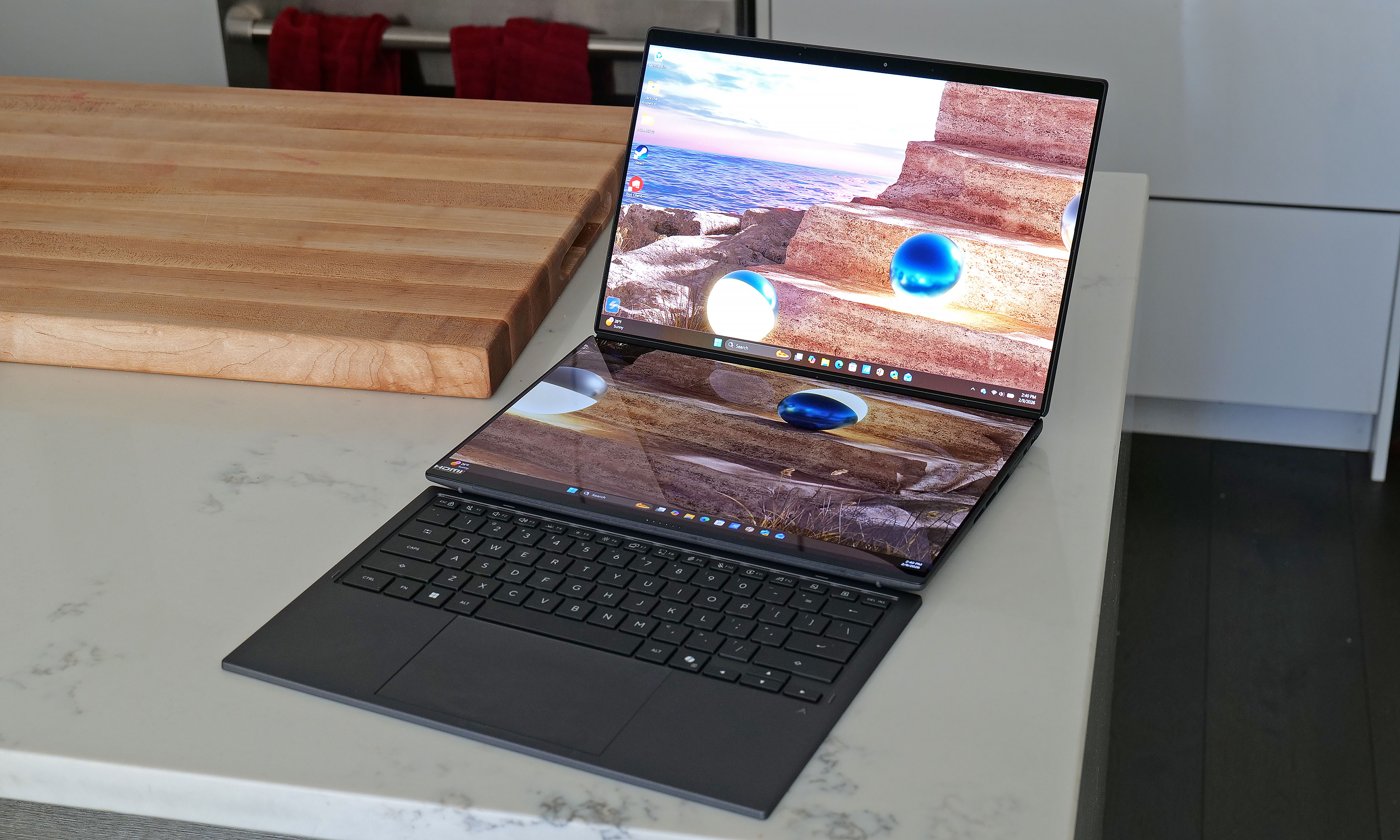
The Zenbook Duo's detachable keyboard gives users a ton of flexibility when it comes to utilizing both of the laptop's displays.
Sam Rutherford for Engadget
One of the Zenbook Duo's most important design upgrades is a new "hideaway" hinge that reduces the gap between the laptop's two screens. Not only does this make the laptop easier and more pleasant to use in dual-screen mode, it also allows the entire system to lay flat on a table, which is nice for drawing or sharing your screen with someone sitting opposite you. Unfortunately, while my review unit didn’t come with one, ASUS says its forthcoming Pen 3.0 will come bundled with the Zenbook Duo in the US, so you won’t need to pay extra for it.
Another small but appreciated improvement is the new pogo pins below the lower display, which provides a more secure and reliable way of keeping the laptop's detachable keyboard topped up. In my experience, even after running multiple rundown tests that completely drained the Duo's battery, I never had to charge up the keyboard on its own. It was always smart enough to sip electricity from the main system in the background, though it also has a built-in USB-C port for power just in case. On the flipside, if you're not scared of typing on glass, you can still use the lower screen as a keyboard and touchpad, or as a place to display widgets for news, the weather, performance and more.
Displays
As someone who loves a desktop with dual monitors, I can't overstate how nice it is to have similar built-in functionality on a laptop.
Sam Rutherford for Engadget
The standout feature on the Zenbook Duo continues to be its dual displays, and now for 2026, they look better than ever. Both OLED panels have a 144Hz refresh rate with a 2,880 x 1,800 resolution while also covering 100 percent of the DCI-P3 spectrum. And while its nominal brightness of 500 nits for SDR content is just OK, ASUS makes up for that with peaks of up to 1,000 nits in HDR. And to make both screens even more enjoyable, ASUS managed to shrink the size of their bezels down to just 8.28mm. That's a reduction of 70 percent compared to the previous model, so now there's even less getting in the way of you utilizing these screens to their fullest.
Performance
The Zenbook Duo can be configured with a range of new Intel Core Ultra 7 and Core Ultra 9 processors, including the X9 388H chip used on our review unit. For general use and productivity, the laptop is super smooth and responsive, though that shouldn't be a surprise coming from Intel's latest top-of-the-line mobile CPU. However, for those seeking max performance, some of the benchmark numbers aren't quite as impressive as you might expect. That’s because ASUS has limited the Duo's TDP (thermal design power) to 45 watts — which is shy of the chip's 80-watt turbo power limit.
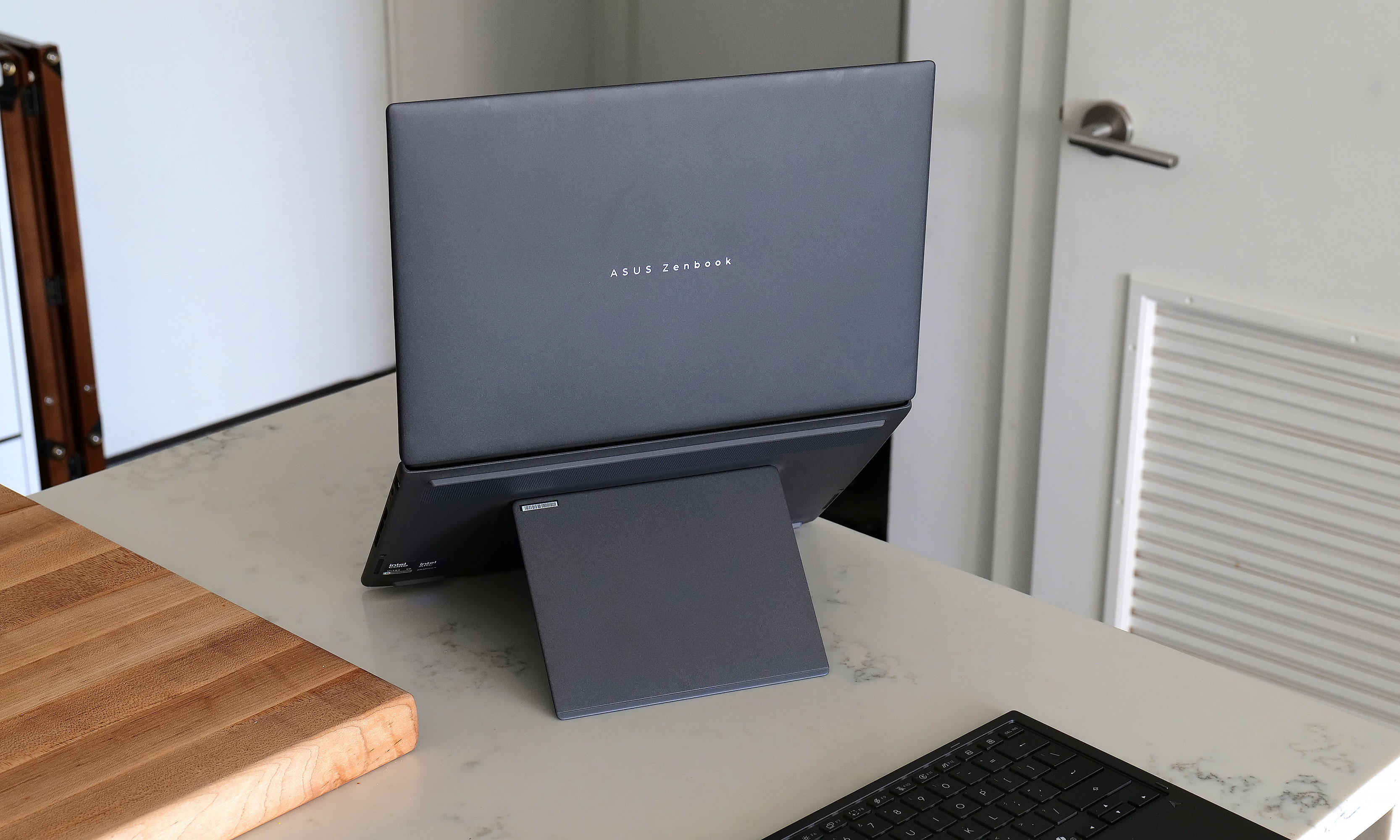
The kickstand in back adds a bit a bulk, but it's better than not having one at all like with Lenovo's Yoga Book.
Sam Rutherford for Engadget
In PCMark 10, the Zenbook Duo only managed a score of 7,153 compared to 9,651 from a Dell XPS 14, despite the latter having a lower-tier Intel Core Ultra X7 358H processor. That said, in other tests like Geekbench 6, the Duo had no trouble staying on top with a multicore score of 17,095 versus 9,651 for the Dell.
Another pleasant surprise is that because the Duo's chip comes with Intel's upgraded Arc B390 integrated GPU, this thing has plenty of oomph to game on, let alone edit videos or other similar tasks. In Elden Ring at 1,920 x 1,200, the Zenbook maintained a relatively stable framerate between 55 and 60 fps on high settings, which is great considering this thing doesn't have discrete graphics. This means as long as you don't mind fiddling with game options a bit, you should be able to play newer AAA games without too much trouble.
Battery life
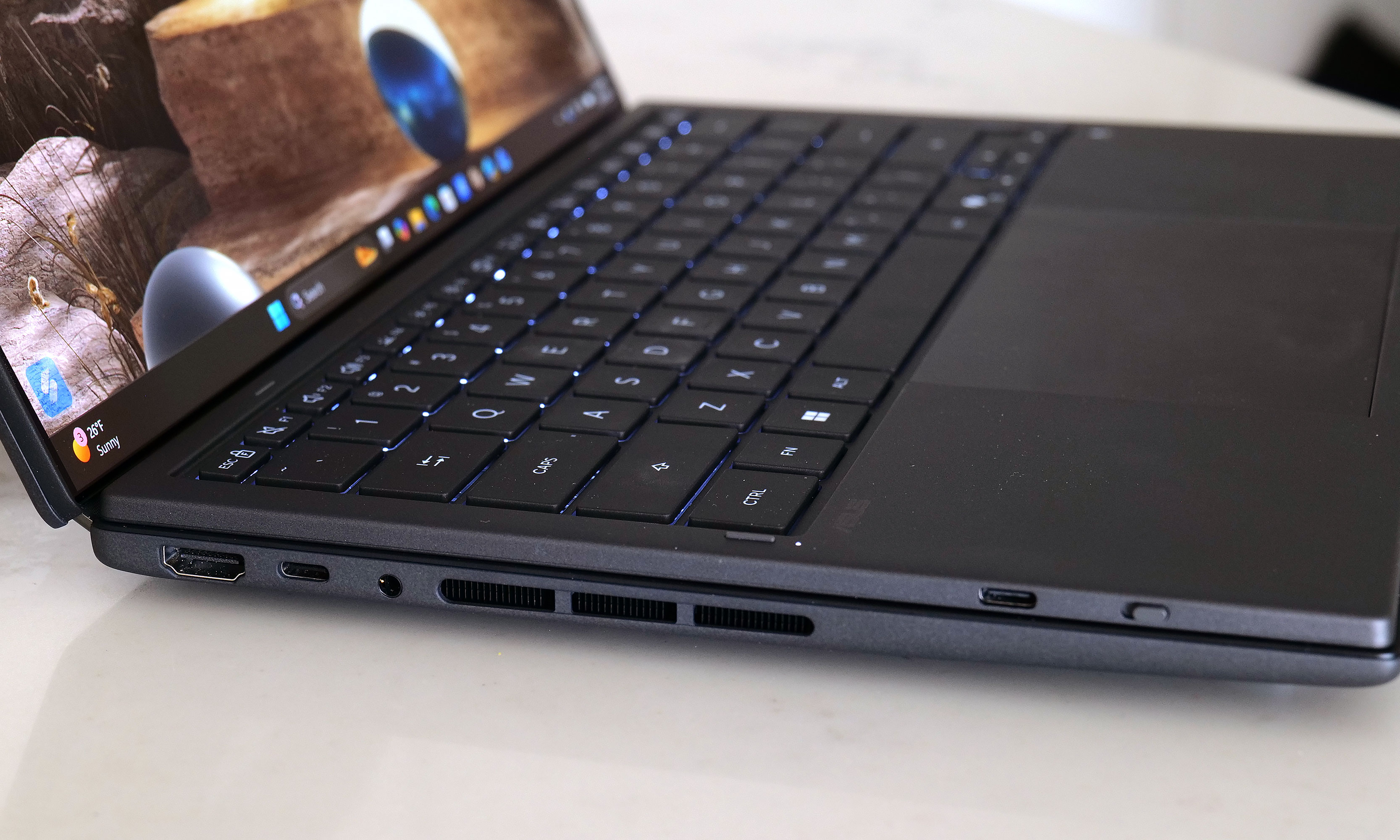
The left side of the Zenbook Duo features a full-size HDMI connector along with a USB-C port, plus a backup USB-C jack for charging the detachable keyboard.
Sam Rutherford for Engadget
You'd think a laptop with two displays would be super power hungry. However, by increasing the capacity of its cell from 75WHrs to 99WHrs, ASUS has made the Zenbook Duo's endurance (or lack thereof) a complete non-issue. On PCMark 10's Modern Office rundown test, the laptop lasted 18 hours and 33 minutes in single-screen mode. Granted, that's nearly four hours less than what we got from MSI's Prestige 14 Flip AI+, but considering that's the longest-lasting notebook we've ever tested, I'm not bothered. When compared to ASUS' own Zenbook A14 (18:16), things are basically a wash, which I think is a win for the Duo, as the A14 is meant to be an ultralight system with an emphasis on portability and longevity.
Obviously, battery life takes a hit when you're using both displays. However, when I re-ran our battery test with its two displays turned on, the Duo still impressed with a time of 14:23. This is more than enough to give you the confidence to set this thing up in dual-screen mode even when an outlet isn't close at hand. Thankfully, for times when you do need a power adapter, the charging brick on ASUS' cable is rather compact, so it's not a chore to lug it around.
Wrap-up
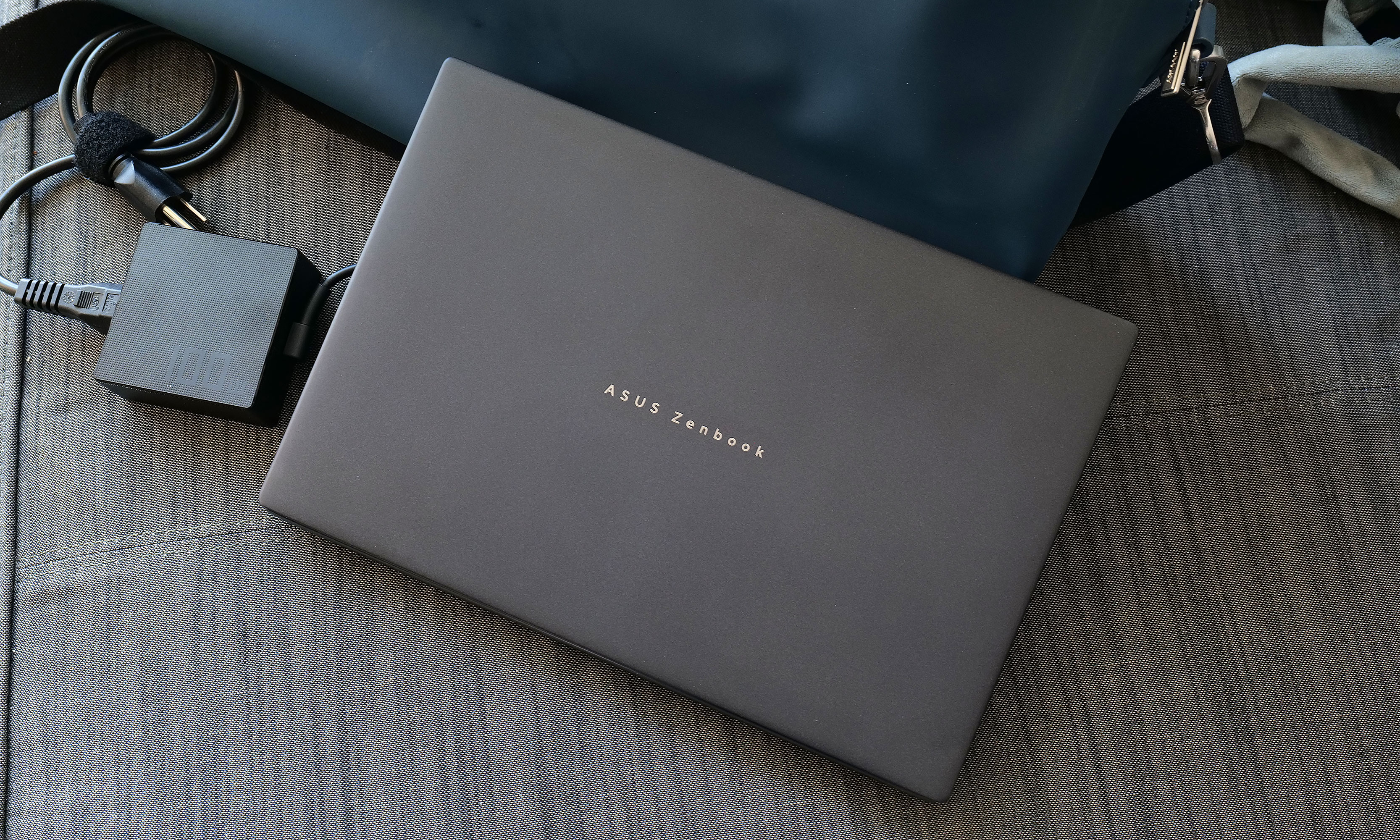
The Zenbook Duo's battery life is good enough you won't always need its power brick. Thankfully, when you do, ASUS' 100-watt adapter is relatively compact.
Sam Rutherford for Engadget
I'm a believer that one day people will eventually embrace typing on screens with laptops just like they have for smartphones. However, even if you're not willing to make that jump just yet, the Zenbook Duo still has all of its bases covered. Its detachable keyboard gives you a pleasant experience while freeing up the bottom of the notebook to be a second display. This allows you to have something similar to a traditional dual-monitor desktop but in a chassis that you can easily take on the road without any major compromises.
The 2026 Zenbook Duo combines a compact design with strong performance, plenty of ports and surprisingly good battery life. Sure, it's a touch heavier than a typical 14-inch laptop, but its two screens more than make up for a little added weight and thickness. That leaves price as the Duo's remaining drawback, and starting at $2,100 (or $2,300 as reviewed), it certainly isn't cheap.
However, when you consider that a similarly equipped rival like a Dell XPS 14 costs just $50 less for a single screen, that price difference is rather negligible. Alternatively, if you opt for a more affordable ultraportable and then tack on a decent third-party portable monitor, you're still likely looking at a package that costs between $1,500 and $1,800. Plus, that setup is significantly bulkier and more annoying to carry around. So while the Zenbook Duo might be an unconventional pick right now, it has all the tools to deliver unmatched portable productivity and I don’t think it will be too much longer until the masses catch on.
This article originally appeared on Engadget at https://www.engadget.com/computing/laptops/asus-zenbook-duo-2026-review-two-screens-really-are-better-than-one-140000982.html?src=rss
What if you could access all your files from anywhere in the world, without relying on third-party services or paying endless subscription fees? Below, Enrique Neyra takes you through how a Raspberry Pi 5, paired with NextCloud and TailScale, can transform into your very own private cloud storage system. Imagine having complete control over your […]
What if the very AI meant to boost your productivity could also expose your most sensitive data? Microsoft 365 Copilot is transforming workplace efficiency, but its ability to access everything a user can see, from overshared SharePoint files to forgotten legacy content, introduces serious security risks. In this guide, T-Minus365 explains how to safely deploy […]
Last year the UK declared that Apple and Google were a duopoly with "strategic market status" in the mobile platforms market, making them subject to special regulations. However, the UK's Competition and Markets Authority (CMA) will not regulate Google and Apple's app stores like the EU has done. Rather, government plans to enforce its own digital markets rules in a "pragmatic" way by accepting "commitments" from Apple and Google in areas like app rankings, the CMA announced.
Google and Apple agreed to work with the CMA to address concerns on the following matters: app review, app ranking, use of data and interoperability process. Effectively, regulators require the tech giants to treat developers fairly, particularly when they compete against Google and Apple's own apps. However, the UK's rules are more like suggestions and "not legally binding in any case," former CMA director Tom Smith told the Financial Times.
This is in stark contrast to Europe's Digital Markets Act, which forced Apple to make changes to open up iOS features and data to rivals, allow app installations from outside its Store and reduce fees collected on purchases.
That could change if the companies fail to comply with its measures, though. The CMA plans to check metrics like the number of apps approved or rejected, app review times and developer complaints received. New requirements could then be brought forward if deemed necessary. "For example, if we find Apple is routinely declining interoperability requests without good reason... we could bring forward specific interoperability requirements. Non-compliance would also mean we would be unlikely to consider commitments as a similar approach in [the] future."
Google said in a blog today that it "welcomed the opportunity to resolve the CMA's concerns collaboratively." Apple, meanwhile, seemed similarly pleased with the deal. "The commitments announced today allow Apple to continue advancing important privacy and security innovations for users and great opportunities for developers,” an Apple spokesperson told Bloomberg.
The UK is possibly taking a light touch on app store rules to avoid antagonizing the Trump administration. Earlier today, French President Emmanuel Macron predicted that the US could go after the EU on areas like data privacy, digital taxation and the plan of multiple EU countries to ban children from social media. "The US will, in the coming months — that’s certain — attack us over digital regulation," Macron said at a special summit yesterday.
This article originally appeared on Engadget at https://www.engadget.com/big-tech/uk-takes-light-touch-approach-to-regulating-apple-and-googles-app-stores-131119575.html?src=rss
The first Pony.ai bZ4X robotaxi, made in partnership with Toyota, has just rolled off the production line and is ready to be deployed. It’s the first of many, if the companies stick to their plan, which is to produce more than 1,000 bZ4X robotaxis this year. The bZ4X is one of the three autonomous vehicle models Pony.ai intends to use for commercial services in Tier 1 Chinese cities, including Beijing and Shanghai. The other two vehicles are already being used for Pony.ai’s ride-hailing service, while the bZ4X robotaxis will be gradually integrated into its fleet. Pony.ai’s goal is to operate 3,000 vehicles by the end of 2026.
Toyota introduced the new bZ4X last year, and the non-autonomous versions are available for purchase to the public. Pony.ai’s version comes equipped with the company’s Gen-7 autonomous driving system, which features Bluetooth-based automatic vehicle unlocking and in-cabin voice interaction. It also comes integrated with online music services and braking patterns that can help minimize motion sickness for passengers. Pony.ai was founded in 2016 and has been testing and operating self-driving vehicles since then. It received permission from Beijing to offer self-driving car services to the general public back in 2022. While It’s a Chinese company, it has headquarters in Silicon Valley and filed for an IPO in the US in 2024.
This article originally appeared on Engadget at https://www.engadget.com/transportation/evs/toyota-and-ponyai-start-mass-producing-robotaxis-for-china-130833065.html?src=rss
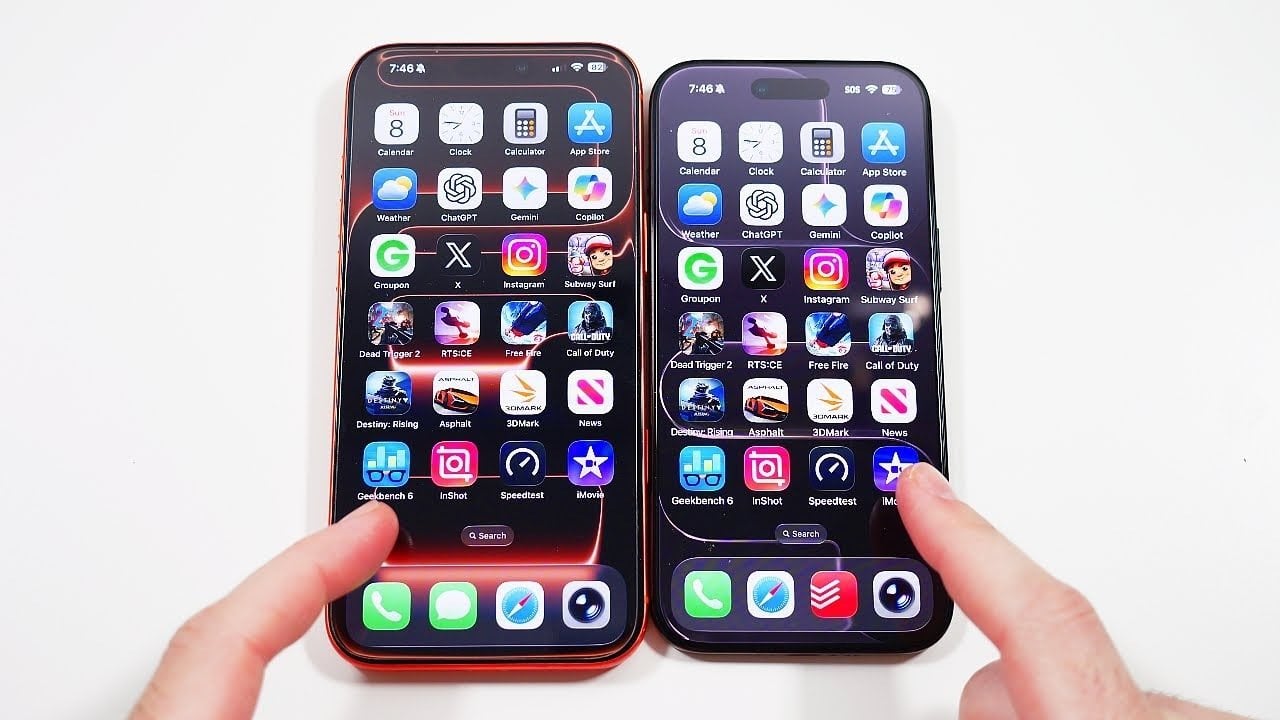
When comparing the iPhone 17 Pro Max and the iPhone Air, you’re looking at two devices that share an innovative foundation but diverge in design, performance under pressure, and overall usability. Both models are powered by the advanced A19 Pro chip and come equipped with 12GB of RAM, making sure smooth multitasking and fast app […]
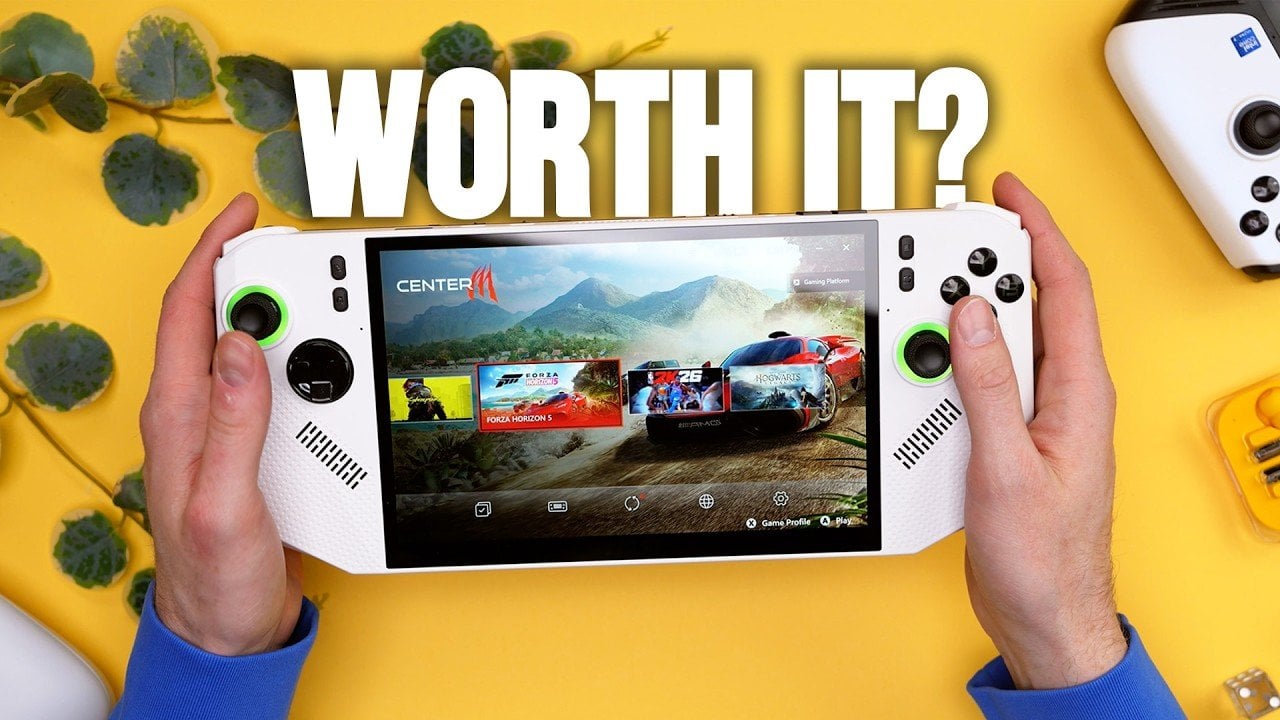
Is the MSI Claw A8 the ultimate gaming powerhouse, or does the MSI Claw 8i+ steal the spotlight with its refined versatility? In this overview, Tech Fowler explores how these two handheld devices stack up against each other, diving into their unique strengths and trade-offs. With the A8 boasting raw gaming performance thanks to its […]
Spotify announced Tuesday that it hit 751 million total monthly active users (MAUs) for quarter-four of 2025. That record-high is an 11 percent jump from the year before and a significant bump from the third quarter's 713 million MAUs.
The quarterly earnings report also showed a 10 percent jump year-over-year in Premium subscribers, from 263 million to 290 million. Europe makes up the greatest number of the Swedish company's premium subscribers (36 percent), with North America coming second at 25 percent.
Spotify contributes a few factors to its growth, including AI. "We consider ourselves the R&D department for the music industry. Our job is to understand new technologies quickly and capture their potential, which we’ve done time and again," Gustav Söderström, Co-CEO of Spotify, said in a statement. The entire industry stands to benefit from this [AI] paradigm shift but we believe those who embrace this change and move fast, will benefit the most.” In late 2025, Spotify announced it would get rid of some of the AI "slop" on its platform and have "artist-first AI music products" — though the specifics were very vague.
The company also claims that December's Spotify Wrapped was bigger than ever, with over 300 million engaged users and 630 million shares across 56 languages.
This article originally appeared on Engadget at https://www.engadget.com/entertainment/music/spotify-now-has-more-than-750-million-monthly-users-124103630.html?src=rss
Valentine’s Day has a sneaky way of arriving before you’re ready. One moment it’s early February, the next you’re scrambling for something meaningful that doesn’t scream “panic purchase.” The good news is that thoughtful gifts exist outside the usual suspects of cologne and chocolate. Design-forward pieces that speak to his interests, rituals, and style can transform a late save into a genuine gesture.
The key is choosing objects that feel intentional. These seven picks bridge form and function in ways that make them feel curated rather than rushed. From tactile drinkware to nostalgic tech, each piece brings substance to the moment. They’re gifts that work for the guy who has strong opinions about his coffee setup, values craftsmanship, or simply appreciates objects that look as good as they perform.
1. ClearFrame CD Player
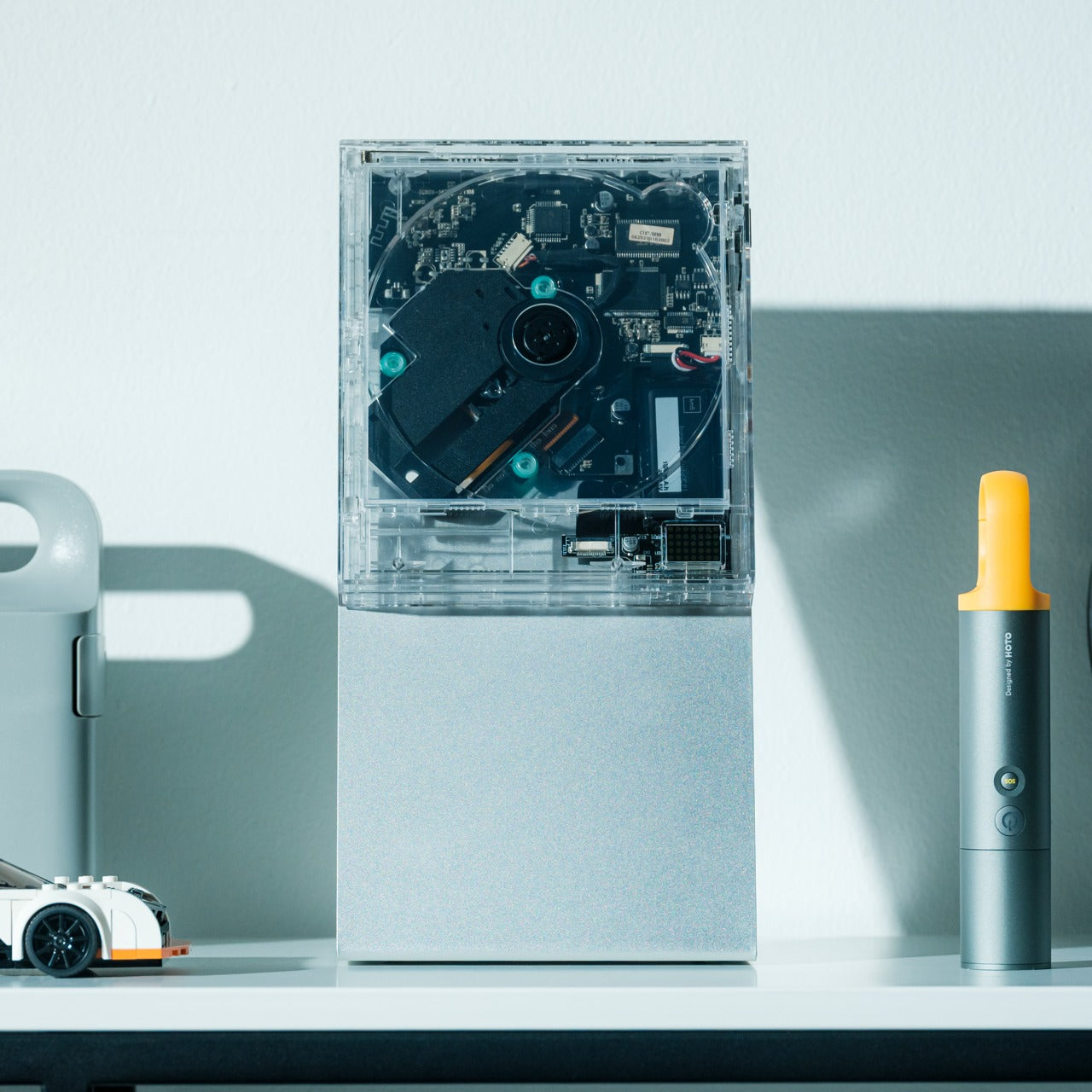
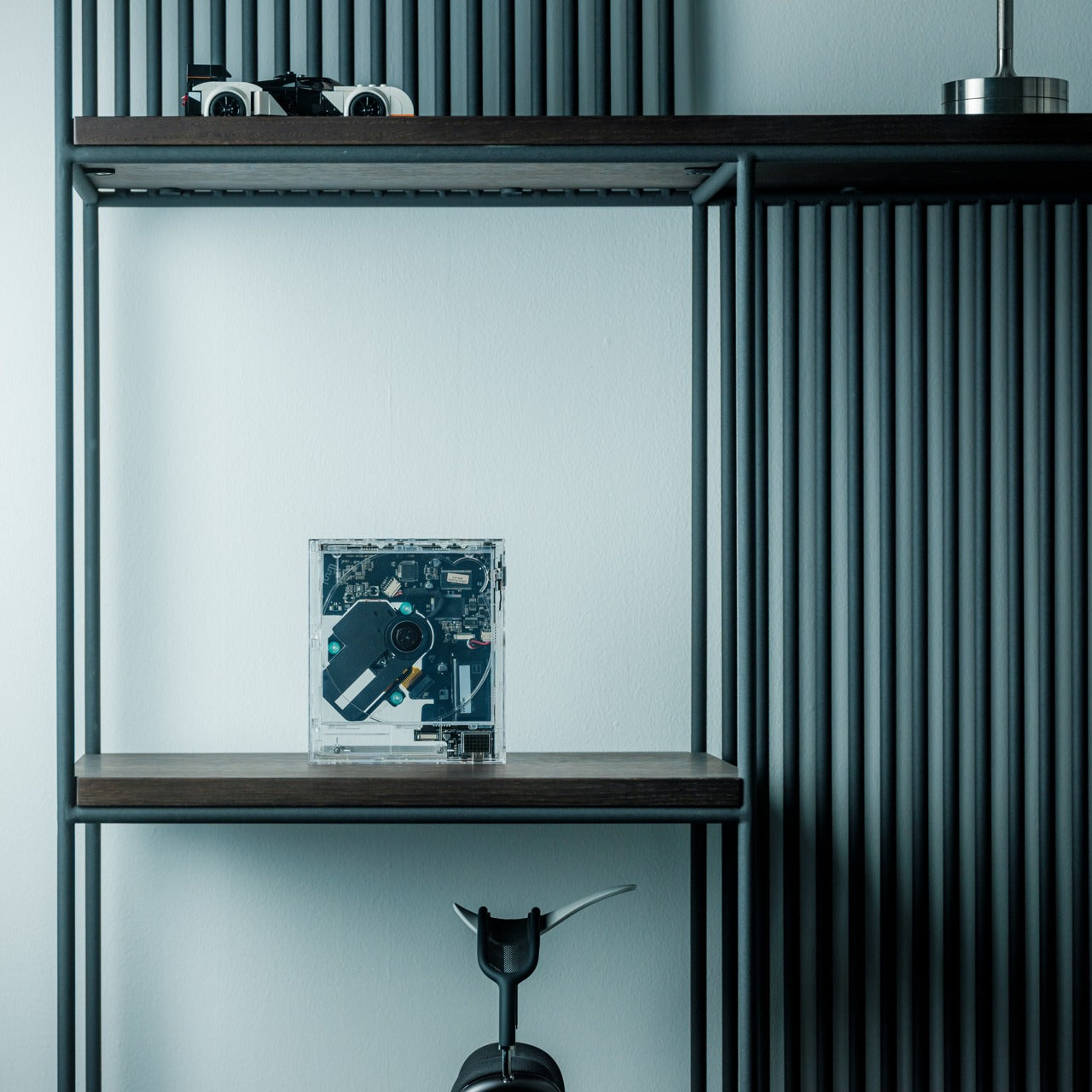
The resurgence of physical media isn’t just nostalgia dressed up. It’s about owning music in a tangible form, album art included. The ClearFrame CD Player taps into that ritual while presenting itself as a piece of functional sculpture. Its transparent polycarbonate body frames both the disc and the cover art, turning playback into a visual experience. The exposed black circuitry sits like minimal abstract art, inviting you to appreciate the mechanics alongside the music itself.
Bluetooth 5.1 connectivity means it pairs with modern speakers while honoring the analog soul of CDs. The rechargeable battery delivers up to eight hours of play, making it genuinely portable. Whether wall-mounted or desk-bound, it fits into spaces designed with intention. It’s a gift for the guy who still curates playlists but misses the weight of a physical album, the one who values ritual as much as sound quality.
The transparent housing transforms the player into a display piece
Bluetooth and wired options accommodate any listening setup
Seven-hour battery life makes it surprisingly versatile
Wall-mountable design adds spatial flexibility
What We Dislike
Limited to CDs, so streaming purists may not appreciate it
Exposed circuitry can collect dust over time
2. Titanium Artisan Spirits Cup
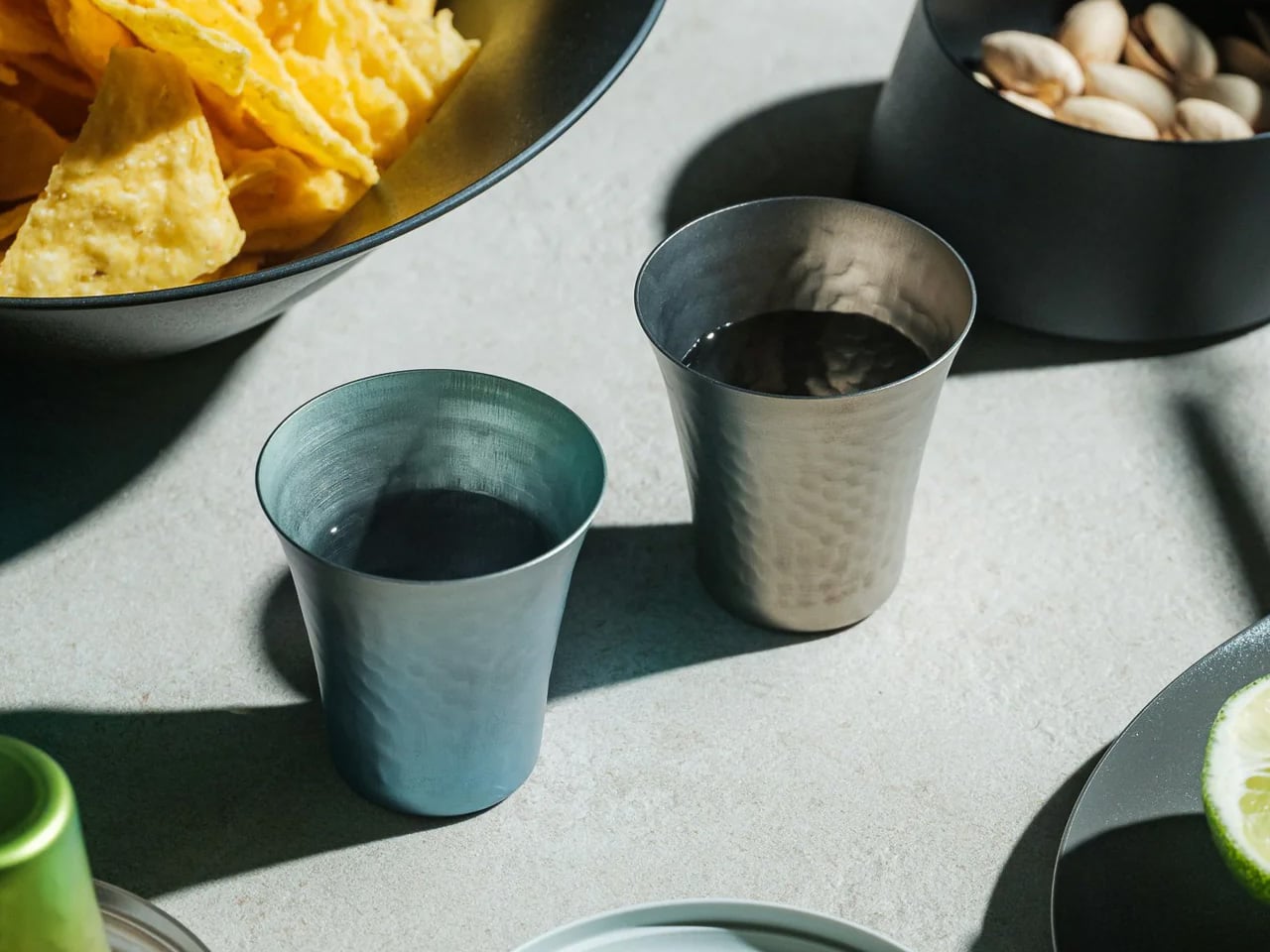
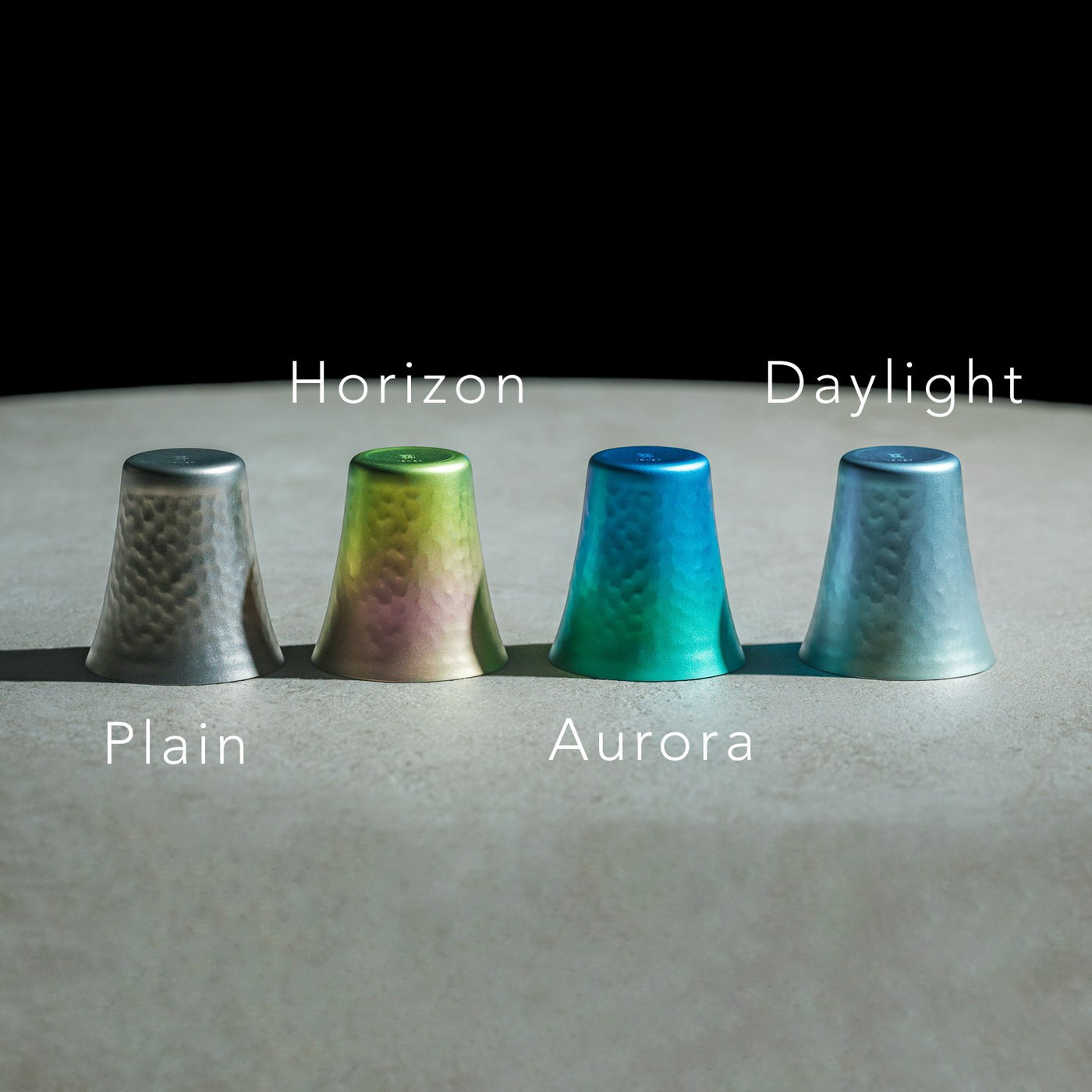
Glassware does its job, but titanium transforms the act of drinking into something tactile and deliberate. This artisan cup weighs just 22 grams yet feels substantial in hand. The hammered texture does more than look striking—it amplifies the aromatic profile of whatever spirit you pour. Sake, whiskey, or tequila all benefit from the sensory boost that comes with each sip. The anodized finish shifts between vibrant hues, ensuring no two cups are identical.
At roughly two inches in diameter and height, it fits comfortably in the palm while maintaining a refined presence on any surface. The thin lip is engineered for smooth contact, enhancing flavor rather than obstructing it. The non-slip surface adds practicality without compromising elegance. It’s a gift for the man who treats his drink selection like a small ceremony, who appreciates the engineering behind simple pleasures, and who doesn’t settle for standard barware.
Lightweight titanium construction feels premium without being fragile
Unique anodized finish gives each cup individual character
Thin lip improves the sipping experience noticeably
What We Dislike
Small capacity may require frequent refills
Premium price point compared to traditional glassware
3. BlackoutBeam Tactical Flashlight
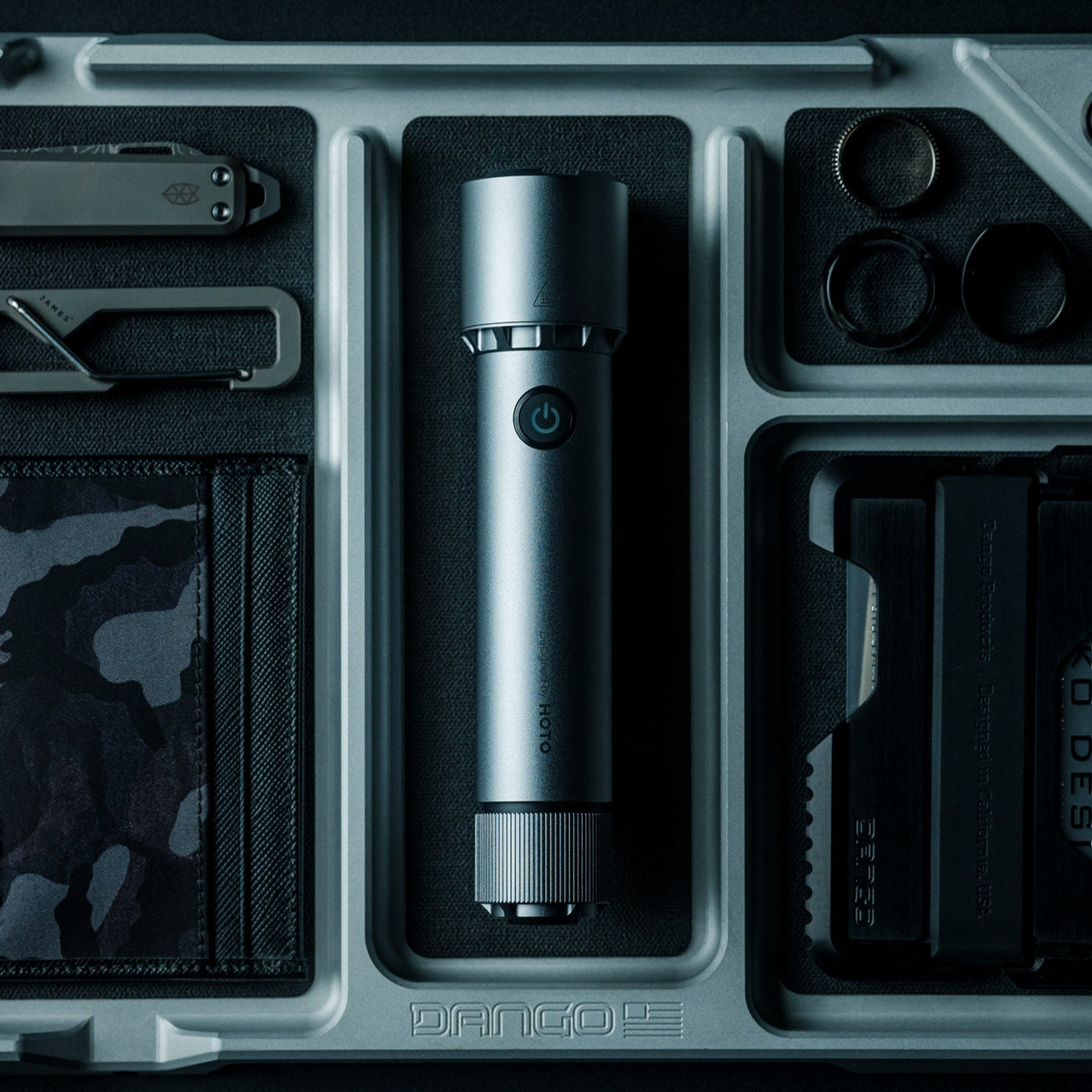
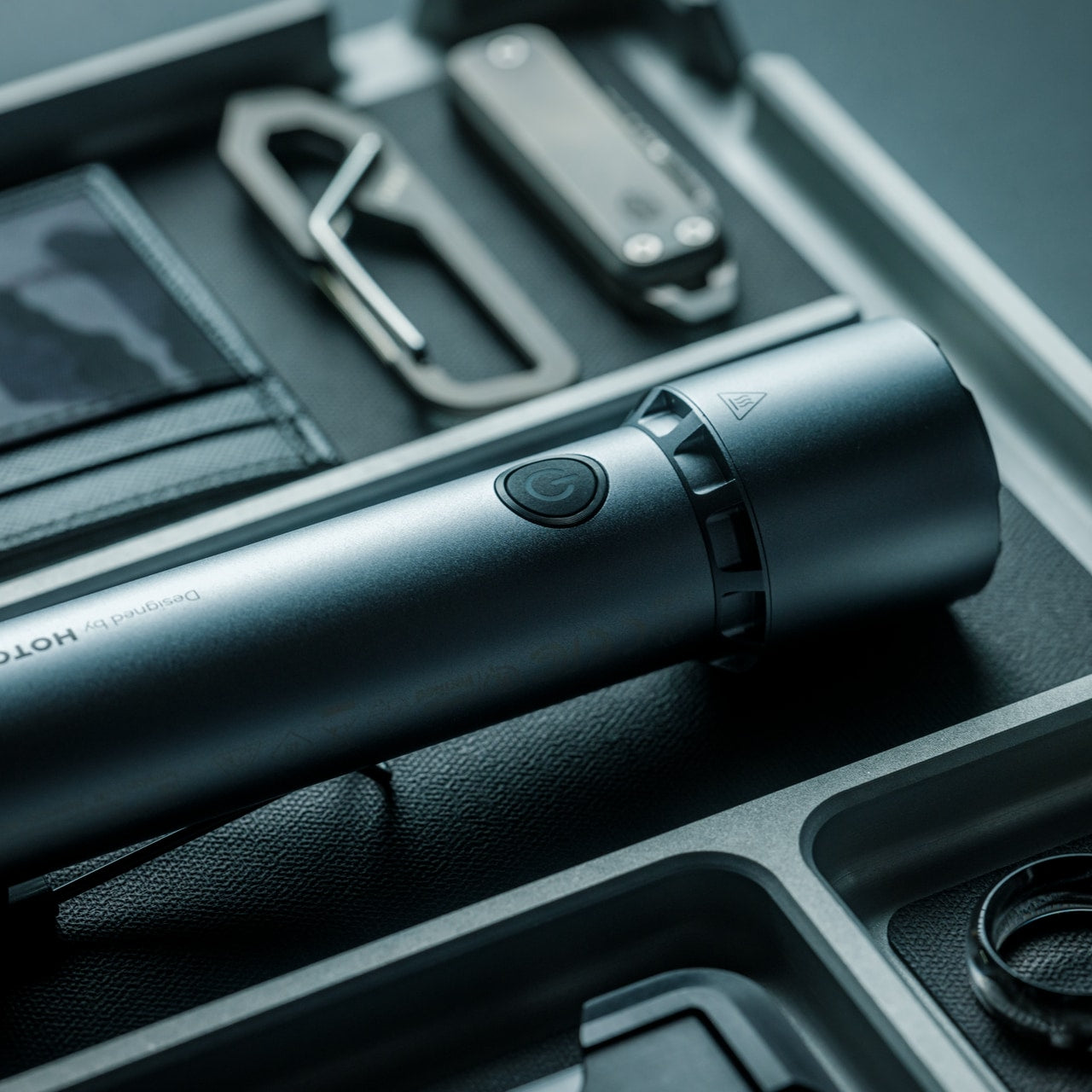
Flashlights often get relegated to emergency drawer status, but the BlackoutBeam earns permanent pocket space. Its 2300-lumen output cuts through darkness with the kind of precision that makes fumbling around obsolete. The 0.2-second response time means instant illumination when you need it, whether that’s during a power outage or while navigating unfamiliar terrain. The IP68-rated aluminum body handles rain, drops, and submersion without complaint, making it genuinely adventure-ready.
Three brightness levels plus strobe and pinpoint modes adapt to different scenarios. Signal for help, disorient threats, or simply light up a path without blinding yourself. The beam throws up to 300 meters, offering serious range in a compact form. It’s built for the guy who values preparedness, who keeps gear in his car or bag just in case, and who wants tools that perform without looking overly tactical or utilitarian.
Blinding 2300-lumen output handles any visibility challenge
Instant 0.2-second response eliminates lag
IP68 waterproofing and a durable aluminum body withstand harsh conditions
Multiple modes provide versatility for different situations
What We Dislike
High lumen output can drain the battery quickly on the max setting
Industrial aesthetic may feel too aggressive for some tastes
4. Battery-Free Amplifying iSpeakers
Acoustic amplification predates electricity, and these metal speakers prove that old principles still work beautifully. Drop your smartphone into the cradle and watch sound waves spread naturally across the room. No charging cables, no Bluetooth pairing, no power source required. The Duralumin construction, borrowed from aircraft engineering, resists vibration while amplifying audio through pure physics. The golden ratio shapes the design, turning functional geometry into something visually balanced.
Compatible with optional mods that direct sound, these speakers adapt to different spaces and listening preferences. They work just as well on a desk as they do outdoors, bringing warmth to acoustic tracks and clarity to podcasts. It’s a conversation starter that actually performs, appealing to the guy who appreciates analog solutions in a digital age. He’ll love the lack of battery anxiety and the simplicity of just setting his phone down to fill a room.
Sound quality depends entirely on the phone’s speaker quality
Limited volume compared to powered alternatives
5. Portable Fire Pit Stand
Outdoor cooking gear can feel cumbersome, but this bonfire stand assembles like a puzzle and packs flat when finished. The black steel plate resists warping despite prolonged heat exposure, maintaining structural integrity through countless fires. Industrial cutouts and holes give it visual character while promoting airflow for better combustion. Removable trivets open up cooking methods beyond basic grilling, accommodating skillets, pots, and direct flame contact depending on your meal plan.
Setup takes minutes, teardown even less. The portability factor means spontaneous camping trips or backyard gatherings don’t require hauling heavy equipment. It’s built for the guy who finds peace in fire, who enjoys cooking outdoors, and who values gear that doesn’t sacrifice design for function. Whether he’s solo camping or hosting friends, this stand turns open flame into a centerpiece rather than just a heat source.
Easy assembly and flat-pack design simplify transport
Warp-resistant steel handles repeated high-heat use
Removable trivets enable multiple cooking methods
Industrial aesthetic looks intentional rather than utilitarian
What We Dislike
Requires an outdoor space to use properly
Steel construction adds weight despite the portability focus
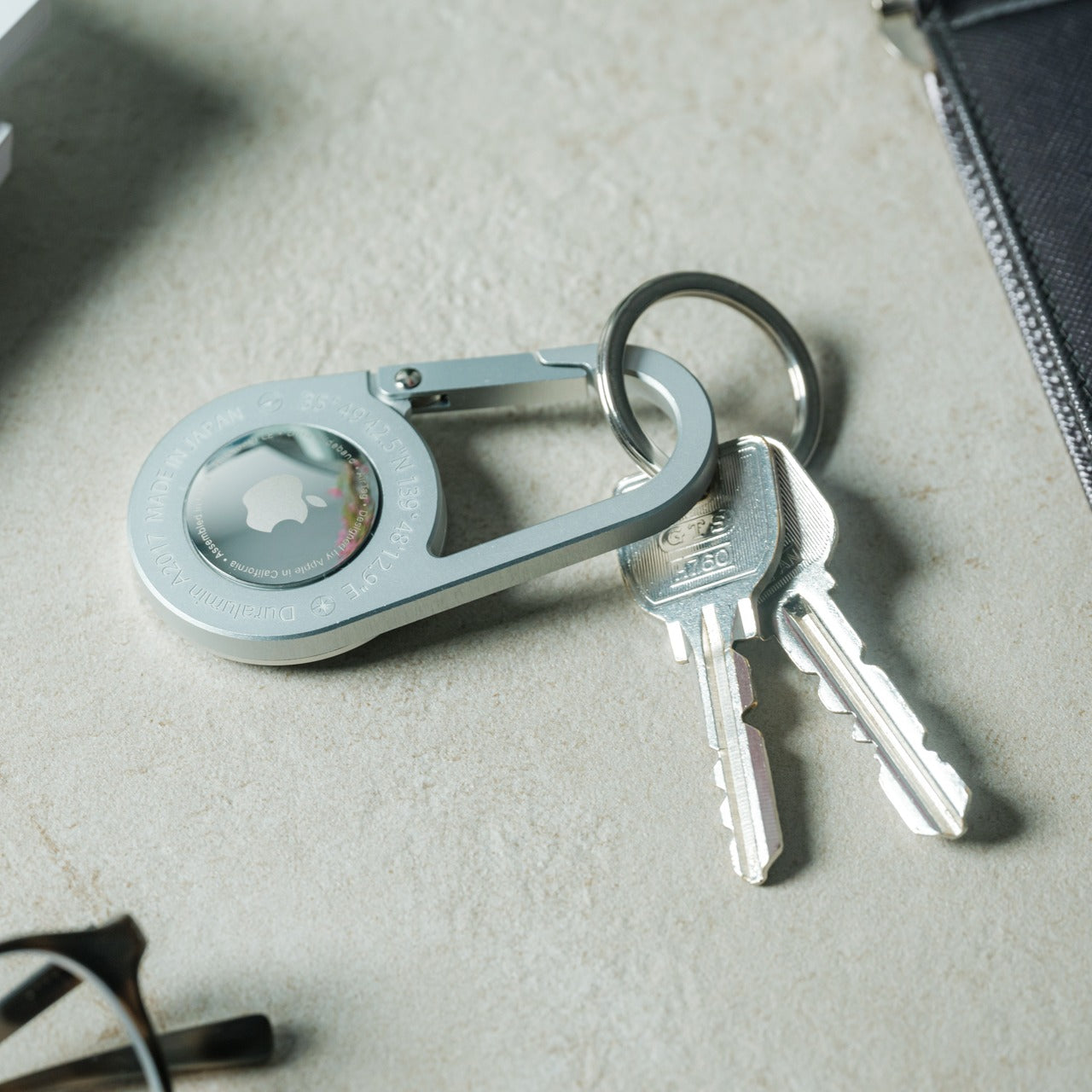
6. AirTag Carabiner
Losing things wastes time and mental energy. This carabiner solves that problem with elegance rather than bulk. Crafted from Duralumin composite alloy, the same material used in aircraft and spacecraft, it clips onto bags, bikes, or umbrellas without feeling heavy. The hand-finished construction ensures quality over mass production, while the Apple AirTag integration brings precision tracking to everyday items. Water resistance and altitude durability mean it performs reliably in varied conditions.
Available in brass and stainless steel finishes alongside the standard option, it suits different aesthetic preferences. The carabiner isn’t just functional—it’s a small piece of engineering that happens to keep track of your belongings. Perfect for the guy who’s always misplacing his gym bag or bike, who appreciates practical design that doesn’t announce itself, and who wants peace of mind without bulky tracking devices clipped to everything he owns.
Duralumin alloy provides aircraft-grade durability in lightweight form
Hand-finished construction feels premium
Compatible with Apple AirTag for seamless tracking
Water and altitude resistance expand usage scenarios
What We Dislike
Requires a separate AirTag purchase
Limited to Apple ecosystem users
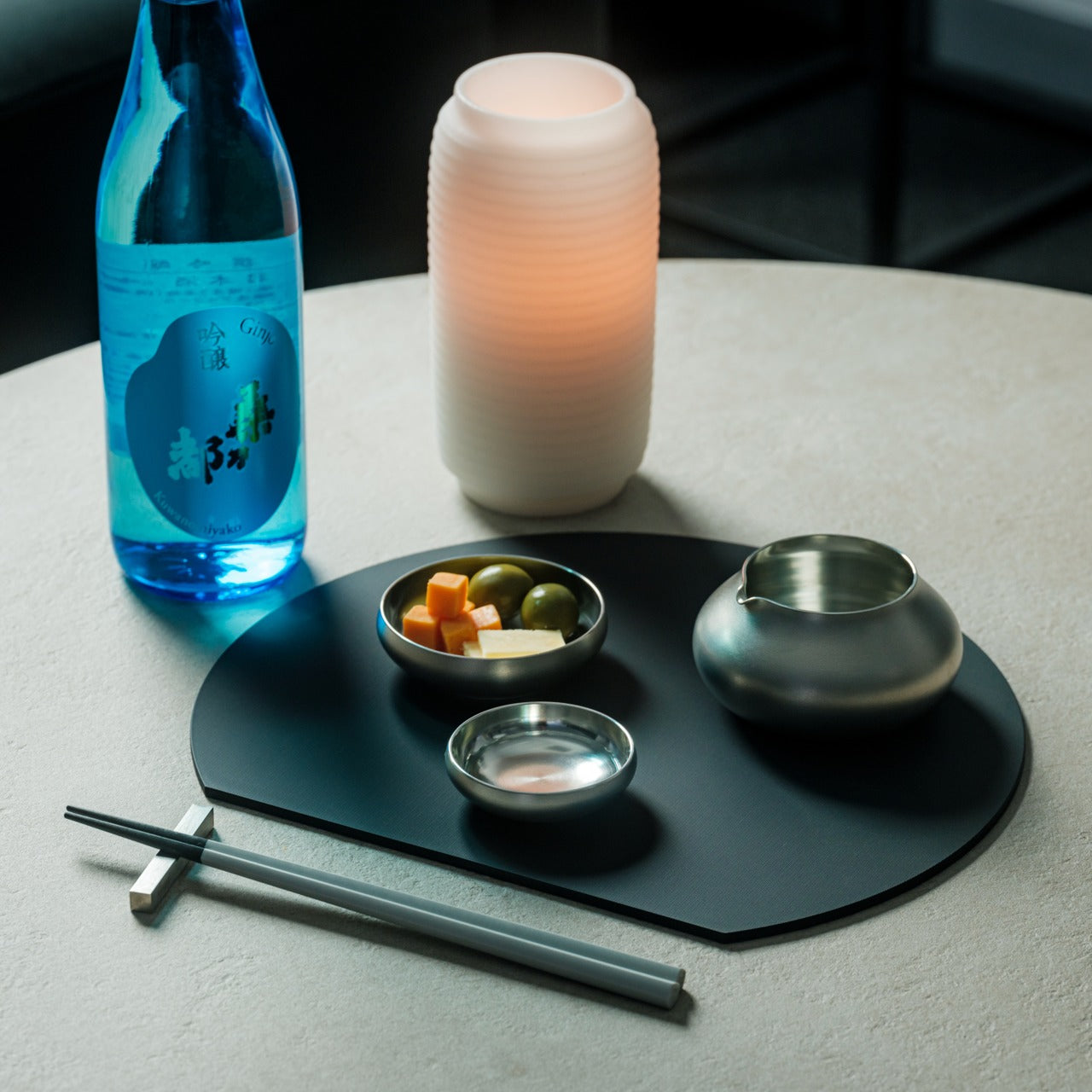
7. Stacking Sake Drinkware
Sake deserves better than generic glassware. This tin drinkware set honors the drink’s cultural roots while enhancing its flavor profile. Tin naturally smooths and improves sake’s taste, a property recognized for over 1,300 years. The design mirrors Japanese rice cakes, stacking elegantly when not in use and creating a tactile experience during use. The matte sandblasted finish moderates the metal’s coolness, making chilled drinks comfortable to hold without condensation issues.
Certified at 95 to 97 percent genuine tin content, the set balances authenticity with functionality. It resists rust and odors while requiring minimal maintenance. The configurations support both solo sipping and shared moments, adapting to how he prefers to enjoy sake. It’s a gift for the man who treats drinking as a ritual rather than a routine, who appreciates cultural craftsmanship, and who values objects that improve the experience they’re designed for.
Stacking design combines storage efficiency with visual appeal
Matte finish provides a comfortable grip temperature
Cultural authenticity adds meaningful context
What We Dislike
Specific to sake, limiting versatility
Requires hand washing and careful maintenance
The Last-Minute Gift That Looks Anything But
Timing shouldn’t dictate thoughtfulness. These seven pieces prove that design-forward gifts exist outside traditional Valentine’s territory, offering substance alongside style. Each one speaks to specific interests without feeling generic, whether that’s reviving CD collections, elevating drink rituals, or solving everyday problems with well-engineered solutions. They’re objects designed to be used, appreciated, and kept rather than stored away after the initial novelty fades.
The best gifts reflect actual observation rather than obligation. These picks work because they address real preferences and habits. They look intentional because they are, even if you’re ordering them with days to spare. Sometimes the most meaningful gesture is choosing something that fits seamlessly into someone’s life, enhancing routines they already value and spaces they already inhabit. That’s not last-minute. That’s just right.