The Amazon Fire Max 11 tablet is on sale for just $140, which is a record low price. This early Black Friday deal brings the price down from $230, which is a savings of nearly 40 percent. That’s a whole lot of tablet for not so much money.
This is a fairly recent entry into Amazon’s library of tablets, having just been released last year. The Fire Max 11 boasts a large 11-inch LCD screen, a slim aluminum frame and plenty of smart home controls. Of course, it integrates with Alexa for voice controls. This is the cooler and more refined sibling of the Fire 10 and Fire 8 tablets.
The tablet uses an octa-core MediaTek processor and weighs just over a pound. There’s a fingerprint sensor, support for WiFi 6 and 4GB of RAM. It runs Fire OS 8, which allows for split-screen and picture-in-picture features. This lets users slam some emails while, say, keeping an eye on a YouTube video.
The tablet integrates with a keyboard and stylus, but those cost extra. There are some minor downsides. First of all, this is an ad-supported model that’ll throw advertisements on the lock screen. In my experience, these are surprisingly unobtrusive. I hate ads and barely notice them. This sale is also for the 64GB version. That’s not a whole lot of room but the tablet does come with a microSD reader for up to 1TB of additional storage.
This article originally appeared on Engadget at https://www.engadget.com/deals/amazon-black-friday-deals-include-the-fire-max-11-tablet-for-a-record-low-of-140-150026096.html?src=rss
Apple devices have a few things in common: they’re well-designed, solidly built and easily connect with one another. But chances are, if it bears the Apple logo, it’s not cheap. That’s why promos like Black Friday are always worth checking out if you’re in the market for a new Apple device.
We’ve reviewed nearly every major release from the company over the last 20 years, including the newest products for 2024, like the AirPods 4, the M4 iPad Pro, the M4 Mac Mini and more. Some of those devices are seeing their first discounts for Black Friday and others are dipping back to the lows they saw earlier in the year. Here are the best Black Friday deals on Apple devices we could find from retailers across the web.
The best Black Friday Apple iPad deals
Photo by Nathan Ingraham / Engadget
The line between Apple’s tablets and laptops is a little blurry at this point, especially with the release of the iPad Pro this year, which (at the time) housed the company’s most powerful chip. The iPad Air is our current pick for the best iPad you can buy and we were delighted by the iPad mini that came out just last month. The only problem is iPads are among the more expensive tablets you can buy. Hopefully these Black Friday iPad deals help out.
Apple iPad (2022, 10th gen) for $250 ($100 off): This is a new all-time low price on the base model iPad. Some models are on sale for $279 on Amazon, and a few colors have additional coupons that bring the price down to $250. It didn’t get an upgrade during Apple’s Let Loose event back in May, though it did get a quiet price reduction by $100 to $349. Now Black Friday sales are bringing down the price even more. This is our current favorite budget iPad because it’s a capable tablet that’s great for casual browsing, streaming and gaming. It can even handle everyday productivity tasks well. Also at Walmart.
Apple has four models of AirPods right now: The AirPods Pro 2, the over-ear AirPods Max and two AirPods 4, one with active noise cancellation and one without. Apple has been doing a lot of interestingthings with their headphones lately, making this a good time to dive in. Though the discounts for Black Friday look to be minor, it's better than paying full price.
Apple AirPods Max (USB-C) for $499 ($100 off): Apple’s only over-ear headphones haven’t had a full revamp in a few years. When the iPhone 16 came out, Apple swapped out the lightning port for a USB-C connector and introduced new colors. While the overall design and build is a bit old at this point, they still deliver balanced sound in a premium package.
Apple AirPods 4 (standard) for $119 ($10 off): Here's a minor discount on Apple’s newest personal audio device. They were announced alongside the iPhone 16 back in September. There are two versions of the AirPods 4, this is the standard version without active noise cancellation. Both have a redesigned shape for a better fit and offer an open ear design (as opposed to the closed-ear shape of the Pro model). We gave them an 88 in our review.
Apple AirPods 4 (ANC) for $169 ($10 off): The new buds with ANC got a respectable 86 in that same review. We noted they had pro-level features like letting you nod or shake your head to respond to Siri’s questions and Personalized Spatial Audio with dynamic head tracking.
The best Black Friday Apple Watch deals
Photo by Cherlynn Low / Engadget
If you take steps or do a workout and you’re not wearing a smartwatch, does it really count? Of course, the Apple Watch is more than a fitness tracker, it’s also a shortcut to your iPhone notifications, a handy Siri portal and an always-on weather forecast. Plus it tells time. While they’re not cheap, these Black Friday Apple Watch discounts should help.
Apple Watch SE for $169 ($80 off): Apple’s budget smartwatch hasn’t had an update since 2022. There were rumblings that we’d see an update with the launch of the Apple Watch Series 10 but that didn’t happen. But if you just need a reliable wrist companion for your iPhone and an accurate fitness and workout tracker, this will serve. It went as low as $170 for October Prime Day, so this a return to an all-time low.
Apple Watch Ultra 2 for $719 ($80 off): The Ultra model is big and has a big price tag to match, so this discount might help. It’s our Apple Watch recommendation for adventurers and athletes thanks to its specialized features like a depth meter, SOS siren, and dual frequency GPS for more accurate route tracking.
The best Black Friday Mac and MacBook deals
Photo by Devindra Hardawar / Engadget
Apple held a quiet Mac Week at the tail end of October in which it announced the new desktop M4 Mac mini, the all-in-one M4 iMac and the M4 MacBook Pro laptop. The MacBook Air from back in March is still the model we recommend for most people
Apple Mac mini (2024, M4) for $500 ($99 off with coupon): Use the coupon to get the full deal as this is a first-time low on Apple’s $599 example of good things, small packages. The five-inch by five-inch box can tackle some serious workloads and remains the most affordable entry point to accessing Apple’s latest silicon. We gave it a solid score of 90 in our review, praising the incredibly fast M4 chip and useful ports. Also at B&H Photo for $560.
Apple AirTags (four-pack) for $73 ($27 off): These are the Bluetooth trackers we recommend if you have an iPhone. They allow you to keep track of your keys, wallet and other belongings using the Find My app and nearly every other nearby iPhone. Note that you’ll need an AirTag holder or case to use them with your keys and a new generation is rumored for next year. The record low for the four pack was $70 which we saw earlier this month, this deal is a few dollars more. Also at Walmart.
Apple Pencil Pro for $99 ($30 off): It’s true that you may need a roadmap to help you figure out which stylus is compatible with which iPad. The Pro is the newest Apple Pencil and it’ll work with the newest iPad Air and Pro models and adds haptic feedback, squeeze and barrel roll movements to the mix of features. The all-time low was $90, but this is still a decent deal. Also at Target.
This article originally appeared on Engadget at https://www.engadget.com/deals/black-friday-apple-deals-2024-the-best-apple-sales-on-ipads-airpods-apple-watches-macbooks-and-airtags-165143404.html?src=rss
The latest Amazon Fire HD 8, updated last month and starting at $100, is a modest refresh, offering more RAM, a nominally upgraded camera and some new AI features. The general sales pitch, however, remains the same: You get a just-competent tablet for the essentials at a dirt-cheap (and often-discounted) price, and in exchange, Amazon gets to plant another appliance for its own apps and services in your home. Nothing about this update drastically changes that agreement, but after using the tablet for the past month (and after using older Fire tablets for years prior), it may be time to demand more from Amazon’s end of the bargain.
It’s definitely a cheap tablet
Physically, the new Fire HD 8 is nearly identical to the last one. It is, without a doubt, A Budget Tablet — it’s nowhere near premium, but it doesn’t feel distractingly cheap either. At just under eight inches tall and 0.37 inches thick, it’s small enough for most kids to operate without much struggle and most adults to carry with one hand. If you care more about your tablet’s travel-friendliness than its virtues as a miniature TV, this size should be fine. The whole thing is lightweight at 0.74 pounds, so it’s not an anchor in your bag. Its textured plastic frame is somewhat slippery but altogether sturdy, with no creaking or flexing. Its gently rounded edges dig comfortably into your palms. There are fairly thick bezels around the display, but I’ve never minded those on a tablet — they give your thumbs a natural place to rest.
The display won’t win any awards. It’s the same LCD panel Amazon has trotted out in previous generations, with the same 1,280 x 800 resolution. If you’ve used any iPad, or even many midrange Android tablets, in the last decade, everything about it will be an obvious downgrade. The meager pixel density (189 ppi) makes images and text visibly less sharp. Colors are more muted, too. It doesn’t get bright enough to be totally usable in direct sunlight; you can read it comfortably on the couch, but don’t expect it to work as well by the pool. It’s also a smudge and fingerprint magnet.
The back of the Amazon Fire HD 8 is composed of a sturdy, if mildly slippery, textured plastic.
Jeff Dunn for Engadget
Again, though, the Fire HD 8 is competing in a different weight class than even an older iPad. The fact that the screen is relatively small makes the lower resolution at least tolerable. You can watch Netflix or read Kindle books and not think “man, this sucks” the whole time, especially if you bought the thing for well under $100.
There are other hardware compromises. The speakers aren’t all that loud and struggle to fully separate different parts of songs. They’re entirely on the left edge when you hold the tablet vertically, which always sounds odd. There’s an old USB-C 2.0 port for charging and a glacially slow 5W power adapter in the box. Amazon says it’ll take about five hours to fully charge the tablet with that; you can cut the wait in half if you bring your own 15W charger, though that’s still not fast. There’s no water resistance rating, so you’ll need to be careful if you ever want to read in the tub. Both the five-megapixel rear camera and 2MP front camera are brutal, washing out colors and blurring fine details even in good lighting. (As always, please report anyone using their tablet as a camera to the nearest authorities.)
It’s not all bad. While the Fire HD 8 only comes with 32GB or 64GB of storage built in — of which only 25GB or 54GB is usable, respectively — you can add up to 1TB of additional space with a microSD card. The 13-inch iPad Pro, which starts at $1,299, does not let you do that (I’m just saying!). The Fire HD 8 also has a headphone jack, which helps offset the mediocre speaker performance a little bit, plus there’s Bluetooth for wireless headphones. And one benefit of the shoddy display resolution is that it makes the Fire HD 8 less power-hungry: Amazon rates the tablet’s battery life at up to 13 hours. I got much more than that in our (relatively forgiving) battery test, but closer to 10 or 11 hours with more strenuous use. Either way, it’s good. Most people can safely expect it to survive a day of basic streaming and web browsing.
The Fire HD 8's rear camera has technically jumped from 2MP to 5MP and now supports 1080p video recording, but it still doesn't take photos you'd want to share.
Jeff Dunn for Engadget
The new Fire HD 8 runs on a 2 GHz six-core processor (the MediaTek MT8169A). The base model includes 32GB of storage and 3GB of RAM, while a $130 variant with twice the storage bumps the memory up to 4GB. I tested the former. The previous generation only came with 2GB of RAM — the pricier “Fire HD 8 Plus” had 3GB — so this is a welcome upgrade.
That said, it’s not a huge boost. With the entry-level model, the gist is the same as it’s been with past Fire HD tablets: You can get by with simple video streaming, web browsing, reading and gaming, but there’ll be hitches and occasional crashes along the way, and it’ll never be powerful enough for serious work or reliable multitasking. The modern web is just too ad-heavy and grossly inefficient for a low-end chip like this, so you’ll inevitably have to deal with some choppiness when loading media-heavy sites like ESPN or The New York Times. Apps take just a bit longer to open than they would on a pricier tablet, and it’s not uncommon to get some lag when you jump back to the home screen.
Still, for the money, it’s all workable. It doesn’t take forever to open a Peacock stream or load an article on Engadget. The Mali-G52 GPU can even handle a decent level of gaming — casual card and match-three games run fine, and even more involved fare like PUBG Mobile and Diablo Immortal are totally playable, albeit with severely low-res textures. On the Geekbench 5 benchmark, the Fire HD 8 earned a single-core score of 193 and a multi-core score of 907. That is lightyears away from impressive, but given that the last-gen version struggled to even complete the tests without crashing, it’s still a step up.
One benefit of buying a cheap tablet: You usually get a headphone jack.
Jeff Dunn for Engadget
Ultimately, it’s about managing expectations. You don’t buy a $100 tablet demanding a workhorse. When discounts bring that tablet's price below $60, “not constantly annoying” becomes a compliment. If you can afford the model with 4GB of RAM, that should hold up better over time. Then again, a device like this makes the most sense when it’s as cheap as possible.
The ad-pocalypse that is Fire OS
The Fire HD 8 still runs on Amazon’s Fire OS, a fork of Android 11 that uses a custom app store and is designed to put Amazon’s own apps and services in the spotlight. (For the record, stock Android is up to version 15.) The generous read is that many of those apps are popular, so having them all front and center can be convenient. If you often stream movies on Prime Video, use Amazon Music with a Prime subscription or own a bunch of Kindle ebooks or Audible audiobooks, all of it is right there. You can set up different user profiles — also not available on an iPad — including child accounts that present a curated selection of kid-friendly websites and videos. A fairly robust set of parental controls let you monitor your child’s screen time within that. You can also call on Alexa and thus control various smart home devices hands-free, though Amazon has dropped support for the “Show Mode” that turned the tablet into a pseudo smart display.
You can install Alexa and all of those Amazon services on any tablet, though. Most of Fire OS’ actual changes suck, and they have for years now. The app store plays a big part in that. It covers many of the big streaming and social media players — Netflix, Hulu, TikTok, X, Max, Spotify, Disney+, etc. — but still omits all Google apps, Reddit, Apple Music, Apple TV+, Slack, tons of games and any browser besides Amazon’s ultra-basic Silk, among many others. The lack of Google remains the biggest killer; Amazon’s stock email and calendar apps are far less robust than Gmail and Google Calendar, while the bootleg YouTube “app” is just a web shortcut.
Left to right: one of Fire OS' lockscreen ads, a snapshot of the less-than-useful "For You" page and an example of the AI-powered "Wallpaper Creator" tool.
Jeff Dunn for Engadget
It’s true that you can install the Google Play Store and download most of what’s missing with a hacky workaround, but that’s not the experience Amazon is selling (and not one most people will opt to do). I can’t praise an OS that works best when you go behind its back. And as with many Android tablets, many of the apps that are supported look like blown-up phone apps more than experiences designed with a larger screen in mind.
Because this is a tech product launching in 2024, the Fire HD 8 also comes with a few AI-centric features, including an automated wallpaper creator, a writing assist tool and webpage summaries in the Silk Browser. All of these perform reasonably fast, but It’s hard to call them game-changers: The writing assist makes copy sound overly stilted, while the webpage summaries strip down most articles of their nuances (I beg you, just read the post.) The DALL-E-style wallpaper generator is neater, offering different styles and responding well to natural language requests, but I can’t get excited over AI art when there’s so much of the real thing out there.
More egregious are the ads. Oh, so many ads. Upon activating the tablet for the first time, I was greeted with a full-screen promo for BetMGM — because what budget-conscious tablet buyer isn’t looking to gamble their savings away — and have since been bombarded with lockscreen ads to buy Toshiba hard drives, State Farm insurance and SteelSeries gaming keyboards. Thankfully, you can remove these for an extra $15, either upfront or after purchase.
You can technically install the Google Play Store and get around some of Fire OS' app limitations, but it'll require a bit of legwork.
Jeff Dunn for Engadget
But the spirit of nickel-and-diming you goes beyond that. The first app you see is “Shop Amazon.” The home screen itself is split into two sections: For You and Home. The former is a page filled with content suggestions, a significant chunk of which are either sponsored apps, links to movies on Prime Video and songs on Amazon Music or calls to subscribe to Amazon services like Kids+, Luna and Audible. Some of these are free; many others are paid. At one point, I kid you not, it presented me with an ad to buy a different Fire tablet.
The Home tab does have a traditional app grid, but above it is a “Discover” row that takes up the top 40 percent of the screen and delivers a similar range of not-so-personalized suggestions. As I write this, it includes a link to the Prime Video series Fallout, the sponsored app “Vita Mahjong for Seniors,” the Max app, links to two different thriller books from the author Frieda McFadden and a few other things I’ve shown zero interest in over my time using Amazon services.
It’s a jumbled, undignified mess. There’s a distinct lack of care to Fire OS, a pervading sense that it doesn’t so much have your best interest at heart it wants to needle cash-strapped customers into pumping more revenue into the Amazon machine. This just isn’t the case with iPadOS or even stock Android. Actually pay attention to what Fire OS is doing, and it becomes difficult to see Fire tablets as anything but subsidized ad platforms Amazon can seed in homes on the cheap. If you want a product that treats you with a little more respect, you have to pay for it.
The Fire HD 8 resting on top of a 13-inch iPad Air.
Jeff Dunn for Engadget
Wrap-up
I get it, some of us just need to save some cash. And Amazon, fairly or not (i.e., not), can significantly undercut most other decent budget tablets on price. If cost is your number-one concern, you only want a tablet for casual media consumption and you can live with the unfiltered Amazon-ness of Fire OS, there’s still value to be had here. Little about the Fire HD 8 is good, but much of it is fine for the price, and when that price is as bananas-cheap as $55 with deals, that’s probably enough. So it goes. Just make sure the slate is on sale before you take the plunge. Otherwise, I’d consider the 10.1-inch Fire HD 10, which has the same software annoyances but a sharper, roomier display, more CPU power and a touch more battery life. Either way, here’s hoping Fire OS becomes less user-hostile one day.
This article originally appeared on Engadget at https://www.engadget.com/mobile/tablets/amazon-fire-hd-8-2024-review-a-cheap-tablet-hampered-by-outdated-software-141924425.html?src=rss
Apple's Black Friday deals have started popping up, and this is your chance to grab a new iPad at a discount if you've been thinking of getting one. The 10th-gen iPad is currently on sale for $279 at Amazon, $70 less than what it usually costs. A few color options have an additional coupon that brings the final price down to $250. Apple released the tablet back in 2022, but it's still our best budget iPad option for 2024.
The 10th-gen iPad is only slightly thicker and heavier than the iPad Air. It looks similar to the iPad Air, too — the tablet no longer has the Home button that its predecessor did, and it has a bigger screen with smaller bezels.
The device is powered by Apple's A14 Bionic chip, which was first seen on the iPhone 12 and is powerful enough that we could edit RAW photos in Lightroom when we tested the tablet. When we ran a test for battery life, we discovered that the model could play movies continuously for 11 hours and 45 minutes on a single charge.
Unlike previous models with Lightning ports, this one comes with a USB-C port for charging. Apple moved its front-facing camera to its landscape edge, as well. The company gave it a larger display, measuring 10.9 inches, so it doesn't feel as cramped as previous models even with a lot of apps. While the iPad Air does have a better display overall with its lamination and anti-reflective coating, the 10th-gen iPad's isn't bad at all seeing as it costs significantly less, especially with this discount.
This article originally appeared on Engadget at https://www.engadget.com/deals/black-friday-apple-ipad-deals-include-the-10th-gen-ipad-for-a-record-low-price-130005131.html?src=rss
Xiaomi Pad 7 and Pad 7 Pro offer premium designs and solid specs. Discover key differences in performance, display, and camera to choose the best fit for you.
Apple is rumored to be working on a new smart home product. Mark Gurman at Bloombergreported that the company is developing a wall-mounted display for controlling appliances, interacting with Siri and videoconferencing. The tablet is said to look "like a square iPad" with "a roughly 6-inch screen." It would have a camera at the top as well as internal speakers and a built-in rechargeable battery. His sources said this smart home display could be officially announced as soon as March following three years in development.
This description sounds a lot like the Google Home Hub, which came out in 2018, or the Echo Show, which is already up to its eighth iteration. If Apple wants to be a serious competitor in this smart home space, it'll have to prove to customers that it has something to offer that these more established brands and products don't.
Right now, the only distinguishing feature is likely Apple Intelligence, which finally began rolling out to users in late October, and the upcoming App Intents system for controlling software programs with AI. But Apple may be looking farther ahead toward something more extravagant than just a smart device control panel. Gurman reported that Apple is already working on a version with a robotic arm that could move the tablet around. It should be interesting to see exactly what Apple does formally launch and when.
This article originally appeared on Engadget at https://www.engadget.com/home/smart-home/apple-could-launch-a-smart-home-control-center-next-year-222136073.html?src=rss
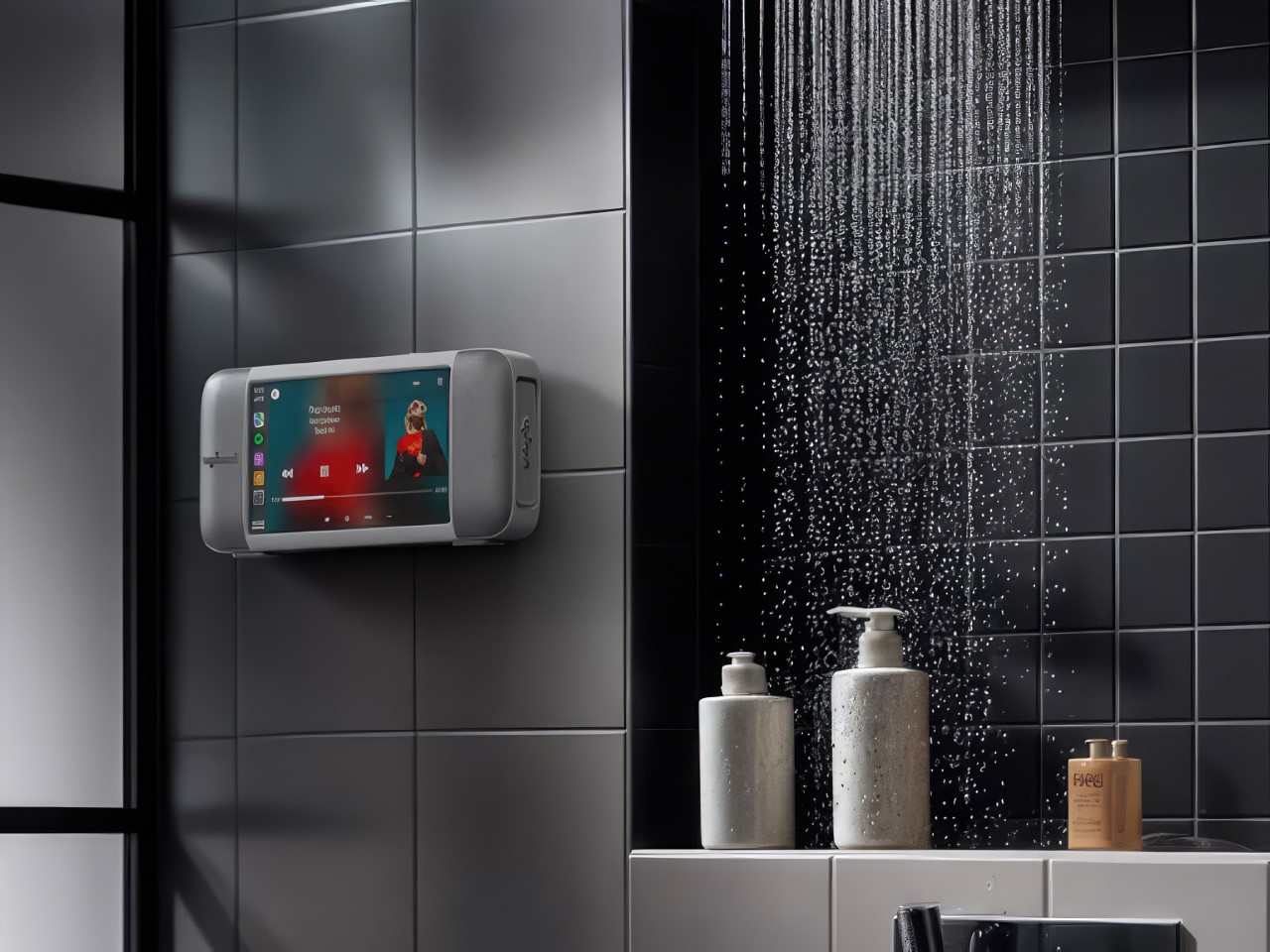
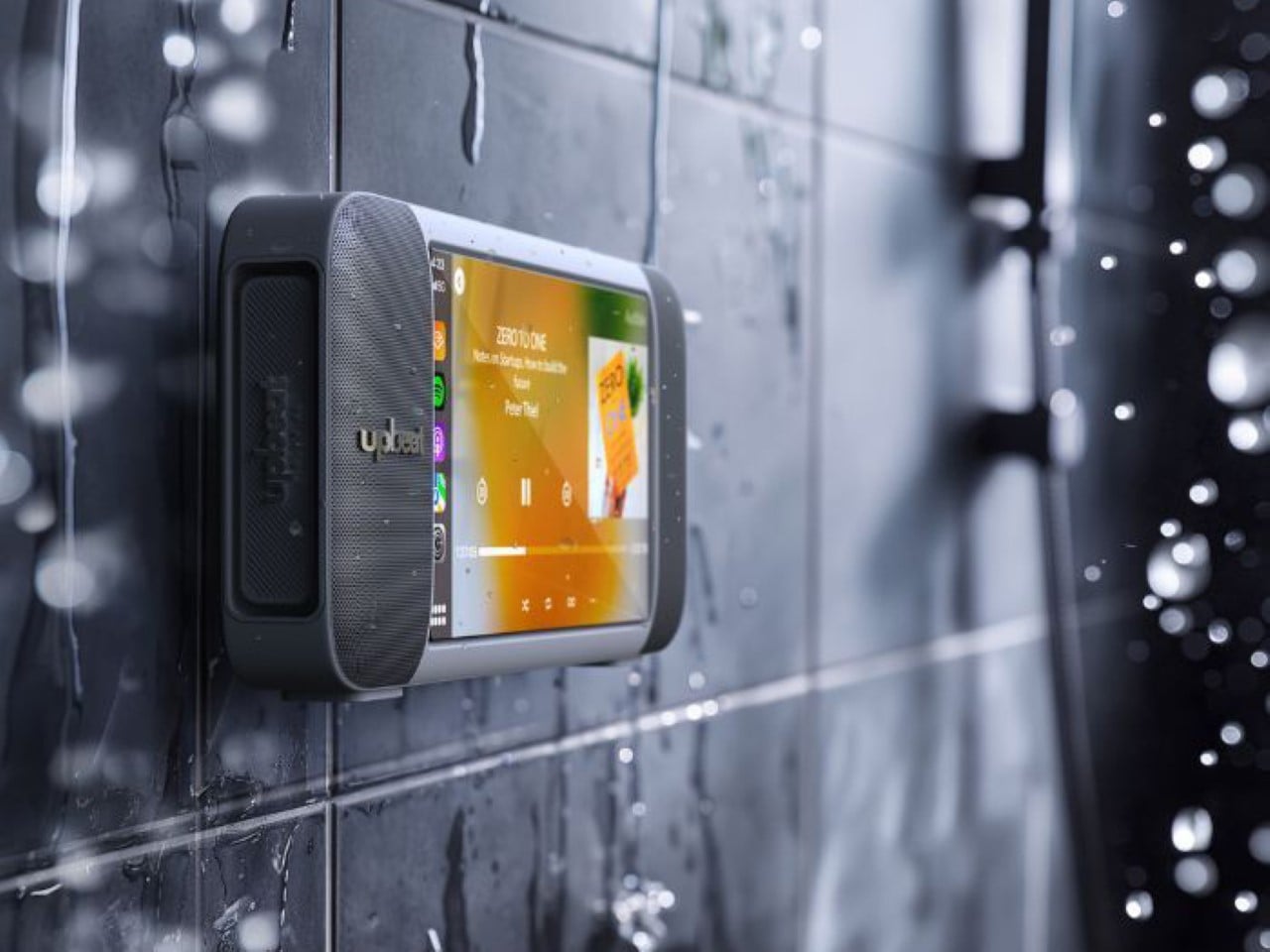
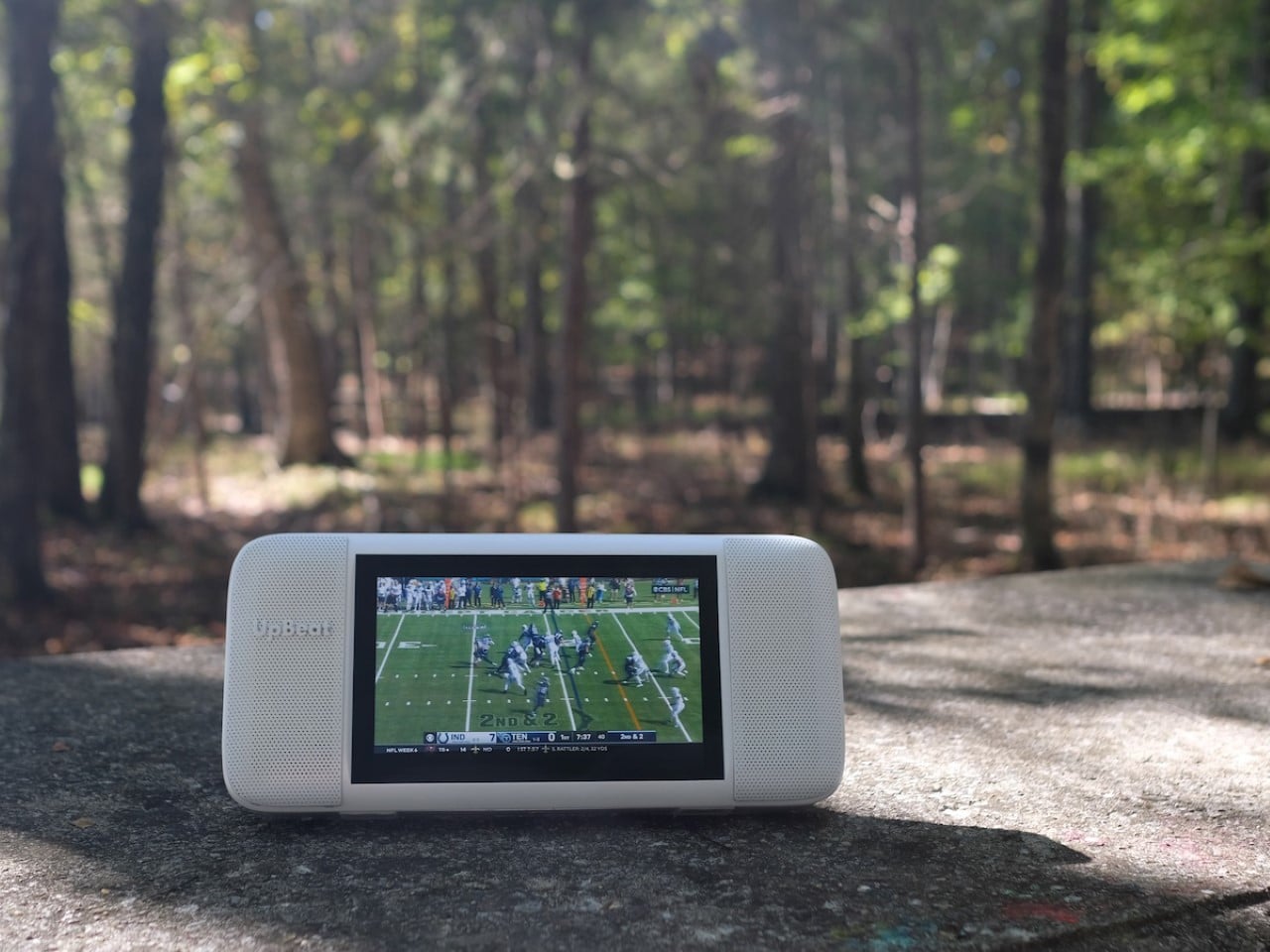
It’s a tablet PC, a shower speaker, your car’s infotainment system, and a portable dashboard for everything from music to video to phone calls. Meet the Nomad – a tablet-speaker that isn’t designed for productivity… it’s designed for entertainment. With a powerful speaker system, a waterproof design, and mounts that let you place the Nomad anywhere, this device doubles as your shower speaker, your smart display, a Carplay/Android Auto-compatible infotainment system, a dedicated device for Netflix and Chill whether it’s in the bedroom, living room, or poolside, and even your perfect radio alternative when you’re camping. For ages, tablets have grown thinner and their speakers weaker… and smart speakers have remained tethered to their plug points. Nomad combines both in a durable, portable package so you can carry your entertainment with you, without compromising on literally anything.
The Nomad isn’t a tablet. It isn’t a speaker. It isn’t a smart home hub like the Echo Show or the Pixel Tablet. It’s a little of everything, combined into one product that offers zero compromises if you know what you’re buying it for. It’s designed purely for entertainment, which means that sleek, laptop-bag-friendly profile is a non-issue. The device is rugged, doesn’t compromise on audio quality, and is made to be used everywhere, from in your shower to your car.
With its waterproof build and four-speaker array, the Nomad was crafted with audio at its core. This device excels as a portable entertainment hub, with an audio quality that outshines any tablet’s built-in speaker system—be it the shower, the backseat of a car, or your outdoor adventures. The 4 front-facing speakers and 2 subwoofers on the side deliver rich, resonant sound (at up to 94 decibels) that rivals traditional portable speakers. Combined with a battery life of over 20 hours for music playback, the Nomad is set to keep the party going without frequent recharges.
On the inside, the Nomad runs on Android, which means it’s ready for all your favorite streaming apps, plus it has a microSD slot for expanding storage and loading up on offline content. The 8-inch HD touchscreen has a striking brightness level of 1200 nits, 20% brighter than the iPad Pro which shines at 1000 nits, making it perfect for outdoor use. The display is responsive, has an anti-glare coating, and complements the overall build of the device—it’s rugged yet refined, a rare find in tablets with a focus on durability.
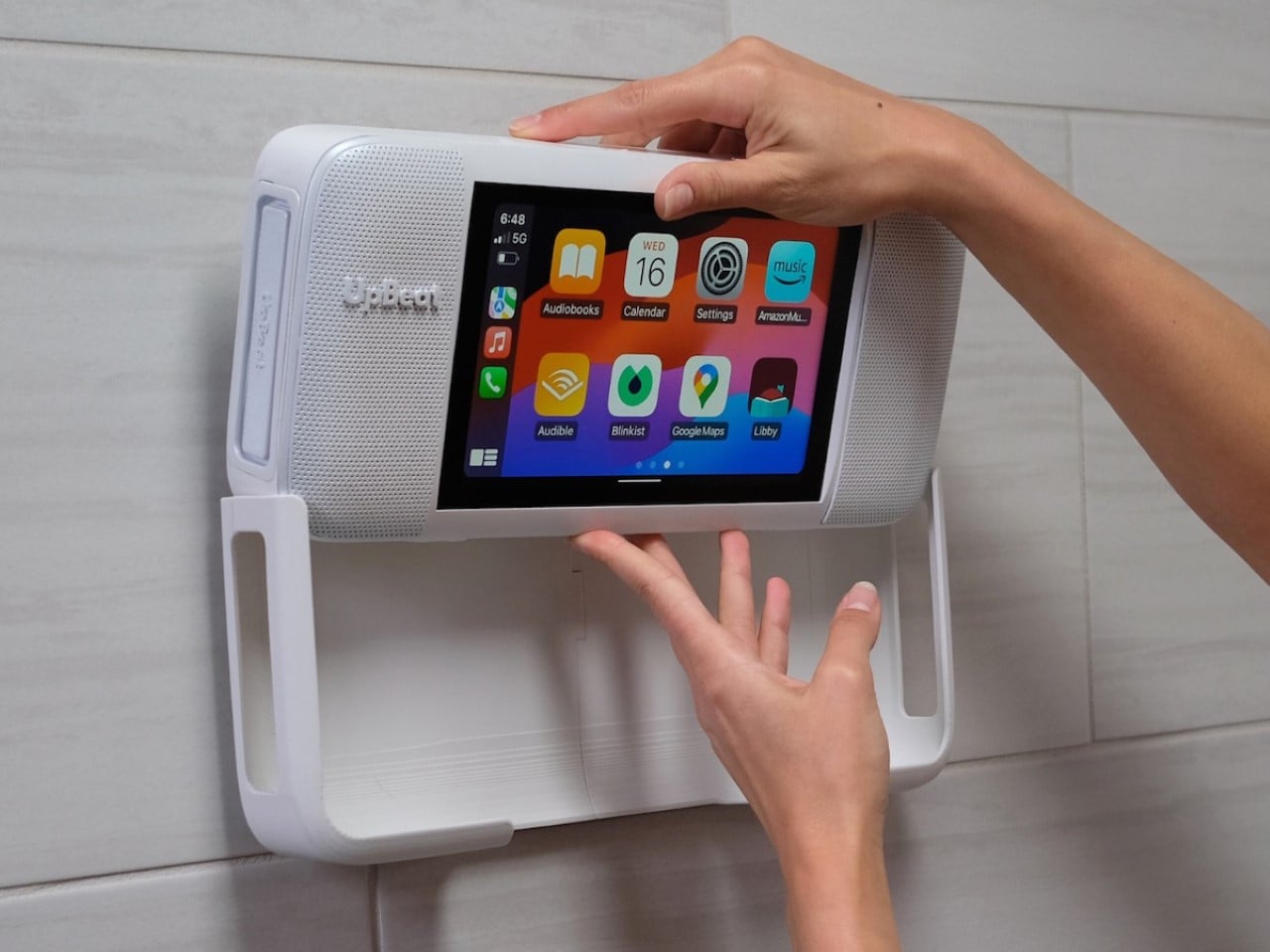
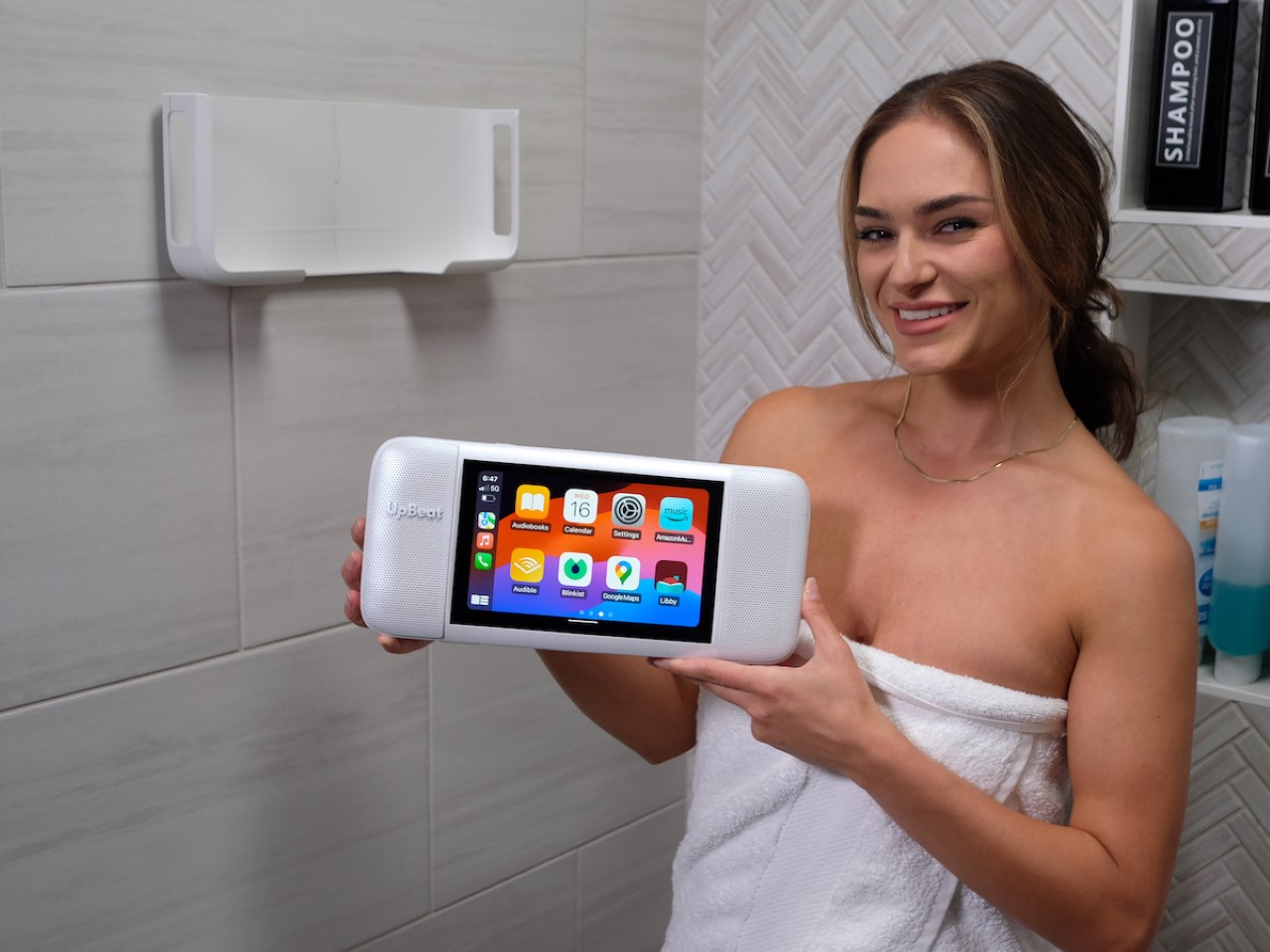
The stick-on Shower Mount lets you easily dock and use your Nomad while in the shower
The built-in speaker is supplemented by microphones too, which means the tablet lets you interact with voice assistants, leave voice notes, or even take phone calls. That’s where the powerful speakers come in handy, allowing you to talk without cupping your ear to hear what the other person is saying. If you want to have a private conversation, just connect Bluetooth earbuds, or better still, use the 3.5mm jack on the Nomad to hook up your wired headphones. The only thing missing is an on-board camera, which means no photographs or even video calls.
Mounting options for the Nomad extend its functionality even further. It comes with a shower wall mount, which lets you easily slip the Nomad in while having a bath. The tablet is fully usable while bathing, so whether you’re watching a TV show or hosting your own bathroom karaoke, the Nomad lets you stay in control, unlike your phone or your Bluetooth speaker, which won’t go in the shower with you.
Outside the shower, a built-in kickstand lets you prop the Nomad up wherever you are. If you want to tether the tablet to a tree or the back of your car-seat for in-car entertainment, the tablet comes with a strap-on mount too. An optional add-on cup-holder mount lets you bring the tablet to the front seat, substituting your in-car radio or music player. When all fails, a tripod mount on the bottom lets you screw a tripod in, allowing you to position your tablet practically anywhere. And since it’s fully waterproof, you don’t have to worry about splashes or moisture damaging the device.
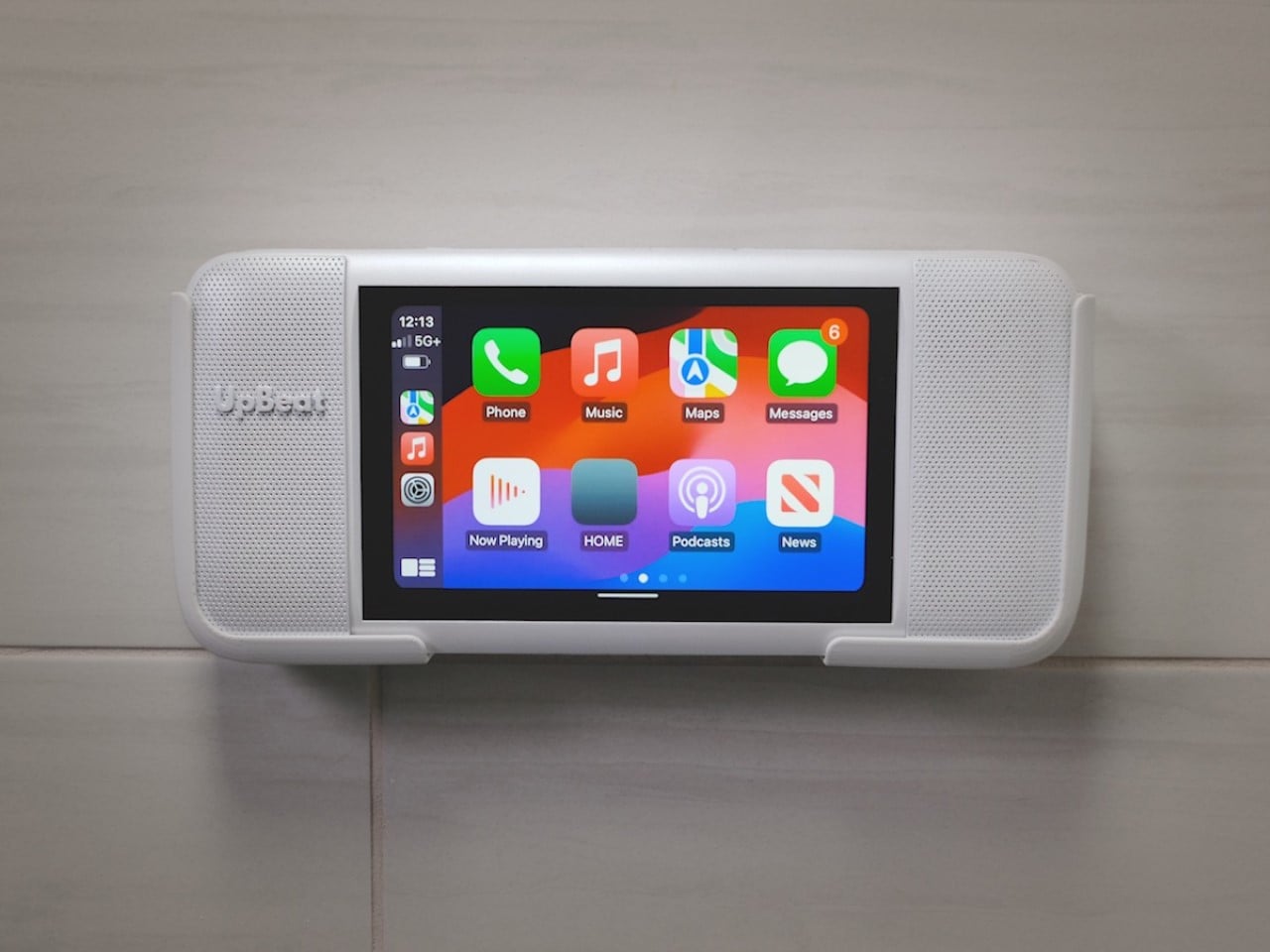
For in-car use, you’ve got built-in Android Auto and CarPlay compatibility, a standout feature that elevates the Nomad from a mere tablet to a full-fledged navigation and media console for your car. CarPlay integration makes the device invaluable for on-the-go use, especially if you prefer your tech streamlined and multipurpose. Mount it on a dashboard, and you have an instant navigation system paired with immersive sound quality, all accessible through the Android interface that many users will find familiar and easy to navigate.
Under the hood, the Snapdragon 662 processor keeps the Nomad humming along smoothly. Sure, it’s not the latest SoC on the market, but in a rugged device focused on reliability and battery efficiency, the Snapdragon 662 is a solid choice that provides a good balance of performance and energy efficiency. You’ll find it more than capable for streaming, navigation, and even some light gaming if the mood strikes. Although the exact battery capacity isn’t mentioned, the Nomad delivers 20 hours of audio on a full charge, and can be doubled thanks to an optional magnetic battery that snaps right on top, bringing its output to 40 hours of music, or 10 full hours of video. Both the tablet and the magnetic battery have USB-C charging, which means you can charge your Nomad anywhere.
The basic bundle starts at $249, which includes the Nomad itself along with the shower mount. The $340 Ultimate Bundle gets you all the other accessories too, like the strap-on mount, the cup mount, and that snap-on magnetic battery. No matter which bundle you pick, the Nomad ships globally, starting February 2025.
The 9th-gen iPad has fallen to $200 for Black Friday. Considering the regular price for this model was $330 at its peak, this is a great discount. This is a tablet Apple first released back in 2021, so it’s getting a bit long in the tooth. The 10th-gen iPad is Apple’s official “budget” tablet, as the 9th-gen will ultimately be phased out. But it’s still a fantastic machine, particularly for the price, particularly if you’re dead-set on getting an iPad but have little to spend.
This is a relatively ancient tablet with an equally ancient A13 Bionic chip. This isn’t the best iPad to buy for those looking for raw power. However, it’s the perfect tablet for those who want a media consumption machine on the cheap. Netflix in bed? Sign me up.
This sale is for the 64GB model and doesn’t apply to the 256GB version. The 9th-gen tablet is being discontinued, so it’s highly likely this is the last chance to pick one up at this price. Once the stock is gone, it’s all over.
This article originally appeared on Engadget at https://www.engadget.com/deals/apple-black-friday-deals-discount-the-9th-gen-ipad-to-a-record-low-of-200-161404354.html?src=rss
The 9th-gen iPad is on sale via Amazon for only $200. That’s a fairly substantial discount of 39 percent, as the regular price for this model is $330. The deal applies to both the dark gray and silver colorways.
This is a tablet Apple first released back in 2021, so it’s getting a bit long in the tooth. However, it’s still a fantastic machine, particularly for the price. We called it a “nice upgrade” in our official review. The battery life is on point, the screen is crisp and the performance is snappy. It’s an iPad.
This is a relatively ancient tablet with an equally ancient A13 Bionic chip. This isn’t the best iPad to buy for those looking for raw power. However, it’s the perfect tablet for those who want a media consumption machine on the cheap. Netflix in bed? Sign me up.
This sale is for the 64GB model and doesn’t apply to the 256GB version. The 9th-gen tablet is being discontinued, so it’s highly likely this is the last chance to pick one up at this price. Once the stock is gone, it’s all over.
This article originally appeared on Engadget at https://www.engadget.com/deals/black-friday-deals-include-the-9th-gen-ipad-for-a-record-low-of-200-161404147.html?src=rss
Amazon's new Kindle lineup features the first color Kindle, a revamped Scribe for notes, and the fastest Paperwhite yet, enhancing the reading experience.