Segway’s Navimow brand unveiled a new line of robotic lawn mowers at CES 2026

Segway, the maker of Steve Wozniak's favorite mode of self-balancing transport, has released a new series of robotic lawn mowers under its Navimow brand, designed for all manner of Roomba-esque mowing action. The lineup includes four residential series and was unveiled at CES 2026.

Navimow's lineup includes the flagship X4 Series for large yards up to 1.5 acres in size. Its AWD system can handle slopes up to 40 degrees and it sports dual 180-watt cutting motors. The largest mode, the X450 will retail for $3,000. A smaller X430 rated for yards up to 1 acre will go for $2,500.

The Navimow i2 series comes in AWD and LiDAR variants and is designed for "everyday" lawn maintenance. The AWD variant's three-wheel-drive system can handle 24-degree slopes and is designed to handle muddy or slippery terrain. The larger i2 AWD model, called the i210 AWD is rated for yards up to a quarter-acre in size, and will retail for $1,300. A smaller model dubbed the i206 AWD can handle yards as large as 0.15 acres and will go for $1,000.

The i2 LiDAR variant can scan 200,000 points per second to create a detailed spatial map of your yard, allowing it to navigate complex paths and, crucially, work at night. That model is rated for yards up to 0.37 acres in size. Pricing has not been announced for the i215 LiDAR model.

Finally, the H2 series features three vision technologies integrated into one model, with LiDAR, Network RTK and cameras combining into what Navimow is calling LiDAR+. The H2 is built for slopes up to 24 degrees and can handle yards up to half an acre in size. The H2 is being released in two models. The H210 for yards up to 0.25 acres, and the H220 for half-acre yards. Pricing for the H2 series has not been released yet.

The i2 AWD Series and the X4 Series will be available for pre-order beginning January 16.

This article originally appeared on Engadget at https://www.engadget.com/home/smart-home/segways-navimow-brand-unveiled-a-new-line-of-robotic-lawn-mowers-at-ces-2026-130007014.html?src=rss
Ugreen launches a smart home security platform at CES

Ugreen makes plenty of things, but you’re probably familiar with the name in the context of its NAS systems (should that be NASes? Who knows). Naturally, the company has turned up to CES 2026 with the former, but it’s also branching out into home security. It’s announcing SynCare, an AI infused all-in-one surveillance platform which, it rather boldly claims, will become an “attentive, integrated guardian” of your home.

Leading the pack is the SynCare Video Doorbell with head-to-toe 4K video, intelligent detection and 24/7 recording — especially if you’ve got it hooked up to your Ugreen NAS. That works in tandem with SynCare cameras offering 4K video on a pan-tilt base and, of course, AI to recognise “people, pets and key events.” Ugreen is also offering a tablet, the SynCare Smart Display, a “home hub” to let you manage your cameras from a single place in your home. 

The company is quick to highlight the major benefit of an at-home system like this, which is no need to pay for a monthly subscription. And, of course, that the footage from your home stays inside your home at all times, making it a better option for those folks who value their privacy. Sadly, Ugreen isn’t ready to share pricing or availability information for the series, saying it’ll be available in the back end of 2026.

This article originally appeared on Engadget at https://www.engadget.com/wearables/ugreen-launches-a-smart-home-security-platform-at-ces-130000389.html?src=rss

Meta has delayed the international rollout of its display glasses

Meta is pausing release of its Ray-Ban Display smart glasses to the UK, France, Italy and Canada due to "unprecedented demand and limited inventory," the company said on Monday at CES 2026. There's no new date for the expansion that was originally set for early 2026. "We'll continue to focus on fulfilling orders in the US while we re-evaluate our approach to international availability," Meta wrote on its blog.

Since Meta's display glasses first went on sale, acquiring them has been a challenge. They're not available online and can only be found in a limited number of retail outlets including select Ray-Ban, Sunglass Hut, LensCrafters and Best Buy locations in the United States. To buy them, you need to book an appointment for a demo at one those stores via Meta's website. Ahead of launch, Meta said it saw "strong" demand for demos with locations booked ahead for several weeks. 

There was optimism that availability would increase as the company expected buying options to "expand" the longer they were on sale. However, with the delay of the planned international launch, it appears that the company still has a mismatch between supply and demand. 

Meta's $799 Ray-Ban Display glasses are its first to incorporate a heads-up display and are also equipped with a camera, stereo speakers, six microphones, WiFi 6 and a finger tracking Neural Band controller. In her review, Engadget's senior reporter Karissa Bell noted that the Ray-Ban display "enables wearers to do much more than what's currently possible with [other] Ray-Ban or Oakley models" — provided you don't mind the look of the chunky, chunky frames. 

This article originally appeared on Engadget at https://www.engadget.com/social-media/meta-has-delayed-the-international-rollout-of-its-display-glasses-120056833.html?src=rss

Meta has delayed the international rollout of its display glasses

Meta is pausing release of its Ray-Ban Display smart glasses to the UK, France, Italy and Canada due to "unprecedented demand and limited inventory," the company said on Monday at CES 2026. There's no new date for the expansion that was originally set for early 2026. "We'll continue to focus on fulfilling orders in the US while we re-evaluate our approach to international availability," Meta wrote on its blog.

Since Meta's display glasses first went on sale, acquiring them has been a challenge. They're not available online and can only be found in a limited number of retail outlets including select Ray-Ban, Sunglass Hut, LensCrafters and Best Buy locations in the United States. To buy them, you need to book an appointment for a demo at one those stores via Meta's website. Ahead of launch, Meta said it saw "strong" demand for demos with locations booked ahead for several weeks. 

There was optimism that availability would increase as the company expected buying options to "expand" the longer they were on sale. However, with the delay of the planned international launch, it appears that the company still has a mismatch between supply and demand. 

Meta's $799 Ray-Ban Display glasses are its first to incorporate a heads-up display and are also equipped with a camera, stereo speakers, six microphones, WiFi 6 and a finger tracking Neural Band controller. In her review, Engadget's senior reporter Karissa Bell noted that the Ray-Ban display "enables wearers to do much more than what's currently possible with [other] Ray-Ban or Oakley models" — provided you don't mind the look of the chunky, chunky frames. 

This article originally appeared on Engadget at https://www.engadget.com/social-media/meta-has-delayed-the-international-rollout-of-its-display-glasses-120056833.html?src=rss

Meta’s EMG wristband is moving beyond its AR glasses

Meta has been experimenting with EMG technology for years. In 2025, the company commercialized it for the first time in its Meta Ray-Ban Display glasses, which users control via a dedicated neural band that is able to interpret subtle muscle movements in the wrist.

Now, at CES 2026, the company is offering its first look at how its neural band could be used to control devices outside of its smart glasses lineup. Meta has teamed up with Garmin, as well as a handful of research partners, to explore some intriguing use cases for its wrist-based controller.

The social media company has previously worked with Garmin on fitness integrations for its glasses. But at CES, the companies were showing off a very early demo of how Meta's neural band inside of a car to control the built-in infotainment system. 

The experience is part of Garmin's "Unified Cabin" concept, which explores a bunch of AI-centric in-car experiences. The demo I tried was fairly limited: while wearing a neural band, I was able to navigate two apps on a touchscreen display in Garmin's cockpit setup. In one, I used pinch and swipe gestures to manipulate an onscreen model of a car, much like how I would use the band to zoom in and out of an image while wearing the display glasses. The second demo, somewhat bizarrely, was a game of 2048. I used the same swipe gestures to move the tiles around. 

Neither of those are the kinds of experiences you immediately think of when you imagine "in-car entertainment," but Garmin, which works with a number of major car brands on infotainment systems, seems to be thinking about some more practical use cases too. The company told me that it will explore using the neural band to control vehicle functions like rolling down windows or unlocking doors. 

Elsewhere, Meta also announced a research collaboration with the University of Utah that will explore how its EMG tech can be used to help people who have ALS, muscular dystrophy and other conditions that affect the use of their hands.

Researchers will work with Meta to test gestures that could enable people to control smart speakers, blinds, thermostats, locks and other household devices using the neural band.  "Meta Neural Band is sensitive enough to detect subtle muscle activity in the wrist — even for people who can’t move their hands," the company explains in a blog post. Researchers will also look at using the band for mobility use cases, like the University of Utah's TetraSki program, which currently uses a joystick or mouth-based controller to help participants ski.

This article originally appeared on Engadget at https://www.engadget.com/wearables/metas-emg-wristband-is-moving-beyond-its-ar-glasses-120000503.html?src=rss

Meta’s EMG wristband is moving beyond its AR glasses

Meta has been experimenting with EMG technology for years. In 2025, the company commercialized it for the first time in its Meta Ray-Ban Display glasses, which users control via a dedicated neural band that is able to interpret subtle muscle movements in the wrist.

Now, at CES 2026, the company is offering its first look at how its neural band could be used to control devices outside of its smart glasses lineup. Meta has teamed up with Garmin, as well as a handful of research partners, to explore some intriguing use cases for its wrist-based controller.

The social media company has previously worked with Garmin on fitness integrations for its glasses. But at CES, the companies were showing off a very early demo of how Meta's neural band inside of a car to control the built-in infotainment system. 

The experience is part of Garmin's "Unified Cabin" concept, which explores a bunch of AI-centric in-car experiences. The demo I tried was fairly limited: while wearing a neural band, I was able to navigate two apps on a touchscreen display in Garmin's cockpit setup. In one, I used pinch and swipe gestures to manipulate an onscreen model of a car, much like how I would use the band to zoom in and out of an image while wearing the display glasses. The second demo, somewhat bizarrely, was a game of 2048. I used the same swipe gestures to move the tiles around. 

Neither of those are the kinds of experiences you immediately think of when you imagine "in-car entertainment," but Garmin, which works with a number of major car brands on infotainment systems, seems to be thinking about some more practical use cases too. The company told me that it will explore using the neural band to control vehicle functions like rolling down windows or unlocking doors. 

Elsewhere, Meta also announced a research collaboration with the University of Utah that will explore how its EMG tech can be used to help people who have ALS, muscular dystrophy and other conditions that affect the use of their hands.

Researchers will work with Meta to test gestures that could enable people to control smart speakers, blinds, thermostats, locks and other household devices using the neural band.  "Meta Neural Band is sensitive enough to detect subtle muscle activity in the wrist — even for people who can’t move their hands," the company explains in a blog post. Researchers will also look at using the band for mobility use cases, like the University of Utah's TetraSki program, which currently uses a joystick or mouth-based controller to help participants ski.

Update, Tuesday, January 6, 2026, 3:40PM PT: Added a video from garmin’s demo.

This article originally appeared on Engadget at https://www.engadget.com/wearables/metas-emg-wristband-is-moving-beyond-its-ar-glasses-120000503.html?src=rss

This speaker by Victrola sits underneath turntables and streams audio via Bluetooth

Noted turntable manufacturer Victrola just announced the Soundstage speaker at CES. This thin little doodad actually sits underneath turntables, removing the need for a full stereo set-up. The Soundstage isn't the first speaker that offers this functionality, but this one has tech-forward features.

It offers multiple connection options, including Bluetooth. Many newer Victrola turntables can do Bluetooth streaming, so adding this speaker to a setup would be extremely simple. Otherwise, companies offer Bluetooth receivers for turntables.

It also allows for traditional wired connections, and there's an option for USB-C. In other words, the Soundstage should easily connect to other audio sources like smartphones and computers. It even integrates with Auracast for multi-speaker setups.

A speaker.
Victrola

As for sound, Victrola promises superior audio thanks to a "vibration-isolated design." There's a specialized woofer for bass response and balanced mode radiators (a type of driver) for stereo separation. It likely won't sound as good as a full sound system but, again, think of all of those annoying wires.

The Soundstage will be available this summer and costs $350. There will be multiple colorways, including walnut and black.

This article originally appeared on Engadget at https://www.engadget.com/audio/speakers/this-speaker-by-victrola-sits-underneath-turntables-and-streams-audio-via-bluetooth-100021991.html?src=rss

Cambridge Audio unveils three wireless bookshelf speakers at CES

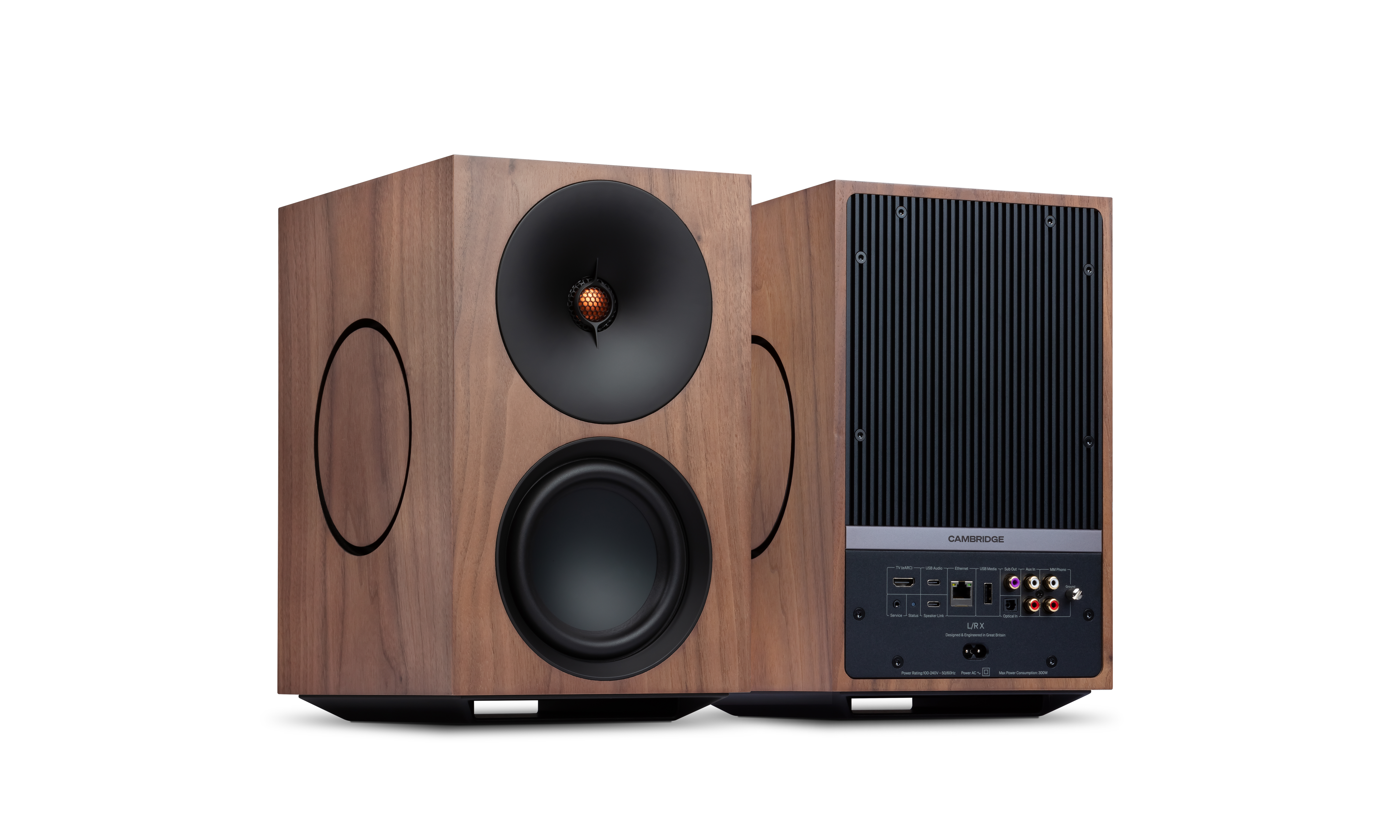
Cambridge Audio has three new active speakers at CES 2026. The L/R Series is a trio of active bookshelf-style speakers, each with wired and wireless modes.

The flagship L/R X is an 800W model (400W per speaker). The largest of the three, it unsurprisingly carries the highest price, at $2,299. It uses a 2.5-way acoustic design: a 28mm Torus tweeter alongside dual 5-inch woofers. The L/R X has a pair of 6-inch force-canceling passive radiators, a 64-bit audio pipeline, DynamEQ and Wi-Fi streaming (via Cambridge Audio's StreamMagic app). It even adds LED underlighting for an extra aesthetic touch.

The walnut variant of Cambridge Audio's new L/R X speaker
The walnut variant of the L/R X
Cambridge Audio

In the middle is the $1,599 L/R M. Cambridge Audio describes it as using the same foundations as the flagship model (including the 2.5-way acoustic design), but with only 300W of power. This model has smaller (4-inch) dual woofers alongside the same 28mm tweeter. Its smaller force-canceling passive radiators measure 4.75 inches each. Like the larger model, the L/R M supports Wi-Fi streaming and includes LED underlighting.

The smallest and most affordable of the three is the $549 L/R S. This 100W speaker pairs a 21mm hard-dome tweeter with a 3-inch long-throw woofer. Although you can save money on this model, you'll miss out on Wi-Fi streaming. (In its place is Bluetooth aptX HD.) It also lacks the LED underlighting found in the L/R X and L/R M.

Each speaker is available in black, white, green, blue, orange and walnut colors. Cambridge Audio says all three tiers of L/R speakers will be available "later in 2026." You can learn more at the company’s website.

This article originally appeared on Engadget at https://www.engadget.com/audio/speakers/cambridge-audio-unveils-three-wireless-bookshelf-speakers-at-ces-100000178.html?src=rss

NVIDIA announces DLSS 4.5 at CES 2026

Just like last year, NVIDIA has used some of its time on the CES stage to introduce an upgraded version of its real-time image-upscaling technology. The new DLSS 4.5 promises sharper visuals with the 2nd Generation Super Resolution Transformer, which the company says will deliver better temporal stability, reduced ghosting and improved anti-aliasing. The DLSS 4.5 also includes Dynamic Multi Frame Generation, which maximizes frame per second to monitor refresh rate, delivering up to 4K 240Hz path traced performance.

The 2nd Gen Transformer Super Resolution is available now for all RTX GPUs, while the Dynamic 6x Frame Generation will arrive some time in spring 2026 for the RTX 50 series. It will also be available for more than 400 games through the NVIDIA app.  

Another new feature is RTX Remix Logic, which allows real-time environmental reactions to in-game events. For instance, when a door is opened on screen, the NVIDIA tech can present changes to volumetric conditions, display different weather simulations with particles or alter materials. More than 30 different common events can be detected, and the RTX Remix Logic can make adaptations to volumetrics, particles, material properties and light properties.

NVIDIA noted that it now has native clients for both Linux and Fire TV. That's the roundup of major gaming updates from the company's CES presentation, but NVIDIA CEO Jensen Huang had plenty to talk about earlier today.

This article originally appeared on Engadget at https://www.engadget.com/gaming/nvidia-announces-dlss-45-at-ces-2026-053000128.html?src=rss

Agibot’s humanoid robots can give directions and learn your TikTok dances

For better or worse, CES 2026 is already shaping up to be a big year for humanoid robots. Chinese company Agibot showed up with two: the roughly human-sized A2 and the slightly smaller X2, both of which were displaying their surprisingly impressive dancing abilities. 

We watched both robots walk around, wave at passersby and show off their best moves. The larger A2 mostly kept its legs still and danced mainly with its arms. The smaller X2 on the other hand is a bit more nimble — it has a larger set of "feet" to give it more stability — and those abilities were on full display.

At the time we saw them, the robots were controlled partially by an Agibot rep using a dedicated controller, but the company told me the robots are able to move autonomously in spaces once they've been able to use their onboard sensors to map out their environmentThe company, which has already shipped several thousand robots in China and plans to make them available in the United States this year, says both the A2 and X2 are intended to provide a flexible platform so people can interact with the robots in a variety of situations.

Agibot envisions the larger A2 as a kind of hospitality helper robot that can greet visitors at museums or conferences (like CES) and provide directions or even walk alongside their human guests. 

The smaller X2 on the other hand could be suited for educational purposes or other scenarios when you might want a robot with slightly more human-like movements. It could even be a good TikTok companion, as Agibot's head of communications, Yuheng Feng explained to me. "Take a Tiktok video, for example, you can use that video to train the robot, [so] it can also dance exactly like you did in the video." 

The company hasn't given details on when its robots might show up in the US or how much they might cost. Feng told me a lot will depend on how companies want to use them because their hardware is able to be customized depending on the use case. For now, though, we'll just soak in the dance moves.

This article originally appeared on Engadget at https://www.engadget.com/ai/agibots-humanoid-robots-can-give-directions-and-learn-your-tiktok-dances-045049798.html?src=rss