Apple has officially announced its next major event, set to take place on September 9th, 2026, at the iconic Steve Jobs Theater in Cupertino, California. This highly anticipated event is expected to unveil the iPhone 18 Pro and Pro Max, alongside Apple’s first-ever foldable smartphone, the iPhone Ultra. Additionally, updates to Apple’s wearables, home devices, […]
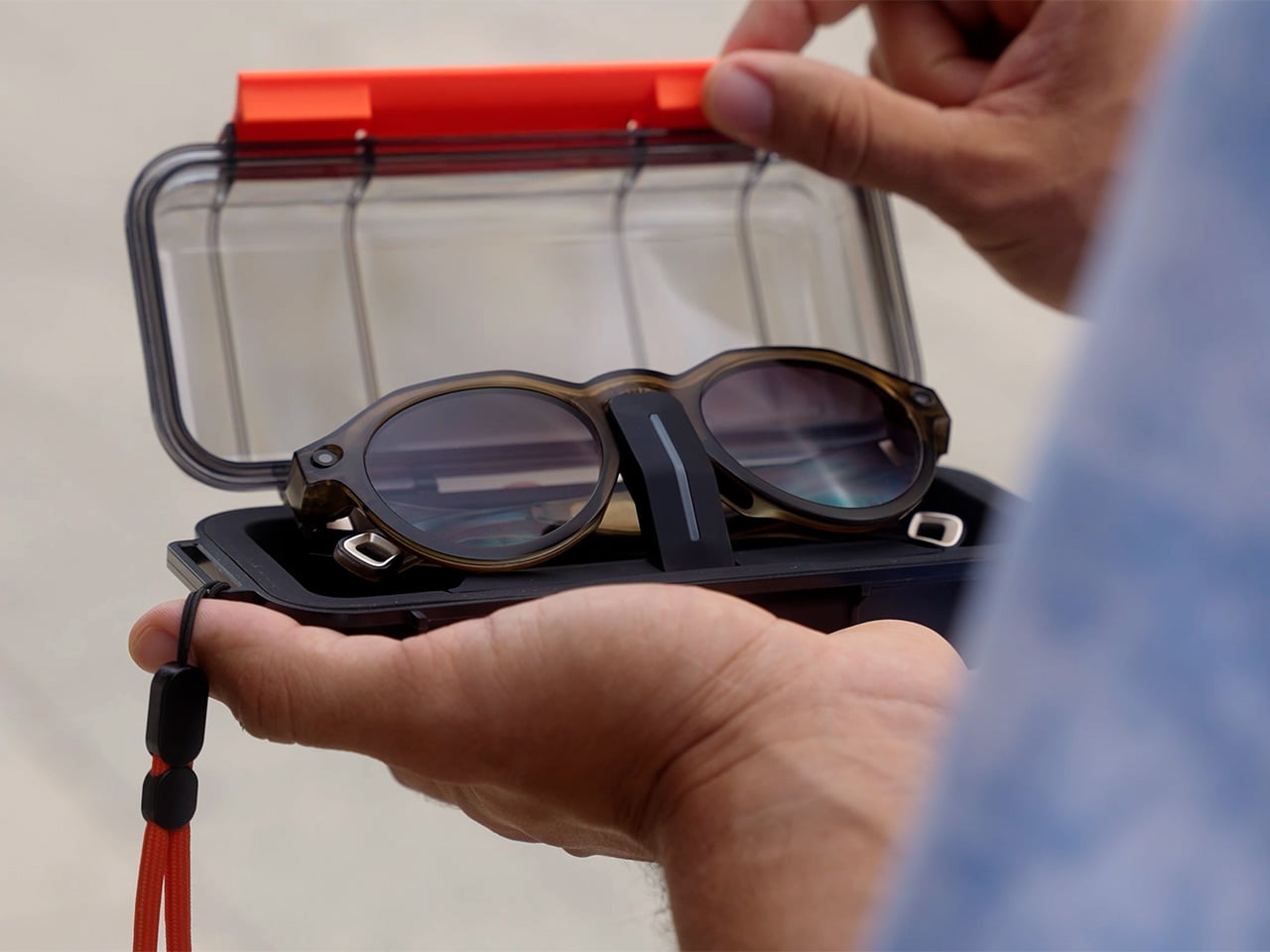
Le Corbusier wore round glasses. John Lennon wore round glasses. Several decades of architects, artists, and intellectuals who wanted to look like they read a lot wore round glasses. There is a long, slightly pretentious tradition attached to the panto and round frame silhouette, one that signals “considered, creative, European in a very specific mid-century way.” L’Atitude 52°N, the Berlin-based eyewear brand behind the Departure Collection, named their panto frame Milan for a reason, and they loaded it with a 12MP Sony camera, an AI assistant, and real-time translation into five languages before shipping it out the door.
Milan launches August 25th in the US and Europe, and the hardware it carries makes a more interesting case than the marketing copy would suggest. A 12MP Sony IMX681 sensor with a 107-degree ultra-wide field of view captures 1080p HD video and high-resolution stills, with a 6nm AI chip handling noise reduction, color processing, and exposure in real time. The Goya AI assistant manages music, calls, navigation, and battery checks by voice, while an AI Tour Guide feature uses the camera to visually identify landmarks and deliver 30-second expert commentary on demand. Live two-way translation covers five languages, all through the frame’s open-ear speakers and five-mic array. It comes in Olive and Obsidian from $399, with the photochromic lens option jumping that to $449.
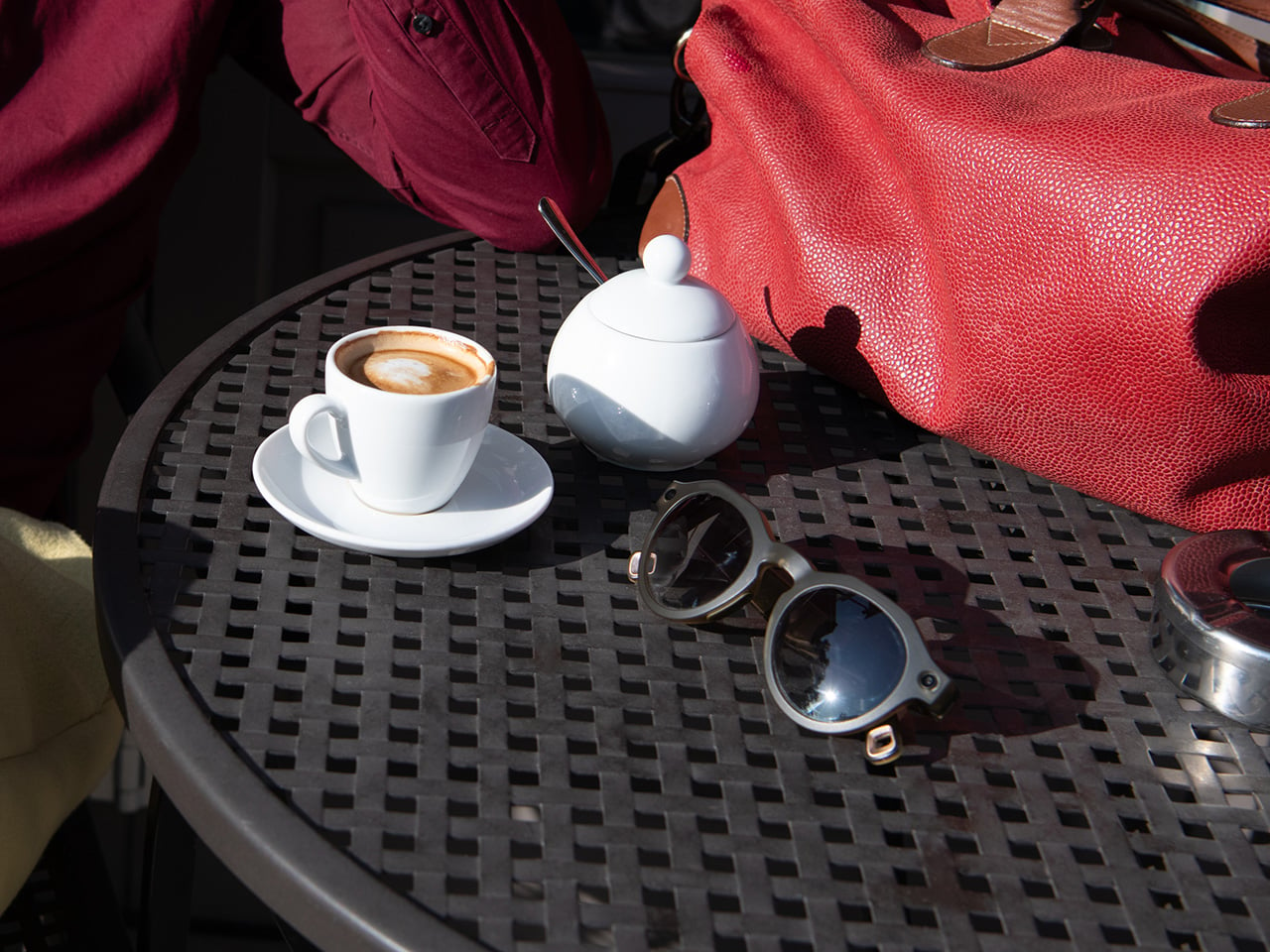
Milan’s matte finish and rounded panto silhouette exist in deliberate contrast to the BERLIN frame’s angular, navigator-coded geometry: BERLIN for a classic utility vibe, MILAN for culture. The EMS TR90 frame and self-adjusting temples bring the total to about 50 grams with lenses, genuinely light for a frame carrying cameras, microphones, speakers, and a 6nm AI processor inside it. Two colorways launch, Olive and Obsidian, each paired with gradient tinted or photochromic lens options that auto-adapt to changing light. Stainless steel spring hinges carry an ultra-wear-resistant nano technology coating tested over 20,000 cycles, three times harder than steel by L’Atitude 52°N’s own testing. IP65 sealing and a UV-hardened finish handle the elements, so the build is more rigorous than the silhouette lets on.
The Sony IMX681 sensor sits at the bridge with a 107-degree field of view that approximates natural peripheral vision reasonably well, and the 6nm AI processor handles real-time noise reduction, exposure calibration, and color enhancement so stills are usable without post-processing. Portrait and landscape modes are both supported, which matters for anyone managing content across platforms with different aspect ratio preferences. A tap on the frame or a “Hey Goya” voice command triggers capture, keeping hands free and the moment intact. 32GB of onboard storage holds everything locally until you sync via the companion app. The 1080p video ceiling is the one number that will catch attention from anyone shopping around, given that rival frames at lower price points are already delivering higher resolutions.
The AI Tour Guide uses the camera’s visual recognition to identify landmarks and artworks, delivering 30 seconds of expert commentary after a tap or voice trigger. Live Translation handles two-way voice conversation in English, German, French, Italian, and Spanish, with each session running up to five minutes before auto-closing. General Goya tasks work hands-free via the “Hey Goya” wake phrase, covering navigation, music, battery status, call management, and quick Q&A. All of it runs directly through the glasses without needing to pull out your phone or break the flow of whatever you are doing. A group communication Intercom Strap accessory is also in development, which will add offline mesh-networked voice chat with up to eight people simultaneously.
Open-ear stereo speakers and a five-microphone array handle audio in both directions, with AI noise reduction keeping voice commands readable even in crowded environments. Privacy is handled with more care than most of the category bothers with: photos and videos live locally on the device and are deleted after syncing to your phone, and Goya AI interactions leave nothing stored in the cloud. A physical LED on the frame lights up whenever recording is active, and covering it stops the camera immediately, audio included. Milan is built for GDPR compliance, which reflects the brand’s German roots and resonates with European buyers especially. Wi-Fi 6 and Bluetooth 5.4 handle connectivity, and the 200mAh battery delivers up to six hours of mixed use, with an IP67-rated charging case offering eight to ten full top-ups and a 20-minute fast-charge to 70%.
At $399 base and $449 with photochromic lenses, Milan is priced at the premium end of what is now a genuinely crowded field, with strong hardware available at lower price points from several well-funded players. The value case lives in design and privacy architecture rather than raw specs. The panto silhouette is more considered and more wearable than most competing frames, and the local-only media storage model is among the tightest privacy implementations shipping in this category today. Six hours of mixed-use battery is workable for a day out, but worth factoring in for anyone planning longer trips. The AI feature set is a meaningful differentiator, particularly for solo travelers navigating unfamiliar cities who would otherwise juggle translation apps, maps, and camera apps simultaneously.
Milan is available from August 25th on the L’Atitude 52°N website, with pre-orders placed before that date qualifying for a $50 discount. Gen 1 Departure Collection buyers, covering both BERLIN and MILAN, get full access to Goya AI features out of the box, including Voice Activation, AI Tour Guide, Live Translation, and AI Image Recognition, with no subscription required. L’Atitude 52°N has committed to giving users advance notice of any changes to that access model. The smart glasses space is genuinely crowded in 2026, with major players from tech and fashion all competing for the same audience. Milan’s answer is a panto frame, a matte finish, and a camera that asks you to simply look at the thing you want to remember. Le Corbusier would probably have approved, and he was notoriously difficult to impress.
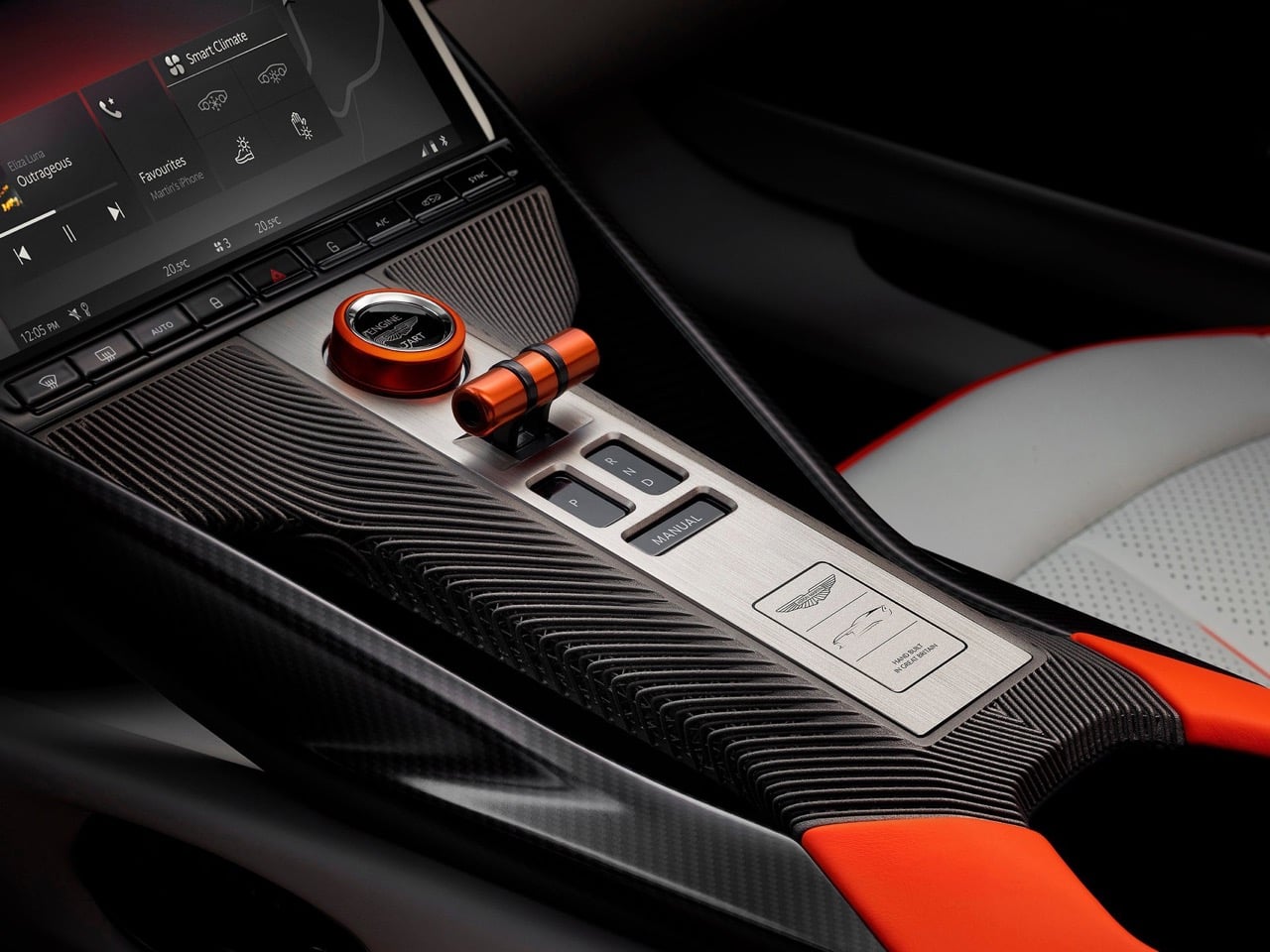
Aston Martin’s new supercar reminds it of, and it was not a Vantage. It was a Mustang. Or a Camaro, depending who you ask on which forum. That is a wild sentence to type about a British V12 GT that costs more than most houses, but here we are, because the Valen swapped Aston’s usual oval headlamps for hooded, horizontal DRL bars that genuinely do look like they escaped from Dearborn. I get the pearl clutching. I also think the internet is only half right, and the other half of the story is way more interesting than a meme.
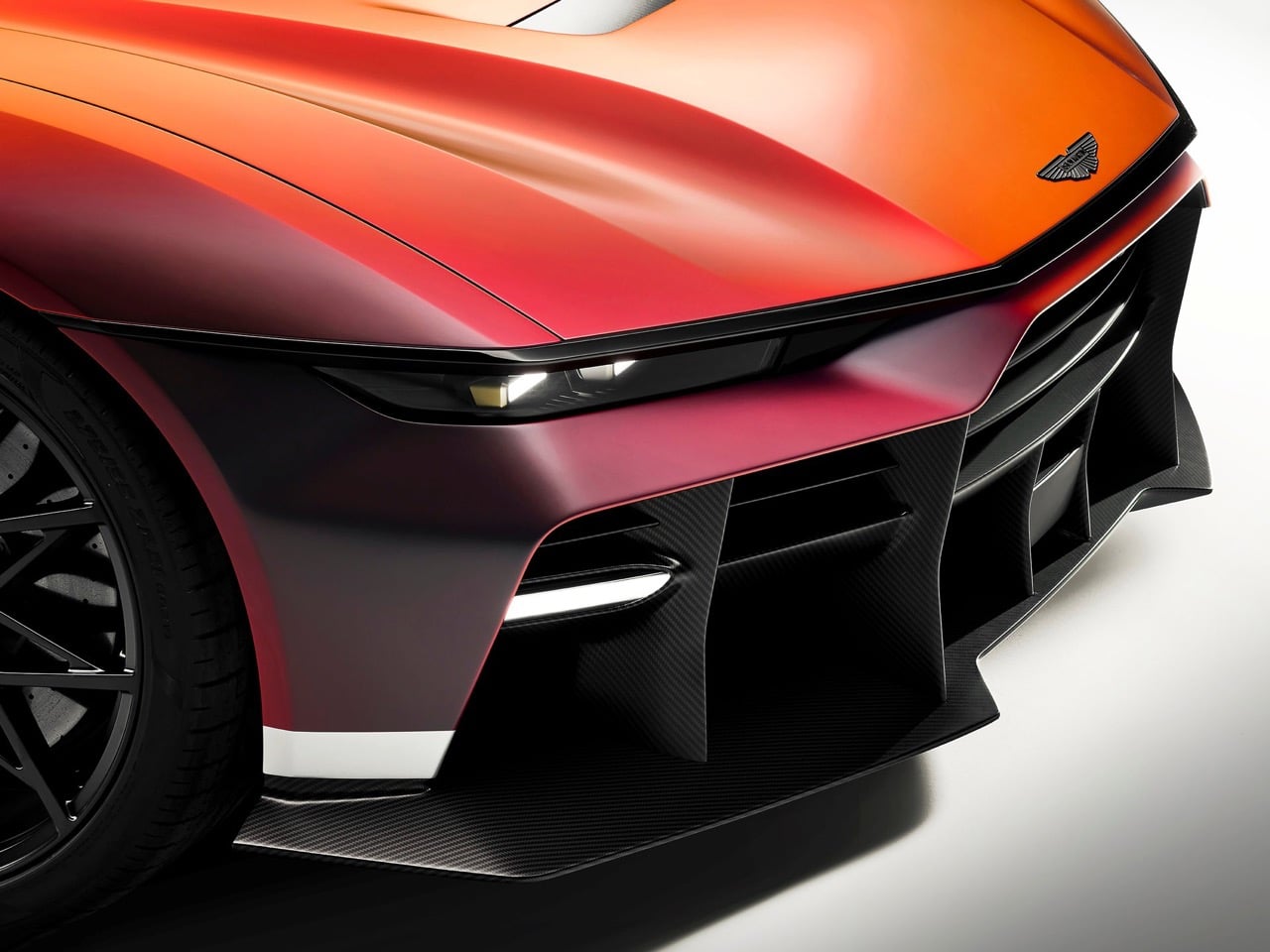
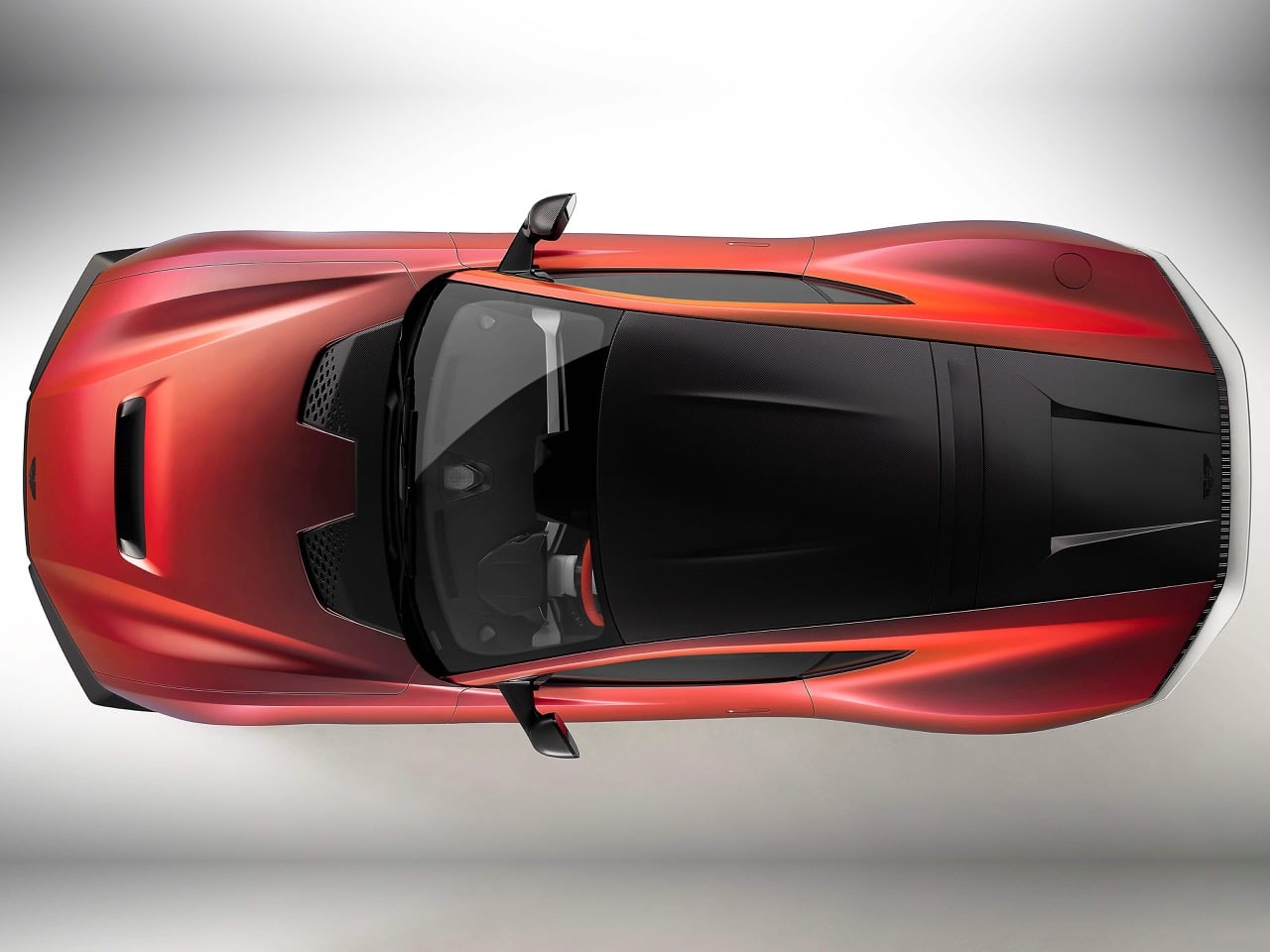
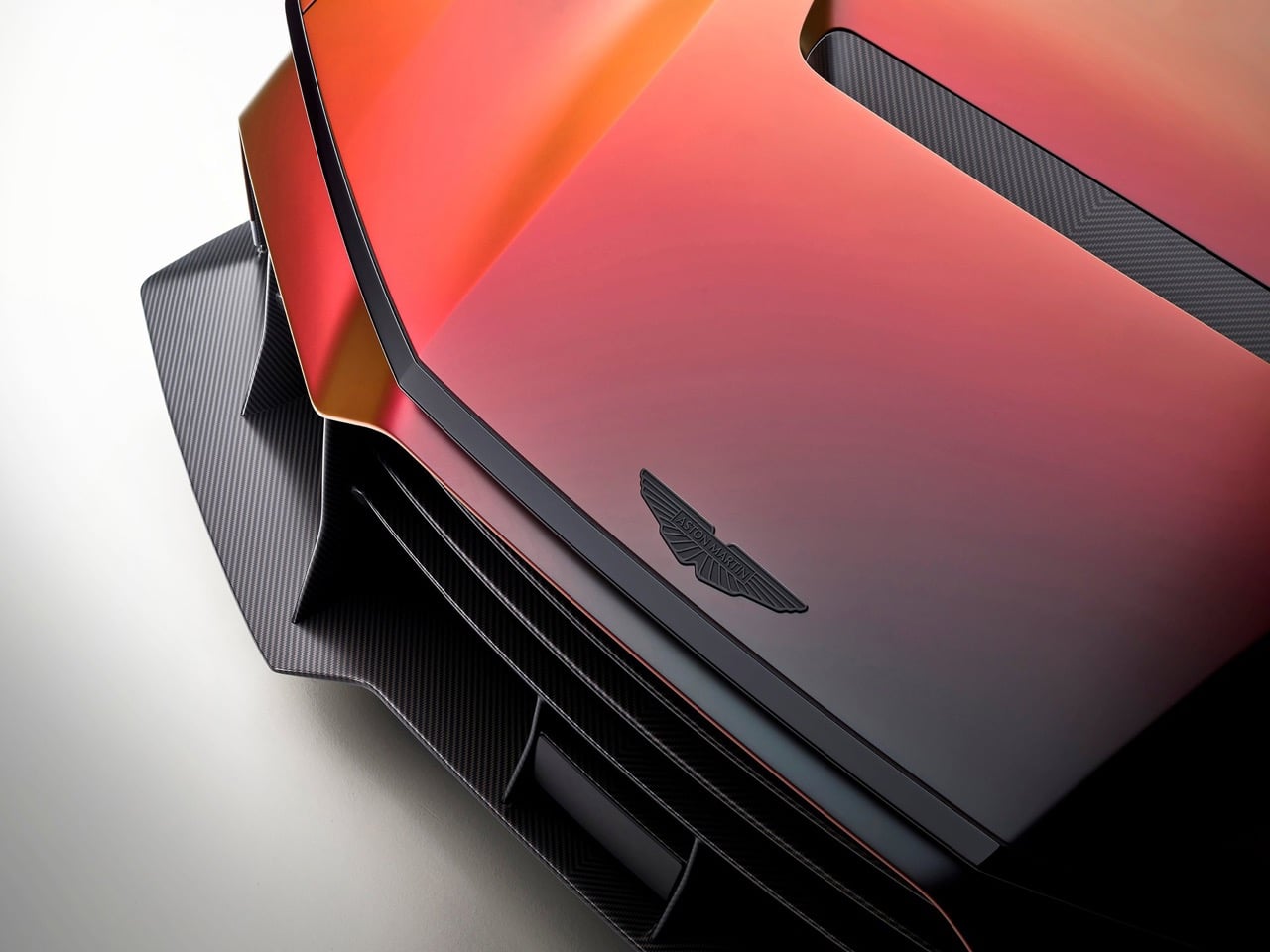
Because while everyone was busy roasting the front end, almost nobody was talking about the paint, which might be the single best thing Aston Martin has ever sprayed onto a car. Satin Andromeda Red shifts from deep red into copper and gold before dipping into blue undertones, using Chromaflair pigment tech that keeps shifting even in low light. There is also no rear window, but we will get to that. First, let us talk about why a supercar with a hood ornament for a face somehow still looks incredible in the metal.
The Mustang comparisons are not baseless, and pretending otherwise does nobody any favors. Deeply recessed slimline headlamps sit hooded under a plunging bonnet edge, the daytime running lights stretch into a horizontal bar, and the grille motif runs almost to the corners of the fascia instead of sitting in its usual trapezoid box. That is a genuinely different grammar for Aston, a brand that has built its entire visual identity around a vertical, jewel-like nose since the DB9. Horizontal light bars and hooded lamps have become the default vocabulary for aggressive front ends across the industry, from pony cars to hypercars, and Aston just adopted it wholesale. The result looks fantastic in isolation. It also looks less like an Aston Martin than anything the brand has built in years, which is either the whole point or the whole problem, depending on how attached you are to the marque’s design DNA.
Reichman has more or less admitted as much. He describes the Valen as a chance to explore more extreme emotions through a new form language, and Robb Report reported the design studio’s moodboard was headed with four words: ruthless, ominous, experimental, alter ego. That is an unusually blunt brief for a company that spent a century being polite about horsepower, and it explains why the Valen’s face reads as confrontational rather than refined. Aston did not stumble into looking aggressive. The team built a car specifically designed to provoke a reaction, and judging by the forum threads, it is working exactly as intended.
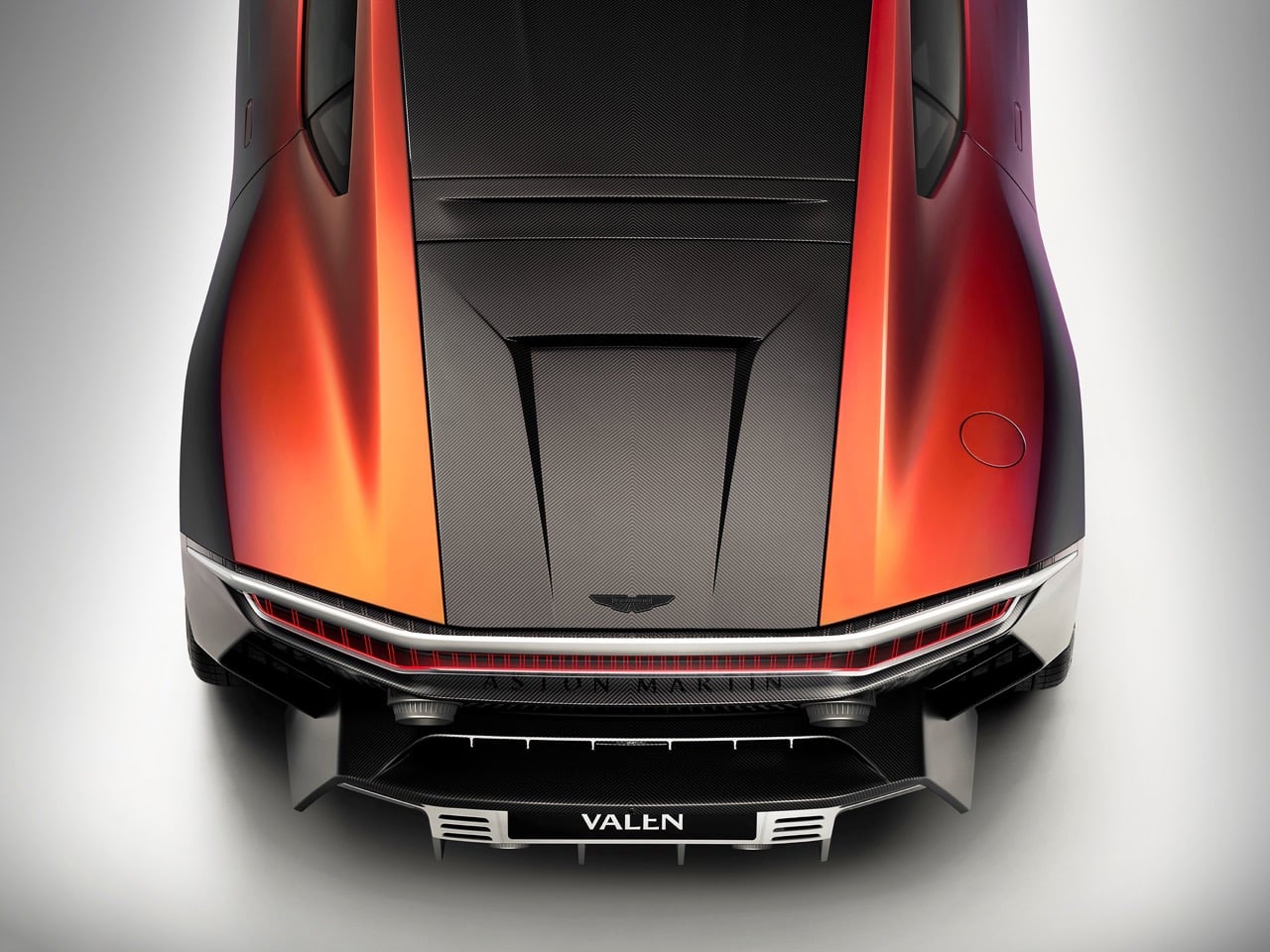
Then there is the paint, and honestly, this is where I think the Valen earns its price tag. Satin Andromeda Red is a bespoke Q Ultra color built on Chromaflair pigment technology, shifting from deep red through copper and gold before settling into intense blue undertones depending on the angle and the light hitting it. Most automotive paint is static. This one behaves like it has moods, holding that color shift even in low light environments rather than needing direct sun to perform. Pair it with the option of a fully exposed carbon body, herringbone weave running down the centerline and tintable in custom satin or gloss finishes, and Aston has built one of the more technically interesting finish options on any current production car, muscle car face or not.
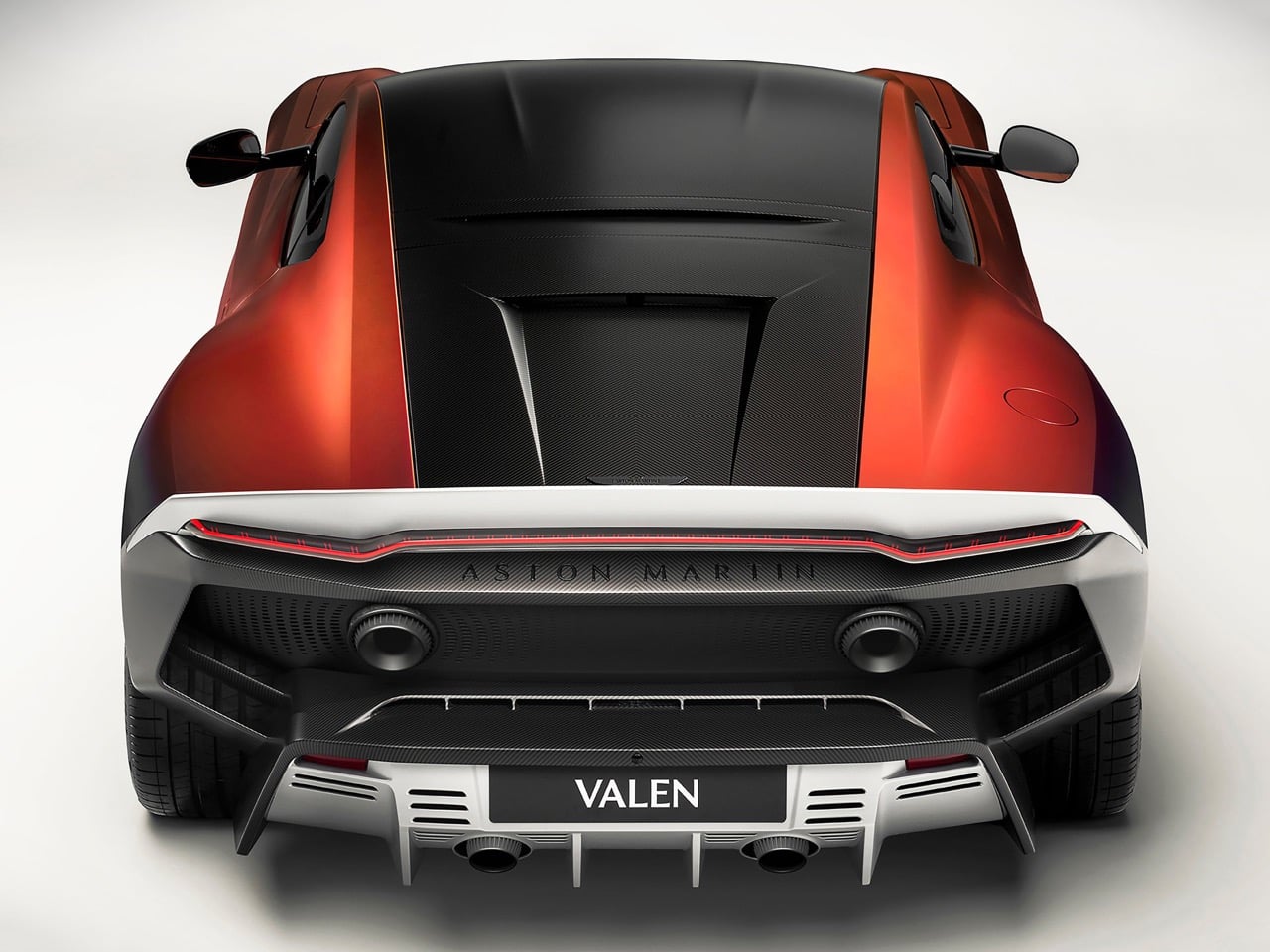
The rear end doubles down on the provocation. Aston deleted the Vanquish’s conventional rear window and bootlid entirely and replaced both with a solid carbon tailgate, its upper edge sculpted into a Gurney flap that generates downforce without a bolted-on wing. Beneath it sits a 170-liter boot with an optional Touring Pack luggage set. Quad titanium exhaust tips, two stacked high and two low, poke through a perforated heat-management panel underneath a full-width light bar. It is a genuinely strange trade of visibility for silhouette, and it puts the Valen in the same conversation as the McLaren P1 and the Polestar 5, cars willing to sacrifice a rear window for a cleaner shape and a cleverer aero solution.
Under all that theater sits a 5.2-liter twin-turbo V12 making 838bhp and 738lb-ft, good for 0-60 in three seconds and a limited 214mph, built on a Vanquish chassis shedding up to 110kg through carbon, titanium, and magnesium. Only 150 will exist, each starting around £1.5 million before Q’s inevitable rabbit hole of options. Whether you read the Valen as Aston Martin finding a bolder voice or briefly losing its accent, it is impossible to look at and feel nothing, and for a company that has spent years being tastefully quiet, that alone might be the real design win here.
At 335 feet tall, the Manhattan Detention Facility rising at 125 White Street in Chinatown is already earning a nickname it can’t shake: the jailscraper. Designed by HOK for New York City’s Department of Design and Construction, the 1,053,671-square-foot tower will become the tallest correctional facility ever built when complete. But the more interesting story isn’t its height — it’s what HOK is attempting to do with it.
The building sits on the same footprint as the old Manhattan Detention Complex, known for generations as The Tombs, which was demolished in 2024. It is one of four borough-based jails commissioned by New York City to replace the notorious Rikers Island complex — a system that, at its peak, held up to 15,000 detainees under conditions that earned international condemnation. HOK is leading the design of both the Manhattan and Brooklyn facilities, with the Brooklyn jail already topping out at 295 feet.
The design splits the building into two main volumes, separated at the base by a pedestrian walkway that cuts straight through the site — a deliberate gesture toward the neighborhood. Chinatown doesn’t lose the block; it moves through it. At ground level, a public lobby, community and retail space, and a staff lobby face the street, while below grade, parking for Department of Correction and NYPD staff keeps the site’s working infrastructure out of sight.
The facade does much of the heavy lifting. A reddish mesh screen and undulating panels wrap portions of the exterior, and toward the middle of the building, this double-skin system serves a dual purpose: it lets those in custody look outward while maintaining visual privacy from the street. Around this zone, HOK has positioned the building’s recreation hall — a spatial acknowledgment that daylight and fresh air are not privileges.
The interiors are guided by a design brief that reads more like a hospitality spec than a corrections document. Materials should be warm and non-institutional. Spaces should give people in custody a sense of personal agency, control over light and temperature, and access to greenery. Visitor areas are designed to feel welcoming rather than processed. Public artwork salvaged from The Tombs — aluminium wire sculptures by Kit-Yin Snyder and stone bas-reliefs by Richard Haas — will be preserved and reintegrated around the new site.
The project is not without opposition. Local leaders have raised concerns about the site’s structural integrity and written directly to Mayor Zohran Mamdani asking for a reevaluation. Construction is underway. Completion is slated for 2032.
Whether the jailscraper succeeds as architecture — let alone as reform — won’t be clear for years. What HOK has produced in the meantime is a building that at least refuses to look like what it is.
There is something oddly comforting about an object that can lose its balance and find its way back. Nevi takes that small, almost childlike pleasure and turns it into a sculptural desk lamp. Inspired by the classic roly-poly toy, it borrows the familiar idea of wobbling, recovering, and returning upright, then translates it into a much quieter and more refined design language.
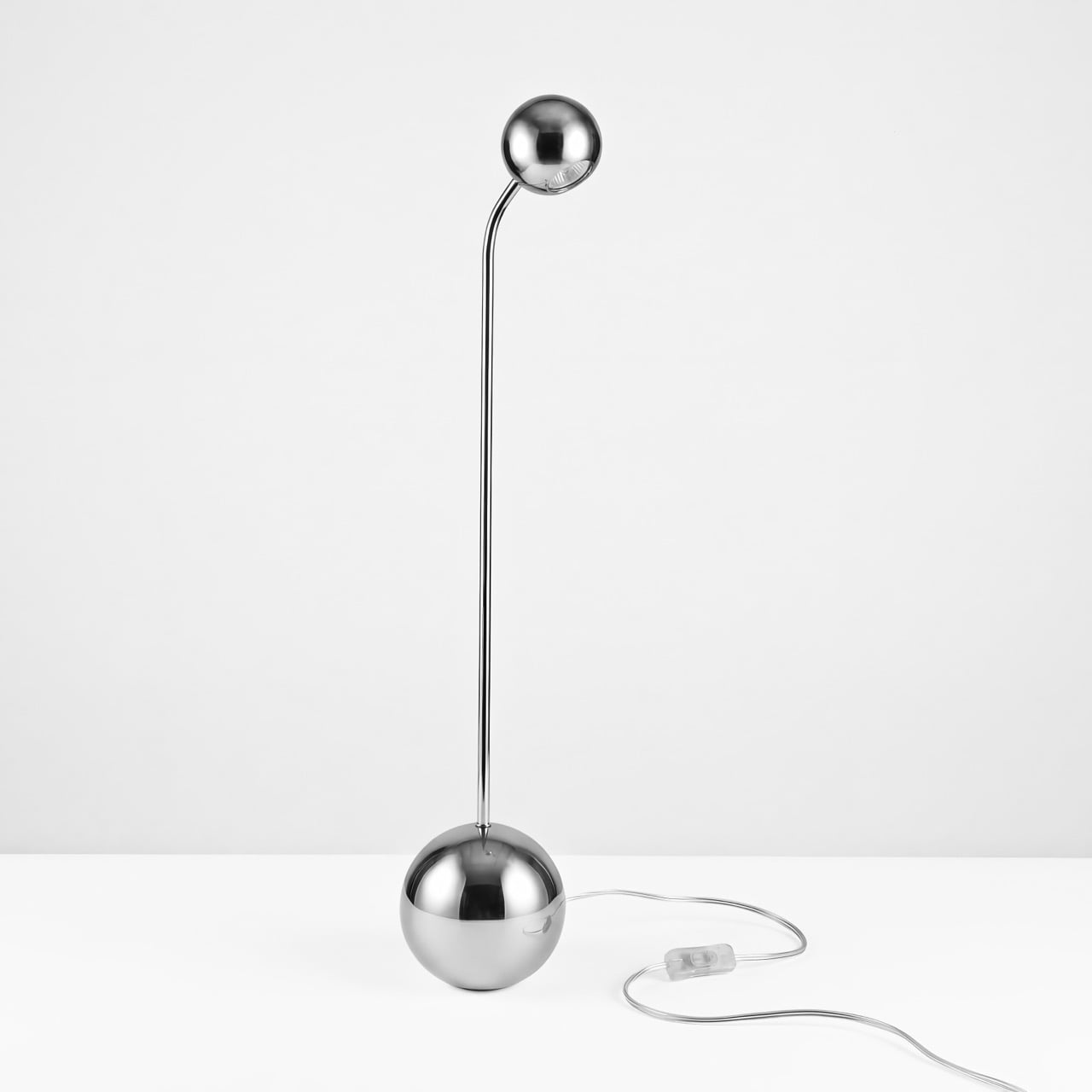
At rest, Nevi feels calm and almost architectural. A rounded stainless-steel base anchors a slender vertical stem, creating a silhouette that feels minimal without becoming cold. But the lamp is not meant to simply sit still. Give it a gentle touch, and it begins to sway, moving smoothly before gradually returning to its upright position. That subtle interaction gives Nevi a personality that most task lights never attempt to have. Instead of being an object that disappears into the background of a desk, it responds to the person using it.
Designer: Andrei Ananenka
The movement is deliberately restrained. Nevi does not perform tricks or demand attention. Its appeal lies in the small moment of interaction: the slight push, the controlled oscillation, and the satisfying return to equilibrium. It makes something as ordinary as a desk lamp feel tactile and surprisingly alive.
Material plays an important role in that experience. The lamp is made from AISI 304 stainless steel and finished entirely by hand. The lower portion of the spherical base has a satin-brushed finish that feels soft and durable, while the upper section is mirror-polished. When Nevi moves, that polished surface catches fragments of the room around it, making reflections shift across the base as the lamp rocks from side to side. The combination of brushed and reflective metal gives an otherwise simple form a sense of depth and movement even before the light is switched on.
For all of its sculptural qualities, Nevi remains a functional desk light. Its focused beam is designed for activities such as reading, writing, and working, with high color fidelity that keeps illuminated surfaces looking natural. The lighting itself is kept intentionally precise rather than flooding the surrounding space, which suits the lamp’s controlled and disciplined character.
Much of the complexity required to create that simplicity remains hidden inside. The designers had to carefully balance the lamp’s internal weight so that its tall, slender body could move freely without ever feeling unstable. The proportions, center of gravity, and duration of each movement were all studied to make the oscillation feel smooth rather than awkward or mechanical. Even the stainless-steel body quietly performs another role by helping manage the heat created by the light source, allowing the clean silhouette to remain uninterrupted.
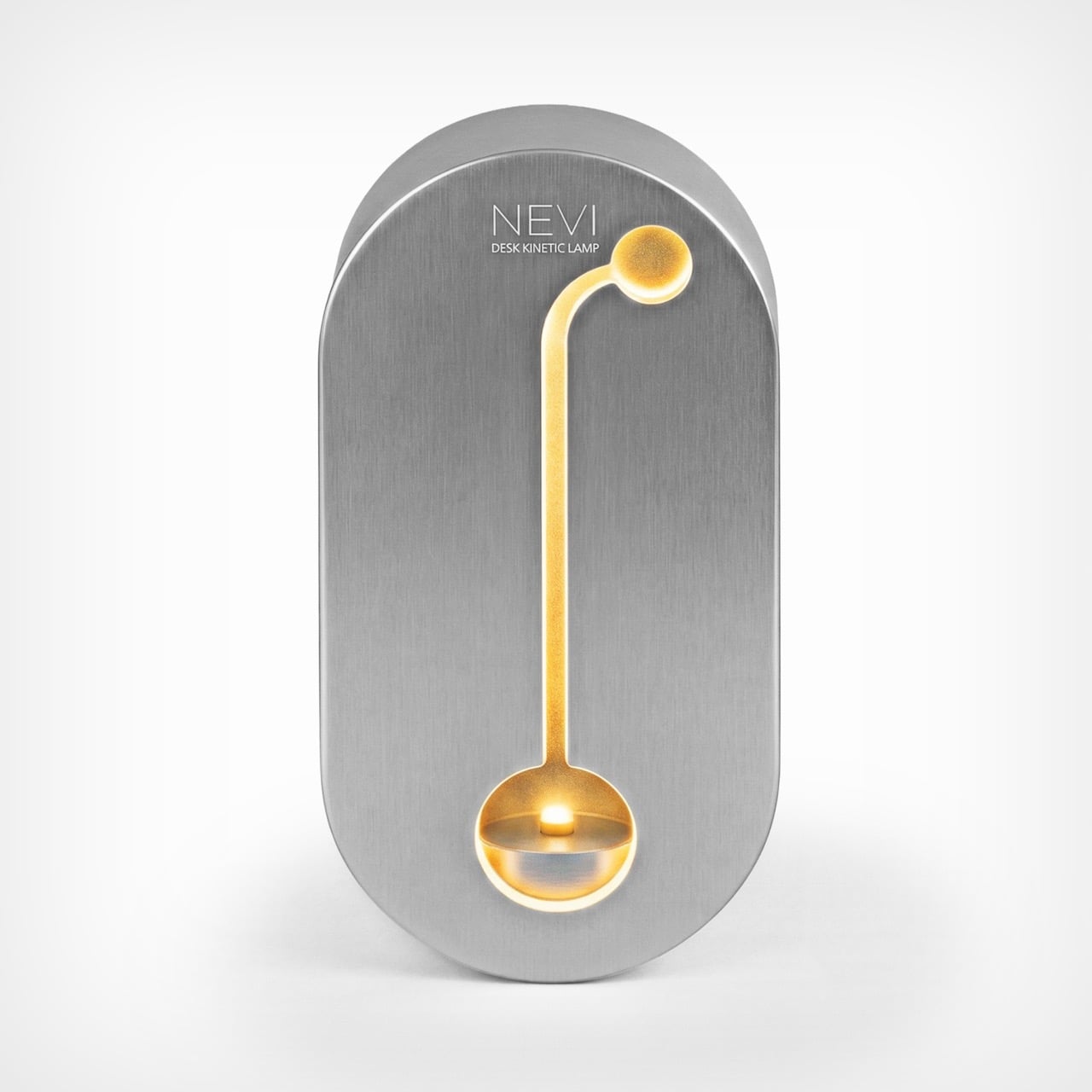
Perhaps Nevi’s most interesting idea, however, arrives before the lamp itself is even revealed. Its packaging was designed with the same self-centering behaviour as the product inside. Rather than becoming an elaborate box that is admired for a few minutes and then stored away or discarded, the high-grade aluminum package has a second life as an ambient light.
After unboxing, a wireless warm LED illuminates a CNC-milled silhouette of the Nevi lamp on the lid, turning the packaging into a small illuminated object for the interior. It can also rock and return upright, echoing the movement of the lamp itself. The package therefore becomes part of the product story rather than an accessory that immediately loses its purpose.
That approach makes the sustainability thinking behind Nevi feel particularly natural. Instead of asking the user to feel responsible for disposing of premium packaging correctly, the design simply gives them a reason to keep it. The box becomes another useful and visually considered object within the home.
The research behind Nevi focused heavily on movement and perception. The designers explored how far an object could tilt, how quickly it should recover, and how long the motion should continue before returning to stillness. Optical studies helped refine the quality and direction of the light, while material experimentation informed the contrast between the satin and mirror-polished finishes. Each decision seems to support the same broader idea: making the lamp feel calm, responsive, and almost instinctive to interact with.
Nevi is ultimately compelling because it brings emotion into a category that is usually defined by utility. It does not reinvent the desk lamp through screens, smart controls or complicated technology. Instead, it uses something much simpler, the pleasure of touch, movement, and return.
There is a quiet metaphor embedded in it too. Push Nevi away from its natural position, and it does not fight the movement. It follows it for a moment, sways, adjusts, and eventually comes back to where it belongs. What began as the behaviour of a childhood toy becomes the defining character of a sophisticated lighting object, turning balance itself into part of the experience.
Every so often, a piece of architecture comes along that makes you question what the job of a building really is. The winning design for the Kaira Looro 2026 competition is one of those rare projects that does exactly that. Created by Greek designers Afroditi Ioannidou and Vladimir Gligorovski, the proposal for a community center in rural Senegal took first prize in one of architecture’s most socially focused competitions, and it deserves more attention than it’s getting.
The Kaira Looro competition, organized by the international non-profit Balouo Salo, is not your typical design brief. Each year, it invites young architects, students, engineers, and designers from around the world to imagine structures for communities in Sub-Saharan Africa that are actually built, or at the very least, seriously considered for construction. This year’s challenge drew entries from over 125 countries, with participants tasked with designing a multifunctional civic space for a rural community in southern Senegal, one that could support educational, cultural, and social life using local materials, self-construction techniques, and low-impact methods. That’s a narrow lane to design within, which is precisely why what Ioannidou and Gligorovski came up with feels so impressive.
Their starting point wasn’t a sketching pad. It was a centuries-old architectural typology from the Casamance region: the impluvium house. The impluvium is organized around a central open courtyard where rainwater collects, light filters in, and daily life unfolds. Rather than import a foreign design idea, the two designers took that logic and scaled it up to serve a whole village. The result is a community center that feels born from the place rather than placed onto it, a distinction that matters enormously when we talk about design for underserved communities.
The materiality is just as considered. The primary structure uses tapia, a rammed earth technique that draws on red laterite soil dug directly from the site. It’s a building material with deep roots in West African construction, practical, thermally efficient, and locally executable without heavy machinery. Above it, the roof is a bamboo truss system, lightweight and renewable, assembled in a way that allows for natural ventilation and keeps the interior cool in a climate that demands it. Together, the materials tell a cohesive story: this structure was designed to be built by the people who will use it and to age gracefully within the landscape it sits in.
The prize package reflects just how seriously the competition takes its mission. Ioannidou and Gligorovski walked away with €6,000 and an internship at Kengo Kuma & Associates in Tokyo, one of the most formally inventive firms in contemporary architecture. It’s a combination of recognition and opportunity that points to what Kaira Looro does well: it doesn’t just celebrate ideas, it cultivates careers while centering humanitarian impact.
If you’re not already following this competition, it’s worth understanding what sets it apart. Previous winners haven’t just gathered dust on a portfolio page. The Children House, which took top honors in an earlier edition, is now in the final stages of construction as a medical center specializing in childhood malnutrition treatment in rural Senegal. The designs are meant to become real buildings for real people, and that raises the stakes considerably for everyone involved.
What makes Ioannidou and Gligorovski’s proposal so satisfying isn’t just its elegance on paper. It’s the philosophy underpinning every decision. The building belongs to the village first and to specific programs second. That’s a line straight from their own concept, and I think it should be printed and pinned above the desk of every architecture student right now. Architecture has a long and complicated history of showing up in communities it doesn’t understand, building things that look impressive in renderings but fail to serve the people they were supposedly designed for. This project pushes back against that instinct quietly, without grandstanding. The best design, at its core, listens before it speaks. This community center for rural Senegal does just that.
Every major brand consultancy on earth will tell you the same thing right now: flatten your logo, go monochrome, simplify for digital. BMW listened. Volkswagen listened. Mastercard, Burberry, Warner Bros., all of them listened, and all of them emerged from their rebrands looking vaguely like they were designed by the same committee in the same week. The industry calls it blanding. The internet calls it something less polite. Razer, apparently, calls it an opportunity.
The Artisan Keycap Triple-Headed Snake Edition is the brand’s first artisan keycap, and it is about as far from a flat logo as physically possible. The triple-headed snake emblem that has lived as a 2D print on Razer products for nearly three decades has been turned into a full sculptural form: resin-cast, painted by hand, and detailed down to the tiny yellow irises in each snake’s eyes. It went on sale on August 22nd, 2026, priced at $89.99, and was gone in eight minutes.
Designer: Razer
Razer’s first product was the Boomslang gaming mouse, named after a venomous green snake from sub-Saharan Africa, with the brand’s now-iconic acid green pulled straight from the animal’s coloring. The triple-headed emblem grew out of that, and has been staring out from mice, keyboards, and headsets ever since. What nobody had done, until now, was give it a body. The Artisan Keycap starts from a precision 3D model built to hold detail at close range from every angle, then gets cast in resin mixed and cured to maximum hardness so the color won’t fade with daily use. After that, a human being sits down and paints each one individually, which means no two come out identical. Razer runs a two-stage quality check against the original model before anything ships.
The result, as seen in the process shots from Razer’s own production workflow, is genuinely impressive at this scale. Grey primed sculpts on painting stands give way to base-coated Razer green, and then a detail brush places the yellow eye dots with the kind of precision you’d normally associate with Warhammer miniature painters, not gaming peripheral makers. The GamesRadar reviewer who got a sample a week before it sold out noted that even the snakes’ tiny nostrils had been painted, which is a level of detail nobody strictly asked for and is therefore exactly the kind of detail worth celebrating.
On the practical side, the keycap fits any cross-stem (MX-style) switch, which covers most mechanical keyboards on the market, not just Razer’s own lineup. Razer recommends dropping it on a lower-traffic key like F12, partly because the three-dimensional snake heads sit noticeably proud of the surrounding keys, and partly because solid resin won’t let RGB backlighting through. The Chroma lighting on your other keys stays unaffected. You can technically use it on any key you want, but putting it on Escape and then accidentally hammering it during a tense moment in CS2 seems like tempting fate.
The keycap is currently sold out, exclusive to Razer.com and RazerStores. Whether Razer runs another batch is unconfirmed, so if the secondary market is your only option right now, just know that resellers have been asking considerably more than $89.99 since about eight minutes after the drop.