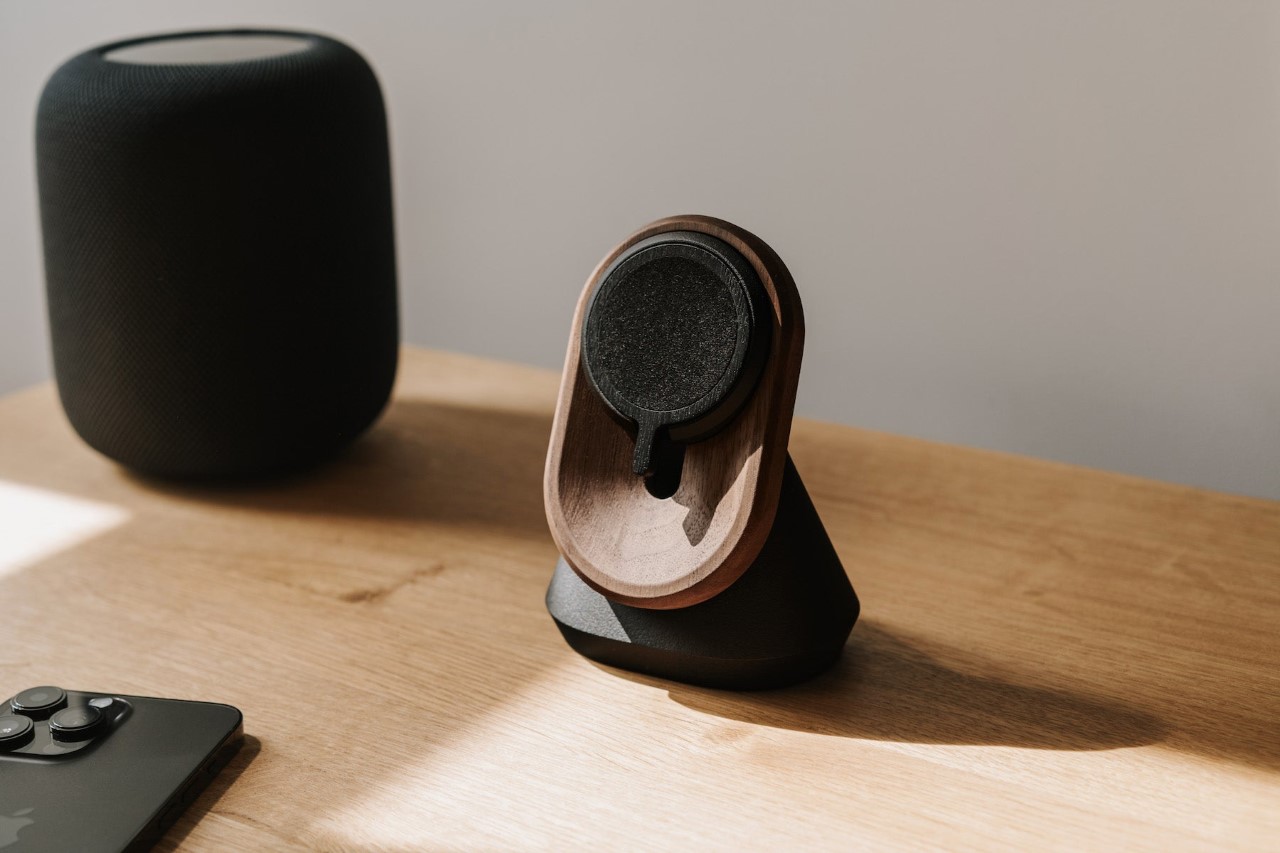
With its simple form factor and dual-shade wood construction, Oakywood’s MagSafe iPhone Stand/Charger has an aesthetic quality similar to the kinds found in Japanese and Scandinavian homes. Fondly known as ‘Japandi’ (an obvious portmanteau of the two words), the design style is characterized by cleanliness and minimalism that eschews materialism and clutter. With its Japandi-inspired style, Oakywood’s MagSafe iPhone Stand adds a touch of rustic beauty to your table, with a design that looks sophisticated but feels familiar thanks to the use of natural materials like Oak and Walnut wood.
The stand’s two-part design features a powder-coated aluminum base with a wooden ‘tray’ on top. The hefty aluminum base gives the stand its stable design (while also allowing it to function as a paperweight of sorts) while customers have a choice between a light oakwood or dark walnut wood upper, complementing their table setup.
The stand comes with an empty slot that lets you weave your MagSafe charger in. Once put in place, it becomes a nifty magnetic charging dock for your iPhone that you can either use as-is, or detach the MagSafe charger to use as a horizontal charging mat (shown above).
When used in the ‘stand’ mode, it angles your phone at a precise 25°, making it easy to view while also triggering the iPhone’s new Standby Mode – a feature unveiled in the latest iOS 17 update.
If you don’t want to use your Oakywood MagSafe iPhone Stand as a charger, the company sells a magnetic puck that you can slide into the stand, allowing it to work as merely a docking station without the charging facility.
The folks at Oakywood pride themselves in embracing nature as a material and a source for their designs. The use of wood feels antithetical to the metal and glass build of your iPhone, but it brings about a certain warmth to your tabletop, allowing it to become a standard fixture in your workplace. Besides, the entire thing weighs roughly 700 grams (1.5 pounds), making it a rather heavy accessory that doesn’t feel cheap in the slightest.
Oakywood sustainably sources its wood from America and Poland, also pledging to plant one tree for each product sold, thus ensuring a circular economy of sorts that helps reduce the effects of deforestation while turning wood into a renewable resource. You can grab your MagSafe iPhone Stand in three color options – a Light Oak, Dark American Walnut, or a Black Solid Oak that’s the darkest of the lot, matching the powder-coated Aluminum base.
Discord is changing its approach to file hosting in an effort to crack down on malware. The platform will begin using temporary file links that will expire after 24 hours for user content shared outside of Discord, BleepingComputer reported. The change is expected to go into effect by the end of the year.
While the stated intention of the move is to crack down on malware, it’ll also curb the wider use of Discord as an unofficial file hosting service. It’s not uncommon for users to upload images and other content to their own servers and then post those links elsewhere. You won’t be able to do that as smoothly anymore once it makes the move away from permanent file links, because the links will go dead after a day. Nothing will change for content posted and shared within Discord itself.
Switching to temporary file links “will help our safety team restrict access to flagged content, and generally reduce the amount of malware distributed using our CDN [content delivery network],” a spokesperson for Discord told BleepingComputer. Discord also noted, “If users are using Discord to host files, we'd recommend they find a more suitable service.”
This article originally appeared on Engadget at https://www.engadget.com/discord-is-switching-to-expiring-links-for-files-shared-off-platform-202533531.html?src=rss
Kids and adults alike have been fascinated with dinosaurs even before Jurassic Park but we have to admit that the movie series has brought even more “fans” into the fold. We’ve seen a lot of merchandise from various brands that would make the most ardent dinosaur fans happy (and spend lots of money). LEGO is one of those brands and they have several Jurassic World sets available and the latest addition to the collection brings the king of dinosaurs to your hands.
Designer: LEGO
The LEGO® Jurassic World Dinosaur Fossils: T. rex Skull (76964) is actually the first of the Jurassic World sets that were meant for a museum-like display. It’s basically a 577-piece set that when put together brings you the T. Rex skull, complete with an opening jaw and a stand to proudly display your LEGO archeological find. It even has an info plaque to go with your stand, an “amber” piece at the back and a fossilized footprint.
Once you are able to put the dinosaur bones together to form the T. Rex skull, you can pose it in different ways on the stand, including opening and closing the jaws. You can also use the LEGO Builder app guide in case you need help in building this archeological piece. You’ll be able to track your progress and zoom in and out on the model in 3D as you try to finish your build. Some people though want to just use their own skills as they build their LEGO sets so to each their own.
While the T. Rex skull is meant for kids 9 and above, we all know that a lot of adults will also get this to add to their LEGO dinosaur collection. But if your kid is interested in paleontology, this is a good tool to encourage them to use their creativity and even expand their storytelling skills by creating their very own dinosaur museum.
Fortnite players are definitely here for the new throwback season. Since the release of “Fortnite OG” at the end of last week, player counts have reached new all-time highs — peaking on Saturday with 44.7 million players total, according to a tweet from the Fortnite team. Players reportedly clocked a cumulative 102 million hours of play, making it the game's biggest day ever. With Chapter 4 Season 5, or “Fortnite OG,” Fortnite is dipping back into its Chapter 1 glory days to bring players back to the original 2018 island map, and reintroduce gear and other elements from its past.
Way to start things off with a big bang 💥
We're blown away by the response to #FortniteOG. Yesterday was the biggest day in Fortnite’s history with over 44.7 MILLION players jumping in and 102 MILLION hours of play.
The season started with an update designed around Chapter 1 Season 5, and subsequent updates will pull from other phases of the game’s history. But, it’s only expected to run for about a month, and players aren’t wasting any time getting in on the battle royale action. The number of concurrent players — or those who are actively playing at the same time — has been rising all weekend, continually breaking the previous record highs.
Within hours of the update’s release, the concurrent player count had spiked to over 3.9 million, according to trackers like Fortnite.gg. Yesterday, concurrent players peaked at over 6.1 million, and already today, there were 5.5 million players on Fortnite as of 11AM ET.
The number of concurrent plays for a single day nearly doubled on Friday, after the update was announced, from those seen earlier in the week, to hit nearly 1.5 million. Saturday logged over 1.8 million concurrent plays. It’s been years since Fortnite has seen numbers like this, but there’s no telling whether it’ll be able to keep it up.
Update, November 5 2023, 1:32PM ET: This article has been updated to include new information released by the Fortnite team after publication.
This article originally appeared on Engadget at https://www.engadget.com/fornite-keeps-breaking-player-count-records-since-releasing-its-nostalgic-og-season-160445720.html?src=rss
The internet's "enshittification," as veteran journalist and privacy advocate Cory Doctorowdescribes it, began decades before TikTok made the scene. Elder millennials remember the good old days of Napster — followed by the much worse old days of Napster being sued into oblivion along with Grokster and the rest of the P2P sharing ecosystem, until we were left with a handful of label-approved, catalog-sterilized streaming platforms like Pandora and Spotify. Three cheers for corporate copyright litigation.
In his new book The Internet Con: How to Seize the Means of Computation, Doctorow examines the modern social media landscape, cataloging and illustrating the myriad failings and short-sighted business decisions of the Big Tech companies operating the services that promised us the future but just gave us more Nazis. We have both an obligation and responsibility to dismantle these systems, Doctorow argues, and a means to do so with greater interoperability. In this week's Hitting the Books excerpt, Doctorow examines the aftermath of the lawsuits against P2P sharing services, as well as the role that the Digital Millennium Copyright Act's "notice-and-takedown" reporting system and YouTube's "ContentID" scheme play on modern streaming sites.
The harms from notice-and-takedown itself don’t directly affect the big entertainment companies. But in 2007, the entertainment industry itself engineered a new, more potent form of notice-and-takedown that manages to inflict direct harm on Big Content, while amplifying the harms to the rest of us.
That new system is “notice-and-stay-down,” a successor to notice-and-takedown that monitors everything every user uploads or types and checks to see whether it is similar to something that has been flagged as a copyrighted work. This has long been a legal goal of the entertainment industry, and in 2019 it became a feature of EU law, but back in 2007, notice-and-staydown made its debut as a voluntary modification to YouTube, called “Content ID.”
Some background: in 2007, Viacom (part of CBS) filed a billion-dollar copyright suit against YouTube, alleging that the company had encouraged its users to infringe on its programs by uploading them to YouTube. Google — which acquired YouTube in 2006 — defended itself by invoking the principles behind Betamax and notice-and-takedown, arguing that it had lived up to its legal obligations and that Betamax established that “inducement” to copyright infringement didn’t create liability for tech companies (recall that Sony had advertised the VCR as a means of violating copyright law by recording Hollywood movies and watching them at your friends’ houses, and the Supreme Court decided it didn’t matter).
But with Grokster hanging over Google’s head, there was reason to believe that this defense might not fly. There was a real possibility that Viacom could sue YouTube out of existence — indeed, profanity-laced internal communications from Viacom — which Google extracted through the legal discovery process — showed that Viacom execs had been hotly debating which one of them would add YouTube to their private empire when Google was forced to sell YouTube to the company.
Google squeaked out a victory, but was determined not to end up in a mess like the Viacom suit again. It created Content ID, an “audio fingerprinting” tool that was pitched as a way for rights holders to block, or monetize, the use of their copyrighted works by third parties. YouTube allowed large (at first) rightsholders to upload their catalogs to a blocklist, and then scanned all user uploads to check whether any of their audio matched a “claimed” clip.
Once Content ID determined that a user was attempting to post a copyrighted work without permission from its rightsholder, it consulted a database to determine the rights holder’s preference. Some rights holders blocked any uploads containing audio that matched theirs; others opted to take the ad revenue generated by that video.
There are lots of problems with this. Notably, there’s the inability of Content ID to determine whether a third party’s use of someone else’s copyright constitutes “fair use.” As discussed, fair use is the suite of uses that are permitted even if the rightsholder objects, such as taking excerpts for critical or transformational purposes. Fair use is a “fact intensive” doctrine—that is, the answer to “Is this fair use?” is almost always “It depends, let’s ask a judge.”
Computers can’t sort fair use from infringement. There is no way they ever can. That means that filters block all kinds of legitimate creative work and other expressive speech — especially work that makes use of samples or quotations.
But it’s not just creative borrowing, remixing and transformation that filters struggle with. A lot of creative work is similar to other creative work. For example, a six-note phrase from Katy Perry’s 2013 song “Dark Horse” is effectively identical to a six-note phrase in “Joyful Noise,” a 2008 song by a much less well-known Christian rapper called Flame. Flame and Perry went several rounds in the courts, with Flame accusing Perry of violating his copyright. Perry eventually prevailed, which is good news for her.
But YouTube’s filters struggle to distinguish Perry’s six-note phrase from Flame’s (as do the executives at Warner Chappell, Perry’s publisher, who have periodically accused people who post snippets of Flame’s “Joyful Noise” of infringing on Perry’s “Dark Horse”). Even when the similarity isn’t as pronounced as in Dark, Joyful, Noisy Horse, filters routinely hallucinate copyright infringements where none exist — and this is by design.
To understand why, first we have to think about filters as a security measure — that is, as a measure taken by one group of people (platforms and rightsholder groups) who want to stop another group of people (uploaders) from doing something they want to do (upload infringing material).
It’s pretty trivial to write a filter that blocks exact matches: the labels could upload losslessly encoded pristine digital masters of everything in their catalog, and any user who uploaded a track that was digitally or acoustically identical to that master would be blocked.
But it would be easy for an uploader to get around a filter like this: they could just compress the audio ever-so-slightly, below the threshold of human perception, and this new file would no longer match. Or they could cut a hundredth of a second off the beginning or end of the track, or omit a single bar from the bridge, or any of a million other modifications that listeners are unlikely to notice or complain about.
Filters don’t operate on exact matches: instead, they employ “fuzzy” matching. They don’t just block the things that rights holders have told them to block — they block stuff that’s similar to those things that rights holders have claimed. This fuzziness can be adjusted: the system can be made more or less strict about what it considers to be a match.
Rightsholder groups want the matches to be as loose as possible, because somewhere out there, there might be someone who’d be happy with a very fuzzy, truncated version of a song, and they want to stop that person from getting the song for free. The looser the matching, the more false positives. This is an especial problem for classical musicians: their performances of Bach, Beethoven and Mozart inevitably sound an awful lot like the recordings that Sony Music (the world’s largest classical music label) has claimed in Content ID. As a result, it has become nearly impossible to earn a living off of online classical performance: your videos are either blocked, or the ad revenue they generate is shunted to Sony. Even teaching classical music performance has become a minefield, as painstakingly produced, free online lessons are blocked by Content ID or, if the label is feeling generous, the lessons are left online but the ad revenue they earn is shunted to a giant corporation, stealing the creative wages of a music teacher.
Notice-and-takedown law didn’t give rights holders the internet they wanted. What kind of internet was that? Well, though entertainment giants said all they wanted was an internet free from copyright infringement, their actions — and the candid memos released in the Viacom case — make it clear that blocking infringement is a pretext for an internet where the entertainment companies get to decide who can make a new technology and how it will function.
This article originally appeared on Engadget at https://www.engadget.com/hitting-the-books-the-internet-con-cory-doctorow-verso-153018432.html?src=rss
Brümate is holding an early Black Friday sale, offering 25 percent off most drinkware sets, including the well-regarded Hopsulator Trio. The deals start today and end on November 7, so you have some time to think about which insulated cups catch your fancy. Once you decide, just enter the code “Cyber25” at checkout. As an example, this sale brings the price of the Hopsulator Trio down to $23.50 from $30.
Brümate makes insulated and leak-proof cups that keep liquids at their desired temperature until you’re done pushing the stuff through your gullet. The insulation here is certainly on point, which is why the company’s products made our list of the best gifts for coffee lovers.
On the opposite side of the spectrum, we put the Hopsulator Trio on our lists of the best outdoor gifts for dads and the best grilling gear, as the integrated insulation keeps cold beers cold even on the hottest of summer days. However, the Hopsulator is just for cans, though the company offers plenty of products to please devotees of loose liquid. Some of them could even serve as a decent container for a lunch stew or soup, so it’s a win/win.
Again, the sale ends on November 7. If you’re in the market for some insulated and leak-proof cups, now’s your time to shine. The cups and containers range in size from 12 ounces all the way to 40 ounces, for those looking to replicate the joy of slurping down a Big Gulp.
This article originally appeared on Engadget at https://www.engadget.com/brumates-early-black-friday-sale-knocks-25-percent-off-drinkware-150047391.html?src=rss
Following on from the recent unveiling of the slimmer version of the PlayStation 5 which has been aptly nicknamed the PS5 Slim. Dave2D has kindly taken his toolkit to the newest member of Sony range to carry out a PlayStation 5 Slim teardown. The PlayStation 5 Slim offers a more compact and lighter version of […]
The mobile gaming industry has seen a significant evolution in the design and functionality of its gaming controllers over time. From the basic joysticks that you would stick onto your screens marking the beginning of the gaming era to the fully featured mobile gaming controllers we see today which provide a console style split controller […]
In a captivating unison of innovation and style, reckoned Japanese RV maker, Kworks, has joined forces with Japanese home goods manufacturer Lixil, to birth the Mio Space trailer. This architecturally fascinating trailer rethinks the concept of furnished camping trailers and presents owners with a blank canvas they can furnish to their willingness.
To that accord, Mio Space trailer is a statement of adaptability. Kworks offers it for two possibilities, either it can be used for camping or seamlessly placed to extend the boundaries of your home. As an adaptable trailer, it can thus cater to every day of the year (in your backyard or in the wilderness), with a fascinating design that blurs the line between nature and modern architecture.
To start out, the Mio Space trailer captivates with its expansive windows that beckon natural light, complemented by the warm embrace of wooden paneling on the inside and out. The strategic placement of wooden slats from top to bottom not only adds a touch of allure to the interior, it also offers functional spaces to hang furniture, imbuing the trailer with a distinct flexibility.
Arriving in a noticeable rectangular structure, the Mio Space trailer has subtle rounded edges to distinguish its looks. Step inside, and the vast emptiness of the space strikes at first glance. However, Kworks asserts that this deliberate openness embodies a ‘flexible design’ ethos. It allows owners the freedom to shape the space as they desire: whether as a camper’s nest or an additional room that complements one’s home.
While the onus of furnishing the Mio Space trailer falls on its future owners, the clever positioning of slats creates opportunities for storage and a possible kitchen area to make the trailer into a desirable mobile home. If you may, you can pre-order the Mio Space starting summer of 2024. Even though Kworks has kept the features and pricing under wraps for now, we learn Mio Space sales will be confined to Japan, at least initially.
Embarking on the journey of eBook creation and monetization can be an exciting venture for aspiring authors and entrepreneurs alike. The digital era has ushered in a transformative shift, making what was once a complex and intimidating process—writing and publishing—an attainable goal for many. Thanks to the strides in AI technology, this landscape is evolving […]