Resident Evil Village and Star Wars Outlaws join January’s Game Pass additions

On Tuesday, Microsoft announced the first batch of incoming Game Pass titles for 2026. Star Wars Outlaws and Resident Evil Village headline the first wave of the January lineup.

If you (perhaps wisely) held off on spending $70 on Ubisoft's first stab at a Star Wars game, here's your chance to try it for less. Star Wars Outlaws sets you loose in an open world as the young thief Kay Vess. The third-person action title includes melee, shooting and stealth. There’s even some speeder chases and space dogfights to scratch your (boilerplate) Star Wars itch. Does it do anything novel or innovative to justify its full price? Not really. But it can still be a good time for fans of the saga.

Star Wars Outlaws arrives on Game Pass on January 13 (cloud, PC, and current-gen Xbox consoles). It will only be available for Game Pass Ultimate and PC Game Pass subscribers.

If you're less into Wookies and more about 10-foot-tall vampire ladies, there's Resident Evil Village. Capcom's 2021 title is "a gothic fairy tale masquerading as a survival-horror game," as Engadget's Jessica Conditt put it. In addition to the iconic Countess Alcina Dimitrescu, you'll encounter werewolves, sea creatures and the requisite creepy dolls. The franchise's eighth mainline game is something of a departure for the series, but you'll still find plenty of familiar horror, puzzles and action.

Resident Evil Village lands on Game Pass on January 20 (cloud, console, PC). It will be available for the Ultimate, Premium and PC tiers.

There's plenty of other fare arriving this month. Little Nightmares Enhanced Edition and the twin-stick shooter Brews & Bastards arrive today. The first-person survival action game Atomfall and the online soccer game Rematch land on January 7. Finally, the Final Fantasy 2D pixel remake arrives on January 8.

You can check out Microsoft's blog post for more.

This article originally appeared on Engadget at https://www.engadget.com/gaming/xbox/resident-evil-village-and-star-wars-outlaws-join-januarys-game-pass-additions-182500938.html?src=rss

LG has released pricing for its new Sound Suite speaker lineup

On Monday, we went hands-on at CES with LG's new Sound Suite speakers featuring Dolby Atmos FlexConnect and now we have pricing for the entire lineup. The modular home audio system consists of four speakers that include a soundbar, surround speakers and a subwoofer.

The centerpiece of the group is the H7 soundbar, which will retail for $1,000. The soundbar uses FlexConnect to optimize sound based on the layout of a room and its location therein. This is intended to solve for when a speaker can't be perfectly placed to deliver optimal sound, especially spatial audio.

The H7 also has a feature LG is calling Sound Follow that tracks the location of a user's phone throughout a room and adapts the audio to their location. The idea is that if you move from one side of the couch to the other, or to a chair in a totally different part of the room, you'll still receive the best possible sound.

The M7 and M5 surround speakers will sell for $400 and $250 respectively. These serve as satellite speakers to the H7 and can be placed around a room in pairs or used on their own. The W7 subwoofer carries a price tag of $600.

The entire suite is available for pre-order on LG's US site now. The site lists several packages like the "Immersive Quad Suite 7" that include the H7 soundbar and four M7 speakers. Sadly, there do not seem to be discounts for purchasing these speakers as a bundle.

This article originally appeared on Engadget at https://www.engadget.com/audio/speakers/lg-has-released-pricing-for-its-new-sound-suite-speaker-lineup-181053832.html?src=rss

Navee’s CES lineup includes a speedy e-scooter, a golf cart and… a seaplane?

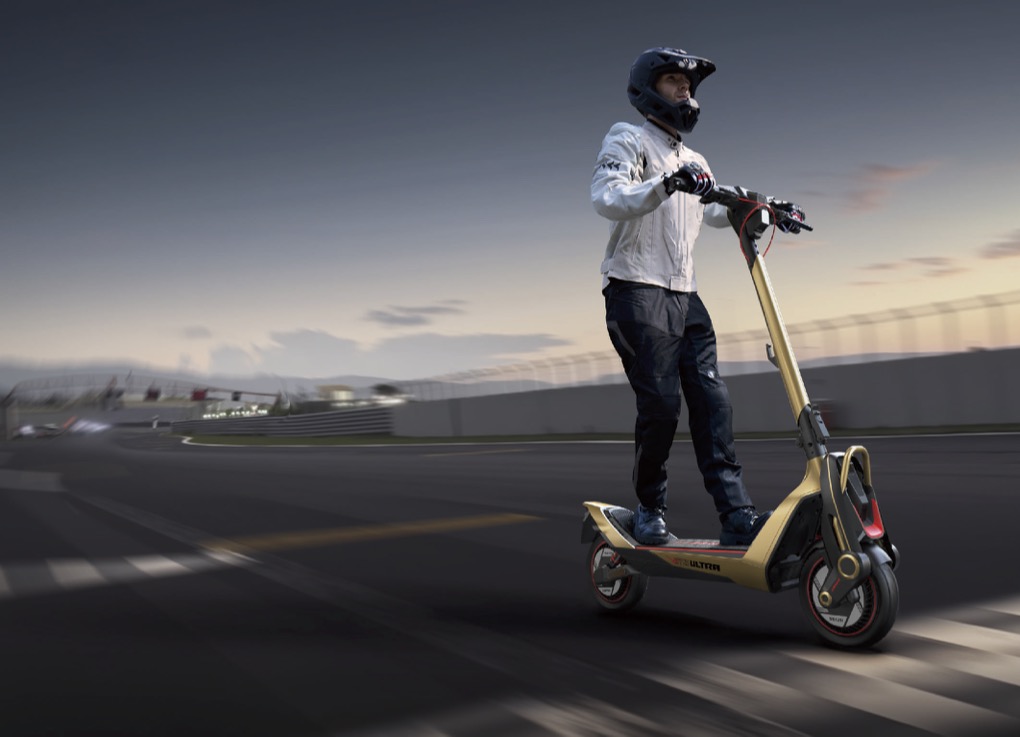
The Chinese micromobility company Navee has some wild new stuff at CES 2026. The lineup is headlined by the UT5 Ultra X, a dual-motor e-scooter with an advertised top speed of 43 mph. And who among us isn't in the market for an auto-following golf cart and a seaplane?

The flagship UT5 Ultra X is a sleek-looking e-scooter with a pair of 2,400W motors. Navee says it can reach a top speed of 43 mph and has a max range of 87 miles. (However, in the world of e-scooters, it's safe to expect the real-world range to be around half of what manufacturers promise.) It has a front and rear hydraulic suspension and front and rear hydraulic disc brakes. Navee claims it can accelerate from 0 to 12 mph in 1.98 seconds.

Rendering of a helmeted person riding the UT5 Ultra X e-scooter on a racetrack.
Navee UT5 Ultra X
Navee

If you want something that can hold its own on rougher terrain, there's the NT5 Ultra X. A pair of 1,200W motors helps this e-scooter reach a top speed of 40 mph and an advertised range of 56 miles. It has dual-disc brakes and an electronic anti-lock braking system. To help manage the bumps, it has two suspension types: a front telescopic suspension and a rear spring one. Navee claims its steel frame supports up to 330 lbs.

Then there's the Eagle F1X, which could put golf caddies out of work. This electronic cart can carry your clubs (up to 44 lbs). It has a "smart auto-follow" feature that uses a combination of AI and ultra-wideband. It also responds to voice and gesture controls. The 33-lb. cart uses a pair of 250W motors, and Navee claims it can handle 36-hole games. Strangely, the bottom portion looks like an F1 racer because, hey, why not?

Render of a golfer using the Navee Eagle F1X as its caddy, following behind.
Navee Eagle F1X
Navee

To further prove that Navee isn't afraid to jump the shark, the company has a product that could, well, jump over sharks. The WaveFly 5X is an electric seaplane that can "glide on the water and ride into the sky." The company claims a max speed of 53 mph, a cruising speed of 40 mph, and a maximum flight time of 70 minutes. I'm not ready to put my life in its hands, but surely some deep-pocketed adventurer will.

In addition to real-world ranges almost always being much lower than advertised, there are other caveats. First, post-purchase customer support in the world of micromobility is almost always a sketchy prospect. I once had to file a Better Business Bureau claim to get support from even the most well-established brand, Segway. Don't be shocked to experience the same or worse from lesser-known companies.

Second, Navee hasn't yet listed pricing or release dates for its new models. Based on their specs and the company's older gear, you'll likely see prices of well above $1,000 for each one. (And that’s not even counting the seaplane.) Regardless, you can learn more at the company’s website.

This article originally appeared on Engadget at https://www.engadget.com/transportation/evs/navees-ces-lineup-includes-a-speedy-e-scooter-a-golf-cart-and-a-seaplane-180000473.html?src=rss

The Morning After: Sony Honda’s new car, Lego’s first CES press event and more

Welcome to your first CES edition of TMA, attempting (almost futilely) to distill the biggest product reveals and announcements. Despite two days of briefings and conferences, today is merely day one. However, we’ve already seen Sony Honda reveal its next car — and the Afeela 1 isn’t yet on sale. We’ve got a deep dive on what we’ve seen so far, right here.

AMD announced new Ryzen AI 400 laptop processors and updated desktop chips, including the Ryzen 7 9850X3D, with a new focus broadly on AI processing improvements. NVIDIA had a lengthy, dense press conference showing off its dominance in AI tech, but it lacked major consumer announcements — until overnight, when it revealed next-gen G-Sync tech and an upgraded version of DLSS. The new tech can handle up to 4K 240Hz path traced performance. It also adds an improved version of Super Resolution Transformer, with more stability.

This year’s wildcard CES press conference was… Lego? It revealed Smart Bricks, which adds sensors, audio and wireless communication to traditional Lego pieces. The system is launching with Star Wars sets later this year — and perhaps crucially, no smartphone or screen is needed to play.

There’s also LG and Samsung to get into — more on those below!

— Mat Smith


TMA
Engadget

After launching its double-folding smartphone in Korea, Samsung is giving its newest foldable the press tour at CES 2026 and, despite reservations, it’s slick. The key difference between the Z Trifold and the Z Fold series is a second fold-out wing, turning it from a traditional smartphone into a more tablet-like form factor, closer to what we’re used to. Farewell square-ish screens.

This is what we were promised when foldables first appeared: a larger screen that offers greater utility than traditional smartphones, without compromise. Sam Rutherford tested one out. Read on for his impressions.

Continue reading.

TMA
Engadget

The big reveal at Samsung’s First Look CES press conference was literally big: a flagship 130-inch Micro RGB TV framed by a giant metal easel with embedded speakers. It’s much more in the realm of concept than reality — no price, no release date. It works as a halo product for more realistic TV sets using Samsung’s new preferred display technology. This year it’ll be offering TVs in 55-, 65- and 75-inch sizes. And if you’re curious, we explain what Micro RGB TVs are.

Continue reading.

TMA
Engadget

CES 2026 marks the return of LG’s ultra-thin Wallpaper TV. The latest version sports a gorgeous OLED screen and wireless connectivity, and it’s about as thin as a pencil. We checked out the new Wallpaper TV during a CES preview event, along with LG’s Gallery and Micro RGB sets. If money were no object, I’d want a 100-inch LG Wallpaper TV. According to Devindra Hardawar, it looks “shockingly thin” in person.

Continue reading.

This article originally appeared on Engadget at https://www.engadget.com/general/the-morning-after-engadget-newsletter-ces-2026-press-day-174444560.html?src=rss

ASUS and GoPro Built a 128GB Laptop for Video Editors at CES 2026

Laptops have quietly become the default creative tool for a lot of people, but the basic clamshell has not changed much in years. Copilot+ PCs, high-TOPS NPUs, and OLED panels are all becoming more common, and ASUS is using CES 2026 to ask what happens when you stop treating AI and displays as afterthoughts and start designing around them.

The updated Zenbook DUO and the ProArt GoPro Edition PX13 are the clear headliners, one stretching the laptop into a dual-screen studio, the other turning a 13-inch 2-in-1 into a mobile editing bay. Around them, the ProArt PZ14, Zenbook S16/S14, and Zenbook A16/A14 fill in different roles, from tablet-first creation to ultra-light Copilot+ travel machines, all tied together by Ceraluminum shells and Lumina OLED displays.

Designer: ASUS

ASUS Zenbook DUO (2026)

Zenbook DUO is the laptop for people who always end up plugging into a second monitor. Both panels are ASUS Lumina Pro OLED, with peak brightness around 1,000 nits, 16:10 aspect ratio, and high refresh, stacked in a way that lets a main workspace live on the top screen while timelines, chat, or reference material sit on the lower one. The new hinge design reduces the gap between screens to about 8.28 mm, making the dual-screen layout feel like a single continuous surface.
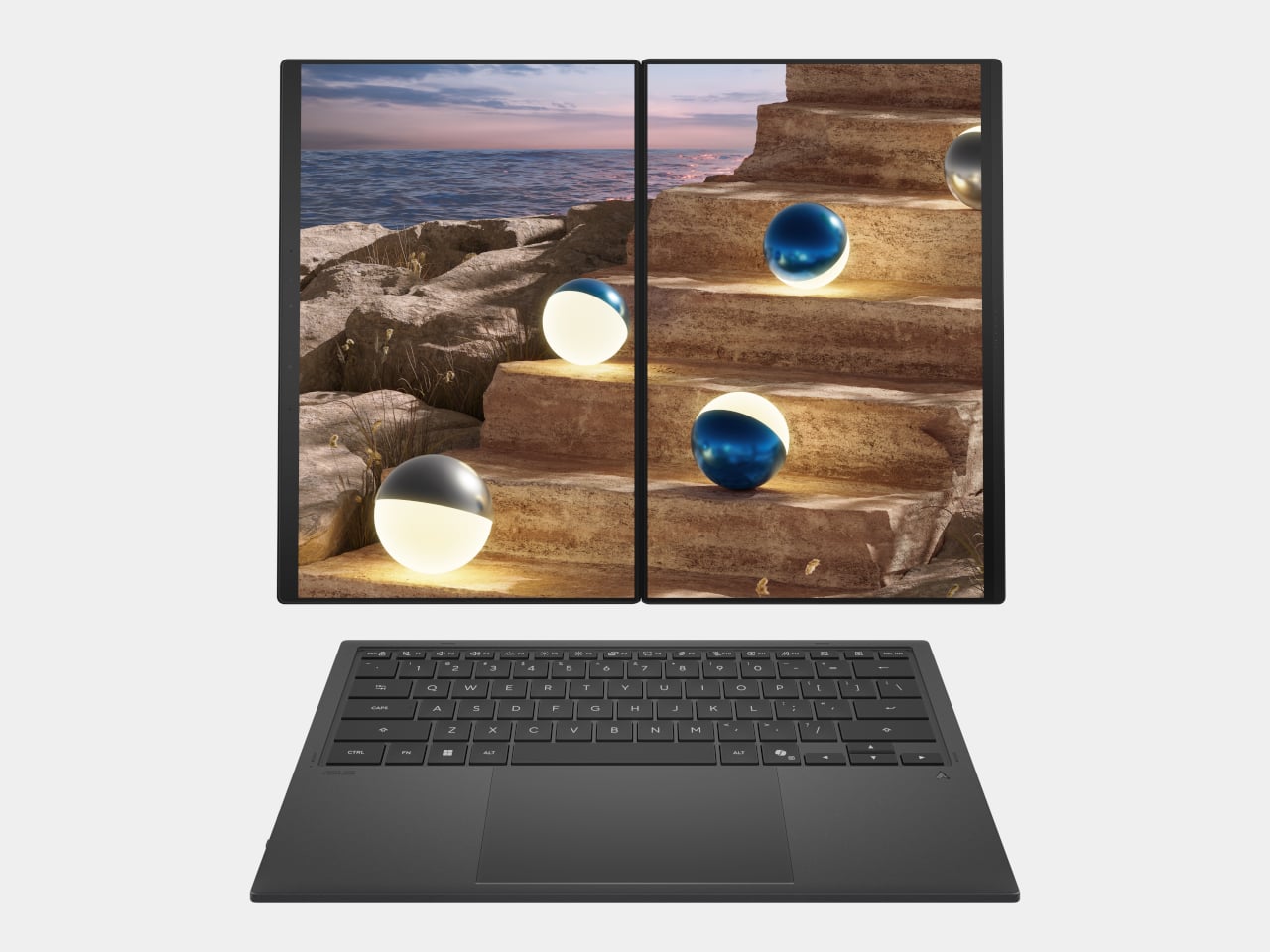
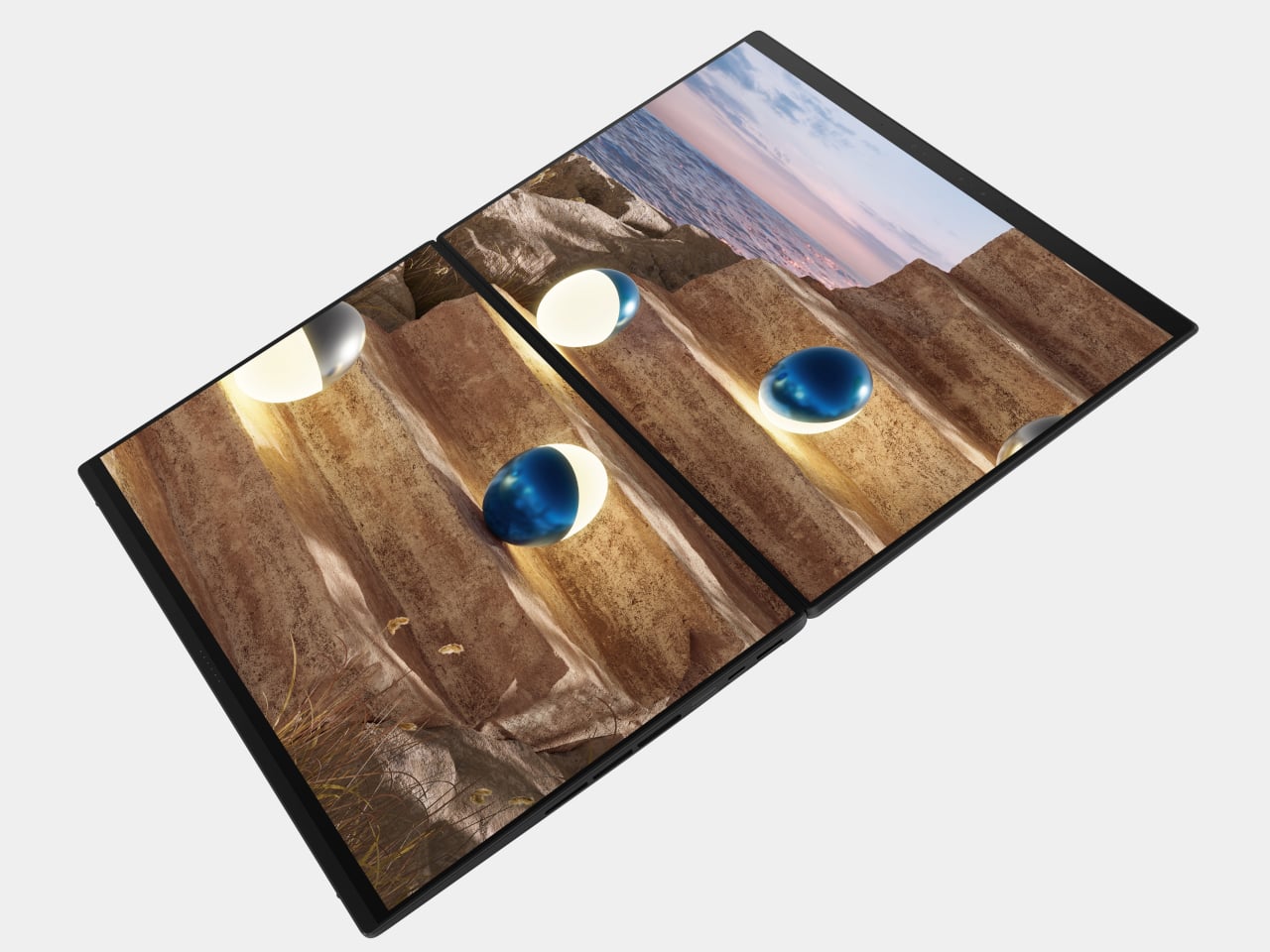
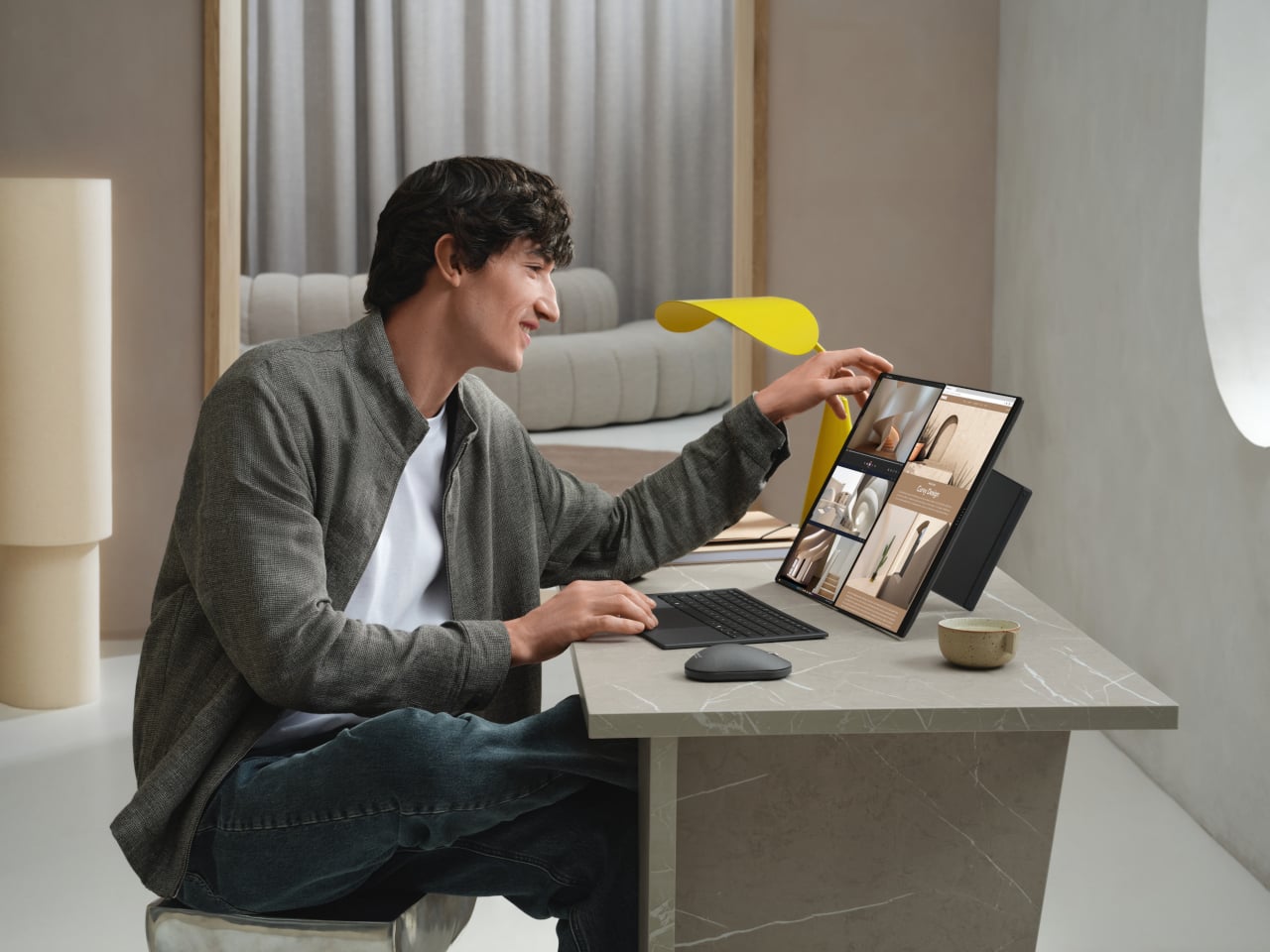
The laptop runs up to a next-gen Intel Core Ultra processor with an NPU around 50 TOPS, up to 32 GB of memory, and up to 2 TB of SSD storage, plus a dual-fan thermal solution to keep a 45 W CPU happy. A detachable keyboard connects via magnetic pogo pins or Bluetooth, so you can push it forward and treat the DUO like a tiny dual-monitor rig. Thunderbolt 4, HDMI 2.1, USB-A, and an audio jack mean you avoid living out of a dongle pouch, while six speakers with Dolby Atmos and ASUS Pen 3.0 support make it feel like a proper creator machine that just happens to fit in a 1.65 kg backpack.

ProArt GoPro Edition PX13

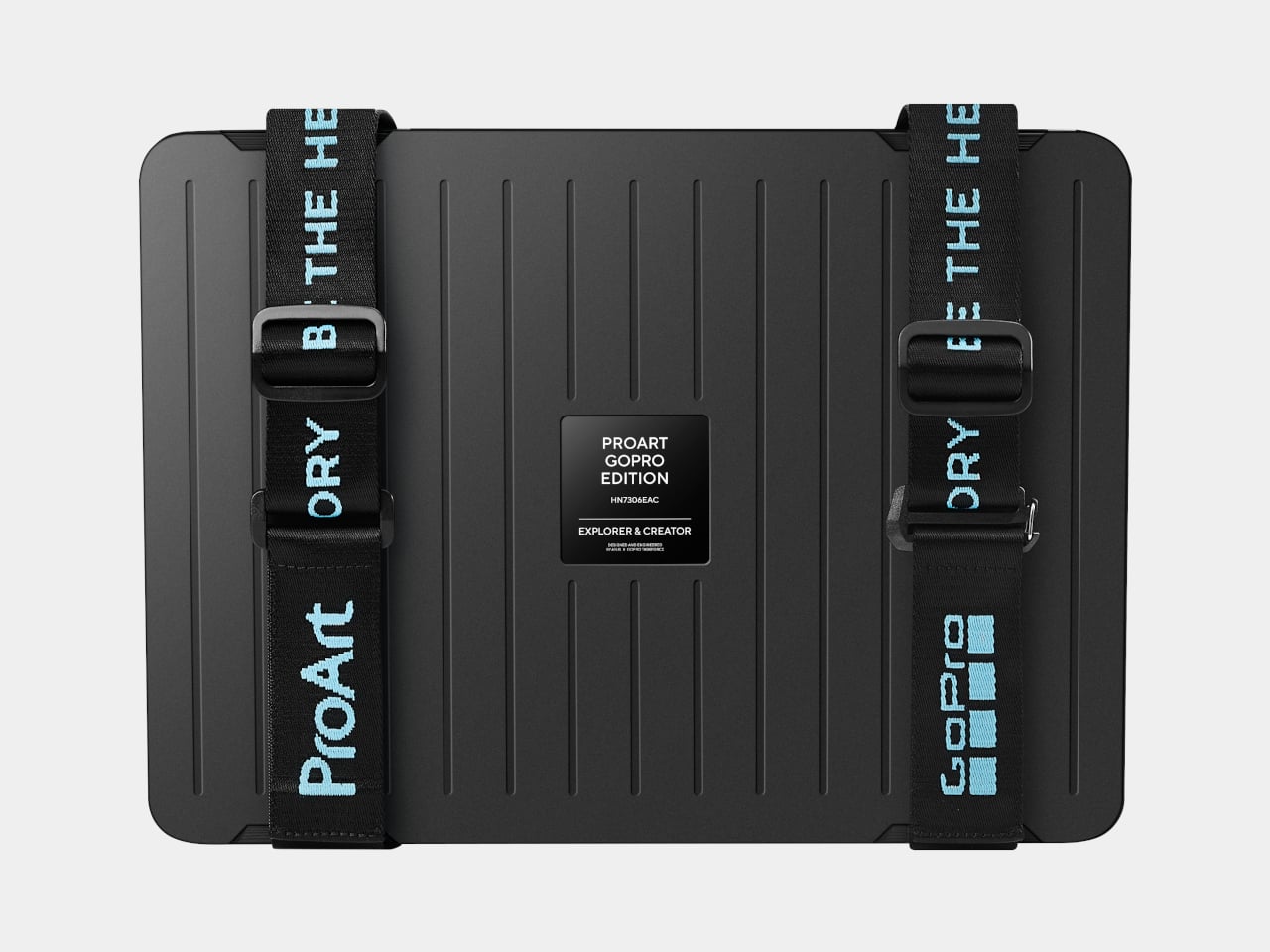
The ProArt GoPro Edition PX13 is the machine for people who think in clips and timelines. It runs up to an AMD Ryzen AI Max+ 395, with up to 128 GB of LPDDR5X onboard RAM and up to 1 TB of PCIe 4.0 SSD storage. That is a lot of headroom for 4K footage, AI-assisted editing, and background renders, and it is explicitly pitched as a “Create Anywhere” device rather than a generic 2-in-1 that dabbles in creative work.
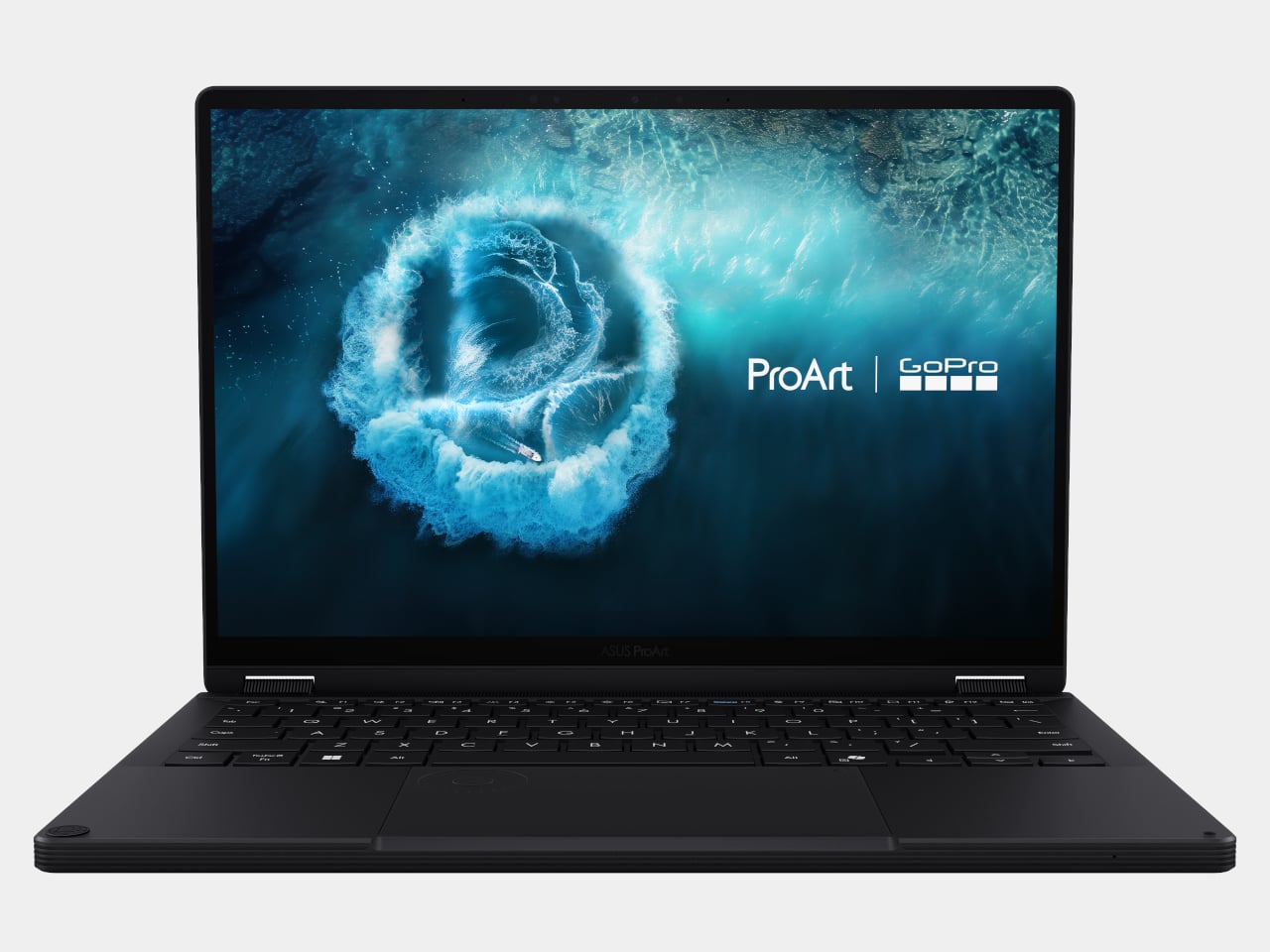
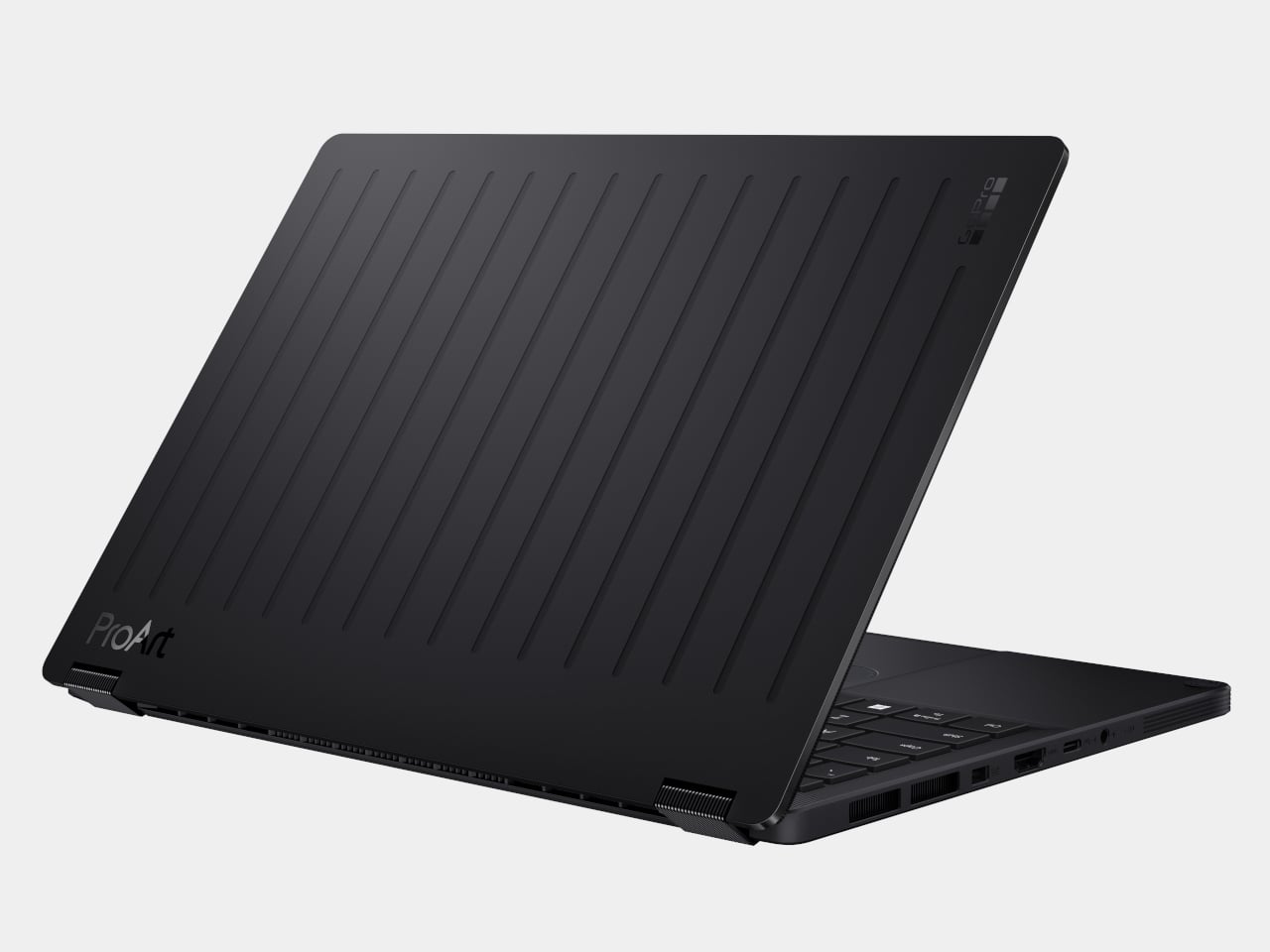
The 13.3-inch 3K HDR Lumina OLED display, with 100 % DCI-P3 and Pantone validation, gives editors and colorists a trustworthy canvas on the go. Ports include two USB 4.0 Type-C, one USB 3.2 Type-A, HDMI 2.1, a MicroSD slot with UHS II, and an audio jack, which means you can go dongle-free with cameras and drives. ASUS DialPad, StoryCube as an AI media hub, and a dedicated GoPro hotkey make it clear this is meant to sit in the middle of a creator’s workflow, bundled with 12 months of GoPro Premium+, six months of CapCut, and three months of Adobe Creative Cloud.

ProArt PZ14

ProArt PZ14 is the tablet-first counterpart, running on Snapdragon X2 Elite with 18 cores and up to 80 TOPS of NPU performance, paired with up to 32 GB of LPDDR5X and 1 TB of PCIe 4.0 SSD storage. The 14-inch 3K 144 Hz Lumina Pro OLED display, with 100 % DCI-P3 and up to 1,000 nits, makes it a serious panel for drawing, grading, or reviewing work.
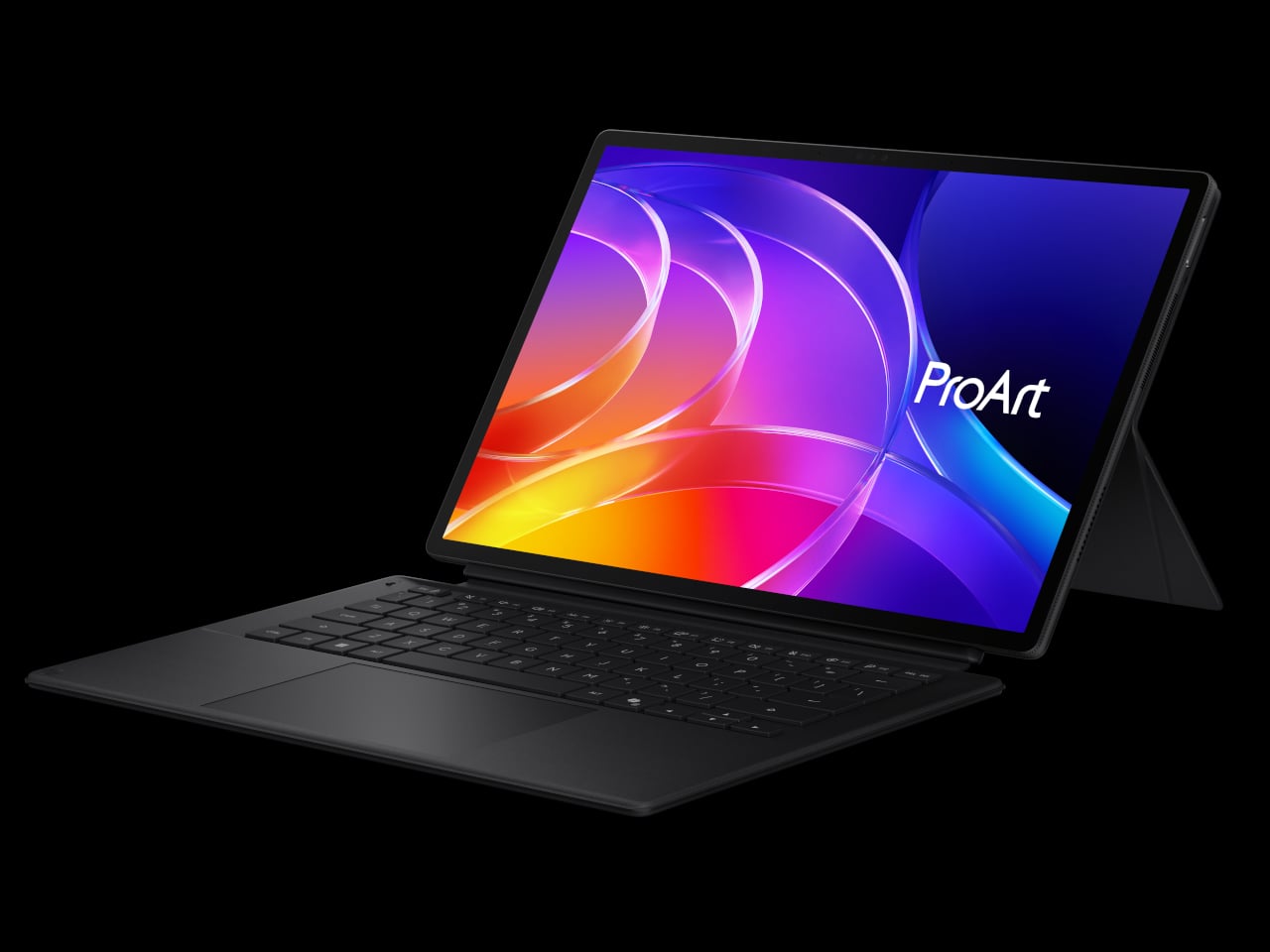

The 9 mm thickness, 0.79 kg weight, and IP52 water and dust resistance make it plausible to take the PZ14 out of the studio and onto a shoot. A Bluetooth keyboard, cover stand, ProArt mouse, and ASUS Pen 3.0 complete the kit, while dual super-linear speakers with Dolby Atmos, an 8 MP IR camera, and a 13 MP 4K rear camera round out the hardware. ProArt Creator Hub, StoryCube with GoPro integration, and MuseTree’s AI-assisted tools make it feel like a portable sketchbook and media station that can survive the field.

ASUS Zenbook S16 and S14
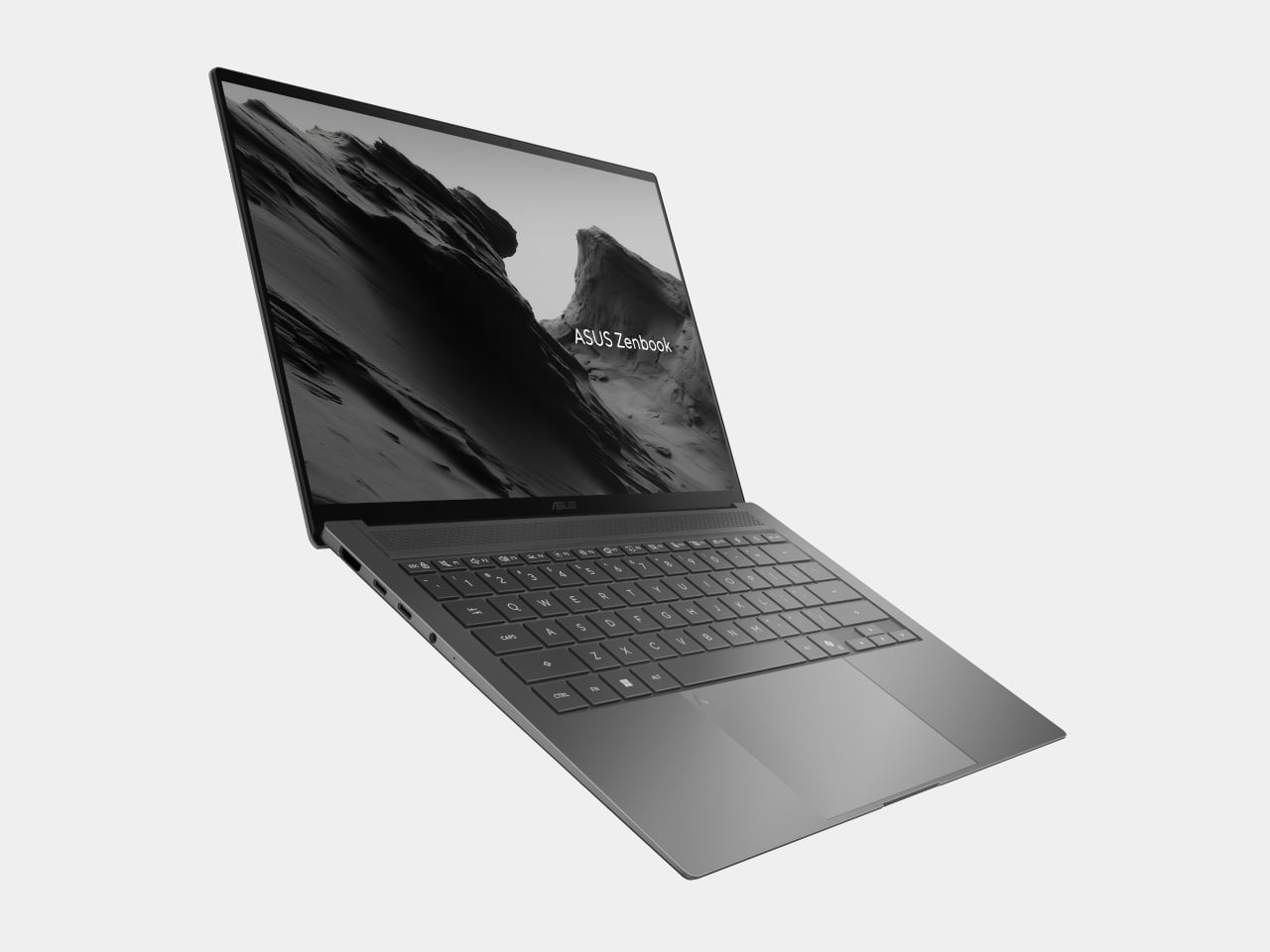
ASUS Zenbook S14

Zenbook S16 and S14 are the premium ultrabooks that bring Ceraluminum into everyday machines. The S14 runs next-gen Intel Core Ultra processors with up to 50 TOPS of NPU performance, while the S16 uses next-gen AMD Ryzen AI chips with similar NPU numbers. Both sit around 1.1 cm thick, with the S14 at about 1.2 kg and the S16 around 1.5 kg, making them thin enough to disappear into a bag.
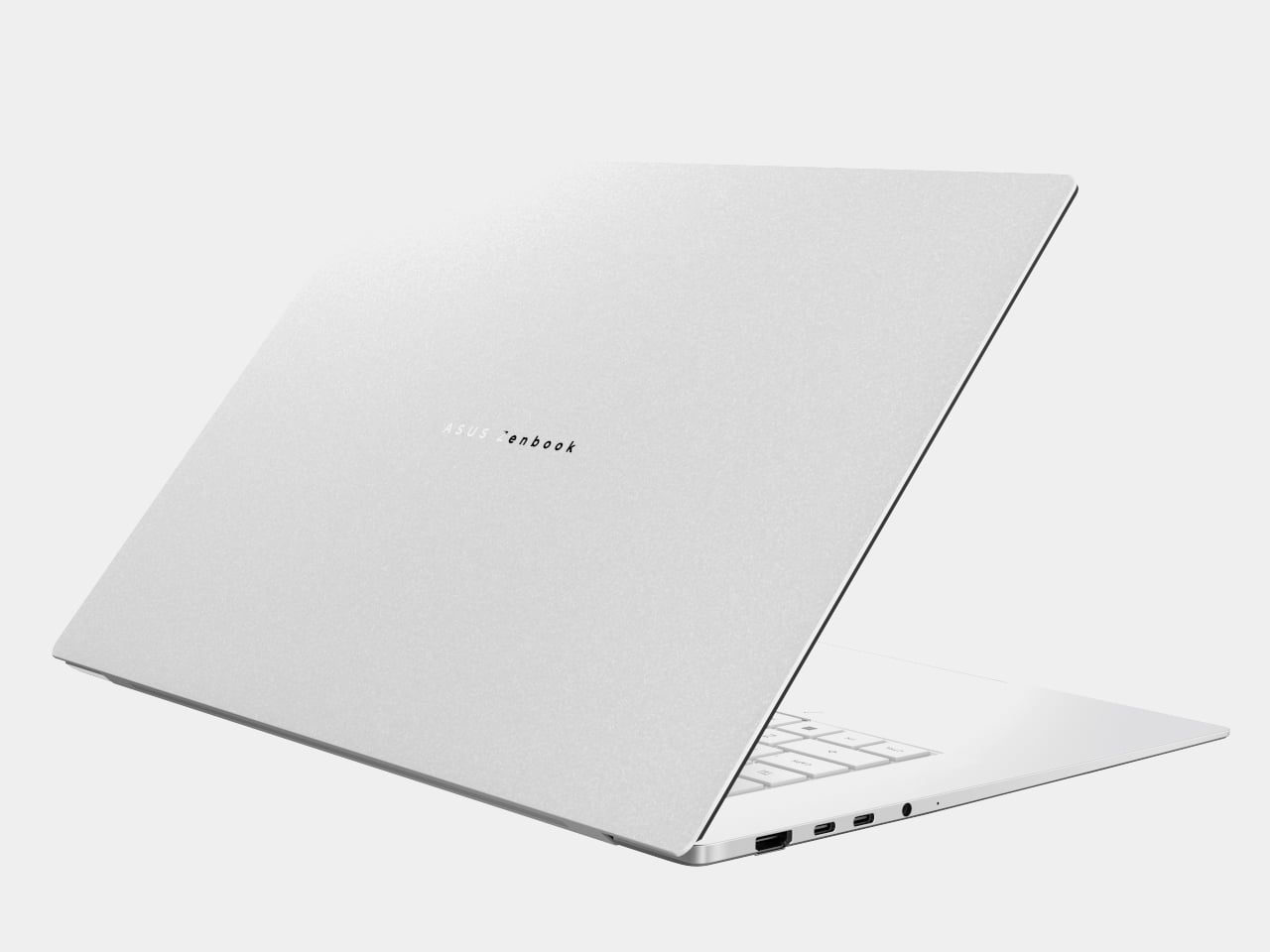

ASUS Zenbook S16

Display options include 14-inch and 16-inch 3K OLED touch panels at 120 Hz, with peak brightness up to 1,100 nits and full DCI-P3 coverage. Four-speaker audio on the S14 and six-speaker audio on the S16, both with Dolby Atmos, plus Quiet Ambient Cooling and geometric grille vents, make them feel more like design objects than generic ultrabooks. Privacy features like Windows Passkey, Microsoft Pluton, and IR webcams, along with Copilot+ PC status, round out machines aimed at people who want a bit of flair with their AI.

ASUS Zenbook A16 and A14

ASUS Zenbook A14

Zenbook A16 and A14 are the ultra-light Copilot+ PCs that lean hardest into battery life. The A14 weighs under 1 kg, while the A16 comes in around 1.2 kg, both using Ceraluminum for the lid, keyboard frame, and bottom case. Both pack 70 Wh batteries, with ASUS claiming multi-day life and more than 28 hours of video playback on the A14, which matters when you are away from outlets for long stretches.

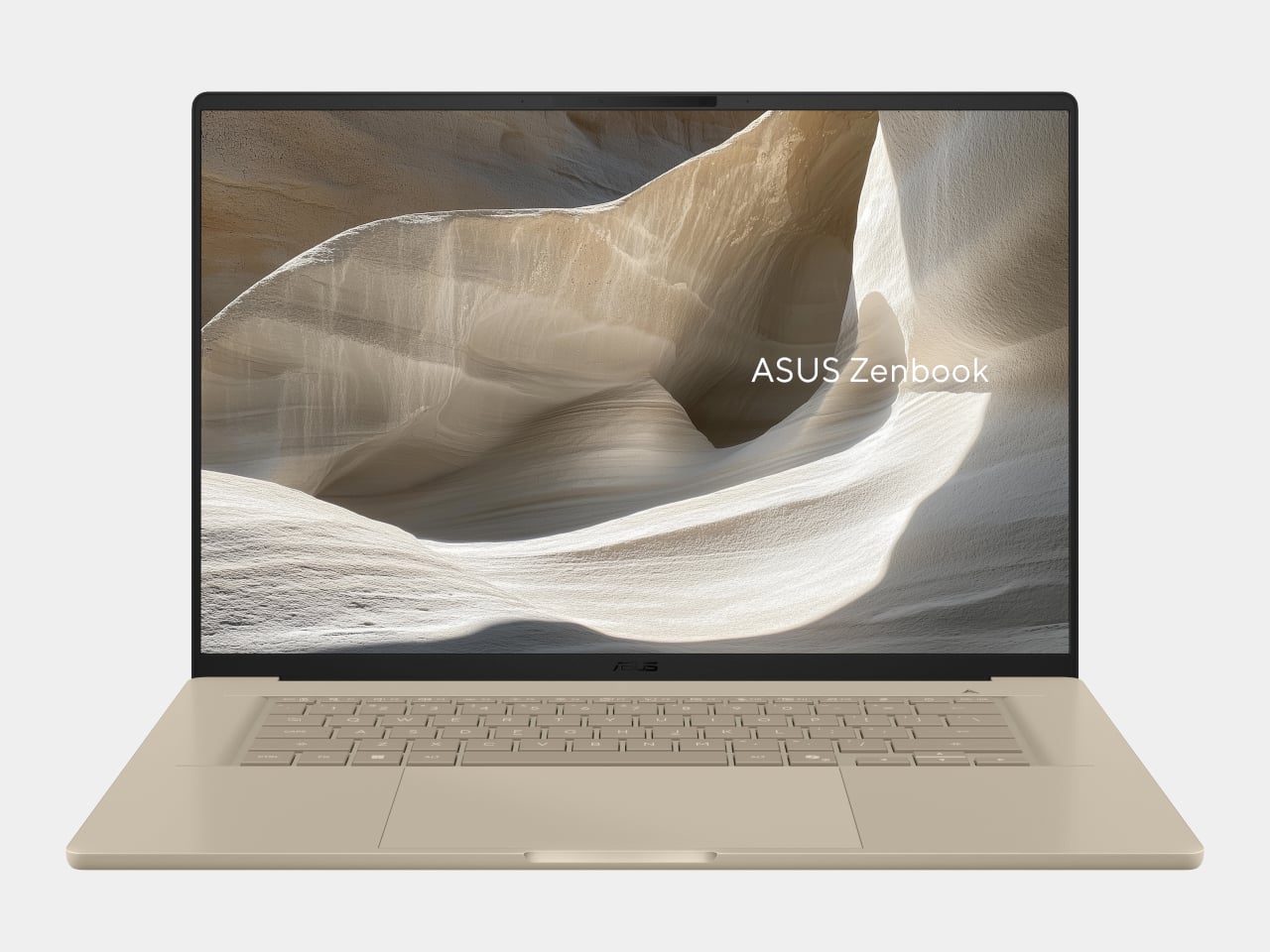
ASUS Zenbook A16

The A16 steps up to a 16-inch 3K 120 Hz OLED with peak brightness around 1,100 nits, powered by Snapdragon X2 Elite Extreme running up to 5.0 GHz with a 192-bit bus and 228 GB/s of bandwidth. Lightweight dual-fan thermals, high-fidelity six-speaker audio, smudge-free keycaps, and Smart Gesture touchpads make both A-series machines feel like travel companions that just happen to be Copilot+ PCs with up to 80 TOPS of NPU performance, built for people who count grams and hours equally.

ASUS at CES 2026: AI Specs That Justify New Shapes

Zenbook DUO and ProArt PX13 GoPro Edition are the clear statements, one turning dual OLEDs into a portable studio, the other turning Ryzen AI and 128 GB of RAM into a mobile editing bay. Around them, ProArt PZ14, Zenbook S16/S14, and Zenbook A16/A14 show how Ceraluminum, Lumina OLED, and high-TOPS NPUs can be tuned for different days and different bags. For Yanko Design readers, the interesting part of ASUS’s CES 2026 story is not just the raw numbers, but how those numbers are being used to justify new shapes and new ways of working that feel like a genuine break from the last decade of laptop design, where every machine looked roughly the same, and only the stickers changed.

The post ASUS and GoPro Built a 128GB Laptop for Video Editors at CES 2026 first appeared on Yanko Design.

The ASUS Zenbook Duo got a fantastic redesign for CES 2026

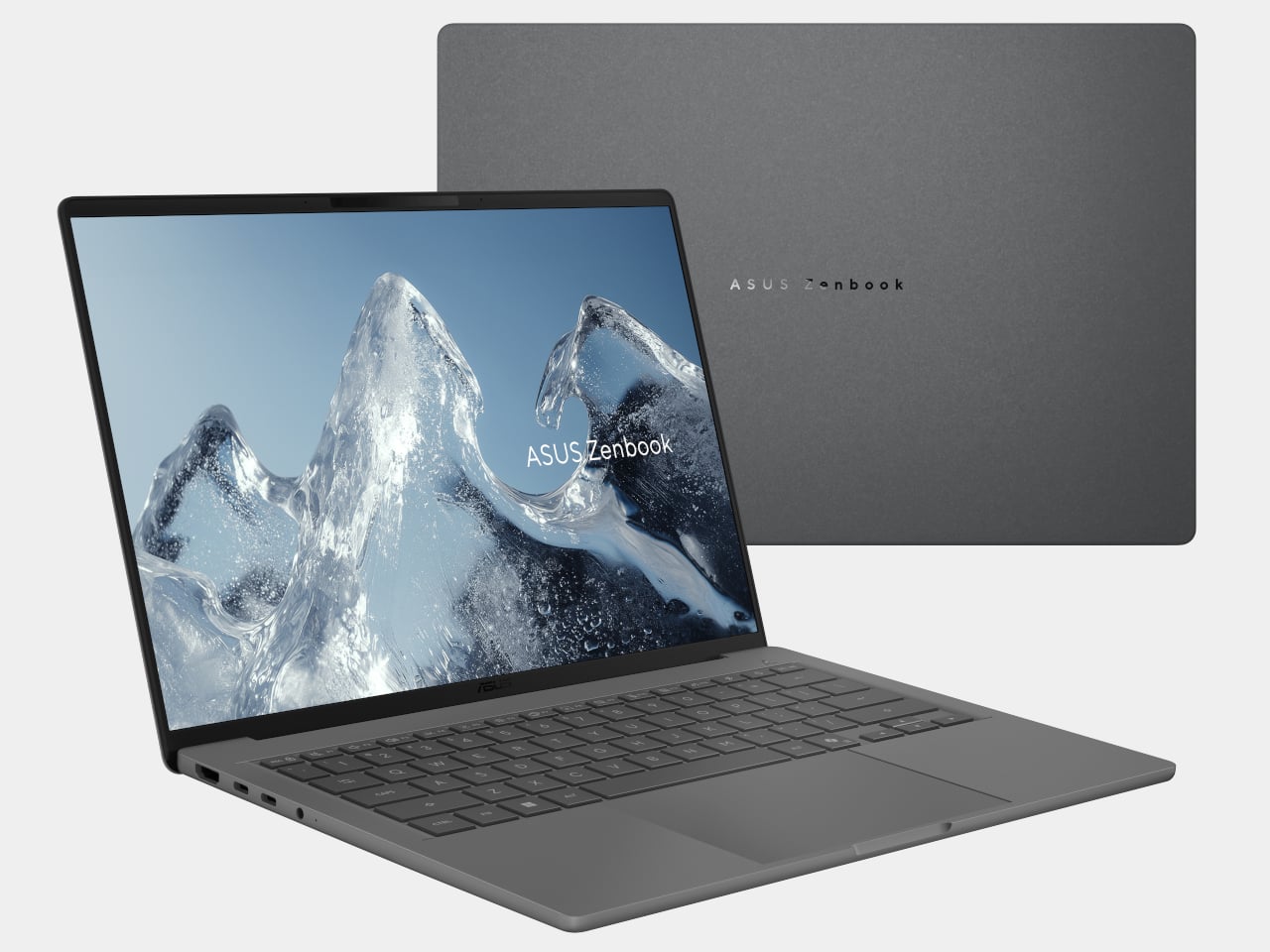
The ASUS Zenbook Duo was easily one of my favorite laptops of 2024 as it was the first dual-screen notebook actually worth buying. But now at CES 2026, ASUS has given the second-gen model a complete revamp with practically all the upgrades and tweaks I’ve been hoping for. 

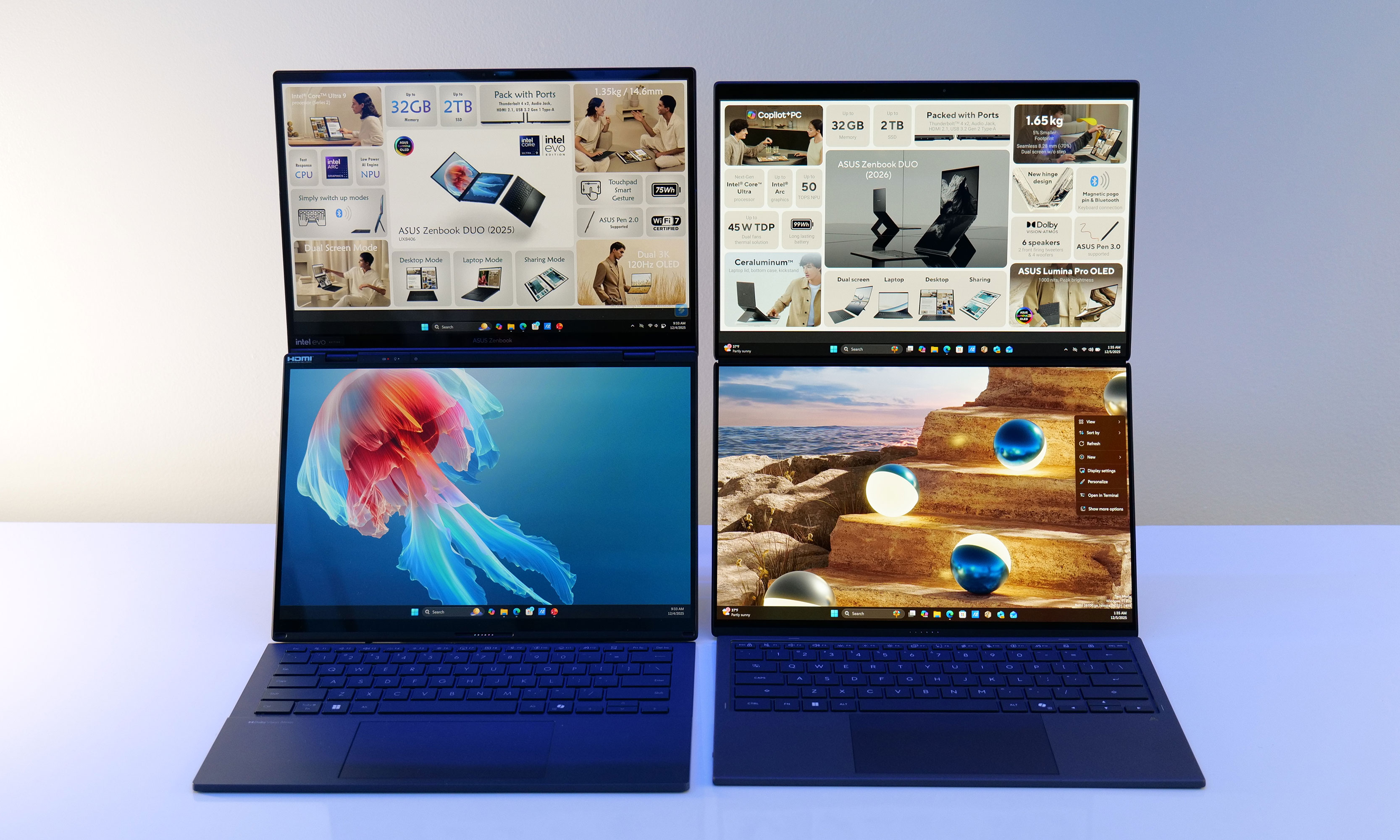
Like the rest of the Zenbook line, the 2026 Duo is getting ASUS’ Ceraluminum treatment on its lid, bottom and kickstand, which not only looks great but it adds an extra bit of durability and scratch resistance. There’s also an improved magnetic latch system and Bluetooth connection for its detachable keyboard to help keep it charged up and paired more reliably. However, the biggest upgrade is ASUS’ all-new "hideaway" hinge. Not only does it allow the system to unfold flat against a table, it also massively shrinks the gap between the laptop’s two 3K 144Hz Lumina Pro OLED displays to just 8.28 mm. That’s a reduction of 70 percent compared to the previous model and it makes the idea of using a dual screen laptop just that much more seamless and appealing than before. 

Another important upgrade is that despite having a significantly larger 99Whr battery (up from 75Whr on its predecessor), the overall footprint of the second-gen Zenbook Duo is actually five percent smaller than before. That makes it noticeably more compact without sacrificing on weight or thinness, which is staying pretty much the same at 3.6 pounds and 0.77 to 0.9 inches thick (depending on where you measure). Connectivity remains excellent as well, with ASUS including Wi-Fi 7, two USB-C with Thunderbolt 4, a USB-A 3.2 Gen 2 connector and even a full-size HDMI 2.1 jack. And for all the artists out there, the Zenbook Duo also supports stylus input via the ASUS Pen 3.0, so you can easily detach the wireless keyboard and use either screen as a built-in drawing tablet. That said, it’s currently unclear if the stylus comes included or not. 

Meanwhile on the inside, the Zenbook Duo features either an Intel Core Ultra 7 355 or Ultra 9 386H chip with up to 32GB of RAM and 2TB of storage. On top of that, ASUS increased the Duo’s TDP to 45 watts, which is another notable bump up over the original. So not only does it have a larger battery, its performance is getting a big boost as well, especially when combined with the much improved onboard graphics from Intel’s latest integrated Arc GPU. 

Here's how the new 2026 ASUS Zenbook duo (right) stacks up against the outgoing model (left).
Sam Rutherford for Engadget

I know a lot of people out there still aren’t convinced that dual screen laptops need to be a thing, and that’s totally OK. But as the kind of person who feels like they are missing a limb when I’m traveling and away from my two monitors at home, the second-gen Zenbook Duo feels like a major refinement of an already great idea. It’s got a bigger battery, faster performance and a hugely streamlined design without gaining any bulkiness or weight. Out of all of the laptops I’ve seen at CES 2026, this is the one I most wish I could grab and start using right away. 

The one potential concern is that ASUS has yet to release pricing for the new Zenbook Duo or say when it will go on sale. So here’s hoping it won’t break the bank when it arrives sometime later this year. 


This article originally appeared on Engadget at https://www.engadget.com/computing/the-asus-zenbook-duo-got-a-fantastic-redesign-for-ces-2026-173000392.html?src=rss

Pebble’s founder might be just the right person to make an AI ring

Eric Migicovsky has been thinking a lot about friction. Specifically, he’s been thinking about how too much friction in the way of using a device can put people off wearing it altogether. The founder of Pebble is here at CES 2026 with a few new devices from the company he recently started to bring back the beloved smartwatch brand, including the Pebble Round 2 and the Index 01. That second one is a simple ring with a button on it that you push down to talk to Pebble’s AI whenever you want it to help you remember something.

In the sea of AI gadgets that clutter the showfloors of CES (and the current tech industry in general), the Index 01 is refreshingly simple. The prototypes I saw here in Las Vegas weren’t connected to phones, so they weren’t actually working. They also seemed a little unfinished, like there was still some polishing to do. But I was able to put a few on and push their buttons. I also checked out the one Migicovsky wears — more on that in a bit.

I have to caveat that the rings that Migicovsky and his team had for us to try on were way too large for me. I did manage to get sized and found out I was a Pebble size 7, while my colleague Dan Cooper was determined to be a size 11. These demo rings sat loosely on my finger — and Migicovsky was particular that I wear it on my index finger and not my thumb or middle finger.

I suspect that has to do with how you reach for and press the button. It’s much easier to push the key if it’s closer to your thumb. Since the idea of the Index 01 began as an app on the Pebble watch, Migicovsky has been working hard to figure out how best to make it easy to access. Back when it was an app, “friction points were having to use your other hand” to press the screen, he said. “We also experimented with gestures and voice activation, wake words,” he added. But as many of us are painfully familiar with, those triggers don’t always work well.

“The whole thing that drives this ring is it being something that you can rely on. It being something that you can incorporate into your… habits,” Migicovsky said. So putting a button right by your thumb not only makes sense, but might even be, in my opinion, a bit more accessible for people with, say, speech impediments or only one hand.

I have to admit I initially found the Index 01’s design to be a bit bulky-looking, and the rubbery button protrudes a lot more than I expected from looking at it in its glamor shots. It’s like in place of a diamond or a gemstone on the ring, there’s a weird little nipple that you twiddle around until you want to push it.

I did find the button easy to press, if that allays any of your concerns at all. But, really, the Index’s powers aren’t visible. It’s what happens after you push the button that matters.

The actual demo was brief. Migicovsky prefaced things by telling me what he was about to ask, held up his hand to his mouth, pushed the button and asked me “What’s your favorite book these days?” I explained I had recently been reading Kaiju Preservation Society by John Scalzi and then Migicovsky let go of the button.

After a few starts and stops due to internet woes, the companion app on his phone responded, showing a transcription of what we said, followed by an answer “That sounds like a fun read! I can create a note about the book you are reading if you’d like.”

I didn’t get to ask many more questions, and I think I’d need to live with an actual unit in my life to start to rely on it more. But I love the idea of a second brain or an AI assistant that’s always ready for my random thoughts at the push of a button. Migicovsky said the Index 01 is water resistant, so you never have to take it off, even in the shower. So for those times when you’re sudsing up and have a random stroke of inspiration about soap art, you can still tell the Index 01 to remember your Eureka moment.

Migicovsky said you can also double click the button (and then hold it) to access a different side of the AI. Instead of simply remembering things you tell it, the AI can try to provide answers. Pebble’s AI is powered by Claude, so the usefulness of these results is going to be dependent on that model.

Depending on how you use it, Migicovsky said the Index 01 can last for years — up to three if you’re not too heavy of a user. Since he doesn’t want for you to have to place the ring on a charger and forget to put it back on again, the device is not rechargeable. When you’re about a month away from running out of juice, the app will send you a warning and ask if you want to order a replacement. You’ll also be offered the option of sending it in for recycling.

That still feels a bit wasteful and potentially expensive, but Migicovsky’s thinking is that if you still are using the ring enough after two years to be thinking about extending its battery life, the price might be justifiable to you.

It’s things like this that make me think Migicovsky (and the Pebble team) have the right approach to making an AI ring. Though the hardware is not the most advanced and there is a quaint simplicity to the software, there is a level of thought and care that feels important to any product’s success.

Migicovsky is quick to acknowledge that Pebble watches won’t be for everyone. That if you want a health-tracking device or something with a bright, colorful screen, you should consider something else. He’s even considering placing ads for other smartwatches on the website listing the new Pebble devices.

“Look — I’m the first person to call myself out when I fail,” Migicovsky wrote in a blog he posted last November. And when he spoke with Engadget, he also recognized that Pebble at one point might have tried to do too much. These days, there are other companies making smart rings that are all about tracking your sleep and fitness, and the Index 01 is not that. “And Pebble is absolutely 100 percent not that company.” Maybe with a renewed focus on a sustainable business model, Pebble actually has a chance to survive and continue making its AI ring and other devices.

Nowadays, Migicovsky just wants to make gadgets that will make you smile. And when I look at a cute little nyan cat wiggling about in its lo-fi, lo-res and low-frame-rate glory on the new Pebble smartwatches, I just feel warm inside.

The Index 01 is available for pre-order now at an early bird price of $75 and will cost $100 after it starts shipping in May.

This article originally appeared on Engadget at https://www.engadget.com/wearables/pebbles-founder-might-be-just-the-right-person-to-make-an-ai-ring-170104222.html?src=rss

InkPoster launches a premium, 41-inch e-paper display for your home

Last year, PocketBook rocked up at CES with a series of large e-paper displays to display art on the walls of your home. This year, the company has turned up with a far larger, A1-sized model called the Duna, which it says mimics the “texture, depth and tonal richness of printed paper.” It’s intended to act as an upmarket alternative to those big screen TVs which display art when they’re not being used for their intended purpose. 

Unsurprisingly, such a fancy product also needs some fancy accessories, so it’s recruited Italian design house Pininfarina to help. It claims the credit for the Duna’s “precision-engineered aluminum frame” and its “elegantly stitched Alcantara.” To celebrate the pairing, the InkPoster App will enable you to view original design sketches from the Pininfarina archives on your screens. 

At last year’s CES, I saw the three smaller models in person and found them to be very promising. The colors are vibrant in a way you don’t expect from an e-paper display, and at a distance you could easily mistake these for a real canvas. Just don’t get too close to the screen itself, since you’ll still be able to see the pixels rather than brush strokes. I’m no expert, but I suspect the technology suits bold, blocky art styles — think modern artists like Modigliani — better than delicate, more antiquated forms.

As before, each InkPoster can be hung for up to a year on a single charge, refreshing from its library of licensed artwork according to your whims. Plus, you can use it as a digital photo frame, if you want to display your selfies at art gallery or movie poster sizes.

If you’re interested in buying one of the new models, you’ll have to wait until April, after the frames are exhibited at Milan Design Week in April. While we don’t have full pricing details right now, you can expect to pay something in the region of $6,000 for one.

This article originally appeared on Engadget at https://www.engadget.com/home/inkposter-launches-a-premium-41-inch-e-paper-display-for-your-home-170000292.html?src=rss

Lovense launches an AI ‘companion doll’ at CES

The following article discusses themes of an adult nature.

Lovense has turned up to CES with a “companion doll,” a life-size sex doll that’s designed to be more than just a life size sex doll. The company has equipped it with its proprietary AI engine and promises “human-like cognition, emotional awareness and expressive behavior.” The doll, which in the marketing video is called Emily, is Lovense’s answer to the global loneliness crisis. It says, over time, a user’s relationship with the system will grow deeper as it learns to adapt to their needs. And that the doll is the natural evolution of the virtual companions that have, until now, “existed only on phones and screens.”

From a hardware standpoint, the doll uses a standard user posable skeleton for everywhere but inside the skull. Up top, there are various servos and mechanisms to give the doll the ability to slightly move their mouth while speaking, as well as some basic facial expressions. (You haven’t lived until you’ve seen Emily attempt a smize or a wink in a matter few would describe as flirtatious.) The company hasn’t spoken about the less delicate parts of her anatomy, but did say her built in Bluetooth can “integrate effortlessly with the full Lovense ecosystem” and can run for eight hours on a single charge.

The major focus, however, is on the AI part of the equation, explaining it will remember details of previous conversations to enable users to build a deeper bond with its user. In addition, you can even engage with the AI when you’re out and about, messaging it via the Lovense app. Oh, and you can even get “AI-generated selfies that mirror her real-world appearance” should you want. The company, in its materials, say that the doll will hopefully lead people out of their comfort zone and better equip them to engage with real people. 

Of course, it’s worth noting that Lovense’s track record with people’s most intimate data isn’t the best. In 2017, a Reddit user discovered the Lovense app was recording a private moment between them and their partner. In July 2025, another security flaw enabled hackers to hijack accounts without a password. The company addressed both issues at the time, but it’s one to consider if you’re thinking about forming a long-term relationship with one of its bots.

There’s no word on pricing or availability just yet —the company will be launching a pre-sale in the near future — but you can probably expect it to be fairly expensive.

This article originally appeared on Engadget at https://www.engadget.com/lovense-launches-an-ai-companion-doll-at-ces-170000490.html?src=rss

Pebble seeks to remedy the wearable industry’s original sin

As soon as I held the Pebble Round 2 in my hand, I suddenly realized what I’d been missing for the better part of a decade. I’ve always felt smartwatches should supplement, rather than supplant, your phone, but that’s an attitude that feels almost quaint these days. After all, Apple and Samsung believe everyone wants a watch that can do almost everything your phone can do. But that wasn’t the prevailing opinion at the dawn of the smartwatch era, either philosophically or from limitations in the technology. Back then, companies like Pebble, Vector, Basis and others all built devices that added a second screen to the device in your pocket, and were all the better for it. Thankfully, Pebble founder Eric Migicovsky agrees, and if his project to revive the company is successful, perhaps we’ll once again see these alternative approaches flourish. The first step on this very long road is the Pebble Round 2, which aims to be the standard bearer for a new generation of comparatively less smart, but fundamentally more useful, smartwatches.

Round 2 was announced on January 2, and is the second product in Core Devices’ (Migicovsky’s new company) lineup of revived Pebbles. The first was the revamped Time 2, aping the form of its more successful predecessor, while the Round 2 is an attempt to correct the mistakes of 2015’s Pebble Time Round. That watch, when it debuted, was met with disappointment from critics who loved its aesthetics but little else. Back then, building a Pebble with a round face required plenty of compromise, including a higher price, shorter battery life, fewer features and a massive bezel. A decade on, and the technology has come along sufficiently to render such compromises moot, making for a much better device overall. 

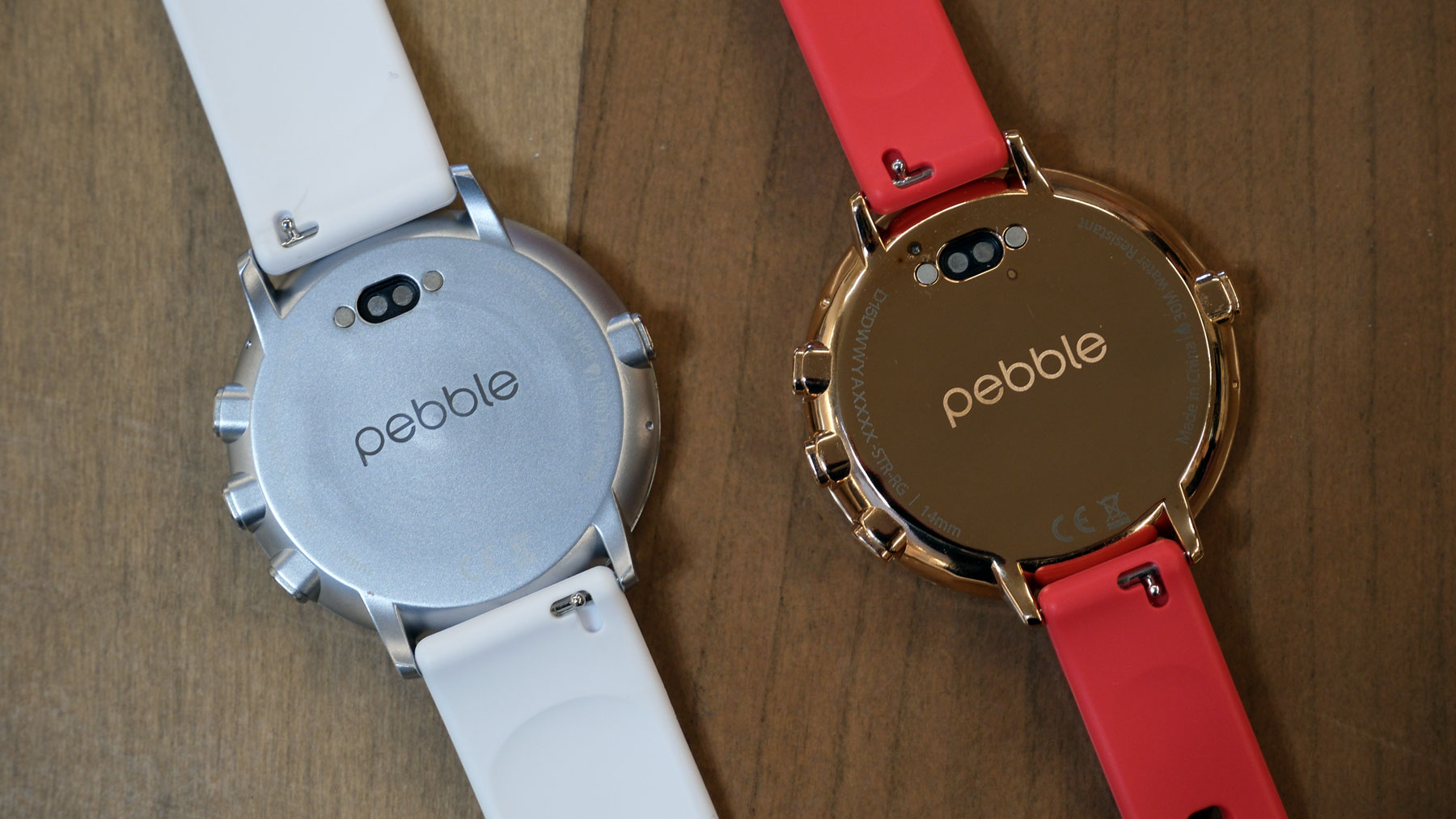
The new watch has a 1.3-inch color e-paper touchscreen which stretches to the end of the case. Its display has been bonded to the glass crystal, dramatically improving the viewing angles and reducing glare. You should expect to get two weeks of life on a single charge, but it remains just 8.1mm thick, and you can really feel that lack of heft when it’s in your hand. In fact, compared to so many of its smartwatch peers, you could almost unironically describe it as dainty, making its case size feel almost comically large. On the materials side, the case feels strong enough that I think it would withstand the rigors of daily life, and I’m quite smitten with both the polished rose gold and brushed silver finishes.

On one hand, it’s hardly the major reason to buy a watch, but I’m deeply smitten by how much text the Round 2’s display can render. Even the fanciest of smartwatches aren’t that willing to display big reams of text for your ease of reading. I was tickled to read a lengthy Slack message which reminded me, again, of what I’ve been missing for all of these years. Perhaps that’s a sign of the broader benefits a device like this offers, which is the ability to tweak its UI to what you need, rather than being tied by the UI designers in Cupertino and Mountain View.

There are plenty of omissions in the spec list, including no optical heart rate sensor, no GPS and no speaker. I’m not weeping over any of them: I’ve not used my smartwatch’s GPS in years and yes, and Pebble is swerving away from the health and fitness market. I don’t want to take calls from my wrist, either, and while the omitted heart rate sensor is harder to take given their ubiquity, it’s been done to ensure the watch is thinner than many of its competitors.

Migicovsky is candid about Pebble’s failure, saying the company spent too much to become a global hardware brand. He invested heavily in inventory in anticipation of blockbuster sales that never came, similar to Peloton’s post-COVID slump. This time around, the focus is on ensuring the company remains sustainable over the long term and, hopefully, building a succession of products. Rather than big investments, he’ll make small batches of devices to cater to pre-orders and won’t water down his philosophy in the hope of attracting a broad user base. He even said the Pebble website may include recommendations for alternative smartwatches from other companies to ensure he’s only catering to the faithful. 

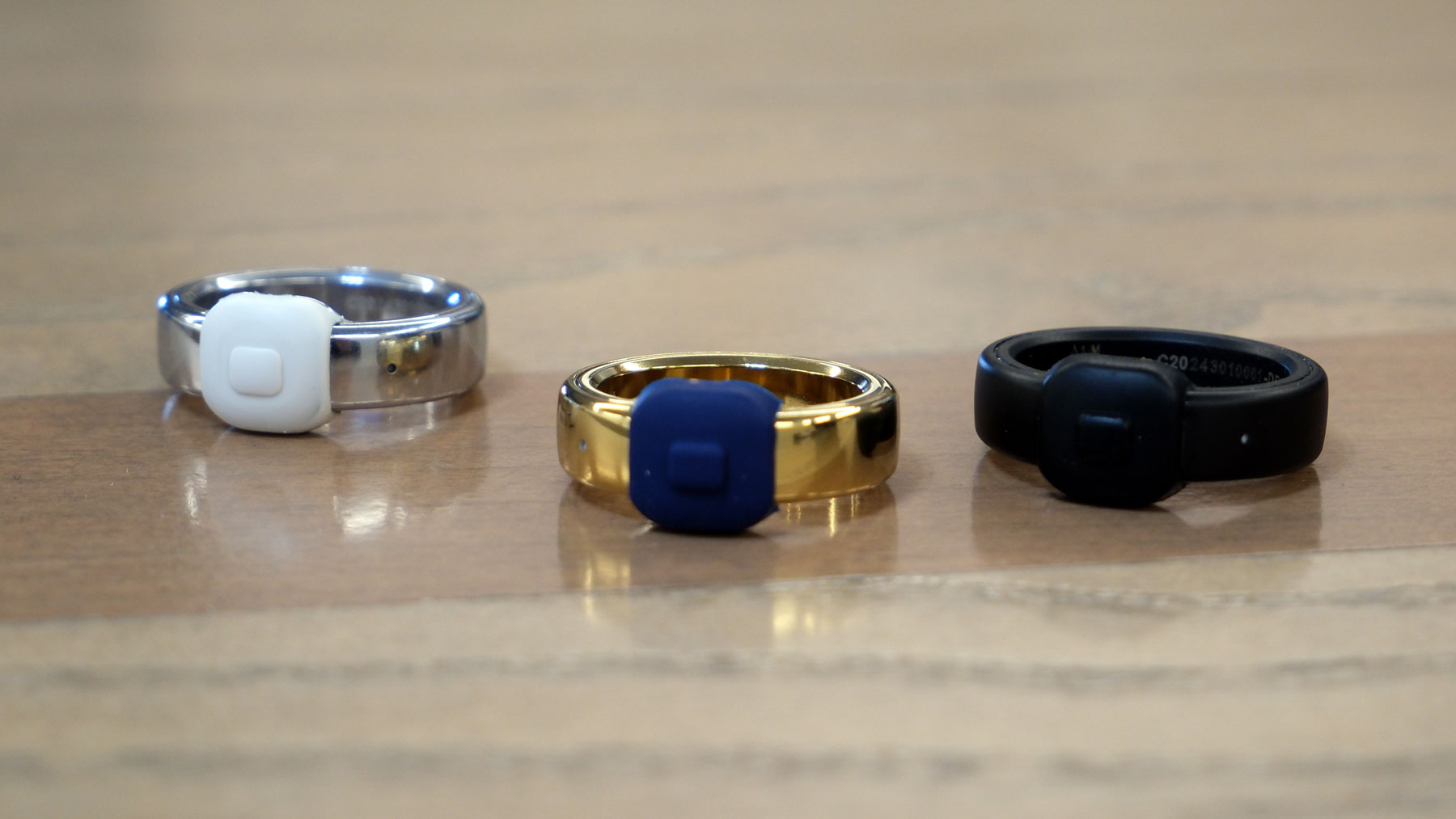
Three Pebble Indexes side by side on a table.
Daniel Cooper for Engadget

It’s his hope that this approach will give him the time and space to make more products, such as the already-announced Pebble Index 01. It’s a $75 ring equipped with a microphone, Bluetooth and a single push button, where users can record brief reminders to themselves. Rather than add weight and complexity with a rechargeable battery, each Index has a sealed-in cell that the company promises will last for up to two years. A month before the battery is due to expire, you’ll be asked if you want to buy a replacement, sending in the original for recycling. It’s an unusual arrangement but one that Migicovsky believes is more compelling than some others. After all, users aren’t saddled with any monthly subscription fees, and they only need to buy a new one if they’ve actually gotten the benefit out of their existing model. As with the revived Pebbles, the prevailing attitude is that nobody’s twisting your arm here.

Image of the rear sides of the Pebble Round 2
Daniel Cooper for Engadget

More broadly, Migicovsky has the time and money now to explore these product ideas free from the usual pressures. He has no investors or backers demanding instant returns and fast growth, giving him license to pursue his ideas as far as he wants to take them. And he is determined to return a small degree of whimsy to consumer electronics, building gadgets that are in some way fun. Let’s hope he succeeds, because the industry can’t survive another decade of homogeneity. 

This article originally appeared on Engadget at https://www.engadget.com/wearables/pebble-seeks-to-remedy-the-wearable-industrys-original-sin-170000834.html?src=rss