Before you take your electric G-Wagon for its next off-roading excursion, you may want to stop by an authorized dealer. The German automaker issued a recall for every Mercedes-Benz G580 with EQ technology with the 2025 model year, as first spotted by InsideEVs. According to the recall on the National Highway Traffic Safety Administration's website, the current wheel bolts could "allow a wheel to loosen or detach from the vehicle," potentially affecting 3,734 models on the road.
The recall report explained that the electric G580's wheel bolts were "not adapted to the increased vehicle mass and higher torque loads associated with the electric variant." According to the NHTSA report, Mercedes-Benz used the same wheel assembly and bolts as its other G-Class vehicles for the electric model, but conducted an analysis from September 2024 to January 2025 that confirmed these wheel bolts could loosen from repeated rough driving and wheel changes, specifically with the 2025 Mercedes-Benz G580 with EQ technology models. In the end, Mercedes-Benz concluded in the report that it couldn't rule out the risk, even though the wheel bolt loosening was "unlikely to occur under real-world operating scenarios."
To get it fixed, owners have to bring their affected G580s to a Mercedes-Benz authorized dealer, who will replace the bolts for free. Owners of the electric G580s, whose 2025 model year started at around $160,000, will get mail notices starting in late May. Besides this luxury SUV model, Mercedes-Benz had to issue another recall for another EV in 2021. The automaker recalled a couple hundred EQS EV and S-Class sedans that allowed for video playback on the dashboard even while the car was moving.
This article originally appeared on Engadget at https://www.engadget.com/transportation/evs/mercedes-benz-recalls-some-g-wagon-evs-due-to-risk-of-wheels-falling-off-150939361.html?src=rss
Back at CES, Samsung showed off a new line of speakers and two of its 2026 soundbars. Today, the company announced pricing for the entire suite of new products, including two soundbars that weren’t inside its showroom in Vegas. All but two of the new devices are available to order now, so you might not have to wait to get your hands on some new Samsung audio gear.
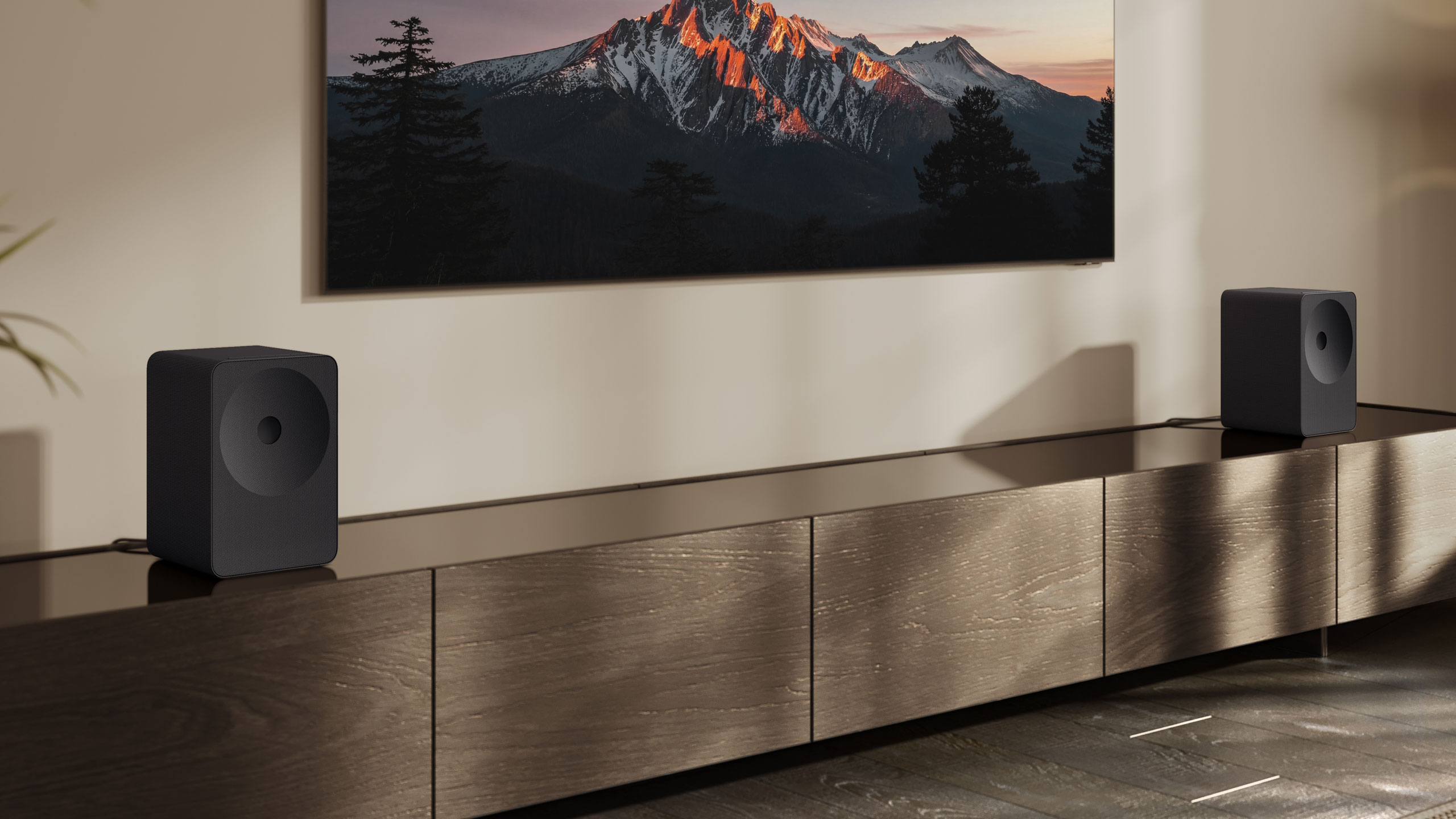
Let’s start with the Music Studio 7 and Music Studio 5 speakers. The Music Studio 7 is the more rectangular model in the duo. It’s a 3.1.1-channel unit with left, right and center speakers alongside one woofer and one up-firing driver. This $500 device is also equipped with Pattern Control tech to direct the sound evenly through the room while keeping distortion to a minimum. The more circular Music Studio 5 has a 2.1-channel configuration composed of two tweeters and a single woofer. It has waveguide technology to evenly disperse the sound and costs $300.
Both the Music Studio 7 and Music Studio 5 use AI processing to customize the sound based on the room and the content. Those capabilities come in the form of Samsung’s Dynamic Bass Control and SpaceFit Sound Pro room calibration features. Both speakers also use Active Voice Amplifier Pro to boost dialogue.
Two Music Studio 7 speakers being used with a TV
Samsung
Yes, this means you can use a pair of either model as your living room setup. In fact, they can work with a compatible TV or soundbar to employ Samsung’s Q-Symphony feature that uses all of your speakers as an immersive group. Samsung is also expanding Q-Symphony to work with up to five of its audio devices and the feature will automatically adjust the sound based on speaker locations. Those upgrades seem an awful lot like LG’s Sound Suite and Dolby Atmos FlexConnect, if you ask me.
Samsung revealed its flagship soundbar, the Q990H, at CES. Unfortunately, the company is keeping the same overall design it’s been using for about years now, so I think it’s time for a change. This is the company’s 11.1.4-channel Dolby Atmos option that comes with rear satellite speakers and a subwoofer for $2,000. Samsung’s home theater features like Dynamic Bass Control, SpaceFit Sound Pro and Adaptive Sound are all here, but there are also two new features on the Q990H for 2026.
First, Samsung promises that Sound Elevation will improve the audio by making dialogue sound like its coming from where characters are on the screen rather than the position of your soundbar. There’s also Auto Volume, which will supposedly nix sudden volume jumps as you switch channels or streaming services.
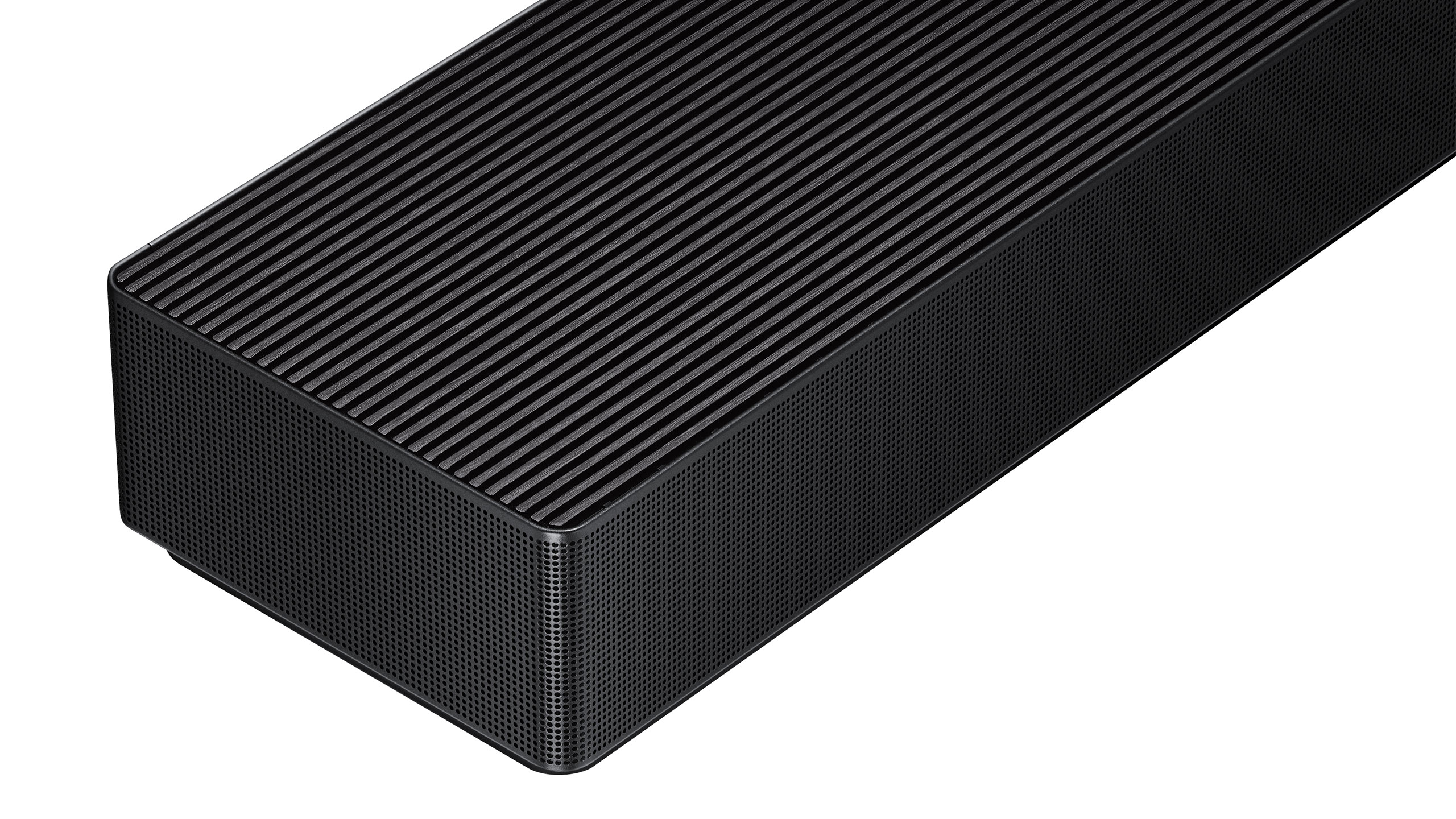
The QS90H is the member of Samsung’s 2026 soundbar lineup that really impressed me at CES. The company says this is its first “all-in-one” soundbar, which means you shouldn’t have to use a subwoofer for adequate bass. Other companies have made that claim, and it’s almost never true, but the $1,000 QS90H pumped out some great low-end tone back in Vegas. That’s thanks to four built-in woofers and an overall 7.1.2-channel setup.
The QS90H has a similar design to the existing QS700 soundbar
Samsung
Like the QS700F, the QS90H has a gyro sensor that automatically detects if it’s sitting flat on a shelf or mounted on a wall. This allows the soundbar to automatically adjust the sound based on its position so you don’t sacrifice performance for what looks best in your home. The QS90H also offers Q-Symphony, SpaceFit Sound Pro room calibration, Adaptive Sound, Active Voice Amplifier Pro and Dynamic Bass Control — plus the new Sound Elevation and Auto Volume from the Q990H.
Two other soundbars that Samsung didn’t discuss at CES are the Q930H ($1,500) and the Q800H ($1,100). As you might expect based on the numbers, these two models sit below the Q990H in the company’s lineup. The Q930H is a 9.1.4-channel option that comes with rear speakers and a subwoofer in the box. In terms of features, Q-Symphony, SpaceFit Sound Pro room calibration, Adaptive Sound, Voice Amplifier Pro and Sound Elevation are all here. Step down to the Q800H and you’ll get all of those features in a 5.1.2-channel arrangement. This soundbar only comes with a subwoofer though. It’s also worth noting that both the Q930H and Q800H have a similar angular design to the Q900H.
This article originally appeared on Engadget at https://www.engadget.com/audio/speakers/samsungs-music-studio-speakers-and-two-of-its-2026-soundbars-are-available-now-150000056.html?src=rss
Artemis II and its four-person crew have entered the Moon’s “sphere of influence,” meaning the spacecraft is more affected by lunar gravity than the Earth’s pull. The transition occurred at a distance of 39,000 miles from the Moon, four days, six hours and two minutes into the mission. The next and most important phase will happen tomorrow when the craft loops around the Moon’s far side, taking humans deeper into space than they’ve ever been before.
At their apogee, Astronauts Reid Wiseman, Christina Koch, Victor Glover and Canada’s Jeremy Hansen will be 252,757 miles from Earth. That will break the previous record held by the Apollo 13 crew by just over 4,000 miles. They’re the first humans to cross the lunar threshold since 1972’s Apollo 17 moon landing mission.
The crew spent this weekend carrying out preparations for their lunar flyby. That included manual piloting demonstrations, reviewing their science objectives for the six-hour observation period and evaluating their space suits, which are there for life support in the event of an emergency and for their return home. But, they've had plenty of time to take in the views, too — and those views sure are spectacular. In the latest series of images shared by the space agency, the astronauts are seen gazing at Earth through the windows of the Orion spacecraft.
Orion will reach the moon's vicinity shortly after midnight on Monday, April 6. Later that day, the crew is expected to reach a point farther than any humans have traveled from Earth, surpassing the record of 248,655 miles from Earth set by the Apollo 13 astronauts in 1970.
Mission specialist Christina Koch takes in the view.
NASA
The lunar observation period will start at 2:45PM ET, and a few hours later, they'll be behind the moon and briefly drop out of communication. The spacecraft's closest approach to the moon is expected to occur at 7:02PM, when it will be 4,066 miles from the surface. "From that distance, the crew will see the entire disk of the Moon at once, including regions near the north and south poles," according to NASA. The crew will later get a chance to see a solar eclipse "as Orion, the Moon, and the Sun align in such a way that the astronauts will see our star disappear behind the Moon for about an hour." NASA will have coverage of the flyby starting at 1PM ET.
Update April 7 at 1:40 AM ET: The post has been updated with news that Artemis II has entered the Moon’s sphere of influence.
This article originally appeared on Engadget at https://www.engadget.com/science/space/artemis-ii-arrives-in-lunar-space-ahead-of-its-trip-around-the-moon-211919381.html?src=rss
While the US and Anthropic are in the midst of a major dispute, the UK is trying to sway the San Francisco-based AI company to expand its presence on English soil. According to a report from The Financial Times, staffers at the UK's Department for Science, Innovation and Technology have worked on proposals that include expanding Anthropic's office in London, along with a potential dual stock listing.
The UK's strategy follows a public fallout between Anthropic and the US Department of Defense earlier this year. After the AI company said it wouldn't budge on certain AI guardrails, the Department of Defense pulled its contract and eventually designated Anthropic a supply chain risk. While the designation is currently temporarily blocked by a court-ordered injunction, the feud is far from over. In the meantime, the UK's efforts to court Anthropic have ramped up in the recent weeks thanks to the company's disagreements with the US, according to FT's sources.
With no end in sight for the debacle with the Department of Defense, Anthropic's CEO, Dario Amodei, is expected to visit the UK in May, according to FT. However, even in London, Anthropic will have to compete against OpenAI, which already committed to expanding its footprint in the English capital in February.
This article originally appeared on Engadget at https://www.engadget.com/ai/the-uk-government-reportedly-wants-anthropic-to-expand-its-presence-in-london-174201049.html?src=rss
Samsung is putting the final nail in the coffin for its own messaging app. The smartphone maker posted an "End of Service Announcement" on its website, revealing that the Samsung Messages app will no longer be available by July of this year. Samsung also recommended that anyone still using Samsung Messages switch over to Google Messages as the default messaging app.
For Samsung Messages users in the US, the switch to Google offers RCS messaging that lets you send high-quality media, join group chats and get real-time typing indicators no matter the smartphone's OS. Galaxy smartphone owners may lose out on some of the Samsung Messages customization options, but Google Messages will make up for it generative AI from Gemini that can remix your photos in chats. On top of those features, Google Messages makes it easier for Samsung users to switch chats between a smartphone, tablet or smartwatch.
It's no surprise that Samsung is only using Google Messages from now on, since it has been phasing out Samsung Messages for a few years now. Dating back to the Galaxy Z Fold 6 and Flip 6, and then followed by the Galaxy S25 series, Samsung stopped preloading the Samsung Messages app and instead pre-installed the Google Messages app. The Samsung Messages app is still available on the Galaxy Store, but Samsung said the exact final date will eventually be announced on the app itself.
This article originally appeared on Engadget at https://www.engadget.com/mobile/smartphones/samsung-will-discontinue-its-messages-app-in-july-and-replace-it-with-googles-162204307.html?src=rss
Pinball video games have been around for years — I cut my teeth on Space Cadet 3D Pinball, which was pre-loaded on Windows 95. They range from realistic recreations of pinball tables you’ll find at arcades to games that could never exist in real life like 2019’s Demon’s Tilt or older ones like Metroid Prime Pinball for the Nintendo DS or Pokémon Pinball for the Game Boy Color.
I didn’t expect to find a detailed pinball game for the humble and delightful Playdate, but a pair of developers working under the name Amano pulled it off with Devils on the Moon Pinball, which arrived last week. It’s the developer’s third game for the Playdate, and Mario and JP (who make up Amano) pointed directly to Pokemon Pinball as the inspiration for this game. “I think one of my most-played games is Pokemon Pinball,” JP said. “But the idea to make a pinball game came from Mario… he came to me and say ‘JP, I want to make a custom engine for Playdate and we should make a pinball game.’”
I love playing pinball in real life, but owning a full-size table is extremely expensive and takes up a ton of room. But Devils on the Moon completely scratches the itch. The controls are extremely simple: pressing left on the d-pad flips the left fipper, A flips the right flipper, and pressing down on the d-pad launches the ball. Amano also included tilt controls; pressing right or up on the d-pad or the B button shakes the table in a particular direction so you can try and save the ball. Sadly, the crank doesn’t come into play, but I can’t say I have a good idea for how it would be used.
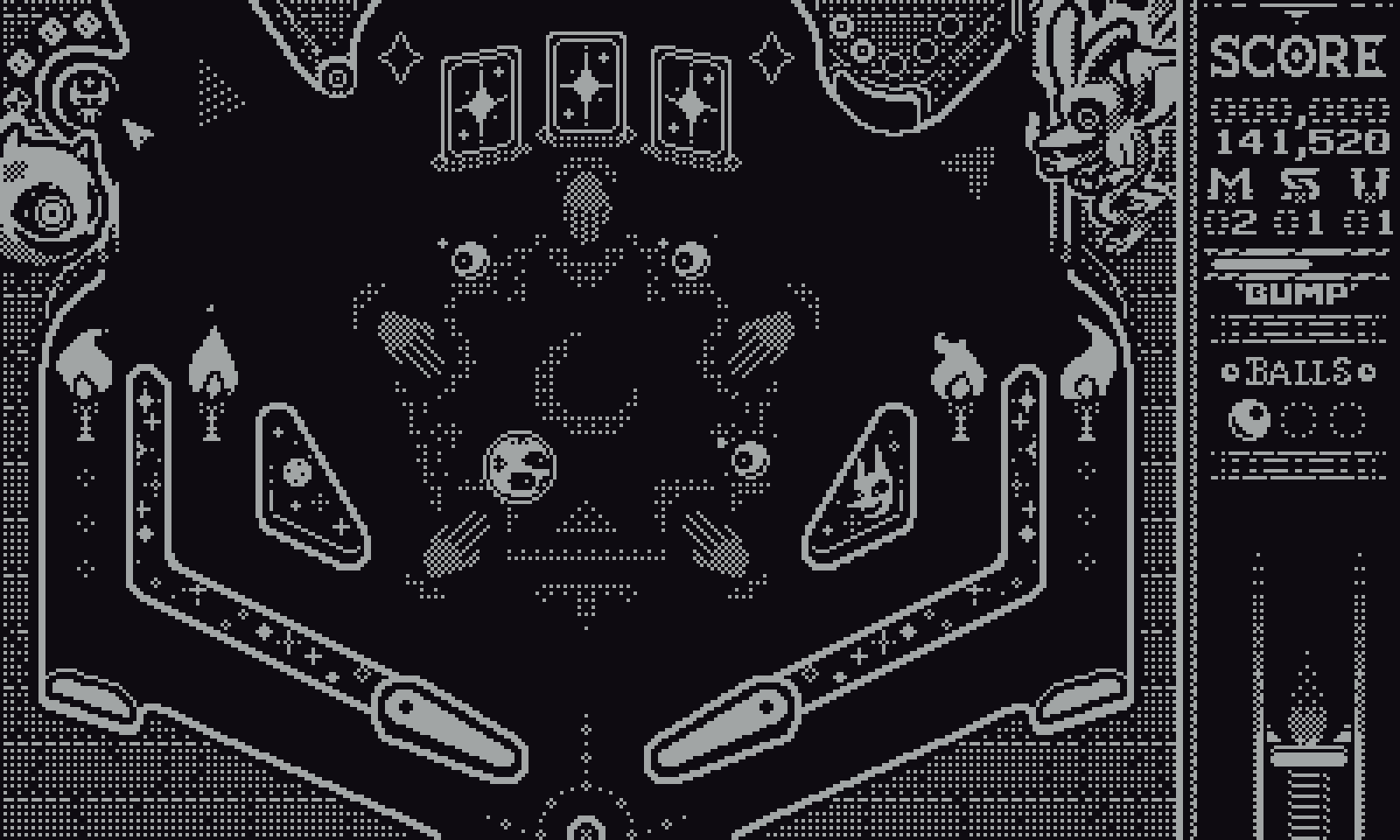
A screenshot from Devils on the Moon Pinball.
Amano
I was impressed with both the physics and table design of Devils on the Moon after playing for just a few minutes. Despite not having analog control, the way the ball reacted when I hit the flippers felt consistent and smooth, and while I was often surprised at some of the bounces it took, it never felt unfair. When I drained a ball, it was almost always something I could have avoided if I knew the game better or had faster reflexes — just like a good, real-life pinball table.
JP and Mario described the game as using “stylized physics” rather than it being fully realistic. “It may not necessarily be accurate to real life,” JP said. “But since the screen is wider than it is tall unlike actual pinball, we needed the ball to feel a little bit floaty and not fall as fast because then it would just zoom straight down the screen.”
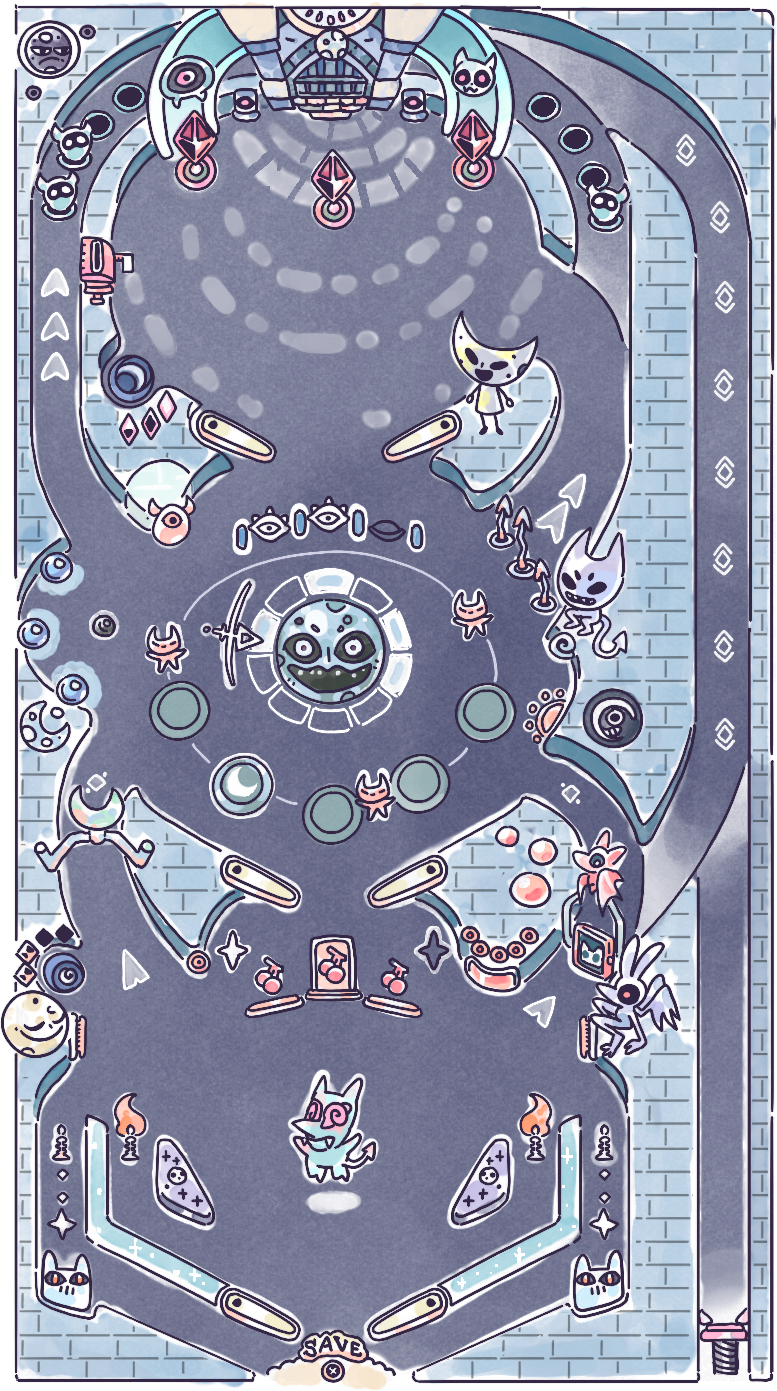
The table design feels both grounded in reality while also taking advantage of its virtual nature. There are three vertical “levels,” each with its own set of flippers. The 2D nature of the game means there aren’t any true ramps like you’ll on most pinball tables, but having three separate sections of the game to get used to makes up for that. And provided you complete various modes in the game, you can reach boss battles where you’re tasked with whacking a giant enemy repeatedly to drain away their health bar. Physical pinball tables often have similar encounters, but they have to be worked into the design of the game — in this case, your ball essentially ports to an entirely different space when you battle a boss.
The full three-stage board layout for Devils on the Moon pinball.
Amano
“It's kind of playing like the old pinball machines where the rules are really simple,” Mario said.". "You just have a few things to do. In our case, it ended up going beyond our original scope, but it’s still quite simple compared to an actual pinball machine in terms of rules.” He said the design intent was to make the game friendlier to people who might try it out without a lot of pinball experience while still putting enough challenge into it.
The audio and visual presentation is top-notch for a Playdate game, too. Perhaps most crucially for a pinball game, there’s no lag or stuttering. The game also has a distinct visual identity, something that’s always important for pinball to draw you into the world of the playfield as much as possible. The game’s page cheekily promises “ at least (1) songs” and it delivers on that with a solid theme for the main game that serves well as background music that doesn’t get old if you’re playing for a while, and the beeps and boops the table makes as you play feel well-suited to the game. It doesn’t “sound” like a real pinball table — but it isn’t one, so that’s okay.
A screenshot of Devils on the Moon Pinball.
Amano
I haven’t played a video pinball game in a long time, but the Playdate feels like an ideal platform for this. I can bring it with me anywhere and play a round or two (provided there’s decent light) or settle in for a longer play session. The game is challenging enough that you’ll need to practice a lot to get the hang of it, but there’s enough variety to the three-tiered table to keep players interested for the long haul. After all, the fun of pinball isn’t necessarily playing a table for the first time — it’s learning it inside out so you can maximize your score. I’m looking forward to getting to that point with Devils on the Moon.
This article originally appeared on Engadget at https://www.engadget.com/gaming/devils-on-the-moon-brings-the-score-chasing-of-pinball-to-the-playdate-130000414.html?src=rss
There's finally a release date for the Spaceballs sequel — but before you get too excited, it's a whole year away. As first reported by Deadline, Amazon MGM Studios announced on Friday night that the upcoming Spaceballs movie will hit theaters on April 23, 2027, right around the 40th anniversary of the first film. Several members of the original cast will be reprising their roles, according to Deadline, including Mel Brooks, Rick Moranis, Bill Pullman, George Wynder and Daphne Zuniga.
— Amazon MGM Studios (@AmazonMGMStudio) April 4, 2026
Whispers of a potential Spaceballs 2 go back a couple of years, but Brooks officially confirmed in an extremely on-brand announcement video last summer that the movie is actually happening. Following Deadline's latest report, Amazon MGM Studios posted a screenshot of the article on X, along with the words, "Spaceballs: The Release Date. April 23, 2027." The movie is being directed by Josh Greenbaum and written by Josh Gad, Dan Hernandez and Benji Samit, according to Deadline. Along with the returning cast members, it will star Gad, Keke Palmer (!!), Lewis Pullman and Anthony Carrigan.
This article originally appeared on Engadget at https://www.engadget.com/entertainment/tv-movies/the-spaceballs-sequel-will-be-released-in-april-next-year-213543871.html?src=rss
For those who will never tire of the words of Ursula K. Le Guin, a special treat is on the way. The esteemed late author's blog, which she started in 2010 at the age of 81, is being rereleased as a podcast, In Your Spare Time. Le Guin's blog ran until 2017, and a book collecting a selection of those posts was published that year. But, the podcast will include everything: essays, poems and "even the ones that are mostly cat pictures," according to the announcement. The first episode will be released April 8 on Apple Podcasts, Spotify and other platforms.
From Le Guin's official Instagram account, which is managed by her estate:
We always wanted to hear a version of the blog that includes every single post, even the ones that are mostly cat pictures. So for the next two years and change, we'll release an episode every Wednesday. Each episode features a different reader of Ursula's text, and each reader adds their own thoughts—about their relationship with Ursula and her work, or about the specific topic of the post, or whatever catches their fancy.
You can listen to a trailer here ahead of the first episode's release this week. Post zero, "A Note at the Beginning," will be read by David Mitchell.
This article originally appeared on Engadget at https://www.engadget.com/entertainment/ursula-k-le-guins-blog-has-been-turned-into-a-podcast-193257106.html?src=rss
Instead of raising prices again, Netflix may have to lower its subscription costs in Italy. A court in Rome recently ruled that Netflix owed its Italian users a refund for price hikes between 2017 and January 2024 and a reduction to previous subscription costs. On top of the refunds, Netflix Italia would have to inform its affected subscribers of their right to a refund.
The lawsuit was originally filed by Movimento Consumatori, a consumer rights organization based in Rome. The group's president, Alessandro Mostaccio, said in a press release that more than 25,000 Netflix users have complained to Movimento Consumatori that they're not satisfied with the price increases over the years. According to the lawyers representing the consumers, Premium subscribers are entitled to a refund of roughly 500 euros, while Standard tier customers should get back about 250 euros.
Mostaccio also said that if Netflix doesn't immediately reduce prices and refund its customers, the consumer rights organization would pursue a class action lawsuit to recover funds. A Netflix spokesperson told Reuters that it would appeal the Italian court's ruling, adding that the company takes "consumer rights very seriously and believe our terms have always complied with Italian laws and practice." On the other side of the world, Netflix again raised prices for its US customers, this time across all of its subscription tiers.
This article originally appeared on Engadget at https://www.engadget.com/entertainment/streaming/an-italian-court-ruled-netflix-has-to-refund-its-customers-for-price-hikes-dating-back-to-2017-190948417.html?src=rss
Before it's publicly available later this year, the Irish government is trialing its Government Digital Wallet, which includes a way to verify a user's age to access social media platforms. In its press release, the government's Department of Public Expediture, Infrastructure, Public Service Reform and Digitalisation said people can store digital versions of their birth certificates, driving licenses, European health cards and more.
Frank Feighan, the department's minister, said that this testing phase would help inform the development of the digital wallet and ensure it was user friendly. The government hasn't laid out when the Government Digital Wallet graduates beyond the testing phase, but Ireland is required to create a digital wallet by the end of 2026 as part of a European Union regulation.
"It will be able to facilitate secure age verification capability as set out in Digital Ireland and the implementation of the Online Safety Code, under which designated platforms must have age verification measures in place to help protect, in particular, children and young people from online harm," Feighan said of Ireland's digital wallet.
The pilot phase will be done on an opt-in basis and the government has a short survey available for comments and concerns. Along with Ireland, many other European Union member states are working on their own age verification methods. Earlier this year, Spain's prime minister Pedro Sanchez announced a law to ban social media for anyone under 16.
This article originally appeared on Engadget at https://www.engadget.com/cybersecurity/ireland-is-testing-out-a-digital-wallet-that-conducts-age-verification-for-social-media-users-175002131.html?src=rss