OpenAI to Launch ChatGPT 5.5 and a New Unified Desktop Super App

OpenAI to Launch ChatGPT 5.5 and a New Unified Desktop Super App DeepSeek V4 illustration alongside Huawei Ascend 910B chips, highlighting a China-based AI hardware stack.

OpenAI, DeepSeek and Anthropic are at the forefront of a rapidly evolving AI landscape, each making strides to secure their position in a competitive market. In a recent overview by Universe of AI, OpenAI’s upcoming ChatGPT 5.5 model is highlighted as a pivotal step toward the anticipated GPT-6, codenamed “Spud.” While ChatGPT 5.5 focuses on […]

The post OpenAI to Launch ChatGPT 5.5 and a New Unified Desktop Super App appeared first on Geeky Gadgets.

Posted in Uncategorized

Forget the Crease: How the Google Pixel 11 Pro Fold Redefines Foldables

Forget the Crease: How the Google Pixel 11 Pro Fold Redefines Foldables Side profile render showing the Pixel 11 Pro Fold thickness in folded and unfolded positions.

The Google Pixel 11 Pro Fold is poised to make a significant impact in the foldable smartphone market. Combining innovative features, a refined design, and advanced hardware, it aims to elevate user expectations for foldable devices. While some aspects may feel more iterative than new, rumored features like a removable battery and enhanced Face ID […]

The post Forget the Crease: How the Google Pixel 11 Pro Fold Redefines Foldables appeared first on Geeky Gadgets.

Posted in Uncategorized

This Cup Replaces the Kettle So Visually Impaired Users Make Tea Alone

For most people, making a morning cup of tea or coffee is an almost automatic routine. But for someone who can’t see, the same steps involve a level of risk that kitchenware has never really been built to handle. Hot liquids, unfamiliar controls, and the constant need to pour from one vessel to another can turn a simple habit into a genuine obstacle.

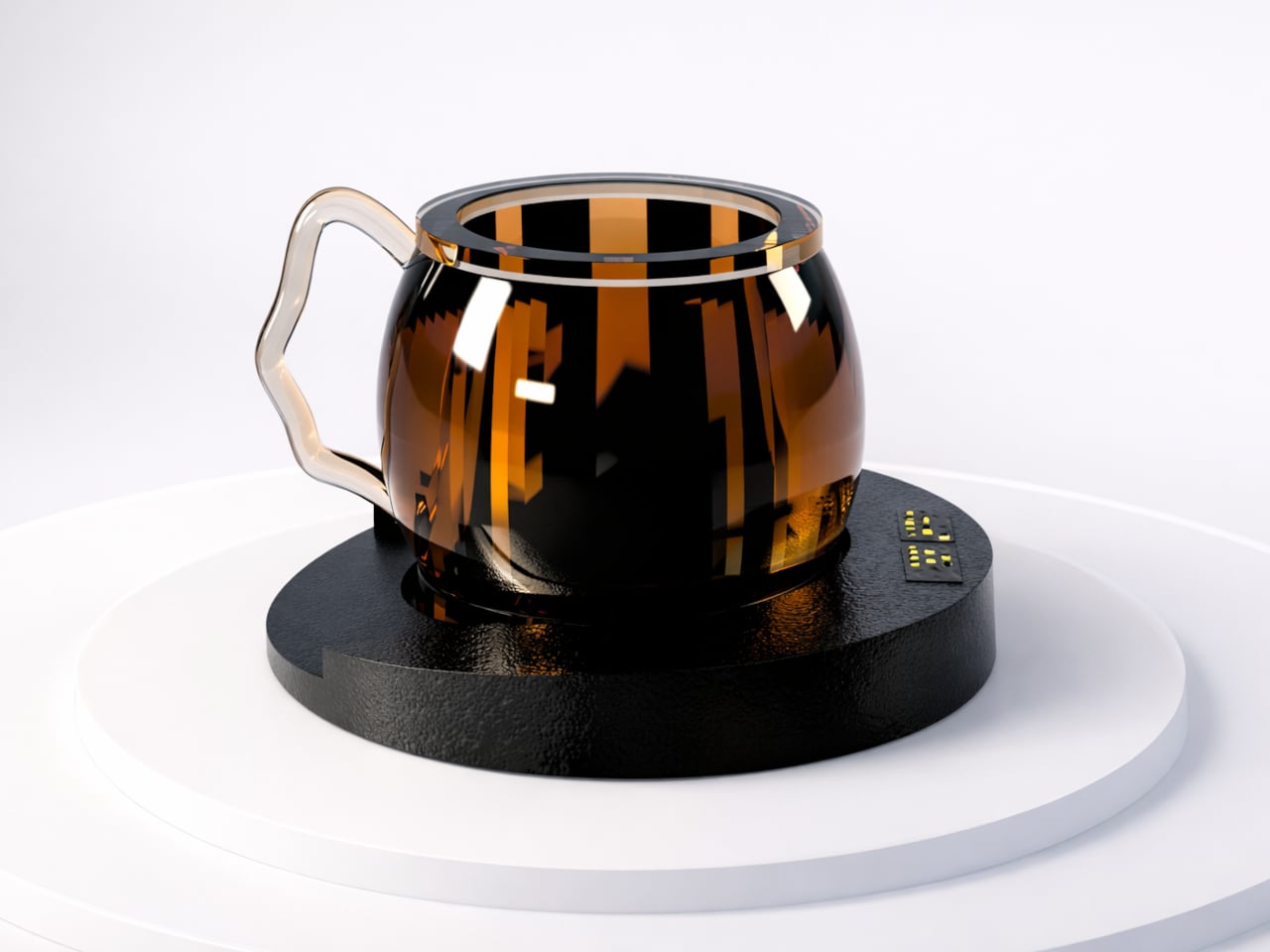
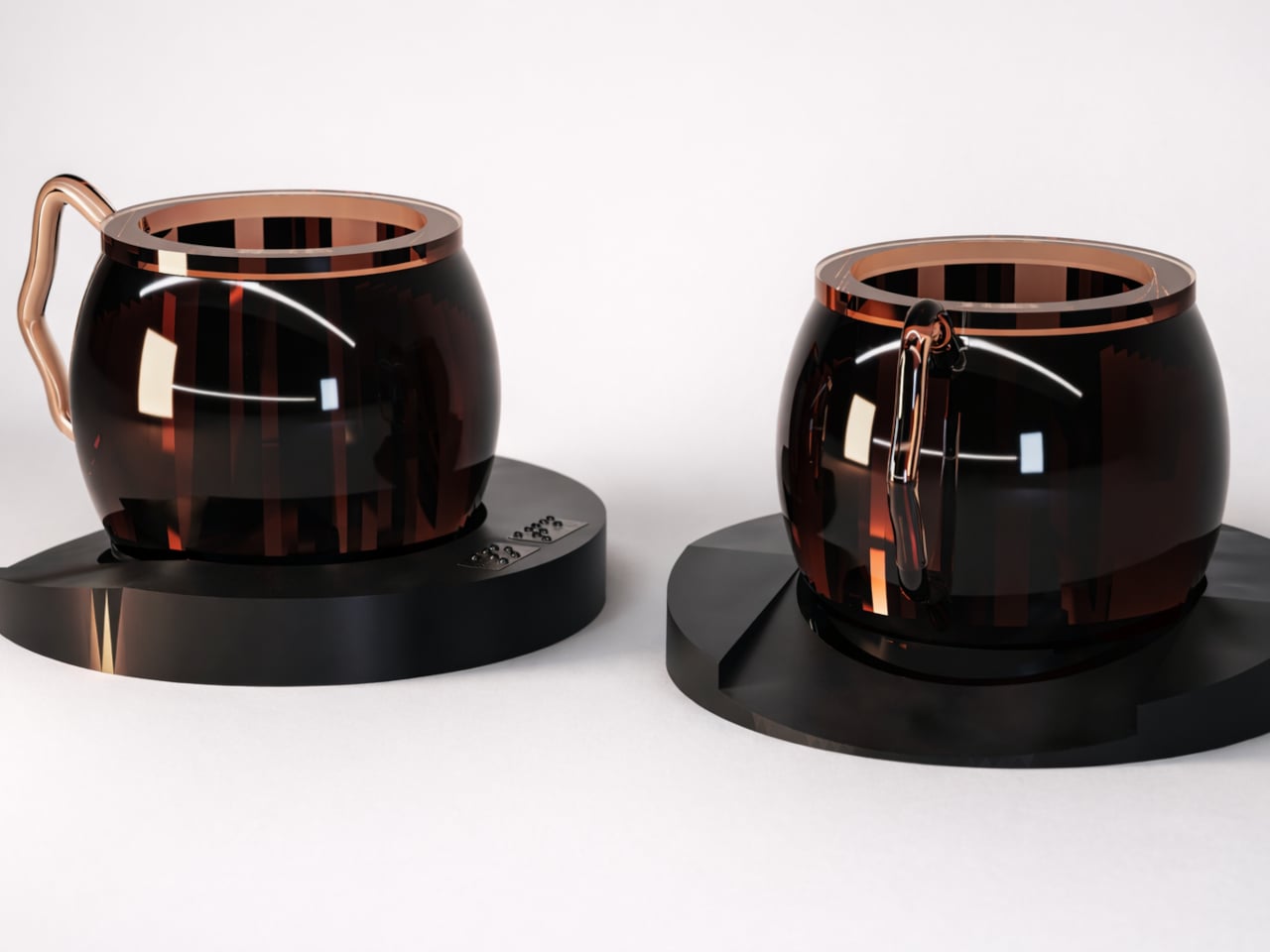
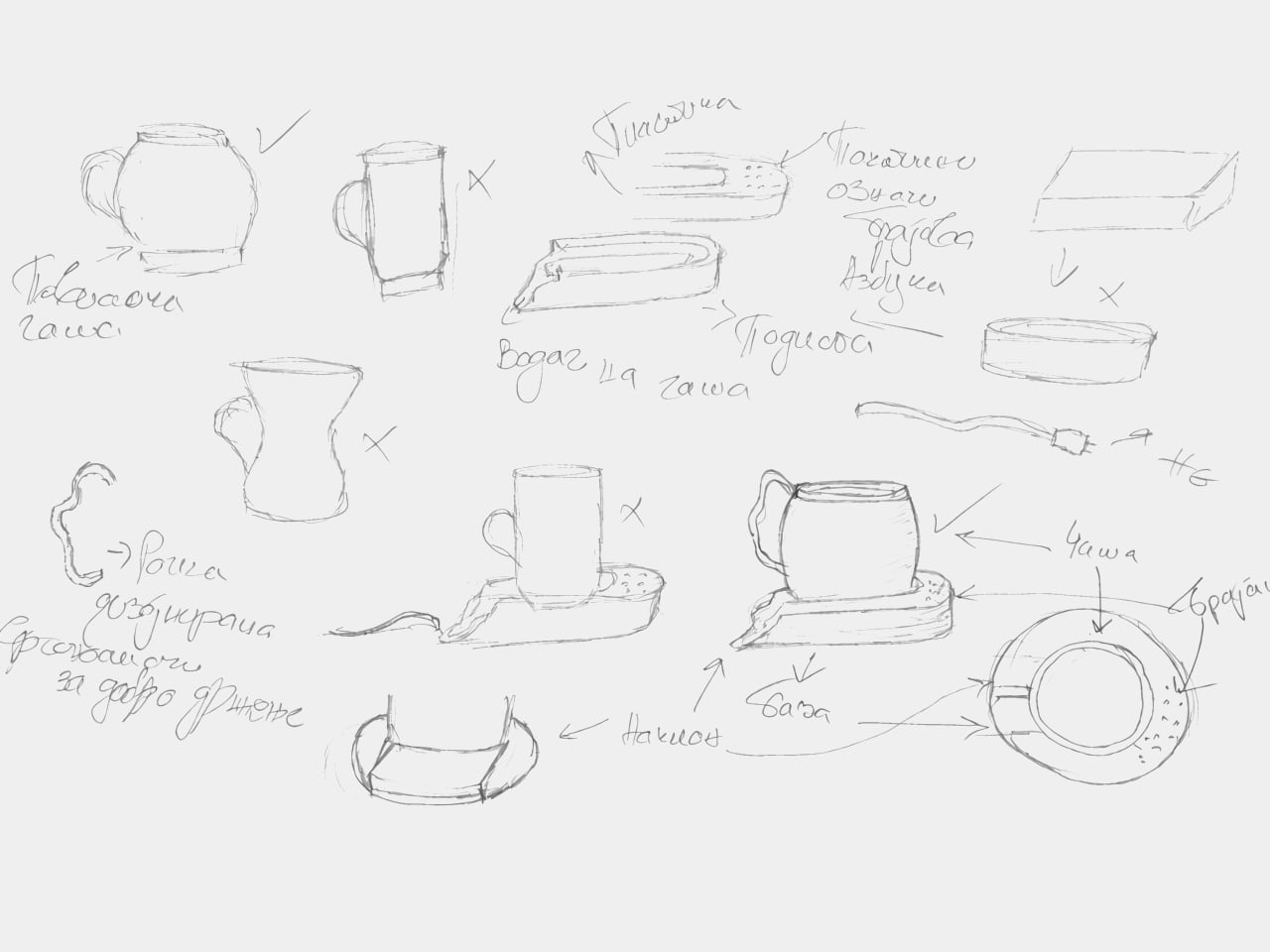
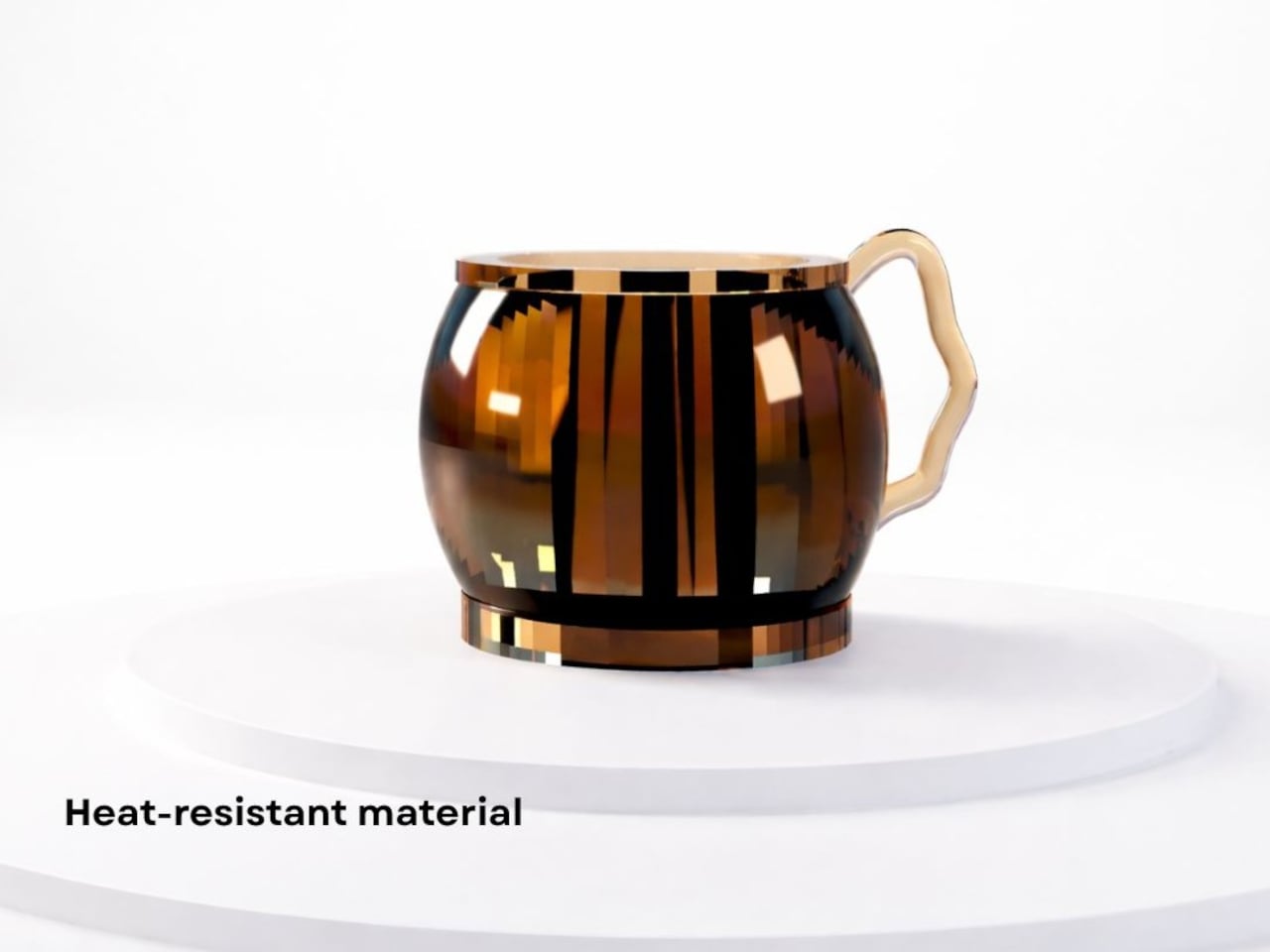
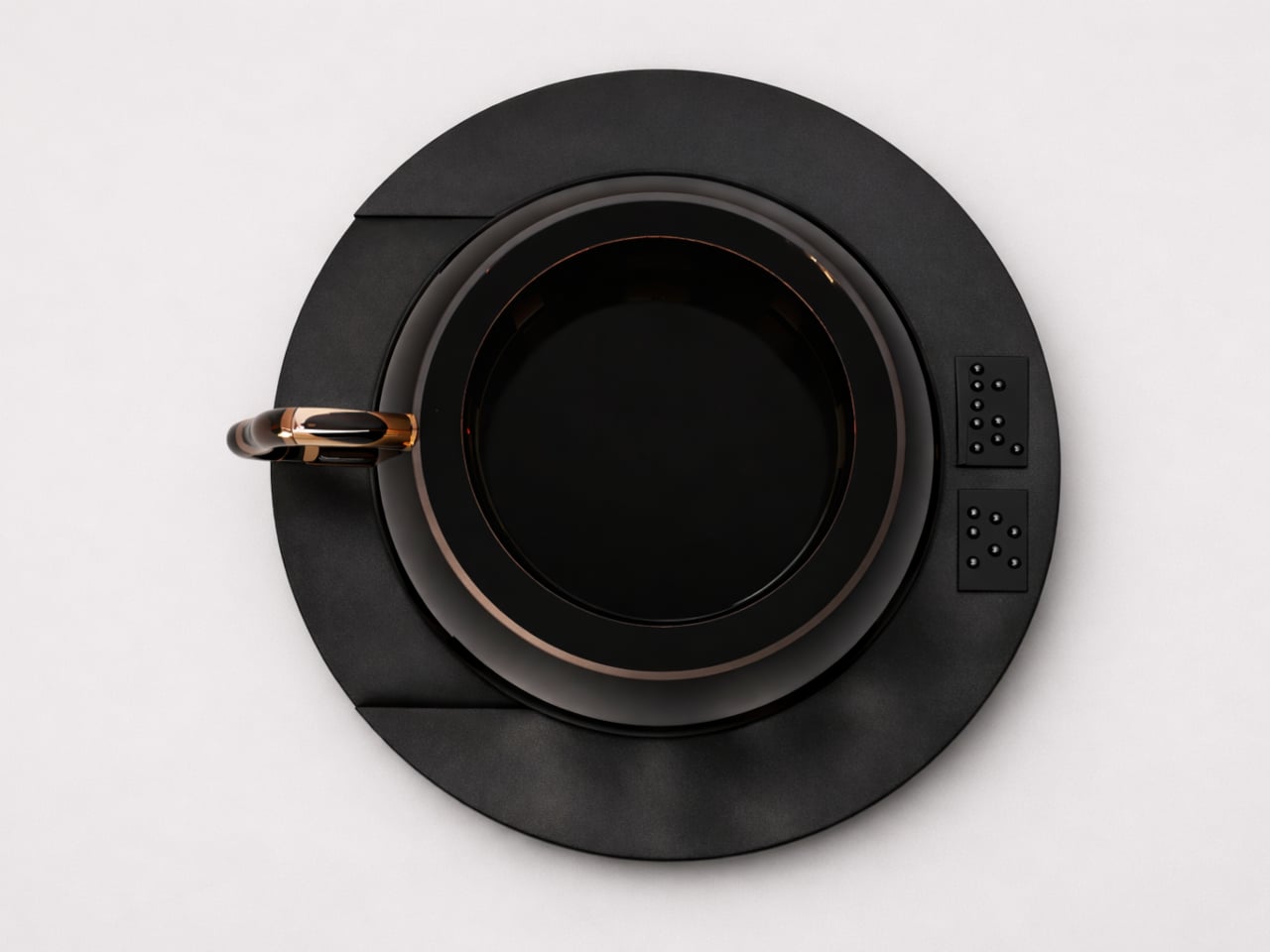
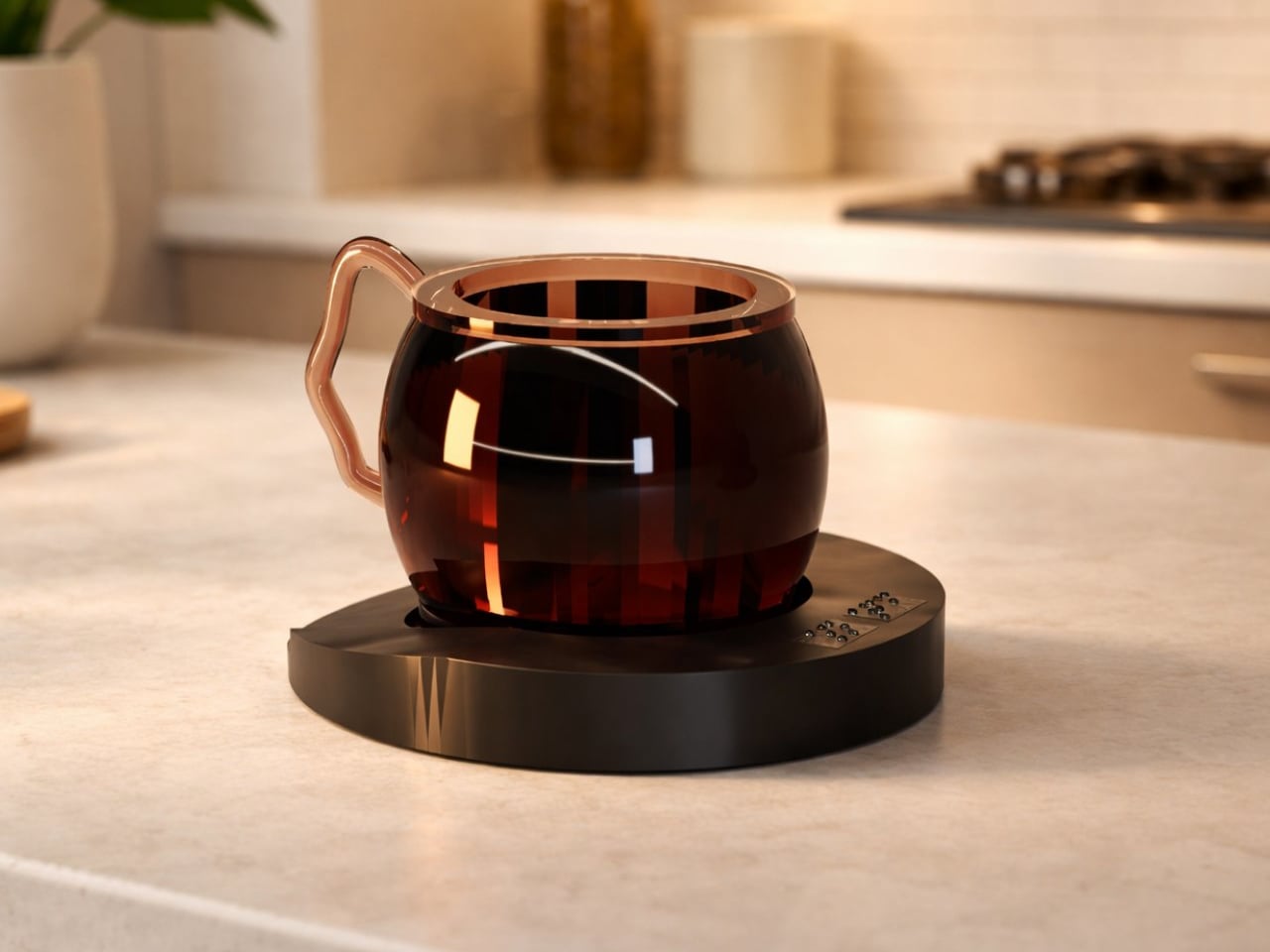
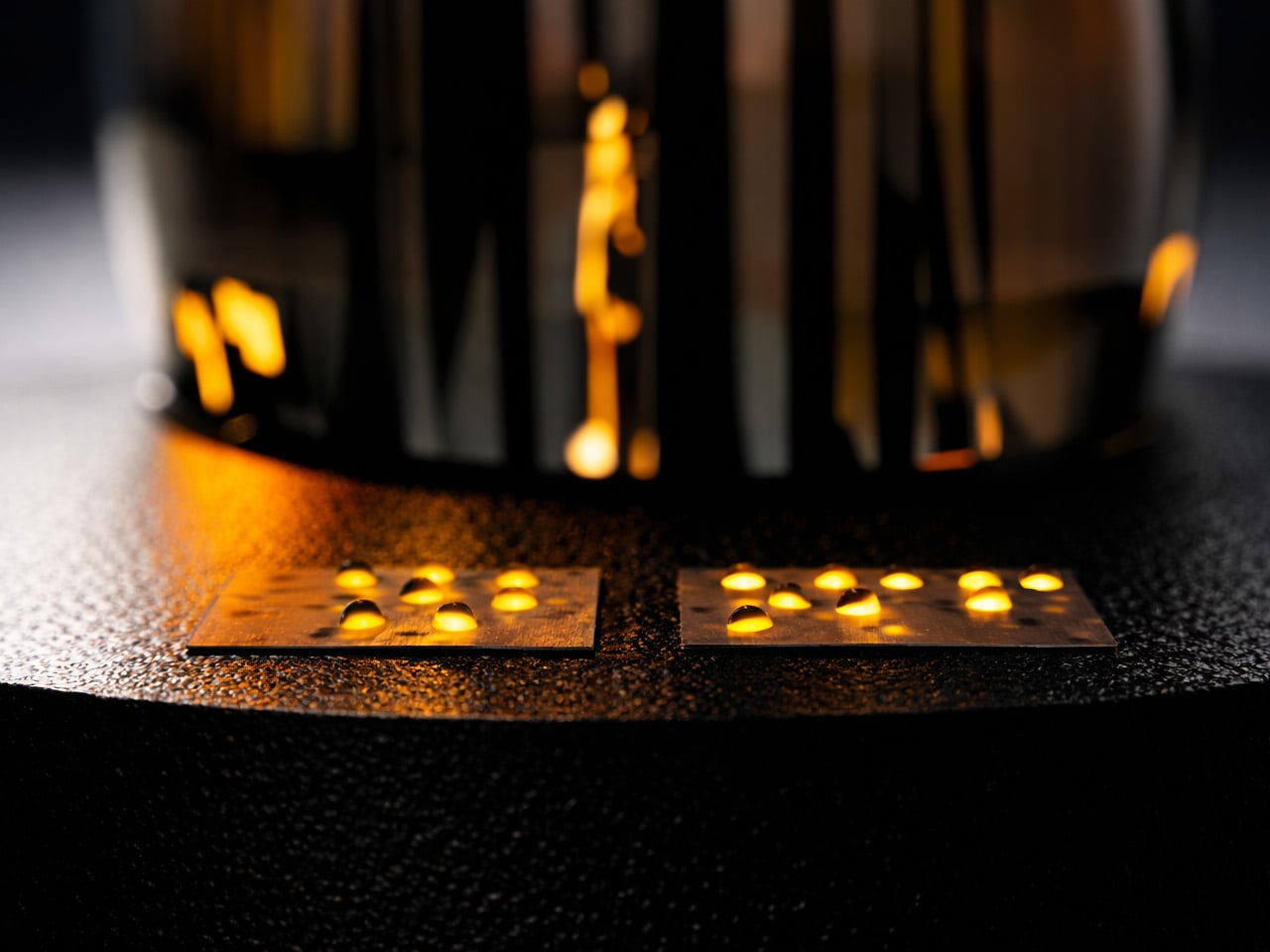
Designer Ivana Nedeljkovska’s Smart Cup for Visually Impaired Users tackles that problem head-on. Built from scratch with blind and visually impaired users as the primary audience, it combines the roles of a kettle, a teapot, and a drinking cup into one integrated form designed to be navigated entirely by touch, so there’s no need to move hot liquid between containers at any point.

Designer: Ivana Nedeljkovska

The challenge isn’t a small one. Conventional kitchen tools, from kettles to electric water heaters, were all designed for someone who can see them. They offer no tactile feedback on whether they’re on or off, no way to safely judge when water is ready, and no guidance on where to set things down. For visually impaired users, the kitchen is full of small ambiguities that add up to real risk.

That matters because every transfer of liquid is a risk. Pouring boiling water from a kettle into a separate cup is the kind of step that can go wrong for anyone, but for a blind user, the consequences are far more serious. Keeping the entire heating and drinking process within one vessel removes those moments before they can become a problem.

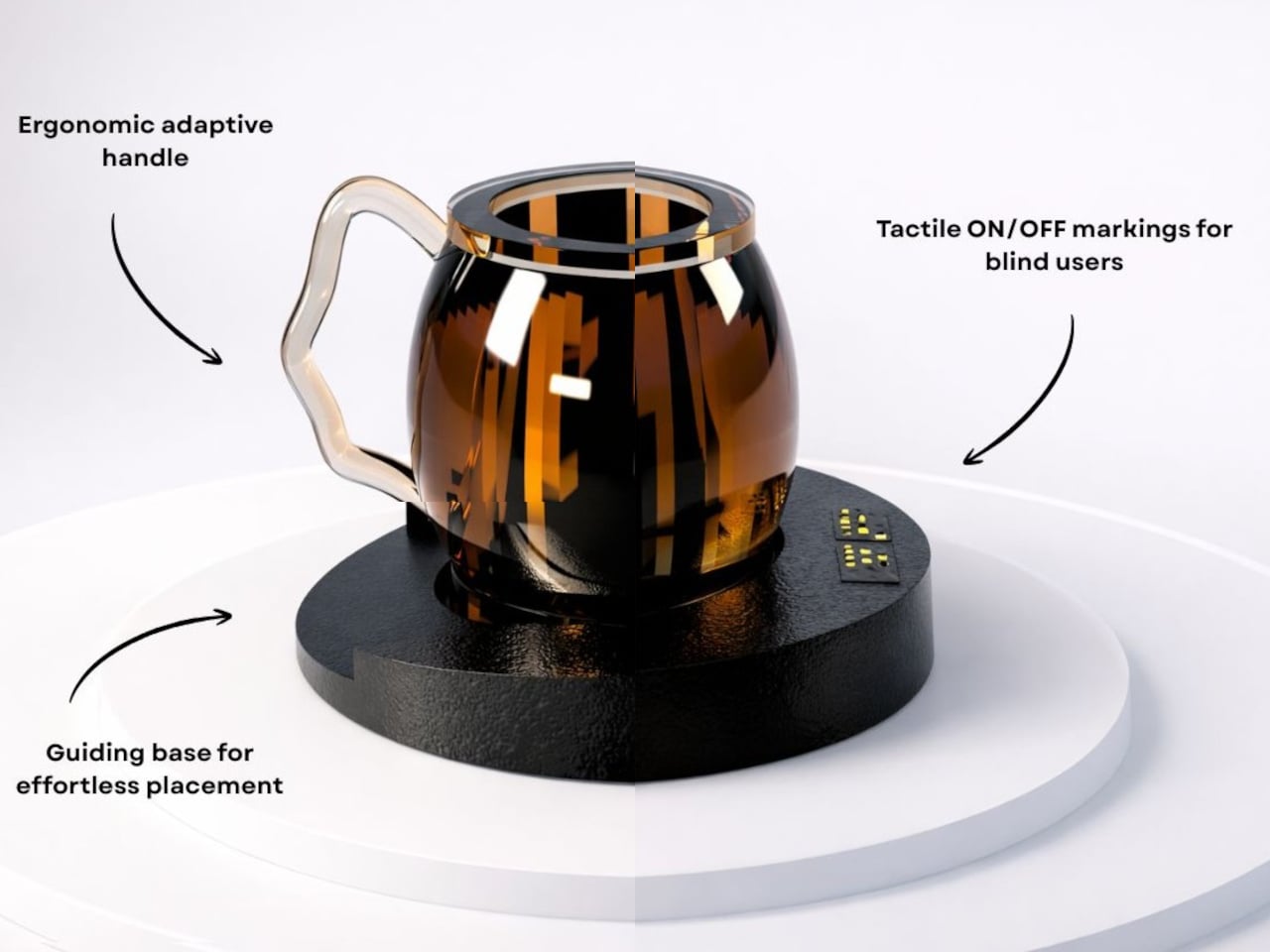
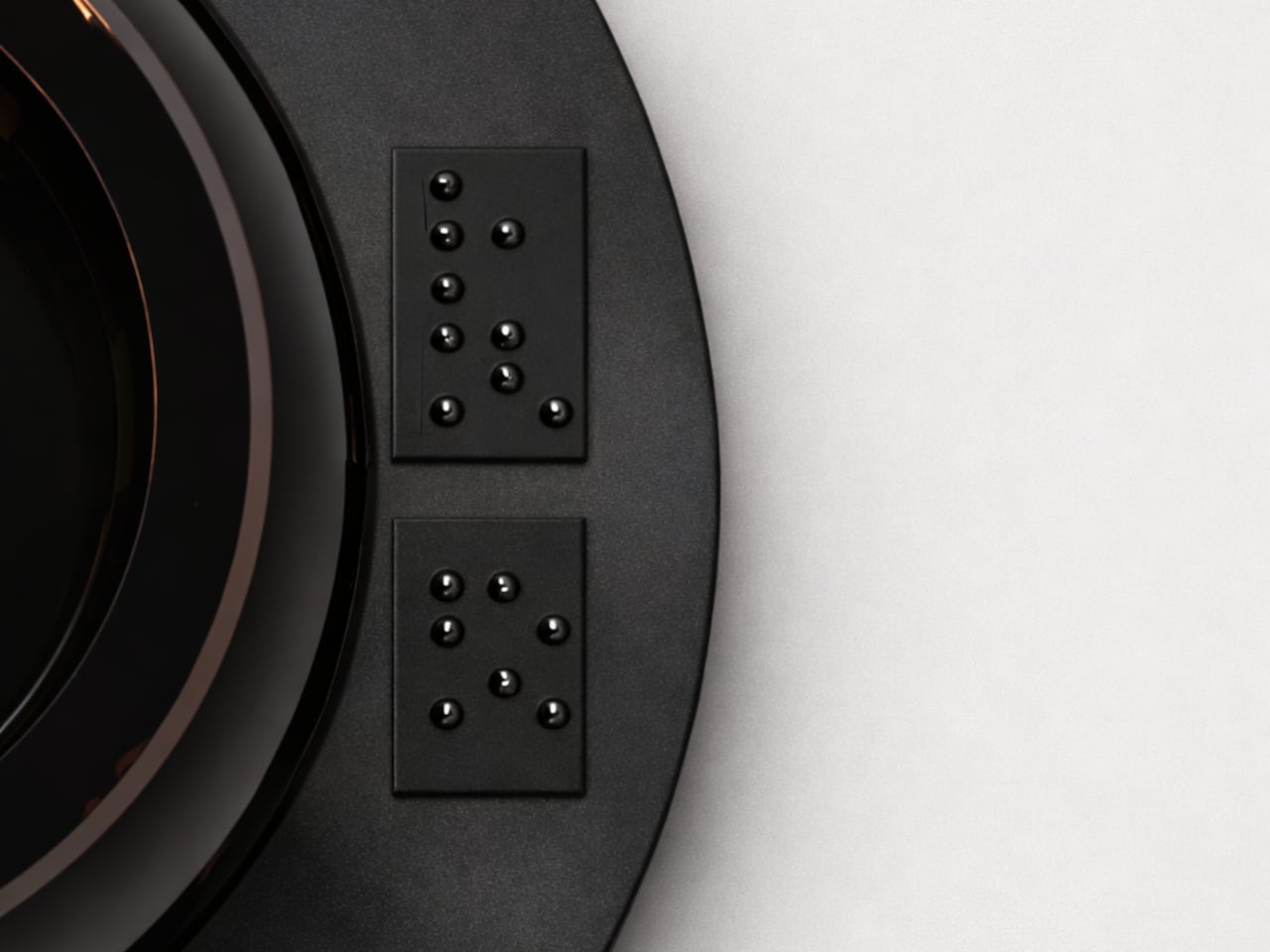
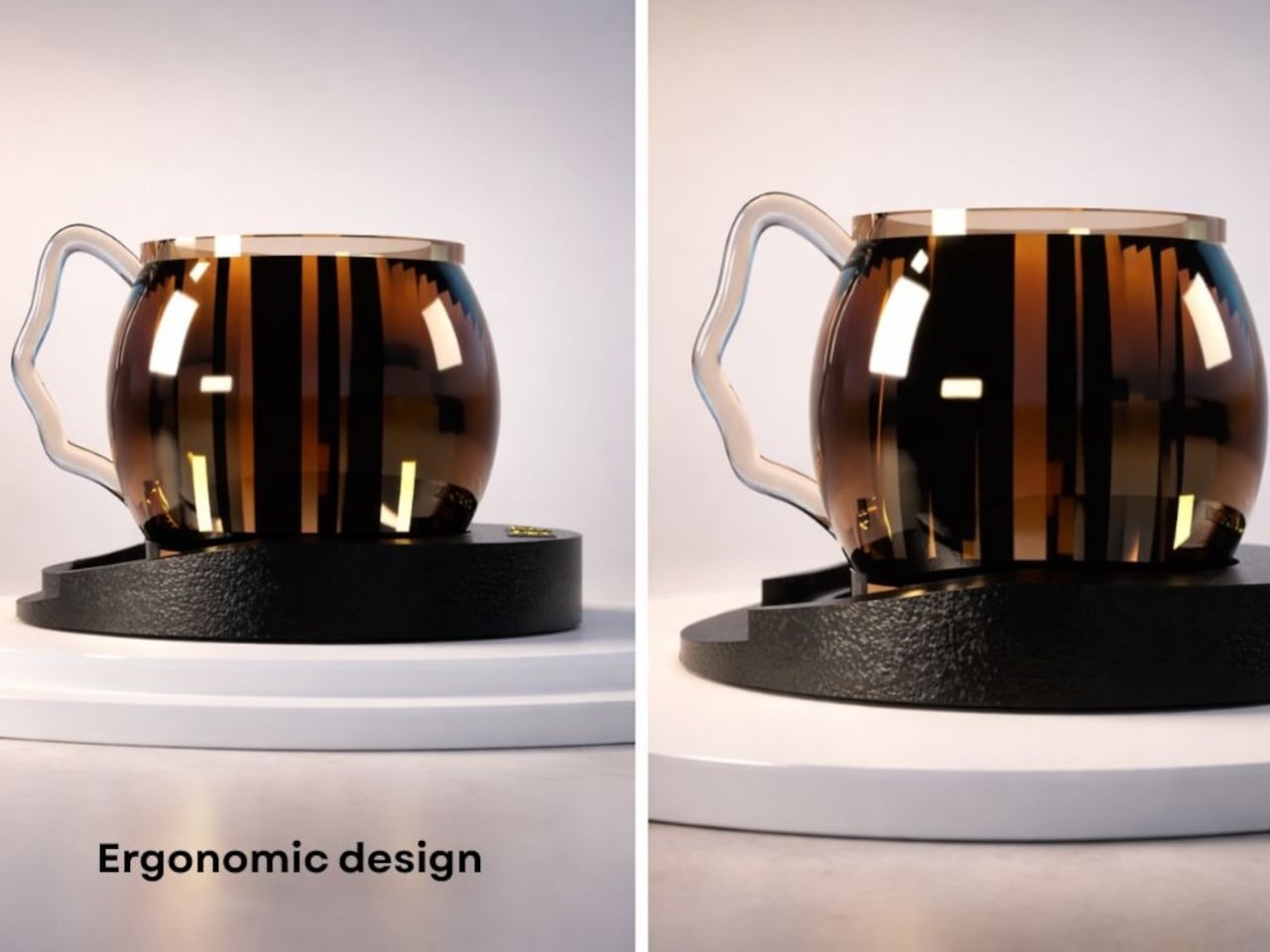
Every tactile detail carries that same logic through the design. A circular base guides the cup into the correct position when placed down, taking the guesswork out of a step that most products never consider. Raised Braille ON/OFF markings let the user activate and control the heating function entirely on their own, with no visual feedback or anyone else’s input required.

As for the cup itself, the same thinking applies. Its rounded, barrel-like body fits comfortably in the hand, and the handle’s adaptive shape ensures a secure grip without needing to search for the right position. The heat-resistant material keeps the exterior manageable even at full temperature, a detail that matters quite a lot when touch is the primary way of reading what’s inside.

Taken together, these choices reflect something that product design rarely gets around to prioritizing: dignity. Blind and visually impaired users shouldn’t have to depend on others or work around tools that were never built with them in mind just to make a hot drink. The Smart Cup treats independent use not as a bonus feature but as the foundational premise of the entire design.

It’s also worth noting that aesthetics aren’t treated as secondary here. The warm-toned form and sculpted handle give the cup a polished quality that would feel at home on any kitchen counter, not just in a specialized or assistive context. Accessible design has long leaned on utilitarian looks, as if beauty and function were incompatible, and this concept quietly pushes back against that assumption.

The post This Cup Replaces the Kettle So Visually Impaired Users Make Tea Alone first appeared on Yanko Design.

Why IKEA’s Hub-Free Dubbelkisel is Changing the Rules of Smart Lighting

Why IKEA’s Hub-Free Dubbelkisel is Changing the Rules of Smart Lighting Under-cabinet lighting setup with an LED driver replacing older IKEA units, keeping the same fixtures in place.

IKEA has introduced the “Dubbelkisel” LED driver, a device designed to simplify and enhance smart lighting systems by centralizing control at the driver level. Unlike setups that require replacing individual bulbs, this approach allows homeowners to upgrade existing fixtures like under-cabinet lights or spotlights without significant rewiring. According to A Smarter House, the Dubbelkisel utilizes […]

The post Why IKEA’s Hub-Free Dubbelkisel is Changing the Rules of Smart Lighting appeared first on Geeky Gadgets.

Posted in Uncategorized

Everything We Know About the Samsung Galaxy Glasses Launch in 2026

Everything We Know About the Samsung Galaxy Glasses Launch in 2026 Samsung Galaxy Glasses

  Samsung, in collaboration with Google, is preparing to make a bold entry into the smart glasses market with the highly anticipated Galaxy Glasses. Scheduled for release in August 2026, these glasses aim to merge innovative technology with a sleek, modern design. Powered by Gemini AI and Android XR, the Galaxy Glasses are designed to […]

The post Everything We Know About the Samsung Galaxy Glasses Launch in 2026 appeared first on Geeky Gadgets.

Posted in Uncategorized

Combining NotebookLM & Gemini Gems to Build Powerful Custom AI Agents

Combining NotebookLM & Gemini Gems to Build Powerful Custom AI Agents Diagram showing NotebookLM as the knowledge layer linked to Gemini Gems for behavior and response rules.

Google’s NotebookLM Gemini Agent combines NotebookLM and Gemini into a unified AI system designed to support complex tasks. NotebookLM acts as a knowledge manager, capable of handling up to 300 sources, such as PDFs, Google Docs and web pages, to create a centralized knowledge base. Gemini complements this by introducing “Gems,” which allow users to […]

The post Combining NotebookLM & Gemini Gems to Build Powerful Custom AI Agents appeared first on Geeky Gadgets.

Posted in Uncategorized

The iPhone 18 Pro Battery Leak is Here—And It’s Better Than Expected

The iPhone 18 Pro Battery Leak is Here—And It’s Better Than Expected Render showing iPhone 18 models with a reduced Dynamic Island area compared with earlier iPhone 17 designs.

Apple’s iPhone 18 Pro is poised to deliver a blend of innovation and refinement, offering meaningful updates that enhance the user experience while staying true to the company’s design philosophy. From hardware advancements to subtle design changes, the iPhone 18 series reflects Apple’s commitment to evolving its flagship lineup. Below is a detailed look at […]

The post The iPhone 18 Pro Battery Leak is Here—And It’s Better Than Expected appeared first on Geeky Gadgets.

Posted in Uncategorized

60Hz Thermal and 4K Night Vision in One Device. SpectraEyes Basically Gives You Superman’s Vision

Military forces figured out decades ago that you need two kinds of vision in the dark: one to detect, one to identify. Heat finds the target, detail confirms it. The problem has always been making both feeds available to a single operator without adding weight, bulk, or the friction of switching between devices. High-end tactical units solved this with helmet-mounted dual-tube systems that cost as much as a used car and require specialized training to operate. Consumer and prosumer markets have lived with the compromise, carrying separate thermals and NVGs or settling for low-refresh overlay systems that blur more than they clarify.

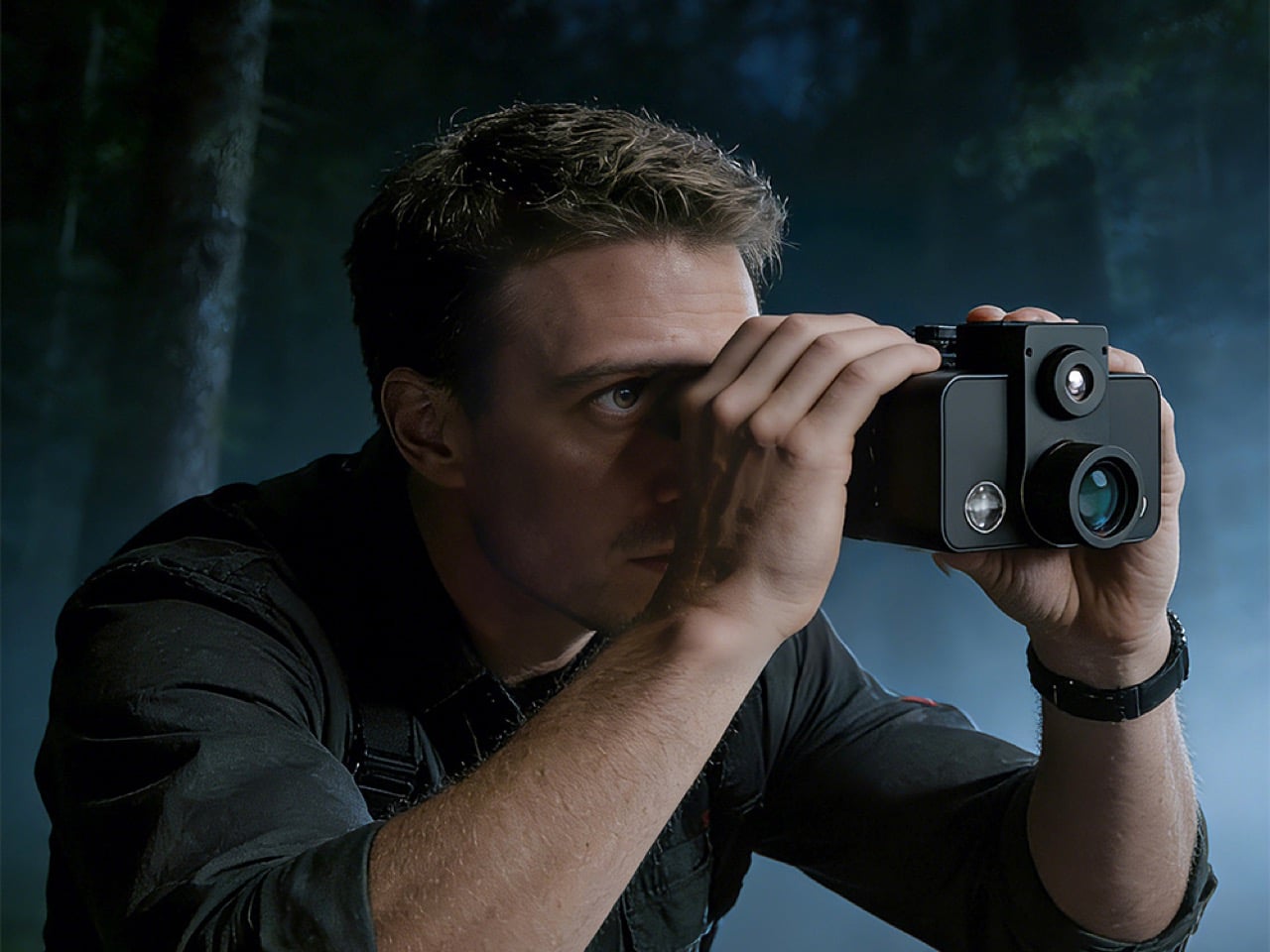
SpectraEyes brings the dual-feed architecture down to the enthusiast and professional level. Developed by a Denver-based team that spent 18 months testing sensor fusion algorithms in high-altitude terrain, the system pairs a 60Hz thermal core with a 4K digital night vision sensor in a synchronized side-by-side display. Each screen operates independently, so you can run thermal-only to conserve battery during long scouts, 4K-only for close-range work, or both feeds simultaneously when the situation demands total awareness. IP67 waterproofing, USB-C fast charging, and an operating range from negative 20 to positive 50 degrees Celsius mean this was engineered for field use, available now at $514 during the current campaign window.

Designer: SpectraEyes

Click Here to Buy Now: $514 $830 (38% off) Hurry! Only 18 days left.
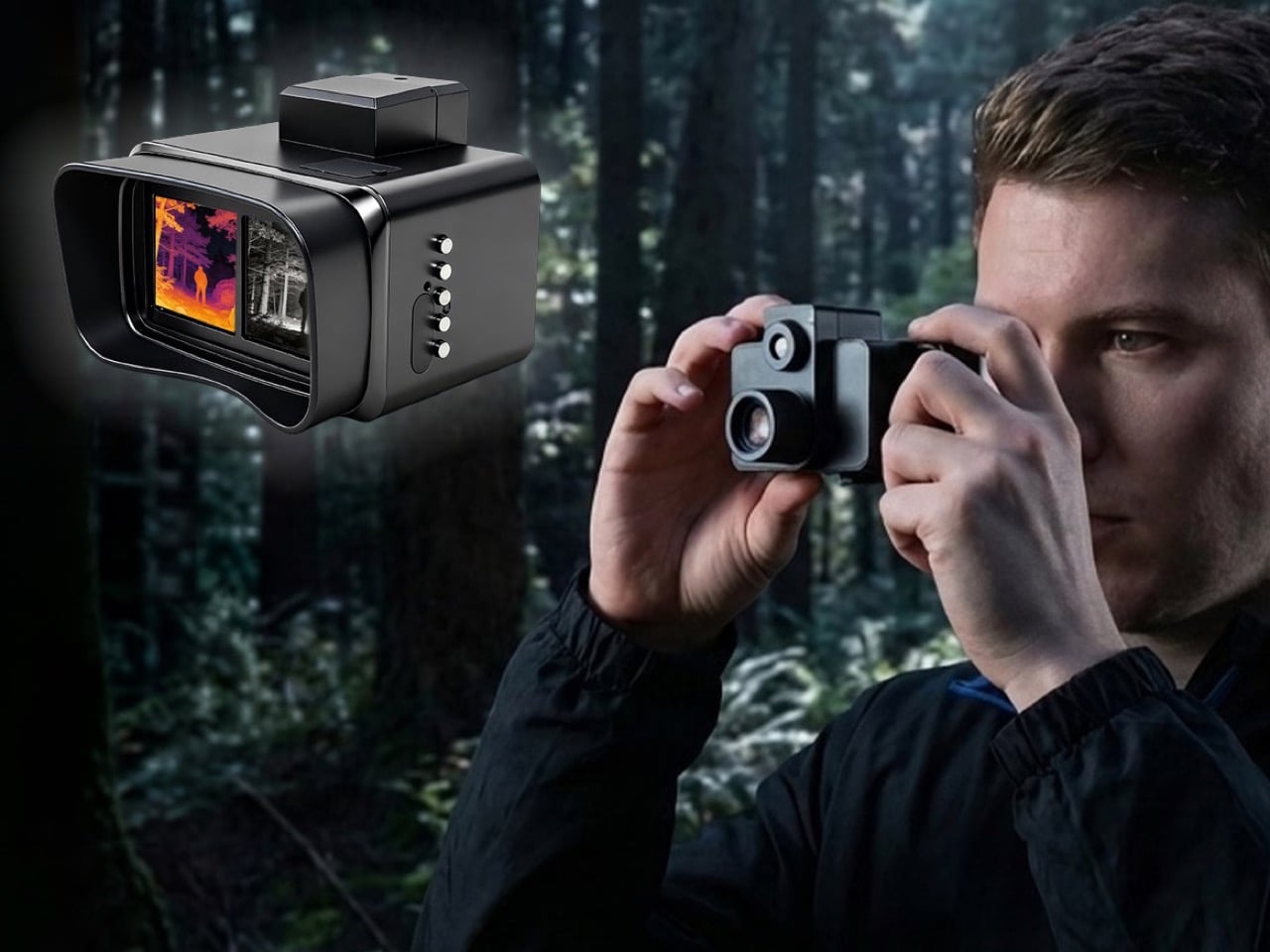
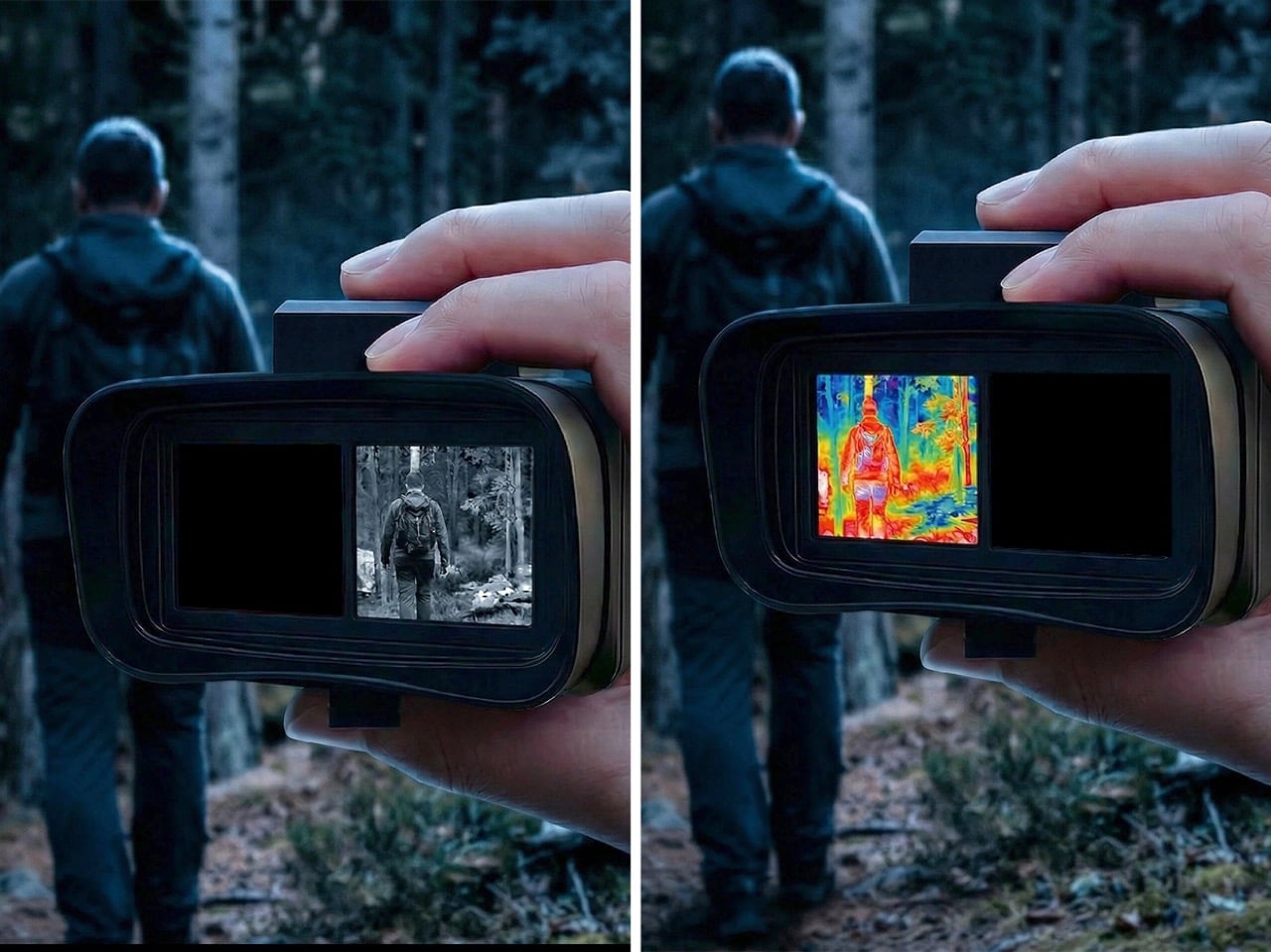
The core innovation lives in what SpectraEyes calls the Real-Time Dual-Screen Synchronization System. Rather than attempting to merge thermal and night vision into a single confused image, the optics route each feed to its own dedicated 1280×720 LCD screen inside the binocular housing. The left screen receives data from a 12-micron thermal sensor running at 60Hz with sub-25mk NETD sensitivity, which translates to the ability to detect temperature differences smaller than 0.025 degrees Celsius. That level of thermal resolution separates a warm body from ambient foliage even when both are nearly the same temperature. The independence of the two displays means your brain processes depth, movement, and context from the night vision channel while simultaneously tracking heat signatures on the thermal side, creating a layered awareness that single-feed systems simply cannot replicate.

Two screens, two feeds, two individual purposes – one Thermal Vision, one Night Vision
The right screen displays output from an ultra-low-light CMOS sensor capable of rendering 4K UHD (3840×2160) footage down to 0.0001 lux, roughly ten times darker than what a human eye can process. In starlight conditions, the sensor delivers full-color imaging, which means you see the actual hues of terrain, clothing, and vegetation rather than the washed-out green associated with legacy analog night vision tubes. In total darkness, the built-in adjustable IR illuminator (850nm and 940nm settings) provides monochrome visibility out to 800 meters without the visible red glow that spooks wildlife or compromises stealth. The choice between 850nm and 940nm wavelengths allows you to optimize for either maximum throw or maximum stealth depending on whether you’re observing skittish animals or working in environments where human detection is a concern.
Most consumer thermal optics run at 9Hz or 30Hz, which produces noticeable lag when panning across a scene or tracking moving subjects. SpectraEyes spec’d a 60Hz thermal core specifically to eliminate that stutter. Whether you’re sweeping a tree line or following an animal through dense cover, the thermal feed stays fluid and responsive. The difference between 30Hz and 60Hz might sound academic until you’re trying to track a running target or assess whether movement in your peripheral vision is wind-blown brush or something warm-blooded, and the lag between what’s happening and what you’re seeing becomes the variable that determines whether you capture the moment or miss it entirely.

The 7.0mm focal length provides a 24.9-degree by 18.7-degree field of view on the thermal side, wide enough for situational scanning without losing the resolution needed to pick out distant signatures. Thermal detection range reaches 500 meters, digital night vision stretches to 800 meters. The system supports 1x to 10x continuous digital zoom on the night vision channel, useful for identifying details at range without physically closing distance. Zooming in doesn’t degrade the thermal feed, so you can magnify the night vision side to confirm a target’s identity while keeping the thermal side at native FOV to monitor the broader environment for additional heat sources.

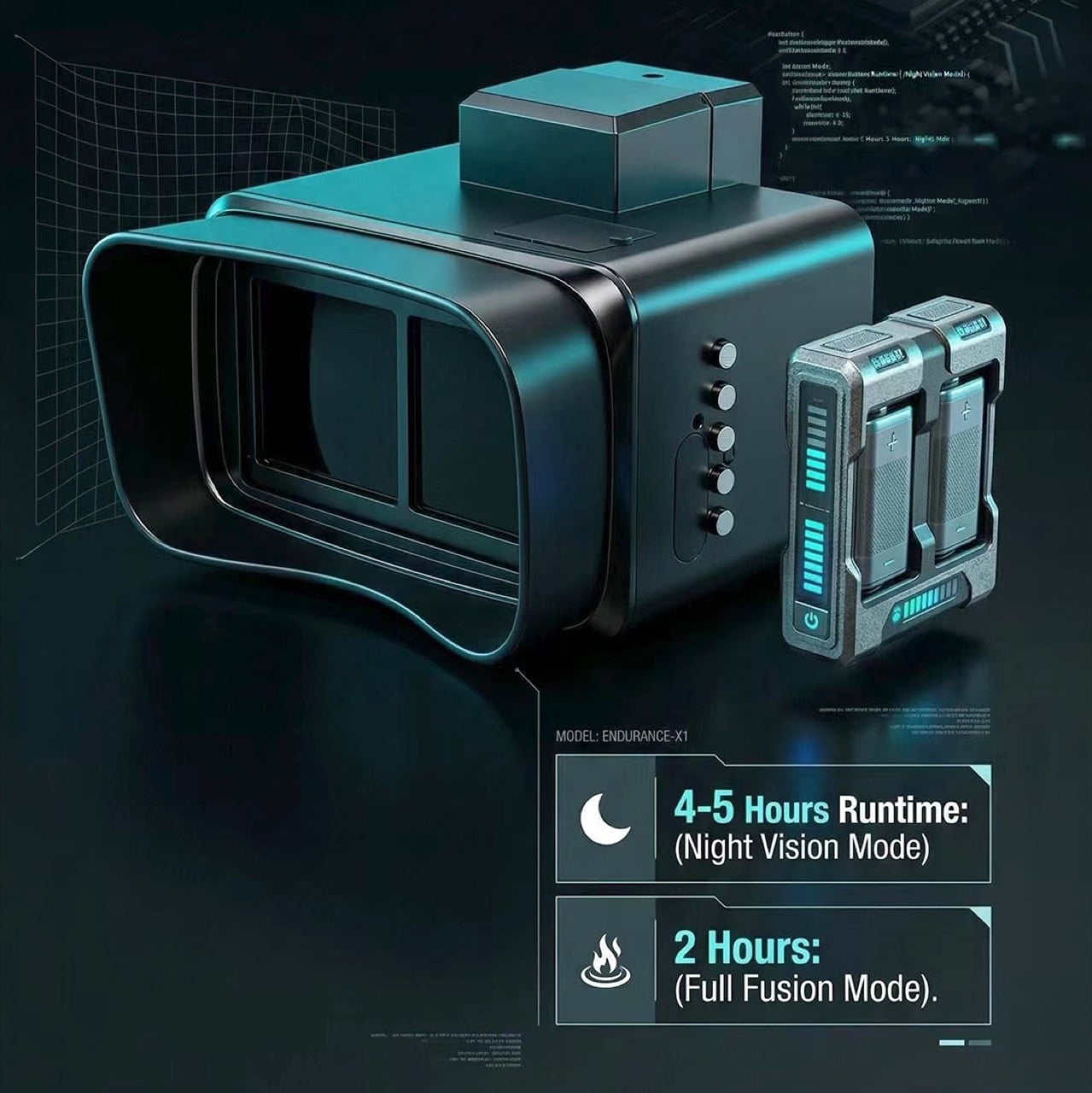
The independent dual-control system means you can toggle each display on or off separately via dedicated buttons on the housing. Running only the thermal channel in scouting mode extends battery life considerably, pulling four to five hours of runtime from the dual replaceable lithium battery setup. Engaging both screens simultaneously in full fusion mode drops that to around two hours, which aligns with what you’d expect from a system pushing two high-refresh displays and processing two sensor feeds in real time. The batteries are external and hot-swappable, so you can carry spares and change them in the field without powering down the unit or losing your position in a critical observation window.

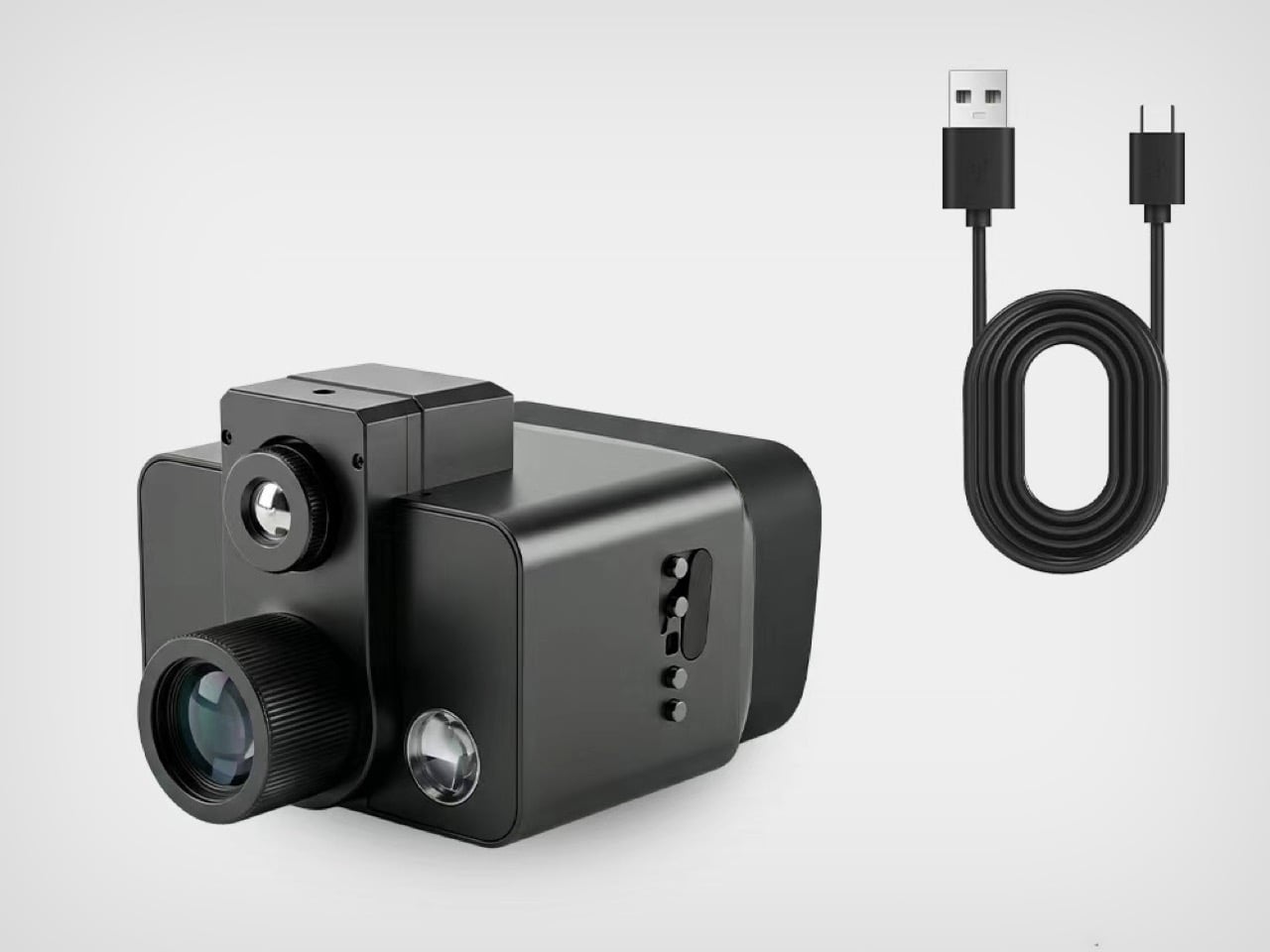
The USB Type-C charging port supports power bank input, so extended missions can be managed with external battery capacity. Storage runs via microSD card, supporting up to 512GB for 4K video recording at 30fps in MP4 or MOV format. Recording captures the night vision feed by default, but you can switch to thermal-only recording or choose to save both feeds as separate files for post-mission review. The ability to document what you observed with native 4K resolution means this doubles as a capture device for wildlife research, security documentation, or any scenario where you need verifiable footage of what happened in low-light or no-light conditions.
The IP67 rating means the housing can handle submersion up to one meter for 30 minutes and shrugs off dust intrusion entirely, appropriate for marine navigation, wet-weather SAR work, or any scenario where gear gets exposed to the elements without warning. The operating temperature range (negative 20 to positive 50 degrees Celsius) covers everything from winter mountain rescue to desert surveillance in summer heat. The form factor is binocular-style rather than monocular, which distributes weight across both hands and allows for more stable long-duration observation compared to single-eye devices that fatigue your grip and throw off your natural field of view balance.
SpectraEyes is currently available through its Kickstarter campaign at $514 as part of the Super Early Bird tier, down from an MSRP of $830. Units ship globally starting June 2026. This is gear built for search and rescue teams who need to spot heat and confirm identity without switching devices mid-operation, for wildlife researchers who track nocturnal behavior across hours of observation, for hunters who work pre-dawn and post-dusk windows where neither thermal alone nor night vision alone tells the full story, and for marine operators navigating in conditions where a buoy, a boat, and a person all look like dark shapes until you layer heat detection over visual context. If you’ve ever carried two optics into the field and spent the night juggling between them, SpectraEyes is the answer to a question the industry has been avoiding for two decades.

Click Here to Buy Now: $514 $830 (38% off) Hurry! Only 18 days left.

The post 60Hz Thermal and 4K Night Vision in One Device. SpectraEyes Basically Gives You Superman’s Vision first appeared on Yanko Design.


How Architects Turned a Postwar London Terrace Into an Open-Plan Home Without Touching the Facade

Islington houses tend to resist openness. The typical Victorian or Edwardian terrace was built for a world of separate rooms, each with its own function and its own door, and even postwar Neo Georgian rebuilds like this one on St Paul’s Road inherited that spatial logic. Hamish Vincent Design and Architecture for London treated that inheritance as a starting point rather than a constraint, keeping the facade exactly as it found it and reorganizing everything behind it around a different set of priorities.

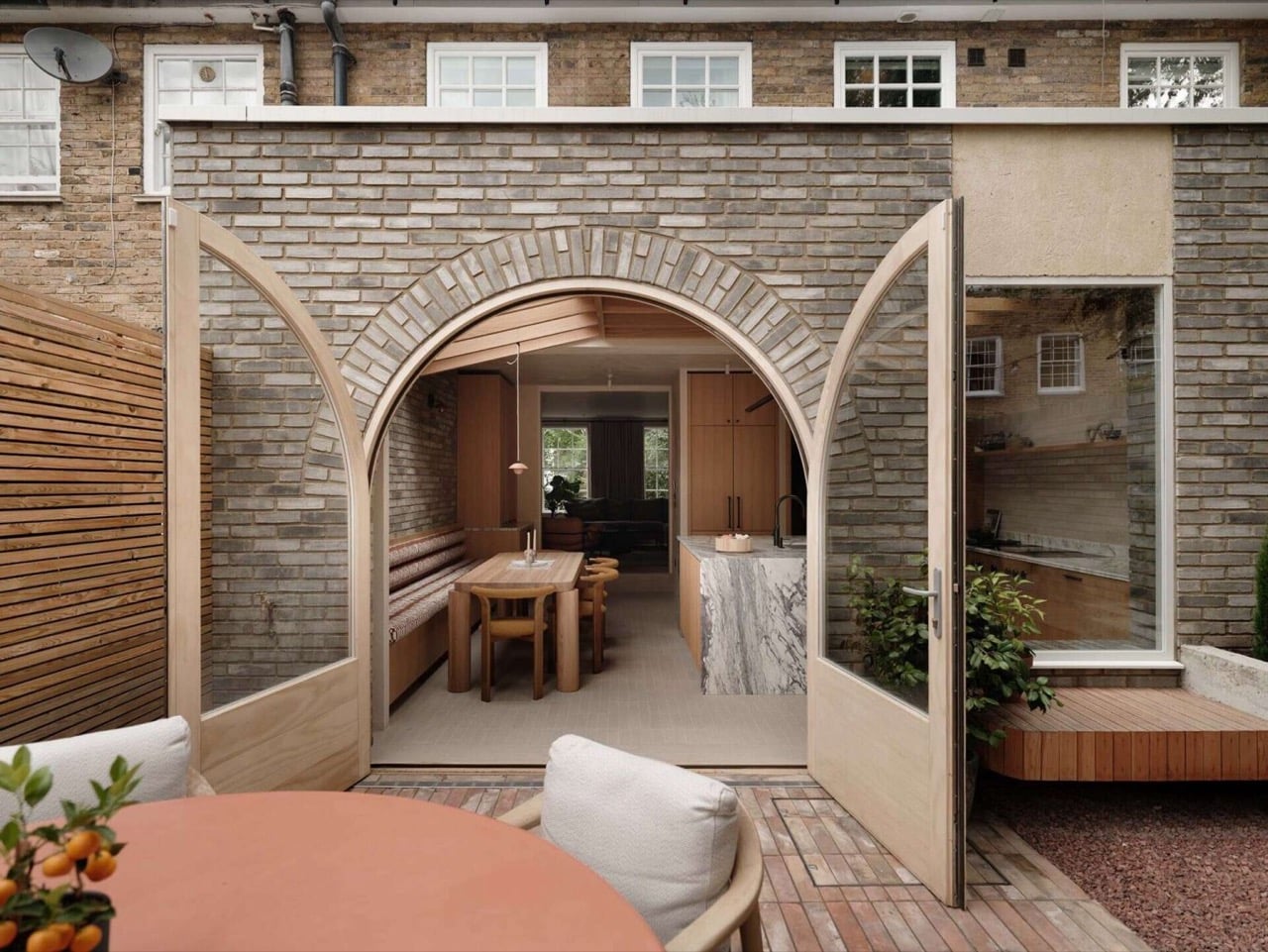
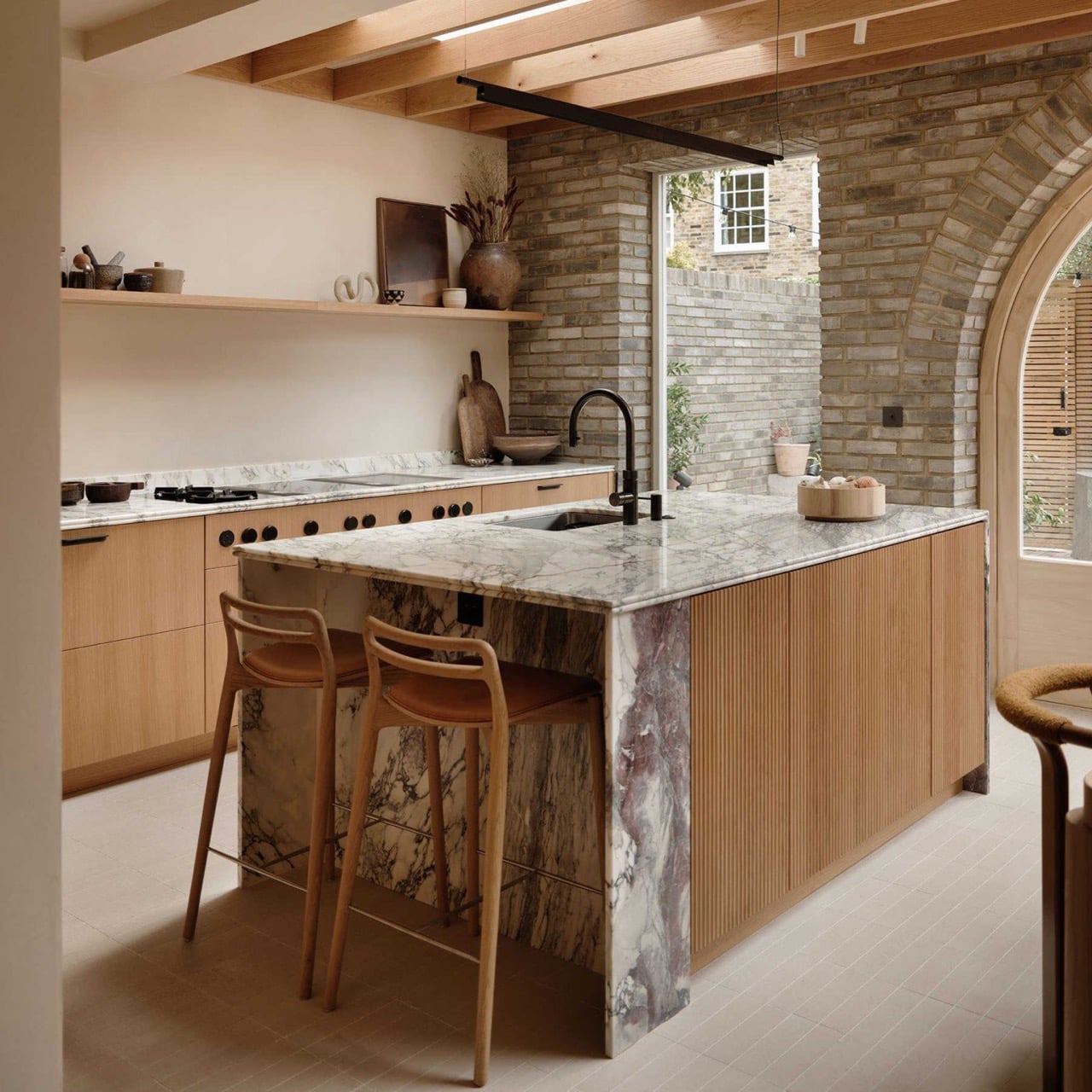
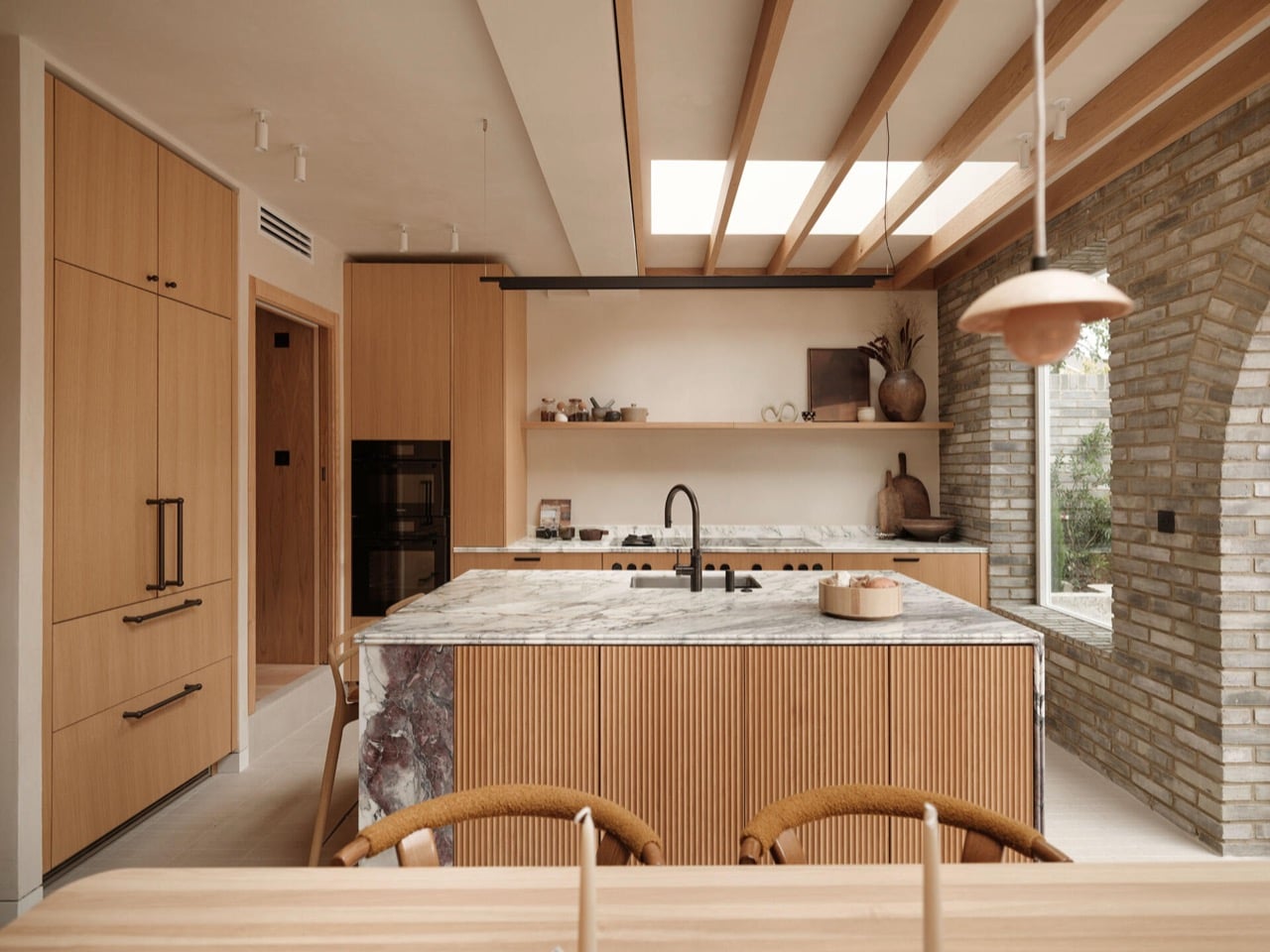
The ground floor has been reworked into a single continuous environment where kitchen, dining, and living dissolve into each other with remarkable ease. A rear brick extension anchors the move, punched through with a full-height arched opening that frames the garden like a painting. Douglas fir beams overhead, a marble and fluted timber kitchen island, a bespoke helical staircase rising through three floors: every decision here is load-bearing, materially and spatially.

Designer: Hamish Vincent Design & Architecture for London

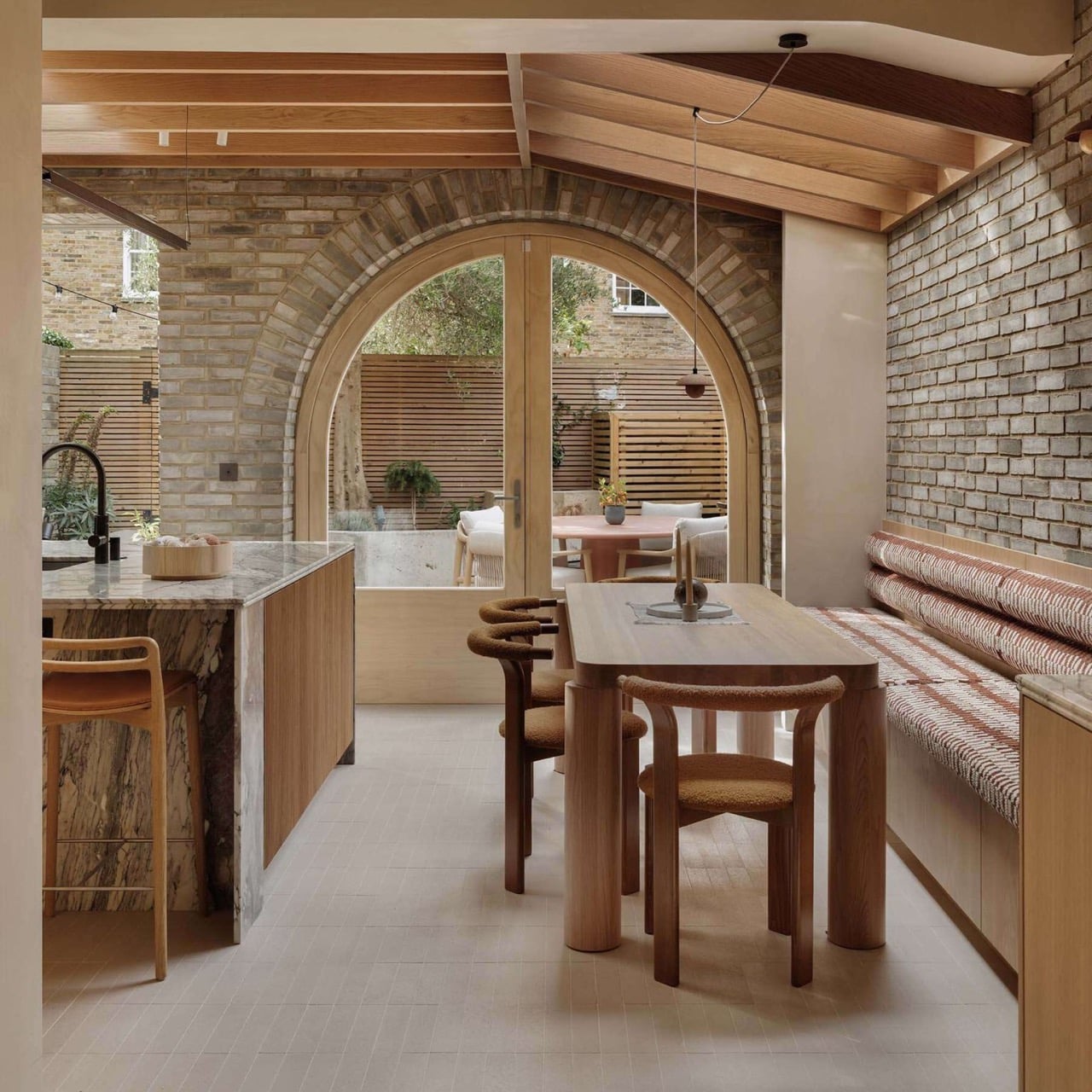
The extension is built in the same grey-green handmade brick as the original rear elevation, which is the kind of decision that sounds obvious but rarely gets made. Most rear extensions announce themselves, either in glass or in a conspicuously different material, as if embarrassed by the ambition. Here the new fabric reads as continuous with the old, and the arched opening cut through it does all the work of signaling that something has changed. That arch is timber-lined on the interior face, brick-voussoir on the exterior, and it frames the entire open-plan ground floor when viewed from the garden with the precision of a composed photograph.

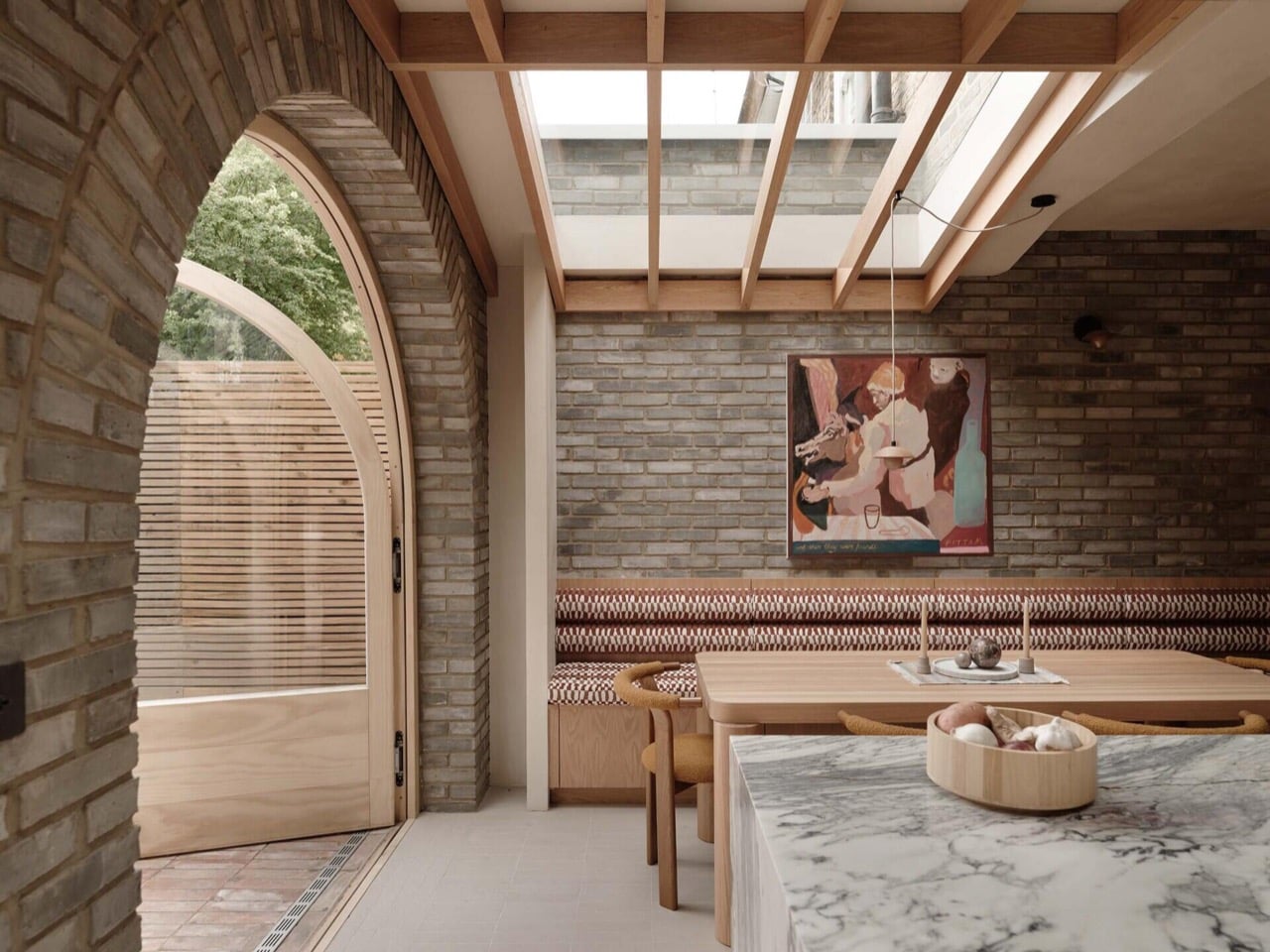
The kitchen island features a top with a heavily veined white marble slab. The body is clad in vertical fluted timber. The end panel, the short face you see from the dining side, is a column of deep purple-toned quartzite with the kind of geological color that reads almost violet in certain light. Three materials, one object, zero apology. The surrounding cabinetry is flat-fronted oak with black hardware, deliberately quiet so the island can operate at full volume without the room feeling overwhelmed.

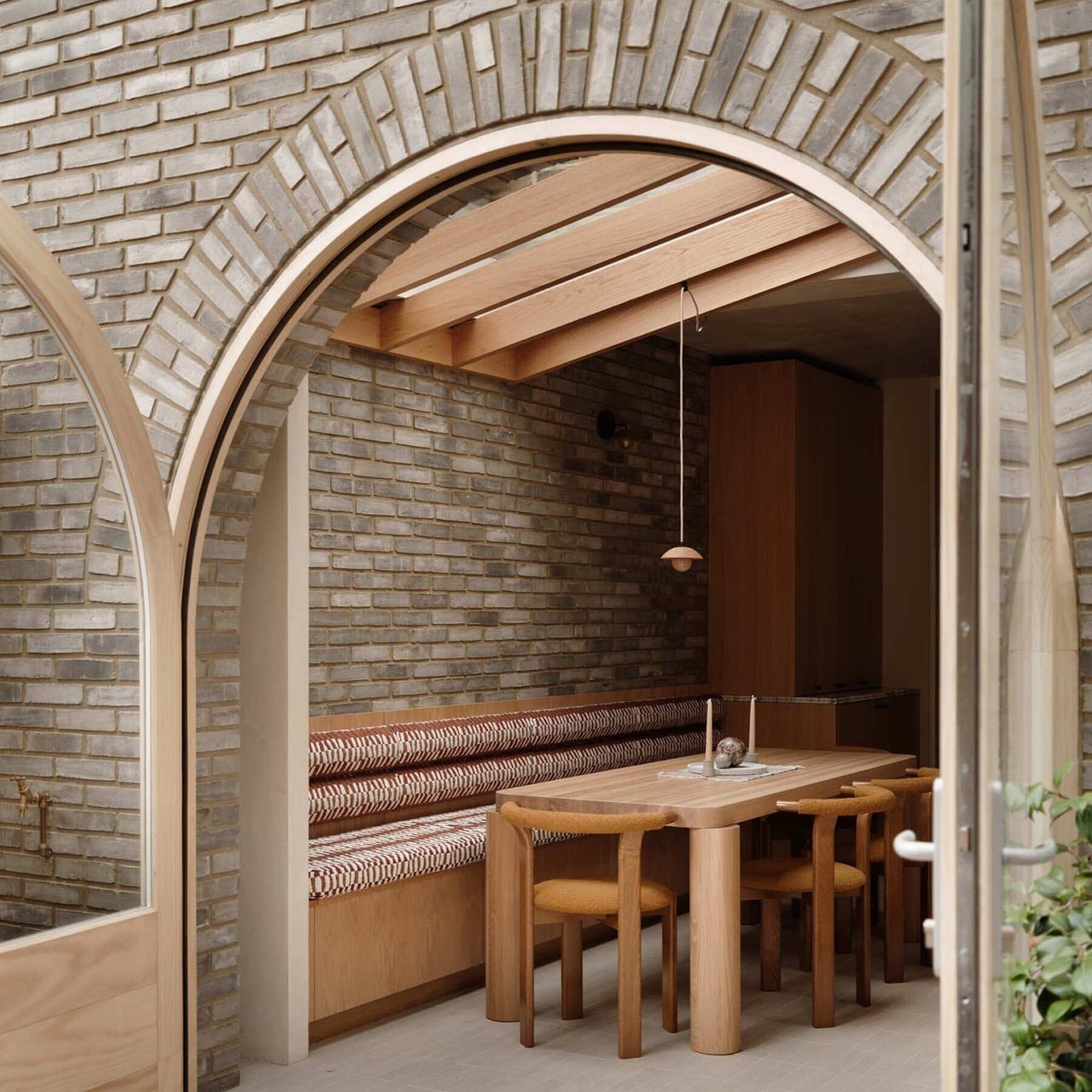
The dining zone sits between the island and the garden wall, anchored by a built-in banquette upholstered in a red and cream woven fabric against exposed brick. A timber dining table with rounded legs and a pendant light overhead completes the arrangement. Skylights cut into the roof above flood the entire zone with natural light, which matters because the extension sits behind the main house footprint and would otherwise feel basement-adjacent. The ceiling beams are exposed douglas fir, running parallel to the garden wall, and they give the space a warmth that keeps the brick from reading as cold or industrial.

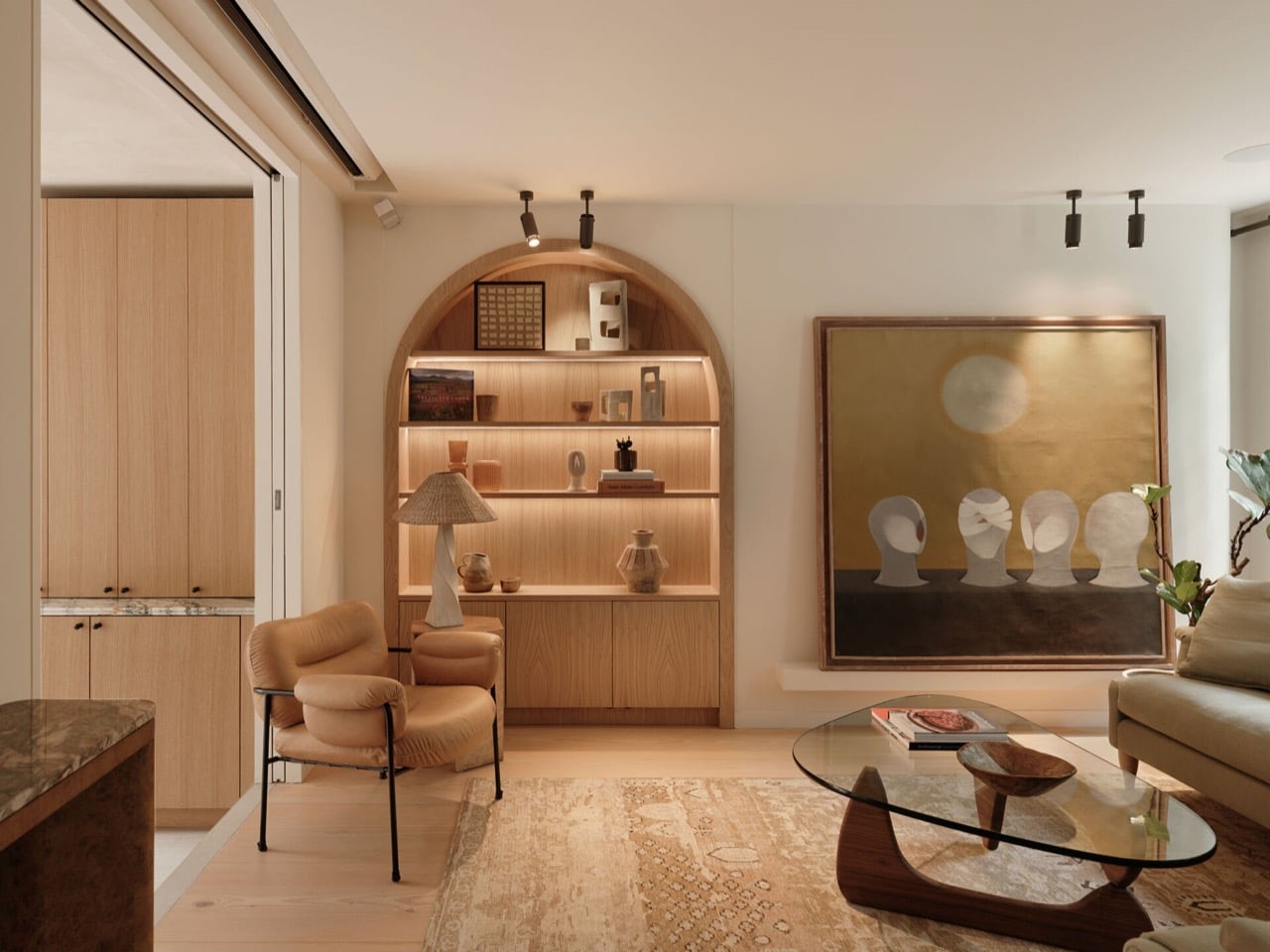
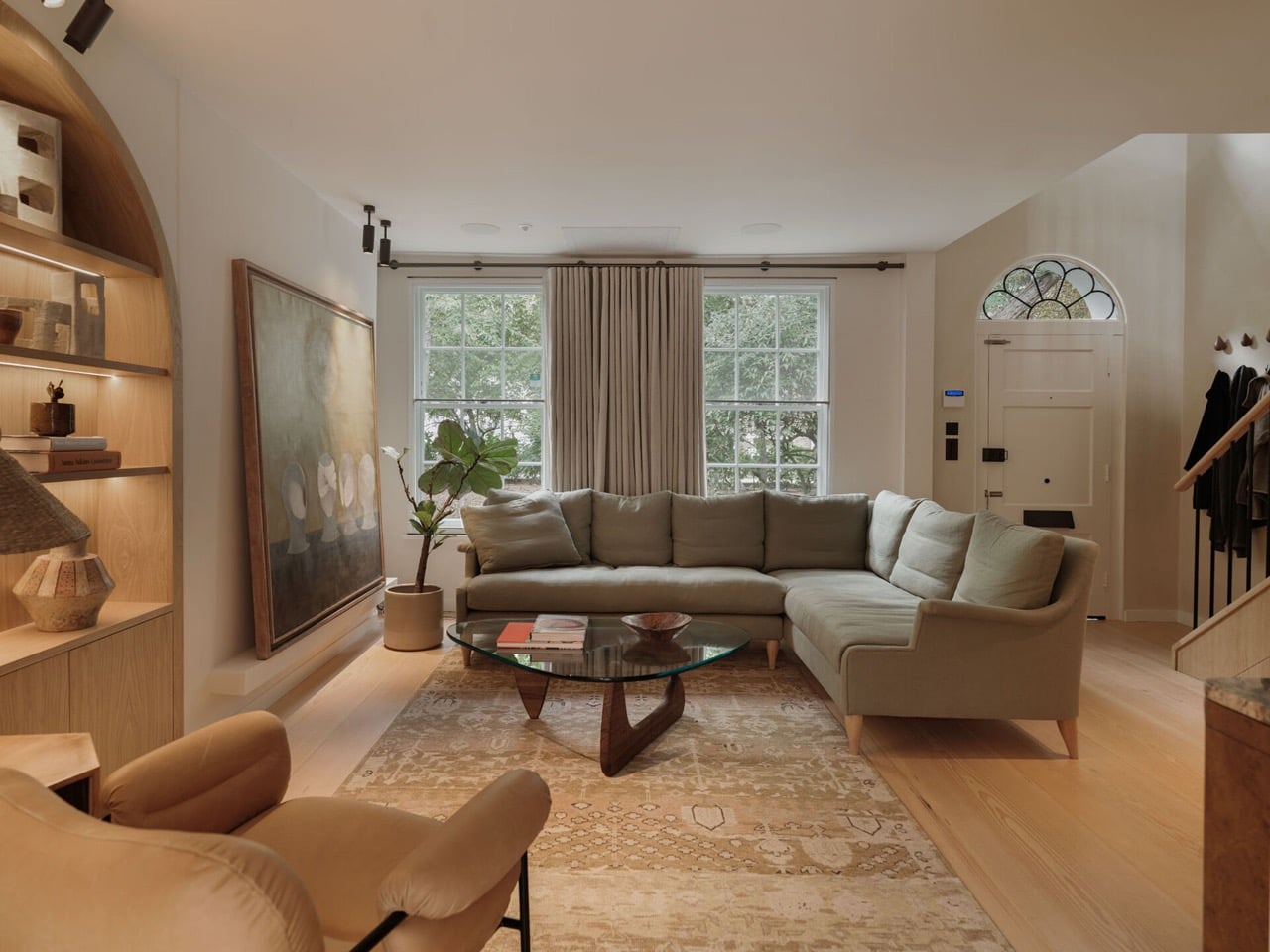
The living room pulls back from the material intensity of the extension. Lime-plastered walls, a Noguchi coffee table in walnut and glass, a vintage rug, and a built-in arched shelving unit with backlit display niches. The arch appears again here, and its recurrence across the garden threshold, the shelving, the staircase handrail, and the original front door fanlight is what gives the project its internal coherence. A single borrowed form, deployed with enough variation that it reads as a theme rather than a tic.

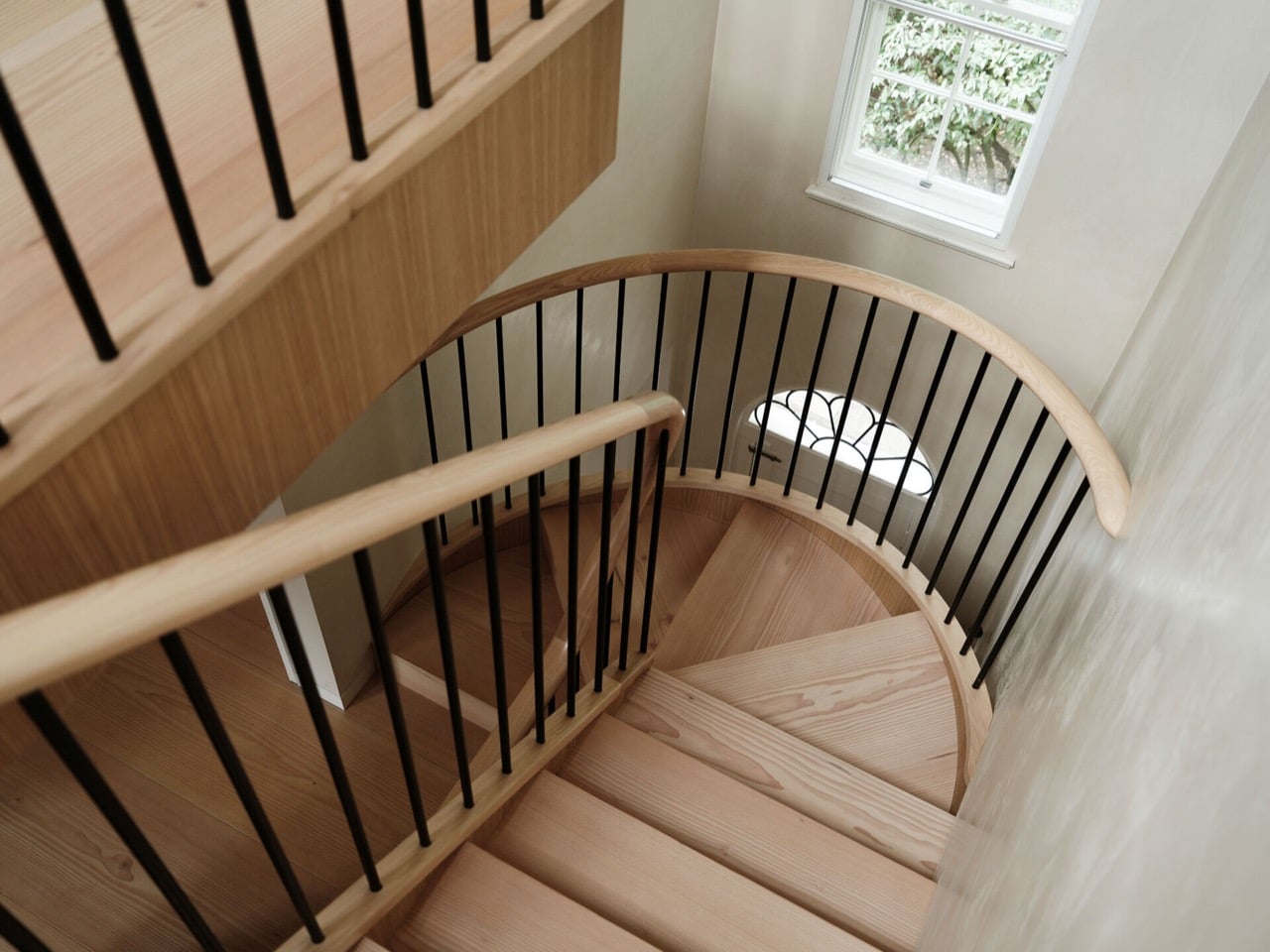
The staircase got repositioned as part of the redesign, which is a significant structural intervention often undersold in project descriptions. Moving a stair in a terraced house means rethinking the entire circulation logic, and the payoff here is a three-story helical structure with douglas fir treads, a curved timber handrail, and slim black metal balusters. Viewed from above, the stair winds down toward the original fanlight above the front door, a Georgian semicircular window that now sits framed at the base of the void like a deliberate full stop.

The Canonbury Conservation Area will never know what hit it. From the street, number 65A reads exactly as it always has: handsome, reticent, correctly proportioned. The ochre door gives nothing away. Behind it, Hamish Vincent Design and Architecture for London have built a ground floor that operates on an entirely different register, one organized around material conviction and a single recurring geometric idea rather than the room-by-room compartmentalization the building was born into. The arch did all the heavy lifting, and the house let it.

The post How Architects Turned a Postwar London Terrace Into an Open-Plan Home Without Touching the Facade first appeared on Yanko Design.
A Stool With Six Legs Just Made Four Feel Outdated

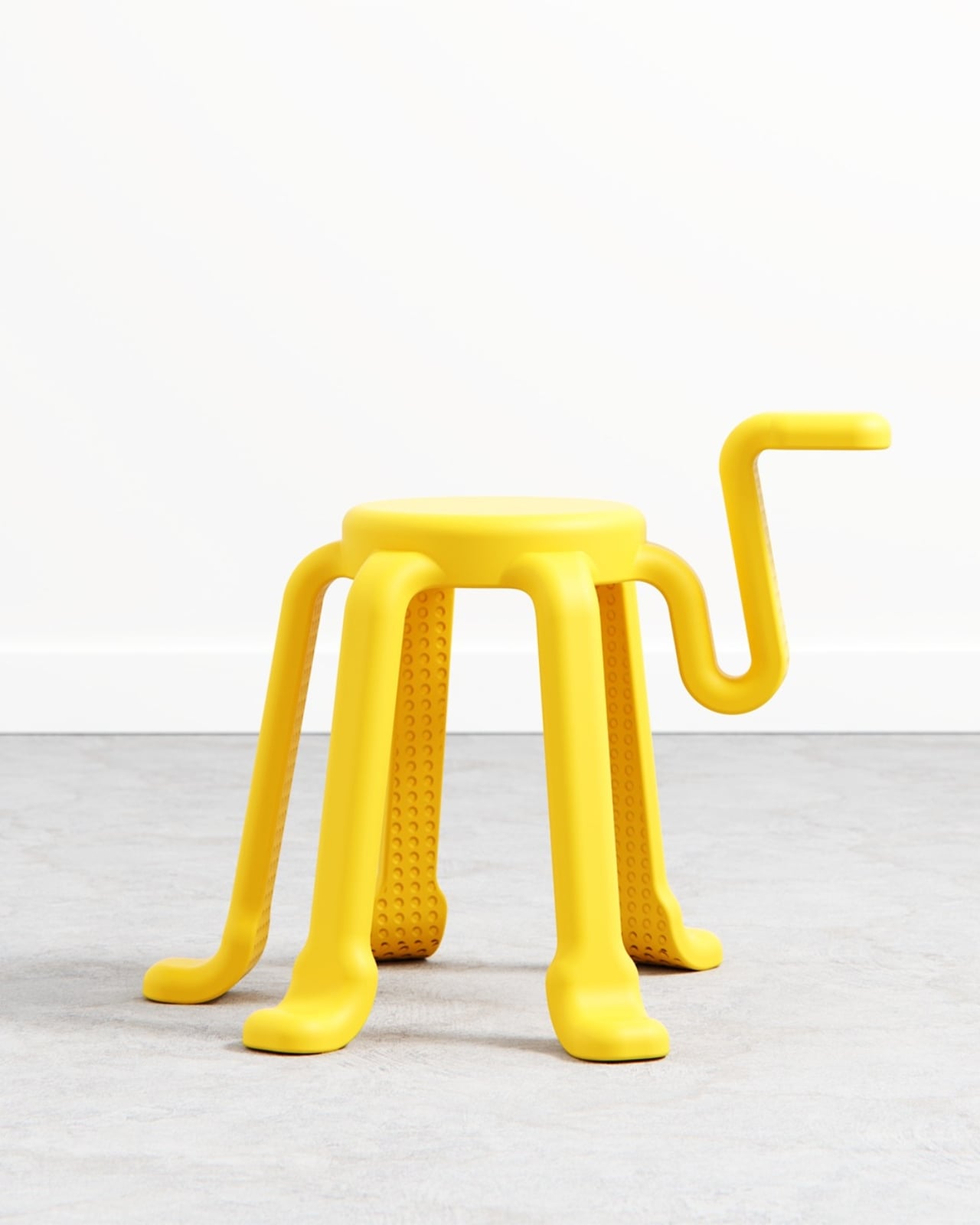
The humble stool has barely changed in centuries. Four legs, a flat seat, done. It exists in every cafe, classroom, kitchen island, and co-working space on the planet, reliably doing its one job and nothing else. So when a designer comes along and asks what happens if you add just one more leg, the answer should probably be “nothing interesting.” And yet here we are, talking about SQOOL.

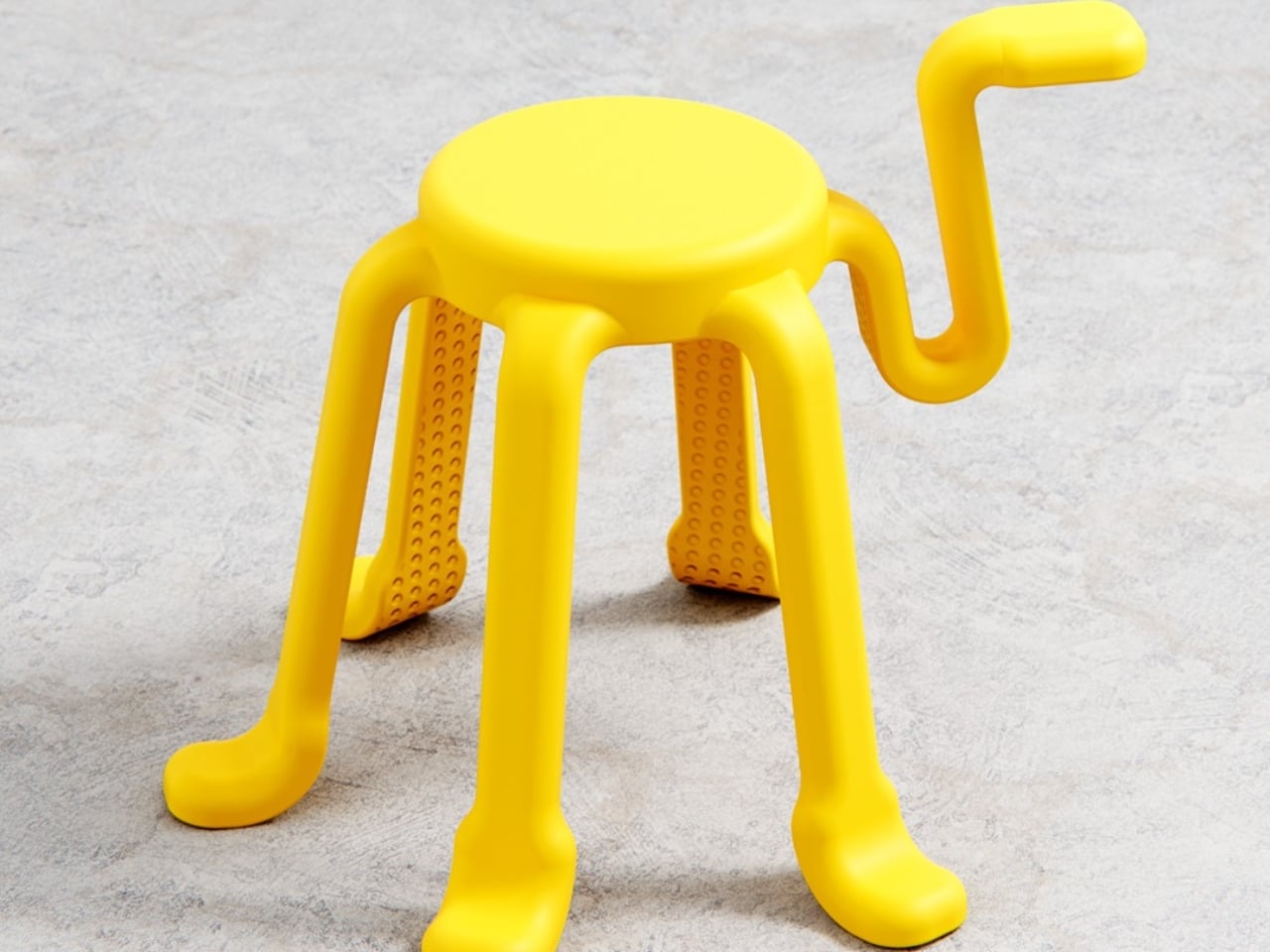
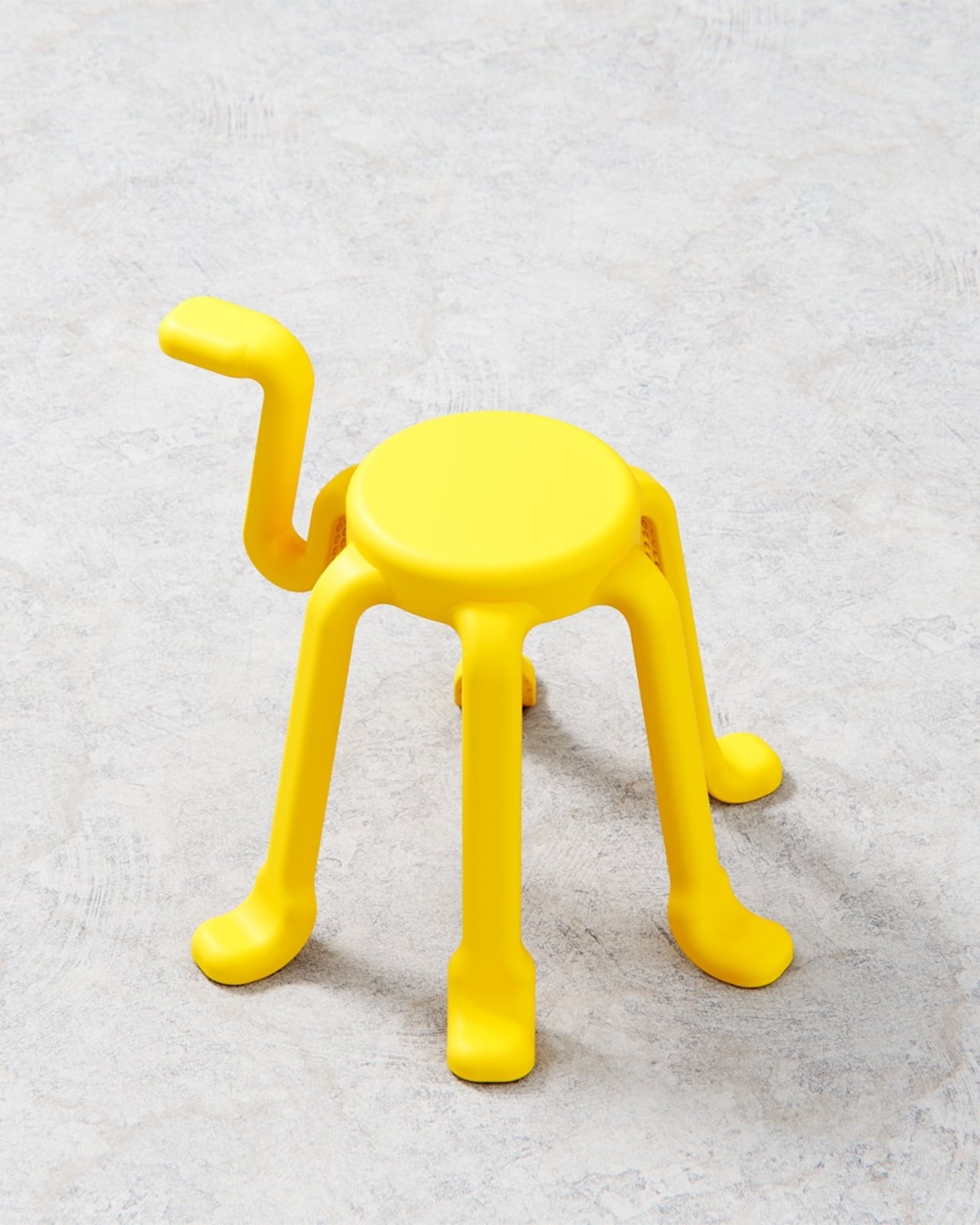
SQOOL is a 2025 personal project by Liam de la Bedoyere of Bored Eye Design, a UK-based independent studio that describes itself as creating work that’s anything but boring. At first glance, the stool reads almost like a creature. Six curved legs splayed outward with little rounded feet, a compact circular seat on top, and that one rogue arm reaching upward and curling into a hook. It looks like a cheerful yellow squid that decided to get into the furniture business, and I mean that entirely as a compliment. The photographs make it look alive. Depending on the angle, it shifts between dog, bug, and some friendly unnamed species you’d encounter in an animated film.

Designer: Liam de la Bedoyere (Bored Eye Design)

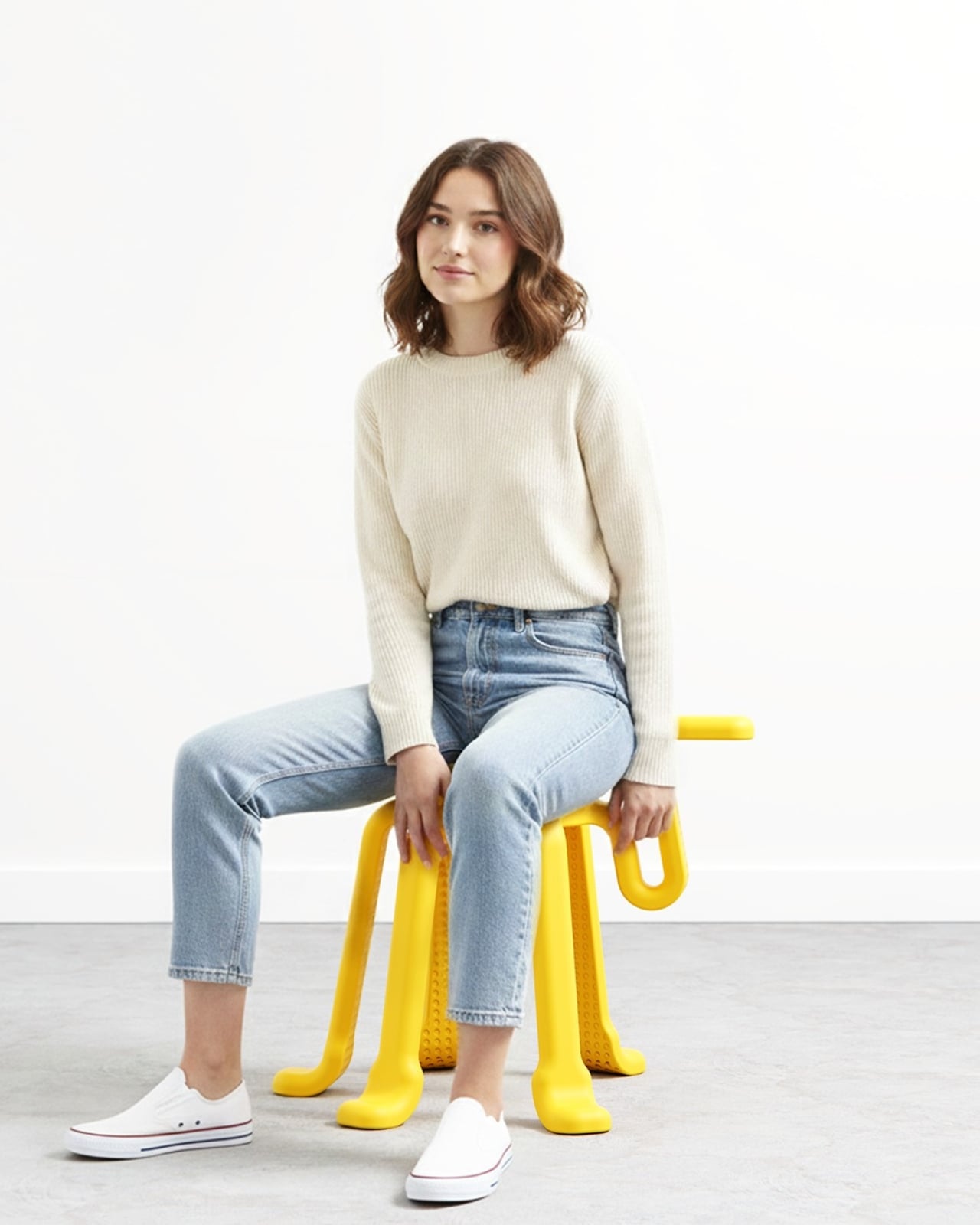
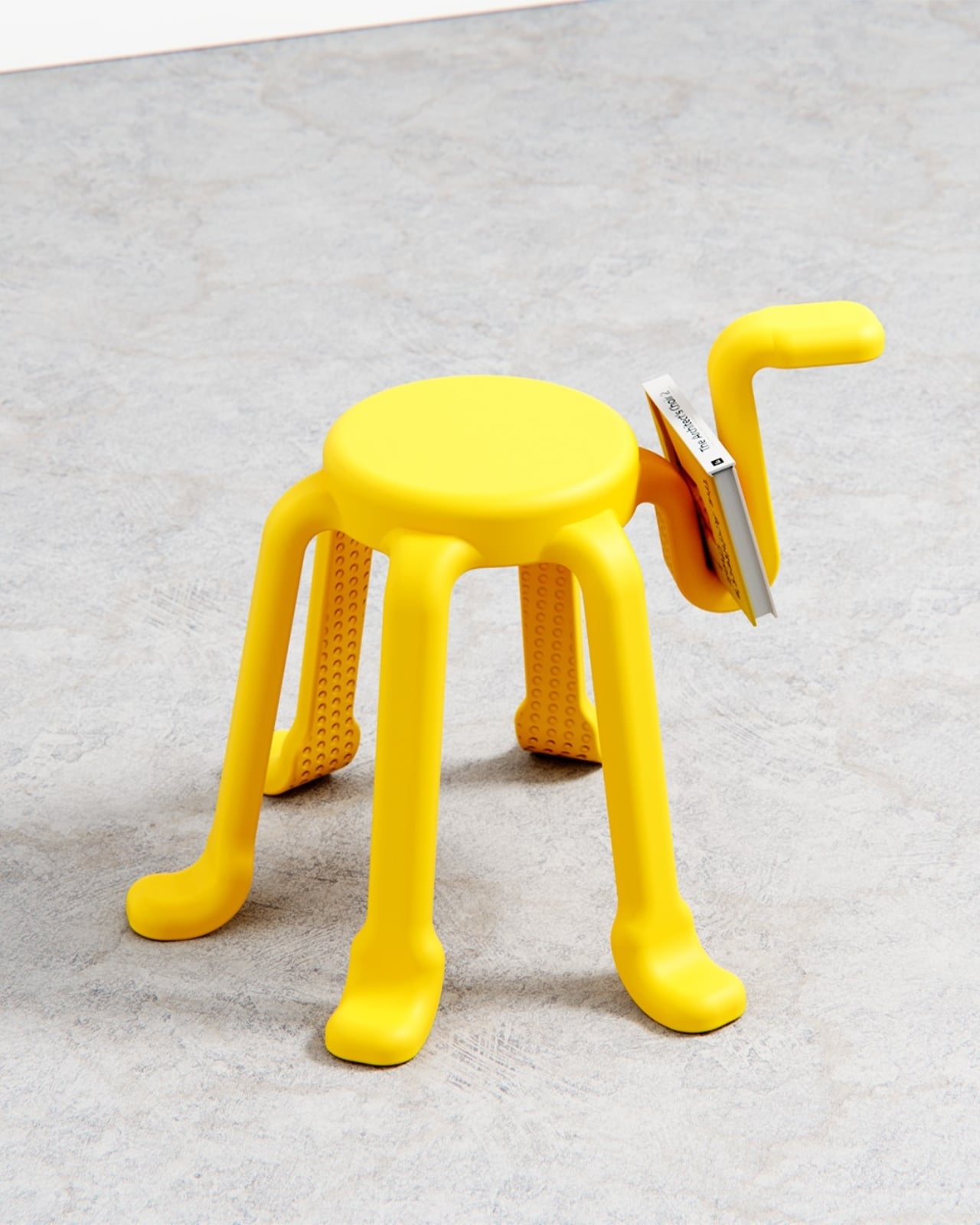
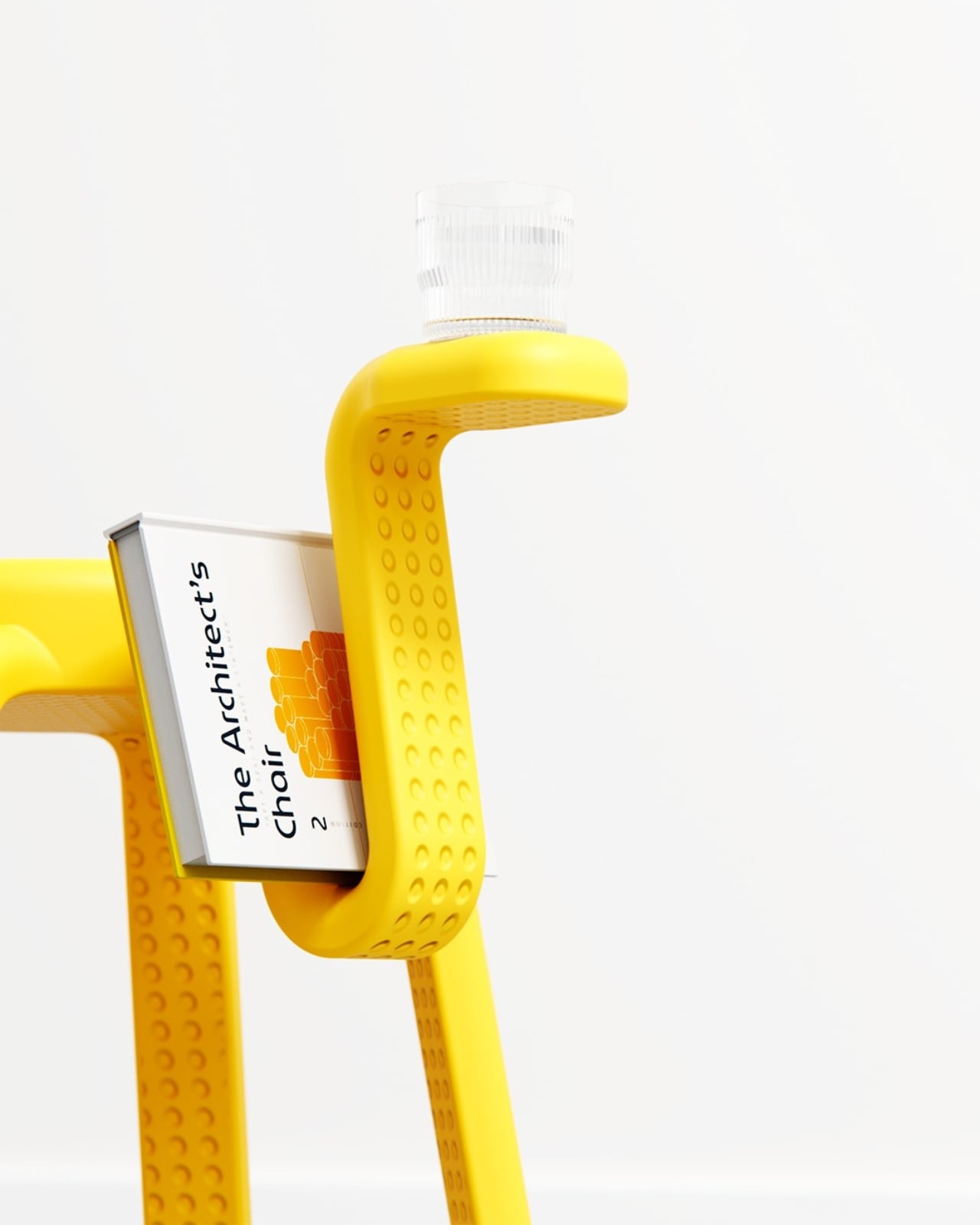
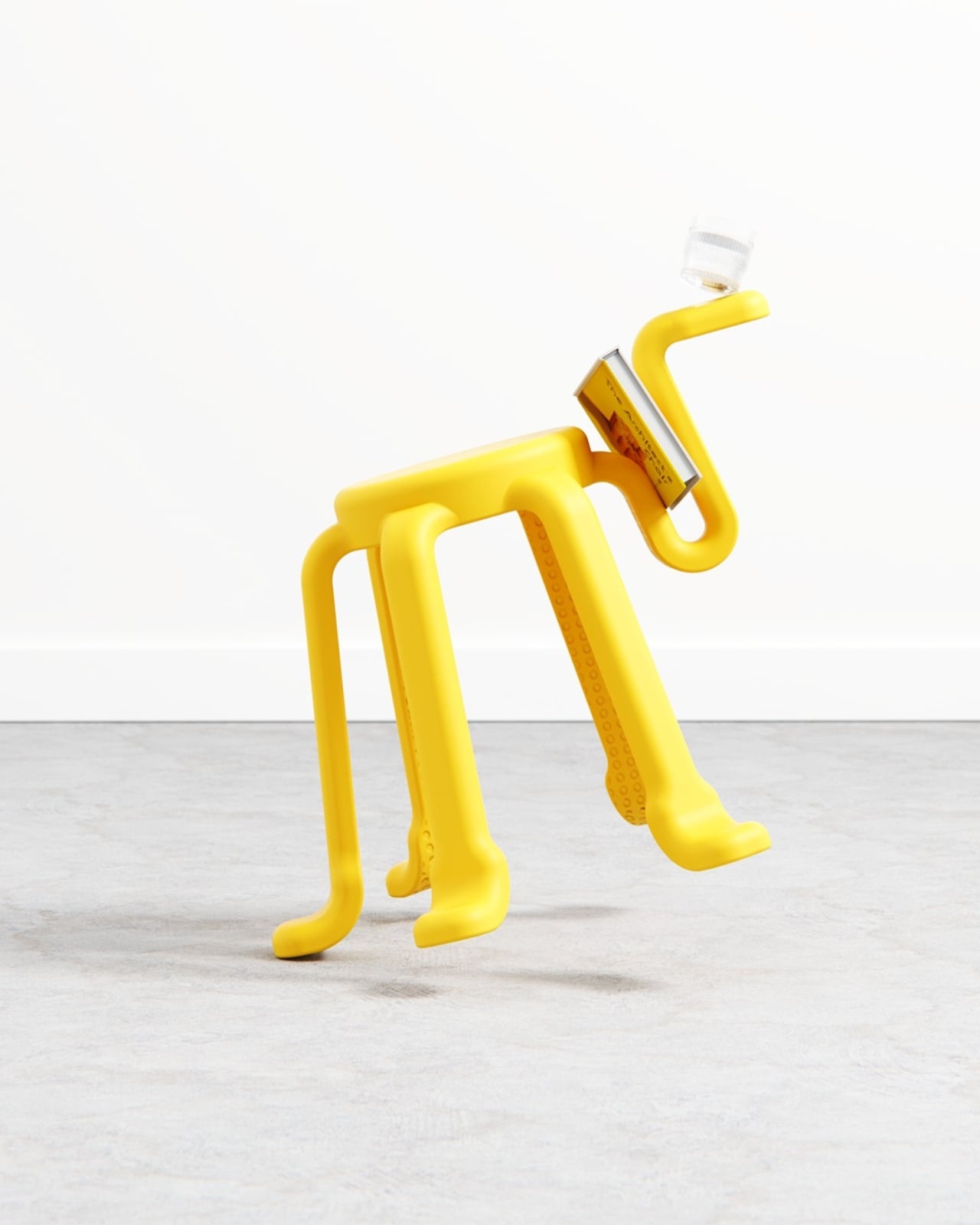
The concept is deceptively simple. Five legs provide complete stability, the same geometric logic you’d get from a traditional four-legged stool, just with an added sense of security and visual rhythm. The sixth leg is the interesting one. Freed from any load-bearing duty, it becomes something else entirely: a handle for carrying the stool, a hook for a bag or jacket, a rest for your coffee cup, a cradle for a book. The images show it doing all of these things casually, as if the stool has always known it could.

What makes SQOOL feel genuinely considered rather than just whimsical is how that extra function was thought through. The sixth arm doesn’t just stick out awkwardly. It curves deliberately, creating a shape that invites the hand to reach for it. People apparently do this instinctively, discovering its utility through touch rather than any printed instruction. That kind of design, where the object teaches you how to use it without saying a word, is harder to pull off than it looks.

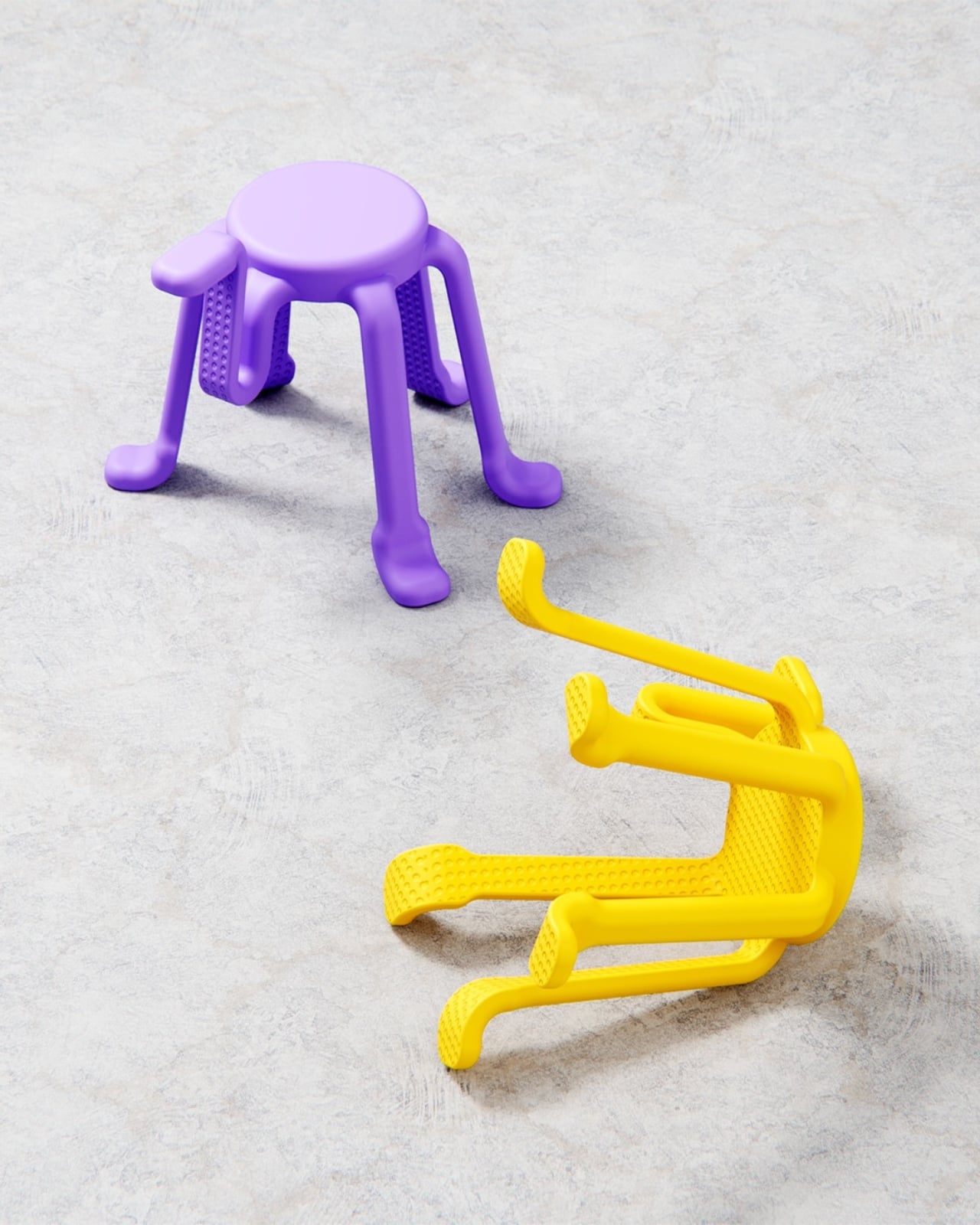
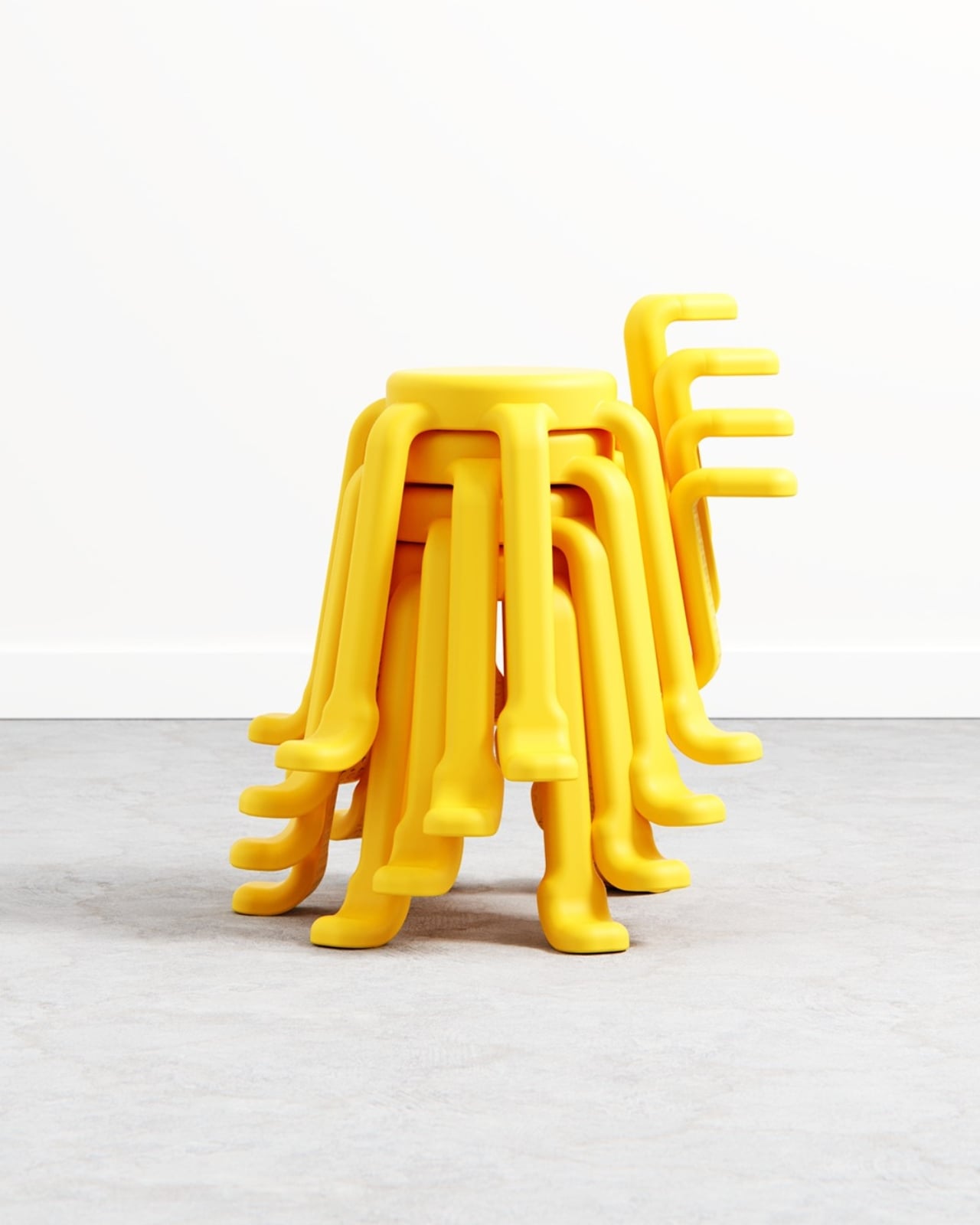
The stacking detail is also worth noting. Getting six legs to nest cleanly on top of each other is a real engineering puzzle, and de la Bedoyere solved it by shaping each leg with enough taper and spacing to allow the stools to slide into each other gracefully. Seen stacked in a column, they look spectacular. Like a sculpture you’d walk past in a gallery and immediately photograph. Which means SQOOL is doing double duty even when no one is sitting on it.

The color choices lean fully into the stool’s playful register. The saturated yellow is hard to miss, and a soft lavender variant appears in some renders, equally confident. These aren’t accent tones chosen to recede politely into a neutral interior. They’re chosen to assert presence. SQOOL isn’t trying to disappear into a corner. It wants to be part of the room, part of the conversation, maybe even part of your grid. That’s not a criticism at all. Personality in furniture is genuinely underrated, and design objects that commit fully to their own character tend to age better than the ones trying to be neutral.

Bored Eye Design’s portfolio shows a consistent interest in objects that are curious and approachable, things that reward a second look and feel good to handle. SQOOL fits neatly into that sensibility. It’s playful without being infantile, practical without being dull, and memorable without leaning on novelty for novelty’s sake. The name alone, a blend of “stool” and something else entirely, already tells you what kind of designer de la Bedoyere is.

The question with any concept project is always whether it would survive production. I think SQOOL could. The logic holds up. The form has already been thought through with stackability in mind, which is usually where playful concepts fall apart. A stool this considered, this expressive, and this genuinely useful deserves more than a render portfolio. It deserves a production run.

The post A Stool With Six Legs Just Made Four Feel Outdated first appeared on Yanko Design.