Apple's USB-C Magic Mouse is back on sale for about $11 off its usual retail price of $79. At $68, that's a savings of 14 percent for one of Apple's best accessories from a company that does not often run sales.
The multi-touch mouse was first released in 2009 with a modest refresh released in 2015 and the addition of a USB-C port in 2024. The rechargeable mouse features gesture controls and automatically pairs with your Mac when connected via USB. The Magic Mouse can also be used with an iPad via Bluetooth, or with a Windows PC, though in that case, functionality would be limited.
Famously, Jony Ive's design of the Magic Mouse sees its charge port on the underside of the body, rendering it unusable while charging. In 2024 there were rumors of a more comprehensive redesign coming but nothing has materialized since.
The first PlayStation State of Play livestream of 2026 has been announced. The stream will take place on February 12 at 5PM ET. It will run for over an hour and feature PlayStation Studios titles as well as third-party projects and indie games that are bound for PS5. You can watch it on PlayStation’s official YouTube channel (in English, Japanese or with English subtitles) or on Twitch.
As the first State of Play of the year, Sony is going to want to drum up some more hype for its upcoming release slate. Since Bungie’s Marathon is due to arrive on March 5, that will surely make an appearance. MLB The Show 26, which is out on March 17, will likely get a look in too. We could also get another peek at Saros, the highly anticipated follow-up to Housemarque’s Returnal, which will arrive on March 20. A new trailer for Marvel’s Wolverineisn’t out of the question, but Sony could wait until a summer showcase to give us another look at that one.
The last State of Play took place in November, but that one was focused solely on games coming out of Asia and Japan. Before that, Sony also had a showcase during Tokyo Game Show in September, which featured a first look at gameplay from the aforementioned Wolverine, which is due to arrive later in 2026.
This article originally appeared on Engadget at https://www.engadget.com/gaming/playstation/the-first-playstation-state-of-play-of-2026-will-air-on-february-12-145747775.html?src=rss
A big day in streaming has finally arrived: HBO Max has finally announced it's coming to the United Kingdom and Ireland. The two countries join over 110 territories worldwide that already offer HBO Max. Some HBO shows, like Euphoria, have already been available in these regions through other platforms. HBO Max will bring titles like The Pitt, One Battle After Another and Sinners. It will also air the upcoming Harry Potter series.
An HBO Max subscription will be available in the UK and Ireland starting on Thursday, March 26. Plans will start at Basic with Ads for £5 per month, offering all titles except movies that first stream on HBO Max after a theatrical release. Then there's Standard with Ads for £6 per month, which includes those releases and 30 downloads. Both can stream on two devices at a time.
Anyone who wants an ad-free experience can purchase a Standard or Premium plan. The former has all titles available on two devices, up to 30 downloads and, of course, no ads. The Premium plan comes with four devices in 4K Ultra HD with Dolby Atmos — if the system has capabilities.
Interestingly, the expanded area comes as Netflix prepares to own Warner Bros., including HBO and HBO Max. While there's no indication of whether this had any influence, Netflix has long been available in the UK and Ireland.
This article originally appeared on Engadget at https://www.engadget.com/entertainment/streaming/hbo-max-is-finally-coming-to-the-uk-and-ireland-145126162.html?src=rss
Elon Musk says SpaceX has shifted its near-term priorities from Mars settlement plans to building what he called a “self-growing city on the Moon,” arguing the lunar target is faster and more achievable. In a post on X, Musk claims the company could complete this in less than 10 years, while doing the same on Mars would take over 20 years.
This marks a major shift for the aerospace company, as Musk points out that the logistics of first completing a proof of concept on the moon are easier with respect to launch windows and proximity to Earth. The SpaceX founder is notorious for promising optimistic timelines that never come to pass, and said in 2017 that a base on Mars would be ready for its first settlers as early as 2024.
In subsequent replies to other posts Musk predicted "Mars will start in 5 or 6 years, so will be done parallel with the Moon, but the Moon will be the initial focus." He also said a manned Mars flight might happen in 2031.
Early last year Musk said in a post on X that SpaceX would be going "straight to Mars" and that "the Moon is a distraction." This was in response to Space industry analyst Peter Hague pointing out that among other considerations, lunar regolith, a material found on the surface of the moon, is about 45 percent oxygen. In 2023 NASA proved this oxygen could be extracted, which would yield enormous payload savings as opposed to shipping liquid oxygen between Earth and Mars.
NASA's Artemis missions, which SpaceX is a contractor for at certain stages, are planned to see humans back on the lunar surface by 2028. Artemis II, during which astronauts will circle the moon before returning to Earth, is set to launch in March of this year.
This article originally appeared on Engadget at https://www.engadget.com/science/space/spacex-is-pivoting-to-focus-on-a-moon-base-before-mars-141851264.html?src=rss
Discord is the latest company looking to bolster its child safety (again). Starting in March, all users will have a "teen-appropriate experience" by default. Unlocking adult content and age-gated spaces will require a (usually one-time) verification process. However, following blowback, the company appears to have pivoted. It now says its age prediction AI will verify the identities of “the majority of adult users” without requiring a manual age check.
The platform's big safety update encompasses communication settings, restricted access to age-gated spaces and content filtering. Users who aren't verified as adults will see blurred sensitive content. In addition, age-restricted channels, servers and app commands will be blocked. DMs and friend requests from unknown users will be routed to a separate inbox.
If you're an adult who didn’t pass the automatic age check, removing these restrictions will require one of two verification methods at launch. You can take a selfie video for age estimation or submit a government ID to Discord's vendor partners. (Let's just hope the age estimations work better than Roblox's.) The company stresses that the video selfies you submit for age estimation never leave your device. And it claims ID documents sent to its vendor partners are deleted quickly, "in most cases, immediately after age confirmation."
Although Discord says the process will be one-and-done for most people required to submit manual verification, some may be required to submit multiple forms. Its original announcement stated that additional verification options would be introduced, including an age inference model that runs in the background. However, following backlash to its initial announcement, the company now suggests that the inference model will be the norm for most adults.
“For most adults, age verification won’t be required, as Discord’s age inference model uses account information such as account tenure, device and activity data and aggregated, high-level patterns across Discord communities,” the company wrote in a statement sent to Engadget on Tuesday. “Discord does not use private messages or any message content in this process.”
Alongside today’s changes, Discord is recruiting for a new Teen Council. The group will include 10 to 12 teens aged 13 to 17. The company says this "will help ensure Discord understands — not assumes — what teens need, how they build meaningful connections, and what makes them feel safe and supported online." This sounds like the corporate equivalent of the parenting advice: “Don’t just talk to your children; listen to them, too.”
The child safety changes will start rolling out globally in early March. Both new and existing users may be required to submit verification for adult content.
Update, February 10, 2026, 5:57 PM ET: This story has been updated to add Discord’s clarification and statement that claims most adults won’t need to conduct a manual age check.
This article originally appeared on Engadget at https://www.engadget.com/social-media/discord-will-soon-require-age-verification-to-access-adult-content-140000218.html?src=rss
Since Apple finally put its mysterious and long-suffering Project Titan out to pasture, we've wondered what a Jony Ive-designed Apple Car might have looked like. Today, we might have a clue. This, though, is no Apple Car. It's the Ferrari Luce ("light" in Italian), the actual name for the EV formerly known as Elettrica, and I'm fresh from getting a walkthrough of the thing from Sir Ive himself. At a glance things look like you might have expected, but there are a few surprises here.
While Ferrari has sold hybrids in some form or another since 2013's LaFerrari, Luce (née Elettrica) will be the company's first all-electric machine. We got our first look underneath back in October, when we saw the chassis, battery pack and other details that pointed to this being a larger, more family-friendly machine than your average Ferrari. Last week, I got a look at the next major component, the interior, which comes courtesy of LoveFrom.
LoveFrom is the house that Jony Ive founded after leaving Apple in 2019. The obsessive design firm, which currently numbers about 60 employees, was acquired by OpenAI for $6.5 billion last year. LoveFrom has thus far taken on a medley of projects, like the $60,000 Linn Sondek LP12 turntable, but the Luce could be among the company's biggest projects so far — at least in terms of literal dimensions.
If you're familiar with the designs that Apple produced under Ive's tenure, particularly in the era beginning with the iPhone 4, you'll feel right at home here. The overall aesthetic is one dominated by squircles and circles, all with absolute, minute perfection and symmetry.
Ferrari Luce interior designed by LoveFrom
Ferrari
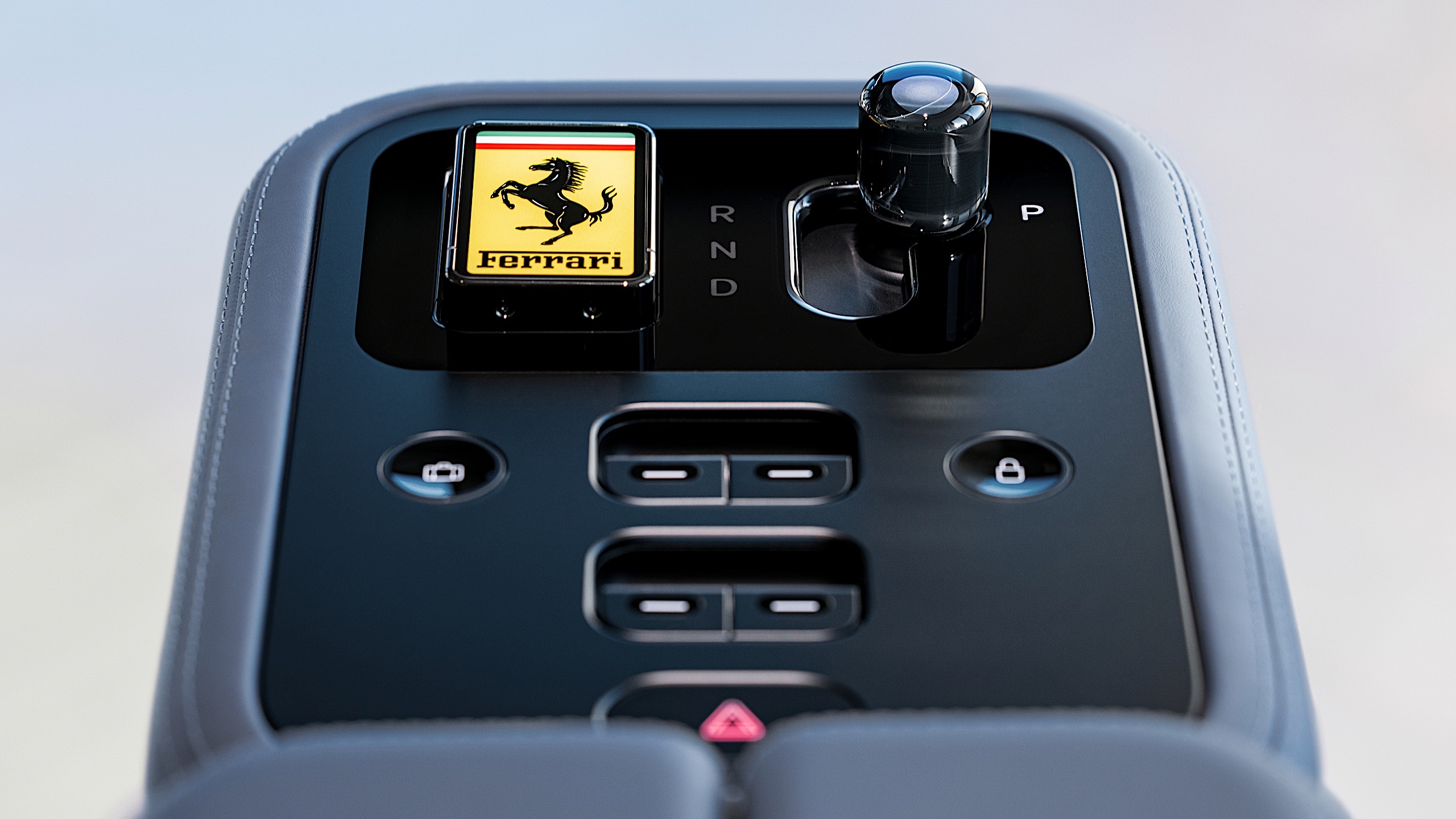
At first blush, it's a bit clinical, but dig deeper, start poking and prodding, and you'll see there's a real sense of charm here. Fun little details and genuinely satisfying tactility begin to reveal themselves. The key, for example, has a yellow panel with an E Ink background. Push the key into the magnetized receiver in the center console, and the yellow on the key dims, moving across to glow through the top of the glass shifter. It’s meant to symbolize a sort of transference of life.
The shifter isn't the only thing that's glass. There are 40-odd pieces of Corning Gorilla Glass scattered throughout the cockpit, everything from the shifter surround to the slightly convex lenses in the gauge cluster. What isn't glass is aluminum, much of it anodized in your choice of three colors: gray, dark gray and rose gold.
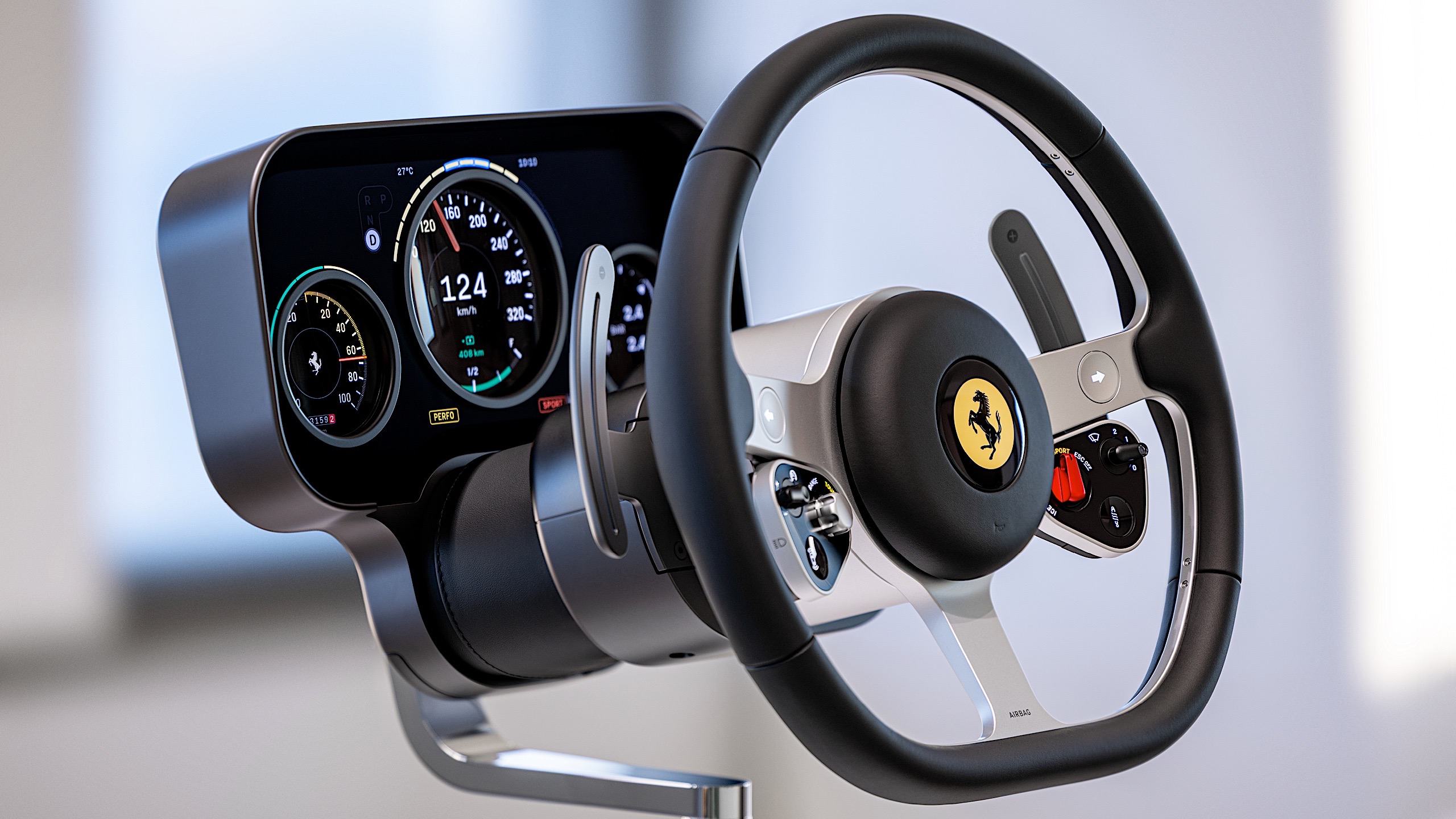
Yes, all that sure does sound like I'm writing about a new iPhone and not the latest Ferrari. But where Apple has been pruning every physical control it possibly can from its devices lately, LoveFrom will insert some great tactility in the Luce. The shifter moves through its detents satisfyingly, the air vents open and close with a clear snick and the paddles behind the steering wheel pop with a great feel.
My favorite feature is the windshield wiper control, a little dial in the upper-right of the steering wheel face. It features a tiny lens that magnifies the current setting. It's actually magnifying one of four custom OLED panels, 200 ppi units from Samsung, cut and shaped to deliver LoveFrom's ornate style.
Ferrari Luce interior designed by LoveFrom
The gauge cluster behind the steering wheel, or binnacle as it's more formally called here, is two OLED displays stacked on top of each other, with a physical needle sandwiched between serving as a pseudo-tachometer for this car without an engine. The gauges change and morph as you move from one mode to the next.
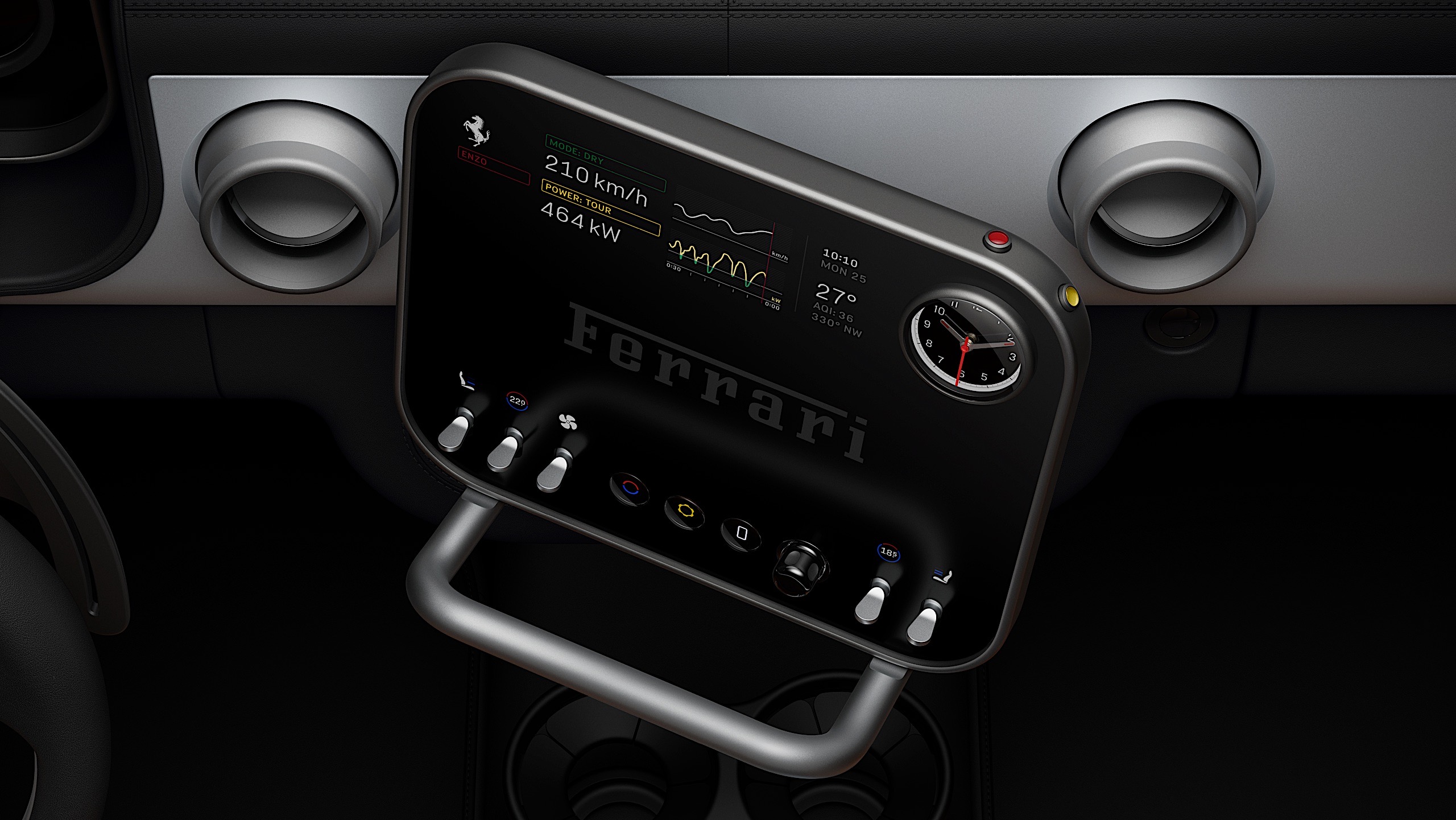
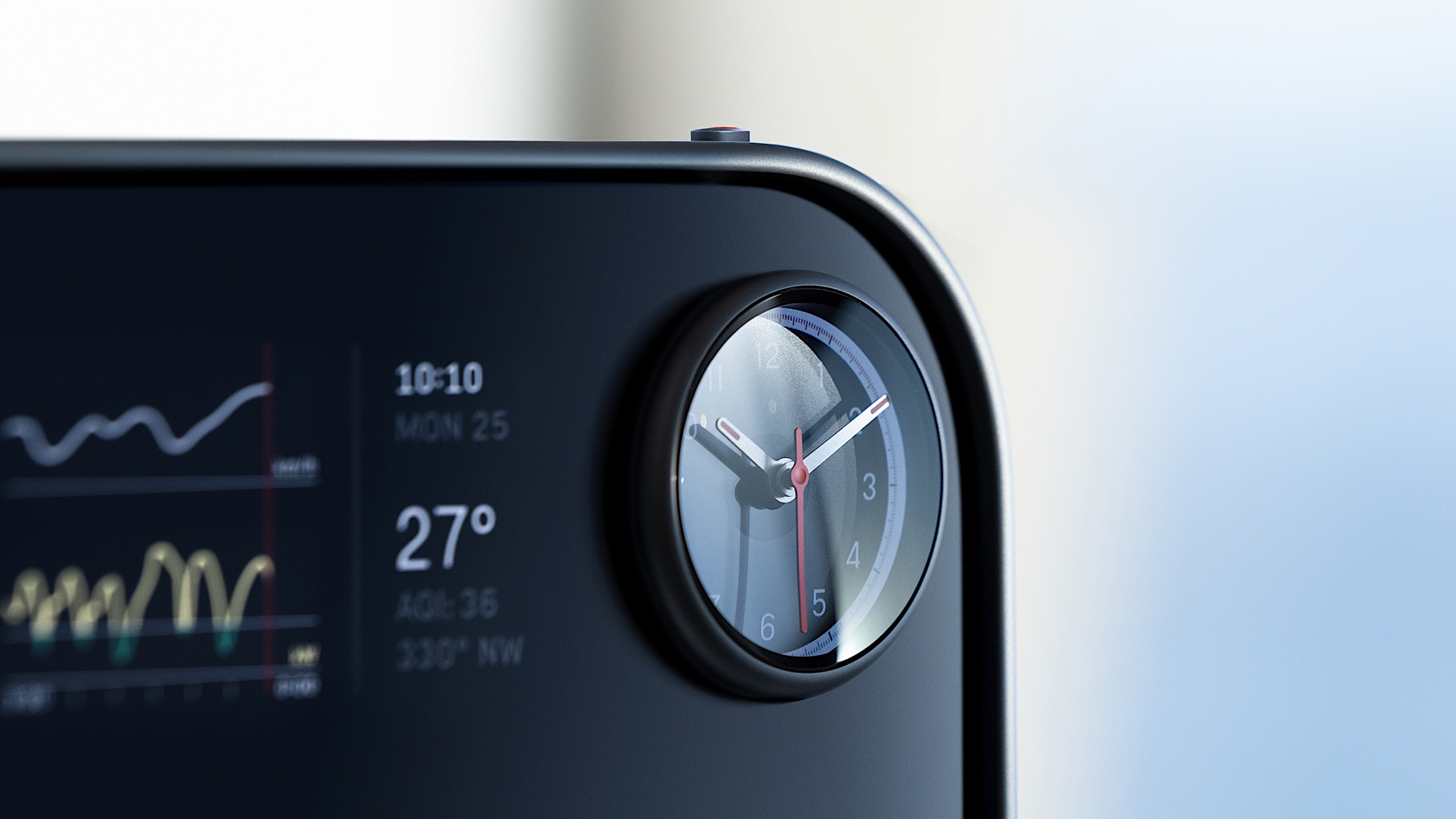
The center display is a 10.12-inch OLED perforated with plenty of holes to allow some pleasingly chunky toggle switches through, plus a glass volume knob. The little clock in the upper-right can turn into a stopwatch or a compass, with its needles swinging about depending on the mode. The whole central control panel pivots and swivels. Just grab the big handle below and drag it where you want it.
The attention to detail on everything is astonishing. Even the rails that hold the seats to the floor are gently shaped and anodized to match the rest of the interior.
Ive was on hand to unveil the interior, clearly a little nervous about showing all this for the first time. After five years of working confidentially on this topic, Ive said he was "enormously excited" and "completely terrified" to provide our first real glimpse at the Luce.
Marc Newson, who founded LoveFrom with Ive, said: "Jony and I share a really, really deep interest in automotive things and vehicles. Actually, I'd go so far as to say that that is probably a hobby of both of ours."
Both Ive and Newson own many vintage machines, and Ive said that modern cars "are missing some things that we love about our old Ferraris." Things like tactility. "It was very clear to us that we needed to figure out as many ways as possible to viscerally and physically connect to the interface," Ive said.
Ferrari Luce interior designed by LoveFrom
So, while the Luce does have that pivoting touchscreen, it's far from the vehicle's primary interface. Ive said he hopes that physical connection and all the clever touches create a uniquely charming vehicle.
Ive told me that the LoveFrom team has genuinely enjoyed working with Ferrari. "It's been really lovely," he said, and he praised Ferrari CEO Benedetto Vigna's dedication to this project and where it might lead down the road. "Benedetto is an amazing engineer," he said, "he's really interested in what can be learned more broadly."
The biggest challenge might have been working within the automotive industry. Here, design, form and function are key, but safety is of the utmost importance. "It's very hard," Ive told me. "I've never worked in an area that's so regulated. Some of it's great, because you understand why, and people's safety is certainly important, but some of it drives you nuts."
It's far and away the most exciting and fresh interior I've seen outside of the ultra-rare machines like the $4 million Bugatti Tourbillon. But it's so clinically precise and refined that it lacks the rough and raw feel that typifies many classic Ferraris. Whether that's a good or a bad thing will be debated endlessly, and I look forward to reading your comments, but I do figure it'll go a long way to delivering the kind of new clientele that Ferrari must be targeting with the Luce.
Ferrari Luce interior designed by LoveFrom
Ultimately, whether anyone will want one is hugely dependent on how good the rest of the car looks and how much it will cost. Those are questions we still can't answer, at least not until May, when CEO Vigna says we can expect the Luce's full reveal.
For Ive, though, it seemed like that won't be the end of the road for this automotive journey. "At the end of a project, there are two products. There's what you've made, and there's what you've learned. I've always been fascinated by what you've learned," he told me. "And honestly, we've learned so much."
This article originally appeared on Engadget at https://www.engadget.com/transportation/evs/inside-ferraris-luce-ev-the-jony-ive-interior-is-here-130000211.html?src=rss
The EU could take "interim measures" against WhatsApp as it investigates AI providers' access to the app. On Monday, the EU's regulatory arm announced its "preliminary view" that Meta, WhatsApp's parent company, violated antitrust laws by blocking third-party AI assistants from operating on WhatsApp.
The European Commission's is concerned that Meta's actions will limit competitors from entering the AI assistant market. "We must protect effective competition in this vibrant field, which means we cannot allow dominant tech companies to illegally leverage their dominance to give themselves an unfair advantage," Teresa Ribera, executive vice-president for Clean, Just and Competitive Transition said in a statement.
Ribera continued: "AI markets are developing at rapid pace, so we also need to be swift in our action. That is why we are considering quickly imposing interim measures on Meta, to preserve access for competitors to WhatsApp while the investigation is ongoing, and avoid Meta’s new policy irreparably harming competition in Europe."
The issue arose in October when Meta announced updates to its WhatsApp Business Solution Terms. According to the European Commission, the January 15 update would "effectively" make Meta AI the only AI assistant available on WhatsApp. The regulatory agency opened an investigation into the matter on December 4.
Today's update stands as a warning to Meta that the European Commission initially believes the company has violated antitrust regulation. A final decision is still to come. It also gave Meta a chance to respond to the allegations — which it swiftly did.
"The facts are that there is no reason for the EU to intervene in the WhatsApp Business API," a Meta spokesperson told Reuters. "There are many AI options and people can use them from app stores, operating systems, devices, websites, and industry partnerships."
This article originally appeared on Engadget at https://www.engadget.com/big-tech/eu-warns-meta-over-blocking-rival-ai-chatbots-on-whatsapp-121708895.html?src=rss
Lyft has officially introduced teen accounts for ages 13 to 17. This is a rideshare feature in which teenagers can request their own rides, which is similar to Uber's pre-existing platform.
Teens request the rides on their own, but parents can keep an eye on things every step of the way. Lyft says that parents or guardians can see every ride in real time and manage the account. They also get updates at pickup and drop-off and the app allows communication with the driver when needed.
This is a rideshare service for teens, so there are several new safety features. The drivers must "meet the highest standards" on the platform. Lyft says they get annual background checks and must have "proven safe driving records, positive passenger interactions and experience behind the wheel."
The teens have to enter a PIN to ensure the correct rider gets in the car, which is something Lyft has been experimenting with for adults. Audio recording of the ride is on by default, for an added layer of safety.
Lyft Teen is available right now, though not everywhere. The company has launched the platform in 200 markets, including New York City, Chicago, Atlanta and Miami, among others. It's coming to more cities as the year winds on.
This article originally appeared on Engadget at https://www.engadget.com/apps/lyft-rolls-out-teen-accounts-with-enhanced-safety-protections-110002761.html?src=rss
YouTube Music has started putting lyrics — a previously free feature introduced in 2020 — behind a paywall, according to multiple users and 9to5Google. In the latest update, the “Lyrics” tab in the Now Playing screen displays a warning message: “You have [x] views remaining. Unlock lyrics with Premium.” Free users get lyrics for five songs, then after that, will only see a few lines before the rest of the song is blurred.
Google has been testing the feature since at least September with a limited number of users, according to previous reports. It’s been speculated that YouTube may have made the change to recuperate costs spent with lyric aggregators like Musixmatch. Spotify also put lyrics behind its Premium paywall in 2024, but a user backlash forced it to reinstate the feature for free users.
Google has yet to confirm the change, and while it appears to be a larger rollout, the feature change could still be in testing. YouTube Music’s Premium subscription costs $10.99 in the US with ad-free playback, offline downloads, AI features and more — the same as its main rivals Spotify, Apple Music and Amazon Music.
This article originally appeared on Engadget at https://www.engadget.com/entertainment/music/youtube-music-starts-limiting-lyrics-for-free-users-101258311.html?src=rss
Amazon MGM just released the final trailer for its upcoming film starring Ryan Gosling, Project Hail Mary, and it provides our first good look at his five-legged alien co-star, Rocky. The movie adapts a 2021 Andy Weir (The Martian) novel of the same name, and follows Dr. Ryland Grace, a scientist who wakes up on a spacecraft far from Earth with no recollection of how he got there or why, only to discover he's on a seemingly impossible mission to stop an extinction event.
If you've read the book, you already know we're in for an emotional rollercoaster with this one, and the latest trailer aptly tugs at our heartstrings with a glimpse of the friendship that grows between Grace and an alien he meets after waking up — and the incredibly high stakes they're facing. The movie will be released nationwide on March 20, but Amazon announced alongside this trailer that it'll be offering tickets for early screenings in premium formats including IMAX, Dolby Cinema, 4DX and 70MM to Prime members. Those screenings will begin on March 16, and tickets go on sale February 20 through Fandango.
This article originally appeared on Engadget at https://www.engadget.com/entertainment/tv-movies/the-final-trailer-for-project-hail-mary-is-here-and-its-an-emotional-ride-213444765.html?src=rss