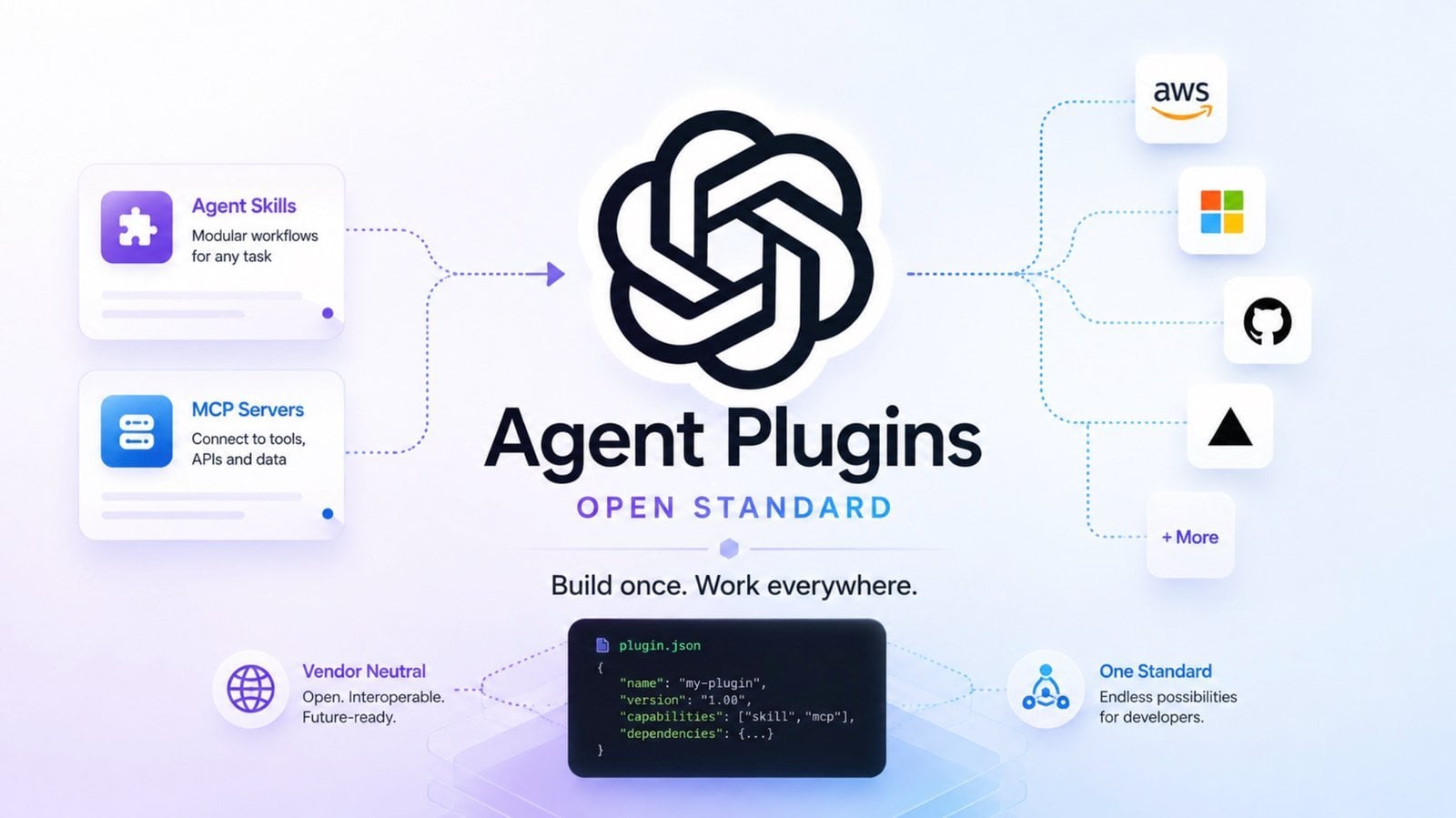
OpenAI introduces Agent Plugins, a vendor-neutral open standard aimed at simplifying the creation and deployment of software agent extensions. By addressing challenges such as platform-specific compatibility, this framework supports more efficient workflows and greater interoperability across systems. The structure is built around two key components: Agent Skills, which are modular workflows for defined tasks and […]
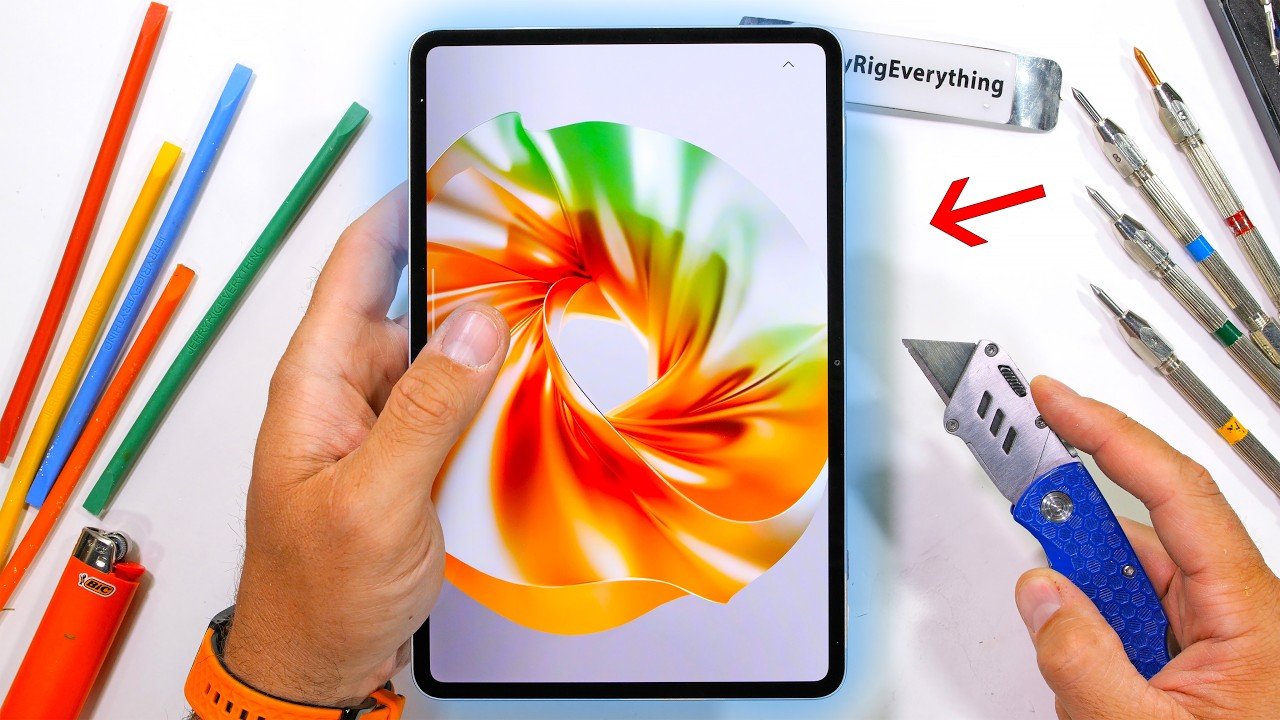
The Red Magic Astro 2 stands out as a gaming tablet that merges innovative technology with practical design. It is not merely a device for casual use but a tool crafted to deliver a gaming experience that rivals traditional PCs. With its advanced cooling system, powerful hardware, and sleek aesthetics, this tablet caters to both […]
Pickup trucks are one of the few vehicles people buy specifically to keep their options open. The whole point is hauling, versatility, doing whatever comes up. So it’s a little ironic that the moment you add a cap, you’ve kind of locked yourself in. A traditional hard shell covers the bed beautifully, keeps everything dry, and then asks you to commit. Removing it involves at least two people, a chunk of your afternoon, and then figuring out where a several-hundred-pound fiberglass or metal shell is going to live in a garage that already has a lawnmower situation going on.
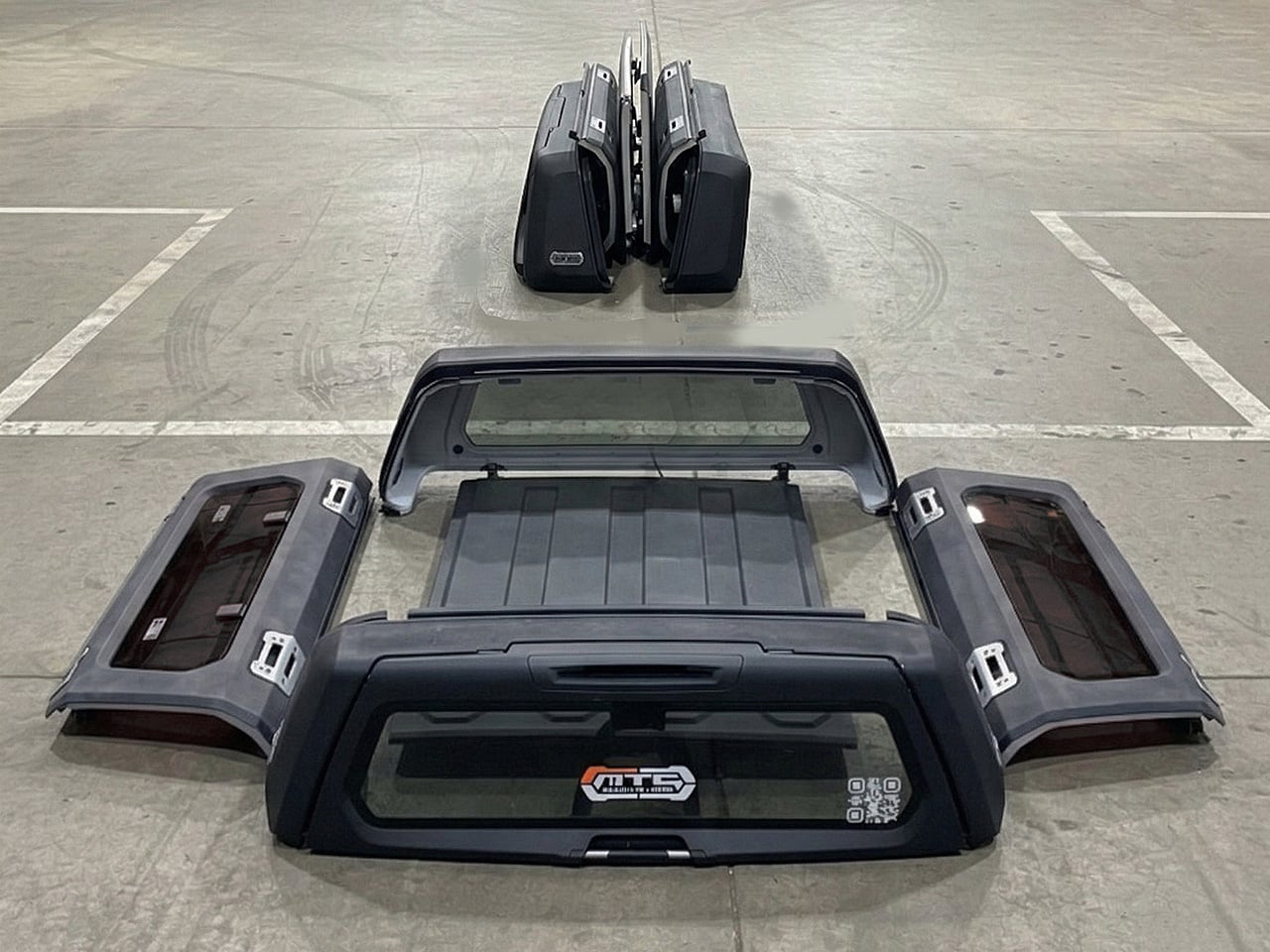
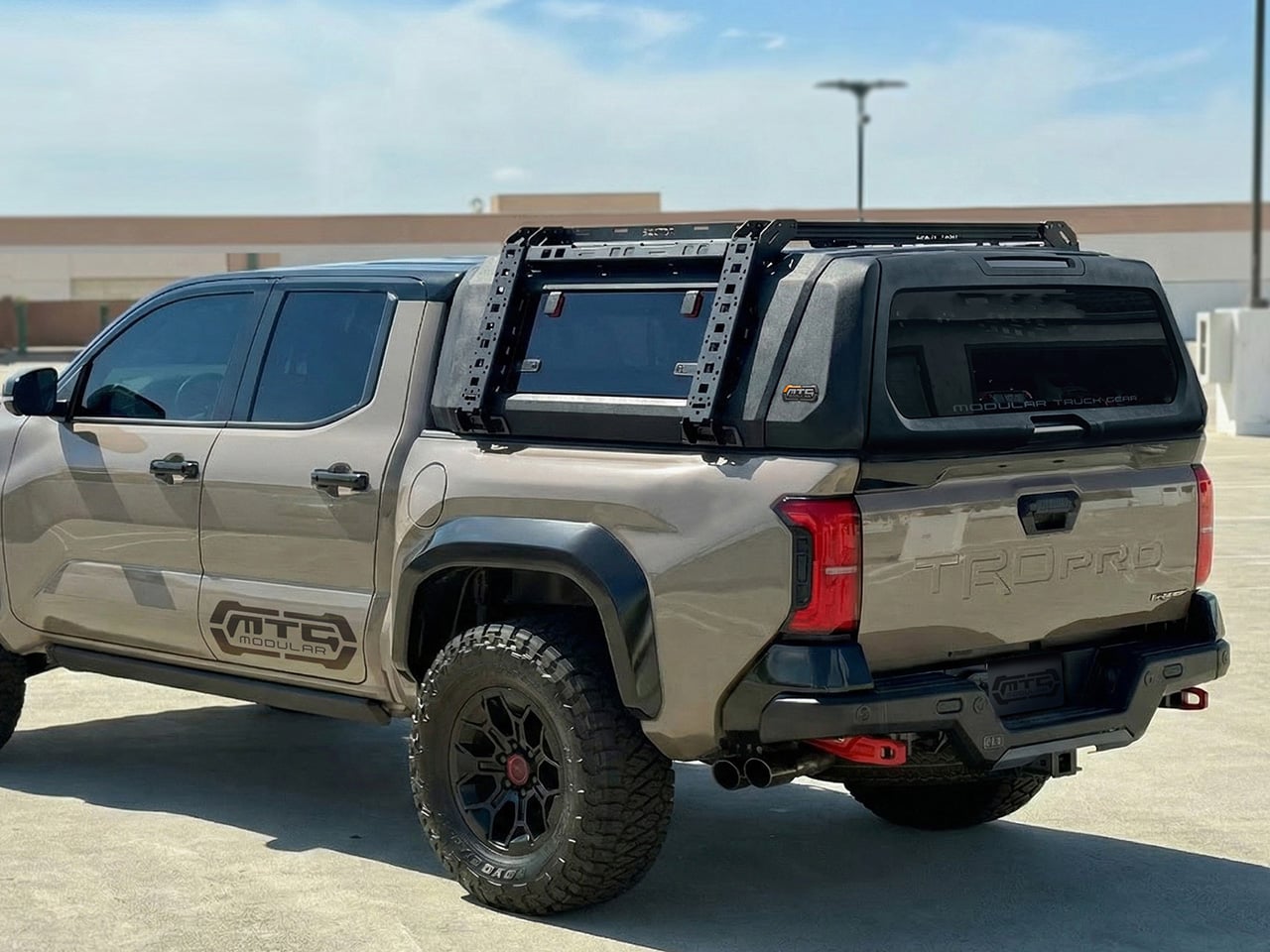
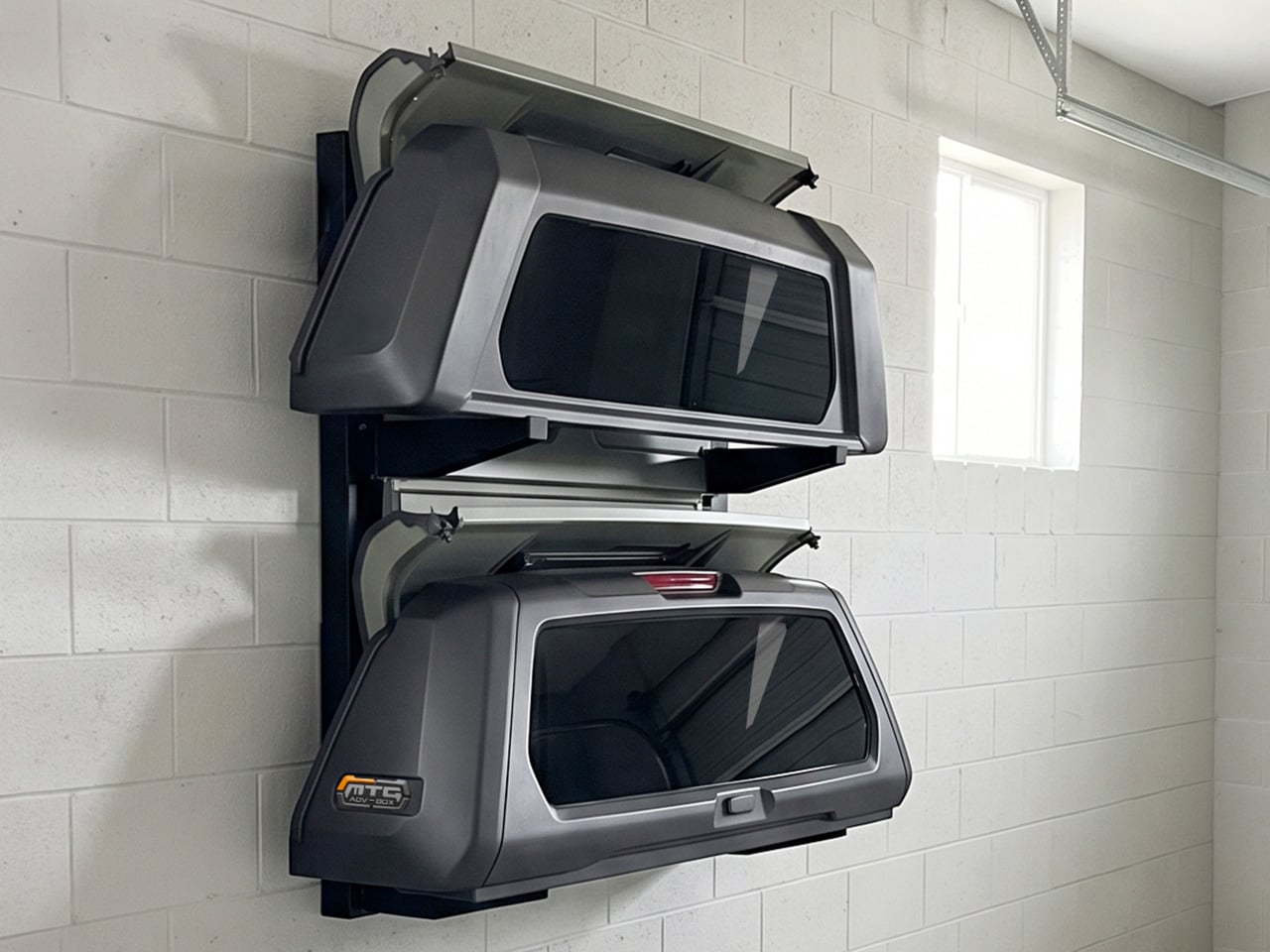
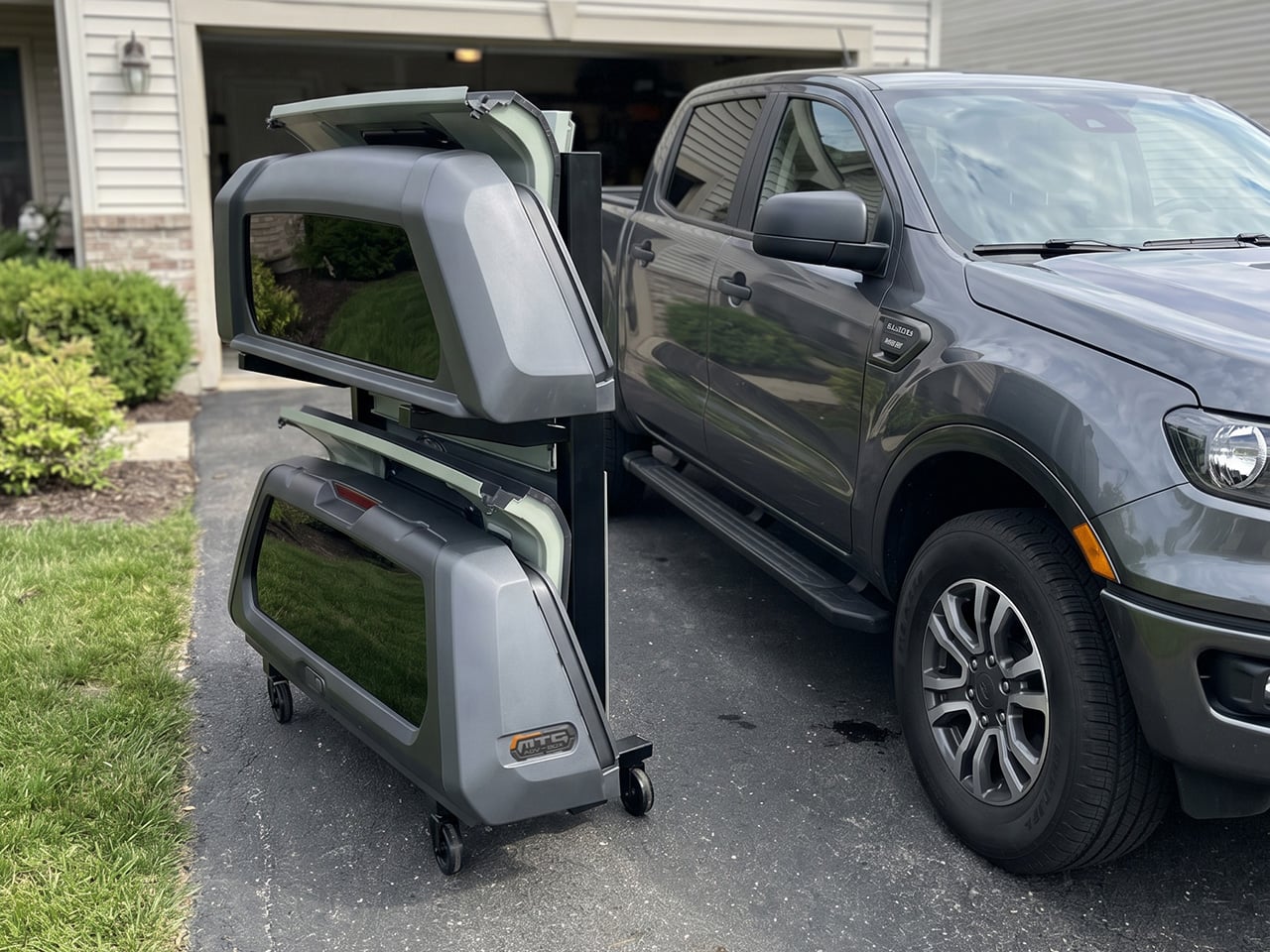
Enrique Giner, the automotive veteran behind Modular Truck Gear, built the ADV-BOX around a fairly simple idea: a truck cap should go on and come off on your schedule, not the cap’s. So they split it into six composite panels, designed a latch system inspired by military cargo hardware, and got the whole install-or-remove process down to under 15 minutes solo. The part that earns the most double-takes is the storage. Disassembled, the panels mount to a dolly or wall rack and take up about a quarter of its assembled size, letting you park your truck inside as well. Your truck gets its cap back whenever you need it, and your garage gets its wall back when you don’t.
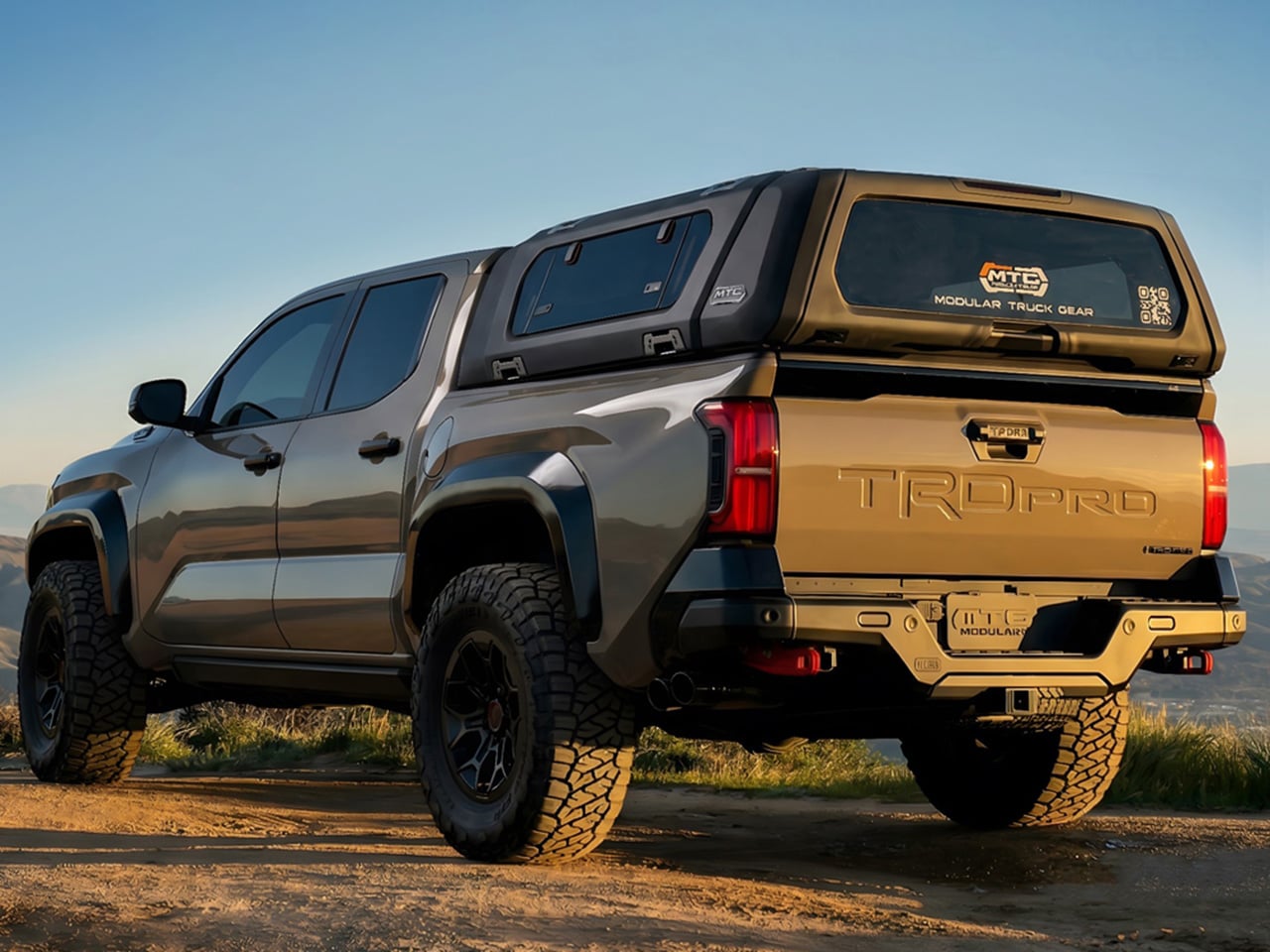
Giner drew design cues directly from tactical military cargo boxes and heavy-duty quick-latch hardware, and the ADV-BOX makes no effort to hide that lineage. It’s blocky, angular, and has zero interest in blending into the soft compound curves of a modern Tacoma or Ranger. The gullwing side windows swing up for easy access, the profile sits tall to maximize internal headroom, and the whole thing reads more mission-ready container than traditional topper. Giner spent over 25 years leading design programs at GM, Kia, and Ford/Lincoln before co-founding MTG, so when he says every detail has a purpose, there’s a resume behind it. The aesthetic is unapologetically tactical, and honestly, on a lifted Tacoma TRD Pro, it looks right at home.
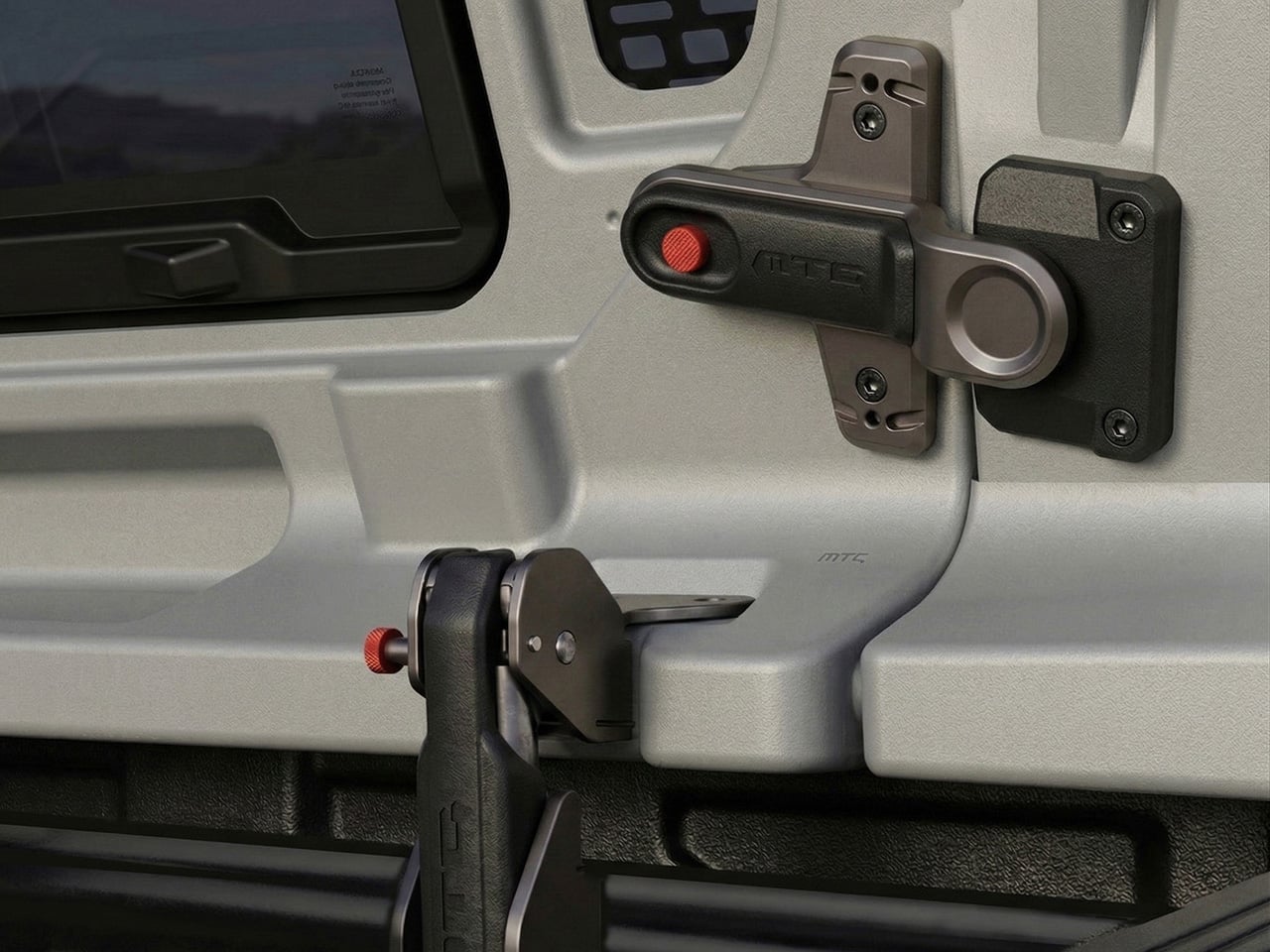
The panels are built from DRTM composite. Dual Resin Transfer Molding (RTM) liquid resin is injected into vacuum-sealed molds lined with fiberglass and targeted carbon fiber patches, forming ultra-precise interior and exterior shells that fuse into a strong, insulated composite structure that’s lighter than traditional fiberglass and better insulated than aluminum. The whole assembled cap lands at around 175 lbs split across six panels, which means each piece is genuinely manageable solo without the usual two-person ceremony. Structurally, the modular architecture does something smart: each modular panel connects to its neighbors through patented heavy-duty aluminum latches with dual safety locks, building a rigid unified structure once everything is clicked into place. The latch design went through multiple iterations during development, allowing MTG to make its ‘removal under 15 minutes’ claim… without any tools, no less. Once locked, they hold in whatever conditions you’d actually drive through.
Position and latch the front and rear panels to the bed anchors, connect the side panels and link them to the front and rear, then drop the roof panels into place and rotate the turn latches closed. That’s the three-step install in full. MTG claims under-15 minutes solo, with no tools, and based on the design logic it tracks, because nothing in the process requires drilling, specialty tools, or anyone’s help but your own. The cap ships pre-assembled to your door with all hardware included, no more dealer visits, no more installation fees, it comes with bed anchors that serve as the mounting foundation that stay on the truck permanently, and every subsequent install gets faster. Removable roof panels are also a separate feature, popping off independently in seconds if you need to load something tall without pulling the whole cap off the truck.
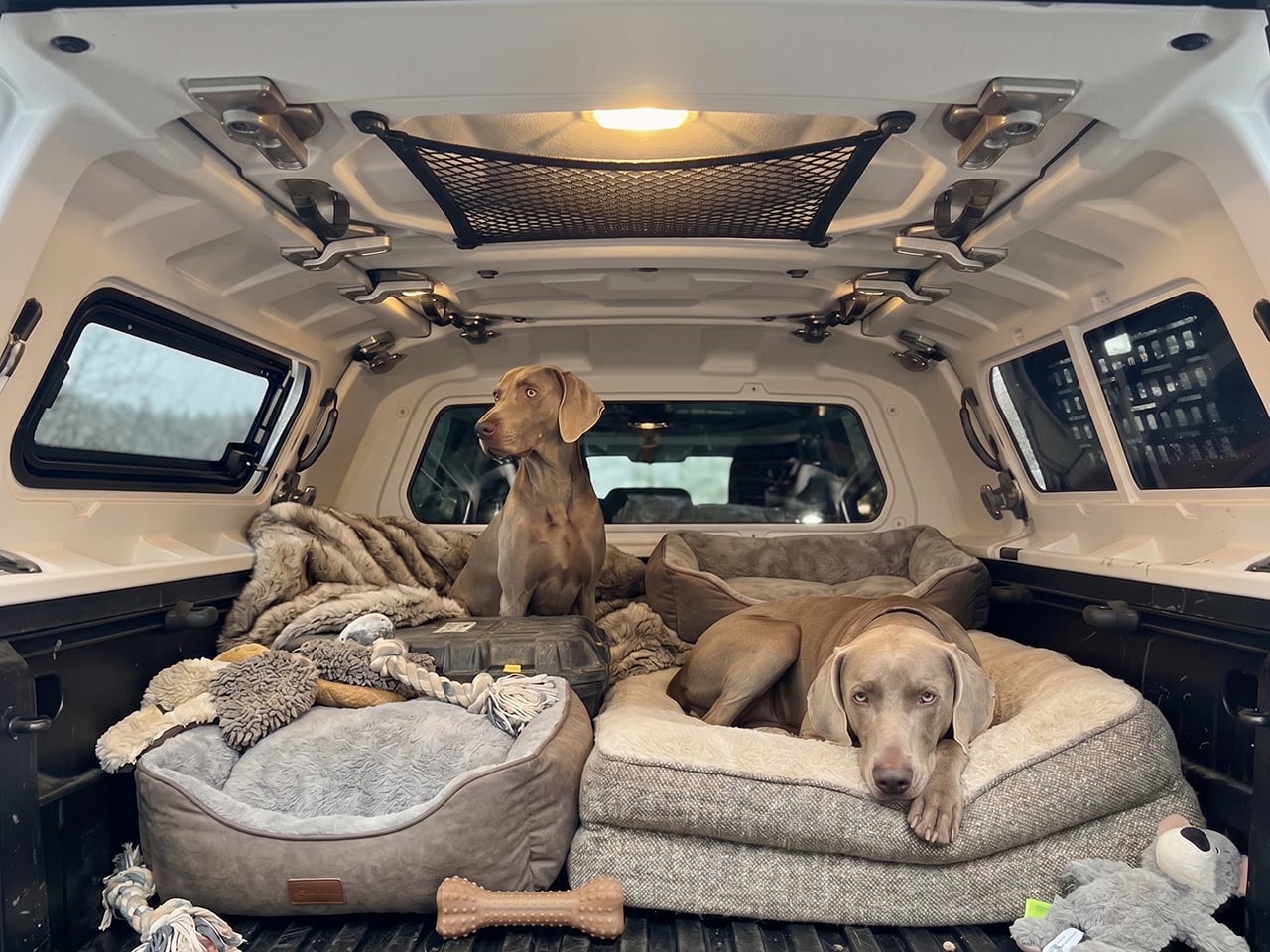
Rather than relying on edge seals alone, the ADV-BOX routes water through engineered channels at every panel joint, keeping the interior dry even during bed torsion, the frame flex that happens when a truck is working rough terrain. Metal caps tend to fail this way over time, vibration loosening screws and compromising seals until water finds its way in. MTG water-tested this extensively during development and rebuilt the sealing system based on exactly where those tests revealed vulnerabilities. The commercial configuration carries an IP56 rating for dust and water resistance, the kind of spec you’d see cited on jobsite power tools. Internal volume runs about 15 percent taller and wider than traditional hard caps, and an overhead cargo net is included in the core package to help you actually use that headroom.
MTG claims the ADV-BOX is the first hard-shell truck cap with a fully integrated roof rack system that attaches to the cap brackets rather than bolted on as an afterthought. The four-pillar architecture is the key here: load transfers directly down to the truck’s bed rails instead of stressing the cap shell, pushing the static capacity past 800 lbs and the dynamic load rating to 400 lbs while driving. That’s enough to support a full rooftop tent setup plus gear, and MTG explicitly designed for that via 80/20 aluminum extrusion crossbars compatible with most standard RTT mounting systems. Removable MOLLE panels attach to the sides for traction boards, recovery gear, or whatever else you want within arm’s reach on the trail. The entire rack comes off alongside the modular panels during removal, keeping the whole system logically consistent from top to bottom.
LEER, the biggest name in truck toppers, launched a modular cap of their own called the NexCap in late 2025, starting at $3,149 in precision-formed aluminum at roughly 240 lbs assembled. The fact that the dominant player in the category moved in this direction at all is useful confirmation that the modular concept has legs, but the two products land quite differently. The NexCap requires standard tools to assemble and doesn’t collapse for dolly or wall-mount storage the way the ADV-BOX does. At 175 lbs, fully tool-free, with a purpose-built dolly and wall storage system that takes the whole thing down to a quarter of its assembled size, the ADV-BOX pushes the modular logic considerably further. Giner brings over 50 combined years of OEM automotive experience to the project, which probably explains why this reads more like a second-generation product than a first attempt.
The ADV-BOX is available now directly through MTG’s website. The core package is available at a discounted $4,899 price tag with free US shipping (you can knock another $200 off the core package with the coupon code ‘211ADVBOX’), covering five mid-size 5-foot truck platforms: Toyota Tacoma (2005-2026, generations 2 through 4), Ford Ranger (2019-2026), Nissan Frontier (2022-2026), Chevy Colorado (2015-2026), and GMC Canyon (2015-2026). Add-ons include the Storage Rack at $469, two Cross Bars at $359, two MOLLE Panels at $249, and the full Rack System at $949, all with free US shipping. A 3-year warranty is included with the core package. Full-size platforms including the F-150, Silverado, RAM 1500, Tundra, and Jeep Gladiator, along with 6-foot mid-size bed variants, are confirmed for a separate future launch.
I got a serious case of déjà vu when Sony announced it was ending physical disc production in 2028. Reading their blog post about “shifting consumer preferences” and this being a “natural direction” felt a little too familiar, like I had seen this exact movie before. It was the same carefully polished language a company uses when it’s about to take away a feature you like, while insisting the decision is actually for your own good. You get the sense they are celebrating a future you never really asked for.
It took a minute to place the feeling, but then it hit me: the headphone jack. The script is identical, just with different actors. Apple told us removing a universal port was an act of “courage” that would push technology forward. Now, Sony is telling us that removing our ability to own, resell, or lend games is just an adaptation to “consumer trends.” In both cases, a simple, reliable, and open standard was sacrificed for a proprietary, walled-off ecosystem that benefits the company far more than the customer.
The ‘Courage’ to Make More Money
When Apple took the stage in 2016, they presented the removal of the headphone jack as a noble sacrifice for the sake of innovation. They needed more space, they said, for a better camera system, a bigger battery, and improved water resistance. While those claims had a kernel of truth, they cleverly obscured the much larger, more profitable truth. The real story, the one that made Apple billions of dollars, was the creation of a new, captive market. Suddenly, every headphone manufacturer had to pay Apple a licensing fee to use the Lightning port, or you, the customer, had to buy an adapter. Better yet, you could just buy their new, wonderfully convenient AirPods.
Sony is playing from the same sheet music, just in a different key. The company points to the very real trend of digital game sales outpacing physical ones as its justification. It’s true, more people are downloading games. But the business logic behind this move is far more calculated than simply following a trend. By eliminating discs, Sony wipes out the costs of manufacturing, packaging, and shipping games globally. More importantly, it lands a fatal blow on the used game market. Without discs, there is no GameStop, no eBay, no lending a copy to your cousin. Every single dollar spent on a new game must pass through the PlayStation Store, where Sony takes a cut, controls the price, and has absolute authority.
A Design That Trusts You Less
I’ve always believed that good product design builds a relationship of trust with the user. You buy a thing, and you expect it to serve your needs, not just the manufacturer’s. The PlayStation’s disc drive was a perfect example of that trust. It was a feature that gave you, the player, autonomy. It let you buy games from any retailer, hunt for deals, borrow from a friend, or sell a game when you were finished to fund your next purchase. It was a gateway to a world outside of Sony’s direct control, and that freedom was a core part of the product’s design. It was a humble component that respected your intelligence and your wallet.
This is what makes Sony’s decision feel like such a step backward. Removing the disc drive is a design choice that actively distrusts the user by removing their options. It funnels a global community of millions into a single, unmissable path that leads directly back to Sony’s pockets. The console transforms from a tool you own into a terminal for a service you rent. Apple did the exact same thing. The 3.5mm headphone jack was an open door, a universal standard that worked with everything from cheap earbuds to high-end studio monitors. The Lightning port and the proprietary chip in AirPods are guarded gates. Sony is simply building its own gate, and the price of admission is your freedom of choice.
Your Digital Library Is Rented. You Own Nothing.
The most significant consequence of this all-digital future is the redefinition of ownership itself. When you buy a game on a disc, you own a physical object. You have a legal right, under the “first-sale doctrine,” to do what you want with that object. You can sell it, lend it, or use it as a very expensive coaster. A company can’t reach into your home and take it back. A digital license, which is what you buy from the PlayStation Store, offers none of those protections. You are paying for permission to access data, and that permission can be revoked at any time, for any reason.
If that sounds like a paranoid exaggeration, just look at Sony’s own actions. A few weeks before this grand announcement about the future of gaming, the company began notifying users in Europe that it would be permanently deleting hundreds of purchased movies and TV shows from their digital libraries because a licensing deal had expired. Acclaimed films like Terminator 2 and Apocalypse Now, which people had paid for, were simply vanishing from their accounts. There were no refunds. This isn’t a hypothetical fear; it’s a demonstrated business practice. The all-digital, streamlined future Sony is so excited about is one where your game collection is not a collection at all. It’s a temporary service that exists entirely at their convenience.
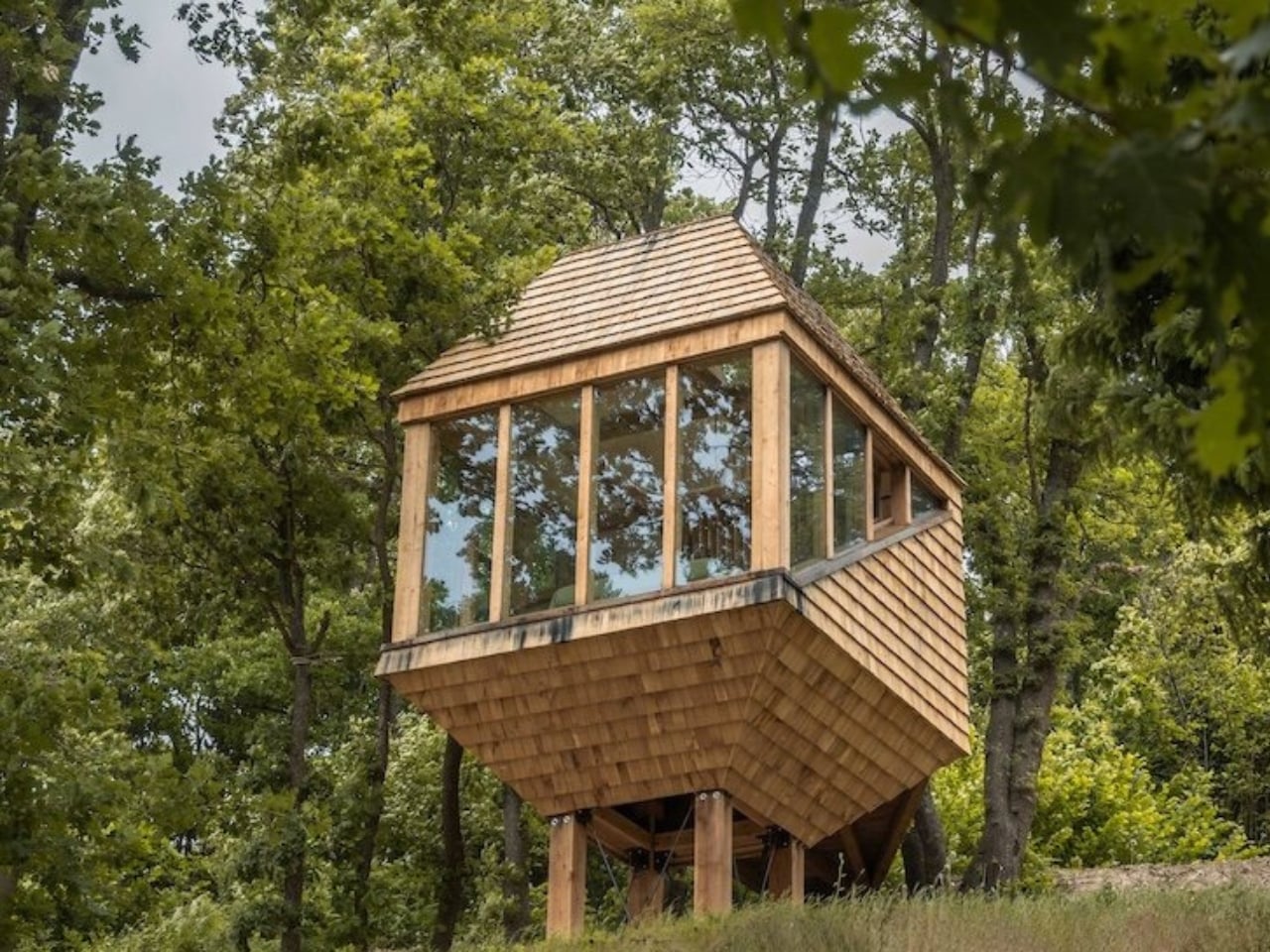
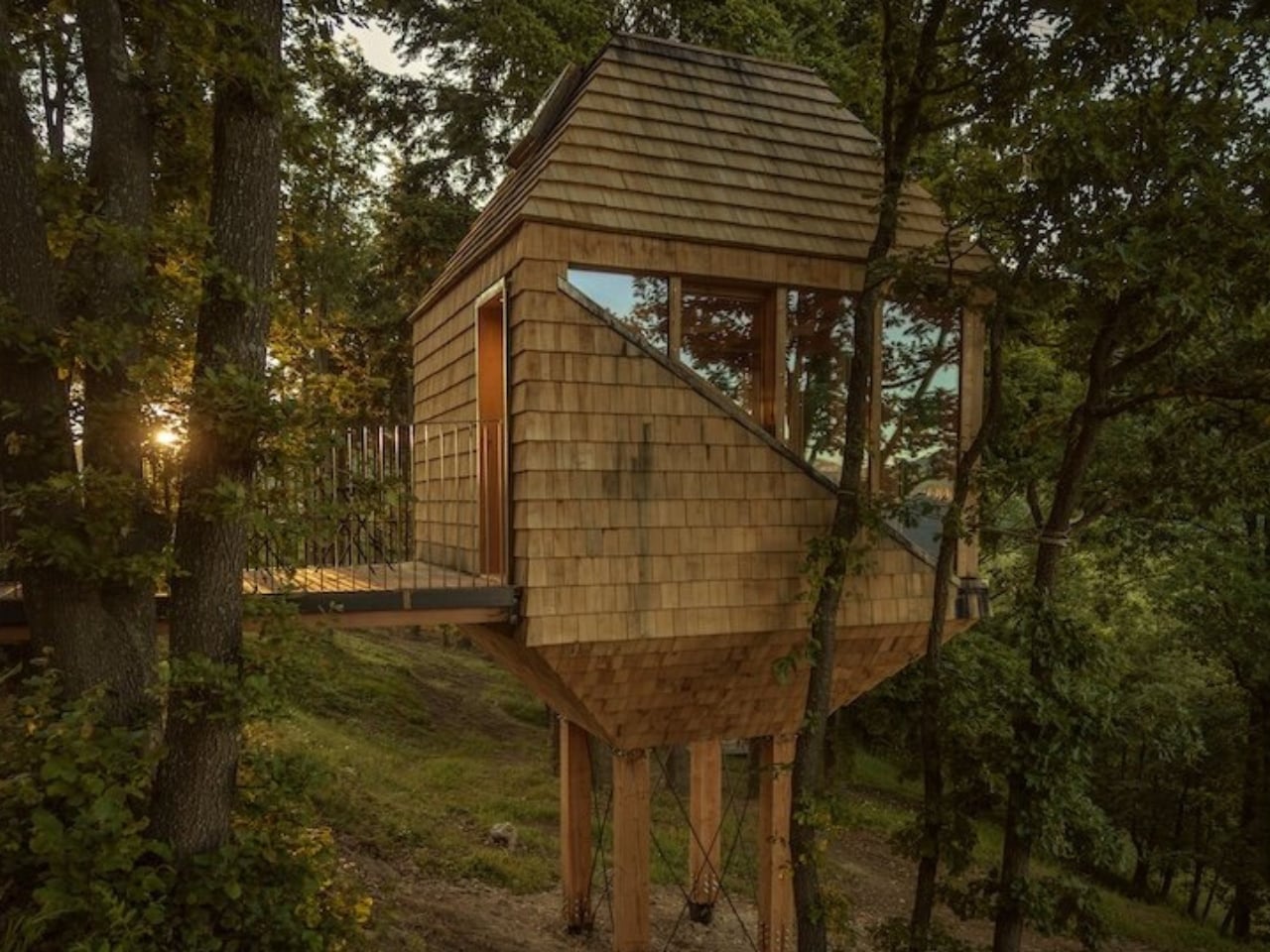
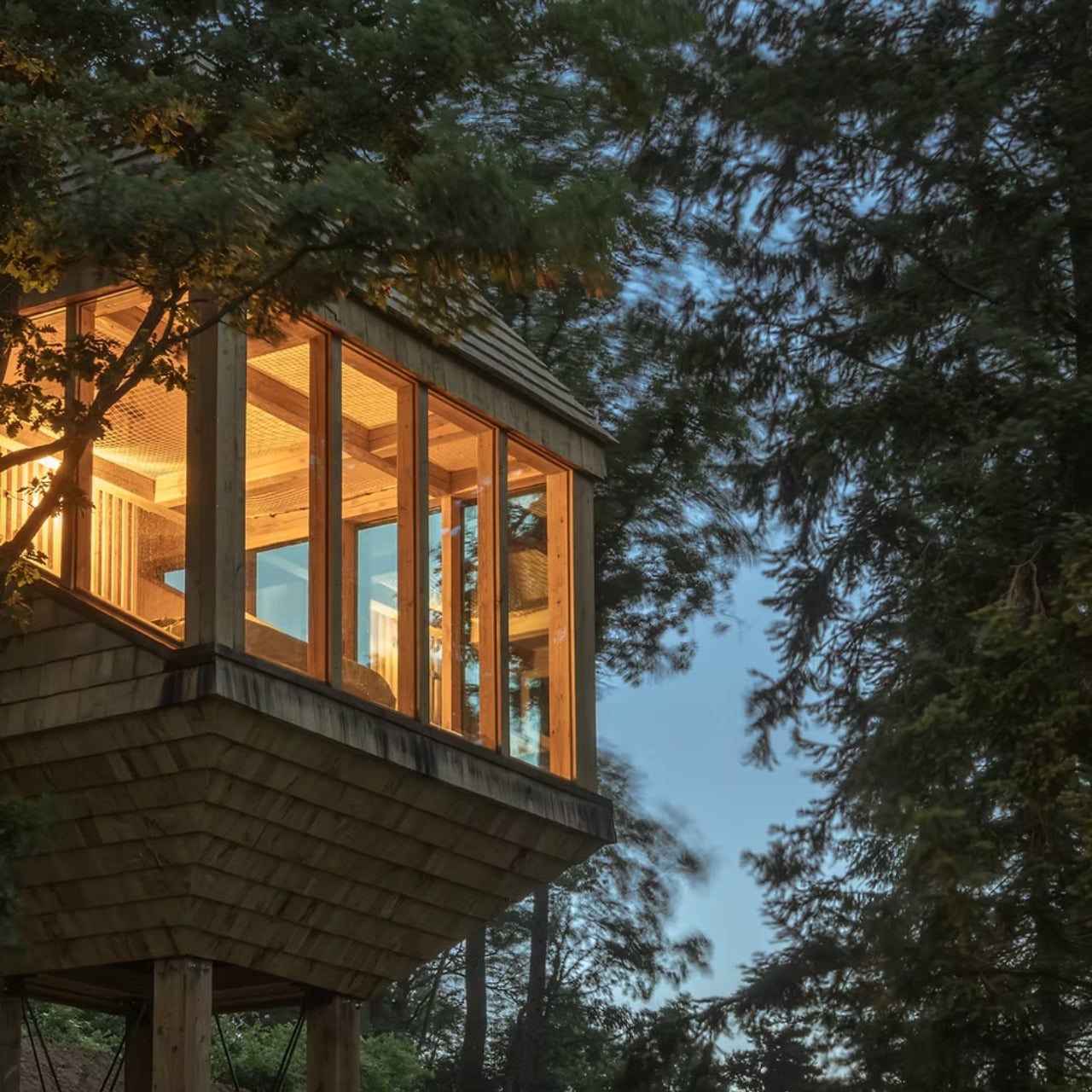
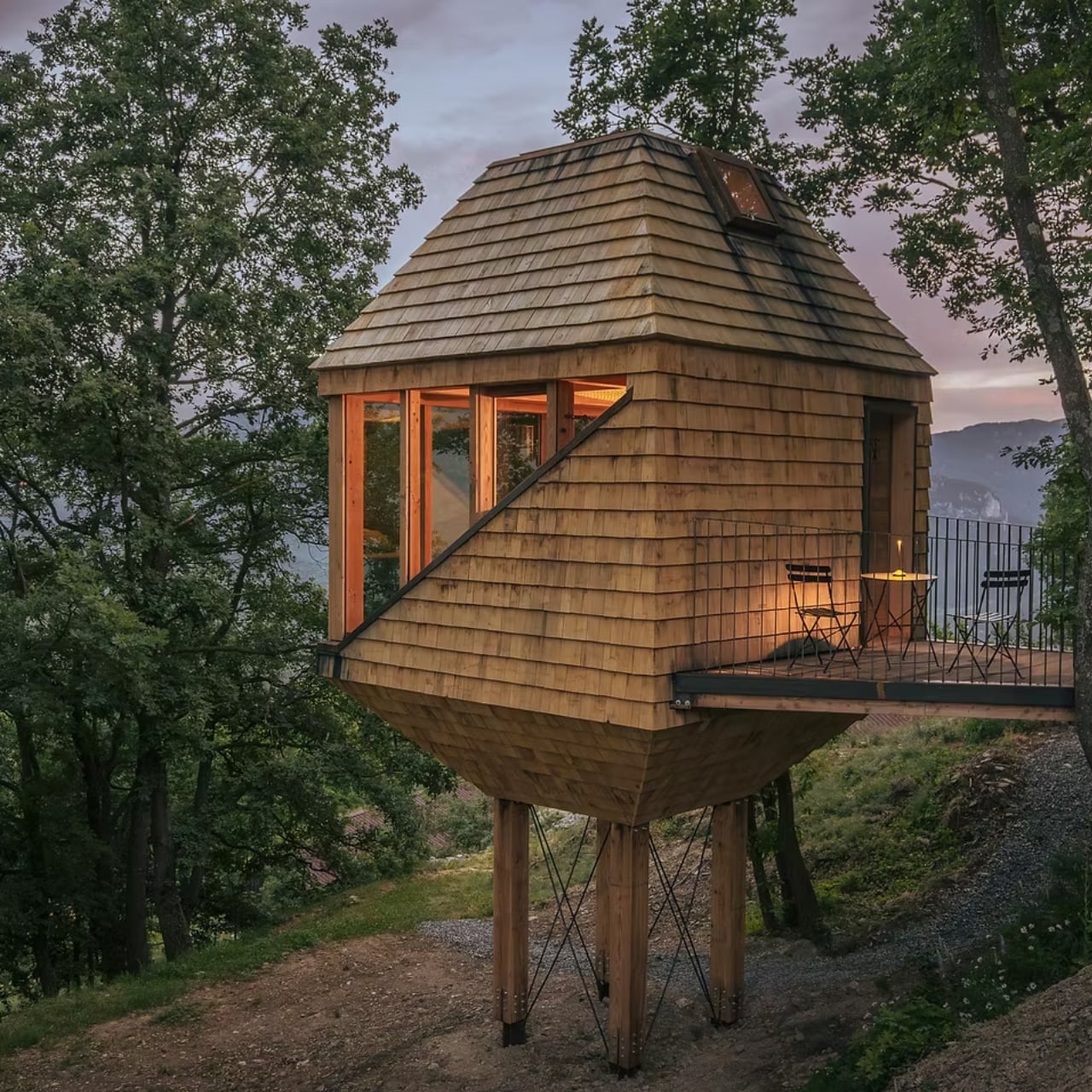
The best design ideas rarely start from scratch. They start from something forgotten, something already proven, and ask what happens if you push it further. That’s exactly what Studio Officina82 did with TreeBOX, a timber retreat perched in an oak canopy in Garessio, a small town in Italy’s Ligurian-Piedmontese Alps.
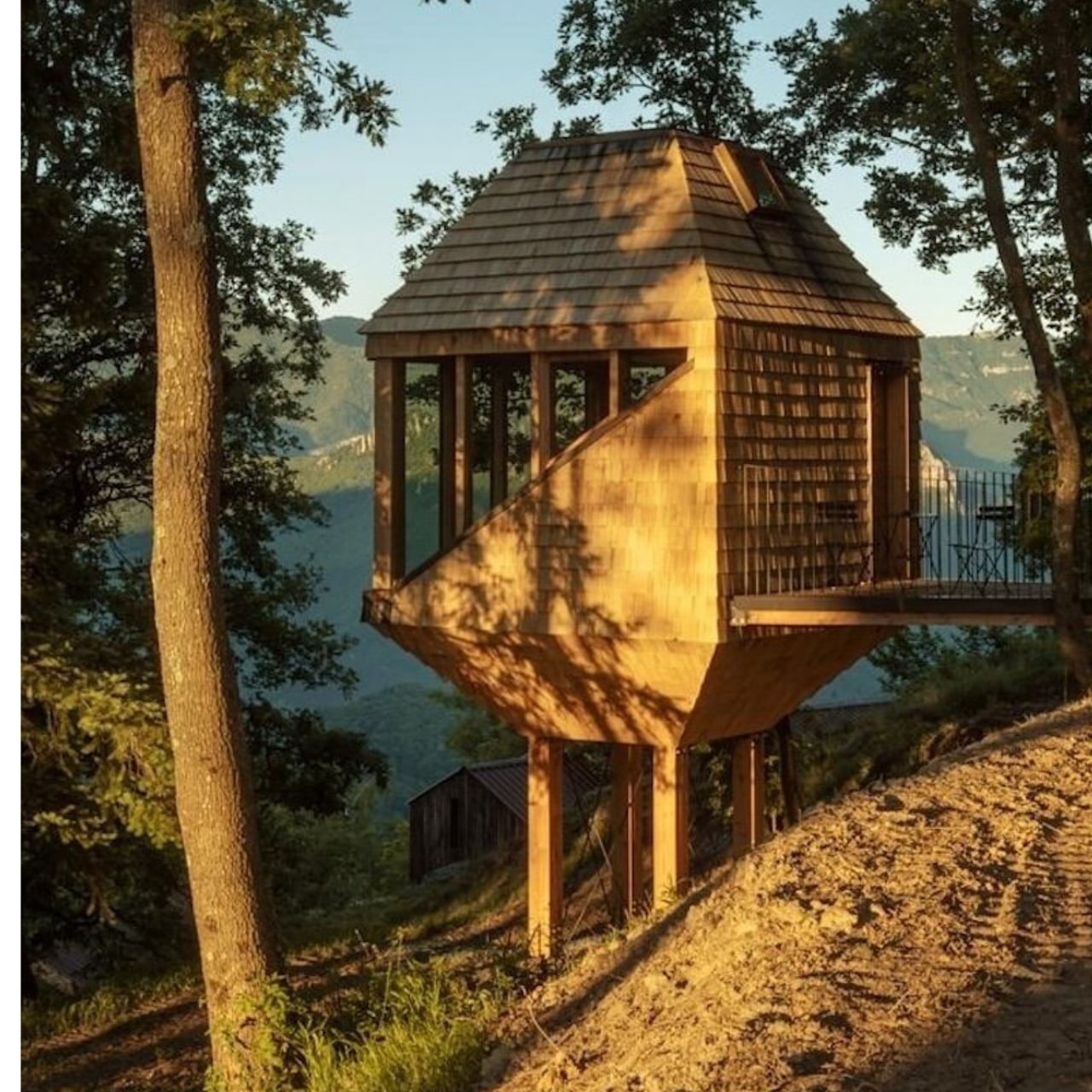
The inspiration came from the barchi, a type of traditional hay barn native to this region. What made the barchi clever, and quietly brilliant, was the movable roof. Supported by just four wooden posts, the roof could be raised or lowered depending on how much hay was stacked beneath it. It was rural engineering at its most economical: no excess, just function. Officina82 looked at that upward motion, that simple mechanical gesture of a roof rising toward the sky, and turned it into architecture.
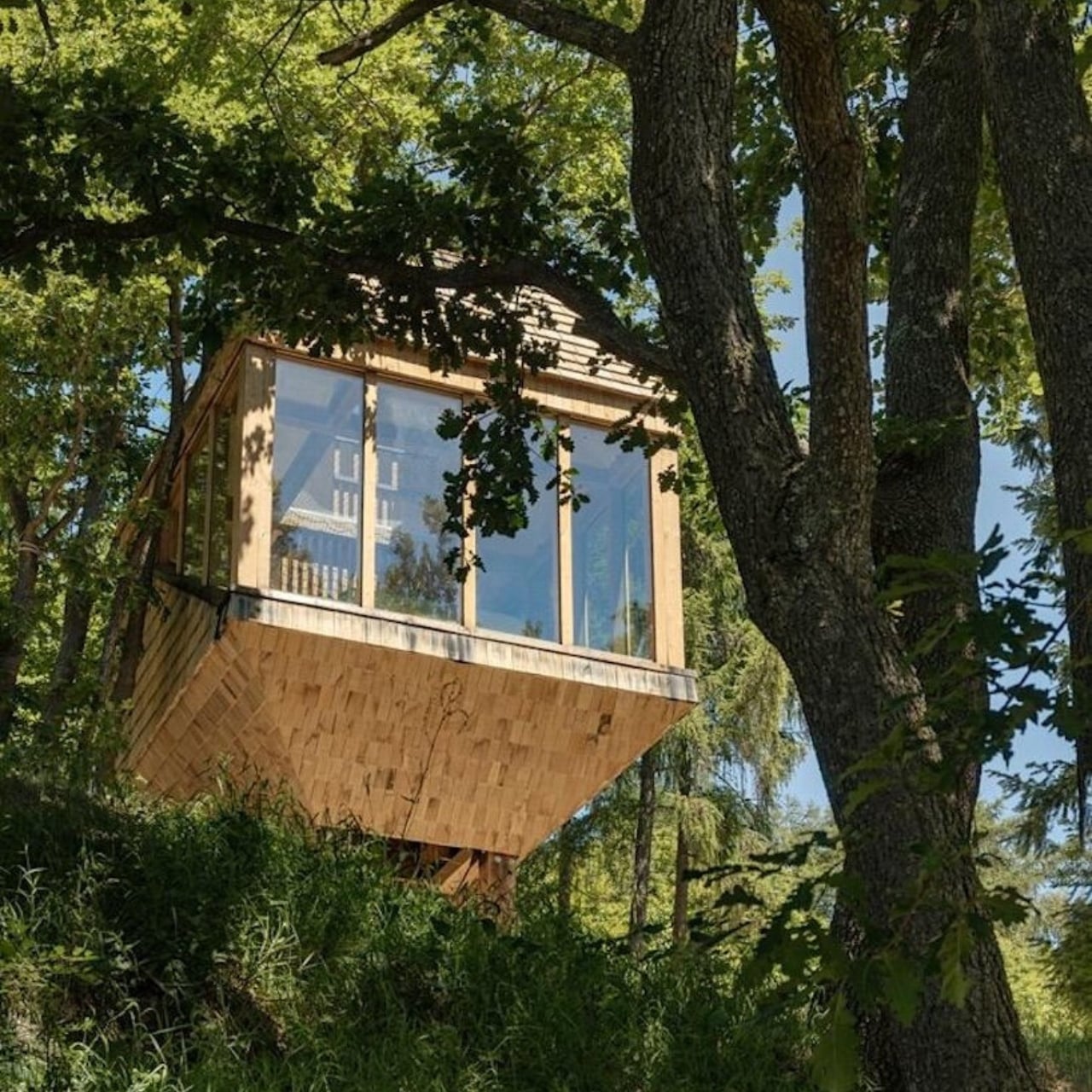
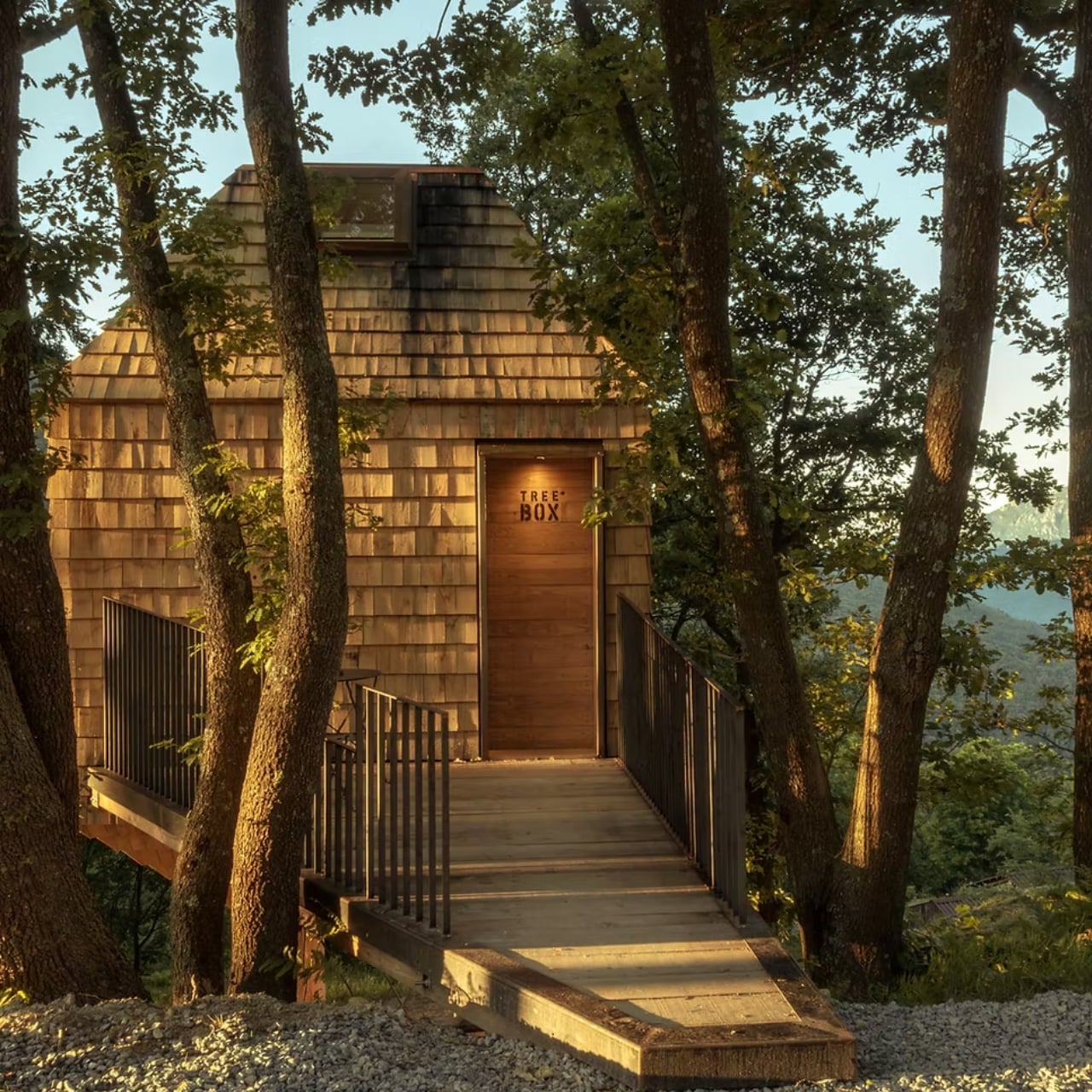
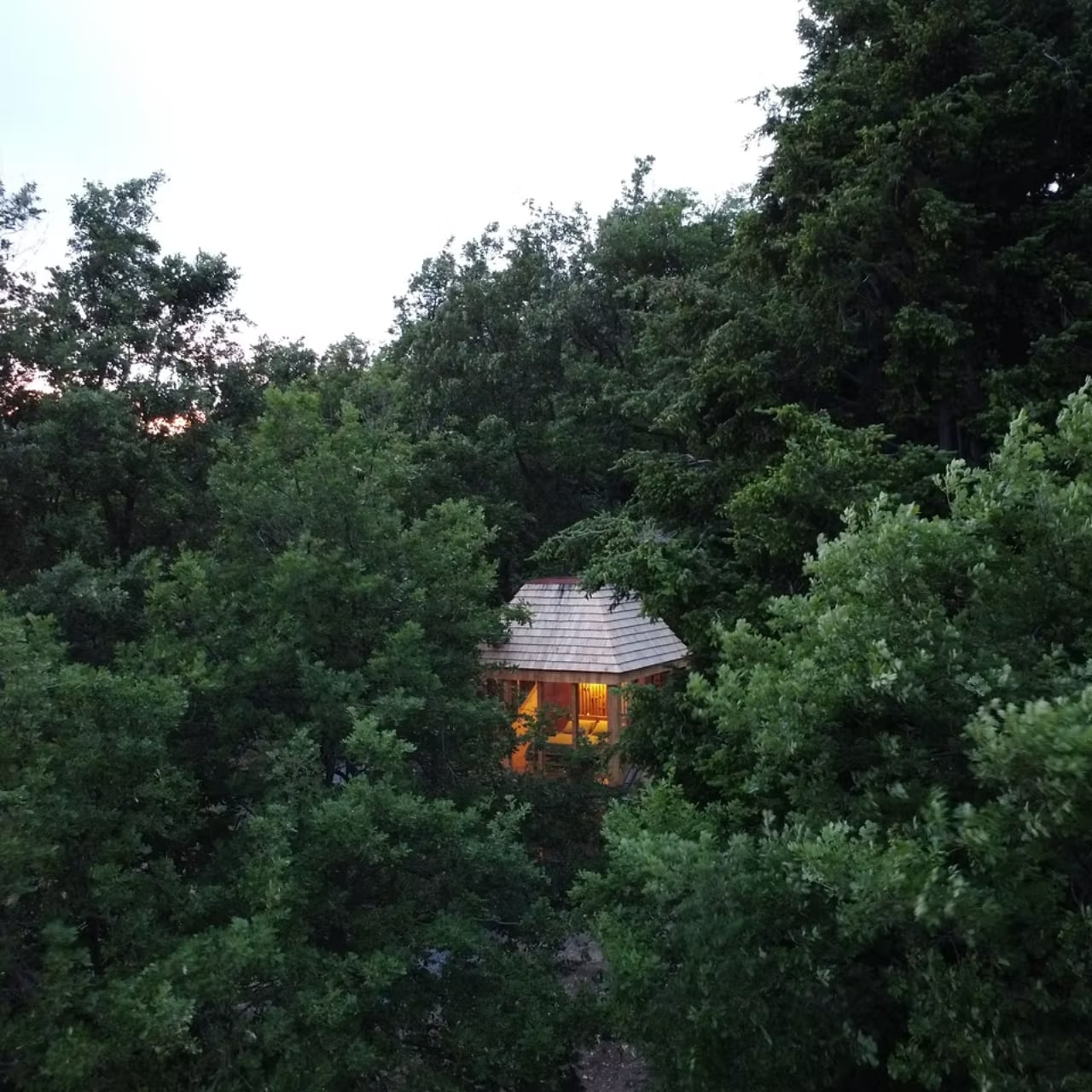
The result is a cabin that looks less like something built and more like something that grew. TreeBOX sits elevated on slender wooden posts, its faceted form rising through the branches like the roof just kept going and never stopped. Timber shingles wrap the entire structure, covering the roof, walls, and tapered underside, giving it a continuous skin that reads as almost organic from a distance. Against the trunks and branches surrounding it, the cabin disappears just enough to feel like it belongs without pretending to be something it’s not. That balance is harder to get right than most people realize, and Officina82 nails it.
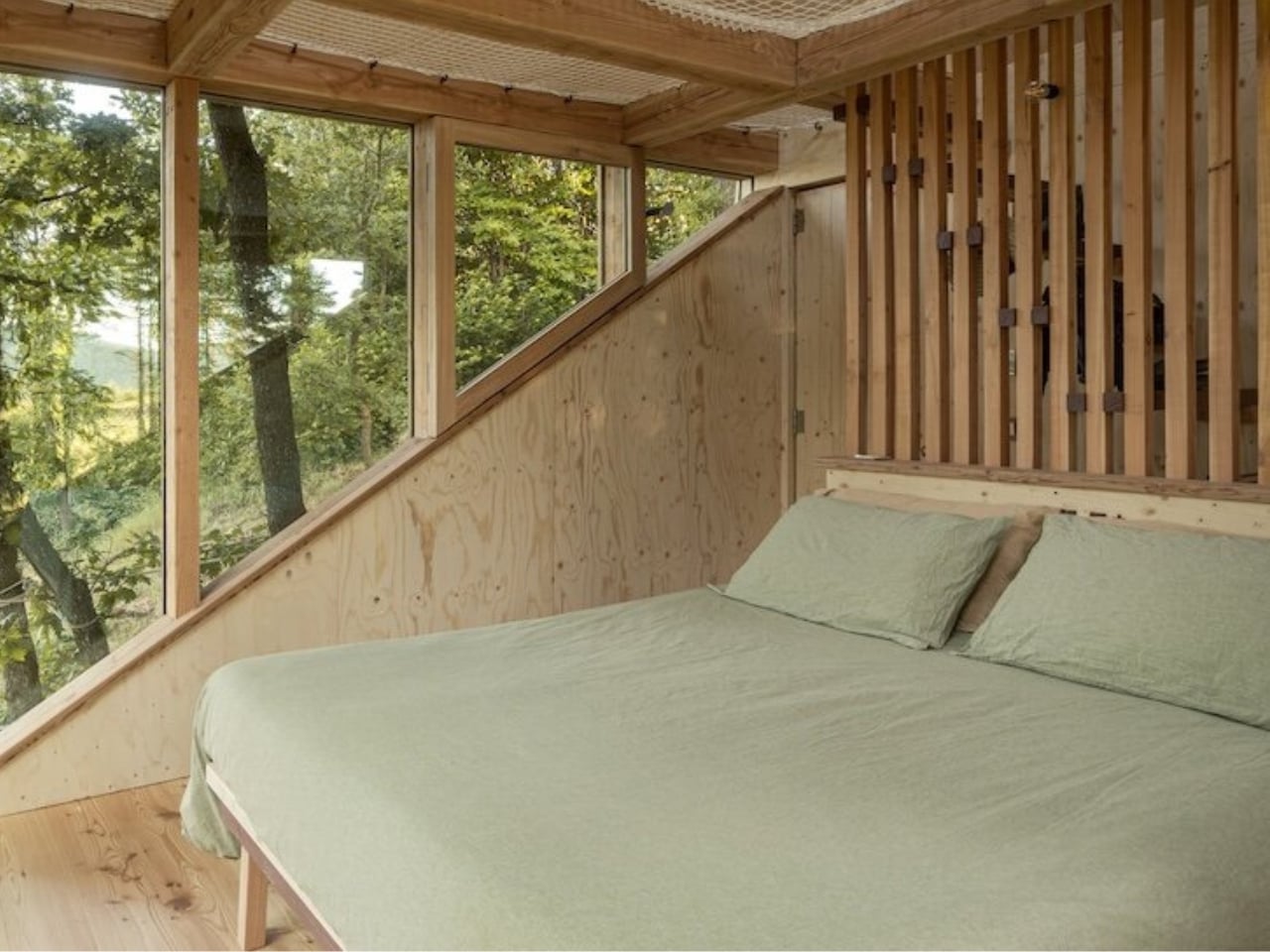
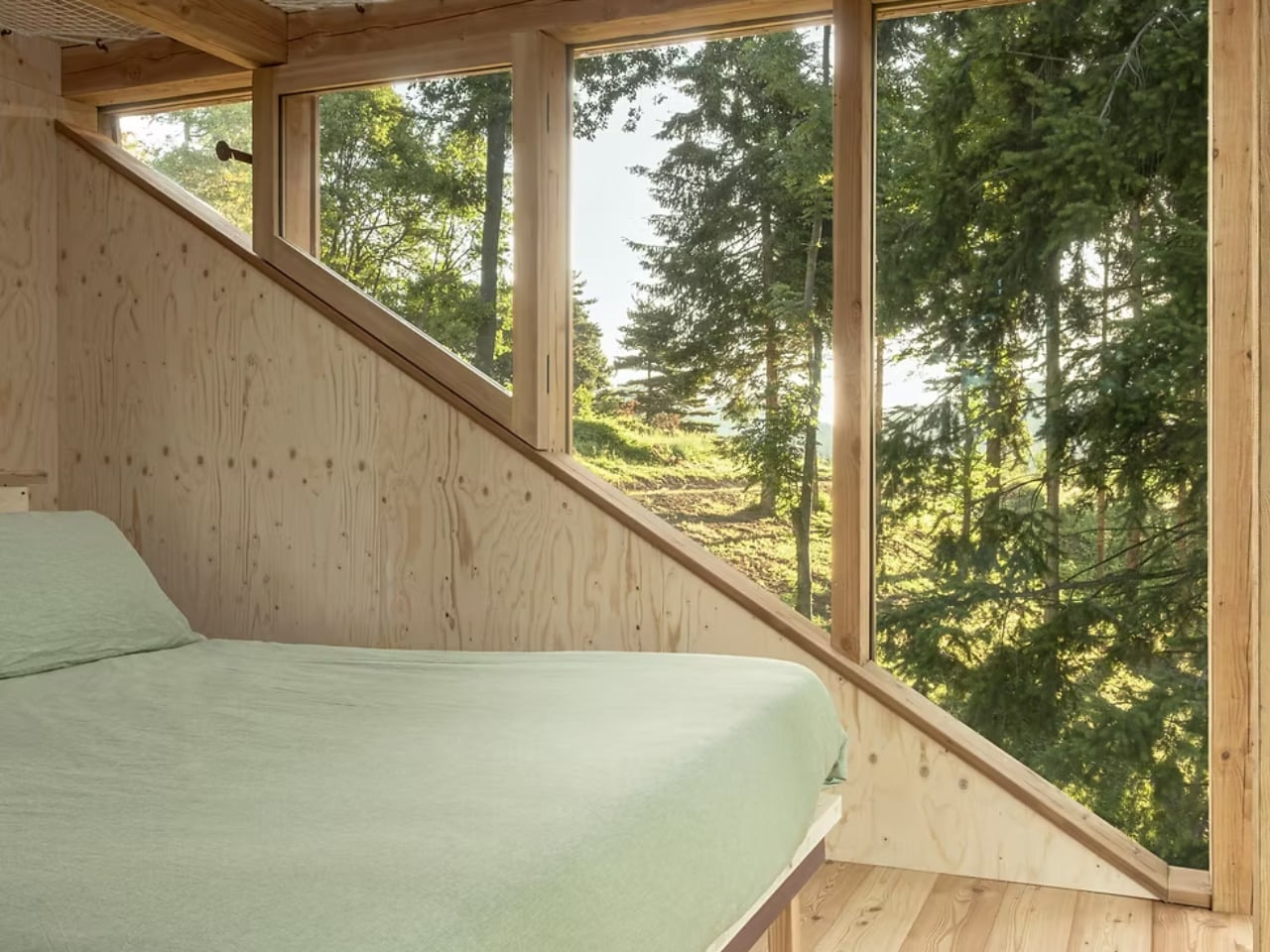
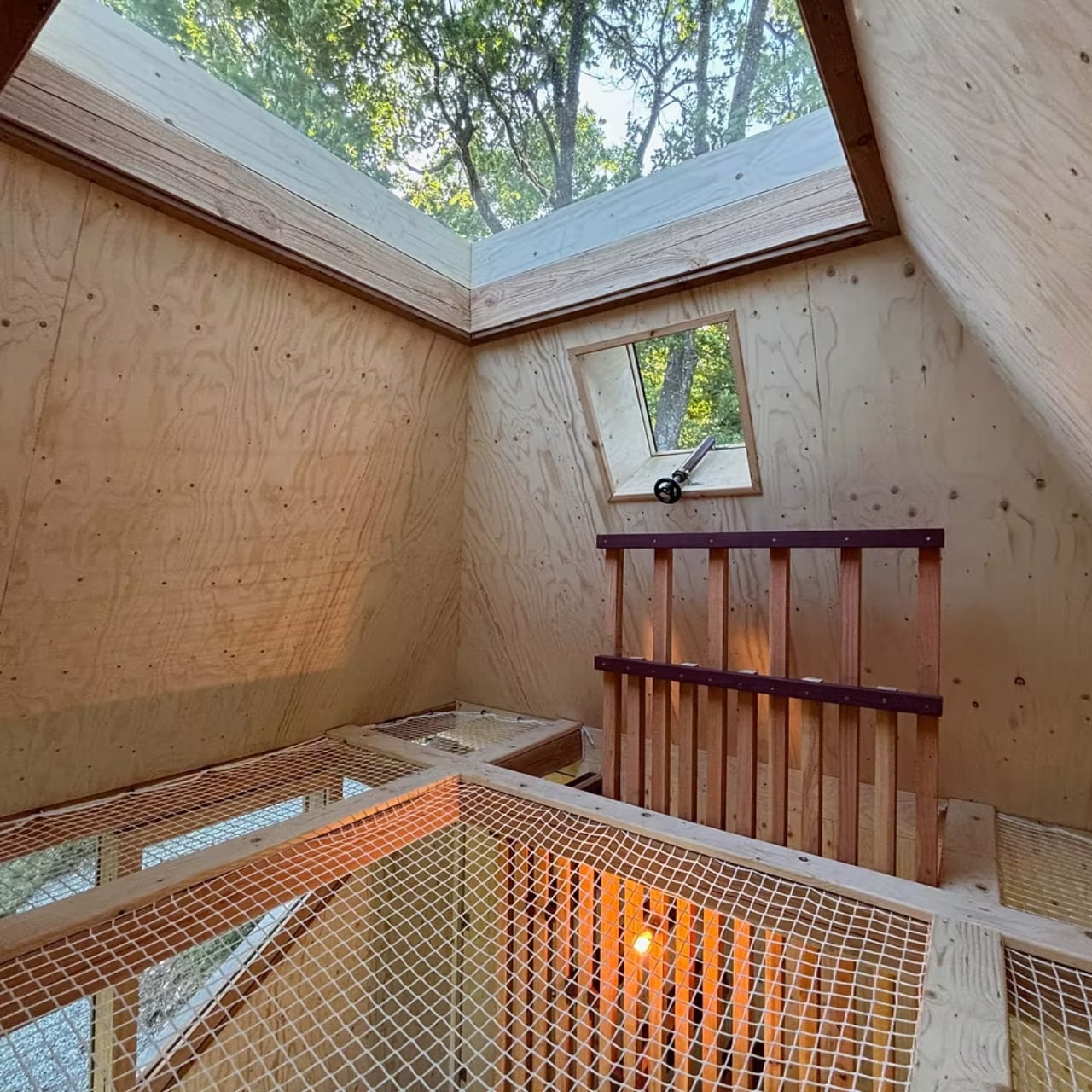
Inside, the space makes a strong argument for restraint. The footprint is compact, but the vertical drop of over four meters turns that constraint into a genuine atmospheric quality. Plywood lines the walls, pale and honest about what it is. A rope net hangs suspended beneath a rooflight, offering a secondary resting spot that has no practical justification whatsoever and is entirely compelling because of it. You’d lie up there in the afternoon light coming through the skylight and feel like a kid who stumbled into a very sophisticated version of what they always wanted.
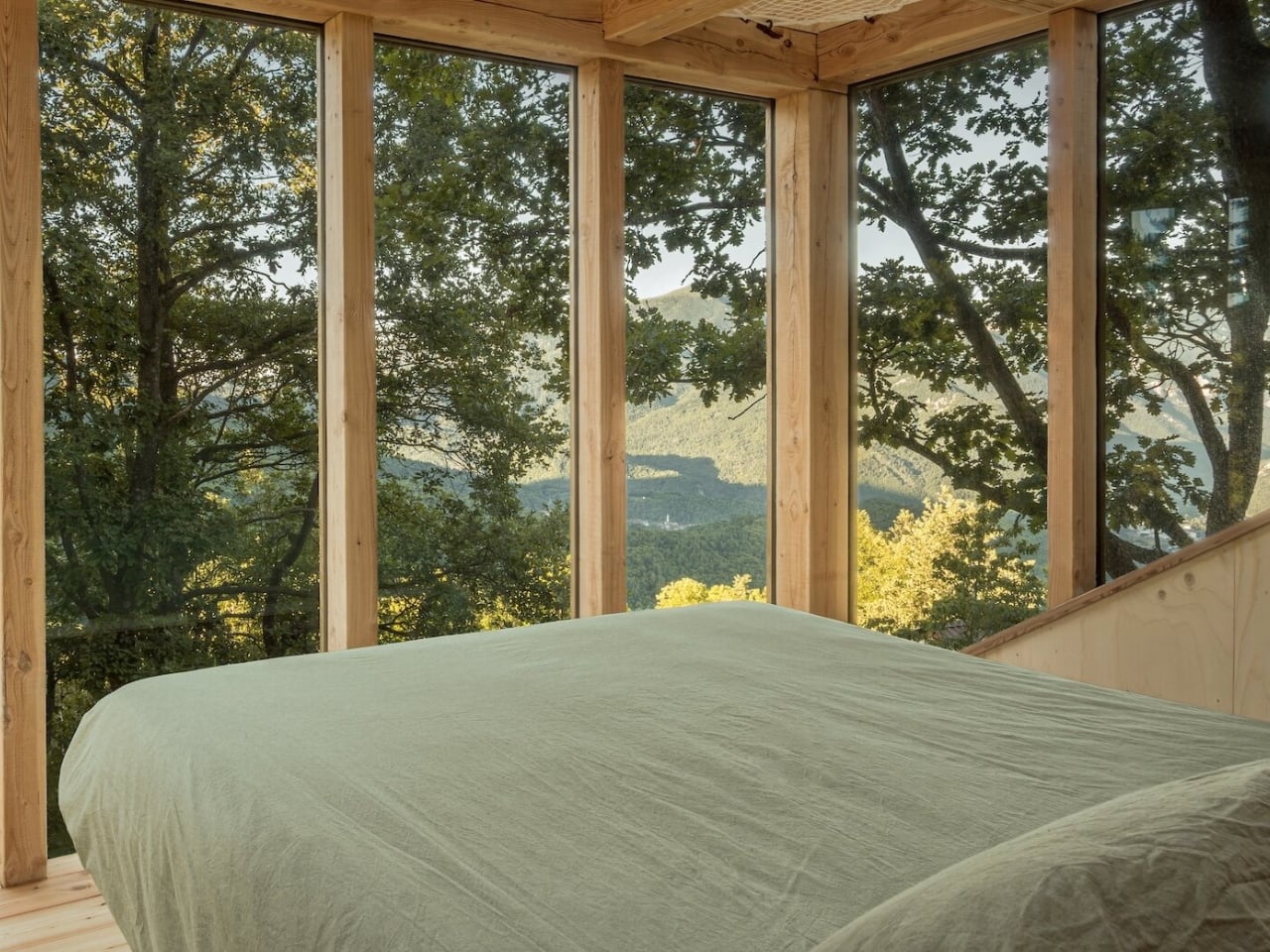
The sleeping area sits at the glazed front of the cabin, positioned directly against floor-to-ceiling windows. A king-size bed dressed in sage-green linen faces the tree line, and beyond it, mountain ridges. The bed and the glass and the trees form a single composition. It’s the kind of view you don’t photograph because you sense the photograph would only disappoint you later.
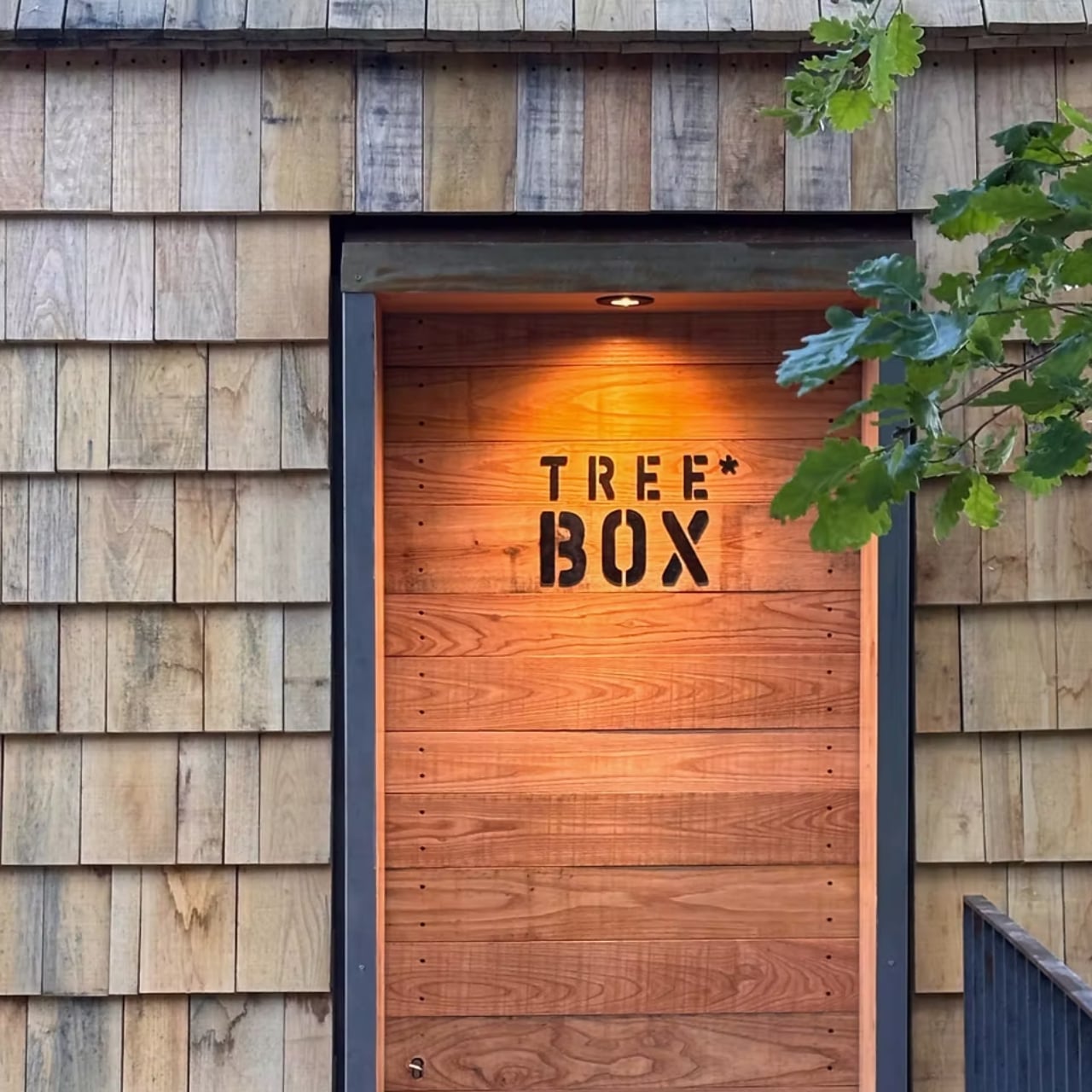
There’s a balcony, too, fitted with a simple bistro set. Nothing elaborate. Just enough to sit with coffee while the forest does what forests do in the early morning. At night, the cabin takes on a different character entirely. Its entrance glows softly, the name “TreeBOX” carved and illuminated above the doorway, visible from the path below. More noticeable after dark than in daylight, which feels intentional and a little poetic.
TreeBOX is part of Selucente, a broader hospitality project built around the recovery of the alpine hamlet of Alpisella. The ambition is to develop the territory through landscape, architecture, and design rather than despite it, which is a rarer commitment than the architecture world sometimes admits. Too often, boutique retreats use nature as wallpaper while remaining architecturally disconnected from the place they occupy. TreeBOX refuses that approach. Every decision, the posts, the shingles, the orientation, the rope net, traces back to context. To history. To a barn that was already doing exactly what it needed to do before anyone decided to call it design.
That’s ultimately what makes this project worth paying attention to. It doesn’t reach for novelty as an end in itself. It asks a genuinely interesting question: what if the vernacular already had the answer, and all we needed to do was follow it upward? The barchi gave Officina82 a concept. The oak forest in Garessio gave it a place. Together, they produced a cabin that feels both completely of its time and somehow ageless. That combination doesn’t come along very often. When it does, it’s worth stopping to look up.
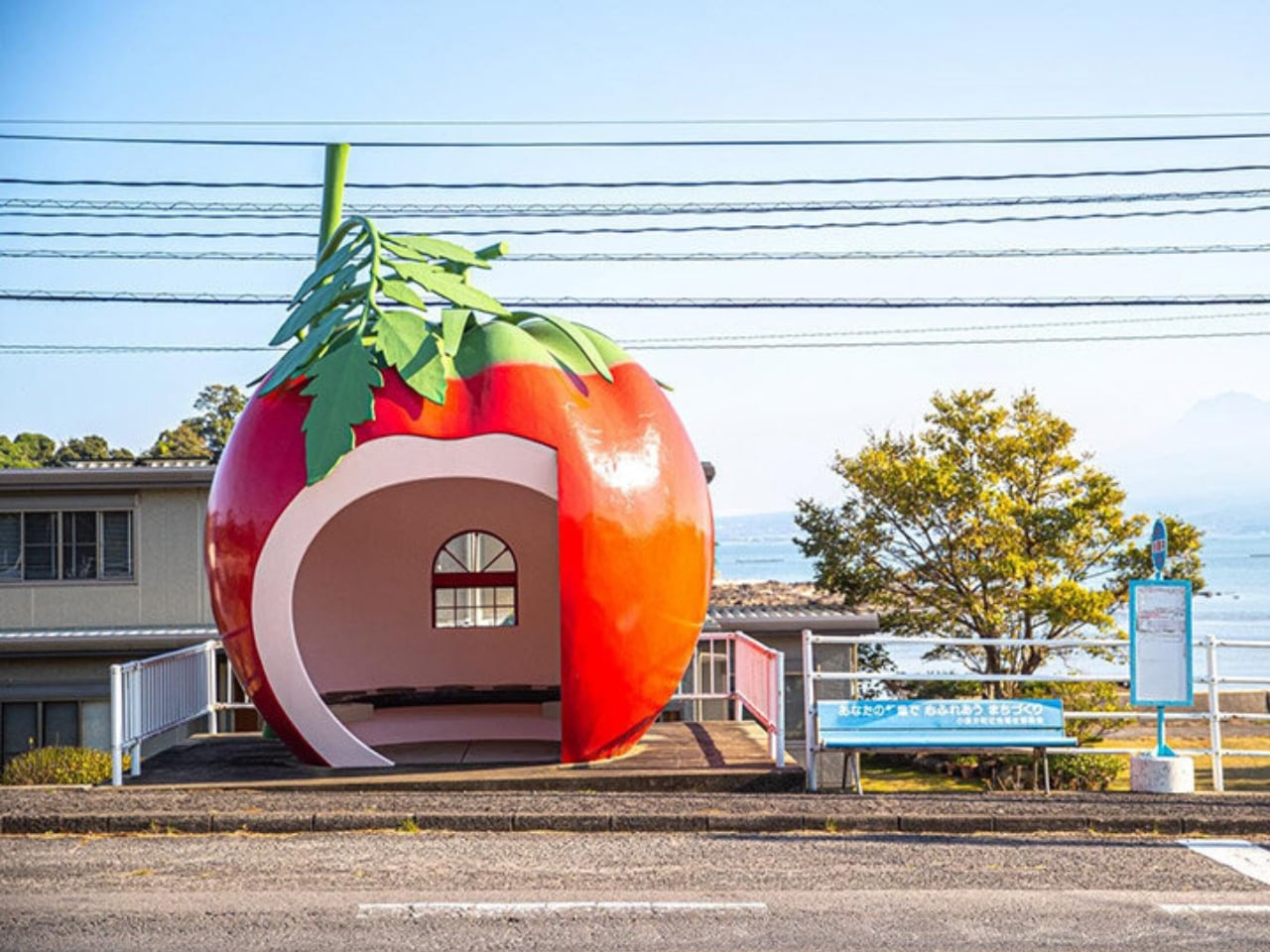
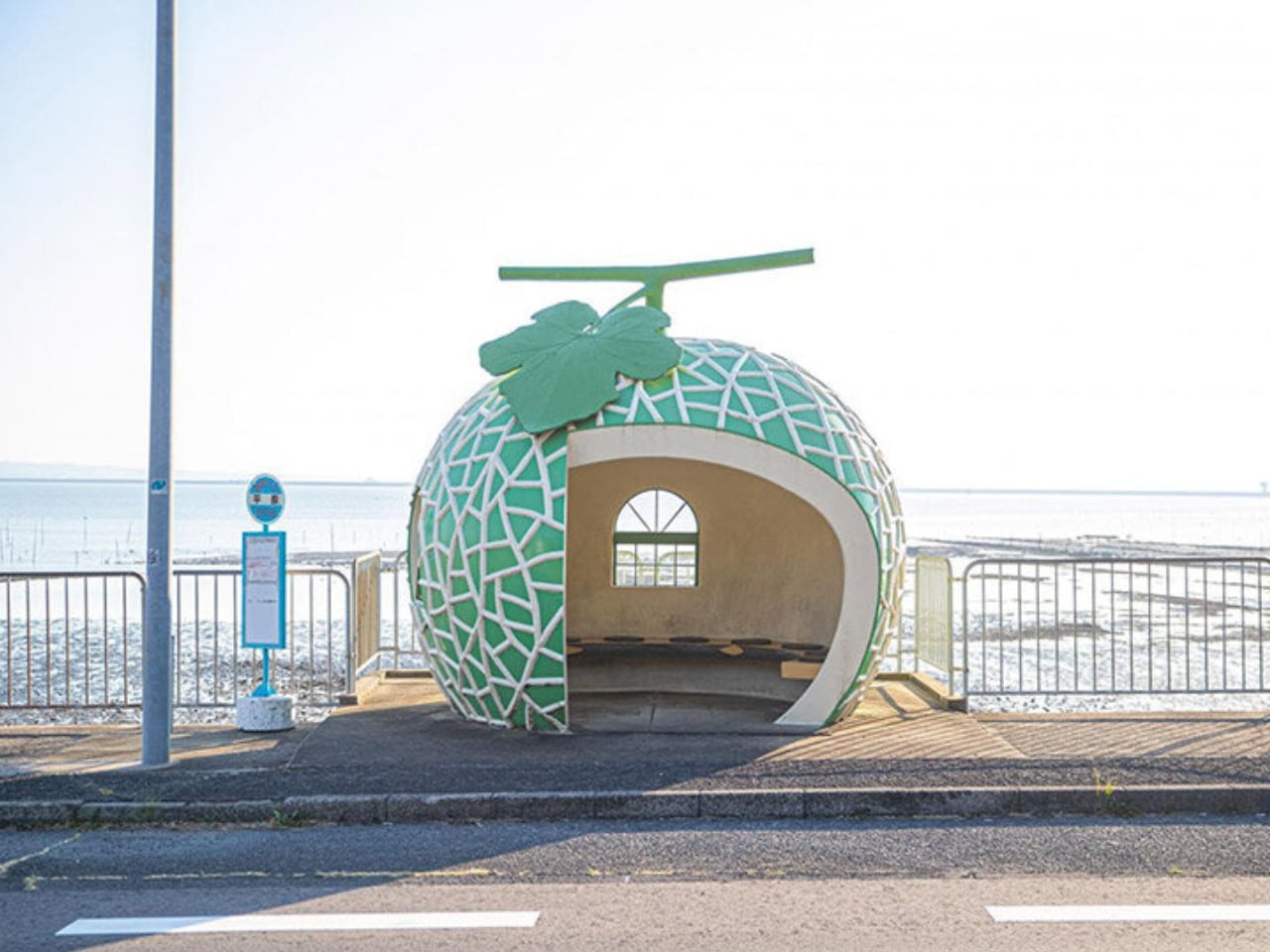
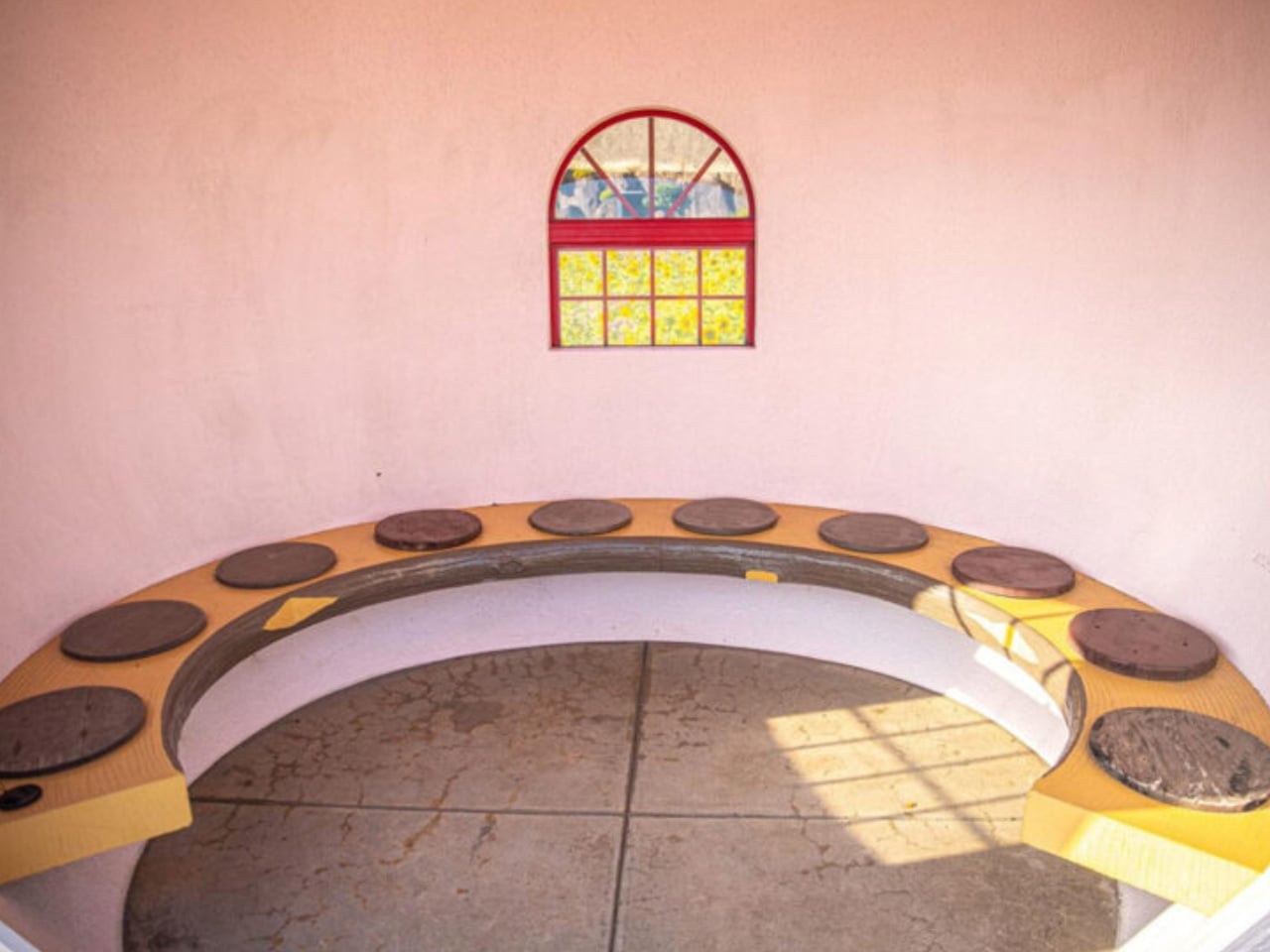
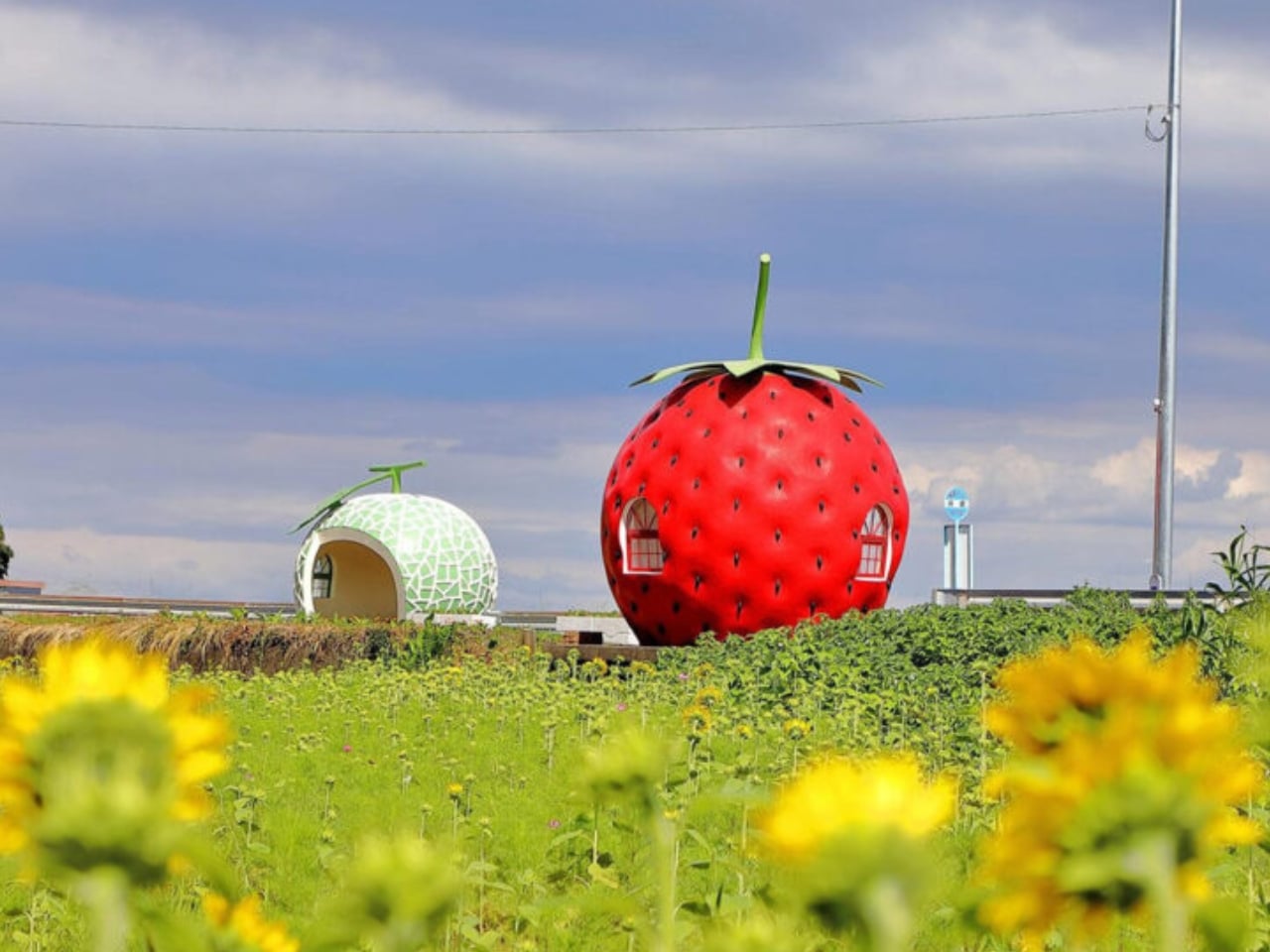
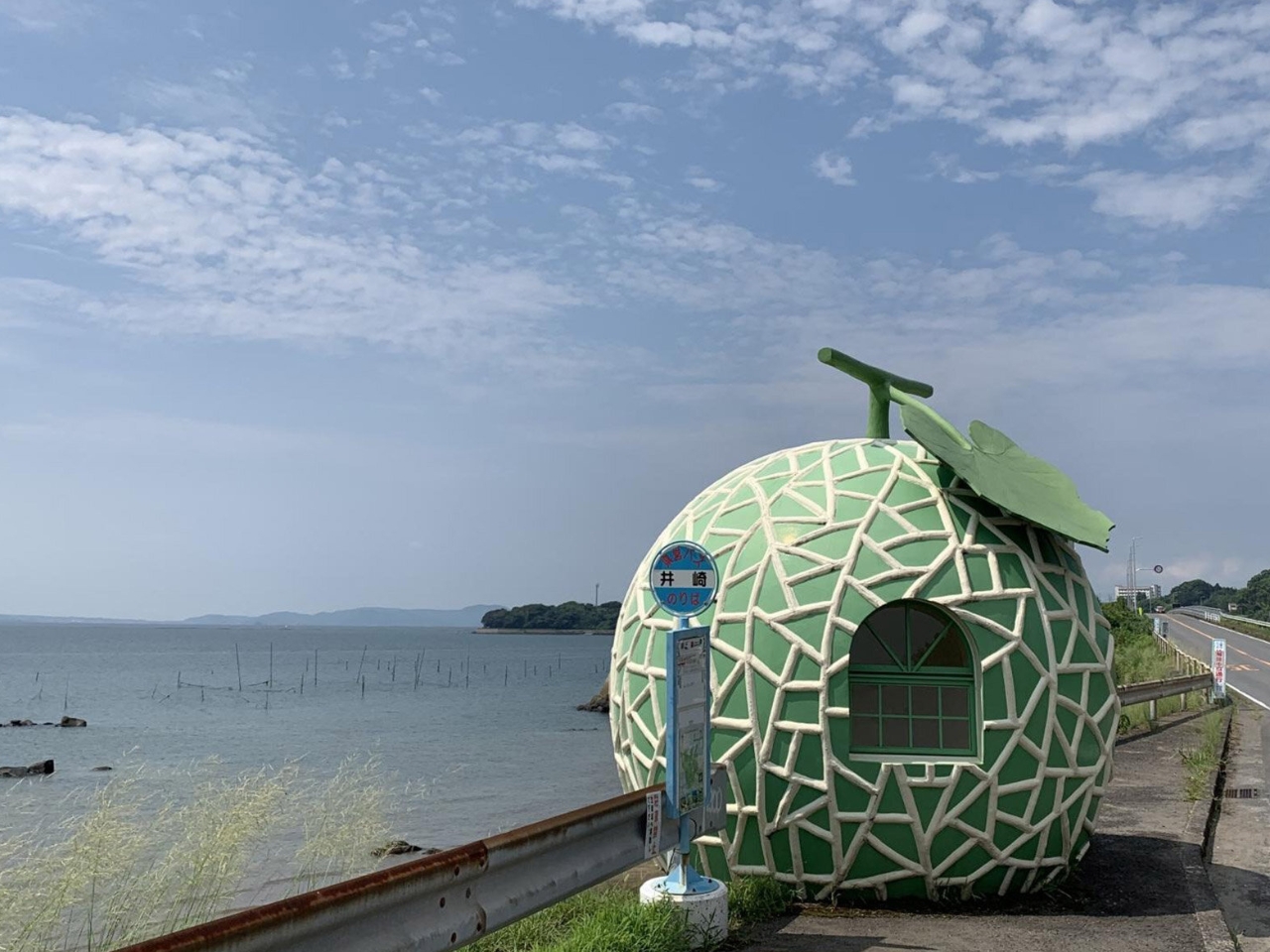
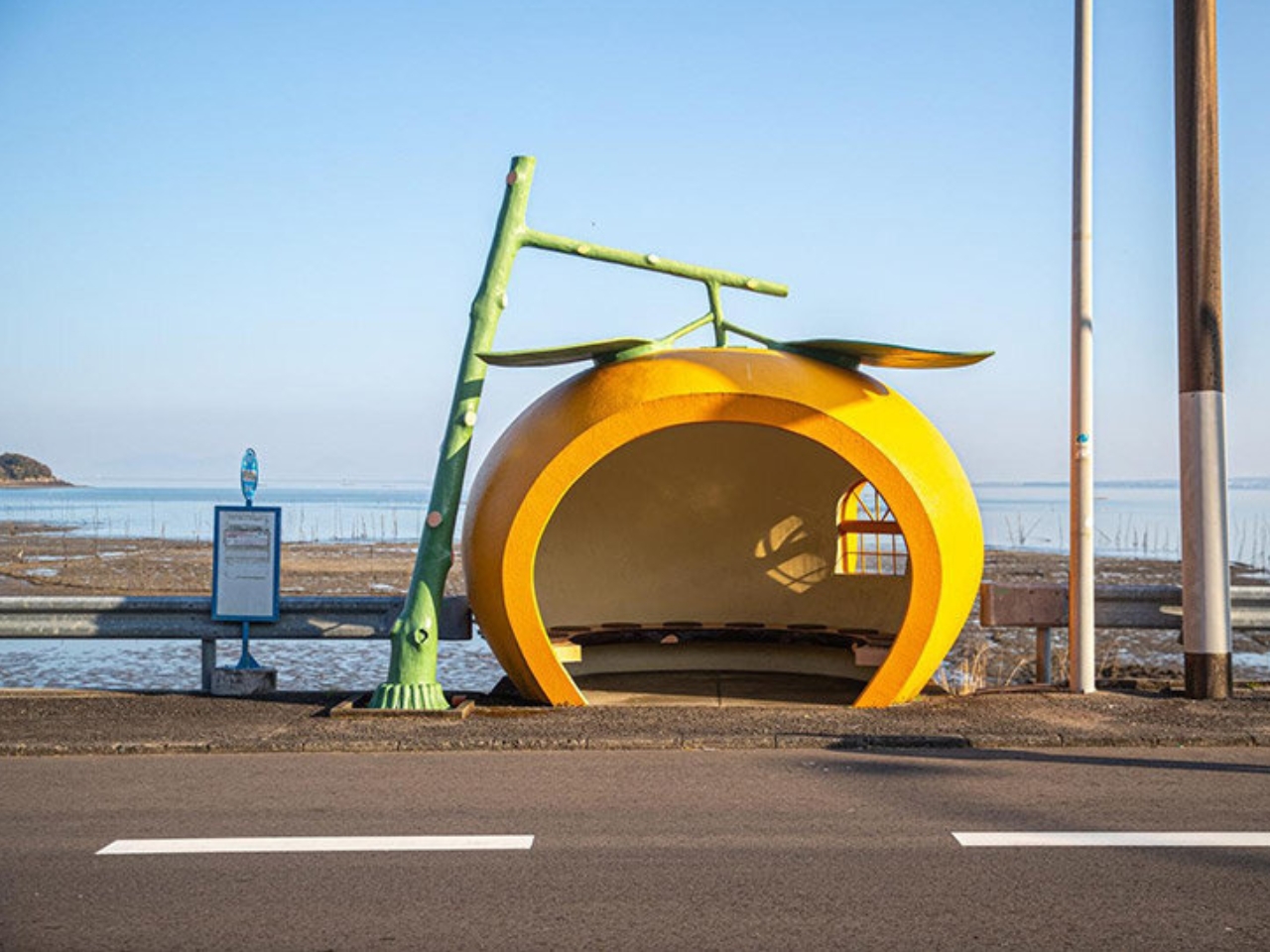
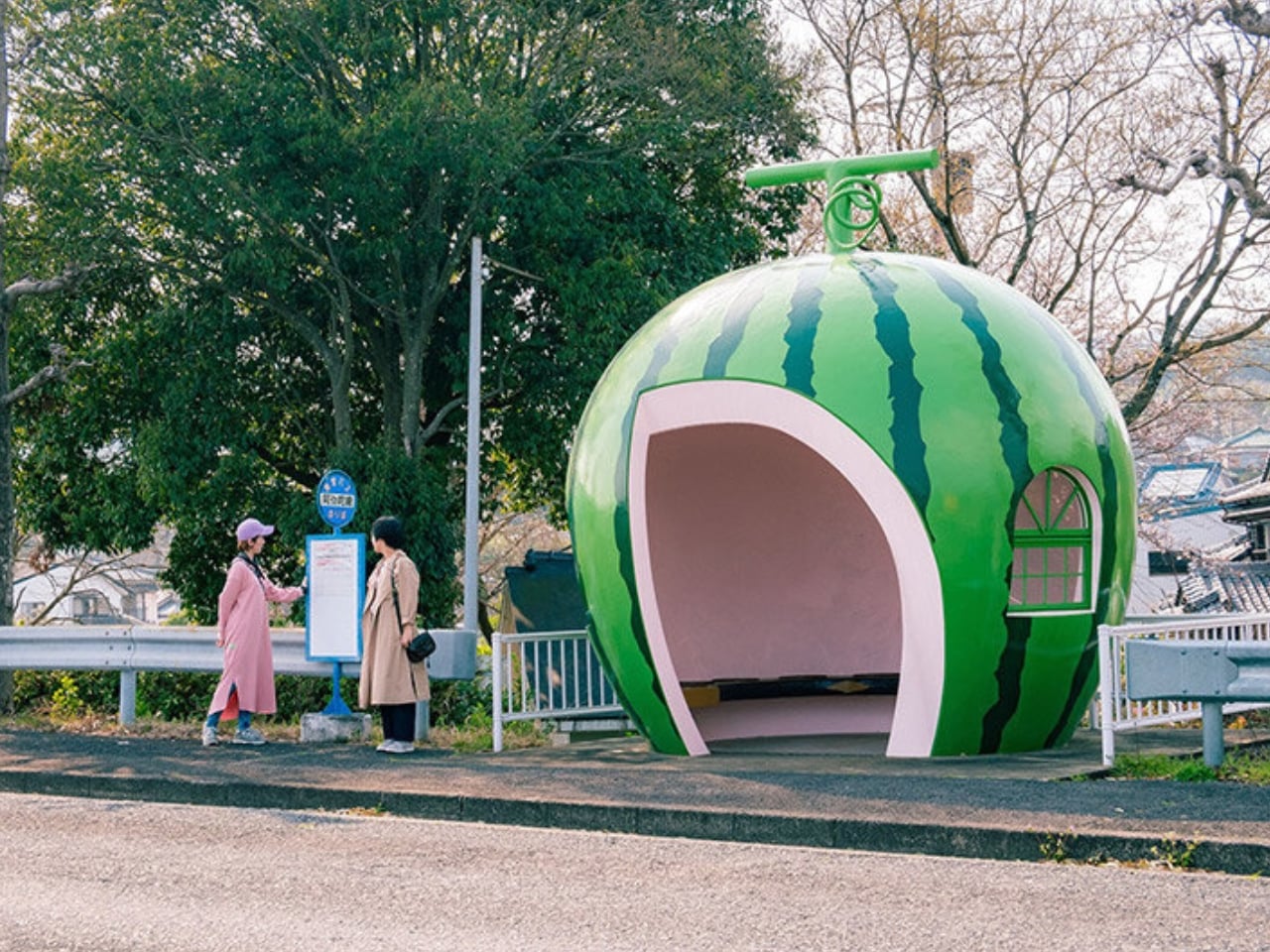
There are 16 bus stops scattered along Route 207 in Konagai, a small coastal town in Nagasaki Prefecture, Japan, and not a single one of them looks like what you’d expect a bus stop to look like. One is a giant watermelon. Another is a melon, its pale green surface etched with thick, bold webbing. There’s a tomato, a mandarin orange, a strawberry. Each one is large enough to stand inside, functional enough to shelter you from the rain, and joyful enough to make you genuinely stop scrolling and just look.
The project is called the Tokimeki Fruit-Shaped Bus Stop Avenue, and the name alone tells you everything about the intention behind it. Tokimeki is a Japanese word that loosely translates to a kind of heart-flutter excitement, the feeling of being pleasantly surprised. That’s exactly what these bus stops deliver every time a driver rounds a bend on Route 207 and a six-foot strawberry appears on the side of the road.
Designer: Yoshitsugu Industries and Time Design Office
They were built in 1989 and 1990 by Yoshitsugu Industries and Time Design Office for the Journey Exposition Nagasaki 1990, an event that brought visitors from across the region into Konagai as one of the eastern gateways to the prefecture. The idea reportedly drew inspiration from Cinderella’s pumpkin carriage, which is the kind of creative brief that could have gone terribly wrong and instead produced one of the most quietly beloved pieces of public design in Japan.
The construction is where things get genuinely impressive. These aren’t fiberglass novelties. Yoshitsugu Industries built each shelter using metal lath frames packed with mortar, applying a colored finish to create each fruit’s skin and shaping the stems and leaves directly into the architecture. The original strawberry shelters were detailed with approximately 180 individual seeds, each one handcrafted from mortar. The melon’s surface webbing was deliberately scaled up so it would read clearly from a passing car. Every decision was made with both visibility and craft in mind, and you can feel that care in how the forms have held up across decades.
The fact that these structures are still standing, still in active use, and still generating genuine delight more than thirty-five years after they were built says something interesting about what public infrastructure can be when it’s treated as an opportunity rather than a checkbox. Most street furniture disappears into the background. These bus stops became a destination. People make specific trips to Konagai to photograph them. They appear in travel guides. They have their own section on the Nagasaki tourism board’s website.
That’s not an accident, and it’s not just novelty either. The design works because it connects directly to the place. Konagai sits along the coast, and the surrounding land is agricultural. Strawberries, melons, oranges, and tomatoes aren’t arbitrary choices. They’re local crops, translated into architecture. The shelters function as a kind of ambient storytelling about what this town grows, who lives here, what the land produces. It’s community identity expressed as a bus stop, and somehow that framing makes the whole thing feel less quirky and more genuinely thoughtful.
Public design rarely gets credit for the emotional labor it performs. We talk about parks and monuments, galleries and cultural centers, but the everyday infrastructure that shapes how people move through a place tends to be treated as a purely practical problem. Konagai’s fruit bus stops are a quiet argument against that logic. They prove that even the smallest civic touchpoint, a covered bench on the side of a rural road, can carry meaning, beauty, and a bit of Cinderella magic all at once.
The bus stops are still there, still waiting along Route 207. Buses still stop. People still wait inside a melon or a strawberry, sheltered by an oversized leaf, and presumably feel at least a small flutter of something that makes the wait a little better.