Apple is reportedly preparing to make its long-anticipated entry into the foldable smartphone market with the iPhone Fold Ultra. Expected to debut alongside the iPhone 18 Pro series in late 2026, this device could represent a significant evolution in foldable technology. By combining the portability and familiarity of an iPhone with the versatility of a […]
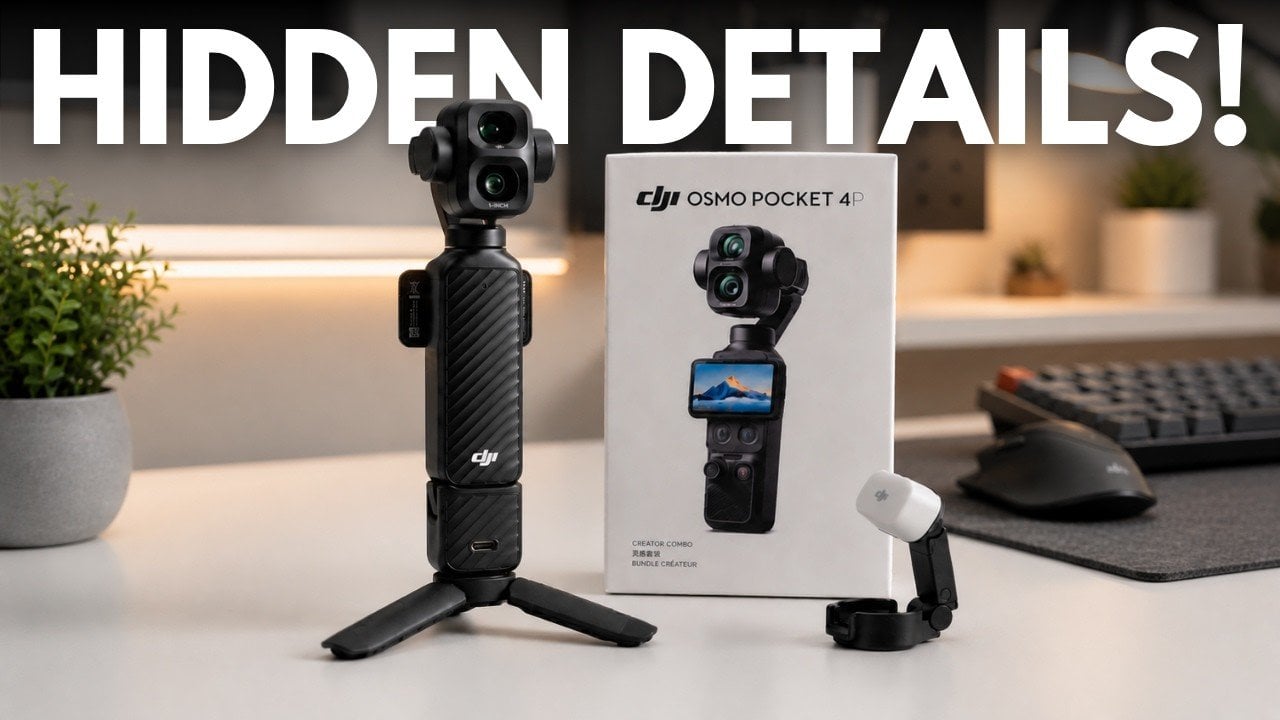
The DJI Pocket 4P introduces a dual-camera system that pairs a 1-inch main sensor with a 60mm telephoto lens, aiming to offer creators both versatility and portability. However, as Tech Court highlights, this setup comes with notable trade-offs. While the main sensor excels with features like 17 stops of dynamic range through the Dlog-M2 profile, […]
Samsung’s Galaxy Z Fold 8 series, including the Z Fold 8 Ultra, Z Fold 8, and Z Flip 8, is set to push the boundaries of foldable smartphone technology while introducing a new level of premium pricing. These devices are expected to represent Samsung’s most advanced and expensive foldable offerings to date. The Z Fold […]
Valve’s long-awaited Steam Machine has officially arrived, offering a compact gaming system that merges PC-level performance with the convenience of a console. In a recent walkthrough by ETA Prime, the device’s standout features were put to the test, including its AMD Zen 4-based CPU and RDNA 3 GPU, which promise smooth gameplay at resolutions up […]
Apple’s iOS 27 Beta 2 is poised to bring a host of new features and refinements, building upon the foundation established by the initial beta release. With a strong emphasis on customization, performance and user-focused improvements, this update aims to elevate the iPhone experience. Below is a detailed look at the most notable enhancements and […]
A modern creator’s desk looks different from how it did a decade ago. A 3D printer often sits where a sketchbook once lay, and filament rolls where stationery sets would sit. But this new method of creation has introduced its own unique challenge: post-processing. The work of transforming a raw print into a professional-grade model or prototype requires a specialized set of tools, ones designed to handle the unique properties of modern materials without destroying fine details. The old workshop sander and utility knife feel clumsy and oversized for this new scale of making.
This new workflow demands a new class of tool, and HOZO has been steadily building an answer. The company’s ecosystem is engineered specifically for the desktop fabricator, providing a complete pipeline for refining intricate parts. It begins with precise measurement, moves to clean support removal, and ends with methodical surface finishing. Each tool in the lineup, from the NeoRuler to the NeoBlade and NeoSander, is a piece of a larger system intended to bridge the gap between digital design and the tangible, finished object in your hand.
HOZO NeoSander – A Detail Sander That Moves with Linear Precision
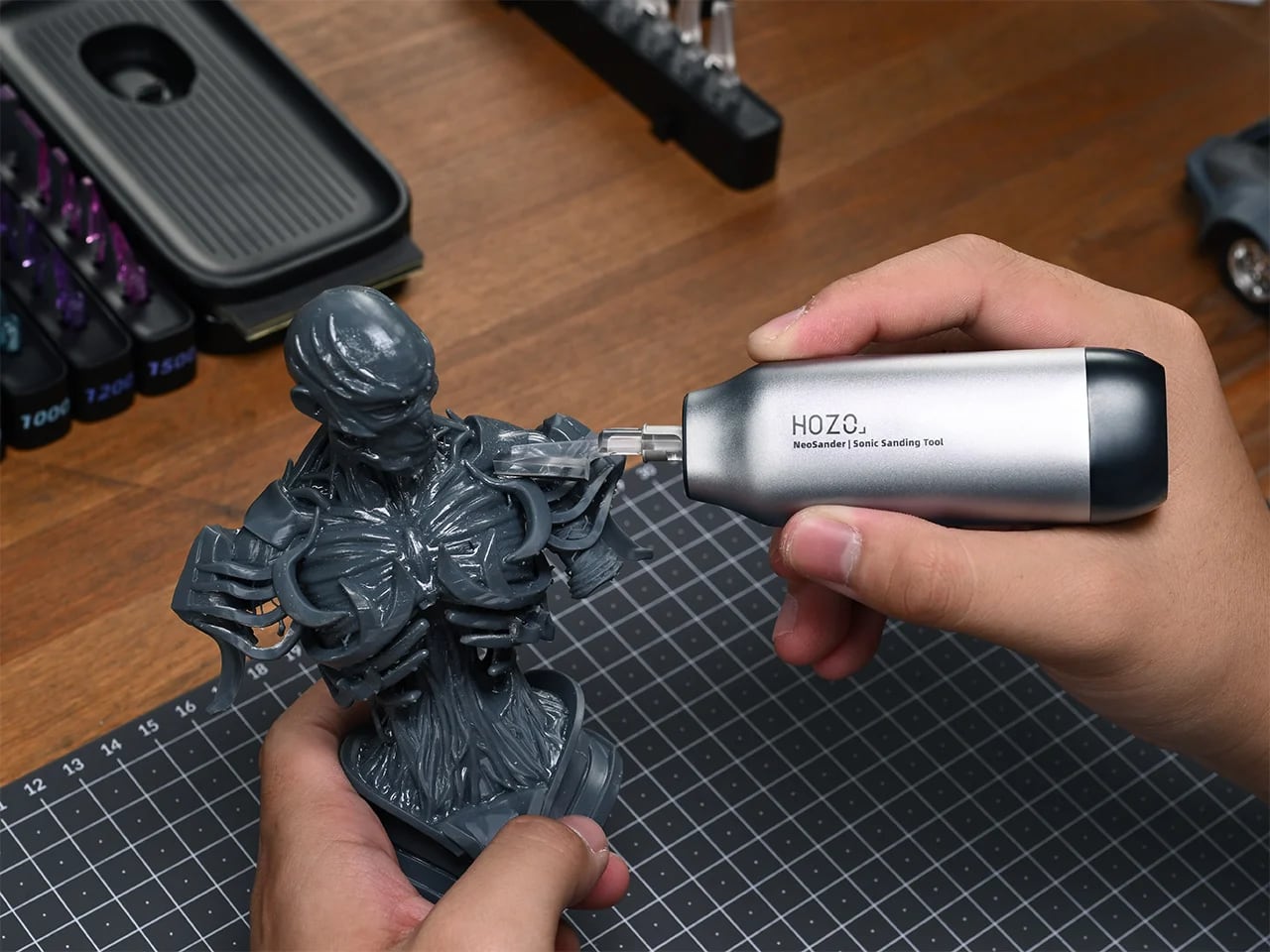
The NeoSander addresses the most delicate stage of making, surface finishing, with an engineering approach that is both clever and incredibly practical. Instead of spinning a sanding tip in a circle, a method that generates heat and can easily gouge softer materials like PLA or resin, the NeoSander uses a patented reciprocating linear motor. This allows the head to move back and forth in a perfectly straight line up to 13,000 times per minute. The motion is more like a controlled, high-speed vibration, giving the user an impressive degree of precision for tasks like removing layer lines from a 3D print or smoothing the surface of a detailed miniature without melting or deforming it.
This design focuses on control that is felt throughout the tool. Weighing just 89 grams, it handles more like a stylus than a traditional power tool, reducing hand fatigue during long finishing sessions. The system includes eight different head shapes, designed to fit into tight corners, follow curved surfaces, or sand flat areas with uniform consistency. These heads pair with a wide range of sandpaper grits, from a coarse 180 for initial shaping to a fine 1500 for achieving a near-polished smoothness. For those building a complete system, the NeoSander Premium Combo expands this with a full accessory suite, including a charging dock and a pro case, turning the tool into a permanent and organized fixture on the workbench. It represents the final, critical step in the HOZO workflow, taking over where the NeoBlade’s cutting work ends.
To accommodate different user needs, the NeoSander is available in both a Starter configuration and a NeoSander Premium Combo. The starter kit provides the essential sanding system for precision finishing, while the Premium Combo expands the experience with an additional 64-Piece Color-Coded Sanding Head Collection and a Charging Dock for a more complete workstation setup. This flexibility allows makers to choose the package that best matches their workflow, whether they need a dedicated detail sander or a more comprehensive desktop finishing system. Within the HOZO ecosystem, the NeoSander represents the final step in the making process, taking over where the NeoBlade’s cutting work ends and transforming raw parts into polished finished creations.
HOZO NeoBlade – The Ultrasonic Cutter for Flawless First Cuts
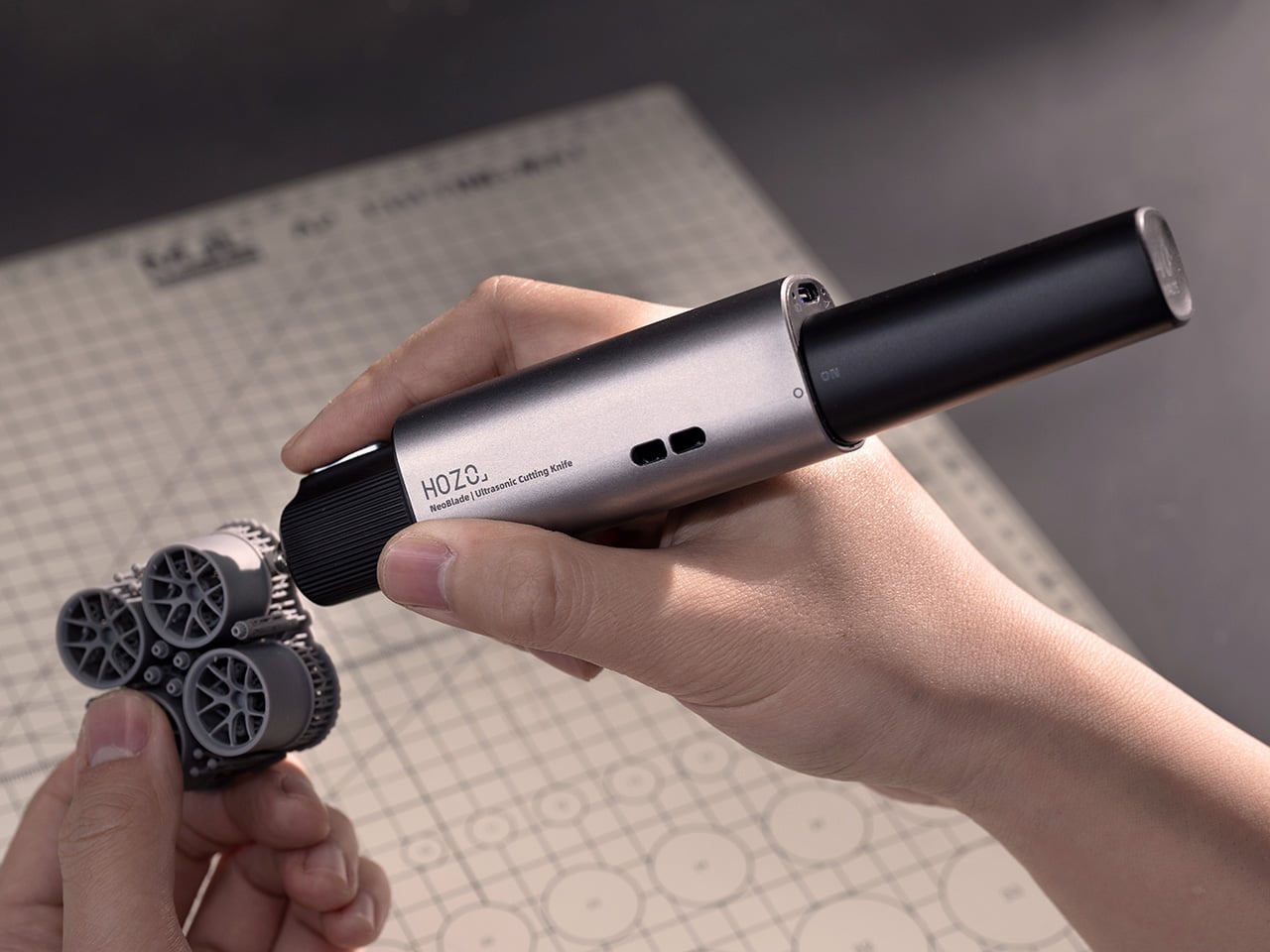
Long before a project is ready for the delicate finishing work of a detail sander, it needs to be cleanly separated from its supports or trimmed of excess material. This is often the most treacherous part of the process, where a standard hobby knife can snag, skip, or require enough force to send a crack through a delicate print. The HOZO NeoBlade is designed to eliminate this risk entirely by using ultrasonic vibrations to do the work. Its blade oscillates at an incredible 40,000 times per second, creating a micro-sawing action that parts materials with minimal pressure. The user simply guides the blade, and it glides through plastic, resin, or acrylic, leaving a clean, smooth edge that requires significantly less cleanup later.
This technology fundamentally changes the experience of working with detailed components. Because the tool supplies the cutting power, the user can focus entirely on accuracy. The cordless, pen-like form factor makes it easy to maneuver around complex geometries, trimming support nubs from inside tight spaces or cutting intricate patterns from foam board without deforming the material. For makers who need versatility, the NeoBlade Premium Combo offers a complete kit with multiple blade types and a Turbo Dock with battery support, from fine points for detail work to chisel tips for broader cuts. It serves as the perfect counterpart to the NeoSander, handling the initial, gross material removal with the same level of precision that the sander brings to the final surface.
NeoBlade serves as the critical first step in material refinement. It handles support removal, trimming, and precision cutting before the NeoSander takes over for surface finishing, creating a seamless workflow that helps makers transform raw prints and materials into clean, professional-quality results.
NeoRuler Premium Combo – A Digital Measuring Tool Built for Precision Checks and Fit Verification
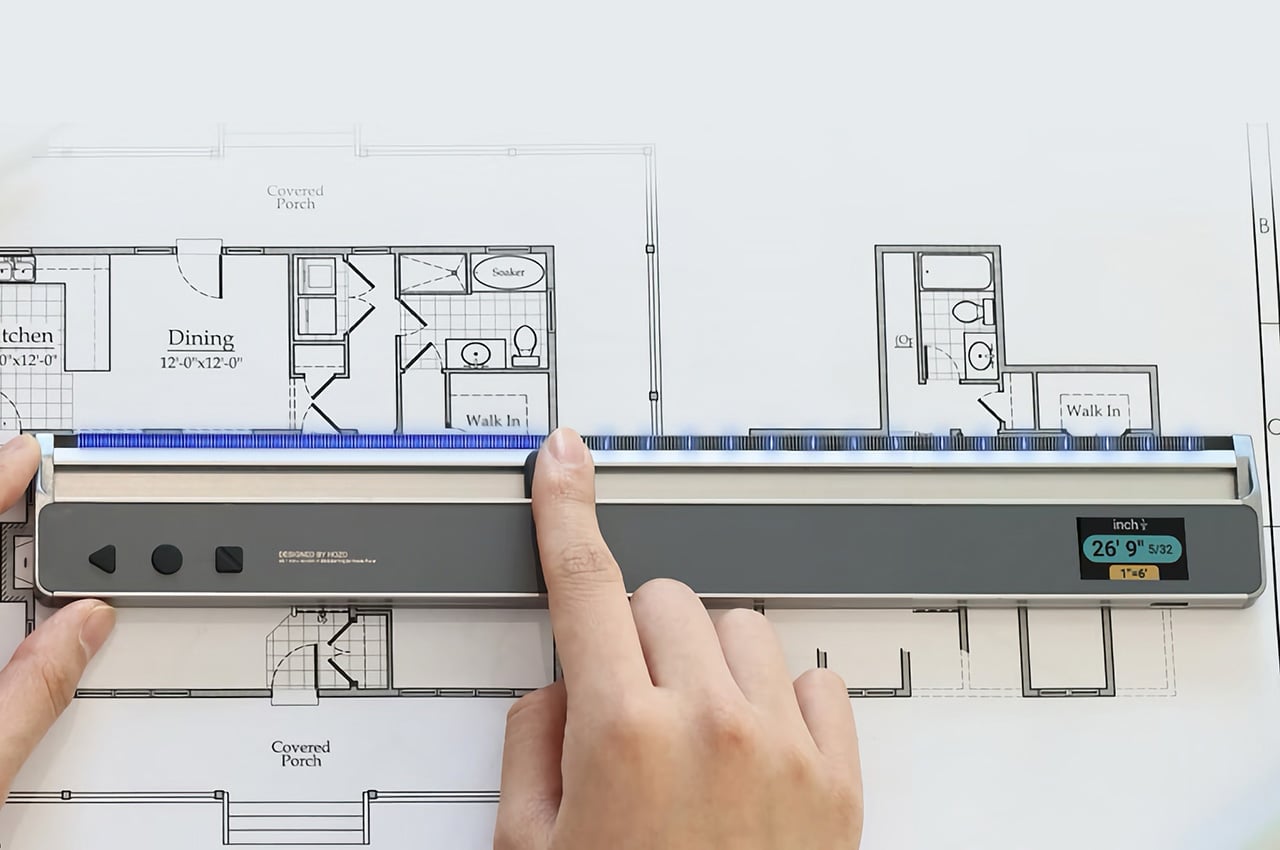
Every clean cut and polished finish starts with accurate dimensions, which is what makes the NeoRuler Premium Combo with the NeoCaliper Kit such an important part of this lineup. Rather than functioning as a simple desk ruler, it is positioned as a digital measuring tool that combines scale-based reference with caliper-style precision, making it especially useful for makers working with prototypes, model parts, and 3D printed components. That added caliper functionality gives the tool a more hands-on role in the workflow, allowing users to check widths, depths, inner dimensions, and outer tolerances before moving on to cutting or finishing. In a setup built around precision, that kind of measurement confidence matters early.
Within the flow of the HOZO ecosystem, the NeoRuler Premium Combo works as the checkpoint tool, the one you reach for before NeoBlade trims away excess material or NeoSander refines the final surface. It helps verify whether a part actually matches the intended geometry, whether two pieces will fit together cleanly, or whether a support area has enough clearance before removal begins. That makes it especially valuable for creators who work on assemblies and detailed fabrication, where a small measuring error can ripple through the rest of the process. While the cutting and sanding tools naturally draw more visual attention, this combo plays a quieter but foundational role by making sure the rest of the workflow starts from the right numbers.
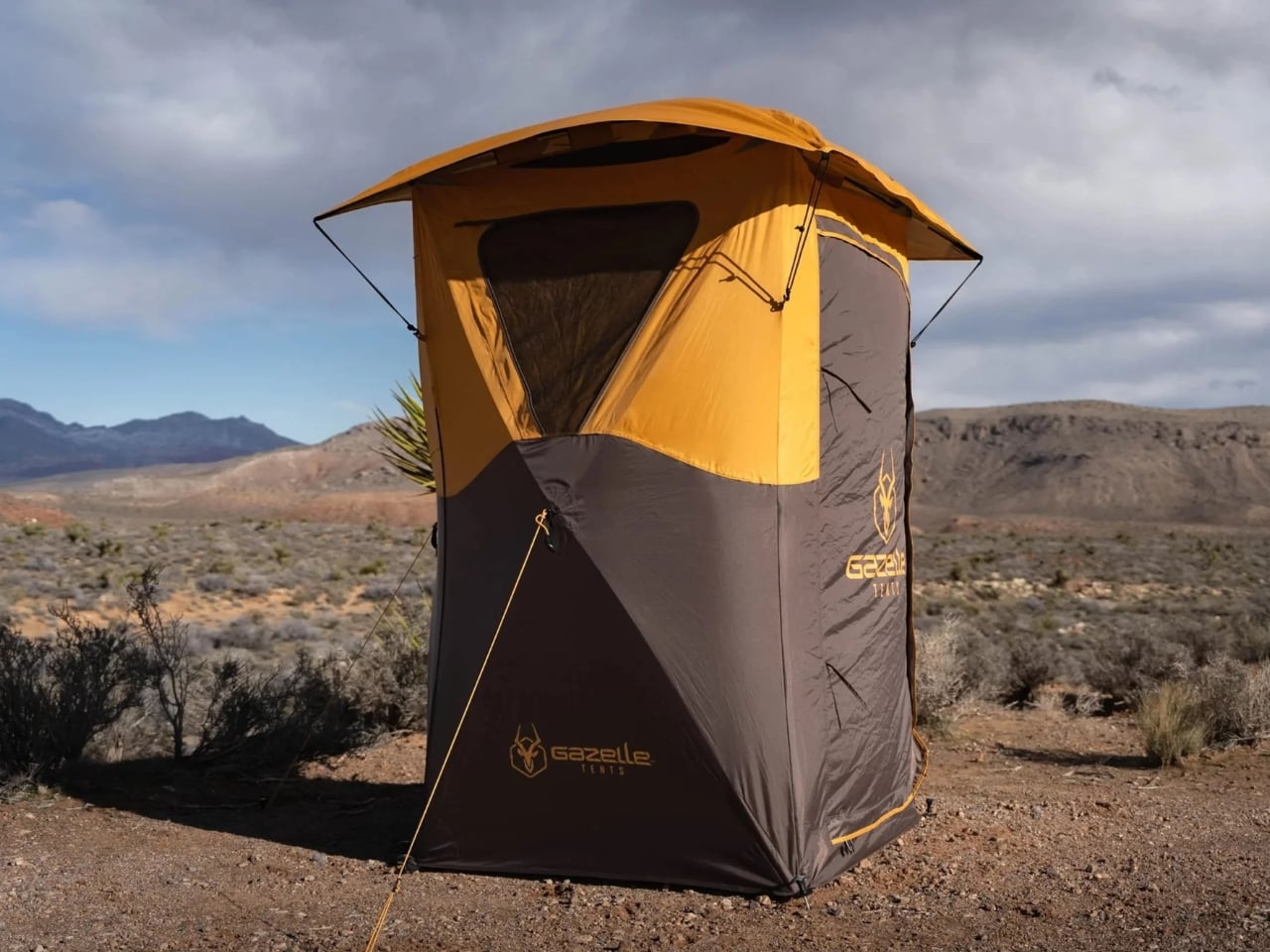
The tent industry has spent decades obsessing over sleeping quarters. We’ve seen ultralight backpacking shelters, geodesic domes rated for basecamp conditions, glamping canvas suites with chandelier hooks and welcome mats. And yet somehow, the bathroom question, the single most pressing daily concern at any campsite, has largely been left to your imagination, a folding shovel, and a lot of prayers for tree coverage. Gazelle Tents has just changed that, and it did so in a way that feels almost embarrassingly obvious in hindsight.
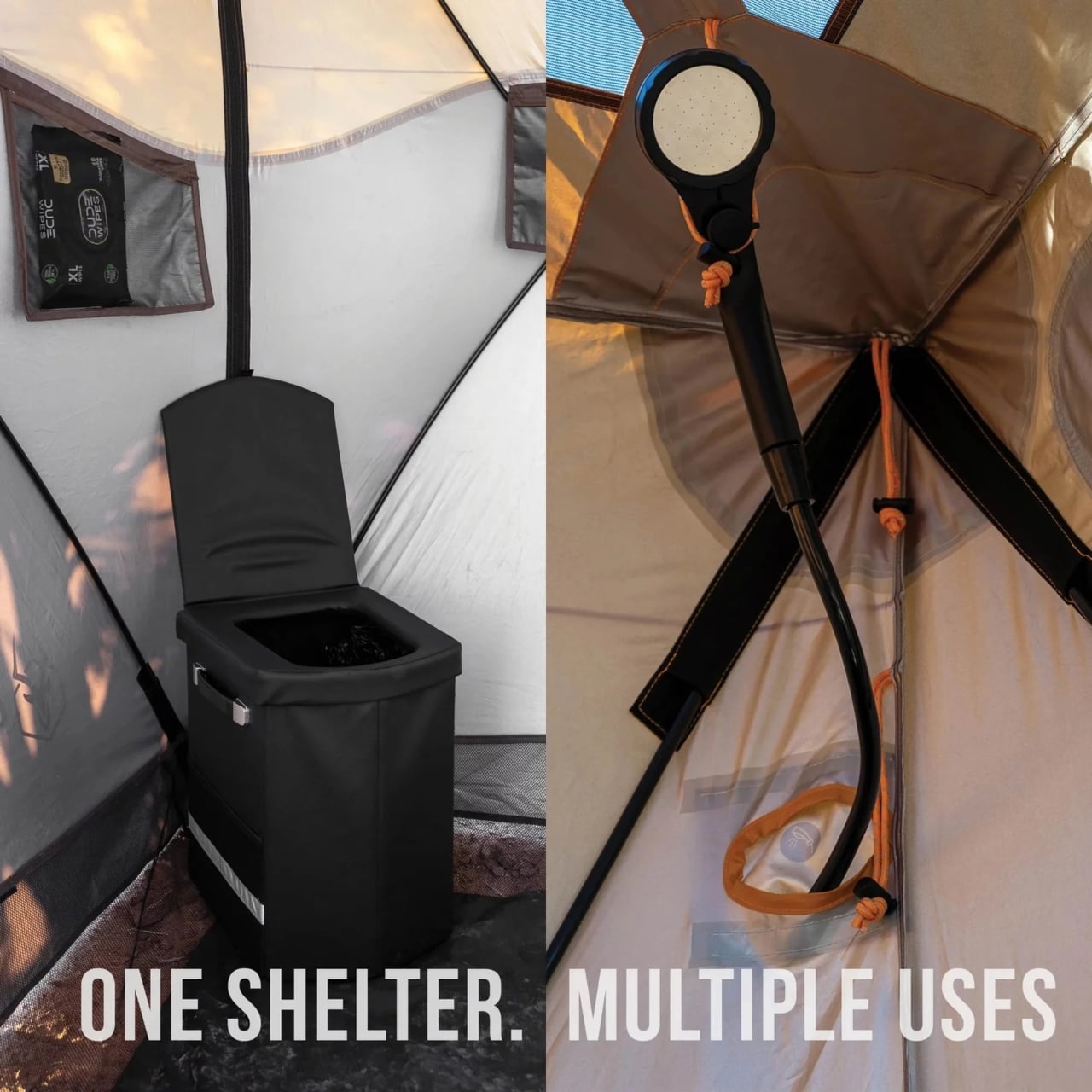
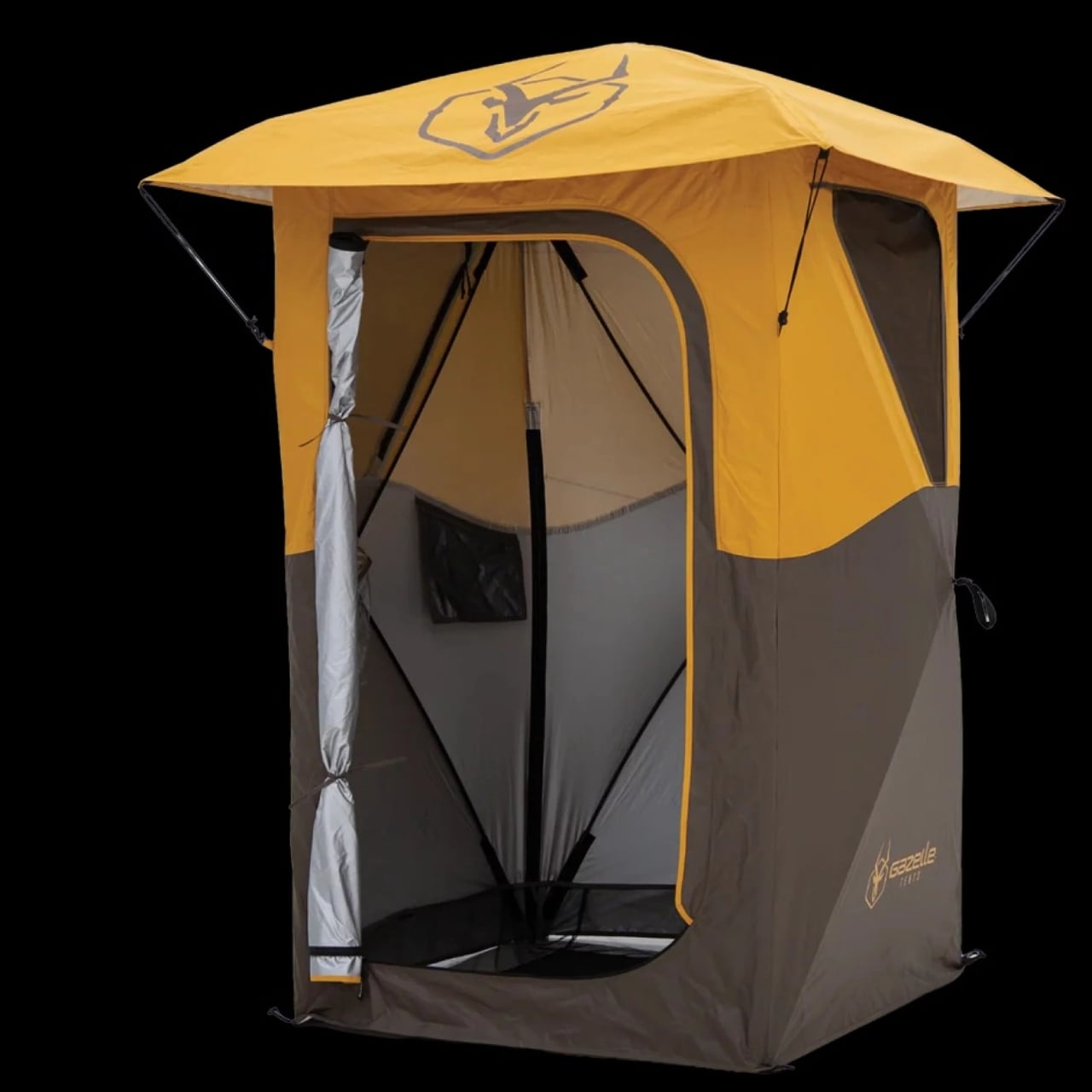
The Privacy Tent is Gazelle’s answer to what I’d call the campsite gap. It functions as a portable shower enclosure, a changing room, or a toilet privacy shelter, and it sets up in about 90 seconds. That last part matters more than it sounds. Nobody wants to spend 20 minutes wrestling with poles and stakes before handling a biological situation. The fact that Gazelle uses its signature pre-assembled hub-frame system here, the same one it’s built its reputation on for regular camping tents, means you’re pulling something out of a bag, releasing it, and watching it pop into shape almost immediately.
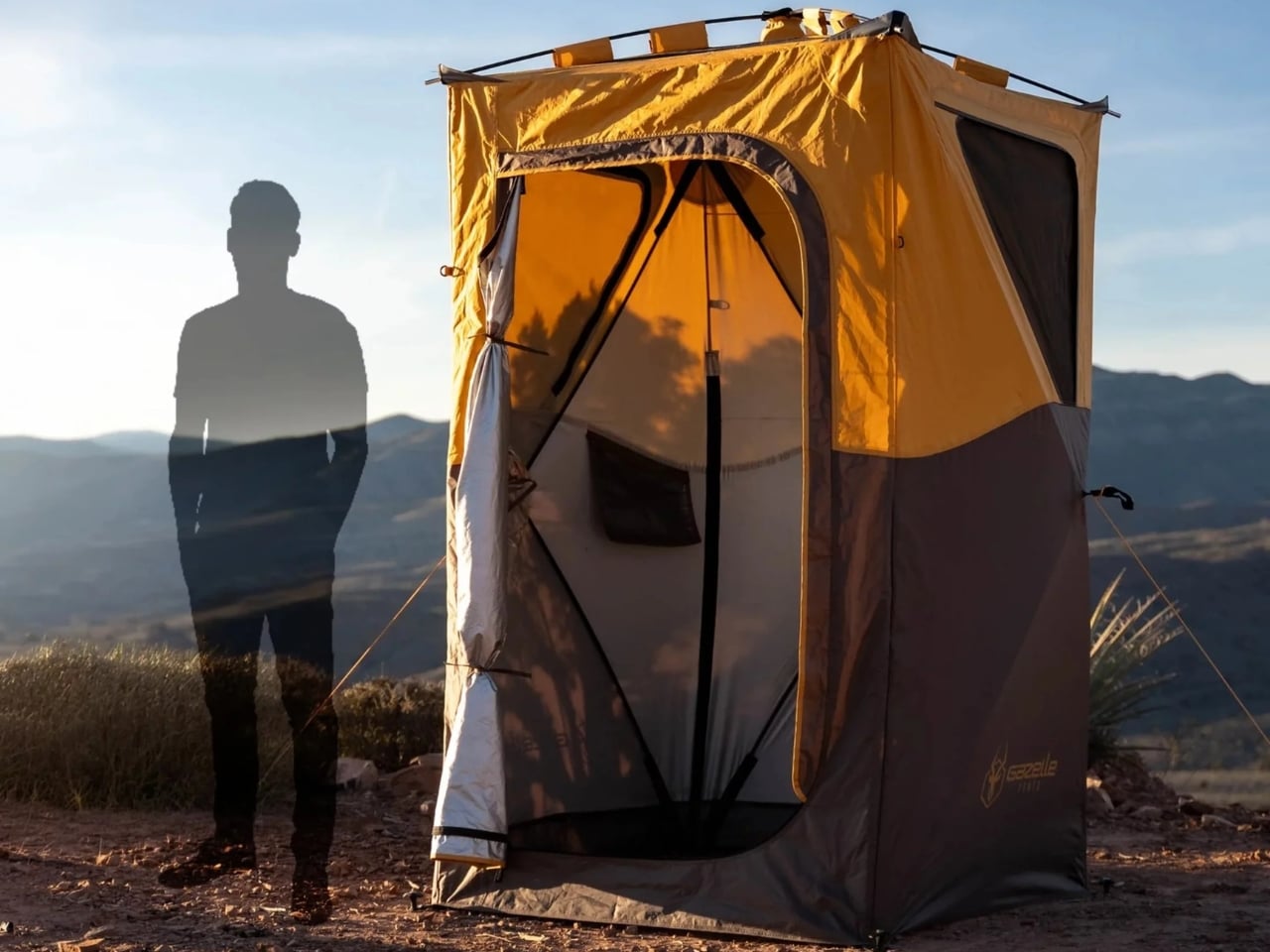
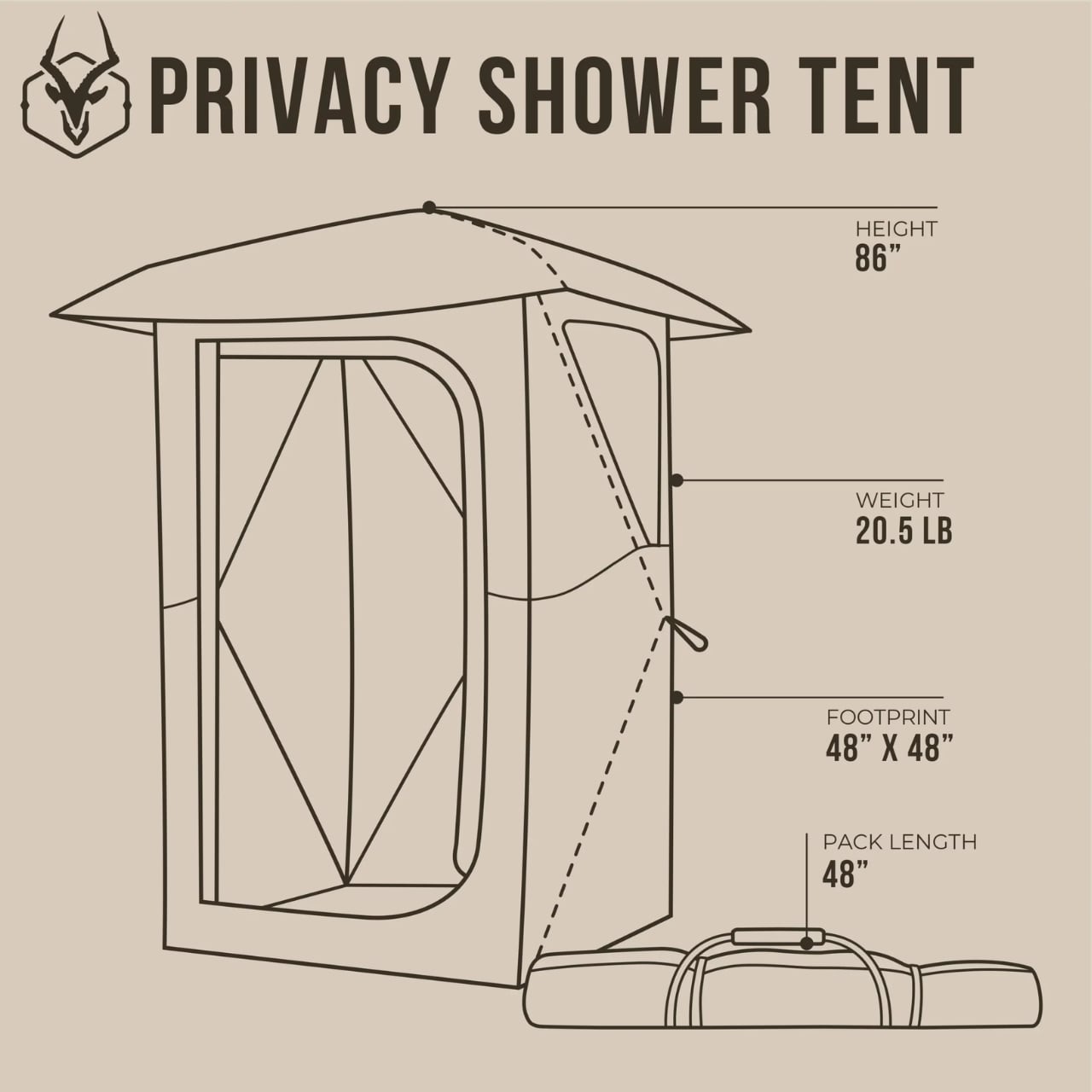
The specs are genuinely good. Standing height clears 86 inches, which means even the tallest people in your group won’t be hunched over trying to get dressed. The footprint is 48 by 48 inches, which is roomy enough to actually move around inside without the kind of claustrophobic side-wall contact that turns a quick shower into an ordeal. When you’re done, the whole thing packs down to 48 by 8.5 inches in diameter, so it slides into the back of a car, a truck bed, or the corner of an overland rig without demanding much real estate.
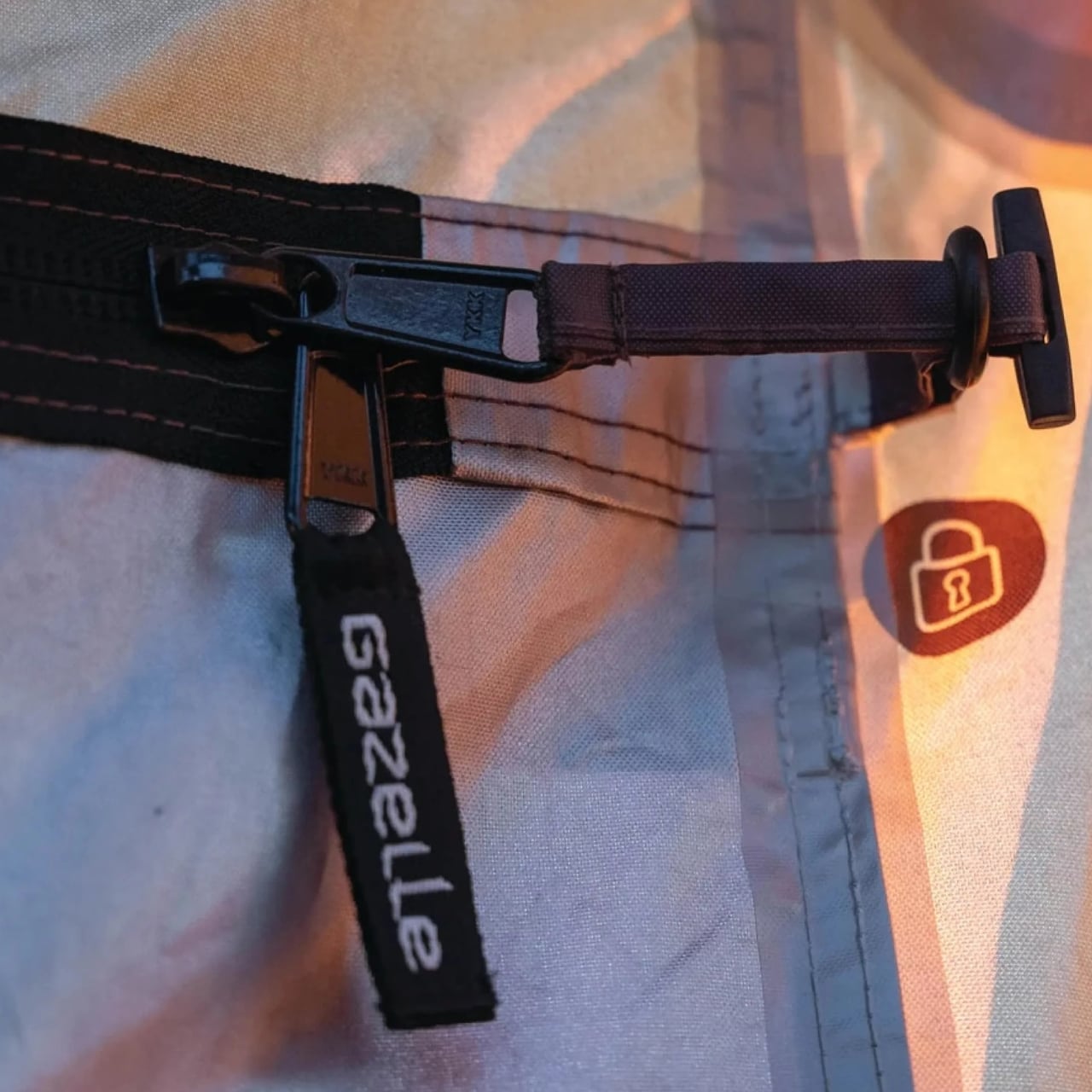
Inside, Gazelle thought through the details in ways that suggest they actually talked to people who camp regularly. There are dual hose ports and a drawstring sprayer holder for portable shower systems, an overhead gear loft, and mesh plus TPU pockets for toiletries and clothes. The fabric is 2,000mm waterproof 210D Oxford polyester, and mesh near the floor handles drainage and cleaning. You can leave the top open for ventilation on warm days, or close it off with a rainfly when the weather turns. Eight all-terrain stakes come included. The price sits at $279.99, a promotional launch price off the regular $379.99.
Is that expensive? Depends on how you camp. If you’re the kind of person who drives four hours to a dispersed site, stays five days, and considers a cold outdoor shower one of the better parts of the trip, then $280 for a genuinely thoughtful piece of kit makes complete sense. If you’re a two-night campground person with access to the facilities block, it’s probably more than you need. But for the growing number of overlanders, van-lifers, and weekend warriors who’ve committed to going further off-grid, this fills a real gap.
The overlanding and car camping space has exploded over the last few years. Gear has gotten smarter, setups have gotten more elaborate, and people have clearly decided that roughing it doesn’t have to mean suffering through the basics. A privacy shelter might not be as exciting to buy as a rooftop tent or a solar generator, but it’s the kind of thing that changes the actual texture of a trip. Getting changed in the open while strangers walk by, or figuring out a portable toilet situation without any coverage, is the stuff that makes some people swear off camping entirely.
The fact that Gazelle applied serious engineering to something this unglamorous is, to me, the most compelling thing about the Privacy Tent. Good design isn’t always about the product that gets photographed beautifully on a mountaintop at sunrise. Sometimes it’s about the one that solves the problem nobody wants to bring up at the gear store. Gazelle’s version does exactly that, quietly, quickly, and apparently in under two minutes flat.
For over a century, a modest corner shop at the intersection of Murray and York streets in Melbourne’s Prahran suburb sold milk, bread, and the kind of everyday essentials that knit neighborhoods together. It closed in 2016, briefly reopened as a café, and then sat waiting. Kister Architects founder Ilana Kister saw something in it — and then decided to move in.
The project, aptly named The Corner Shop, is Kister’s own home, designed for herself and her daughters. It is a three-story residence carved out of the original 287-square-metre plot, expanded by an adjacent 90-square-metre lot that became available during construction and was immediately absorbed into the design as a garden. That garden is not a feature — it is the entire logic of the building.
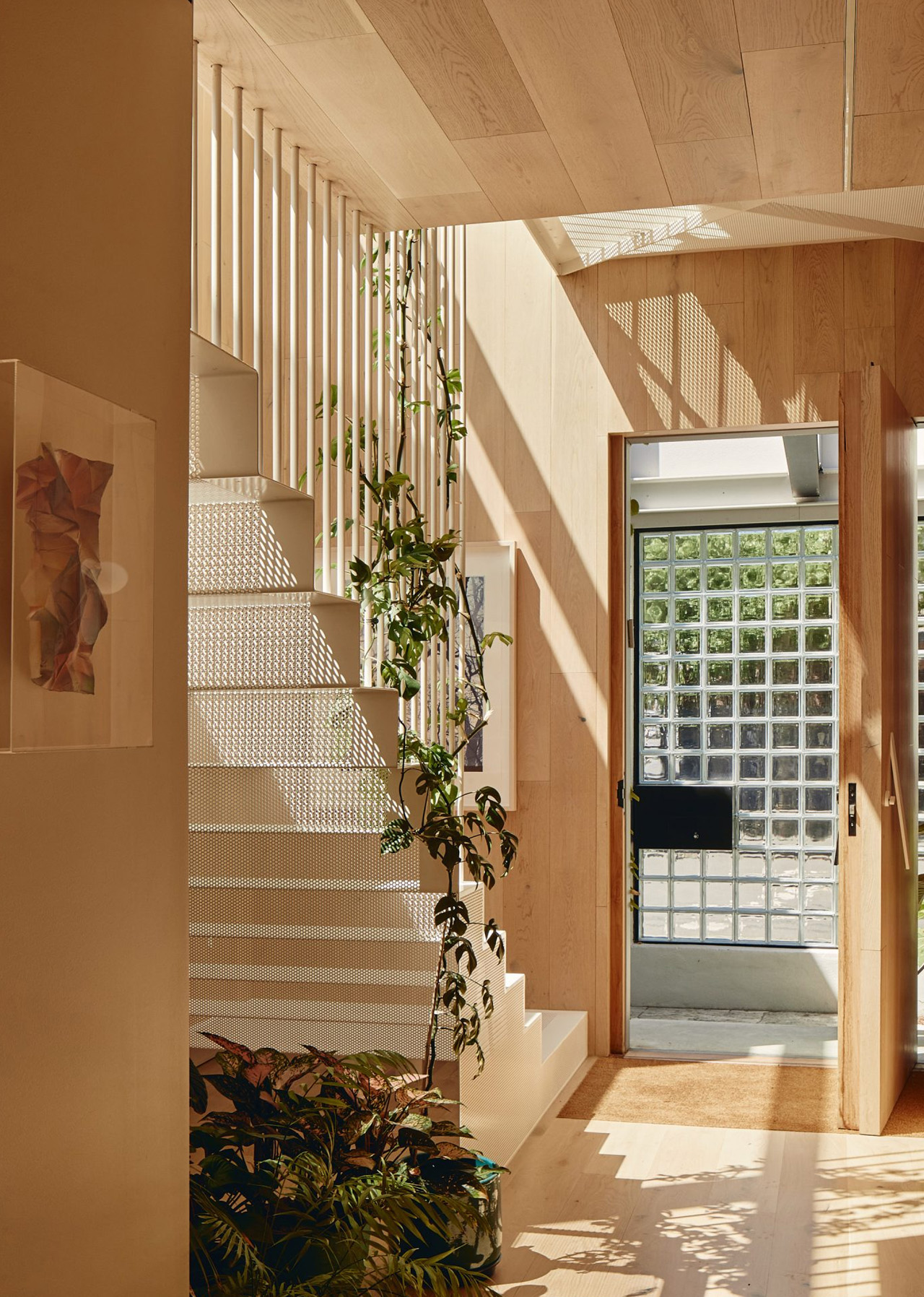
“Making the entry a courtyard was the single most important decision in the project,” Kister told Dezeen. “Entering through the original milk bar door, you land in the garden, not a hallway or foyer. By the time you reach the interior, you’ve already been outside — that sequence sets the tone for the whole house.”
The original shopfront façade has been preserved in full, bottle-green tiles and all. Street-facing windows were replaced with glass bricks — a move that keeps the building reading as a corner shop from the outside while flooding the interior with diffused, dappled light. The external palette layers grey and black render against silvertop ash timber cladding, with climbing vegetation threading through the surface and rooftop planting crowning the upper levels. Wherever you look, something is growing.
Inside, a white perforated steel staircase rises through all three floors, lit from above by a sequence of triangular skylights. Oak covers the floors, walls, and ceilings, anchoring the interior in warmth. On the second floor, three bedrooms, a family bathroom, and a living space are dressed in timber panelling and mossy-green carpet, with floor-to-ceiling windows drawing the outside in. The colour palette is deliberately restrained — natural materials do the work.
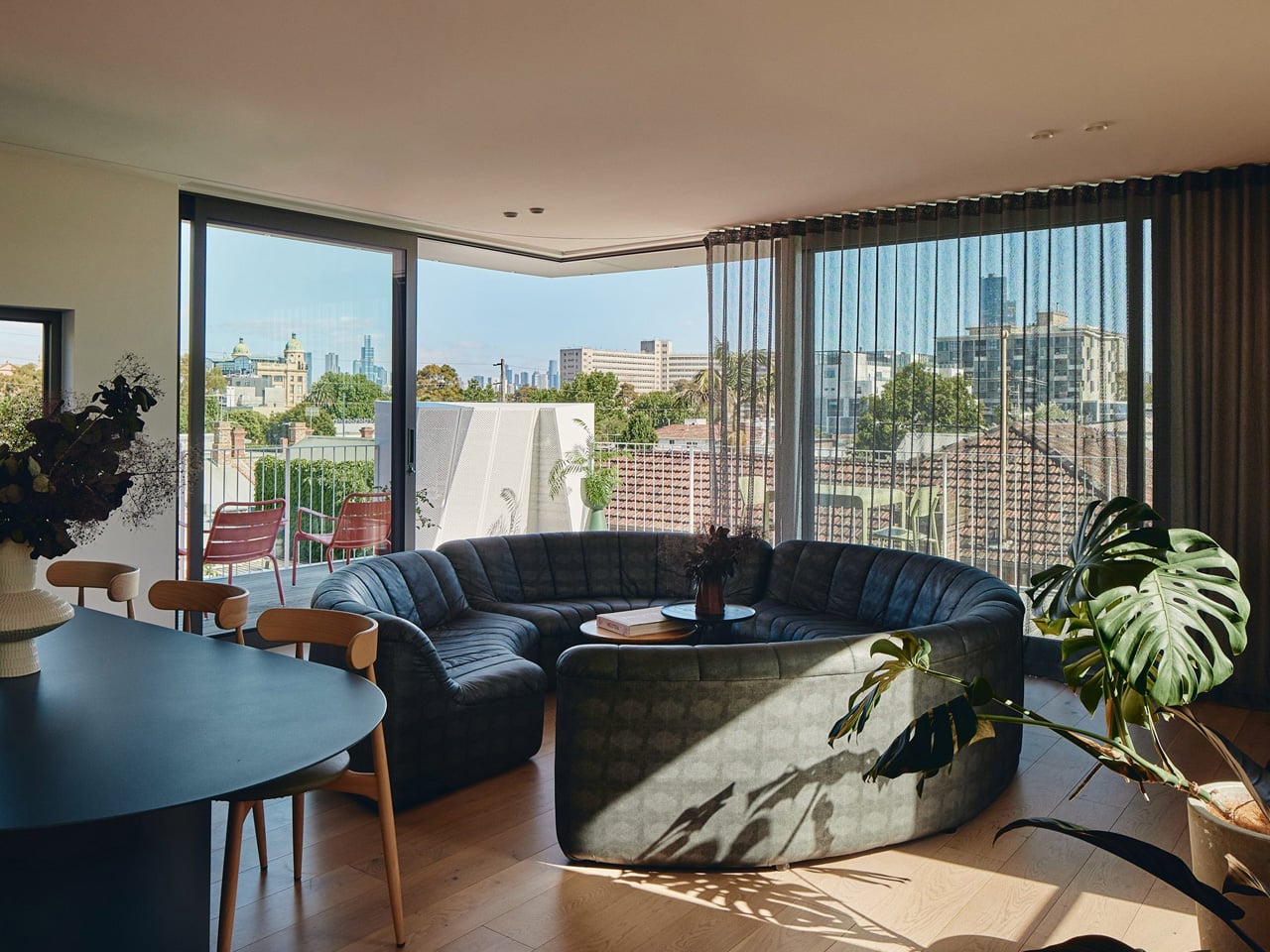
The third floor opens everything up. An open-plan kitchen, dining, and living space spills onto a silvertop ash deck with treetop views and sightlines to Melbourne’s city skyline. Below, the back garden holds a swimming pool, outdoor seating, and the kind of quiet that inner-city addresses rarely afford.
Green roofs, vertical gardens, and planted internal screens mean that no matter where you stand in the house, you can see something alive. That is not incidental — it is the brief. Kister built a home where nature is the architecture, and the century-old corner shop is simply its best possible frame.
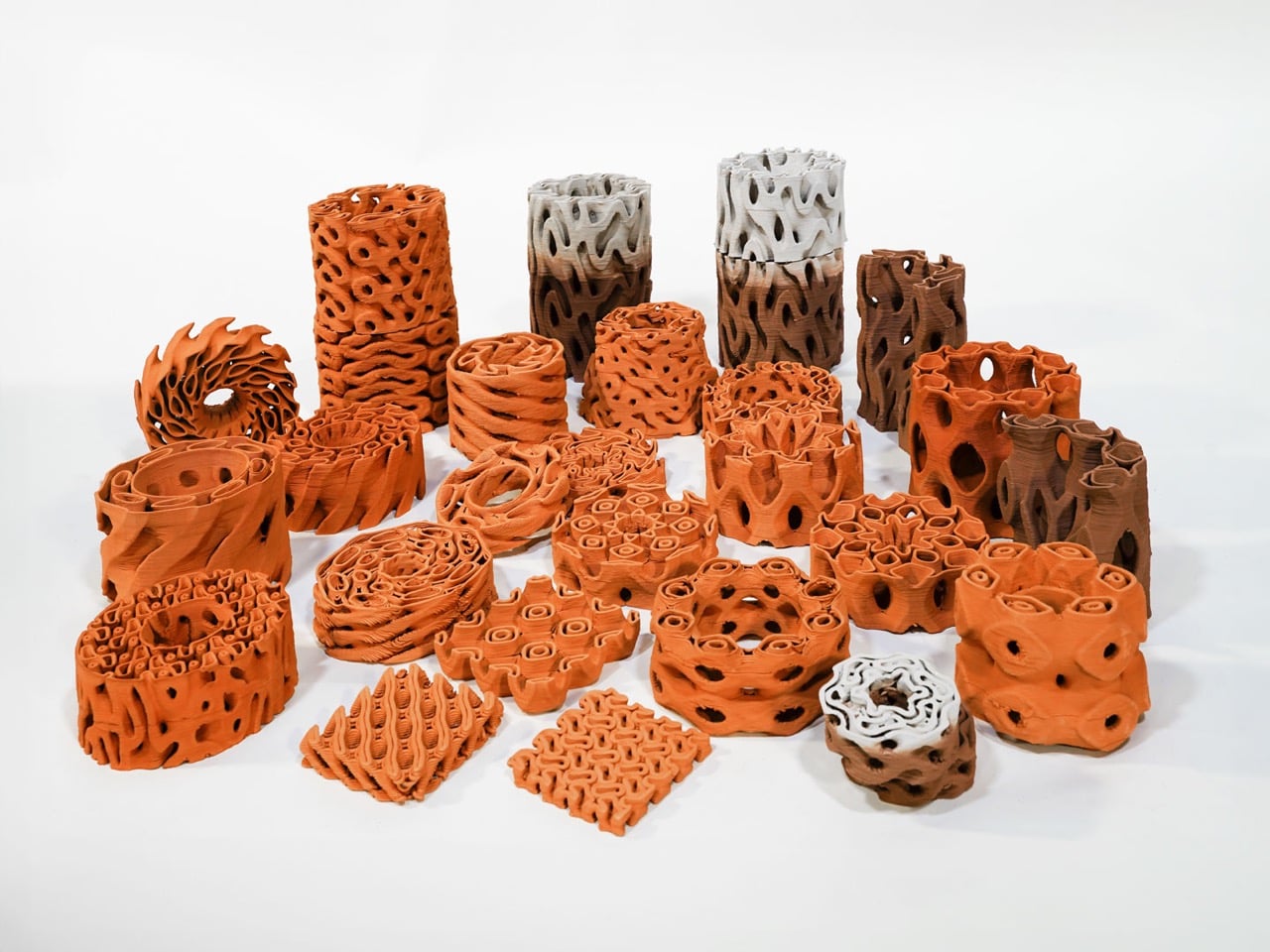
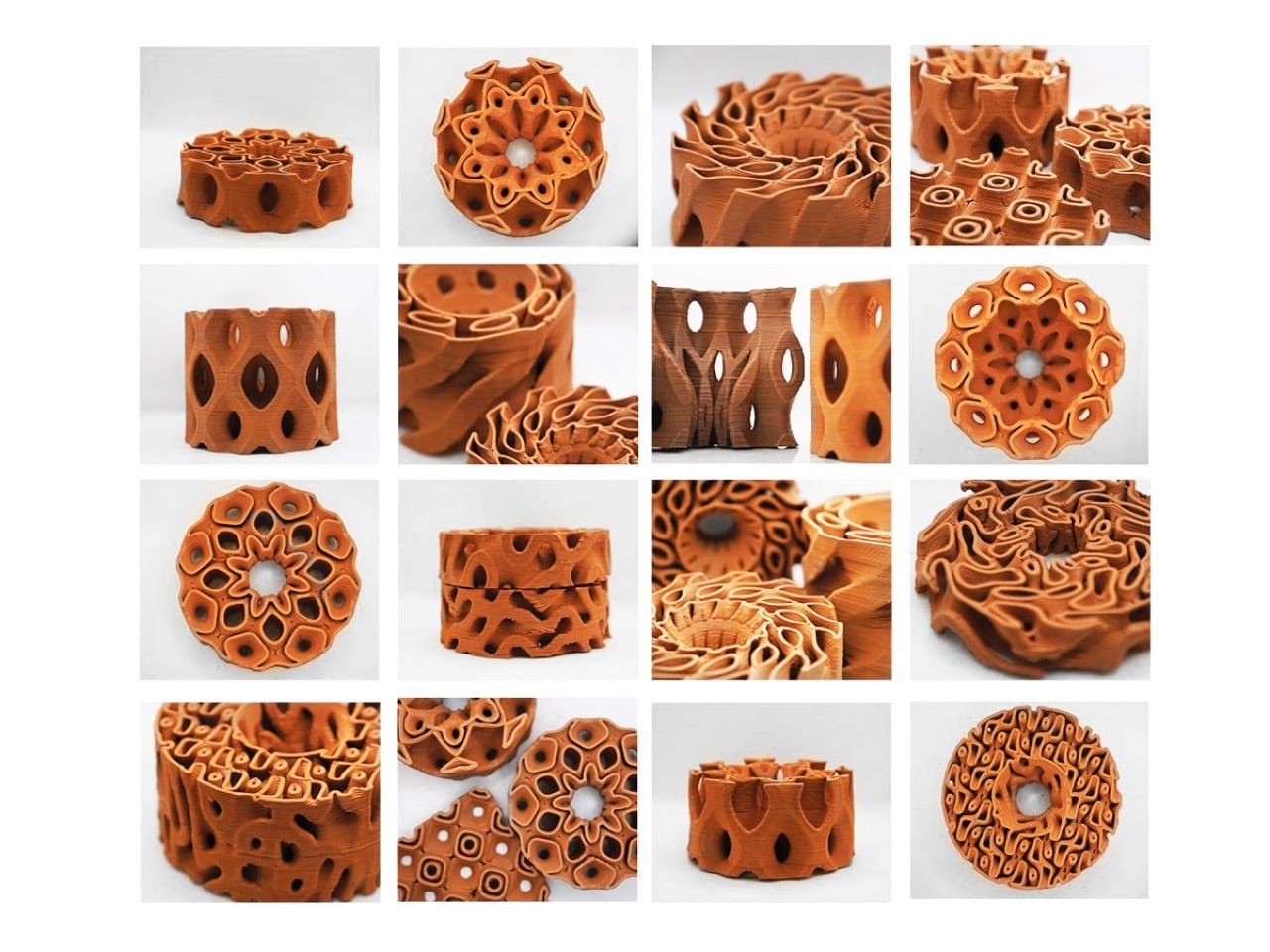
What would it look like for a building material to behave more like a living organism? Rameshwari Jonnalagedda has been sitting with that question, and Minimal Matter is her answer in clay. Drawing on the mathematics of minimal surfaces, geometries that appear in soap films, leaf veins, and cellular membranes, she has developed a system of 3D-printed terracotta forms that adapt to context the way natural structures adapt to environment. Each piece is porous and open-ended, capable of functioning as a thermal surface, an ecological habitat, or a structural element depending on how its geometry is tuned. The work is produced through additive manufacturing, which allows for continuous variation without additional cost or complexity. The forms look ancient and computational at once, as though the earth had been asked to solve an equation and answered in terracotta.
Jonnalagedda frames the work as a framework rather than a product, a set of conditions from which form continues to emerge long after the printer has stopped. The structures are designed to host moss, insects, air, and light, becoming more themselves over time rather than less. There is something almost philosophical in that proposition, the idea that a designed object could have an open-ended future, that it might weather and colonize and shift rather than degrade. Most materials we build with are fighting time. Minimal Matter is cooperating with it.
I keep thinking about the Sagrada Família when I look at these pieces, which is admittedly a strange place for the brain to go when confronted with palm-sized terracotta modules. But Gaudí spent his life studying natural load-bearing geometries, catenaries and paraboloids and hyperboloids, and insisting that nature had already solved the structural problems architects were torturing themselves over. Jonnalagedda is working in a completely different register, scale-wise and ambition-wise, but the underlying conviction is the same. The math is already there. Your job is to listen to it.
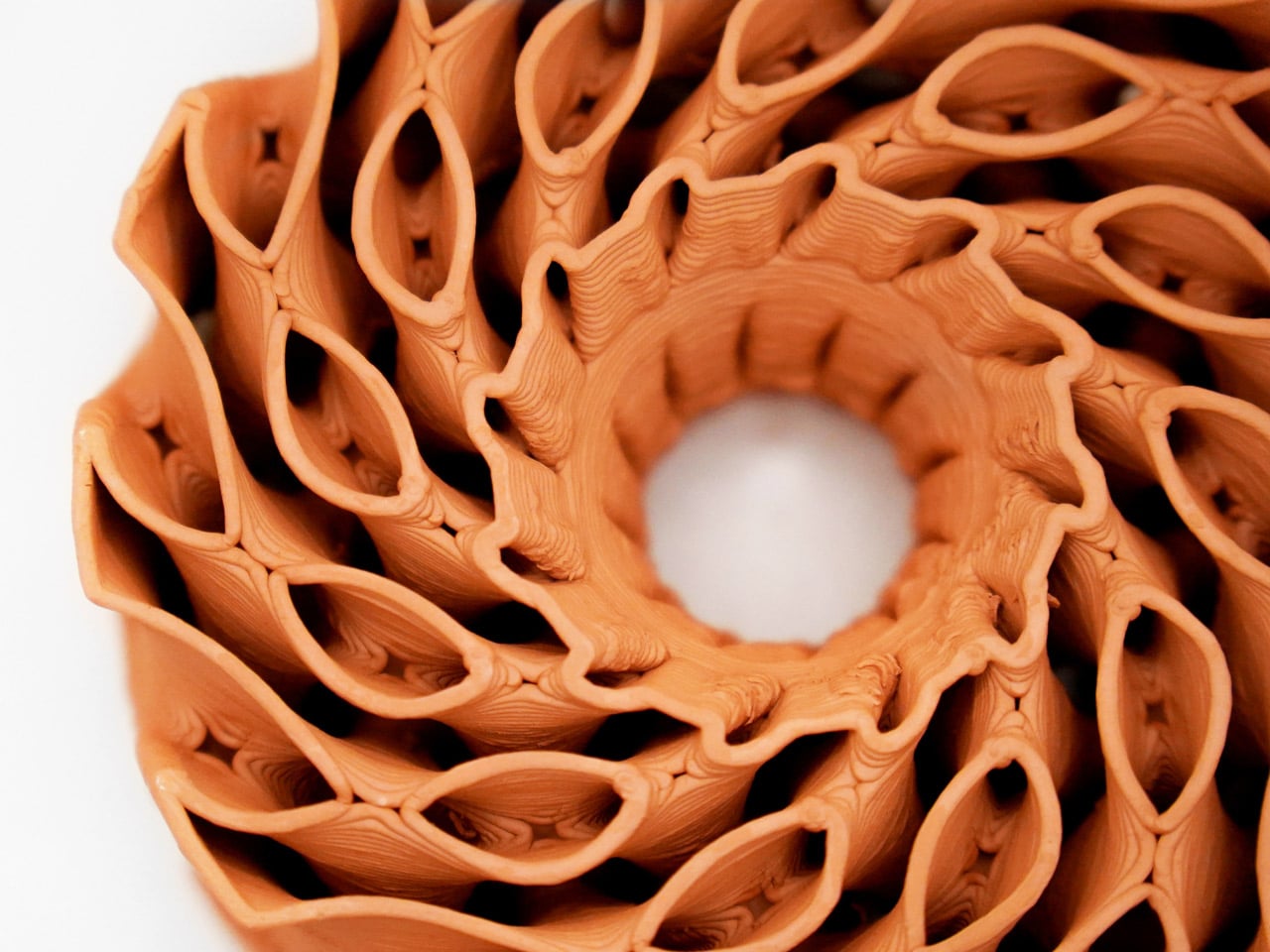
What makes Minimal Matter visually arresting, beyond the obvious formal beauty of the pieces, is the way the layering from the 3D printing process becomes part of the surface language. Close up, each form reads almost like topographic contour lines, the deposit of clay recording every decision the algorithm made. You can see the logic of the geometry in the material itself, which is rare. Most 3D-printed objects try to hide their process, with sanding, acetone baths, or even tweaking the build settings to reduce ‘steps’ from showing. These celebrate it, and the terracotta’s warm ochre tone makes the whole thing feel less like a prototype and more like something excavated.
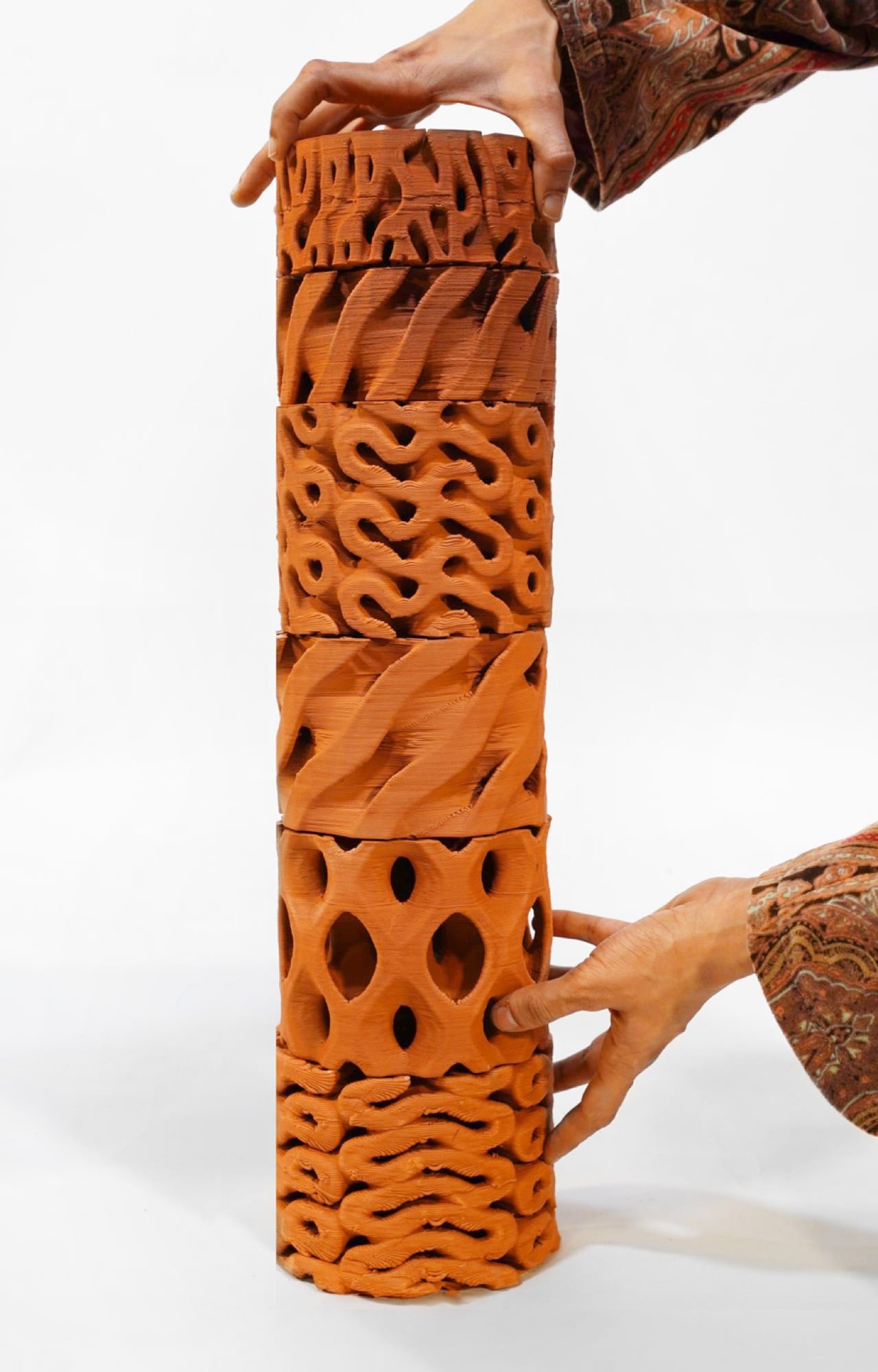
Individual pieces stack, combine, and reconfigure, which means the system scales without losing coherence. A single module functions as a sculptural object on a desk. Four stacked become a column. Spread flat across a surface, they start to read as landscape. This scalar flexibility is genuinely hard to achieve in material design, and Jonnalagedda pulls it off by keeping the underlying geometry consistent while varying the expression at the surface level.
The work points somewhere larger than a single award category can contain. Jonnalagedda is asking a question that the construction industry has been too busy pouring concrete to consider: what if the things we build were grown into place rather than imposed upon a site? What if a wall could host an ecosystem, a surface could regulate temperature through its own geometry, a material could become more itself the longer it was left alone? Minimal Matter, recognized in the Young Talents category at the Design Intelligence Award, doesn’t answer all of those questions, and it doesn’t need to. It just makes them impossible to ignore.