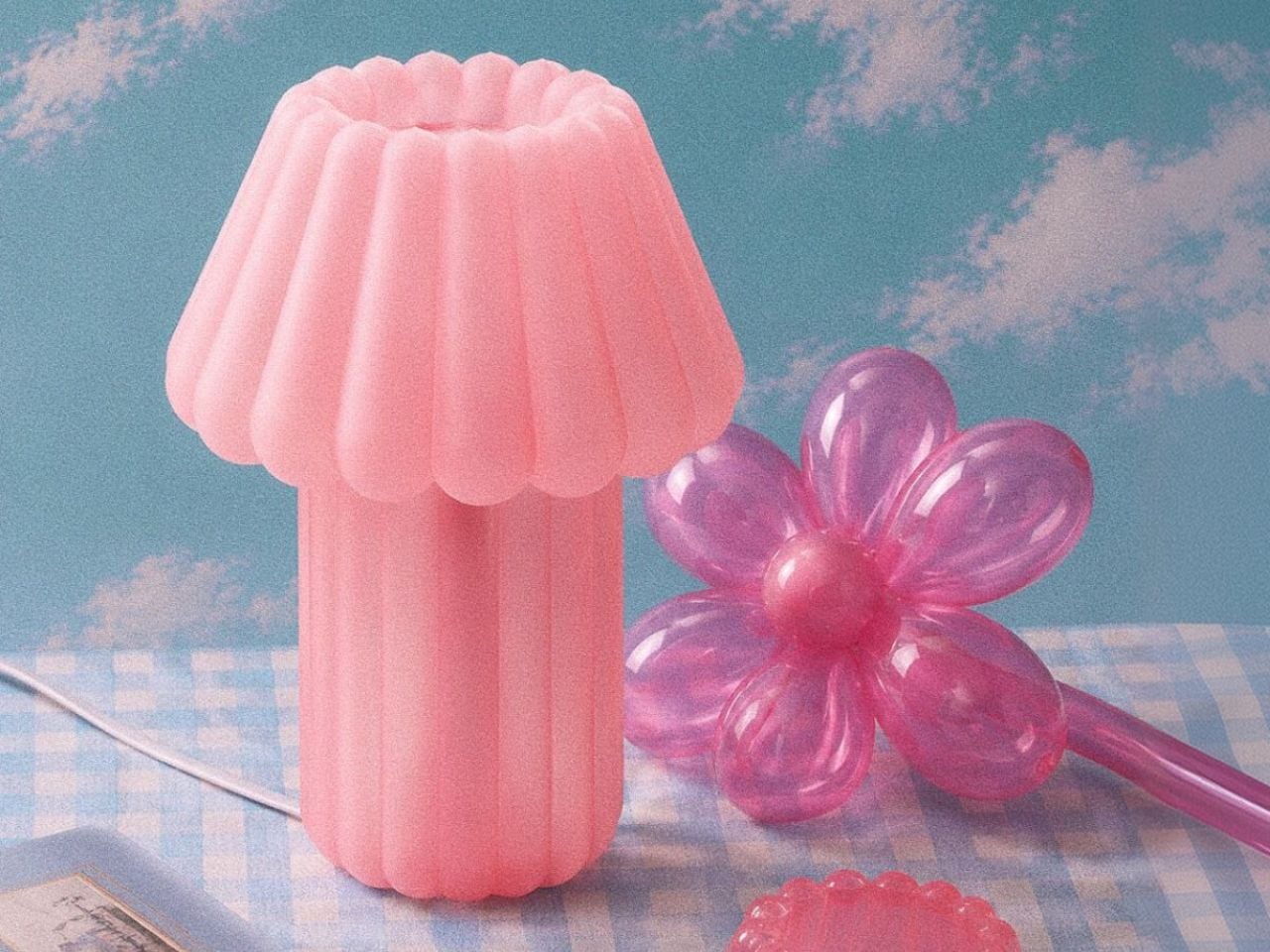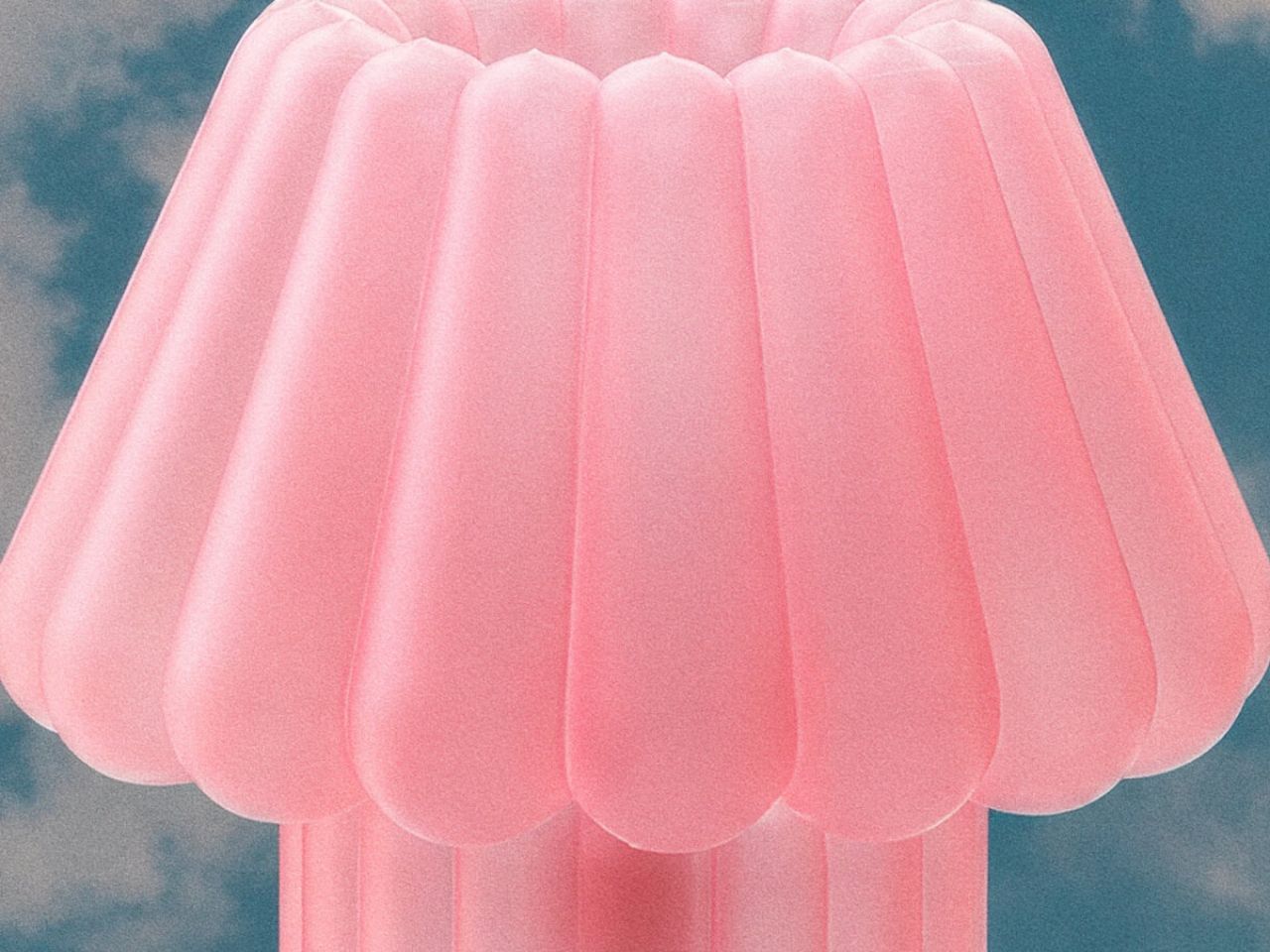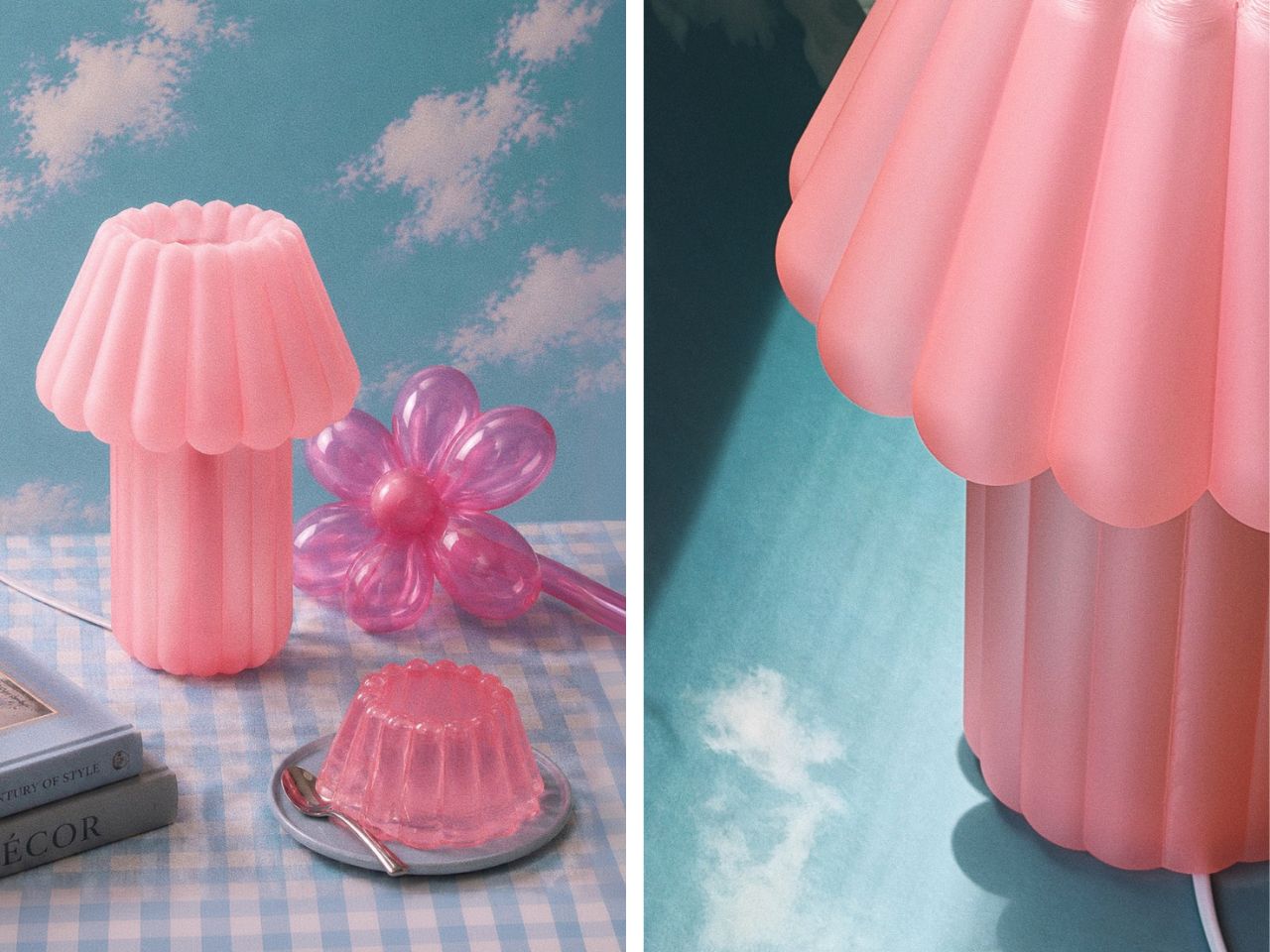
This Stabilo Table Lamp puts the ‘Light’ in Highlighter!

Creatives see the world very differently from how the rest of us do. Someone sees a binder clip, a creative sees a miniature handbag, someone sees a fork, a creative holds the fork close to their eyes to simulate being in a prison cell. Someone sees a highlighter as a piece of stationery used to make text prominent, Jane Morelli saw the ‘light’ in highlighter, turning it into a tabletop lamp every stationery nerd will absolutely love.

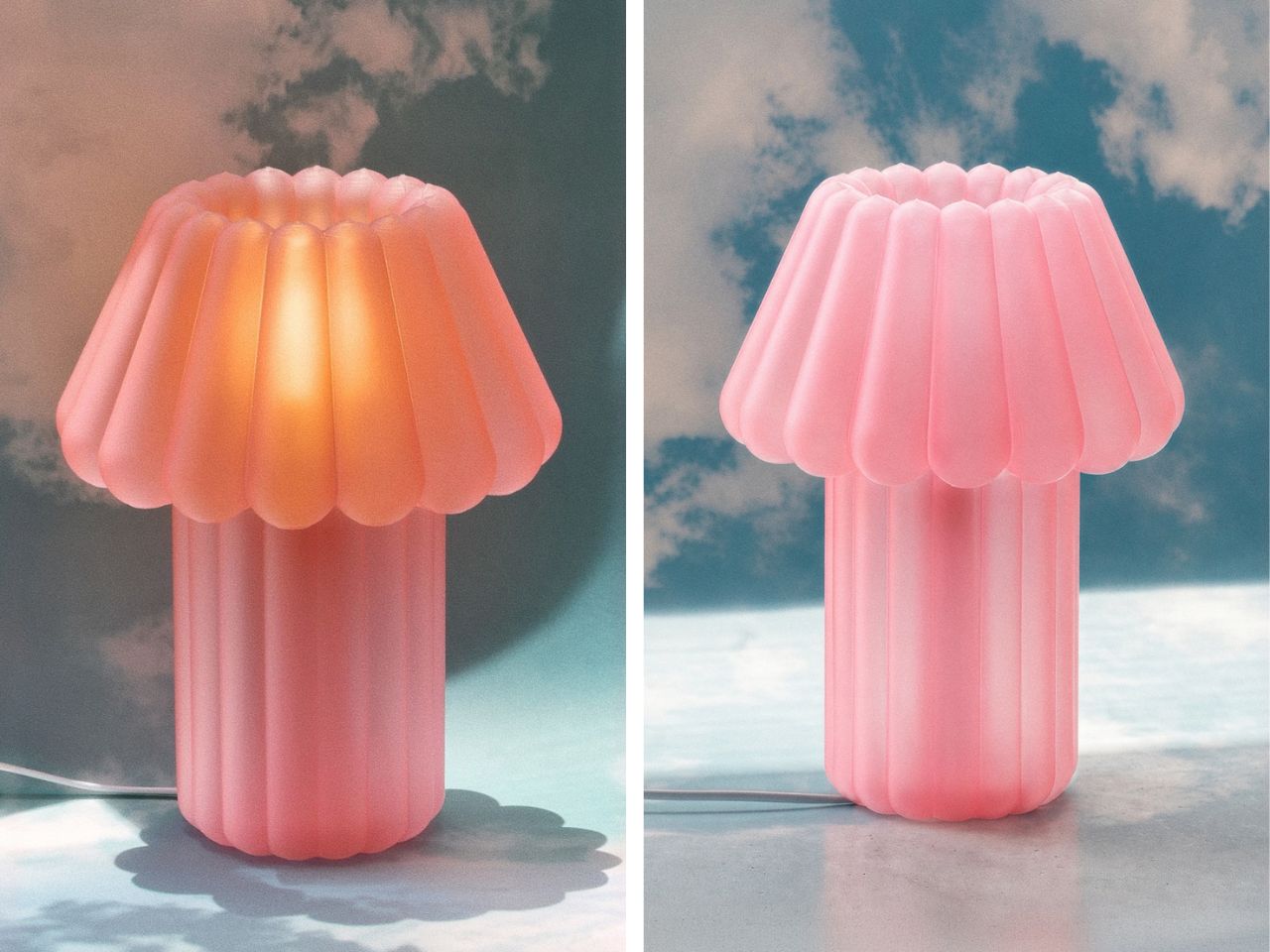
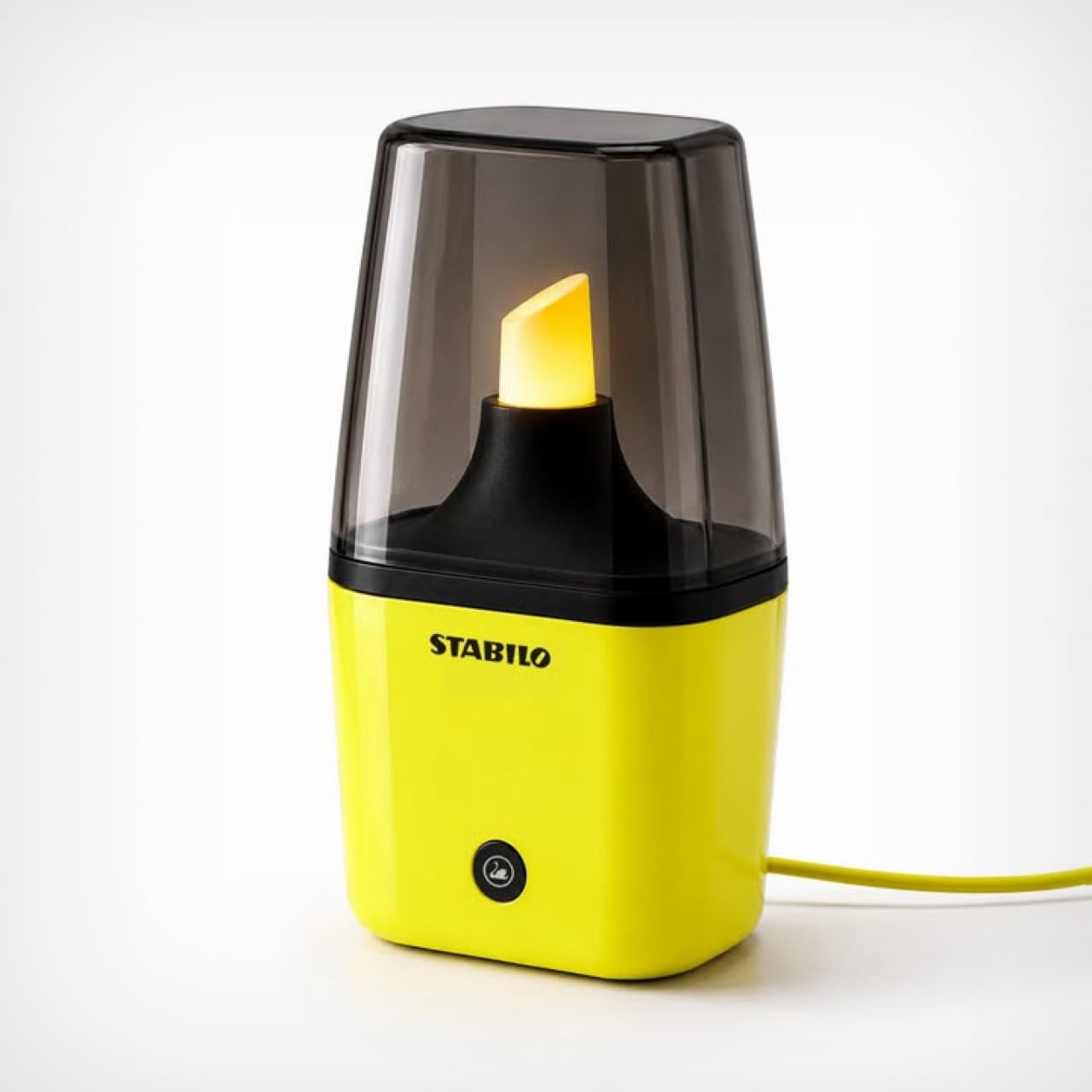
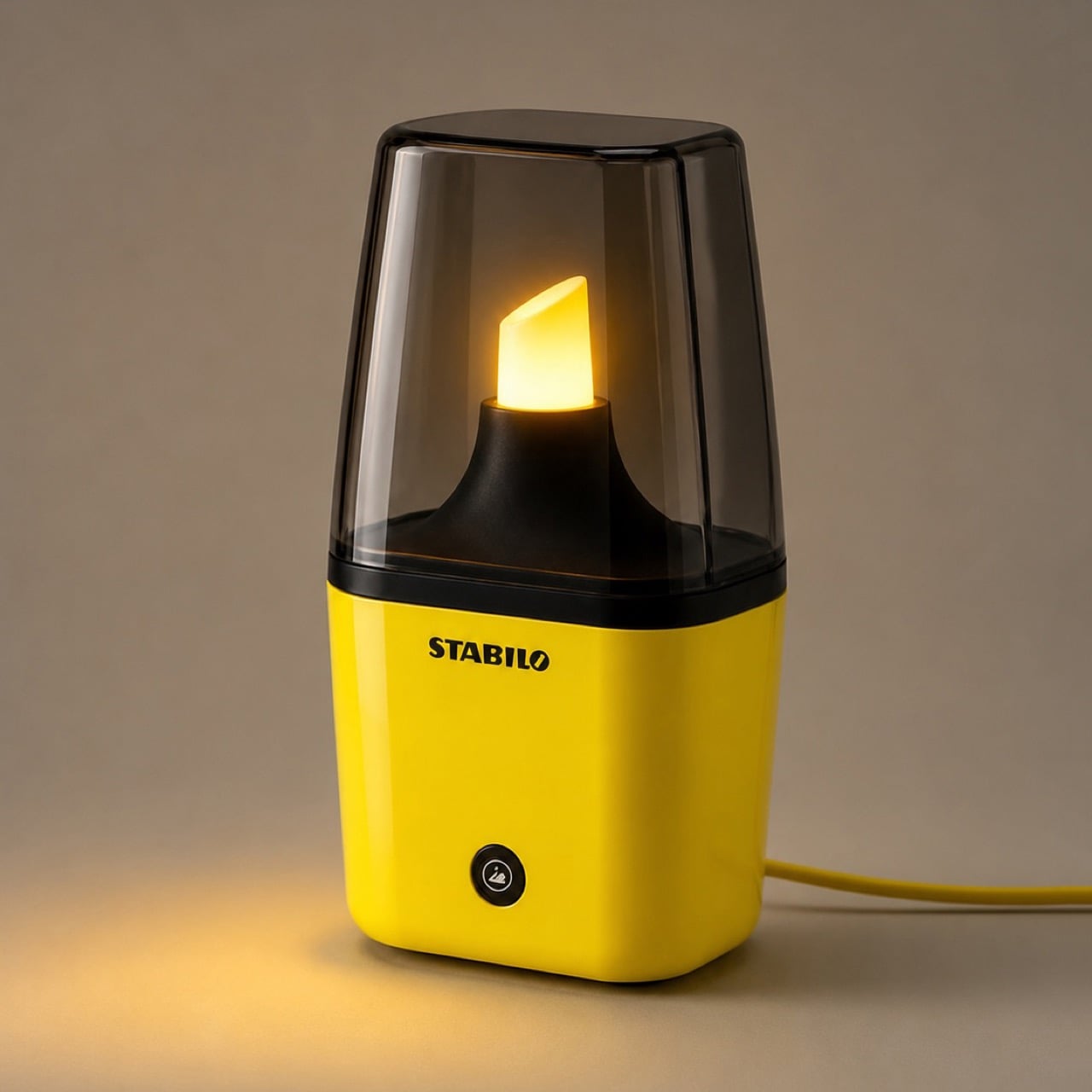
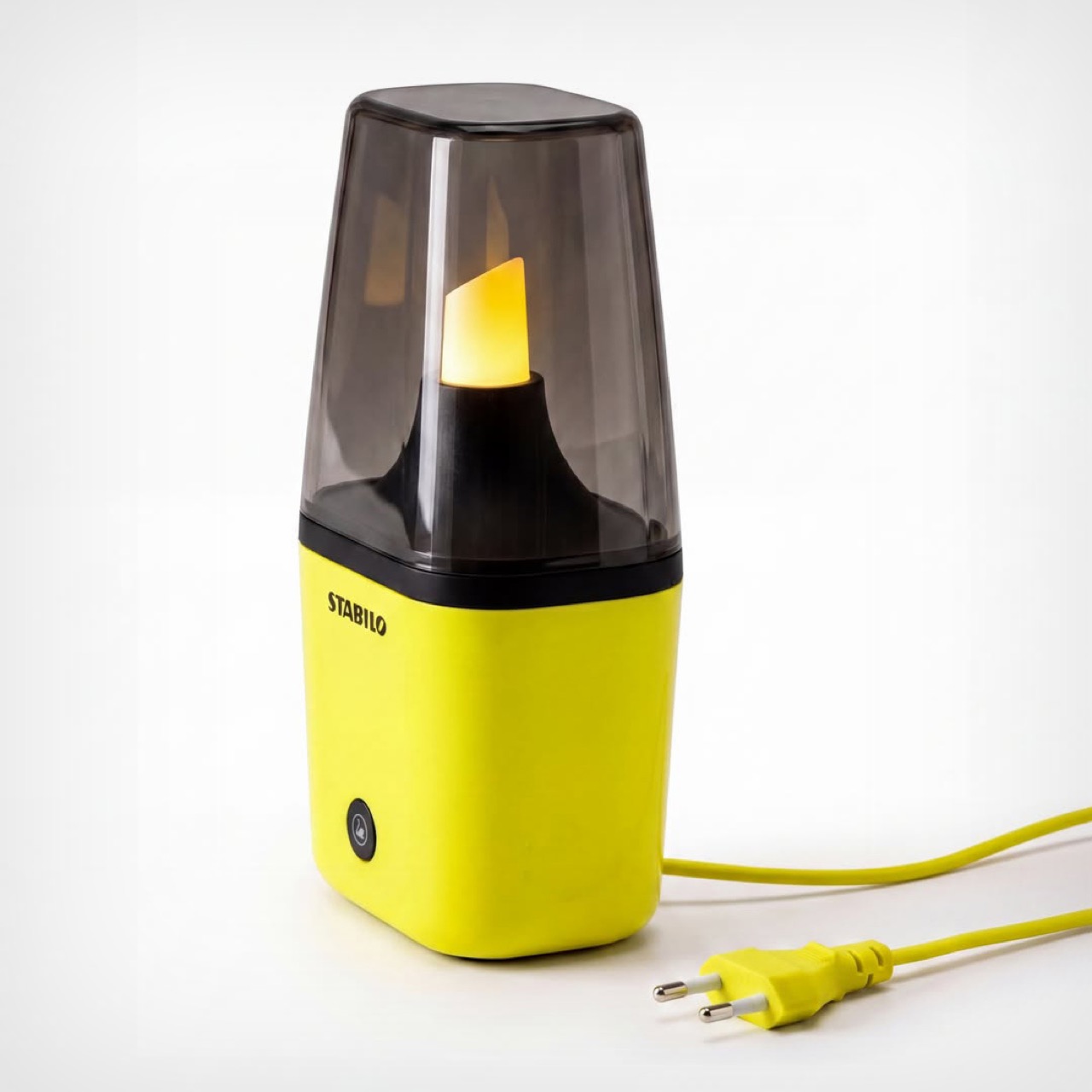
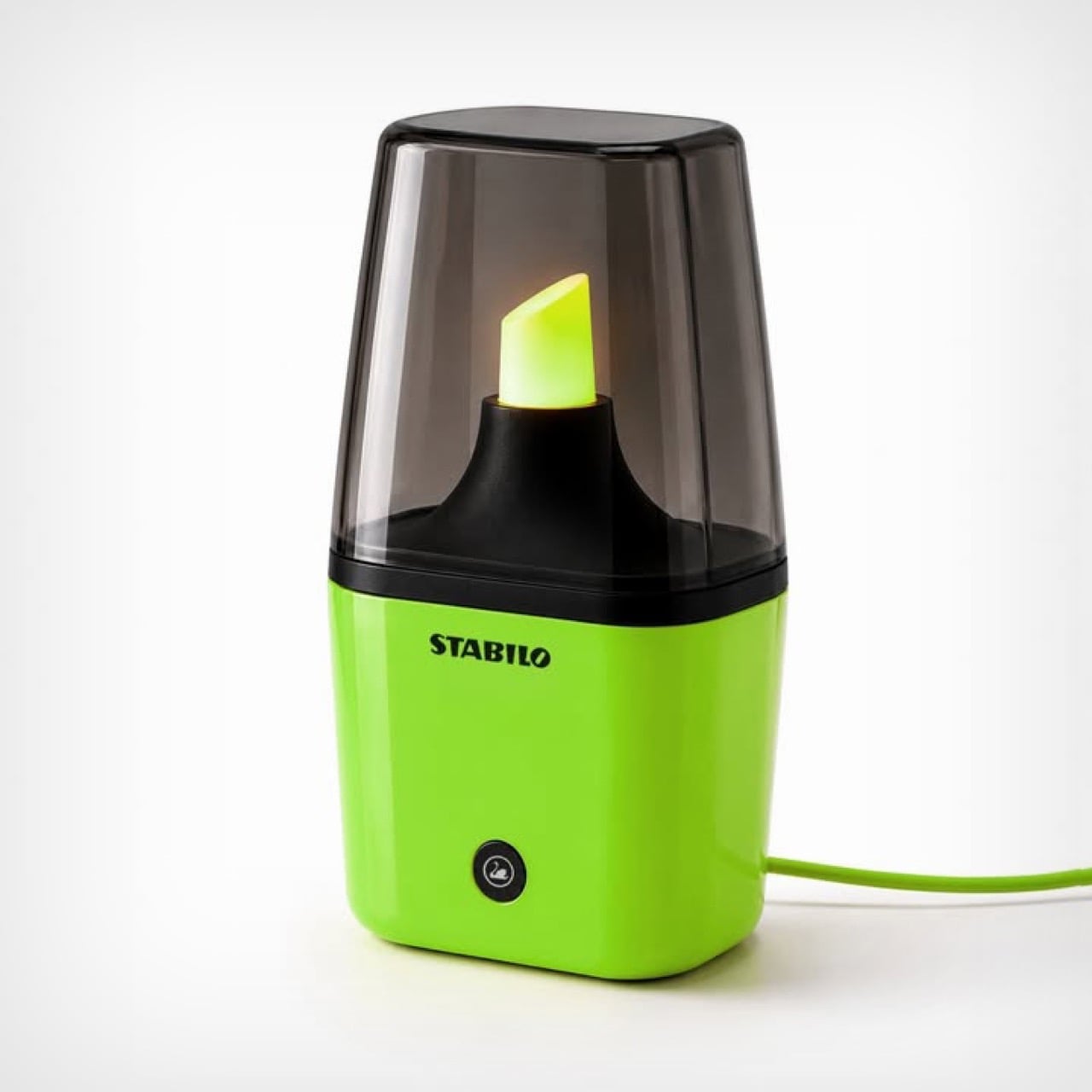
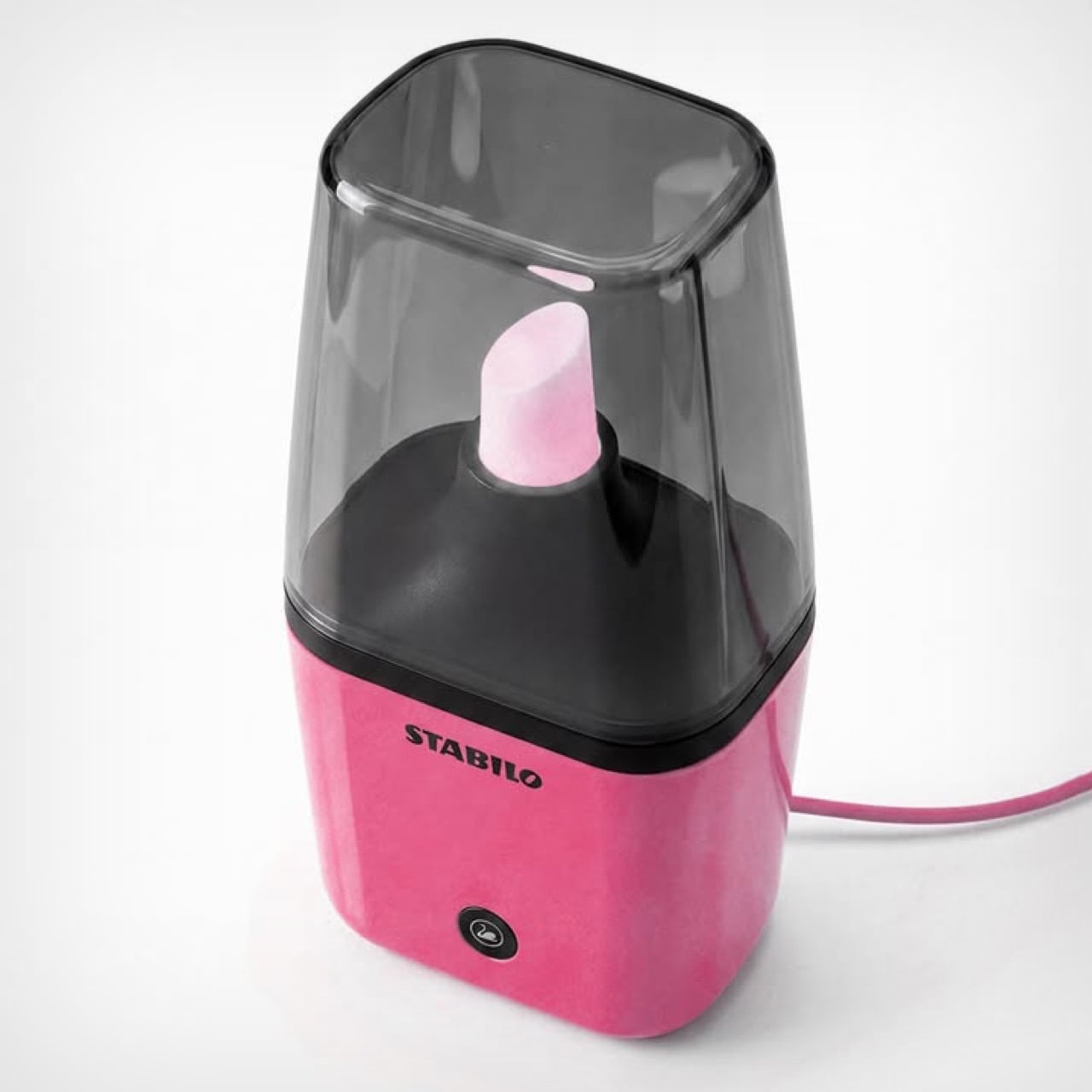
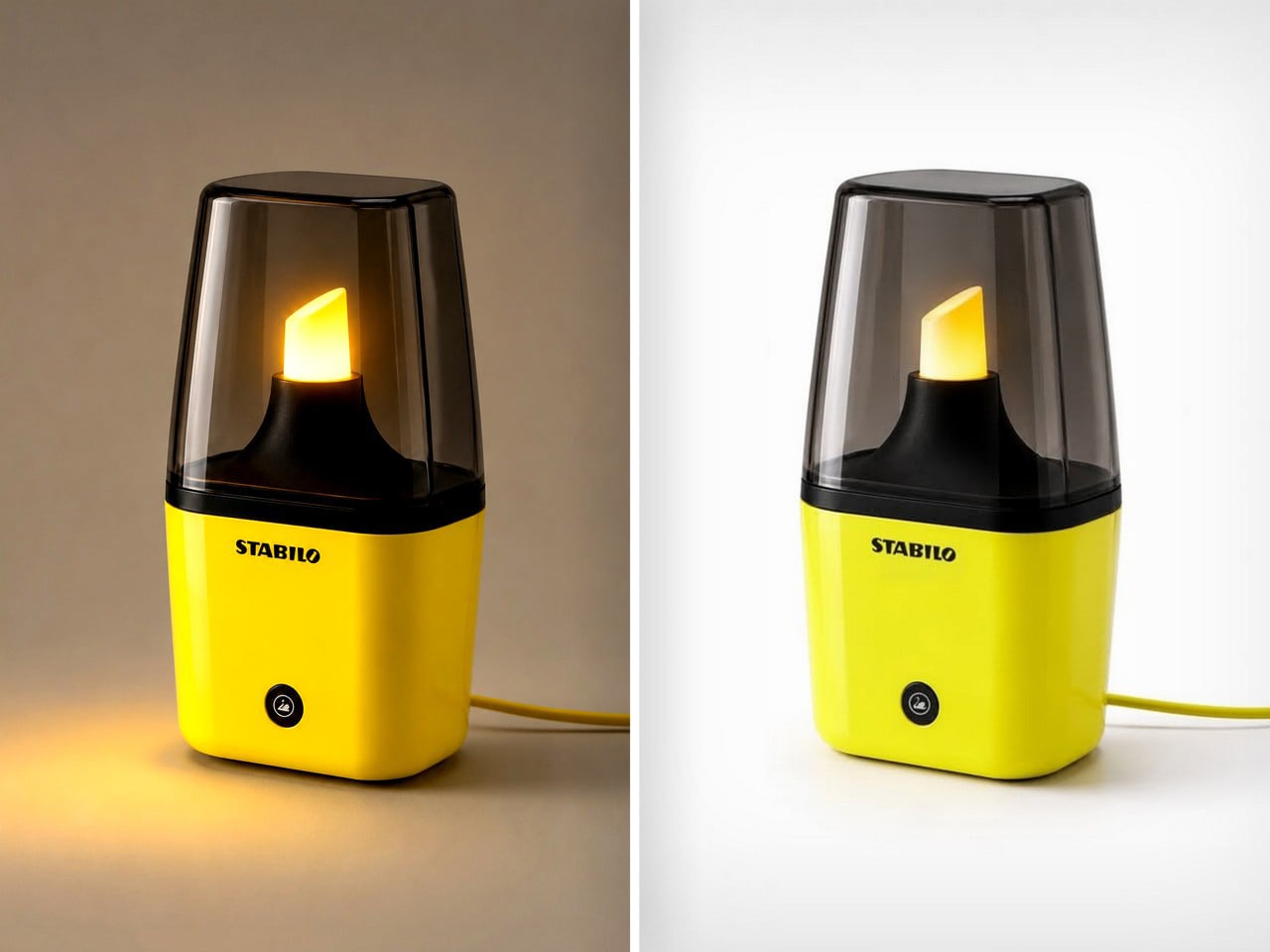
Modeled on the iconic Stabilo highlighter, Morelli’s Stabilo Lamp is an unofficial tabletop lamp that turns the fluorescent tip of a highlighter into a literal light source. Designed to be roughly a foot tall, the lamp comes with a cord – plug it in, switch it on, and the tip glows in its signature color. Morelli’s designed the lamp in 3 common colors for now, neon yellow, pink, and green. I say unofficial because this is purely fan-made visual punnery – but Stabilo did comment on Morelli’s post, marveling at her idea.

Designer: Emanuele Jane Morelli

The lamp is witty, fun, and caters to a highly specific niche. Not everyone wants to celebrate stationery in such a literal way, but for the people who do, this is an absolute win. The lamp is modeled on the short Stabilo highlighters, the proportions have been adjusted to ensure the base doesn’t overpower the actual light source – something that bright is sure to command one’s attention, but it mustn’t steal it. The showstopper is the nib, a cloudy, translucent element with a powerful light source underneath that causes it to glow once switched on. A tinted ‘lampshade’ in the form of a highlighter cover sits on top, acting as a visual and physical barrier from the light source.

The lamp’s pretty tiny, as is its light source. Don’t expect it to produce enough light to let you read a book. Its sole job is to emit a warm, diffused glow akin to a lava lamp, setting the mood with a nerdy panache that only will appeal to stationery lovers and people with a quirky personality. You won’t see this in an edition of Architecture Digest, or an eclectic Airbnb. Then again, to be honest, you won’t see this anywhere because Morelli’s work is currently just a concept.

However, with enough attention, Morelli could totally build a working prototype and take this to production. Stabilo definitely loved the idea, and this isn’t the first time we’ve seen designers garner attention on their work on social media and get enough validation to turn them into real products. David Delahunty’s work is a brilliant example of how creative thinking and visual puns can turn into real merch and a genuine business. Morelli, if you’re reading this, I’d suggest busting out your 3D printer, heading down to Home Depot or the like, and putting together a prototype!

The post This Stabilo Table Lamp puts the ‘Light’ in Highlighter! first appeared on Yanko Design.

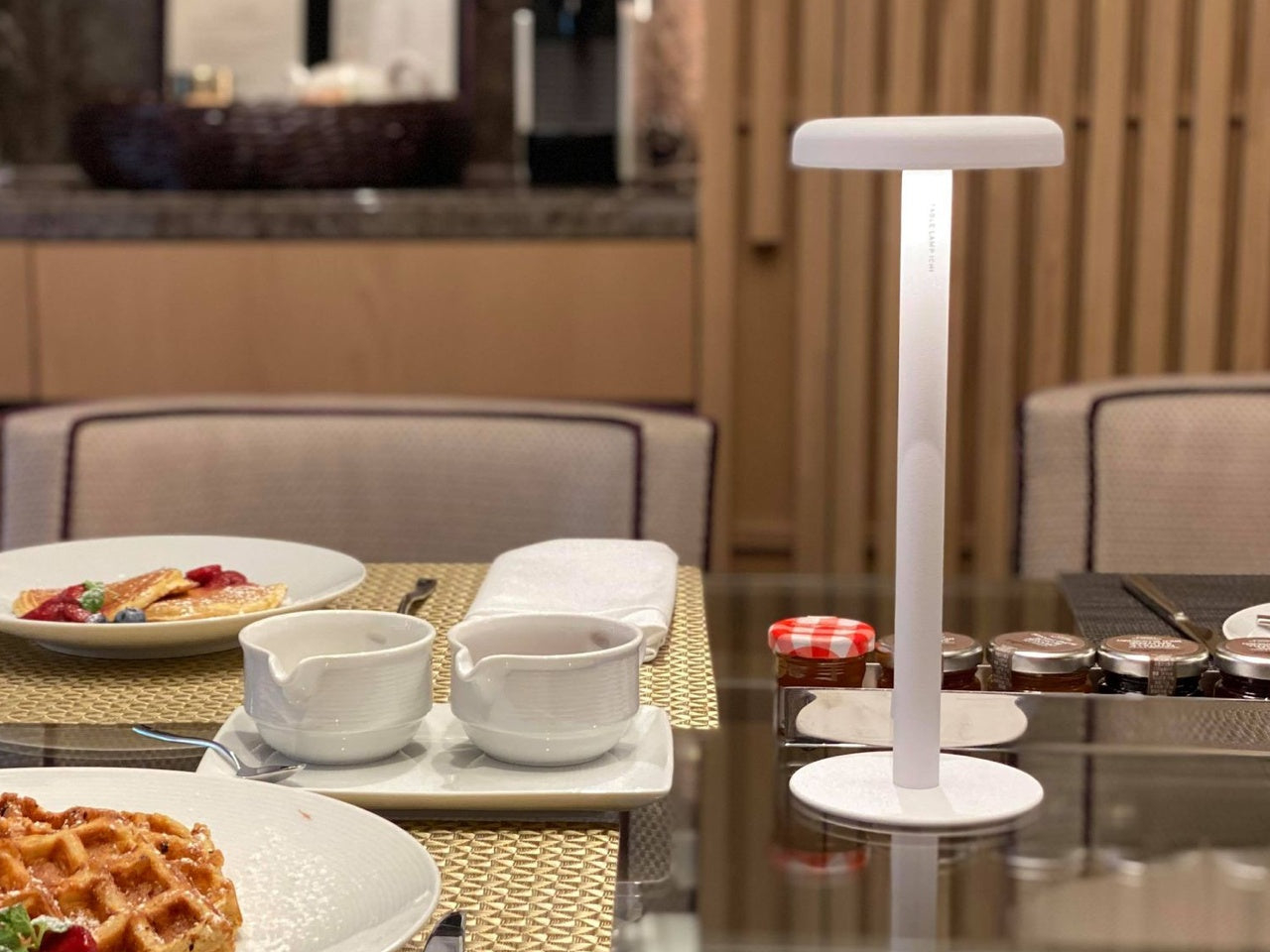
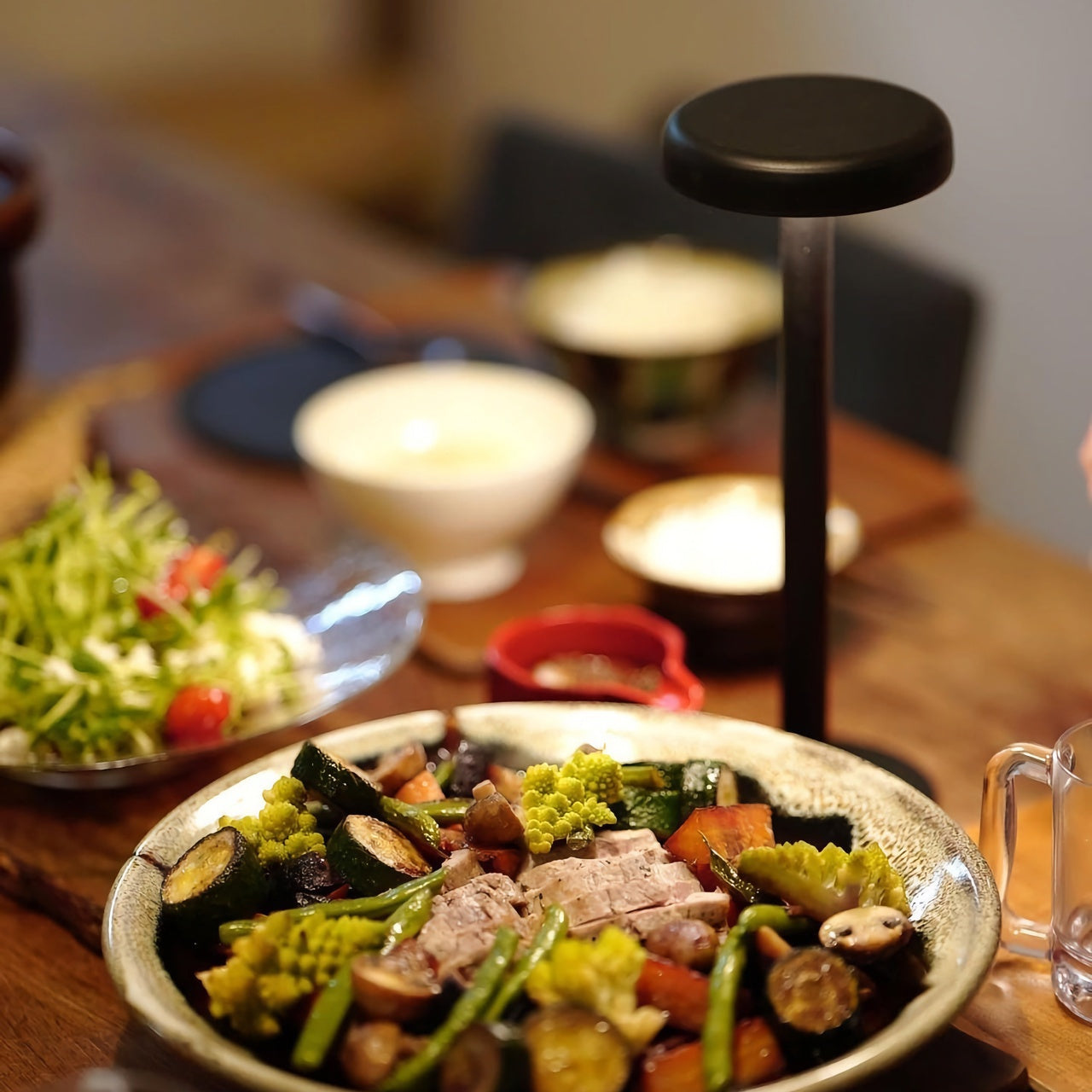
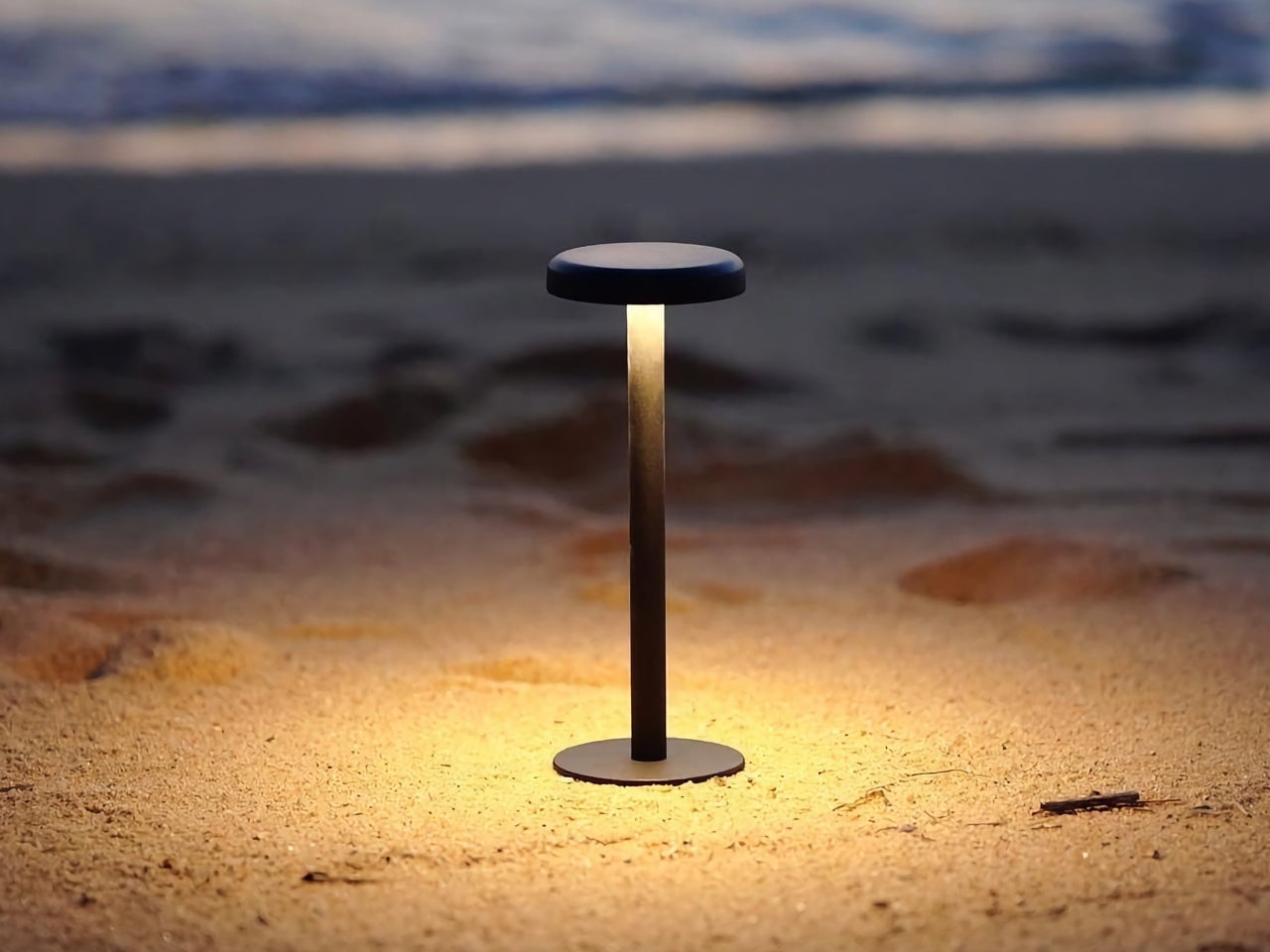
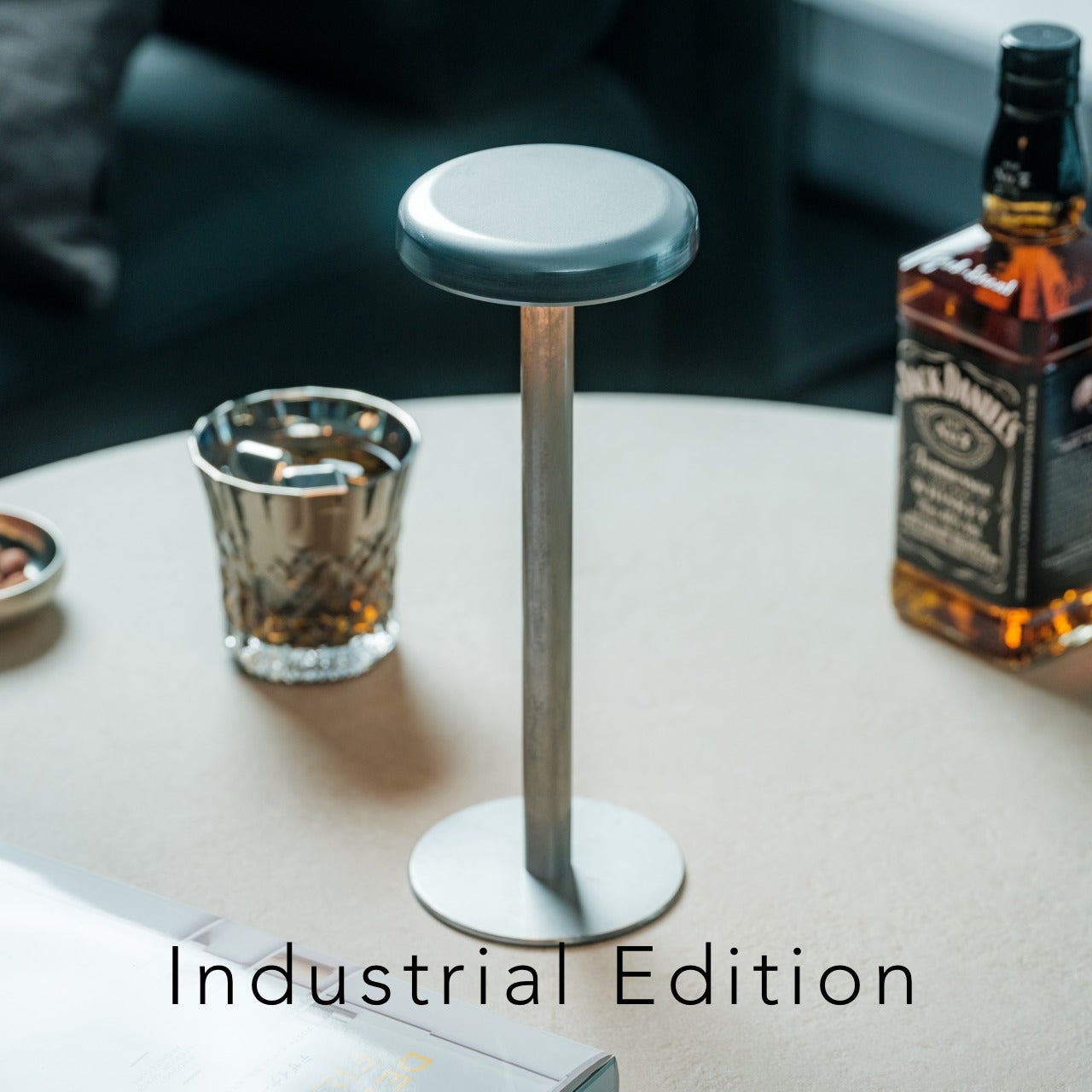
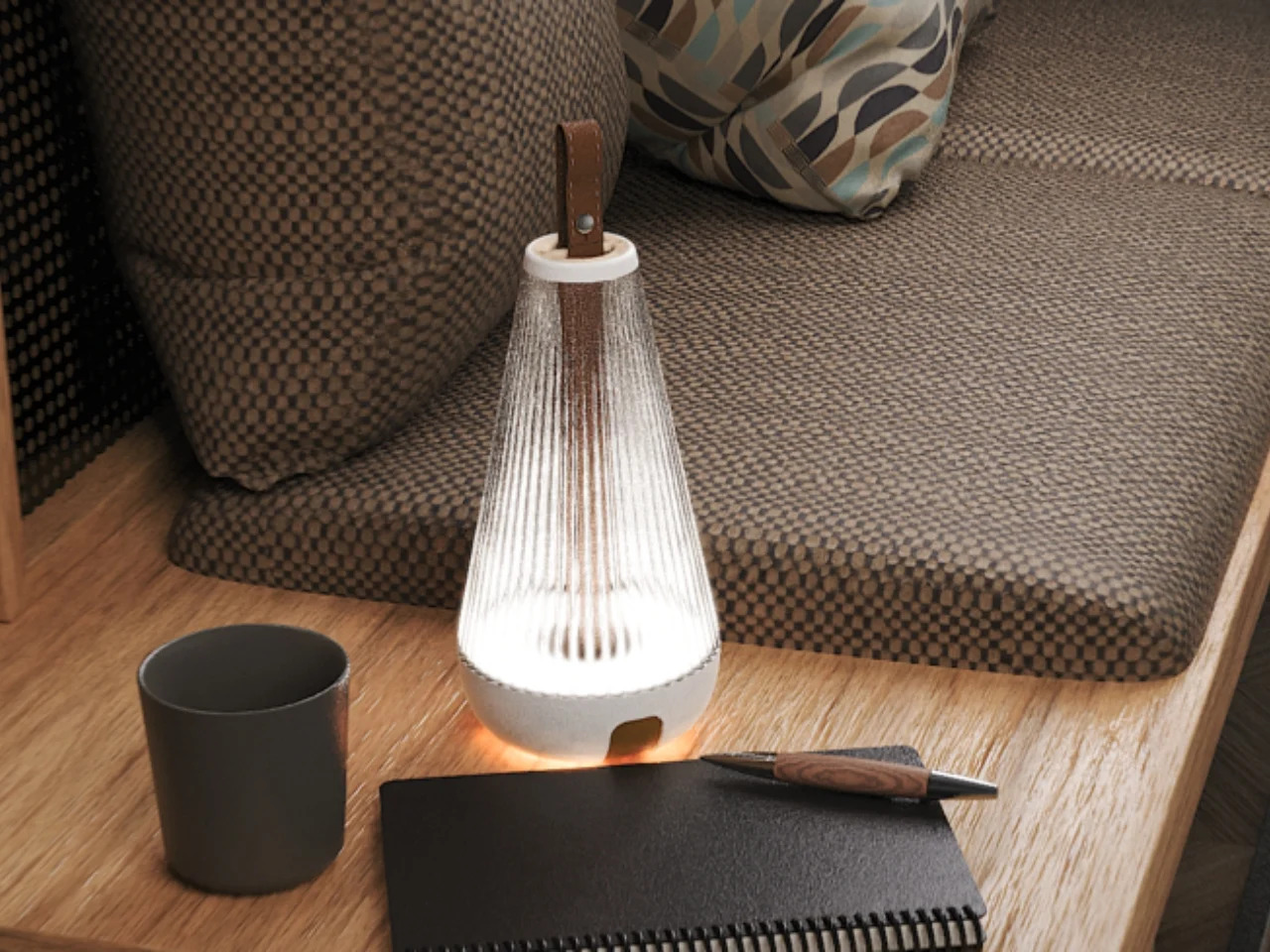
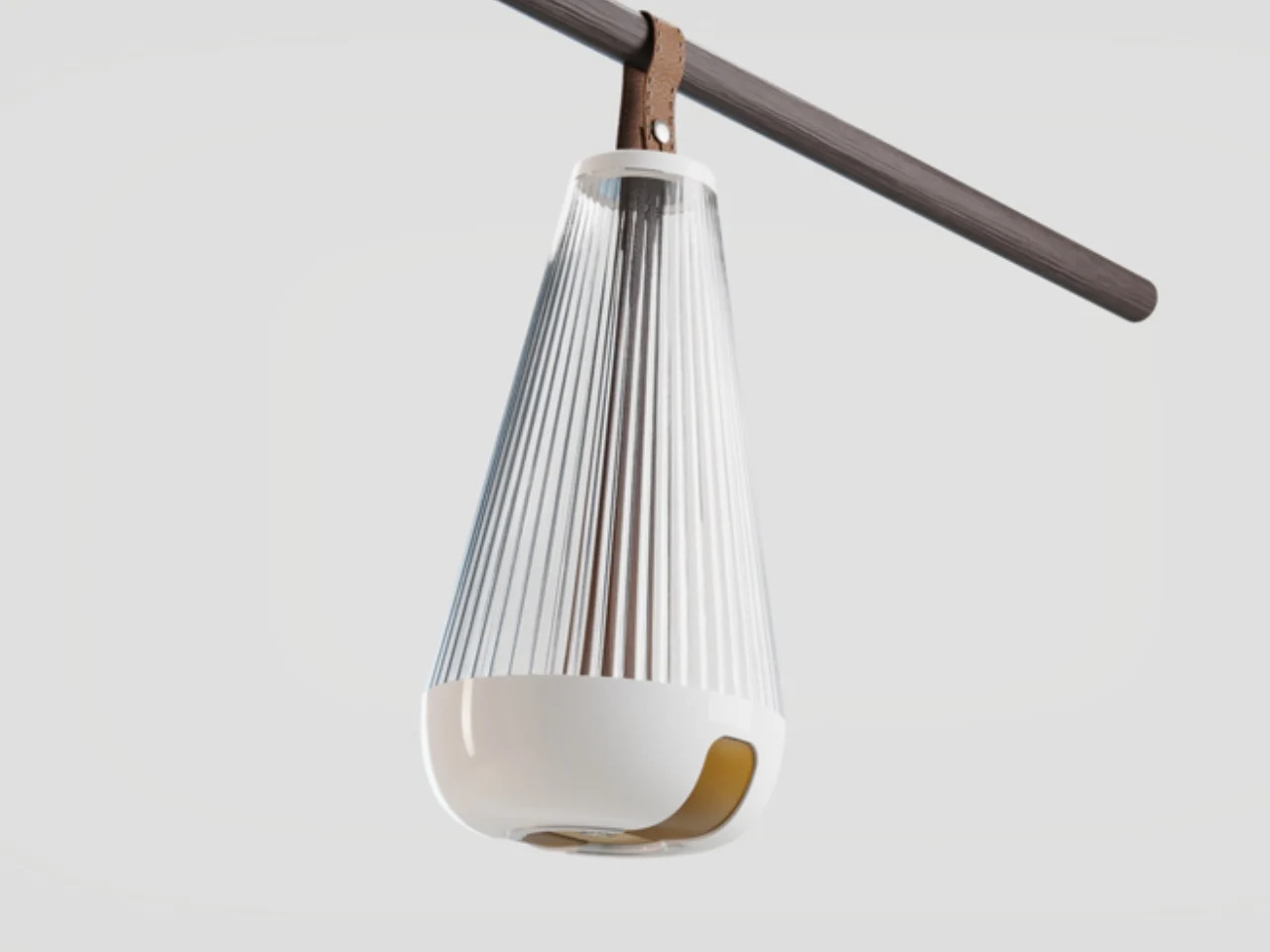
9 Cordless Lamps Killing the Dinner-Table Extension Cord

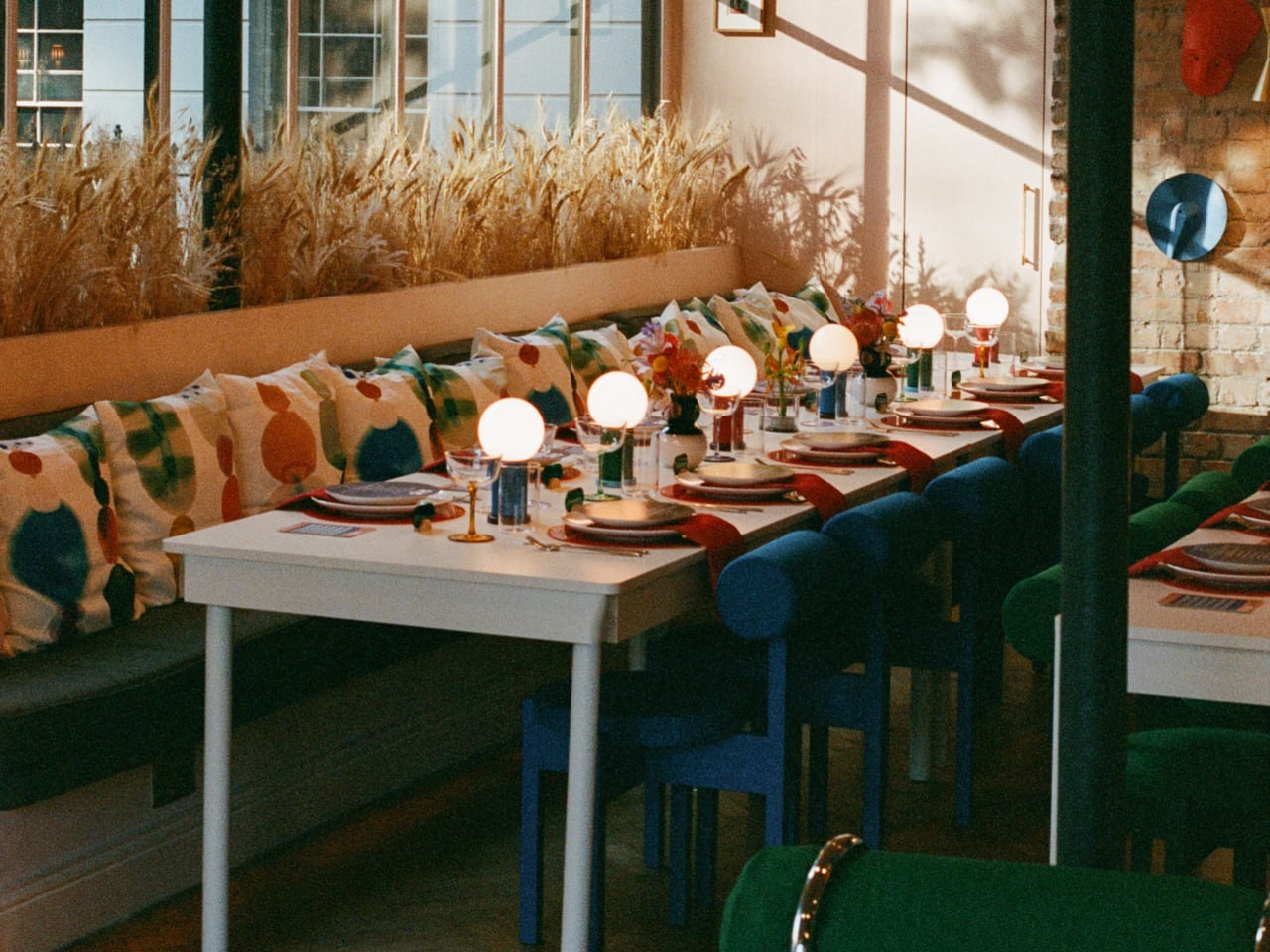
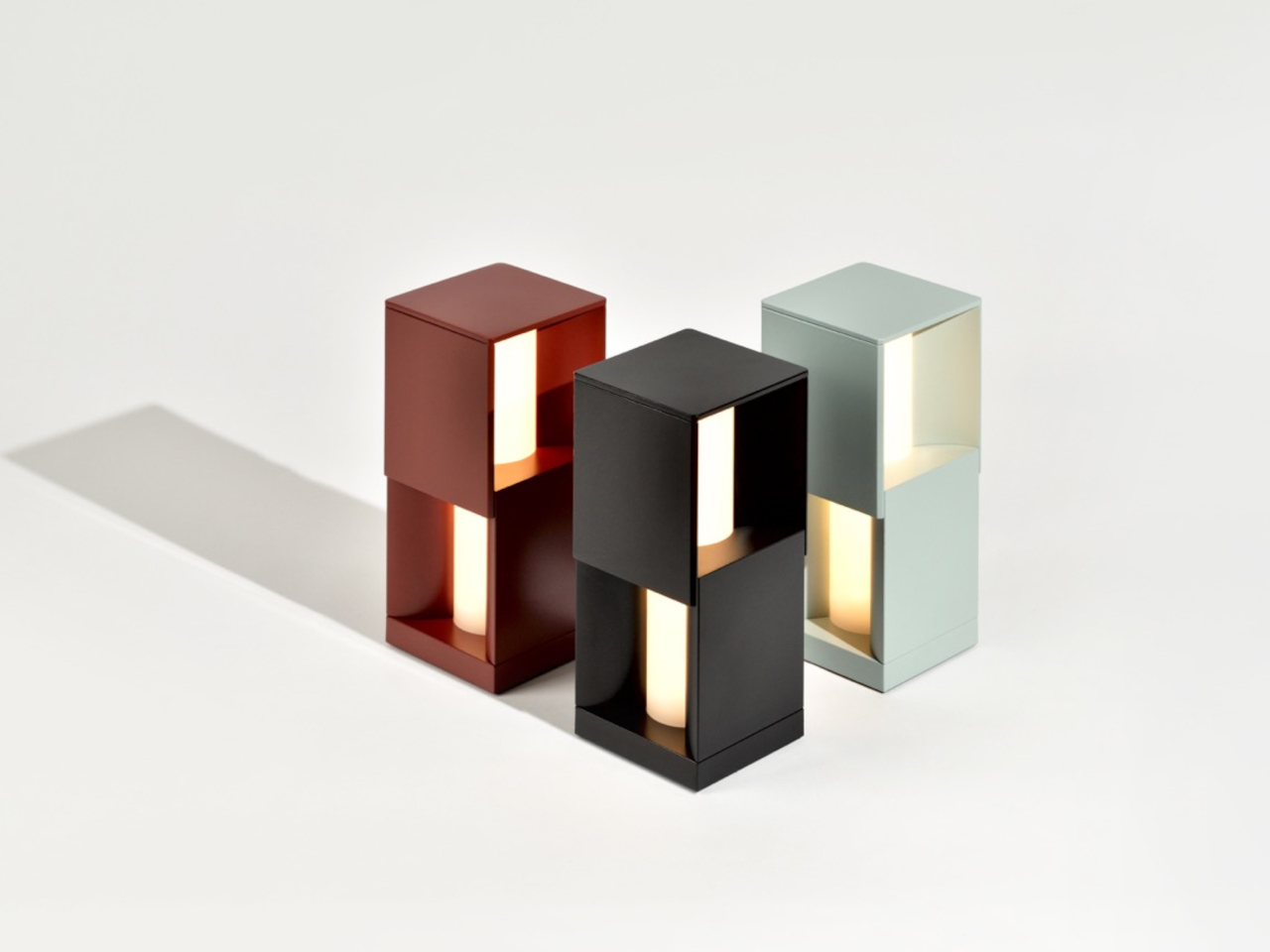
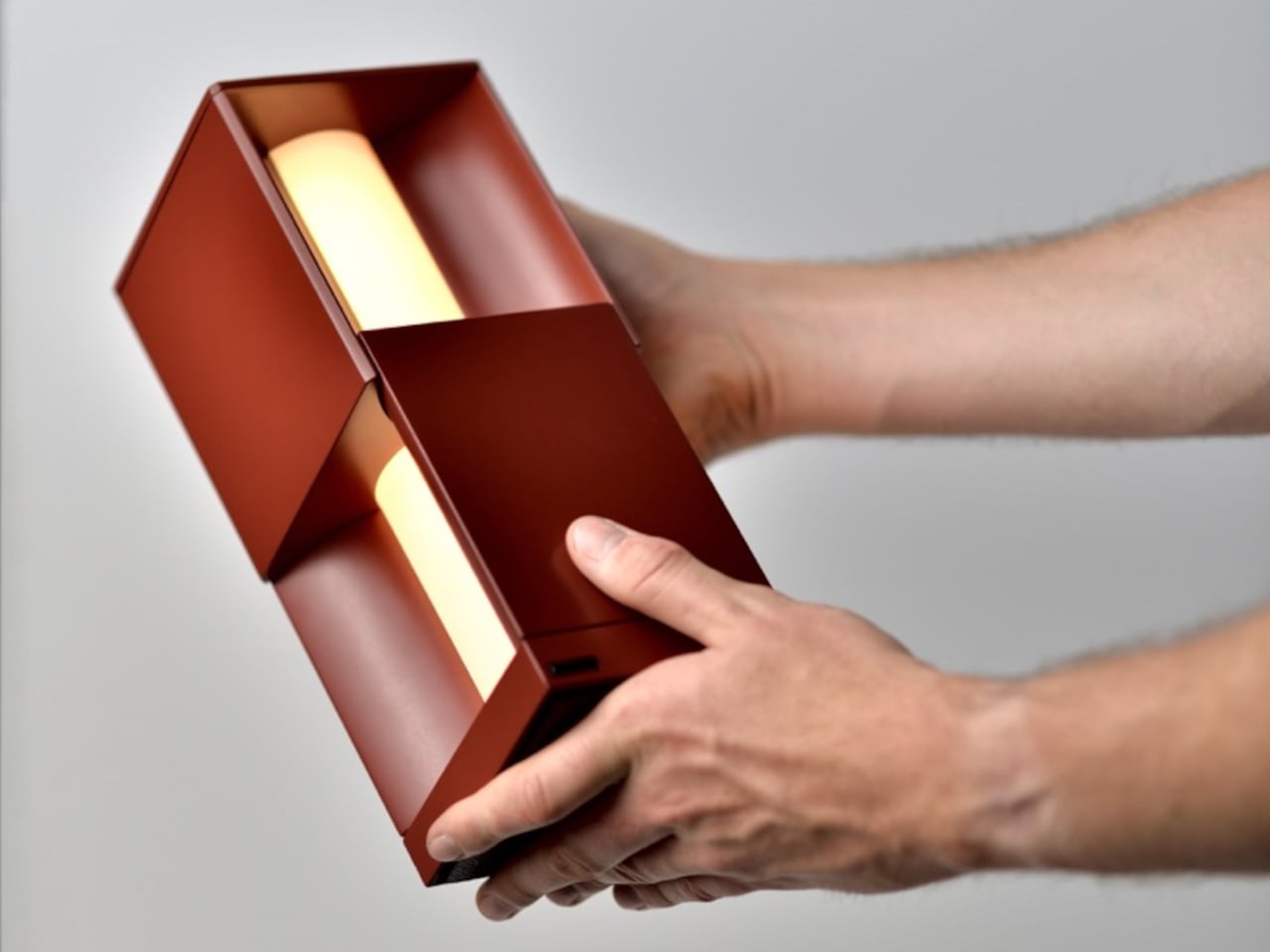
The rechargeable table lamp has been around for a while, but it hasn’t always been something designers were excited to work on. For most of its life, it was a category of hotel patios and restaurant terraces, objects tolerated for their practicality and forgiven for looking like camping gear. Most of them leaned on lantern shapes, chunky handles, and rubberized finishes that communicated utility before anything else.

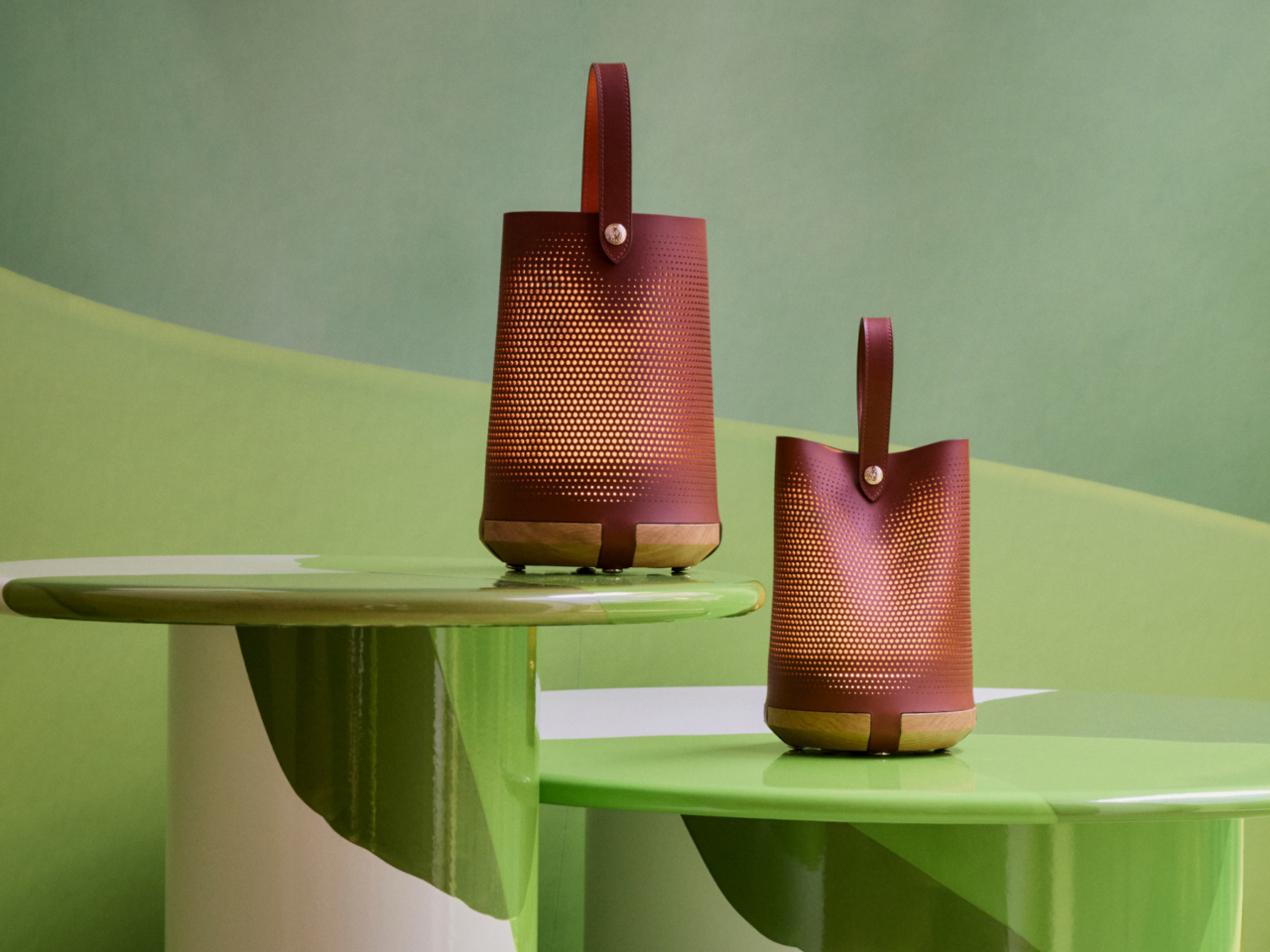
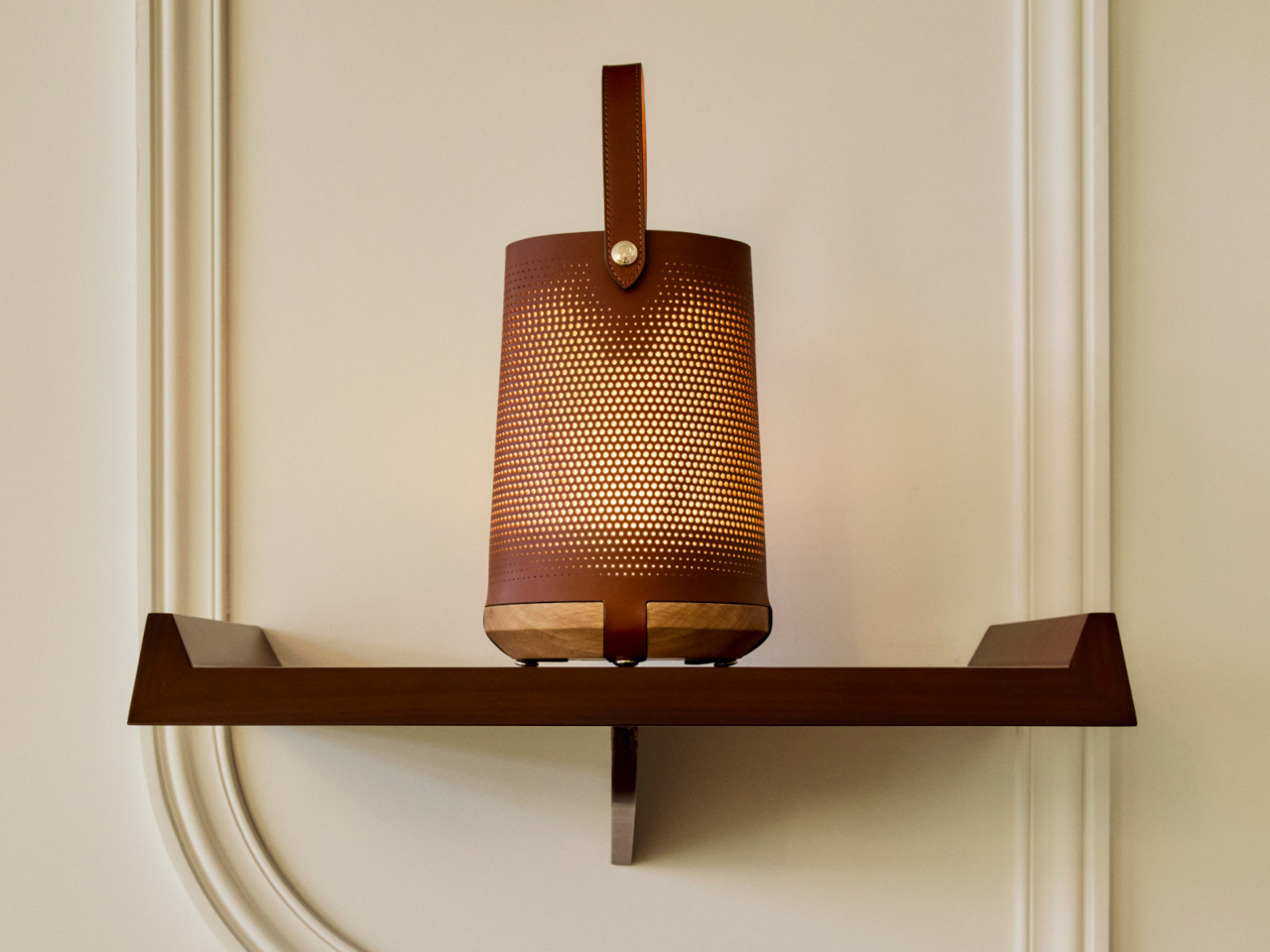
That started to change noticeably around Milan Design Week 2026, when the cordless lamp stopped being a hospitality accessory and became something designers were treating as a proper object type. Alexander Pott did one for IKEA’s PS Collection. Studiopepe built an entire lamp family around it for Rakumba. Patrick Jouin wrapped one in micro-perforated leather for Longchamp. Suddenly, the rechargeable table lamp had a design argument behind it.

Photo courtesy of: Compton Coffee House

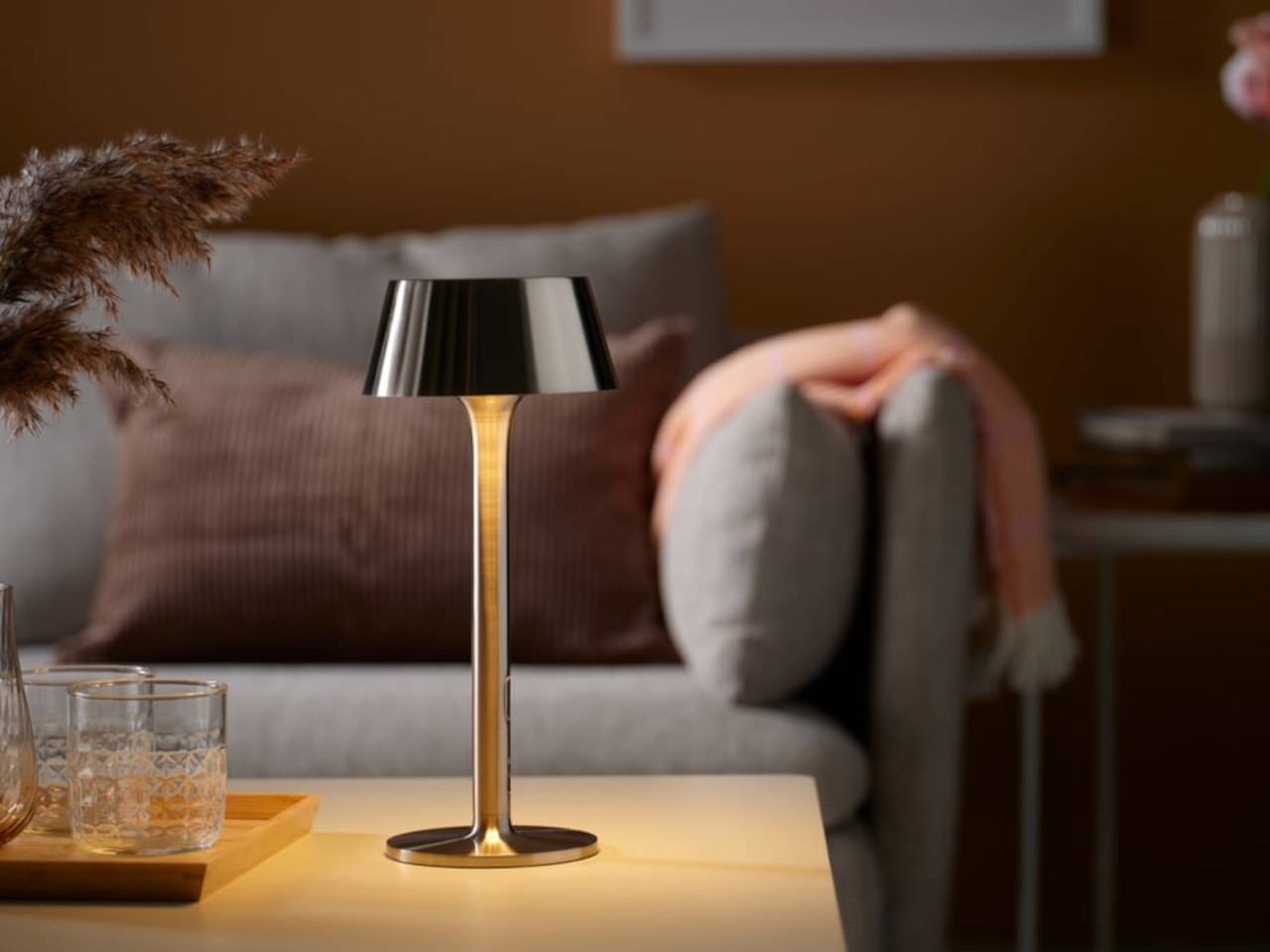
IKEA PS 2026 brings Alexander Pott’s cordless lamp to the mainstream

There’s a certain logic to watching what IKEA does with its PS Collection. The line has a history of giving up-and-coming designers a platform to push against convention, which means that when a rechargeable lamp shows up there, it’s worth paying attention. It signals that portable lighting has moved far enough into the mainstream that it deserves a considered, well-designed answer at an accessible price point.

Designer: Alexander Pott (IKEA)

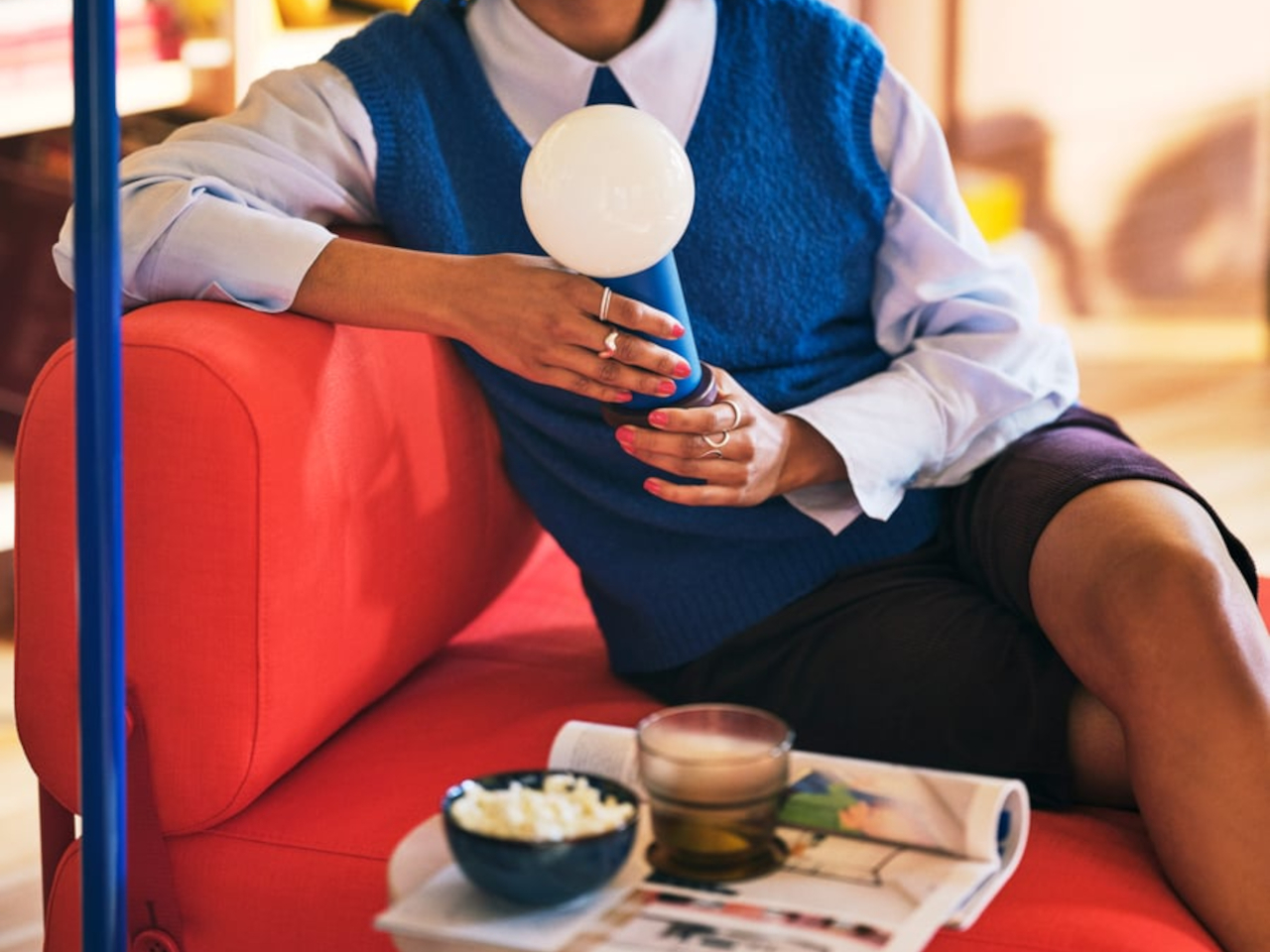
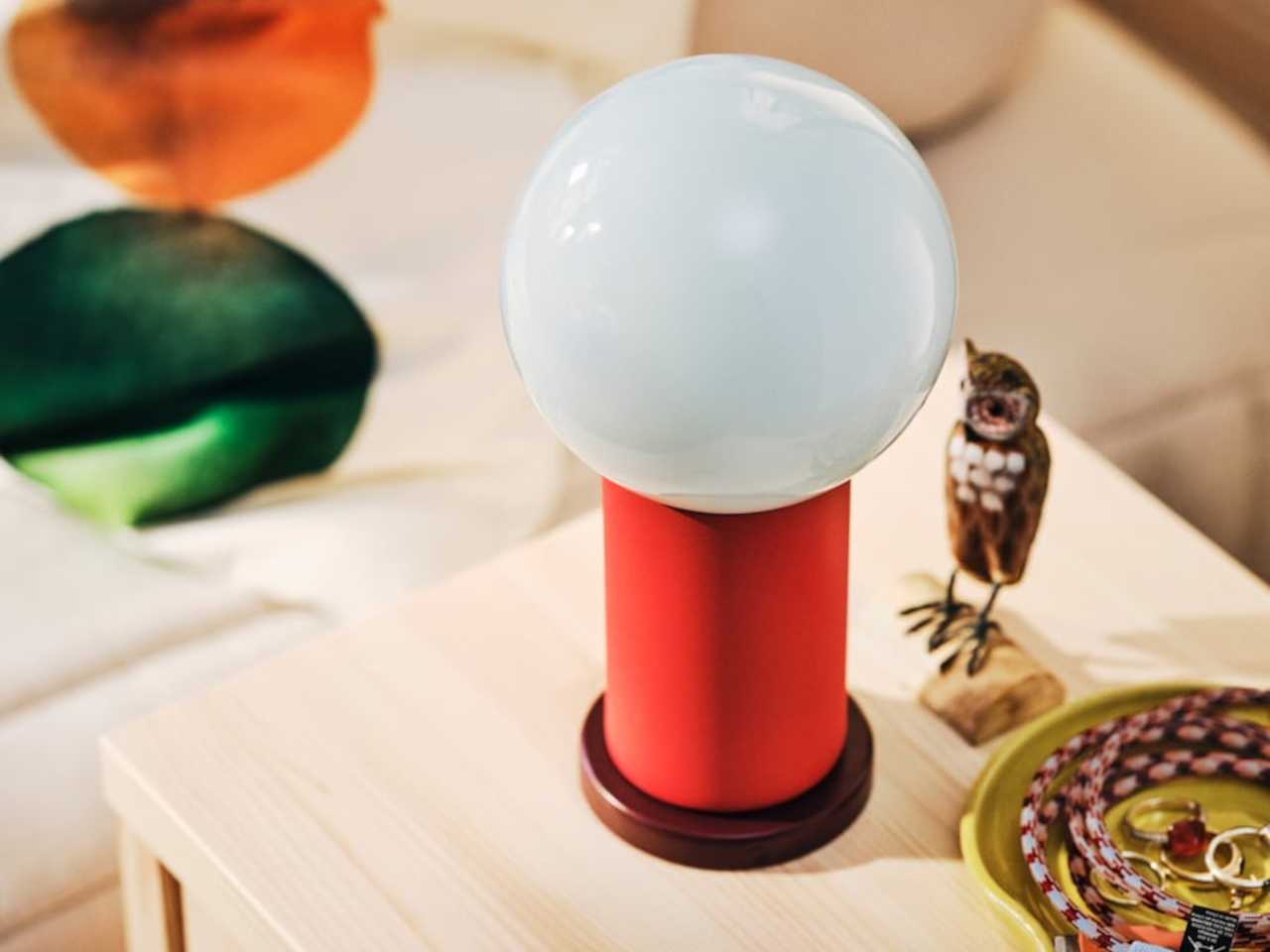
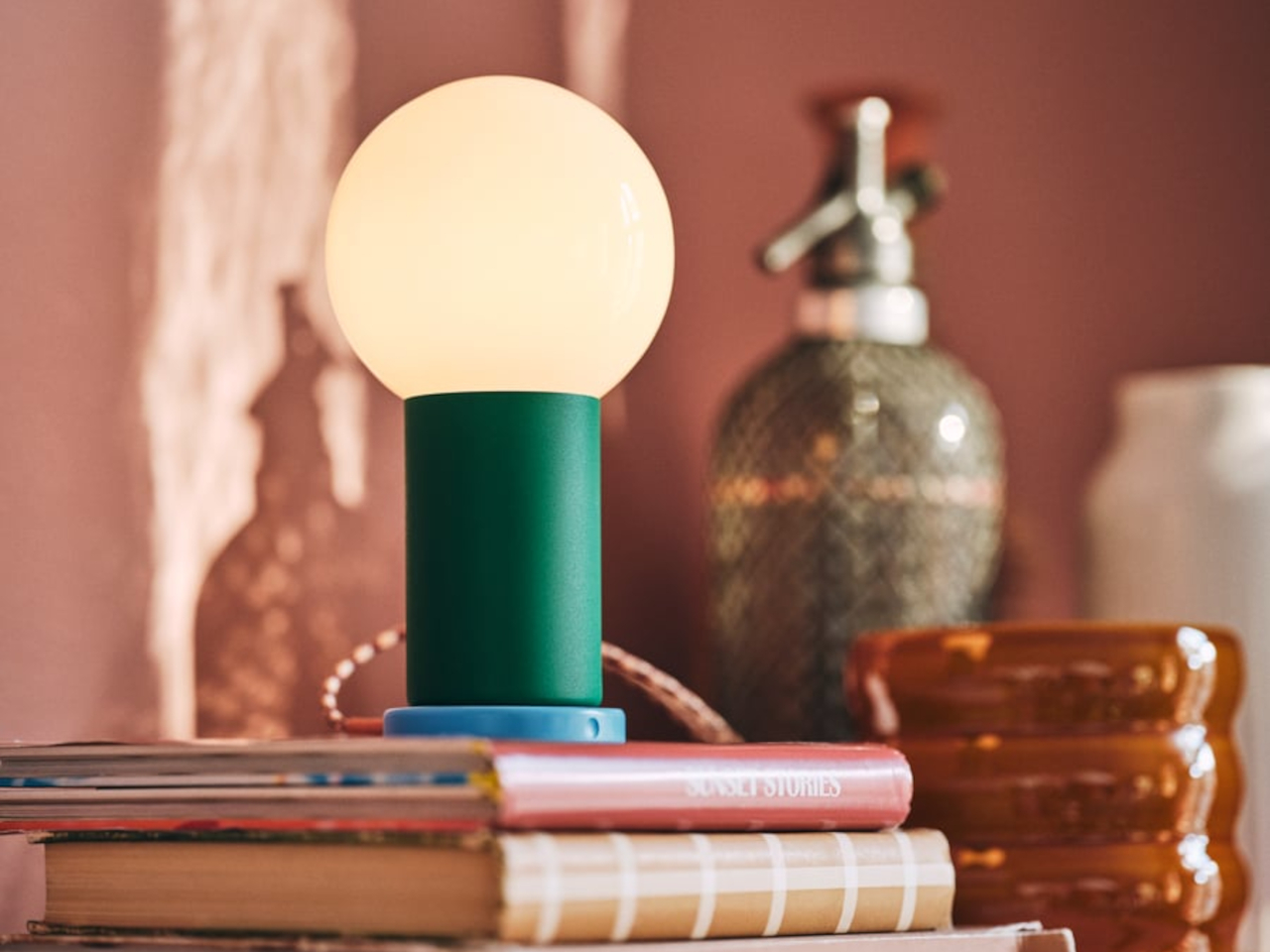
Alexander Pott’s design for the IKEA PS 2026 line keeps things deceptively simple: a metal-and-glass body with three dimming levels and a battery that frees you from thinking about where the nearest socket is. It comes in a few color combinations that make it feel more playful than precious, and it’s light enough to move from a dining table to a windowsill without making it a whole thing.

Studiopepe’s Torre family gives Rakumba a fully rechargeable lamp line

One-off cordless lamps are easy enough to find, but a whole family of them built around a consistent design language is something else. It suggests that whoever made it isn’t treating the rechargeable lamp as an afterthought or a novelty but as a genuine product category worth investing in. That’s the kind of thinking Studiopepe brought to their Torre line for Rakumba, and it shows.

Designer: Studiopepe

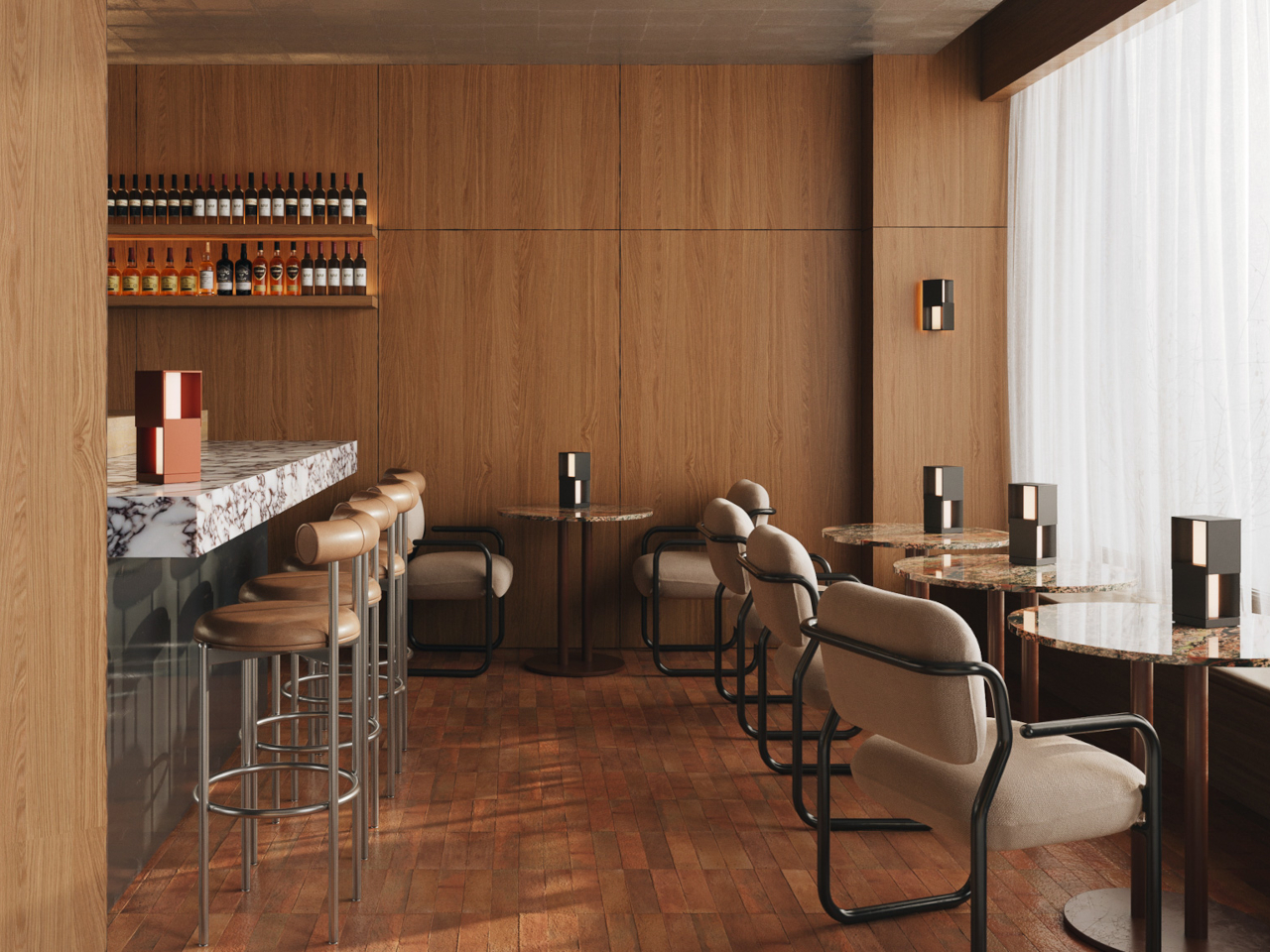
The Torre family doesn’t try to hide what it is. The forms are clean and architectural, built for spaces where the lighting is meant to feel intentional rather than improvised. The concealed light source keeps it calm in a room, and being rechargeable means it can move between an indoor shelf and an outdoor table without losing any of that composure in the process.

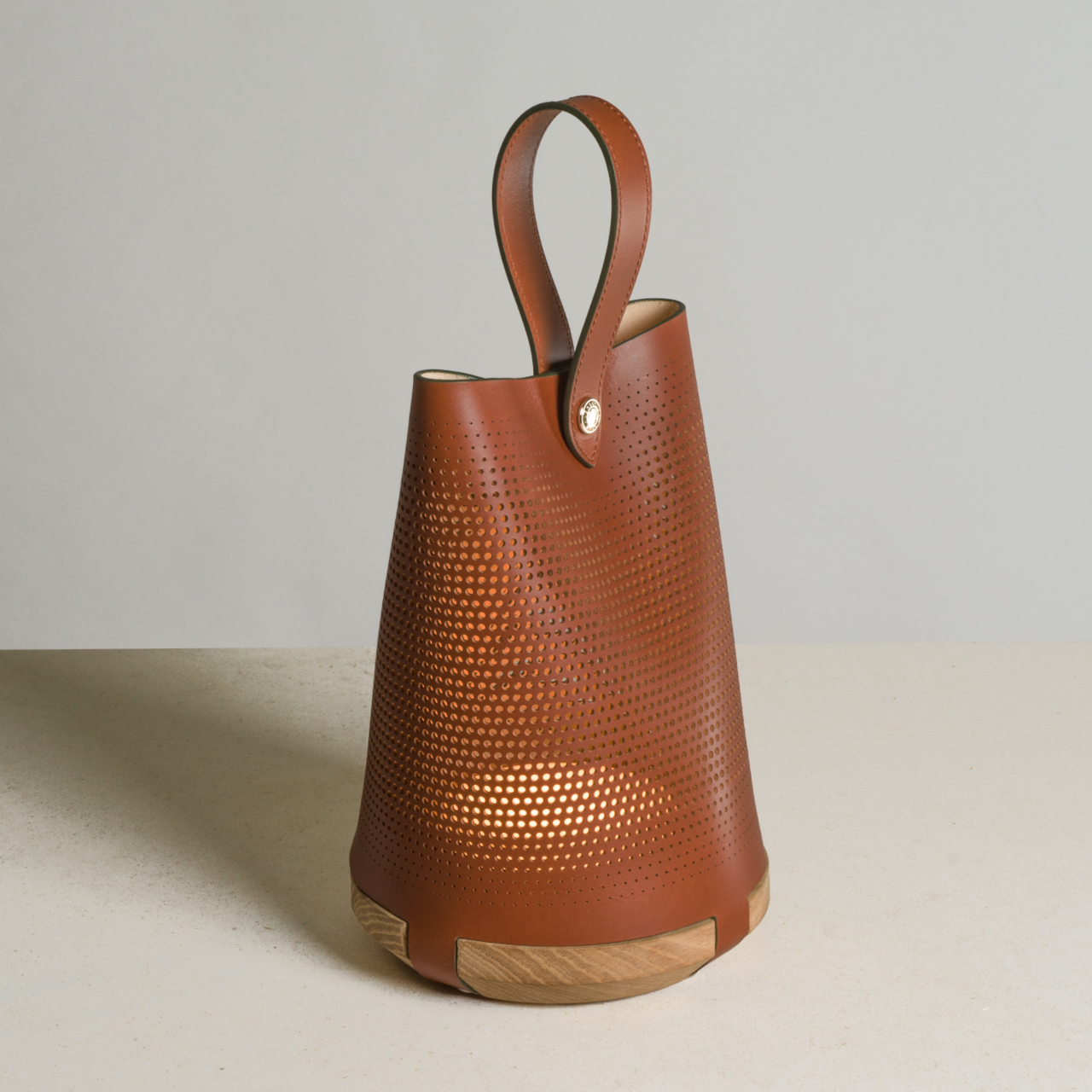
Ostara is what happens when Longchamp and Patrick Jouin design a lamp together

Fashion and luxury brands don’t wander into product design unless they see a genuine opportunity to say something with the object. The result is usually either impressive or awkward, with little in between. With Ostara, Longchamp and Patrick Jouin landed on the right side of that line, producing a rechargeable lamp that feels less like a lifestyle extension and more like a considered design object.

Designer: Longchamp x Patrick Jouin

Jouin used micro-perforated leather for the shade, which gives the light that comes through it a texture that’s harder to achieve with glass or plastic. Being wireless and rechargeable means it can sit on a dining table or a bedside surface without the visual interruption of a cord, which matters more in a lamp built around intimacy and atmosphere than around raw output.

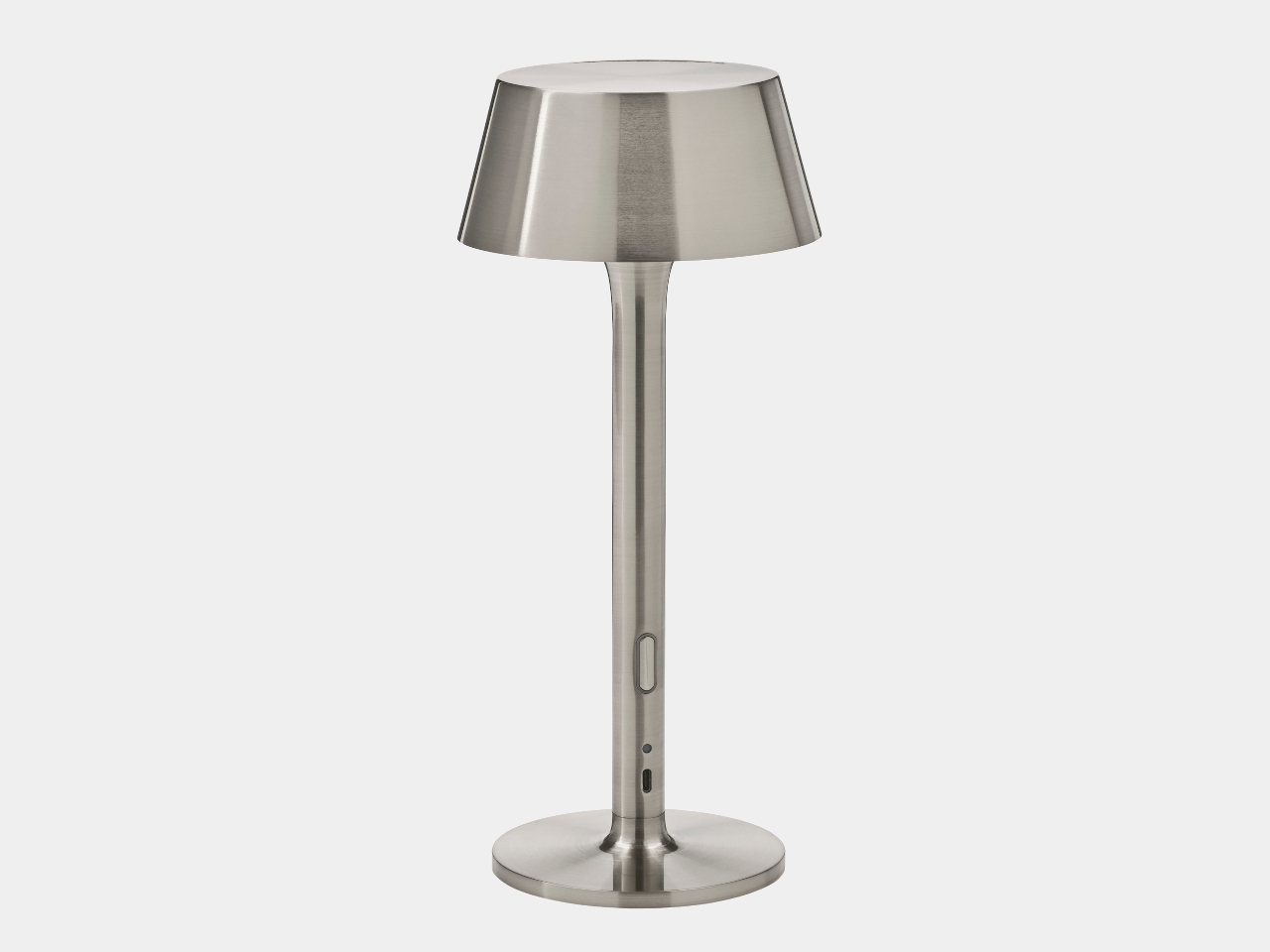
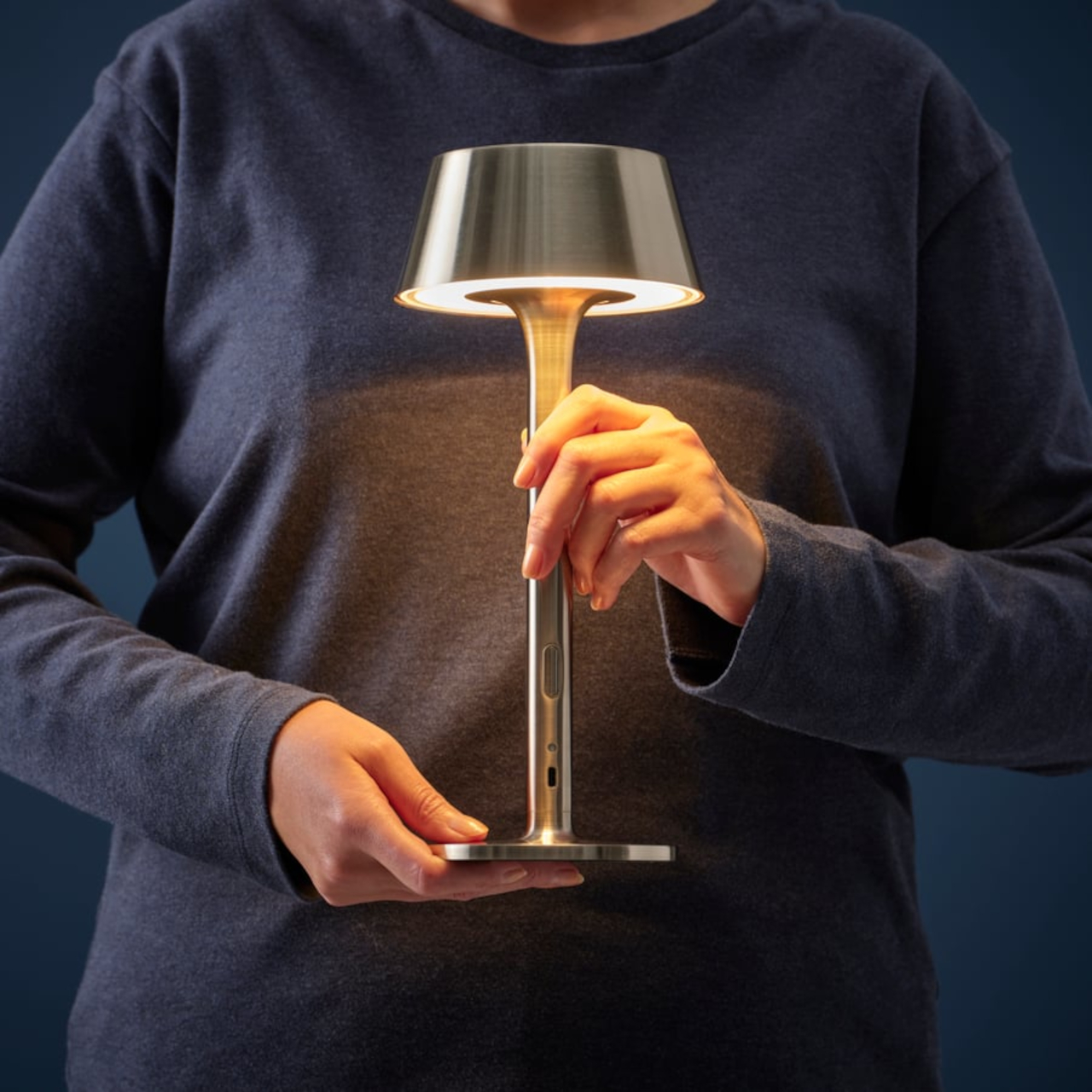
IKEA AVHÅLL goes outdoors without looking like it belongs there

There’s a frustrating design problem at the heart of most outdoor-rated portable lamps. They want to be taken seriously as practical objects, so they usually adopt a rugged aesthetic that makes them look slightly out of place indoors. Bringing one in from the balcony feels like dragging a piece of patio furniture into the living room, which is exactly the kind of visual compromise most people don’t want to make.

Designer: Carl Öjerstam (IKEA)

The AVHÅLL handles that transition more gracefully than most. It’s a metal lamp with three dimming settings and enough weather tolerance to live on a terrace, but it doesn’t dress itself up in tactical styling or rubberized finishes to make that point. At $39.99, it’s the kind of object that can light an outdoor dinner, come back inside afterward, and not look out of place in either setting.

The Anywhere-Use Lamp makes the case for AA batteries over built-in cells

Not every cordless lamp needs to carry a built-in battery to justify its place in this conversation. The Anywhere-Use Lamp makes a different kind of case: four AA batteries instead of a sealed internal cell, which sounds like a step backward until you factor in that rechargeable AAs are widely available, easy to swap, and don’t degrade the way built-in batteries do after a couple of years of daily use.

Click Here to Buy Now: $149.00

It moves freely between a desk, a bookshelf, a bedside table, or an outdoor corner without needing a socket or a charging cable. Four brightness levels cycle through a tap of the cap, and the whole thing breaks down flat when you need to pack it. At $149, it isn’t cheap, but the placement freedom it offers is the kind that genuinely changes how you think about where light belongs.

Melt is one of the more dramatically finished lamps on this list

Once the rechargeable lamp stopped having to justify itself as a practical solution, designers had more room to get expressive. The form no longer had to be neutral or apologetic, which opened the door for objects that could hold their own in a room even when they weren’t switched on. That’s a higher bar than most lamps are held to, and one worth reaching for.

Designer: Tom Dixon

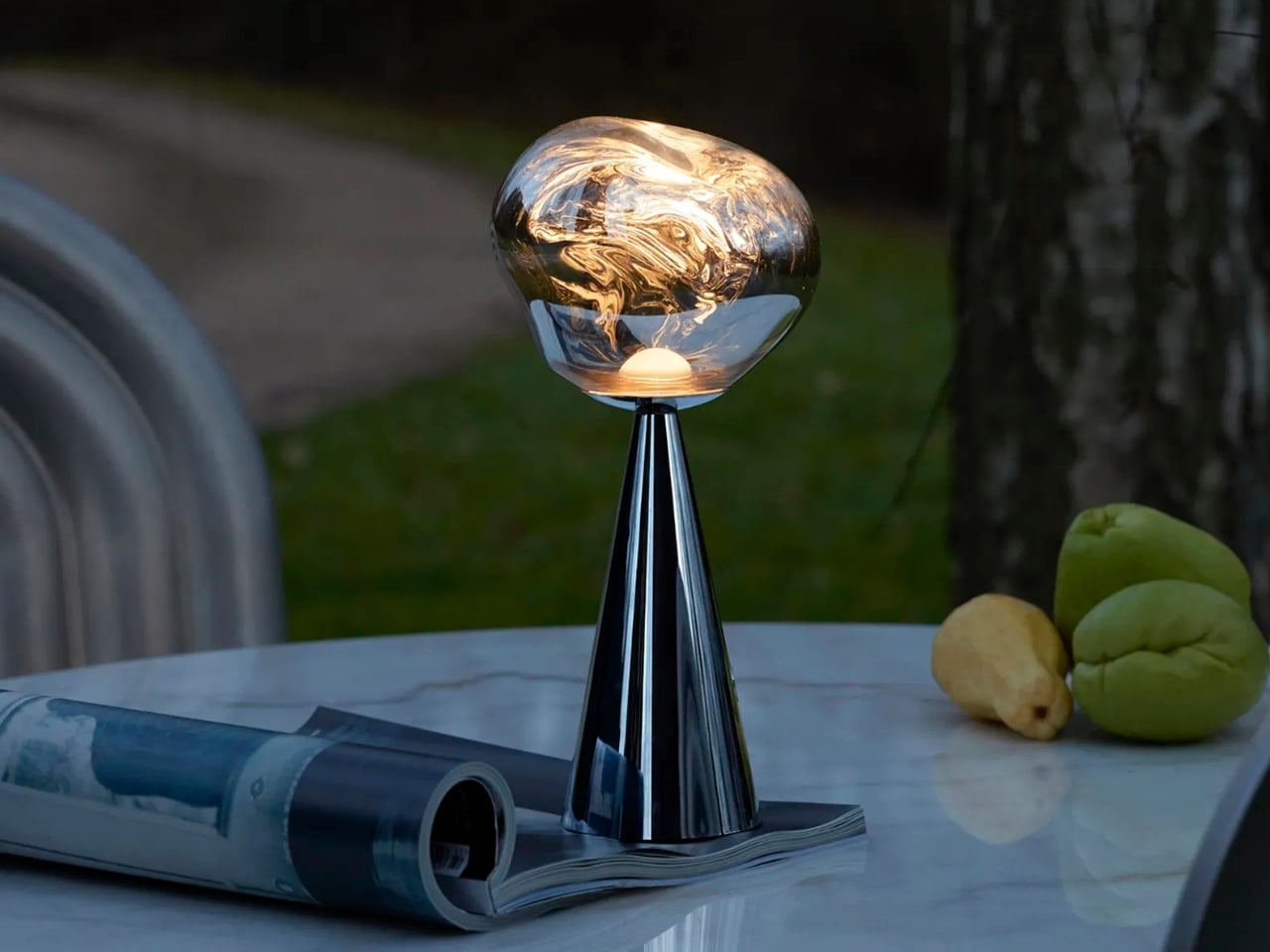
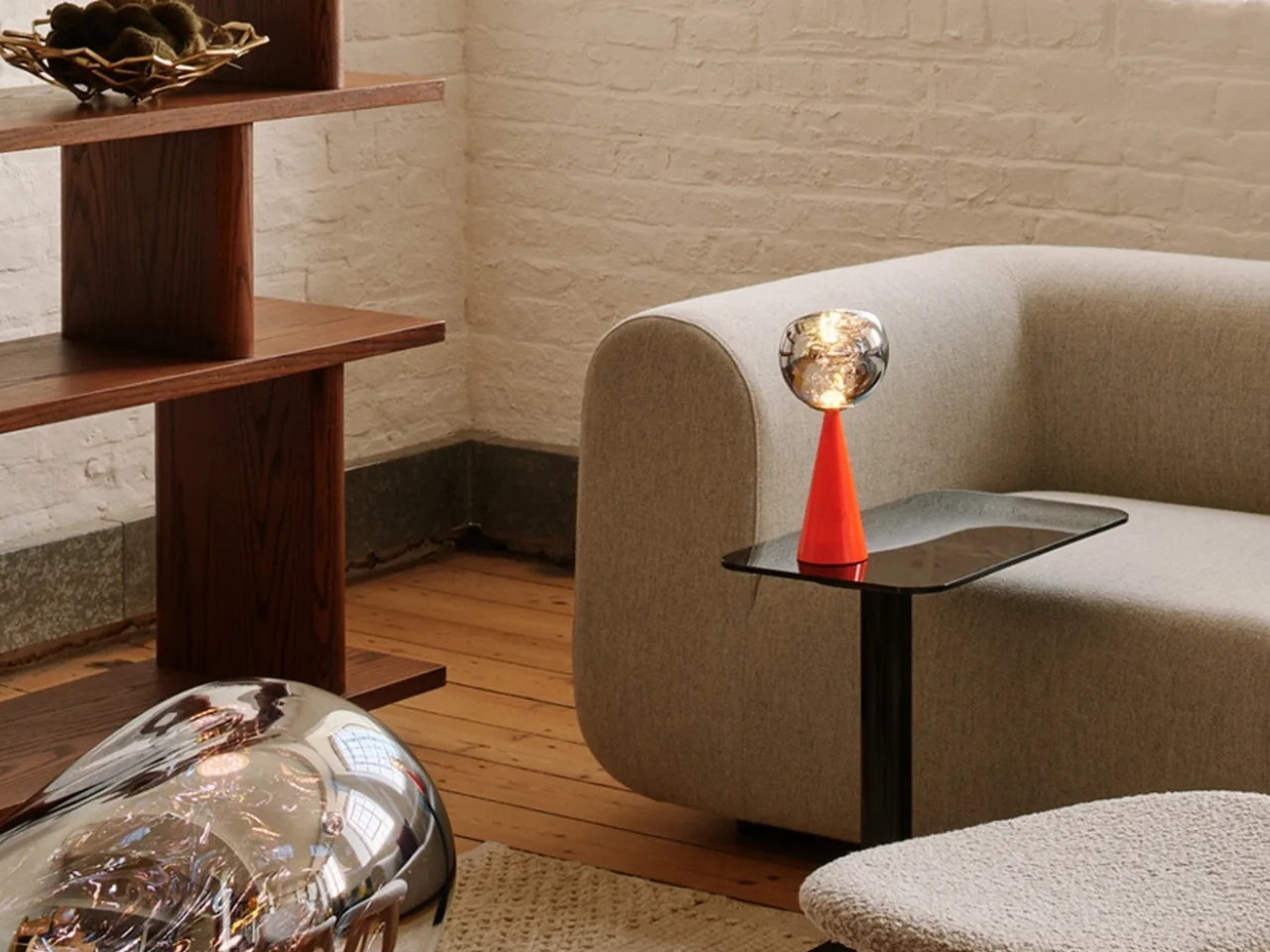
Melt leans into that idea pretty directly. Its surface treatment mimics the look of metal mid-pour, giving it a kind of arrested-motion quality that makes it genuinely interesting to have around. It also runs for up to 10 hours on a single charge, which means it can handle a long evening without going dark before the conversation does. At around $300, it’s the most overtly expressive lamp on this list.

Monir skips the app, the cord, and all the usual complications

There’s a growing exhaustion with lamps that want to be smart home hubs. At some point, the dimming app, the voice controls, and the tunable spectrum start feeling like overhead for something that’s supposed to quietly light a corner of the room. Not every lamp needs to be a connected device, and it’s becoming clearer that the most relaxed interiors are often lit by the least complicated objects.

Designer: Rahi Seyedi

Monir makes no effort to be anything other than a lamp. No app required, no cord in sight, and the whole thing is built from 100% recycled aluminum, which gives it a quieter kind of design intention than most objects in this space. Its moon-inspired form is soft enough to fit into a bedroom or reading corner without demanding attention, just providing a warm, ambient glow when you need it.

Fluted questions what the portable lamp’s silhouette should look like

The lantern is the oldest visual reference point in portable lighting, and it’s also one of the hardest to escape. Designers keep reaching for it because it signals mobility and self-sufficiency, but it also carries a lot of campsite and emergency-preparedness baggage that’s difficult to shed. Younger designers seem more interested in questioning those associations rather than just refining them, which is where things get more interesting.

Designer: Benjamin Mtonya

Fluted, a student project recognized at the Core77 Design Awards, does exactly that. It borrows the lantern’s silhouette but softens its edges and refines its finish into something that reads less like outdoor gear and more like an object you’d actually want to keep on a shelf. It’s a concept rather than something you can order today, but it points at where the category’s visual language could go next.

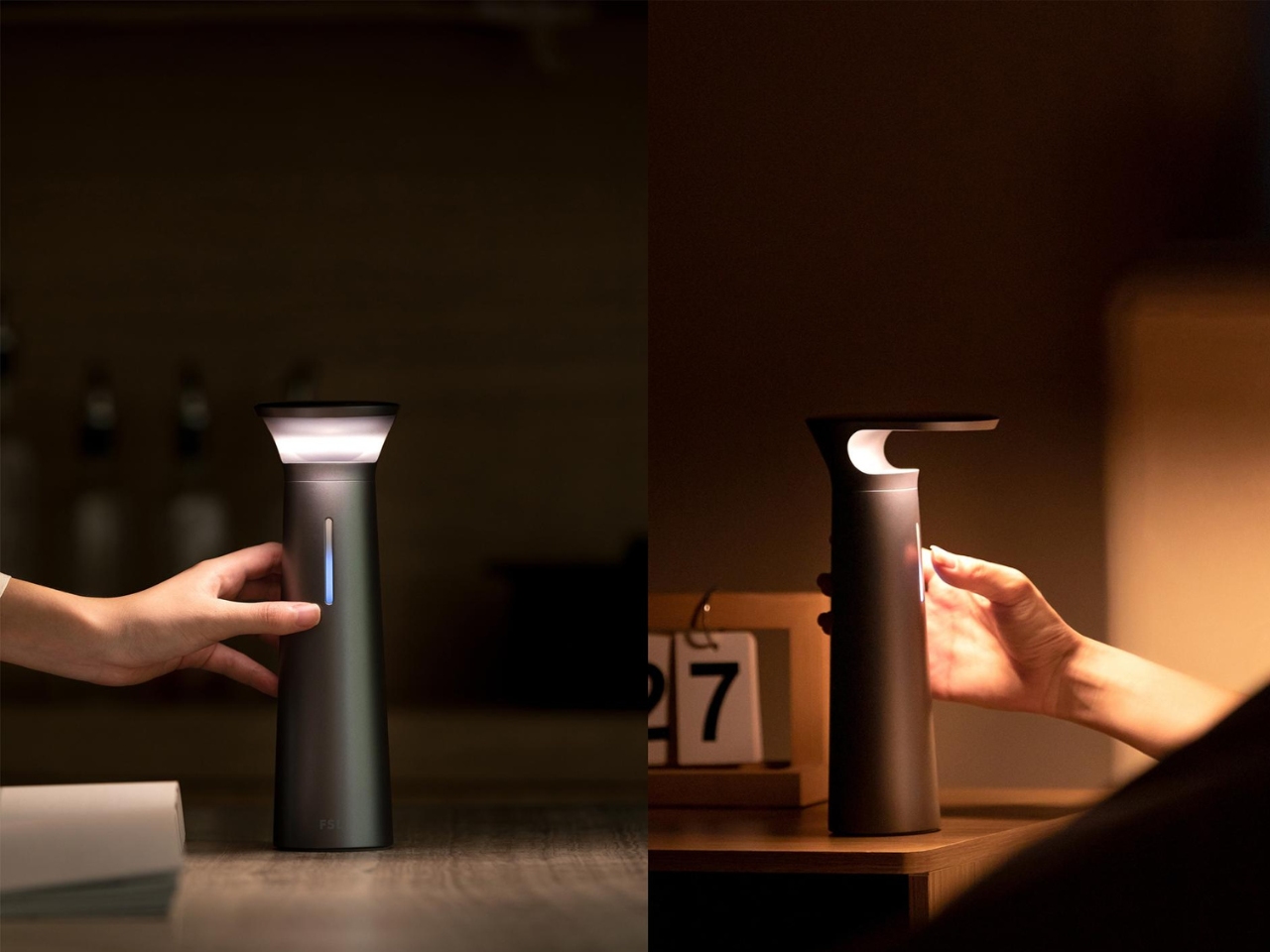
The FSL Wireless Portable Desk Lamp doesn’t know which category it belongs to

Desk lamps and table lamps have always played by slightly different rules. A desk lamp is positioned and pointed; a table lamp is placed and left alone. That distinction made a lot of sense when both types were tethered to a wall, but it starts to feel less rigid when the power source is no longer doing the work of keeping the object in one place.

Designer: FOSHAN ELECTRICAL AND LIGHTING

The FSL Wireless Portable Desk Lamp sits comfortably in that gap. It carries the directed functionality of a task light with the portability of an object that doesn’t belong to any single corner of the room. It can move from a desk to a dining table to a nightstand without asking for a socket along the way, which quietly makes the case for what cordless lighting could become.

The post 9 Cordless Lamps Killing the Dinner-Table Extension Cord first appeared on Yanko Design.

Award-Winning Modular Lamp Turns Discarded Eggshells Into Sculptural Lighting

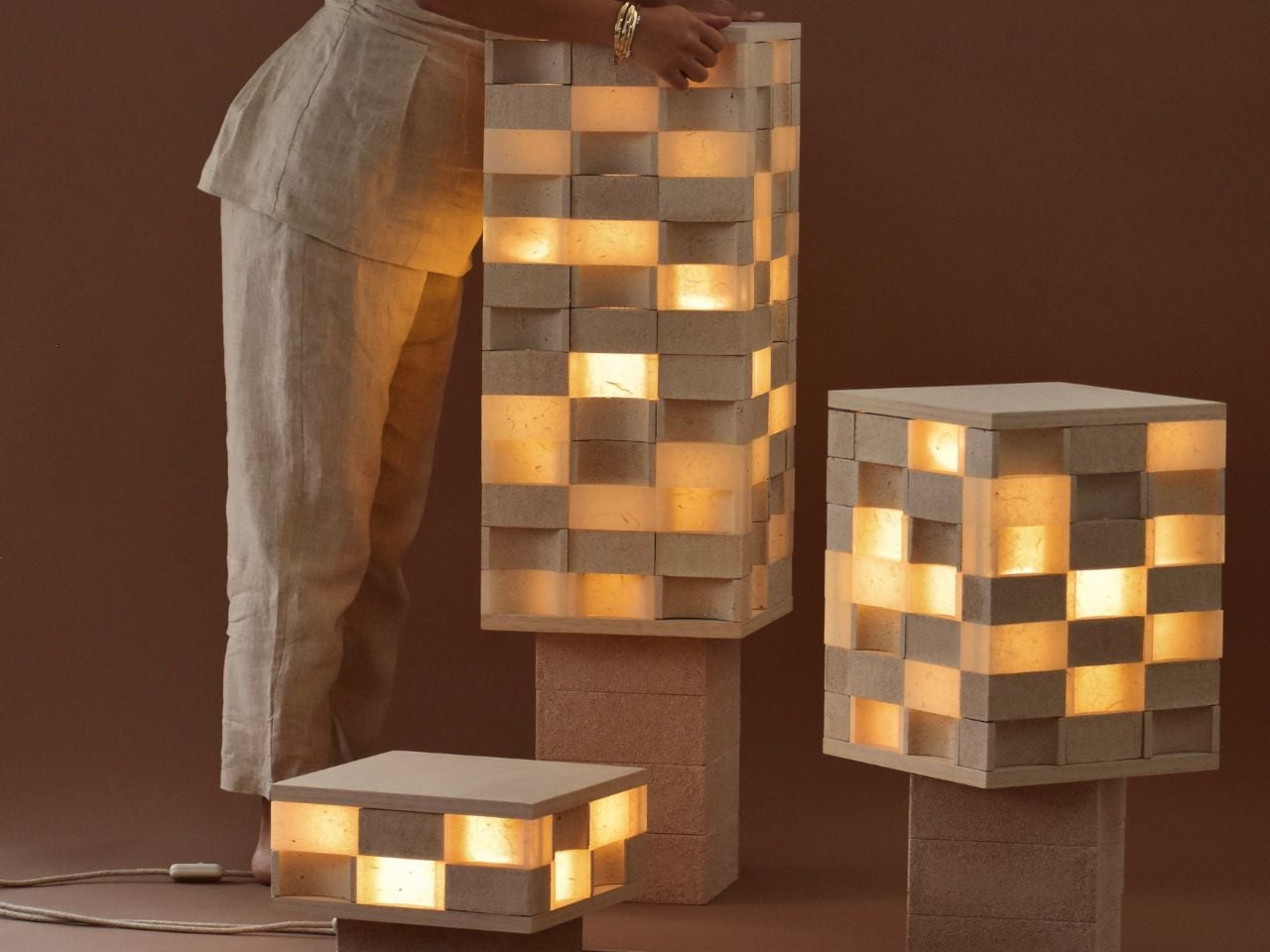
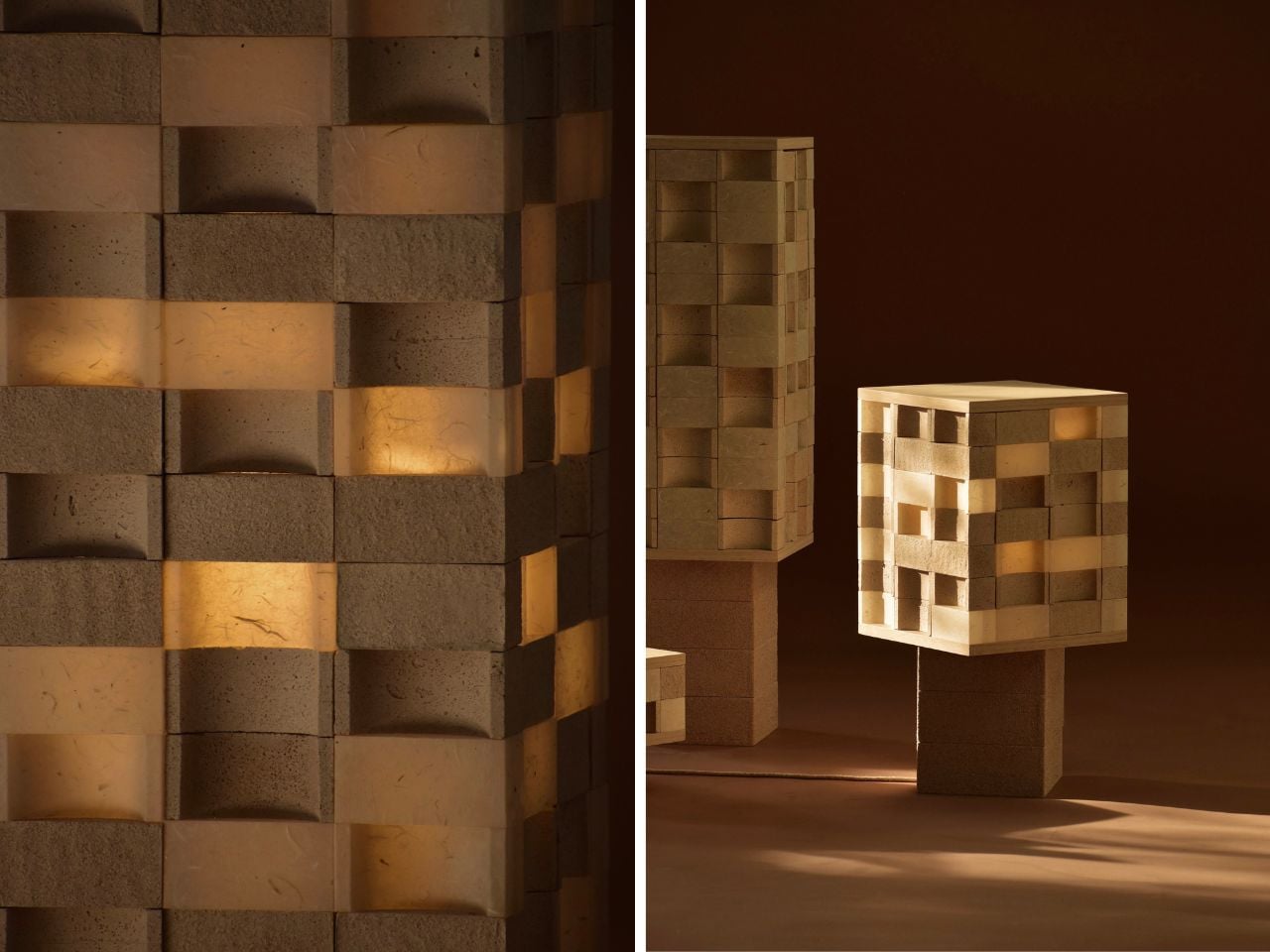
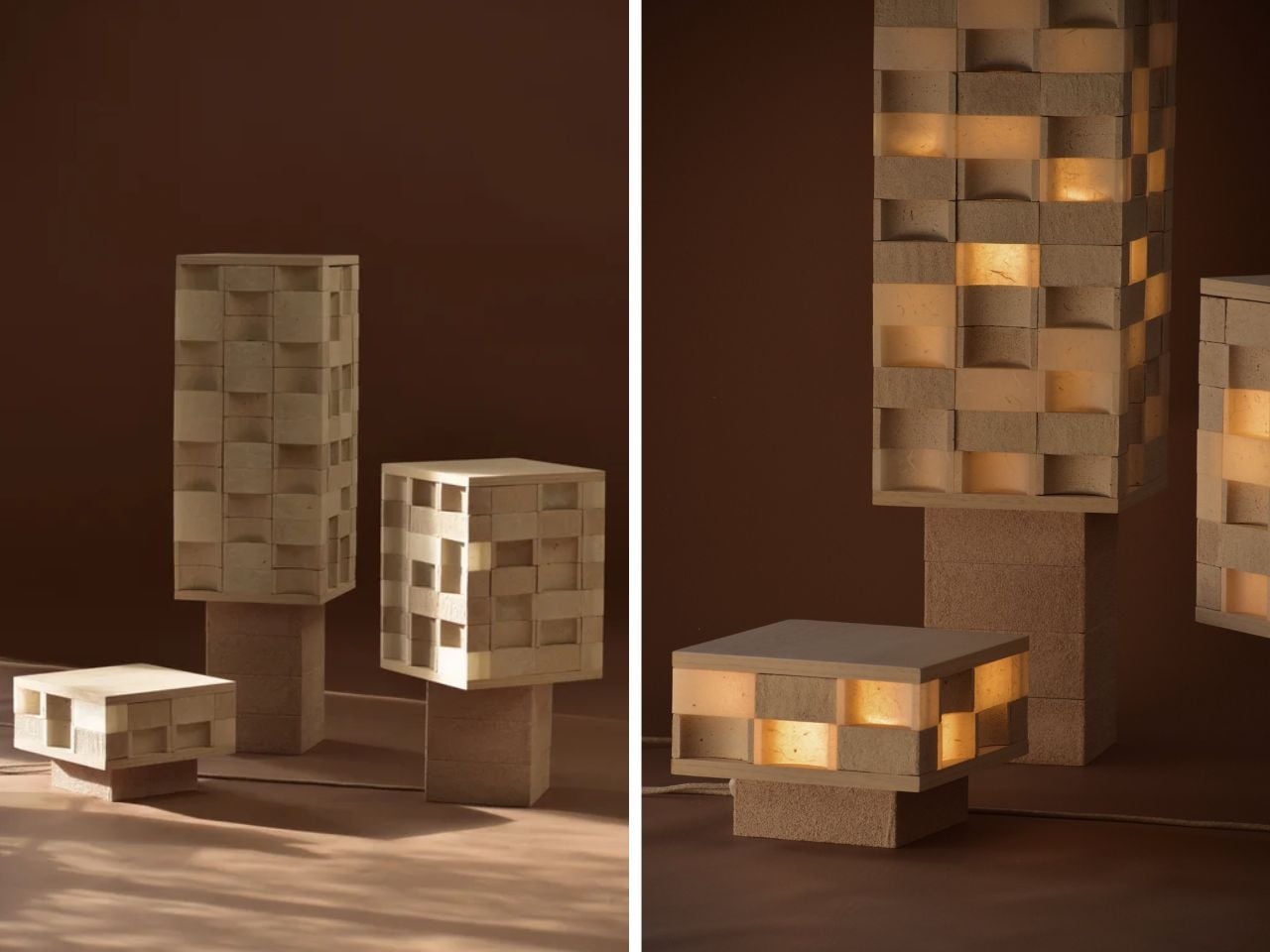
Joanne Odisho’s Mod-u lamp feels like the kind of object you want to touch before you fully understand what it is. Made from modular, Jenga-like blocks, the lamp sits somewhere between lighting, furniture, and sculpture. The surprise is its material. The Melbourne-based designer has created the piece using thousands of discarded eggshells collected from local cafes, turning a fragile everyday waste material into a durable, tactile, award-winning design.

The process starts in a very ordinary place: cafe kitchens. Odisho collects used eggshells, sterilises them, dries them, and crushes them into a fine powder using a Nutribullet. The powdered shells are then mixed with a biodegradable biopolymer to form a wet, sand-like composite. This mixture is poured into moulds and left to dry naturally for about a week. There is no firing process, no synthetic dye, and no complex industrial setup. Once cured, the material becomes hard and rock-like, while still holding onto the soft, natural tones of the eggshells themselves.

Designer: Joanne Odisho

The idea began in 2022 while Odisho was studying furniture design at RMIT. For a school assignment, she was asked to create a product using food waste. Her first experiments with coffee grounds did not work because they developed mould. Eggshells, however, offered something more promising. With inspiration from Materiom, an organisation focused on nature-based material innovation, she began testing how this overlooked kitchen scrap could become a strong, compostable design material.

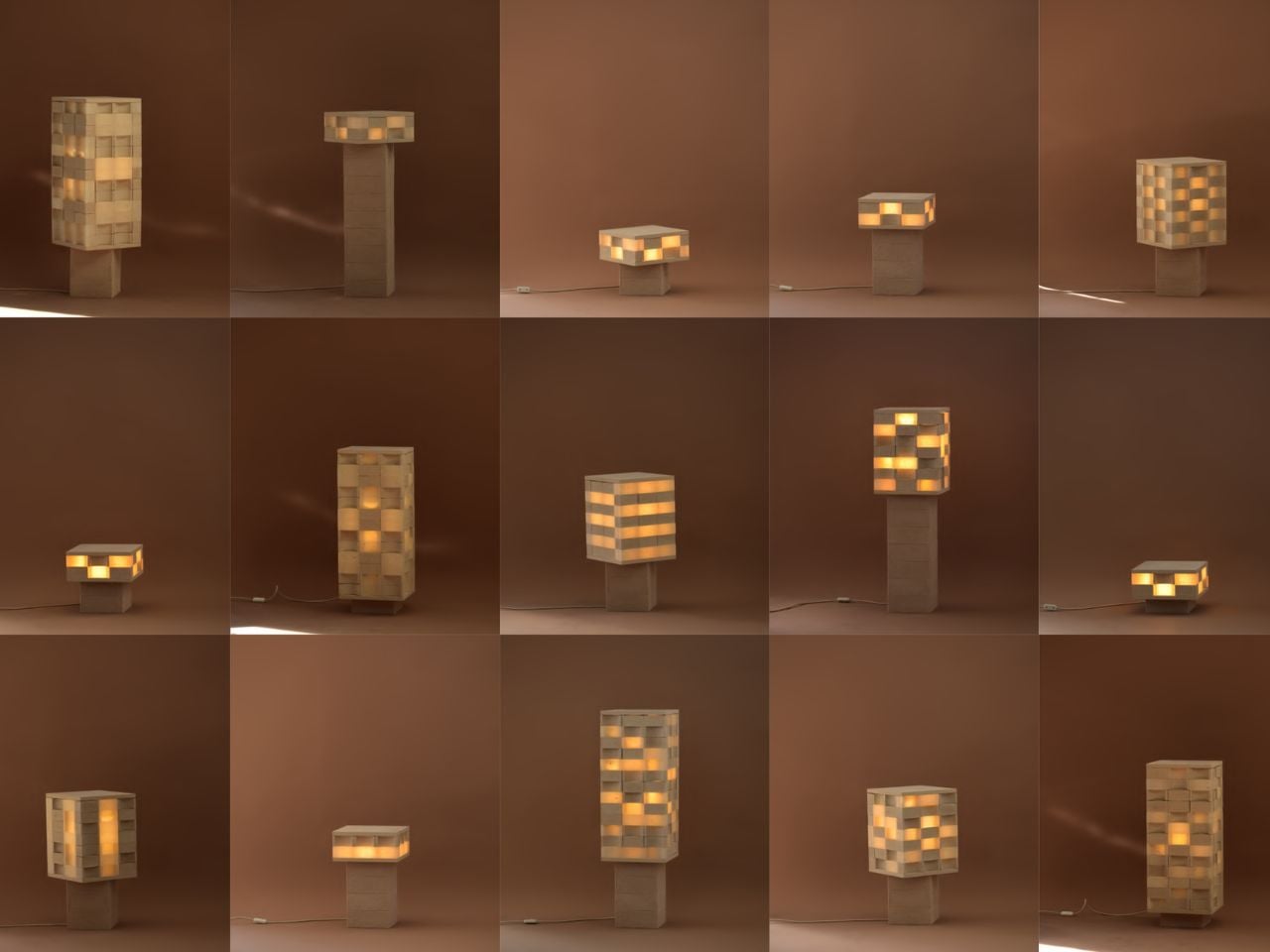
That material eventually became Mod-u, a collection of configurable lighting pieces made from dozens of individual eggshell-composite blocks. Each block can be moved, rotated, stacked, and rearranged, allowing the lamp to shift between a table lamp, a floor lamp, or a sculptural feature piece. This makes the design especially relevant for smaller homes, where objects often need to adapt to different spaces and uses.

The lamp recently won the Australian Furniture Design Award, one of the country’s most respected design prizes. The award, led by Stylecraft and presented with the National Gallery of Victoria during Melbourne Design Week, challenged designers to respond to the theme “living well, living small.” Odisho’s lamp answered that brief with a balance of function, material experimentation, and emotional appeal.

What impressed the judges was not just the use of eggshells, but the way the object invites interaction. Mod-u is not a lamp that simply sits in the corner and performs one fixed role. Its modular structure gives the user control over its form. It can be built up, pulled apart, shifted, and reimagined depending on the room, the mood, or the need. That sense of play gives the piece a rare warmth. It feels practical, but still personal.

There is also something quietly powerful about the way the lamp treats waste. The eggshells are not disguised or hidden under a polished finish. Their natural colour remains visible, giving each piece a soft, earthy palette that feels honest to the material. It makes the object feel less manufactured and more grown, even though it is carefully designed.

For Odisho, the project opens up a much bigger conversation about what sustainable furniture can look and feel like. It does not rely on guilt or overly technical language to make its point. Instead, it offers a simple idea: the materials we throw away every day might still have value, beauty, and strength left in them.

Mod-u succeeds because it feels experimental without being inaccessible. It is clever, but not cold. Sustainable, but not preachy. By turning something as delicate as an eggshell into a strong and adaptable object for the home, Joanne Odisho shows how thoughtful design can begin with the most ordinary leftovers.

The post Award-Winning Modular Lamp Turns Discarded Eggshells Into Sculptural Lighting first appeared on Yanko Design.

Turkish Designer Cut 800-Year-Old Islamic Geometry Into a Stone Lamp That Casts Patterns on Your Wall

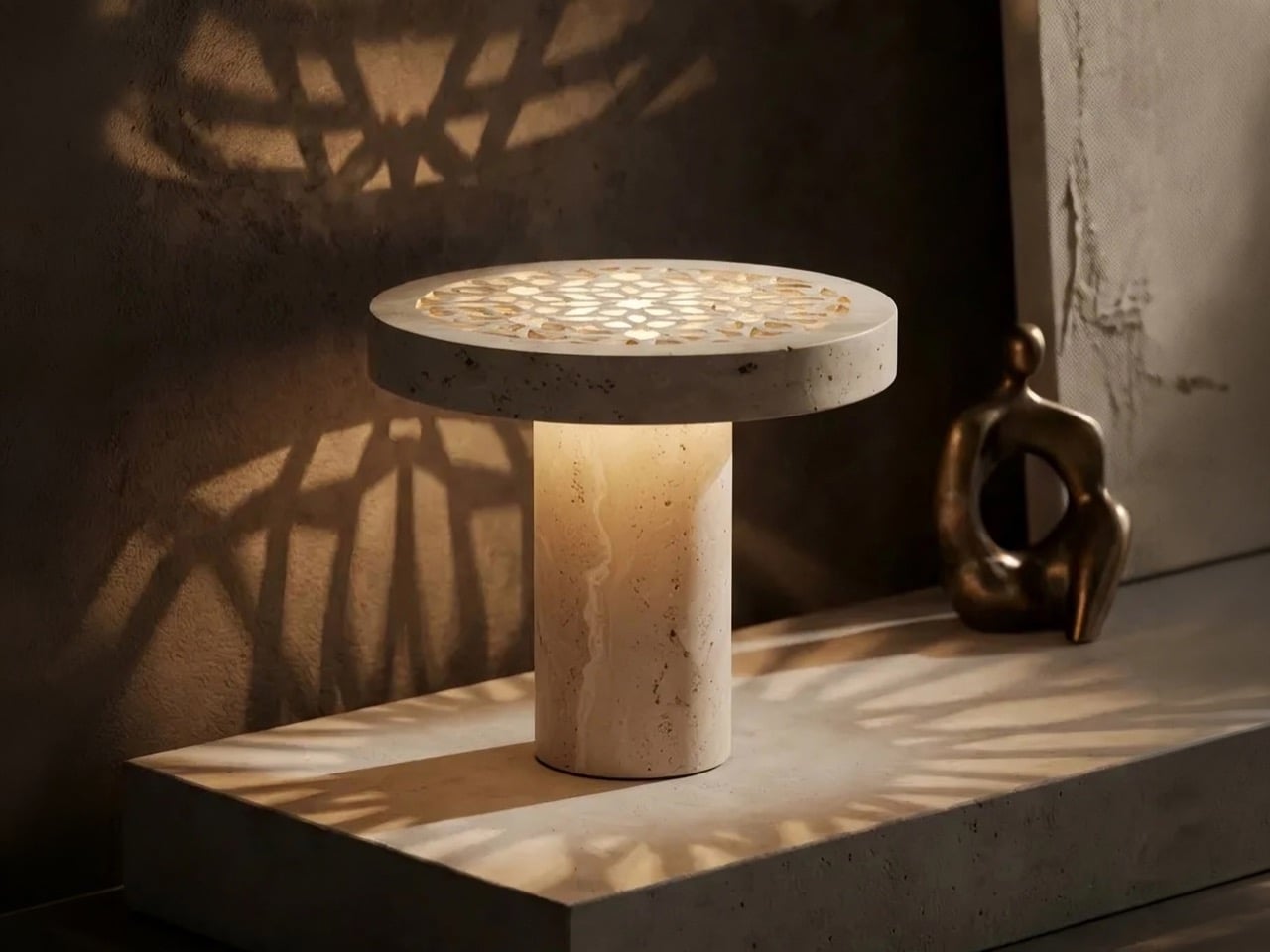
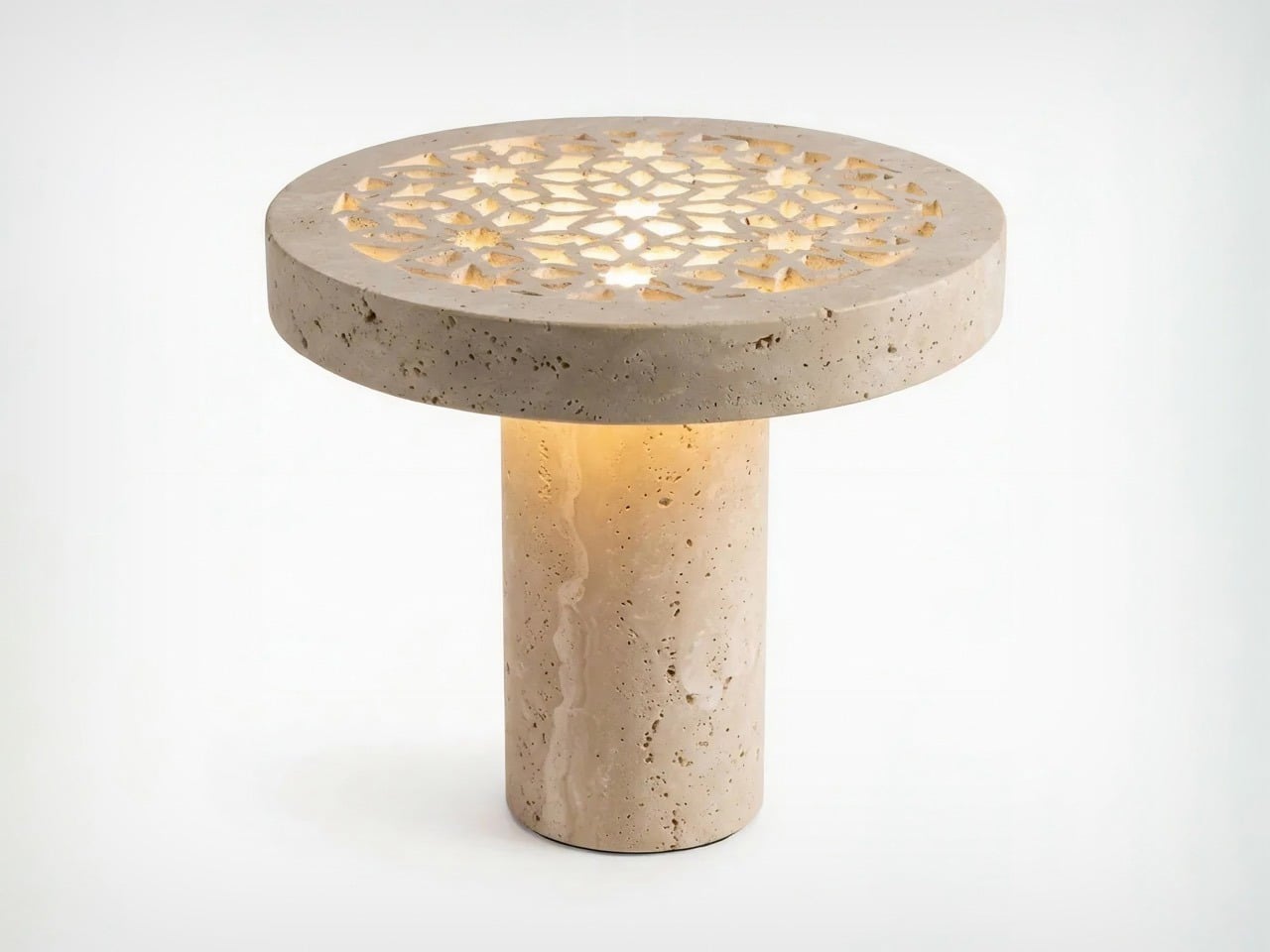
The history of decorative stone carving and the history of electric lighting have almost never intersected in any meaningful way at the shade level. The closest attempts have been thin marble slices backlit into warm translucency, or those Himalayan pink salt lamps that colonized every wellness-adjacent bedroom in the 2010s, both of which use the stone as a passive diffuser, a material you shine through rather than one you design with. The geometric traditions of Islamic architecture, meanwhile, have lived primarily in plaster, wood, and tile, materials that reward the kind of fine, repetitive cutting those patterns demand. Ibrahim Fatih Satilmis, founder of Istanbul’s Studio Soldout, spent the latter part of 2025 testing whether travertine could bridge those two histories, and Sukun is what came out of that research.

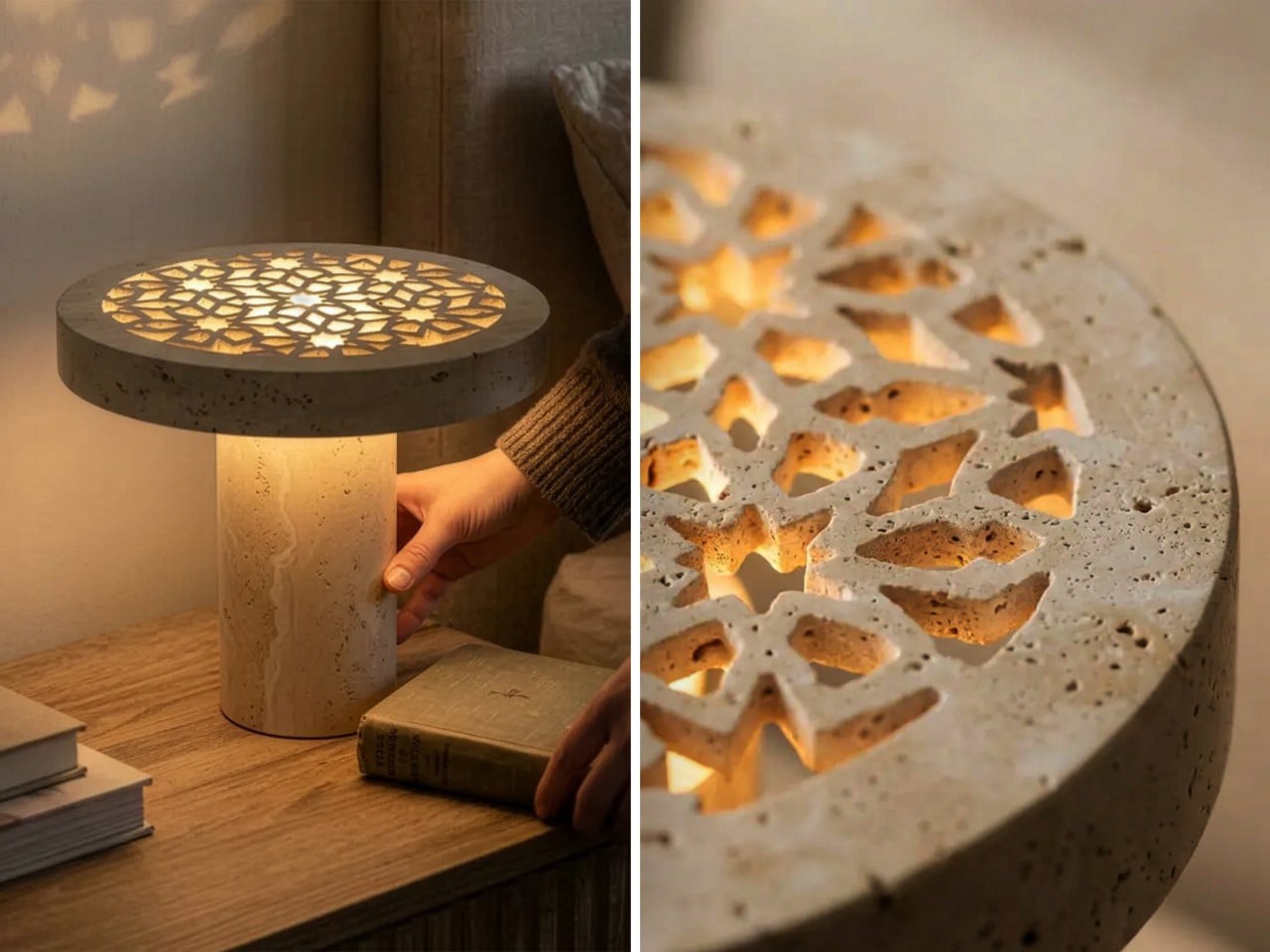
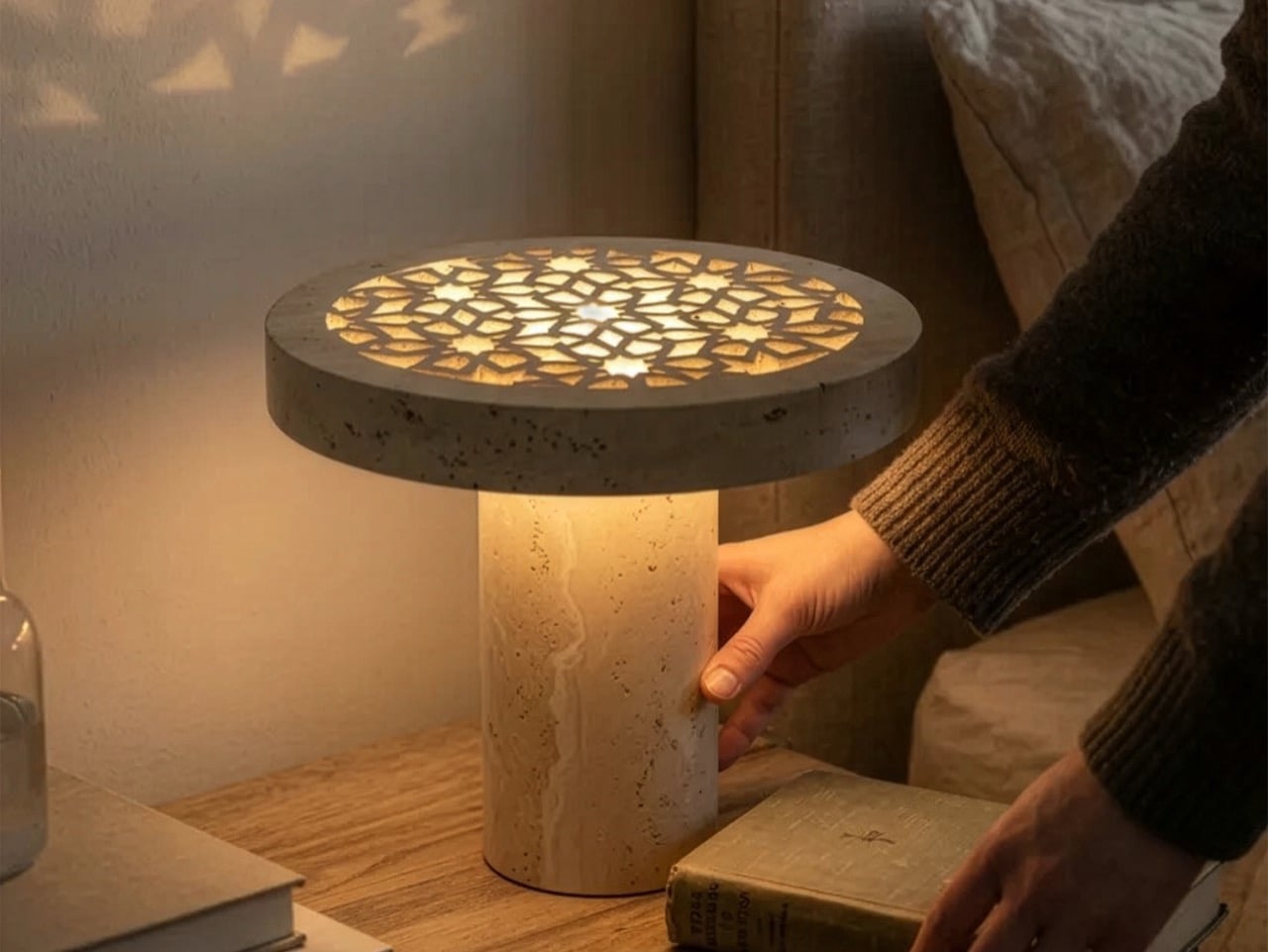
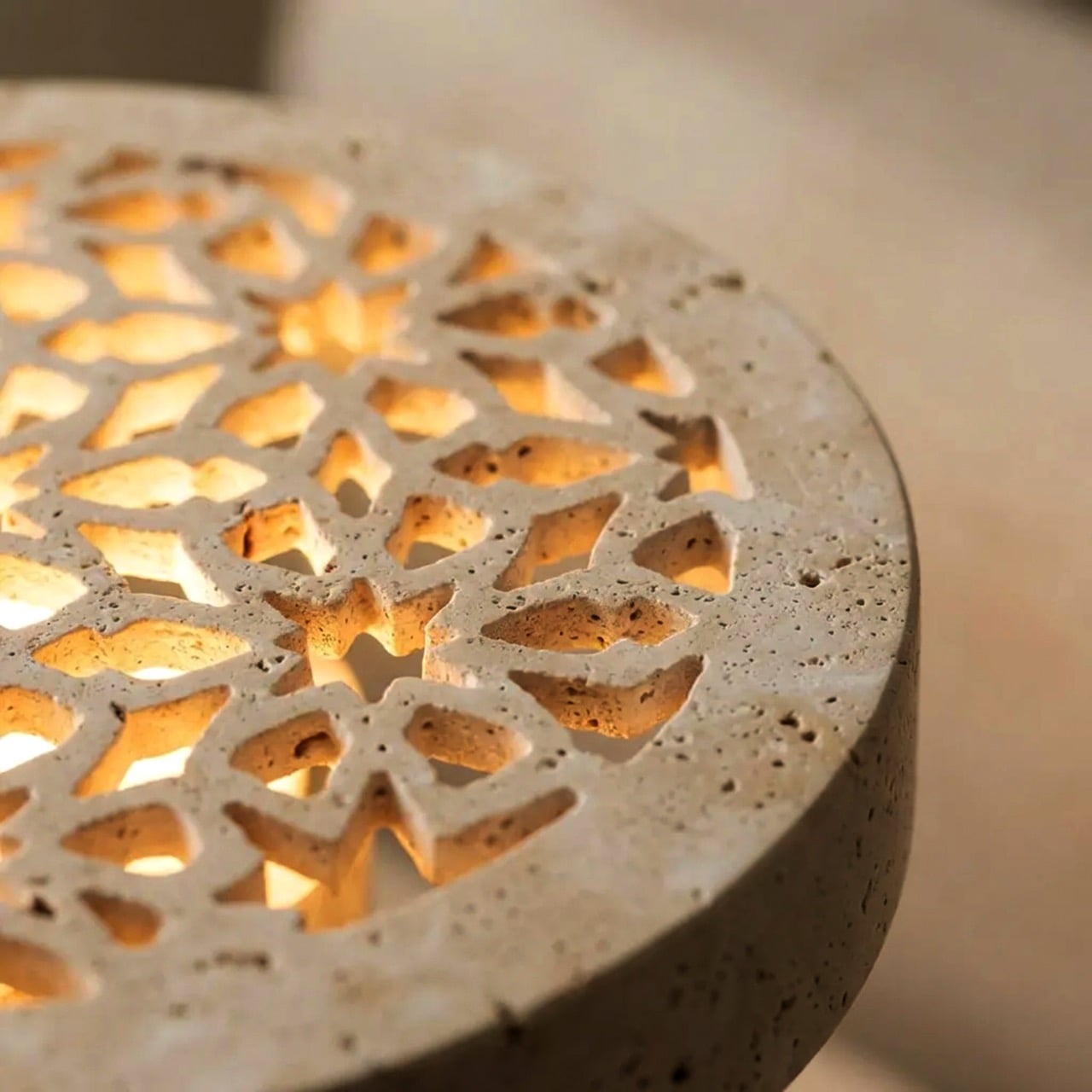
Six Islamic geometric motifs, each sourced from a specific landmark in Konya, Kayseri, Karaman, Cordoba, Valladolid, or Granada, are waterjet-cut and CNC-refined through the travertine disc that forms the lamp’s top. A concealed rechargeable battery powers an integrated LED at 2700K, with three-step phase dimming and six to eight hours of runtime per charge. When lit, the pattern projects outward in every direction, the ceiling, the wall behind, the table surface below, turning the geometry from object into environment. Sukun just picked up a win in the A’ Design Award’s Lighting Products and Fixtures category for the 2025-2026 cycle.

Designer: Ibrahim Fatih Satilmis

Travertine is defined by geological accident, by voids and veins left behind as calcium carbonate settled over millennia, and those natural pores sit millimeters away from the machined perforations without any visual conflict. If anything, the stone’s inherent texture makes the precision of the geometry feel more earned, the way a hand-laid mosaic reads differently than a printed reproduction of the same pattern. Satilmis worked through Eric Broug’s geometric reconstruction methodology to ensure each motif was mathematically faithful to its source site before committing it to stone, which matters because these patterns are systems, not ornaments, and a slightly wrong angle compounds across repetitions into something that reads as off without the viewer quite knowing why. The main machining challenge was cutting fine perforations through travertine without chipping, while keeping the disc thick enough to remain structurally stable, a balance that required significant prototyping before the geometry held cleanly at full depth.

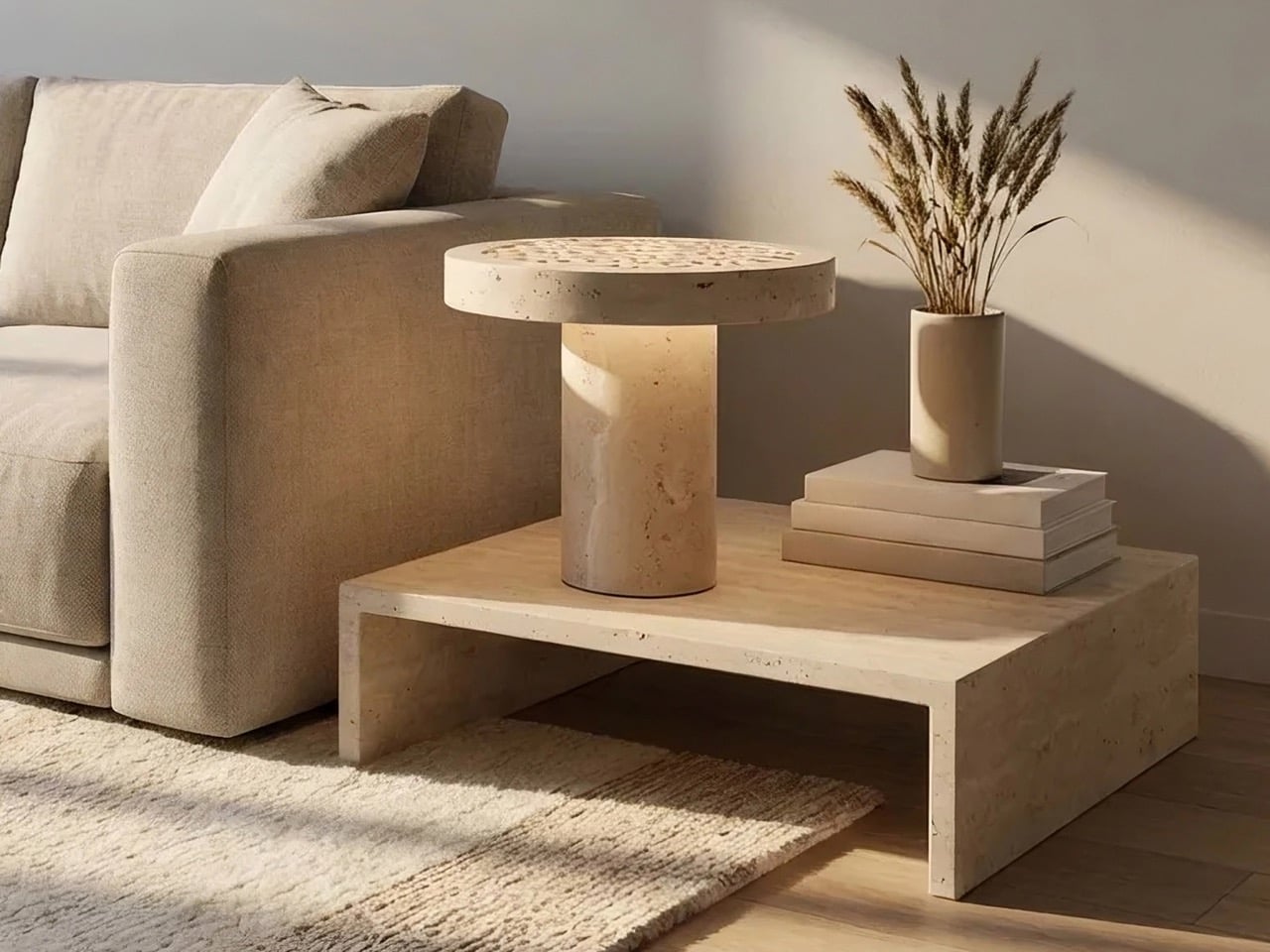
A cylindrical travertine base houses the electronics and doubles as a downward light diffuser, washing the table surface in soft 2700K warmth, while the carved disc floats above on a simple shoulder, elevated just enough to let light escape sideways and upward through the pattern. At 250mm wide and 300mm tall, the proportions sit comfortably between a statement object and an everyday lamp, substantial enough to anchor a bedside table or a dining sideboard without demanding the room reorganize around it. The rechargeable system charges via USB-C and runs six to eight hours per charge, which means no cord breaking the silhouette, a non-negotiable for a lamp this considered about its own appearance. Three-step phase dimming lets you dial the output down for ambient use without the flicker that plagues cheaper dimming implementations.

Switched off, Sukun reads as a serious piece of stone craft, the kind of object that holds its own in a well-edited interior without requiring explanation. Switched on, the room changes, and because travertine’s natural texture catches light unevenly, the projected shadows carry a slight warmth and irregularity that a laser-cut metal shade could never replicate. The stone absorbs and diffuses before releasing, softening the LED’s output into something that feels genuinely warm rather than merely color-temperature warm. Six pattern variants are available as separate lamps, each tied to a different historical site, giving the collection a documentary dimension that most lighting ranges never attempt.

The post Turkish Designer Cut 800-Year-Old Islamic Geometry Into a Stone Lamp That Casts Patterns on Your Wall first appeared on Yanko Design.

Someone Turned the “Cat Knocking Things Off Tables” Meme Into a 3D Printed Lamp and It’s Perfect

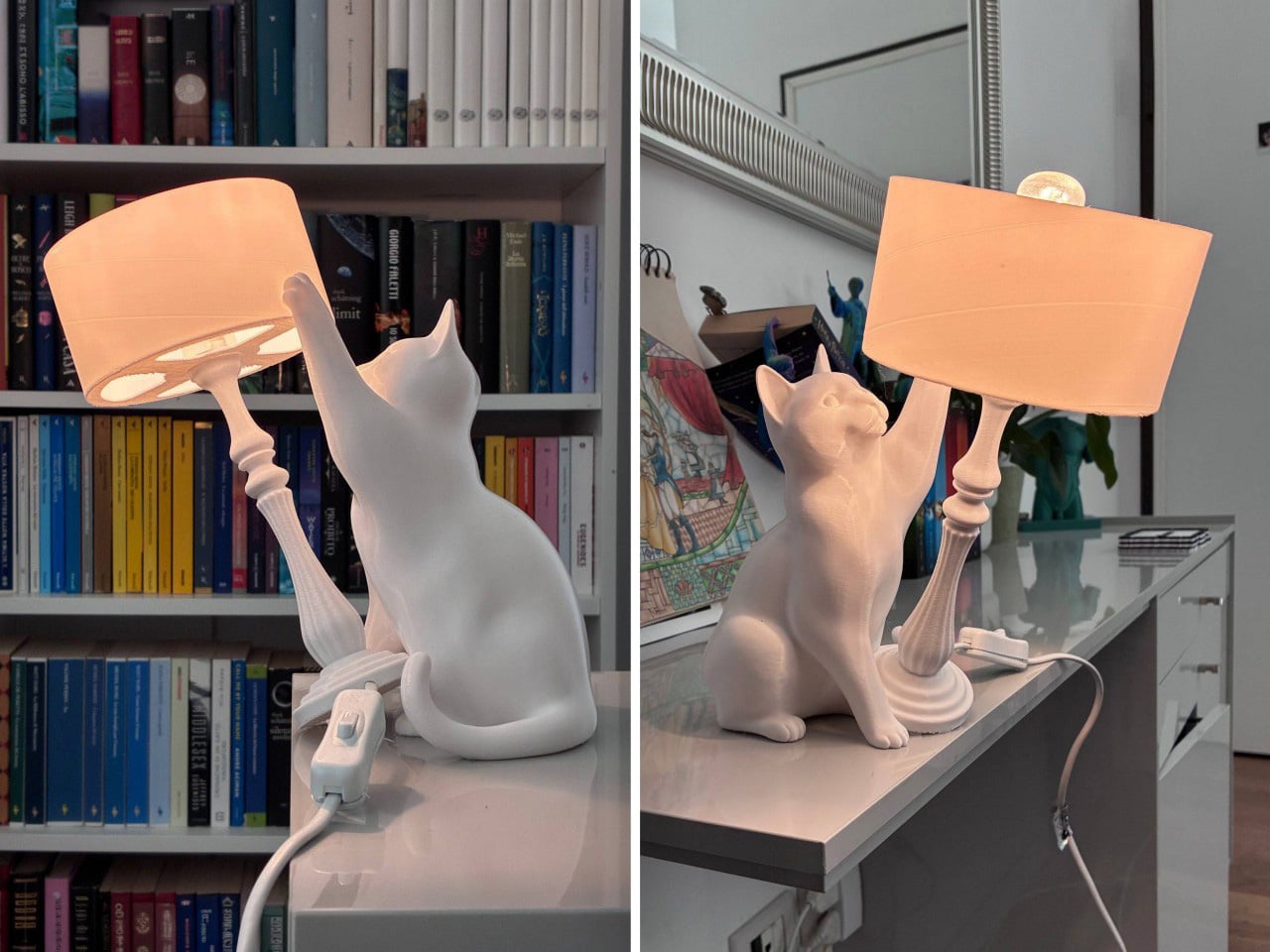
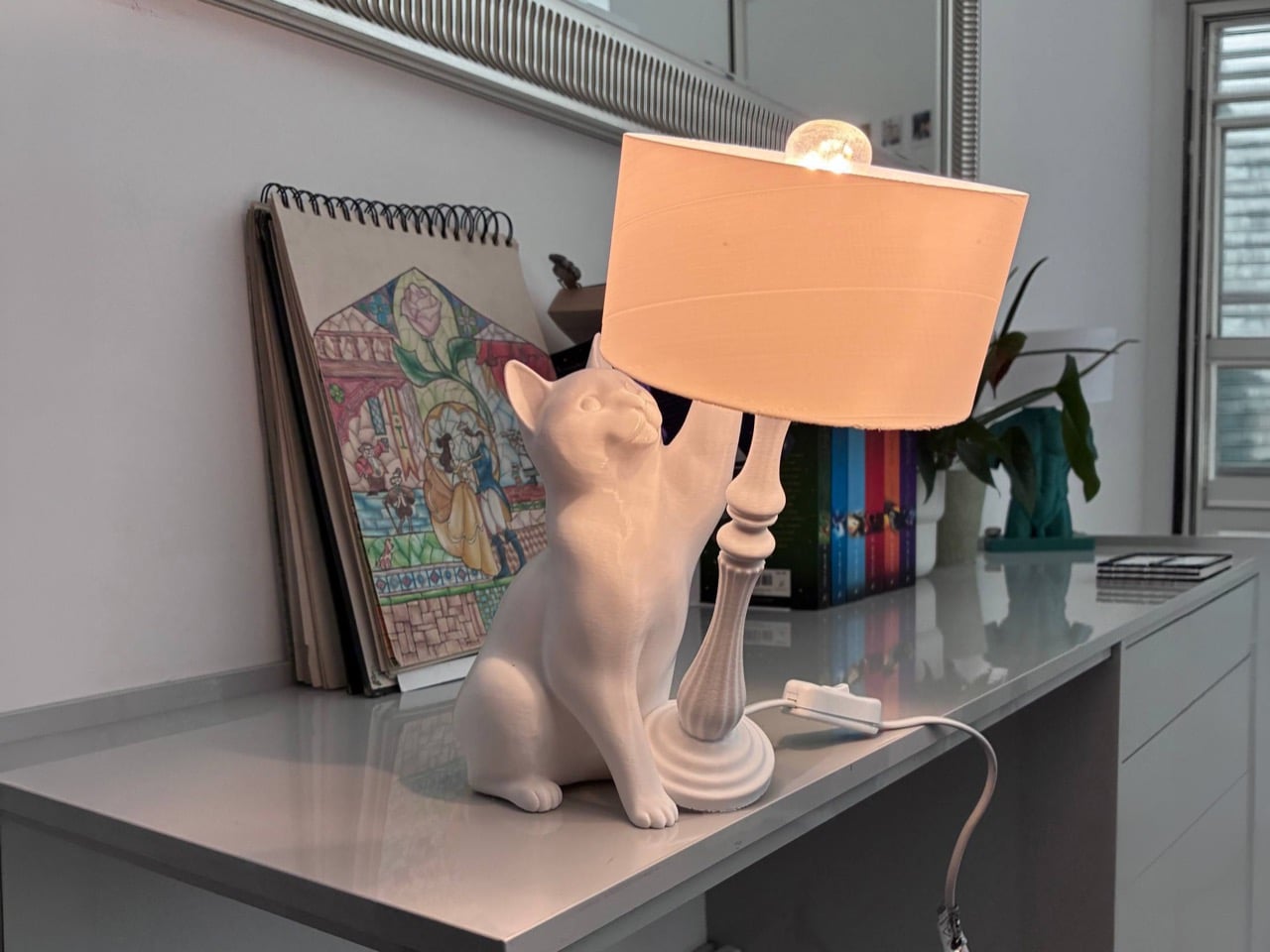
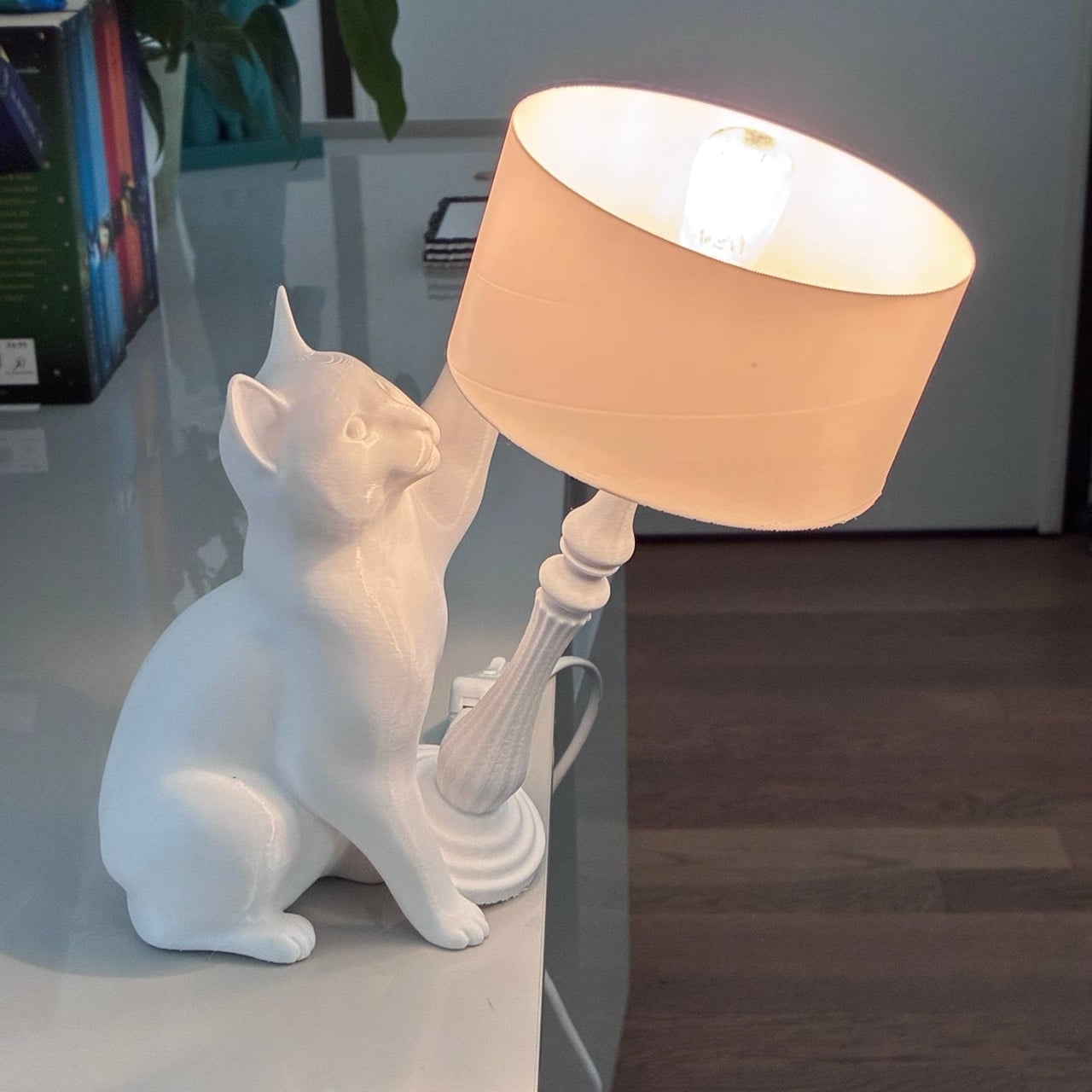
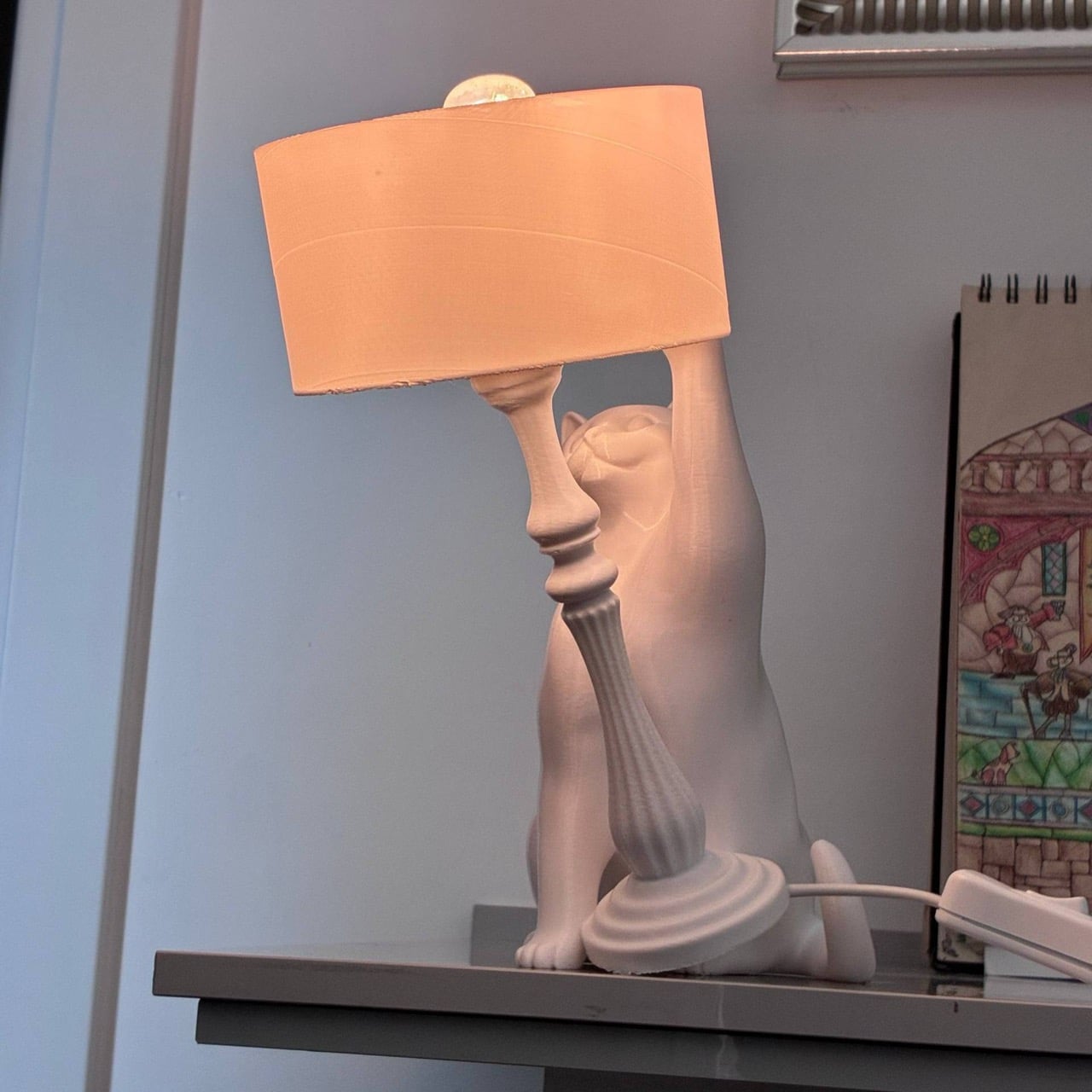
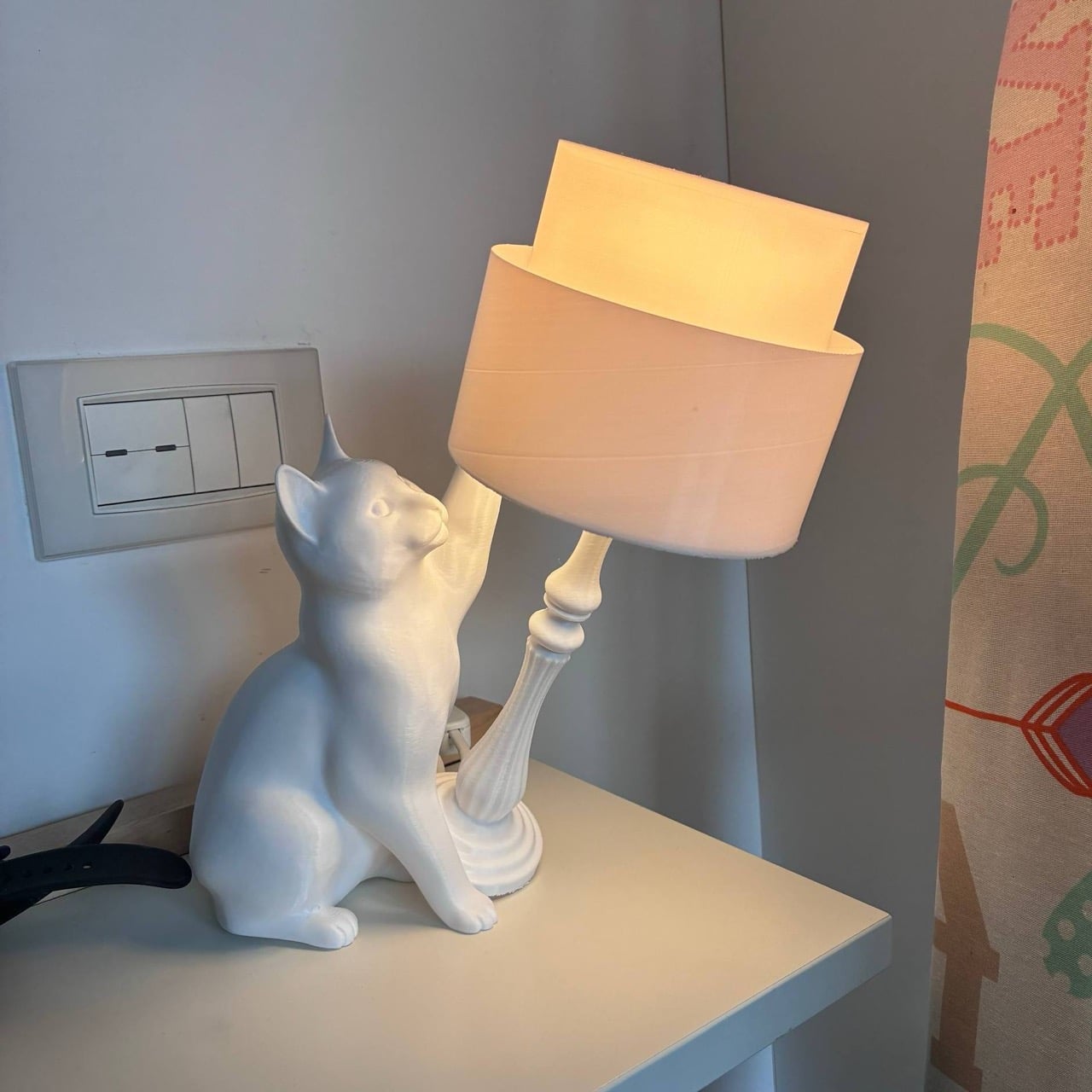
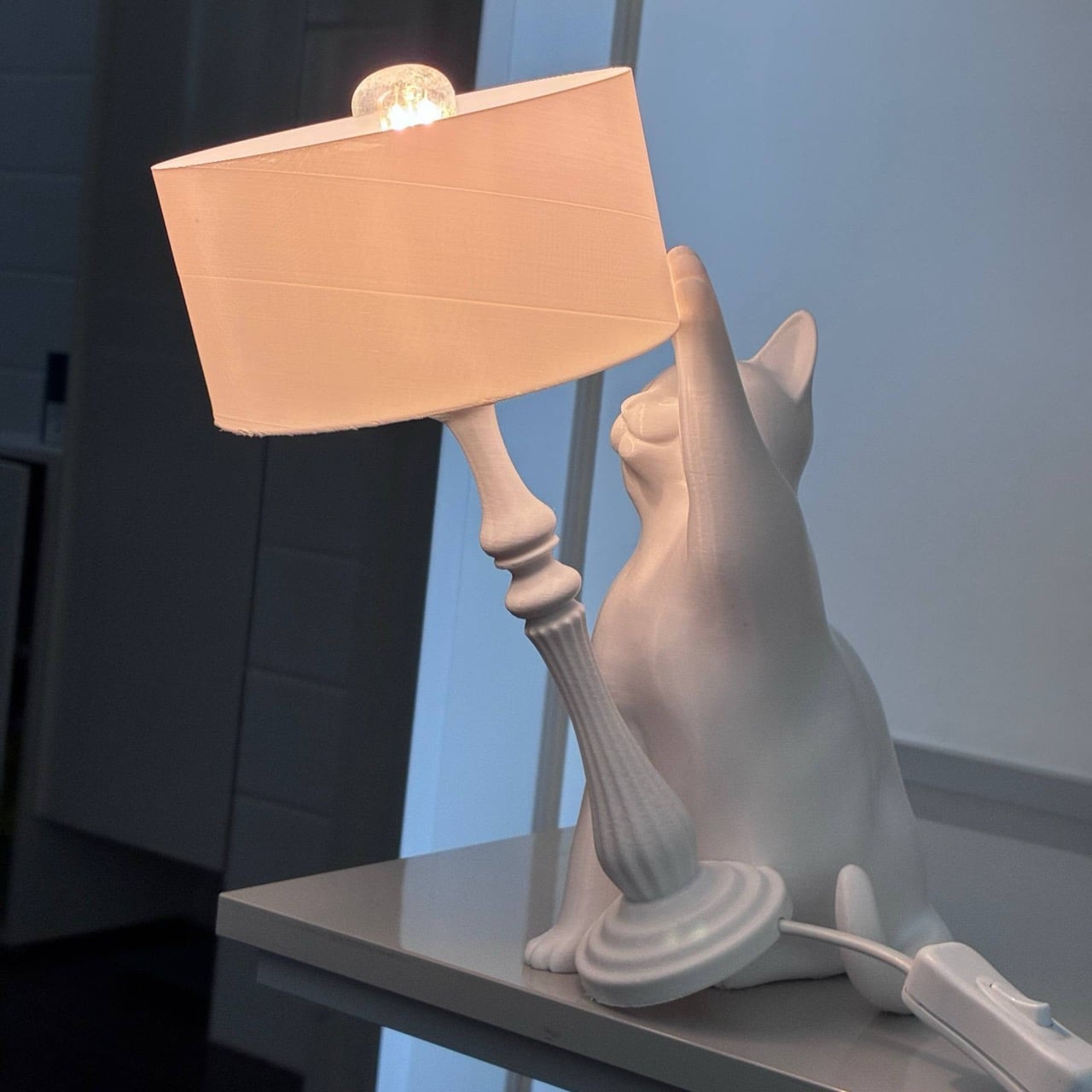
Cats knocking things off tables is old internet. It predates memes as a concept, predates YouTube, predates the entire visual language of digital humor. It is perhaps the most documented animal behavior in human history, captured billions of times, studied by actual ethologists, and still inexplicably funny every single time. Fabio Ferrari has taken this behavior and made it load-bearing, literally, designing a 3D-printed table lamp where a seated cat figure tilts the shade off-axis mid-push, and the resulting tension between lampshade and gravity is the entire point of the object.

Printed white in PLA, the classical turned column and drum shade read as a proper lamp, and the cat sits alongside it with one paw extended toward the column, head craned upward, frozen in that particular expression of focused feline mischief that every cat owner recognizes immediately. The layer lines on the print dissolve into surface texture at this scale, giving the whole thing an almost ceramic quality. It lands on a desk or nightstand and earns a second look from anyone who passes it.

Designer: Fabio Ferrari

Ferrari released the STL pack on Cults3D in late March 2026, priced at $4.04 after a 50% discount, and it pulled 102 downloads and 7,000 views within days, which for a single-designer listing on a platform with 3.2 million models is a genuinely strong signal. The pack ships five files covering two body variants sized for different bulb lengths, plus a supplementary shade that covers the bulb completely for a cleaner look.

The recommended material is white or marble PLA, though PETG and resin both work, and the print settings are straightforward: 15 to 20 percent infill for the shade, higher for the cat and base to keep the center of gravity honest. The shade is the only component that needs supports, and Ferrari is emphatic that the lamp column itself should print support-free since anything inside that channel will obstruct the wire routing.

The lamp works with standard E12, E14, or E27 bulb kits depending on how you scale it, and the warm ambient glow it throws makes it best suited on a nightstand or shelf light rather than serving task lighting. At roughly 250 to 294mm tall depending on the variant, it has enough physical presence to read across a room without overwhelming a surface.

The design sits in an interesting lineage. Seletti’s Monkey Lamp and the broader wave of anthropomorphic lighting that swept through the design-forward homeware market in the 2010s established that people would pay serious money for a lamp with a personality. What Ferrari has done is democratize that impulse entirely, collapsing the distance between a $300 design object and a $4 STL file and a weekend print. Just make sure you aim for 25% or higher infill or the balance goes awry. You wouldn’t want a lightweight cat actually knocking your lamp over, right?!

The post Someone Turned the “Cat Knocking Things Off Tables” Meme Into a 3D Printed Lamp and It’s Perfect first appeared on Yanko Design.

This 3D-Printed Lamp Changes Its Pattern When You Tilt It

Many of us first encountered the magic of lenticular printing on a pocket-sized novelty card. Tilting it back and forth would make a cartoon character move or a flat image suddenly appear to have three-dimensional depth. The principle was simple and clever: a series of tiny, parallel lenses on a plastic sheet would direct different slivers of an underlying image to our eyes depending on the viewing angle. It was a fun, tactile illusion, a small piece of optical engineering designed to create a moment of surprise and delight from a static object.

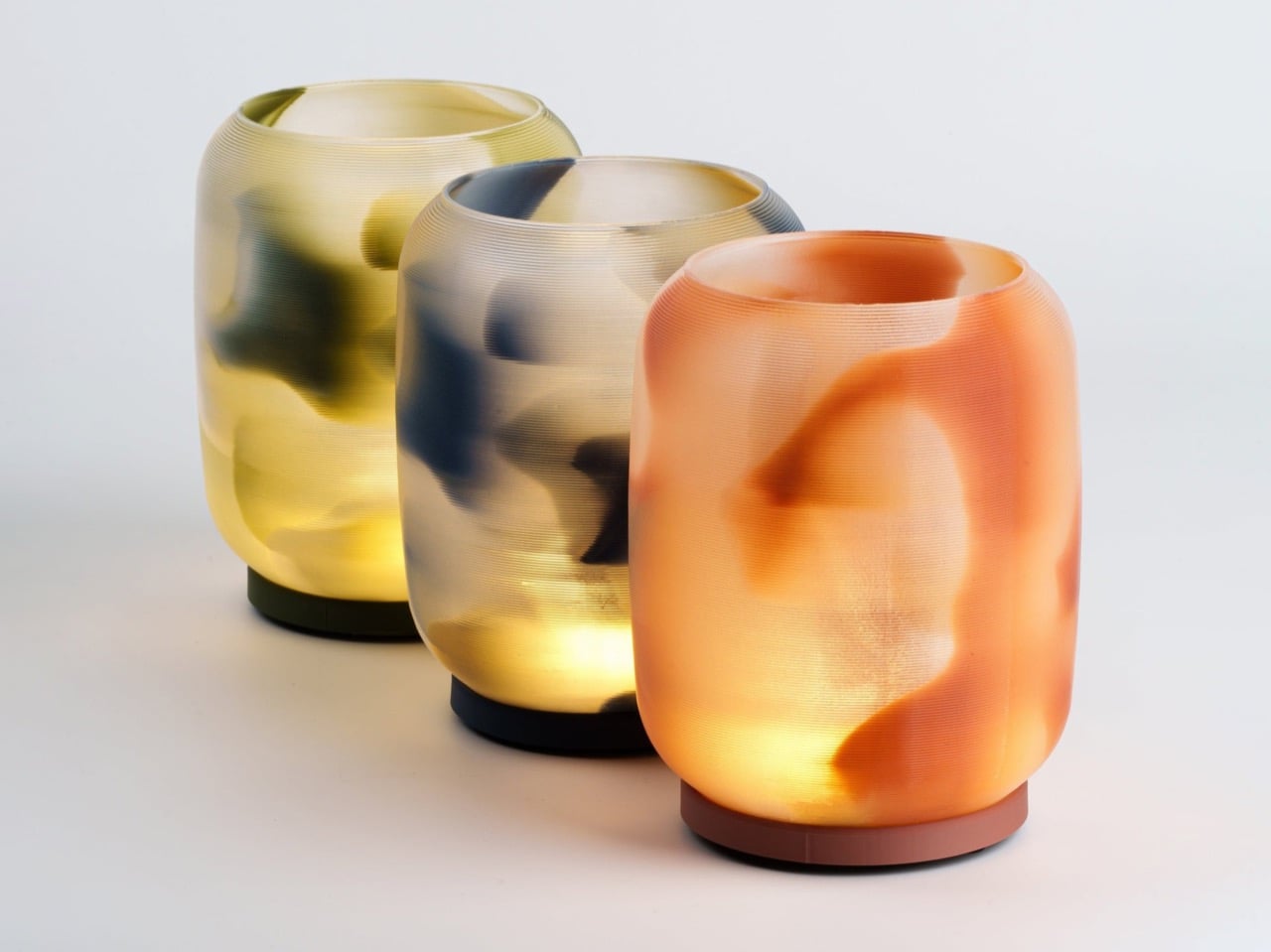
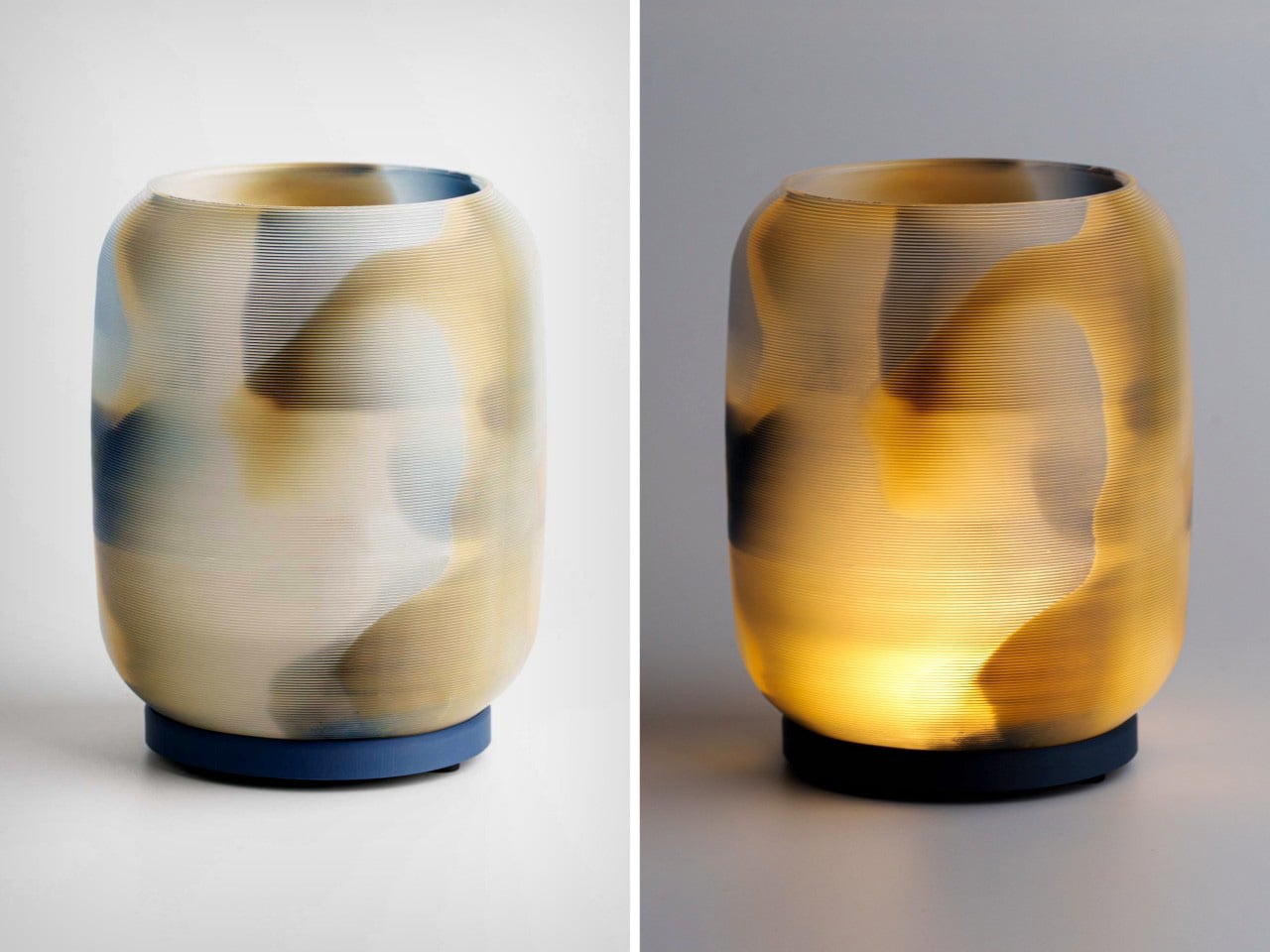
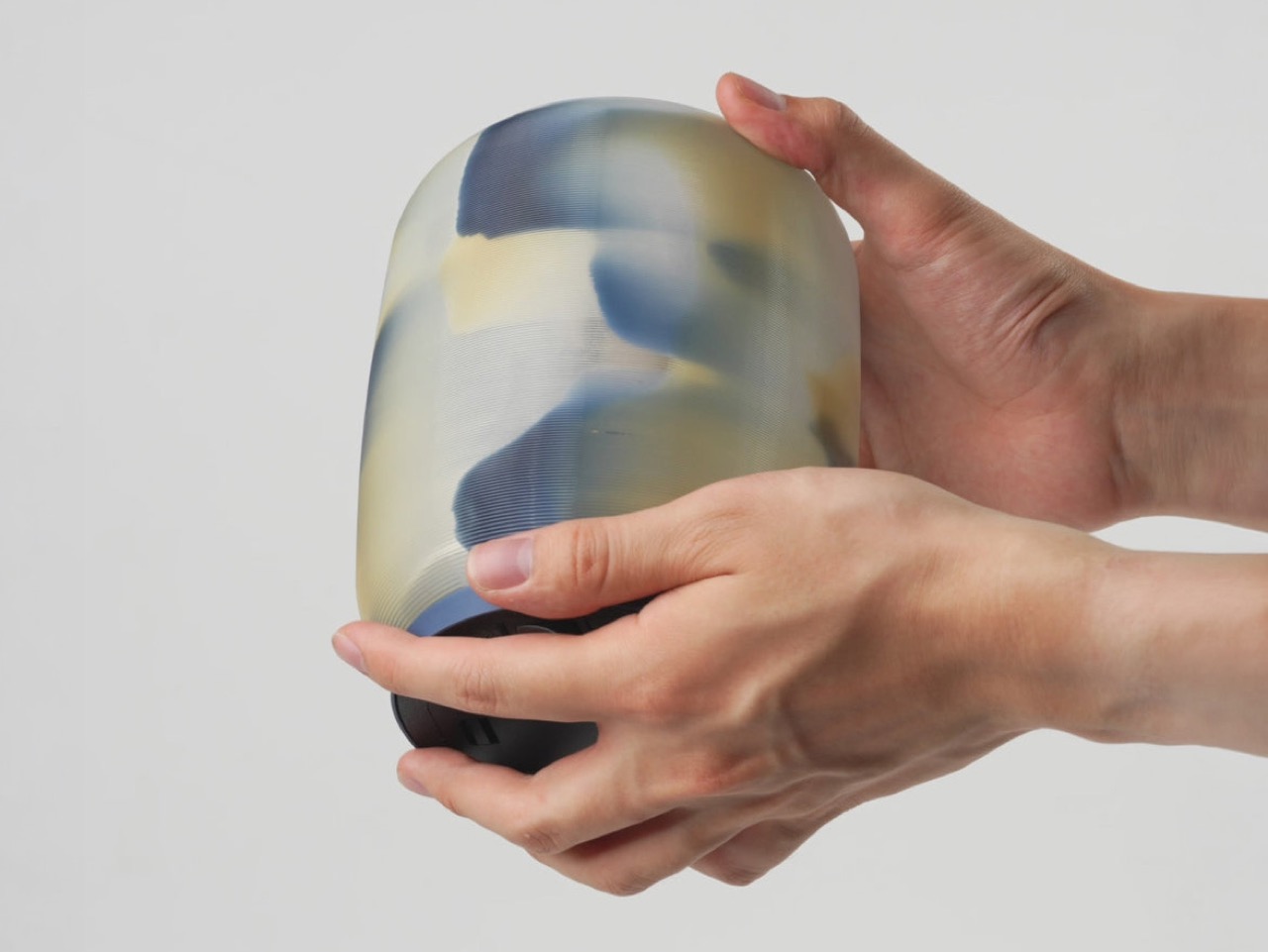
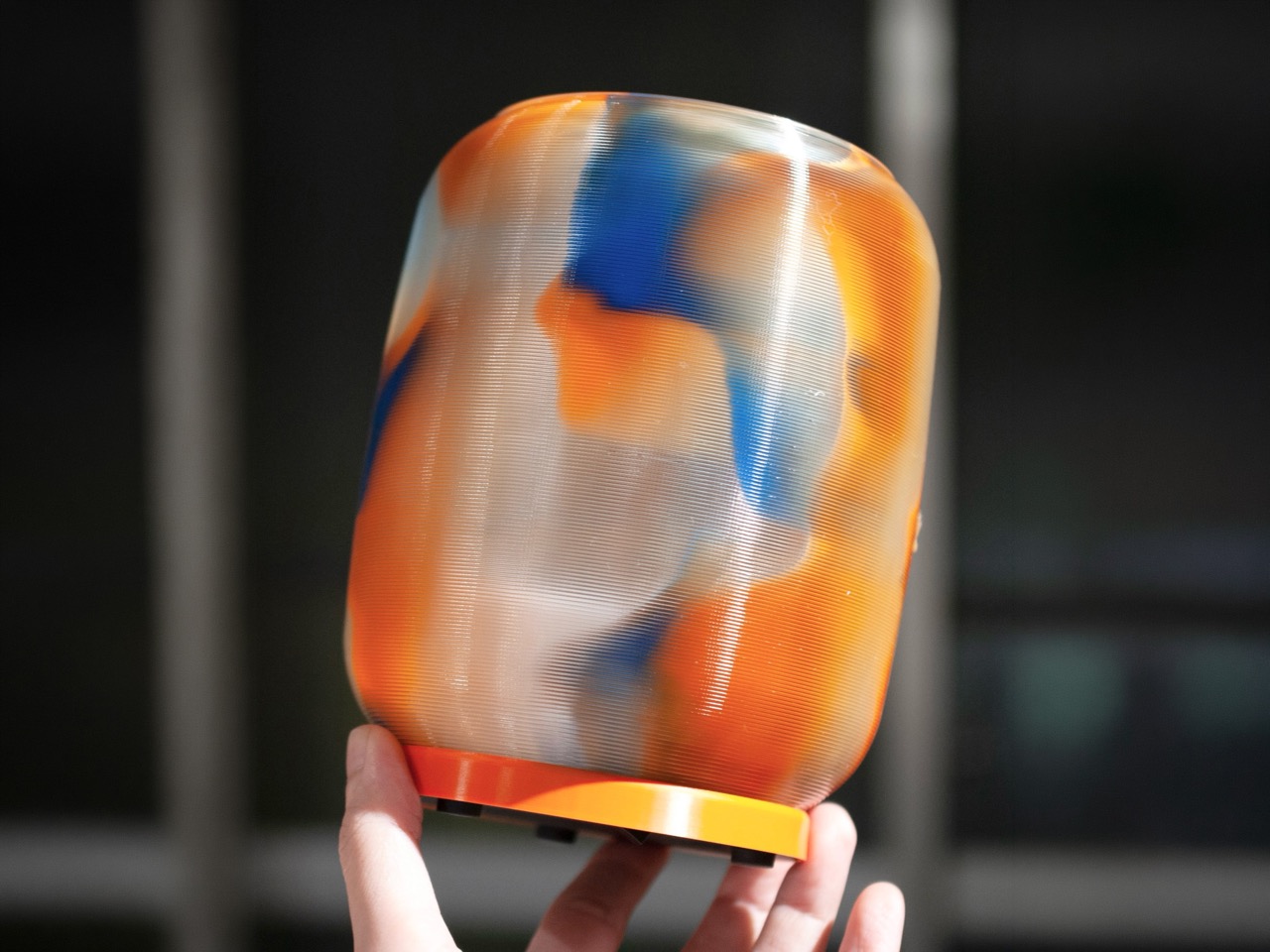
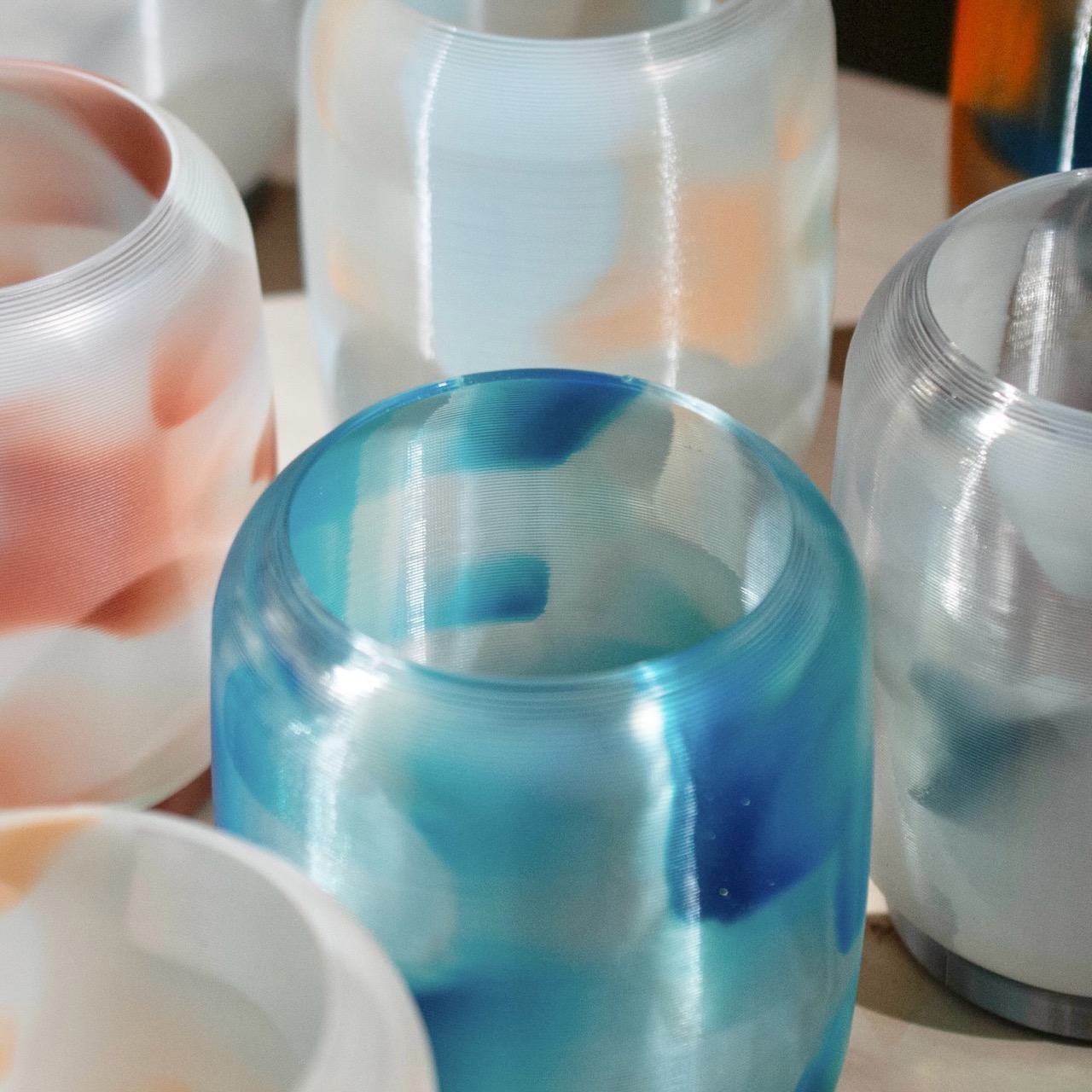
Imagine taking that same principle and applying it to a gracefully curved, three-dimensional lamp. This is precisely what the Japanese brand QUQU has achieved with its Nishiki line. The entire body of the lamp functions as a lenticular lens, using the fine, horizontal ridges of the 3D printing process as the optical array. As you move around the lamp, patterns of colour suspended within its translucent walls shift and swim, revealing new dimensions and tones. It transforms a simple light source into a dynamic object that performs a quiet, constant dance with the viewer’s perspective.

Designer: QUQU

The entire trick hinges on QUQU’s decision to weaponize what most of the FDM printing world considers an imperfection. We spend countless hours and dollars on post-processing to eliminate layer lines, chasing that injection-molded smoothness to prove the technology is “ready.” QUQU went in the complete opposite direction and made those 0.2mm or 0.3mm ridges the star of the show. Each concentric line acts as a cylindrical lens, refracting light that passes through the lamp’s wall. Instead of a flaw, the texture becomes the engine of the visual effect. This is a genuinely sharp piece of design thinking that elevates the manufacturing process itself into an aesthetic feature, rather than something to be hidden.

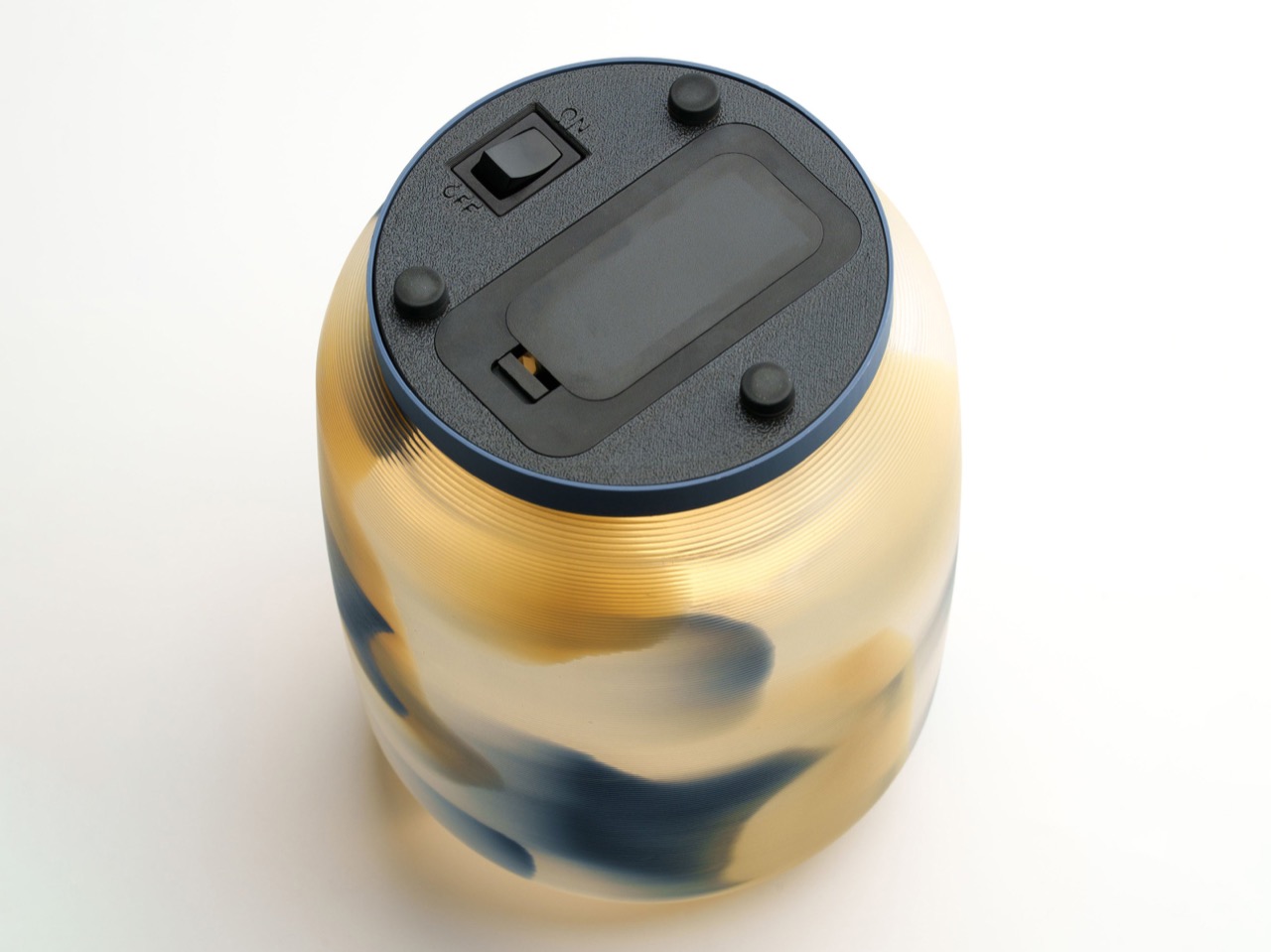
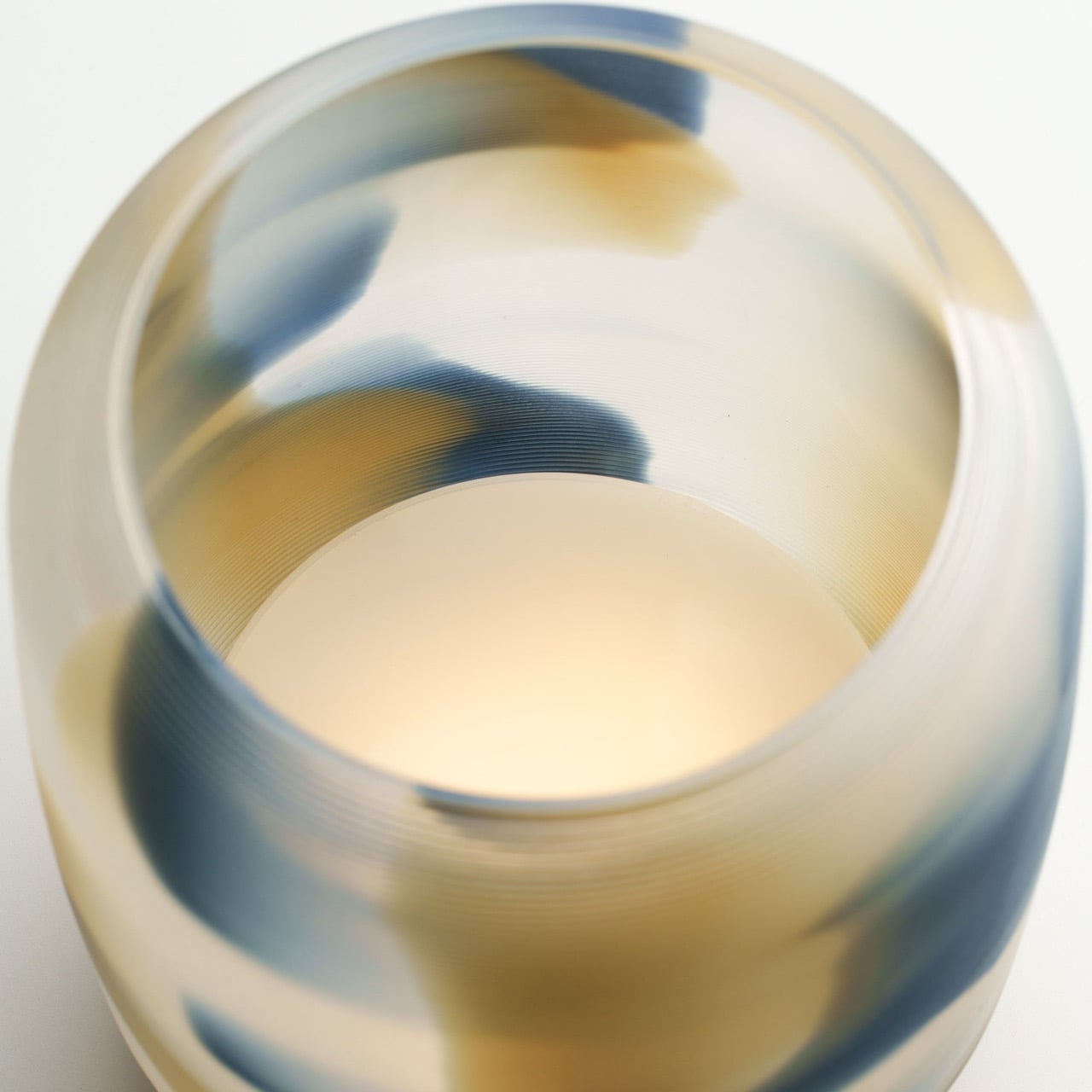
This effect would fall completely flat with the wrong material. A standard PLA or PETG filament would be too opaque or have the wrong refractive index, turning the whole thing into a muddy mess. QUQU’s use of a semi-translucent, grain-derived biomass plastic is the critical second half of the equation. This specific material choice gives the 155mm tall shade a soft, fibrous quality that diffuses light beautifully, preventing harsh hotspots from the internal LED. It has just enough clarity to let you perceive depth but enough haze to blend the suspended colours into those soft, koi-like patterns. The material is doing as much optical work as the surface geometry is.

The printer deposits coloured filament at varying depths inside the thick wall of the shade, sandwiching it between inner and outer layers of the translucent base material. This is a level of algorithmic control that feels like a form of digital craft, placing colour with volumetric precision. When you see the lamp unlit, the colours appear soft and suspended. Turning the internal LED on then completely inverts the experience, as the pigmented patterns become dark, dramatic silhouettes against a warm, glowing background. This gives the object a compelling dual personality, making it an entirely different piece depending on whether it is active or at rest.

The Ruri colorway, with its deep lapis lazuli tones, is the one getting the most attention, but the line includes others worth a look. The Koubai offers a warm plum red, Moegi provides a fresh spring green, and Hakumu is a subtle “white mist” variant. They are available directly from QUQU’s Japanese webstore for ¥19,800, which works out to roughly $125 USD. Now imagine this technique being used on other 3D printed products. I’d kill for a phone case made this way!

The post This 3D-Printed Lamp Changes Its Pattern When You Tilt It first appeared on Yanko Design.

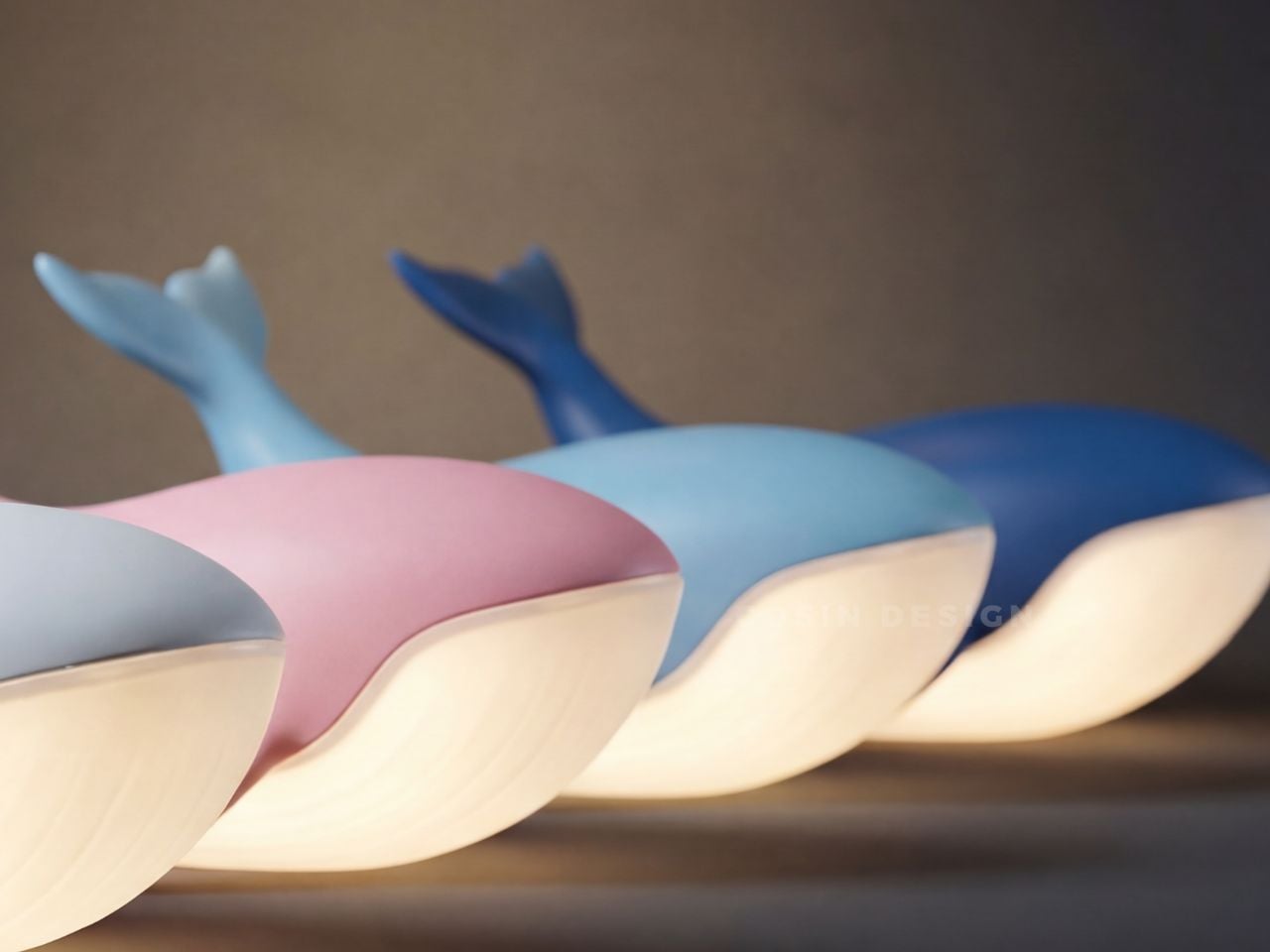
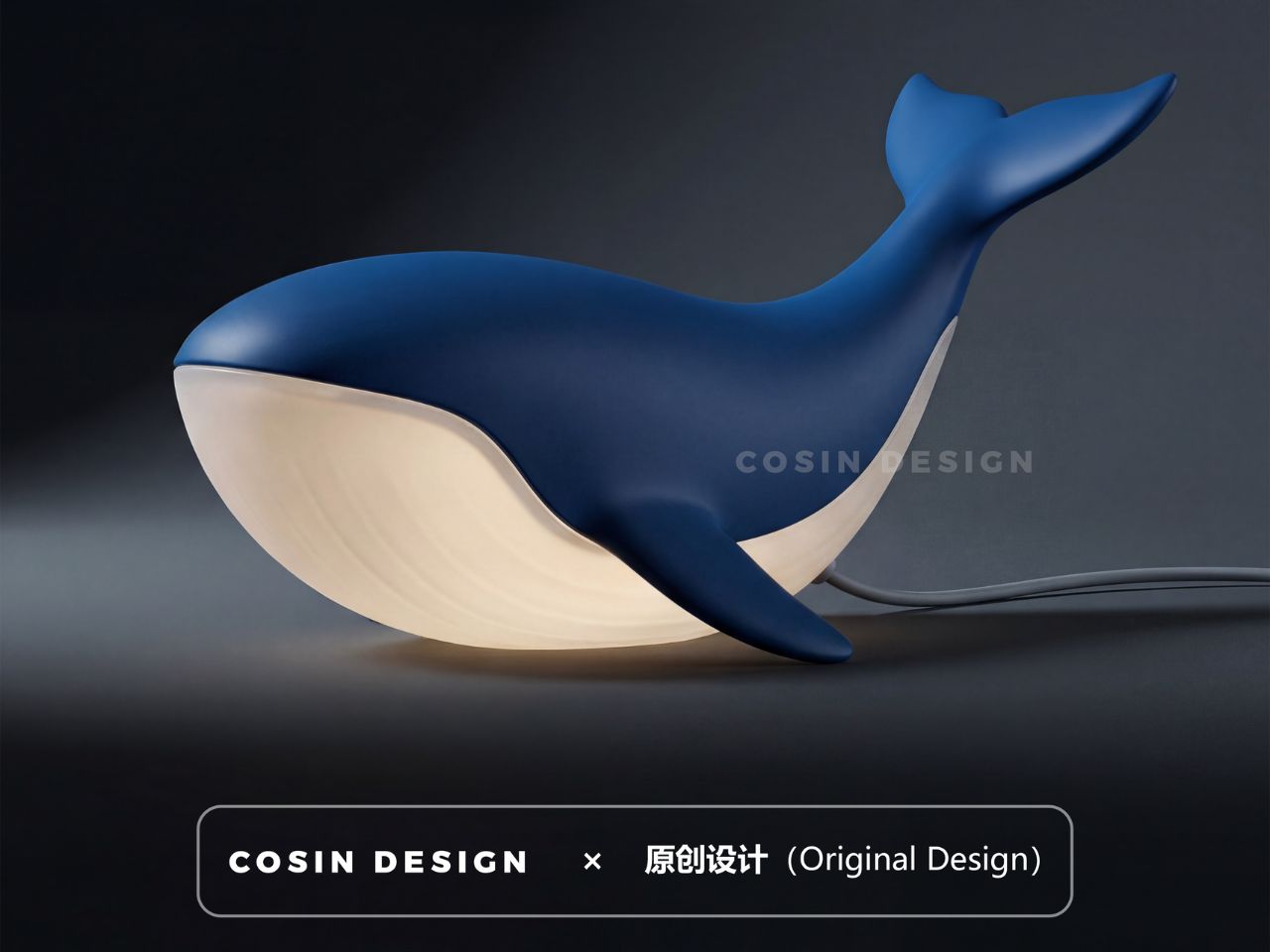
A Whale Lamp That Transforms Ocean Vastness into a Gentle Bedside Glow

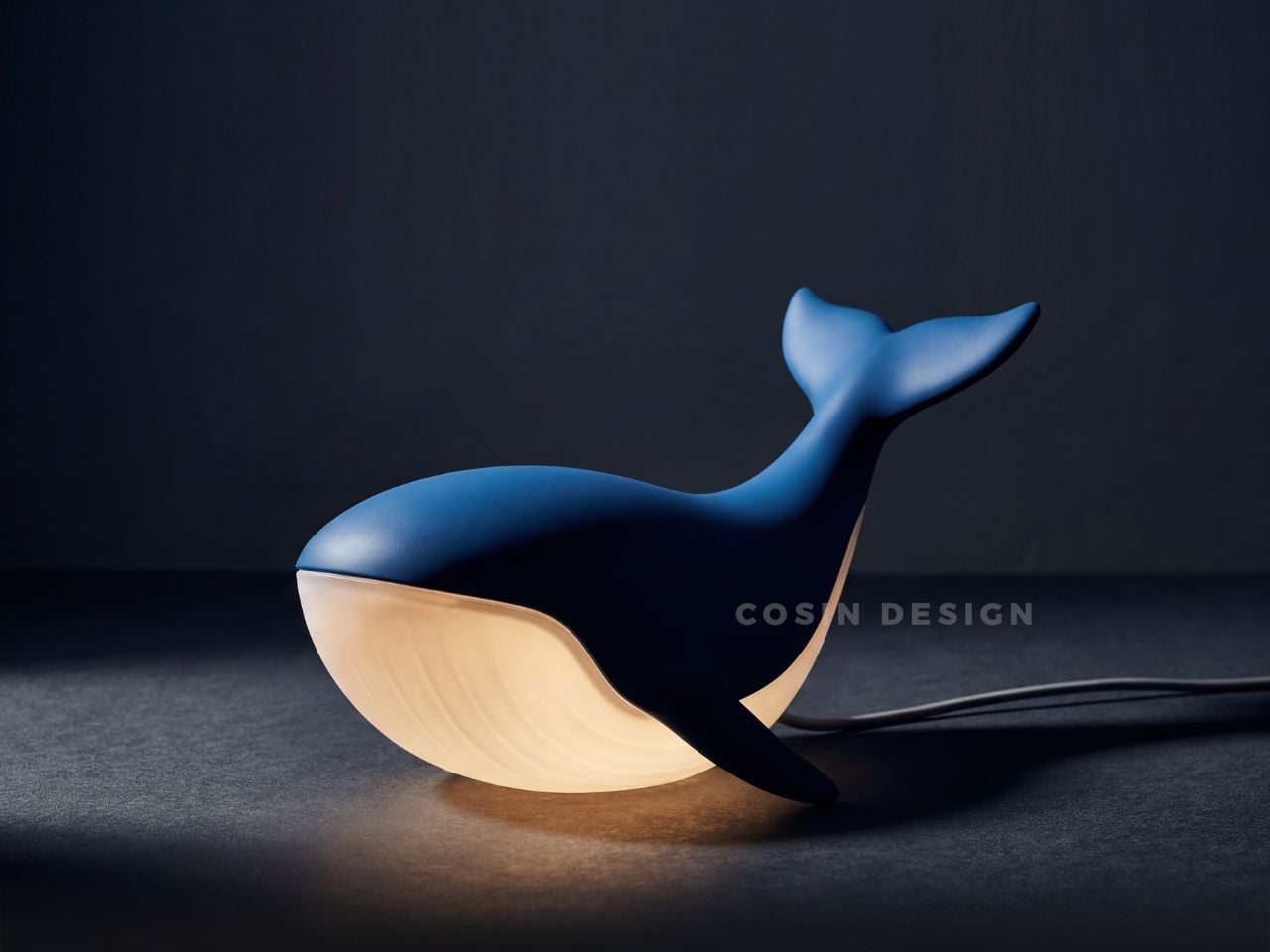
There is something quietly radical about a whale that does not belong to the ocean. Not because it has been displaced, but because it has been reimagined. COSIN DESIGN’s whale lamp is not an imitation of nature. It is a reinterpretation of how we feel about it. We are used to whales as symbols of magnitude. Vast, powerful, unknowable. They belong to depths we cannot reach. Yet here, that same creature is reduced in scale, softened in form, and placed gently on a bedside table. It no longer overwhelms. It comforts, and that shift in perception feels intentional.

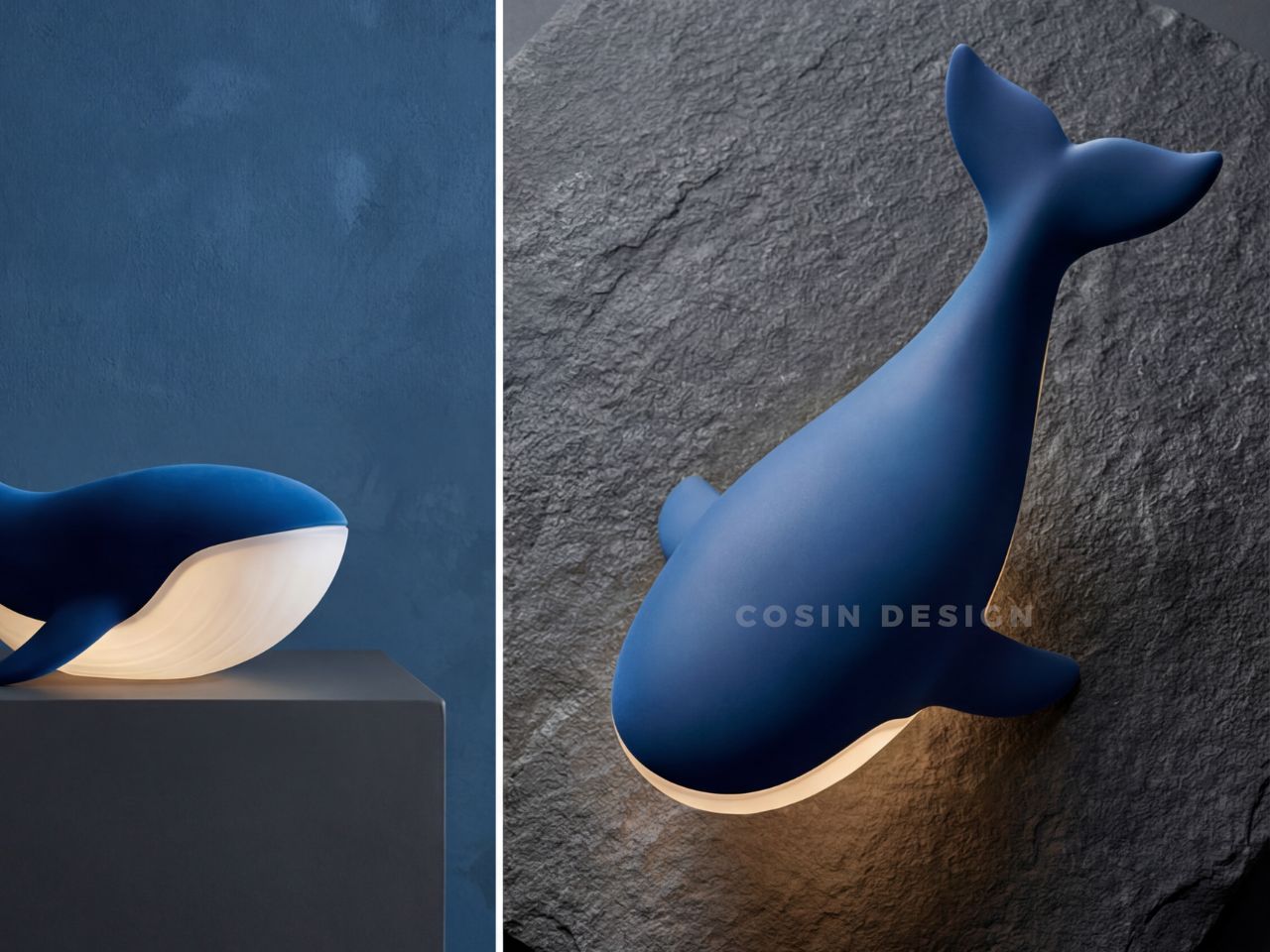
The lamp captures a whale mid-leap, its body curved in a suspended gesture that feels both dynamic and still. The lines are fluid and uninterrupted, almost meditative. There are no sharp edges, no visual noise, just a continuous surface that invites the eye to move along with it. It feels like a sculpture before it feels like a product, and that is what gives it presence even when it is not turned on.

Designer: COSIN DESIGN

The real transformation happens with light. It seeps through the semi-transparent abdomen, not as a beam but as a soft diffusion that spreads slowly and evenly. It does not try to dominate the room or claim attention. Instead, it settles into the space, creating a calm and ambient glow. There is something almost alive about it, as if the whale carries light within itself, like a quiet presence from the deep sea. In that moment, the object shifts from something you look at to something you feel, and that emotional transition is where the design becomes meaningful.

For a long time, lamps have been about control. Adjustable brightness, direction, and precision. But there has been a noticeable shift toward lighting that feels more atmospheric and emotionally aware. The whale lamp sits comfortably within this shift. It does not attempt to do everything. It focuses on creating a specific feeling, and it does so with clarity and restraint. The design does not rely on complexity or excess detail. Instead, it leans into softness, both in form and in function.

Nature plays an important role here, but not in a literal sense. The whale is recognizable, yet simplified just enough to feel universal. It is less about replicating an animal and more about capturing a sense of calm, depth, and quiet strength. That balance allows the lamp to exist across different environments without feeling out of place. It feels just as appropriate in a child’s room, where its gentle glow can provide comfort at night, as it does in a more mature, minimal interior where it reads as a sculptural object.

The availability of four color options adds to this flexibility. Each variation subtly changes the mood of the piece, allowing it to align with different interior styles and personal preferences. Whether placed in a playful setting or a more subdued one, the lamp adapts without losing its identity.

What lingers most, however, is the way the design translates something vast into something intimate. A whale, typically associated with scale and distance, becomes a small, glowing presence that quietly occupies a personal space. It turns awe into reassurance and transforms something distant into something familiar. In doing so, it reflects a broader shift in how we approach design today, where emotional resonance matters just as much as function.

Not everything needs to be louder or brighter to be effective. Sometimes, the most powerful design choice is to soften, to create objects that do not demand attention but instead become part of the atmosphere. The whale lamp does exactly that. It does not insist on being noticed, yet over time, it becomes something you grow attached to.

The post A Whale Lamp That Transforms Ocean Vastness into a Gentle Bedside Glow first appeared on Yanko Design.

ILO Lamp Lets Soft Light Wander Between Rooms

Evenings drift from kitchen to dining table to balcony and back, while the nicest lamp stays tethered to a single socket. The small but persistent annoyance of cords, extension leads, and the feeling that lighting never quite follows where people actually end up sitting becomes background noise. Beautiful lamps are static, and that friction quietly shapes how and where you use light, even when it should not.

Arieto Studio’s ILO Lamp is a response to that pattern. The designers started by watching their own routines, noticing how often they moved while the light did not. ILO is an attempt to let light move as naturally as people do, without turning into a tech gadget or a camping lantern, treating the portable lamp as a piece of furniture that happens to be untethered when you need it.

Designer: Hanna Billqvist (Arieto Studio)

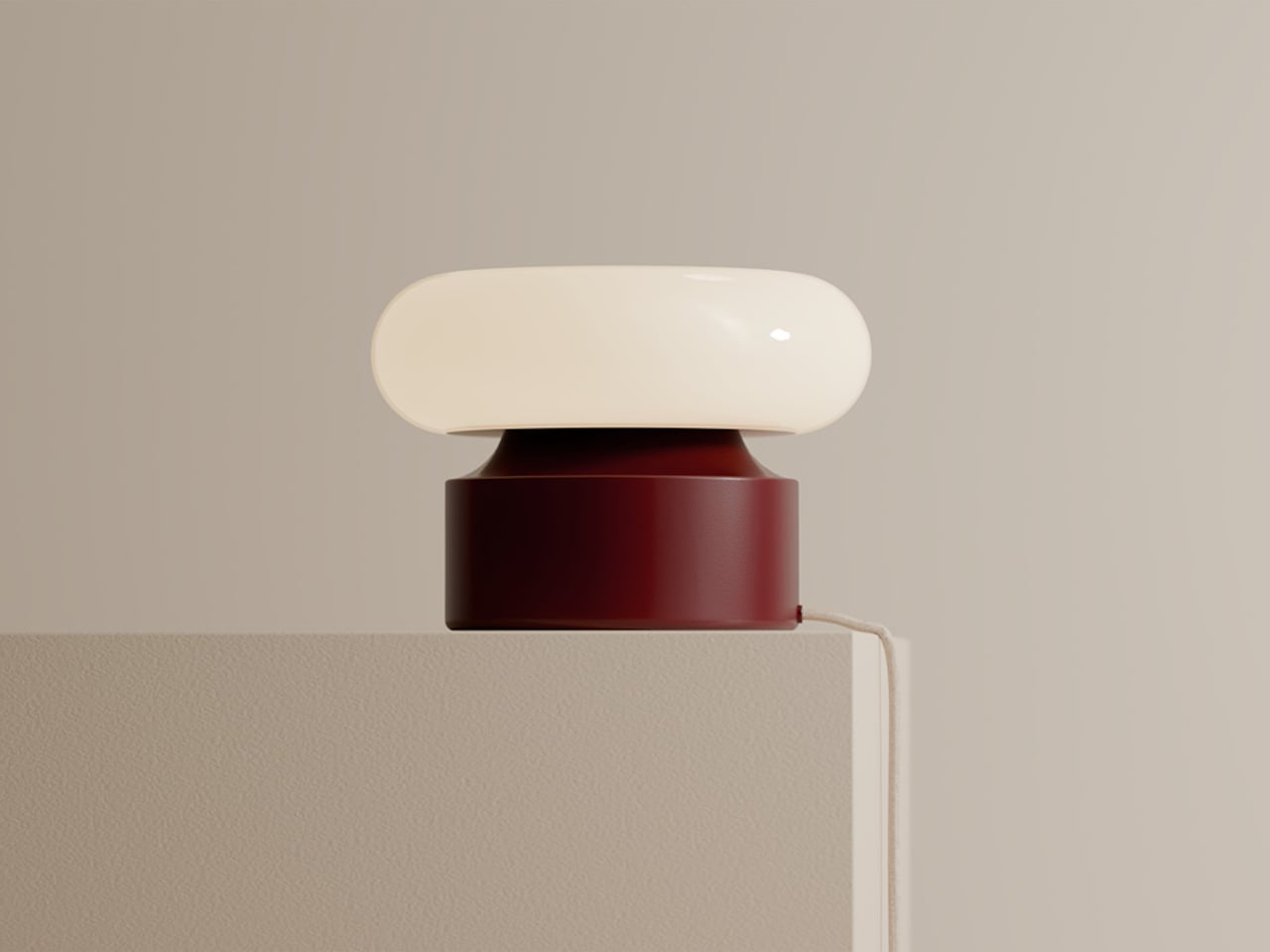
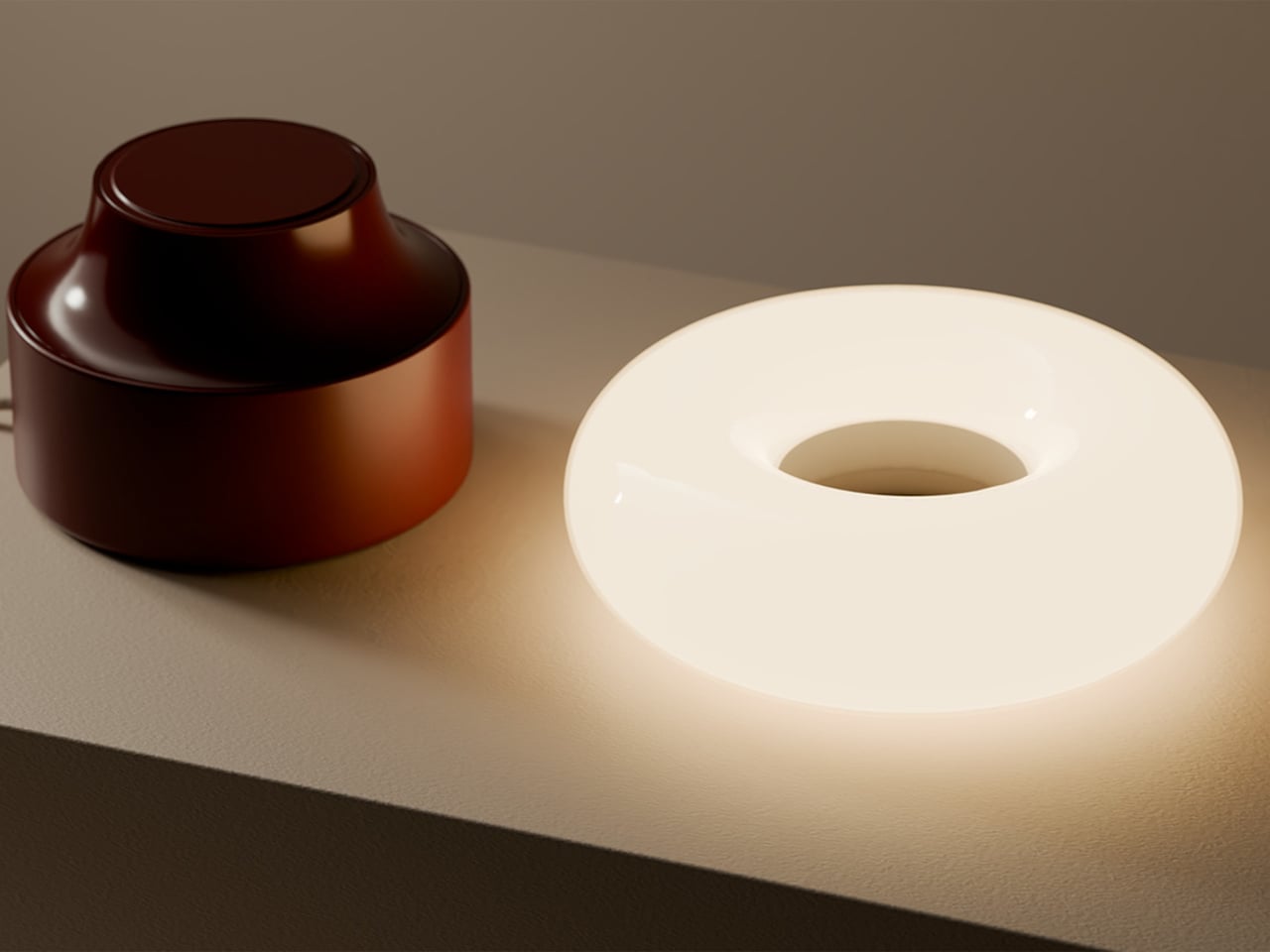
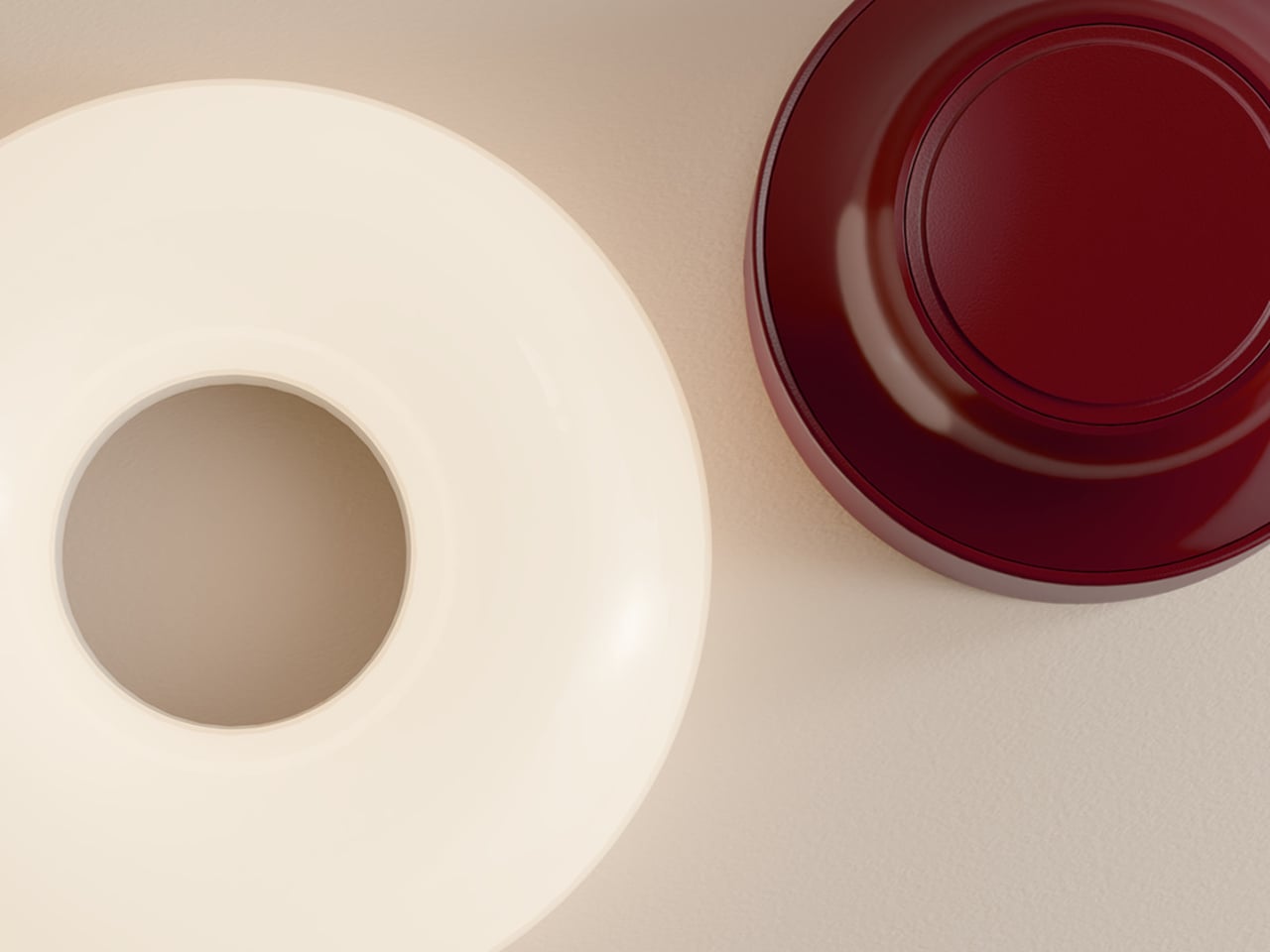
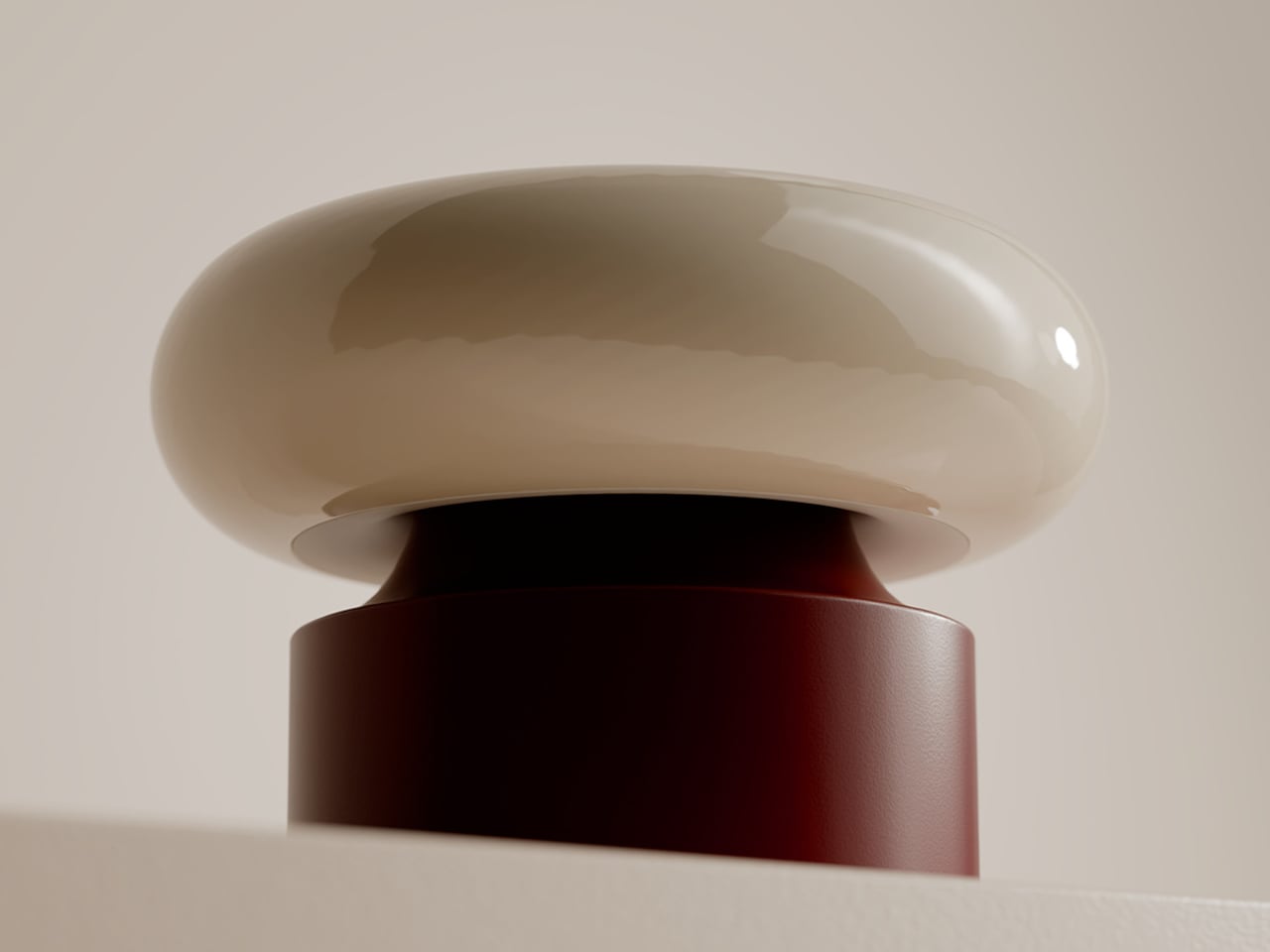
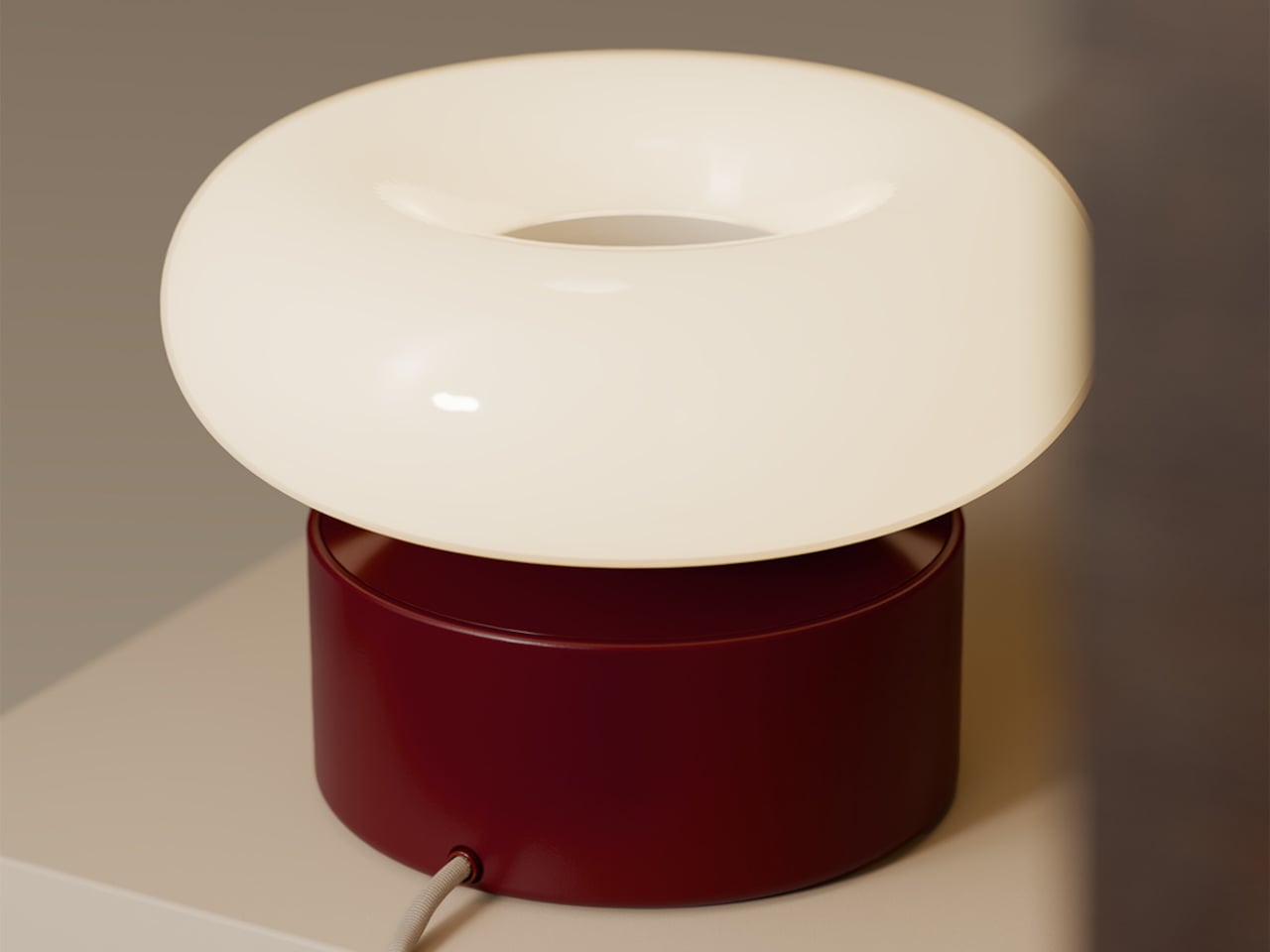
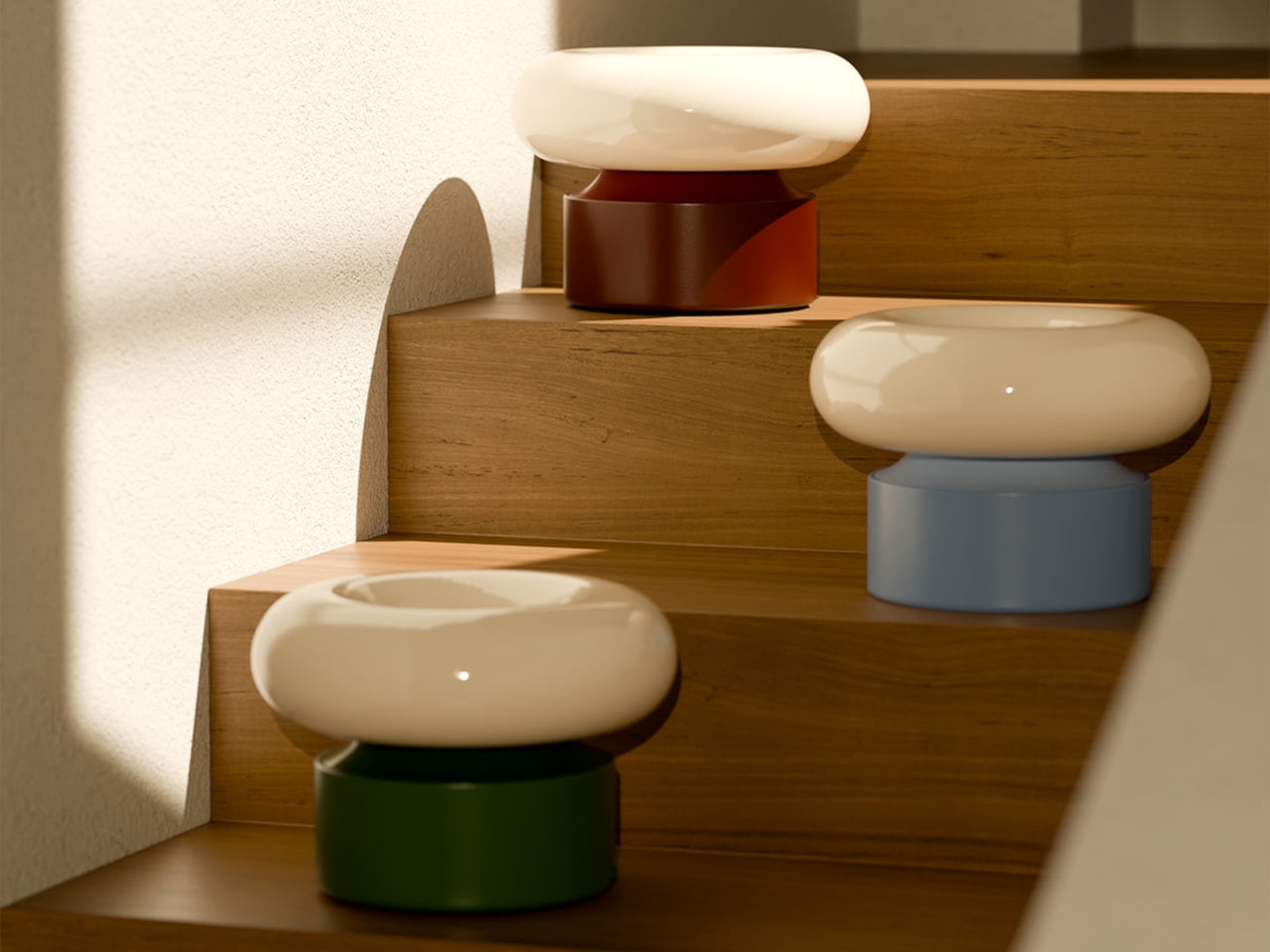
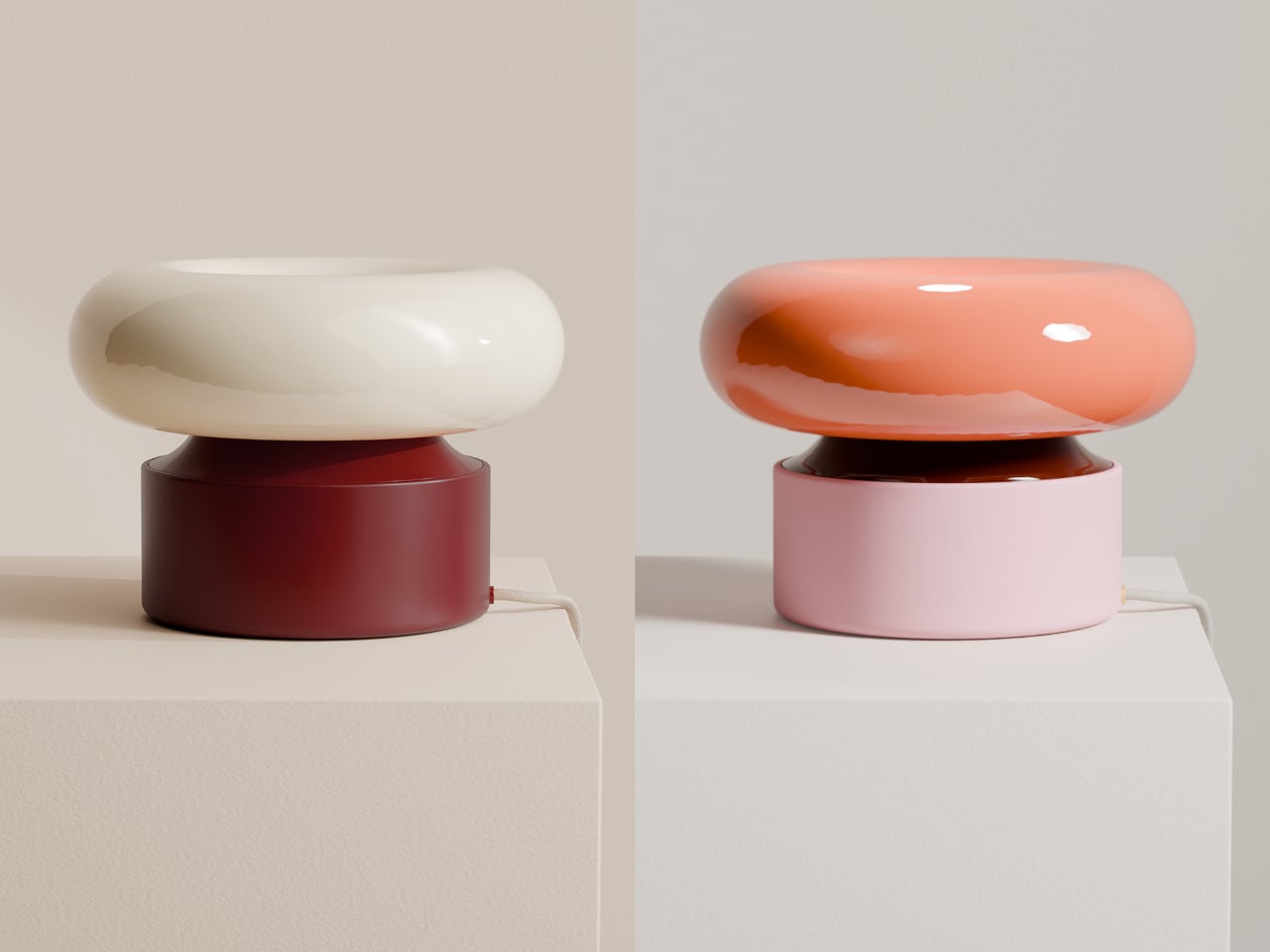
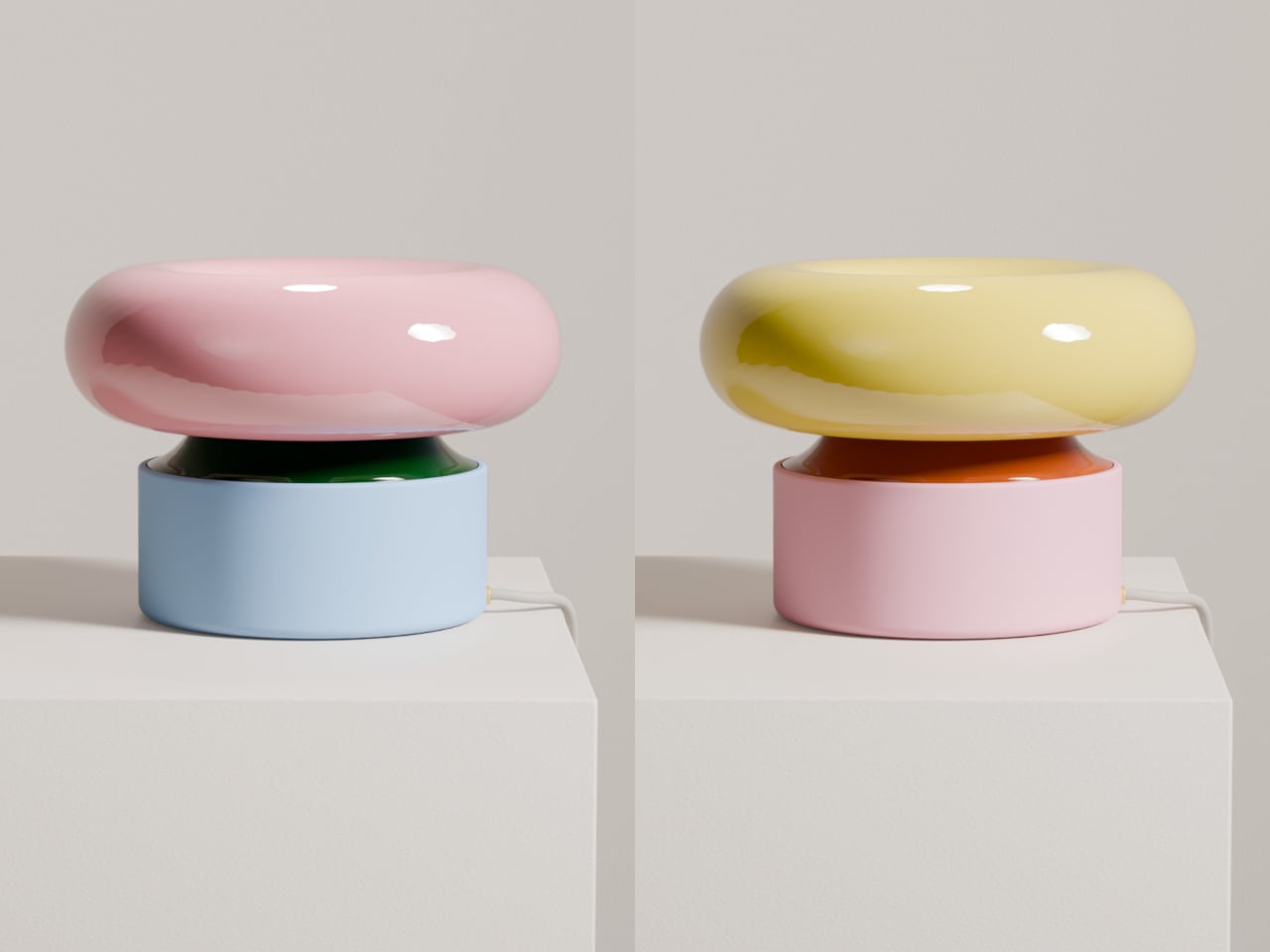
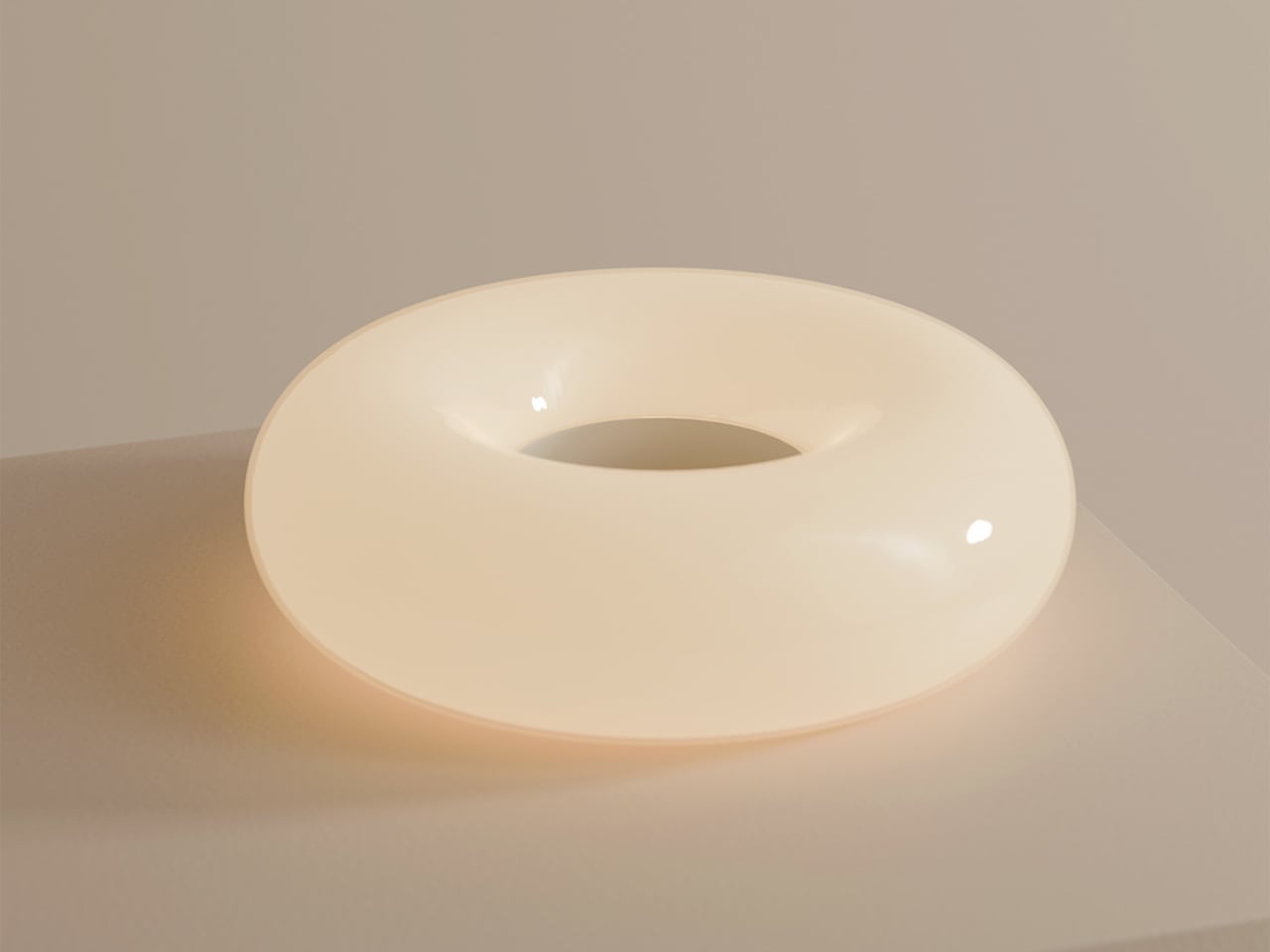
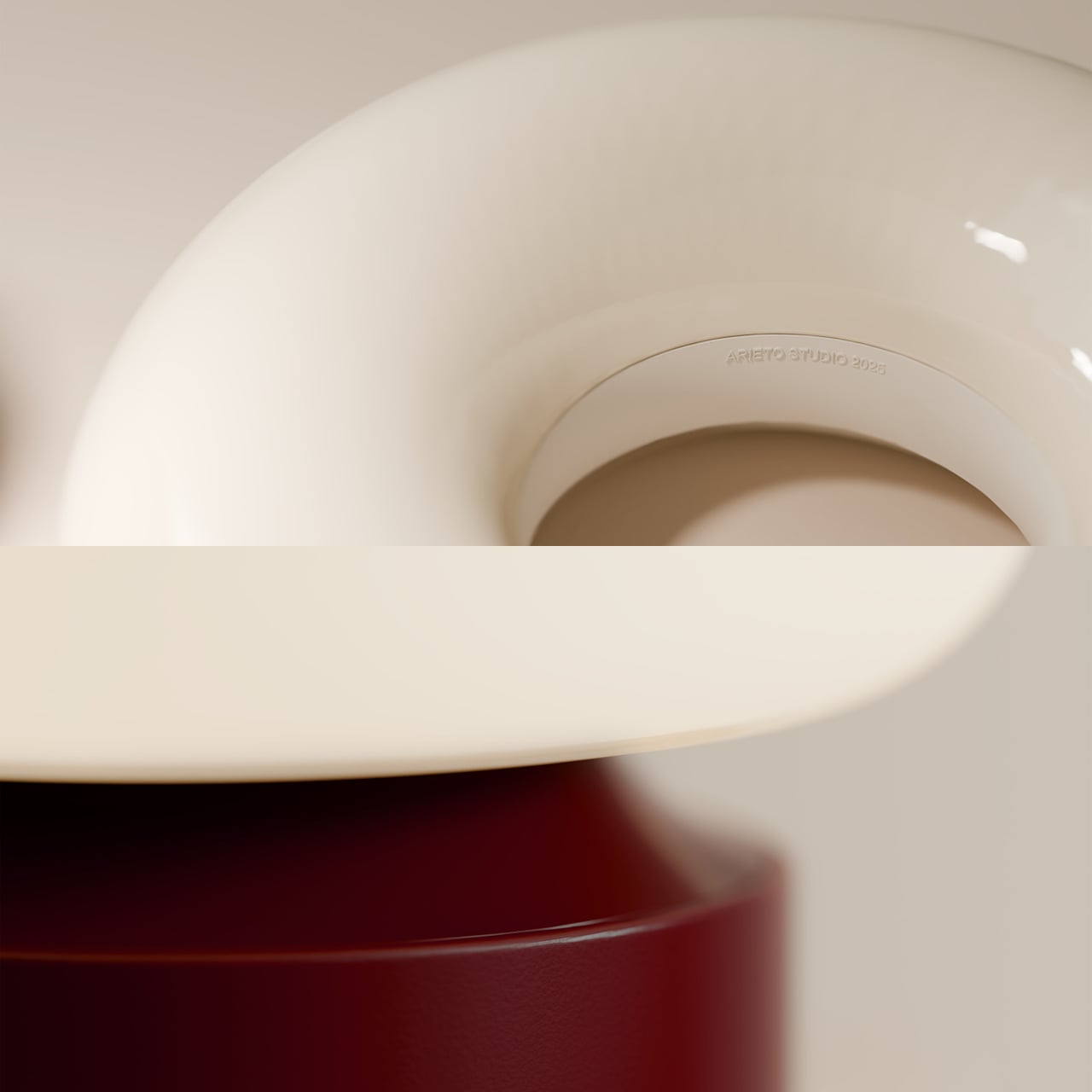
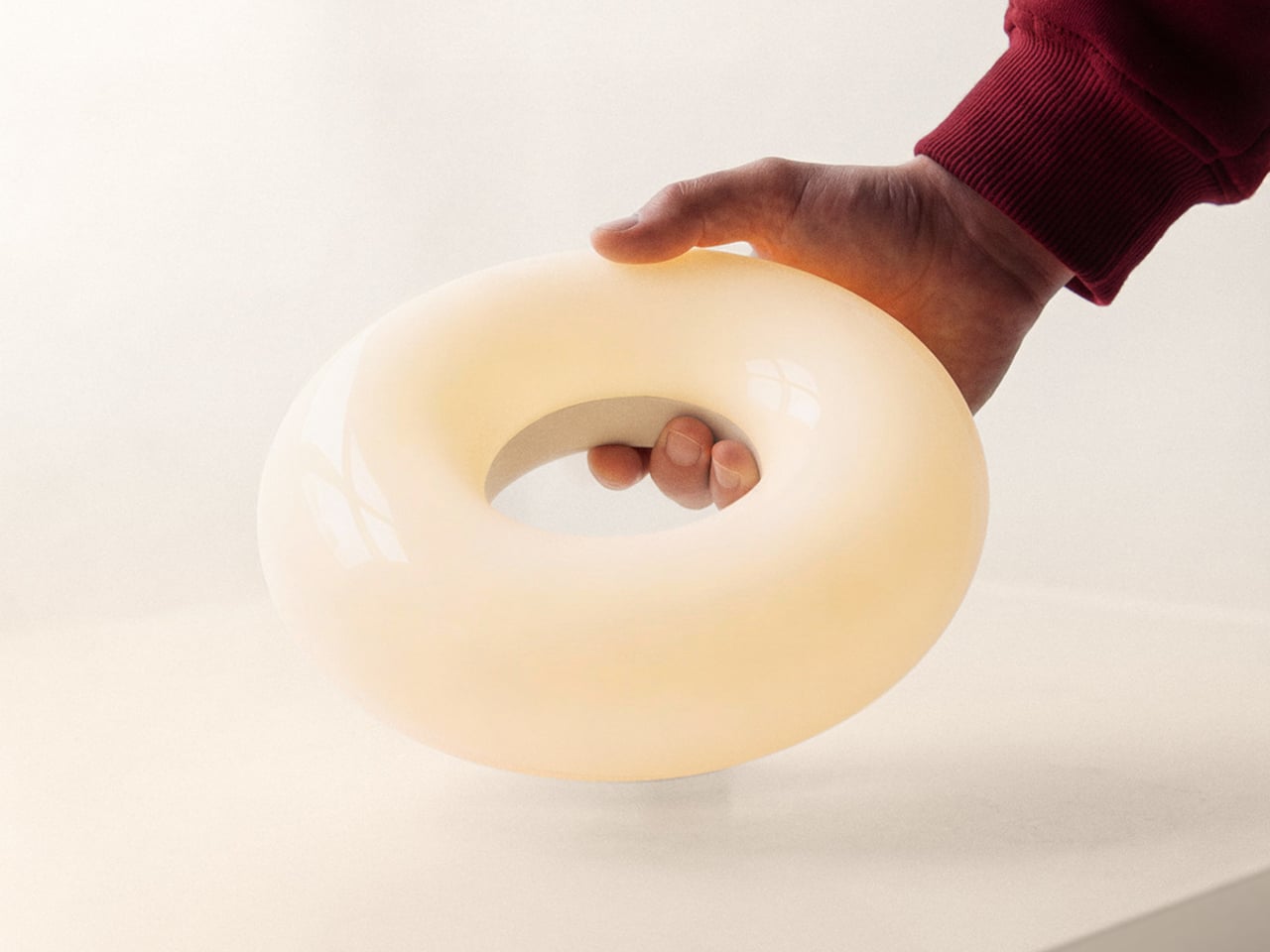
The lamp is two elements that live together, a luminous donut that holds the light and a weighted base that stays plugged in. When the donut rests on the base, it behaves like a sculptural table lamp. When lifted, it becomes a compact, cordless light that can travel to the terrace, coffee table, or hallway without trailing cables behind it or requiring a new outlet.

The base is both a stand and an induction charger. When the donut is dropped back onto it, charging starts automatically, no ports or cables to find in the dark. This turns recharging into a background ritual, the same motion you would make when tidying a table at the end of the night, and the lamp is ready again by morning without thinking about it.

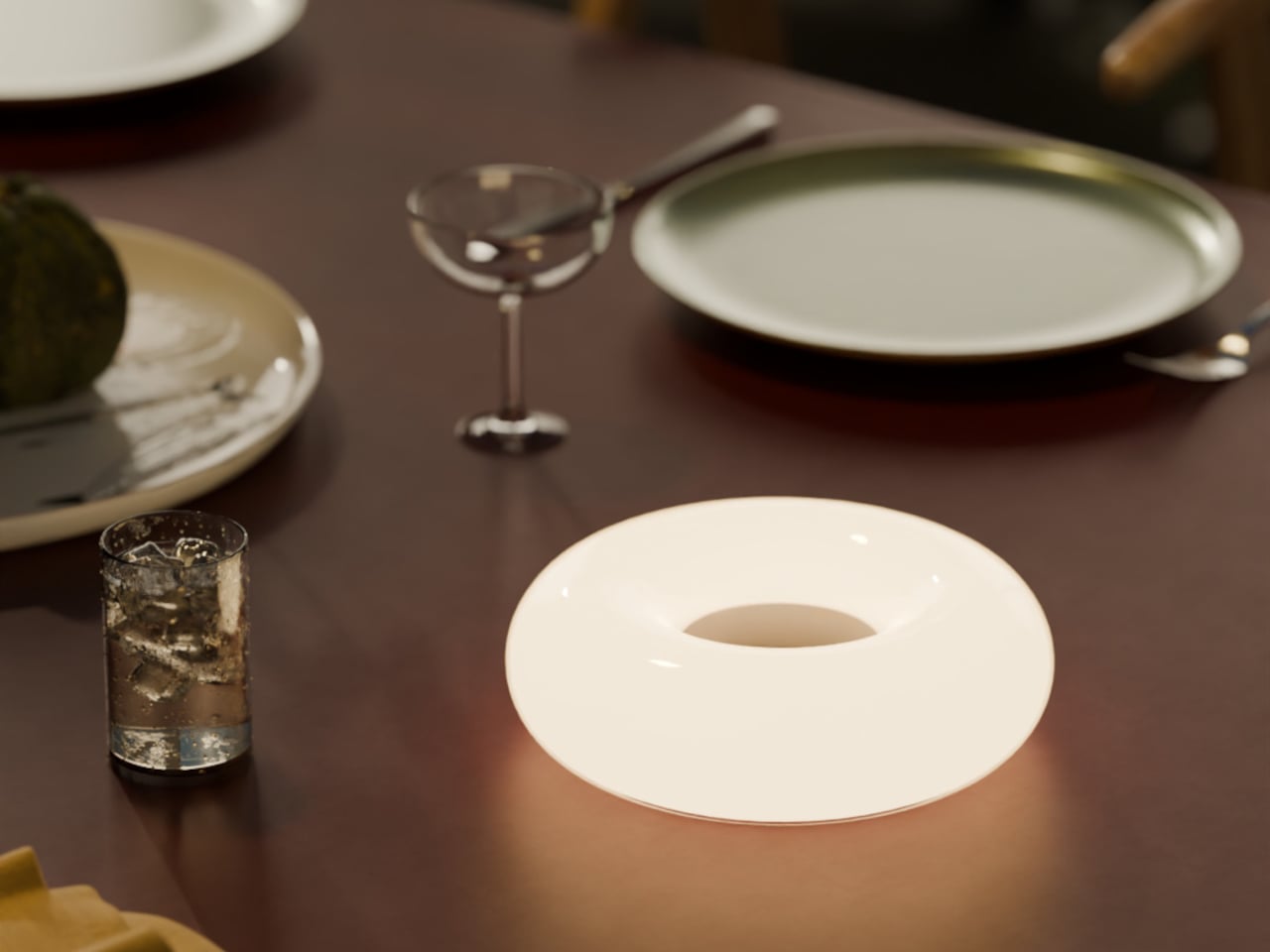
The soft, diffused glow from the ring throws gentle light across a table rather than a harsh spotlight. It is meant for calm, ambient illumination, the kind that makes late conversations feel unhurried and lets food or books sit in a pool of warm light without glare. The donut radiates evenly in all directions, so it never casts hard shadows or creates bright spots.

The donut on a balcony rail during a late drink, on a low shelf beside a sofa, or in a hallway where there is no convenient outlet shows how the same object moves between roles without looking like camping gear. It stays firmly in the language of interior objects, simple forms, rich colors, and a glow that feels like it belongs rather than borrowed from a utility drawer.

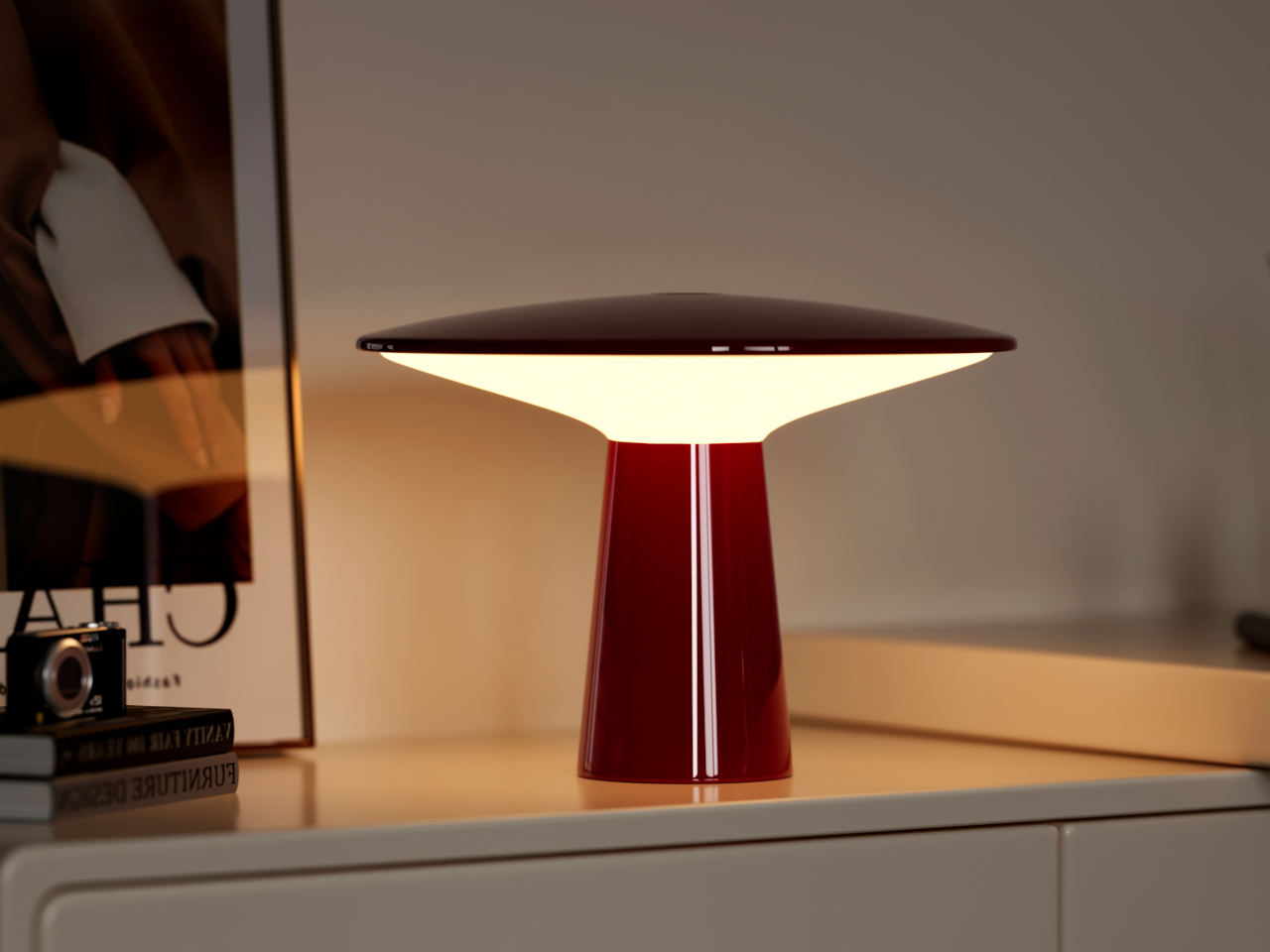
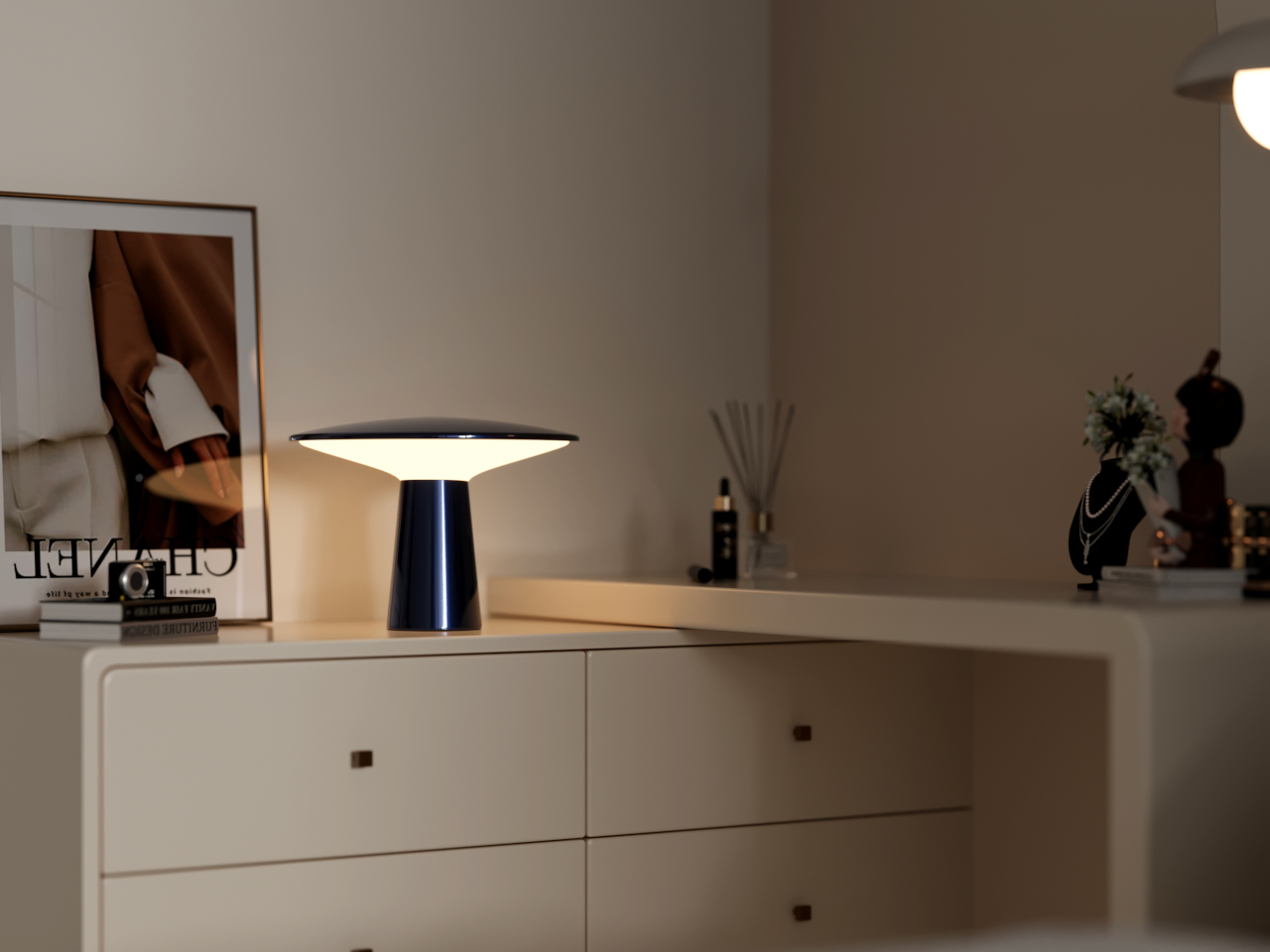
The contrast between the glossy, cream-colored ring and the solid, colored base makes the lamp read almost like a small sculpture when assembled. The base comes in several tones, burgundy, green, and blue, so it can either disappear into furniture or act as a quiet accent in a neutral room. The proportions are calm and grounded, not trying to impress with complexity.

ILO is less about showing off wireless charging and more about removing the tiny compromises that come with static lamps. It treats light as something that can follow dinners, conversations, and quiet moments, while still looking like a considered object when it comes home to its base. For people who move through their homes rather than settling in one spot all evening, a lamp that can keep up without cables or outlets starts to feel less like a luxury and more like how lighting should have worked all along.

The post ILO Lamp Lets Soft Light Wander Between Rooms first appeared on Yanko Design.

Paardarshi Carves Bamboo So Thin It Glows Like a Natural Light Pipe

Bamboo usually shows up in design as a structural element, furniture frames, baskets, or as a surface veneer. It is almost always treated as opaque, even though it has a natural light-passing quality if you thin it enough. Paardarshi is a table lamp concept that takes that translucency seriously and builds the whole project around making bamboo glow from within, treating the material itself as the optical element.

Paardarshi is a translucent bamboo table lamp that celebrates the natural light-passing quality of bamboo. The designer set out to create a hand-crafted lamp with two functions, a soft ambient mode and a brighter reading mode, and the name, meaning transparent in Hindi, hints at the goal: reveal what bamboo can do with light instead of hiding it behind a shade or treating it like just another wooden tube.

Designer: Ashray Sachan

The early experiments involved splitting bamboo with nodes intact, hand-scooping the inner surface with a half-round chisel, and dealing with cracking when too much material was removed. The designer then moved to a third approach, carving from the outside in to thin and straighten the tube while controlling wall thickness. The aim was even translucency along the length, turning the bamboo wall into a kind of natural light pipe that could diffuse an LED smoothly.

1

The lamp’s form is simple, a vertical bamboo tube on a base that can be closed for ambient light or opened and angled for a focused reading beam. The designer labels these as reading mode and ambient mode, and the same piece of bamboo is asked to behave differently depending on orientation. The geometry stays minimal, the behavior changes with how you interact with it and where you point the tube.

Inside the tube, the designer carves space to house the mechanism and notes the challenge of fitting hardware into something asymmetric and distorted. A press-fit component with springy arms is developed to adapt to different bamboo diameters, and permanent gluing is avoided. Threaded parts and a fully removable assembly are used so the light source can be replaced, bringing craft closer to industrial design and keeping the lamp serviceable over time.

All that carving and assembly work shows up in the way the lamp handles light. The thinned bamboo diffuses and refracts the LED into a warm, even glow along the tube, while the opening mechanism lets you concentrate that light where you need it. It is less about a decorative shade and more about treating the bamboo itself as the optical element, tuned by hand until it behaves the way the designer wants.

Paardarshi is a workshop project that still carries lessons for real products. It shows that a humble material like bamboo can be pushed into new roles with enough patience and iteration, and that serviceability and craft do not have to be opposites. For anyone interested in lighting that feels alive and repairable, rather than sealed and anonymous, a translucent bamboo tube that glows from within is a surprisingly compelling starting point.

The post Paardarshi Carves Bamboo So Thin It Glows Like a Natural Light Pipe first appeared on Yanko Design.
Spherical table lamp adds a beautiful playful touch to an everyday object

Lamps are the most common lighting fixture in our home, and they present the biggest opportunity to change the ambiance using thoughtful design. Some lamps are elaborate and luxurious, bordering on art masterpieces, while others are minimal to the point of disappearing from view. Lamps don’t just bring light to a room but also certain emotions like joy, energy, or fun. This lamp design, for example, tries to visually recreate the phenomenon of a ball colliding with a sheet of material, creating a playful mixture of uncommon forms, warm colors, and a simple yet impactful design that adds a little flavor to any shelf, table, or living space.
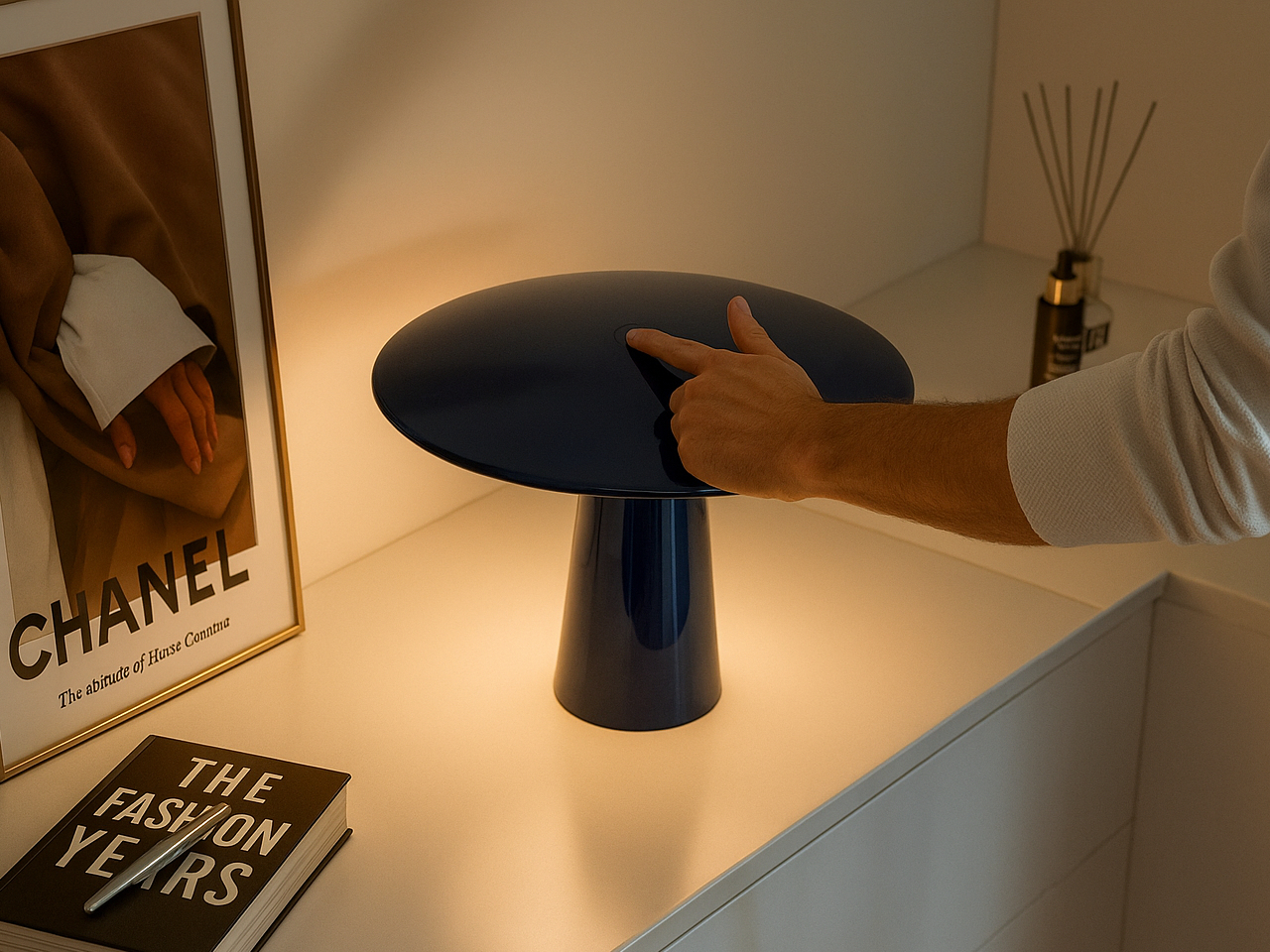
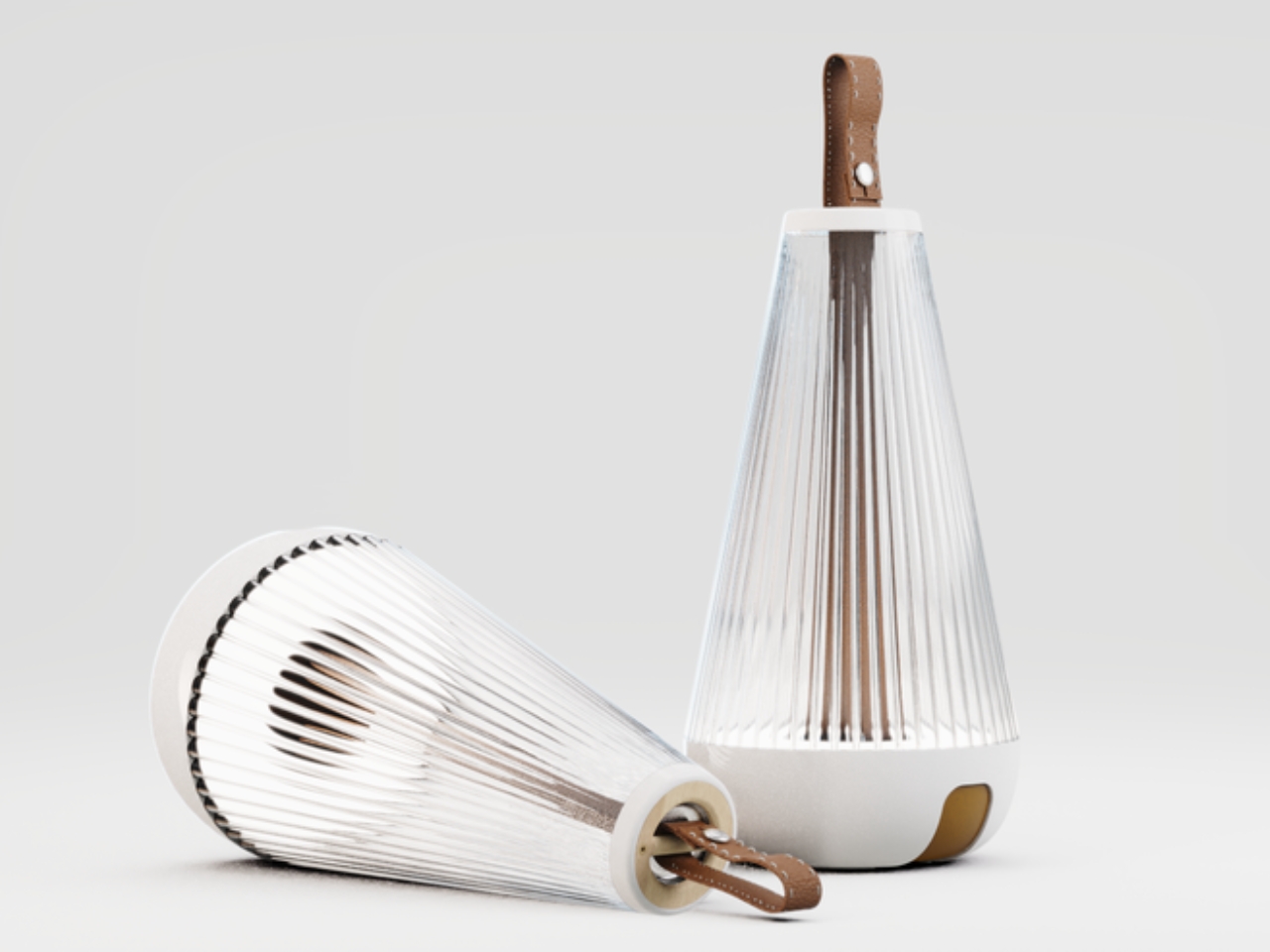
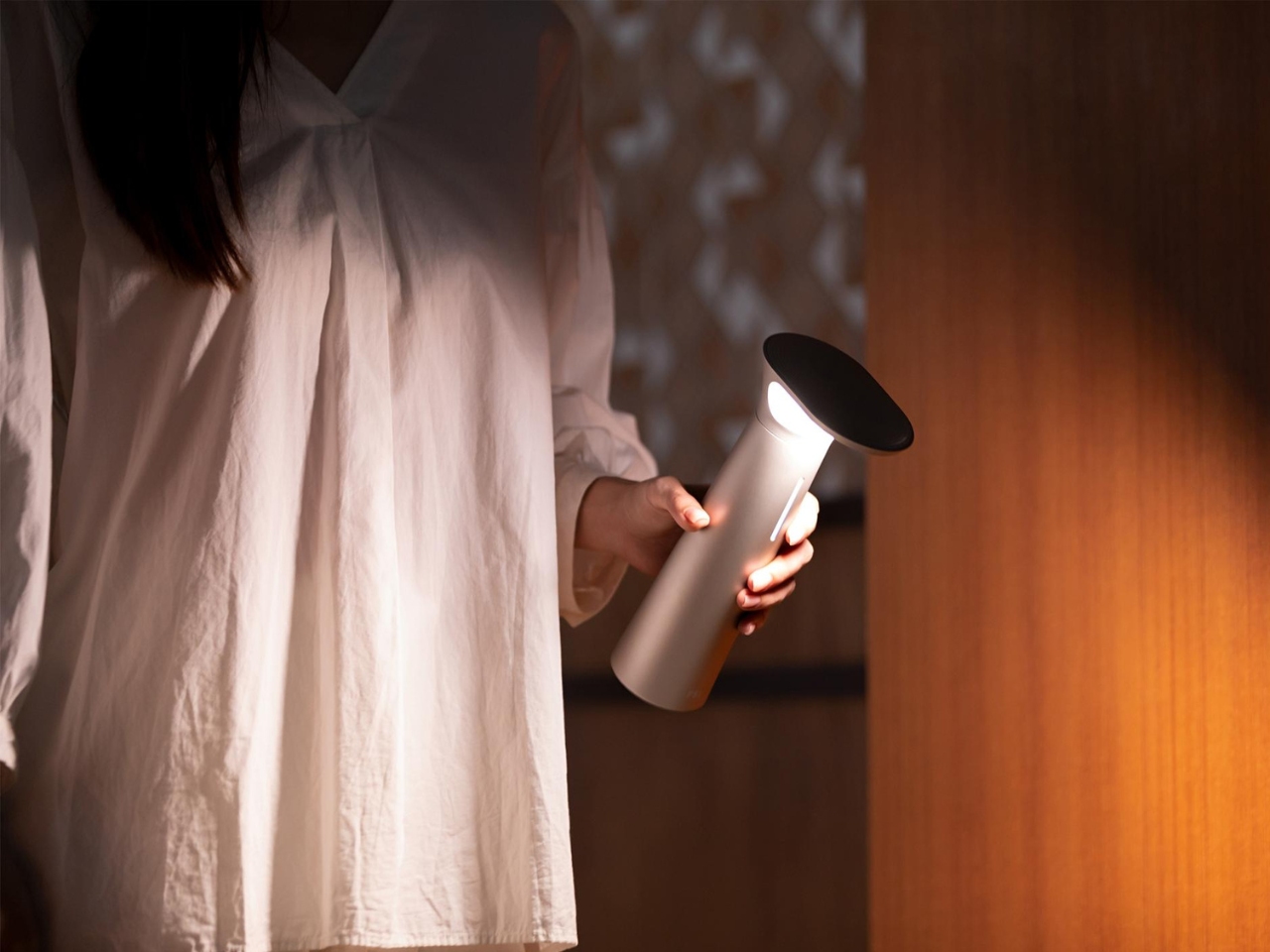
Designer: Lidia Gomez

There is probably nothing more playful than a ball. Its spherical kind introduces a form of instability that makes it wobble and roll unless something stands in its path. Both kids and adults alike love playing with balls, rolling them, throwing them, and even making them bounce. The playful “bonk” sound that this bouncing action makes is just as fun, which is why some kids just can’t stop doing it even after being scolded repeatedly.

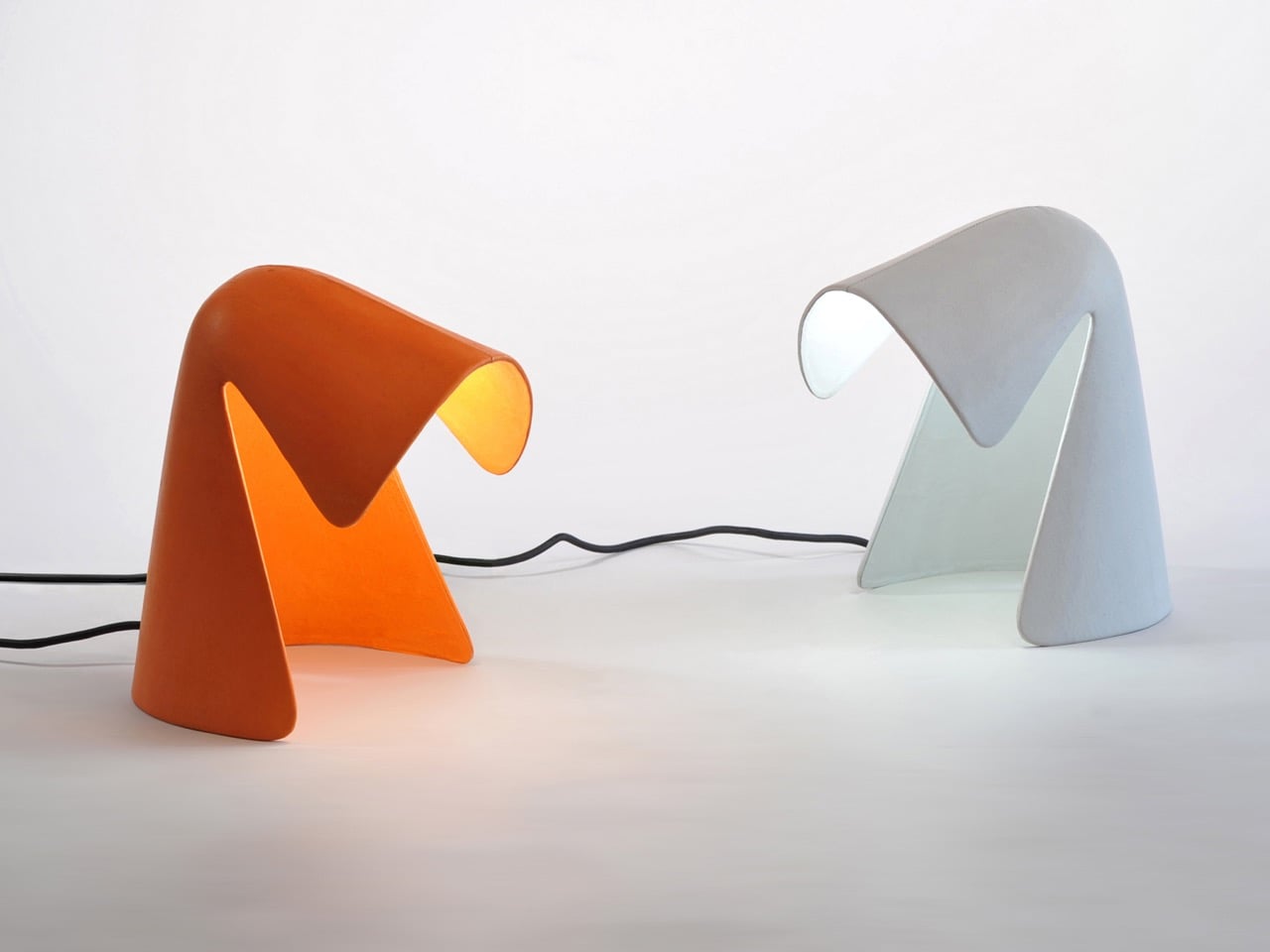
The Bonk table lamp design brings that imagery to common everyday appliances, transforming it into something like a living and dynamic object. Its form, with the ball half sunken into what seems to be a sheet of fabric, captures and freezes that moment, creating a visual tension between movement and stillness, action and rest. It creates an interesting aesthetic on its own, and an almost eerie appearance once you turn the lamp on in the dark.

Almost like its shape, Bonk also balances its cheerful disposition with a more subdued color palette. Tiger Orange, Sand, Sunrise Yellow, and Stone convey warmth yet still remain subtle and almost understated. It creates a juxtaposition of design elements that is a perfect metaphor for the symmetrical yet unbalanced form of a ball. It combines all these into a design that will fit perfectly inside modern homes, regardless of the interior motif.

Bonk is also a design that’s a bit in touch with nature, even if indirectly. It can be 3D printed using FDM technology and utilizing PLA, a more renewable and sustainable form of plastic in wide use with this production method. Simple, striking, and sustainable, Bonk tries to challenge the status quo of home decor design where these elements can come together in a harmonious composition that not only brings light to your space but also sparks joy in your life.

The post Spherical table lamp adds a beautiful playful touch to an everyday object first appeared on Yanko Design.