This kid just became the first person to beat NES Tetris

Tetris is one of the most popular and enduring video games of all time, with versions on just about every console, computer and gadget. Many of these iterations have endings baked into story modes and the like, but the original endless mode was considered unbeatable by humans, until now. A 13-year-old boy has become the first person to ‘beat’ the NES version of Tetris, 34 years after it originally released back in 1989, as announced by YouTuber aGameScout.

The reason we put ‘beat’ in quotes is due to the nature of the achievement. Oklahoma teenager Willis Gibson, also known as Blue Scuti on YouTube, didn’t access an authorized ending, as there isn’t one. Instead, he played the game so perfectly for so long that it forced a kill screen that crashed the game. These kill screens are usually caused by an overflow error that occurs when you speed the game up so much that the software can’t keep up.

The teen achieved this feat after 38 minutes of gameplay and captured the moment on video. He’s the first person to do this, but not the first, uh, entity. An AI program called StackRabbit forced a kill screen with the NES Tetris back in 2021. Score one for the humans!

This was done by incorporating a gameplay style called the rolling technique, which has players glide their fingers along the bottom of an NES controller and use that momentum to roll the controller into the other hand. When done correctly, you can hit the D-pad up to 20 times per second. The method revolutionized competitive Tetris play a couple of years back. Prior to this achievement, the 13-year-old had already broken the game’s high score record, level achieved record and the total number of lines cleared by using the rolling technique.

Gibson, aka Blue Scudi, told another YouTuber that he’s dedicating the achievement to his late father, who recently passed away in December. He also said that the gameplay session was so frantic that he couldn’t feel his fingers afterwards.

Achieving the mythical kill screen is something of a rite of passage for old-school games. If you’ve seen the documentary King of Kong, involving the arcade cabinet Donkey Kong, you know just how competitive it can be to snag those bragging rights. Players have hit the kill screen on Pac-Man, Dig Dug, Duck Hunt, and many others.

This article originally appeared on Engadget at https://www.engadget.com/this-kid-just-became-the-first-person-to-beat-nes-tetris-191557002.html?src=rss


Combining Nature And Technology For Sustainable Plant Care

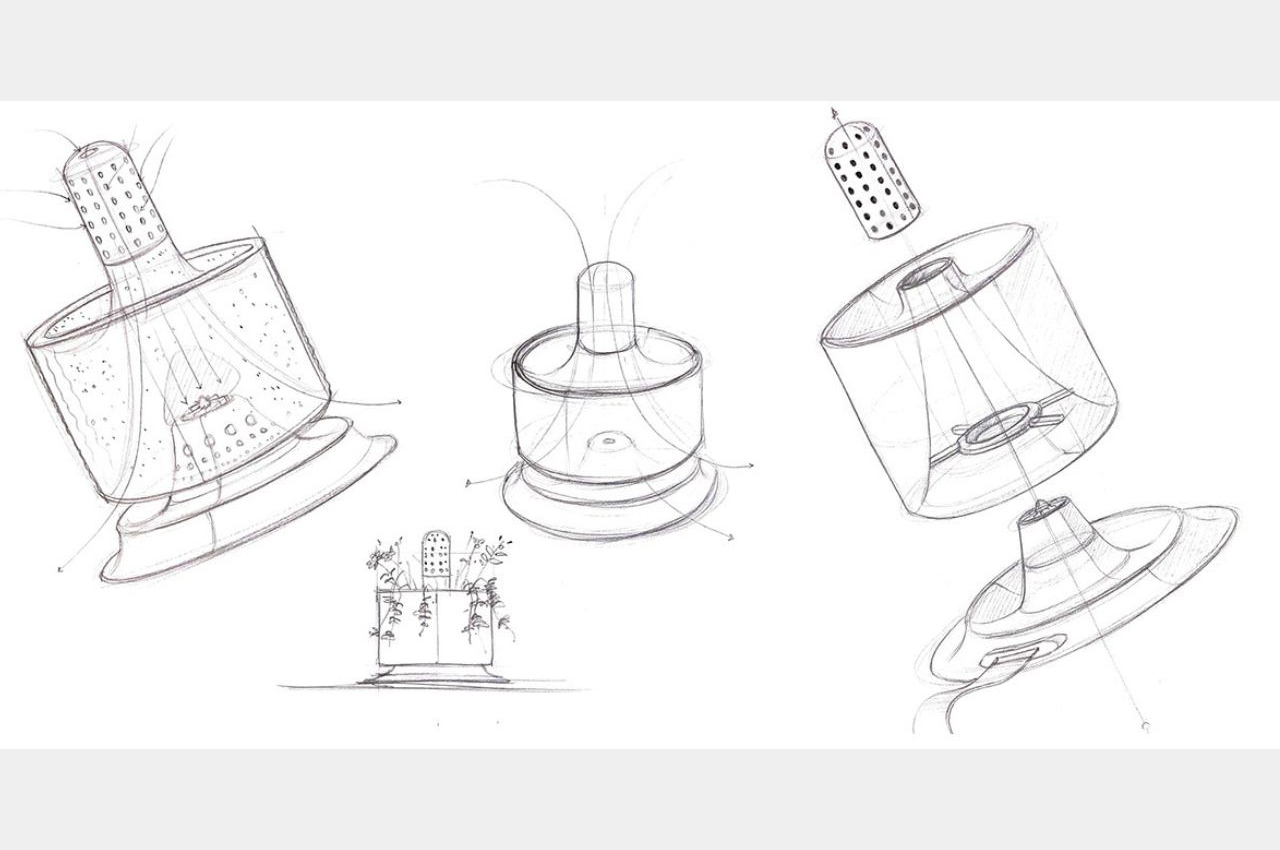
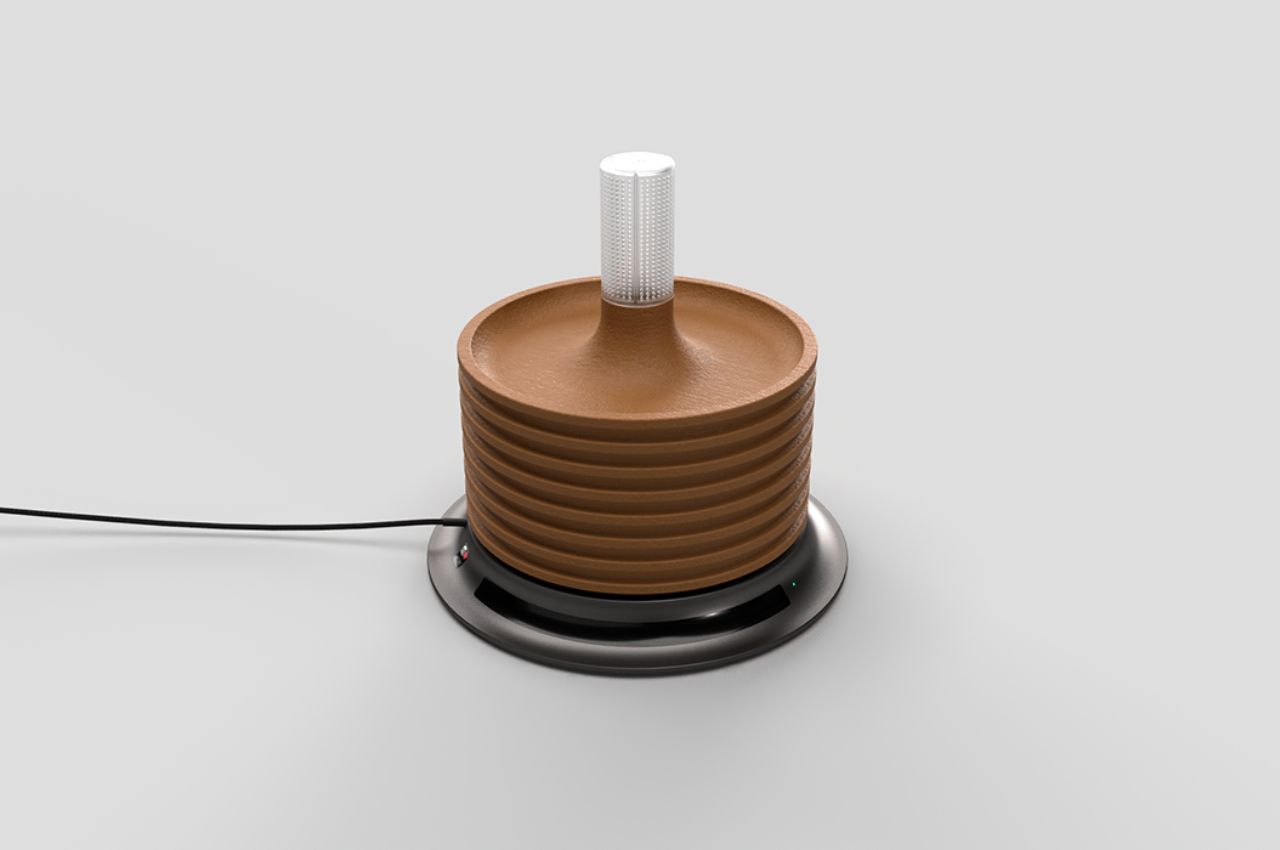
In the realm of biomimicry, the Fog Smart Hydroponic Planter stands out as a futuristic marvel inspired by the incredible abilities of the fog-basking beetle. It is a masterpiece that seamlessly blends the brilliance of biomimicry, advanced materials, and smart technology. Inspired by the fog-basking beetle native to the Namibian deserts, this hydroponic planter is not merely a vessel for plants but a pioneering solution that promises a greener, more sustainable future.

Designer: Rishikesh Sonawane

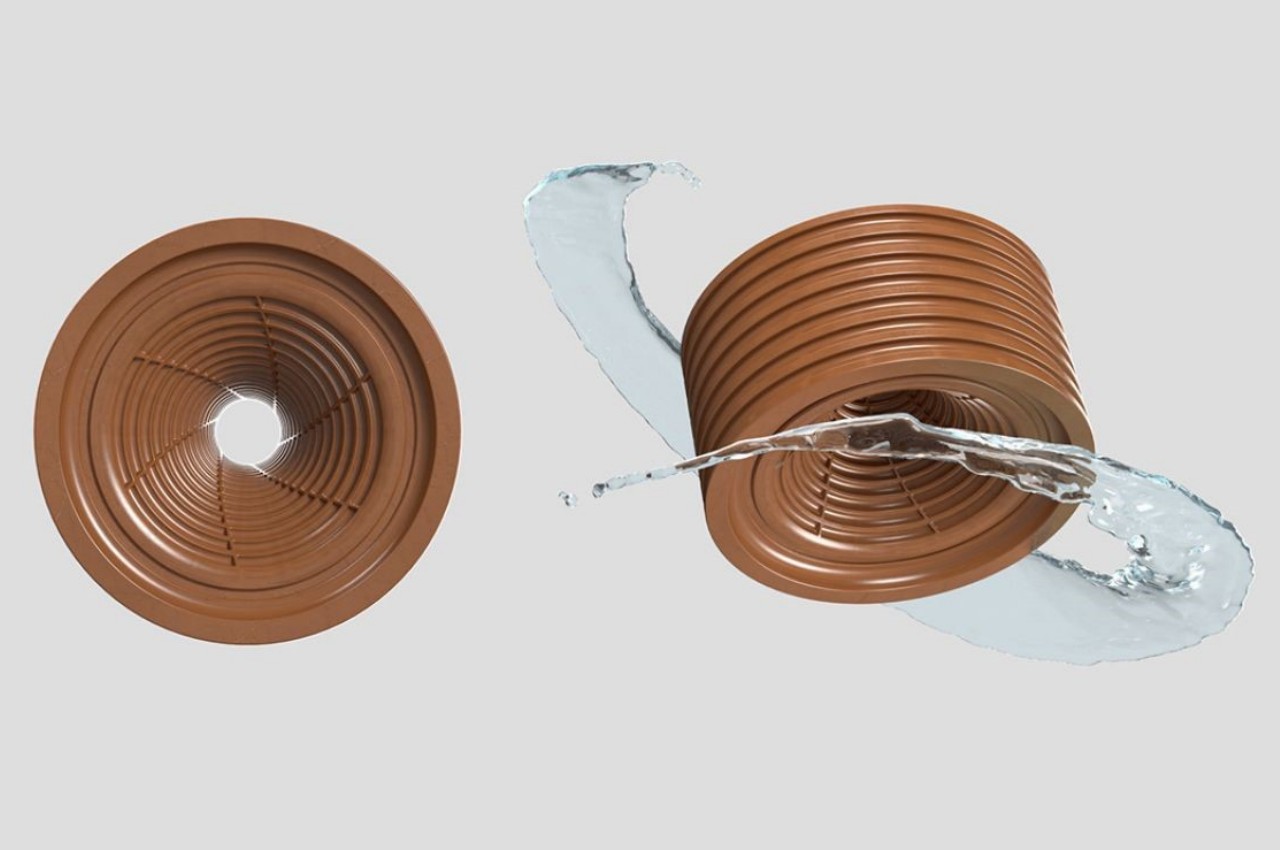
Biomimicry is a practice that learns from and mimics the strategies found in nature to solve human design challenges. The fog-basking beetle, a tiny inhabitant of the Namibian deserts, can thrive in arid conditions by extracting moisture from the surrounding fog. Its microstructural adaptations, enhancing surface area by up to 60%, allow it to condense and redirect moisture, providing a source of sustenance in environments where water sources are scarce. This ingenious adaptation has become the inspiration behind the Fog Smart Hydroponic Planter.

This planter represents a harmonious convergence of biomimicry and modern design principles. Unlike traditional planters, it transcends mere functionality, aspiring to become a statement piece that marries aesthetics with technological innovation. The modular design, a hallmark of this project, not only facilitates ease of use but also underscores the commitment to adaptability and sustainable plant care.

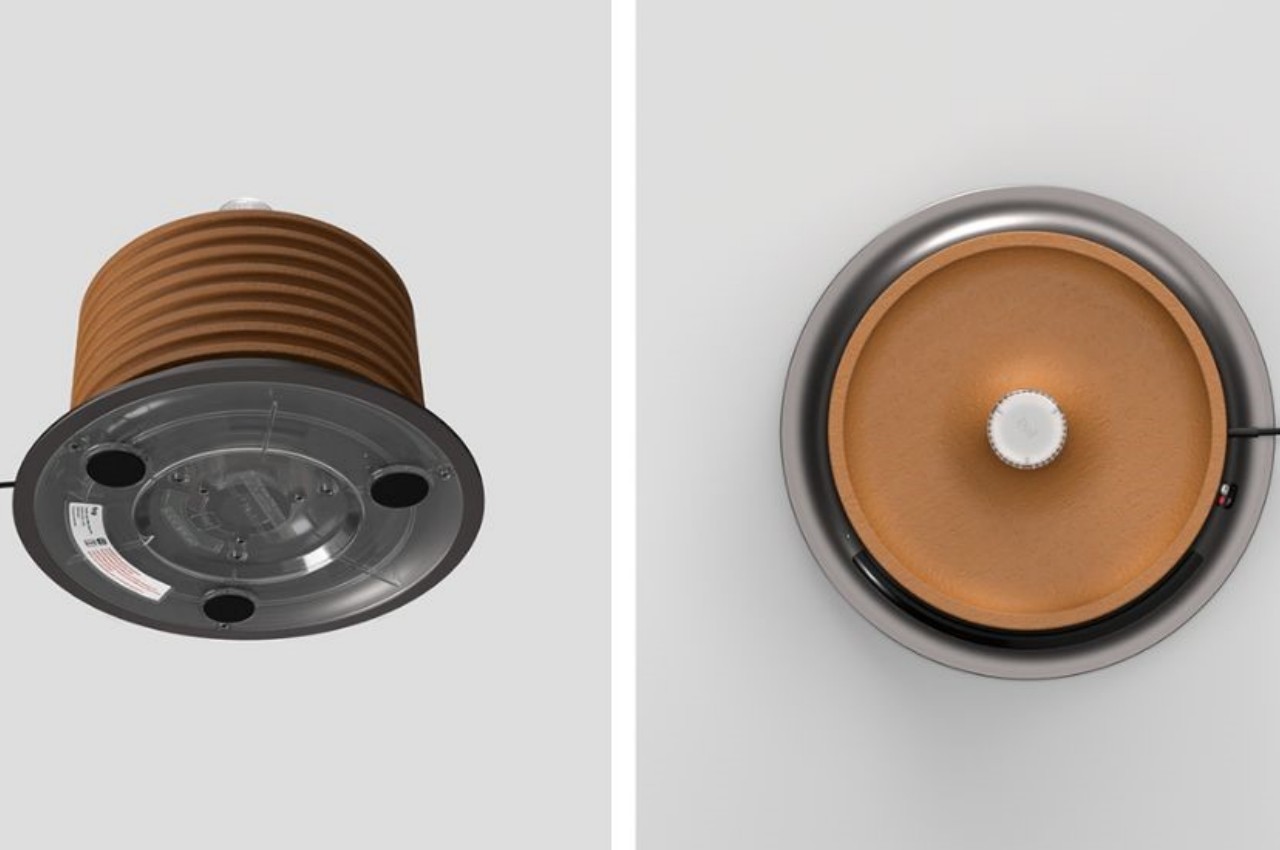
The use of advanced materials fortifies the structural integrity of the Fog Smart Hydroponic Planter. The air intake module is meticulously crafted from Plexiglas, a polymer renowned for its resistance to sunlight (also used in aquariums and airplane windows), preventing yellowing over time. The main body incorporates Lightweight Expanded Clay Aggregate (LECA), a versatile clay composite with superior water retention properties, strength, and porosity. The aluminum 6063 base complements this ensemble, providing a stable foundation resistant to corrosion.

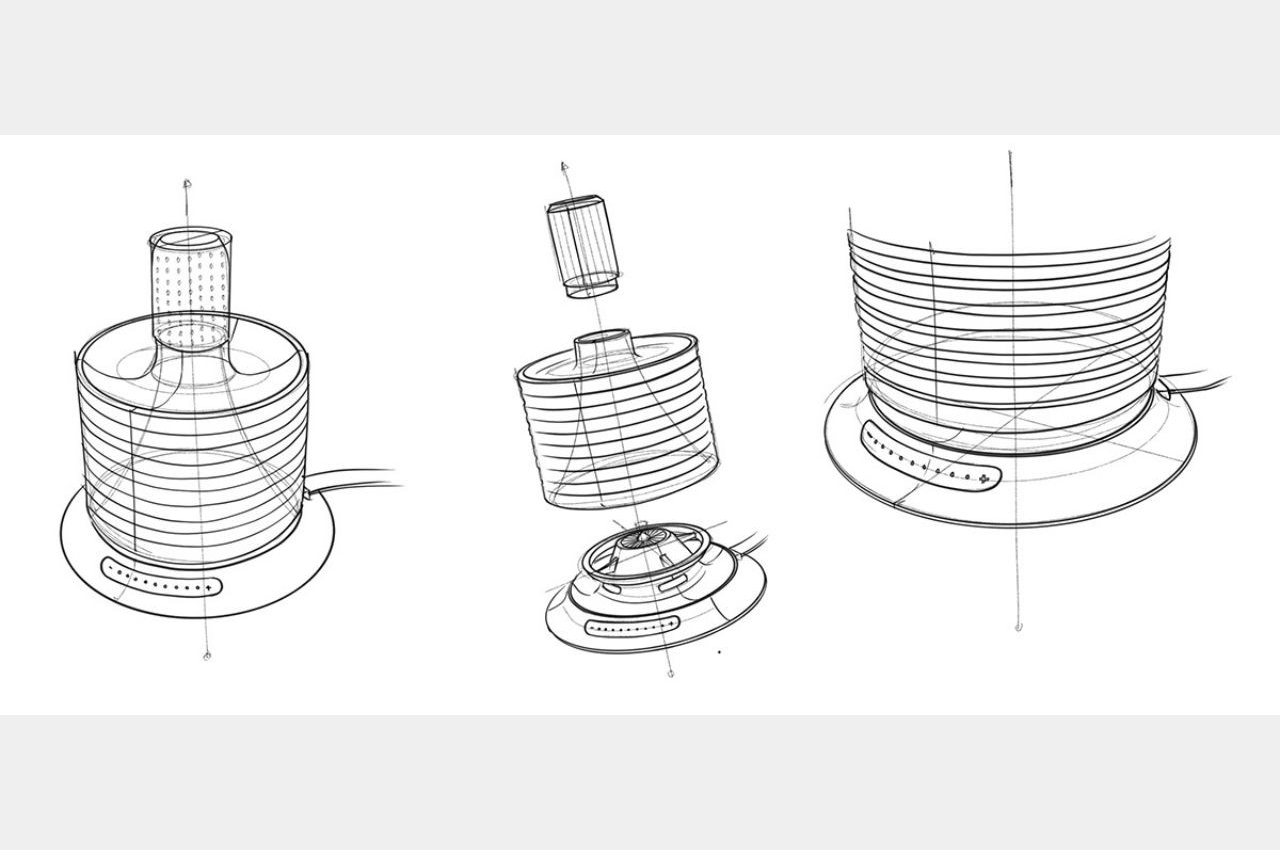
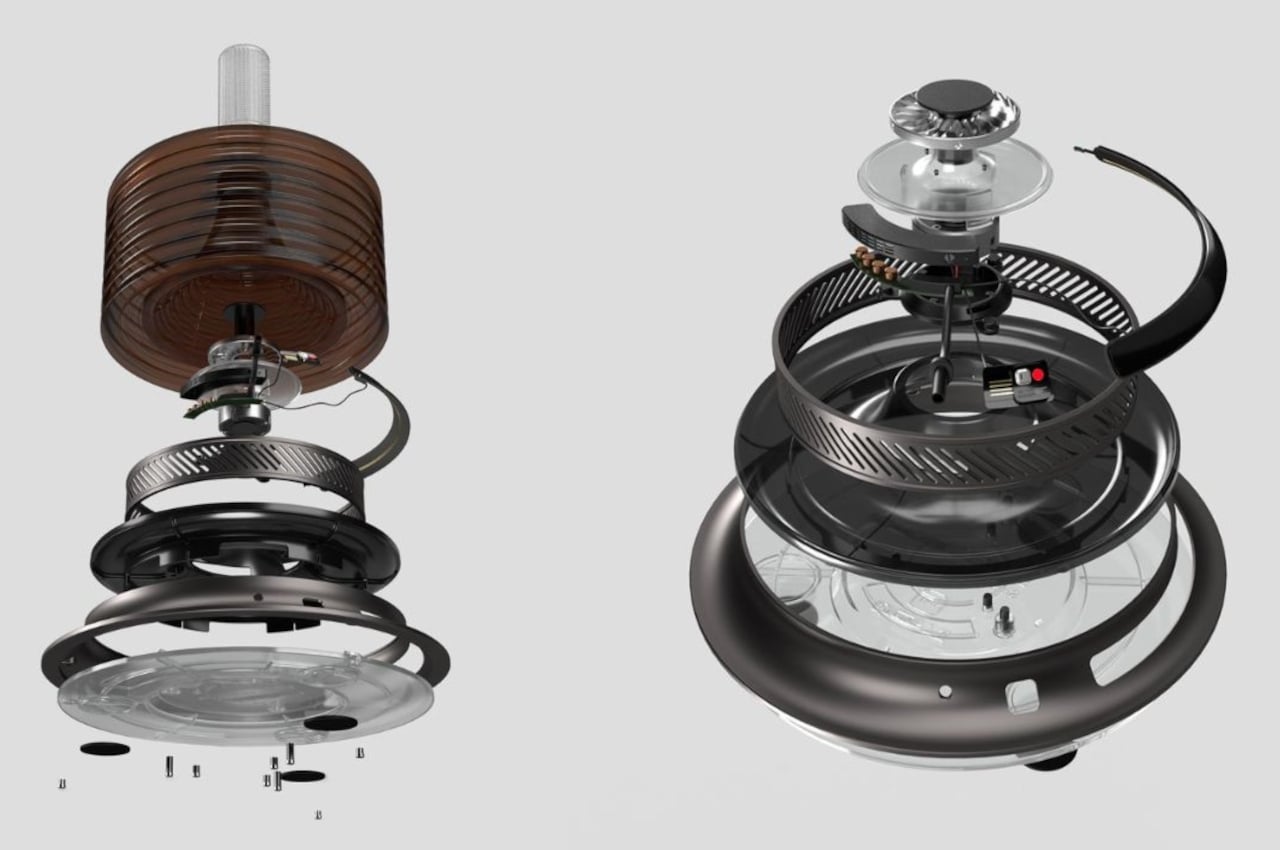
To achieve simplicity and practicality, the planter is ingeniously disassembled into four primary components. The drip tray, perforated ring, metal ring, and polymer cap collectively ensure easy maintenance and cleaning. The LECA planter’s internal structure, designed to mimic the fog-basking beetle’s shell, employs hydrophilic and hydrophobic elements strategically, optimizing moisture retention and distribution.

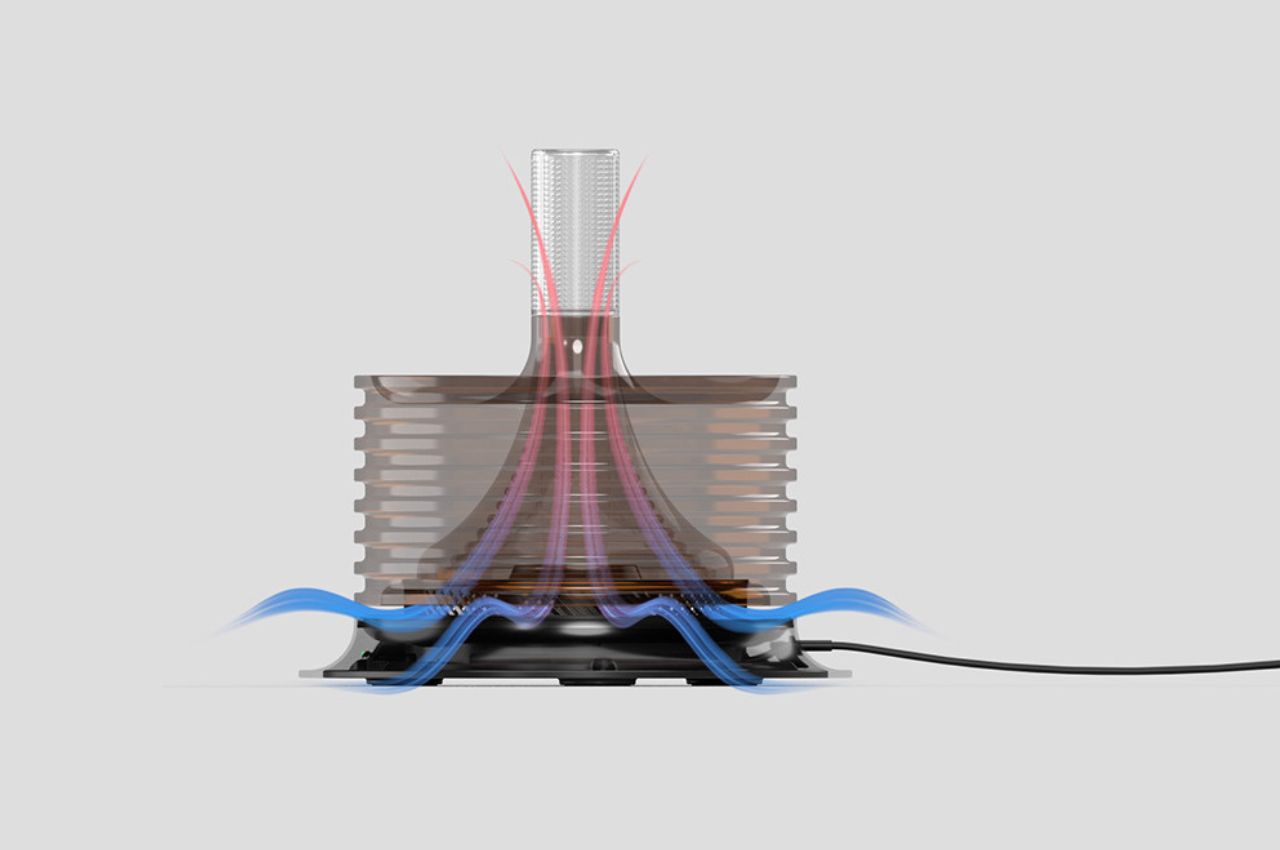
The planter introduces a groundbreaking approach to airflow dynamics by incorporating the Coanda Effect. As humid air courses through the planter, moisture is absorbed, contributing to increased turbine efficiency. This design concept draws inspiration from well-established technologies, such as Dyson fans and jet turbines, showcasing a commitment to energy efficiency.

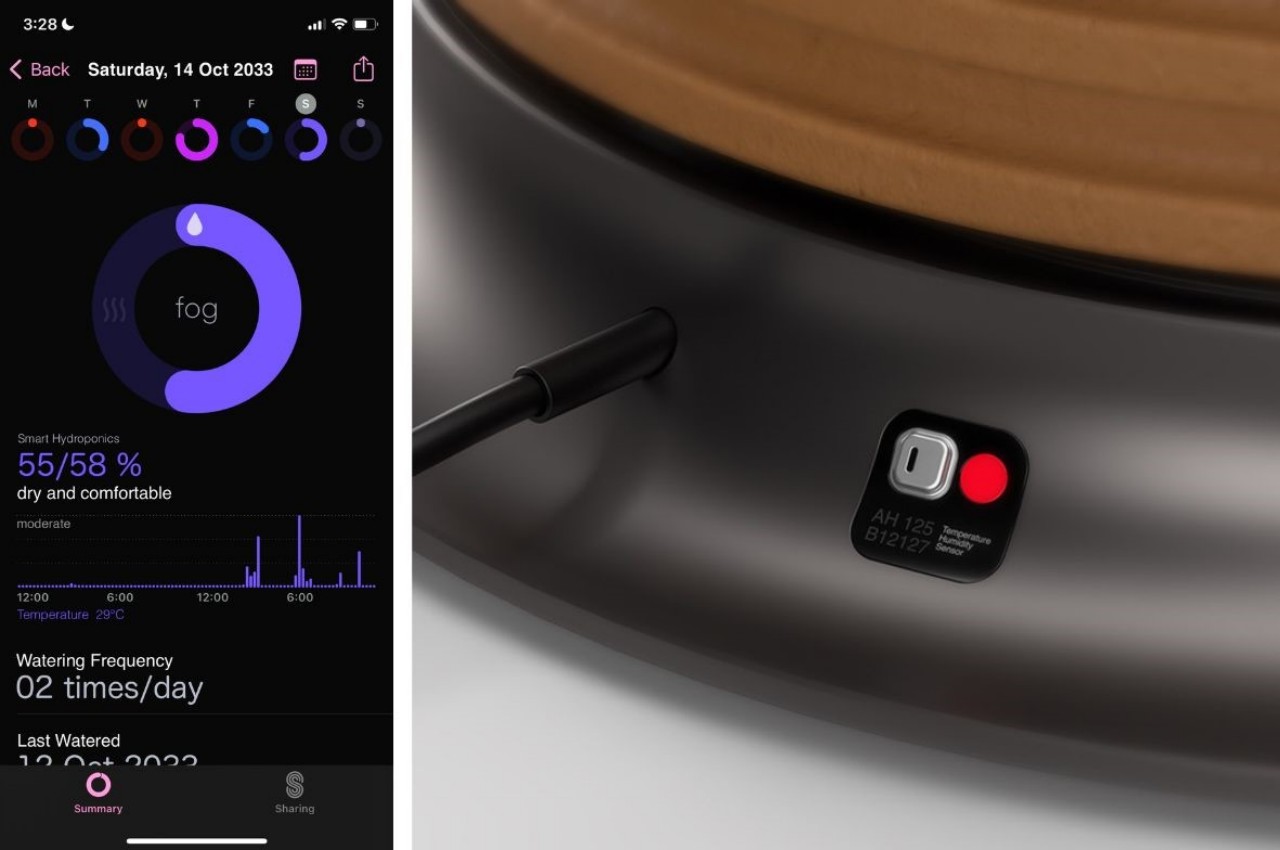
Elevating plant care to new heights, the planter integrates intelligent features denoted as Smart+. A temperature and humidity sensor, intricately linked with the electronic components, dynamically adjusts the turbine speed, allowing users precise control over the plant’s microenvironment. The accompanying app, a technological companion, provides real-time data on humidity and temperature levels, offering insightful recommendations for optimal watering cycles based on the geographic location of the planter.

User interaction with the Fog Smart Hydroponic Planter is facilitated through an intuitive and user-friendly app interface. The app acts as a conduit between the user and the planter’s internal environment, allowing the monitoring of moisture concentrations, receiving water cycle recommendations, and tracking humidity and temperature levels throughout the day. This digital integration transforms the planter from a mere vessel into a sophisticated and futuristic table accessory.

The Fog Smart Hydroponic Planter is not merely a horticultural innovation; it is a testament to the symbiosis of nature and technology in the pursuit of sustainable living. As we navigate the complexities of modern existence, this planter stands as a beacon of hope, offering a glimpse into a future where our interaction with nature is characterized by thoughtful design, cutting-edge technology, and a commitment to environmental harmony. With each leaf it nurtures, it heralds a greener, more sustainable tomorrow, where biomimicry and technological ingenuity converge to create a better world—one plant at a time.

The post Combining Nature And Technology For Sustainable Plant Care first appeared on Yanko Design.

Jack Black will reportedly play Steve in the long-delayed Minecraft movie adaptation

Jack Black is reportedly set to play Minecraft Steve. Deadline wrote on Tuesday that the School of Rock actor will play the game’s blocky protagonist alongside Jason Momoa in the game’s long-delayed film adaptation.

The Minecraft adaptation has been in development since 2014. It’s cycled through at least three previous directors (Shawn Levy, Rob McElhenney and Peter Sollett) and two missed release windows (2019 and 2022). Its current target date is April 4, 2025.

The writers for the project’s current iteration haven’t yet been revealed. However, adapting the sandbox building game into a plot-driven Hollywood blockbuster will allow for (and probably require) ample creativity from its scribes. A plot synopsis published in 2019 (which may or may not still apply) describes the film as following “a teenage girl and her unlikely group of adventurers. After the malevolent Ender Dragon sets out on a path of destruction, they must save their beautiful, blocky Overworld.”

Image of the character Steve (blocky, rudimentary graphics) from Minecraft in front of an orange gradient background.
Minecraft Steve
Mojang / Microsoft

Black is fresh off a beloved performance as Bowser in The Super Mario Bros. Movie, where he showed the effectiveness of his larger-than-life comedic presence in gaming adaptations. IGN even noted that both of Black’s gaming roles — Bowser and Steve — appeared in Super Smash Bros. Ultimate.

Napoleon Dynamite creator (and Black collaborator on Nacho Libre) Jared Hess will direct. Deadline says production will start soon on the film, which hails from Warner Bros, Vertigo, Legendary, Mojang / Microsoft and On the Roam. Emma Myers, Danielle Brooks and Sebastian Eugene Hansen have signed on to join Black and Momoa in the cast.

This article originally appeared on Engadget at https://www.engadget.com/jack-black-will-reportedly-play-steve-in-the-long-delayed-minecraft-movie-adapatation-175331365.html?src=rss

LG reveals 2024 OLED TVs with AI processors ahead of CES

LG just announced a new lineup of OLED TVs just days before CES 2024 kicks off in Las Vegas next week. The LG Signature OLED M4 and OLED G4 TVs are, surprise, packed with an updated AI processor that offers four times the performance of last year’s models. The Alpha 11 AI processor works to enhance picture and audio quality, offering a 70 percent improvement of visual performance when gaming compared to its predecessor.

The AI chip upscales objects and backgrounds to reduce blur and allegedly analyzes and adjusts colors to “best convey the mood and emotional elements intended by filmmakers.” LG also promises a more “three-dimensional” image, thanks to its proprietary Dynamic Tone Mapping Pro technology that fine-tunes brightness and contrast on the fly. The AI chip also allows for virtual surround sound and even separates vocals from soundtracks to enhance the dialogue.

The resolution remains 4K but the refresh rates have gotten a glow up. Last year’s models capped out at 120Hz, but the M4 and G4 now offer a refresh rate of 144Hz. Obviously, high refresh rates are great for watching action-packed content and for gaming. To that end, each TV offers access to LG’s webOS platform for viewing streaming content and playing games via the cloud.

Some people in a nice white living room watching live music on TV.
LG

The M4 ships with LG’s proprietary Zero Connect Box that streams audio and video wirelessly, eliminating the need for connected cables. The tech provides real-time video and audio transmission up to 4K with a 120Hz refresh rate. This is for people absolutely committed to a clean living room aesthetic.

Each of LG’s new OLED TVs offers support for both NVIDIA G-Sync and AMD FreeSync, which is great for gamers. The panels also come with LG’s Game Optimizer selection screen, allowing users to instantly switch between display presets designed for different gaming genres.

Pricing and availability are both still up in the air. Maybe we’ll get more information at CES 2024 next week. In addition to this reveal, LG also announced an absolutely massive 97-inch M3 OLED display and a 98-inch QNED model.

We're reporting live from CES 2024 in Las Vegas from January 6-12. Keep up with all the latest news from the show here.

This article originally appeared on Engadget at https://www.engadget.com/lg-reveals-new-oled-tvs-with-high-144hz-refresh-rates-ahead-of-ces-2024-164550931.html?src=rss

Roku’s ‘high-end’ Pro Series TVs feature Mini LED screens

Roku is stepping into premium TV territory at CES 2024 with its new Pro Series sets, which feature Mini LED backlighting for better brightness and contrast, as well as enhanced audio. The company announced its first self-made TVs at CES last year — a surprising move, since it has also partnered with TCL and others for years to build "Roku TVs" powered by the Roku OS. Roku's first batch of TV sets, the Select and Plus models, were clearly value-oriented, with prices ranging from $149 to $999. The Pro Series — which includes 55-inch, 65-inch and 75-inch models — tops out at $1,500. We expect to see them in person in Las Vegas next week once CES kicks off.

Calling these "high-end" TVs is relative, of course. You can easily spend thousands more for QLED sets from Samsung, Sony and LG, and the prices only get higher once you're looking at OLED TVs. Rather than gunning for the top of the heap, Roku still appears to be targeting value-oriented shoppers who would normally consider TCL's cheaper TVs. (Roku told us last year it wasn't planning to compete with partners like TCL, but that seems harder to believe now.)

While Roku's earlier mid-range Plus TVs included some notable features, like QLED displays and support for Dolby Vision and Atmos, the Mini LED backlighting in the Pro Series TVs will be a noticeable upgrade. Most mid-range TVs feature a small amount of local dimming backlight zones, which can increase the brightness and contrast in specific areas of the screen. Mini LED backlights offer higher brightness, and since they're so small, they allow for hundreds (and potentially thousands) of dimming zones.

At this point, Mini LEDs are the closest you'll get to the power of OLEDs — which can turn individual pixels on and off to achieve perfect blacks and extreme levels of contrast — on a standard LED screen.

A family watching a Roku Pro Series TV
Roku

On top of a new family of TVs, Roku also announced that it will be tapping into AI and machine learning for its new Roku Smart Picture features, which can automatically adjust Roku TVs for specific types of content. The company says most consumers don't typically adjust their TV settings, which means they're likely stuck viewing content in sub-optimal ways. We won't see Smart Picture in action until Spring 2024, but it could potentially help to tone down motion smoothing during films and bump it up for sports, where you want footage to look more realistic. (And of course, image purists can always turn it off.)

Roku says its new Pro Series TVs will arrive in the US in Spring 2024. The company will also expand retail availability for its Select and Plus series sets, but we don't have specifics on where they'll show up yet.

We're reporting live from CES 2024 in Las Vegas from January 6-12. Keep up with all the latest news from the show here.

This article originally appeared on Engadget at https://www.engadget.com/roku-high-end-pro-series-tvs-feature-mini-led-screens-164354589.html?src=rss

Fitbit’s Inspire 3 fitness tracker drops back to an all-time low of $70

If you're looking to buy a fitness tracker for the new year, a sale on Fitbit devices that kicked off earlier this week may be of interest. Chief among the discounts is the Fitbit Inspire 3, the top budget pick in our fitness tracker buying guide, down to $70 in multiple colors. That matches the lowest price we've tracked. Fitbit normally sells the device for $100, though we've seen it fall $80 at several points in the past year. The sale is available at multiple retailers, including Amazon, Walmart and Fitbit's online store.

The Inspire 3 is an entry-level fitness band with a simple interface and no built-in GPS, so it's not ideal for dedicated runners or cyclists. (Instead, you'll need to bring your phone with you to map runs and bike rides.) For more casual users who just want a dedicated device to log their everyday activity, however, it should be enough. It's slim, light and easy to wear, and navigating its color OLED display is straightforward. Its step, sleep and heart rate tracking is relatively accurate, and it can detect various workouts automatically. Fitbit rates its battery life at 10 days per charge — you may not always reach that, but it'll last longer than most smartwatches either way. The design is also water-resistant up to 50 meters, so it'll be safe in the pool. And while there's no support for contactless payments or digital assistants, it can still display basic smartphone notifications. 

Fitbit's app remains an uncomplicated way to view all your metrics after a recent makeover, though it did lose some longtime social features last year. New users will also need to log in with an account from Fitbit's parent company Google. We wouldn't be surprised to see more Google-related tweaks going forward, but for now, the Inspire 3 is still a good buy at this price for those who only need the essentials. 

If you do have a little bit more to spend and want a Fitbit smartwatch, however, the Fitbit Versa 4 is also worth a look at $150. That one is bigger and gets less battery life but has built-in GPS and more of the smart features the Inspire 3 lacks. We've seen this price for much of the last few months, but it's only $10 above the best deal we've tracked.

Follow @EngadgetDeals on Twitter and subscribe to the Engadget Deals newsletter for the latest tech deals and buying advice.

This article originally appeared on Engadget at https://www.engadget.com/fitbits-inspire-3-fitness-tracker-drops-back-to-an-all-time-low-of-70-162153884.html?src=rss

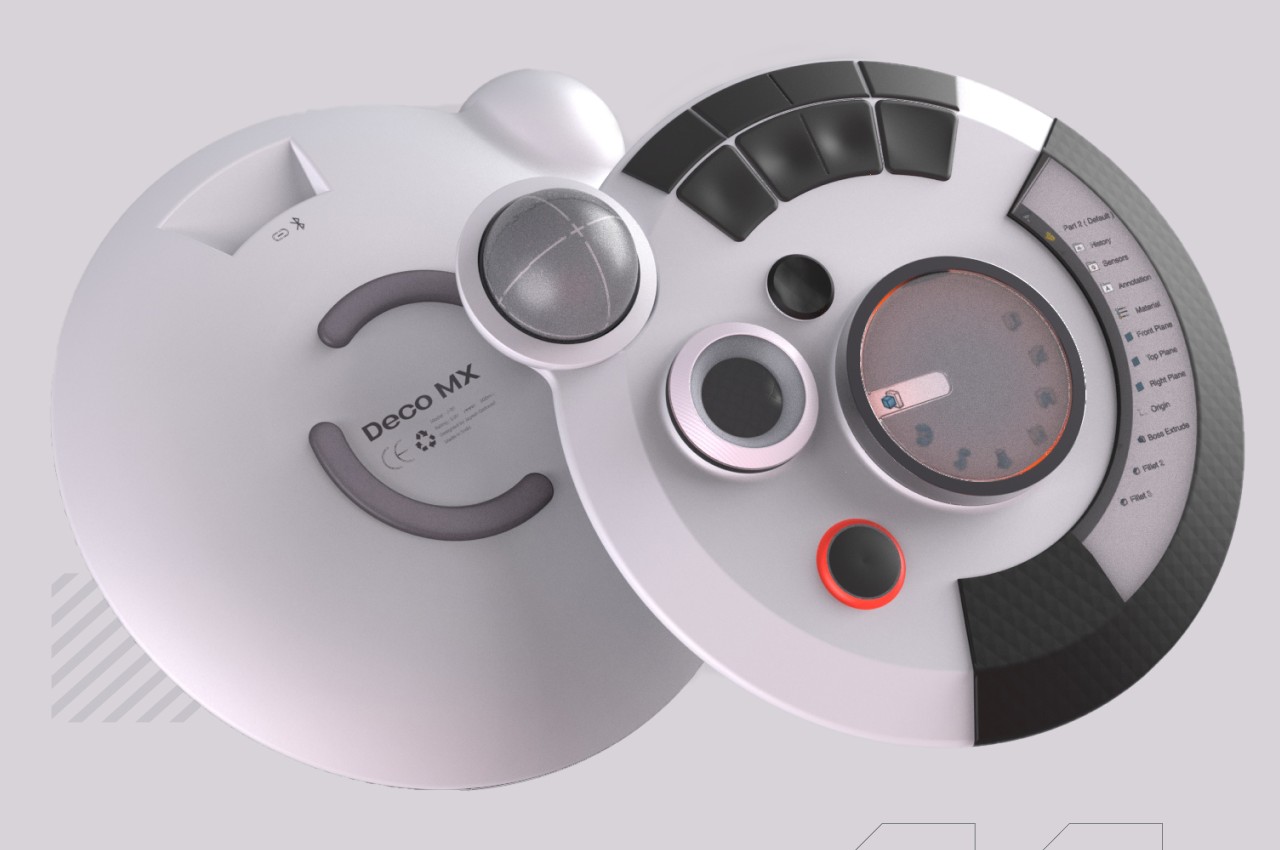
3D modeling device concept imagines what it’s like to create 3D with 2D tools

We live in a three-dimensional world, but we see the digital world through flat computer screens. That’s why 2D input devices like mice, trackballs, and pens are fine for most creative work that is made to be seen in 2D anyway. With the increase in 3D objects in mixed reality spaces, however, these tools are no longer sufficient and can even become painful to use. Our hands are used to manipulating real-world three-dimensional objects, but our computer tools are confined to the 2D space, making them inefficient and counterintuitive. For the new age of 3D, we need newer and better tools designed specifically for those needs, and this concept imagines a new device designed from the ground up to offer a better way to create those 3D models that will populate the virtual worlds of the future.

Designer: Jayesh Gaikwad

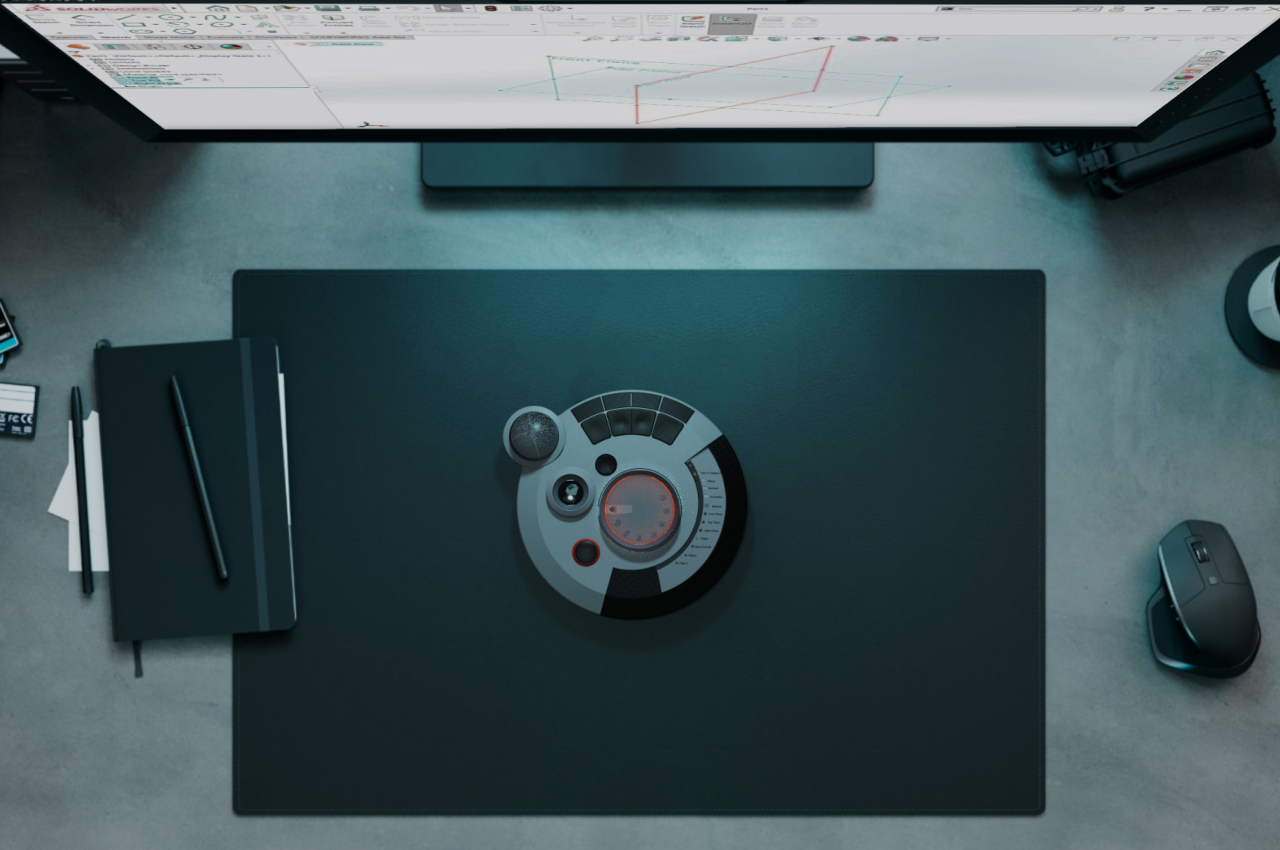
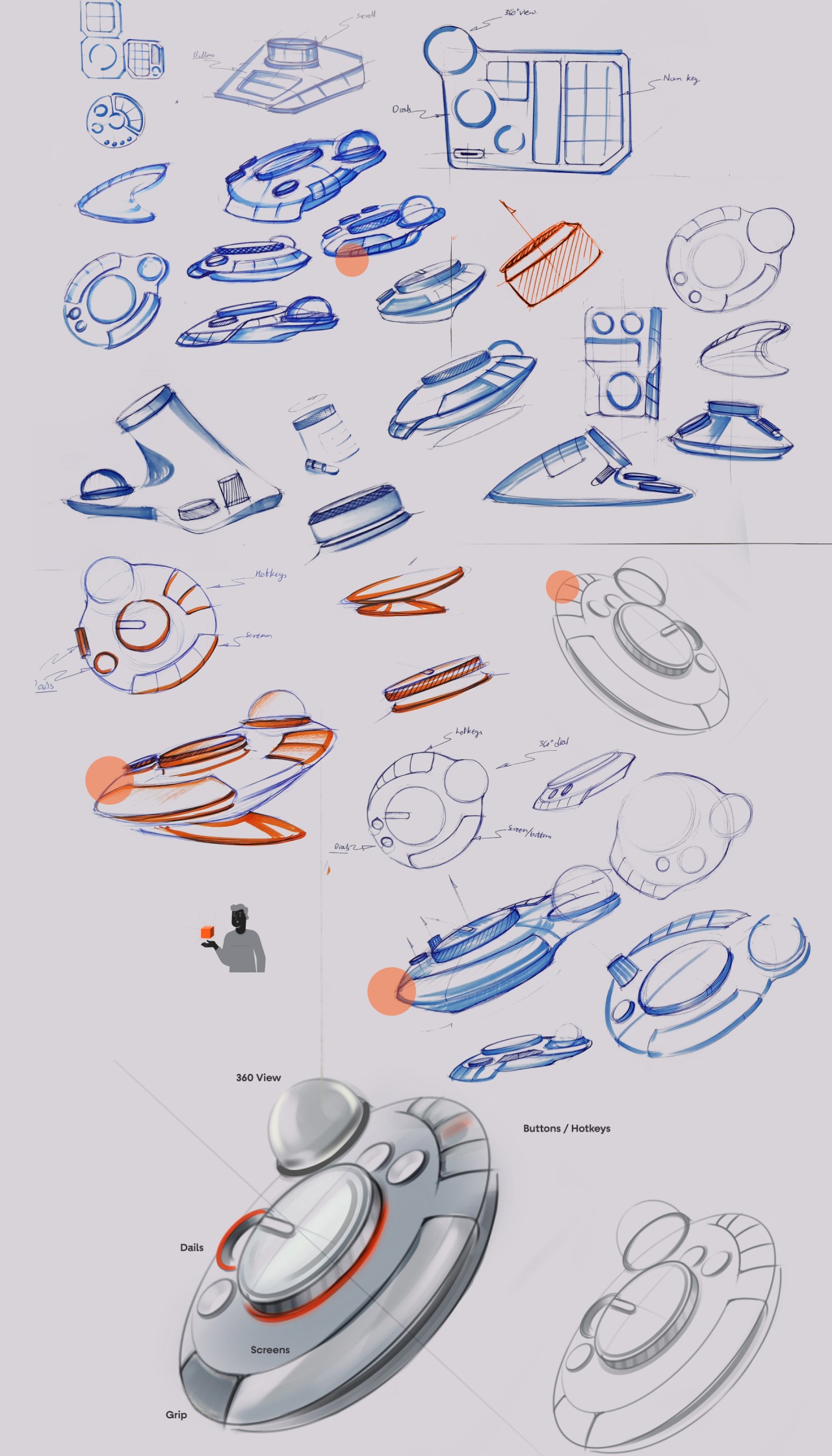
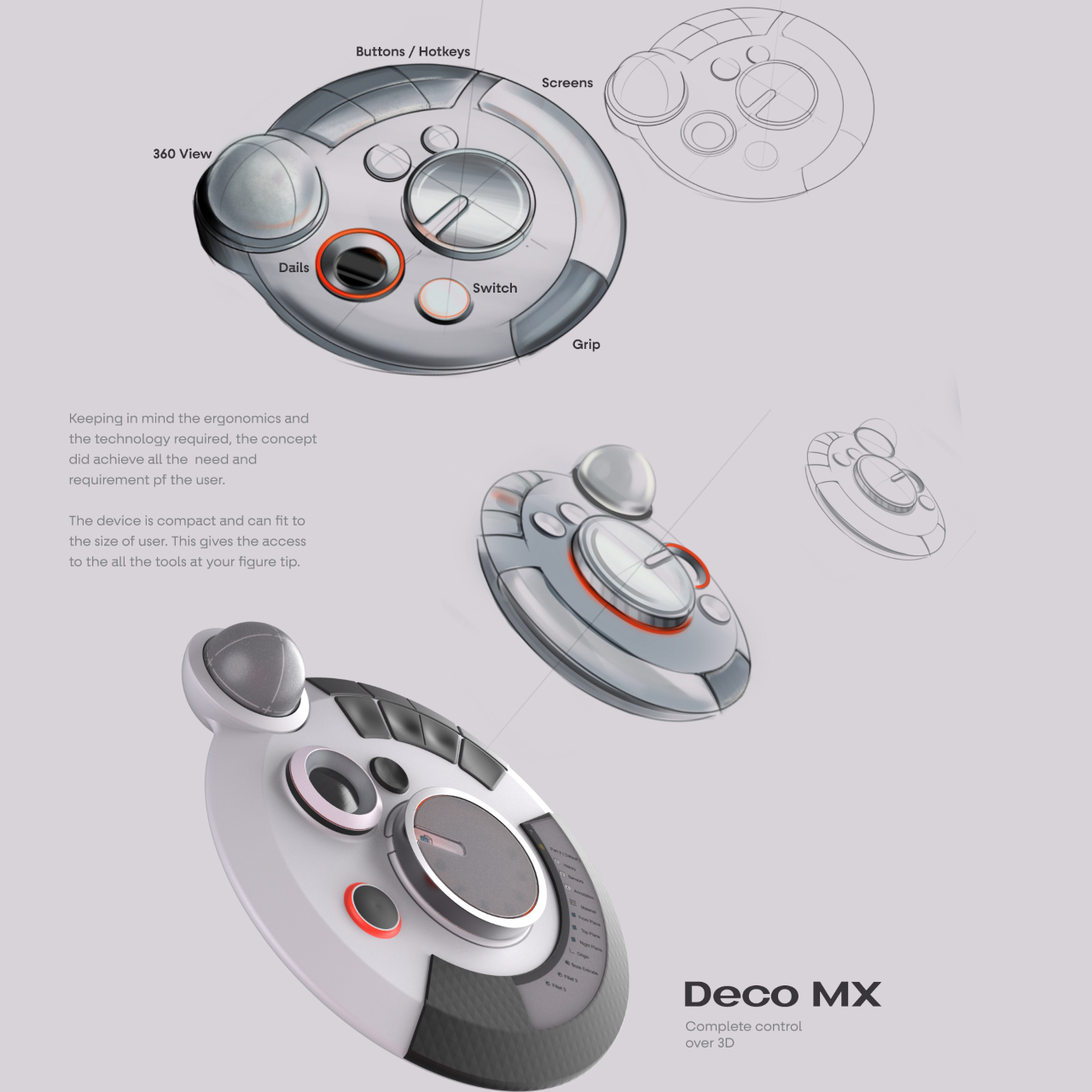
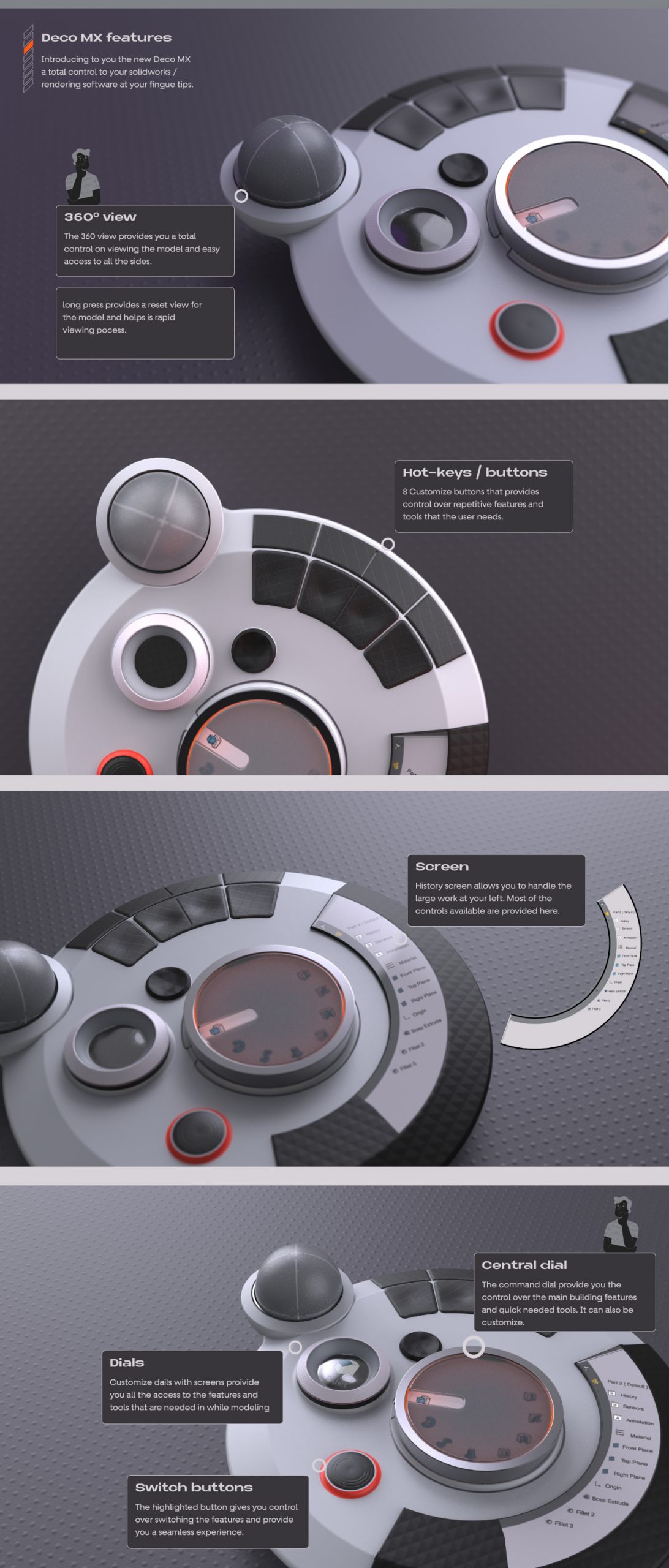
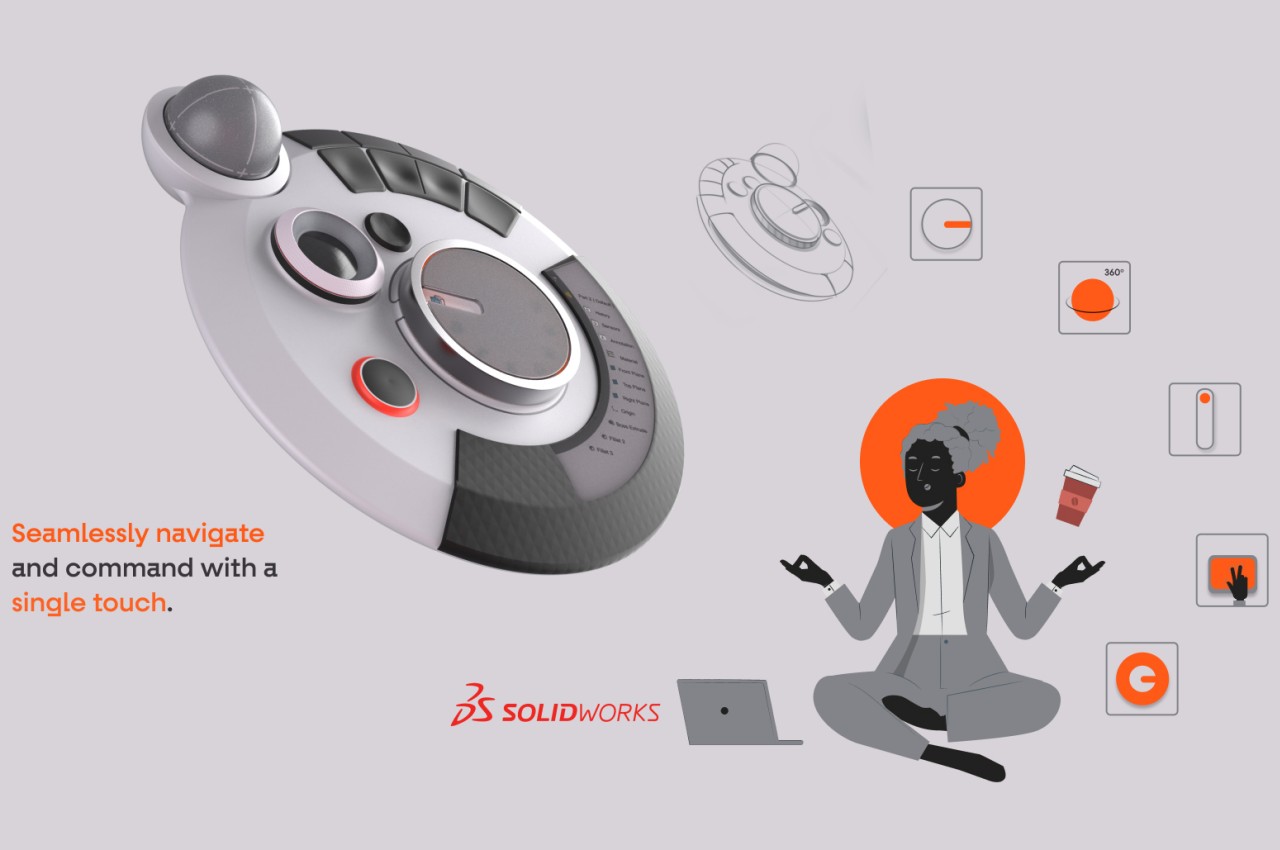
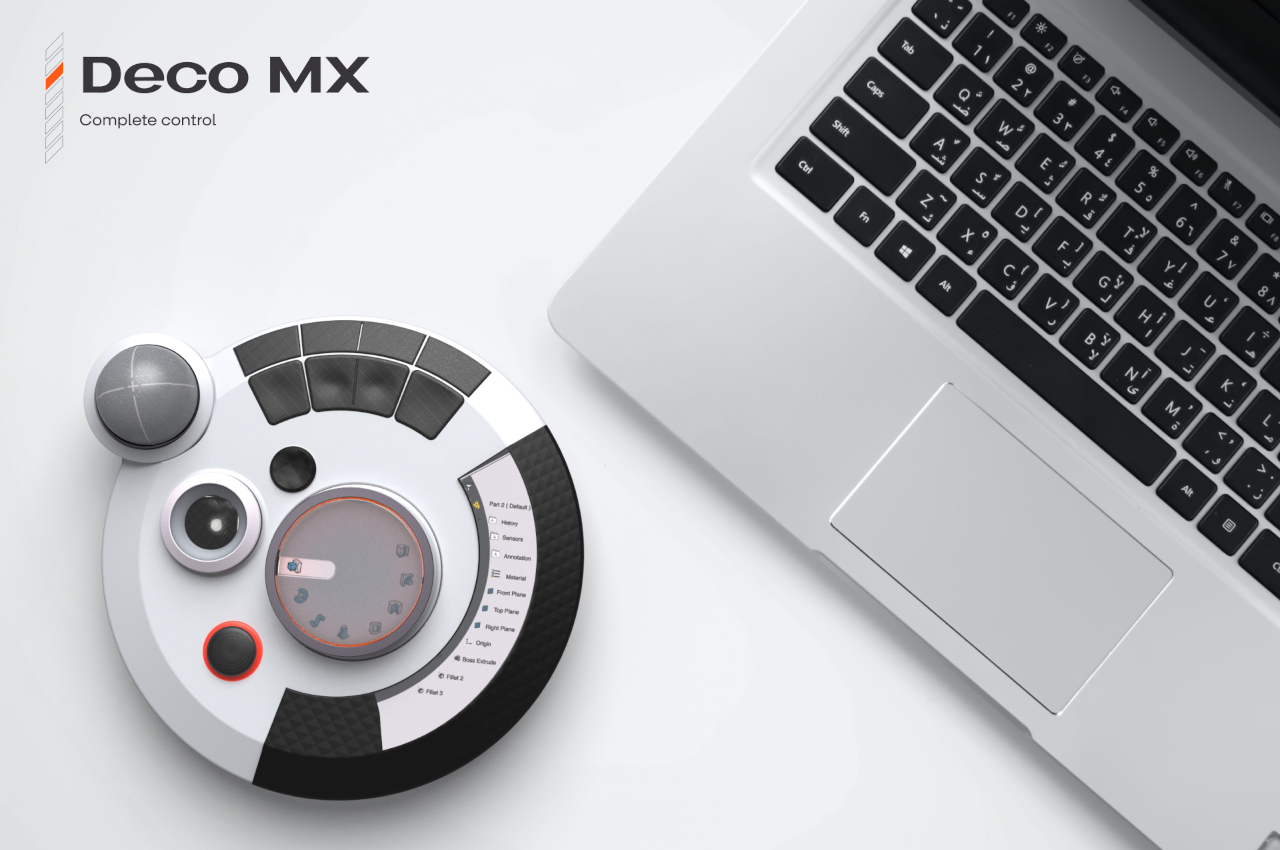
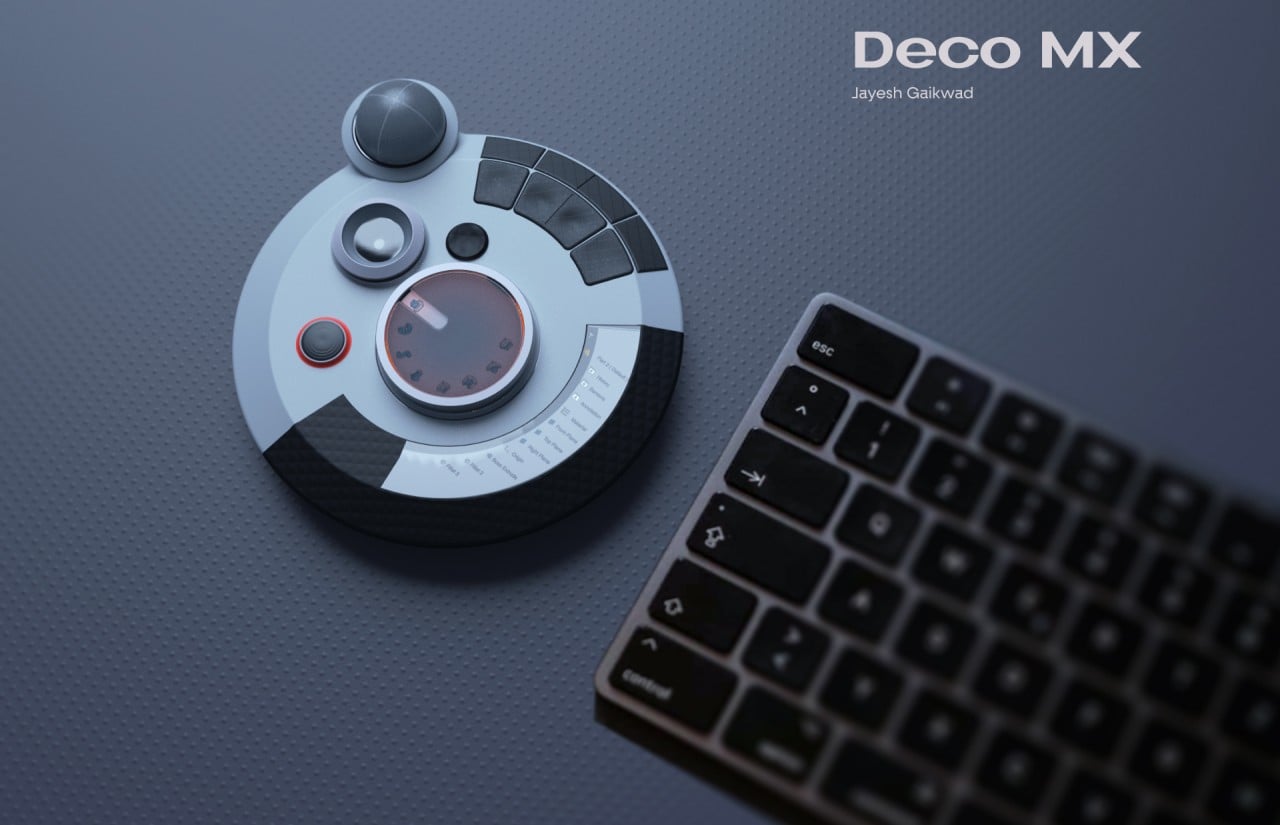
You might brush the Deco MX off as a glorified trackball, but that couldn’t be farther from the truth. After all, a trackball is still just like a mouse that moves a cursor on a 2D screen. You can use that cursor to move and rotate a 3D object, but it’s a clumsy and awkward gesture that doesn’t map what we have in our mind when we want to turn those 3D objects living inside our flat displays. That’s what that ball in the corner of the Deco MX is for, letting you rotate an object more naturally in all three axes, making it easier to see the 3D model from all angles.

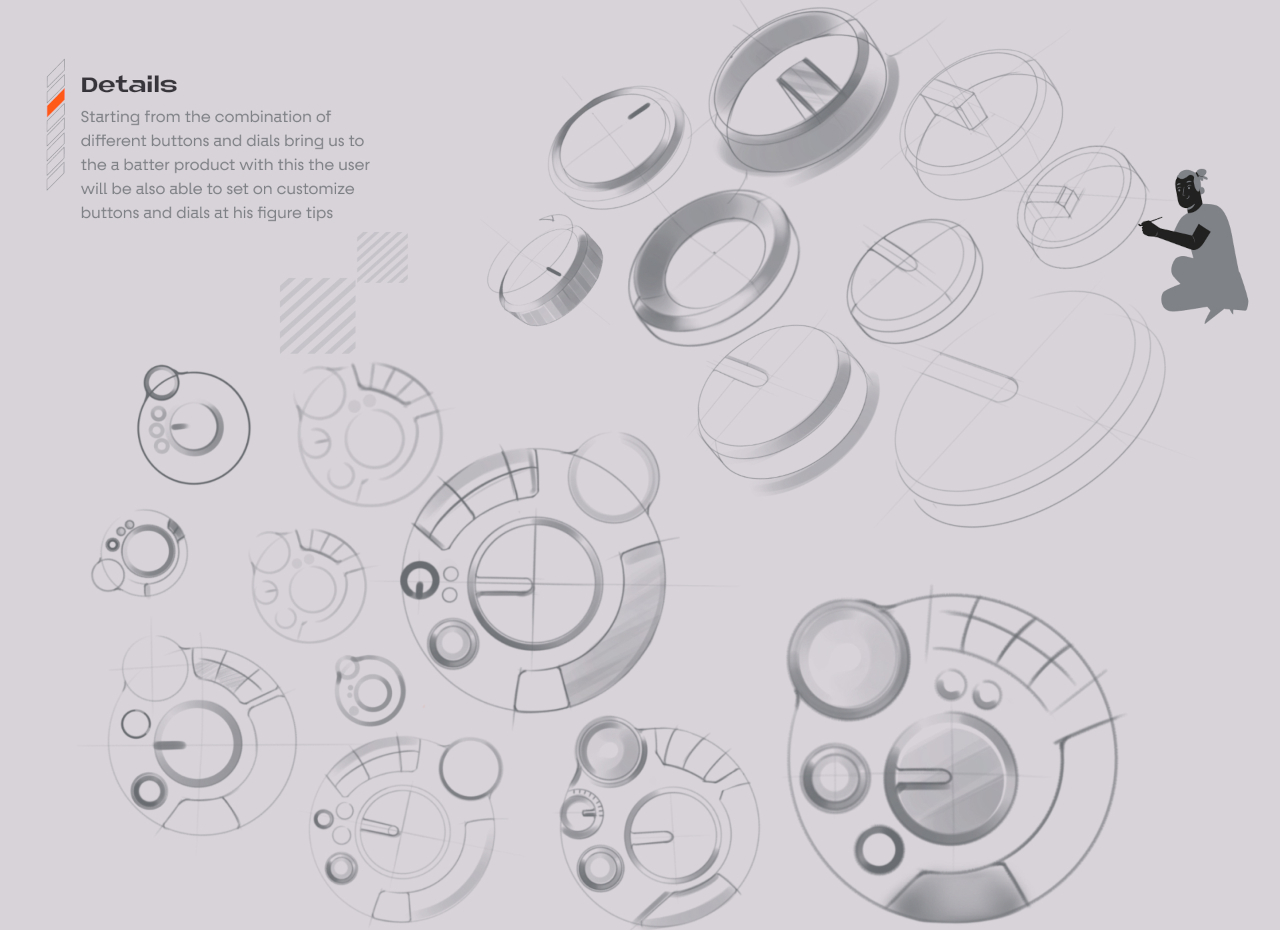
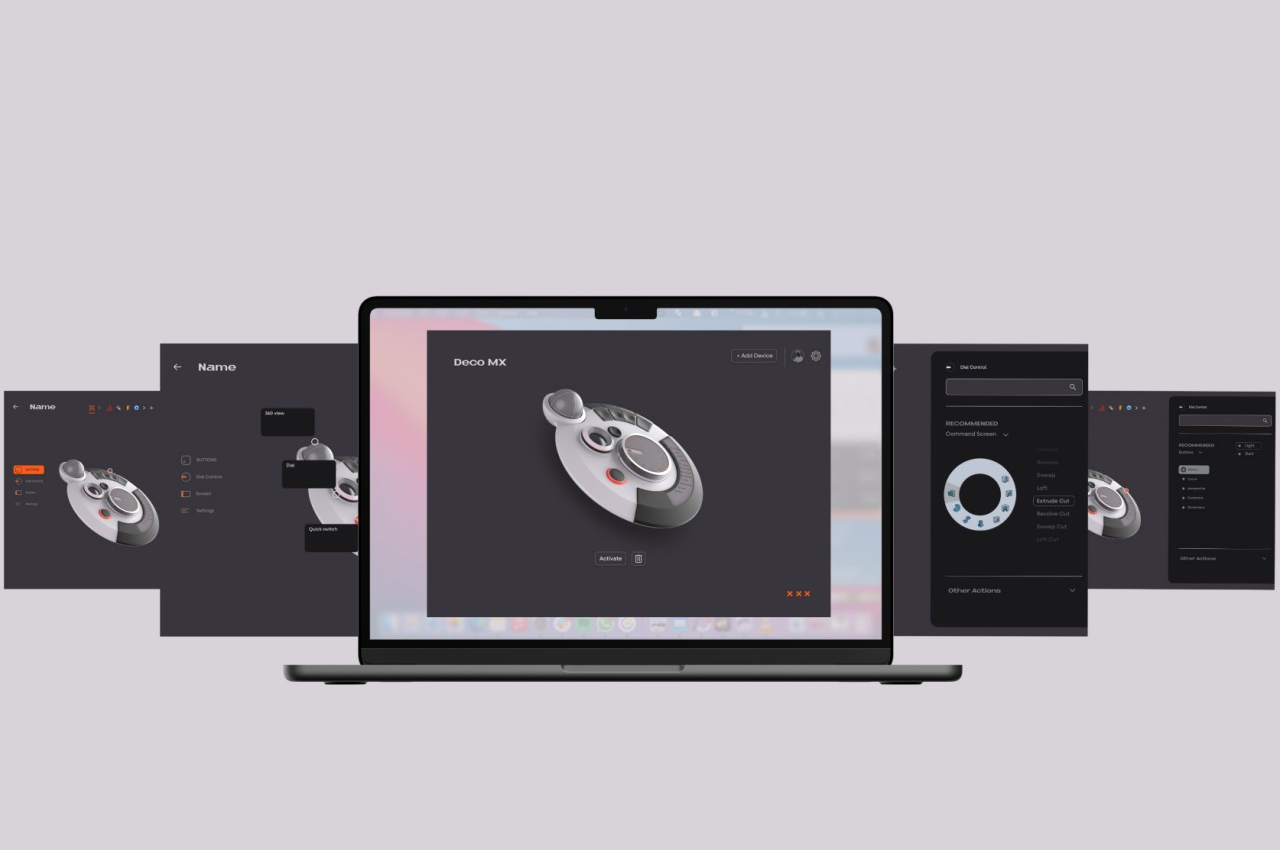
The rest of the device is made to give easier access to the tools that a designer needs when building those 3D models. There are programmable buttons to set your own shortcuts within the app, as well as dials to switch tools quickly. The central dial is, in fact, the biggest control on the Deco MX, and it gives access to the most common building and editing tools in a program. You can change which tools those are to suit your workflow, of course.

What makes the Deco MX extra interesting is the amount of screen on it. There’s one that arcs to the side, showing a history of actions you’ve taken so far. The central dial also has a screen underneath that changes depending on the tools you’ve set to be your favorite ones. There’s also a small circular screen to the side that shows you the currently selected tool without having to squint your eyes too hard.

While this 3D modeling device offers an innovative interface, the software we use today still presumes a 2D input device like a mouse or a stylus. Deco MX still can’t replace that and is instead designed to supplement it, perhaps taking the place of a large and cumbersome keyboard. Admittedly, the existence of screens on the device might actually make it harder to actually produce, but the concept has enough strong points that manufacturers should consider, especially as we journey deeper into mixed reality worlds.

The post 3D modeling device concept imagines what it’s like to create 3D with 2D tools first appeared on Yanko Design.

DEEPX DX-M1 chip designed for AI of Things applications

Anyone in the process of or interested in building AI of Things applications might be interested to know that DEEPX has unveiled its latest creation, the DX-M1 chip. This new piece of technology is making waves in the realm of artificial intelligence (AI), promising to deliver top-notch performance while keeping energy use to a minimum. […]

The post DEEPX DX-M1 chip designed for AI of Things applications appeared first on Geeky Gadgets.

Vivo V30 Lite smartphone unveiled

Vivo V30 Lite

Vivio has added a new Android smartphone to its range with the launch of the Vivo V30 Lite, the handset comes with a 6.67-inch AMOLED display with a Full HD+ resolution of 2400 x 1080 pixels. The device is powered by a Qualcomm Snapdragon 695 5G mobile processor and it comes with 12GB of RTAM […]

The post Vivo V30 Lite smartphone unveiled appeared first on Geeky Gadgets.