Favor AR Pen Lets You Draw Messages in Air, Print as Photo Cards

Most of our gifts to friends now are quick messages, emojis, or mobile vouchers that arrive instantly and disappear just as fast. They’re convenient but rarely feel as meaningful as a handwritten note or a physical card you can pin to a wall. Favor AR Message is a concept that tries to bring some of that effort and ceremony back into how Gen Z says thank you, sorry, or congratulations, without abandoning phones entirely.

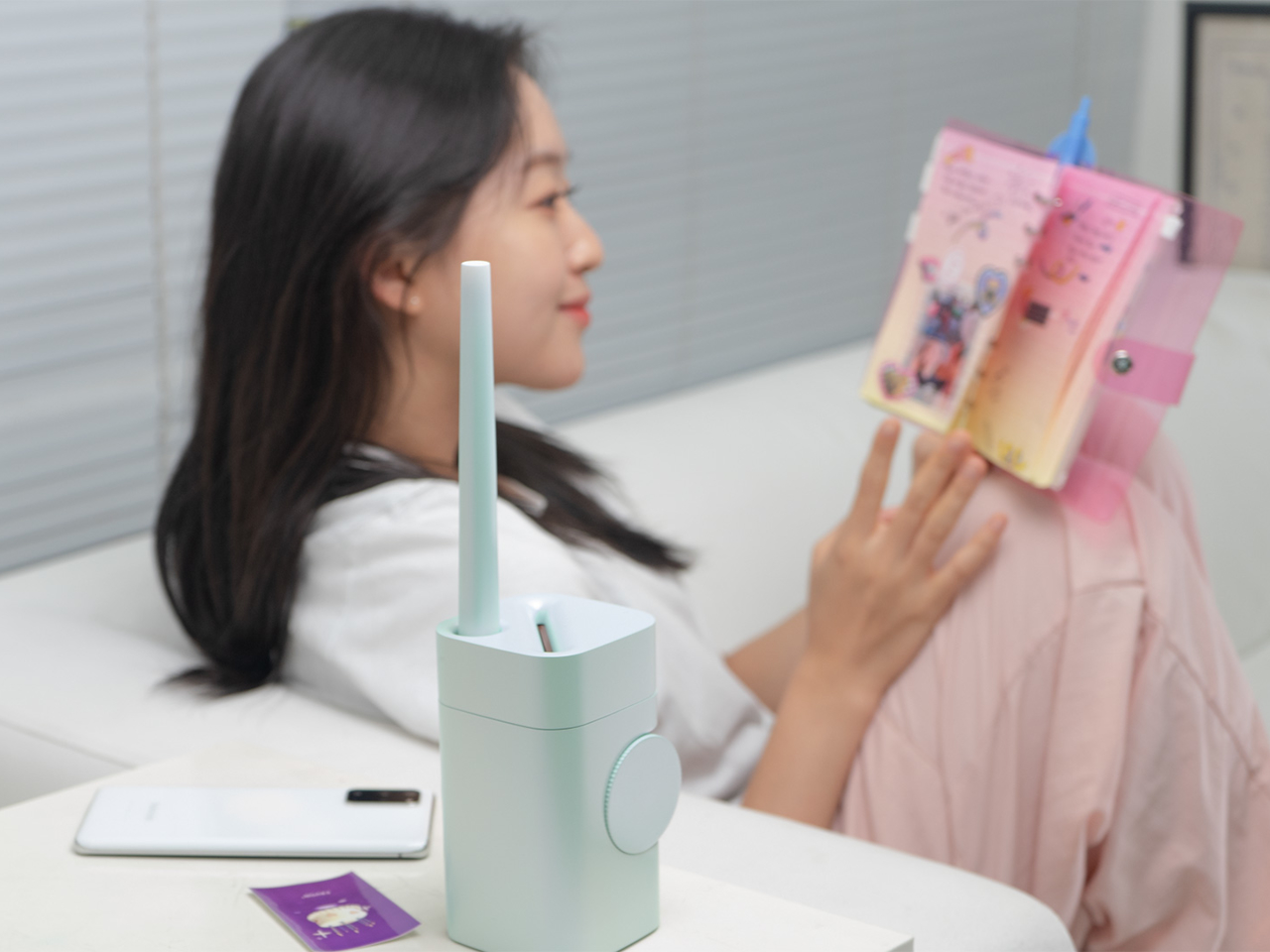
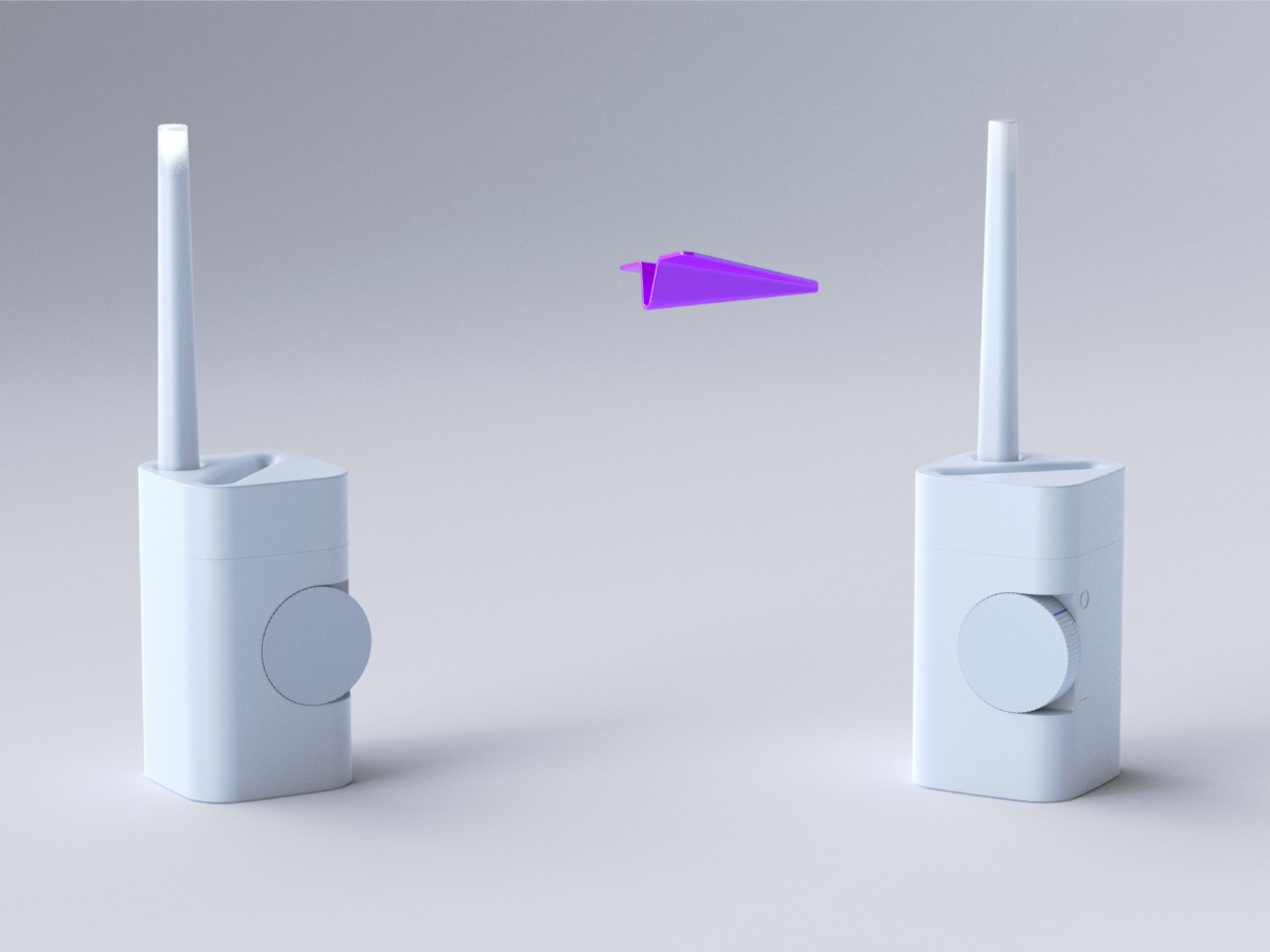
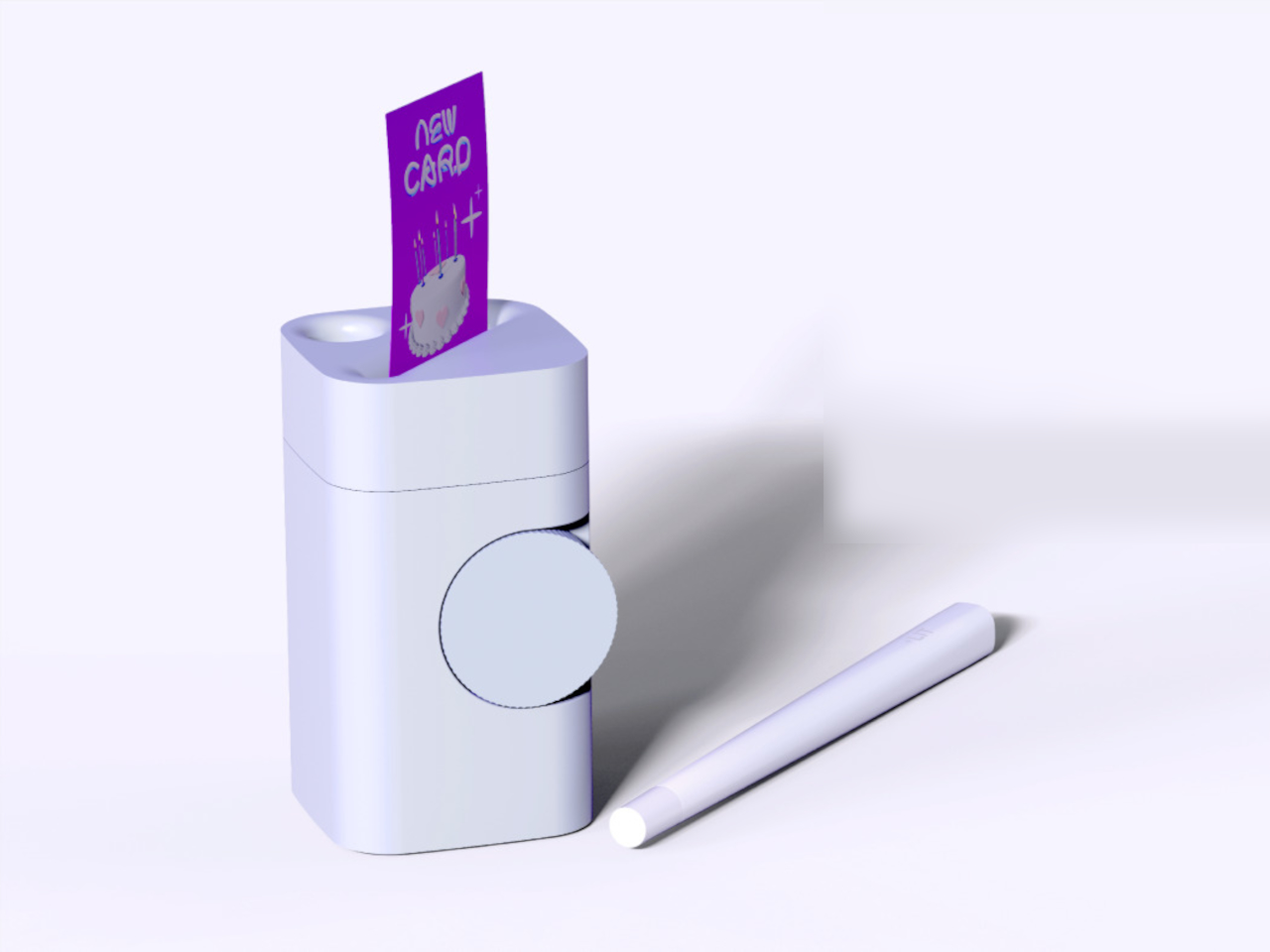
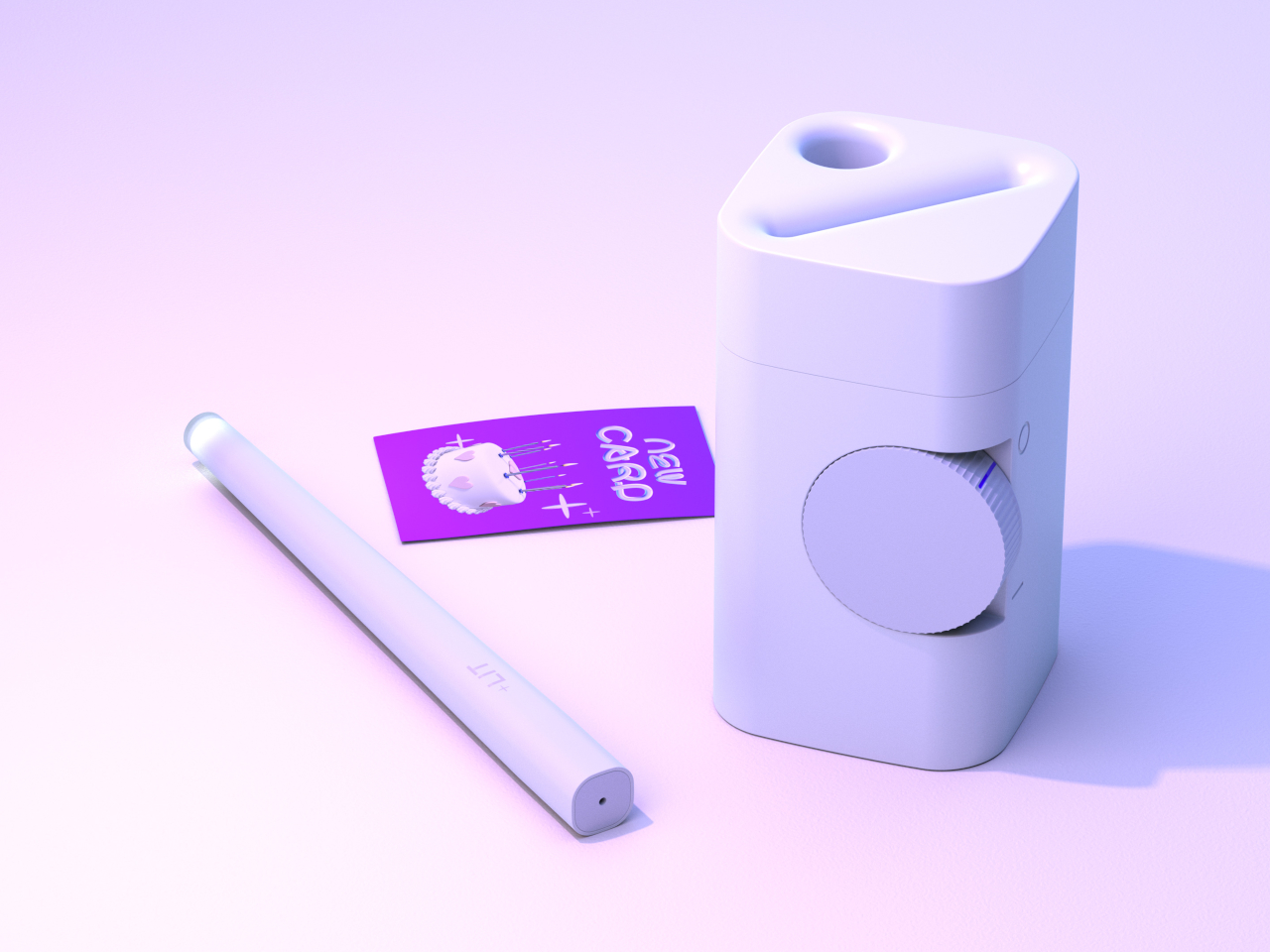
Favor is a speculative system built around three parts: an AR pen, a tiny photo printer, and a mobile app. You use the pen to draw messages in augmented reality, the app to decorate and package them, and the printer to turn them into physical photo cards. The recipient scans the card with their phone to see the hidden AR message floating above it, like a secret that only appears when you know where to look.

Designers: Junseo Oh, Seungyeon Hong, Yoojin Lee, Youn Taejune
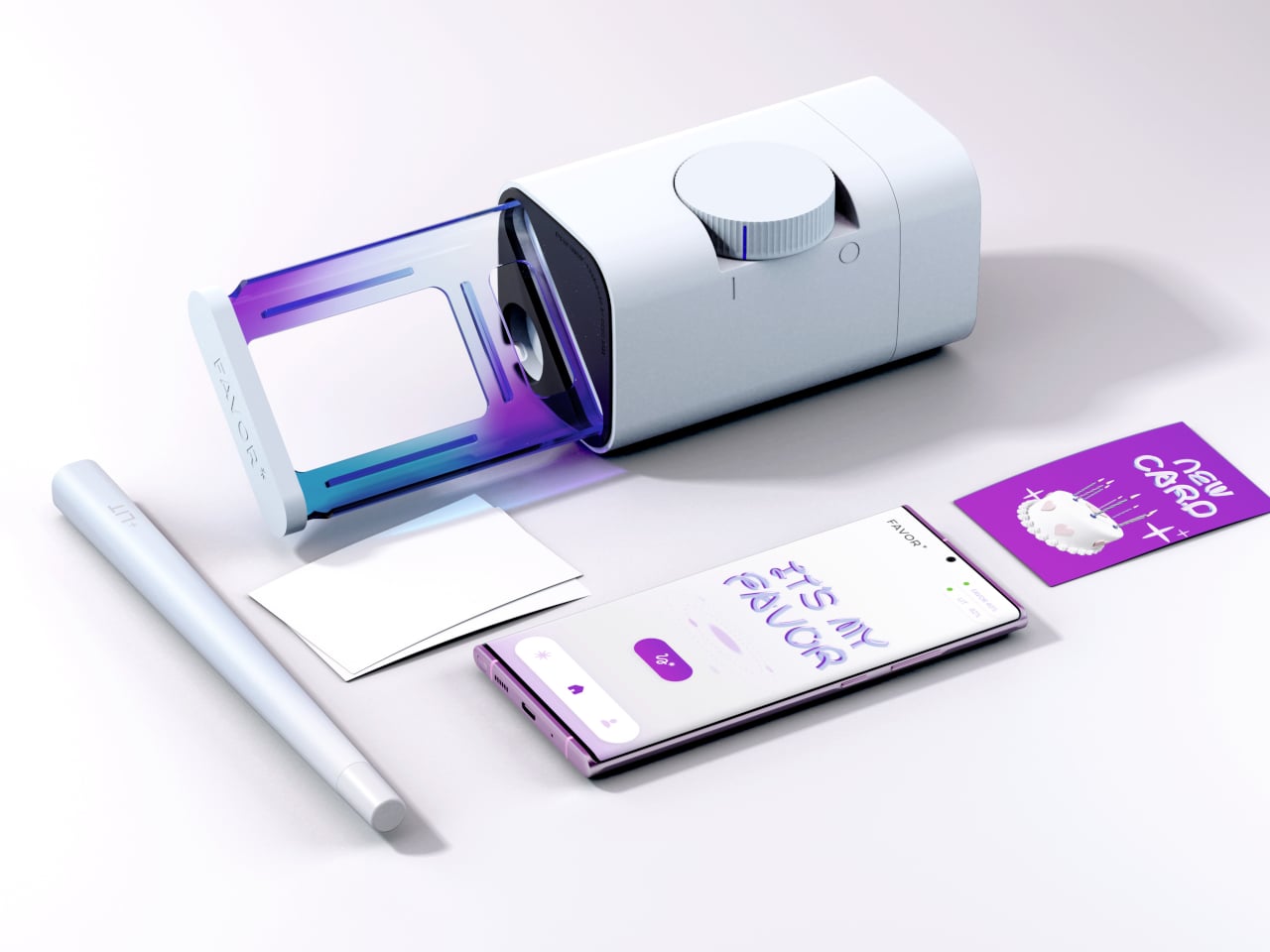
The AR pen, called LIT, is a slim wand that the phone’s camera tracks while you draw in the air. In the app, your strokes become floating 3D text and graphics, animated with light and particles. The designers call this process “LITing,” and it turns writing a message into a small performance, closer to painting with light than typing into a chat window or firing off another text you’ll forget about ten minutes later.
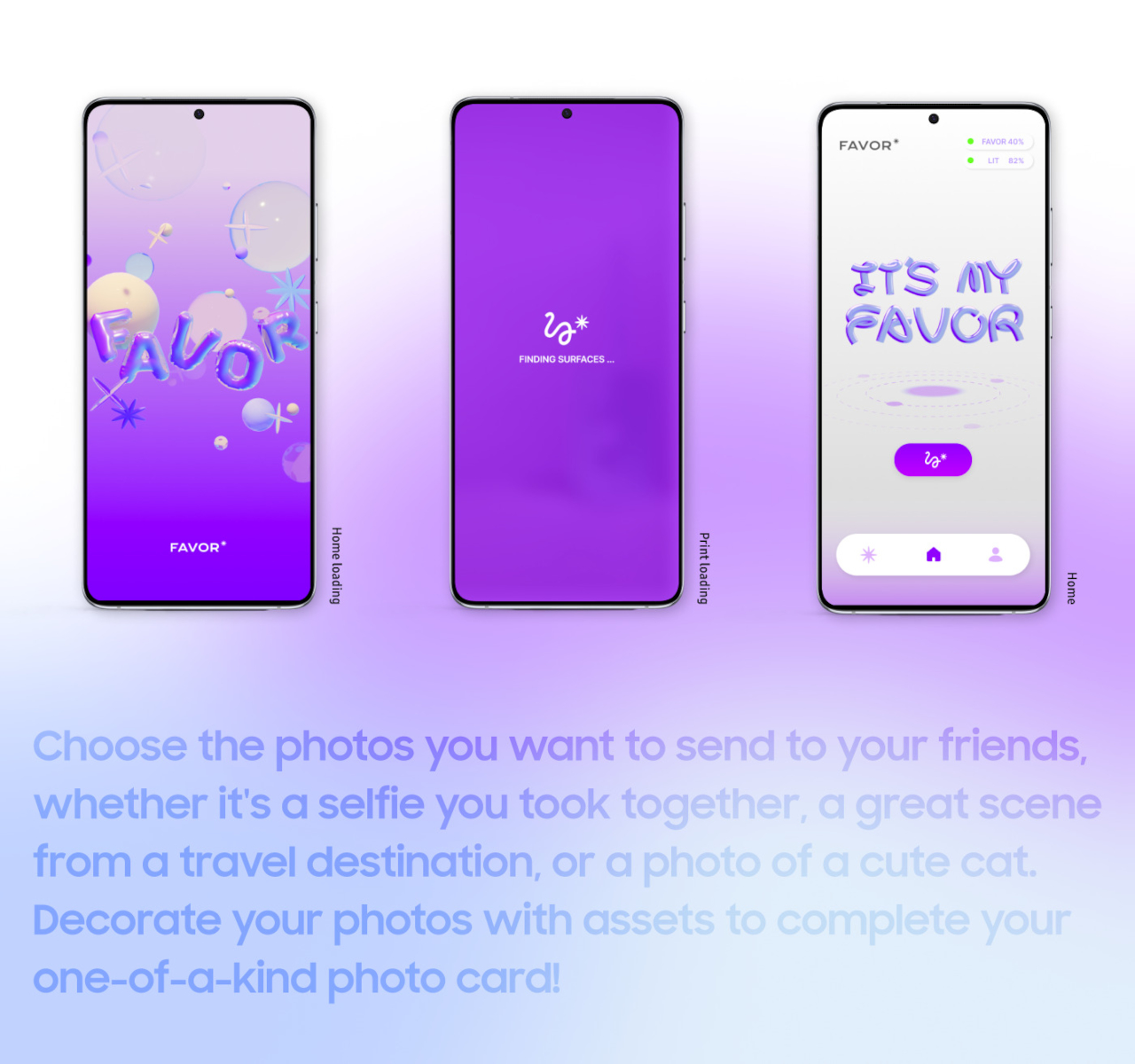
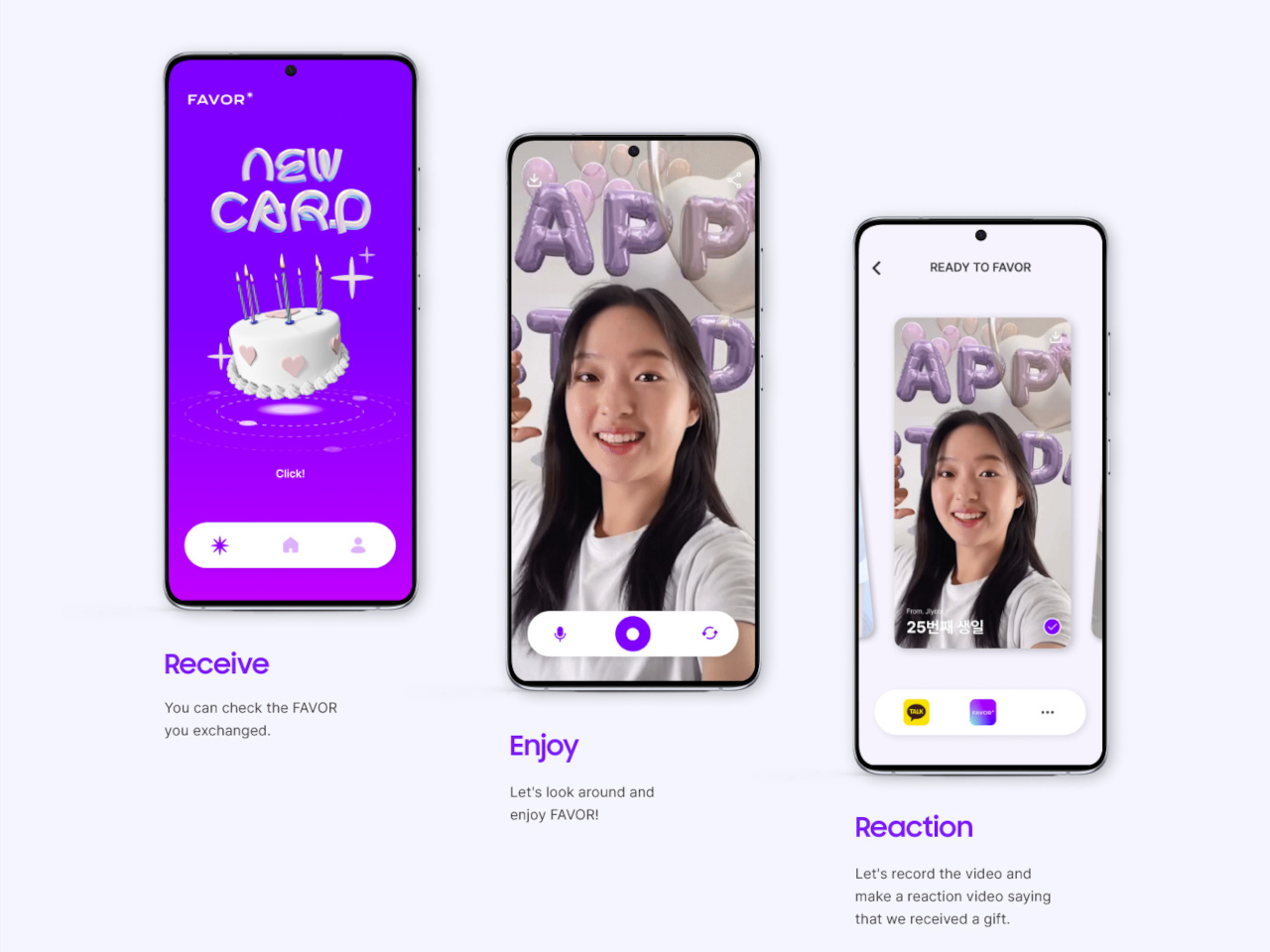
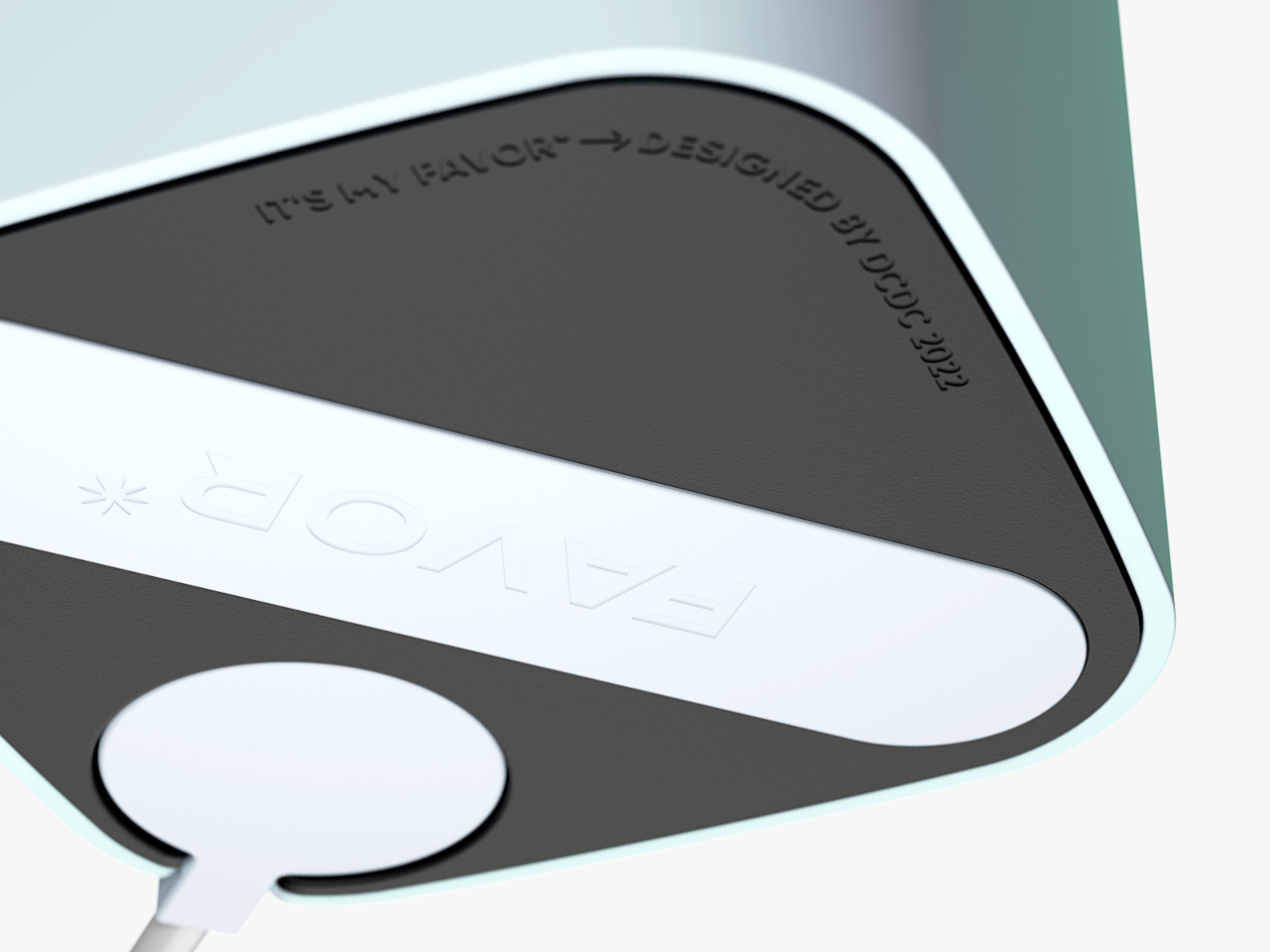
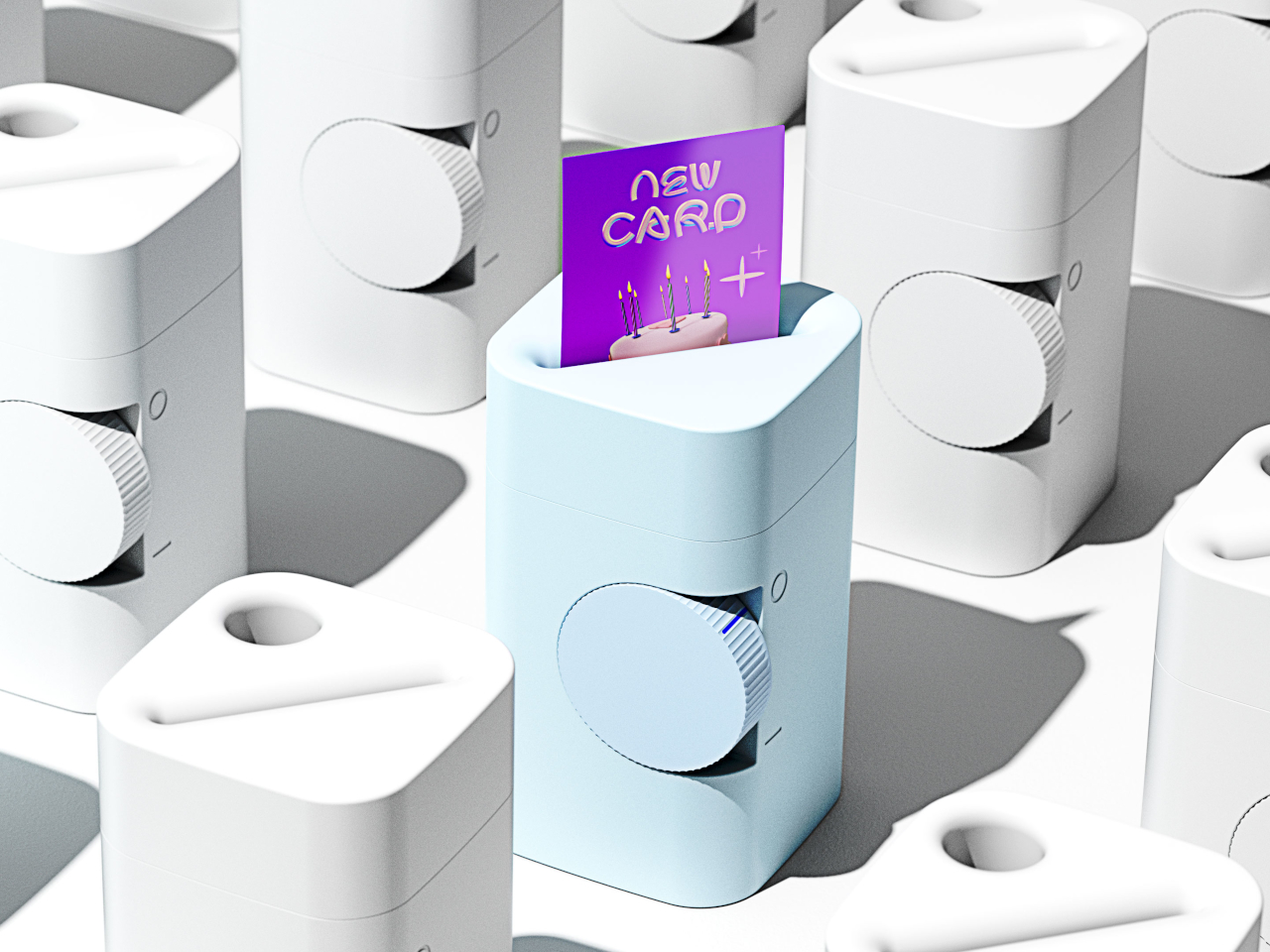
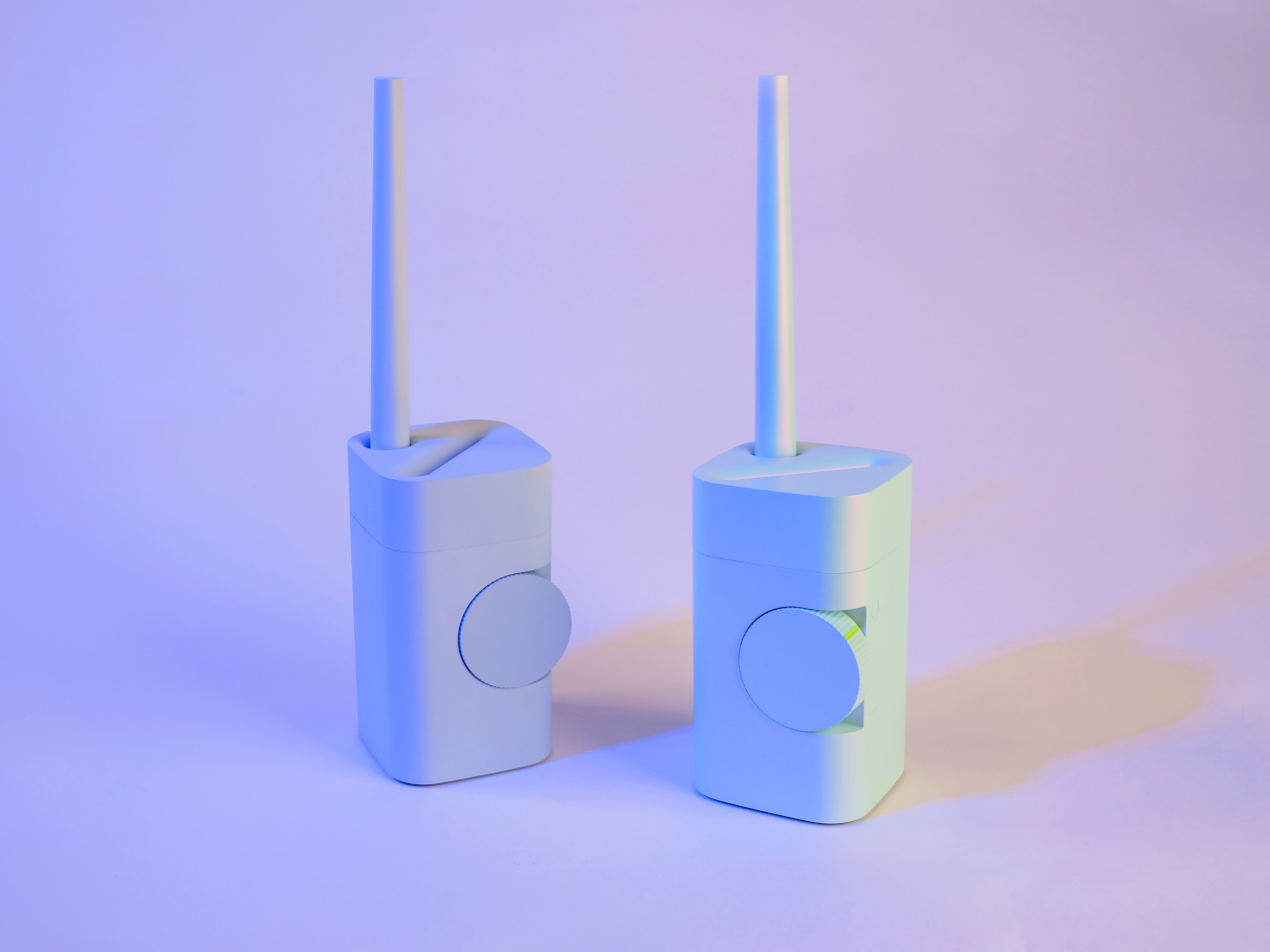
The printer is a compact, pastel-colored box that takes your AR composition and links it to a printed photo card. You can choose selfies, pet photos, or travel shots, then layer stickers and assets on top. On the surface, the card looks like a cute mini print, but when the recipient scans it with the app, the hidden AR message appears in space above the card, like a secret only they can unlock.
The app’s flow is straightforward. You pick a friend, choose a template, LIT your message with the pen, and send or print the card. When your friend receives it, they scan to reveal the AR content, then record a reaction video and send it back. The concept even imagines smart lights in the room reacting when a new Favor is opened, turning the exchange into a tiny event.
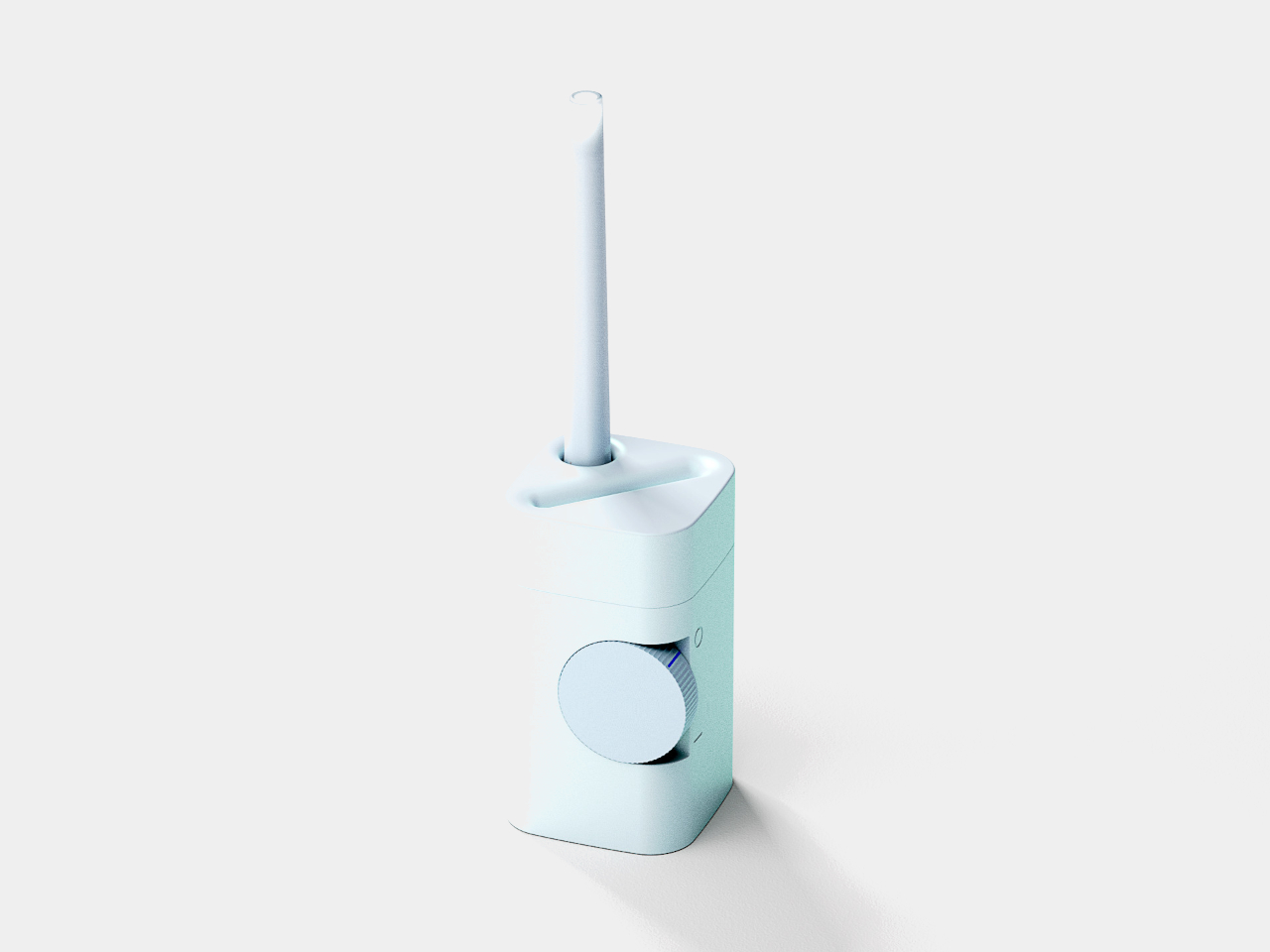
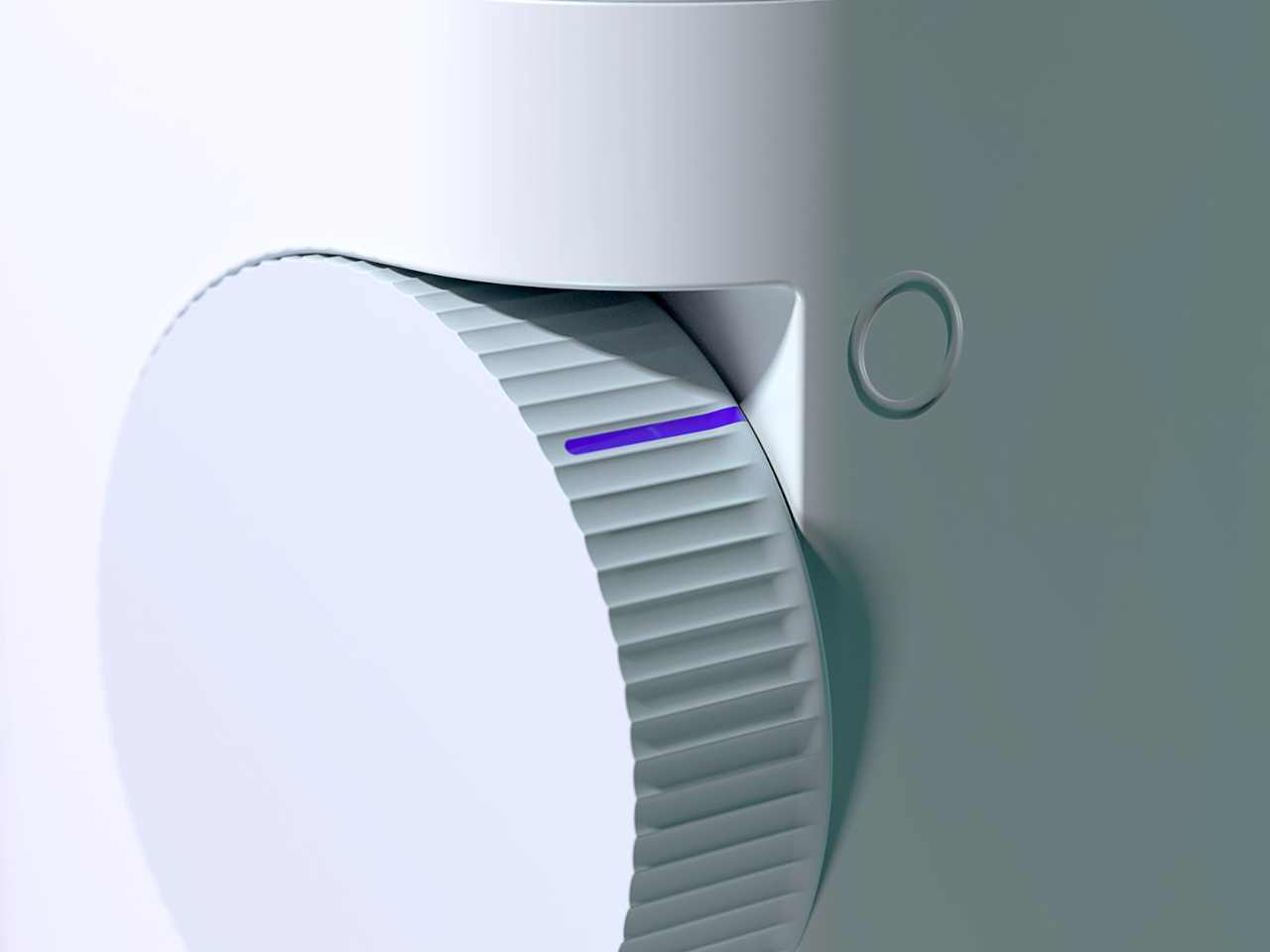
The visual language is deliberately playful. The hardware uses soft rectangles, rounded corners, and gentle gradients in lilac and mint, while the app leans into bold purple, bubbly 3D type, and oversized icons. Everything is designed to feel approachable and fun, more like a toy or cosmetic gadget than a piece of serious tech that takes itself too seriously.


Favor AR Message is a thought experiment about how we might make digital communication feel more like a ritual again. By asking you to stand up, wave a pen, design a card, and wait for a reaction, it slows the process down just enough to feel intentional. Whether or not something like this ever ships, the idea of turning AR into something you can hold and revisit is an appealing twist on how we say “this is for you.”
The post Favor AR Pen Lets You Draw Messages in Air, Print as Photo Cards first appeared on Yanko Design.
The Analogue 3D will be restocked on November 24, but it’ll cost $20 more

After several delays, Analogue finally started shipping its 4K remake of the Nintendo 64 this week. That was great news for those lucky enough to have pre-orders secured, but the console was firmly sold out beyond that first wave of shipments. However, the company has now announced that it will have new stock of the Analogue 3D ready to go from November 24.

You’ll be able to order from 8am PST on the day, with orders set to start shipping on December 2, once Analogue has honored all of its original pre-orders. This batch will likely go very quickly too, and if you do manage to get one, you’ll have to accept a (seemingly tariff-related) price $20 hike, with the Analogue 3D now costing $270.

As with previous Analogue systems, the reimagined N64 uses an FPGA (field programmable gate array) chip to emulate Nintendo’s original hardware. FPGA-based systems are more accurate than software emulation options and deliver reduced input lag.

Every N64 cartridge is supported, according to Analogue, including both PAL and NTSC variants, and the 3D is capable of 4K output with variable refresh rate. You also get an "original display mode" filter to faithfully recreate the look of gaming on your dusty old CRT.

A word of warning, though: while our review of the Analogue 3D praised the hardware design and strength of the emulation, our reviewer's biggest mark against the console is that a lot of N64 games just aren’t very fun to play in 2025. Still, if you still have the likes of Mario 64 and Ocarina of Time lying around in a cupboard, you’ll no doubt have an enjoyably nostalgic holiday season with the Analogue 3D, should you successfully get hold of one next week.

This article originally appeared on Engadget at https://www.engadget.com/gaming/the-analogue-3d-will-be-restocked-on-november-24-but-itll-cost-20-more-173615217.html?src=rss

The Future of Retail Fits in This 3D-Printed Suitcase

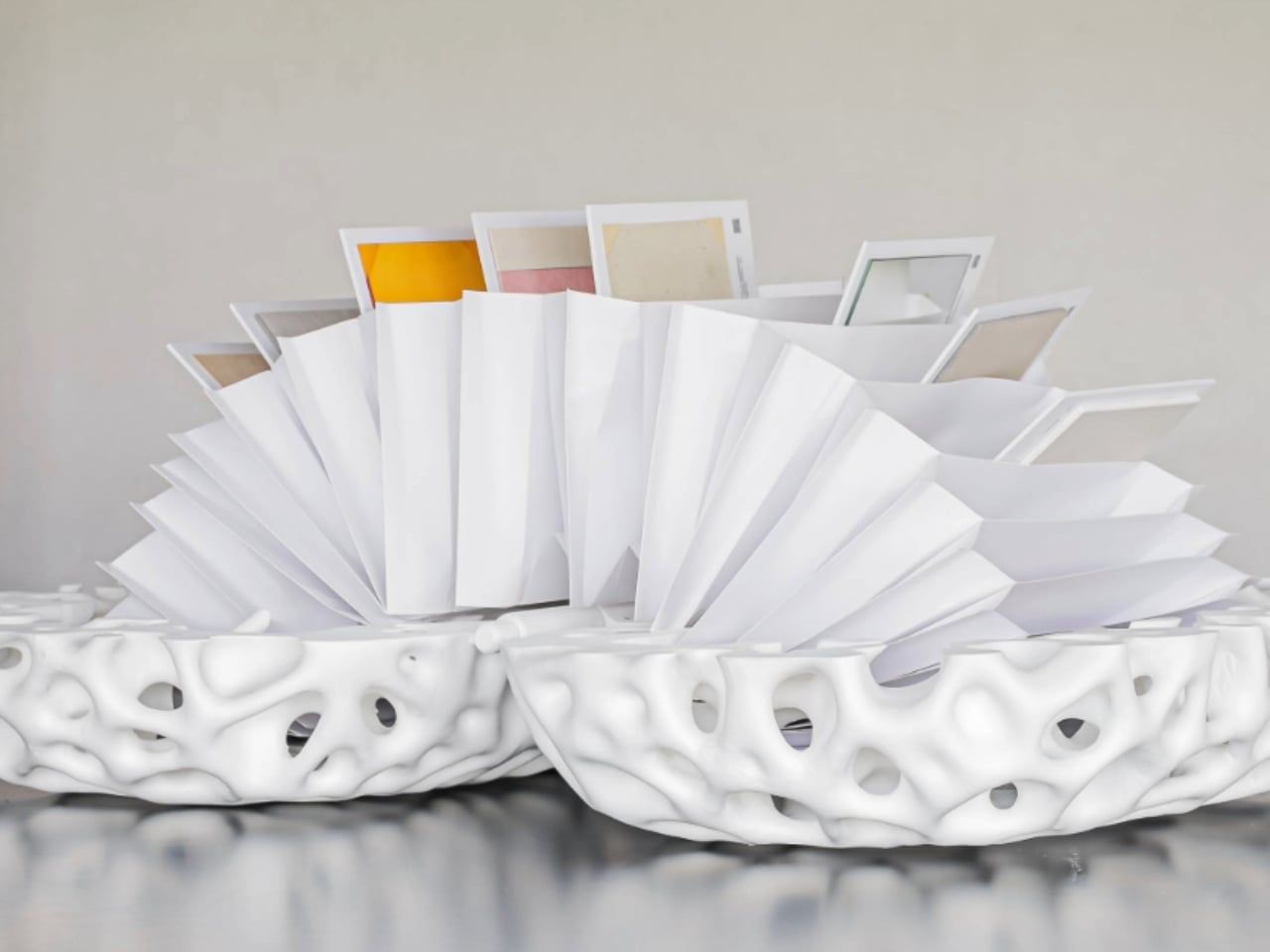
Imagine packing the future into a suitcase. Not your clothes or toiletries, but ideas about how we’ll shop, connect, and experience retail spaces in the years to come. That’s exactly what Valencia-based design studio Cul De Sac has done with their latest project, and honestly, it’s one of the coolest design concepts I’ve seen in a while.

The piece is part of Gerflor’s “Portable Architecture” initiative, a traveling exhibition that challenges three international design studios to literally pack their visions of tomorrow into custom suitcases. Think of it as a design thought experiment meets art installation, inspired by Marcel Duchamp’s famous “Box in a Valise” concept where he miniaturized his entire body of work into a portable case.

Designer: Cul De Sac

What makes Cul De Sac’s contribution so compelling is its radical optimism about retail’s future. While many of us have grown accustomed to sterile, product-focused shopping environments, architect and creative director Borja Berna offers a completely different vision. “The future of retail will be human,” he explains. “We come from a past where the product was the center, but the spaces of the future will put the person at the center. They will be places of community, connection, where things happen beyond the purchase.”

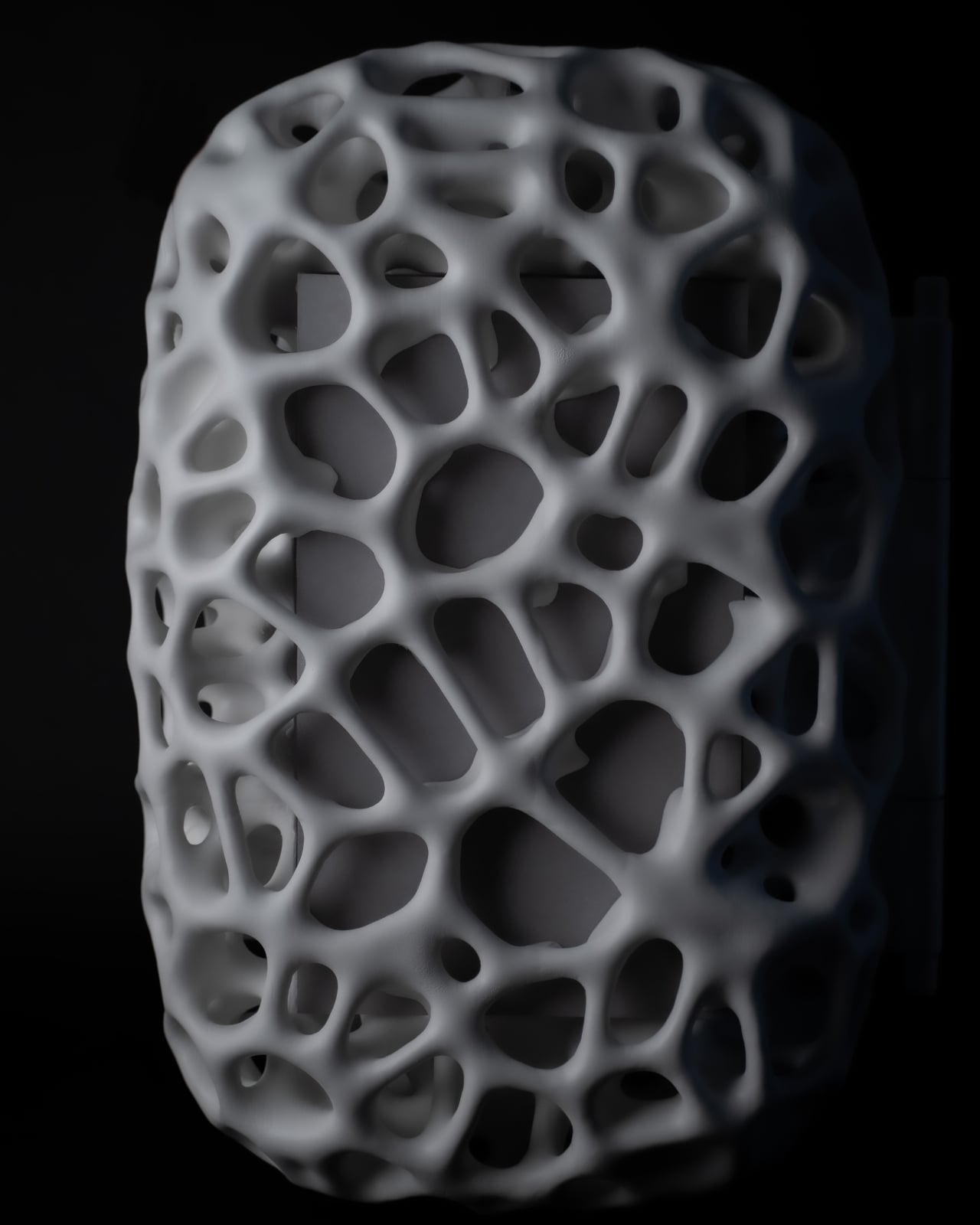
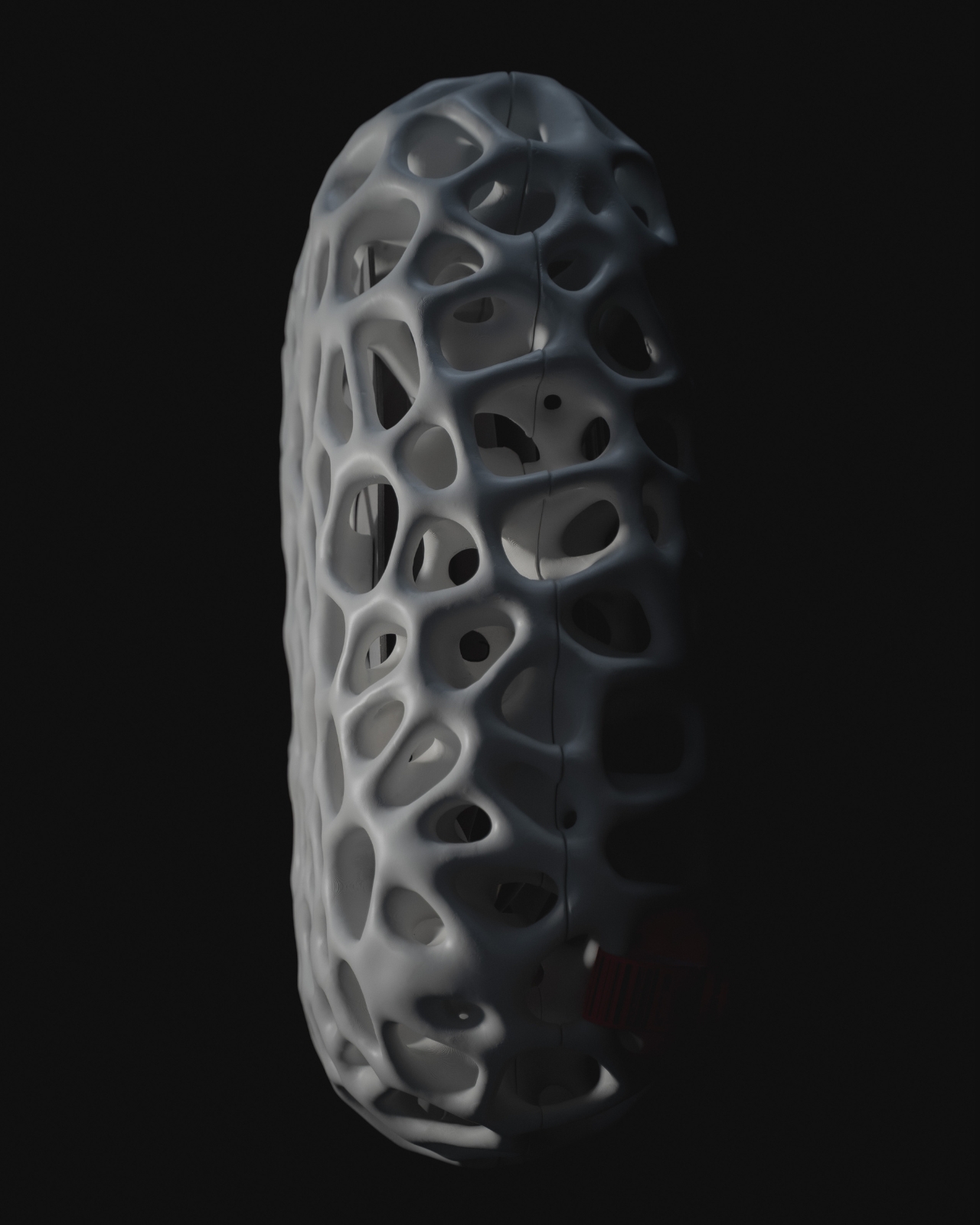
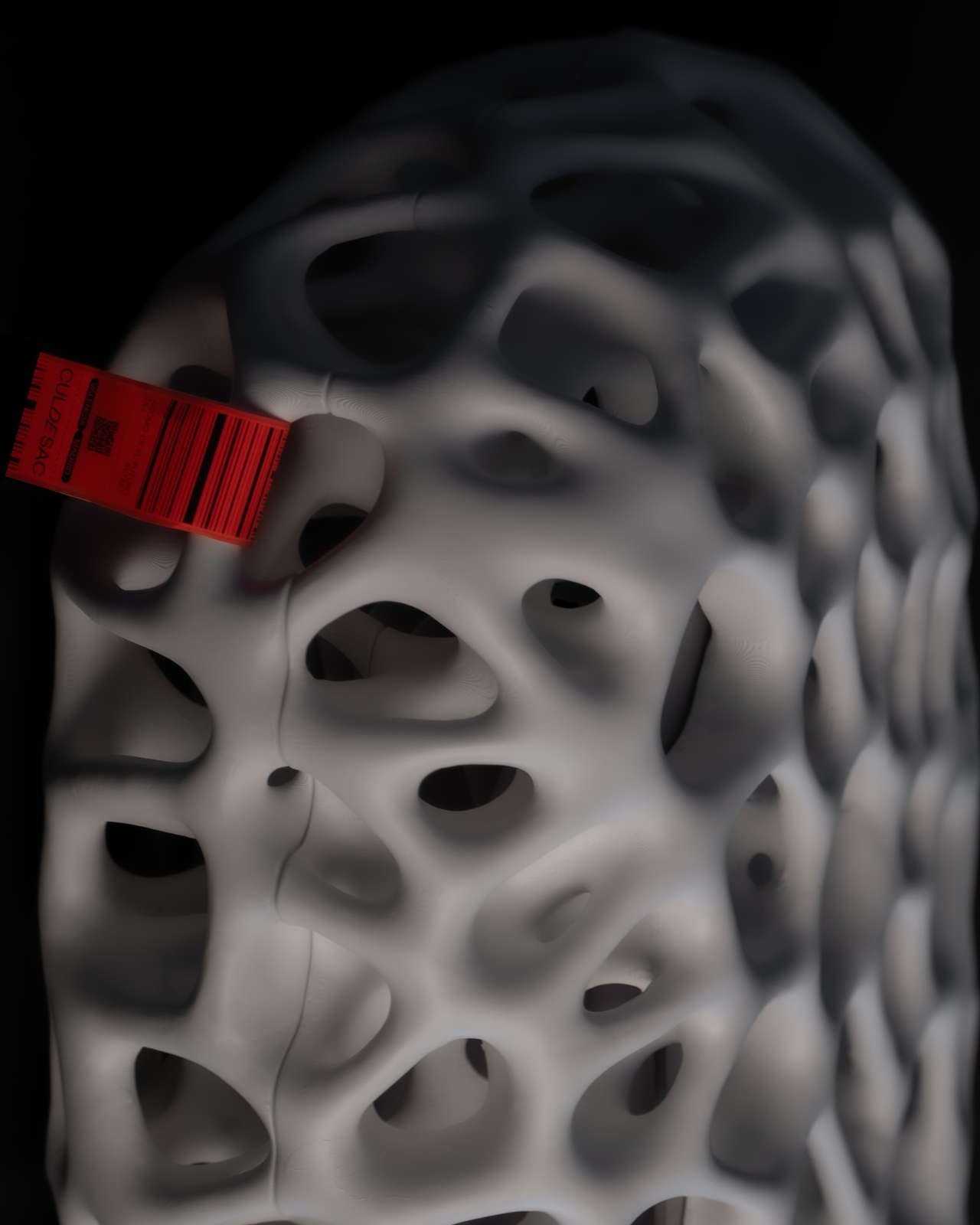
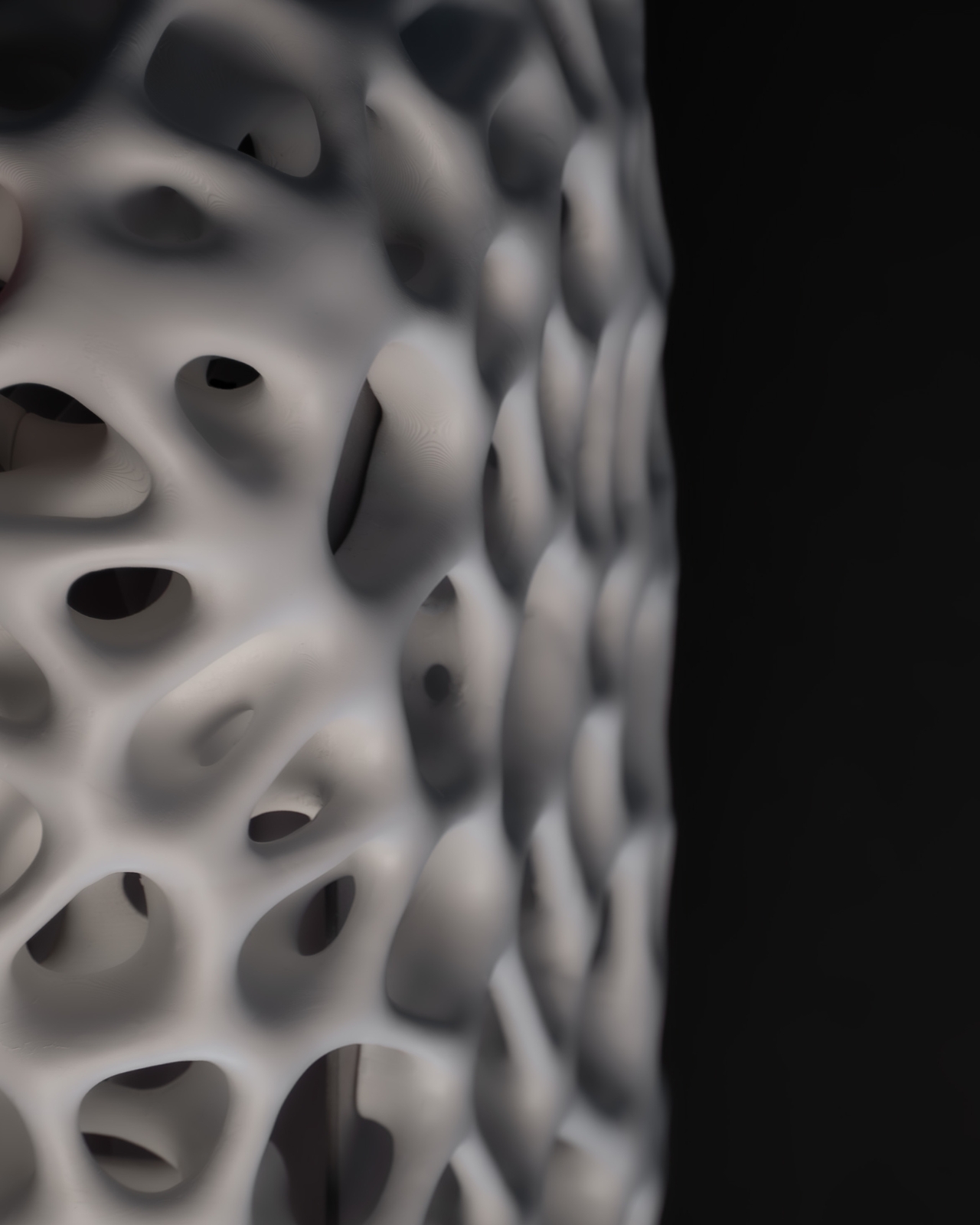
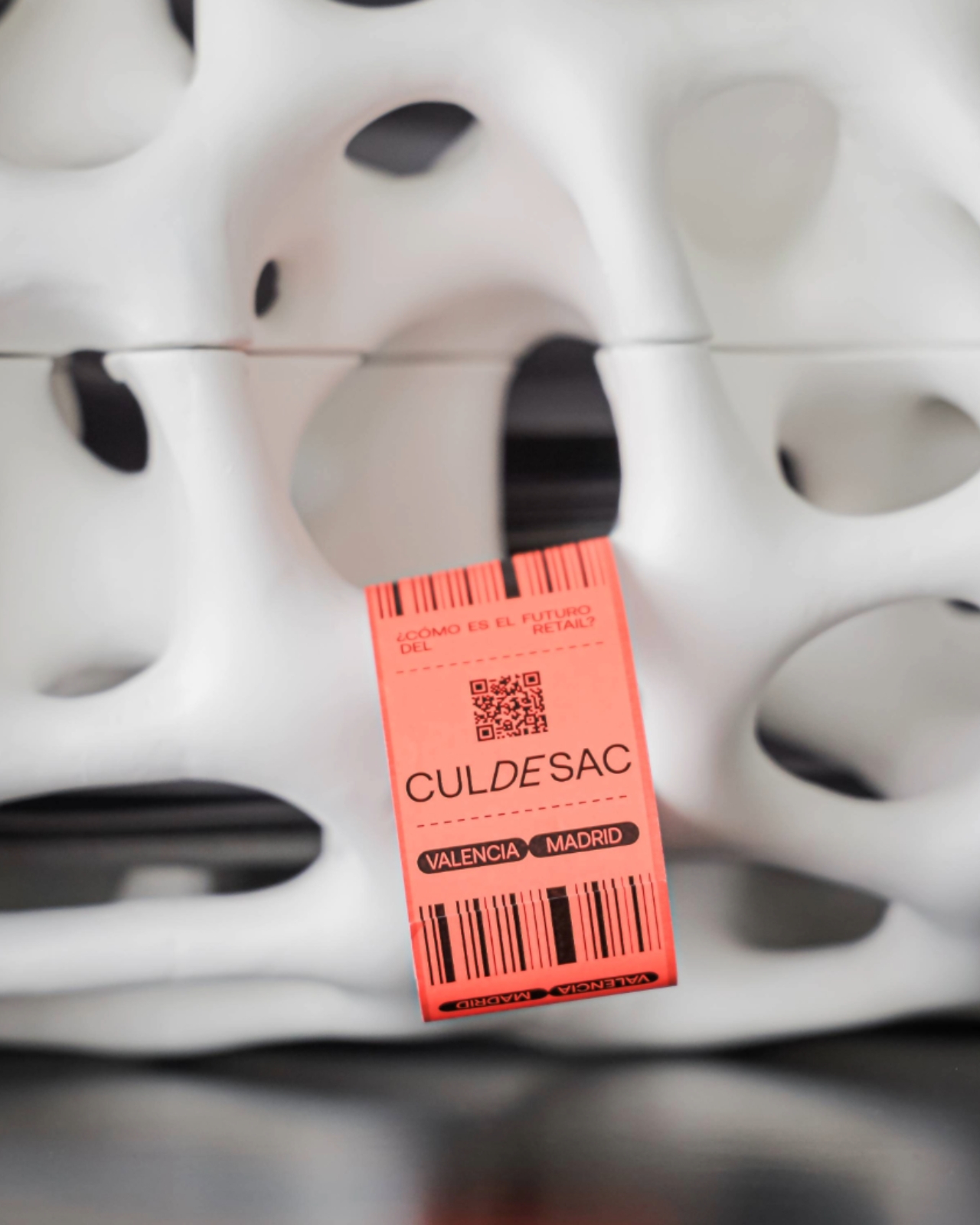
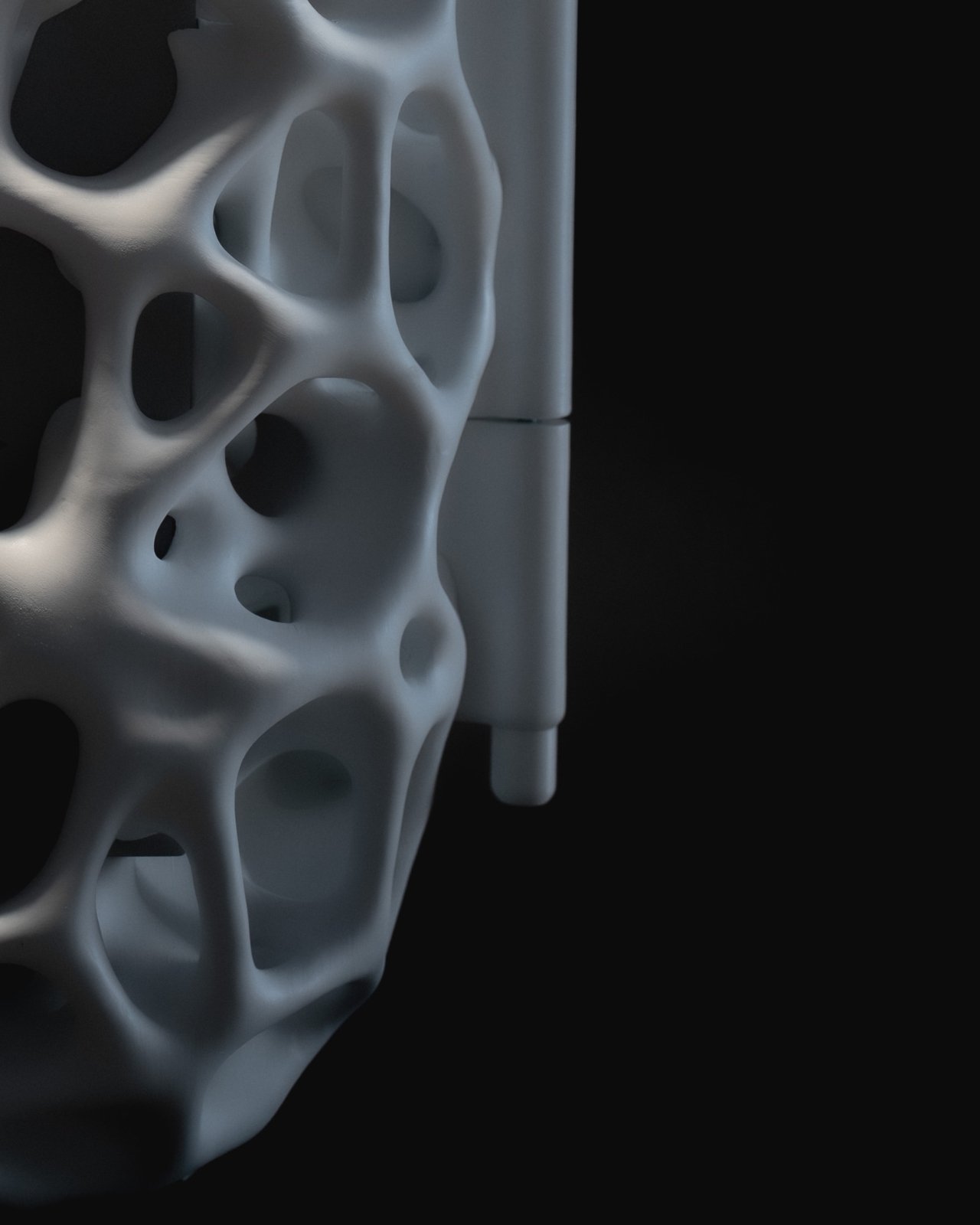
That philosophy isn’t just talk. It’s physically manifested in the suitcase’s 3D-printed design, which looks like something between a neural network and organic coral. The structure breathes with these flowing, interconnected forms that evoke energy pathways and human connections. It’s deliberately designed to feel alive, like it’s constantly evolving and adapting, much like the retail spaces Berna imagines for our future.

The choice of 3D printing feels particularly intentional here. This technology allows for organic, impossible-to-manufacture-otherwise shapes that traditional fabrication methods simply can’t achieve. The result is a sculptural piece that captures fluidity and movement in a way that feels almost biological. You can see why they chose this approach when you look at the images: those undulating surfaces and cellular patterns really do suggest something living rather than static.

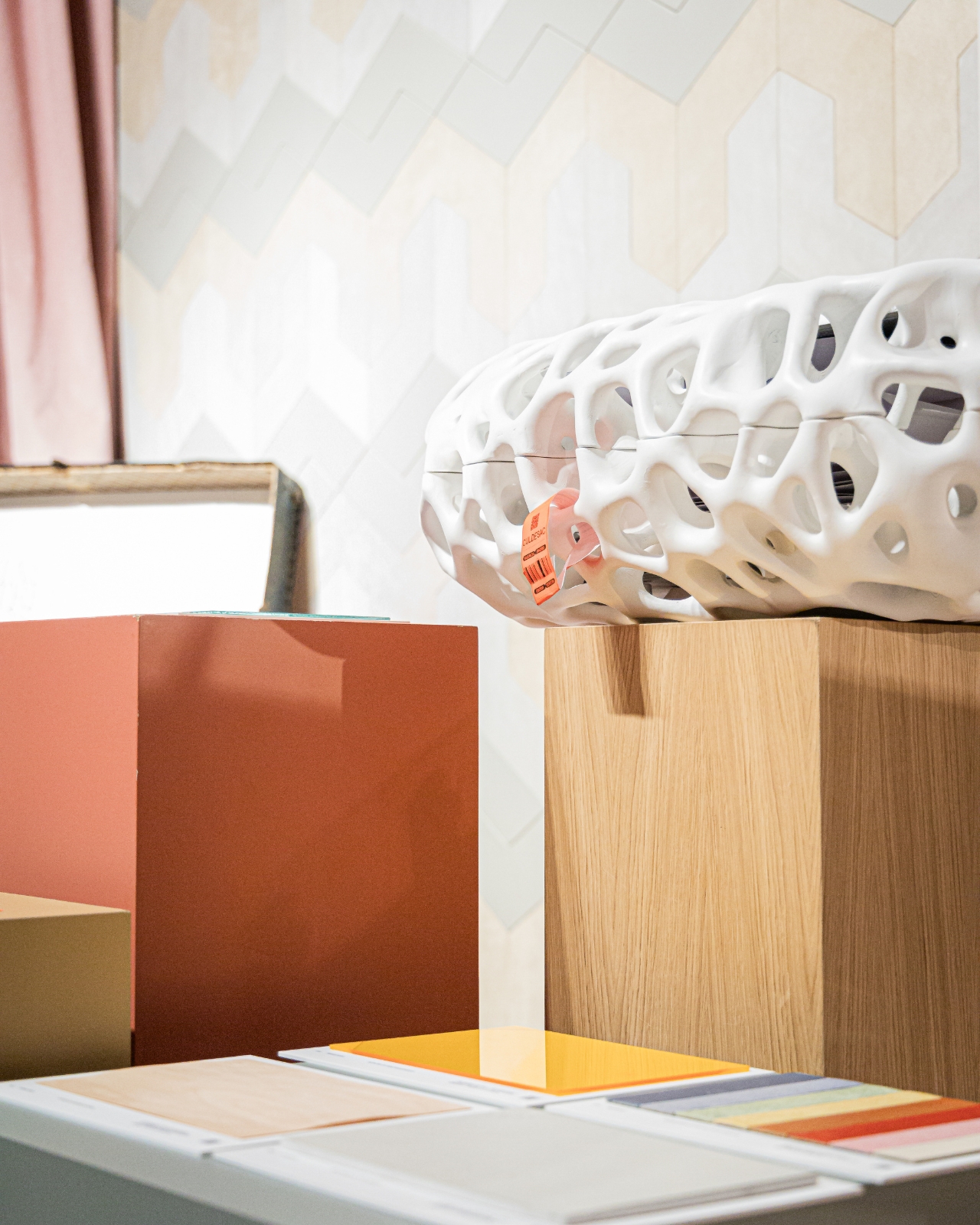
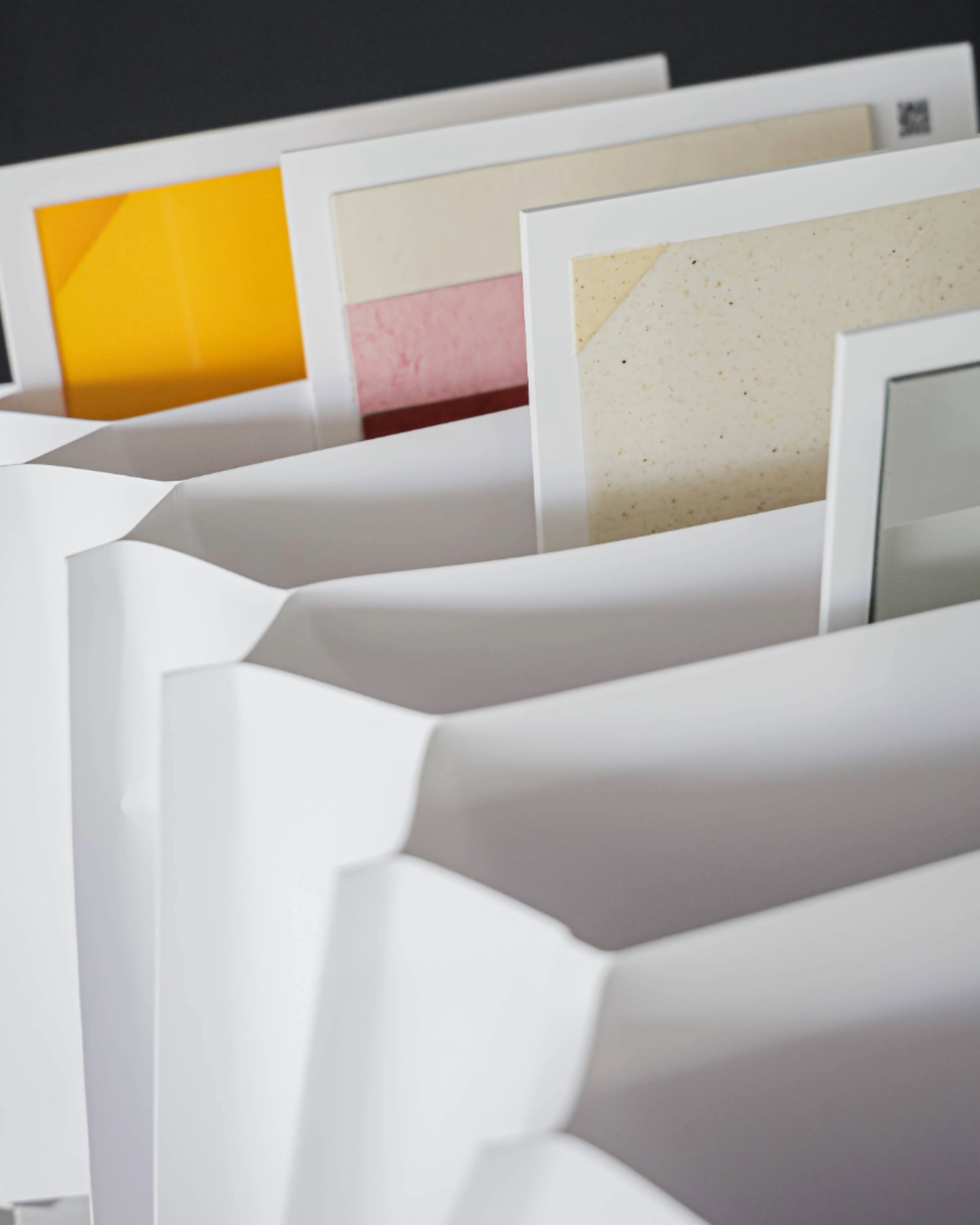
But here’s where it gets really interesting. The suitcase doesn’t just contain samples of Gerflor’s flooring materials as a reference library. The container itself becomes the statement. As Berna puts it, they wanted “the design itself to summarize our vision of the future of retail.” The piece integrates materials from Gerflor’s Creation range not as mere swatches but as part of the identity itself. In a market saturated with brands competing for attention, materials become the language through which spaces communicate with people and create memorable experiences.

Berna describes the biggest challenge as “condensing usually conceptual ideas into a tangible piece.” And you can feel that tension in the final work, in the best possible way. It’s both abstract and concrete, theoretical and physical. The suitcase manages to be a manifesto, a prototype, and an art object all at once.

This project sits alongside equally intriguing contributions from Studio Banana, who tackled the future of office spaces, and Nini Andrade Silva from Madeira, who explored hotels as experiential gathering places. Together, these three suitcases form a traveling exhibition that will move through seven cities across the Iberian Peninsula, sparking conversations about how we want to inhabit tomorrow’s spaces.

There’s something wonderfully democratic about packaging big architectural ideas into portable, approachable formats. Rather than presenting a massive installation or dense white paper, these studios offer something you can literally walk around, something that invites curiosity and conversation. As Juan Segura, Marketing Manager of Gerflor Iberia, notes, “More than showing product, we want to generate dialogue.”

What I love most about this project is how it reframes retail from transactional to transformational. In an era where online shopping dominates and physical stores struggle to justify their existence, Cul De Sac suggests that the answer isn’t better product displays or flashier signage. It’s about creating spaces where human connection happens, where community forms, where something meaningful occurs beyond the exchange of goods for money.

That 3D-printed suitcase, with its neural-network-like structure, becomes a perfect metaphor: retail spaces as living organisms that facilitate connections between people, emotions, and yes, brands, but in ways that feel organic rather than forced. It’s a vision of shopping as something closer to a social experience than a chore. And really, isn’t that the kind of future we’d all want to pack our bags for?

The post The Future of Retail Fits in This 3D-Printed Suitcase first appeared on Yanko Design.
In a rare deal, my favorite gaming headset is 28 percent off for Black Friday

The truth is, most gaming headsets aren’t great values. I’ve tested a ton of them for our buying guide, and while the space has improved over time, it remains far too centered on branding and marketing. Too much of what passes by my desk comes off as overpriced compared to a good set of “normal” headphones in the same range, both in audio and build quality. If you have a pair you love, more power to you. But generally speaking, these things tax you for the perception of being specialized for gaming. In reality, most are just OK headphones with a mic, a logo and maybe some fancy RGB lighting attached.

All that said, there are always exceptions to the rule, and a few headsets have stood out as actually being worth the money. My current favorite is the Turtle Beach Atlas Air, which is currently on sale for $130 at various retailers as part of a Black Friday deal. That’s the cheapest it’s been since February, $50 off its MSRP and $20 below its street price over the last month. When it’s discounted to this extent, it’s the rare gaming headset I’d call a solid bargain.

The hook with the Atlas Air is that it’s one of the few wireless headphones (let alone headsets) with an open-back design, meaning its ear cups don’t completely seal off your ears from air and outside noise. Pairs like this aren’t for everyone: They both let in and leak lots of ambient sound, so if you don’t use them in a quiet room, you and anyone nearby will probably be distracted. On the flipside, this can be a positive if you don’t want to be completely shut off from your surroundings. More notably, they can produce a far more spacious and natural sound than closed-back models. Games feel more like they’re happening around you instead of being confined to a space in your head.

All of this holds true with the Atlas Air. Going from this pair to a traditional headset often makes it feel like a chunk of the world has been lopped off — giant boss fights in games like Elden Ring or Final Fantasy XVI sound more narrow, and it becomes harder to gauge where exactly an opponent is coming from in a competitive shooter like Counter-Strike 2. It helps that the Atlas Air is also tuned well. It’s not as dynamic as the best non-gaming open headphones, and like most open-backs it doesn’t get super deep bass, so explosions and gunfire lack a little boom. But it’s balanced and easygoing, with a jump in the treble that helps dialogue and footsteps sound clearer.

The headset itself is exceptionally comfortable beyond that. It’s lightweight at 0.66 pounds, and the big memory foam earcups clamp down gently without trapping much heat. The battery lasts a solid 50-60 hours on a charge, and while the mic isn’t the absolute best I’ve tested, it still lets you come through clearly. It all works with PC and PS5 by default, and you can pair with a Switch or Switch 2 over Bluetooth. There’s no Xbox wireless support, unfortunately, though you can at least use an included 3.5mm cable. And though the plastic design isn’t exactly “premium,” it hasn’t developed any sort of cracks or creakiness in the months I’ve used it. For $130, it’s totally fine.

There are other things to nitpick: You can’t listen to two devices connected over the USB dongle and Bluetooth simultaneously; you want to ignore Turtle Beach’s companion software as soon as you update the firmware; and there isn’t much room to adjust the headband, so certain heads may struggle to find the best fit. The design is also kind of ugly, if I’m being honest. Still, in an samey market, the Atlas Air stands out. If you know you can live with the trade-offs that come with any open-back headset, it’s a unique value at this price.

This article originally appeared on Engadget at https://www.engadget.com/deals/in-a-rare-deal-my-favorite-gaming-headset-is-28-percent-off-for-black-friday-165029987.html?src=rss

Silent Hill 2 is now available on Xbox

If you’re an Xbox-only player who’s been waiting patiently for the arrival of Bloober Team’s superb Silent Hill 2 remake on Microsoft consoles, now’s your time. While the ideal release window would have been last month to coincide with spooky season (PS Plus subscribers got lucky here), there’s never a bad time to play Silent Hill 2.

A full remake of the seminal 2001 survival horror game, Silent Hill 2 has you play as widower James Sunderland, who’s summoned to the eponymous rural town after receiving a letter from his deceased wife, where all manner of psychological horrors await him. Slightly controversially, the 2024 game ditched the fixed camera angles of the original in favor of a more modern over-the-shoulder perspective. Fortunately, this transition sacrifices none of the game’s signature oppressive atmosphere, with the foggy streets of Silent Hill being as creepy as ever to tentatively explore.

To celebrate the release of Silent Hill 2 on Xbox Series X|S, Konami has slashed the price of the Xbox and PC versions by 50 percent. You can also grab this year’s brand new entry, Silent Hill f, for 30 percent off for Black Friday.

It’s been a pretty good week for long-awaited Xbox ports. Engadget 2023 game of the year award winner Dave the Diver finally arrived on all Xbox consoles (including Xbox One), while the excellent horror-themed roguelite Clover Pit also surprise dropped this week. That one’s on Game Pass too.

This article originally appeared on Engadget at https://www.engadget.com/gaming/xbox/silent-hill-2-is-now-available-on-xbox-164052884.html?src=rss

Apple teamed up with another artist to make this iPhone grip and stand

Apple has teamed up with an artist named Bailey Hikawa to make an iPhone grip and stand thingamajig. The appropriately-named Hikawa Phone Grip & Stand is a MagSafe compatible device that snaps onto an iPhone. The grip can be "removed with ease" and also doubles as a stand.

To that end, it supports two different viewing angles, both vertical and horizontal. Apple says the ergonomic form factor was "designed with accessibility in mind from the ground up" and that Hikawa was given "direct input from individuals with disabilities affecting muscle strength, dexterity and hand control."

A grip.
Bailey Hikawa/Apple

It's also intended to be a work of art, as it was "inspired by modern sculpture." This is what likely ticks the price up. The grip is available in two colorways, both of which cost $70. Generic grips cost around $10 on Amazon or big-box retailers, but Hikawa has been making noteworthy phone cases for years. She also makes eye-catching toilet seats.

That leads us to the knitted elephant in the room. Apple introduced a bizarre knitted sleeve last week intended to hold iPhones. This, uh, phone sock starts at a whopping $150 and goes all the way up to $230. The idea of spending $150 on a little knitted bag for a smartphone has, quite obviously, irked some consumers and sparked internet outrage.

This article originally appeared on Engadget at https://www.engadget.com/mobile/smartphones/apple-teamed-up-with-another-artist-to-make-this-iphone-grip-and-stand-163508039.html?src=rss

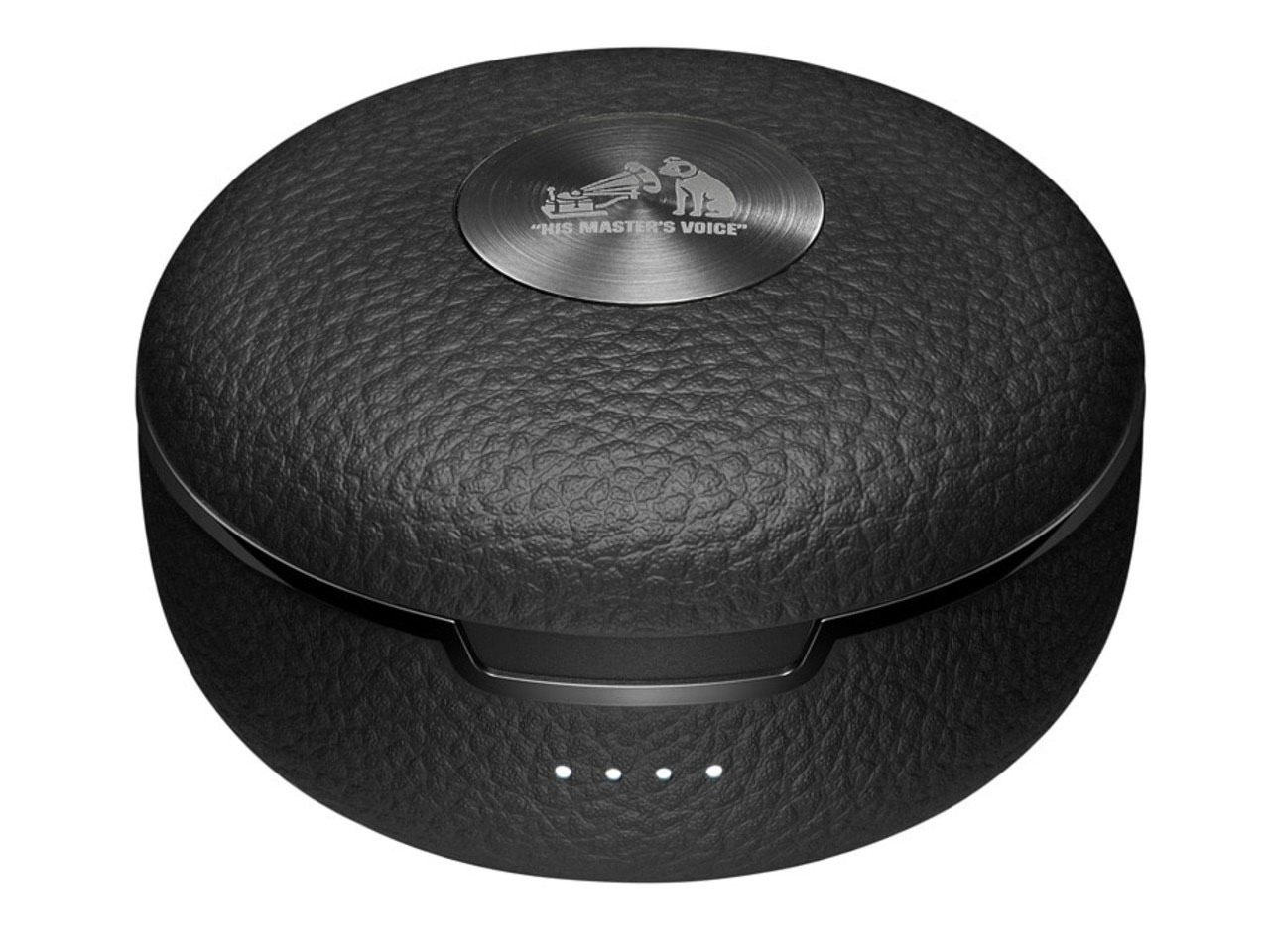
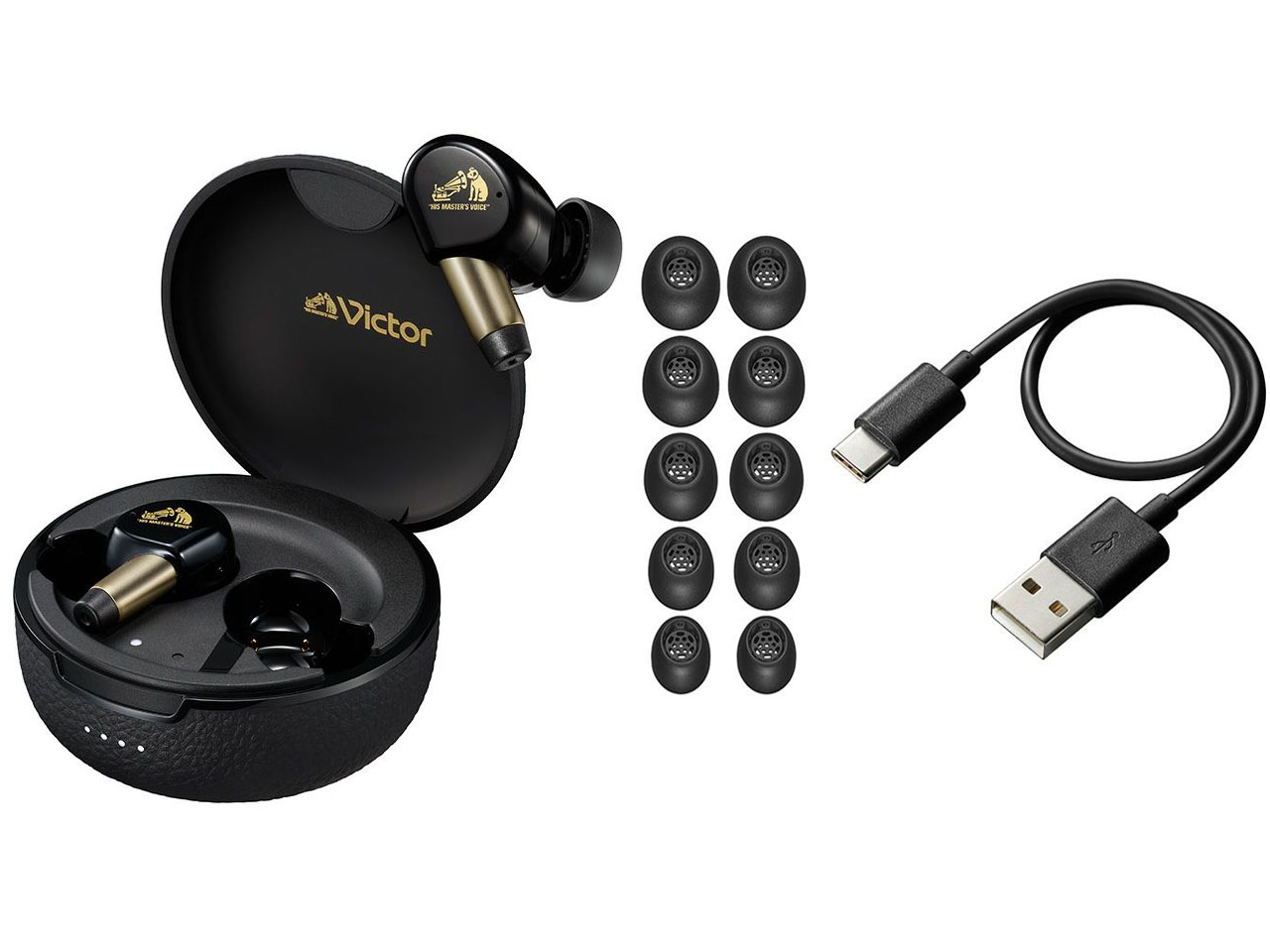
JVC’s Victor WOOD Master earbuds boast self-healing exterior, authentic wooden drivers for pristine sound

Options for true wireless earbuds have exploded in the last couple of years owing to technological innovations and the affordability of owning them. The marketplace is flooded with so many TWS earbuds that you, as a buyer, find it hard to decide which one fits your set of priorities. For a manufacturer, the ideal strategy is to come up with a pair that is distinct from the other available options.

In the audio world dominated by the likes of Sony, Bose, Sennheiser, Technics, and many more, JVC has revealed its pair of earbuds that are unlike any one of them, at least in form. The unique distinction that the company is pitching these earbuds is their ability to self-heal from minor scratches. Meaning, they’ll look in pristine condition even if you are one of those users who stashes earbuds and keychains in the same pocket.

Designer: JVC Kenwood

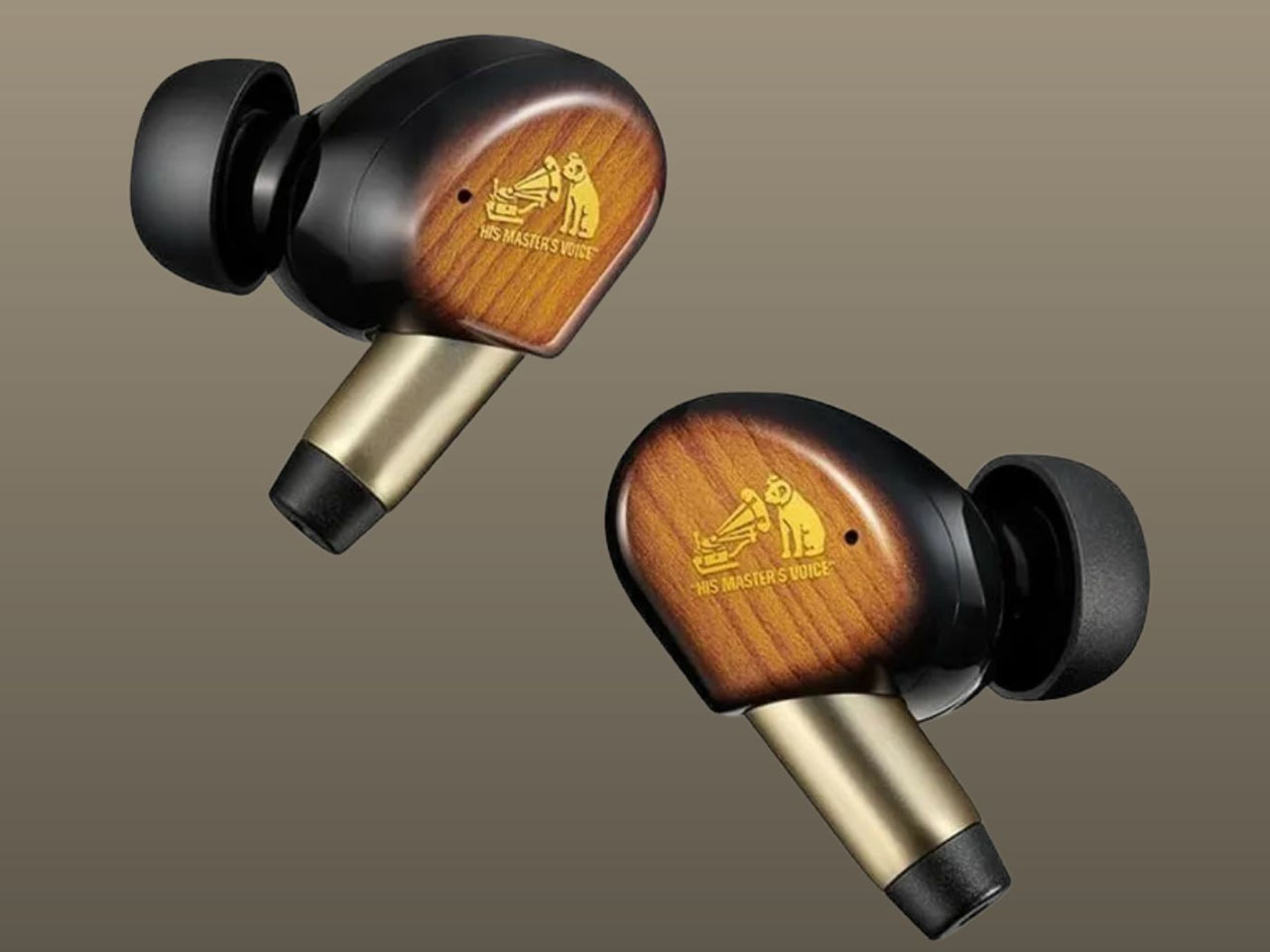
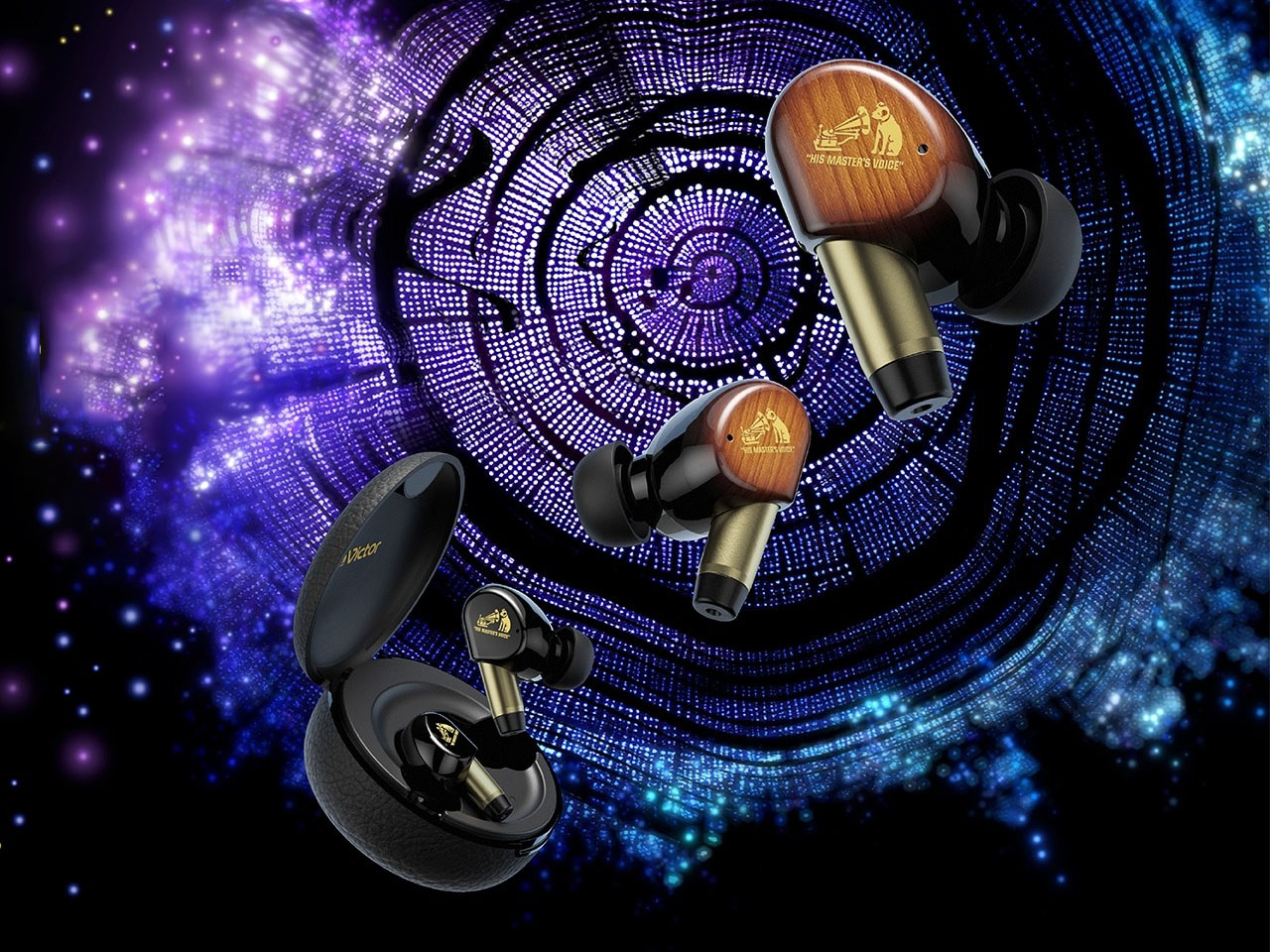
Meet the Victor WOOD Master earbuds by the Japanese audio pioneer, which have a self-healing paint coated on the exterior of the shell. Whenever there are hairline scratches on the earbuds, they self-heal over time when exposed to heat from sunlight or other sources. This is the same technology that’s used in car paints, employing a polymer structure for the pristine magic. The USP extends to the interior as well, where the use of exclusive materials for the drivers promises an ear-pleasing sound signature. They get the industry’s first hybrid WOOD Driver that has pulp and African rosewood in the diaphragm of the 10mm drivers.

The result, pristine vocals and studio-like sound across all the frequencies. All the audiophiles out there will have keen ears on these ones, I’m sure, especially if looking for an audio profile that is distinct from any other pair out there. JVC also promises the highest noise cancellation levels in the world, courtesy of the dedicated high-performance IC and Knowles microphones. Now, that’s a claim we’ll have to test, and if true, Bose and Apple better watch out.

The buds are accompanied by the oval-shaped Spiral Dot Pro SF ear tips, which improve the reproduction of high-frequency sounds without any bloating. Their oval shape ensures a snug fit and reduced pressure with long-term use. To make the audio sound as good as it is perceived, the Personalized Sound system scans the user’s ears to toggle the audible output. Spatial Audio is another great feature that’ll make these buds appeal to users who want bang for their buck.

Apart from the self-healing paint, the Hi-Res Audio earbuds boast an IP55 rating for dust and water resistance. Three-year warranty by the maker reflects the trust they have in their product, which is another assuring point.  Support for SBC, AAC, and LDAC codecs over Bluetooth 6.0 is good news for users who like to own their pair of earbuds for more than a couple of years. Another compelling reason for advanced listeners to consider these is the two-device multipoint connectivity and low-latency gaming mode.

Victor WOOD Master earbuds have a battery life of around 10 hours on a single charge, which extends to 31 hours in the case. With ANC on, these numbers slip down to 7 hours on the buds and 14 hours in the case, respectively. The case is Qi wireless charge compatible, and a quick charge of 15 minutes will be good for over one and a half hours of listening time. The earbuds are slated for late November release in two color options: Sunburst Brown and Piano Black, for a price of around $270 in Japan.

The post JVC’s Victor WOOD Master earbuds boast self-healing exterior, authentic wooden drivers for pristine sound first appeared on Yanko Design.
Ubisoft delayed its latest earnings report due to an accounting issue

The possible reasons behind Ubisoft delaying the earnings report it was expected to release last week were the subject of much discussion, especially given the company’s well-documented issues in recent times. But we now know that the delay was forced by an accounting issue relating to its soon-to-be finalized transaction with Tencent.

As detailed in Ubisoft’s now-published first-half 2025-26 earnings figures, the company was required to restate its FY2024-25 accounts, concerning revenue for this period attributed to sales from a partnership. "This position now applied by the Group going forward has also resulted in a partnership signed in Q2 FY2025-26 not being recognized in IFRS15 revenues," the company said. "The above results in the Company not complying with its leverage covenant ratio under certain existing financing agreements at September 30, 2025. However, this is being addressed by the aforementioned actions relating to the concerned debt instruments."

With the report now published, Ubisoft has asked Euronext to resume trading its shares. And while the accounting snag led to the week-long delay, the French company said that its deal with Tencent is set to close in "the coming days," with the imminent €1.16 billion ($1.36 billion) investment expected to help the company pay off outstanding debt. Once finalized, the partnership will also "enable the acceleration" of Vantage Studios, the new Ubisoft subsidiary in which Tencent will own a 25 percent stake. The new studio will be responsible for Ubisoft’s three biggest IPs: Assassin’s Creed, Far Cry and Rainbow Six.

Ubisoft reported net bookings of €491 million ($564 million) this quarter, which it said was a 39 percent year-on-year increase. The company said that Assassin’s Creed Shadows, which is getting a Switch 2 port next month, had overperformed this quarter, likely helped by arrival of its New Game+ mode in the summer.

This article originally appeared on Engadget at https://www.engadget.com/gaming/ubisoft-delayed-its-latest-earnings-report-due-to-an-accounting-issue-152017119.html?src=rss

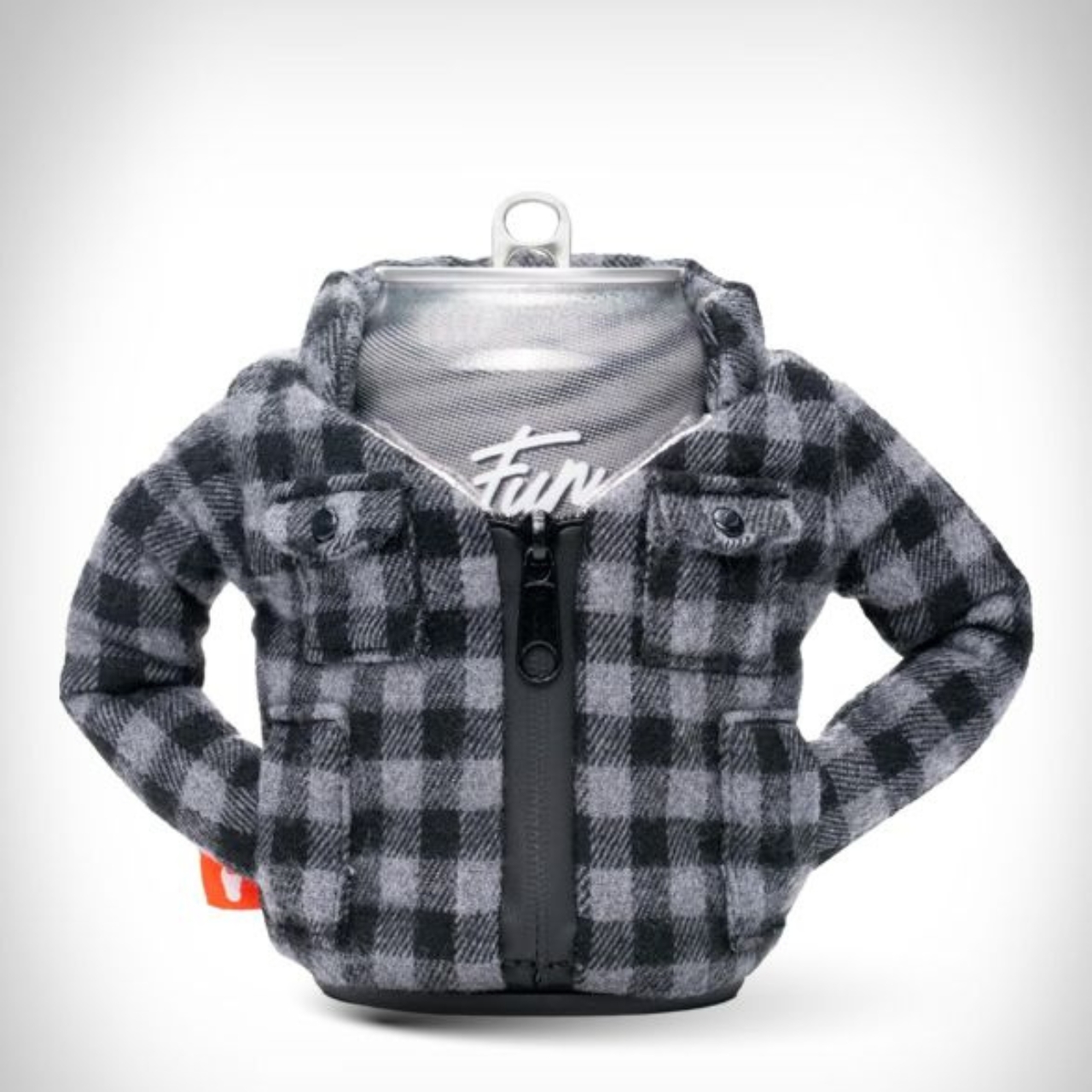
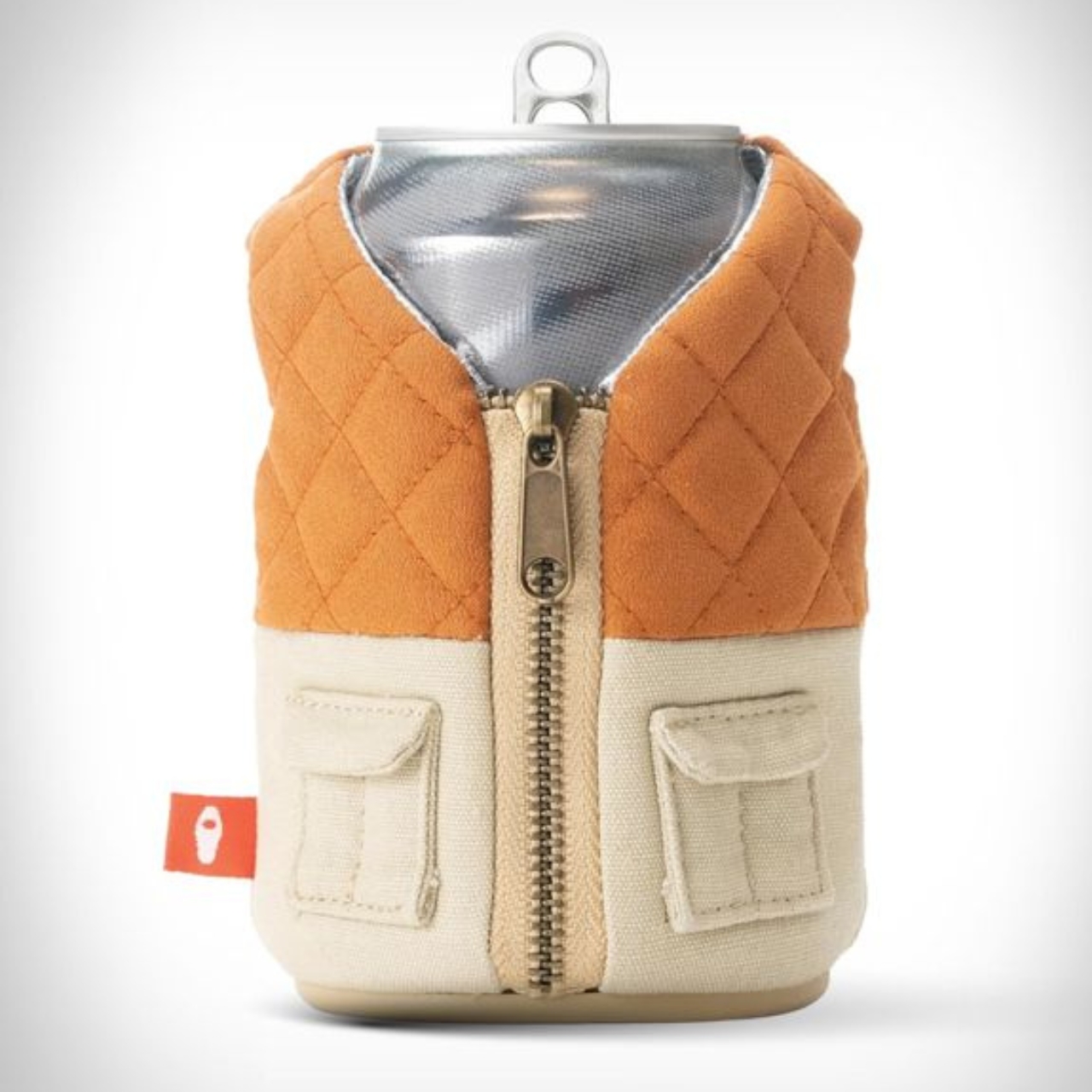
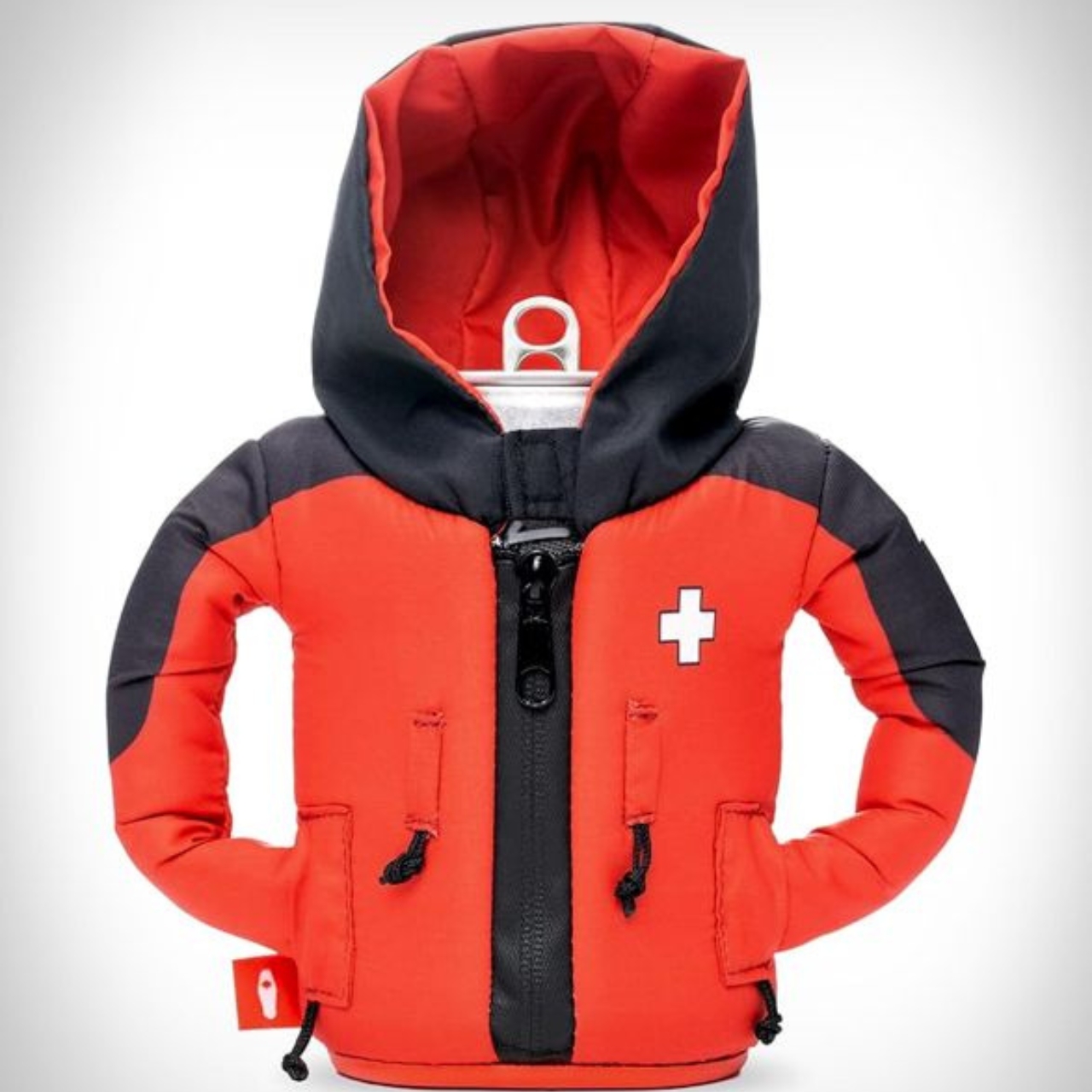
Puffin’s Insulated Drink Holders Are This Year’s Best Gift

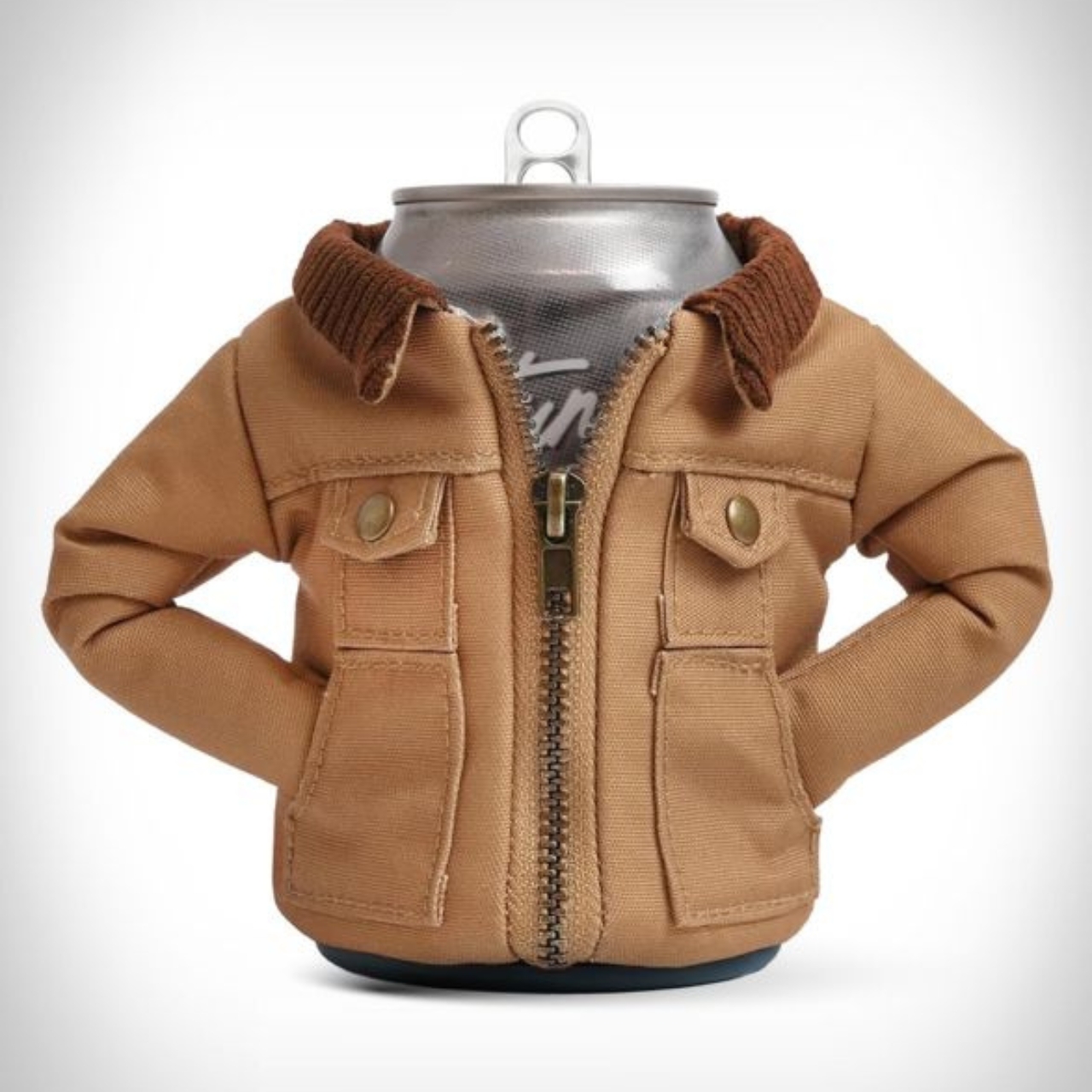
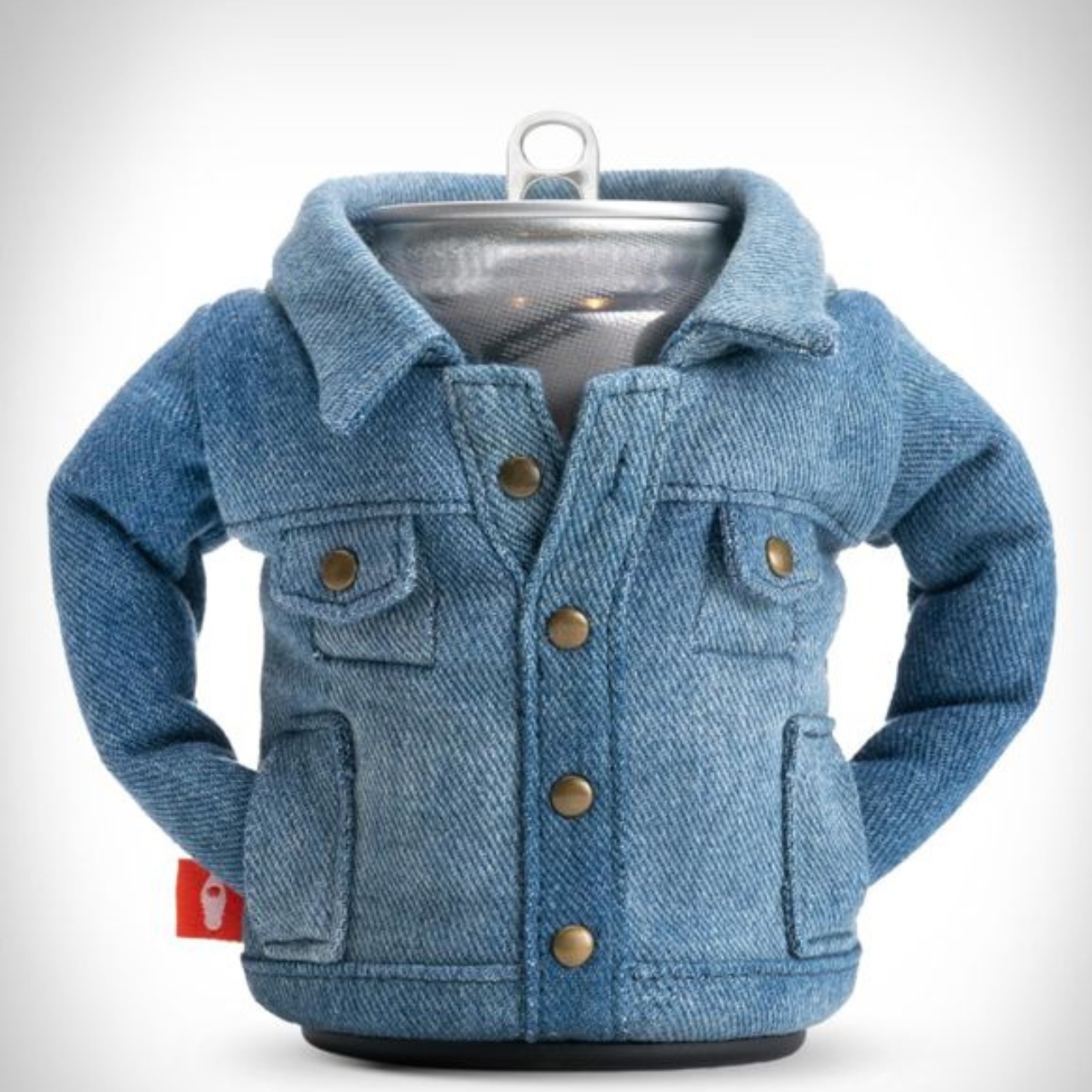
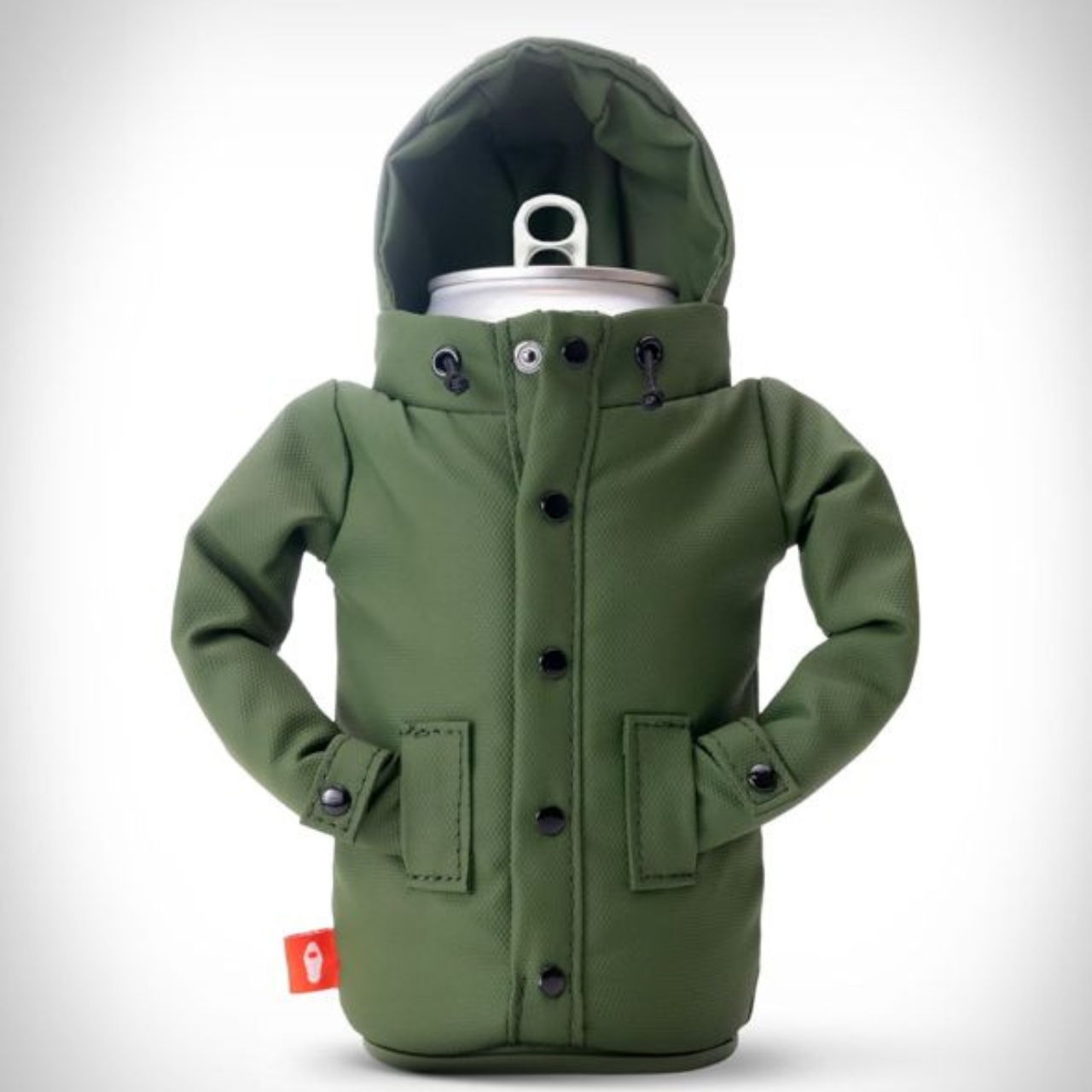
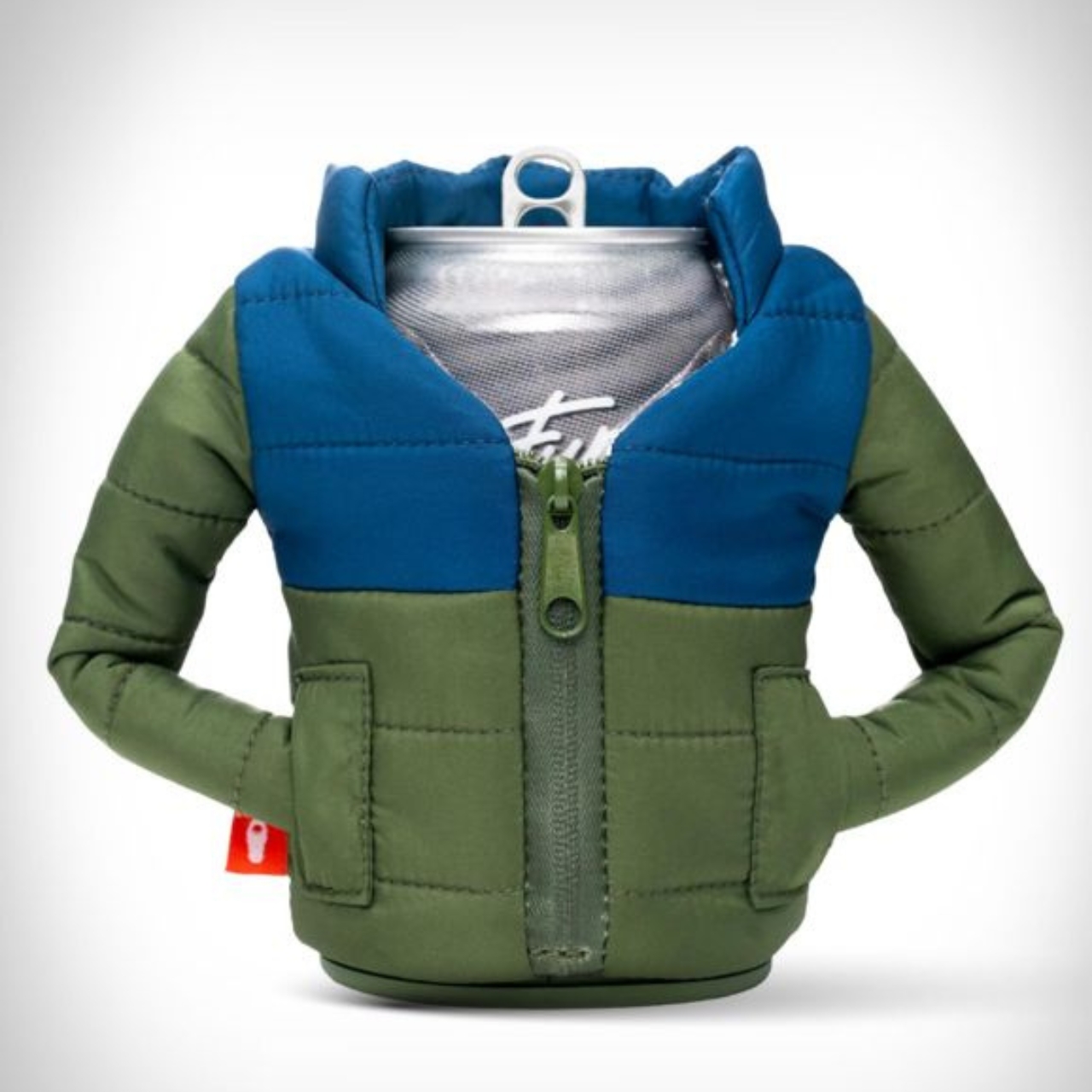
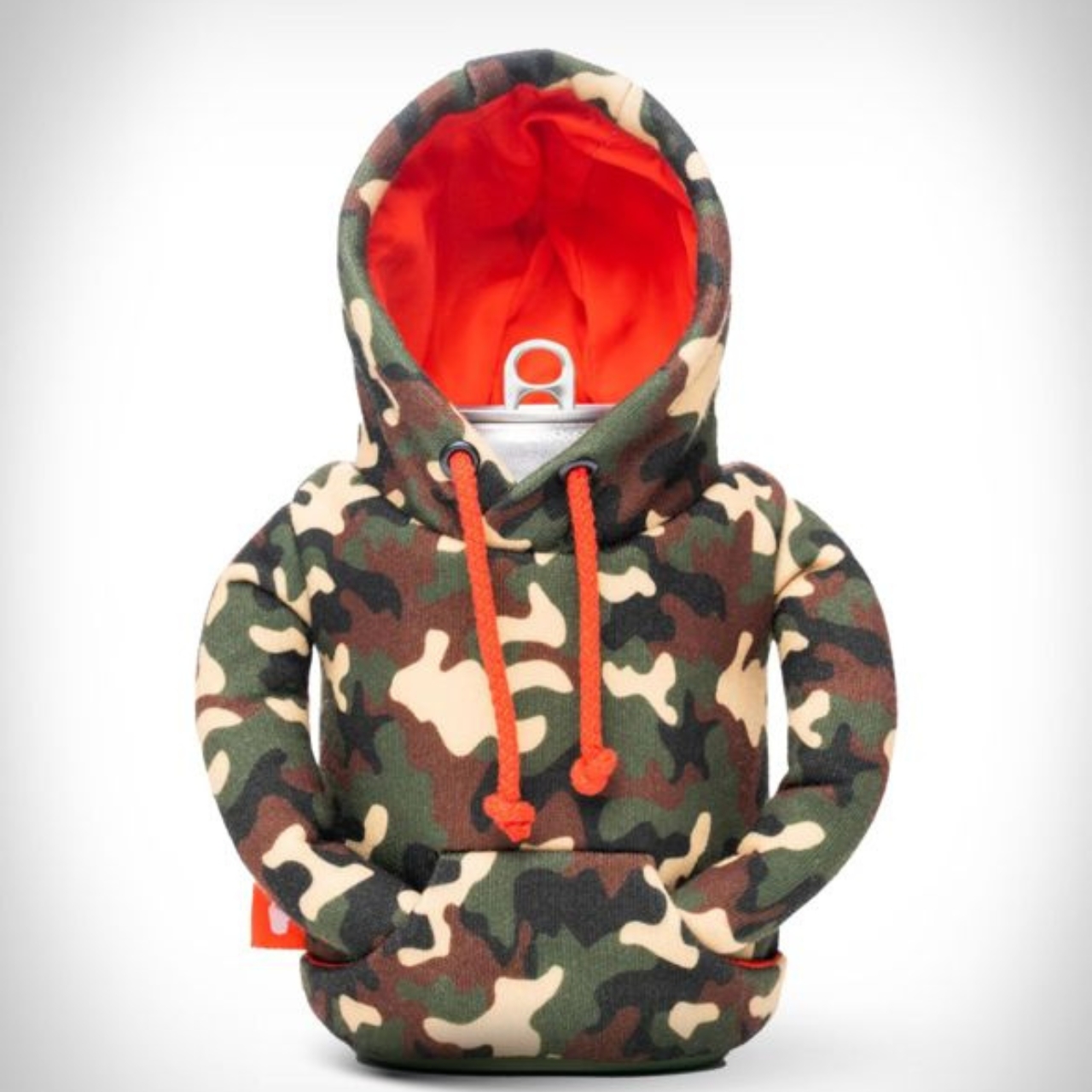
You know that feeling when you’re at a holiday party, fully invested in a conversation about whether Die Hard counts as a Christmas movie, and you suddenly realize your drink has gone warm? Yeah, that’s the worst. But here’s the thing: there’s actually a super clever solution that’s been sitting right under our noses, and it comes from a brand that took the concept of a puffy jacket and applied it to your beverages. Meet Puffin Drinkware, the insulated can and bottle holders that are basically winter coats for your drinks.

Let me paint you a picture. It’s December, you’re hosting friends for a gift exchange or maybe you’re the guest who wants to bring something actually useful instead of another scented candle. Puffin Drinkware is that gift everyone will actually use. These aren’t your basic foam koozies from the corner store. They’re designed with the same concept that keeps you warm in your favorite winter jacket, with double-layer thermal insulation that keeps your beverage cold from first sip to last.

Designer: Puffin

The genius is in the details. Each Puffin holder features a rubberized base for stability, so you’re not dealing with that annoying wobble when you set your drink down on a table. There’s even versions with carabiners that include bottle openers and utility pouches, which is perfect for anyone who likes to keep their hands free while they’re out and about. Whether you’re tailgating in cold weather, ice fishing, or just hanging out in your backyard while the temperature drops, these little guys work incredibly well.

What makes Puffin stand out in a market flooded with drink holders is how they’ve turned something purely functional into something with personality. The designs are fun, bold, and Instagram-worthy. They’ve got everything from classic solid colors to wild patterns, and even special editions like “The Pahka,” which comes with a faux fur-lined hood that makes your drink look like it’s ready for a trip to the Arctic. It’s functional design meeting playful aesthetics, and that’s a combo that’s hard to beat.

The holiday angle here isn’t just about keeping drinks cold at winter gatherings. Think about all those outdoor holiday activities we do: tree lighting ceremonies, caroling meetups, sledding adventures, Christmas market wandering. These are situations where you want a warm beverage to stay warm or a cold one to stay cold, and you don’t want to worry about constantly checking if your drink is still at the right temperature. Puffin handles both 12 oz and 16 oz sizes, fitting standard bottles and tall cans with ease.

From a design perspective, Puffin Drinkware represents that sweet spot where form follows function but doesn’t forget to have fun along the way. The thermal insulation technology keeps condensation off your hands, which anyone who’s tried to hold a cold beer on a chilly night knows is a game changer. You’re not dealing with wet, freezing fingers or leaving water rings on every surface.

These make fantastic stocking stuffers, Secret Santa gifts, or additions to a larger present for the person in your life who has everything. They’re compact, affordable, and universally useful. Plus, they’re conversation starters. Someone’s going to ask where you got that cool drink holder, and you’ll look like the person who knows about all the clever design products before everyone else.

The beauty of Puffin is that it solves a problem we didn’t realize was solvable. We just accepted that drinks get warm or that our hands get wet and cold. But with thoughtful design and a bit of creativity borrowed from outdoor gear, Puffin created something that enhances every drinking experience, whether it’s craft beer, sparkling water, or that hard cider you save for special occasions.

This holiday season, when you’re thinking about gifts that combine practicality with personality, Puffin Drinkware deserves a spot on your list. It’s one of those products that people use constantly once they have it, making it the kind of gift that keeps on giving long after the wrapping paper is recycled.

The post Puffin’s Insulated Drink Holders Are This Year’s Best Gift first appeared on Yanko Design.
Samsung Galaxy S26 Ultra: Separating Hype from Reality

Samsung Galaxy S26 Ultra: Separating Hype from Reality

The Samsung Galaxy S26 Ultra, anticipated to launch in early 2026, is poised to set new benchmarks in smartphone technology. Packed with state-of-the-art features, this flagship device combines exceptional performance, innovative design, and advanced functionality. With a focus on delivering a seamless user experience, the Galaxy S26 Ultra is engineered to cater to the needs […]

The post Samsung Galaxy S26 Ultra: Separating Hype from Reality appeared first on Geeky Gadgets.

Posted in Uncategorized