
IO Interactive’s 007 First Light has been delayed until May 27

IO Interactive's James Bond simulator 007 First Light has been delayed until May 27, 2026. It was supposed to come out in March. The company says two-month delay is for polish and refinement, which is fine by me. I'd always rather wait a bit longer for a better end product.

IO says the game is already "fully playable from beginning to end" but still needs a bit of attention to ensure "the strongest possible version at launch." The developer promises to share more updates at the beginning of next year.

For the uninitiated, 007 First Light is the first James Bond game in over a decade. The developer is the same organization behind the renowned Hitman franchise, so this could potentially be the best Bond game since Goldeneye.

The gameplay looks fast-paced, frenetic and filled with spycraft. It features an original story that pulls from all over the decades-long franchise. We got a chance to speak to narrative director Martin Emborg and he noted that the game stars a young and inexperienced Bond, which seems to be the direction Amazon is taking with its upcoming film.

The game also boasts a pretty stacked cast. Patrick Gibson, from The OA and Dexter: Original Sin, plays the famous lothario spy and Lenny Kravitz has been cast as the primary villain. Other cast members include Lennie James, Kiera Lester, Alastair Mackenzie and Priyanga Burford.

Who knows when the next Bond film will actually come out, so this should be a nice little stopgap for fans.

This article originally appeared on Engadget at https://www.engadget.com/gaming/io-interactives-007-first-light-has-been-delayed-until-may-27-194809718.html?src=rss

Engadget Podcast: Why is the Nex Playground ‘AI console’ such a hit?

Over the past two years, the Nex Playground has carved out a niche for itself with kids and parents alike. It's a small box that sits in front of your TV and uses a camera, along with computer vision AI processing, to track your movement for interactive games. Think of it like a simplified version of Microsoft's Kinect (RIP), with a bit of the local multiplayer we see from the original Wii. In this bonus episode, we chat with David Lee, Nex's CEO and co-founder, about how he went from building a basketball tracking app to one of the most intriguing gaming console alternatives on the market. (The Nex Playground even managed to outsell Xbox in November!)

Subscribe!

Topics

  • What led to the development of the Nex Playground? — 2:04

  • Who helped design and build the console? — 8:36

  • Questions about the Nex PlayPass subscription and other ways to get new games — 13:23

  • How did Nex convince major brands to build for Nex Playground? — 19:10

Credits

Host: Devindra Hardawar
Guest: David Lee, CEO and co-founder of Nex
Producer: Devindra Hardawar
Music: Dale North

This article originally appeared on Engadget at https://www.engadget.com/social-media/engadget-podcast-why-is-the-nex-playground-ai-console-such-a-hit-181151201.html?src=rss

Xbox cloud gaming comes to newer Amazon Fire TV models

Xbox has brought cloud gaming gaming to some Amazon Fire TV models. These include the Fire TV 4-Series and the Fire TV Omni QLED Series. This lets people play Xbox games directly on the television, without needing a bulky console or even something like a Fire TV stick. 

Gamers do need a couple of things. First and foremost, this service requires a subscription to Game Pass. Plans start at $10 a month and shoot all the way up to $30 per month. They'll also need a compatible wireless controller, though most Bluetooth-enabled gamepads should work.

Two TVs.
Amazon

The feature works for every game on the Game Pass platform and will also stream many titles that people own outright via the "stream your own game" feature. This won't work with everything, but hundreds of titles are supported. 

Amazon says this is just the beginning and that more TV models will receive the functionality in the future. Xbox Game Pass became available on select Amazon streaming devices earlier this year. Today's move makes sense, given that Fire TVs and the company's streaming sticks use the same OS. 

This article originally appeared on Engadget at https://www.engadget.com/gaming/xbox/xbox-cloud-gaming-comes-to-newer-amazon-fire-tv-models-163517432.html?src=rss

Atlanta Airport Has Chairs Made From Campus Trash. They’re Gorgeous

There’s something quietly radical about sitting in a recycled Adirondack chair while you’re waiting for your flight at the world’s busiest airport. Plastic Reimagined transforms locally sourced plastic waste into full-scale seating prototypes, bridging design education, material research, and civic infrastructure at Hartsfield-Jackson Atlanta International Airport, and honestly, I can’t stop thinking about how clever this is.

Here’s what happened. Assistant Professor Hyojin Kwon, founder of the research-oriented practice Pre– and Post–, developed this through a graduate design research studio at Georgia Tech’s School of Architecture, where students took a very practical question and turned it into something beautiful. What if all that plastic waste from campus could actually become something useful again?

Designer: Hyojin Kwon (curator and instructor)

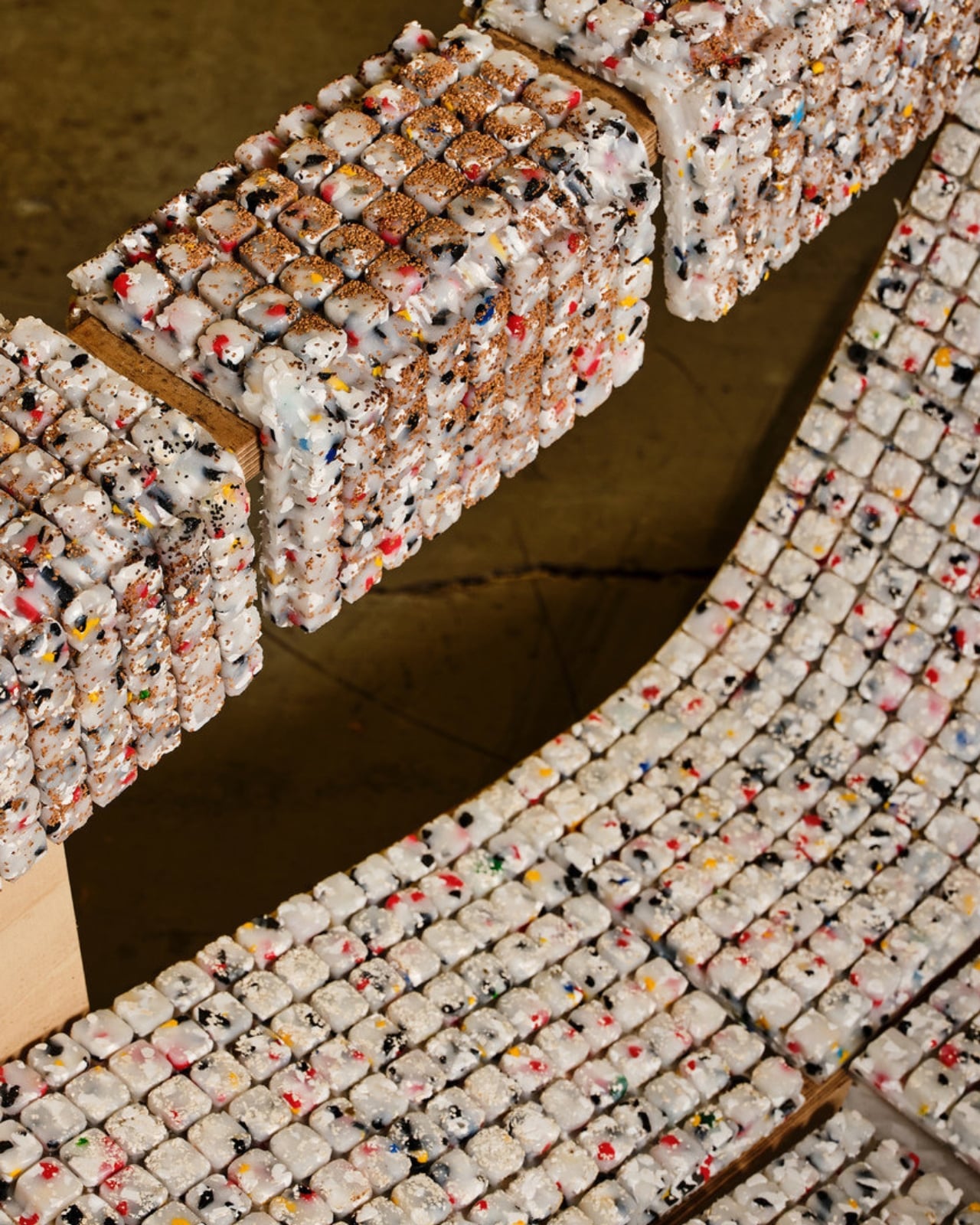
Graduate students collected post-consumer HDPE and PLA from campus makerspaces, waste collection streams, and local recycling facilities. Think about that for a second. The plastic cups from the student union, 3D printing scraps from late-night projects, all that everyday campus detritus that usually ends up in a landfill. Instead of being tossed, the materials were shredded, pressed into sheets, milled with CNC routers, or cast into volumetric forms.
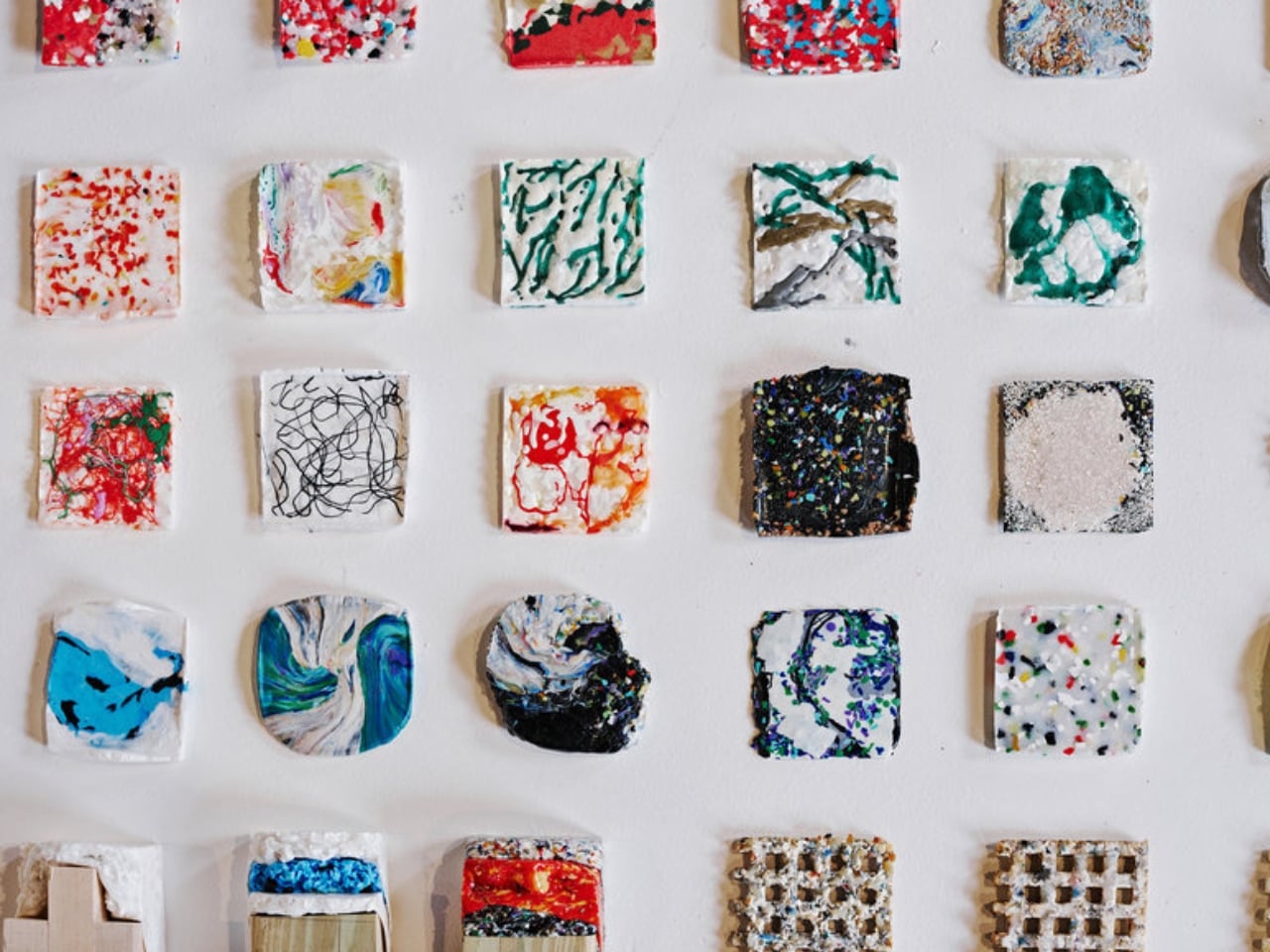
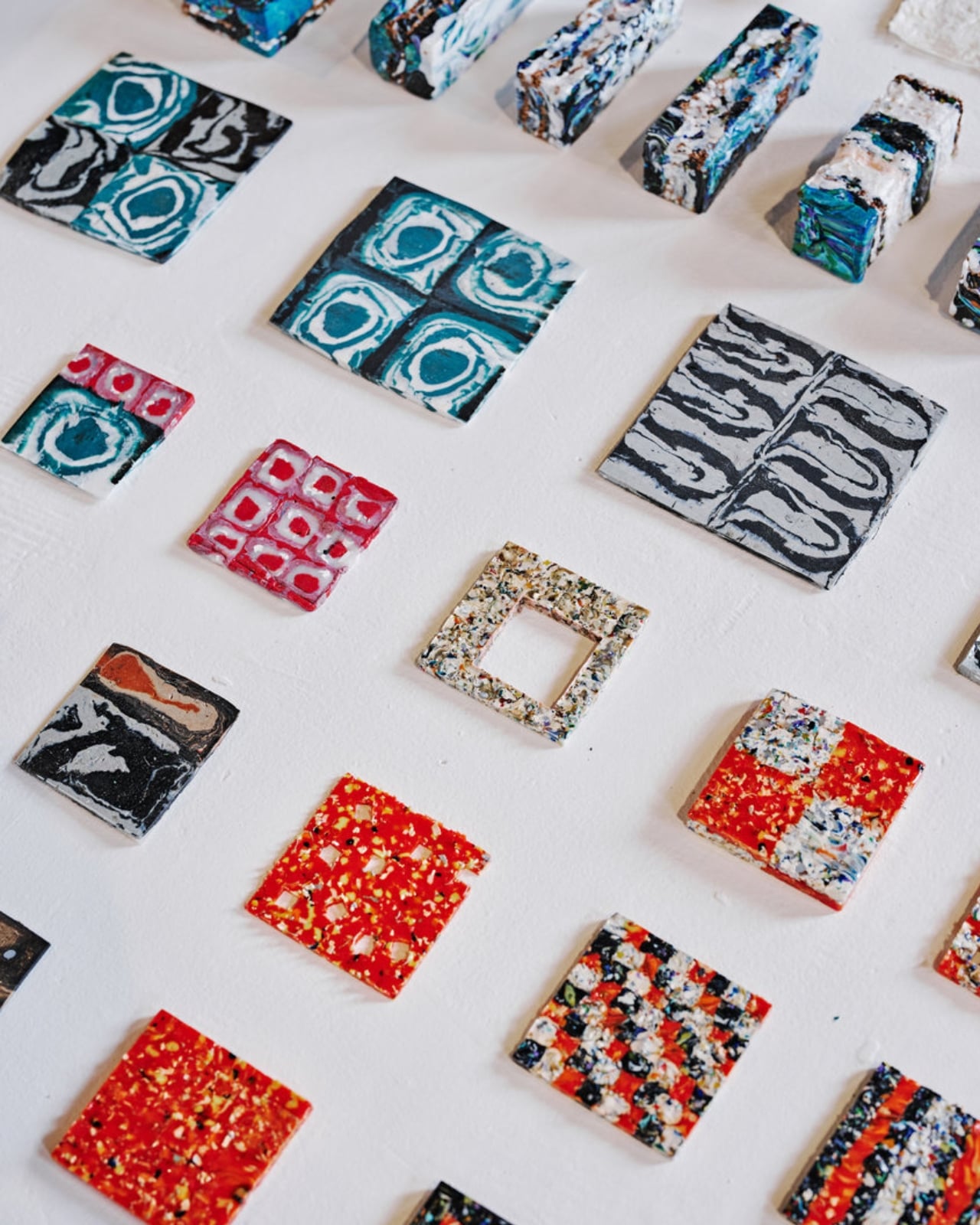
What I love most is that they didn’t try to hide the recycled nature of these pieces. Surface variations, including marbled color patterns and irregular textures, were retained as integral elements of the final designs, so each chair has this gorgeous, swirly aesthetic that screams “I used to be something else.” The imperfections became the personality.
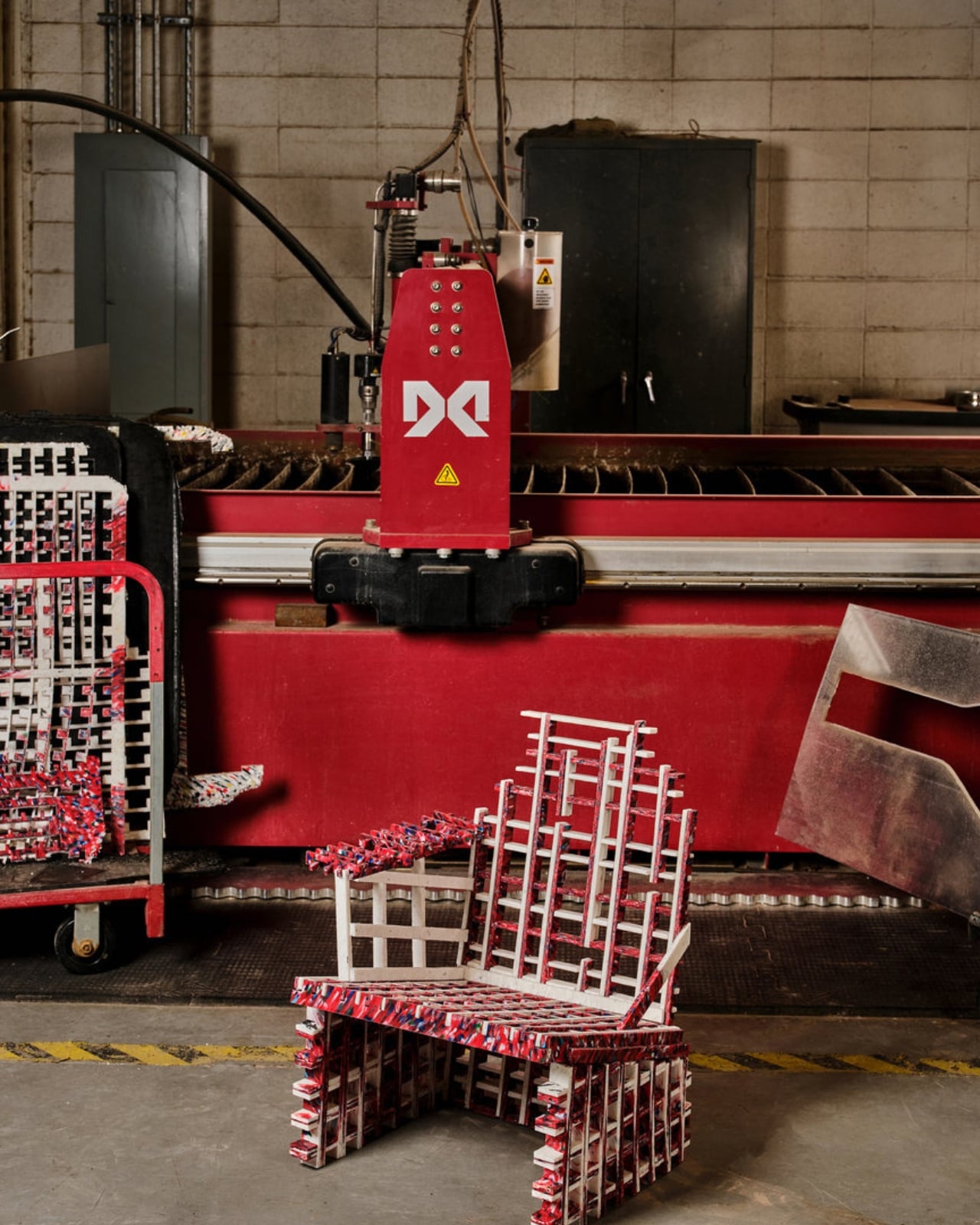
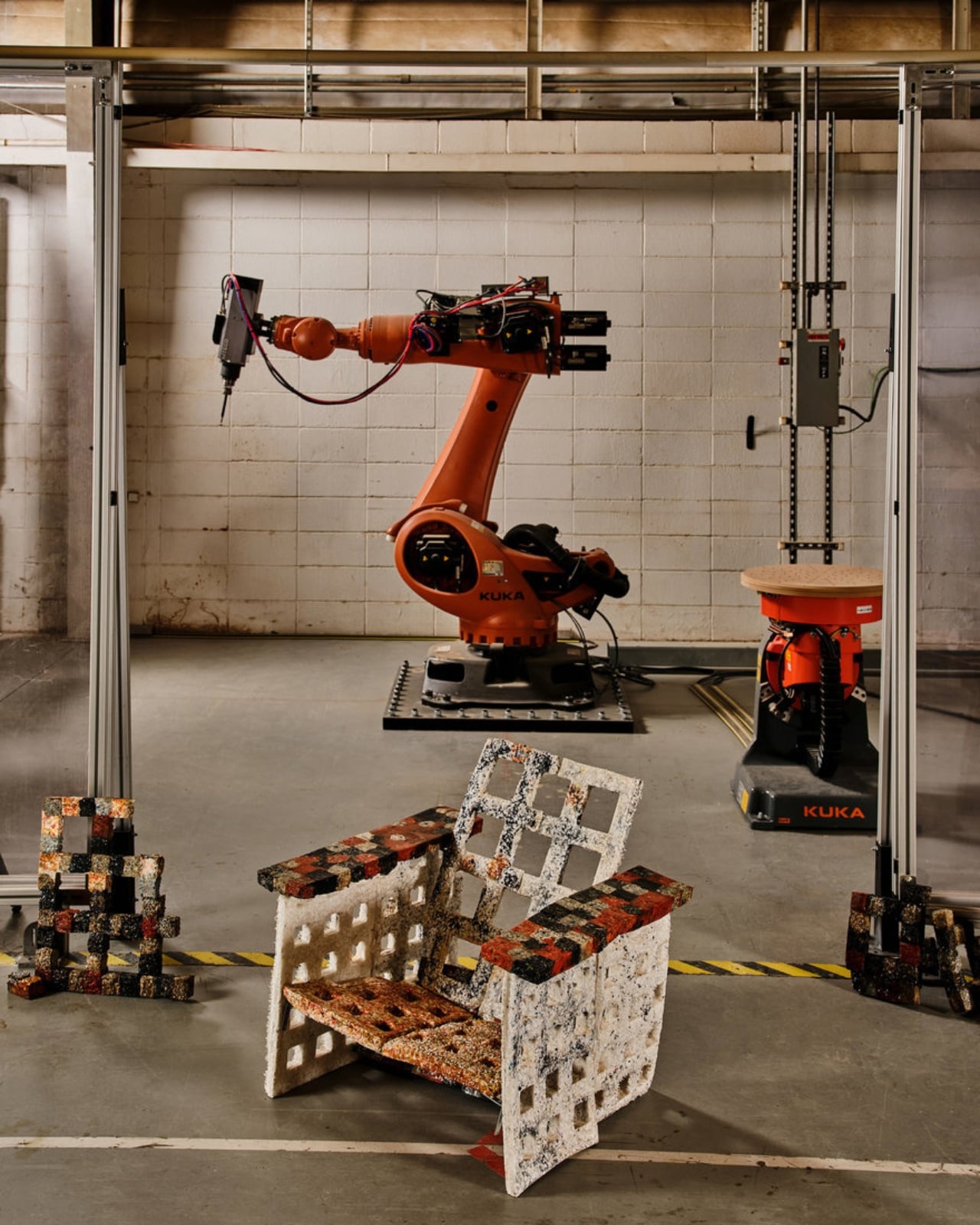
The project started modestly enough. It was first exhibited at Atlanta Contemporary from June to September 2025, where a series of Adirondack chairs and collective seating elements were presented as both design artifacts and material propositions. But then it went public in a bigger way. During SITE 2025 at the Goat Farm Arts Center, the chairs were installed across the 12-acre property during a one-night arts festival and encountered by over 4,000 visitors who could actually sit on them, touch them, use them in the wild.
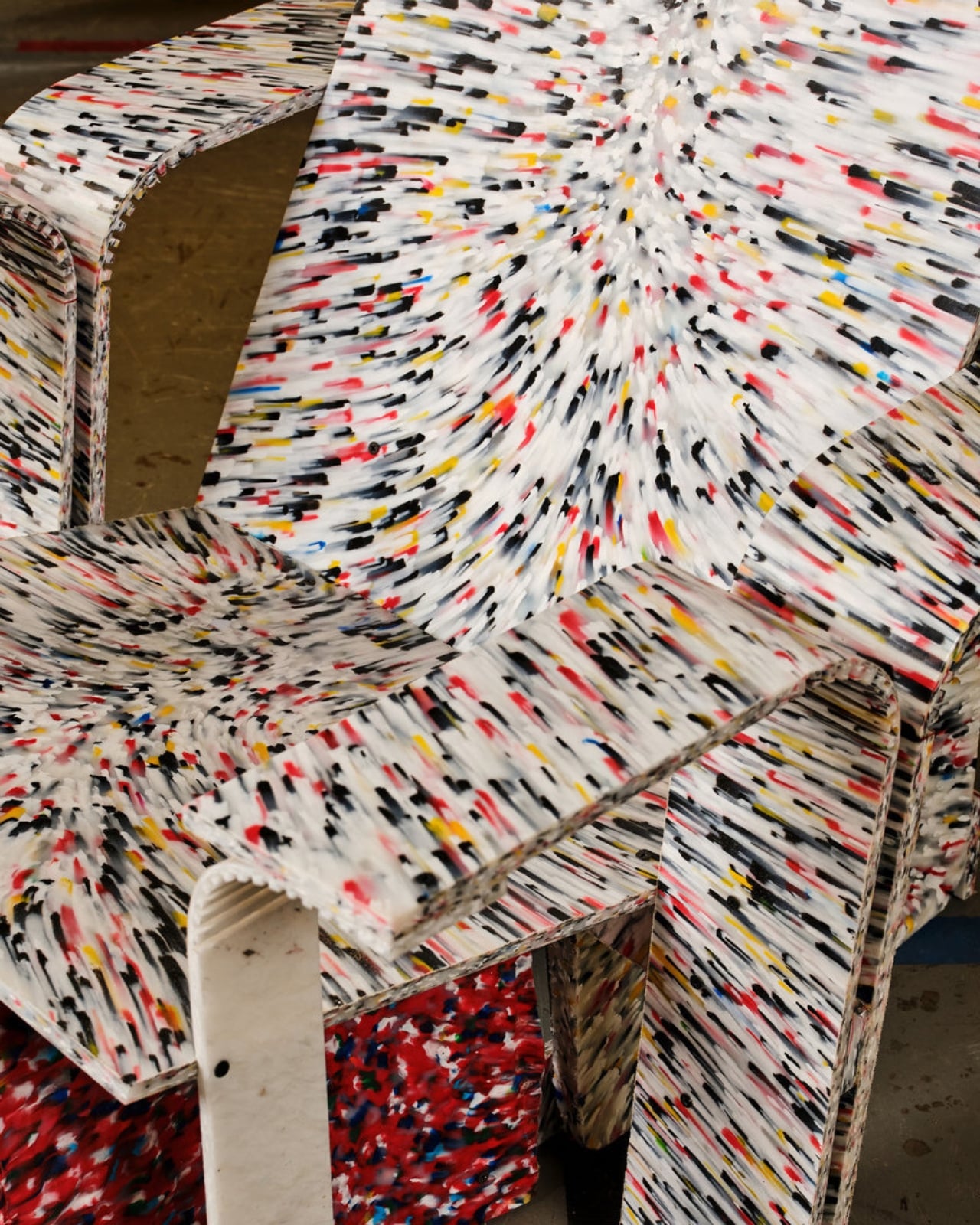
Now comes the really exciting part. Plastic Reimagined transitioned into a long-term civic setting as part of TRANSPORT | Transform | TRANSCEND, a year-long exhibition partnership between Georgia Tech Arts and Hartsfield-Jackson Atlanta International Airport, installed in Terminal T and on view through November 2026. That means millions of travelers from around the world will see these chairs, and maybe pause long enough to wonder about their own relationship with plastic waste.


As Kwon noted, “These post-consumer materials were coming from our campus, our students’ everyday life. By repurposing them, we created meaningful research outcomes.” There’s something deeply satisfying about that circularity. The students created the waste, then figured out how to give it a second life as functional furniture that other people can actually use.

The individual pieces have names and personalities. There’s Vincent, with its hand-shaped forms and marbled surfaces. There’s Modu-Chair, built from cubic modules that echo quilting patterns. And Framework, a translucent lattice structure that reimagines what an Adirondack chair can even be. Each one asks the same question in a different way: what if we stopped seeing plastic as garbage and started seeing it as potential?

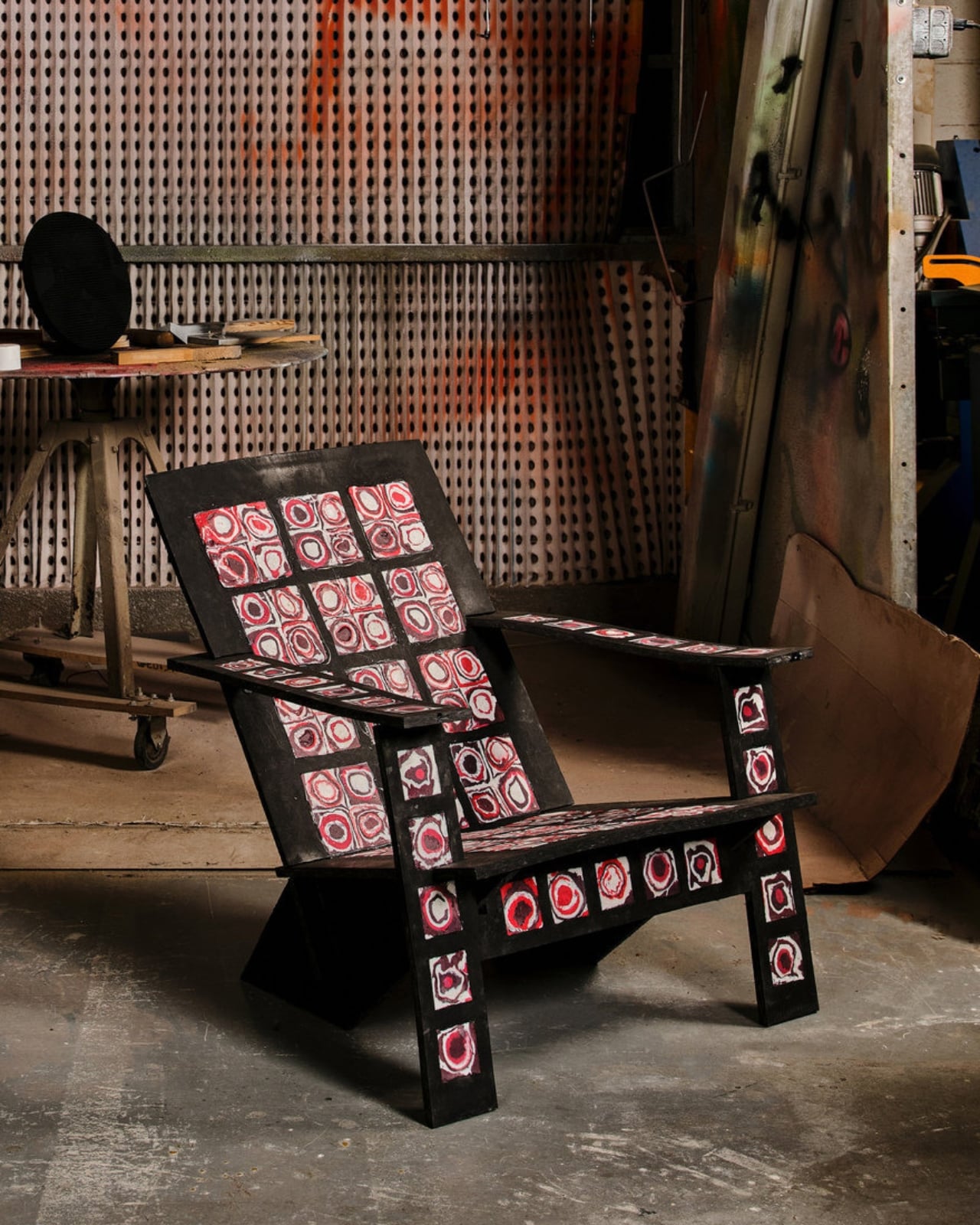
Across its transitions from gallery to festival to global transit hub, Plastic Reimagined argues for sustainability as infrastructural literacy rather than aesthetic signaling. This isn’t performative environmentalism. It’s practical, tangible, and sitting right there in the airport terminal where anyone can plop down and rest their feet.


This project proves something I’ve always believed: the best design solutions come from constraints, not abundance. When you have to work with what’s already there, you get creative in ways you never would with unlimited resources. These Georgia Tech students turned their campus waste stream into a civic contribution, and now their work is literally supporting weary travelers at one of the planet’s busiest crossroads.

The post Atlanta Airport Has Chairs Made From Campus Trash. They’re Gorgeous first appeared on Yanko Design.

New York Times reporter files lawsuit against AI companies

Investigative reporter John Carreyrou of the New York Times filed a lawsuit against xAI, Anthropic, Google, OpenAI, Meta and Perplexity on Monday for allegedly training their AI models on copyrighted books without permission. Carreyrou is perhaps best known for exposing the Theranos fraudulent blood test scandal.

According to Reuters, the lawsuit was filed alongside five other writers who all claim big tech companies have been violating their intellectual property rights in the name of building large language models.

This comes after a banner year for IP lawsuits against AI companies brought by rights holders. Just about every type of entity that deals in protected content has gone to court against AI companies this year, from movie studios like Disney and Warner Bros. to papers like the New York Times and the Chicago Tribune. Some of these cases have led to settlements in the form of partnerships, such as the licensing deal between Disney and OpenAI.

It's notable that this case is being brought by a small group of individuals instead of as a class action, something the authors involved say is no accident. "LLM companies should not be able to so easily extinguish thousands upon thousands of high-value claims at bargain-basement rates," the complaint reads. This is also the first case of its kind to list xAI as a defendant.

A spokesperson for Perplexity told Reuters that the company "doesn't index books." Anthropic, for its part, is no stranger to lawsuits from book publishers, having recently settled a class-action lawsuit brought by half a million authors for $1.5 billion. Apple was also sued earlier this year amid similar allegations. This latest complaint mentions the Anthropic settlement specifically, saying that class members in that case will only receive "a tiny fraction (just 2 percent) of the Copyright Act’s statutory ceiling of $150,000."

Engadget has reached out to xAI, Anthropic, Google, OpenAI, Meta and Perplexity for comment and will update with any response.

This article originally appeared on Engadget at https://www.engadget.com/ai/new-york-times-reporter-files-lawsuit-against-ai-companies-161624268.html?src=rss

iPhone Fold: Everything the Latest Design Leaks Tell Us So Far

iPhone Fold: Everything the Latest Design Leaks Tell Us So Far

Apple’s long-awaited entry into the foldable smartphone market is poised to reshape the industry. Leaked factory CAD files reveal a design that challenges the norms established by competitors like Samsung’s Galaxy Fold. Unlike the tall, narrow designs that dominate the market, Apple’s foldable iPhone emphasizes usability, comfort, and seamless integration with its ecosystem. This device […]

The post iPhone Fold: Everything the Latest Design Leaks Tell Us So Far appeared first on Geeky Gadgets.

Posted in Uncategorized

From Bloggy to Sharp: a Simple System to Refine Prompts for ChatGPT, Claude That Work

From Bloggy to Sharp: a Simple System to Refine Prompts for ChatGPT, Claude That Work

What if a single sentence could completely reshape the quality of an AI’s response? Below, Matt Maher breaks down the intriguing contrasts between ChatGPT vs Claude, two leading AI models with distinct approaches to prompt language. Claude often feels like a natural conversationalist, while ChatGPT excels with more structured input. But here’s the challenge: if […]

The post From Bloggy to Sharp: a Simple System to Refine Prompts for ChatGPT, Claude That Work appeared first on Geeky Gadgets.

Posted in Uncategorized

LEGO and Nike revive the Air Max 95 Neon for a spring release next year

LEGO and Nike make an impactful pairing. We have seen that in the past, and it’s a story that will repeat itself in the Spring of 2026, when the two stalwarts revive the Nike Air Max 95 in its OG colorway for the love of brick fans. Designed by Sergio Lozano, Air Max 95 is often regarded as the most popular Nike sneaker, and now, with its collaborative revisit after twenty years since release in 1995, the LEGO x Air Max 95 “Neon”⁠ is going to have some definite takers.

Nike and LEGO have been redefining the norm with their collaborations since the first fully co-branded Nike Dunk x LEGO Set. The idea behind their partnership has been to give kids a world where sports and creative play always win. In that accord, an inspiring celebration of the sneaker culture and creative imagination of LEGOs was the LEGO x Nike Air Max Dn that painted the internet yellow on its release in the summer this year.

Designer: Nike x LEGO

After dropping these beauties, the two now have their eyes set on the release of the LEGO x Air Max 95 next spring. The sneaker in its neon colorway has a drawn-on upper and an evident love affair with LEGO bricks. The reimagined “Neon” colorway of the Air Max 95 is confirmed in Grad School and Pre School sizes, and is remarkably apparent in its inspiration even though it doesn’t feature the typical suede side panels.

The new LEGO Air Max 95 has a T-toe, which appears stretched on both sides and climbs up to the laces in shiny leather. The illustrated gradient panels – reaching up to the mesh upper – in a smooth progress from deep black to smoky gray and up to metallic silver, have a sense of charm in themselves. But what stands out is the vibrant neon accents that illuminate the lace eyelets, the Swoosh branding, and also finds a hint in the pressurized Air units within the midsole.

The volt green is not limited to the abovementioned accents, you can also find it in the underfoot, where it livens up the Air Max bubbles. The iconic square LEGO logo with the brand name outlined in white font is featured on the tongue and insoles. But what subtly makes its presence felt are the LEGO mini figs on the heel tab – one with a trophy in the hand and the other heading a football. If you like what you see, you can get the LEGO x Nike Air Max 95 Neon starting March 28, 2026. It will be released through Nike and select retailers, both online and in-store, in grade school and pre-school sizing, starting $162 and $132, respectively.

The post LEGO and Nike revive the Air Max 95 Neon for a spring release next year first appeared on Yanko Design.

Samsung Galaxy Z Fold 8 Leak: Massive 50MP Ultrawide Camera Finally Confirmed

Samsung Galaxy Z Fold 8 Leak: Massive 50MP Ultrawide Camera Finally Confirmed

The Samsung Galaxy Z Fold 8 is shaping up to be a significant step forward in the evolution of foldable smartphones. Leaks suggest that this upcoming device will feature substantial advancements in areas such as camera technology, battery performance, and overall design. These enhancements aim to bridge the gap between foldable devices and traditional flagship […]

The post Samsung Galaxy Z Fold 8 Leak: Massive 50MP Ultrawide Camera Finally Confirmed appeared first on Geeky Gadgets.

Posted in Uncategorized

Apple’s iOS 26.3 will introduce proximity pairing to third-party devices in the EU

Apple is making it a little easier to use third-party devices with iPhones in order to comply with Europe's Digital Market Act (DMA), MacRumors reported. For iOS 26.3, Apple's devices will support third-party proximity pairing and notifications in Europe only, according to the latest beta notes. That will make it a bit easier to connect devices like Sony headphones or receive notifications from an iPhone on Wear OS smartwatches — provided manufacturers support the new feature. 

"The DMA creates new opportunities for developers to bring to market innovative products and services in Europe," an EU spokesperson told The Wall Street Journal. "This is another step towards a more inter-connected digital ecosystem to the benefit of all EU citizens." The EU Commission added that the functionality will be "fully available" in the bloc in 2026.

The new capabilities are as follows:

  • Proximity pairing - Devices like earbuds will be able to pair with an iOS device in an AirPods-like way by bringing the accessory close to an iPhone or iPad to initiate a simple, one-tap pairing process. Pairing third-party devices will no longer require multiple steps.

  • Notifications - Third-party accessories like smart watches will be able to receive notifications from the ‌iPhone‌. Users will be able to view and react to incoming notifications, which is functionality normally limited to the Apple Watch. Notifications can only be forwarded to one connected device at a time, and turning on notifications for a third-party device disables notifications to an Apple Watch.

Proximity pairing is a relatively minor quality-of-life upgrade, allowing you to connect with a tap via NFC rather than diving into the Bluetooth settings. However, there's no indication that it will allow seamless switching between devices as you can do with Apple's iPods, for instance. Notifications, however, will finally make third-party watches feasible with iOS devices. 

Apple's DMA compliance efforts are interesting to watch, as it appears to be doing the bare minimum required, often for what it calls privacy reasons. In some cases, the company is removing features in Europe that are available elsewhere, like iPhone mirroring on Mac — meaning it doesn't have to implement the same feature on Android devices or PCs. 

This article originally appeared on Engadget at https://www.engadget.com/mobile/apples-ios-263-will-introduce-proximity-pairing-to-third-party-devices-in-the-eu-133037696.html?src=rss