Steam Deck OLED Shortages Persist as Valve Waits for Memory Prices to Settle

Steam Deck OLED Shortages Persist as Valve Waits for Memory Prices to Settle Neo1 running on Steam Deck with a performance overlay near 30 FPS and recommended graphics settings shown.

The Steam Deck OLED has sparked significant interest among gamers, offering an upgraded display and enhanced gaming performance. However, as outlined by Deck Ready below, the device’s availability has been impacted by supply chain issues, particularly with memory and storage components, leading to production delays. Despite these challenges, Valve has chosen to maintain the Steam […]

The post Steam Deck OLED Shortages Persist as Valve Waits for Memory Prices to Settle appeared first on Geeky Gadgets.

Posted in Uncategorized

Leaked: Samsung’s Z Fold 8 Finally Fixes the Foldable’s Biggest Flaw

Leaked: Samsung’s Z Fold 8 Finally Fixes the Foldable’s Biggest Flaw Samsung Galaxy Z Fold 8 showcasing its wider design and creaseless display

Samsung is poised to redefine the foldable smartphone market with the anticipated release of two new devices this year: the flagship Galaxy Z Fold 8 and a more affordable foldable model. These devices aim to push the boundaries of mobile technology by introducing innovative features, refined designs, and a focus on larger form factors. Powered […]

The post Leaked: Samsung’s Z Fold 8 Finally Fixes the Foldable’s Biggest Flaw appeared first on Geeky Gadgets.

Posted in Uncategorized

Meta Patent Proposes AI-run Accounts Based on History, Including Posts, Audio & Video

Meta Patent Proposes AI-run Accounts Based on History, Including Posts, Audio & Video Phone screen shows a social feed with AI-generated posts labeled as a simulated user activity example.

Meta’s latest artificial intelligence system introduces a controversial capability: simulating user activity on social media, even after death. By analyzing historical data such as posts, comments, and multimedia contributions, the AI creates a digital replica that mimics a user’s communication style and behavior. According to AI Grid, this system is designed to maintain engagement on […]

The post Meta Patent Proposes AI-run Accounts Based on History, Including Posts, Audio & Video appeared first on Geeky Gadgets.

Posted in Uncategorized

Why Apple’s OLED MacBook Pro Will Crush the Competition in 2026

Why Apple’s OLED MacBook Pro Will Crush the Competition in 2026 Apple’s OLED MacBook Pro 2026 redesign featuring thinner, lighter design

Apple is preparing to redefine its MacBook Pro lineup with the introduction of OLED displays and a host of design and performance enhancements, set to launch in late 2026. This significant update will not only make the laptops thinner and lighter but may also introduce touchscreen capabilities—a first for the MacBook Pro series. While incremental […]

The post Why Apple’s OLED MacBook Pro Will Crush the Competition in 2026 appeared first on Geeky Gadgets.

Posted in Uncategorized

This Tactical Outdoor Pocket Watch Can Start a Fire – And That’s Just the Beginning

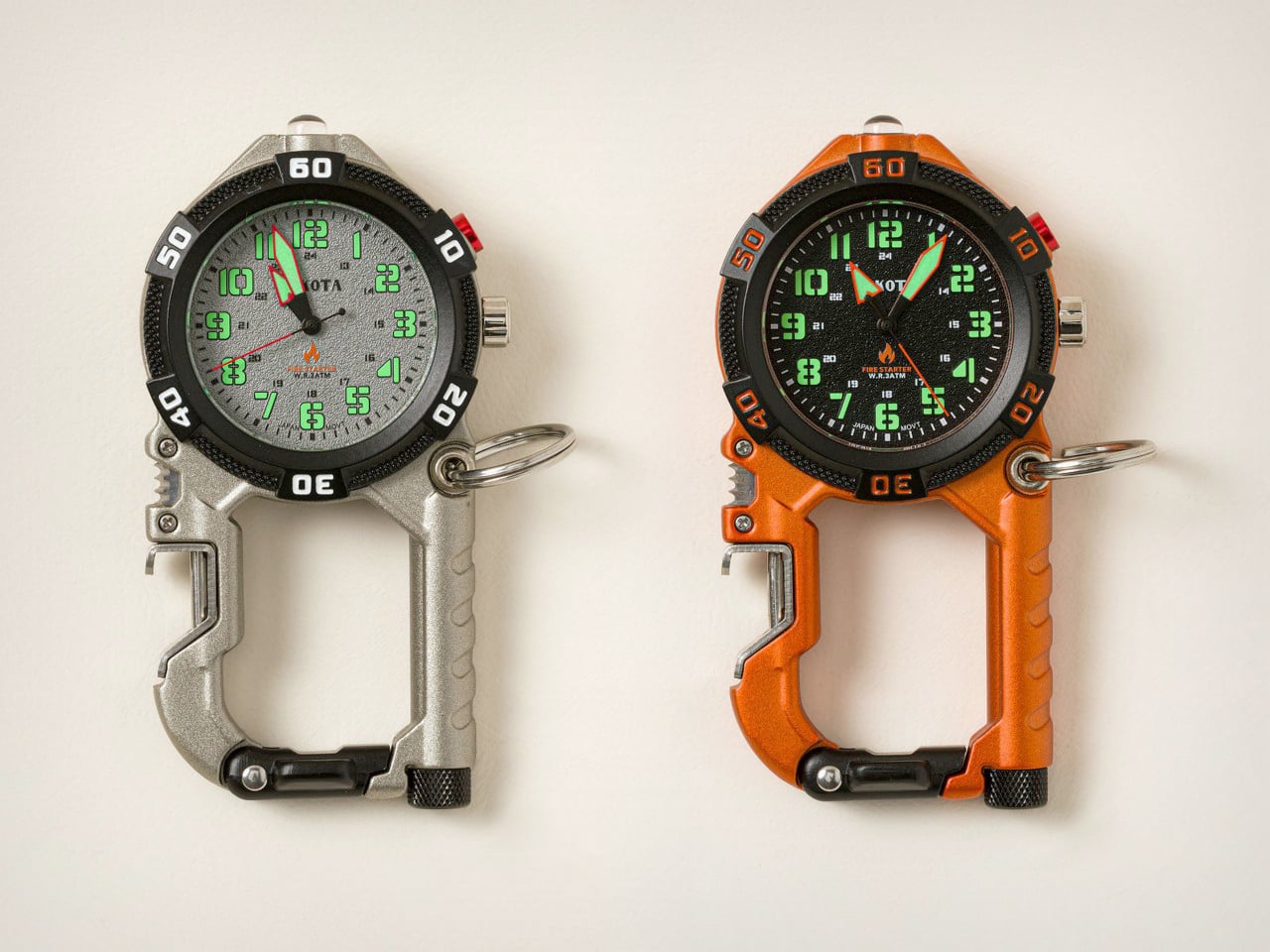
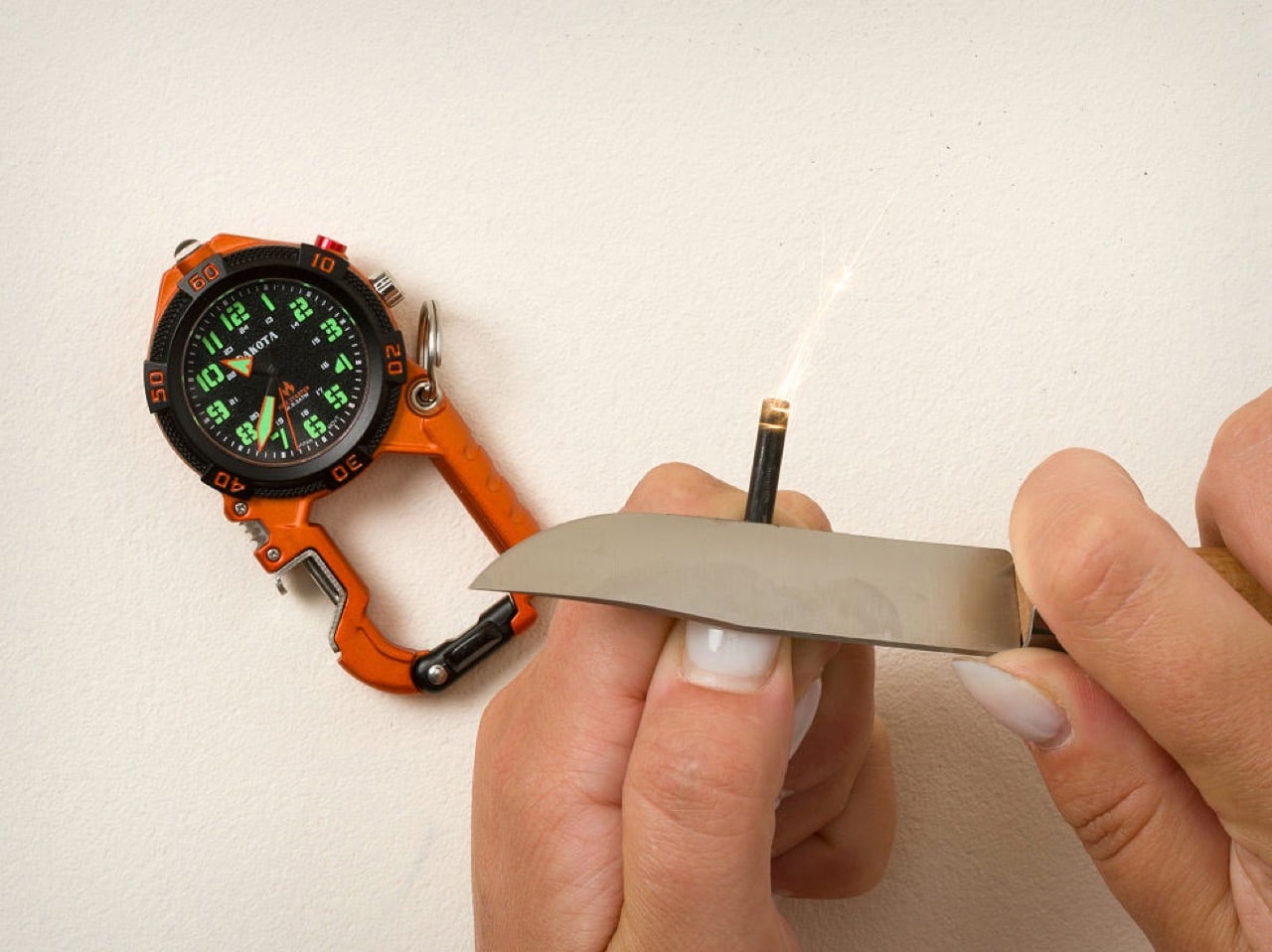
Funnily enough, this isn’t a fairly new product. Dakota Watch Company’s sort of pioneered this category of outdoor-ready carabiner pocket-watches… with the Flint being just one of multiple in the set. However, each individual watch has its own unique selling point – and for the Flint (as its name rightfully suggests), it’s the waterproof flint-rod that’s integrated into the watch’s body. Unscrew it when you want to start a fire, scrape on the rod using a pocket knife, and sparks immediately shoot off, igniting any form of tinder, creating a tiny fire that can then be harnessed to light a campfire, an old-fashioned torch, or an emergency signal in a time of distress.

Before we talk about the watch itself, Dakota Watch Company used this particular elevated-carabiner format to pack even more tools, making the pocket watch something that goes beyond just keeping you punctual. A built-in bottle opener lets you crack open a brew when you’re in the great outdoors, and it could be used to pry open lids too (not to be mistaken with a can opener). A slight serrated corner above the bottle opener doesn’t outline a specific purpose, but it looks sharp enough to cut through rope with a little vigorous action. You could use it to scrape against the flint-rod too, lighting that campfire to go perfectly with the chilled beer you just cracked to get the evening started.

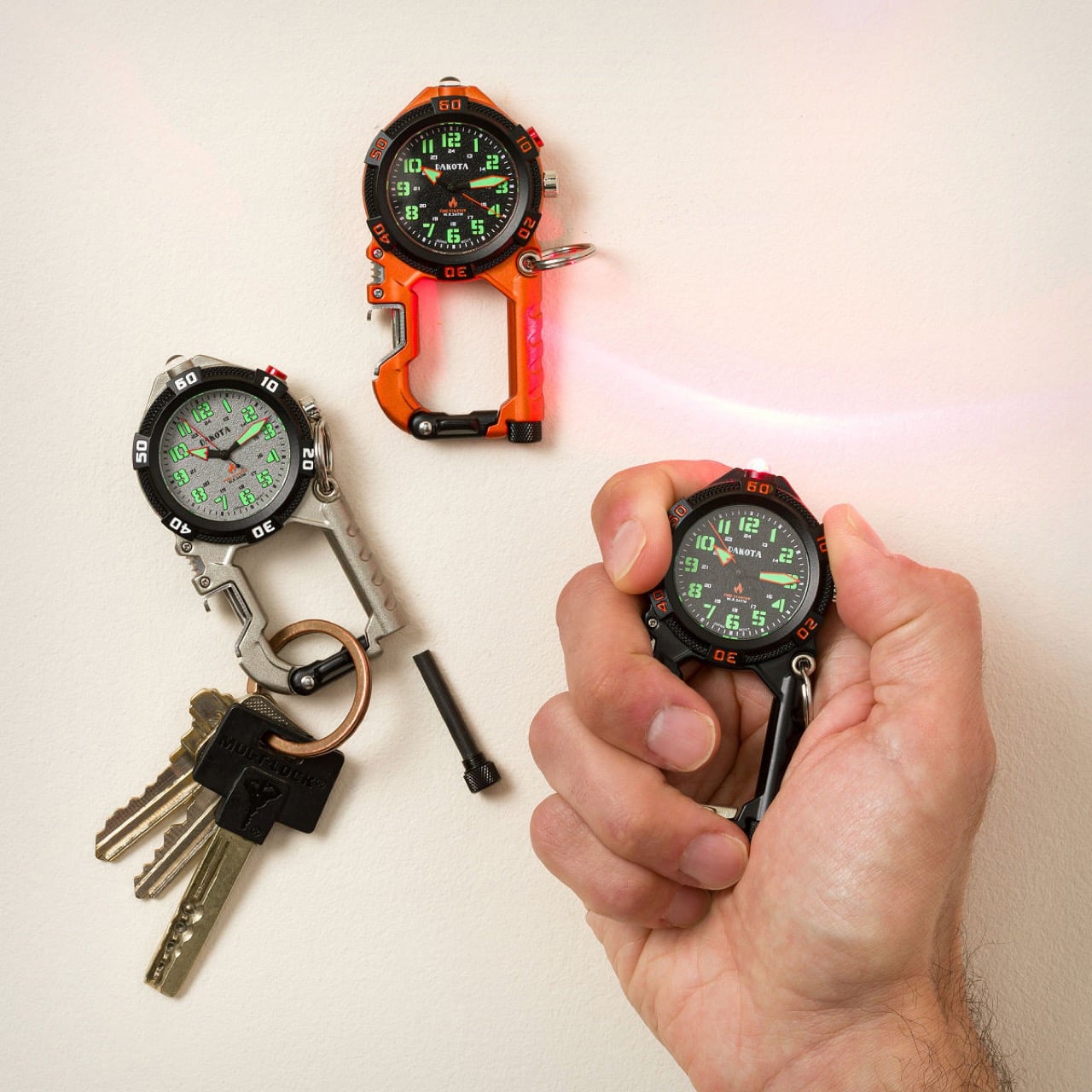
Build almost exclusively for the outdoors, the Flint Clip Carabiner Watch also packs a discreet red LED microlight, used for illuminating the way in stealth scenarios where bright lights could give away your position. The red light (activated using a button at the 2 o’clock position) provides the right amount of visibility without necessarily blowing your cover or obscuring your low-light vision in the dark. This means you can see with the light, but continue to do so even after the light’s shut (unlike most flashlights that leave you blinded in the pitch dark once the light’s turned off).

The watch itself is as outdoor-ready as it gets. The body is crafted from stainless steel (carabiner included), with a mineral glass cover on the top. Numbers on the dial are thick and easy to read without straining your eyes, and luminous coatings on both the numbers as well as the hands means reading the time flawlessly in the dark. The watches are built to be water-resistant up to 100 feet, which means you could go boating or wading through a stream with the Flint attached to you and you’d have nothing to worry about.

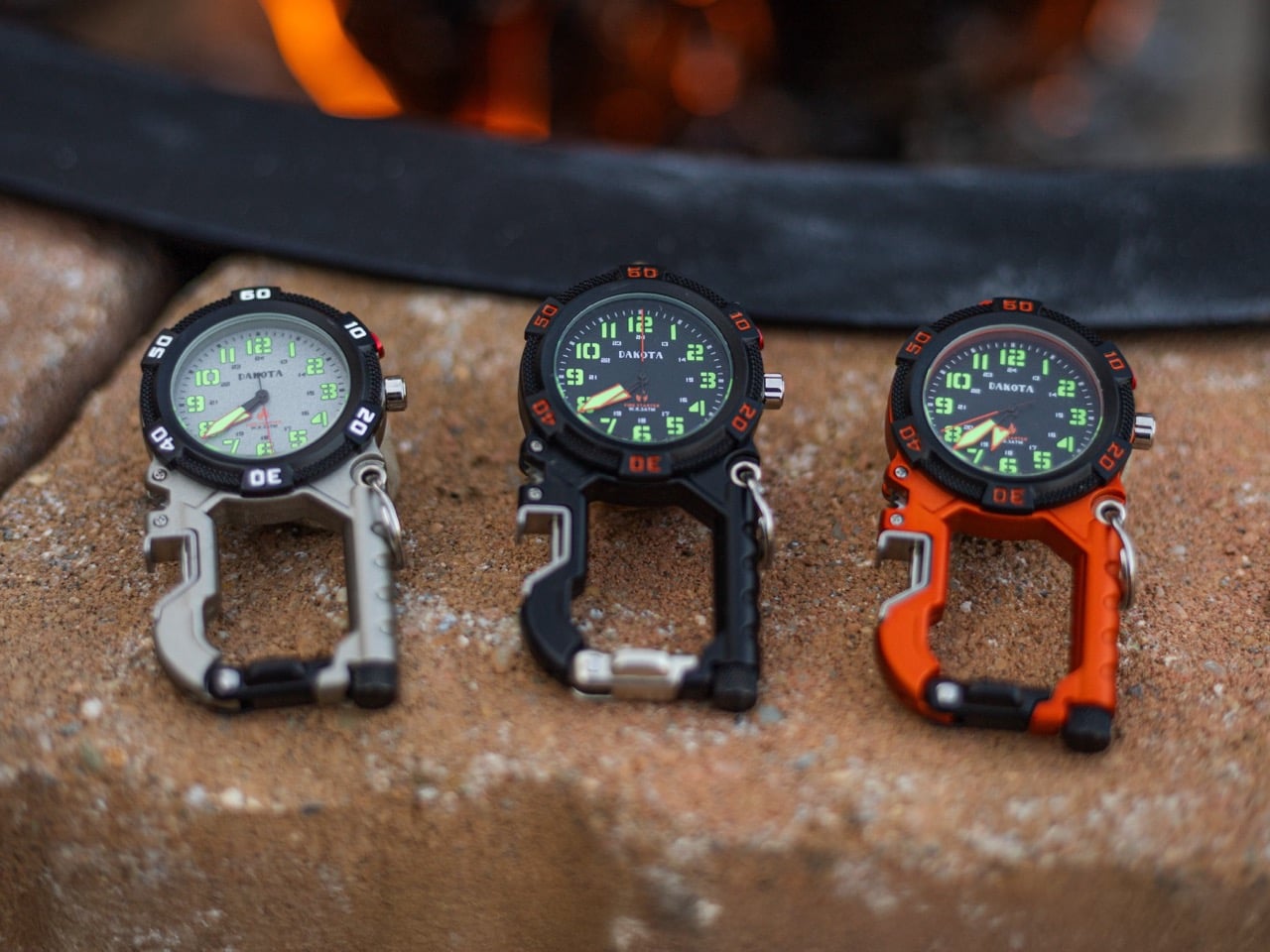
The Flint Clip Carabiner comes in 3 distinct colors – a silver, with a light-colored watch-face to match, a black, with a dark watch-face, and perhaps my favorite, an eye-catching orange that also sports the same dark-colored watch face. All three watches have a Japanese Quartz movement on the inside, which isn’t anything to write home about if you’re a watch aficionado, but the movement, like every other part of the watch, screams reliability, so you know you’ve got an EDC you can trust, whether it’s to tell you the time, or be your ultimate outdoor adventure sidekick.

Click Here to Buy Now

The post This Tactical Outdoor Pocket Watch Can Start a Fire – And That’s Just the Beginning first appeared on Yanko Design.

Cessna 172 (The Most Manufactured Plane in History) Just Got Immortalized in 2,000 LEGO Bricks

The Cessna 172 has logged more flight hours than any other powered aircraft in history. Since its debut in 1956, it has carried student pilots over Kansas wheat fields, bush flyers above the Canadian tundra, and island-hoppers between Greek archipelagos. It is the plane that taught the world to fly.

Now, LEGO Ideas builder Mike_the_Brickanic has translated that enduring icon into approximately 2,000 bricks, capturing the 172’s distinctive high-wing silhouette, its trademark strut-braced wings, and a cockpit detailed down to the dual yokes and instrument panel. The result is a faithful tribute to one of aviation’s most beloved machines, rendered in a striking dark blue and curry yellow livery that feels every bit as purposeful as the real thing.

Designer: Mike_the_Brickanic

The real Cessna 172 Skyhawk sits at about 8.28 meters long with a wingspan of 11 meters, cruises at 226 km/h, and has a service ceiling of 4,300 meters. It weighs just 767 kg empty. That power-to-weight ratio combined with forgiving low-speed handling is why flight schools worldwide still default to it after nearly 70 years. Over 44,000 units have been produced. When Mike_the_Brickanic chose this as his subject, he picked something with real cultural weight, not just a recognizable shape, but a machine with a documented, measurable legacy in aviation history.

Building aircraft in LEGO is genuinely hard. Appliances have flat surfaces, buildings have right angles, but planes demand curves that flow into each other without telegraphing the underlying geometry. The 172’s fuselage is particularly tricky because it tapers toward the tail while simultaneously curving downward, and the wing root blends into the cabin in a way that feels almost organic. Mike solved this with a combination of curved slopes, ball joints at the wing sides, and clip connections at the cabin top, which is clever because it distributes structural load while preserving that smooth visual transition from windscreen to wing.

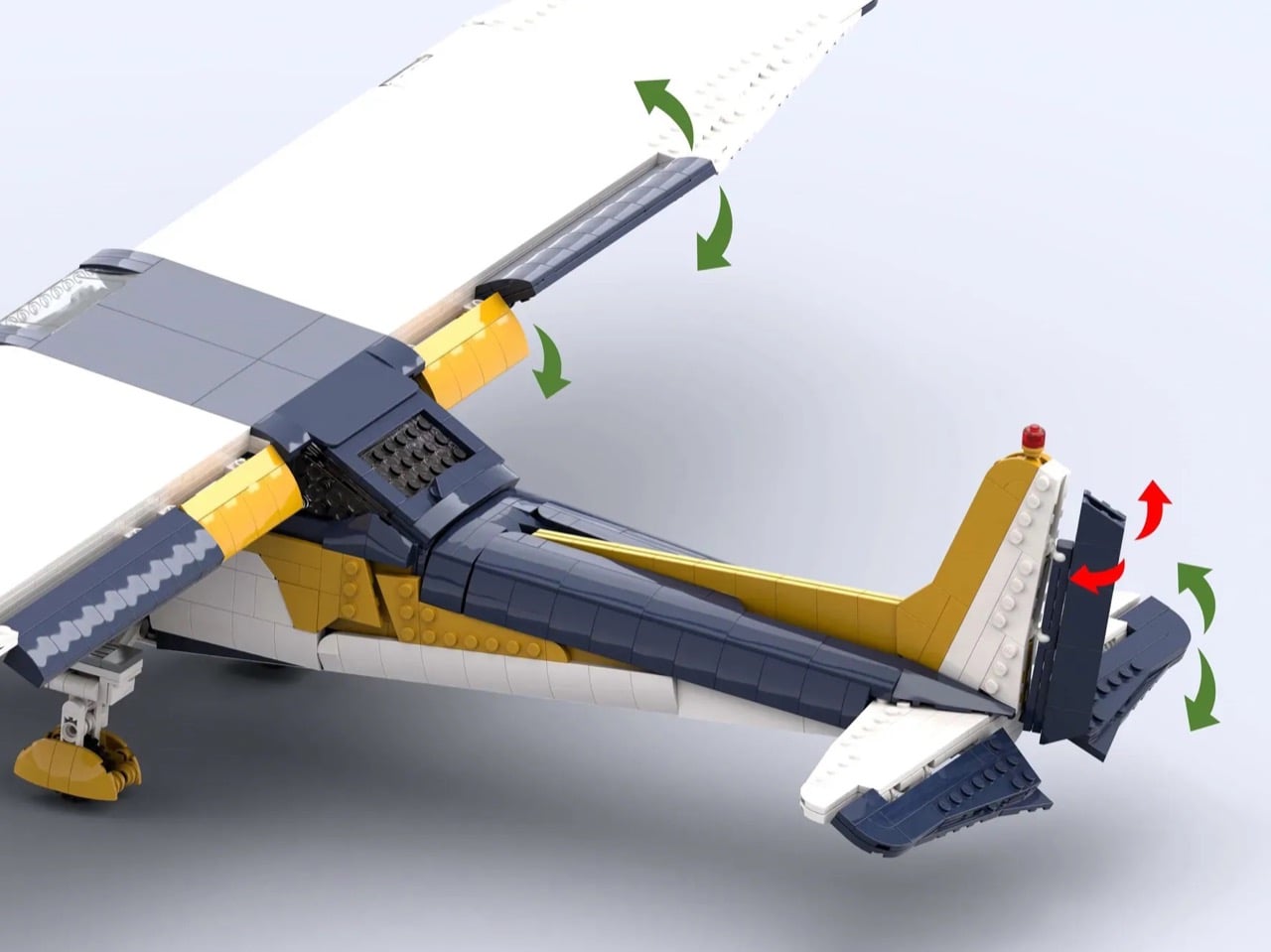
The ailerons, elevator, and rudder all move. The flaps extend to 40 degrees, which is accurate to the real 172’s full-flap configuration used during short-field landings. The propeller spins, the wheels roll and steer, and the nose gear is mounted on Technic axles for structural integrity. Those aren’t decoration, they’re engineering decisions that required real thought about how LEGO geometry intersects with aeronautical geometry. The “Remove Before Flight” tags on the pitot cover and control locks are a nerdy touch that actual pilots will absolutely clock.

Open the door and the interior holds up. Two adjustable front seats rendered in medium brown, a rear bench, tinted rear windows, and a cockpit panel dense enough with sticker detail that you can actually identify individual instruments. The dual yokes are there. The throttle quadrant is there. This is the kind of interior work that separates builders who understand their subject from builders who are approximating it. The 172’s cockpit is famously approachable and uncluttered, and the model reflects that without oversimplifying.
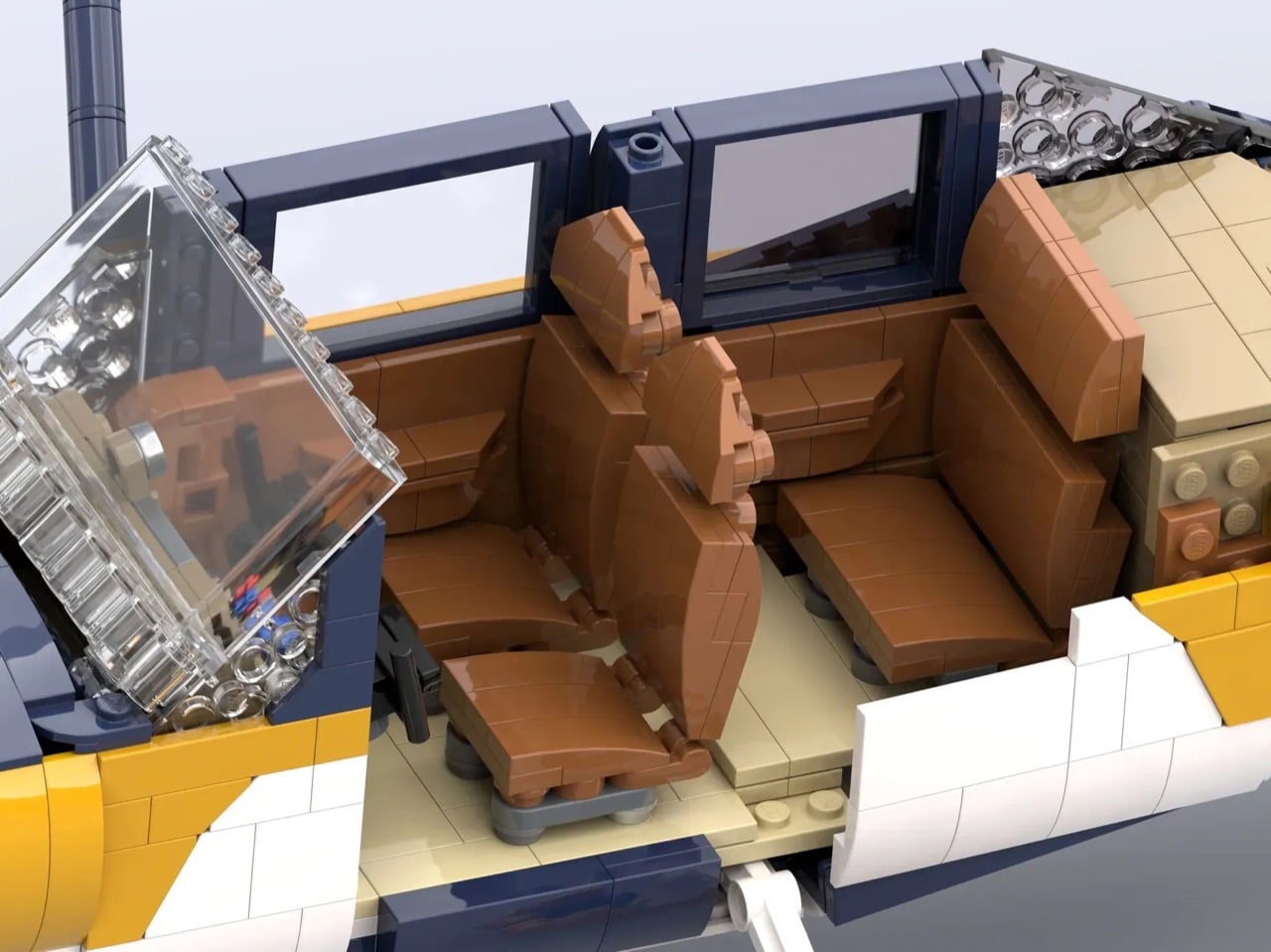

The color choice is just *chef’s kiss*. Dark blue over dark yellow (curry) with white accents is not a scheme you see constantly in LEGO aviation MOCs, which tend toward red-white or military grey. It gives the model a particular visual weight, something that reads as contemporary but grounded. The way the curry stripe flows along the fuselage and up into the tail mirrors how real-world livery designers think about visual continuity across an airframe. Whether intentional or instinctive, it works.


LEGO Ideas is the official platform where fan-designed sets get a shot at becoming real retail products. Submissions need 10,000 supporters to trigger an official LEGO review, after which the company decides whether to produce it commercially. Mike’s Cessna 172 is currently sitting at just over 1,000 supporters with 598 days left on the clock, which means there is runway to work with. If you have any appreciation for aviation, precision building, or just want to see more interesting things on toy store shelves, head to the LEGO Ideas page and give it a vote.

The post Cessna 172 (The Most Manufactured Plane in History) Just Got Immortalized in 2,000 LEGO Bricks first appeared on Yanko Design.

French Artisans Built a 21-Foot Tiny House That Needs No Grid

I love a home that is designed to do everything you need and nothing you don’t. The Chillhouse, or La Chillhouse as it’s known in its native tongue, is exactly that kind of home. Built for two, designed for off-grid living, and rooted in a distinctly French woodworking tradition, it’s the latest statement from Brittany-based artisan workshop Atelier Bois d’ici. Small in footprint, deliberate in execution, and almost stubbornly unhurried in its approach, the Chillhouse offers a compelling vision of what modern self-sufficient living can actually look like.

Atelier Bois d’ici, roughly translated as “the local wood workshop, has never been a typical construction company. Wood sits at the absolute center of everything they do, not merely as a raw material but as a guiding principle. The studio operates its own sawmill and timber storage facility on the same grounds as the workshop, meaning each build begins not with pre-cut lumber but with raw logs. This hands-on relationship with the material shapes every decision, from species selection to finish, and gives their homes a depth of character that factory-built alternatives simply cannot replicate.

Designer: Atelier Bois d’ici

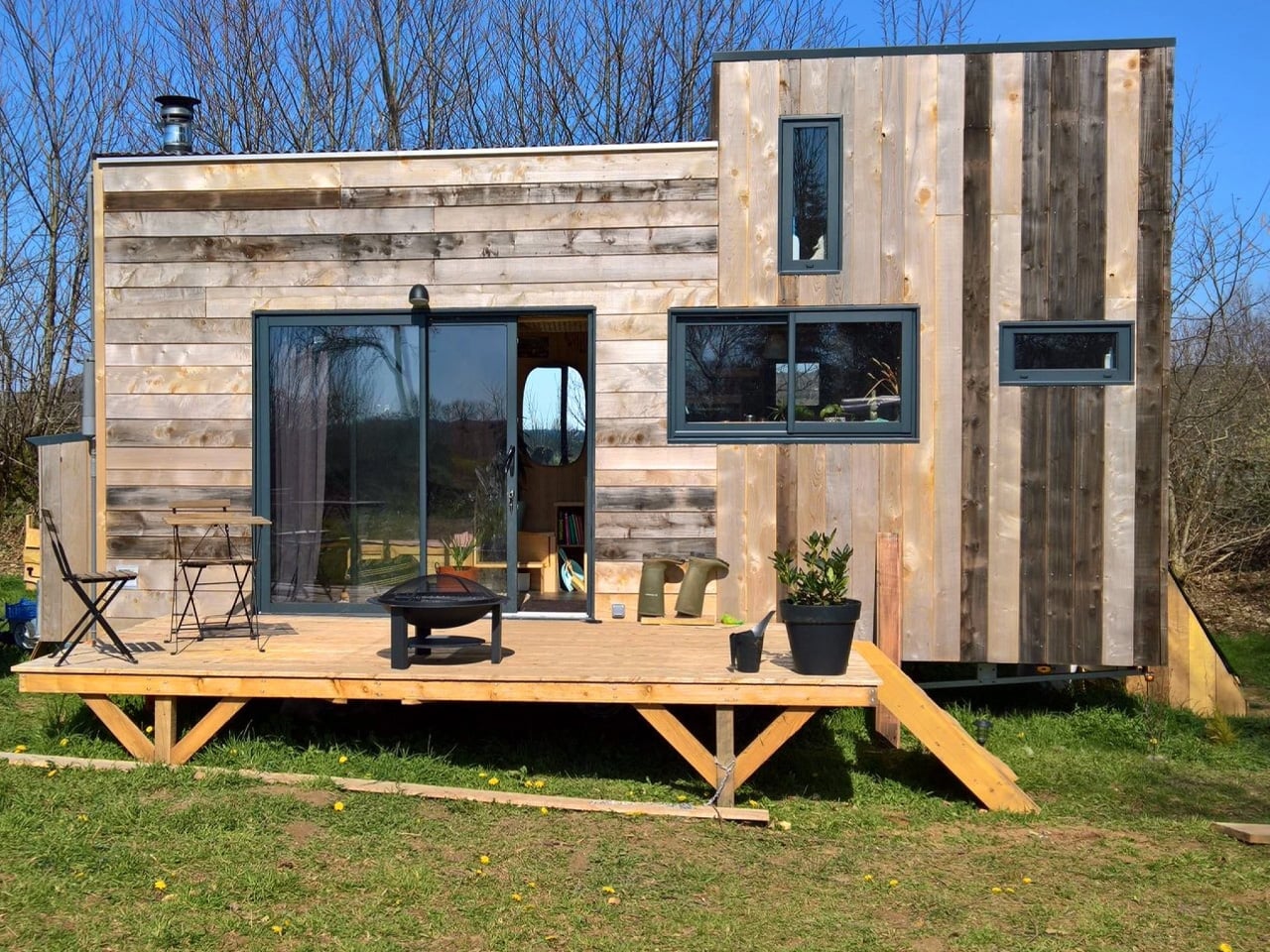
Sitting on a double-axle trailer and measuring 6.6 meters in length, the Chillhouse is compact by design rather than by compromise. The exterior is wrapped in natural timber cladding, warm and textured in a way that reads differently depending on the landscape around it — equally at home against pine trees or open countryside. The profile is clean without being cold, and the construction feels solid in a way that telegraphs craftsmanship before you’ve even stepped inside. It’s built for couples or solo dwellers ready to trade square footage for genuine freedom.

As you enter the home, the living room makes its intentions clear immediately. A low-profile sofa, discreet storage tucked into every available corner, and a wood-burning stove anchor the space with a sense of warmth that’s both literal and atmospheric. Nothing is decorative for the sake of it. Every element earns its place, and the result is a room that feels genuinely comfortable rather than curated for a photoshoot.

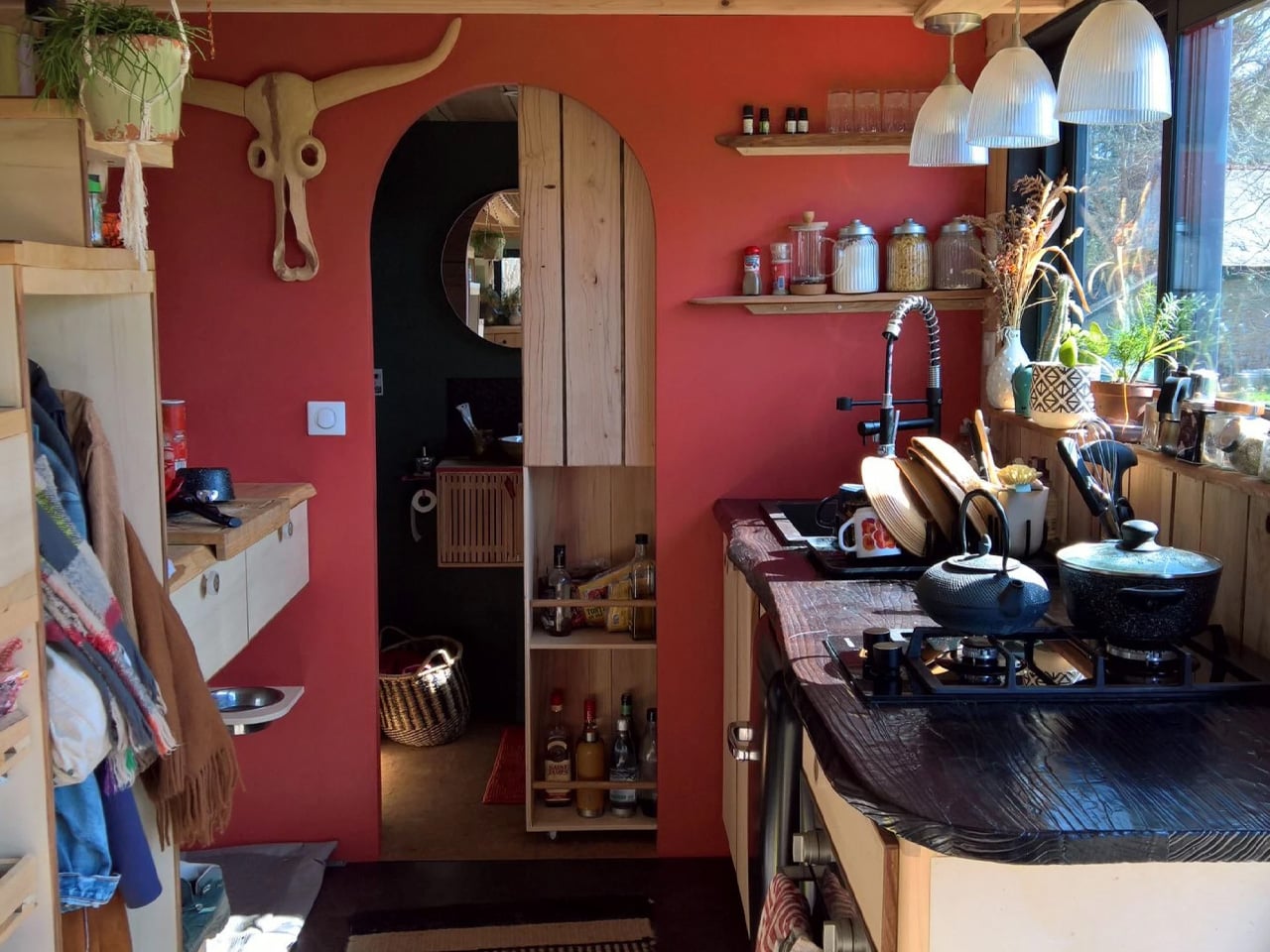
The kitchen runs on the same ethos of considered practicality. A two-burner propane stove, a compact oven, a sink, and a small refrigerator cover every real cooking need without overpromising on space. It’s a kitchen built for people who actually cook, not one designed to impress during an open house. Adjacent to it, the bathroom offers the essentials in a layout that wastes nothing.

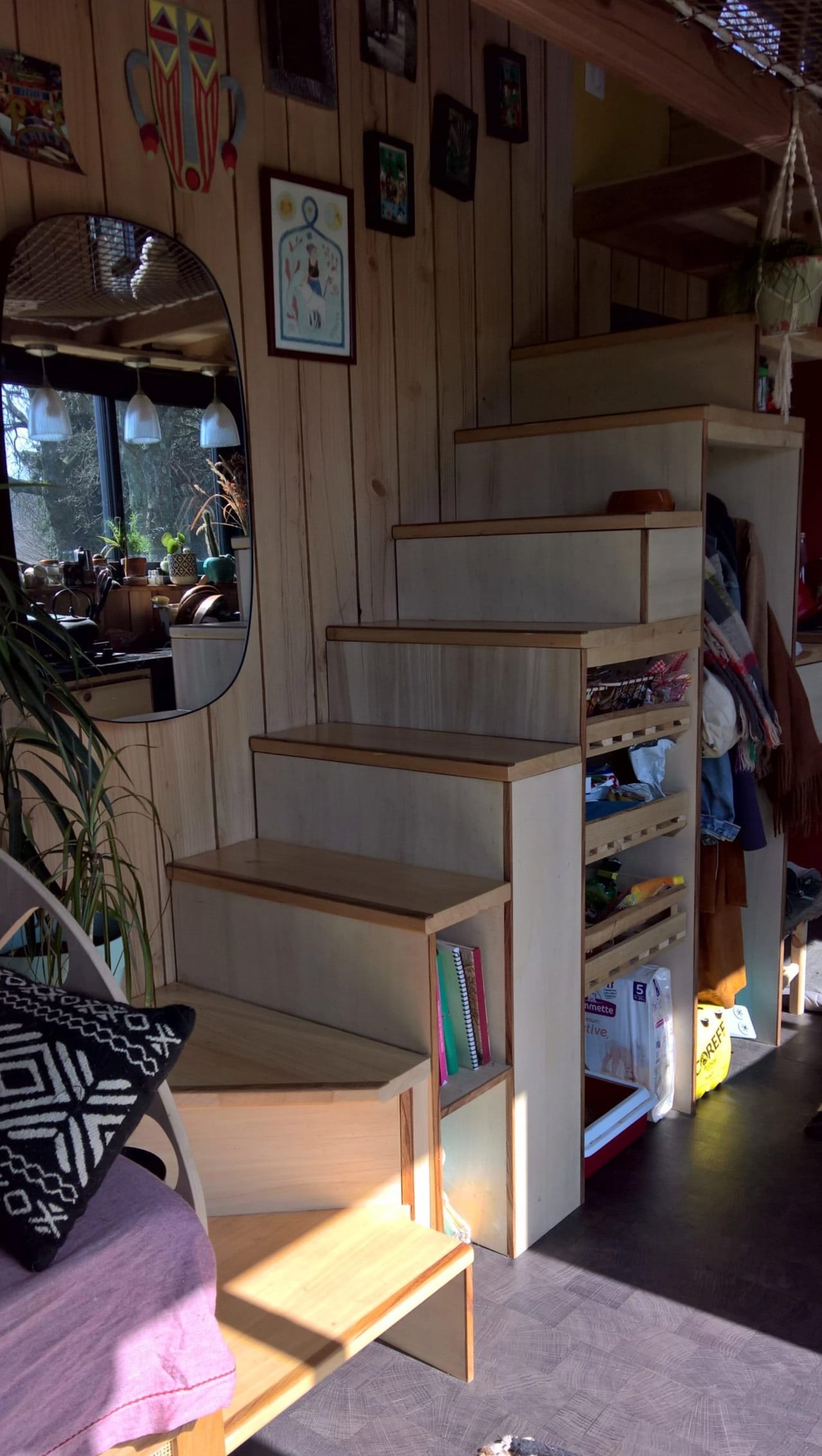
Above it all, the bedroom loft is reached by a staircase with storage built directly into each step — one of many small design decisions that quietly distinguish the Chillhouse from less considered builds. The sleeping space itself sits low under the roofline, intimate and removed from the rest of the home in the best possible way. Atelier Bois d’ici sources all timber from within a close radius of the workshop, avoiding chemical treatments entirely and letting the natural resilience of carefully chosen wood species do the work. The Chillhouse doesn’t shout about sustainability, it just lives it.

The post French Artisans Built a 21-Foot Tiny House That Needs No Grid first appeared on Yanko Design.

A Wind-Powered Sculpture Is Lighting Up Tanzania’s Plains

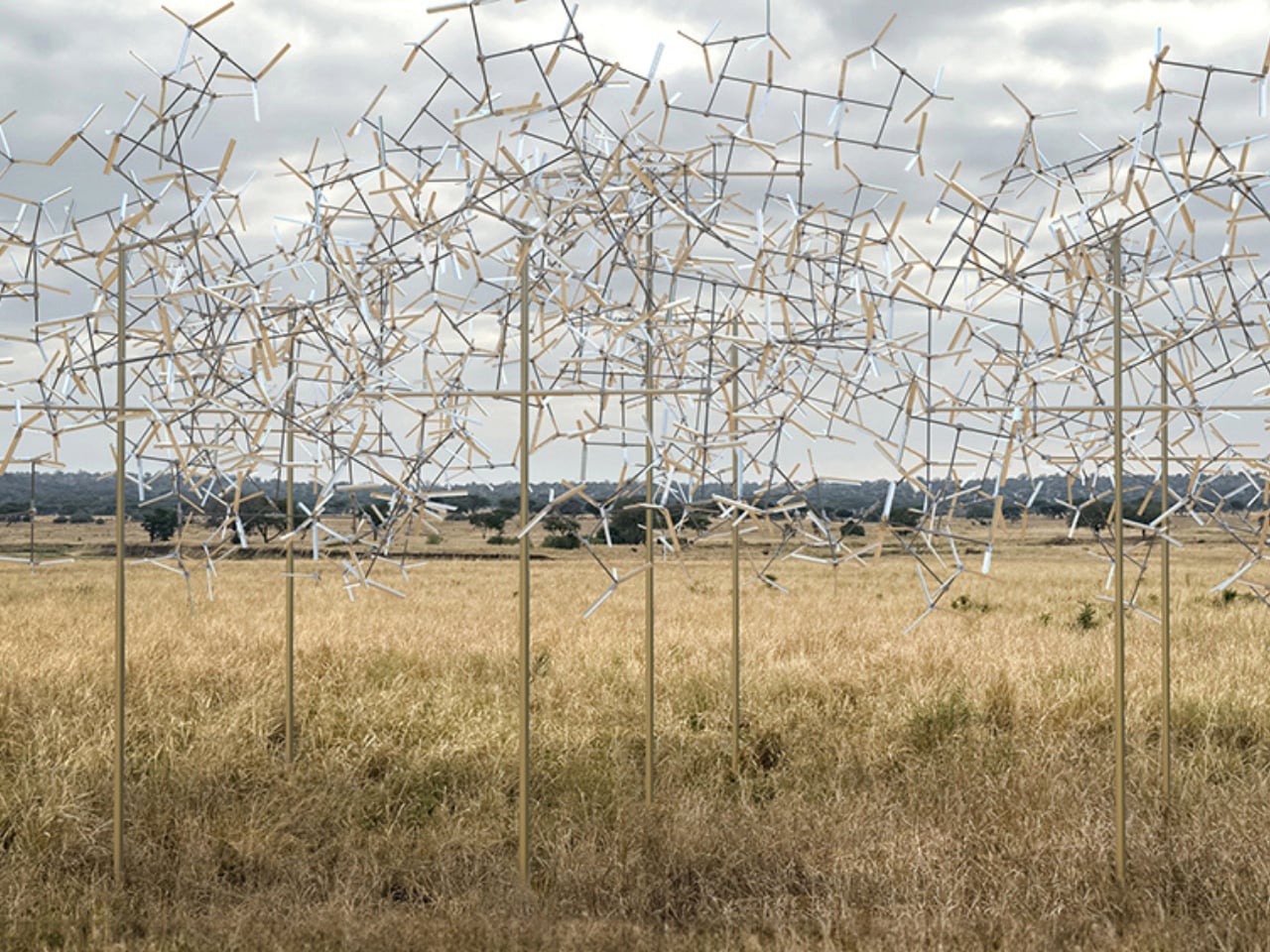
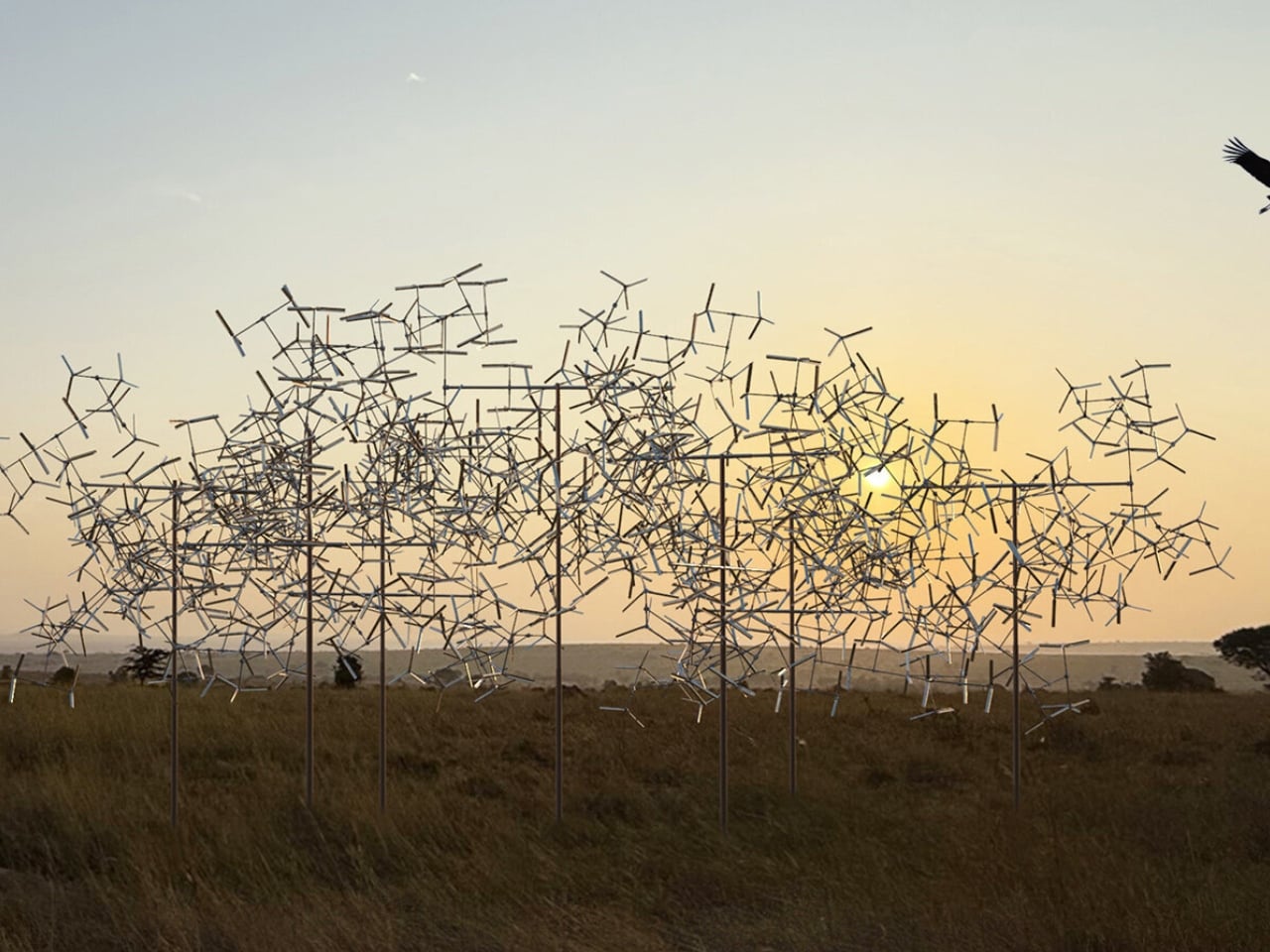
There’s something almost unsettling about a structure that appears to breathe. Not in a horror movie kind of way, but in that quiet, mesmerizing way that makes you stop, squint, and wonder if what you’re seeing is really happening. That’s exactly what Vincent Leroy’s Fractal Swarm does to people. It sits in the vast openness of the Tanzanian plains, and it moves. Not because of motors or hidden mechanisms, but because of the wind.

Leroy is a Paris-based French artist who grew up in rural Normandy tinkering with whatever he could get his hands on. That early habit of experimenting turned into a full-blown obsession with movement, which led him to study industrial design at the Ecole Nationale Supérieure de Création Industrielle in Paris. By the time he graduated, he was already making kinetic work that galleries wanted to show. Since then, he has built a practice that sits comfortably between sculpture, installation art, and something that doesn’t quite have a name yet. His work has appeared everywhere from Parisian museums to Zanzibar’s shoreline, and the thread that runs through all of it is the same: movement as a material, not just as an effect.

Designer: Vincent Leroy

Fractal Swarm is his latest statement on that idea, and it might be the most ambitious one yet. The installation is built around the logic of fractal geometry, which is the kind of math that describes the way nature repeats itself at different scales. Think of the branching pattern of a tree, or the way a fern unfolds, or the texture of a coastline seen from above. Nature uses this structure constantly, and Leroy decided to make it visible in a landscape where that pattern is already everywhere.

The Tanzanian plains during the dry season are stripped down to essentials. Acacia trees stand with bare, branching silhouettes against the sky. The ground breaks into fragmented, textured patches of arid vegetation. Leroy’s installation mirrors all of that. Its branching configuration echoes the acacia silhouettes so closely that from a distance, it reads more like something that grew there than something that was built. That’s the point. Rather than imposing itself on the landscape, Fractal Swarm extends it.

What makes it come alive, literally, are the mirrored fins embedded within the structure’s modules. Thin and precisely placed, these fins catch and refract the intense light of the plains as they move. The wind sets everything in motion, and the fins respond by scattering light in constantly shifting patterns across the ground and the air around them. The result is something that changes every second depending on where you’re standing, what direction the wind is coming from, and what time of day it is. No two moments of looking at it are the same.

This is what Leroy keeps coming back to in his practice: the idea that slowing down and watching something move can completely change how you see it. His work tries to reveal the gaps that usually go unnoticed in today’s frenetic race for speed and performance. Fractal Swarm does that on a grand scale. It puts you in front of something enormous and quietly says: stand here. Watch this. Let the wind do something beautiful.

It’s also worth noting that Leroy isn’t new to working with wind in dramatic outdoor settings. His Drifting Cloud installation on Zanzibar’s east coast used rotating canvas discs that interacted directly with the shoreline’s breeze. Fractal Swarm takes that same sensibility deeper into the continent and scales it up into something more structural and mathematically precise.

What’s quietly radical about all of this is that Leroy uses some of the most rigorous abstract math available (fractal geometry) and turns it into something you feel before you think about it. You don’t need to understand the Mandelbrot set to be moved by Fractal Swarm. You just need to stand near it when the wind picks up and watch the plains light up like they’re waking. That’s the kind of art that sticks with you long after you’ve walked away.

The post A Wind-Powered Sculpture Is Lighting Up Tanzania’s Plains first appeared on Yanko Design.

Xbox head Phil Spencer is leaving Microsoft

Phil Spencer, CEO of Microsoft Gaming, is retiring, Satya Nadella has announced. Asha Sharma, the President of Microsoft's CoreAI division is taking over Spencer's role, while Sarah Bond, the current President of Xbox, is resigning.

"I am long on gaming and its role at the center of our consumer ambition, and as we look ahead, I’m excited to share that Asha Sharma will become Executive Vice President and CEO, Microsoft Gaming, reporting to me," Nadella says. "Over the last two years at Microsoft, and previously as Chief Operating Officer at Instacart and a Vice President at Meta, Asha has helped build and scale services that reach billions of people and support thriving consumer and developer ecosystems. She brings deep experience building and growing platforms, aligning business models to long-term value, and operating at global scale, which will be critical in leading our gaming business into its next era of growth."

In a thread on X, Spencer shared his thoughts on Sharma’s new position. “I’m excited for [Asha Sharma] as she steps into the CEO role,” Spencer wrote. “She’s joining an incredible group of people; teams full of talent, heart, and a deep commitment to the players they serve. Watching her lean in with curiosity and a real desire to strengthen the foundation we've built gives me confidence that our Xbox communities will be well supported in the years ahead.”

Alongside Sharma, Matt Booty, the current head of Xbox Game Studios, is getting promoted to Chief Content Officer, and will report to Sharma. Sarah Bond, who like Spencer served as a public face for the Xbox brand and was assumed to be his successor, is leaving Microsoft to "begin a new chapter." Bond has yet to make a public statement about her resignation.

Spencer joined Microsoft in 1988, and has worked on Xbox since at least 2001. He assumed responsibility for Microsoft's gaming brand and its various studios and associated subscription products in 2013, before becoming an Executive VP of Gaming in 2017 and later CEO of Microsoft Gaming in 2022. Spencer's biggest impact on Xbox will likely be remembered as the creation of Game Pass, Microsoft's "Netflix for Games" and the wave of studio acquisitions Microsoft completed from 2018 to 2022, which included smaller studios like Double Fine and the massive $68.7 billion purchase of Activision Blizzard King.

While Microsoft has plenty of developers and IP to fall back on, it's struggled to compete with the likes of Sony and Nintendo during the current console generation. Microsoft's gaming division has gone through widespread layoffs, its revenue continued to fall throughout 2025 and it raised the prices of both its consoles and Game Pass Ultimate, which likely won't help things going forward. Sharma is in many ways inheriting a broken-down car.

As far as her plans go, Sharma’s email to staff that was included in Nadella's announcement is light on details. Sharma says she plans to continue developing "great games," wants to "recommit" to core Xbox fans and "invent new business models and new ways to play." Whether that’s enough to turn Xbox's fortunes around remains to be seen.

Update, February 20, 4:52PM ET: Added statement from Phil Spencer shared on X.

This article originally appeared on Engadget at https://www.engadget.com/gaming/xbox/xbox-head-phil-spencer-is-leaving-microsoft-212838419.html?src=rss

Roland’s $299 Pocket-Sized Audio Interface Was Designed Specifically For TikTok and Instagram Music Creators

The bedroom studio era changed everything. A generation of musicians learned to record, mix, and release music without ever setting foot in a professional facility, and the results reshaped the entire industry. Now, that same creative energy has migrated to the livestream, where a single performance on TikTok Live or Instagram can reach more people than a record label could have dreamed of a decade ago. The bar for audio quality has quietly but decisively risen.

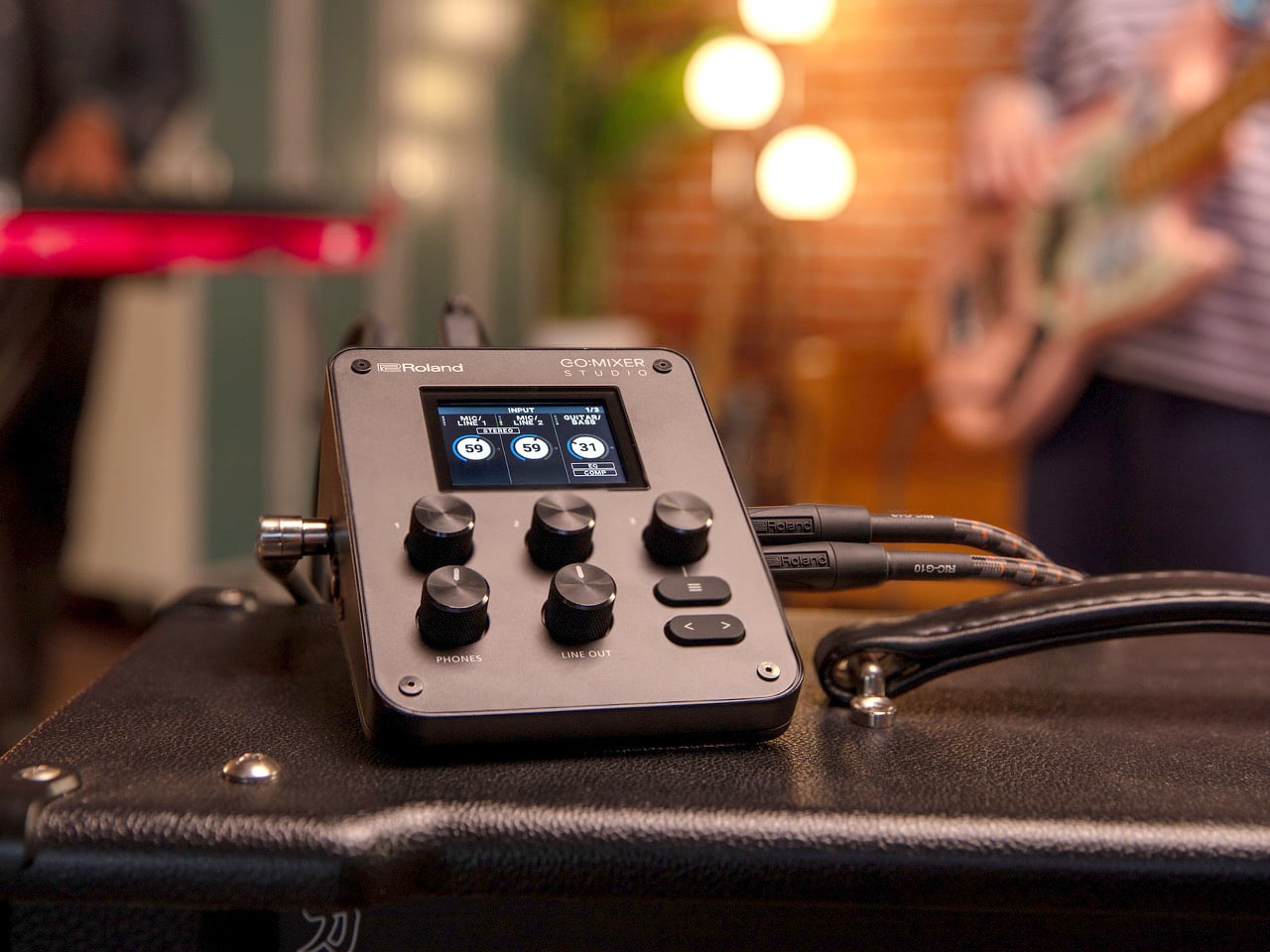
Roland’s GO:MIXER STUDIO arrives at exactly this inflection point. The company has been iterating on this product family since 2017, and with each generation you could feel them getting closer to something that actually made sense for serious creators. At $299, this latest version brings 24-bit/192kHz recording, onboard EQ, compression, and reverb modeled after Roland’s own studio processors, all into a chassis that weighs roughly as much as a large coffee mug. Whether that combination of specs and portability holds up in the real world, where cables get tangled and livestreams go sideways, is a more interesting question than the spec sheet alone can answer.

Designer: ROLAND

Click Here to Buy Now

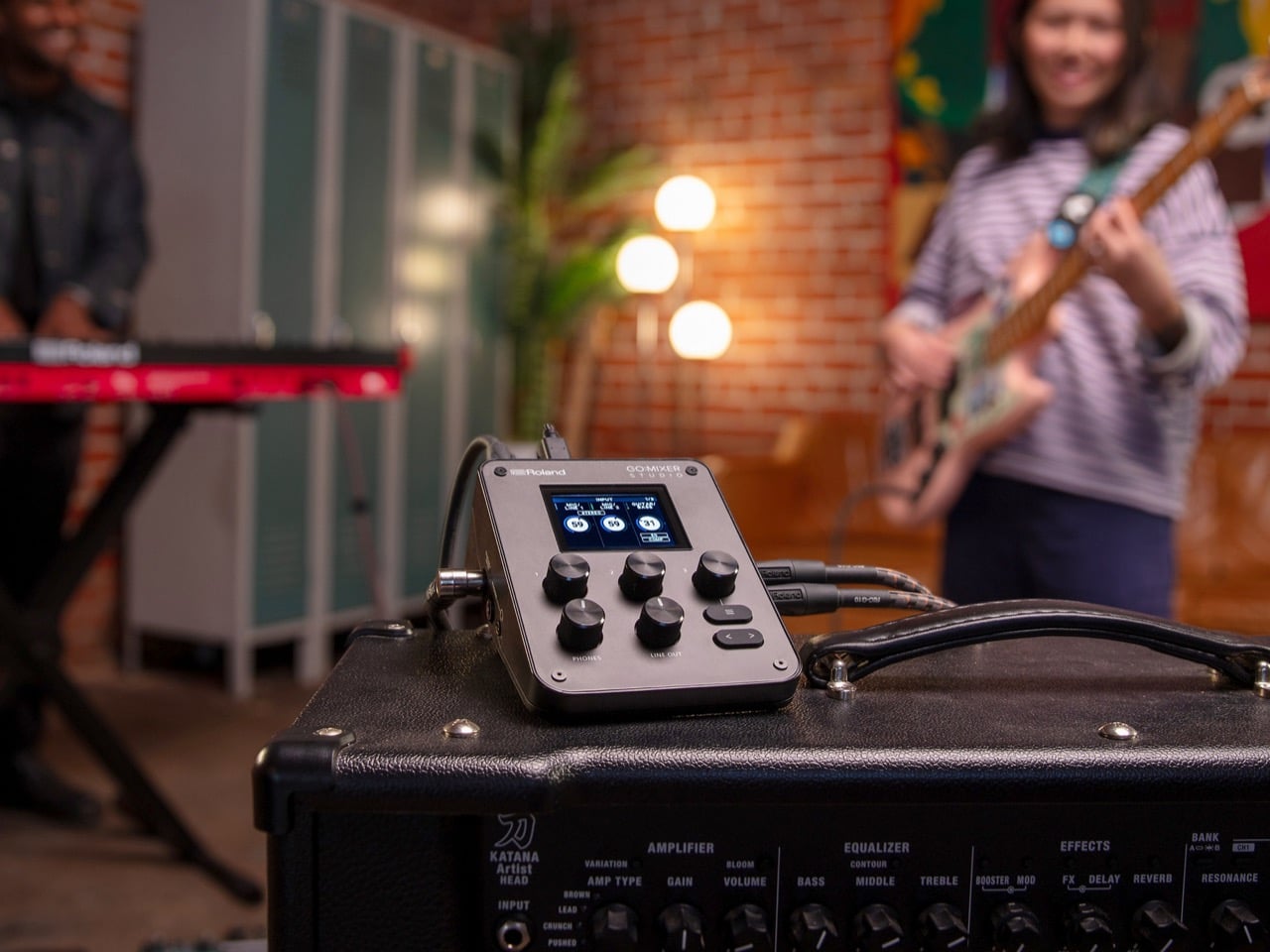
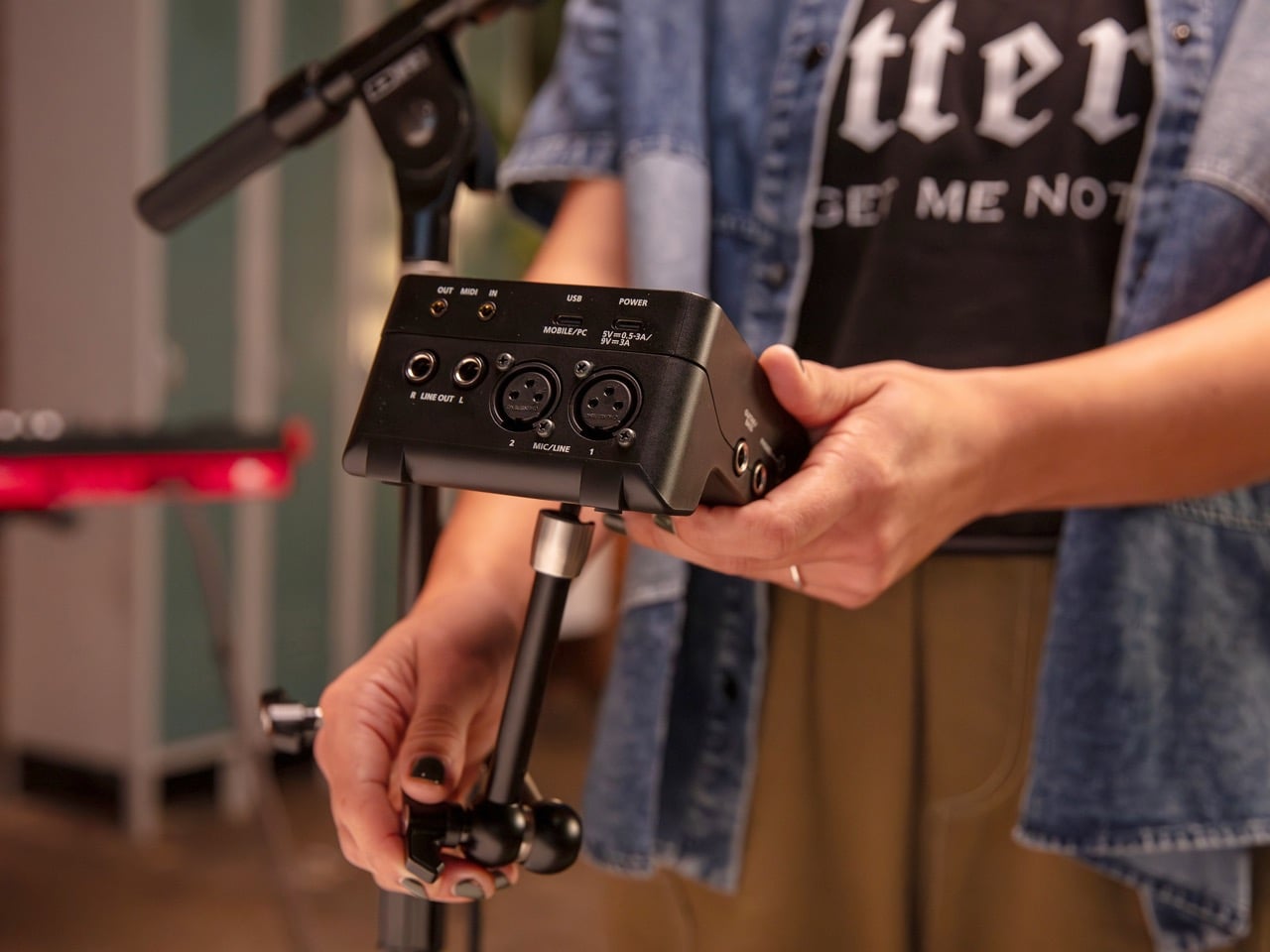
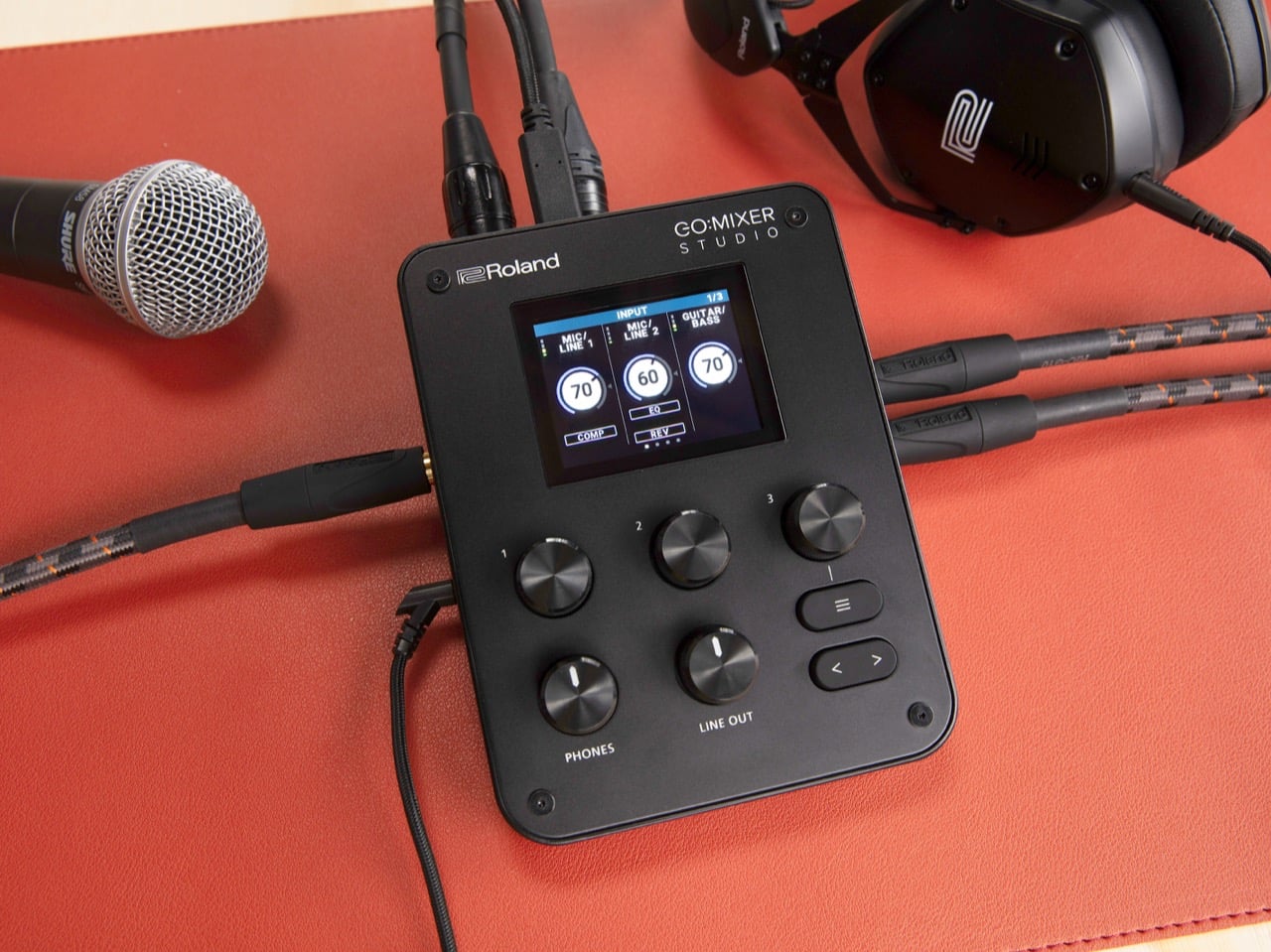
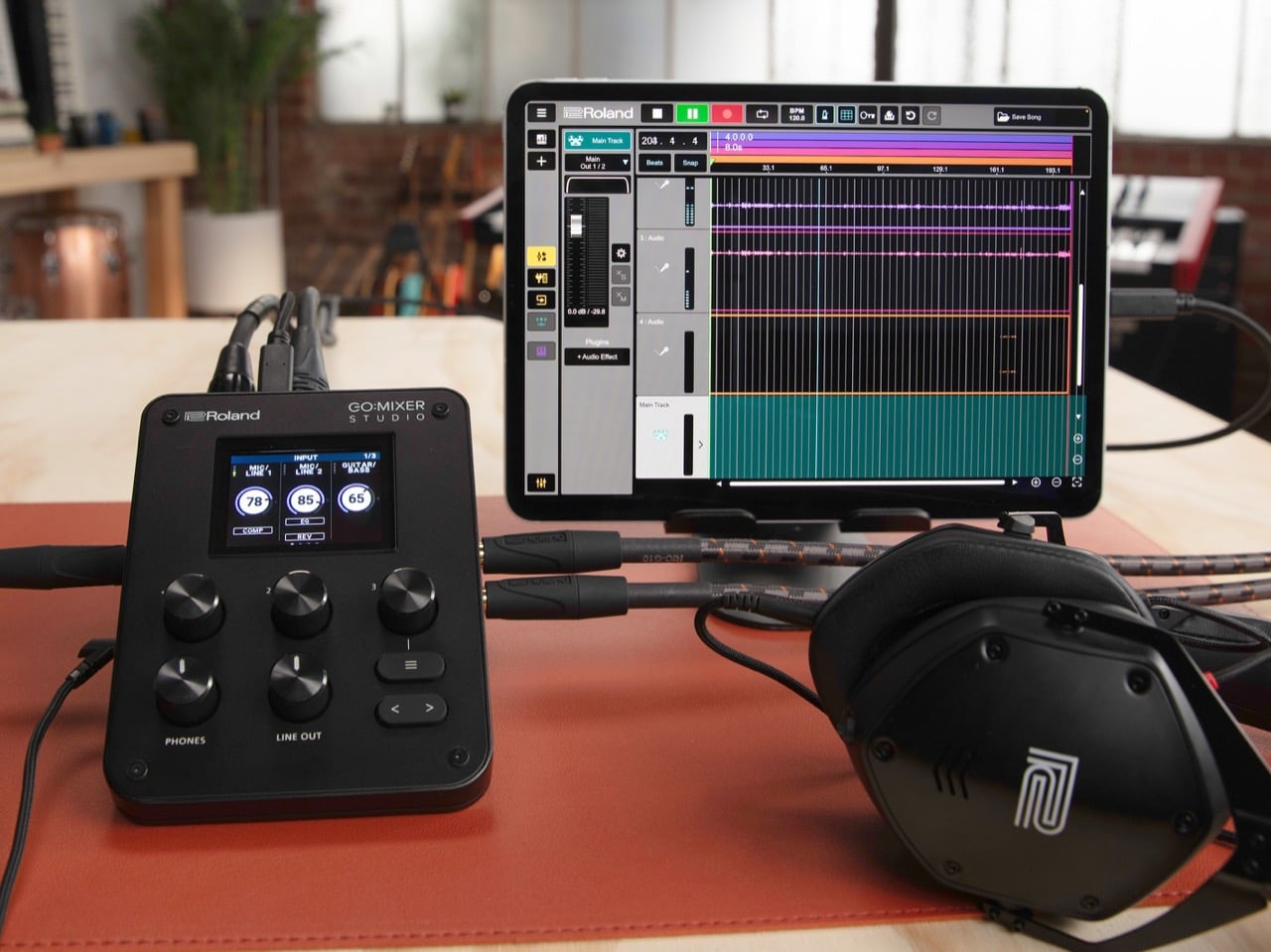
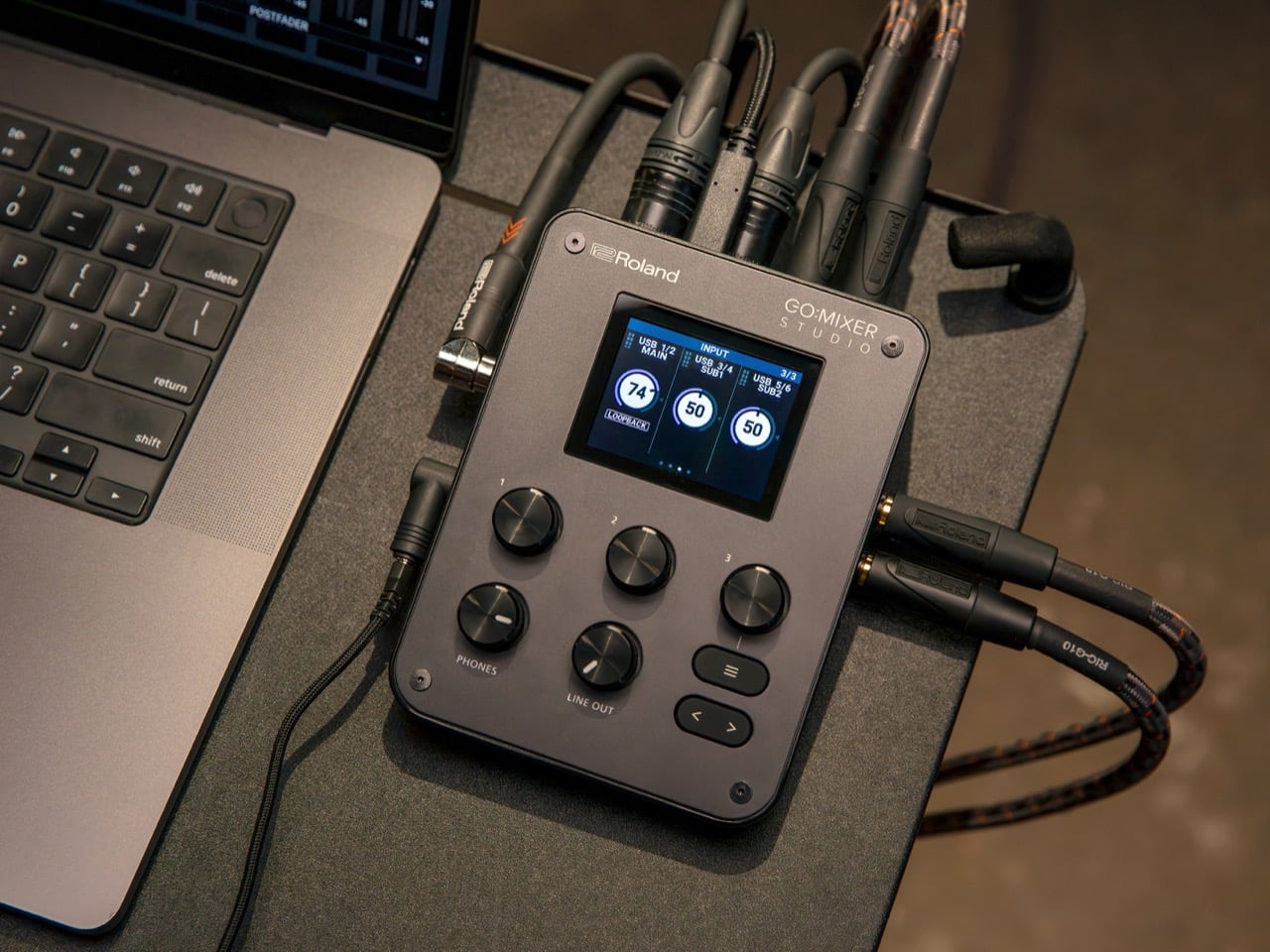
At 156 x 110 x 65mm and 440 grams, it sits comfortably on a mic stand next to a performer mid-set, which is a specific and deliberate choice. The color LCD showing per-channel EQ, compression, and reverb status is genuinely useful during a live session when reaching for your phone means losing eye contact with your audience. Three chunky knobs handle channel levels, and the whole thing can be powered by a USB battery pack, which means no wall outlet required and no excuses for bad audio in a green room, a hotel room, or the back of a van. The matte black chassis reads professional without being precious about it, the kind of gear that does not mind getting thrown into a backpack.

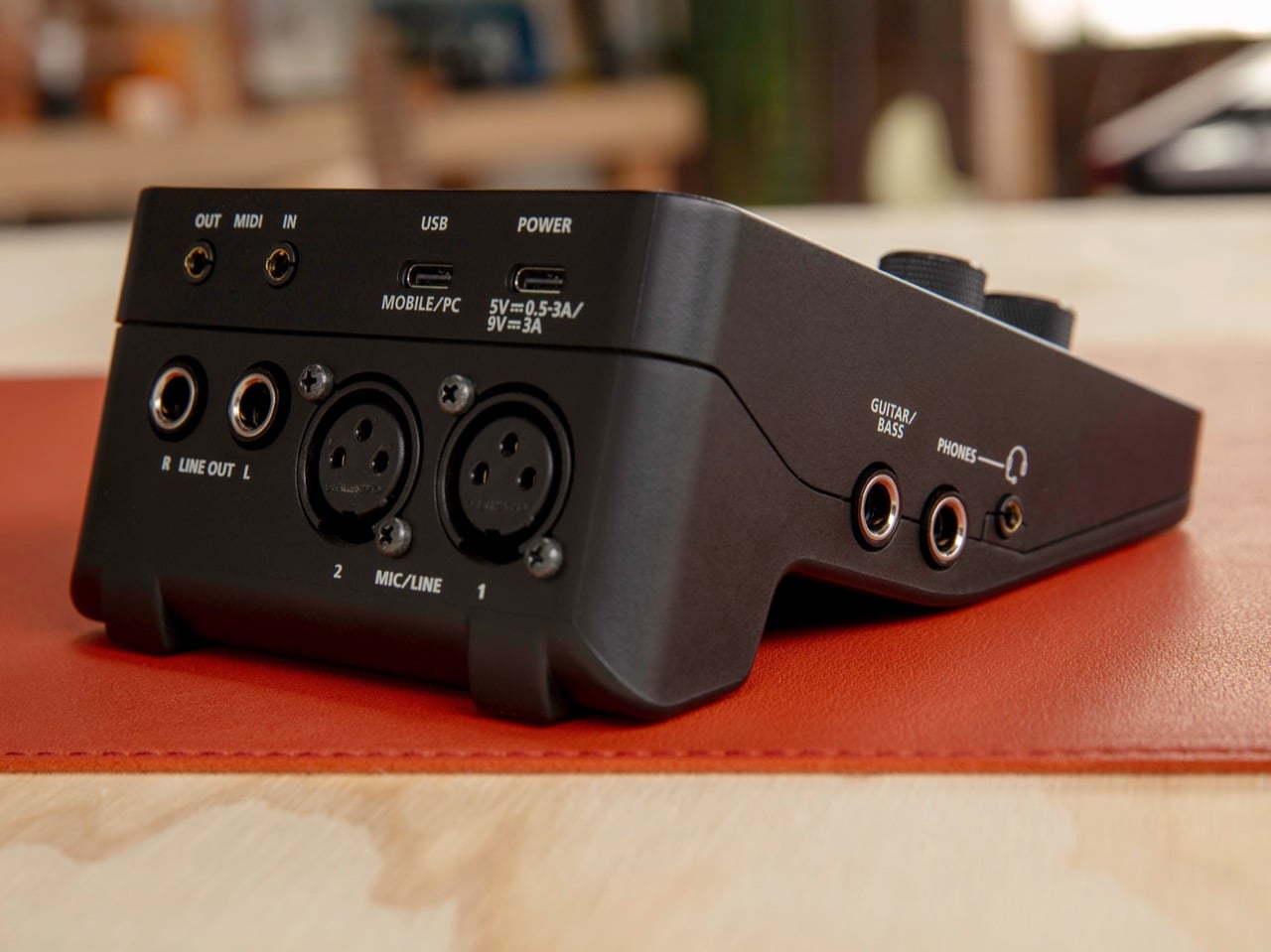
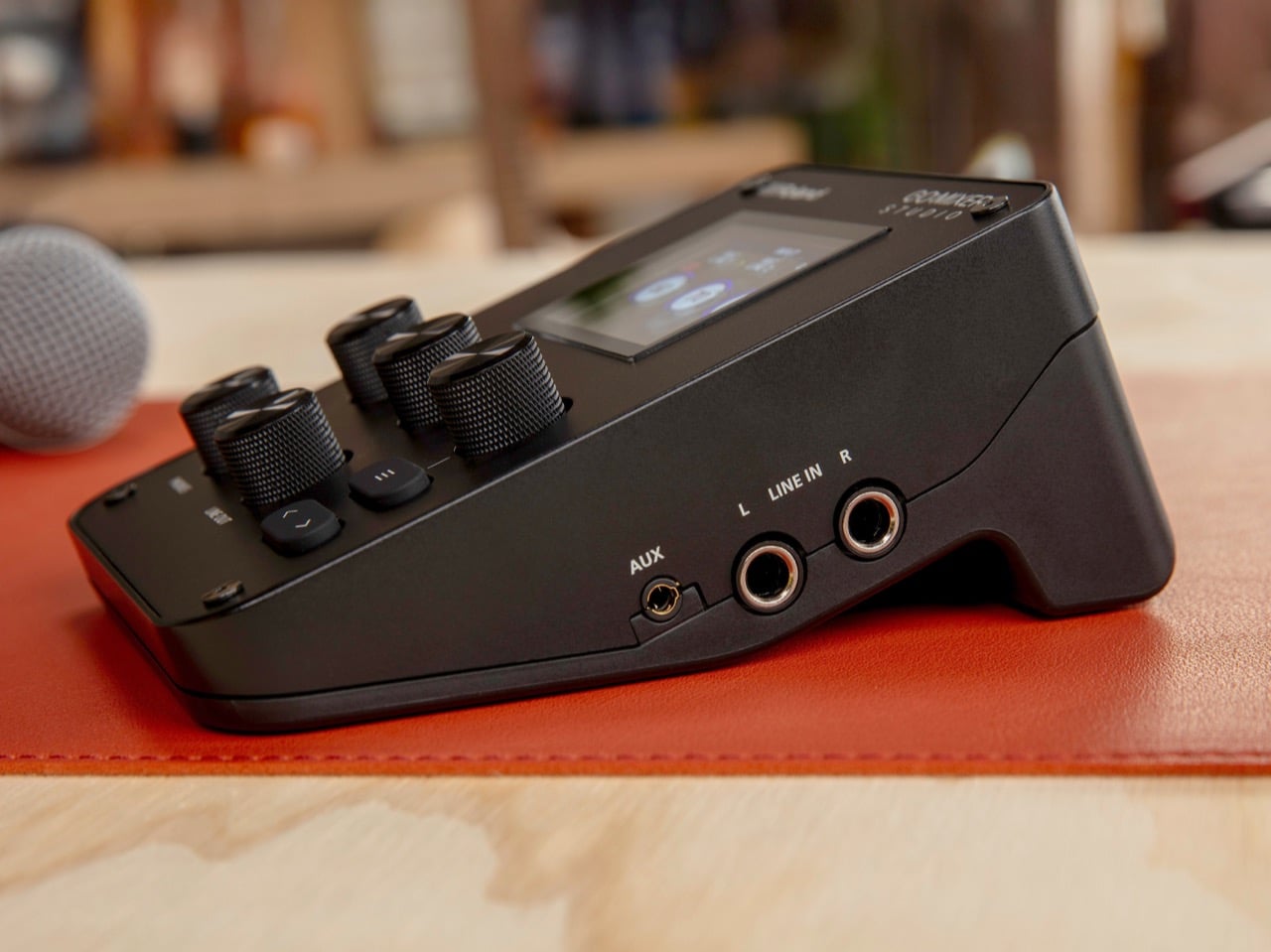
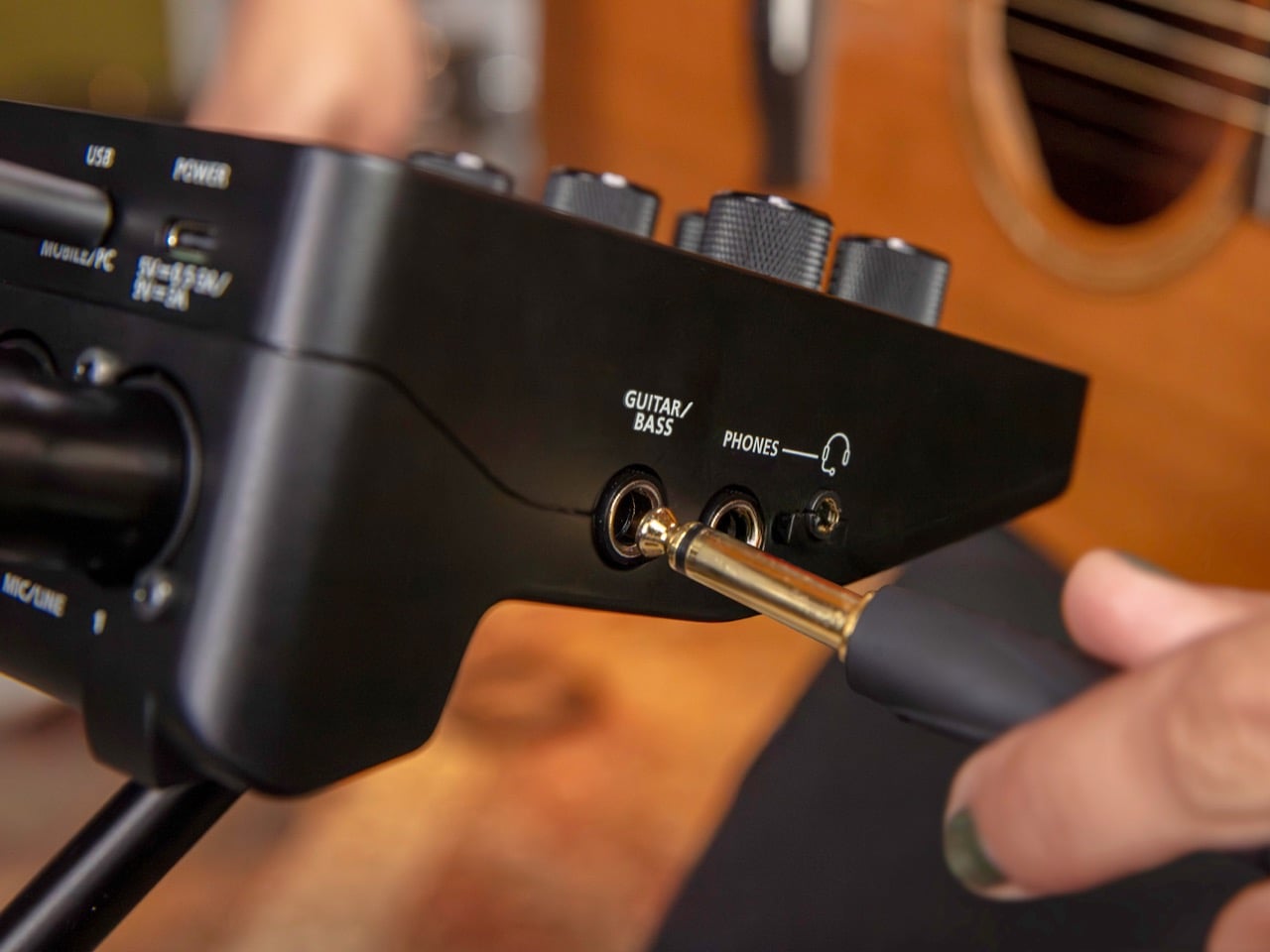
Twelve input channels is pretty great value for money. Two XLR mic inputs with 48V phantom power, a dedicated high-impedance guitar and bass input, stereo quarter-inch line inputs for keyboards or drum machines, a 3.5mm aux with TRRS support for mobile devices, and MIDI via 3.5mm TRS. That last one matters more than it might seem, because it means you can sync external hardware, run a click track, or trigger backing tracks without adding another piece of gear to your table. The 32-bit float internal processing handles the heavy lifting before anything gets committed to your recording at 24-bit depth, giving you real headroom for fixing gain mistakes in post.

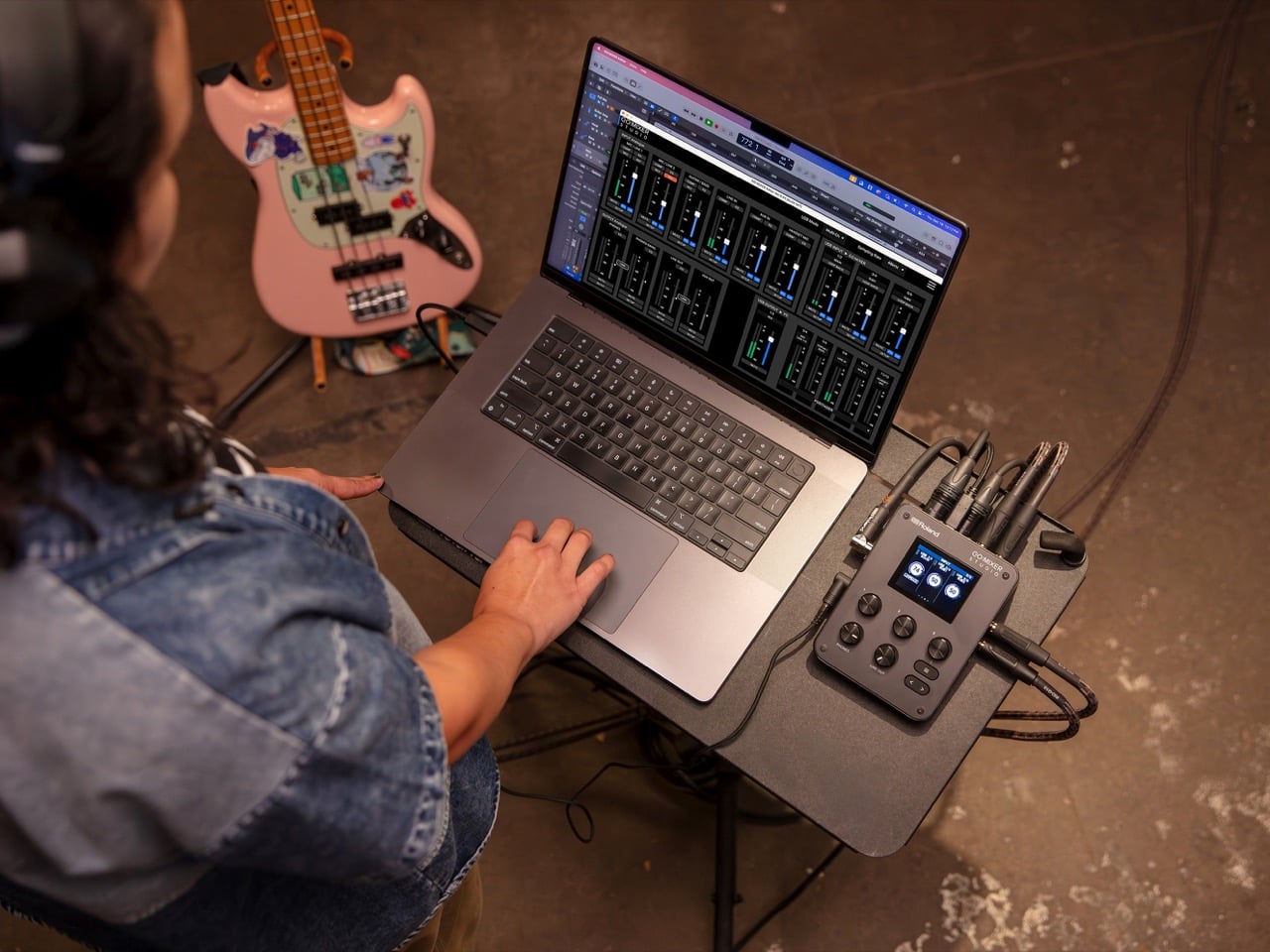
The GO:MIXER Cam app for iOS records genuine multitrack audio alongside your video, which opens up post-production options that creators on competing setups simply do not have. Standard camera apps give you a single stereo mix from whatever mic is closest, and that is the entire ceiling of what they can do. Roland also ships a desktop editor for macOS and Windows with full remote control of the mixer, and the 16 scene memory slots mean a creator with a regular weekly setup can recall their entire configuration instantly. That kind of workflow thinking is genuinely rare in gear aimed at the creator market, where the assumption is usually that you will rebuild everything from scratch each time.

No Android support is a real omission in 2026, full stop. SD card recording is also absent, meaning you are always dependent on a connected device and truly standalone operation is off the table. At 192kHz via USB, the channel count drops from 12 inputs to 8, a constraint worth knowing before planning a complex live setup around it. The Zoom LiveTrak L-8 and the Rode RodeCaster Pro II occupy overlapping territory, though both trade the GO:MIXER STUDIO’s portability for more features, and neither fits as naturally into a one-person mobile setup. Roland has made a very acceptable set of mild tradeoffs here, and at $299 the value case is solid for almost everyone that’s already tied into the Apple ecosystem.

Click Here to Buy Now

The post Roland’s $299 Pocket-Sized Audio Interface Was Designed Specifically For TikTok and Instagram Music Creators first appeared on Yanko Design.