Record-breaking Drone hit 510km/h speeds, dethroning Red Bull for the World’s Fastest Drone

Earlier this year, Dutch Drone Gods, in partnership with Red Bull, unveiled the World’s Fastest Drone that went head-to-head with Max Verstappen behind the wheel of an F1 car. With a top speed of 350km/h, that drone held the title for barely a few months before YouTuber Luke Maximo Bell decided to challenge it.

Taking on the entire design and R&D team of Red Bull Racing, Bell managed to 3D-print a drone that was nearly 50% faster, hitting high speeds of 500km/h (310mph) and setting a new record, verified by the team at Guinness Book of World Records. The video above captures Bell’s entire journey, from prototype to building to tuning, and finally FPV footage of the world’s fastest drone. To think that one YouTuber with a BambuLabs printer managed to outpace a drone built out of carbon fiber by the elites at Red Bull Racing known for manufacturing the world’s leading F1 cars…

Designer: Luke Maximo Bell

Bell’s design process was a reiteration of one of his older drones named Peregreen, which could hit speeds of up to 400km/h. If you look at the shape of the drone you’ll quickly realise how even Red Bull and DDG opted for a similar format. The drone isn’t your average quadcopter or even FPV racer. Instead, it has a missile-style design with propellers at the bottom that give it an eVTOL style ability to vertically take off, tilt forward to race ahead, and then land vertically too.

The backbone of Peregreen 2’s success lies in its meticulous design and the use of high-quality materials. The frame, constructed from carbon fiber, was chosen for its exceptional strength and wide availability. Custom frames were precision-cut using a CNC machine at Flying Robot in Cape Town. Despite initial setbacks with incorrect mounting hole dimensions, which required manual adjustments, the final product was a high-precision, robust frame capable of withstanding the rigors of high-speed flight. Building on data from the original Peregreen, Bell and his father (who helped build the original Peregreen) selected larger motors, propellers, and batteries. However, this brought a new set of challenges. The initial batteries overheated, reaching temperatures above 130°C, leading to failures. Additionally, the motor wires were not thick enough, causing them to overheat and even catch fire during bench tests. After extensive testing and adjustments, the team switched to thicker wires and sourced new batteries that maintained a stable temperature below 80°C. These changes were crucial in ensuring the drone could operate at high speeds without the risk of overheating or component failure.

A cheap reliable way to test aerodynamics, simply hold it outside a car’s window!

Aerodynamics played a pivotal role in the drone’s performance. Initial designs faced stability issues at high speeds, necessitating extensive experimentation with tail lengths and fin sizes. The goal was to achieve a stable flight profile with a low drag coefficient. By creating and testing various models (often by simply 3D printing them and holding them out of a car window at high speeds), the team eventually found a configuration that provided the necessary stability. This iterative process of refinement led to a design that not only looked sleek but also performed exceptionally well in high-speed conditions. The final aerodynamic model was a testament to the team’s dedication to optimizing every aspect of the drone’s performance.

Once a drone’s built, its performance needs to be tuned by programming all its components to work in sync so that there isn’t a malfunction in the sky. Despite several initial failures during test flights, the team sought the expertise of Chris Raser, a renowned FPV drone specialist. His insights and detailed tuning guides were instrumental in resolving stability issues and fine-tuning the drone’s flight characteristics. This collaborative approach underscored the importance of seeking specialized knowledge and continuously learning from each phase of the project. The resulting improvements were significant, allowing the drone to perform high-speed maneuvers with precision and reliability.

The testing phase was rigorous and demanding, marked by numerous iterations and rebuilds. The drone was 3D printed using the Bambu Lab X1 Carbon printer, which proved to be an excellent tool for creating precise and durable components. Through a series of high-speed runs, the Peregreen 2 eventually achieved speeds of 500 km/h, a milestone that underscored the success of the design and engineering efforts. This achievement was officially recognized by Guinness, solidifying the team’s place in the record books.

Beyond setting a world record, the Peregreen 2 project also focused on capturing stunning cinematic footage. By incorporating a new open canopy for the camera (shown below), the team was able to obtain clear, distortion-free shots. The Insta360 Go 3 camera, known for its small size and lightweight, was integral in capturing high-speed footage. The drone’s performance in endurance tests was equally impressive, managing a flight of 7.5 km at an average speed of 180 km/h. These accomplishments highlight the drone’s versatility and potential for various applications.

The post Record-breaking Drone hit 510km/h speeds, dethroning Red Bull for the World’s Fastest Drone first appeared on Yanko Design.
This tailored Mercedes-Benz concept hypercar adapts the volumes of a classy suit for its dynamic shape

Mercedes-Benz has been a name synonym for panache and luxury ever since it was first established in 1926. Headquartered in Stuttgart, Germany, the automotive giant has set the bar high for four-wheelers of the present and the future world. The AMG GT introduced in 2014 is still one of the most liked supercars in the industry and Concept VISION AVTR is setting the precedence for electric cars of the future already.

While the brand is one of the few big names inclined towards electric concept designs, it is understandable how many concept designers gravitate towards the Mercedes name for building their imaginative four wheels that could someday actually land them at one of the renowned brand’s design nests. The Mercedes-Benz Dresscode is one such iteration that has a unique take on what a British hypercar of the future could be like.

Designer: Jeongtae Lee

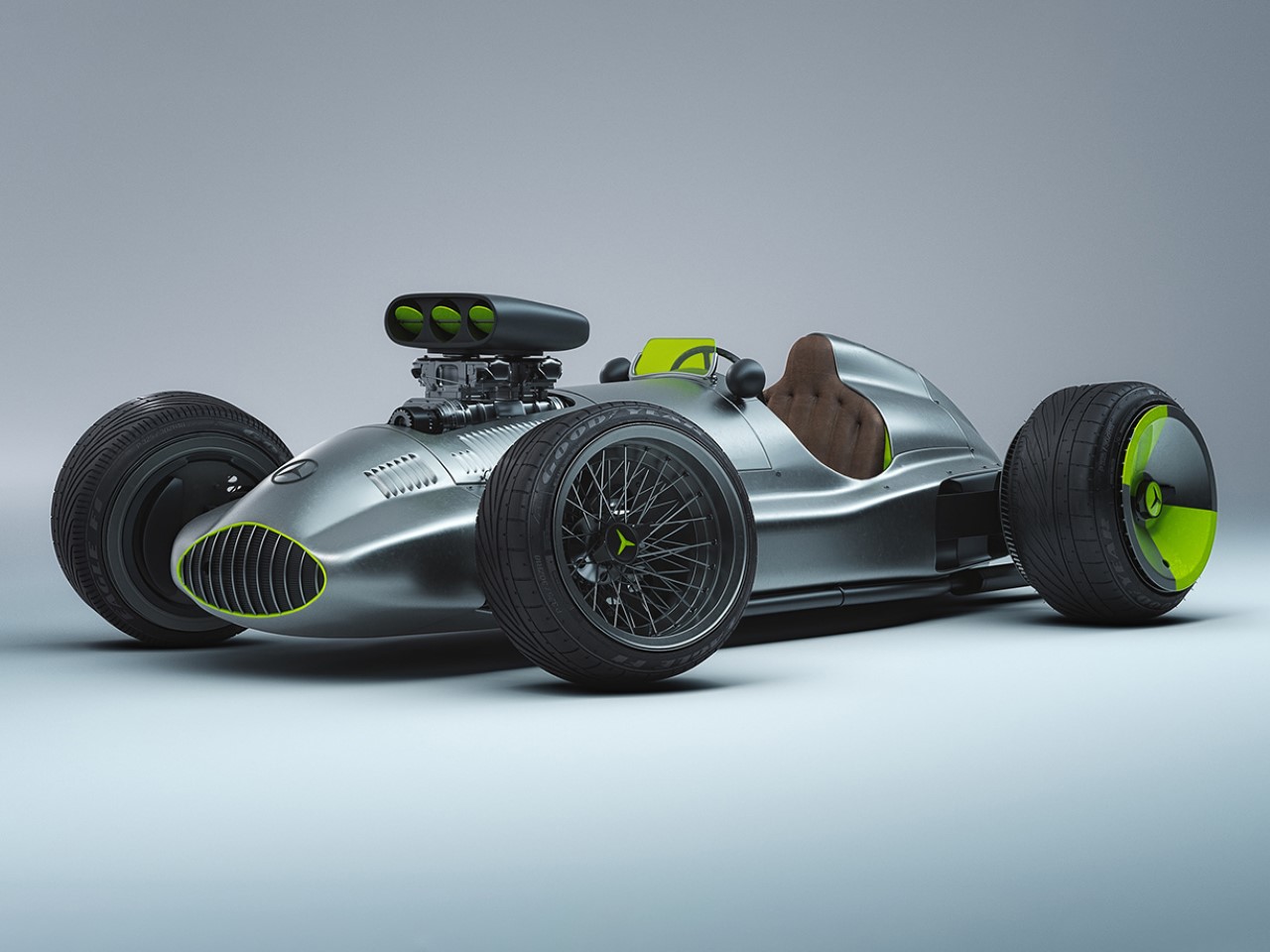
The design direction of the car interprets iconic luxury through the shapes of collar and rich volumes of a formal dress. If you look closely the hypercar adapts the form of a white shirt with a tie on top and a black jacket layered over it. Yes, the white sections represent the shirt with edged surfaces while the black body wraps the entire car in a large volume reminiscent of a jacket. The rear of the vehicle is like the back of a person wearing a suit – simple and chic. Unlike other supercars having luxurious gull-winged doors (or scissor doors) which can be tricky to get in and out, the Dresscode concept has doors designed to feel like the process of taking off a suit which is elegant and easy.

The side profile of the car is inspired by the seam lines on the shoulder of a jacket, wherein the lines flow from the front to the rear. Those wheel parts are rotatable through these lines. Also, the seam stitches on the shoulder of a suit jacket are reinterpreted as Mercedes patterns on the hypercar. In a true sense, this is a tailored Mercedes concept maintaining an aggressive yet elegant stance with its dynamic shape.

The post This tailored Mercedes-Benz concept hypercar adapts the volumes of a classy suit for its dynamic shape first appeared on Yanko Design.

Genesis X Dog Concept has every luxury your pooch needs before, during, and after travel

Max tells me; being a celeb dog is not an easy thing. You have to dress up well, eat without spilling or slurping, have trimmed nails, clean paws, and be at your best behavior at all times. Ah, poor doggo! After all the made-up life throughout the day, Max deserves the ultimate relaxation and time of his own during traveling, he says. Luxury automaker Genesis seems to have heard his woof and has created an ultimate dog-friendly space exclusively to fit in the boot of the Electrified GV70. This is what Max would’ve always needed. A dedicated area to himself that would take care of his before, during, and after travel needs.

The Genesis X Dog concept is primarily meant to allow the four-legged friend to relax with all the possible amenities inside it or at the paw’s reach. Along with the comfortable ride of its Electrified GV70, the interesting dog module allows the pooch to have a relaxed me time, drenched in the luxuries of a cozy bed, ambient lighting, and Bluetooth audio system.

Designer: Genesis

A lightweight, retractable aluminum and carbon fiber ramp has been designed to provide easy access for the dog into the luxury crate resting in the boot of the Electrified GV70. Sitting there, the dog can feel as special as their owners while on the road with all the range of exclusive accessories and equipment at their disposal.

Matching with the interior of the Genesis electric, the Genesis X Dog Concept has quilted vegan leather sidewalls and comes with bespoke features including a heated dog bed, Bluetooth audio system, ambient lighting with the pull-out ramp facilitating entry and exit. More interesting here is the built-in electric shower (attached to a six-liter pressurized water tank) with a hairdryer for the pooch to clean up after her muddy adventures.

To ensure the time within the Genesis X Dog Concept is as comfortable and personalized as possible for the dog, it features an anti-skid surface, a safety lock mechanism comprising two straps on the sides, a safety harness and a leather dog collar. Before you start believing in the luxury and willing to inculcate it into your pooch’s lifestyle, this is just a concept that Genesis would be displaying in its select studios between 9 May and 5 June.

The post Genesis X Dog Concept has every luxury your pooch needs before, during, and after travel first appeared on Yanko Design.
LEGO G Wagon and SL63 convertible roadster arriving in June for an irresistible price

Video:

LEGO and cool cars have a long-standing relationship that gravitates toward kids as well as grown-ups. The Speed Champions Sets address the craving for every generation to build their loved cars from scratch in LEGO form. The LEGO Mercedes-AMG W14 F1 car is one of my favorite because I love the sport so much.

The number of sets available for every kind of motorhead is increasing in this collection and the Mercedes brand keeps calling us back to the LEGO world. The German automaker has revealed the LEGO version of two of its most acclaimed cars for speed enthusiasts and avid off-roaders. Yes, I’m talking about the AMG 63 G-Wagon SUV and the AMG SL63 convertible roadster. The kit can be ordered June 1 onwards for a price of $50 which is an absolute steal if you are a collector.

Designer: LEGO

The two performance cars come in a kit with 2 driver minifigures as a part of the LEGO Speed Champions line. Combined the two cars have a total of 808 pieces that when put together for weekend fun, turn into the G Wagon in black and the SL 63 roadster in yellow. Of course, the color distinction will help you out in separating the pieces if you happen to mix them up. The LEGO car models boast authentic design details adapted from real-life models. Attention to detail has been paid to the front grilles, hoods and interiors complete in the Mercedes livery.

This pack comes with the printed building instructions if you want to go old school, or via the app that’ll guide you step-by-step to bring the G Wagon and convertible roadster to life. Since there are two cars in the set, the size of each one is a bit smaller than the other individual Speed Champions collection. Standing tall at 2.5 inches the AMG G 63 LEGO car measures 7 inches long and 3 inches wide. Parked on your living room shelf or the geeky desk, these two LEGO collectibles could be easily mistaken for a toy car but you know the deeper truth!

The post LEGO G Wagon and SL63 convertible roadster arriving in June for an irresistible price first appeared on Yanko Design.
Hear the Roar of 6 Iconic Lamborghini in Your Living Room with the SL-1200M7B Turntable

Automobili Lamborghini and Technics, both leaders in automobiles and audio equipment, have long upheld traditions of excellence. Each, known for innovation and expertise, continually advances their respective fields. Their collaboration has produced the SL-1200M7B turntable, a product that combines top-tier engineering and design, showcasing the strong capabilities of both brands.

Designer: Technics + Lamborghini

Founded in 1963 by Ferruccio Lamborghini, Automobili Lamborghini set out to create the world’s most beautiful and powerful sports cars. Known for their dramatic designs and thunderous V12 engines, Lamborghini cars quickly became symbols of status and performance. Over the decades, Lamborghini has consistently pushed the boundaries of automotive engineering, achieving a legendary status among car enthusiasts.

On the flip side, Technics, established by Panasonic in 1965, revolutionized the audio industry with its direct-drive turntable technology, first introduced in the early 1970s. This innovation was crucial for DJs, as it provided a more reliable and precise way to mix and scratch records, effectively changing the DJ scene forever. The SL-1200 series, introduced for DJs, is appreciated for its reliability and sound quality, making it a common choice in clubs globally.

Both brands have continuously evolved, driven by a commitment to innovation and a passion for delivering extraordinary experiences. Their collaboration on the SL-1200M7B turntable represents a blend of cutting-edge audio technology and automotive design flair anchored in their shared heritage. For enthusiasts of both brands, this turntable showcases decades of pioneering history and performance.

The SL-1200M7B’s tonearm, a key component in the DJ scene for years, provides excellent tracking performance due to its high-precision bearings and superior initial-motion sensitivity.

Firing up the SL-1200M7B goes beyond playing vinyl—it ignites the visceral thrill of a Lamborghini. The turntable includes an exclusive vinyl record featuring the sweet-sounding engine exhaust notes of six iconic Lamborghini V12-engine super sports cars: the 400GT 2+2, Miura SV, 25th Anniversary Countach, Diablo 6.0 SE, Murciélago LP 640, and Revuelto. These sounds mirror the exhilarating sensation of driving a Lamborghini, where every rev feels like the roaring bull comes to life.

This special edition turntable turns each playback into a performance, highlighting Lamborghini’s rich legacy. The picture disc, illustrating the tire of the Revuelto, adds visual drama to the auditory experience. The package is completed with a custom slipmat and stickers featuring the Automobili Lamborghini and Technics logos, enriching its collectible appeal.

Experience the roar of Lamborghini with Technics’ exclusive gift: a turntable adorned with prestigious logos.

Turning Tables: The SL-1200M7B Combines Top-Notch Audio with Sleek Design

The SL-1200M7B turntable represents a significant leap forward in audio technology, combining Lamborghini’s dynamic flair with Technics’ renowned precision. At its heart is a coreless direct drive motor that provides stable, cogging-free rotation and powerful torque. This feature ensures that DJs can perform without experiencing the interruptions or inconsistencies that can occur with lesser equipment. The motor’s ability to maintain consistent speed under varying loads means that the audio output is always crystal clear and faithful to the original recording.

In addition to its robust motor, the SL-1200M7B boasts a highly sensitive tonearm that uses high-precision bearings, surpassing the performance of its predecessors. This tonearm is adept at reading the nuances in vinyl grooves, translating them into audio with minimal error or distortion. Whether it’s old classics or new cuts, this tonearm ensures that every detail of the music is captured and conveyed with exceptional clarity. The ability to track grooves accurately, even during intensive scratching sessions, makes this turntable a reliable choice for DJs who demand the best in their performances.

Coreless Direct Drive Motor Achieving Stable Rotation and Stylus Illuminator Featuring a High-brightness and Long-life White LED

Design-wise, the SL-1200M7B does not disappoint, featuring a two-layer structure platter that significantly enhances vibration damping. Together with a high-rigidity cabinet and high-damping insulator, the turntable is virtually immune to external vibrations, preserving sound quality even in high-energy environments. The visual aesthetics are equally compelling, with the design drawing inspiration from Lamborghini’s iconic style. This turntable not only sounds exceptional but also stands as a striking piece of craftsmanship that complements any DJ setup or home audio system.

Let’s Set the Right Tone: Power and Prestige in Lamborghini’s Legendary V12 Lineup

Lamborghini 400GT 2+2 (Introduced: 1966)

Lamborghini 400 GT 2+2

  • Engine: 3.9-liter V12
  • Power Output: 320 horsepower
  • Exhaust Note: Smooth yet robust, with a deep rumble that underscores its grand touring capabilities.
  • Features: This grand tourer blends power with luxury, offering a spacious interior and refined driving experience. It marks a significant early step in Lamborghini’s performance car history.
  • Notable Design Feature: The 400GT 2+2 features a distinctive, elongated front end and sleek, rounded body lines that exude elegance and sophistication, setting it apart as a true classic in automotive design.

Lamborghini Miura SV (Introduced: 1971)

Lamborghini Miura SV

  • Engine: 4.0-liter V12
  • Power Output: 385 horsepower
  • Exhaust Note: Sharp and intense, the Miura SV’s sound is as dramatic as its appearance, with a high-pitched roar that crescendos rapidly with acceleration.
  • Features: This is the pinnacle of the Miura line, with technical refinements for improved handling and a more powerful engine setup.
  • Notable Design Feature: The Miura SV is renowned for its revolutionary rear mid-engine, rear-wheel-drive layout that significantly improved the car’s balance and handling, making it a trendsetter for sports cars. Its striking “eyelash” headlight surrounds became one of its most distinctive and iconic visual elements.

Lamborghini 25th Anniversary Countach (Introduced: 1988)

  • Engine: 5.2-liter V12
  • Power Output: 455 horsepower
  • Exhaust Note: Aggressive and loud, the Countach’s exhaust bellows with a raw, mechanical intensity that is unmistakable.
  • Features: Introduced to celebrate 25 years of Lamborghini, this model sports aesthetic and functional enhancements, maintaining the Countach’s iconic status.
  • Notable Design Feature: The 25th Anniversary Countach features distinctive scissor doors, a hallmark that became synonymous with Lamborghini’s image of exotic performance and dramatic flair. This edition accentuated the model’s wedge-shaped, sharply angled design, further solidifying its presence as a symbol of 1980s automotive extravagance.

Lamborghini Diablo 6.0 SE (Introduced: 2001)

  • Engine: 6.0-liter V12
  • Power Output: 550 horsepower
  • Exhaust Note: Deep and powerful, the Diablo’s roar is commanding with a clear, thunderous pitch that signals its formidable power.
  • Features: Among the most powerful Diablos, featuring advanced engineering for improved stability and an ultra-modern look.
  • Notable Design Feature: The Diablo 6.0 SE features a distinctive wedge-shaped body that is both aerodynamic and aggressively styled. Its sharp, angular lines and gullwing doors accentuate its appearance, making it instantly recognizable as a symbol of 90s supercar design.

Lamborghini Murciélago LP 640 (Introduced: 2006)

Lamborghini Murciélago LP 640

  • Engine: 6.5-liter V12
  • Power Output: 640 horsepower
  • Exhaust Note: Overwhelmingly ferocious, the Murciélago’s exhaust has a guttural growl that turns into a piercing scream at high revs, embodying the beast it is named after.
  • Features: Known for its raw power, the Murciélago LP 640 offers advanced aerodynamics and a robust frame, enhancing speed and performance.
  • Notable Design Feature: The Murciélago LP 640 features iconic scissor doors that rise up and forward when opened, a hallmark of Lamborghini’s most exclusive models. This dramatic door design not only adds to the visual impact but also reflects the car’s bold, aggressive nature.

Lamborghini Revuelto (Introduced: 2022)

Lamborghini Revuelto

  • Engine: Latest V12 hybrid technology
  • Power Output: Unspecified, but includes electric boost
  • Exhaust Note: A complex symphony of traditional V12 bellow blended with the whir of electric motors, offering a glimpse into the future of hybrid sports cars.
  • Features: Combining classic V12 engine power with electric motors, the Revuelto showcases Lamborghini’s innovation towards more efficient and high-performing hybrids.

Lamborghini Revuelto 1001-HP Hybrid V-12

  • Key Notable Design Feature: The Revuelto features a cutting-edge aerodynamic design with active elements that adjust to enhance performance and efficiency dynamically. The exterior incorporates sharp lines and an aggressive stance, embodying Lamborghini’s modern design ethos while optimizing airflow to reduce drag and improve handling at high speeds.

Lamborghini Revuelto

Each of these models showcases Lamborghini’s evolution in automotive design and performance, with their distinctive exhaust notes playing a crucial role in defining the visceral driving experience they offer.

The post Hear the Roar of 6 Iconic Lamborghini in Your Living Room with the SL-1200M7B Turntable first appeared on Yanko Design.

Polestar Fenrir is a sophisticated electric hot rod straight from the Hot Wheels universe

Polestar as an electric car manufacturer has taken the heat to Tesla in the last few years. The Swedish brand has proved its metal with the Polestar 2 EV, even when stacked against the Tesla Model 3. There’s a whole lot to like and the brand is evolving in the right direction.

The Polestar 6 slated for production in 2026 as an open-top grand tourer has got the challenge very well accepted for future dominance, at least in the electric roadster domain. We though, are always on the hunt for something larger than life in the concept world. Just like this Hot Wheels-inspired Polestar hot rod that would be perfect for the Japanese street racing scene.

Designer: Henrique Alves

This electric concept named Polestar Fenrir imagined for the 2024 Polestar design contest hits the nail right on its head with the Hot Wheels theme. That’s because the contest is done in collaboration with Hot Wheels. The only doubt in Henrique’s mind was if the vehicle should be a Monster Truck, Surf Van or Dune Buggy. Ultimately he went for the obvious choice of a hot rod, since Hot Wheels is all about cool street racers. The idea was to fuse the Hot Rod DNA to a modern electric car aesthetic that the designer creatively achieved with the form.

The contours are maintained at the right places while the heavy influence of an EV is not ignored at all. Muscular element also follows in with a forward-leaning stance that’s exemplified by the fat rear, both in the body and the size of the wheels. This broadening stance from the front to the back makes space for a unique two-seater configuration. The low ride height barely enough to slip through a sheet of paper means the hot rod will have to avoid any bumps or speed breakers.

The designer expresses the creation as a 2-seater hot rod with some goofiness and playful feelings. He adds that the Polestar Fenrir is a well-proportionated EV racer with minimal lines and shapes that complement the Polestar’s visual identity. Surely we second that thought and a Polestar concept of the future could draw inspiration from this model.

The post Polestar Fenrir is a sophisticated electric hot rod straight from the Hot Wheels universe first appeared on Yanko Design.
CubeSeries pop-up trailer with aluminum body is strong, lightweight, and all-weather camping solution

Pop-up roof campers have their own advantages of space and towing convenience. Add to that the cost effectiveness of this camping solution and you arguably have the most perfect option for a small group of friends or a family on a budget. On that course is the Cube Series pop-up roof trailer; a home-away-from-home for the campers desirous of experiencing the enhanced version of all-season camping with the security and reliability of the best.

‘Strong, lightweight, and waterproof,’ the Cube Series pop-camper is a new kid on the market that presents a worthwhile solution to the tent-like canvas-lined pop-up roof campers that are susceptible to elements and make the unit slightly weighty. The new CubeSeries trailer is hard-sided, canvas-free pop-camper which is made from industry grade aluminum, resilient composites, and numerous alloys to ensure robustness and durability.

Designer: Cube Series

Courtesy of the aluminum construction overlaid with a fiberglass roof, the 17.6-foot CubeSeries trailer is lightweight at 2730 lbs, yet it features sturdiness (both in flat and camp mode) seldom seen in campers of this kind. The standout feature of this foldable camper still is the multipurpose roof system that allows the rig to grow from a towable low-rider during the day to a full backcountry home by opening up without much human intervention. The system thrives on a set of 12V electric actuators lifting the roof up while you fold out the side walls together in support.

The folding system is patent-pending, but according to Cube Series, it makes sure the camper can haul behind your truck without creating much drag, yet reaching where you like it, and then effortlessly gives you (in minutes) a space you can call home in the middle of nowhere, no matter the weather outside. The tough structure walls are provided with windows for ventilation and light, while the structure is approved waterproof and secure to withstand the elements and harsh weather conditions.

When open, the hard roof of the camper pops up to increase the height to an interesting 9.8 feet, leaving a clear 7.5-foot headroom. This makes ample space inside the trailer for a family of four or a small group of friends to live together. For this to be an inhabitable area for so many people, Cube Series has actually made some interesting interior tweaks.

The fully equipped space is furnished with a double bed on one side, and a wraparound sofa on the other. In the middle is the full-functional kitchen and a collapsible wet bathroom with a standing-height shower cordoned off with curtains. The dining lounge – comprising a sofa and a folding table – allows the table to drop down by evening creating an additional bed for two people. Handy for all-season camping, the four-person trailer also receives some off-grid capabilities to help increase the days in the outdoors from a weekend to a few weeks.

To that accord, the CubeSeries trailer comes with 94.5 liters of fresh and gray water storage, 53 liters of LPG to run the cooking business, and a 12V water heater with a 19,000-BTU air furnace to keep you rolling in the colder months. An electrical system comprising a DC truck-to-battery charger, AGM battery, and 30-A shore power out, accompanied by a 2,000-W inverter hooked to 1,140-W solar panels keeps the trailer powered at all times. The entire package starts at $55,730, though there is the option to include AC, more solar charging options, and, of course, more off-roading capacities as add-ons.  

The post CubeSeries pop-up trailer with aluminum body is strong, lightweight, and all-weather camping solution first appeared on Yanko Design.
The Apple Vision Pro is already playing a critical role in the Automotive, Filmmaking, and Healthcare industry

Who knew that Porsche would become the Vision Pro’s most valuable customer?!

Addressing people for the first time since the Vision Pro went on sale in March, Tim Cook decided to give viewers an update of the Vision Pro’s success during this year’s iPad keynote. Although it isn’t clear exactly how many spatial headsets the company sold so far, although the Vision Pro is surely finding its footing in certain industries beyond just the average movie-watching and multi-screen workspace scenarios that Apple sold us on back at WWDC last year when the headset was first announced.

Cook mentioned that the Vision Pro is already becoming a crucial part of Porsche’s showroom experience, with the automotive giant investing heavily in building spatial experience centers around the Vision Pro and their cars. Prospective buyers can wear the Vision Pro to easily and quickly see all the car’s color options in virtual reality instead of looking at images or swatches in a catalog. The Vision Pro’s incredibly high resolution displays help customers experience the car in ways that were never though possible, allowing Porsche to provide a new dimension to their showroom’s UX in ways that other car companies cannot. Additionally, the headset also enables track experiences, and can also be used to train service technicians, harnessing the true power of Spatial Computing. Quite like the Apple Watch eventually settled into becoming a healthcare device, even though the company originally wanted it to be a fashion-tech wearable, the Vision Pro is only now finding its footing months after its announcement and delivery.

What’s remarkable is that Apple’s Vision Pro managed to breach the filmmaking industry and the healthcare industry just months after being delivered – something that Meta hasn’t really spoken at length about when it comes to their devices, and something that Microsoft’s own Hololens has taken years to achieve (at least in the healthcare and military research industries). Cook spoke about Dr. Tommy Korn, using the Vision Pro to improve surgical eye care through simulations and visualizations, while director Jon M. Chu was using the Vision Pro to oversee the entire post-production process for his upcoming film Wicked.

While entertainment and healthcare seemed like sure shot areas where the Vision Pro would create some form of procedural disruption, seeing Porsche invest so heavily in reinventing their showroom and technical training domains by relying on Vision Pros is fascinating. It’s been just over 2 months since the first Vision Pro was delivered to customers, so one can only wait and see what updates Apple provides us with over the next few months. The 2024 WWDC will mark the first anniversary of the headset’s announcement, and maybe we’ll get a few more upgrades to the device’s software as well as some updates on its industrywide acceptance. Hopefully even a price drop, perhaps? Or maybe that’s just wishful thinking!

The post The Apple Vision Pro is already playing a critical role in the Automotive, Filmmaking, and Healthcare industry first appeared on Yanko Design.
Is Audi’s $10,000 Electric Mountain Bike Worth the Price Tag?

Audi has partnered with the Italian brand Fantic to launch a limited edition electric mountain bike (eMTB), combining the best of automotive engineering and e-bike technology. This collaboration reflects Audi’s deep-rooted motorsport heritage and Fantic’s 50-year legacy in motorcycle excellence, offering a robust option for trail enthusiasts and urban riders alike.

Designer: Audi + Fantic

The eMTB is inspired by Audi’s Dakar Rally-winning RS Q e-tron, incorporating its high-performance DNA into a bike designed for extreme environments. The frame, made from lightweight aluminum, ensures agility and responsiveness, making it suitable for the most challenging terrains. It features a sleek design that’s functional and also visually appealing, echoing the aesthetics of Audi’s pioneering racing models.

Powering the Audi eMTB is the Brose S-MAG motor, known for its seamless, natural pedaling feel and robust output of 250 watts continuous and 565 watts peak power. This motor, complemented by a 720-watt-hour Fantic Integra battery, provides substantial range, theoretically allowing riders up to six hours of riding time at moderate power usage. This combination is ideal for long, adventurous rides where efficiency and reliability are paramount.

There are four levels of electrical assistance—Eco, Tour, Sport, and Boost—each tailored to different riding conditions and preferences. Eco mode is calibrated to deliver maximum efficiency and range, offering substantial electrical assistance for extended rides. Tour mode provides a significant boost and is suitable for varied terrains. Sport mode adds powerful assistance tailored for dynamic cycling, and Boost mode, the most powerful setting, delivers maximum electrical assistance ideal for tackling steep climbs. The level of assistance and the bike’s speed can reach up to 20 mph, with an estimated battery range between 12 and 90 miles, depending on the terrain, rider weight, and chosen level of assist.

The bike’s performance is further enhanced by its class-leading Öhlins suspension system, featuring a TTX22m.2 coil rear shock and RXF38 m.2 fork. This setup mirrors World Cup downhill bike specifications, ensuring smooth handling and effective shock absorption on rough trails. The inclusion of high-end Braking 4 piston hydraulic disc brakes guarantees that riders can manage high speeds safely and comfortably.

Fantic XEF 1.9 Factory enduro e-bike vs. World Cup downhill spec cross-country bikes

When comparing World Cup downhill spec cross-country bikes with the Fantic XEF 1.9 Factory enduro e-bike, several similarities stand out:

  • Advanced Suspension: Both types of bikes use high-performance suspension to handle rough terrains. While XC bikes now commonly feature up to 120mm of travel, the Fantic XEF 1.9 goes further with a 190mm RockShox ZEB fork for even tougher trails.
  • Power Assist: Unlike traditional XC bikes, the Fantic XEF 1.9 includes a motor. This Brose S-MAG motor offers powerful assistance, similar to what might be useful on tougher XC courses, helping with challenging climbs.
  • Stable Geometry: Both XC and the Fantic XEF 1.9 are designed for stability. The XEF 1.9 uses downhill bike features like a slack head angle to enhance control on descents, a trend that’s growing in XC designs.
  • Dropper Posts: Dropper posts are becoming increasingly common in XC racing for better control on descents. They are a standard feature on the Fantic XEF 1.9 and enhance maneuverability.

  • Tough Tires: Both bike styles sport robust tires suitable for diverse trail conditions, ensuring grip and durability on rough tracks.

These features make the Fantic XEF 1.9 well-suited for enduro and similar to modern XC bikes that are built to tackle increasingly technical courses.

Beyond these technical specifications, the Audi eMTB is versatile and designed to cater to the needs of expert bikers navigating black trails as well as those seeking an exhilarating ride on local paths. It is classified as a Class 1 e-bike, which means it assists up to 20 mph and is permissible on a variety of bike trails, ensuring compliance with most local regulations.

Key Components Contributing to Cost:

  • Motor—Brose S-MAG: This motor offers 250 watts of continuous power and peaks at 565 watts, with 90Nm of torque. It is known for its robust performance and natural pedaling feel.
  • Battery—Fantic Integra 720Wh: This high-capacity battery provides up to 6 hours of ride time at moderate power usage, enhancing both aesthetics and balance.
  • Suspension System – Öhlins Components: Features the Öhlins TTX22m.2 coil rear shock and Öhlins RXF38 m.2 fork, crucial for smooth rides on rough terrain and renowned for superior performance and comfort.

Audi and Fantic’s new electric mountain bike combines tough components and sleek design with advanced technology and user-friendliness. Priced at $9,795 and available this summer, it sets a new standard in the rapidly expanding e-mobility market. Designed for biking enthusiasts and professionals seeking top-notch gear to boost their rides, this bike showcases the culmination of Audi’s innovation and Fantic’s expert craftsmanship in e-bike design. With all things considered, I’d venture to say the price tag is justified—now, if only Audi would throw in a bottle holder!

The post Is Audi’s $10,000 Electric Mountain Bike Worth the Price Tag? first appeared on Yanko Design.
With Springs for Tires, this SUV is Breaking All the Rules to Test a Simple Theory

Why do cars have air-filled tires? And why do spring suspensions exist as separate entities? What if someone just made tires out of springs, wouldn’t that kill two birds with the same stone? Moreover, spring tires would be more durable, wouldn’t require air, and could therefore never get punctured. All of these questions make a lot of sense, and to be honest, Germans even experimented with spring tires in the 1900s during rubber shortages, but soon reverted back to good-old air-filled rubber tires soon thereafter, sticking to it when they developed the autobahn too.


A YouTuber by the name of Garage54 decided to put this experiment to the test, just to see how things would play out. Instead of rubber treads, G54’s car was outfitted with wheels made of springs in the hopes of being able to travel well on snowy roads and off-road trails. Hate to give you spoilers, but the experiment almost instantly failed, in part because metal doesn’t make a good rubber substitute, and also because G54 quite literally welded springs to his tire. However, it was a great starting point for what I personally think is a pretty unique theory. The design could be optimized, material considerations could be made, and if there’s anyone I trust with getting things right, it’s The Q, who designed the Wheelless Bicycle we saw last year!

Designer: Garage 54

The project started, as most do, with seeing an image on the internet of a spring tire from the early 20th century – designed to boost off-roadability. Of course, good ideas have a certain sticky nature to them, so the fact that nobody uses spring tires anymore was a warning sign to begin with… but then again, I bet you’re just as curious as I am. What if you replaced bouncy rubber tires with bouncy spring tires? How much of a difference could it really make?!

The process of attaching springs to the wheel was quite literally as simple as sanding down the wheel, bending a few massive springs, and welding them in place. To make sure the springs don’t make direct contact with the ground (and potentially destroy the roads), an extra metal strip was then welded around the rim.

A look at the springs that were going to be attached to the wheel

Bending and spot-welding the springs in place

Attaching the rim

Finally, the new tires got a spray of red paint to increase their visibility. Even in their new avatar, they were just about as thick as the original wheels, making the modification incredibly easy.

G54 then attached the tires to his Mercedes-Benz G-Class

The tires, however, ran into a few snags as G54 drove the car on sludgy snowy roads. For starters, metal doesn’t provide much friction, so even though the spring shape promised to easily conquer off-road paths, the tires tended to either rotate in place or slip in all four directions. Secondly, rubber and air are infinitely lighter than steel springs, so the new wheels added immense weight to the car, causing it to literally sink in the snow – this happened especially when the car was stationary. What also didn’t help the weight problem was the fact that snow managed to fill right up inside the hollow spring tires, adding to the vehicle’s bulk. The springs also managed to catch stray twigs and branches, creating more problems than they solved. And as far as suspension was concerned, the new wheels hardly offered any improvements.

Although an instant flop, the experiment had a few areas of improvement. For starters, manually welding together a metal wheel will result in imperfections that then affect the car’s performance. However, before we dismiss metal tires entirely, it’s worth noting that NASA has been extensively testing airless metal mesh wheels for its Mars rover, allowing the vehicle to quite literally drive on the most off-road terrain mankind has ever witnessed! If NASA can do it, I’m sure us normies could figure something out too!

The post With Springs for Tires, this SUV is Breaking All the Rules to Test a Simple Theory first appeared on Yanko Design.