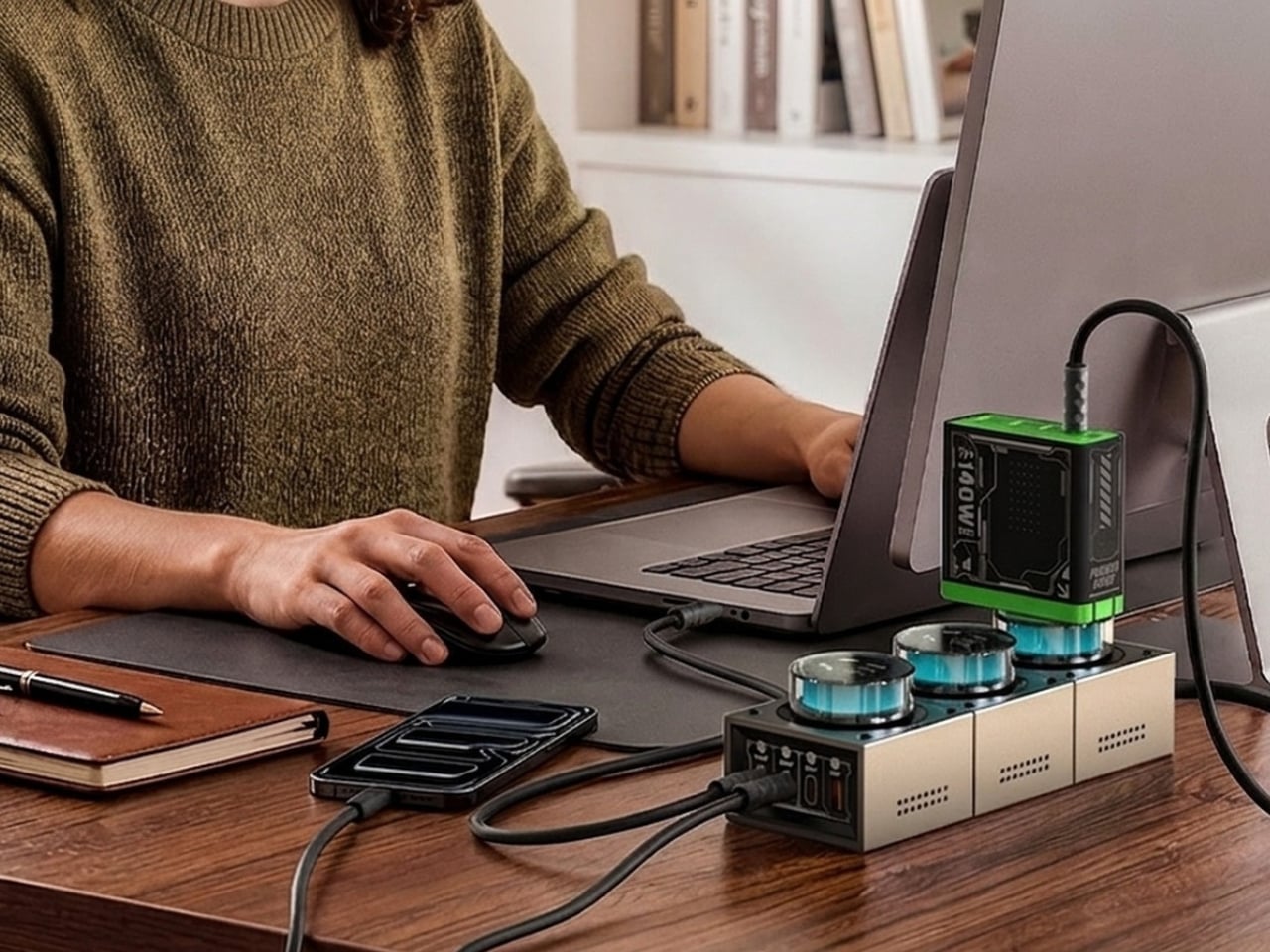
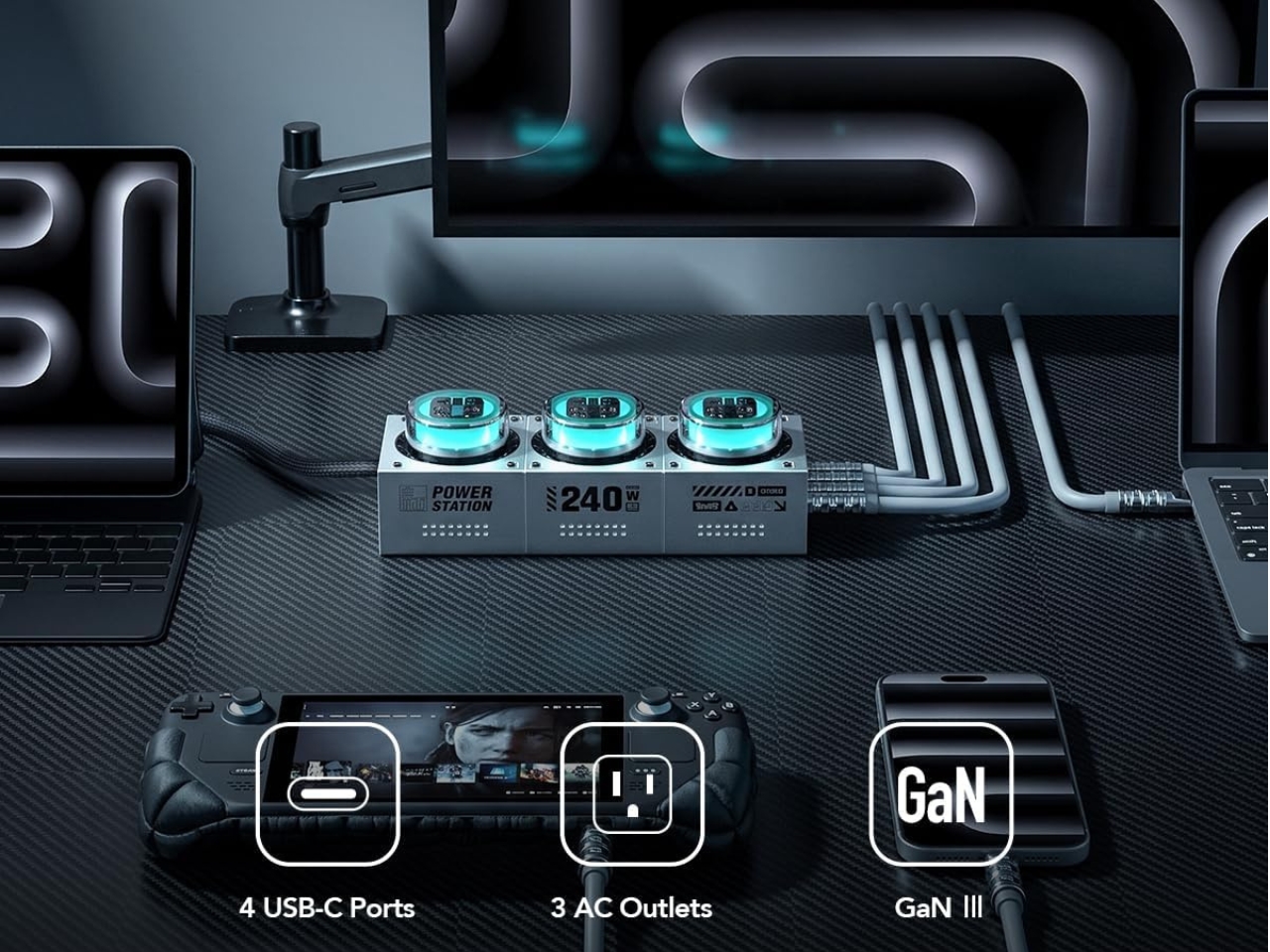
At some point, most of us made peace with the idea that the charging situation on our desks would always be a little ugly. A tangle of cables running to a flat power strip wedged behind the monitor, a USB hub perpetually on the verge of toppling, a wall wart blocking every outlet beside it. We accepted the chaos because the alternative was supposedly to sacrifice power for aesthetics, or aesthetics for power. The MFish E-Tank 7-in-1 Desktop Charging Station argues that’s a false choice. After looking closely at what this thing actually delivers, I think it has a strong point.
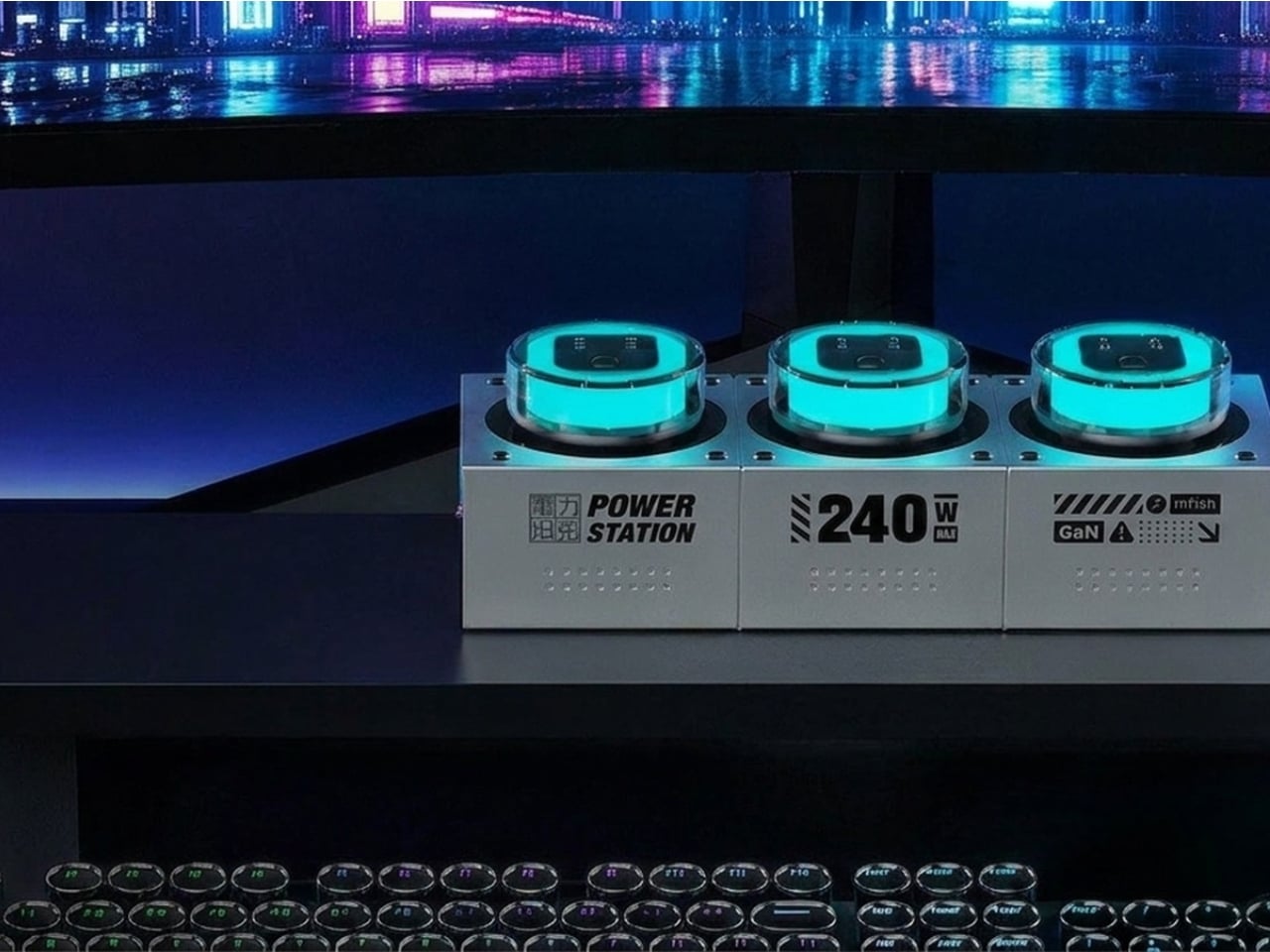
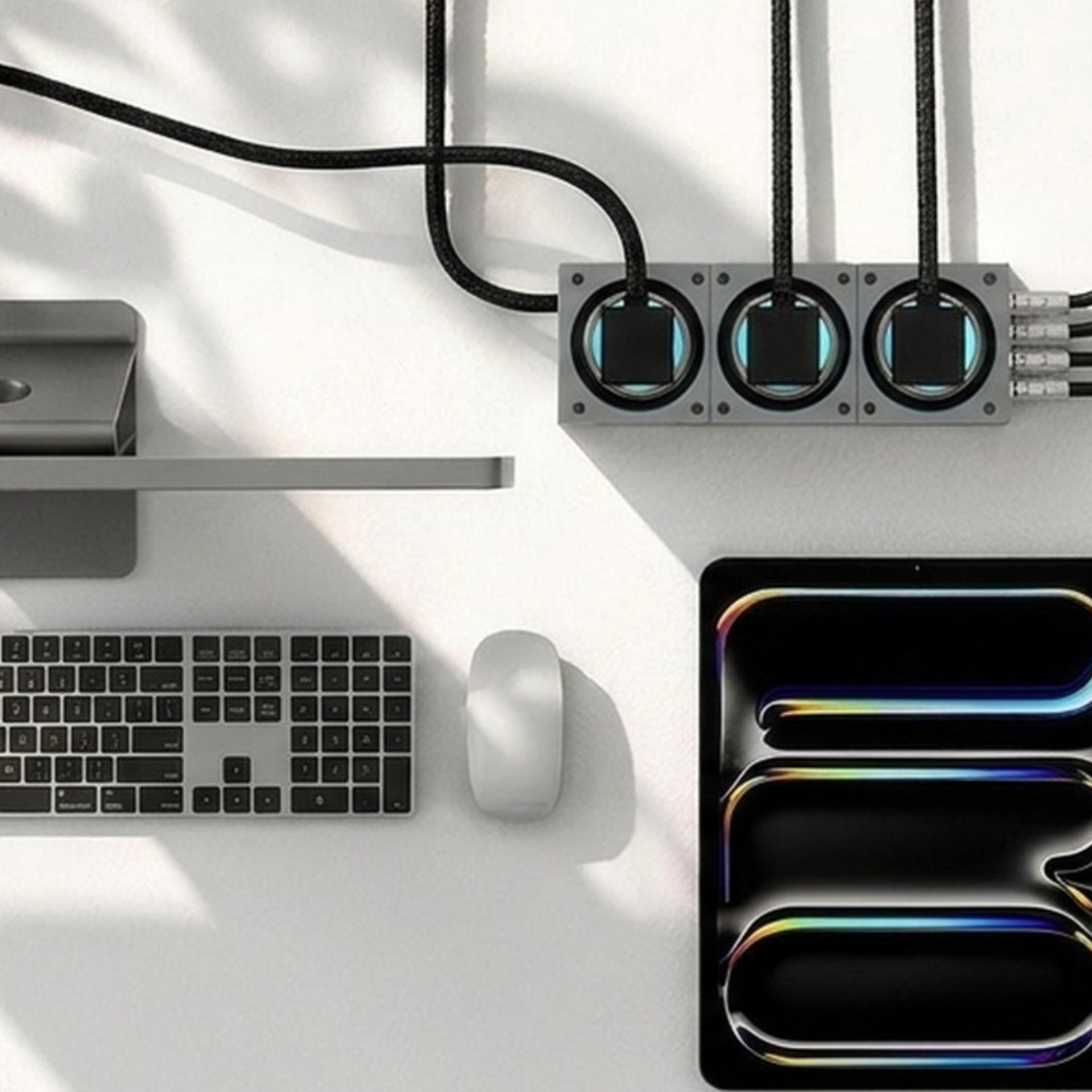
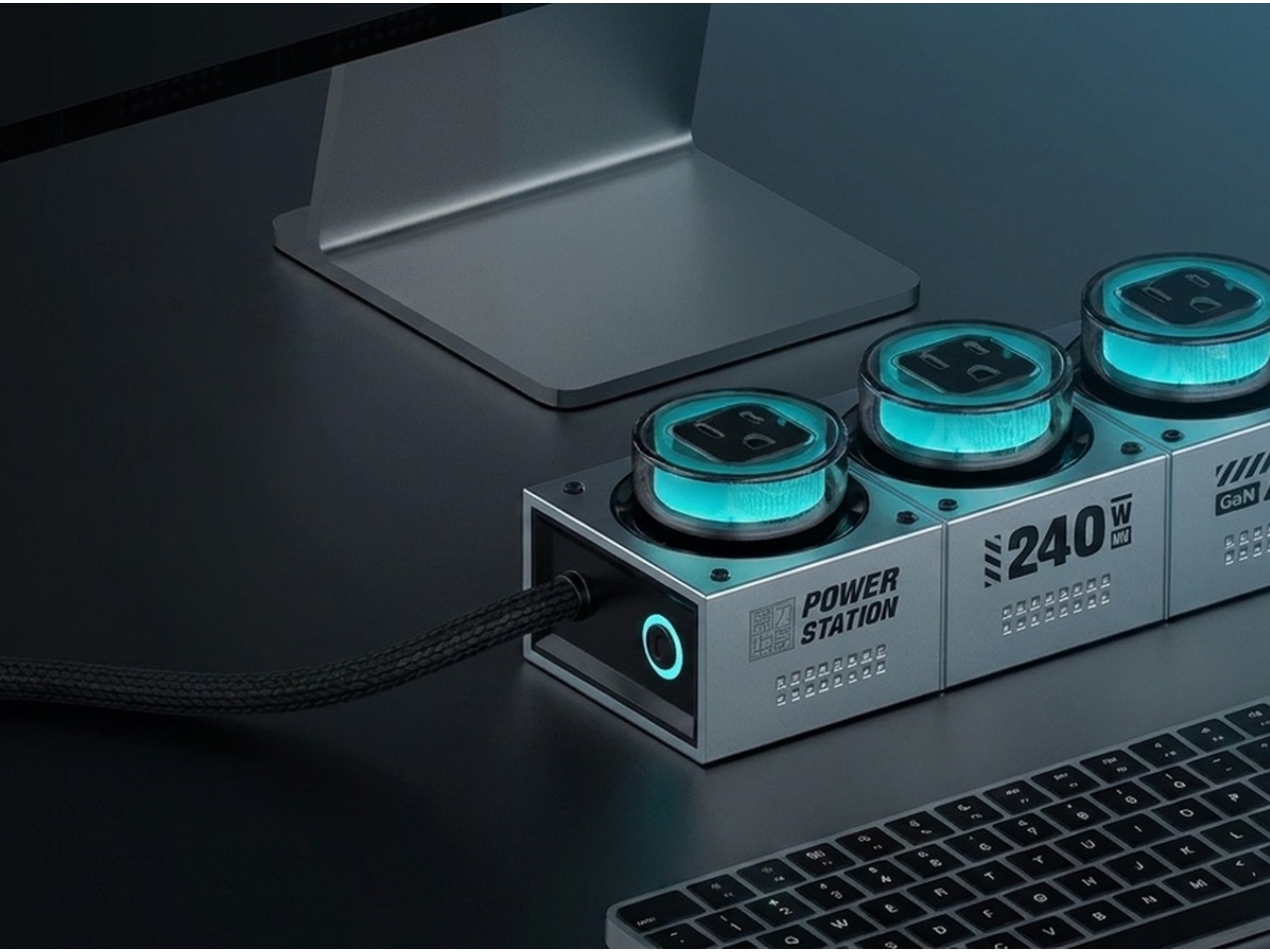
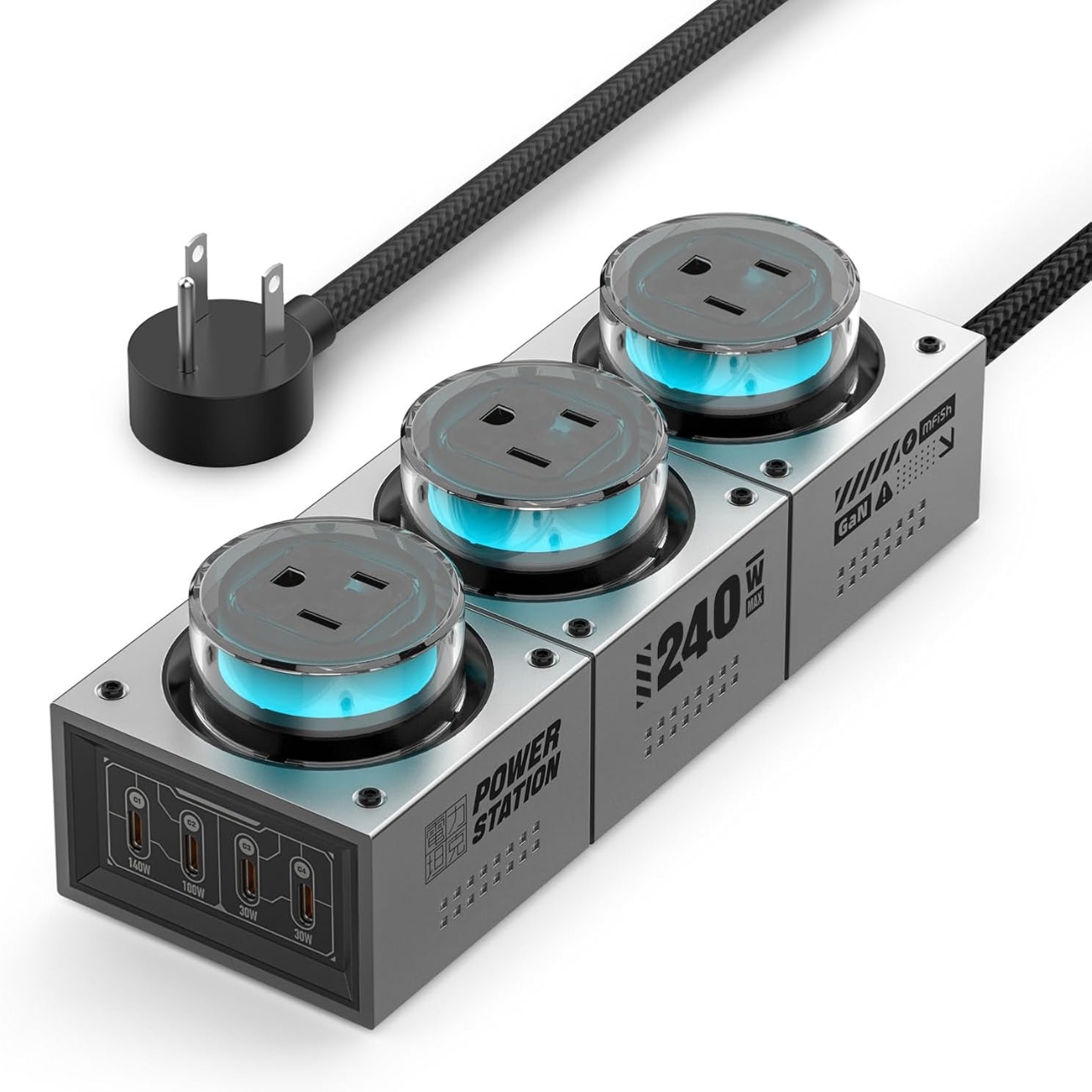
The E-Tank brings four USB-C ports and three AC outlets into a single compact station, pushing up to 240 watts of total shared output and up to 140 watts through a dedicated USB-C port via PD 3.1 fast charging. That single-port output alone can charge a MacBook Pro 16″ to 50% in roughly 30 minutes, which is the kind of performance that used to require a dedicated wall brick eating up half a power strip on its own. The three AC sockets are generously spaced, too, so chunky adapters actually fit side by side without blocking each other. That detail alone signals that the designers thought practically first and aesthetically second, which is the right order for hardware that has to work every day.
What powers all of this under the hood is GaN 6.0, the latest iteration of gallium nitride technology that has been quietly rewriting the rules of compact charging hardware for a few years now. Compared to traditional silicon-based designs, GaN runs cooler, delivers more power in a smaller form factor, and tends to be more energy-efficient overall. MFish pairs it with smart load-balancing zones that automatically adjust output based on what’s connected, so a power-hungry laptop and a low-demand pair of earbuds aren’t competing for the same allocation. It’s the kind of intelligent background function that doesn’t announce itself loudly, but you feel its absence when it’s not there.
The design is where things get genuinely interesting. The E-Tank doesn’t look like a power station. It has a clean, upright form, an anti-slip suction cup base that keeps it anchored to your desk, and a touch-controlled RGB ambient light ring that can cycle through colors and modes or switch off entirely for a more understated look. The fact that it also comes in a soft pink colorway alongside the standard version is a deliberate design choice I appreciate. It signals that MFish isn’t building exclusively for the gaming setup crowd, and that charging hardware doesn’t have to default to aggressive all-black aesthetics to be taken seriously as a product.
The RGB feature will split people, and that’s fair. If your workspace leans professional or minimal, even a soft ambient glow can feel like noise. But the touch control makes switching it off immediate and simple, so it reads as a bonus layer rather than a core identity. I’d call it an optional mood element rather than a defining one, which is exactly how these things should work.
At $129.99, the E-Tank isn’t budget-range, but it’s reasonably priced given what it covers. Seven ports across two format types, GaN 6.0 internals, dual-zone protection running continuously, and a form compact enough to sit on your desk without dominating it. Compare that to piecing together a separate USB-C hub, a power strip, and a standalone fast charger, and the cost starts to feel more proportional fairly quickly.
The larger statement the E-Tank makes is one the tech industry has been slow to fully absorb: the tools and accessories that live on your desk every single day deserve the same level of design intention as the devices they support. A charging station isn’t just utility infrastructure. For most people, it’s one of the most-used objects in their entire workspace. A product that handles serious power while still looking considered and intentional is a genuinely different thing to own, and MFish is making a real case for that with this one.
If you have ever charged a Xiaomi phone with the bundled brick, there is a decent chance CUKTECH’s engineers had a hand in it, even though the name never made it onto the packaging. The company started in 2016 as a straight up OEM, building chargers behind the scenes for Xiaomi and other big players, before merging with ZMI in 2022 and finally launching products under its own name. It is the classic story of a supplier deciding it was tired of being invisible.
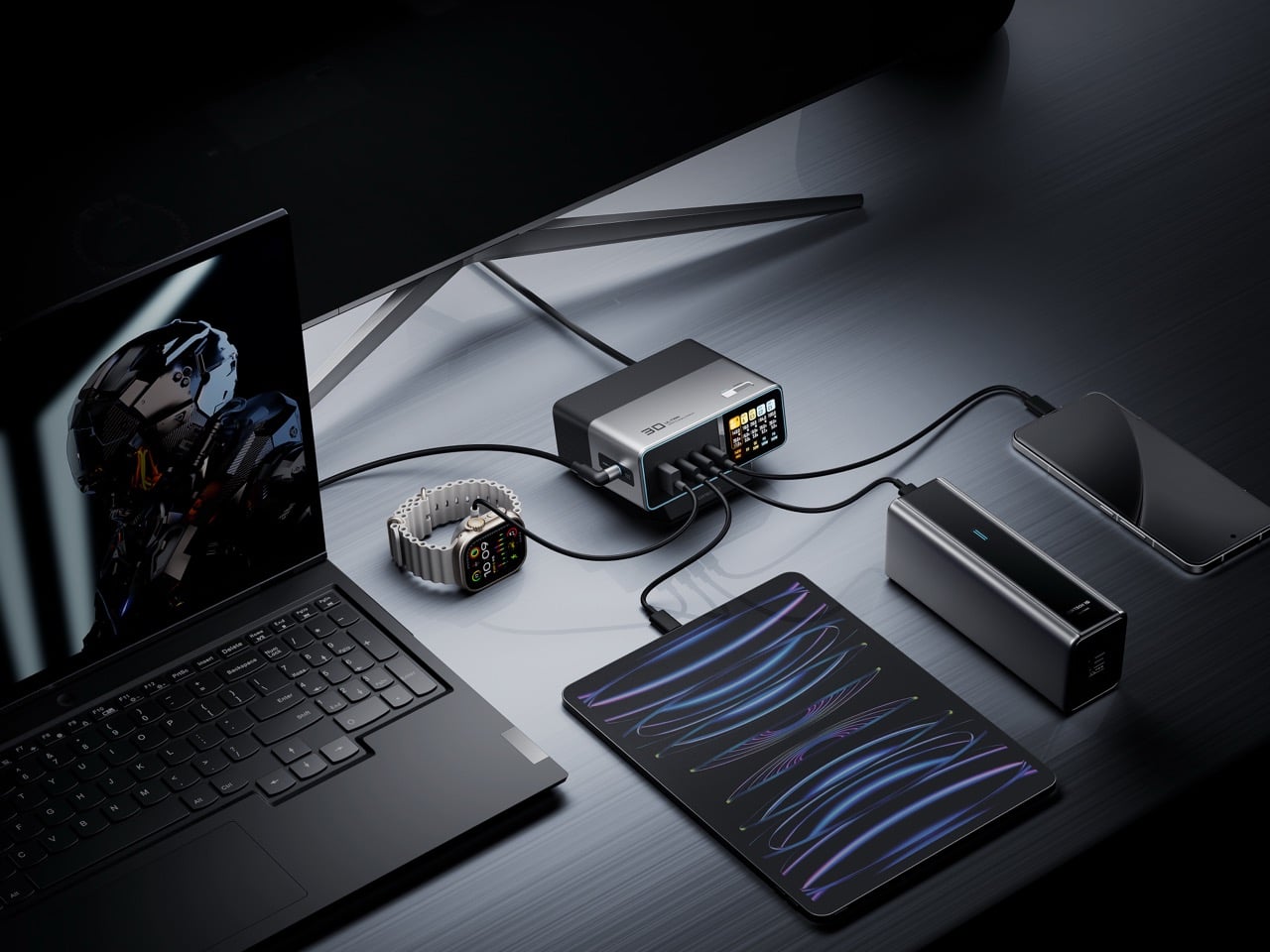
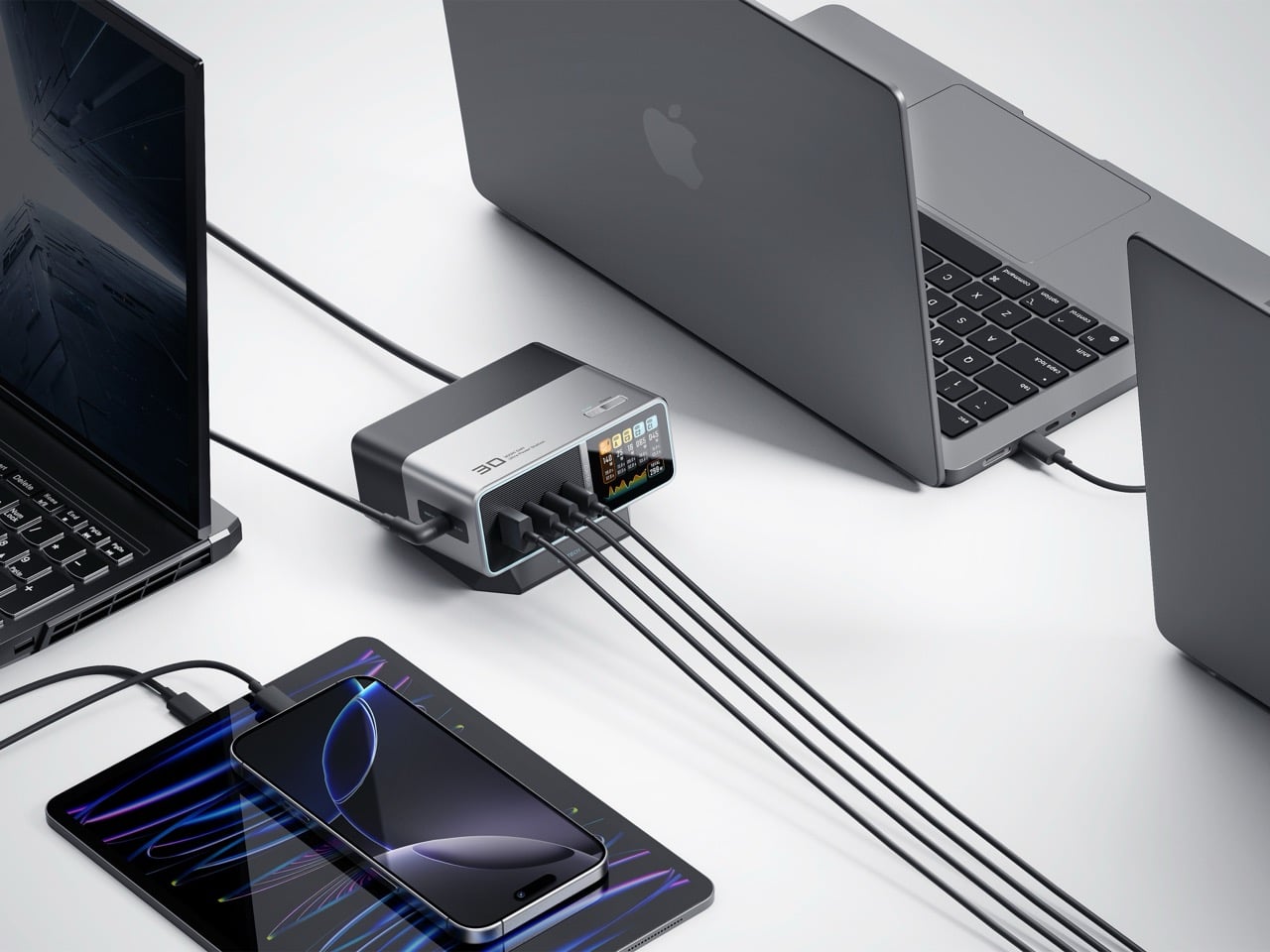
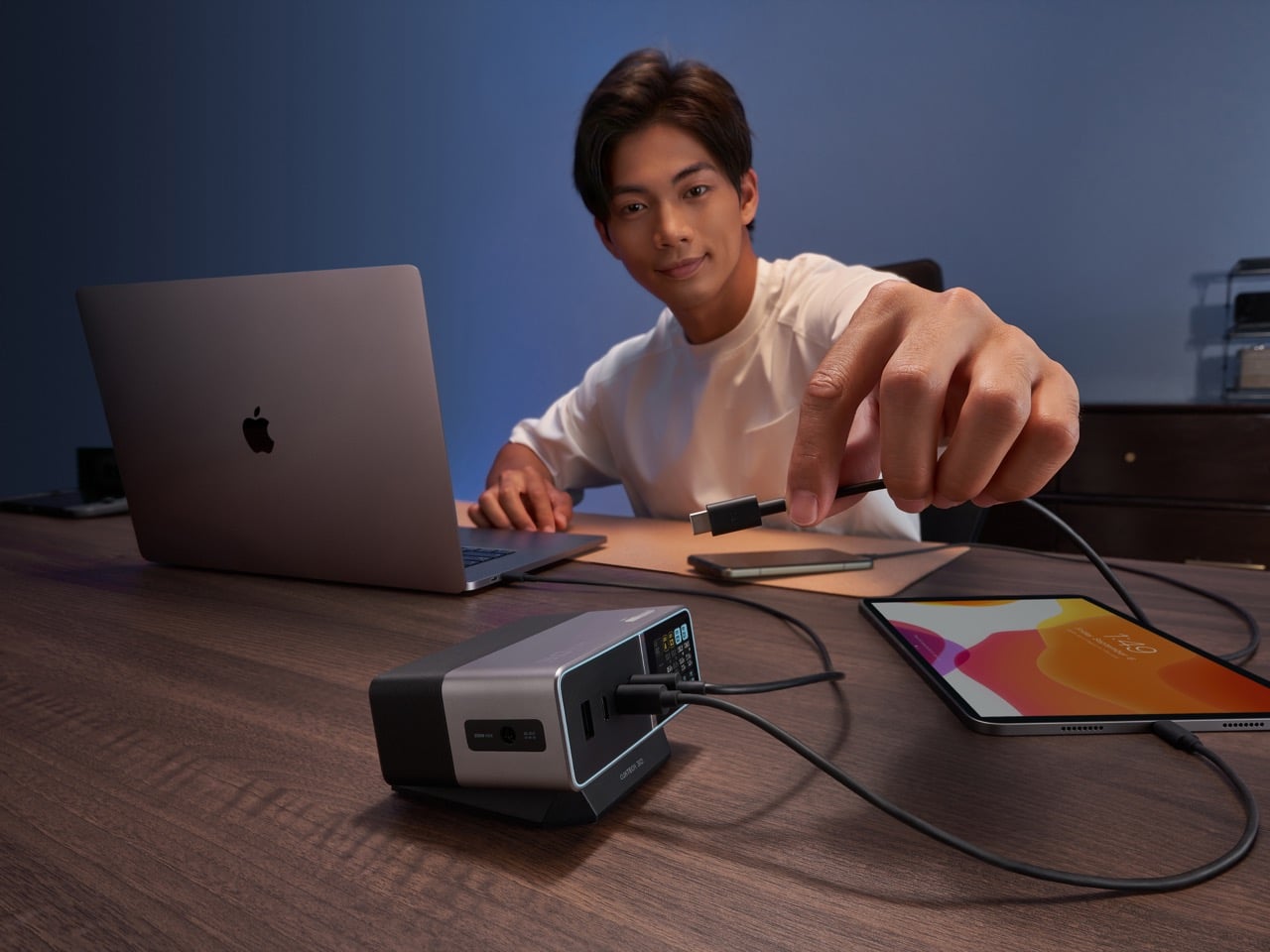
That decision has paid off. The CUKTECH 30 Charging Station Ultra just picked up two wins at the European Product Design Award, one for computer accessories and one for office appliances, thanks to a 300W GaN powered design from Chong Wang and Ziyao Wang. We have followed the brand’s climb as its power banks and chargers kept getting screens, better materials, and sharper industrial design with every release. This latest charging station, with its five ports and a live readout of exactly what your gear is pulling, is the moment the sleeper brand stops sleeping.
Designers: Chong Wang & Ziyao Wang
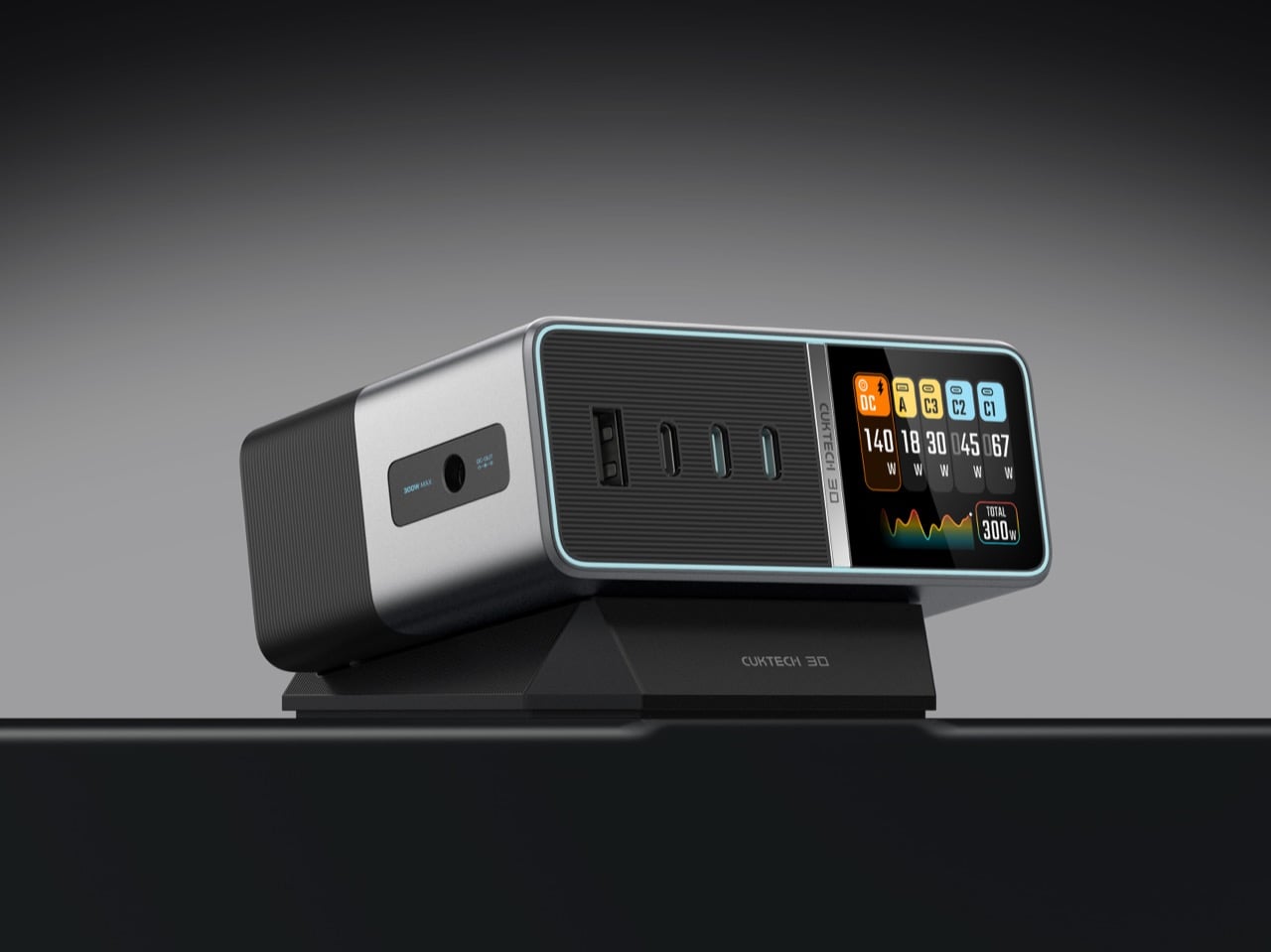
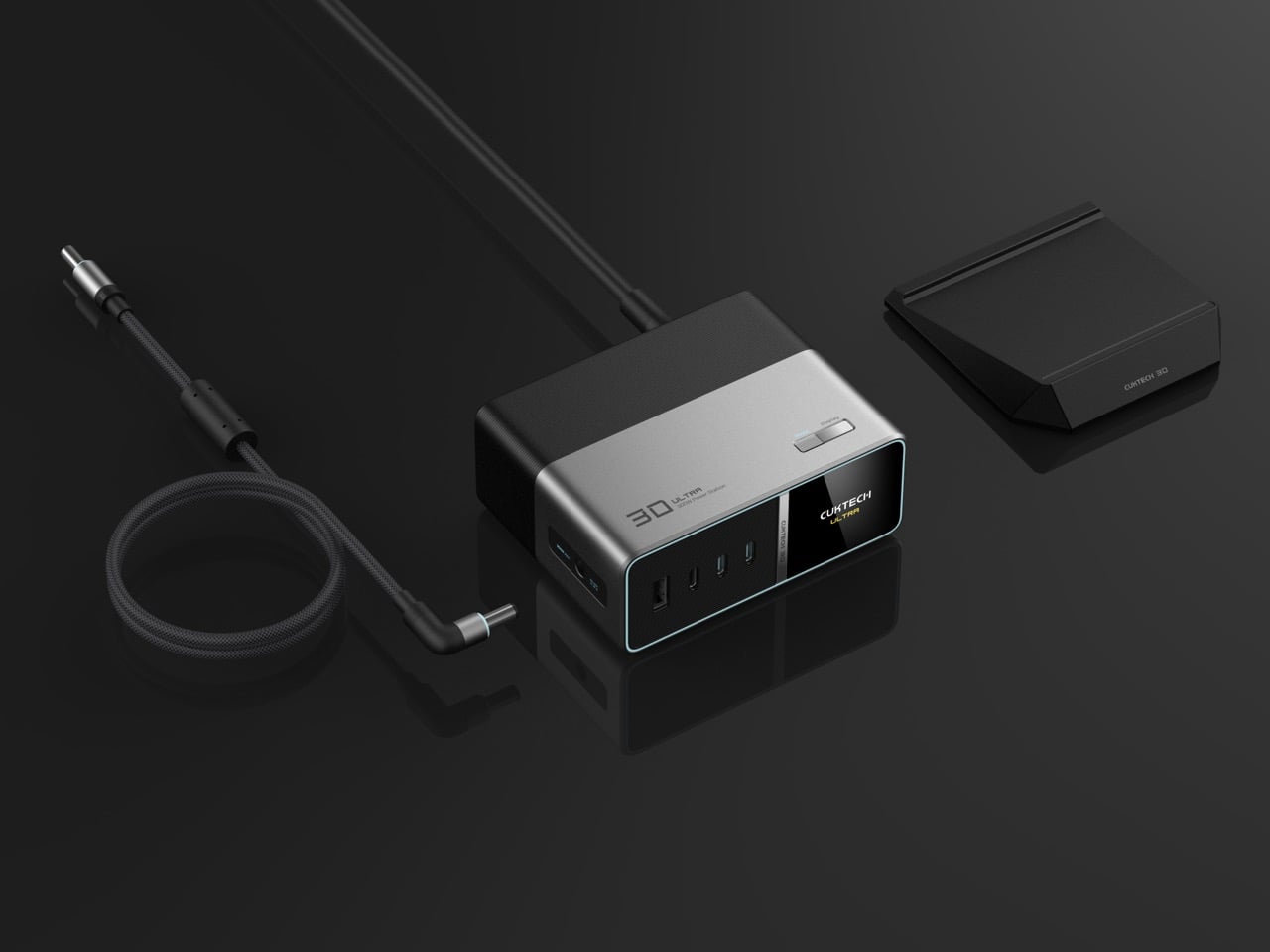
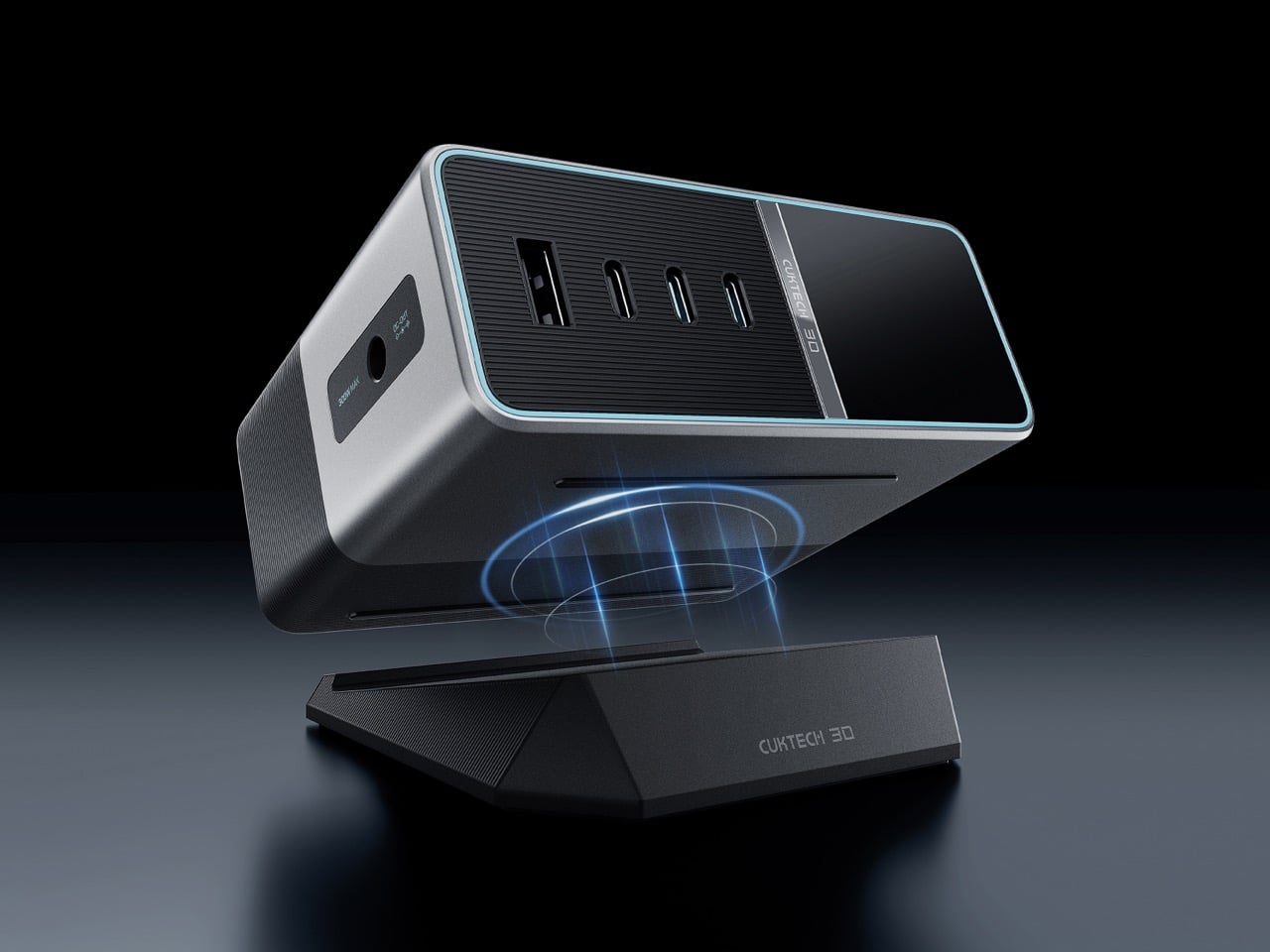
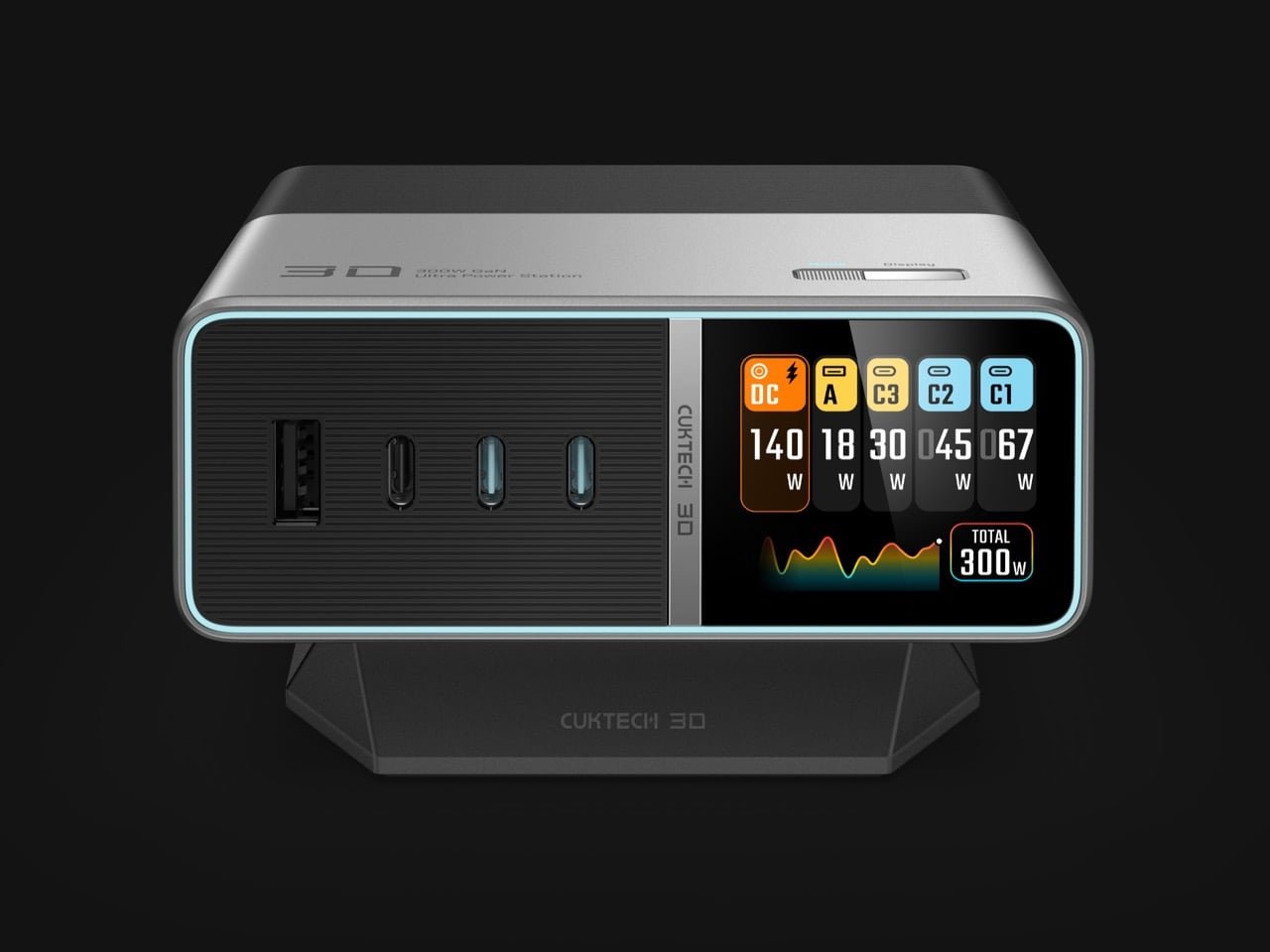
Three USB-C ports, one USB-A port, and a dedicated DC output share the front face, and together they can push out up to 300W total. The two primary USB-C ports handle up to 140W each under PD 3.1, which covers most modern laptops without breaking a sweat, but the real number only shows up when you route power through the DC port. That single line is built to talk directly to compatible laptops and can hit the full 300W ceiling on its own, essentially replacing the oversized proprietary brick that usually ships in the box. I have three of those bricks sitting in a drawer right now doing absolutely nothing, and a single box that can outmuscle all of them at once is exactly the kind of consolidation I did not know I needed.
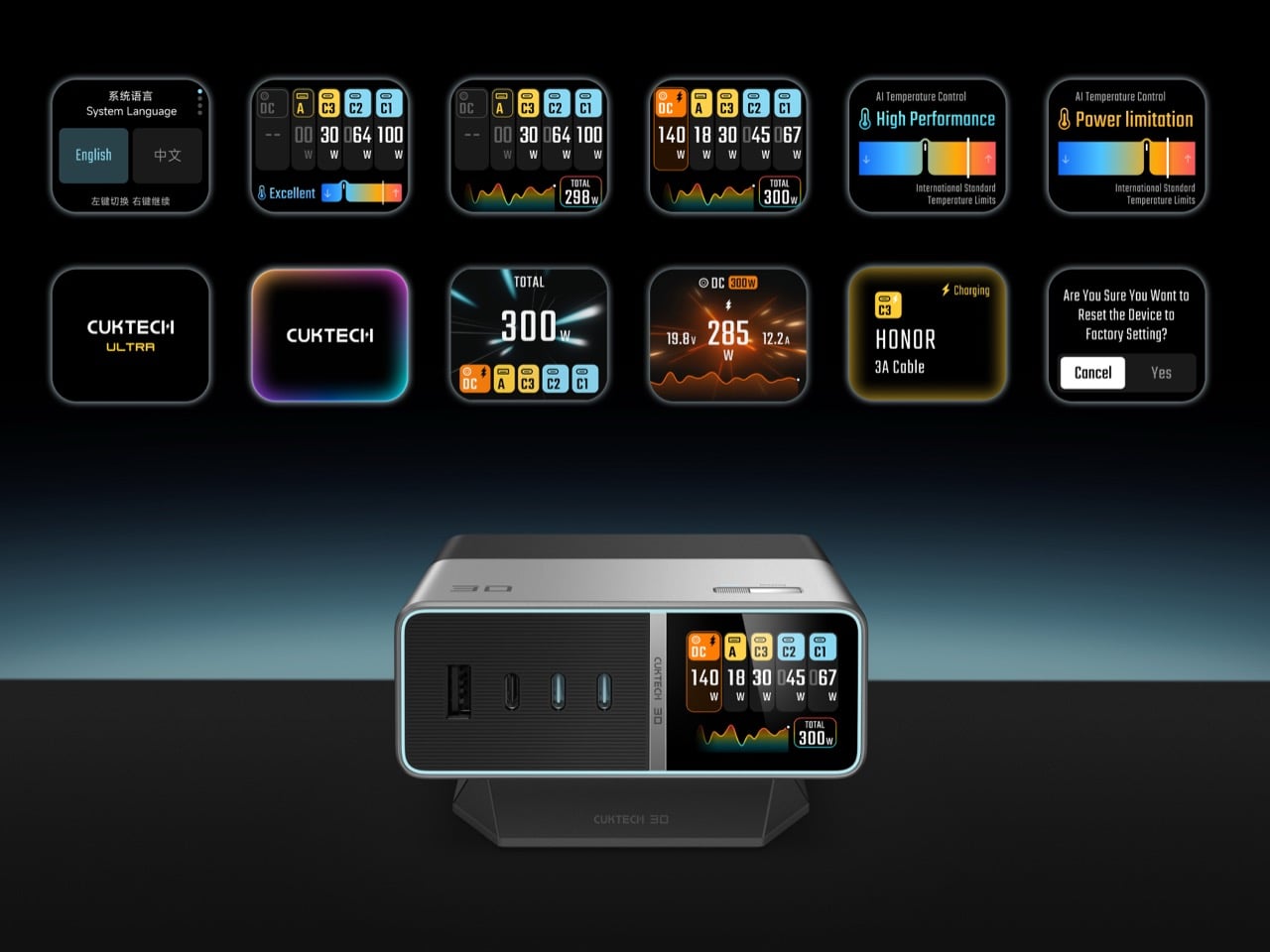
Third generation GaN sits at the core of the whole system, paired with what CUKTECH calls a PFC plus LLC dual architecture, a combination chosen specifically to keep five simultaneous charging sessions stable without the unit turning into a space heater. Gallium nitride has become the default material for anyone chasing high wattage in a small footprint, since it switches more efficiently than older silicon designs and sheds heat faster under sustained load. Thirteen fast charging protocols are baked in, including PD 3.1, PPS, Xiaomi’s own 120W standard, UFCS, Huawei SCP, and both QC and AFC, which is a genuinely broad net for a single charger to cast. Intelligent power allocation reads what is plugged in and redistributes wattage on the fly, with specific tuning for handhelds like the Steam Deck and ROG Ally that tend to confuse less sophisticated multi port chargers.
A 1.83 inch IPS display sits front and center, color coded per port, tracking wattage, voltage, and current across all five connections in real time, with a small running graph of total load underneath. Most chargers ask you to trust a single LED and hope for the best. This one just tells you, continuously, which is a small shift that changes how the object feels to live with on a desk. Nine layers of protection cover temperature, over-voltage, and over-current scenarios, which matters more than usual given how much power is moving through a chassis this size.
The form itself leans minimal, angled slightly on a magnetic tilting base so the screen stays readable without craning your neck, and finished in a two tone silver and black that reads more like studio monitor than power strip. A right angle DC cable keeps the desk tidier than the usual straight jack, and the grounded three pin AC cable is a small nod to safety that a lot of competitors skip to save a few cents.
None of this would matter much if the pricing did not make sense, and at $159.99 it lands right where a serious desk upgrade should, undercutting rivals capped at 140W or 200W while offering meaningfully more headroom. CUKTECH spent a decade building other companies’ chargers before it ever put its own name on a box. Two design award wins later, it is clear that decade taught them exactly which details actually matter.
At some point, most of us stopped caring what our charging setup looks like. A tangle of cables here, a plastic brick there, maybe a few adapters scattered across the desk like tech confetti. It works, so why fuss? London-based design studio LAYER is making the case that we’ve been setting the bar way too low, and once you see Node and Loft, it’s pretty hard to disagree.
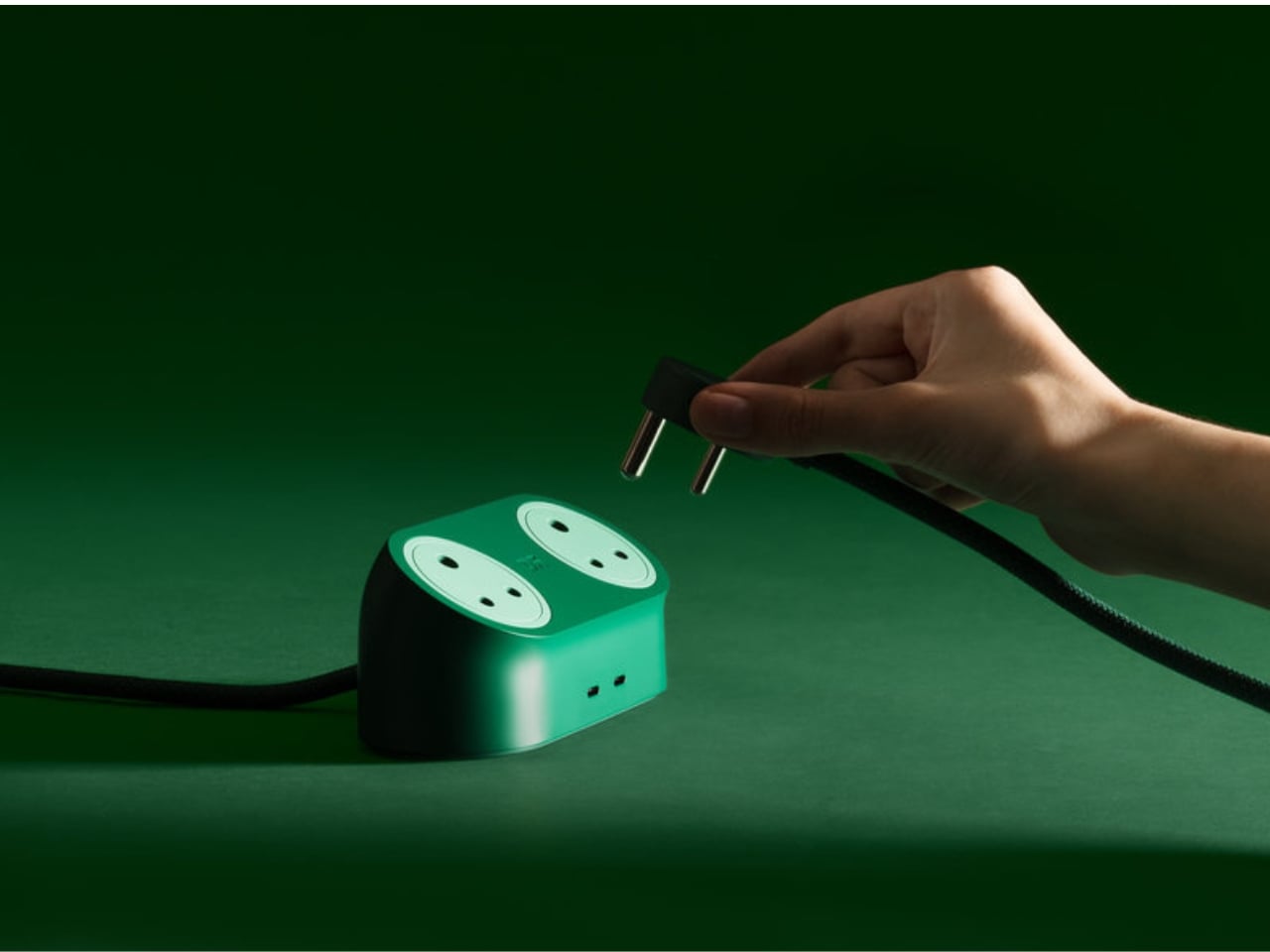
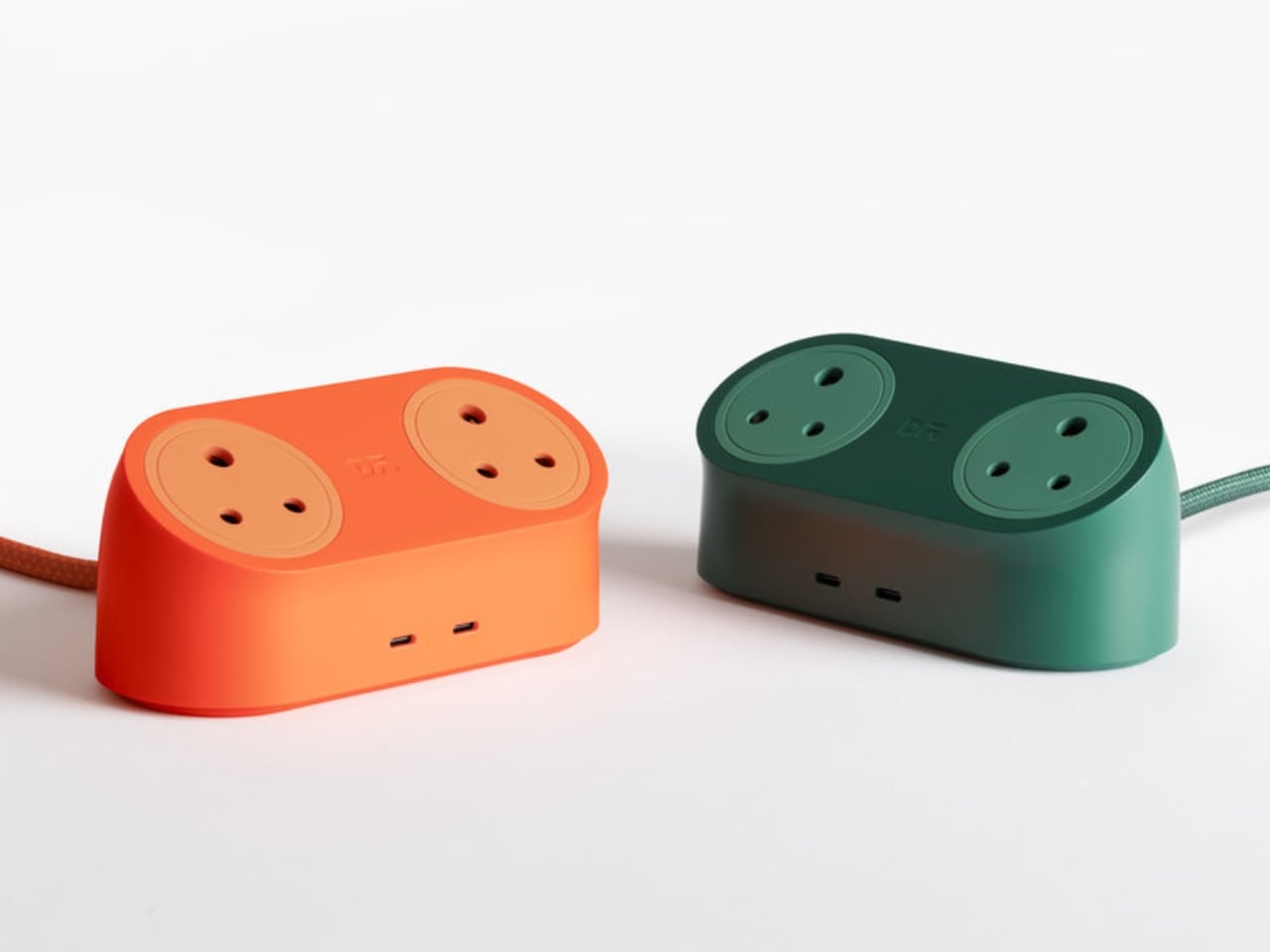
LAYER, the studio founded by award-winning British designer Benjamin Hubert, recently unveiled Node and Loft, a new family of charging products developed for lifestyle brand Daily Objects. The premise is simple but smart: what if your charging accessories actually looked like something you chose on purpose?
Node is the modular piece of the duo, and it’s genuinely clever. Built around a one-wire setup, it works as either a 2-in-1 or 3-in-1 dock, with four interchangeable modules to mix and match: a Wireless Charging Phone Stand, a Wireless Charging Disk, an Apple Watch Charging Stand, and a Portable Lamp. Each module clicks in when you need it at the desk and lifts off just as easily when you’re heading into a different room or packing a bag. The whole thing feels less like cable management and more like a system you’d actually enjoy using.
Loft, the other half of the collection, is a 65W charging station designed to sit on your desk without apology. It handles up to four devices at once, mains and USB-C included, all packed into a compact, sculptural form that looks far more intentional than what most charging stations have to offer. The silhouette is arched and minimal. The materials feel considered. It’s the kind of object you leave out because you want to, not because you forgot to tidy it away.
What LAYER has done here, and what makes this more than just another tech accessory launch, is commit fully to a design language rather than just a functional brief. Soft forms, arched silhouettes, tactile materials, a recurring circular charging motif: it all adds up to something cohesive. The goal isn’t just to make charging look prettier. It’s to make it feel like part of how you live, whether at a home desk, in a hotel room, or on a kitchen counter.
Hubert described charging as “one of the most repeated interactions in daily life, yet the products that enable it are often treated as background objects.” That observation is so obvious you’d think more designers would have acted on it sooner. The ugly charging block has been a design blind spot for years, and the solutions that have come before Node and Loft have largely fallen into two camps: clinical and all-white, or trying so hard to look “lifestyle” that they end up feeling performative. Node and Loft feel like neither. They feel like objects with actual personality.
For Daily Objects, an Indian lifestyle brand that’s been steadily building a reputation for design-forward tech accessories, collaborating with LAYER on this makes a lot of sense. The studio is known for a philosophy rooted in what Hubert calls humanising technology, taking things that usually feel cold or utilitarian and giving them warmth and presence. That’s a harder balance to strike than it sounds, especially in a category as commoditised as charging hardware. It’s a thread that runs consistently through LAYER’s work, and it’s very visible here.
The broader trend Node and Loft belong to is worth paying attention to. We’re moving away from the idea that tech accessories have to look like tech accessories. People are putting more thought into how objects feel in a space, not just how they function in one. The line between product design and interior design keeps getting blurrier, and collections like this one are a big reason why.
You probably don’t spend a lot of time thinking about where your charger lives on your desk. Node and Loft are betting that, given the right option, you might start.
Every January, the Las Vegas Convention Center fills up with ideas that sit somewhere between prototype and inevitability. Some will vanish after a single news cycle, but a few feel like early drafts of how we will actually live with technology, once the spectacle wears off and the hardware shrinks into something you can forget about until you need it. Those are the ones worth bookmarking, the quiet experiments that hint at new categories rather than just new specs.
This year’s crop of emerging tech has a very particular flavor. Robots are edging closer to being housemates instead of stage acts, ambient objects are getting just enough AI to feel expressive rather than chatty, and work gear is evolving into compact appliances that reclaim space instead of stealing it. None of these ideas are mainstream yet, but they are all far enough along that you can imagine them in your home or on your desk, which is exactly what makes them so interesting to watch.
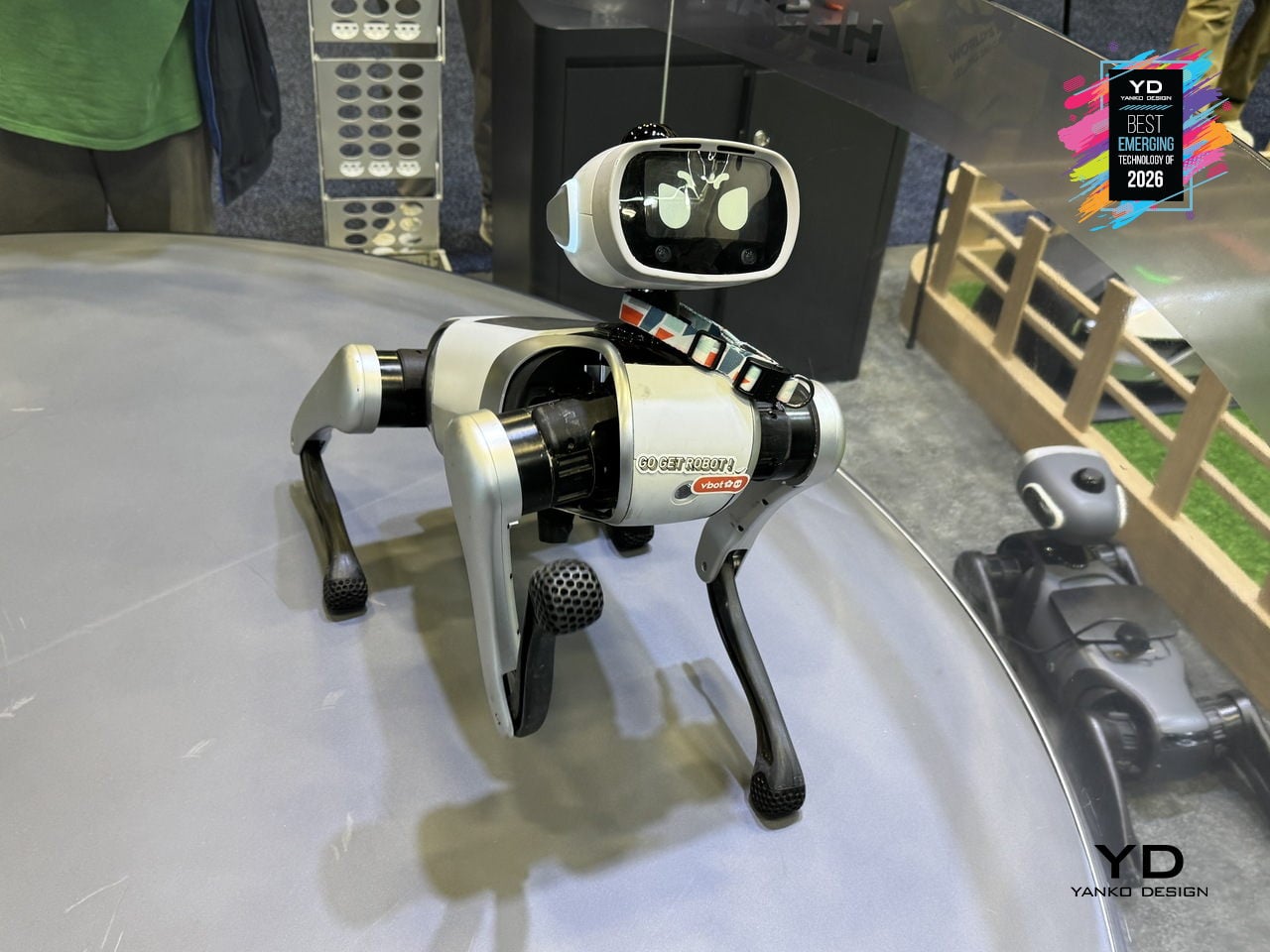
Vbot Companion Robotic Dog
Most quadruped robots people have seen are either industrial, loud, or built for stage demos rather than living rooms. Vbot is a companion robotic dog engineered around a single principle, Made to Be Near, designed for safe, quiet, human-scale proximity. The rounded body has no sharp edges, pinch-free joints maintain 2.5cm safety gaps, and soft-touch mesh covers the mechanical core. Low-noise locomotion using 3D-printed shock-dampening feet and tuned motors makes it quiet enough to watch over a sleeping baby.
Vbot’s social intelligence turns that safe form into something that feels alive and helpful. It interprets natural-language commands through tone, context, and meaning, understanding verbs like bring, follow, lead, show, or find without a remote. Agent intelligence breaks down objectives into steps, guiding visitors, escorting someone along a route, or positioning itself as a camera buddy for hands-free filming. It matches walking pace and repositions for better engagement.
Under the skin, embodied and spatial intelligence allow Vbot to operate as a real physical agent. Its legs use 22cm segments proportioned to match 18-20cm stair standards, giving it leverage to climb steps where wheeled robots struggle. A proprietary N45 motor delivers more torque at 25% less weight, while a 594Wh battery supports more than five hours of outdoor operation. A perception system with 360-degree LiDAR and UWB positioning understands paths and obstacles without cloud latency.
Vbot signals an early consumer-grade physical AI category. Unlike robots adapted from industrial platforms, it is built from scratch around close human proximity, readable motion based on animation principles, reliable battery life, and modular interfaces for cargo baskets, cameras, and tow carts. Its three-layer intelligence, embodied, spatial, and agent, points toward robots that are sociable enough to join you outside, smart enough to anticipate intent, and gentle enough to belong in family spaces.
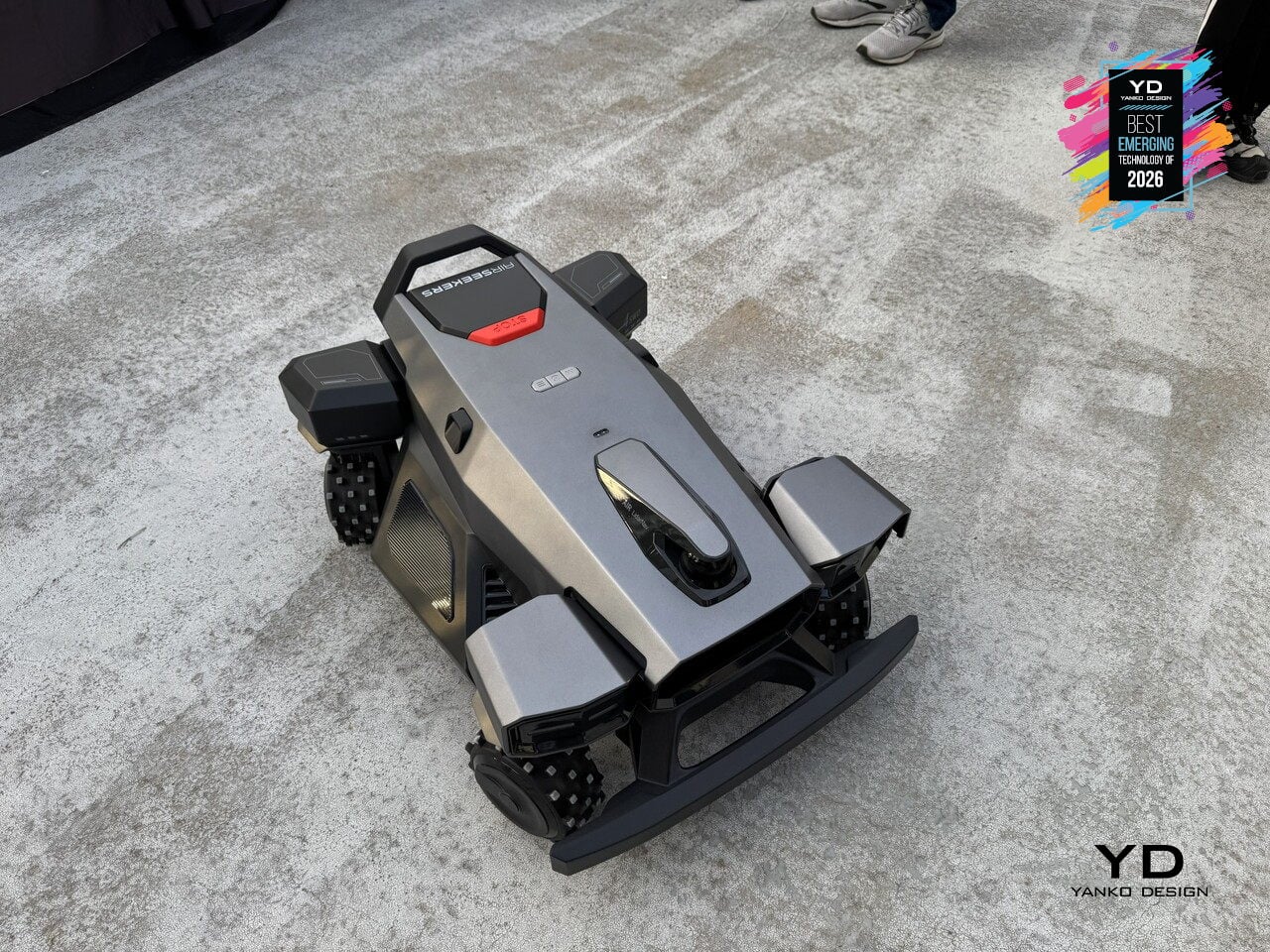
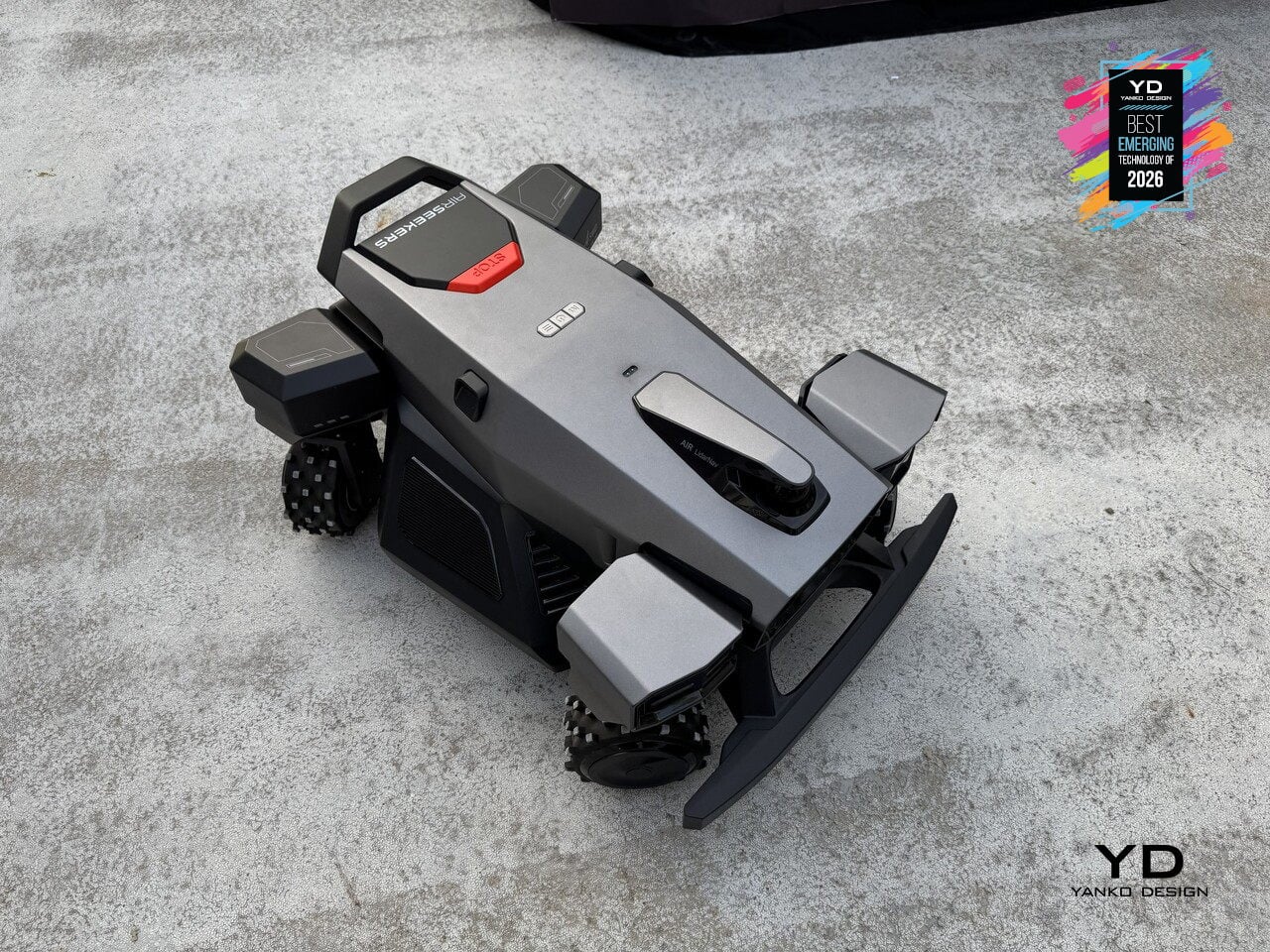
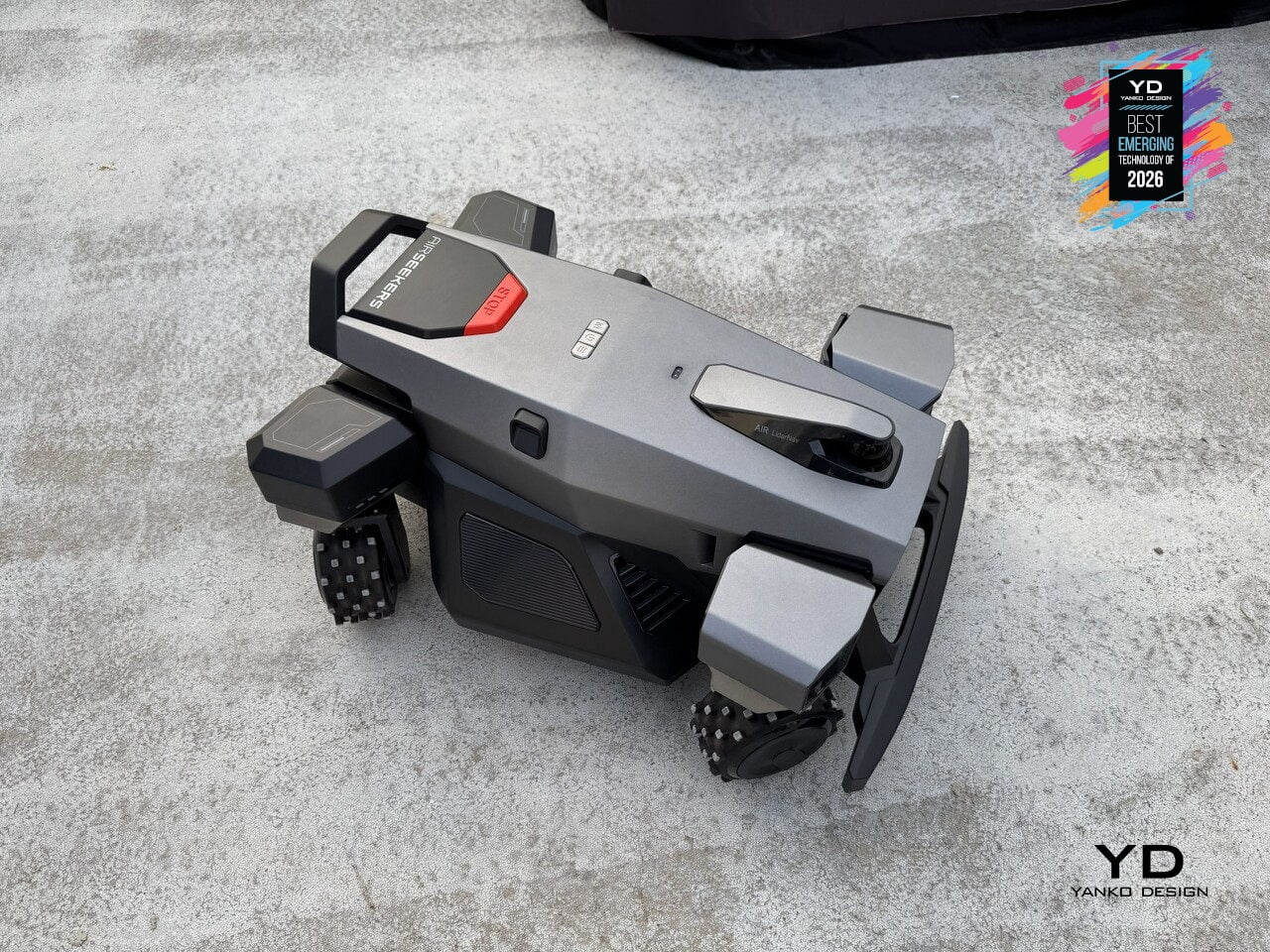
Airseekers Tron Ultra Robotic Lawn Mower
Robotic mowers have mostly relied on differential steering or front omni-wheels to navigate yards, which works for wide-open lawns but struggles with tight corners and complex obstacles. Airseekers Tron Ultra uses a 4SWD drive system with independent control of each wheel, allowing it to move in ways that feel closer to industrial robotics than consumer lawn care. The mower can rotate in place without a turning radius, shift laterally, horizontally, or even diagonally through narrow gaps between garden beds, and pivot around obstacles up to 2.36 inches tall without backing up. That four-corner independence changes how the mower approaches difficult terrain. Upgraded high-traction wheels give it the grip to climb inclines up to 85% grade and traverse wet grass without spinning out, while intelligent environmental detection adjusts power distribution per wheel to prevent soil compaction and turf damage.
Under the hood, Omni Navigation combines AI vision sensors, LiDAR, and VSLAM mapping with a 300° field of view to feed real-time data to the 4SWD controller, dynamically adjusting wheel speed and direction as terrain changes. A 594Wh swappable battery supports up to 0.49 acres per charge, with the mower autonomously returning to its dock and resuming exactly where it left off. Paired with 360° radar beacons that eliminate dead zones under trees and around structures, the Tron Ultra reduces manual intervention by over 50% compared to earlier models. It signals a shift from mowers that follow preset patterns to machines that move like outdoor robots, treating lawns as navigable environments rather than obstacle courses.
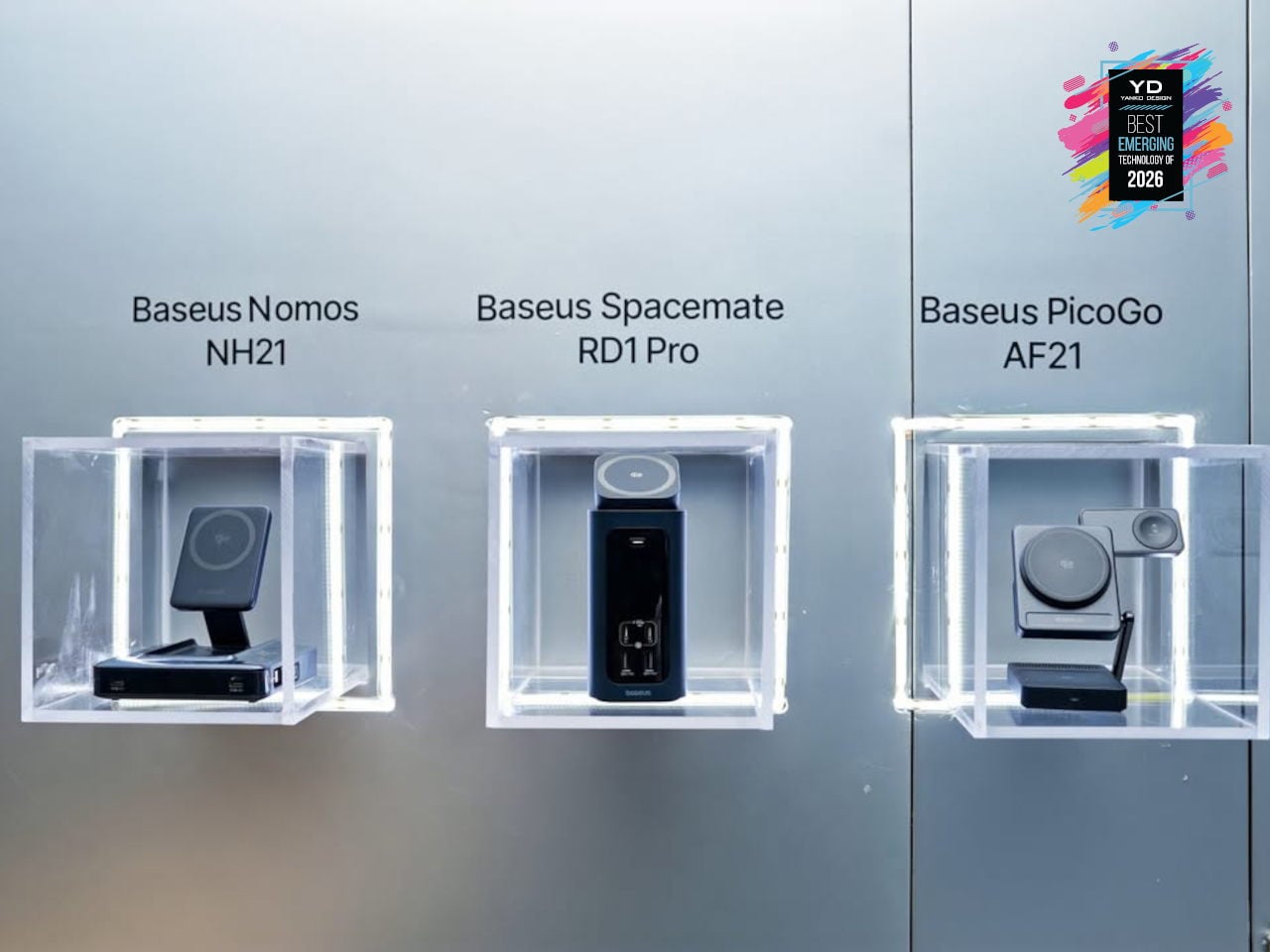
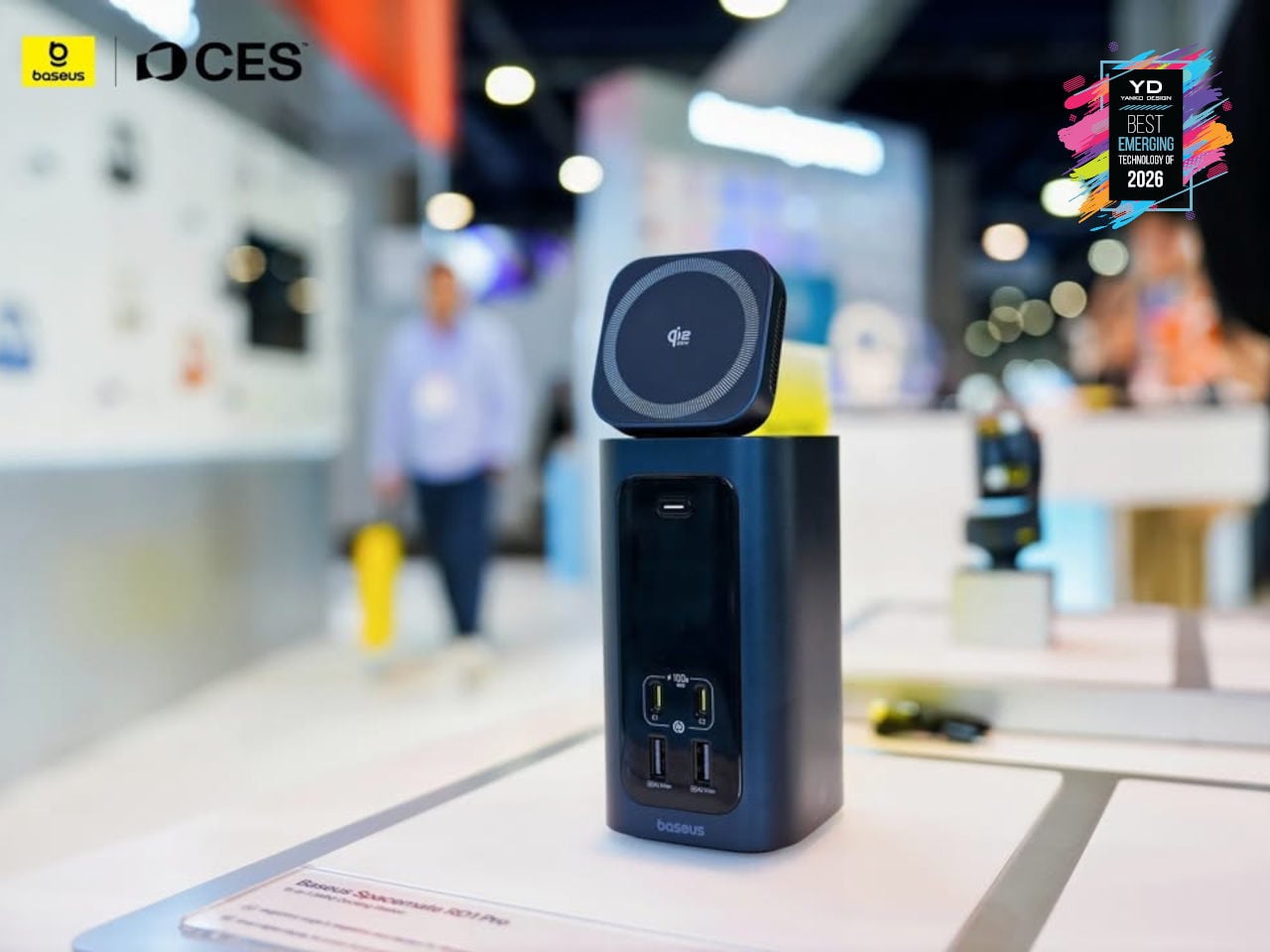
Baseus Spacemate RD1 Pro Desktop Dock
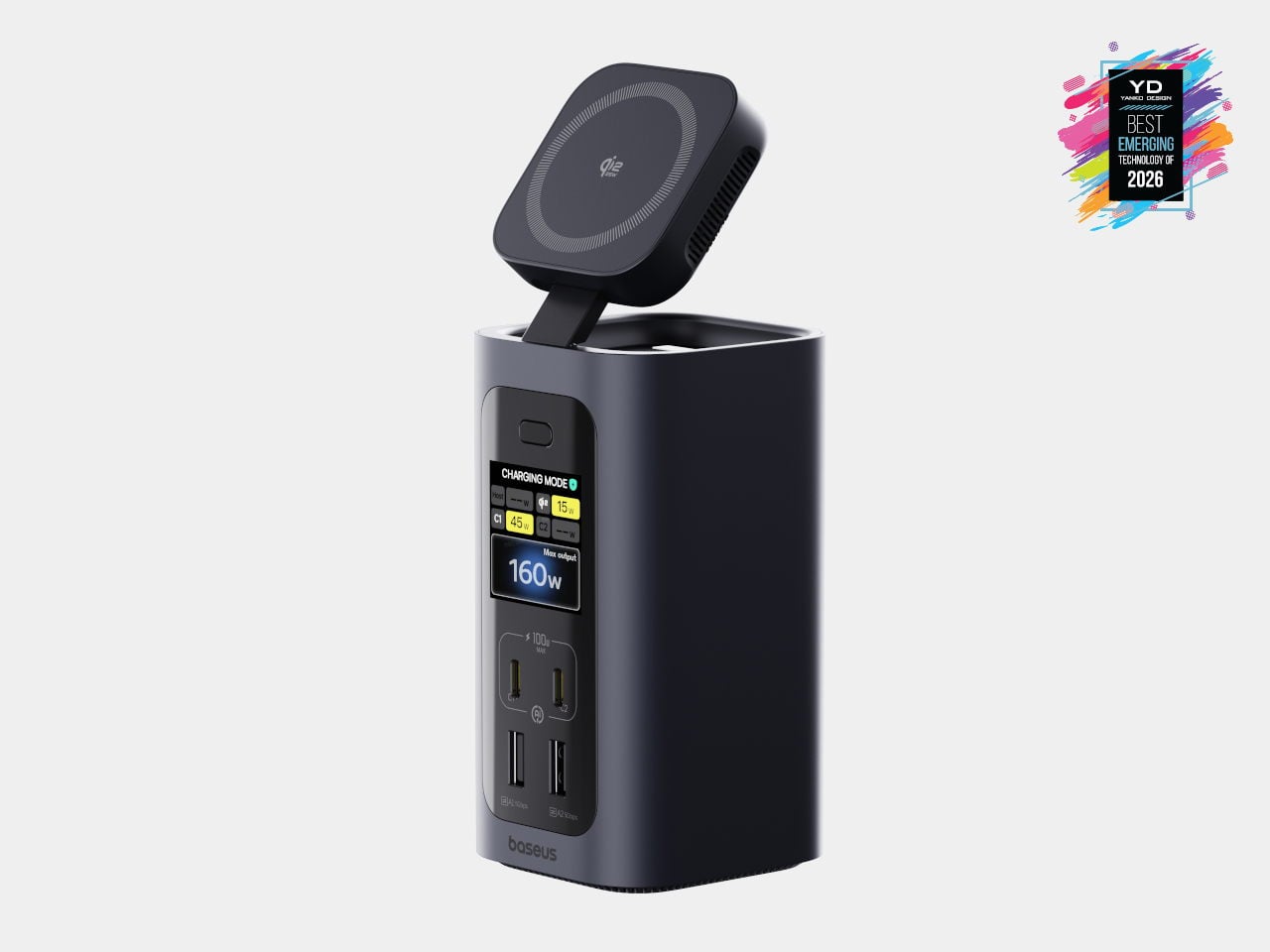
USB-C hubs and flat docks have become standard, but most still sprawl across the desk with cables radiating in every direction. Baseus Spacemate RD1 Pro is a vertical, 15-in-1 docking station that treats the dock as a compact desktop appliance instead of a dongle. A single USB-C cable links a Windows laptop to dual 4K monitors, 10 Gbps USB-C ports, SD and TF slots, and 1 Gbps Ethernet, while the tall, minimalist tower tucks ports on the back and keeps the footprint small.
The Spacemate RD1 Pro merges that connectivity with a serious GaN power stack. An included 180 W GaN adapter feeds up to 160W of total output, with 100W PD reserved for the laptop, dual USB-C 100W-capable fast-charging ports for accessories, and a retractable Qi2.2 25W magnetic wireless pad on top for phones or earbuds. Intelligent power management dynamically allocates power and surfaces status on a front LED display, showing per-port draw and alerts. It feels like an early example of vertical, multifunctional docks becoming central power-and-I/O blocks for increasingly dense, multi-device workspaces.
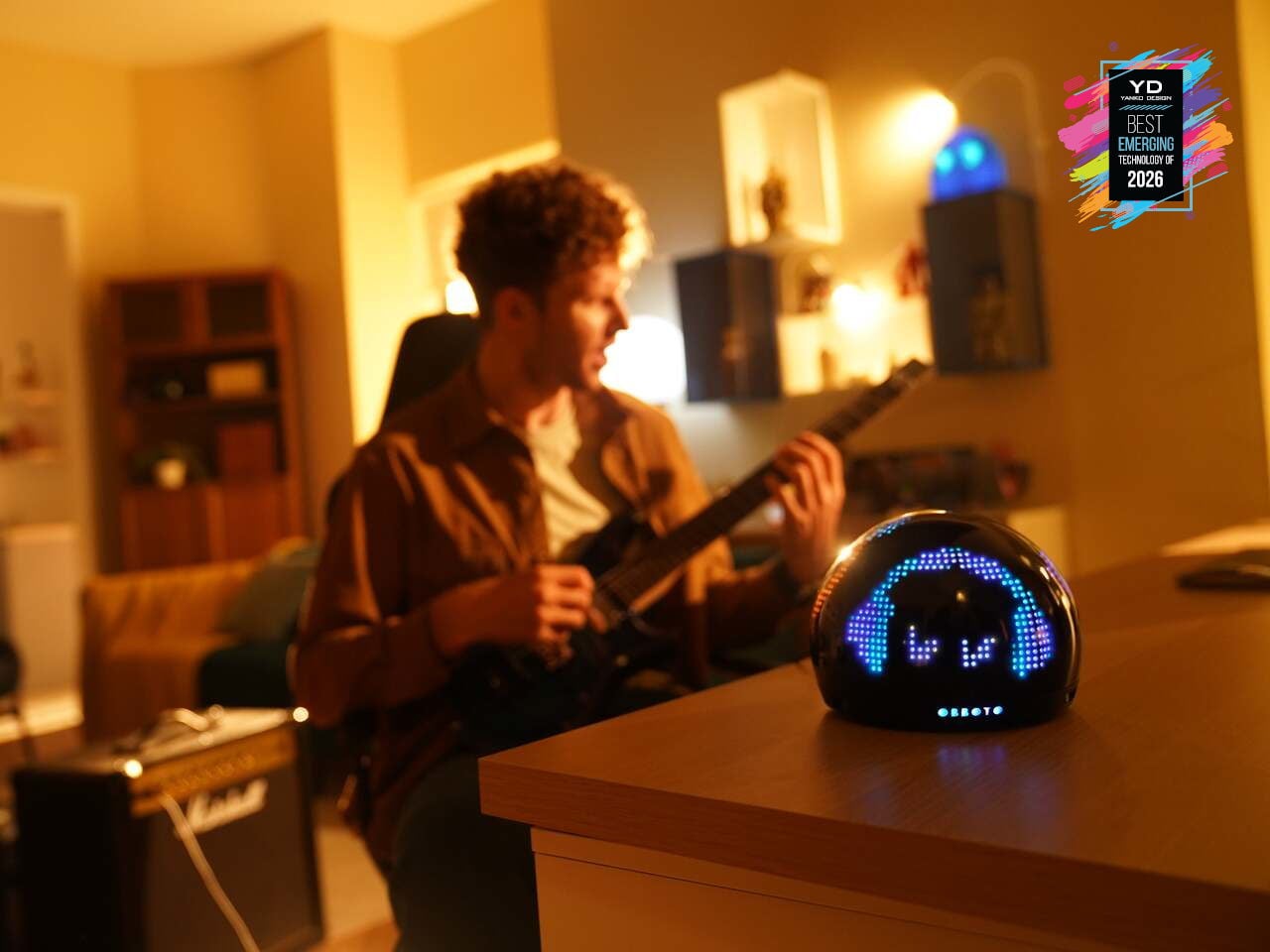
Switchbot OBBOTO
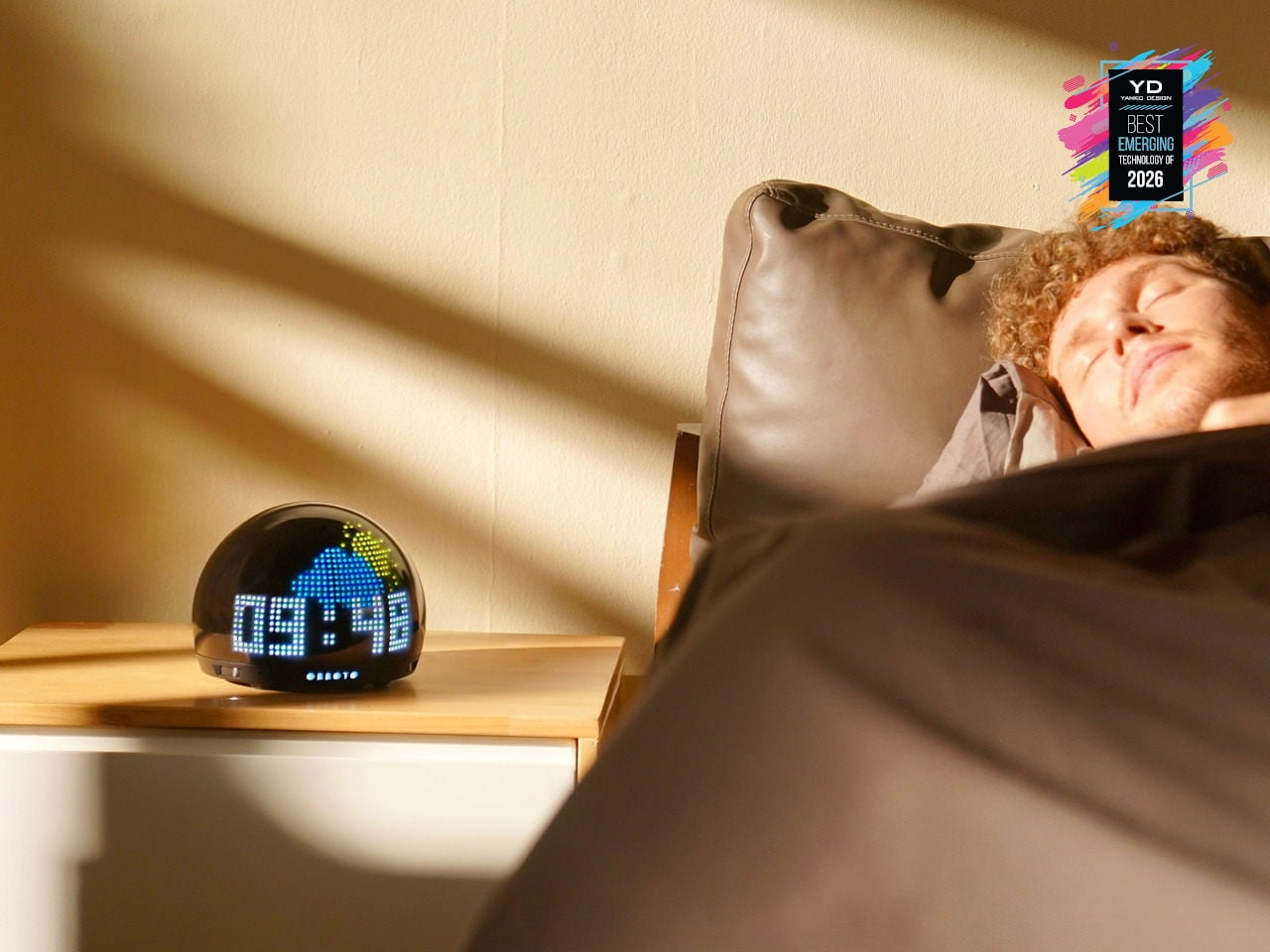
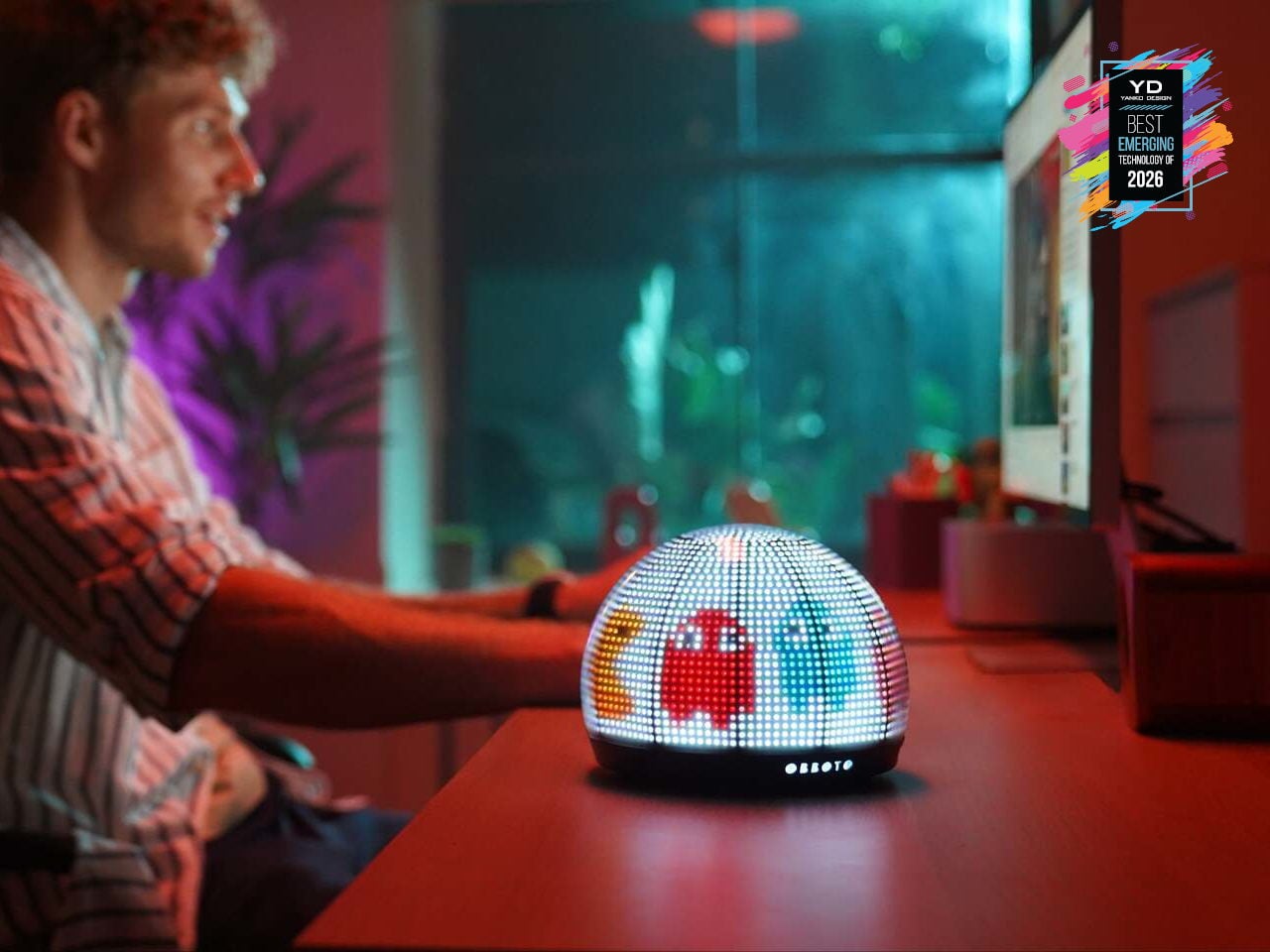
Desks and living rooms are filling up with smart lights and displays, but most still behave like obedient bulbs or tiny billboards. SwitchBot OBBOTO is a desk-sized pixel globe that tries to be something closer to a companion, using more than 2,900 RGB LEDs, motion sensing, and music visualization to turn light into an expressive presence. It can show time and weather as patterns, react when someone walks by, and sit alongside SwitchBot’s Comfort Tech lineup as the one that gives the room a bit of personality.
OBBOTO leans on AI-driven mood animations and ambiance modes to adjust to what someone is doing, shifting between sleep-friendly scenes, focus-oriented visuals, or relaxed, reactive patterns that move with music. Interactive pixel art and animations can be triggered or customized, making it as much a canvas as a lamp. It hints that tomorrow’s smart home might rely less on flat screens and more on small, characterful devices that quietly broadcast information and vibe at the same time.
OPSODIS 1 Compact 3D Audio Speaker
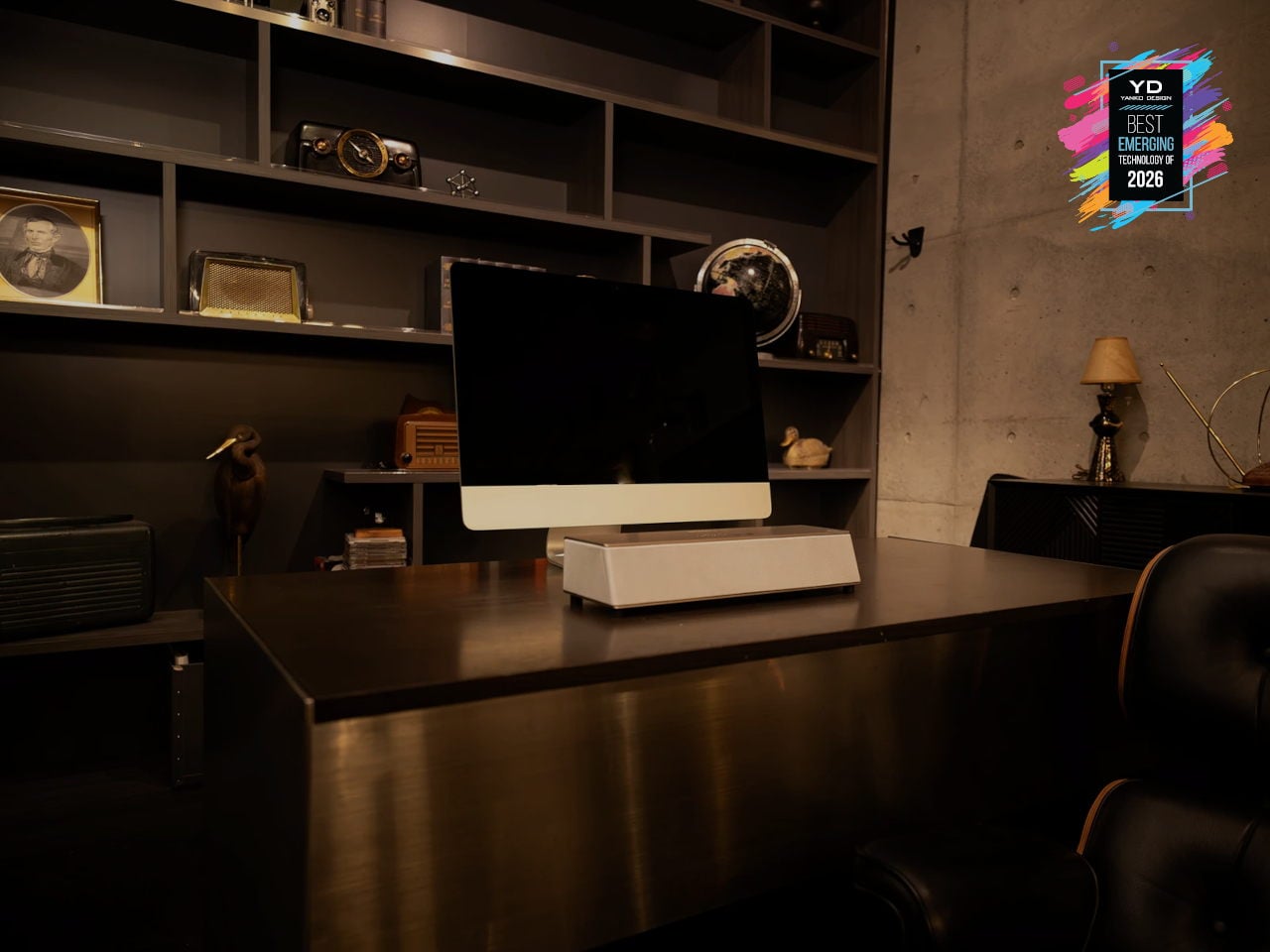
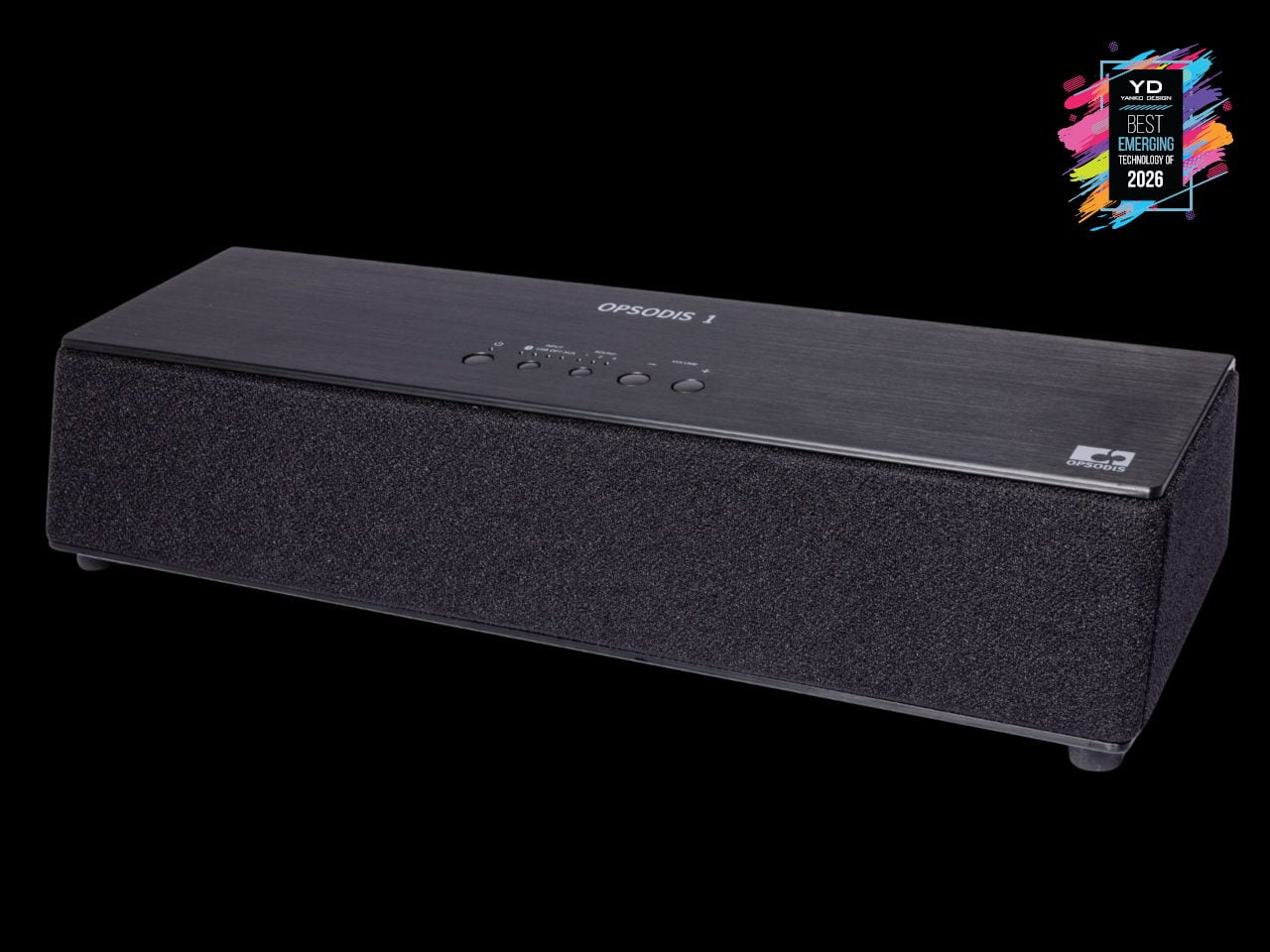
Surround sound has usually meant either a ring of speakers around the room, a big soundbar that leans on wall reflections, or headphones that lock you into a bubble. OPSODIS 1 is a compact desktop 3D audio speaker that tries a different route, using Kajima’s OPSODIS technology to project a 360-degree sound field from a single box. The 6-channel, 3-way, 6-driver array delivers natural spatial cues without depending on walls or ceilings, making it as at home on a desk as in a small living room.
OPSODIS, developed with the University of Southampton’s Institute of Sound and Vibration Research, uses optimal source distribution, crosstalk cancellation, and a symmetrical layout with high-frequency drivers near the center axis to send precise sound to your ears. Multiple inputs, from Bluetooth and USB-C to optical and 3.5 mm, plus listening modes like Narrow, Wide, and Simulated Stereo, adapt to different setups. It hints at a shift where immersive audio is moving beyond headphones and multi-box systems, toward single, research-driven speakers that create convincing 3D soundstages from one spot on your desk.
ASUS ROG NeoCore WiFi 8 Router
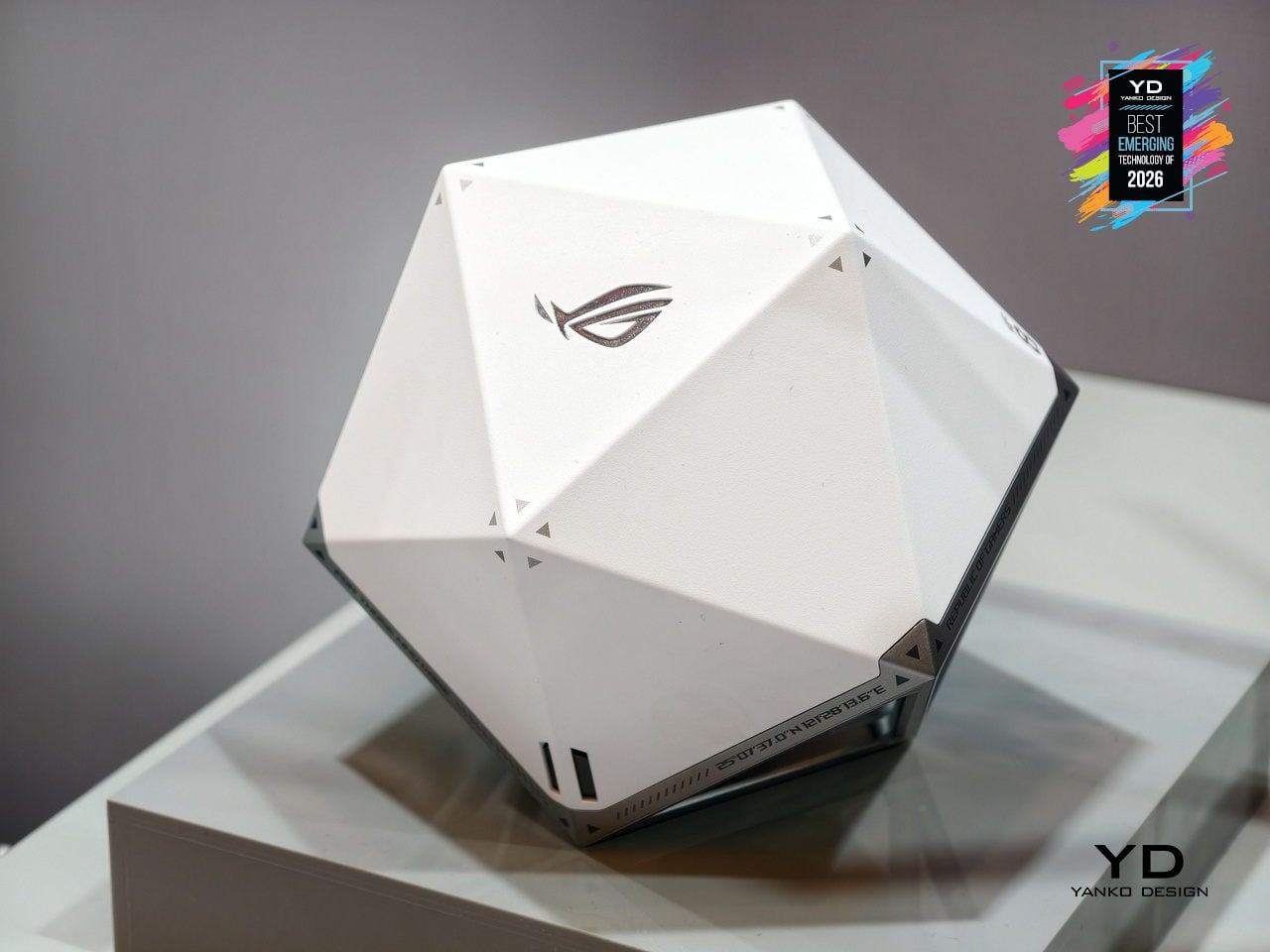
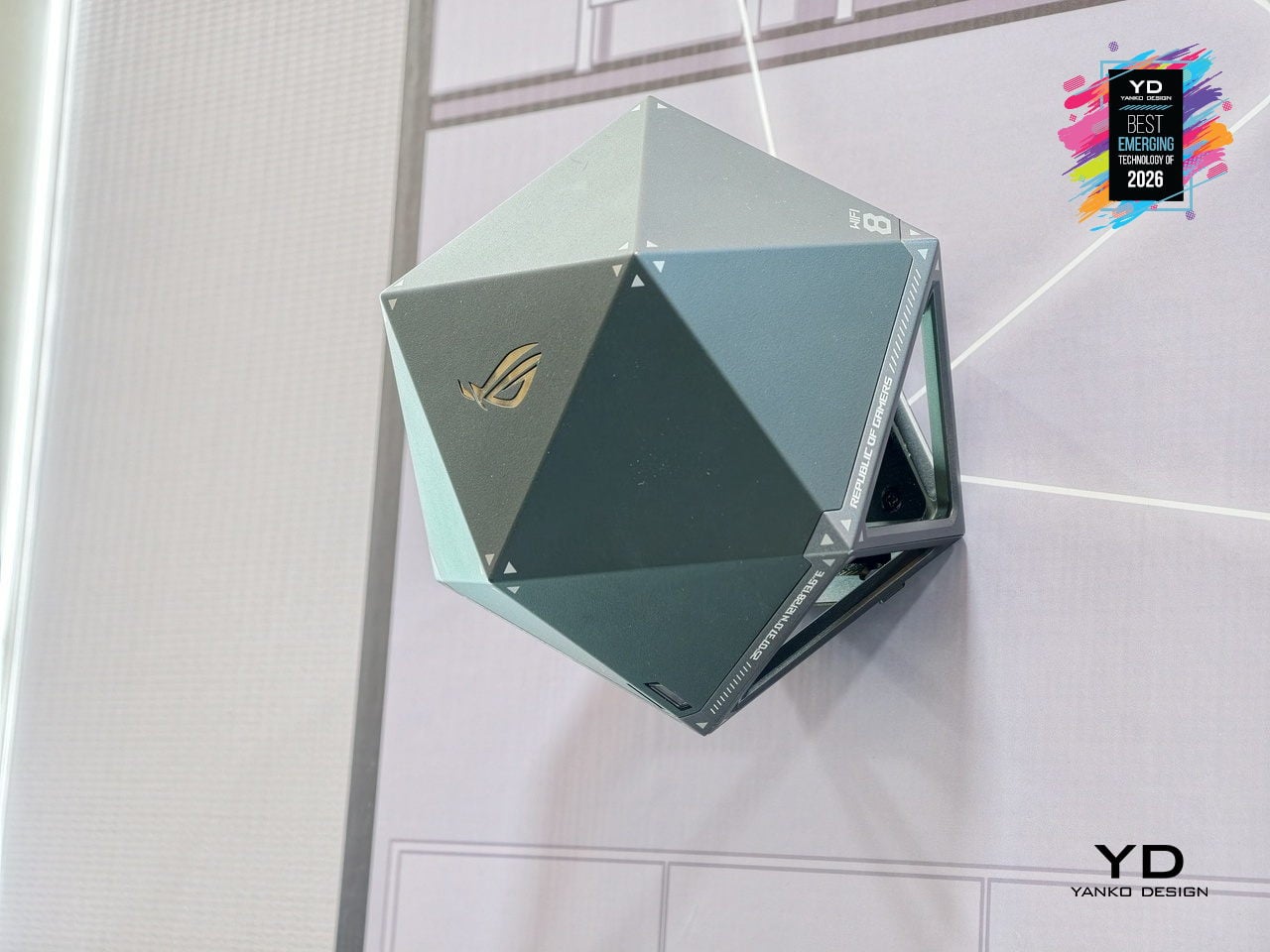
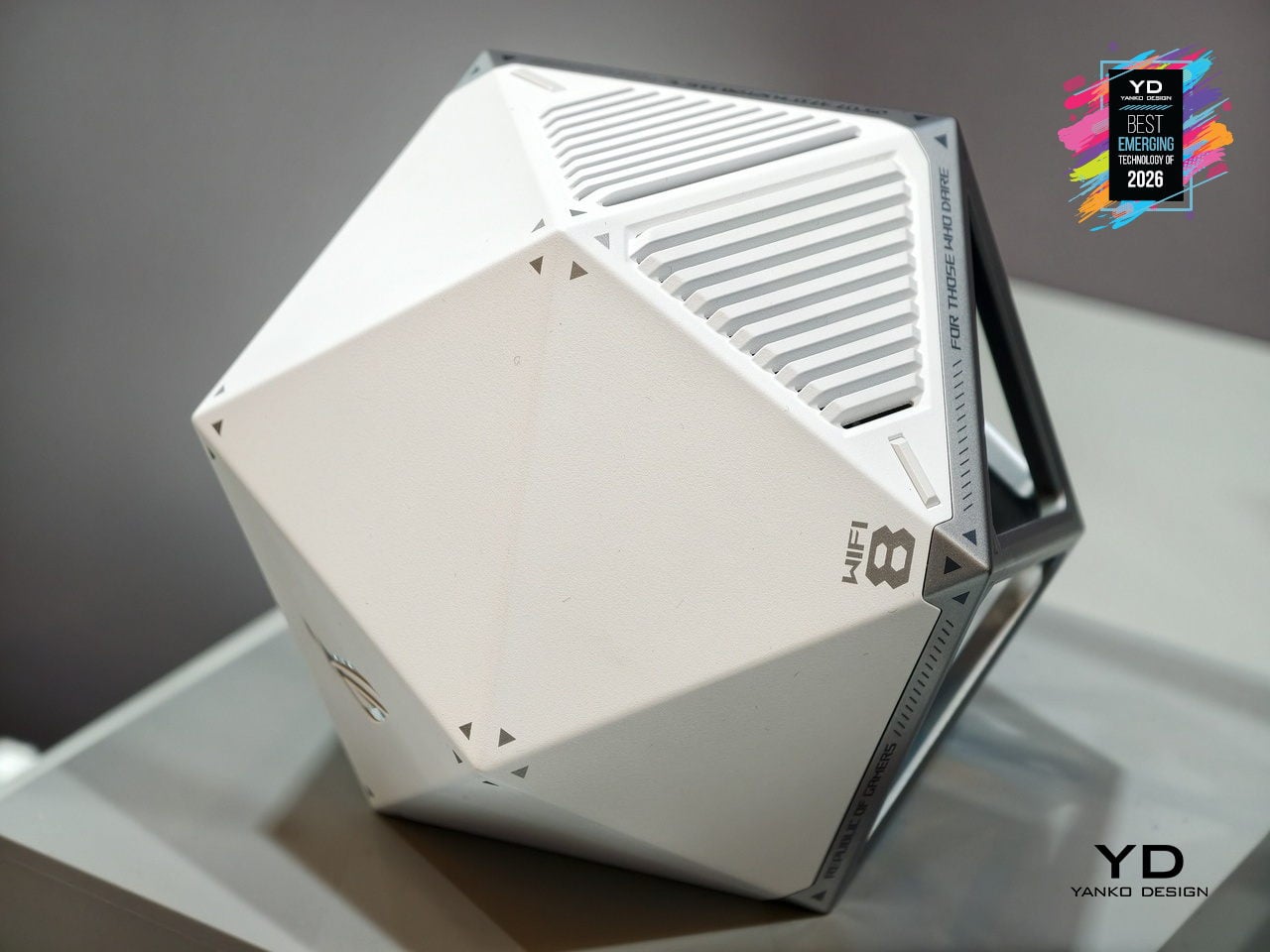
Most routers are still anonymous black slabs you hide behind a monitor or under a TV, even as they quietly run more and more of the home. ASUS ROG NeoCore takes the opposite approach, turning next‑gen Wi‑Fi 8 hardware into an object you actually want on the desk. The faceted polyhedral shell, somewhere between a gaming dice and a sci‑fi artifact, replaces the usual antenna farm with a sculptural form that can sit flat or be wall‑mounted without looking like infrastructure.
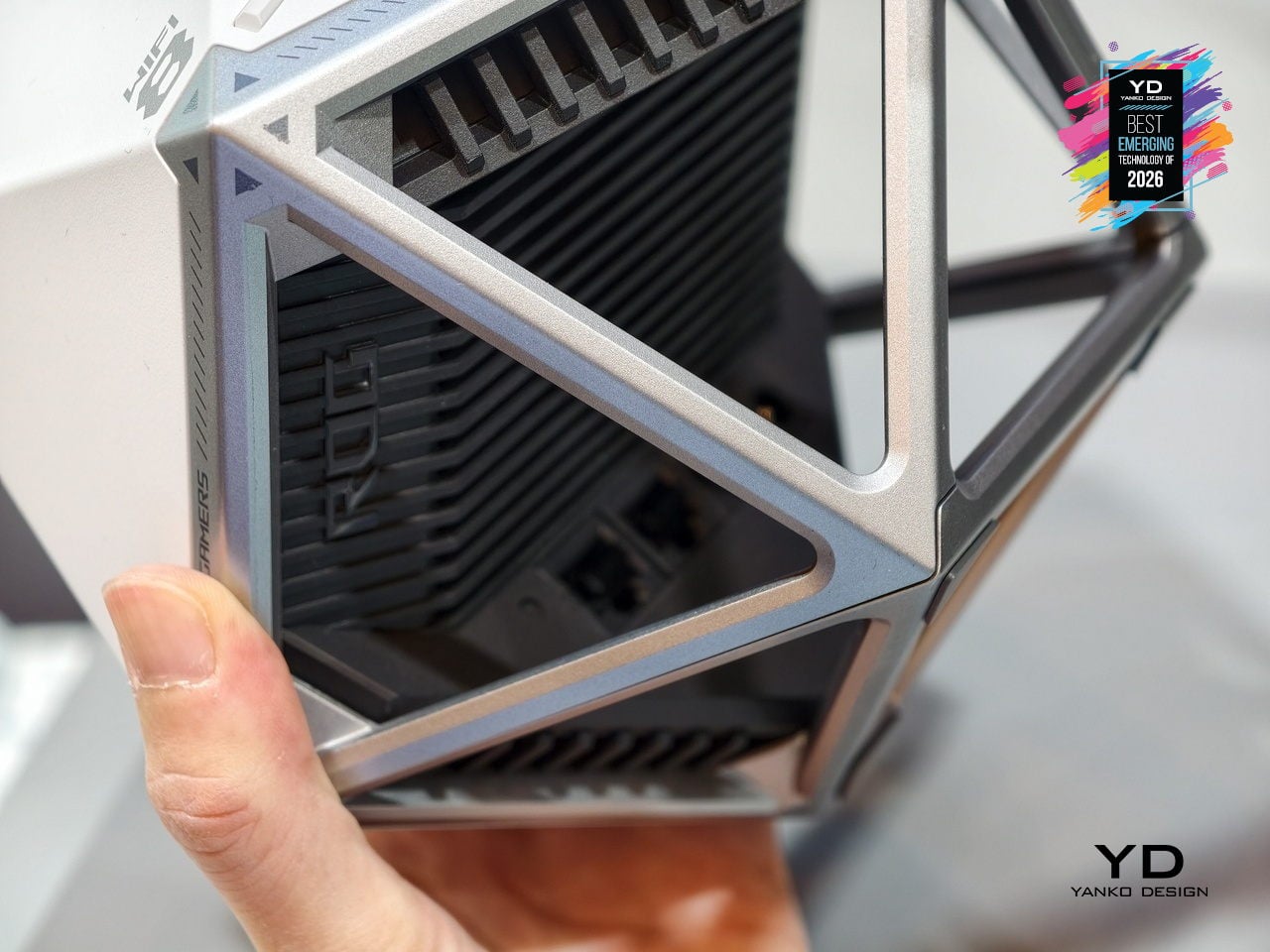
That shape is not just for show. A rigid exoskeleton frame wraps a ventilated inner core, giving the router plenty of airflow while keeping ports and heatsinks tucked into one face. The multifaceted body helps distribute antennas in three dimensions, supporting the tri‑band Wi‑Fi 8 radio stack that pushes more data, more efficiently, to many devices at once. NeoCore ends up feeling like an early glimpse of networking gear designed as part of a performance‑focused setup, where the box handling low‑latency gaming, 4K streaming, and dense device loads finally looks as intentional as the hardware it supports.
LEGO SMART Brick
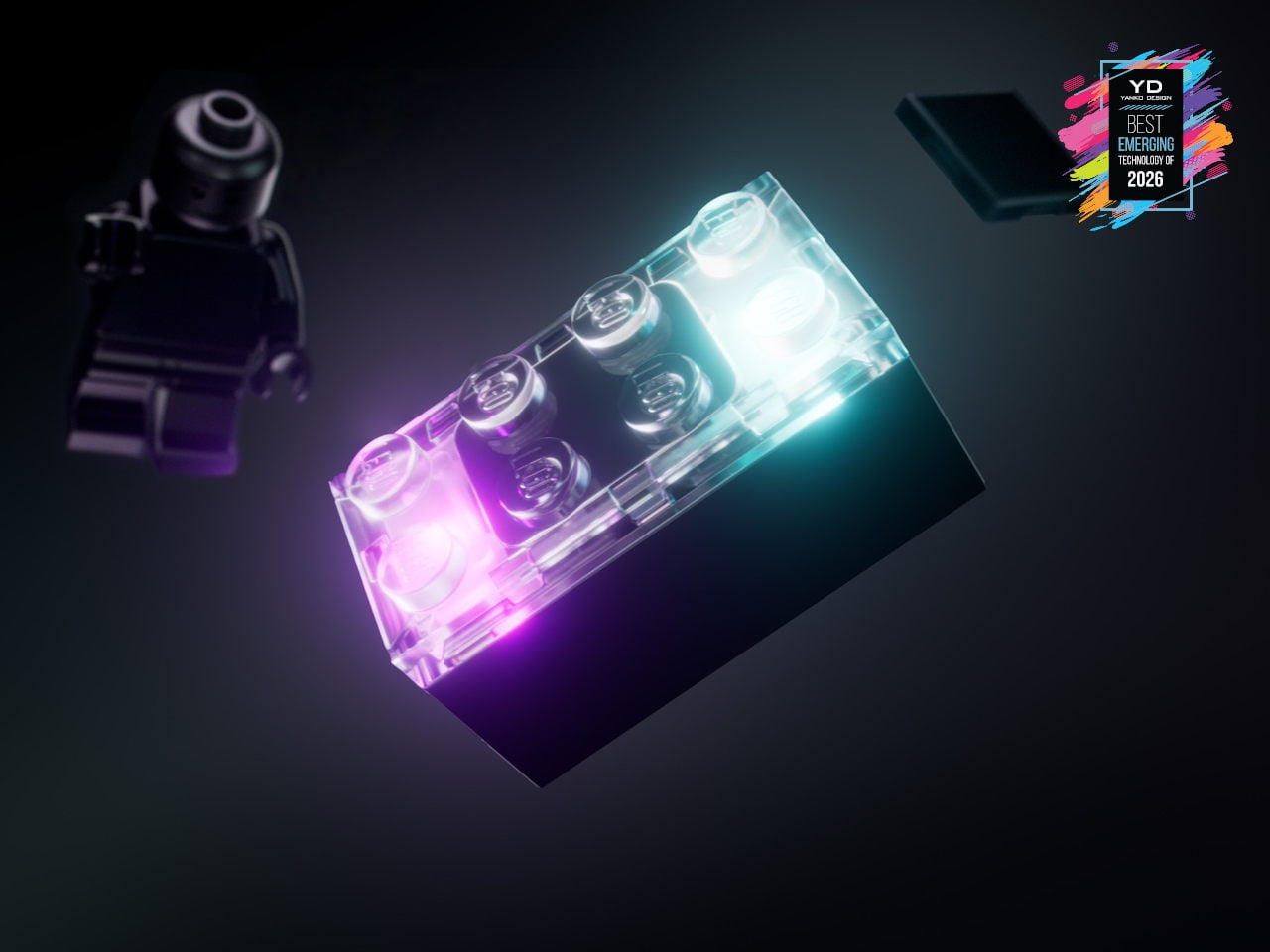
LEGO has flirted with electronics before, but usually in the form of obvious hubs or screen-tethered experiences. LEGO SMART Play shifts that by hiding a custom chip smaller than a stud inside the new SMART Brick, along with sensors, a sound engine, and wireless charging. Paired with SMART Tags and SMART Minifigures, it lets familiar builds react to swoops, crashes, and docking maneuvers with lights, motion-aware sounds, and contextual behaviors, while still feeling like pure, open-ended brick play on the table.
This platform quietly turns the entire LEGO System-in-Play into a canvas for responsive, screen-free interaction. Instead of asking kids to stare at a tablet, the SMART Brick listens through its sound sensor, feels through accelerometers, and responds through an onboard synthesizer, making ships, turrets, and throne rooms hum, fire, and react as they are moved. Because it is fully compatible with existing bricks and anchored in more than 20 patented world-first technologies, it feels like the early layer of a long-term platform that hints at everyday building blocks quietly carrying embedded intelligence.
LG CLOiD Home Robot
Home robots that can actually do chores are finally edging out of concept videos and into real homes. Robot vacuums are now background noise, and companies are quietly testing machines that can sort laundry or help in the kitchen instead of just answering questions from a speaker. LG’s CLOiD feels like the next step in that progression, a full-body home robot that does not just connect to appliances; it moves through the house and physically uses them.
CLOiD can take milk from the fridge, slide a croissant into the oven, start laundry cycles, and fold and stack clothes after drying. A tilting torso, two seven-degree-of-freedom arms, and five-finger hands ride on a wheeled base tuned for stability around kids and pets. LG’s AXIUM actuators give its joints compact, high-torque behavior, while a Vision Language Model and Vision Language Action system trained on tens of thousands of hours of household tasks lets it recognize appliances and coordinate with the ThinQ ecosystem, making housework automation feel less like science fiction.
iPolish Color-changing Press-on Acrylic Nails
Fashion and beauty are quietly becoming the next frontier for consumer tech, from smart fabrics to LED-laced festival fits, but nails have mostly stayed analog. iPolish is a set of smartphone-driven digital press-on acrylics that behave like reprogrammable cosmetics, with wearable electronic nails that can display hundreds of rich colors on demand. You apply them like regular press-ons, then pair the iPolish app with the Magic Wand over Bluetooth to send your chosen palette, turning color changes into a quick gesture instead of a full removal and repaint.
The interaction is simple: you choose colors in the app, the Magic Wand stores them, and each nail cycles through options when inserted, pausing with a green blink at one of your selections so you can stop at the exact shade you want. Colors can last minutes, hours, or days, and if your outfit or mood changes, you just reselect and reinsert rather than soaking off layers of polish. Because the system works with accessories and fashionwear as well as nails, it feels like an early glimpse of where beauty tech is heading, where digital finishes become as swappable as makeup.
The modern desk holds a laptop, phone, tablet, earbuds, maybe a camera or handheld console, all needing power at different times. The usual sprawl of wall warts, USB hubs, and cables creeps across the surface, claiming outlets and desk real estate. Most charging solutions still assume you have infinite outlets and space under the table, even though desks keep shrinking while the number of things competing for power keeps climbing.
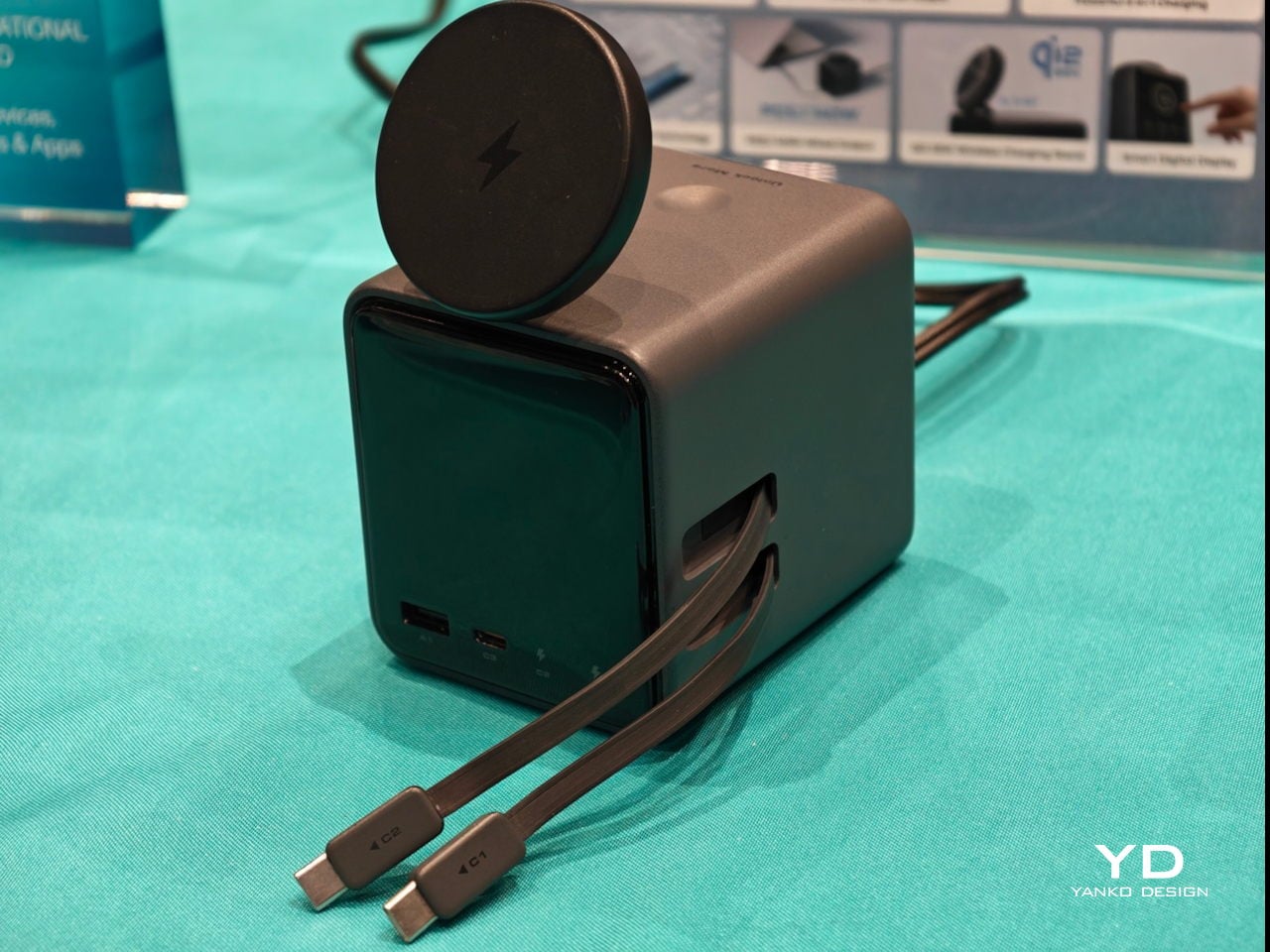
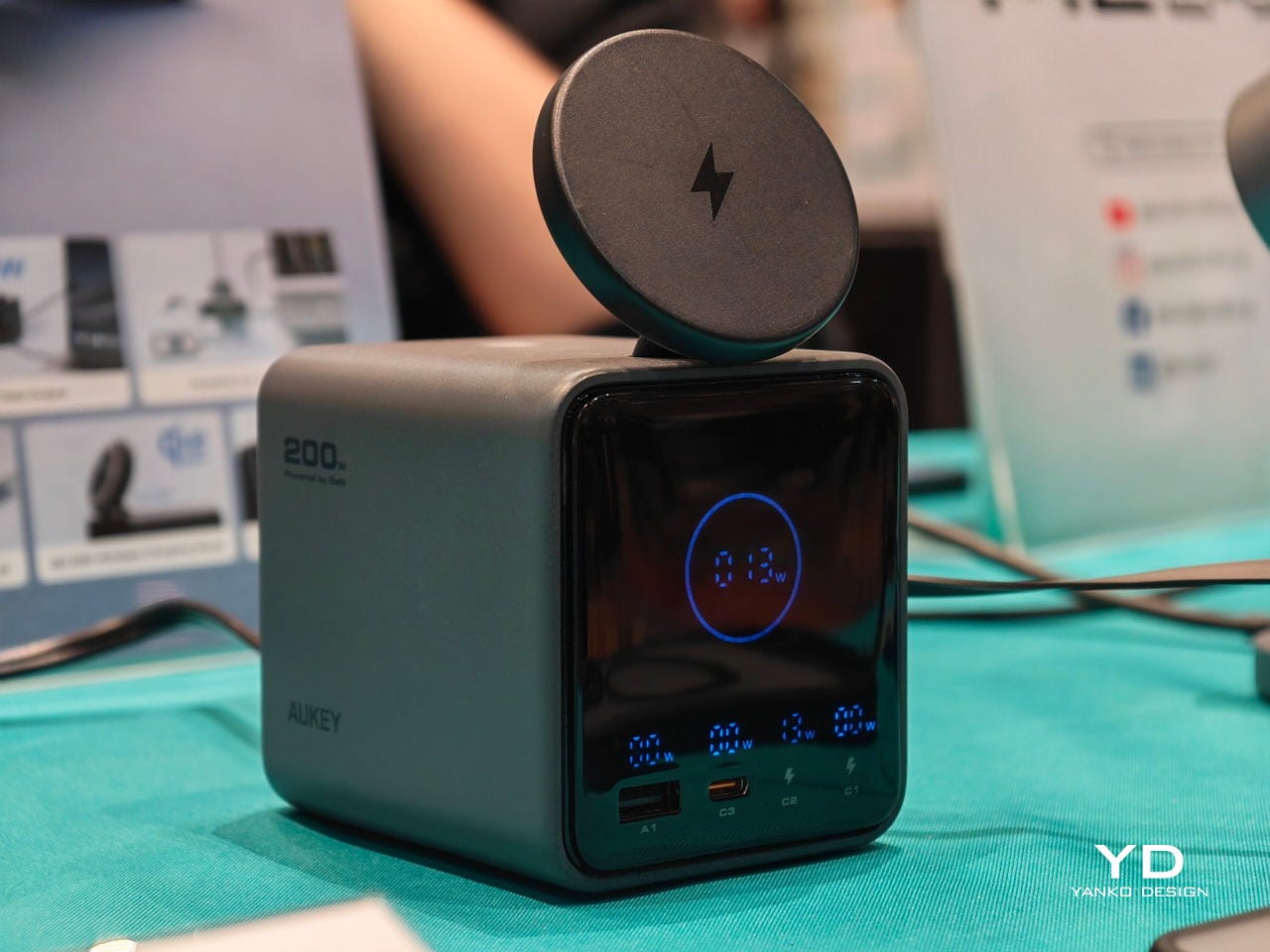
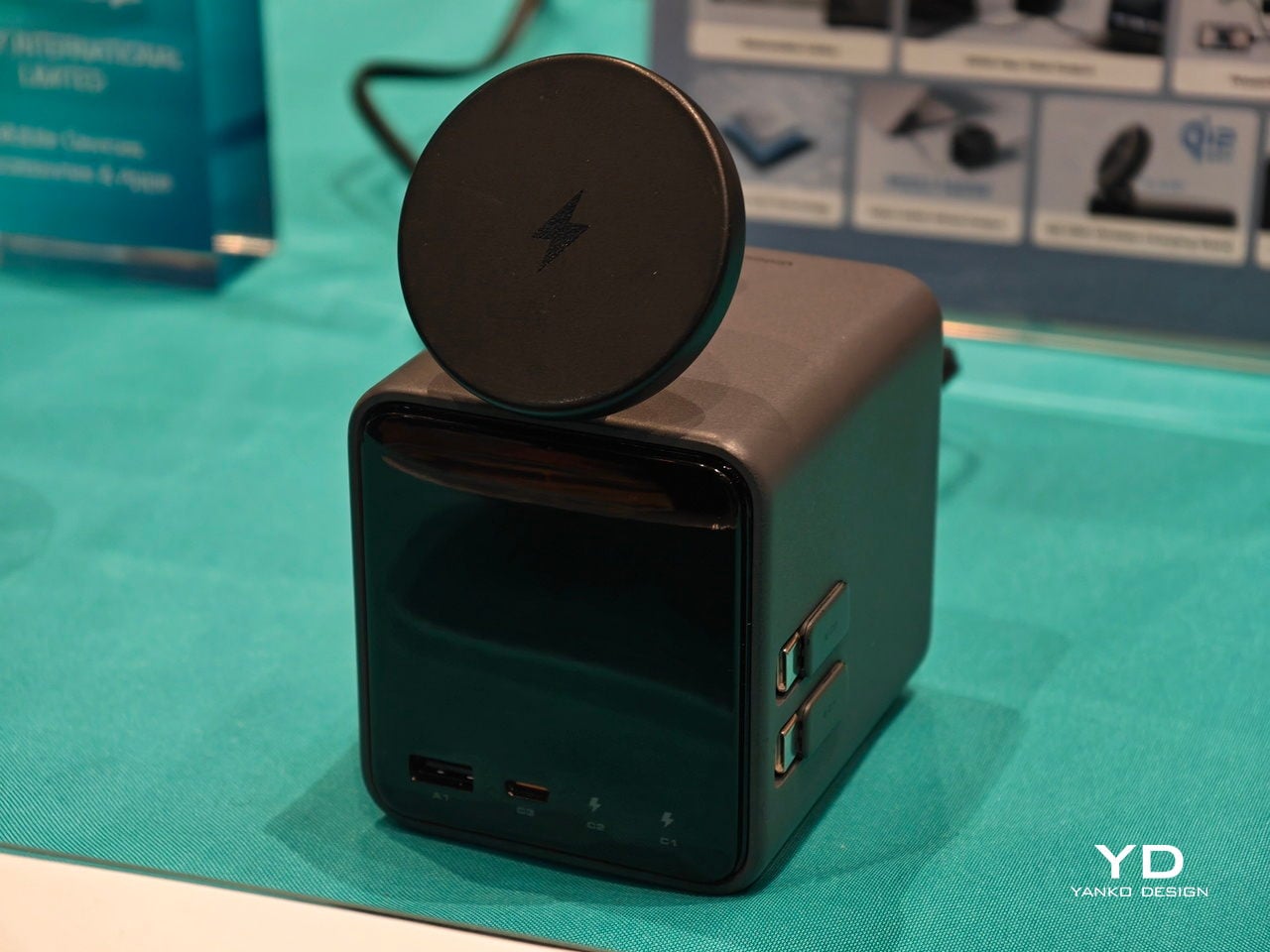
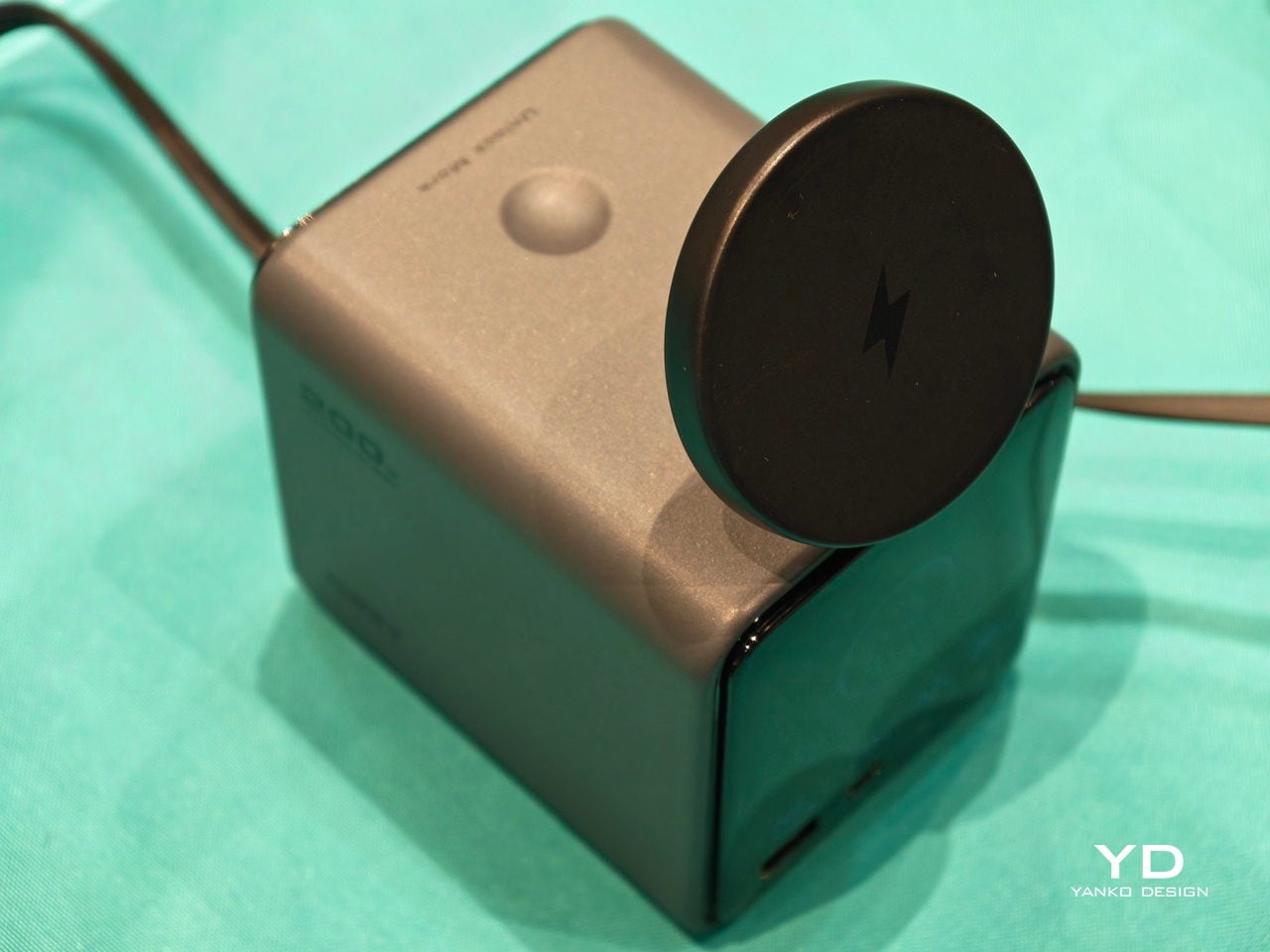
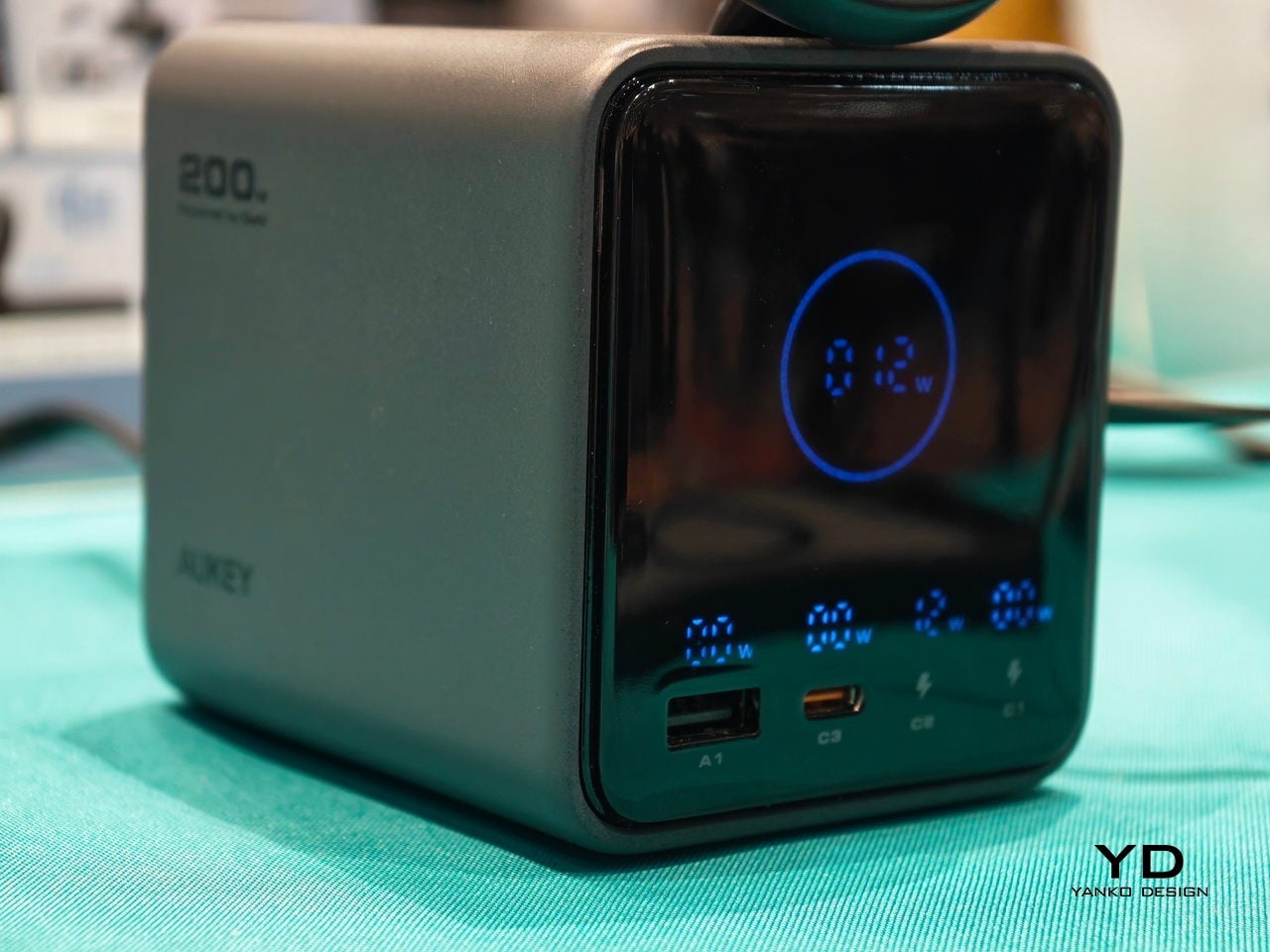
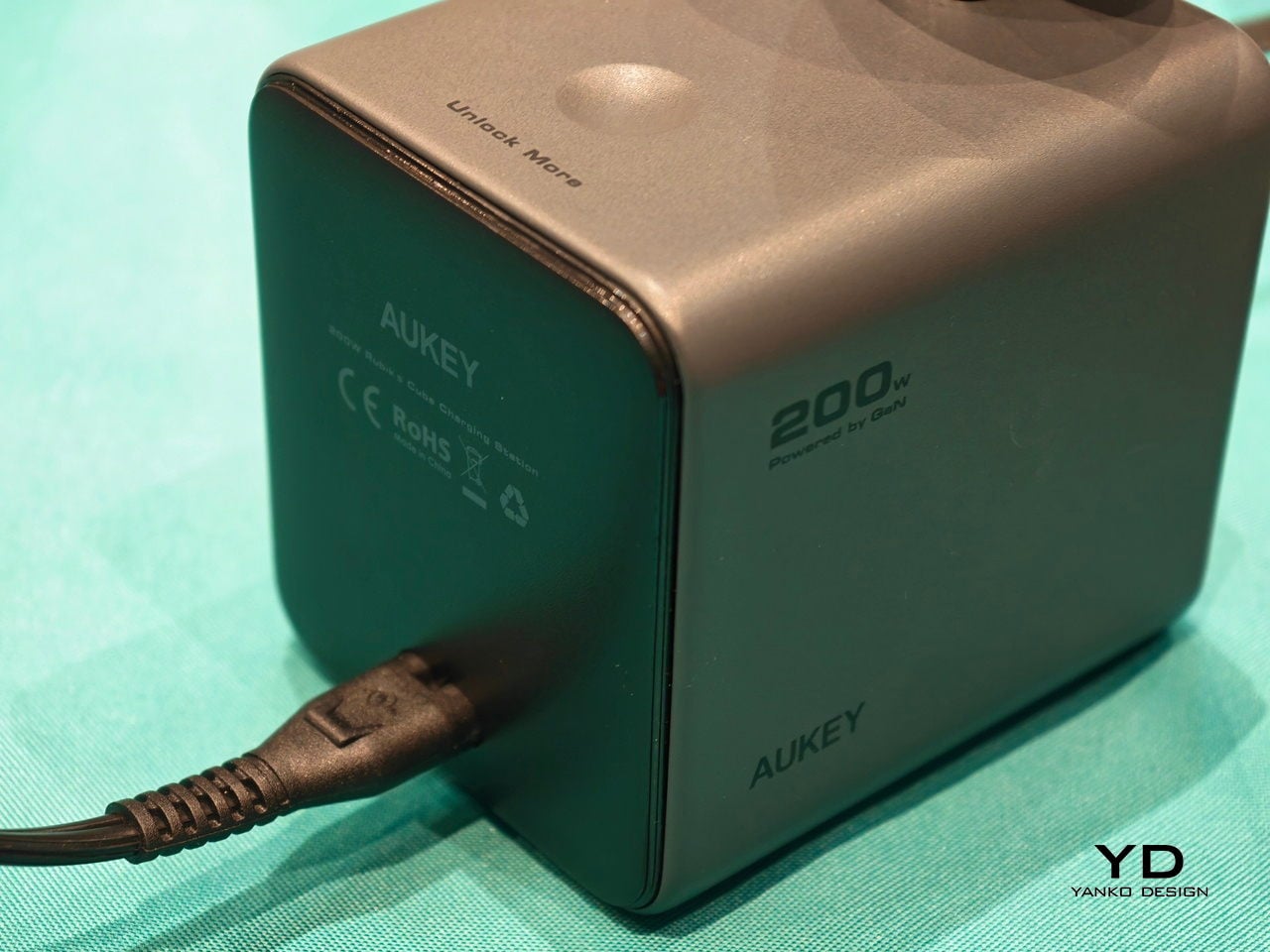
The Aukey MagFusion DeskHive 5X Pro is a 5-in-1 desktop charging station that tries to pull everything into one small cube. It combines four wired outputs, including two retractable USB-C cables, with a Qi2 25W magnetic wireless stand on top, all powered by a 200W GaN engine. The idea is that one object in arm’s reach quietly replaces the pile of bricks and cables, sitting visibly on the desk instead of hiding behind the monitor.
Designer: AUKEY
Plugging a power-hungry laptop into the USB-C1 port gets you up to 140W with PD 3.1, enough to keep big machines happy. While that runs, there is still room for a second USB-C device, a USB-A accessory, and the two retractable USB-C leads that stay hidden until you need them. DeskHive can be the main charger for a workstation, not just a phone dock sitting on the side waiting for occasional use.
The two retractable USB-C cables spool out to about 75 cm when needed and disappear when they are not. That changes the desk, no more permanently snaked cables waiting for a device, just a quick pull when a tablet or camera needs a top-up, then a satisfying click back into the cube. It is a small interaction, but it keeps the surface visually calmer and makes charging feel less like tending to clutter.
The top of the cube is where the Qi2 25 W magnetic stand holds a phone at an adjustable angle between 0 and 65 degrees. That makes it natural to drop the phone there during calls, video meetings, or for quick reference, charging while staying in view. The aluminum-alloy hinge is tested for 10,000 adjustments, so tilting it up and down becomes part of the daily rhythm without feeling fragile or like something you have to baby.
The smart digital display shows real-time power output for each wired port and the total system draw. A quick glance tells you which device is fast-charging, which one is trickle-charging, and whether you are pushing the 200 W budget. It turns charging from a black box into something you can read and manage, which is oddly satisfying when you live with a lot of gear and want to know what is happening behind the scenes.
DeskHive layers in the expected protections, short-circuit, over-current, over-voltage, over-temperature, and over-charging, so running it all day does not feel risky. The compact 3.76-inch footprint and single power cable clean up the visual field, replacing a cluster of chargers with one object that looks intentional. For a desk that already does too much, having one small cube quietly handle the power side feels like a relief, freeing up mental space and physical outlets for the things that actually need them.
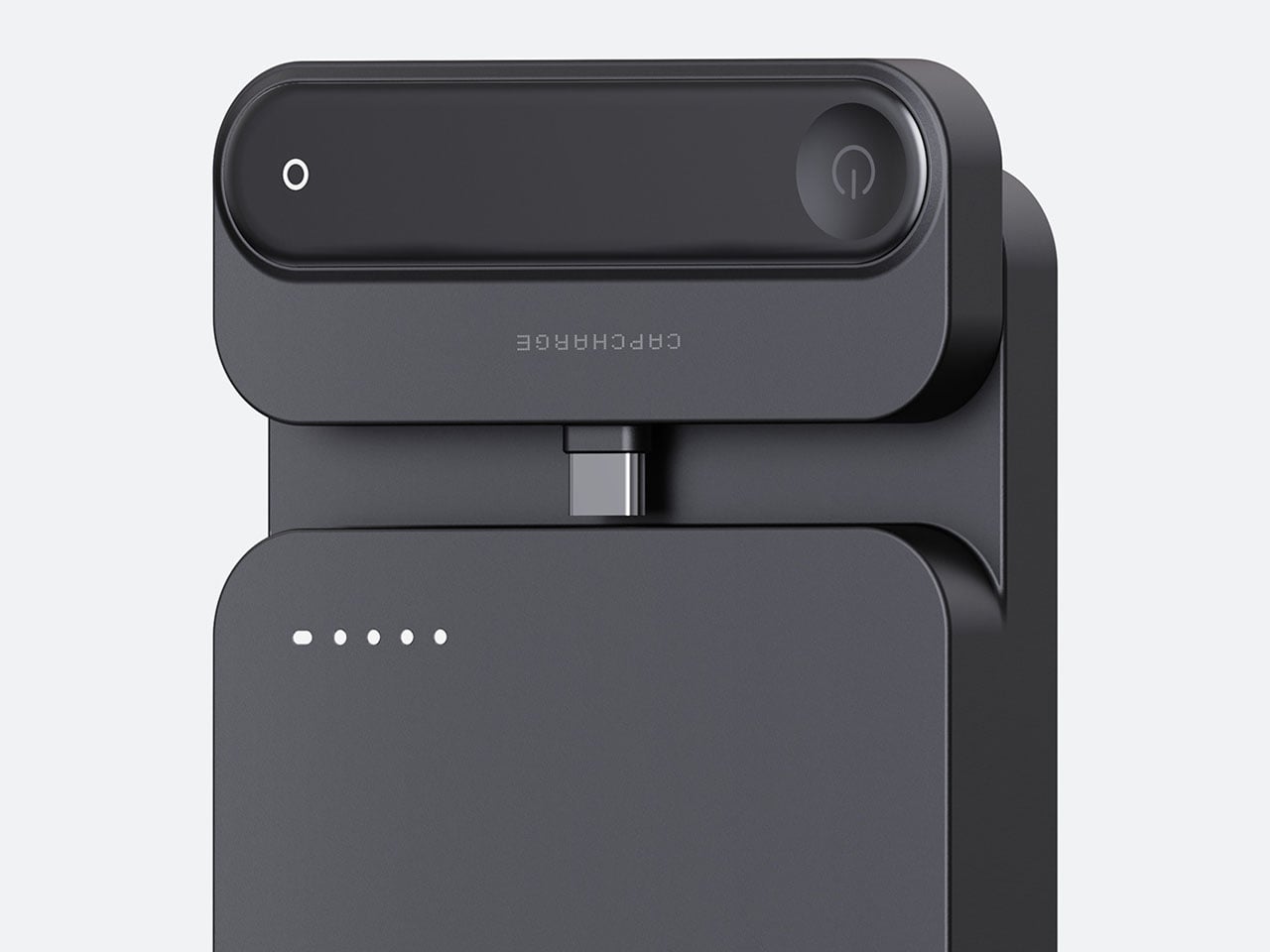
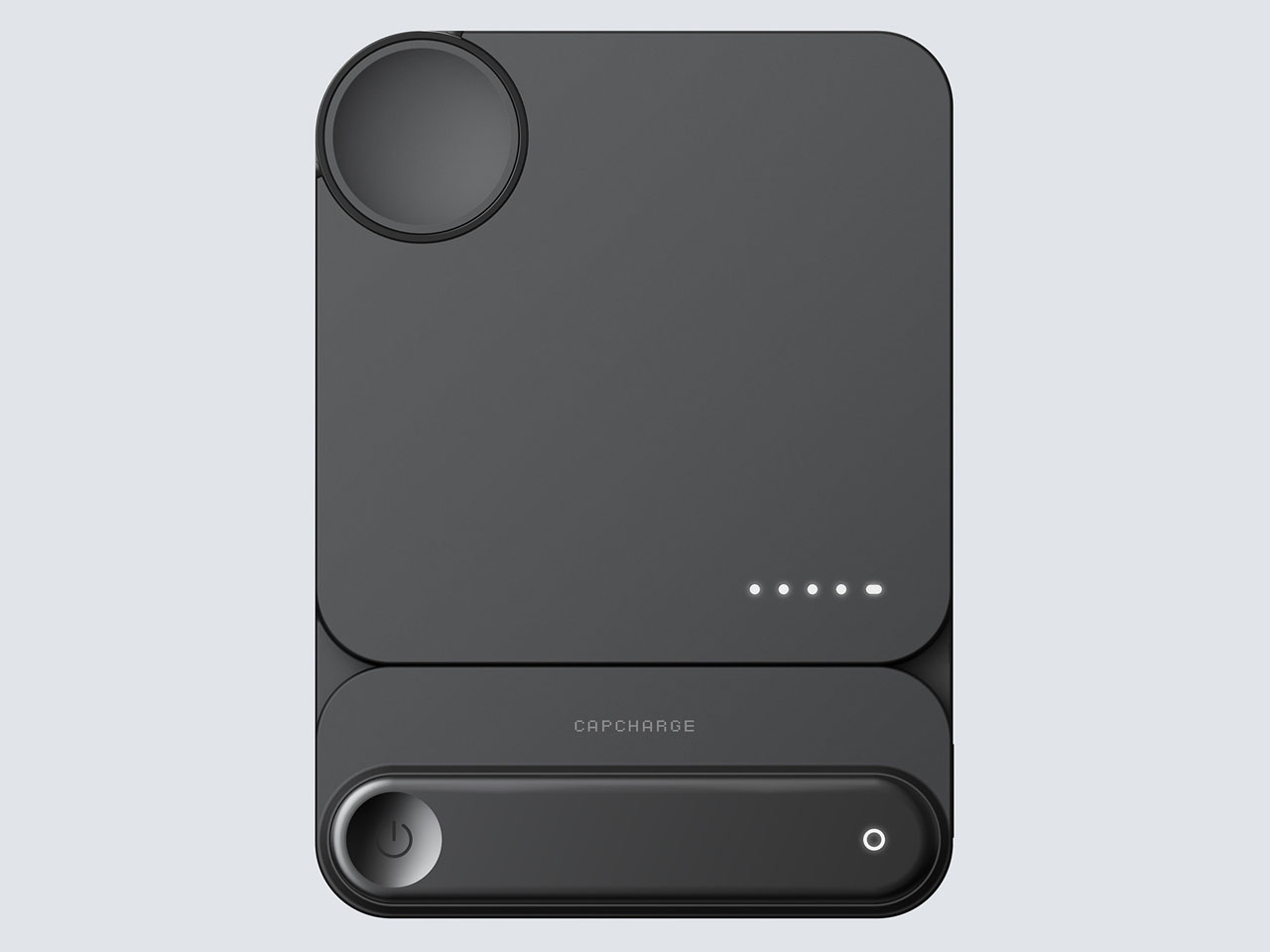
In a world where screens rarely go dark and our devices feel like extensions of ourselves, a reliable power source has become almost as essential as the devices it fuels. Yet even after years of iterations, power banks still fall into the same trap; they’re either bulky blocks with too much capacity to carry comfortably, or slim and portable but unable to keep up with a full day’s use. The Portable Magnetic power bank brings a smarter, more adaptable approach to this everyday struggle, one that feels designed for how people actually move through their day.
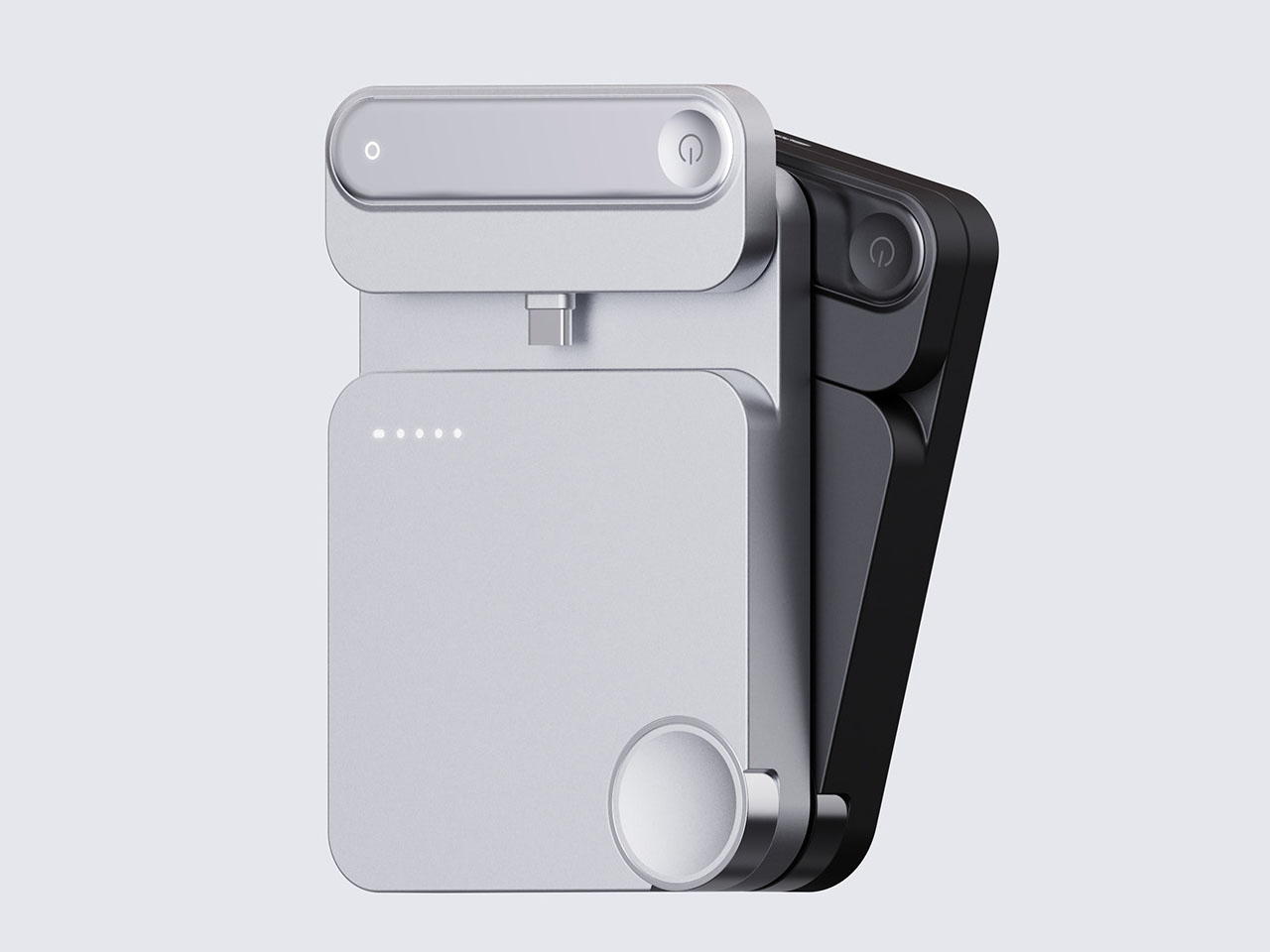
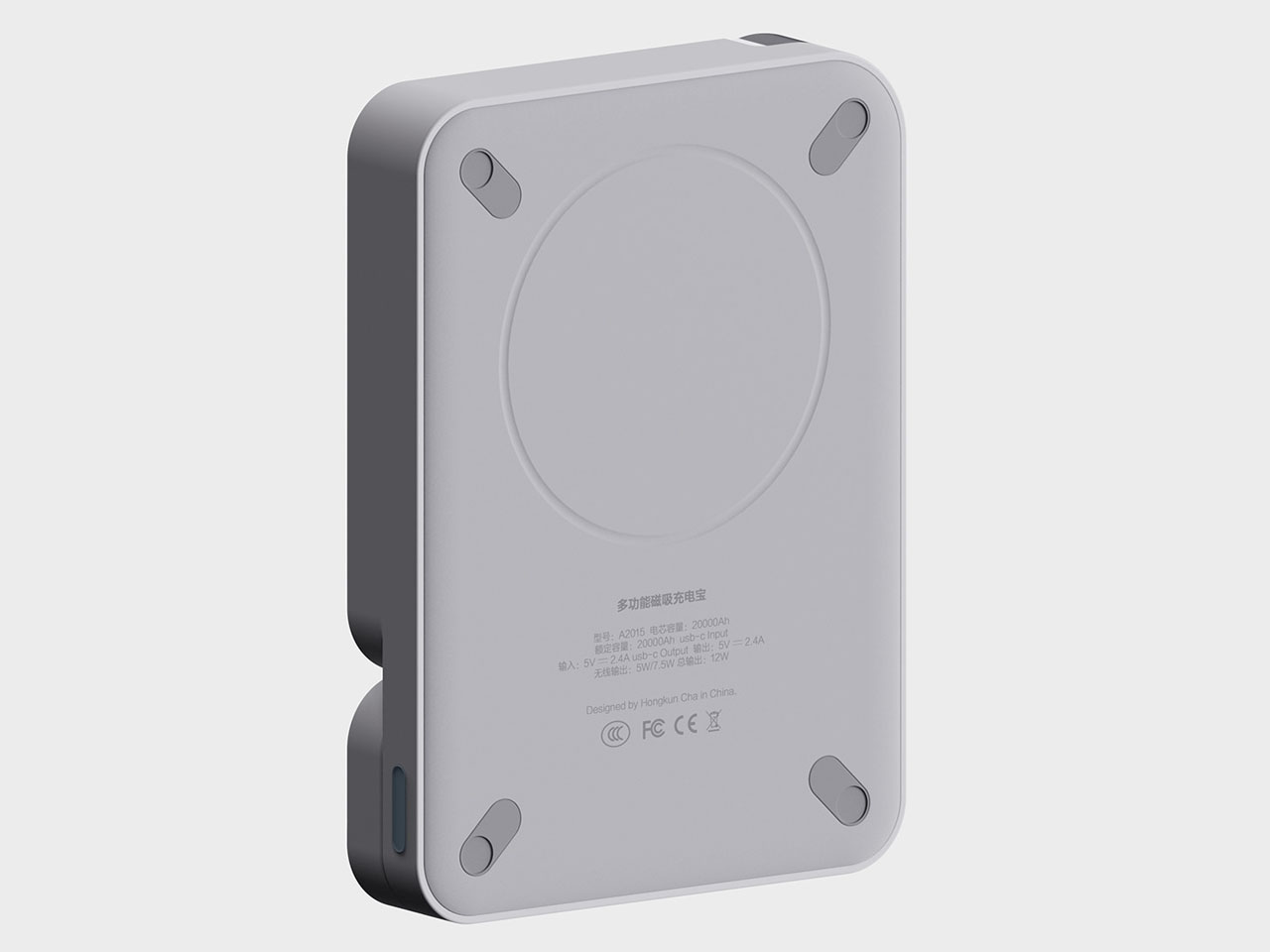
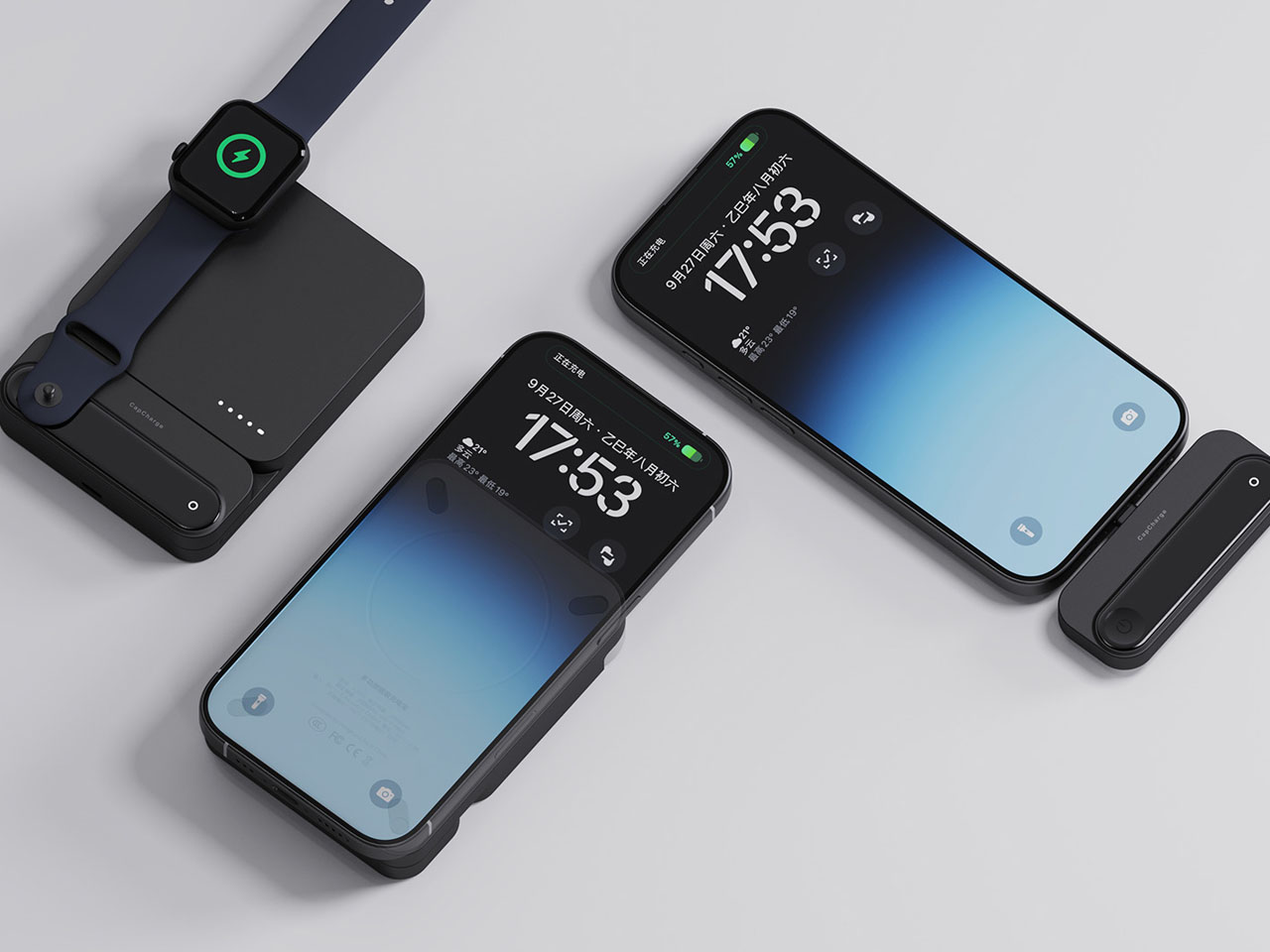
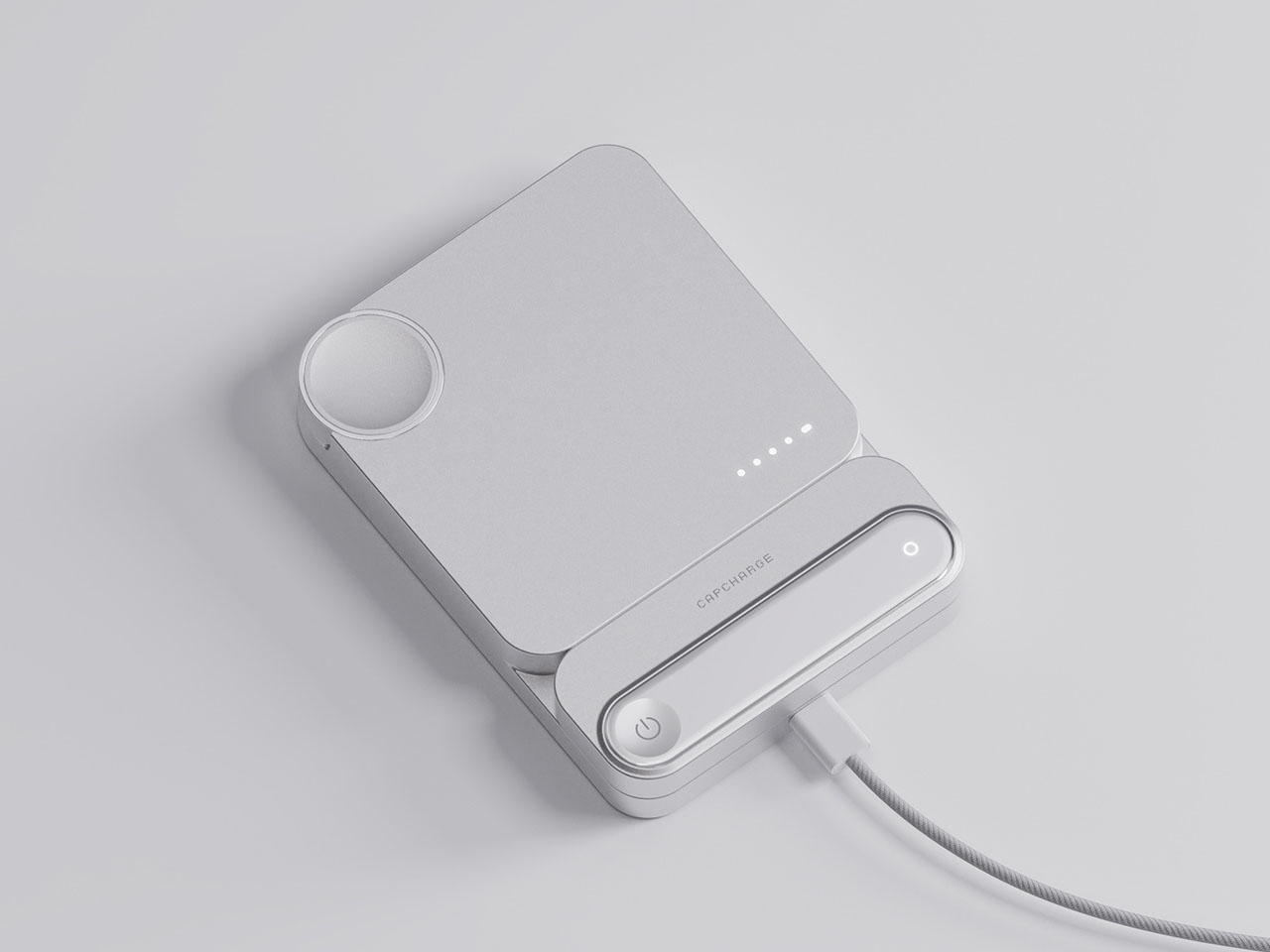
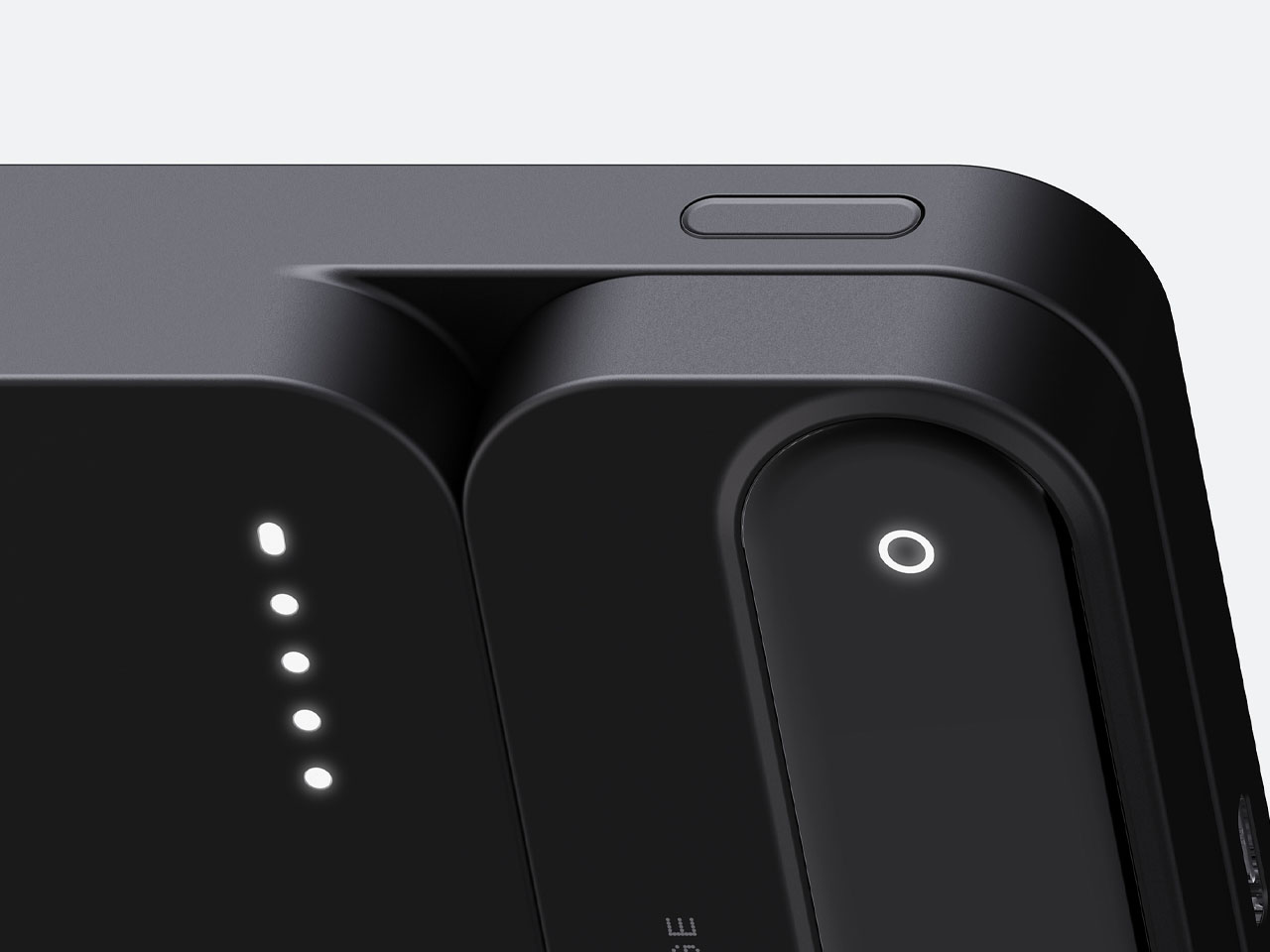
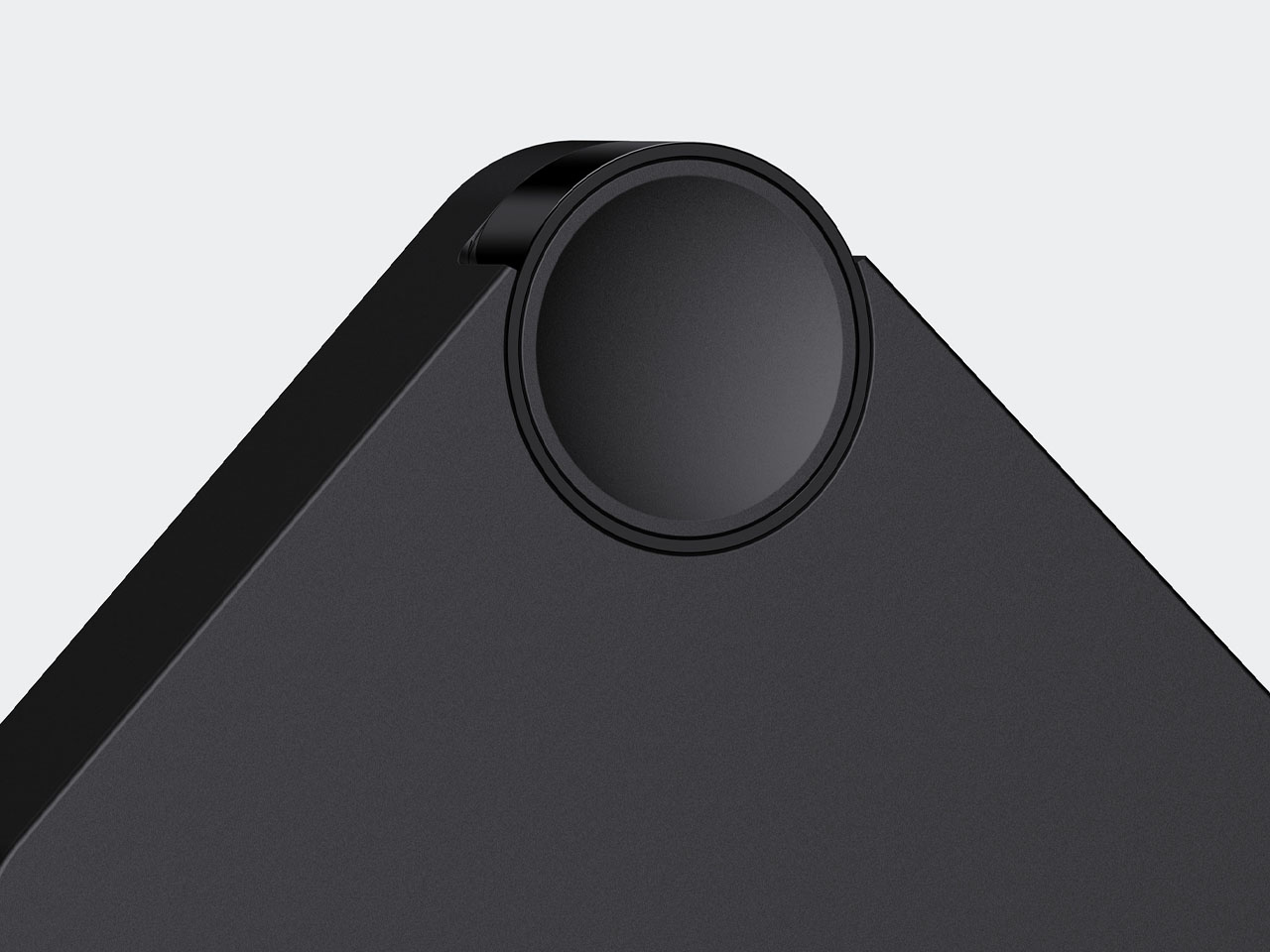
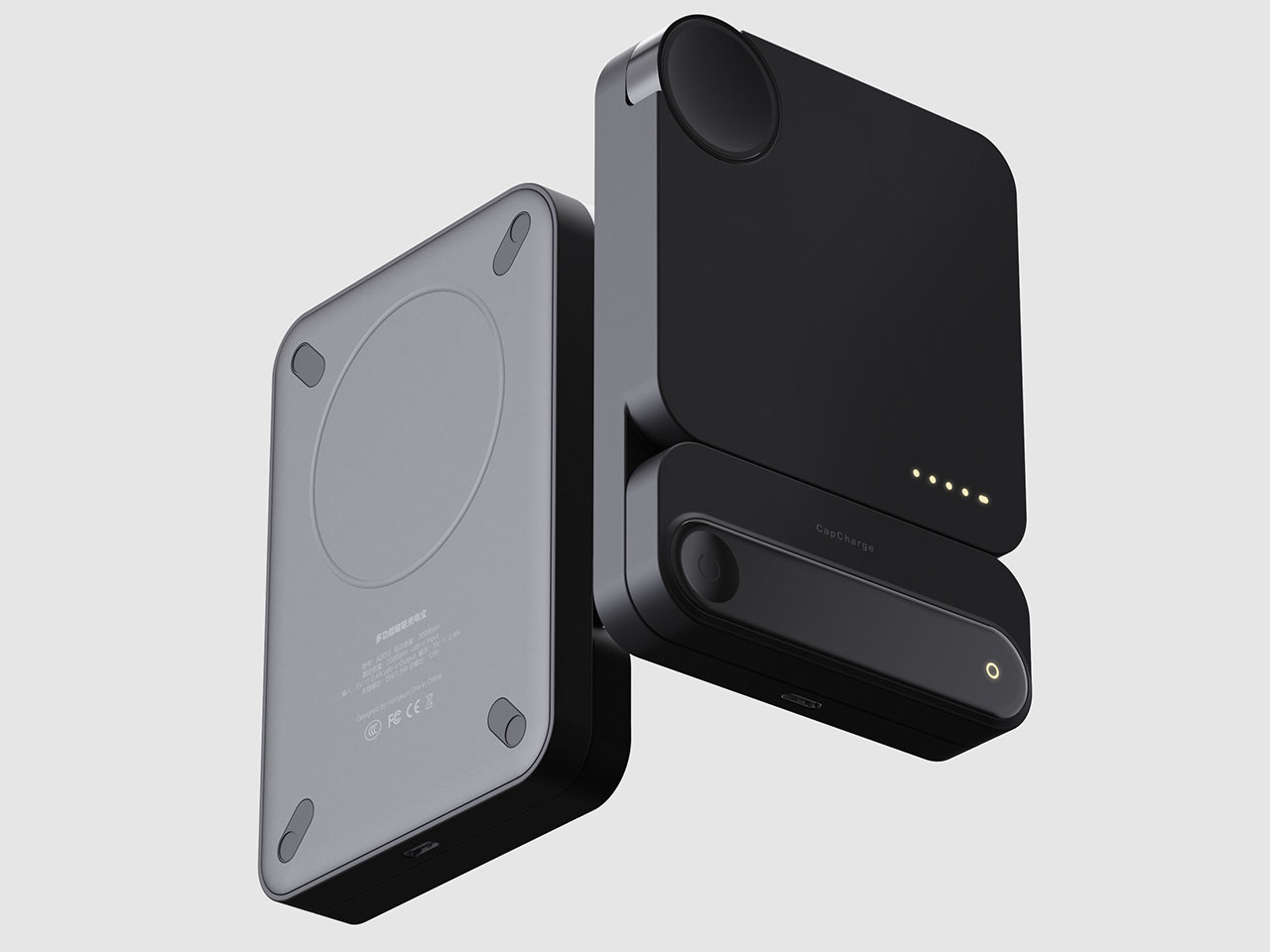
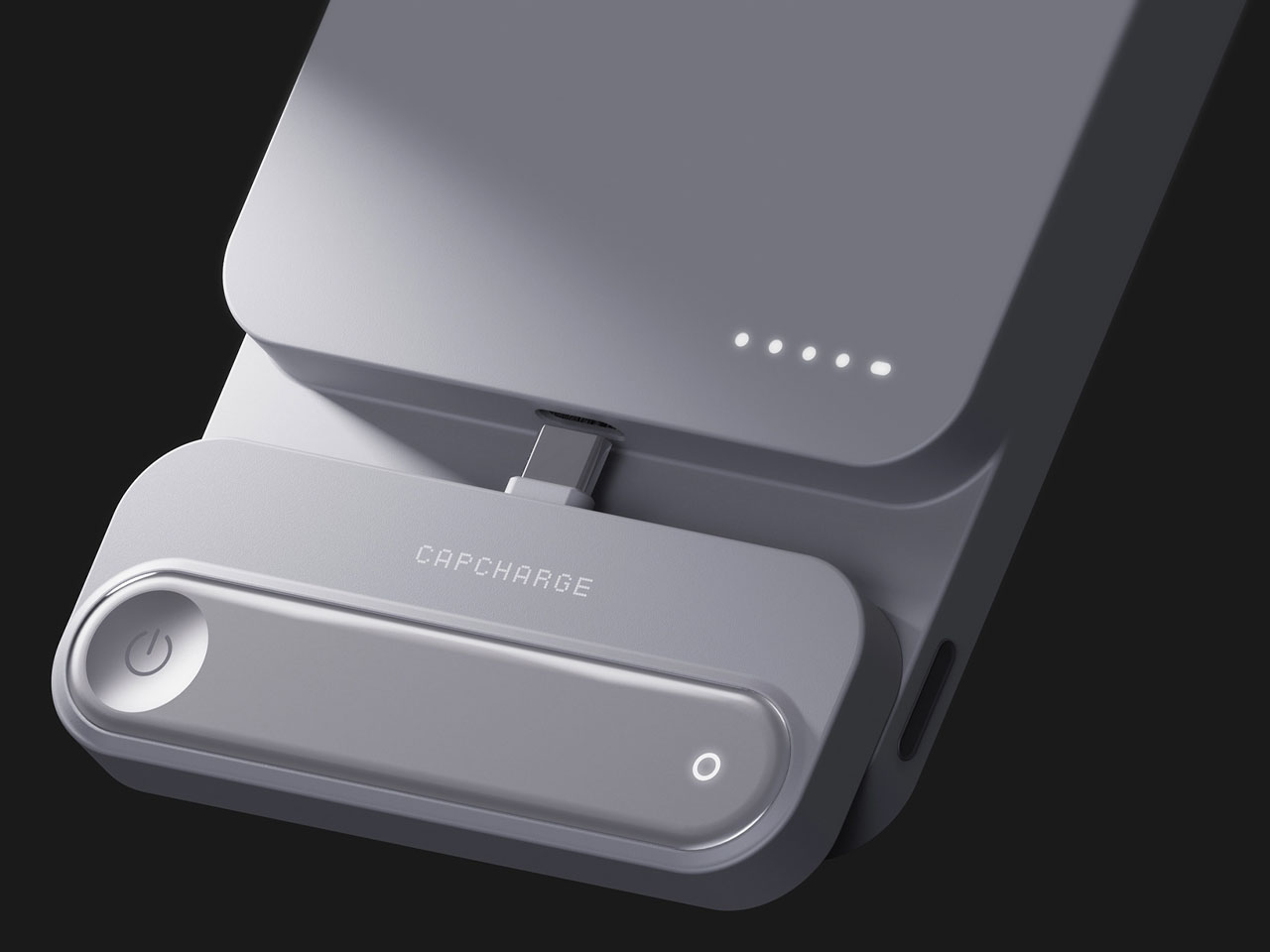
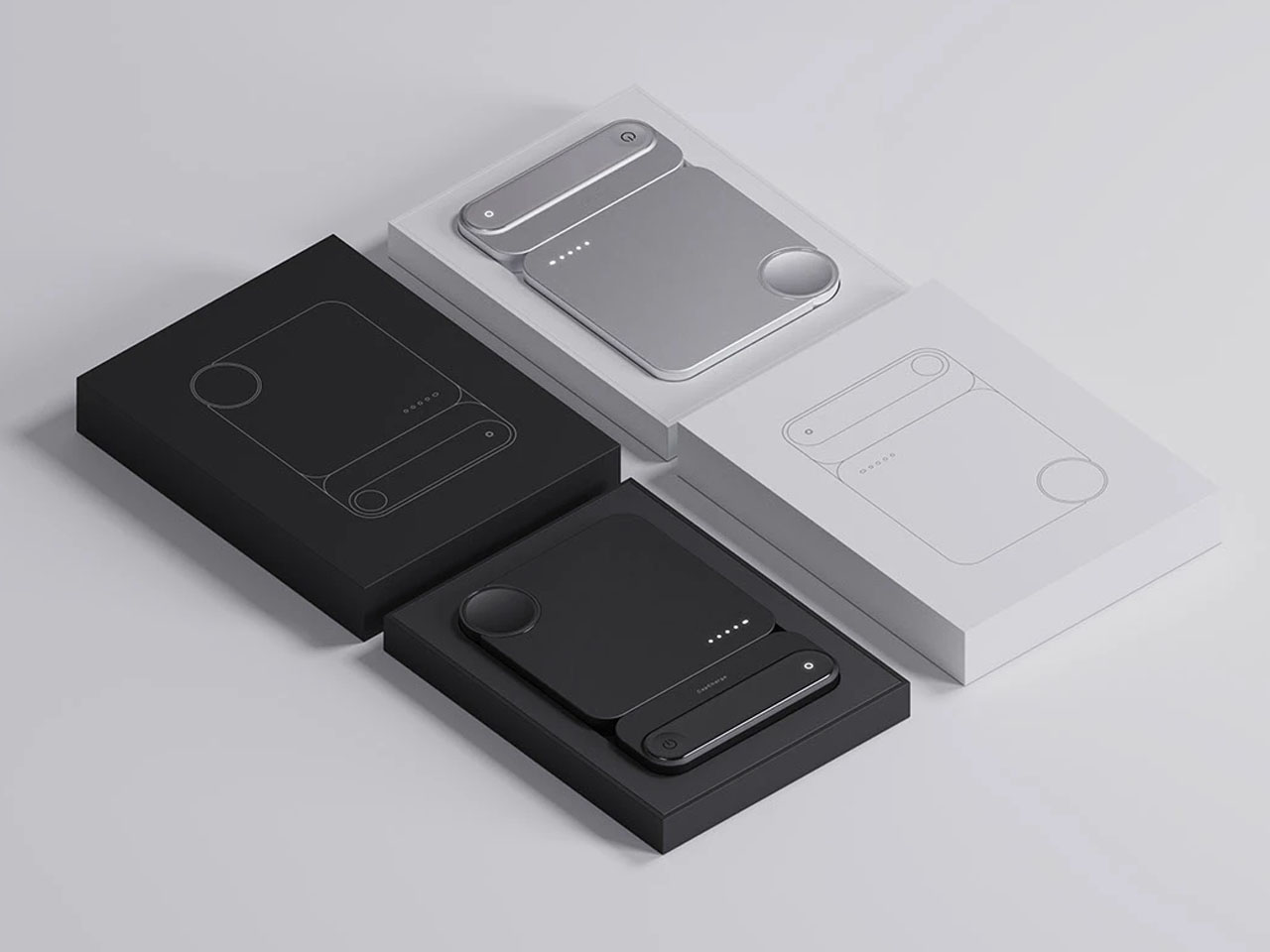
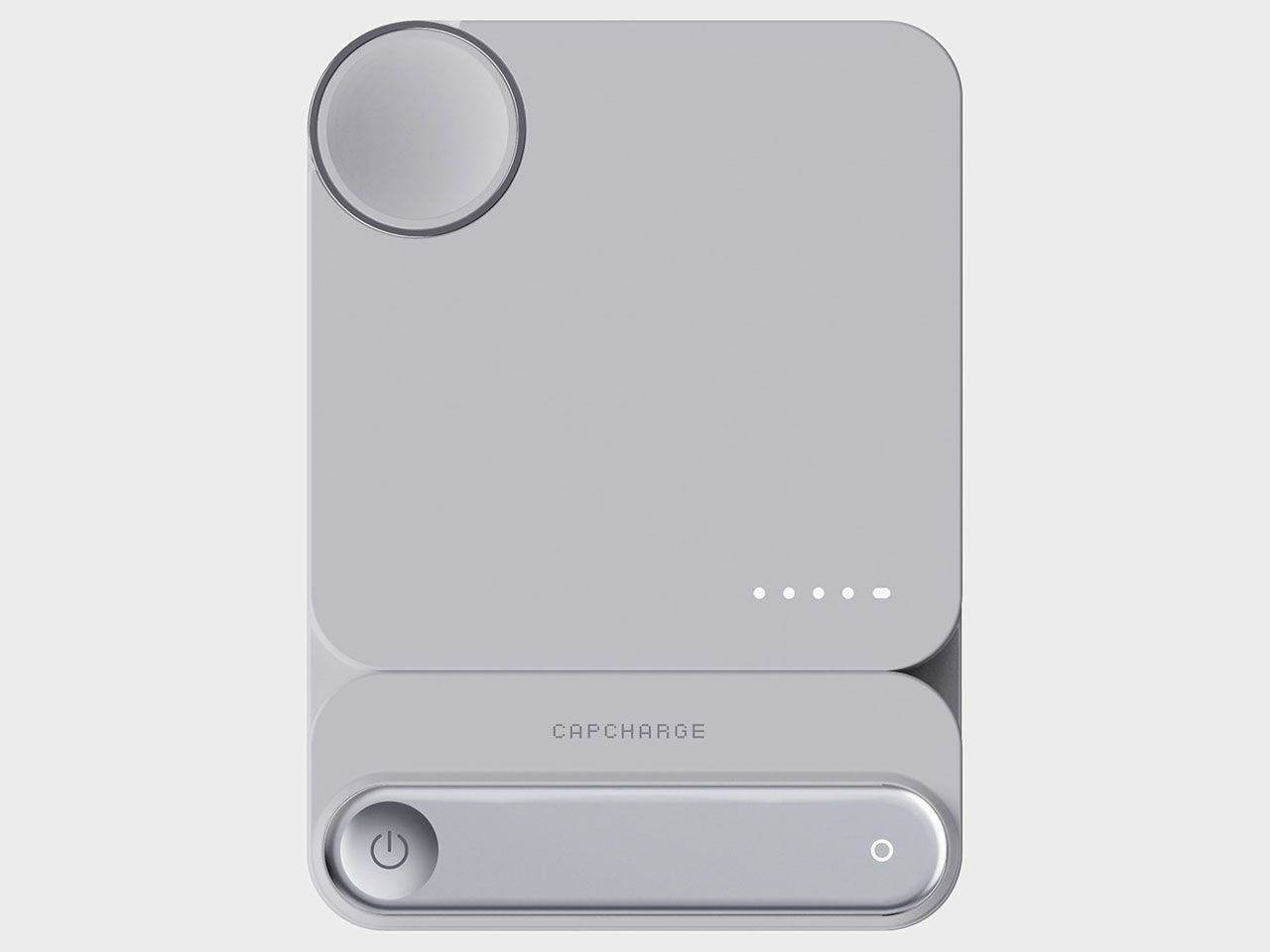
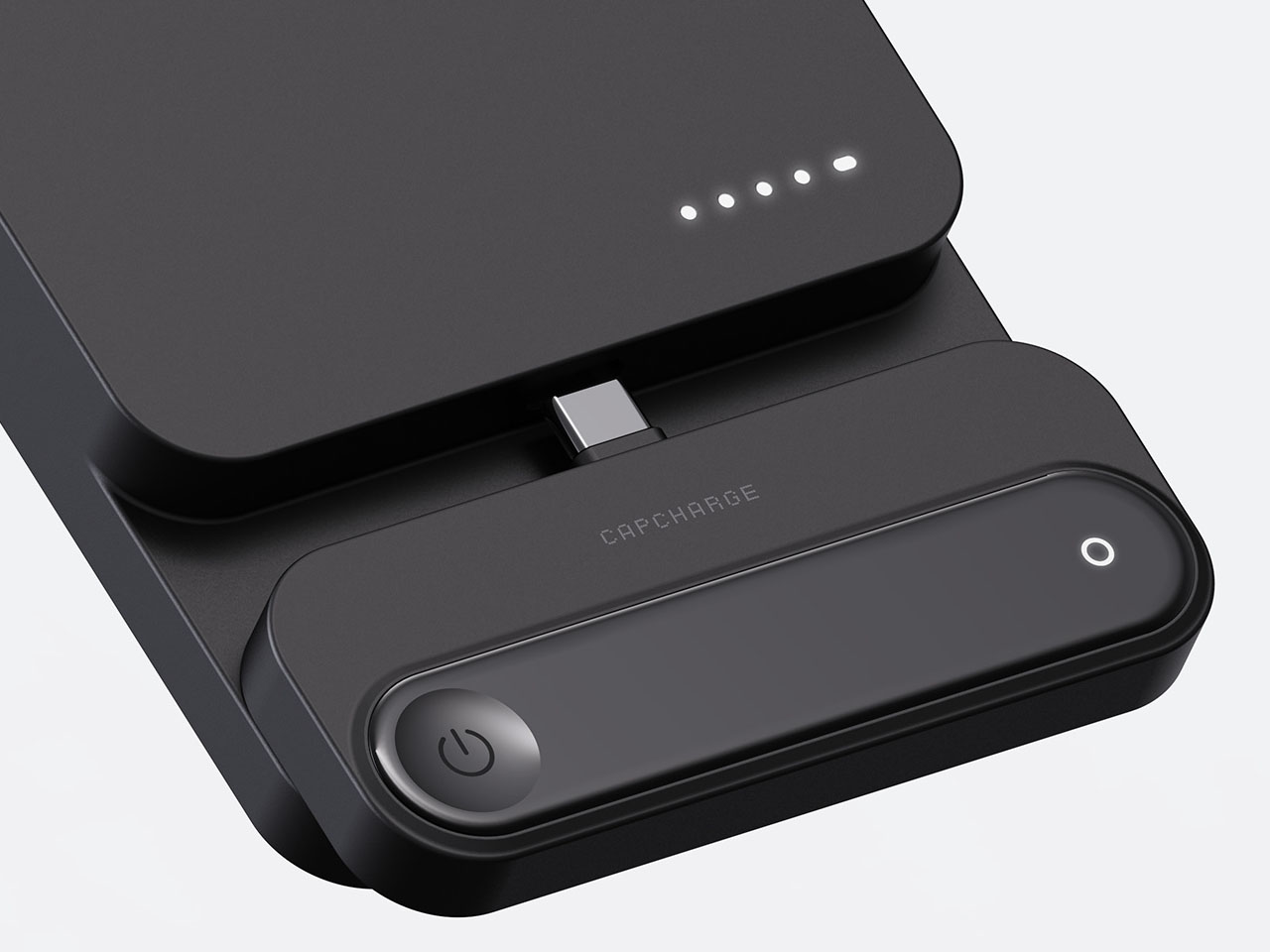
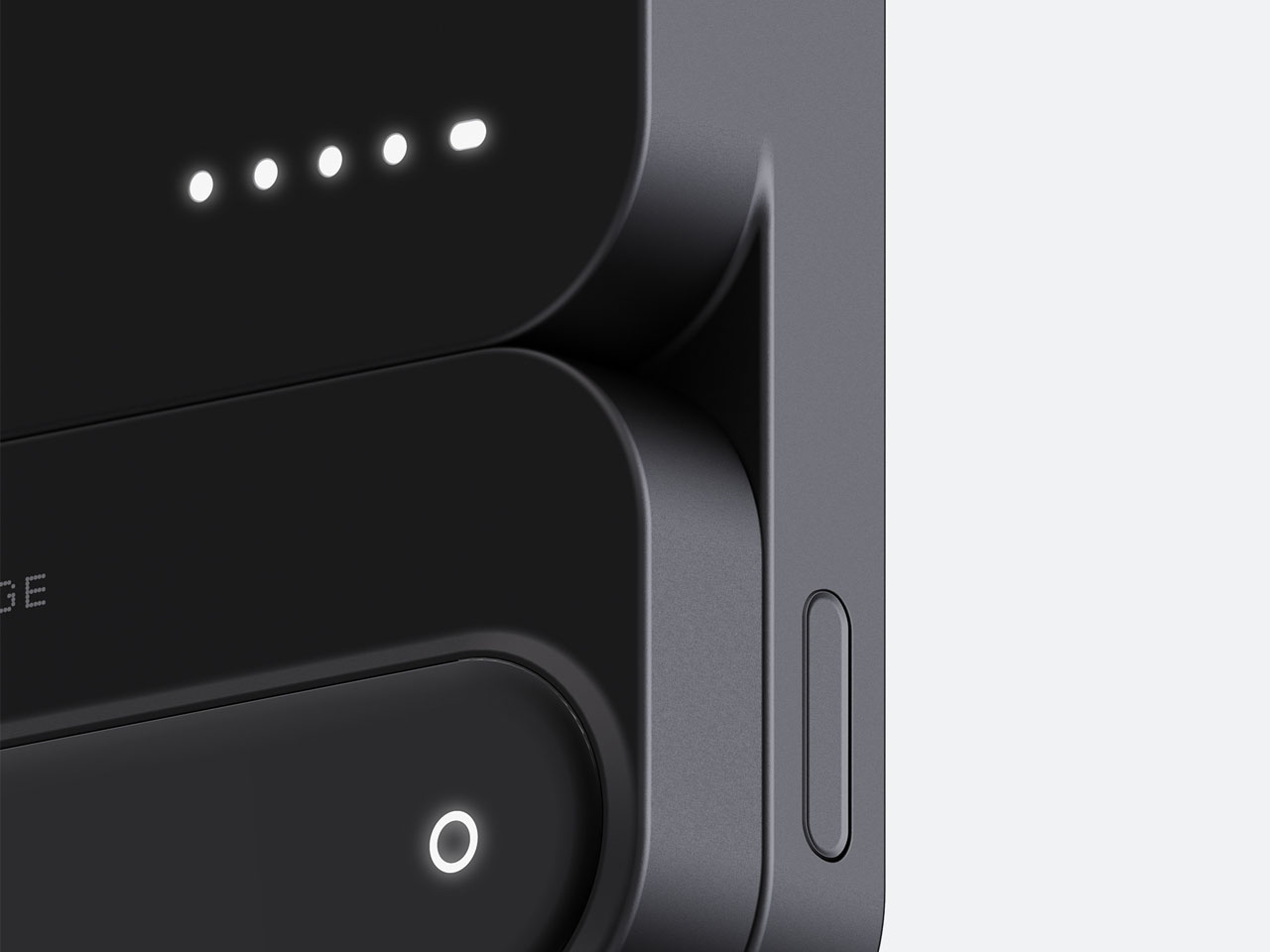
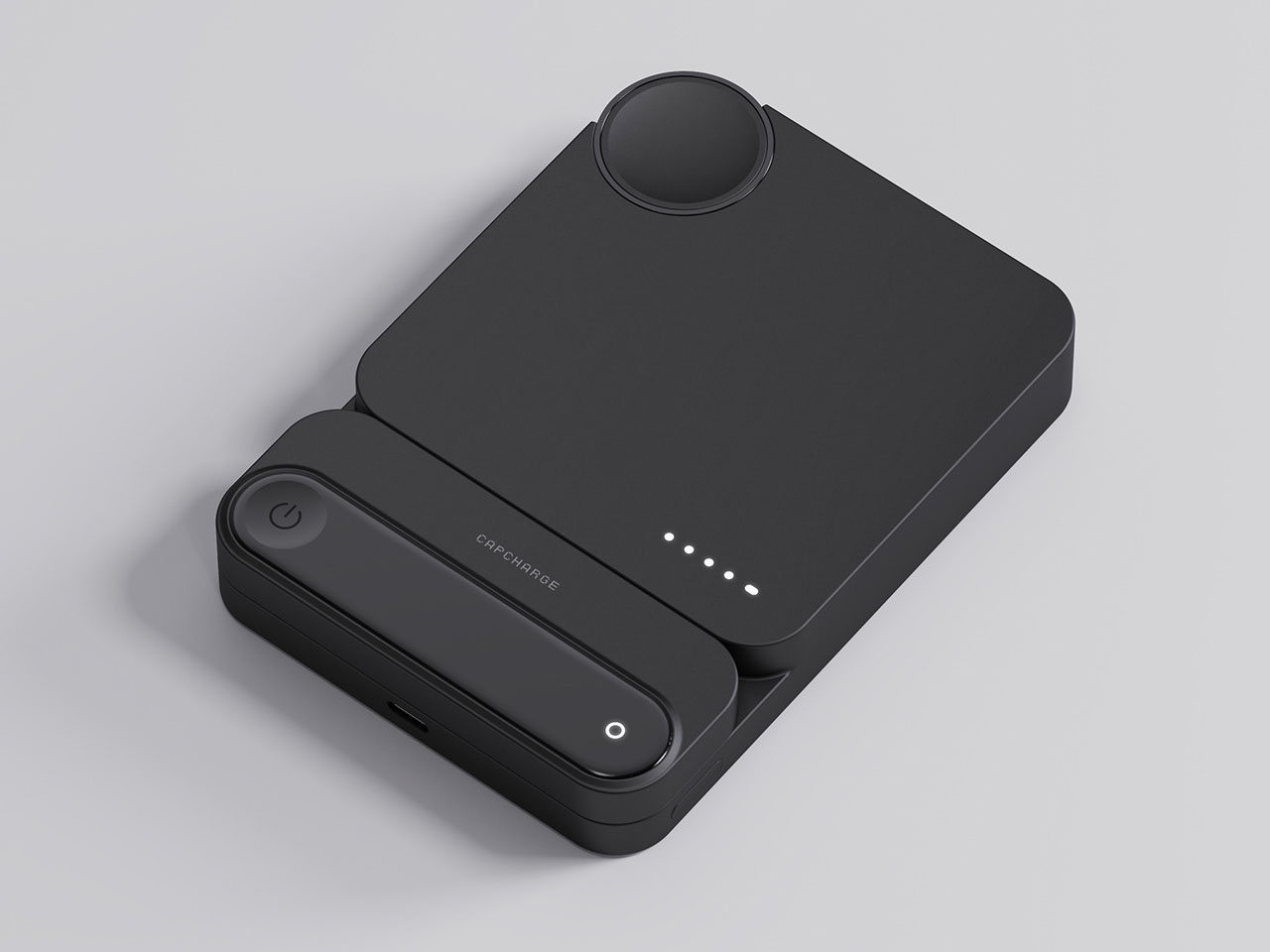
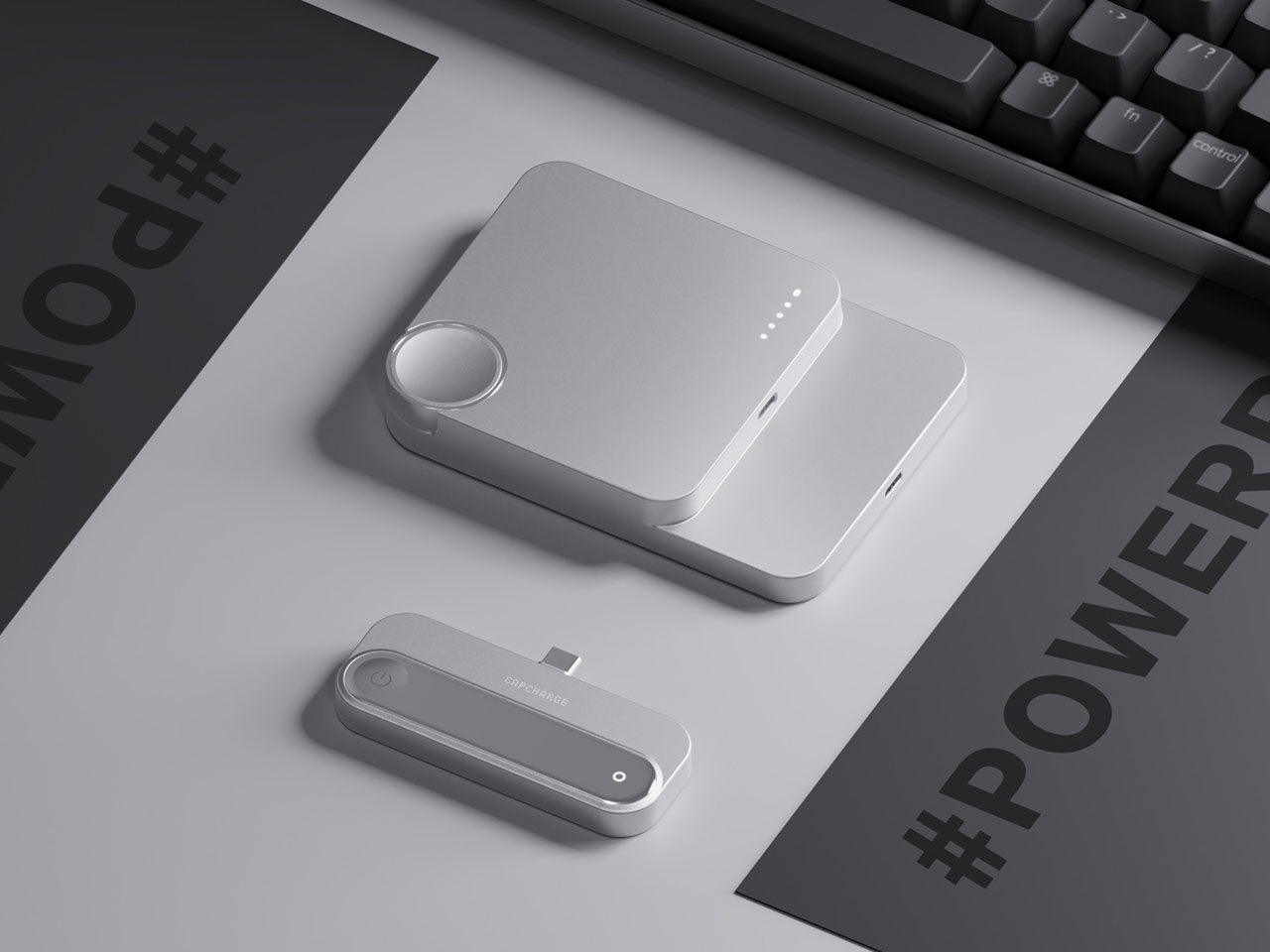
Rather than locking users into a single capacity or form, this concept introduces a modular, magnetically connected system that lets you choose what you carry. The main body works as a high-capacity unit capable of charging a phone or multiple devices, while a detachable “Energy Capsule” offers a lightweight option for topping up smaller gadgets like earbuds or smartwatches. Together, they form a cohesive all-in-one charging system; apart, they become personalized tools tailored to different needs.
The intrigue of this approach lies in its simplicity. The two modules snap together magnetically, merging into a single seamless unit when you need more power, and separating instantly when you prefer to travel light. The magnetic connection feels deliberate and intuitive, eliminating the fuss of cables or clips while ensuring both units align perfectly. It’s a design that adapts as quickly as the pace of your day, from desk to commute to travel, offering flexibility that traditional power banks never quite mastered.
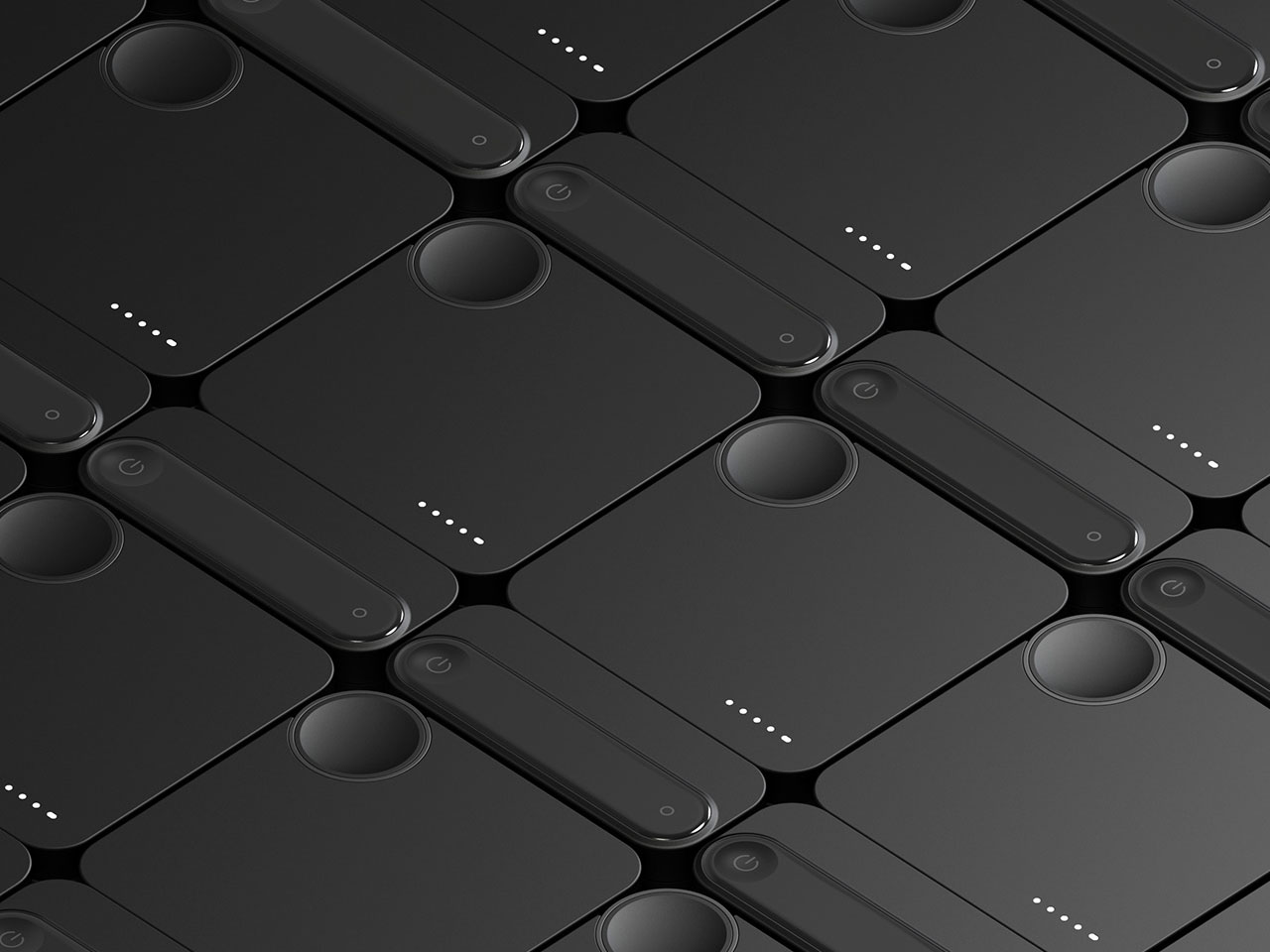
Visually, the Portable Magnetic Power Bank maintains a sense of calm precision. Every surface is smooth and uncluttered, avoiding the heavy industrial look most portable chargers carry. The minimal silhouette, clean geometry, and refined finish make it feel more like a lifestyle accessory than a tech gadget. It’s the kind of product you wouldn’t mind keeping visible on a work desk or coffee table. It’s understated yet purposeful!
Functionally, it aims to simplify multi-device charging. With the growing ecosystem of gadgets (phones, watches, earbuds, and beyond), carrying separate chargers for each is both impractical and messy. This concept eliminates that need through modular integration, ensuring one device can meet multiple scenarios. While detailed specifications, such as capacity, charging wattage, or battery chemistry, remain undisclosed, the concept clearly prioritizes versatility over raw numbers, focusing on the user experience instead.
There’s also an emphasis on comfort and balance. Detaching the capsule reduces the weight you hold while still keeping essential power within reach. Attaching it back extends your battery life without adding visual or physical clutter. This fluid adaptability embodies a quiet kind of innovation, one that improves daily usability without reinventing the wheel.
To say that I have a messy desk is an understatement. Aside from the various books, office supplies, and knick-knacks that I have lying around, one of the things that make it pretty messy are all my cords connectors, and sockets. I work with multiple devices so I need all kinds of charging and connecting tools, therefore adding to the clutter on my desk. If ever I one day decide to have a cleaner and more minimalist desk, then I definitely need one of these docking hubs to make my work and home office life a bit more organized.
Designer: Lon
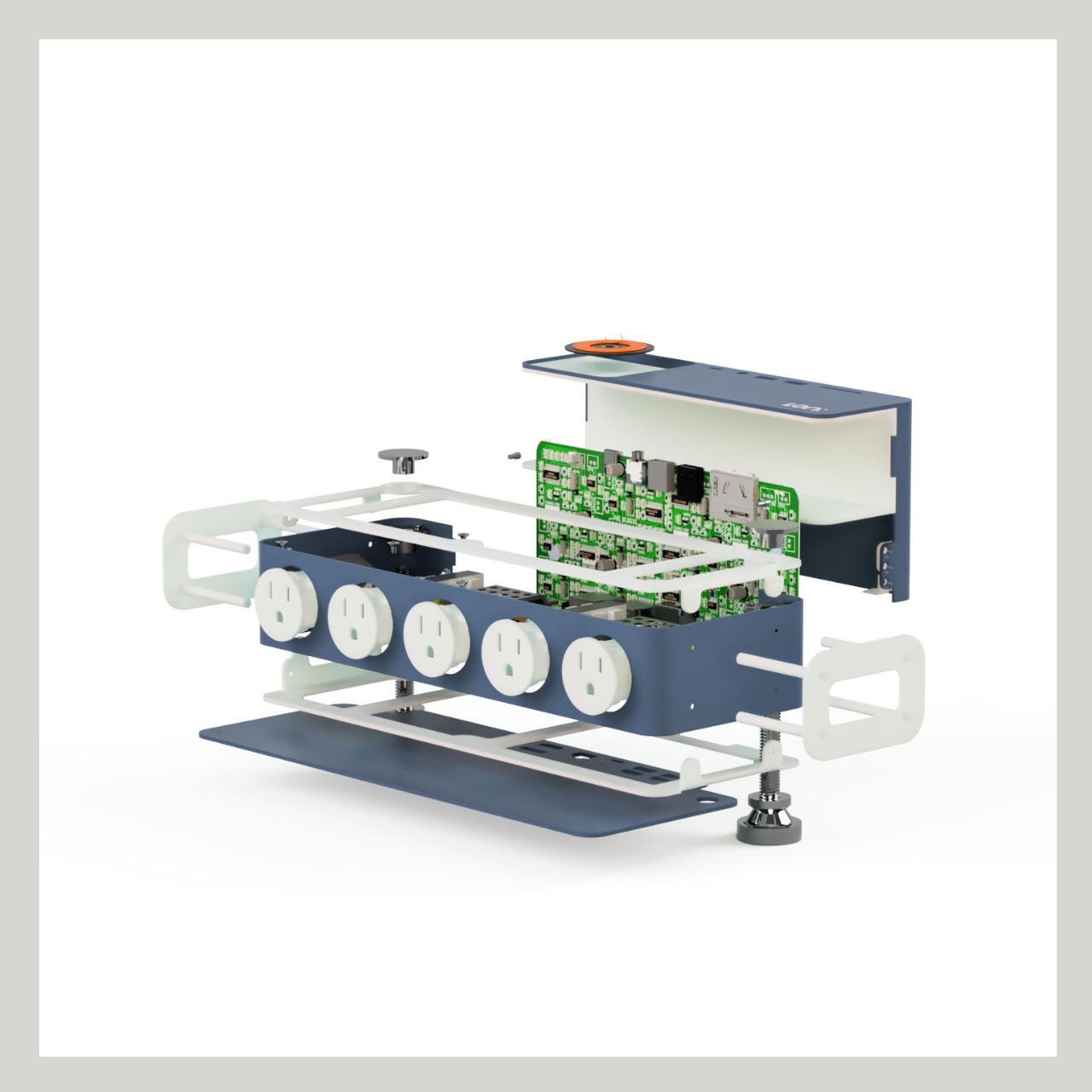
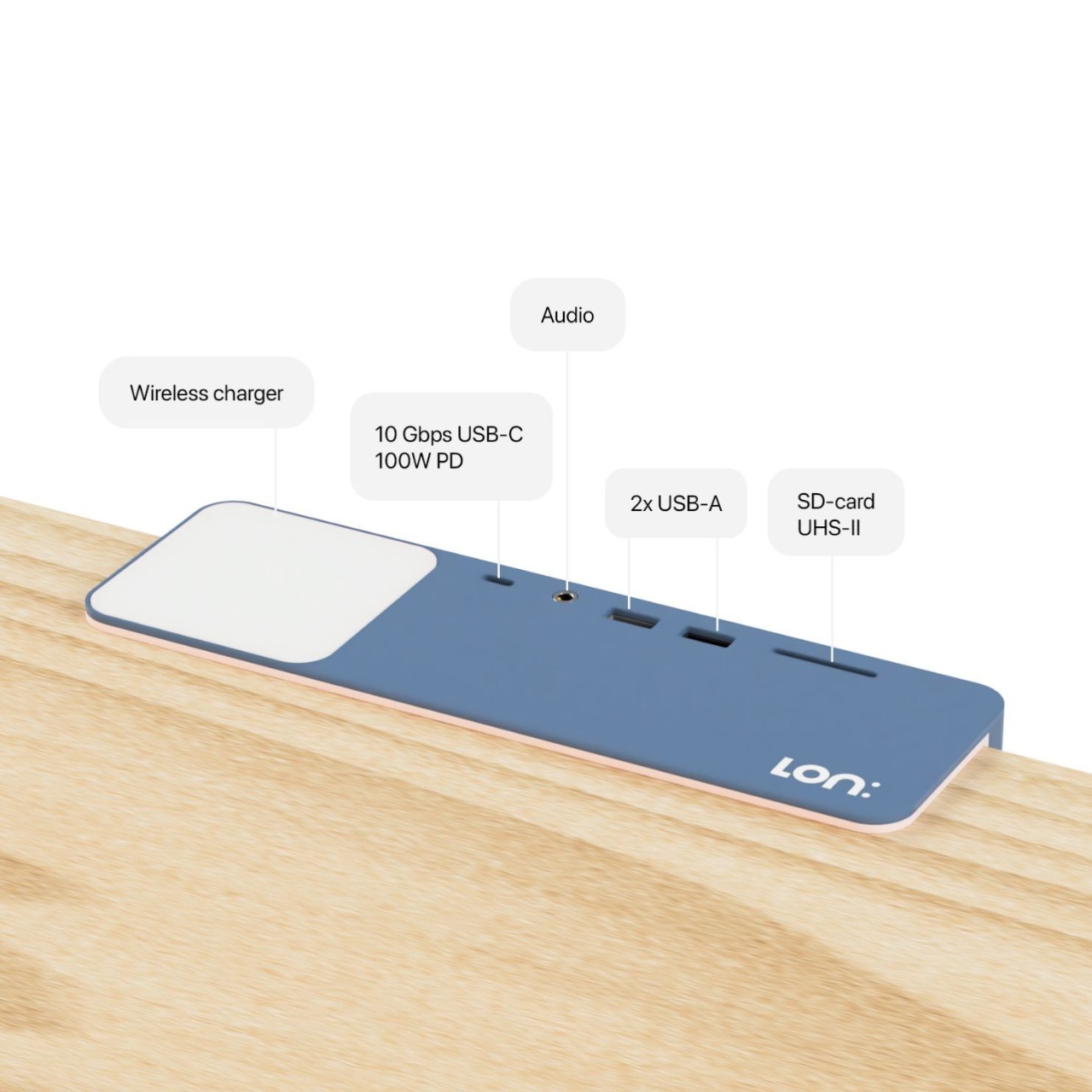
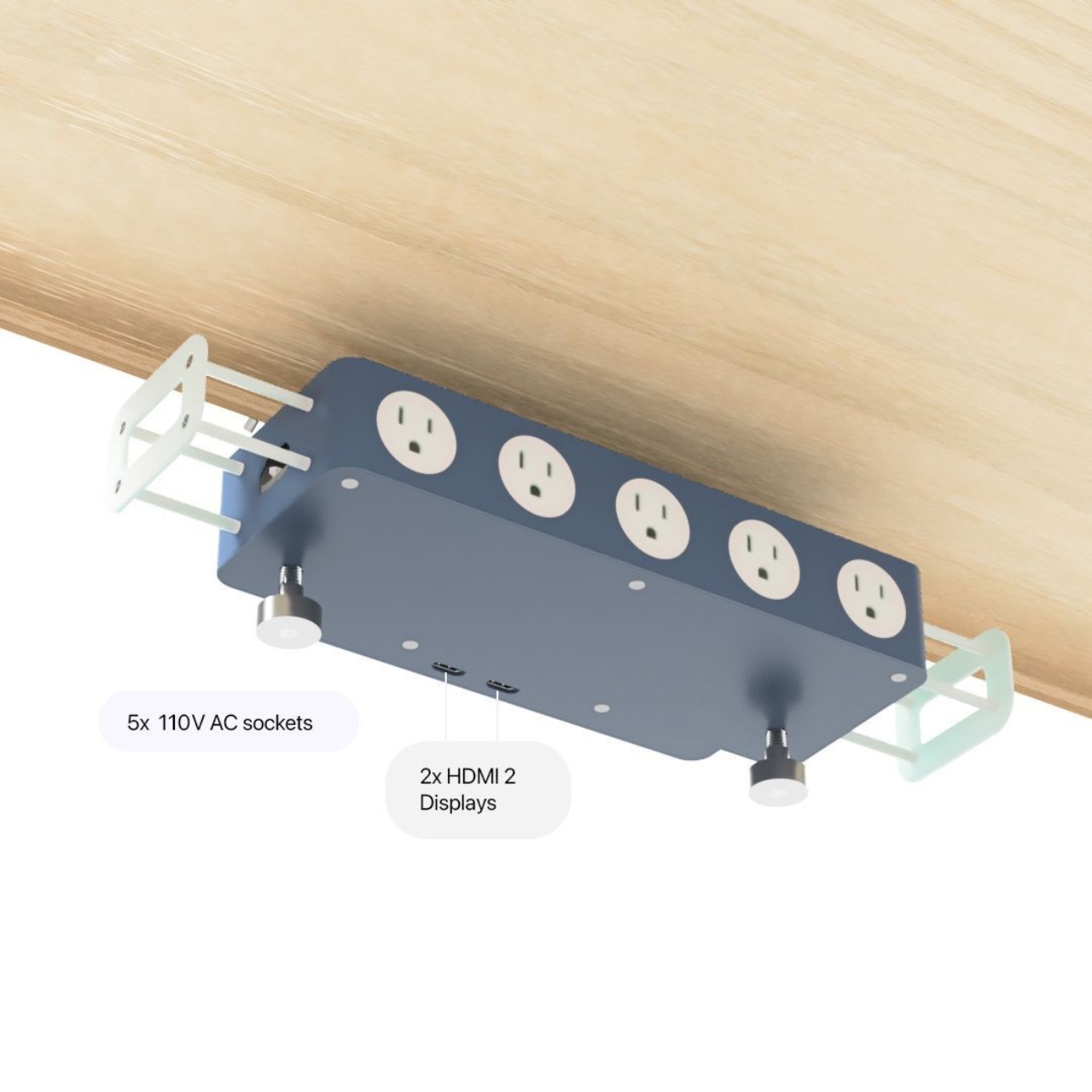
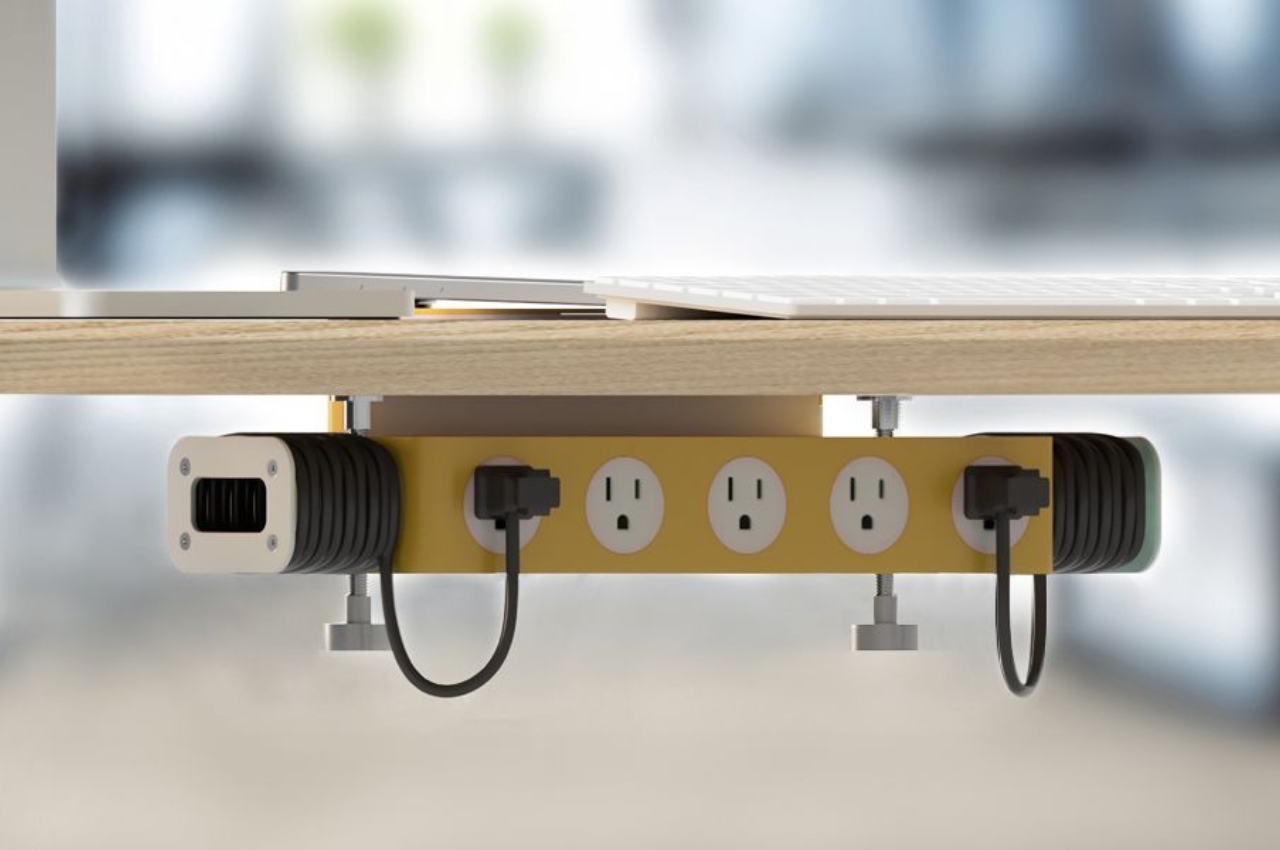
The Lon:HUB is one such docking hub that can give your desk a cleaner appearance and at the same time provide you with all the outlets and ports that you need. The ports and sockets are attached under your desk and on top of your space, you have some of the ports that you would need. Underneath, you have 5x 110V AC sockets, 2x HDMI 2 display ports, and 2x arms where you can wrap your cords around so you don’t get a spaghetti-like mess. On the edge of your desk, the hub has a 10 Gbps USB-C 100W port, 2x USB-A ports, an SD card slot, and it even has a wireless charger landing pad.
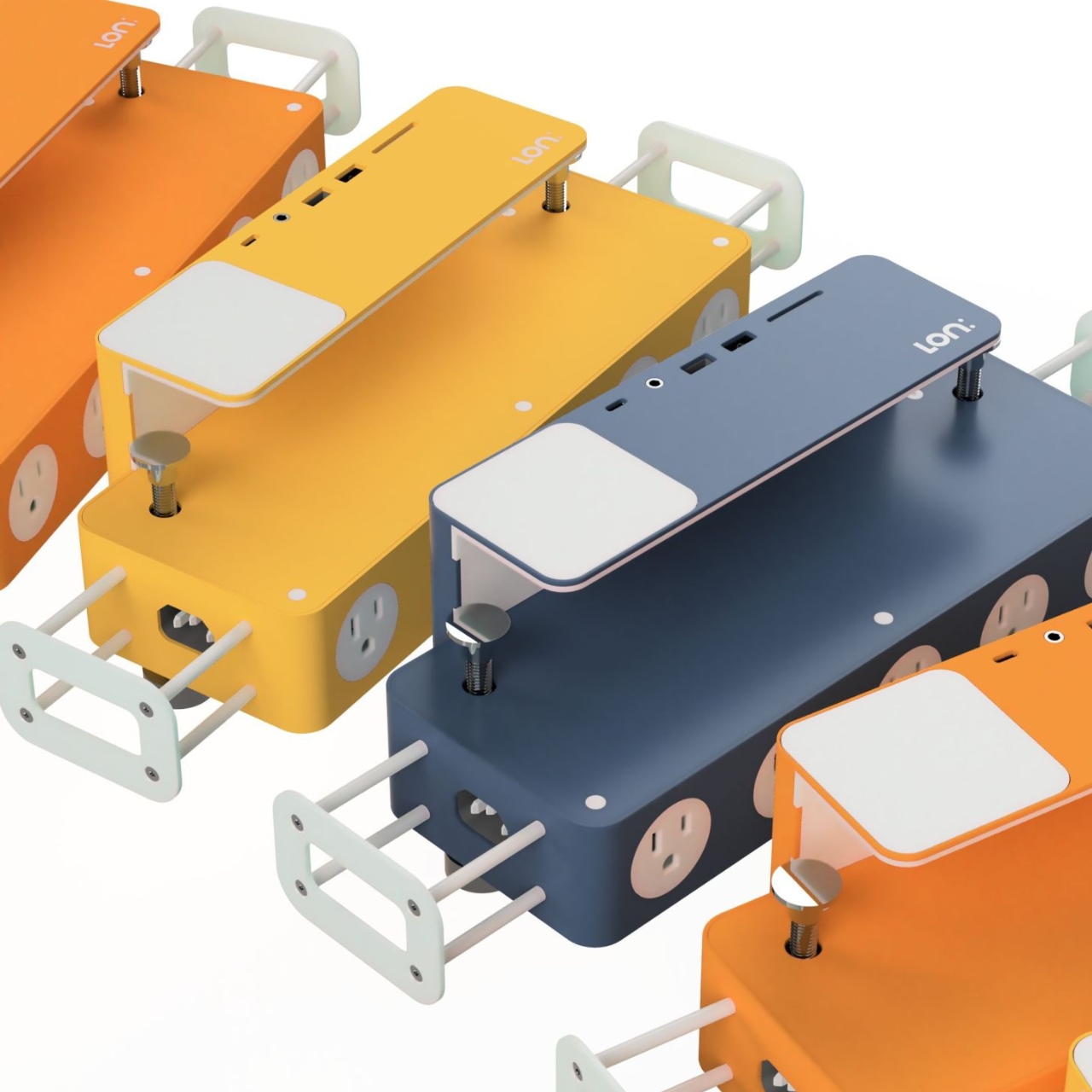
The hub also comes with a proprietary high-speed PCB with 100W PD and medical-grade power unit. It will also be available in several color options. We’re seeing orange, yellow, and a dark blue/grayish one if you prefer muted colors. If you want a more powerful unit, there will be a Pro version available which has a Thunderbolt 4 port, 2x HDMI 2.1 and 2x DisplayPort 1.4 ports,, a 2.5Gbps Ethernet card, 2x 10Gbps USB-C and 6x 10Gbps USB-A ports, a UHS-II SD-Card slot, QI2 wireless charger pad, and a 100W PD. It will also have a full aluminium casing.
The price tag hasn’t been officially revealed yet but it looks they’re planning to go for $199 which is a pretty good price tag for a dock. Design-wise the Lon:HUB is pretty minimalist and that is the point as something intricately designed may add to your desk’s clutter. I may not be leaving my maximalist style anytime soon but removing the cord and socket clutter may be the first step I’ll take and this dock would be a good start.