Snapchat is updating its parental control features to give parents more detailed information about who their kids are connecting with in the app and which features they use the most. The app's Family Center already gives parents visibility into their child's friend list, but it will now surface contextual details when a new friend is added.
For example, the feature could highlight that the two share mutual friends or have each other's contact info saved in their phones. It could also indicate that they are classmates if both users have joined the same in-app “community.” If the two have no commonalities, then that could be a sign for a parent to "start a productive conversation," Snap says.
The company has long been criticized for making it too easy for teenagers to talk to strangers. The issue has come up in safety-related lawsuits, including an ongoing case brought by New Mexico's Attorney General. Snap says that adding additional "trust signals" to its parental control features "make it easier for parents to understand new connections and have greater confidence that their teen is chatting with someone they know in real life."
The update is also adding more granular stats about how exactly teens are spending their time in the app. Family Center's screen time dashboard now includes a breakdown of how much of their time spent in the app is in its messaging, camera, map or shortform video features. It will still be up to parents to decide what, if any, limits they want to put on their teens. But at a time when there's increasing conversation around banning teens from social media entirely, having access to more stats could better help parents understand their kids' relationship with Snapchat.
This article originally appeared on Engadget at https://www.engadget.com/social-media/snapchat-gives-parents-more-info-on-who-their-kids-are-talking-to-120000077.html?src=rss
Setting up a PS5 for a child means you can offer an age-appropriate and safe platform for them to play. Sony made its parental control tools more comprehensive in recent years and they allow families to manage screen time, block unsuitable content, guide online interactions and approve purchases. The process is straightforward once the right menus are in view, but it helps to understand how each feature works before handing over the controller.
The system uses individual accounts for each family member, and these accounts determine what a child can access. A parent or guardian assigns restrictions to the child’s profile and the console enforces them more consistently than earlier PlayStation systems. The process begins with creating a child account, then linking it to the Family Management section of the adult account, and finally adjusting controls on the console itself.
Create a child account through Family Management
A child account is required before you can use any parental controls. This account is linked to the family manager’s PlayStation account and cannot be converted into an adult account until the child reaches the appropriate age under local regulations.
From the PS5 Home screen, navigate to Settings, Family and Parental Controls then choose Family Management. The system will request the family manager’s password before any changes can be made. Select Add Family Member and choose Add a Child. The console generates a QR code that opens a secure PlayStation webpage on a phone or browser. This page guides the setup process and ties the new account to the family group.
The form asks for the child’s date of birth first. Sony uses this to assign default age restrictions and to determine which features are allowed. A small credit card charge may be requested to verify the adult’s identity. The next steps involve entering an email address for the child, creating a password and selecting basic settings for content access, communication and spending. The child account must then be verified through a link sent to the provided email address. This ensures the account can use PlayStation Network features including any future purchases through the PlayStation Store.
Once complete, the new profile appears in the Family Management list on the PS5. This profile is now ready for fine-tuning.
Manage parental controls on the console
The PS5 keeps all parental controls in Family and Parental Controls within the main Settings menu. This section is organized into Playtime Settings, Content Restrictions, Communication and User-Generated Content and Spending controls. Each area can be adjusted separately for every child account in the family group.
How to set limits on playtime
Playtime controls help set boundaries for gaming sessions. Select the child’s profile, then open Playtime Settings. Limits can be set by total daily hours or by specific time windows. The console can be configured to notify the child when time is nearly up, or to log them out automatically once the limit is reached. These settings apply across the child’s account, so they remain active even if the child switches between PS5 consoles in the same household.
Parents can choose how strictly the system enforces these rules. For example, the console can continue to display warnings without blocking gameplay or it can stop activity when the allotted time ends. Playtime reports can also be viewed through the family manager’s PlayStation account or the PS App.
How to restrict content based on age ratings
Sony’s content filters are based on age ratings from the ESRB in the United States and equivalent regional boards in other countries. In Family Management, select the child’s profile and then select Parental Controls. Here, parents can set an age level for games. Titles above this level will not launch without approval from the family manager.
Blu-ray and DVD content can also be restricted and the system browser can be disabled entirely. If the family uses services that stream movies or TV shows through the console, those apps often apply their own content filters, but the PS5 can serve as a first line of control.
Engadget
How to manage communication and online interactions
Online communication can be limited to prevent unwanted contact. In Parental Controls, select Communication and User-Generated Content. This area controls messaging, voice chat, profile sharing and the ability to see or share player-created media such as screenshots and video clips.
Online play can also be adjusted. For younger kids, it may be helpful to block online multiplayer entirely until they better understand online etiquette and safety. For older children, communication can be limited to friends only. The PS5 respects these limits across all supported games.
How to set spending limits for purchases
A child account cannot use payment cards directly, but it can spend funds from the family manager’s wallet. Spending limits can be set in the child’s profile under Family Management. Parents can choose a monthly spending cap or block purchases altogether. Any attempt to exceed the limit requires approval from the family manager.
This feature covers games, add-ons, subscriptions and in-game currency. It ensures surprises on the credit card are less likely, especially in titles that promote quick digital purchases.
How to sign your child into the PS5
Once controls are set, the child can be added as a user on the console. Return to the home screen and select the user icon to switch users. Choose Add User, then select Get Started. Sign in using the child account’s email address and password.
The console guides the profile setup process and prompts for an online ID, avatar and privacy preferences. These steps help personalise the child’s space on the PS5. The system may request a locally created passcode that prevents access to parental controls without the family manager’s approval. This passcode should be unique and not shared with the child.
After setup is complete, the child will see a version of the PS5 tailored to the restrictions applied. Games that exceed the assigned age rating will appear with a lock icon and the console will block any actions that the family manager has limited.
Use the PS App and PlayStation’s online tools for ongoing management
Playtime and permissions can be managed remotely through Sony’s PS App or the PlayStation website. This makes it easier to adjust rules without taking over the TV. The app also provides notifications when playtime is running low or when the child attempts to access restricted content.
Sony’s Family Management tools synchronise across devices. Changes made from a phone appear on the PS5 within seconds. This helps maintain consistent rules, especially in homes with more than one console.
A child-ready PS5 is more than a restriction tool. It creates a safer environment for learning how to navigate digital spaces, interact with friends and handle screen time. Sony’s updated controls take much of the pressure off parents by enforcing rules in predictable ways that are difficult to bypass. Once everything is configured, the child can enjoy the console’s library while staying within the boundaries that support healthy gaming habits.
This article originally appeared on Engadget at https://www.engadget.com/gaming/playstation/how-to-set-up-a-ps5-for-a-child-160039866.html?src=rss
Baby gear used to mean loud colors and chunky plastic that demanded its own corner of the living room. Most swings looked like they belonged in pediatrician waiting rooms, and breast pumps came with tubes and bottles that made discretion impossible. For parents trying to maintain some semblance of style in their homes, it meant choosing between function and aesthetics, rarely getting both in the same product.
Momcozy approaches parenting products differently, with a design philosophy they call Cozy Tech that blends performance with calm, contemporary aesthetics. Loved by over 4.5 million moms globally, the brand starts from the reality of modern parenting: hybrid work schedules, small urban apartments, and the need for tools that integrate into existing routines without demanding wholesale lifestyle adjustments or visual compromises that most baby gear traditionally required.
Designer: Momcozy
Engineering Meets Empathy
The gap Momcozy noticed was straightforward. Traditional baby swings assumed parents had unlimited space and patience for bulky furniture, while breast pumps were designed as if mothers had all day to sit in private rooms. The disconnect was obvious once you looked at it from the parents’ side: why couldn’t products work beautifully and look beautiful at the same time, especially when those products occupy your home for years?
Cozy Tech is the answer that emerged from that question. It is a design language that prioritizes both powerful performance and restraint. Soft forms, neutral tones, and quiet operation let the products blend into design-conscious homes rather than standing out as medical equipment. The hardware still does serious work, but the presence is gentle enough that you do not feel the need to stash things in closets when people visit.
Momcozy S12 Pro Wearable Breast Pump
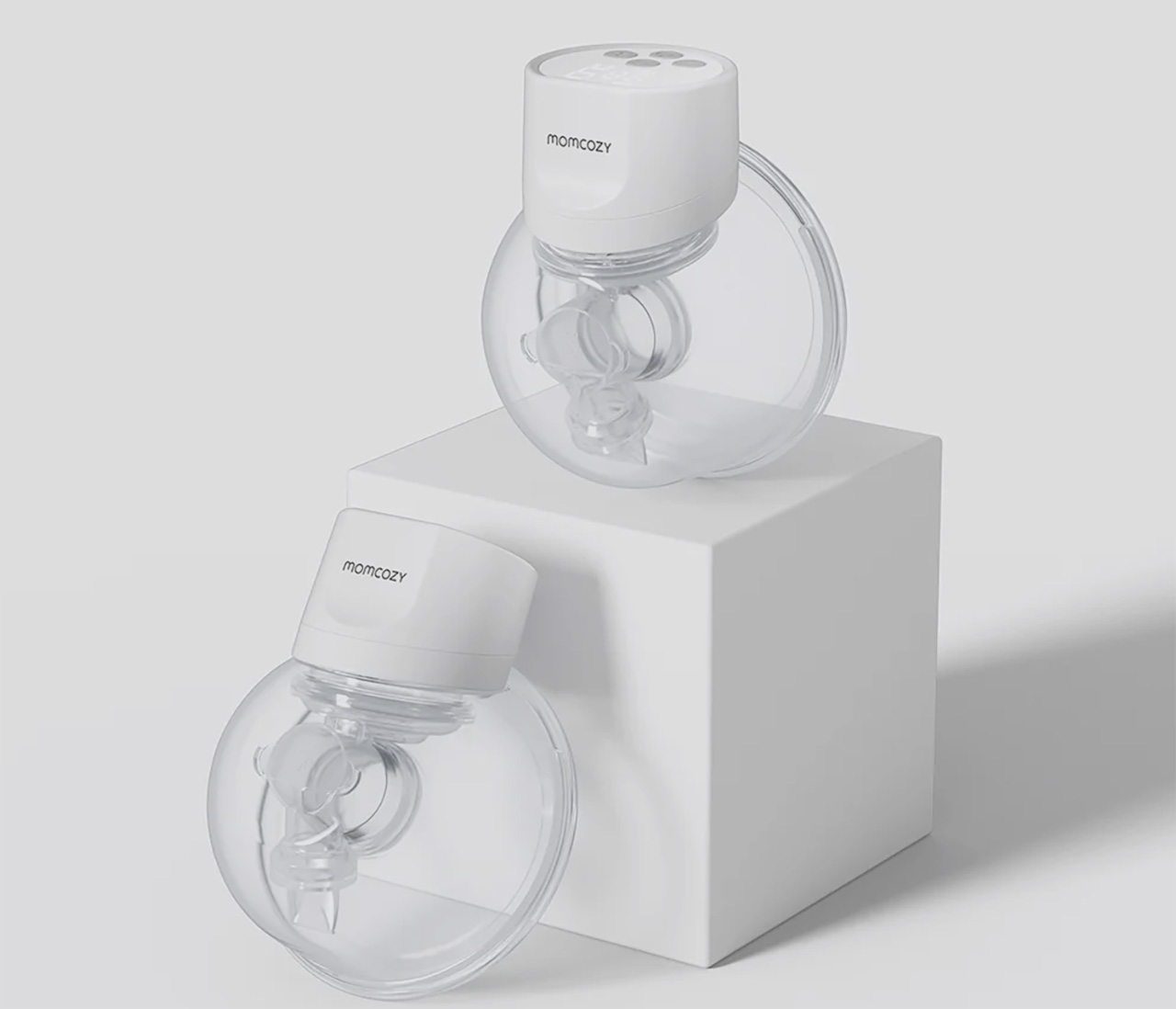
Picture a mother pumping in a parked car between meetings, or quietly at her desk during a video call. The Momcozy S12 Pro Wearable Breast Pump sits inside a standard nursing bra, disappearing under clothing so there are no tubes or external bottles to manage. From the outside, it looks like any other workday, not a carefully orchestrated routine built around pumping schedules.
The S12 Pro is shaped to mold to the body for comfortable all-day wear, offering multiple modes and adjustable suction to match different stages of expression. The internal battery supports seven to eight sessions on a single charge, reducing the mental load of planning around power outlets. It is the kind of device that quietly acknowledges mothers have careers, meetings, and social commitments, building around that reality instead of ignoring it.
The M9 Mobile Flow Hands-Free Breast Pump is designed for parents who need flexibility without compromising comfort. Imagine someone folding laundry or prepping dinner while the pump works quietly in the background, tucked inside a bra and barely noticeable. The soft, rounded shape and pink finish make it feel closer to a personal wellness device than clinical equipment, blending into the flow of a busy day.
What sets the M9 apart is the combination of smart control and efficiency. The DoubleFit Flange improves fit and reduces leakage, while the app lets parents choose from three modes and fifteen customizable settings to match their rhythm. The eighteen hundred milliampere-hour battery supports up to six sessions per charge, and the upgraded third-generation motor delivers hospital-grade suction without the noise or bulk of traditional pumps.
Shift to a different scene: a parent working from home in a small apartment, laptop open at the dining table while the baby rests in the Momcozy 2-in-1 Electric Baby Swing a few feet away. The swing’s neutral tones and clean lines blend into the living room rather than dominating it. Dual arms and a sturdy base keep everything steady, so there is no nervous checking every time the baby shifts position.
The swing mimics the natural soothing motions of a parent’s arms with four swing patterns and four speeds, helping babies stay calm outside of a caregiver’s embrace. The breathable seat adjusts to two recline positions, the cover zips off for machine washing, and when the baby outgrows the swing mode, it converts into a stationary seat that supports kids up to sixty-six pounds, turning it into furniture that lasts years instead of months.
Instead of asking parents to hide the tools that make their days possible, Momcozy designs swings and pumps that can live in the open, both visually and practically. They respect the spaces parents have built for themselves and the complex routines that run through them, showing that parenting gear can be gentle on the eyes while still doing serious work beneath the surface.
New Mexico's attorney general has filed a lawsuit against Snap, accusing the company of failing to protect children from sextortion, sexual exploitation and other harms on Snapchat. The suit contends that Snapchat's features "foster the sharing of child sexual abuse material (CSAM) and facilitate child sexual exploitation."
The state's Department of Justice carried out a months-long investigation into Snapchat and discovered a “vast network of dark web sites dedicated to sharing stolen, non-consensual sexual images from Snap.” It claims to have found more than 10,000 records related to Snap and child sexual abuse material “in the last year alone,” and says Snapchat was "by far" the biggest source of images and videos on the dark web sites that it examined.
In its complaint [PDF], the agency accused the app of being “a breeding ground for predators to collect sexually explicit images of children and to find, groom and extort them.” It states that "criminals circulate sextortion scripts" that contain instructions on how to victimize minors. It claims that these documents are publicly available and are actively being used against victims but they “have not yet been blacklisted by . . . Snapchat.”
Furthermore, investigators determined that many accounts that openly share and sell CSAM on Snapchat are linked to each other through the app's recommendation algorithm. The suit claims "Snap designed its platform specifically to make it addicting to young people, which has led some of its users to depression, anxiety, sleep deprivation, body dysmorphia and other mental health issues."
“Our undercover investigation revealed that Snapchat's harmful design features create an environment where predators can easily target children through sextortion schemes and other forms of sexual abuse,” Attorney General Raúl Torrez said in a statement. “Snap has misled users into believing that photos and videos sent on their platform will disappear, but predators can permanently capture this content and they have created a virtual yearbook of child sexual images that are traded, sold and stored indefinitely. Through our litigation against Meta and Snap, the New Mexico Department of Justice will continue to hold these platforms accountable for prioritizing profits over children's safety.”
A Snap spokesperson sent the following statement to Engadget:
We have received the New Mexico Attorney General’s complaint, are reviewing it carefully, and will respond to these claims in court. We share Attorney General Torrez’s and the public’s concerns about the online safety of young people and are deeply committed to Snapchat being a safe and positive place for our entire community, particularly for our younger users.
We have been working diligently to find, remove and report bad actors, educate our community, and give teens, as well as parents and guardians, tools to help them be safe online. We understand that online threats continue to evolve and we will continue to work diligently to address these critical issues. We have invested hundreds of millions of dollars in our trust and safety teams over the past several years, and designed our service to promote online safety by moderating content and enabling direct messaging with close friends and family. We continue this work in collaboration with law enforcement, online safety experts, industry peers, parents, teens, educators and policymakers towards our shared goal of keeping young people safe online.
Update September 5, 2024, 3:24PM ET: Added Snap's statement.
This article originally appeared on Engadget at https://www.engadget.com/big-tech/new-mexico-sues-snap-over-its-alleged-failure-to-protect-kids-from-sextortion-schemes-182426135.html?src=rss
It’s never good to recommend a comedy by saying it makes you weep, but somehow Bluey, a comedy for kids, feels more real and more truthful than anything else on TV. I see so much of myself in Bandit’s triumphs and failures as he tries to parent his two daughters. I nod along to all of his unsuccessful parenting tactics that, I’ll admit, I’ve also tried on my own two kids. And then, at the end of so many episodes, I’ll realize that the front of my t-shirt is wet with tears because I've been crying.
There can’t be many people unfamiliar with Bluey, the biggest kids’ TV series on the planet, if not the biggest series overall. Each seven-minute episode is a slice-of-life sitcom about the Heelers, a family of anthropomorphic dogs living in Brisbane, Australia. Bluey and her younger sister Bingo live with parents Bandit and Chilli. The show started out focused on the playtimes the kids would have with each other or their parents. But it quickly sprawled out to create a rich world in the vein of The Simpsons, with a whole city’s worth of storylines. It can now regularly relegate the Heelers to the background to focus on the show’s deep cast of characters.
It closed out its third season with last Sunday's “The Sign,” a (comparatively) epic 28-minute episode and this week with “Surprise,” a sweet little postscript. The former’s long running time was described as a dry-run for any potential Bluey movie, wrapping up a number of the show’s storylines. It focuses on a wedding taking place at the Heeler’s home in the shadow of the family’s plan to relocate to another city. I won’t spoil too much beyond saying “The Sign” is a story about the bigness of change and how that affects parents and kids alike. Much of it focused on Bandit’s decision to move for a better-paid job and the way that impacted Chilli and the two girls. It’s a complicated issue, especially because it highlights that parents often just want to do what’s best for the kids.
Ludo Studio
“Surprise,” meanwhile, focuses more on the mundane struggle of Bandit trying to play two different games with his daughters at the same time. Much as Bluey wants to be just seven minutes of silly fun, it can’t quite help but be honest about the emotional and physical labor of parenting. All Bandit wants to do is sit down and watch sport on the TV but his daughters won’t allow him that luxury. He’s chased around the house, forced to pretend to teach a tennis ball to ride a bike and then pelted with ping pong balls fired from a toy launcher. (Bluey’s happy to highlight how often Bandit will get hit in the groin as a consequence of whatever game the girls are playing.)
The payoff to all of that effort comes in the final half minute of the episode, which is when I started sobbing. As much as it may be pitched as a palate cleanser after the scale and emotional heft of the previous episode, the final moments offer a real (if pleasant) punch to the gut. I can’t help but feel plenty of parallels in Bluey’s life and that of my own (similarly-aged) daughter, and feel a lot of kinship with Bandit as well. If I’m one one-hundredth as good a parent as this silly cartoon dog who often gets it wrong, then I’ll feel like I’ve done a good job.
There’s been speculation that this third season may be the end for Bluey. Bloomberg reported the uncertainty around creator Joe Brumm’s future with the show, although producer Sam Moor has said it will continue in some form. Any delay would also risk that the child actors – who remain anonymous for their own safety — will age out of being able to play their roles. But in many ways, Bluey can’t not continue given the show is now a multi-billion dollar cash cow for the BBC, which owns a big chunk of the show’s rights.
I don’t want to say goodbye to Bluey and the Heelers, and I’d prefer they kept the cast as-is and let them grow up alongside Bandit and Chilli. That, to me, would be an honest thing to do, rather than indulging in the fakery that dogs so many TV shows which face this problem. But if they have to go, I’ll choose to remember Bluey’s three perfect seasons through the highs and lows of parenting.
This article originally appeared on Engadget at https://www.engadget.com/what-we-watched-blueys-joyful-finales-161527282.html?src=rss
It’s never good to recommend a comedy by saying it makes you weep, but somehow Bluey, a comedy for kids, feels more real and more truthful than anything else on TV. I see so much of myself in Bandit’s triumphs and failures as he tries to parent his two daughters. I nod along to all of his unsuccessful parenting tactics that, I’ll admit, I’ve also tried on my own two kids. And then, at the end of so many episodes, I’ll realize that the front of my t-shirt is wet with tears because I've been crying.
There can’t be many people unfamiliar with Bluey, the biggest kids’ TV series on the planet, if not the biggest series overall. Each seven-minute episode is a slice-of-life sitcom about the Heelers, a family of anthropomorphic dogs living in Brisbane, Australia. Bluey and her younger sister Bingo live with parents Bandit and Chilli. The show started out focused on the playtimes the kids would have with each other or their parents. But it quickly sprawled out to create a rich world in the vein of The Simpsons, with a whole city’s worth of storylines. It can now regularly relegate the Heelers to the background to focus on the show’s deep cast of characters.
It closed out its third season with last Sunday's “The Sign,” a (comparatively) epic 28-minute episode and this week with “Surprise,” a sweet little postscript. The former’s long running time was described as a dry-run for any potential Bluey movie, wrapping up a number of the show’s storylines. It focuses on a wedding taking place at the Heeler’s home in the shadow of the family’s plan to relocate to another city. I won’t spoil too much beyond saying “The Sign” is a story about the bigness of change and how that affects parents and kids alike. Much of it focused on Bandit’s decision to move for a better-paid job and the way that impacted Chilli and the two girls. It’s a complicated issue, especially because it highlights that parents often just want to do what’s best for the kids.
Ludo Studio
“Surprise,” meanwhile, focuses more on the mundane struggle of Bandit trying to play two different games with his daughters at the same time. Much as Bluey wants to be just seven minutes of silly fun, it can’t quite help but be honest about the emotional and physical labor of parenting. All Bandit wants to do is sit down and watch sport on the TV but his daughters won’t allow him that luxury. He’s chased around the house, forced to pretend to teach a tennis ball to ride a bike and then pelted with ping pong balls fired from a toy launcher. (Bluey’s happy to highlight how often Bandit will get hit in the groin as a consequence of whatever game the girls are playing.)
The payoff to all of that effort comes in the final half minute of the episode, which is when I started sobbing. As much as it may be pitched as a palate cleanser after the scale and emotional heft of the previous episode, the final moments offer a real (if pleasant) punch to the gut. I can’t help but feel plenty of parallels in Bluey’s life and that of my own (similarly-aged) daughter, and feel a lot of kinship with Bandit as well. If I’m one one-hundredth as good a parent as this silly cartoon dog who often gets it wrong, then I’ll feel like I’ve done a good job.
There’s been speculation that this third season may be the end for Bluey. Bloomberg reported the uncertainty around creator Joe Brumm’s future with the show, although producer Sam Moor has said it will continue in some form. Any delay would also risk that the child actors – who remain anonymous for their own safety — will age out of being able to play their roles. But in many ways, Bluey can’t not continue given the show is now a multi-billion dollar cash cow for the BBC, which owns a big chunk of the show’s rights.
I don’t want to say goodbye to Bluey and the Heelers, and I’d prefer they kept the cast as-is and let them grow up alongside Bandit and Chilli. That, to me, would be an honest thing to do, rather than indulging in the fakery that dogs so many TV shows which face this problem. But if they have to go, I’ll choose to remember Bluey’s three perfect seasons through the highs and lows of parenting.
This article originally appeared on Engadget at https://www.engadget.com/what-we-watched-blueys-joyful-finales-161527282.html?src=rss
Experts suggest, going out with your fussy infant for a drive can lull them to sleep and smoothen their peace. But sitting in the car, facing the other way around in their chair, a child may not always be the happiest and you may not have all the control you desire. To your rescue, Japanese auto giant Nissan has designed cute robots that will make in-car parenting a breeze and a favorite activity for your tiny winy.
This is being made possible by Nissan through Iruyo: The Intelligent Puppet. The automaker has collaborated with compatriot Akachan Honpo, a baby goods retailer, to make the Iruyo, furry babysitter. It comes built-in with a range of sensors and communication devices to ensure parents get an affordable toy robot they can safely have around their baby.
To cut the chase, Iruyo: The Intelligent Puppet is a moniker used for a set of two similar-looking state-of-the-art robotic companions that vary visually in their size and come in thoughtfully fashioned red and subtler pink and white colors. The little one, aptly called the Baby Iruyo, is designed to sit near the driver – essentially in the cup holder – while the elder Iruyo rests in the backseat, facing the child sitting in their chair.
Baby Iruyo is programmed to understand voice commands; guess, only in Japanese for now. So, when the child gets cranky in the backseat, the parent can speak some consoling commands such as “I’m here” or “play peek-a-boo” and the little Iruyo relays that to the Iruyo, facing the child, which then makes suitable gestures to keep the kid entertained.
Well, Iruyo is either avatar is only a concept for now, but already the highly researched companion robot has been found to be a preoccupying activity in 90 percent of babies. Half of this percentage of babies have even experienced mood enhancements with the robot by their side. This data is instigating the makers to continue with trials and general experience sessions. One such event is slated at the Akachan Honpo store in LaLaport Yokohama on February 10 and 11.
The CEOs of Meta, Snap, Discord, X and TikTok testified at a high-stakes Senate Judiciary Committee hearing on child exploitation online. During the hearing, Mark Zuckerberg, Evan Spiegel, Jason Citron, Linda Yaccarino and Shou Chew spent nearly four hours being grilled by lawmakers about their records on child safety.
The hearing was the first time Spiegel, Citron and Yaccarino testified to Congress. Notably, all three were subpoenaed by the committee after refusing to appear voluntarily, according to lawmakers. Judiciary Committee Chair Senator Dick Durbin noted that Citron “only accepted services of his subpoena after US Marshals were sent to Discord’s headquarters at taxpayers’ expense.”
The hearing room was filled with parents of children who had been victims of online exploitation on social media. Many members of the audience silently held up photos of their children as the CEOs entered the room, and Durbin kicked off the hearing with a somber video featuring victims of child exploitation and their parents.
“Discord has been used to groom, abduct and abuse children,” Durbin said. “Meta’s Instagram helped connect and promote a network of pedophiles. Snapchat’s disappearing messages have been co-opted by criminals who financially extort young victims. TikTok has become a quote platform of choice for predators to access, engage and groom children for abuse. And the prevalence of CSAM on X has grown as the company has gutted its trust and safety workforce.”
During the hearing, many of the senators shared personal stories of parents whose children had died by suicide after being exploited online. "Mr. Zuckerberg, you and the companies before us — I know you don't mean it to be so — but you have blood on your hands," Senator Lindsey Graham said in his opening remarks. The audience applauded.
Sen. @LindseyGrahamSC: "Mr. Zuckerberg, you and the companies before us, I know you don't mean it to be so, but you have blood on your hands. You have a product that's killing people." pic.twitter.com/QPAlUQwIqZ
While years of similar hearings have so far failed to produce any new laws, there is growing bipartisan support in Congress for new safety regulations. As Tech Policy Presspoints out, there are currently more than half a dozen bills dealing with children's online safety that have been proposed by senators. These include the Kids Online Safety Act (KOSA), which would require platforms to create more parental control and safety features and submit to independent audits, and COPPA 2.0, a revised version of the 1998 Children and Teens' Online Privacy Protection Act, which would bar companies from collecting or monetizing children’s data without consent.
Senators have also proposed a number of bills to address child exploitation, including the EARN IT Act, currently in its third iteration since 2020, and the STOP CSAM Act. None of these have advanced to the Senate floor for a vote. Many of these bills have faced intense lobbying from the tech industry, though some companies in attendance said they were open to some bills and some aspects of the legislation.
Spiegel said that Snap supports KOSA. Yaccarino said X supports the STOP CSAM Act. Shou and Citron both declined to specifically endorse the bills they were asked about, but said they were open to more discussions.
Zuckerberg suggested a different approach, saying he supported age verification and parental control requirements at the app store level, which would effectively shift the burden to Apple and Google. "Apple already requires parental consent when a child does a payment with an app, so it should be pretty trivial to pass a law that requires them to make it so parents have control anytime a child downloads an app,” Zuckerberg said.
Meta has come increased pressure in recent months following a lawsuit from 41 states for harming teens’ mental health. Court documents from the suit allege that Meta turned a blind eye to children under 13 using its service, did little to stop adults from sexually harassing teens on Facebook and that Zuckerberg personally intervened to stop an effort to ban plastic surgery filters on Instagram.
Unsurprisingly, Zuckerberg came under particular scrutiny during the hearing. In one awkward exchange, Senator Graham asked Zuckerberg if the parents of a child who died by suicide after falling victim to a sextortion scheme should be able to sue Meta. Zuckerberg, looking uncomfortable, paused and said “I think that they can sue us.”
Sen. Josh Hawley (R-MO) asks Mark Zuckerberg if he'd like to apologize to families in attendance at Senate hearing on social media
He stands, turns & talks about Meta's "industry-leading efforts..to make sure that no one has to go through the things..your families have suffered" pic.twitter.com/lqaUgFqhxu
Later, Senator Josh Hawley pressed the Meta founder on whether he would personally apologize to the parents in the hearing room. Zuckerberg stood up and faced the audience. "I’m sorry for everything you have all been through," he said. "No one should go through the things that your families have suffered and this is why we invest so much and we are going to continue doing industry-wide efforts to make sure no one has to go through the things your families have had to suffer."
Spiegel was also asked to directly address parents. “Mr. Spiegel, there are a number of parents who have children who have been able to access illegal drugs on your platform, what do you say to those parents,” Scenario Laphonza Butler asked the Snap founder. “I’m so sorry,” he said.
As with many past hearings featuring tech CEOs, some lawmakers strayed off topic. Multiple senators pressed Chew on TikTok’s relationship with China, as well as its handling of content moderation during the Israel-Hamas war. Senator Tom Cotton repeatedly asked TikTok's CEO about his citizenship (Chew is Singaporean).
There were also some bizarre moments, like when Senator John Kennedy asked Spiegel if he knew the meaning of “yada yada yada” (Spiegel claimed he was “not familiar” with the phrase). “Can we agree … what you do is what you believe and everything else is just cottage cheese,” Kennedy asked.
During the hearing, many of the companies touted their existing safety features and parental controls (Meta launched several updates in the lead-up to the hearing). Yaccarino, who repeatedly claimed that X was a “brand new company” said X was considering adding parental controls. “Being a 14-month-old company we have reprioritized child protection and safety measures,” she said. “And we have just begun to talk about and discuss how we can enhance those with parental controls.”
In the US, the National Suicide Prevention Lifeline is 1-800-273-8255 or you can simply dial 988. Crisis Text Line can be reached by texting HOME to 741741 (US), 686868 (Canada), or 85258 (UK). Wikipedia maintains a list of crisis lines for people outside of those countries.
This article originally appeared on Engadget at https://www.engadget.com/senate-tells-social-media-ceos-they-have-blood-on-their-hands-for-failing-to-protect-children-170411884.html?src=rss
California will float a pair of bills designed to protect children from social media addiction and preserve their private data. The Protecting Youth from Social Media Addiction Act (SB 976) and California Children’s Data Privacy Act (AB 1949) were introduced Monday by the state’s Attorney General Rob Bonta, State Senator Nancy Skinner and Assemblymember Buffy Wicks. The proposed legislation follows a CA child safety bill that was set to go into effect this year but is now on hold.
SB 976 could give parents the power to remove addictive algorithmic feeds from their children’s social channels. If passed, it would allow parents of children under 18 to choose between the default algorithmic feed — typically designed to create profitable addictions — and a less habit-forming chronological one. It would also let parents block all social media notifications and prevent their kids from accessing social platforms during nighttime and school hours.
“Social media companies have designed their platforms to addict users, especially our kids. Countless studies show that once a young person has a social media addiction, they experience higher rates of depression, anxiety, and low self-esteem,” California Senator Nancy Skinner (D-Berkeley) wrote in a press release. “We’ve waited long enough for social media companies to act. SB 976 is needed now to establish sensible guardrails so parents can protect their kids from these preventable harms.”
L to R: California AG Rob Bonta, State Senator Nancy Skinner and Assemblymember Buffy Wicks
The Office of Nancy Skinner
Meanwhile, AB 1949 would attempt to strengthen data privacy for CA children under 18. The bill’s language gives the state’s consumers the right to know what personal information social companies collect and sell and allows them to prevent the sale of their children’s data to third parties. Any exceptions would require “informed consent,” which must be from a parent for children under 13.
In addition, AB 1949 would close loopholes in the California Consumer Privacy Act (CCPA) that fail to protect the data of 17-year-olds effectively. The CCPA reserves its most robust protections for those under 16.
“This bill is a crucial step in our work to close the gaps in our privacy laws that have allowed tech giants to exploit and monetize our kids’ sensitive data with impunity,” wrote Wicks (D-Oakland).
The bills may be timed to coincide with a US Senate hearing (with five Big Tech CEOs in tow) on Wednesday covering children’s online safety. In addition, California is part of a 41-state coalition that sued Meta in October for harming children’s mental health. The Wall Street Journalreported in 2021 that internal Meta (Facebook at the time) documents described “tweens” as “a valuable but untapped audience.”
This article originally appeared on Engadget at https://www.engadget.com/proposed-california-bill-would-let-parents-block-algorithmic-social-feeds-for-children-220132956.html?src=rss
California will float a pair of bills designed to protect children from social media addiction and preserve their private data. The Protecting Youth from Social Media Addiction Act (SB 976) and California Children’s Data Privacy Act (AB 1949) were introduced Monday by the state’s Attorney General Rob Bonta, State Senator Nancy Skinner and Assemblymember Buffy Wicks. The proposed legislation follows a CA child safety bill that was set to go into effect this year but is now on hold.
SB 976 could give parents the power to remove addictive algorithmic feeds from their children’s social channels. If passed, it would allow parents of children under 18 to choose between the default algorithmic feed — typically designed to create profitable addictions — and a less habit-forming chronological one. It would also let parents block all social media notifications and prevent their kids from accessing social platforms during nighttime and school hours.
“Social media companies have designed their platforms to addict users, especially our kids. Countless studies show that once a young person has a social media addiction, they experience higher rates of depression, anxiety, and low self-esteem,” California Senator Nancy Skinner (D-Berkeley) wrote in a press release. “We’ve waited long enough for social media companies to act. SB 976 is needed now to establish sensible guardrails so parents can protect their kids from these preventable harms.”
L to R: California AG Rob Bonta, State Senator Nancy Skinner and Assemblymember Buffy Wicks
The Office of Nancy Skinner
Meanwhile, AB 1949 would attempt to strengthen data privacy for CA children under 18. The bill’s language gives the state’s consumers the right to know what personal information social companies collect and sell and allows them to prevent the sale of their children’s data to third parties. Any exceptions would require “informed consent,” which must be from a parent for children under 13.
In addition, AB 1949 would close loopholes in the California Consumer Privacy Act (CCPA) that fail to protect the data of 17-year-olds effectively. The CCPA reserves its most robust protections for those under 16.
“This bill is a crucial step in our work to close the gaps in our privacy laws that have allowed tech giants to exploit and monetize our kids’ sensitive data with impunity,” wrote Wicks (D-Oakland).
The bills may be timed to coincide with a US Senate hearing (with five Big Tech CEOs in tow) on Wednesday covering children’s online safety. In addition, California is part of a 41-state coalition that sued Meta in October for harming children’s mental health. The Wall Street Journalreported in 2021 that internal Meta (Facebook at the time) documents described “tweens” as “a valuable but untapped audience.”
This article originally appeared on Engadget at https://www.engadget.com/proposed-california-bill-would-let-parents-block-algorithmic-social-feeds-for-children-220132956.html?src=rss