Someone Made a Flat-Pack Stool from Glass That Loops Like Frozen Water

Flat-pack furniture is usually shorthand for budget compromises, cardboard boxes stuffed with dowels, and Allen keys that disappear the moment you need them. It is something you tolerate for convenience rather than admire, defined by getting furniture to your door cheaply rather than making you excited about assembly. The tension between wanting sculptural pieces and needing things that can actually ship and fit through narrow stairwells rarely gets resolved gracefully.

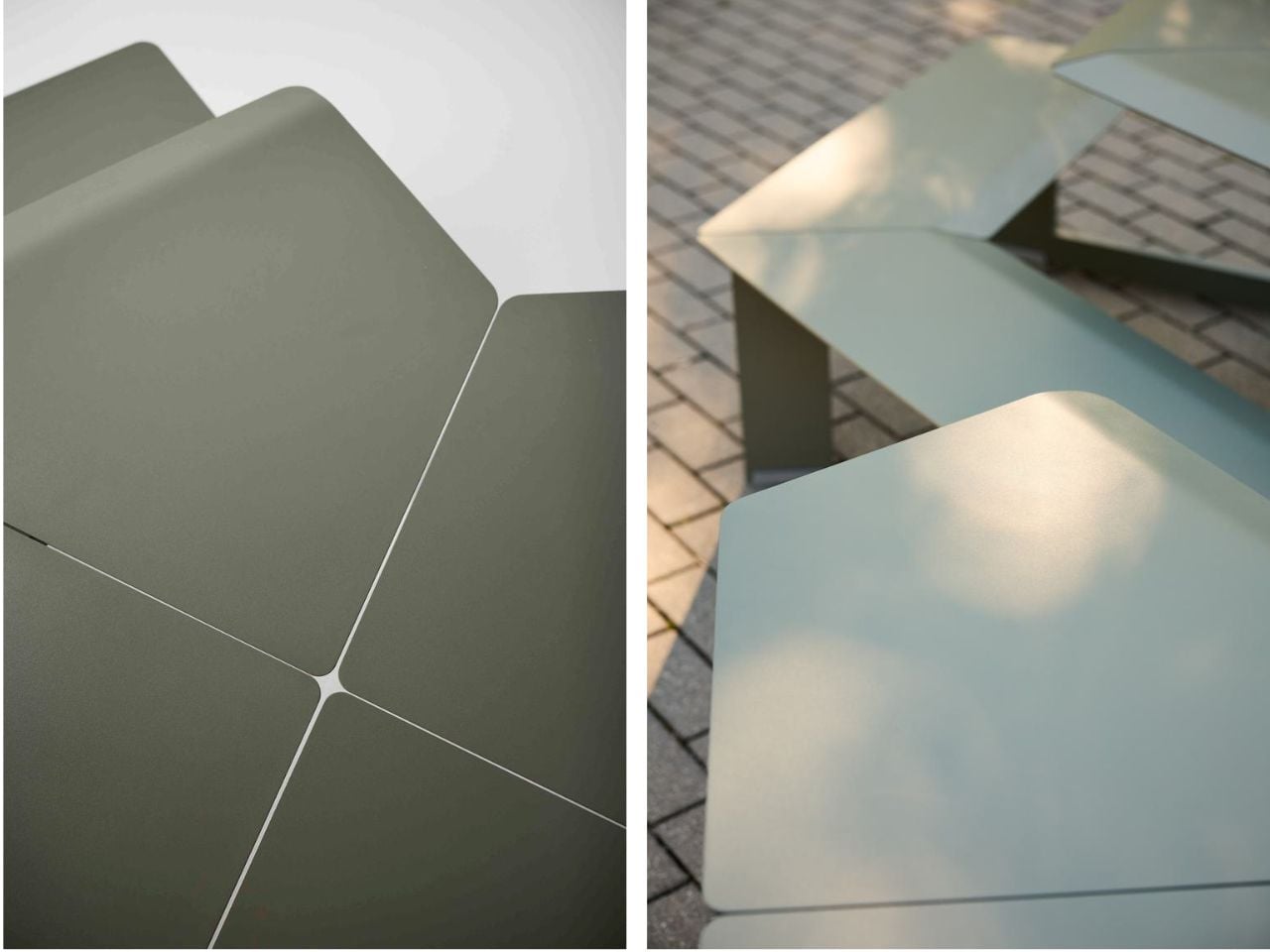
Tide Stool treats flat-pack as a starting point for luxury instead of a constraint. Designed by Vinayak Syam for DreamDeadline Works and produced by House of Sach, it is built from toughened glass legs, precision 3D-printed joinery, and hand-finished upholstery. The structure rises from a flat kit into a flowing form, shaped by curves and loops rather than brute-force mass, with the name being very much intentional.

Designer: Vinayak Syam

Instead of chunky wooden legs, Tide uses transparent glass fins that fold and loop around a central axis, carrying load through geometry. The panels curve out and back in, sharing weight across their profiles, so strength comes from the path the glass takes rather than thickness. It flips the usual hierarchy where glass is treated as fragile skin and heavier materials are trusted with structural work.

Receiving Tide as a flat set of glass pieces and joinery turns assembly into a building ritual rather than a chore. Slotting the fins into 3D-printed nodes lets you watch the structure emerge from motion, where overlapping curves and visible joints become part of the composition. The design makes those connections part of the visual language, so engineering reads as an aesthetic feature rather than something to hide.

The upholstered top sits above the glass base as a soft disc that comes in more than thirty colour finishes. Upholstery is offered in fabric and vegan leather, with Deep Sienna being the leather option and the rest using elevated textiles. That palette lets the same glass base feel quiet and monochrome in one space or warm and expressive in another, without losing its sculptural identity.

Flat-pack construction makes shipping and moving easier, especially for people who rearrange or relocate often, yet once assembled, the stool reads as a single object rather than a kit. The toughened glass and looping geometry give real load-bearing confidence while keeping the footprint visually light. It is the rare piece that respects both logistics and living rooms without asking you to choose between practicality and presence.

Tide turns apparent fragility into a quiet expression of resilience. The transparent legs, visible joinery, and soft seat work together to make strength feel like a product of balance and flow rather than heaviness. For anyone tired of choosing between sculptural furniture and flat-pack practicality, a glass stool that arrives as parts and stands like a tide frozen mid-rise feels like a surprisingly thoughtful middle ground.

The post Someone Made a Flat-Pack Stool from Glass That Loops Like Frozen Water first appeared on Yanko Design.

Wikimedia announces AI partners including Meta and Microsoft

As part of Wikipedia's 25th anniversary, parent company Wikimedia announced a slew of partnerships with AI-focused companies like Amazon, Meta, Perplexity, Microsoft and others. The deals are meant to alleviate some of the cost associated with AI chatbots accessing Wikipedia content in enormous volumes by giving the tech companies streamlined access.

As noted by The Verge, the timeline on these deals is a little squirrely. The Wikipedia foundation says that several companies became enterprise partners "over the past year," while listing Amazon, Google and Meta as "existing" partners. It appears today is the first time they have been officially announced.

The organization sounded the alarm on this issue last year, saying the reduction in traffic due to LLMs and AI summaries could prove existential for the nonprofit and the world's largest online encyclopedia. Wikipedia's 65 million free articles have served as rich training data for AI chatbots, but all that scraping has driven up server costs at the organization.

Wikimedia had been hoping to move these large firms over to its enterprise platform to help with costs. "It took us a little while to understand the right set of features and functionality to offer if we're going to move these companies from our free platform to a commercial platform ... but all our Big Tech partners really see the need for them to commit to sustaining Wikipedia's work," Lane Becker, president of Wikimedia Enterprise told Reuters.

Under the deal, these companies will have access to high-throughput APIs that can supply chatbot systems with content from Wikipedia as well as Wikimedia’s other projects, including Wikivoyage, Wikibooks, Wikiquote and more.

This article originally appeared on Engadget at https://www.engadget.com/ai/wikimedia-announces-ai-partners-including-meta-and-microsoft-162834383.html?src=rss

Indie RPG Sea of Stars hits iOS and Android on April 7

The indie RPG Sea of Stars is being released for mobile platforms on April 7. The iOS and Android versions are priced at just $10, which is a steal considering it cost $35 when it was first released for PC and consoles. Heck, it still costs that much on many platforms.

This is a mobile release, so it's not an exact port. The interface has been revamped to allow for complete touch control. It's also compatible with controllers, which is always a good thing with smartphone ports. The Android version has a couple of unique features. It offers Google Play Games achievements and cloud saves across various Android devices.

Otherwise, this is the same great game we know and love. There's a reason, after all, why Sea of Stars snagged best indie game in a particularly crowded field at The Game Awards two years back.

This is a fantastic retro-inspired RPG with more than a few things in common with the 1990s classic Chrono Trigger. The story is utterly charming, the turn-based battle system is just deep enough and the art and character designs are gorgeous. It's more than just an homage to 1990s RPGs.

The older versions offer three-player couch co-op, which isn't available here for obvious reasons. The mobile port will also not allow access to the recently-released Throes of the Watchmaker DLC. That'll probably come as a paid update down the road. 

This article originally appeared on Engadget at https://www.engadget.com/gaming/indie-rpg-sea-of-stars-hits-ios-and-android-on-april-7-162339690.html?src=rss

This Nintendo Switch-inspired concept morphs gaming DNA into track performance

When Nintendo introduced the Switch in 2017, it reshaped modern gaming by merging handheld convenience with living-room power in a single, modular device. Its detachable Joy-Cons, bold color accents, and instantly recognizable silhouette turned the console into both a functional tool and a design icon. That same philosophy now takes an unexpected leap into automotive design with the Nintendo Switcher, a concept car that reinterprets the Switch’s playful yet purposeful identity as a low-slung, track-ready performance machine.

Created as a concept design project, the Nintendo Switcher imagines an alternate reality where the Japanese gaming giant channels its design language into motorsports-inspired mobility. Rather than simply applying branding to an existing vehicle shape, the concept approaches the car as if it were designed from the ground up by the same team that shaped Nintendo’s hardware. The result is a vehicle that feels expressive and unmistakably influenced by gaming culture while still reading clearly as a high-performance car.

Designer: Anton Kulakov and Florin Ivan

The exterior design makes the connection immediately obvious through its use of color blocking and contrast. Red, black, and white dominate the bodywork, echoing the Switch console and its Joy-Con controllers. These colors are applied in sharp, deliberate sections rather than blended gradients, reinforcing the idea of modular components coming together to form a cohesive whole. The body itself sits low and wide, with exaggerated proportions that emphasize speed, grip, and stability, giving the Switcher the visual stance of a track-focused machine.

Aerodynamic intent plays a major role in shaping the car’s surfaces. Long, flowing lines guide the eye from the front toward the rear, while aggressive wheel arches and sculpted side panels suggest functional airflow management. The front end appears compact and assertive, with lighting elements integrated cleanly into the body rather than treated as separate components. From every angle, the design strikes a balance between sharp geometry and smooth transitions, mirroring the way gaming hardware often combines angular forms with ergonomic curves.

While interior details are presented more subtly, the concept hints at a driver-focused cockpit influenced by digital interfaces. The layout suggests a minimalist and immersive approach, prioritizing essential controls and visual clarity, much like a gaming interface designed to keep players engaged without distraction. The emphasis appears to be on interaction and responsiveness rather than luxury, reinforcing the car’s performance-oriented character.

The Nintendo Switcher is a creative exploration of how deeply ingrained product identity can travel across industries. By translating the Switch’s modular thinking, bold visuals, and user-centric design into an automotive context, the concept shows how gaming culture continues to influence design far beyond screens and controllers. Though it remains purely conceptual, the Switcher feels like a convincing glimpse into a world where entertainment brands shape mobility with the same confidence they bring to interactive experiences.

The post This Nintendo Switch-inspired concept morphs gaming DNA into track performance first appeared on Yanko Design.

ASUS has stopped producing the NVIDIA RTX 5070 Ti and 5060 Ti 16GB, saying they’ve reached ‘end of life’

YouTube channel Hardware Unboxed is reporting that ASUS has stopped producing the RTX 5070 Ti and 5060 Ti 16GB due to the ongoing memory crunch. In its most recent video, the channel states ASUS “explicitly” told it the RTX 5070 Ti is “currently facing a supply shortage.” As a result, the company has “placed the model into end of life status,” and no longer plans to produce it.

Hardware Unboxed also spoke to retailers in Australia, who told the channel the 5070 Ti is “no longer available to purchase from partners and distributors,” adding they expect that to be the case throughout at least the first quarter of the year. The 5060 Ti 16GB “is almost done as well," with ASUS stating it no longer plans to produce that model going forward either. Both GPUs are 16GB models, making them more expensive to manufacture in the current economic climate. And while there might be some hope of the 5070 Ti and 5060 Ti 16GB returning later this year, the channel suggests both are unlikely to make a comeback.

“Demand for GeForce RTX GPUs is strong, and memory supply is constrained. We continue to ship all GeForce SKUs and are working closely with our suppliers to maximize memory availability,” a NVIDIA spokesperson told Engadget. ASUS did not immediately respond to Engadget’s comment request.

After uploading its video, Hardware Unboxed published a clarification. “ASUS did not tell us that NVIDIA said the RTX 5070 Ti has been discontinued. ASUS told us there is very little supply of the 5070 Ti, so their own 5070 Ti products (e.g, the Prime and TUF Gaming) have been put into end of life status,” the channel said. “With retailers also unable to source 5070 Ti SKUs from any AIB, this effectively makes it a dead product.”

The AI boom has created an insatiable demand for RAM and other computer components from data center infrastructure companies. In response, many memory manufacturers have shifted their production lines to focus on high bandwidth memory for those clients at the expense of their regular offerings, leading to dramatically increased prices among consumer RAM kits, GPUs and SSDs. In December, Micron Technology announced it would wind down its consumer-facing Crucial brand to focus exclusively on providing components to the AI industry.

ASUS is the first of NVIDIA’s add-in board (AIB) partners to comment on the memory crunch. AIBs are the companies that produce the majority of GPUs you can buy from NVIDIA and AMD. Historically, NVIDIA has provided its board partners with both the die and memory needed to make a graphics cards. However, a recent rumor suggested the company had told it partners they would need to start sourcing memory on their own.

Update 12:55PM ET: Added more context.

Update 2:06PM ET: Added comment from NVIDIA.

Update 6:31PM ET: Added additional comment from Hardware Unboxed.

This article originally appeared on Engadget at https://www.engadget.com/gaming/pc/asus-has-stopped-producing-the-nvidia-rtx-5070-ti-and-5060-ti-16gb-saying-theyve-reached-end-of-life-162012253.html?src=rss

BMW M Neue Klasse: 1,341 HP and Four Motors to Redefine the M3

BMW M Neue Klasse: 1,341 HP and Four Motors to Redefine the M3

The BMW M Neue Klasse is poised to transform the high-performance electric vehicle (EV) market. Scheduled for release in 2027, this fully electric lineup combines innovative technology, sustainable design principles, and the signature driving dynamics that define the BMW M brand. Designed for both road and racetrack excellence, the Neue Klasse represents a significant leap […]

The post BMW M Neue Klasse: 1,341 HP and Four Motors to Redefine the M3 appeared first on Geeky Gadgets.

Posted in Uncategorized

This Art Deco Watch Looks Like a City on Your Wrist

You know that feeling when you spot something so unexpected it makes you stop mid-scroll? That’s exactly what happened when I saw MB&F’s latest creation. The HM11 Art Deco doesn’t just tell time, it looks like someone shrunk an entire 1930s metropolis and strapped it to your wrist. And honestly, I’m here for it.

Let’s talk about what makes this thing so wild. MB&F introduced their HM11 series back in 2023 with the Architect edition, which already pushed boundaries with its architectural inspiration. But the new Art Deco versions, released in 2025, take that concept and run it through a time machine straight to the Jazz Age. Instead of the organic, humanist forms of the original, these new editions embrace the geometric vocabulary of 1930s design, complete with vertical lines, stepped profiles, and those signature sunburst graphics that defined the era.

Designer: MB&F

The case itself is a masterclass in three-dimensional thinking. Picture this: a central atrium surrounded by four peripheral pods, each covered with its own sapphire crystal window. The whole thing sits under a double-domed sapphire roof that creates this incredible play of light and shadow. It’s like looking down at a miniature cityscape from above, which is exactly what MB&F intended. The titanium construction keeps it surprisingly wearable at 42mm wide, though at 23mm tall, this isn’t exactly a watch that’s going to slip under your shirt cuff.

What really gets me excited are the details. MB&F released two versions, and each one has its own personality. The blue dial version features 3N yellow-gold-toned bridges that catch the light beautifully, while the green edition goes for 5N rose-gold-toned bridges. The display markers aren’t your typical hour indexes either. They’re laser-cut with a circular grain finish that echoes Art Deco’s obsession with geometric patterns. And those hands? They’re white gold skeletons with transparent red enamel inserts that create this stunning stained-glass effect when light passes through.

Here’s where things get really interesting from a mechanical standpoint. The movement inside is a fully in-house creation that’s basically a three-dimensional sculpture. It features a flying tourbillon (that’s the fancy spinning cage that helps with accuracy) and uses bevel gears to distribute the mechanics throughout those four pods. The power reserve clocks in at 96 hours, which means you can take it off Friday night and it’ll still be running Monday morning.

But my favorite quirk? You don’t wind this watch with a crown. Instead, you wind it by rotating the entire case clockwise. It’s such a tactile, engaging way to interact with your timepiece, and it completely fits the architectural theme. You’re literally turning a building to power it up. The straps deserve a mention too. The blue version comes on a white lizard leather strap, while the green gets a beige lizard strap, both with titanium folding buckles. They’re textured and refined, adding another layer of 1930s luxury to the whole package.

Now, let’s address the elephant in the room: the price. At CHF 198,000 (or about EUR 215,000), this is firmly in “if you have to ask” territory. But for that price, you’re getting one of only 10 pieces per color. Twenty watches total for MB&F’s 20th anniversary. This is wearable art that happens to tell time, not just another luxury watch.

What makes the HM11 Art Deco so compelling is how it refuses to play by conventional rules. In a world where most high-end watches still look fundamentally like, well, watches, MB&F went ahead and created something that challenges every assumption about what can sit on your wrist. It’s bold without being gaudy, complex without being cluttered, and somehow manages to be both a tribute to 1930s design and utterly futuristic at the same time.

Whether you’re into horology, design history, or just appreciate objects that make you think differently about everyday things, the HM11 Art Deco is worth paying attention to. It’s the kind of piece that sparks conversations and makes people question what’s possible. And in a market saturated with safe choices and heritage reruns, that’s pretty refreshing.

The post This Art Deco Watch Looks Like a City on Your Wrist first appeared on Yanko Design.

More than 100 classic episodes of Sesame Street are now streaming on YouTube and YouTube Kids

If you’re looking for something to entertain your kids for the next several months (and potentially longer), YouTube would like you to know that more than 100 classic episodes of Sesame Street are now streaming on the platform.

The partnership between Sesame Street creator Sesame Workshop and YouTube was first announced last year and encompasses both old episodes as well as new content. Some of the themed compilations that have also been added to YouTube and YouTube Kids focus on specific educational topics such as ABCs and STEM, while others have broader themes like “Adventure & Imagination” and “Friendship & Play.”

Media history enthusiasts also have good reason to check out the new Sesame Street archive. The very first episode, which aired in 1969, is included, back when Kermit the Frog was still hanging out with the likes of Big Bird and Bert.

The YouTube partnership is not to be confused with the deal Sesame Workshop also recently penned with Netflix, which saw new episodes of Sesame Street — now in its 56th season — move to the streamer and PBS from its former home on HBO. The network opted not to renew a partnership that lasted a decade.

This article originally appeared on Engadget at https://www.engadget.com/entertainment/streaming/more-than-100-classic-episodes-of-sesame-street-are-now-streaming-on-youtube-and-youtube-kids-151959561.html?src=rss

Samsung’s Secret "H8” Device: Meet the Galaxy Z Fold 8 Wide

Samsung’s Secret

Samsung has introduced a new foldable display technology at CES 2026, addressing one of the most persistent challenges in foldable devices: the crease. This innovation represents a significant leap forward in foldable screen design, promising a smoother and more seamless user experience. While this development has generated excitement, questions remain about its potential integration into […]

The post Samsung’s Secret “H8” Device: Meet the Galaxy Z Fold 8 Wide appeared first on Geeky Gadgets.

Posted in Uncategorized