
NVIDIA decided now is the time to announce ‘GeForce Trading Cards’
NVIDIA launches trading cards that feature 'GeForce PC gaming's great moments.'

ChatGPT 5.6 Sol has entered the AI field as a competitor to established models like Fable 5, emphasizing cost efficiency and performance. Prompt Engineering highlights its ability to optimize token utilization, which reduces operational costs while maintaining fast processing speeds. This makes it an attractive option for businesses and developers handling complex tasks. At the […]
The post New ChatGPT 5.6 Sol Model Undercuts Fable 5 on Operational AI Costs appeared first on Geeky Gadgets.

The release of iOS 27 introduces a range of new features and performance upgrades, making it a significant update for Apple users. Whether you’re currently using iOS 26, an earlier version of the iOS 27 beta, or the latest developer beta, transitioning to the iOS 27 public beta requires a clear understanding of the process. […]
The post How to Safely Move from iOS 27 Developer Beta to Public Beta appeared first on Geeky Gadgets.

Apple’s iOS 27 Beta 3 introduces a range of updates designed to improve usability, performance, and functionality. With features like faster search indexing, refined animations, enhanced Siri integration, and improved AirPods controls, this beta version focuses on delivering a more seamless and responsive user experience. Below, we explore the most notable updates and their practical […]
The post iOS 27 Beta 3: Every Major New Feature Revealed appeared first on Geeky Gadgets.
After roughly 14 years at Samsung and then more than 20 years engineering Bluetooth audio, much of it developing products for and alongside Samsung’s ecosystem, Juwon Heo began asking a new kind of question. He had dedicated his career to making earphones sound clearer and connect more reliably. He helped perfect the technology that allows people to fill their world with music and podcasts. He then wondered if that same small device could do something more, something to help people quiet their inner world, too.
The result of that inquiry is the HealingFit TWS, a product that reflects its creator’s deep background in audio hardware. Heo’s company, MobiFren, developed a unique system in which premium true wireless earbuds transform, through a single magnetic link-cable connection, into a wellness device for better sleep, stress relief, and improved focus and memory, whenever the user needs it. It represents a seasoned engineer’s attempt to evolve the earbud’s purpose, from a simple listening tool into a versatile daily companion.
Designer: Juwon Heo, Founder & CEO, MobiFren
Click Here to Buy Now: $169 $300 (44% off). Hurry, only 15/210 left! Raised over $51,700.

The core innovation lies in the product’s dual-mode architecture. HealingFit TWS operates as fully independent wireless earbuds most of the time, handling calls, music streaming, and podcast listening without any cable or physical link. The moment a user wants to engage the wellness features, they snap on the Magnetic TES Link , a slender cable that magnetically attaches to both earbuds. During a session, it provides the pathway for the TES microcurrent signal between the two earbuds. If you detach the cable or remove the earbuds from your ears, the microcurrent is immediately cut off, just like turning off a light switch. This connection enables bilateral TES (Transcranial Electrical Stimulation) microcurrent delivery paired with binaural soundscapes. The design allows the product to preserve the freedom of true wireless audio while activating a wellness mode only when deliberately chosen. The architecture has received a U.S. patent application allowance and is proceeding to registration, signaling that the concept offers technical novelty beyond typical wellness add-ons.

Personal audio has followed a clear trajectory over the past two decades. Wired earphones removed the need for bulky speakers but kept listeners tethered to their devices. The first wireless models cut the cord, but still linked the two earbuds together with a neck cable. True wireless earbuds eliminated that last physical connection, turning a pair of earphones into two independent modules that communicate through Bluetooth alone. Each leap reduced constraints and simplified the user experience. Heo views HealingFit TWS as the next logical step in that evolution, a category he refers to as TES wellness earbuds. The product builds on the independence of TWS but reintroduces connectivity selectively, for a functional purpose rather than a technical limitation.

MobiFren began in 2002 as a contract-development business working on feature phones for Samsung Electronics. Around 2005, while continuing that Samsung feature-phone development work, the company moved into Bluetooth audio development in parallel. By 2006, it brought its first Bluetooth earphones to market. That two-decade stretch gave Heo and his team fluency in hardware miniaturization, acoustic tuning, and wireless protocol integration. HealingFit TWS draws on that accumulated expertise, especially in balancing audio fidelity with the demands of compact electronics.

The earbuds use the MobiFren Sound Tuning System (MSTS), a proprietary approach to acoustic profiling. Everyone hears differently, so the My HealingFit app provides five fully tuned MSTS sound modes, like five great earphones in one pair. MobiFren Mode delivers clean, natural, and balanced sound. BassBoost Mode offers richer low-end energy. Enhance Mode adds clarity for vocals, podcasts, and acoustic detail. Tender Mode provides soft, gentle sound for calm listening. Space Mode creates a wider, more immersive soundstage. Rather than forcing one fixed sound on everyone, Heo built the equivalent of five separate high-end, high-fidelity earphones into a single device, so each listener can choose the one that matches their taste. At CES 2015, in a blind listening comparison against Westone’s W60, more than 92% of listeners preferred MobiFren’s tuning. Sound tuning is the founder’s life’s work, and this audio foundation is what the entire product is built on.
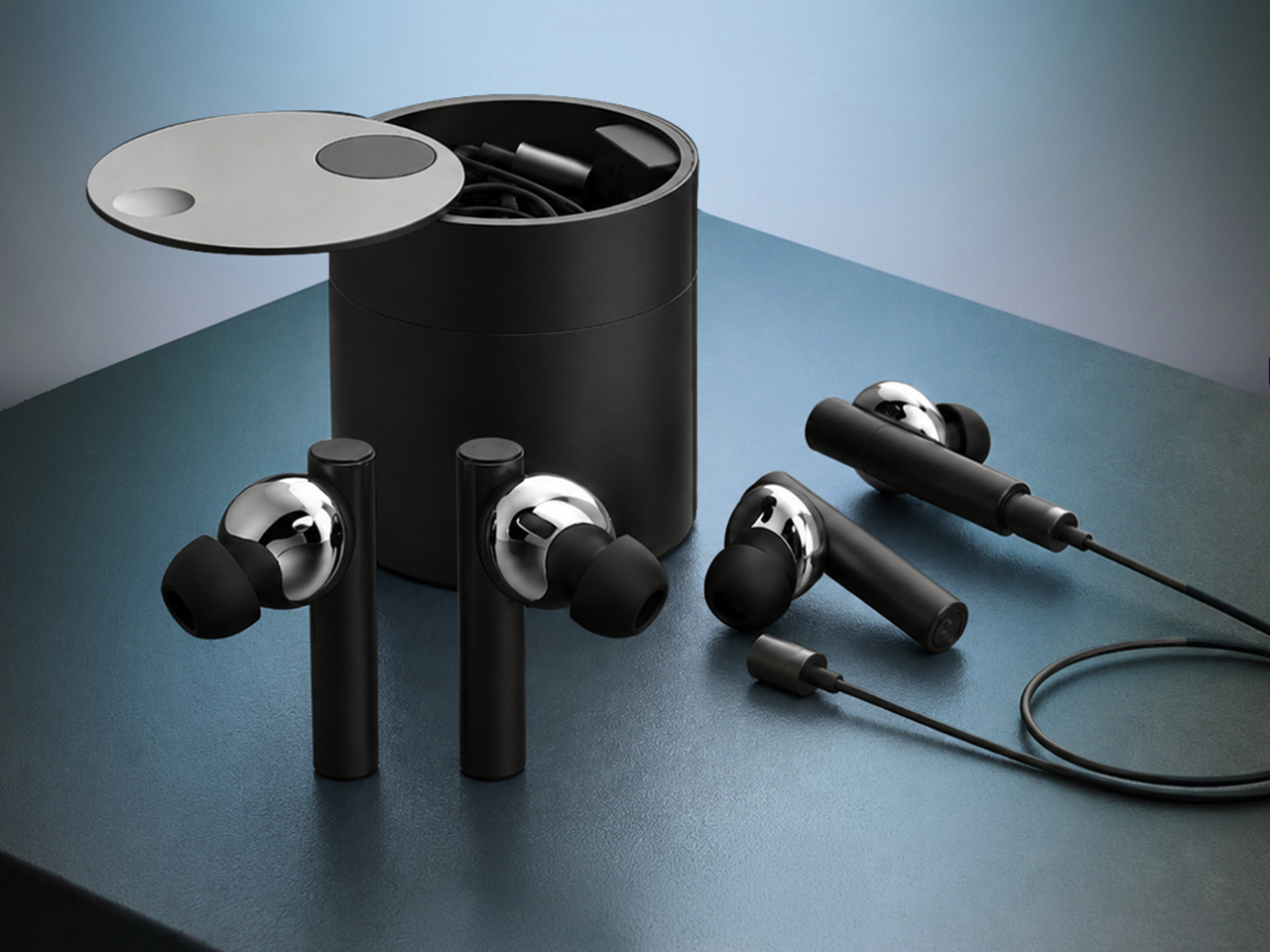
The physical design is built around everyday portability and comfort. The earbuds feature an anodized aluminum body with an in-ear fit, a form factor intended to remain stable during commutes, calls, and general daily wear. The charging case uses a cylindrical design with a magnetic docking mechanism, sized to fit comfortably in a pocket or bag. The TES Link cable stores inside the case alongside the earbuds, avoiding the need for separate accessories or additional carrying solutions. The entire system is engineered to minimize friction in both modes, whether the user is moving through the day untethered or settling in for a focused wellness session at night.

HealingFit TWS recently passed another technical milestone. The device has received FCC certification, a regulatory requirement that confirms compliance with electromagnetic interference and radio frequency standards in the United States. This approval follows the U.S. patent application allowance and a CES 2026 Innovation Awards Honoree designation in the Headphones & Personal Audio category. These markers suggest that the product has moved well beyond concept-stage validation and into formal manufacturing readiness. For a crowdfunding campaign, these certifications provide a measure of reassurance that the hardware is real, tested, and legally cleared for production distribution.
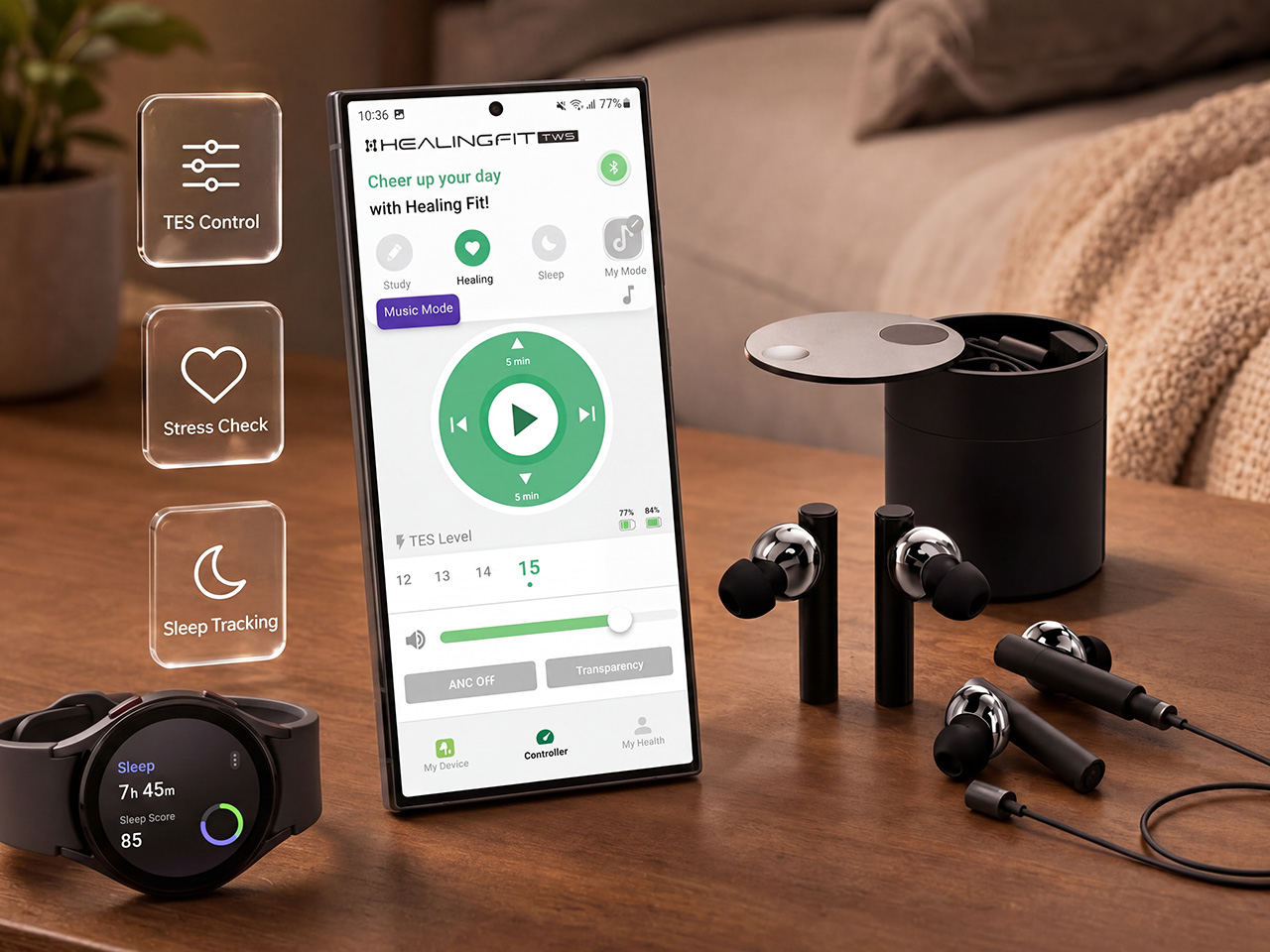
The wellness component of the system centers on user control and choice. The app, My HealingFit, offers three routine modes: Sleep, Healing, and Study. Each mode delivers a combination of gentle microcurrent and binaural audio designed to support a specific mental state. Users can adjust the TES intensity across 15 levels, tailoring the experience to their own comfort threshold. The device is designed as a wellness tool, explicitly disclaiming any medical diagnosis or treatment function. That distinction is important. It positions HealingFit TWS as a personal relaxation and focus aid, not a therapeutic device subject to medical regulatory oversight.

Heo’s question from the beginning was simple. Could earbuds designed for the noise and motion of the day also serve the stillness and quiet that follows? HealingFit TWS is his answer, a product that tries to bridge those two states without forcing the user to own two separate devices. Earbuds have already become an everyday essential of the smartphone era, worn for hours at a time by millions. What Heo proposes is that they are evolving from a device we listen with into a device we also heal with. Whether that vision takes hold will depend on how users experience the transition between modes, and whether the wellness routines prove meaningful enough to justify the added capability. For now, HealingFit TWS stands as a milestone in that shift, a thoughtful industrial design experiment from a team that understands audio hardware deeply and believes the next chapter of personal audio is about versatility across the full rhythm of modern life.
Click Here to Buy Now: $169 $300 (44% off). Hurry, only 15/210 left! Raised over $51,700.
The post What If Your Earbuds Could Help You Sleep After They Played Music And Podcasts All Day? first appeared on Yanko Design.
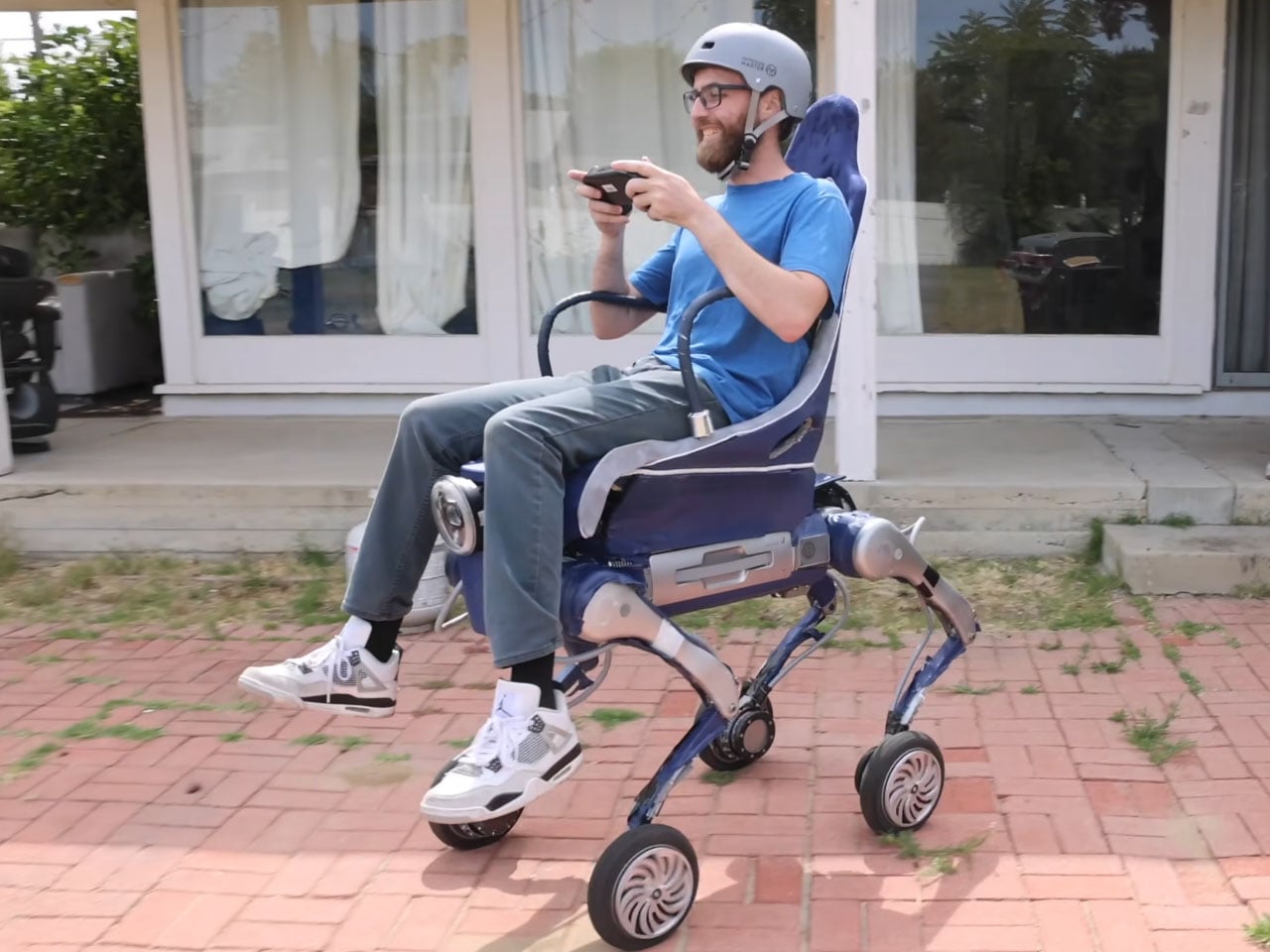
Some inventions are meant to push the boundaries of technology, while others are built to break the barriers people face every day. This remarkable all-terrain robotic mobility chair belongs to the latter category. Designed by YouTuber Jake Laser for his father, who has lived with multiple sclerosis (MS) for more than 20 years, the project is a powerful reminder that engineering can be an act of love as much as innovation.
Living with MS had gradually taken away many of the experiences Jake’s father once enjoyed. Simple obstacles such as stairs, rocky trails, steep hills, or uneven paths became impossible to cross in a conventional wheelchair. Rather than accepting those limitations, Jake set out to create a machine capable of taking his father where ordinary mobility aids simply could not.
Designer: Jake Laser

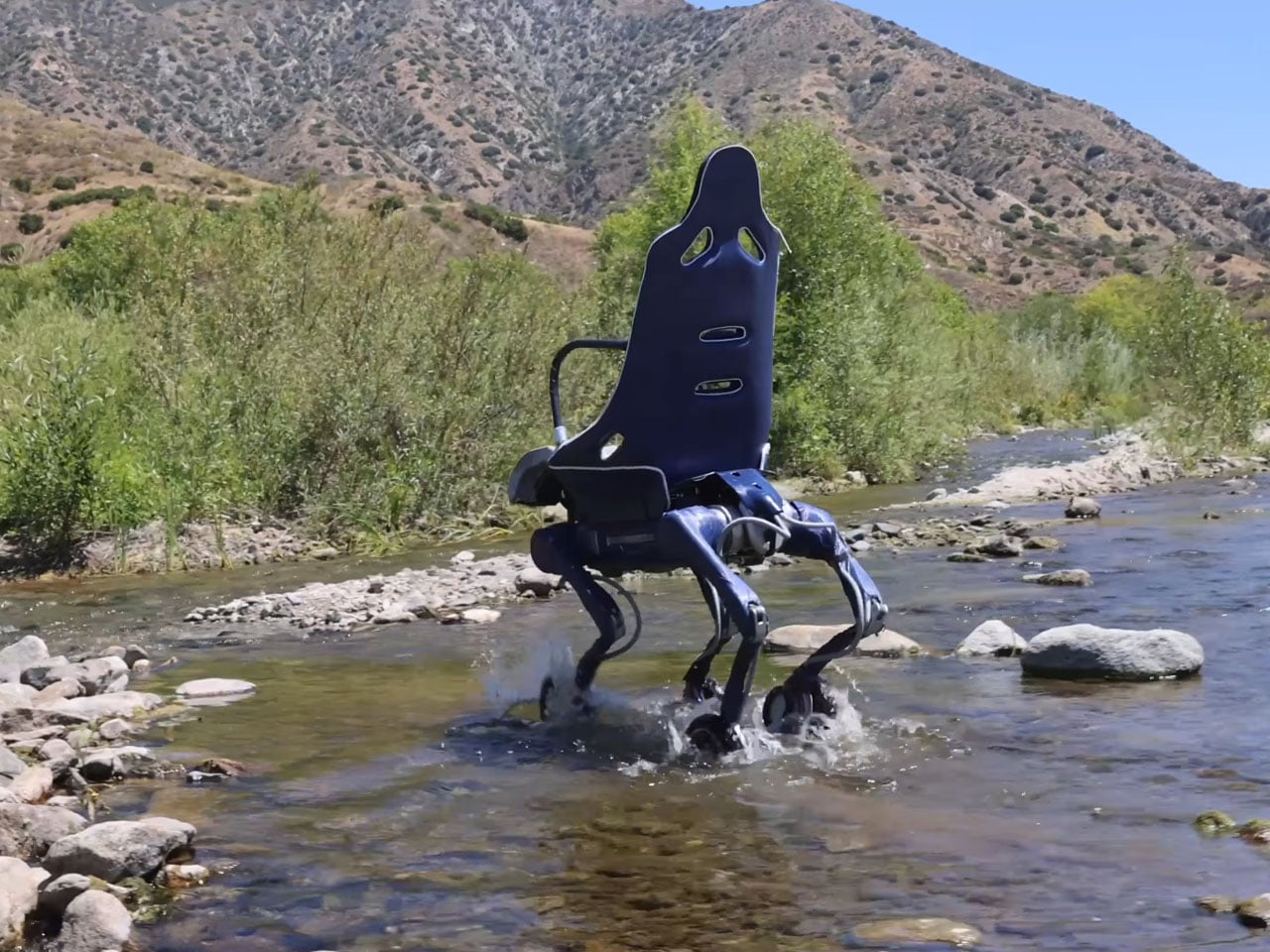
Instead of designing a robotic platform from scratch, Jake modified a sophisticated industrial quadruped robot from Unitree. The robot already featured an unusual hybrid design, combining powered wheels with articulated legs. On smooth ground, it rolls efficiently like a wheeled vehicle, while on rough terrain it engages its walking capabilities, allowing it to climb stairs, step over obstacles, and navigate rocky landscapes with impressive stability.
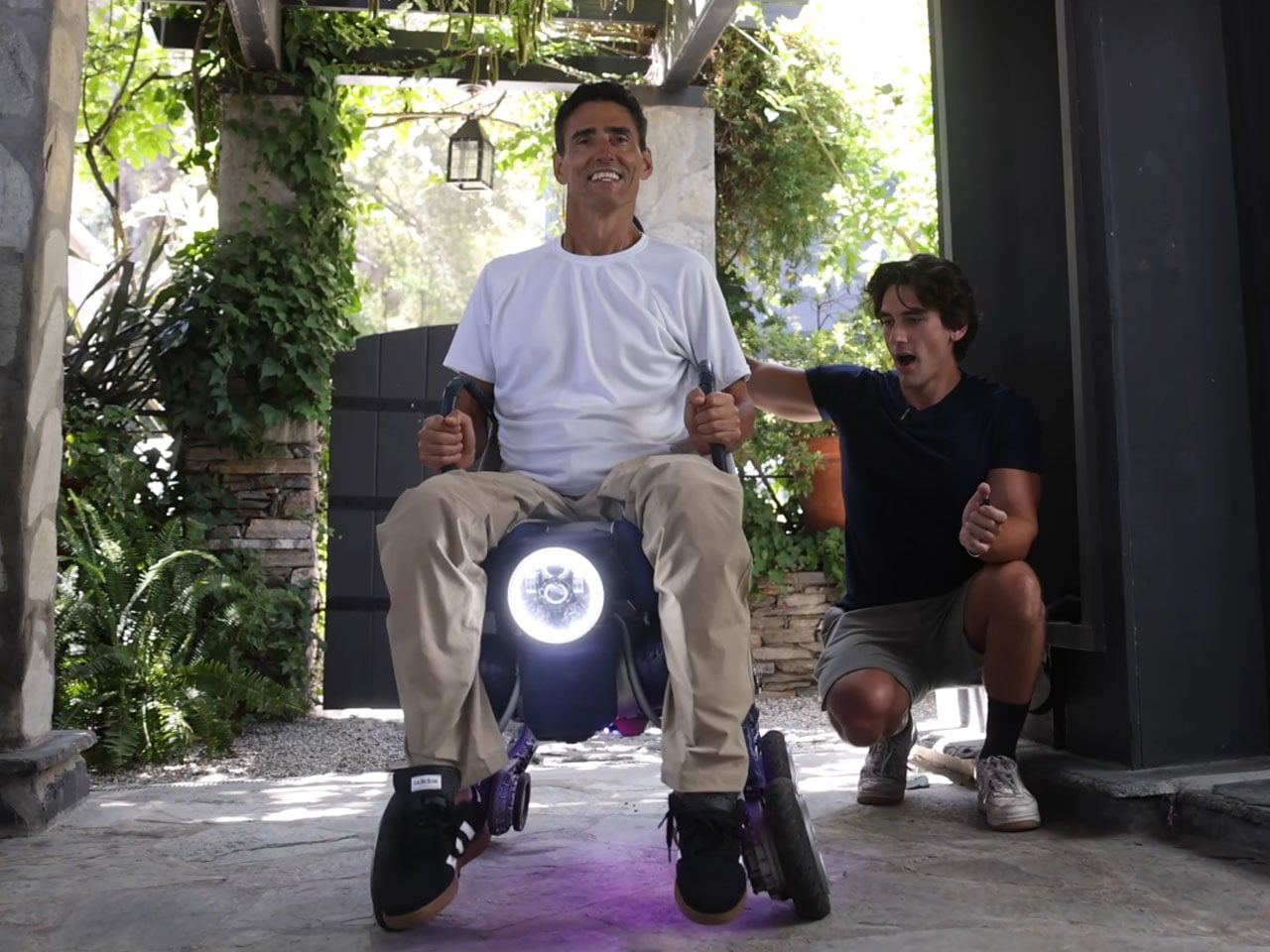
Transforming the industrial robot into a rideable mobility device required extensive engineering. After experimenting with multiple seating positions, Jake mounted a racing bucket seat directly over the robot’s spine, positioning the rider’s legs forward to ensure the robotic legs could move freely underneath. A heavy-duty safety harness was added to keep the rider secure, while the software controlling the robot’s balance system had to be recalibrated to compensate for the constantly shifting weight of a human passenger. This allowed the robot’s sensors and motors to maintain stability even while walking across difficult terrain. A wireless dual-joystick controller gives the rider full control over movement, including driving, rotating, strafing, and adjusting the robot’s height for easier entry and exit.
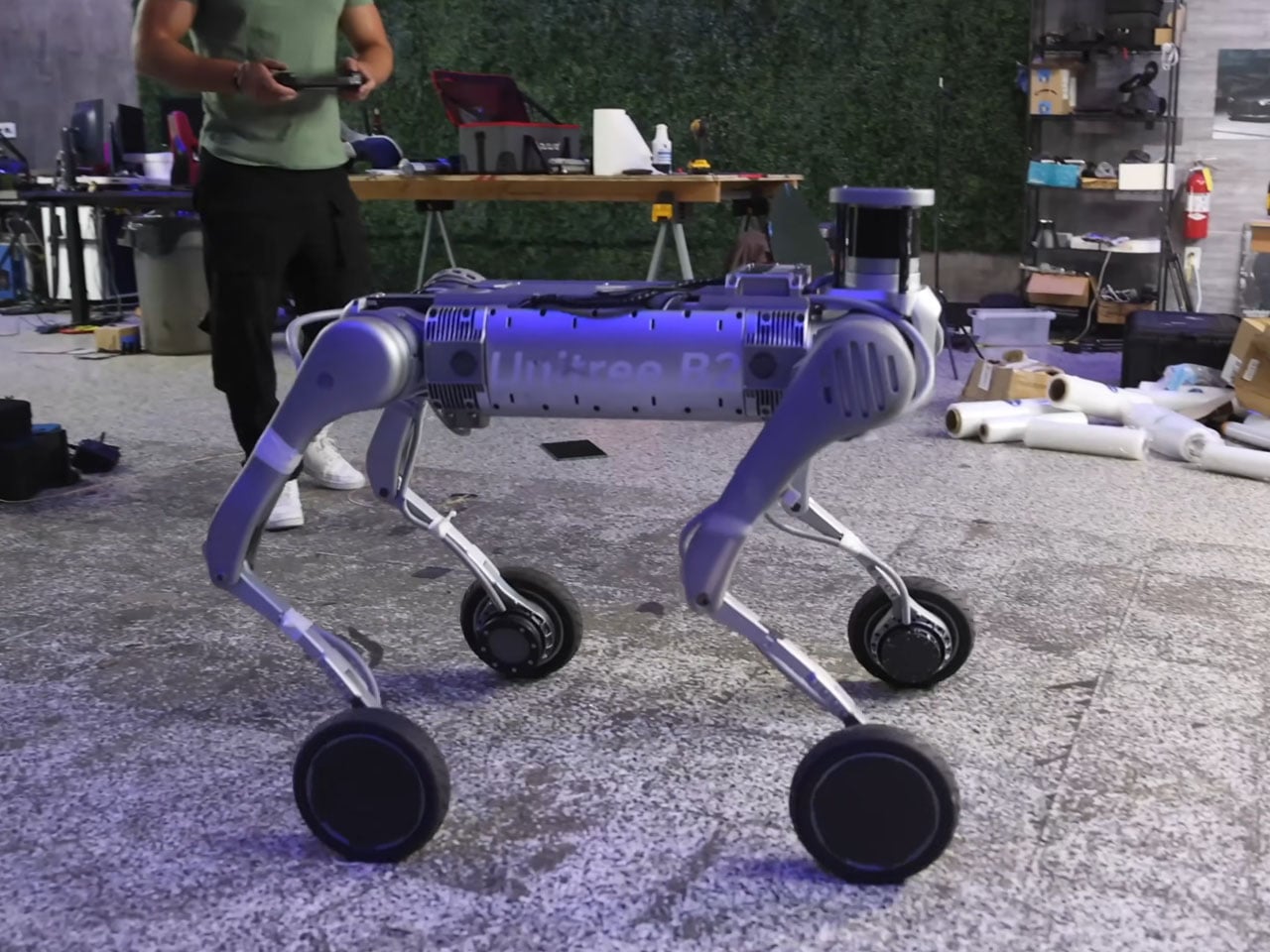
Jake also wanted the machine to feel something his father could proudly call his own. Inspired by elegant 1940s Bugatti automobiles, he added curved body panels, carbon-fiber accents, chrome-style headlights, LED underbody lighting, and custom spinner wheel covers. The result is a futuristic personal vehicle that blends cutting-edge robotics with timeless automotive styling. Before allowing his father to ride it, Jake subjected the robot to demanding tests. It climbed tall ledges, crossed ladders, navigated full flights of stairs, and traversed rocky riverbeds without losing balance. Only after proving its reliability did his father climb aboard. The experience was deeply emotional. For the first time in more than two decades, he was able to visit places that had long been inaccessible, exploring trails and landscapes that had become distant memories. Jake did far more than build a remarkable robot; he gave his father the freedom to make new memories where wheelchairs had once reached their limit!





The post Son transforms a Unitree robot dog into an all-terrain mobility chair for his disabled father first appeared on Yanko Design.
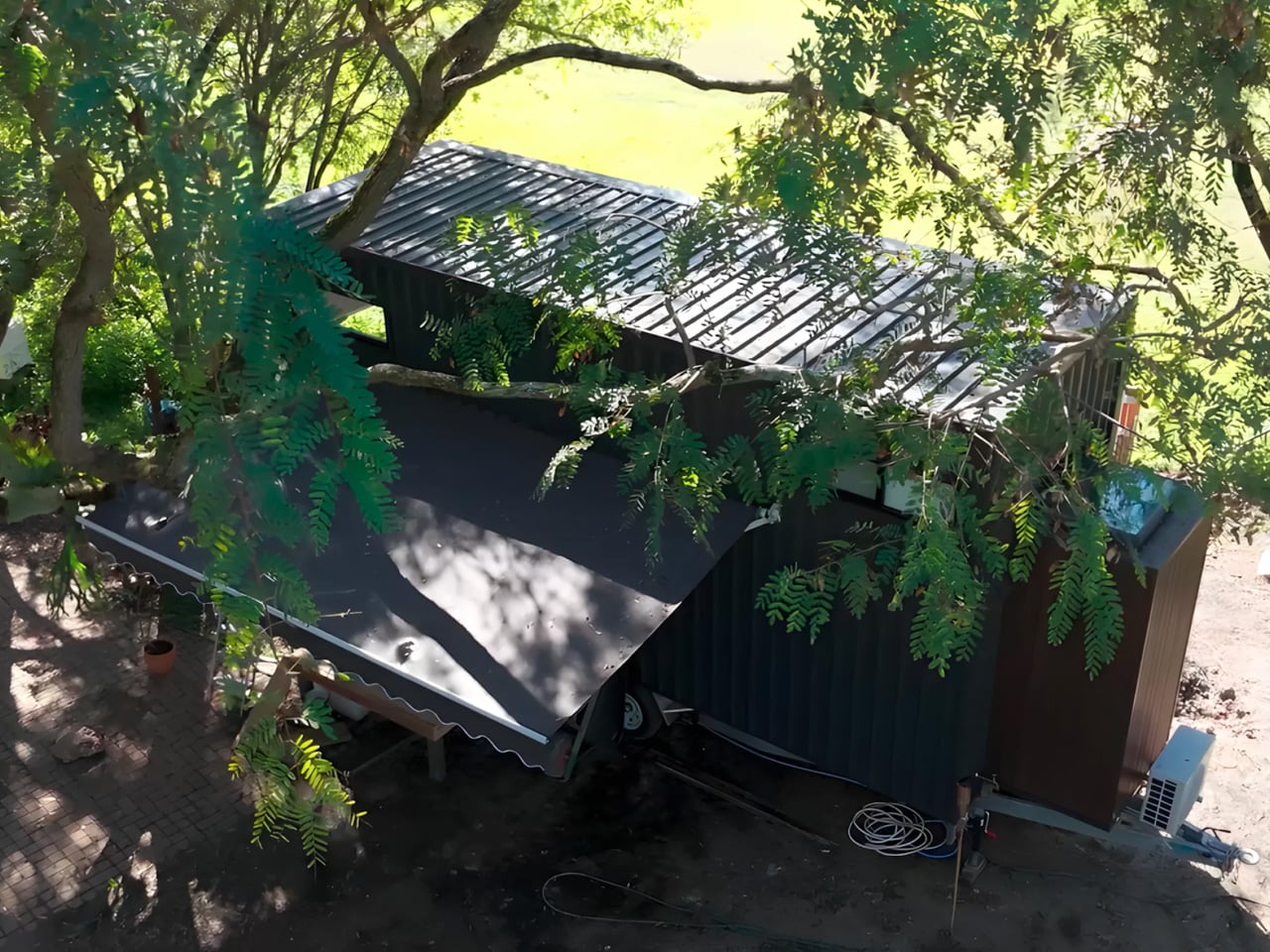
Most tiny homes ask you to sacrifice. The Springbrook 7.2 doesn’t. The Springbrook 7.2 from Gold Coast–based Removed Tiny Homes is the opposite of that. Named for its 7.2-meter length (23.7 feet), it’s a build that makes a convincing case for intentional design over raw square footage.
Built on a standard trailer and clad in Colorbond steel, the home’s exterior is durable and weatherproof — Colorbond is a popular choice across Australia precisely because it holds up in extreme climates without losing its clean, contemporary finish. An awning runs along the exterior, extending the home’s livable edge and softening its profile against the surrounding landscape.
Designer: Removed Tiny Homes
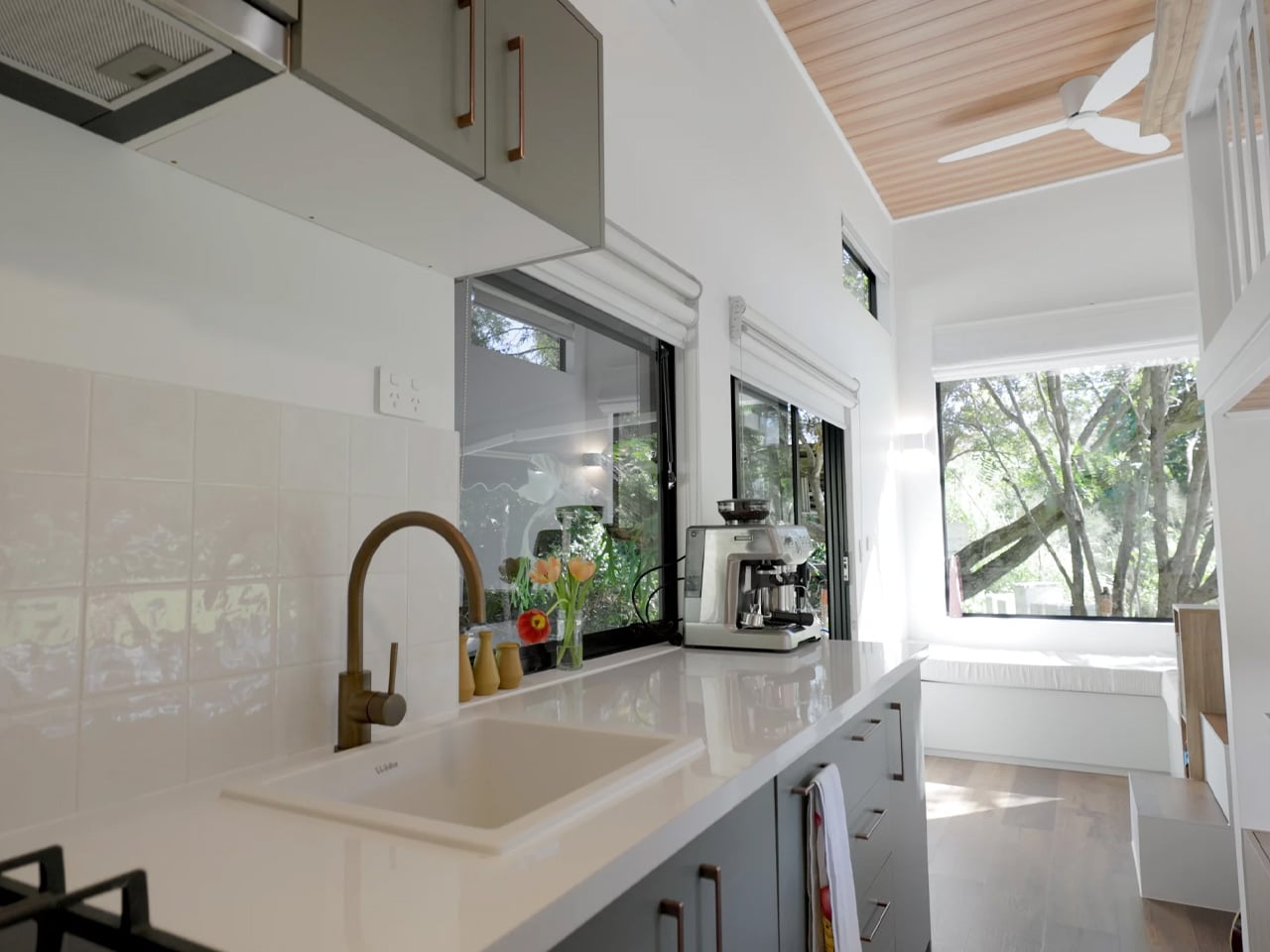
The interior greets you through double glass doors that open into a living area anchored by an L-shaped sofa. The ceiling reads high, and generous glazing keeps the space from contracting inward the way so many compact homes do. Light fills the room freely, which is less a given than it sounds in a build this size. Removed’s design instinct here is to borrow volume from the outside rather than manufacture it through material trickery alone.
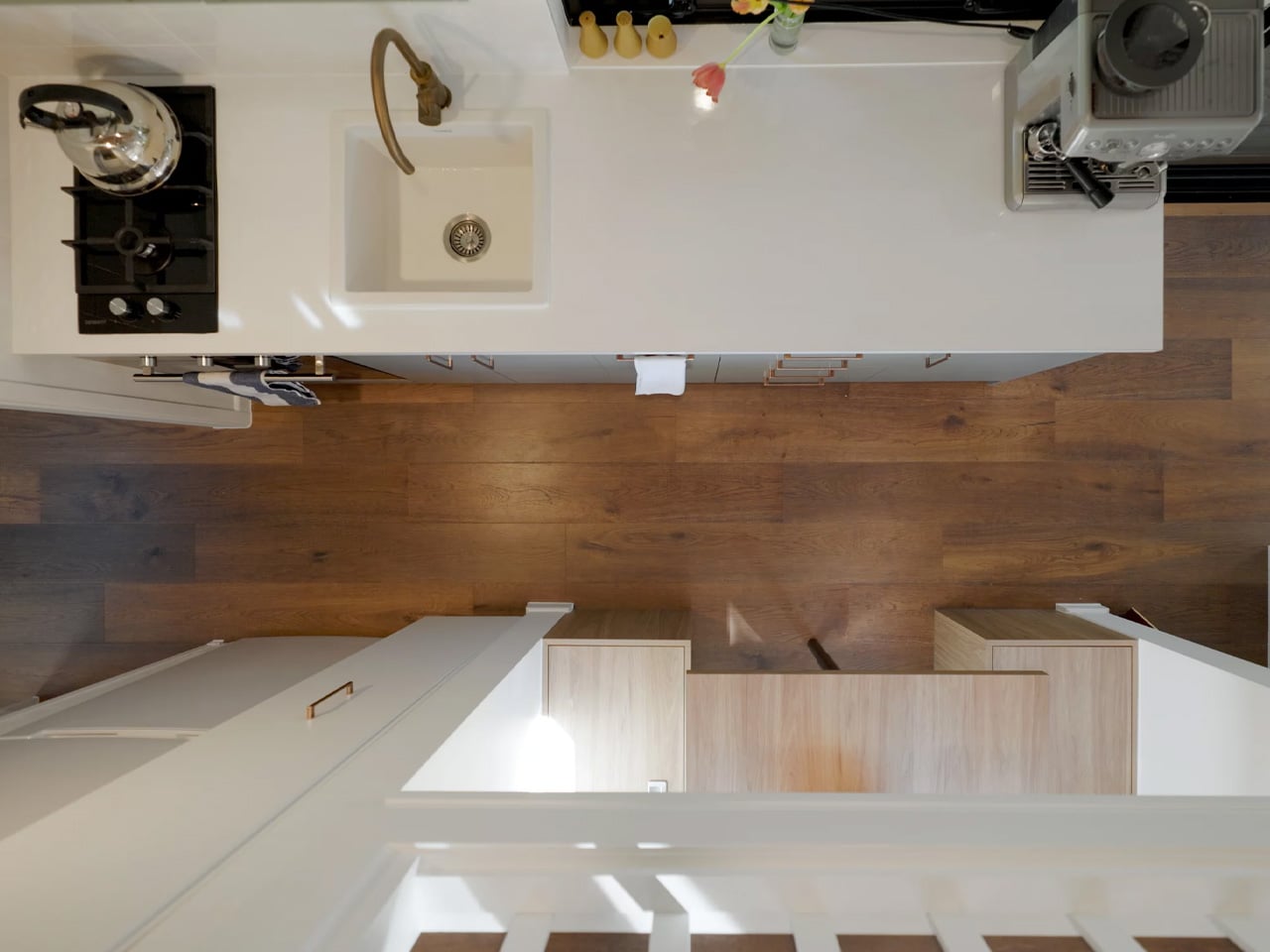
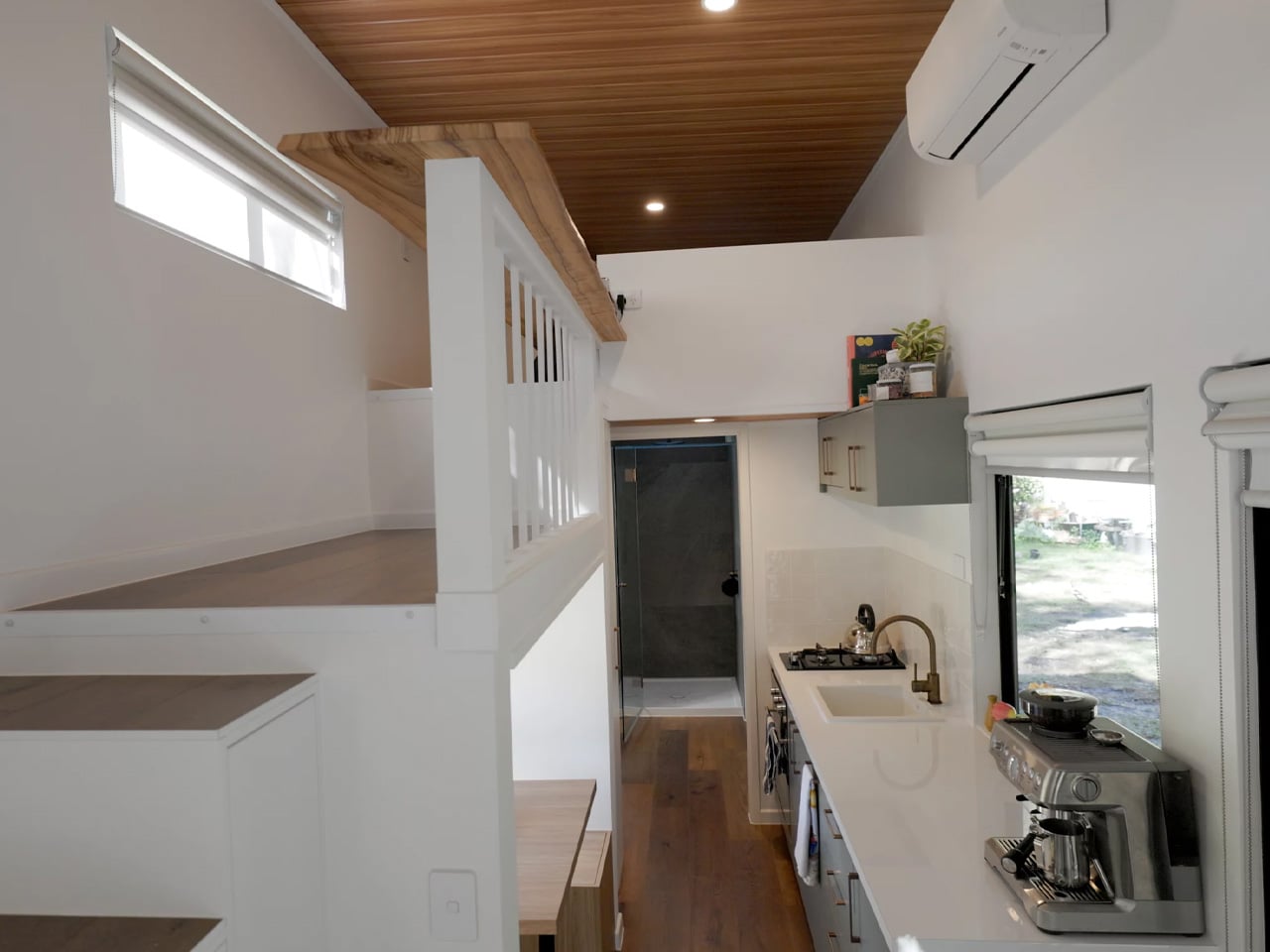
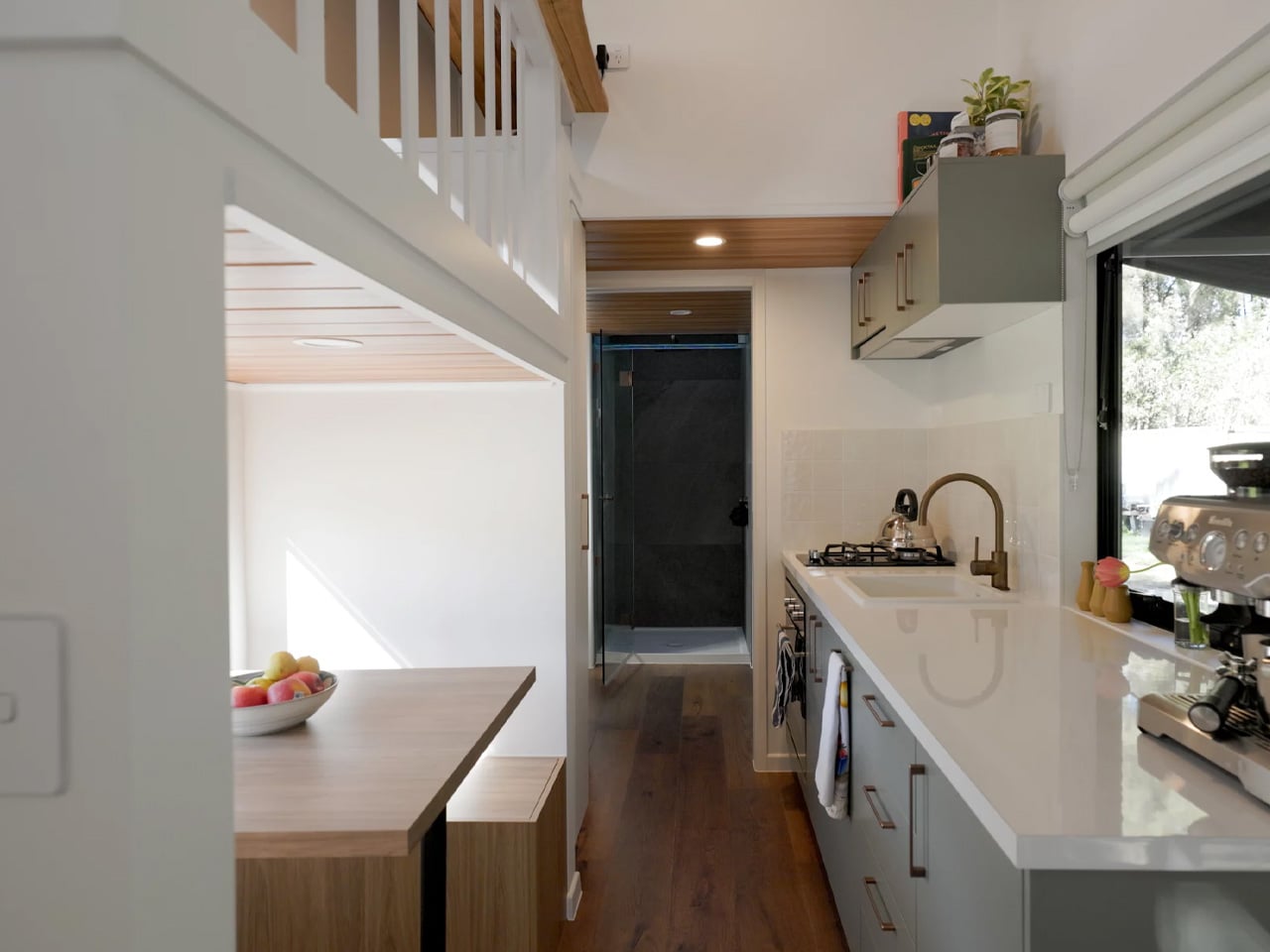
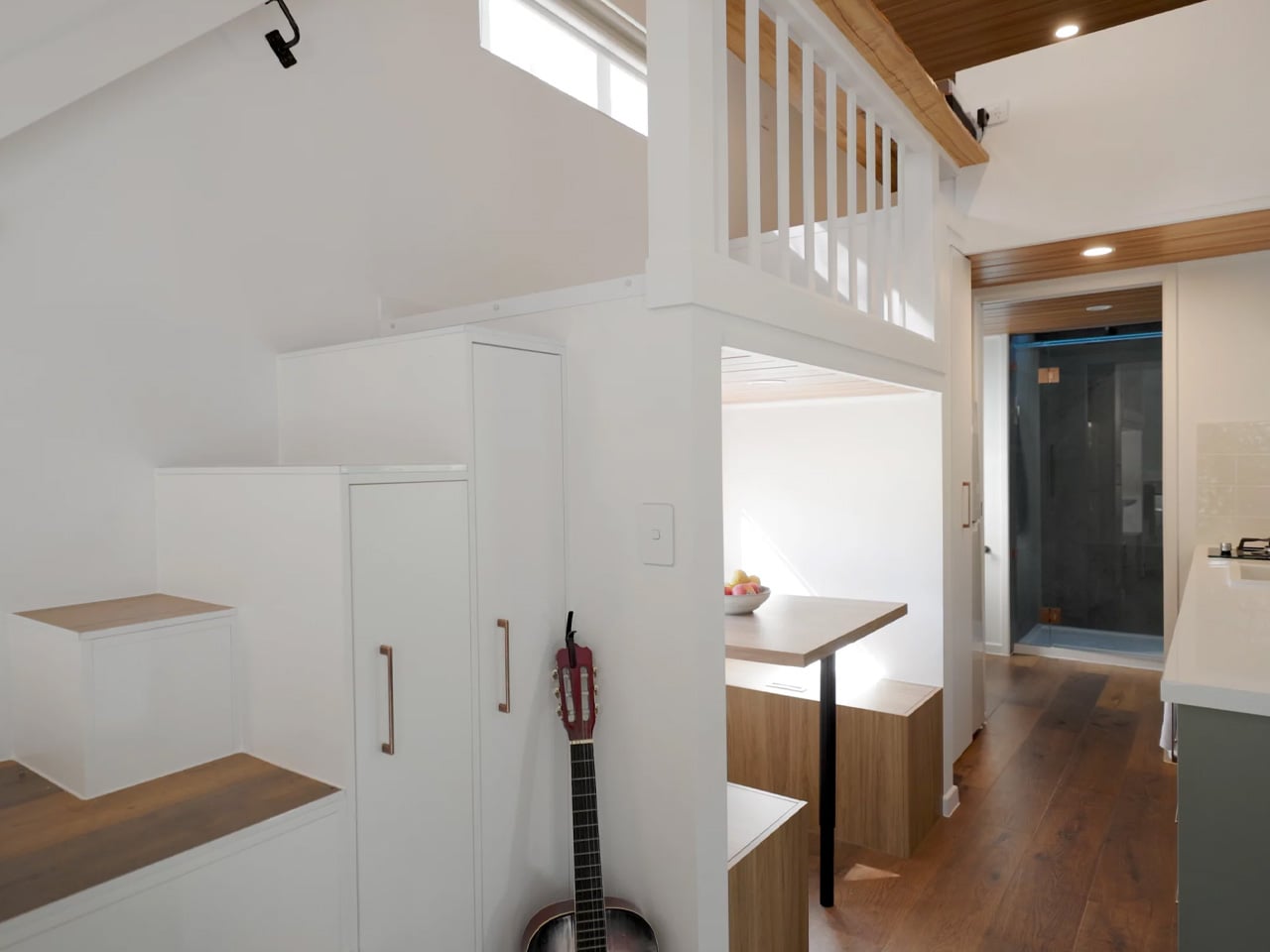
The kitchen, positioned deeper into the plan, is remarkably complete. There’s a sink, an oven, a two-burner propane stove, a fridge and freezer, and a full complement of upper and lower cabinetry. Beside it sits a booth-style dining nook with bench seating and a table — the kind of tucked-away setup that feels more intimate than cramped, more considered than squeezed in.
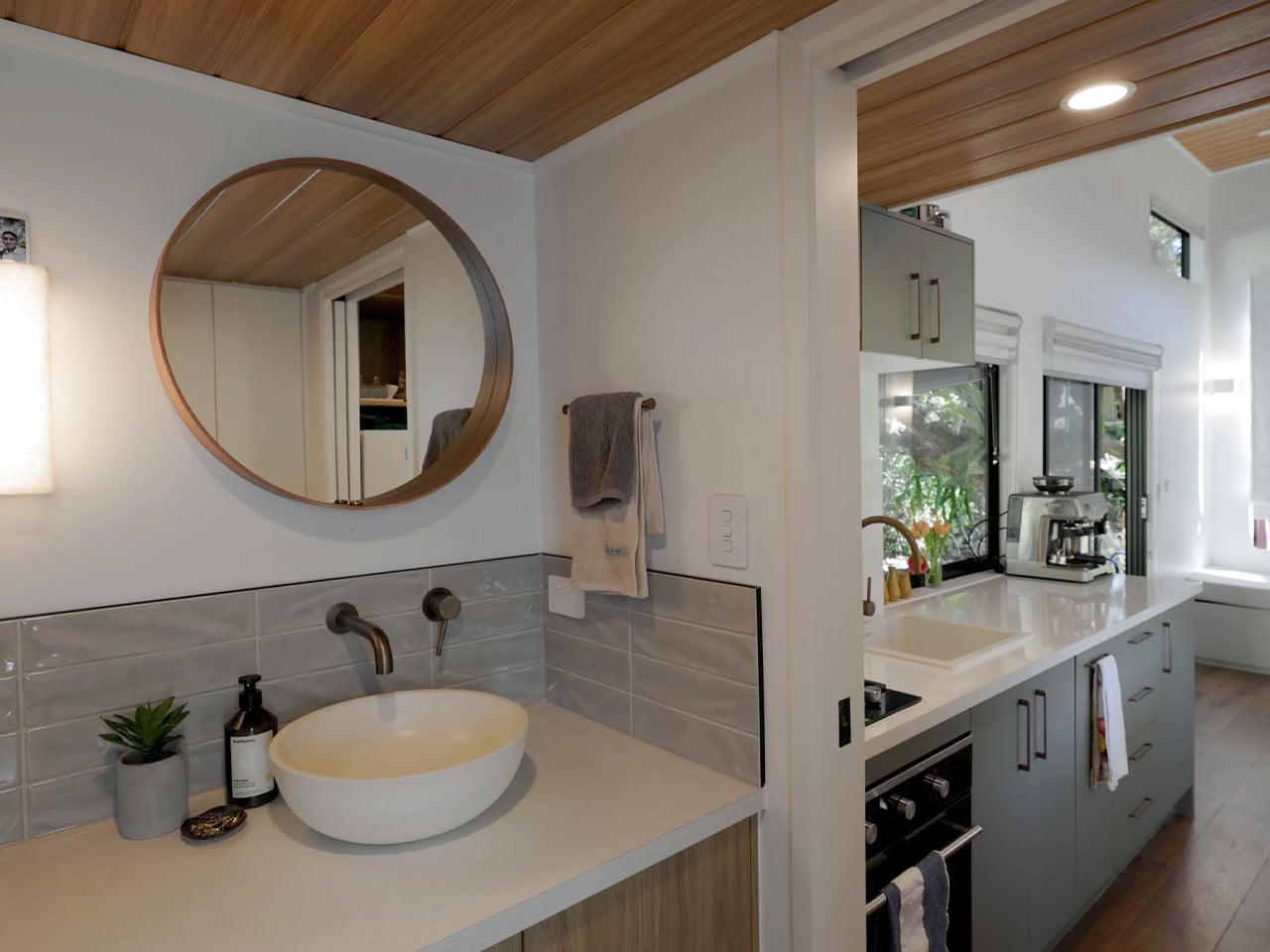
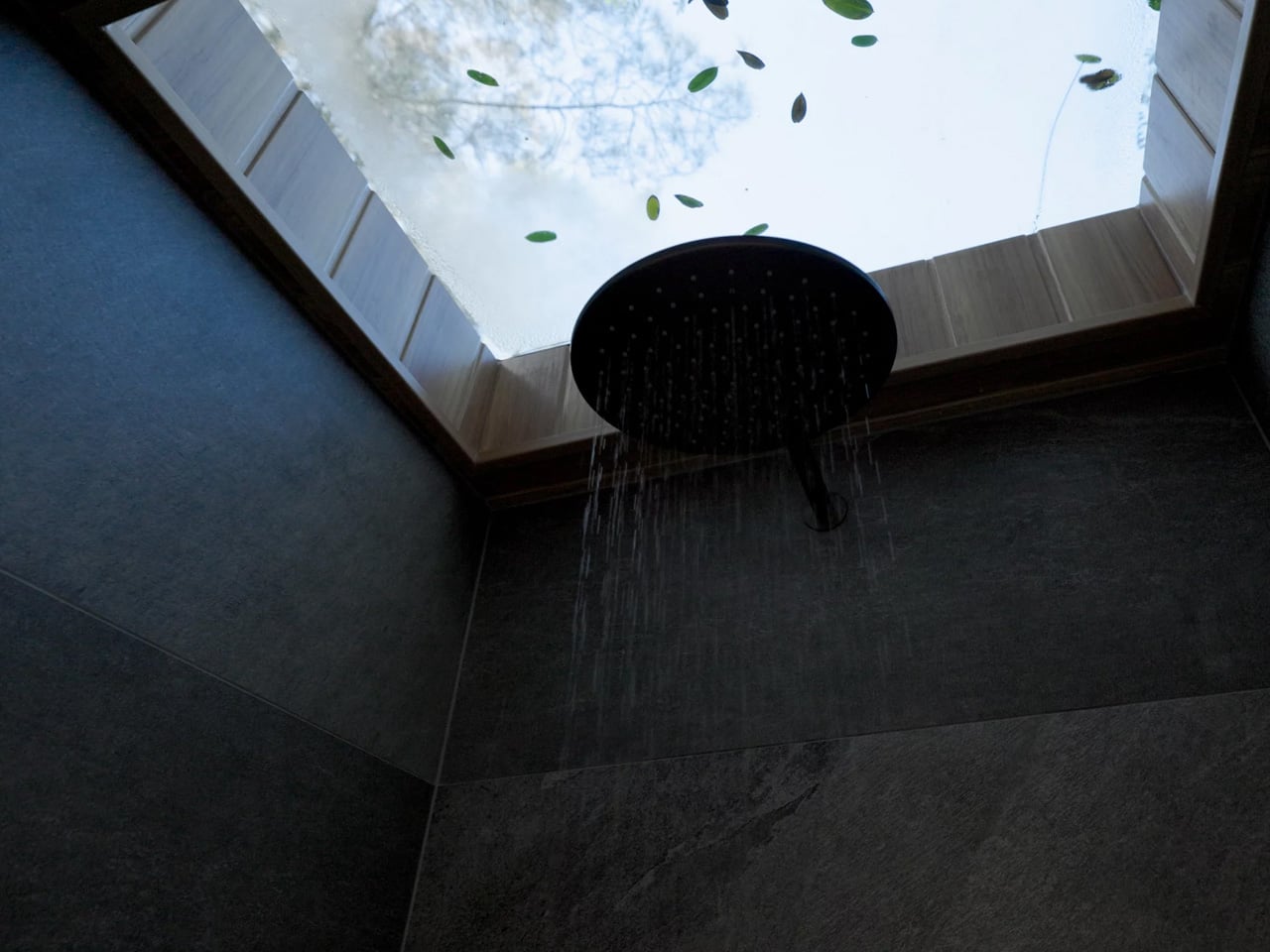
The bathroom sits at the far end of the home. A composting toilet, a vanity sink, and a walk-in shower occupy the space with no sense of conflict. The shower is topped by a skylight, a small detail that does a lot of work — it draws natural light straight down into what could easily have been the home’s darkest corner, and keeps it private without compromising that openness.
Circulation between levels is handled by a corner staircase that integrates storage into its structure, winding up to the loft bedroom above. The loft holds a queen-sized bed and a desk built directly into the balustrade, converting the sleeping area into a workspace without any additional furniture. The ceiling sits low up here, but the resolution is smart: it makes the space feel cocooning rather than confined.
The Springbrook 7.2 was designed and delivered as a custom commission. Pricing is available on request directly through Removed Tiny Homes.
The post This 24-Foot Tiny Home From Australia Proves Small Space Design Is All About Intention first appeared on Yanko Design.
Most tiny homes ask you to sacrifice. The Springbrook 7.2 doesn’t. The Springbrook 7.2 from Gold Coast–based Removed Tiny Homes is the opposite of that. Named for its 7.2-meter length (23.7 feet), it’s a build that makes a convincing case for intentional design over raw square footage.
Built on a standard trailer and clad in Colorbond steel, the home’s exterior is durable and weatherproof — Colorbond is a popular choice across Australia precisely because it holds up in extreme climates without losing its clean, contemporary finish. An awning runs along the exterior, extending the home’s livable edge and softening its profile against the surrounding landscape.
Designer: Removed Tiny Homes
The interior greets you through double glass doors that open into a living area anchored by an L-shaped sofa. The ceiling reads high, and generous glazing keeps the space from contracting inward the way so many compact homes do. Light fills the room freely, which is less a given than it sounds in a build this size. Removed’s design instinct here is to borrow volume from the outside rather than manufacture it through material trickery alone.
The kitchen, positioned deeper into the plan, is remarkably complete. There’s a sink, an oven, a two-burner propane stove, a fridge and freezer, and a full complement of upper and lower cabinetry. Beside it sits a booth-style dining nook with bench seating and a table — the kind of tucked-away setup that feels more intimate than cramped, more considered than squeezed in.
The bathroom sits at the far end of the home. A composting toilet, a vanity sink, and a walk-in shower occupy the space with no sense of conflict. The shower is topped by a skylight, a small detail that does a lot of work — it draws natural light straight down into what could easily have been the home’s darkest corner, and keeps it private without compromising that openness.
Circulation between levels is handled by a corner staircase that integrates storage into its structure, winding up to the loft bedroom above. The loft holds a queen-sized bed and a desk built directly into the balustrade, converting the sleeping area into a workspace without any additional furniture. The ceiling sits low up here, but the resolution is smart: it makes the space feel cocooning rather than confined.
The Springbrook 7.2 was designed and delivered as a custom commission. Pricing is available on request directly through Removed Tiny Homes.
The post This 24-Foot Tiny Home From Australia Proves Small Space Design Is All About Intention first appeared on Yanko Design.