3D printing has brought a lot of changes when it comes to designing products. It has made experimentation with various materials and prototyping these proposed designs easier and more efficient. We’re seeing a lot of concepts get past the initial product rendering stage just by utilizing various 3D printing techniques and tools that are now available and is constantly evolving.
Designer: Nils Sorger
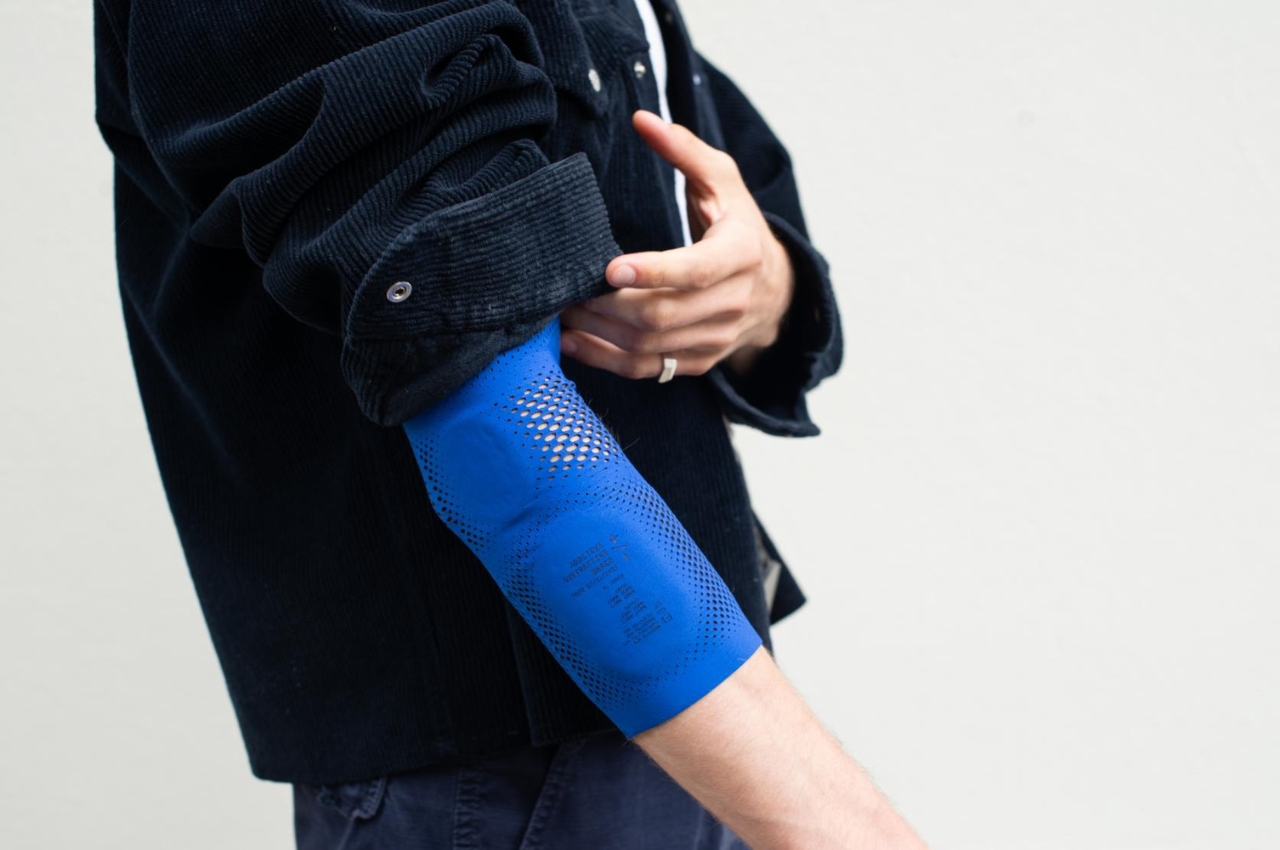
The +/- Brace is one such concept for a pain relieving elbow brace that can be used when doing physical labor or any kind of sports that requires strenuous activity so you can minimize the risk of injury. It’s something that can be created and customized using an app. choosing your size, form, structure, and padding. The final product you created can then be fabricated on your own, ordered through the maker community, or ordered through the creator’s app platform.
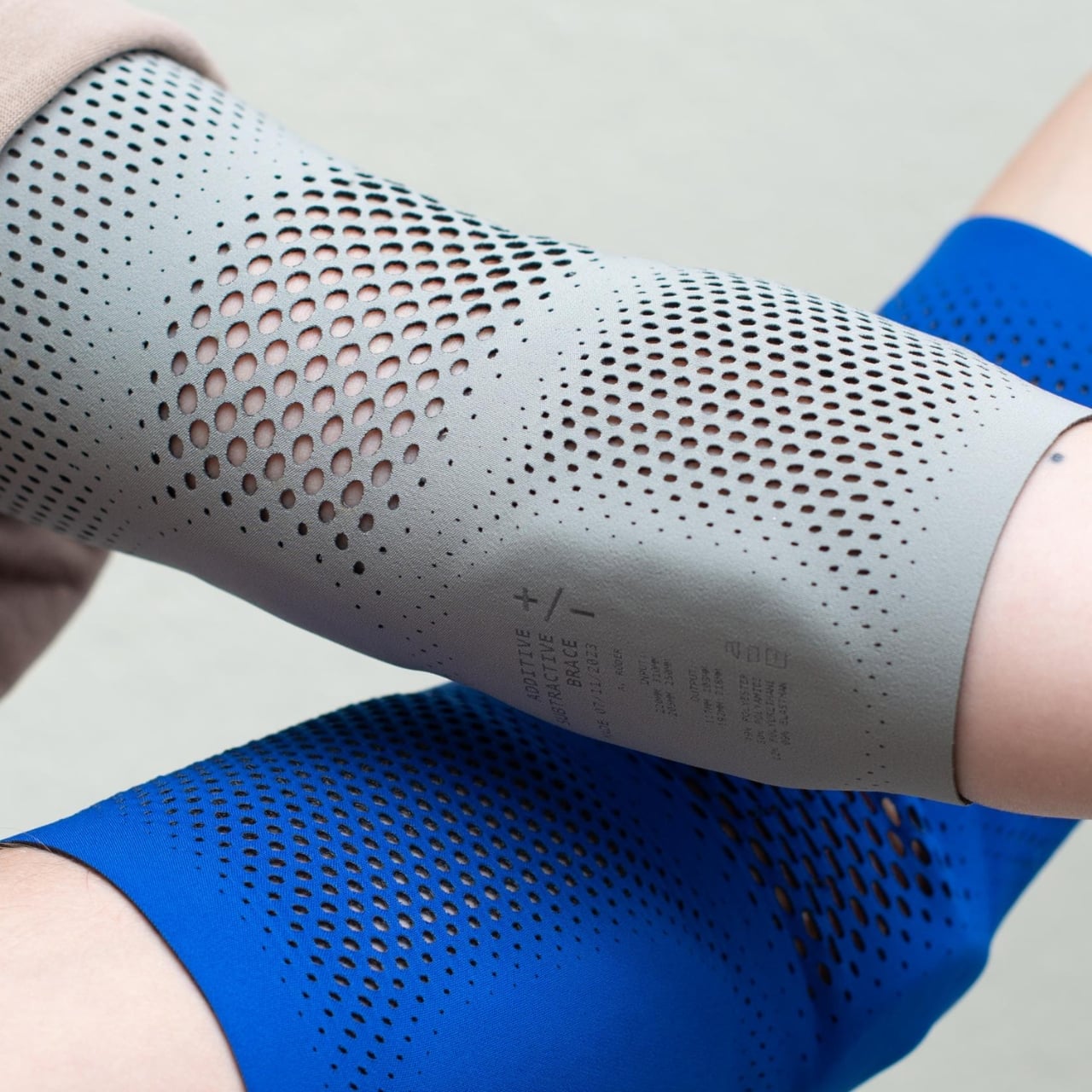
The 3D printing and laser cutting machine is called Grasshopper with a custom built script so body measurements inputted can be used to generate the data output. They used various iterations to find the optimal pattern for the brace and ended up with the 4-way stretch softshell fabric which is made up of 49% Polyester, 30% Polyamide, 12% Polyurethane, and 9% Elasthan. This is the best one for breathability and flexibility as well as a comfortable and flexible fit so you can still do all the activities you need to do. For the additive, they also tested several FDM-printed pads and ended up with something that is like foam or gel.
After much prototyping, the +/- Brace ended up with an aesthetic that seems like a combination of a Bluetooth speaker and a honeycomb packaging. It looks pretty flexible and comfortable, which are important characteristics of this kind of product so the user will not really feel like the brace is hindering their movement. All thanks to the improvement and enhancement of the 3D printed fabric-based manufacturing plus open source process, they were able to conceptualize and actually prototype this kind of individualized brace that shouldn’t break the bank.
Google has revealed a new feature for Pixel devices that's designed to keep your data safe when it's at the repair shop. The company says that, by activating this feature, you may be able to prevent technicians from deleting and restoring your data during the repair process while making it easier for them to run diagnostics. It can also protect your data from potentially prying eyes, Google notes.
The mode is available on Pixel devices that are running the latest Android 14 update and that have at least 2GB of spare storage. To activate the feature, go to Settings > System > Repair mode and follow the prompts (follow the same chain to turn off the feature). Google notes that even though repair mode should protect your data, it's always worth backing up your data if possible before any repair service.
Meanwhile, Google has rolled out a new diagnostic app that you can access from your Pixel device's Phone app. It says this should help you get a better sense of any issues your device has before a repair and to check that it's working properly once you get your phone back. To run the diagnostics, enter #*#7287#*# in the keypad in the Phone app.
Along with helping provide any professional repair shop with the parts it needs to fix Pixel devices, Google is looking to make it easier for people to remedy issues with their phones as well. The company started offering legitimate Pixel parts and repair manuals with the help of iFixit last year (and also now through Shyft Global Services). You should be able to find information about how to order the parts you're looking for and view repair manuals through the Google Help site. Repair manuals are available from Google directly in English and French for certain devices. Manuals for more devices and in more languages will be available in the coming months.
This article originally appeared on Engadget at https://www.engadget.com/a-new-pixel-mode-can-protect-your-data-while-your-device-is-being-repaired-195835764.html?src=rss
The Video Game History Foundation set up shop back in 2017 and offers a gigantic collection of gaming-related archival materials, from magazines to art books and even source code. Previously, you’d have to make the trek to Oakland, California to peruse the archive, but that changes soon. The VGHF just announced a digital library that will offer remote access.
These tools will be made available to researchers, academics and garden-variety gaming enthusiasts like the rest of us. The library will offer access to the collection “for free from anywhere in the world.” There’s a video that shows the archive in action, hosted by library director Phil Salvador.
The VGHF has an eventual goal of digitizing the entire archive, but this is a massive undertaking. It’ll be a while before the whole collection is digitized, as this stuff takes time. Just ask any museum curator. The organization has already been at it for two years, but some of that was spent designing the search technology and interface platform. The library is expected to launch sometime next year and will likely release with a sampling of the catalog.
Once completed, however, this will be an absolutely crucial tool for preserving the legacy of gaming for future generations. The collection includes print magazines, design documents, audio assets, press materials, concept art and so much more. Some of the current physical archive is already grouped into handy collections, like media chronicling the atmosphere surrounding the Nintendo Entertainment System’s launch in the US. Perhaps the digital archive will do the same.
The VGHF has an extraordinary pedigree. The organization was founded by games journalist Frank Cifaldi, who ran a popular website about unreleased games called Lost Levels. Cifaldi is also known for his journalism work at Gamasutra. He's joined by a team of industry veterans like Game Developers Conference leader Simon Carless and Smithsonian exhibit creator Chris Melissinos, among others.
Beyond the archive, the VGHF is heavily involved with restoring media materials from companies like Bethesda, Capcom, SNK and others. The foundation is also an advocacy group for game preservation.
This article originally appeared on Engadget at https://www.engadget.com/the-video-game-history-foundation-will-open-a-digital-version-of-its-research-library-182800502.html?src=rss
As businesses are shifting focus from more polluting and space-consuming cargo vans and cars to cargo-hauling bikes for the last-mile approach, there is a huge demand for better options. Tapping on the opportunity, a Vancouver-based startup is designing what it calls the Scootility – precisely a portmanteau of scooter and utility. A reasonable and compact alternative for last-mile delivery; the cargo-hauling Scootility is for now in the prototype stage with production to begin in the next 12 months.
Given its unique design, the Scootility is not another electric bike. In fact, it draws design inspiration from a segway with a column handle for maneuvering it. By virtue, however, it is an electric scooter that allows the rider to stand up and ride while the cargo remains intact in the covered box right in front of the eyes.
In the design then, a lockable cargo box with a standard load-bearing capacity of 140 liters is the biggest takeaway. This weatherproof box becomes even more beneficial for the delivery guy with the swappable feature. The cargo box can be taken off and replaced with a swappable option on the fly minimizing time between pickup and delivery.
The e-scooter with its compact size and narrow footprint in the traffic, can also be used for delivering medication or supplies in affected areas where access to other forms of transport may be hindered. Interestingly, Scootility has full suspension and wheels measuring 16-inches on the front and 13-inches on the back. The smaller wheel size allows more space for a cargo box on this scooter with utility as its basis over a simple mode of commutation.
For the safety of the rider, it’s installed with LED lighting and has a small turning radius, the manufacturer claims. A foldable leg rest of the Scootility can double as a glove compartment, and the long steering column and handle can fold down for easy storage. Powered by a swappable lithium battery offering a 100 km range in the standard variant, the Scootility is easier to ride (no license needed) and more economical (as opposed to cargo e-bikes on the market).
Since Scootility is only raising funding for its utility scooter at the moment, there is no definite word on the retail price. Given its benefits of minimum parking space requirement, swappable cargo box and battery, and substantial drive range, we are sure many businesses already have their eyes out for the Scootility.
Spotify is testing an AI-powered feature that creates playlists from text prompts. TikTok user @robdad_ posted a short clip of it, captioned, “I just randomly discovered Spotify’s ChatGPT?” For the chosen guinea pigs, the feature is available as an option under Your Library after tapping the plus sign to create a new playlist. The news was reported byTechCrunch, which says it received confirmation from Spotify that it’s testing AI playlists. It isn’t yet clear if the music streamer plans to launch it publicly.
“Turn your ideas into playlists using Al,” the feature’s in-app description reads in the TikTok video (while noting it’s only available in English). Above a chatbot field for custom inputs, it also suggests prompts. These include, “Get focused at work with instrumental electronica,” “Fill the silence with background cafe music,” “Get pumped up with fun, beat, and positive songs” and “Explore a niche genre like Witch House.”
@robdad_ TikTok
@robdad_ chose the last option. “Here’s your Witch House Exploration playlist,” the bot responded. “Swipe left to remove any songs you don’t want as you continue refining your playlist.” Due to video editing, it’s impossible to tell from the TikTok clip how long Spotify’s AI took to generate the tracks.
The resulting (Grimes-heavy) playlist included “Bloom for Me” by Pearly Drops, “Goth” by Sidewalks and Skeletons, “Pin” by Grimes, “After Dark” by Mr.Kitty, “Suffocation” by Crystal Castles, “Cold Touch” by Kito and GrimesAI and “chain” by Aziya and “Nothing Lasts Forever” by Sevdaliza and Grimes. I’ll leave it to the Witch House experts to determine if the AI did a good job.
In a statement to TechCrunch, Spotify was tight-lipped about whether the general public can expect to see AI playlists. “We routinely conduct a number of tests,” a Spotify spokesperson wrote. “Some of those tests end up paving the path for our broader experience and others serve only as an important learning. We don’t have anything further to share at this time.”
Earlier this year, Spotify launched an AI DJ feature (powered by OpenAI tech) that talks you through recommendations. It does so using an AI voice trained on the company’s Head of Cultural Partnerships, Xavier “X” Jernigan.
Like much of the tech industry, the music streamer appears eager to incorporate artificial intelligence into its products. In addition to the AI DJ, Spotify CEO and co-founder Daniel Ek said in a July earnings call that the company could use AI to “contextualize and personalize content.” The Ringer founder Bill Simmons noted in May (first reported by Semafor) that Spotify was developing “a way to use my voice for ads.” The sports analysis podcaster added, “You have to obviously give the approval for the voice, but it opens up, from an advertising standpoint, all these different great possibilities for you.”
The UN has set out a pathway to avoiding the very worst effects of climate change. Earlier this week, delegates from around the world ratified a document setting out what we need to do, and when. Even better, the text finally ended the decades-long omerta of never talking about the impact fossil fuels have had on our environment. It’s a landmark moment in history and one that means we can have hope for the future of humanity. Unless, that is, you spend any time examining the substance of the deal to see if the expectations meet the reality. Because then you’ll see that while it’s not all doom and gloom, it’s certainly not the bold action we really need.
Context
All of this took place at the Conference of the Parties (COP) an annual, UN-backed conference to build international consensus on climate change. Delegates from all UN member states, as well as bodies like the EU, all meet at a host city for two weeks to speedrun something that looks a lot like a treaty. The 28th such event was hosted in Dubai, which attracted plenty of criticism given the emirate’s fossil fuel wealth. Its president was Sultan Al Jaber, UAE minister of industry and, uh, the head of the Abu Dhabi National Oil company.
The perception that the event would be a fossil fuel industry stitch-up wasn’t helped when BBC News reported the UAE secretly planned to use the event to strike new oil and gas deals. Or that Al Jaber was quoted by The Guardian saying there was “no science” supporting the idea that a phase out of fossil fuels was necessary to prevent further warming. He later said his comment had been taken out of context and that he supported work to reduce fossil fuel use.
For all the light and heat around COP, it’s not as powerful as you might hope or think, since there is no real enforcement mechanism. The parties (should) negotiate in good faith but if nations don’t actually follow through on their promises, there’s no mechanism to address it. Diplomacy is a delicate art, especially with so many moving pieces, so maybe we should all learn to appreciate the subtleties. That’s the positive case.
The negative one being that COP28 has been more theater than politics. Anne Rasmussen, representing the Alliance of Small Island States, pointed out her group wasn’t even in the room when the declaration was ratified. Ironic, given that the event was dubbed as “the most inclusive COP to-date, ensuring all voices could participate in the process.” During the plenary, Rasmussen said the text, approved in her absence, doesn’t go far enough in several ways and carries a “litany of loopholes” for wealthy nations to delay, or avoid their responsibilities.
TL;DR
The text opens with a long introductory section admitting that humanity as a whole hasn’t been doing a good enough job. It admits humans are responsible for raising the Earth’s temperature by at least 1.1 degrees celsius, and we’re on the hook to fix it. And the 1.5 degrees celsius limit agreed in Paris in 2015 isn’t going to happen unless we really start putting the work in right now. It adds that while the technology is there, we haven’t made enough use of it, and that plenty of small island nations and countries in the developing world will bear the brunt of our inaction.
1: The Task at Hand
Because we’ve dragged our feet for so long, the extent of action needed to limit warming to 1.5 degrees celsius will be stark. (And 1.5 degrees isn’t maintaining the status quo but the limit that keeps the slew of natural disasters it precipitates from becoming biblical.) Humanity needs to reduce global greenhouse gas emissions by 42 percent by 2030, and 60 percent by 2035. To get a sense of that task, we emitted around 60 gigatonnes of CO2 in 2019, and now we’ve got a decade to cut it by more than a half. Should we reach that ambitious target, we then need to repeat the same feat even faster to ensure we reach net zero emissions by 2050. Even though most climate scientists I’ve spoken to feel that the 2050 deadline is far too late.
2: The Loopholes
Rasmussen already highlighted that the goals laid out in the text are hazy, more guidelines than real processes. They’re written with the caveat that nations should contribute to the overall goal in a “nationally determined manner.” On one hand, that respects “their different national circumstances, pathways and approaches.” On the other, it allows some nations to pass off insufficient work as them doing their part without consequence.
3: Tripling global renewable energy capacity by 2030
One of the biggest pledges in the document is to triple renewable energy generation capacity by 2030. Data from the International Renewable Energy Agency says that in 2022 that figure stood at 3,371,793 MW. So, we’ve got six years or so to manufacture and build 6,743,586 MW of renewable energy, from wind turbines, solar panels, nuclear and the rest. Simple, right?
Not so much. Not to denigrate the work that’s already been going on, but we’re nowhere near that level. Between 2021 and 2022, the world got a little under 300,000 MW of new renewable generation up and running. To lay even one finger on the target COP28 has set down, the world needs to be averaging closer to 1.2 million MW every single year.
But, and here’s the thing – these figures don’t actually feature in the ratified version of the text at all. I’ve done the math from the 2022 figures because that seems relevant but the text itself has no baseline, or any frame of reference at all. It’s conceivable a bad actor could say they’ve tripled domestic renewables work from an earlier date, or start their count from zero.
4: Transitioning away from fossil fuels in energy systems
You’ll have seen plenty of the headlines out of COP28 commenting this is the first declaration to explicitly mention fossil fuels in its text. It’s wild to think we’ve had nearly three decades of these summits and everyone has chosen to just look the other way until now. You can see how tightly these points have been massaged and lawyered to make sure while the elephant in the room has been pointed out, it’s still very welcome to stay. It can continue to knock over the furniture and drop big piles of dung, too, so long as certain folks keep making money.
One clause pledges to speed up efforts to “phase down unabated coal power,” which means plants that gesture toward carbon capture aren’t targeted. The fact that the deal doesn’t call for a near-instantaneous blanket ban on coal burning boggles the mind given the science at hand. After all, coal isn’t just the worst fossil fuel, it’s the most environmentally harmful: if you burn one ton of coal, you’ll actually create more than twice that amount of CO2. Earlier this year, the International Energy Agency said that global CO2 emissions from coal power increased by two percent, reaching “a new high in 2022.”
Another clause pledges an acceleration toward “net zero emission energy systems” that use “zero and low carbon fuels” before 2050. And then there's the big one — a clause talking about a transition away from “fossil fuels in energy systems” in a “just, orderly and equitable manner.” I’m enough of a cynic to think those phrases can be bent miles out of shape, and the fact there’s no benchmarks or enforcement mechanisms means that, for now, it’s all just cheap, sweet words.
Then we’ve got a push for other low-emission technologies which, alongside renewables and nuclear, include “abatement and removal” like carbon capture and low-carbon hydrogen. It’s fair to say that those last two should be treated like the mythical unicorns they really are. After all, abundant, low-carbon hydrogen created with renewable energy is a technological cul-de-sac. And while it’s fair to say (mechanical) carbon capture is still relatively new, data from the Institute for Energy Economics and Financial Analysis suggests it’s a non-starter.
It’s hard not to be cynical watching entities with a vested interest in the status quo gesture toward these projects when they're likely to use them as license to stick with business as usual. If there’s one good point in this part, it’s that there’s a pledge to “substantially” reduce the volume of non carbon dioxide emissions. It specifically namechecks methane, a greenhouse gas that is significantly more damaging than CO2 in the short term. There’s also a reference to cutting emissions in road transport by pushing infrastructure for low and zero-emission vehicles.
As notable as the mention of fossil fuels was, the declaration also “recognizes that transition fuels can play a role in facilitating the energy transition while ensuring energy security.” To you and me, that means countries can continue to exploit and burn fossil fuels like natural gas. Now, gas is better than coal for greenhouse gas emissions, but it’s a bit like saying you’ll only burn down the ground floor of your home rather than the whole thing. Not to mention that natural gas is predominantly made up of methane, that thing we’re also meant to be reducing.
5: The rest
Much of the work at COP28 was focused on broader issues, including making sure the financial gravity of the situation was addressed. There was a lot of negotiation around various monetary tools and funds that could be used to incentivize responsible emissions reduction. There were also pledges made for international co-operation, knowledge sharing and protecting economic growth. One clause that did leap out was a pledge to phase out “inefficient” fossil fuel subsidies that “do not address energy poverty or just transitions,” which is similarly weak in its definition. And while there are gestures toward halting deforestation and restoring the natural environment, there’s little substance. One section invites — invites! — parties to “preserve and restore oceans and coastal ecosystems.”
Reactions
Dr Phil Williamson, Honorary Associate Professor in Environmental Science at the University at East Anglia said that COP28’s declaration “represents modest political process, recognising what has been scientifically obvious for at least 30 years.” And it’s this point that probably needs highlighting given how many Very Serious People will likely hail COP28 as a landmark. Yes, it’s a massive achievement to finally mention that fossil fuels are the reason we’re in this mess. But the fact it’s taken so long for us to even be confident enough talking about the problem means we now have almost no time to do the work to get us out of it.
This article originally appeared on Engadget at https://www.engadget.com/time-to-get-miserable-about-the-cop28-declaration-174527863.html?src=rss
If you’ve been crowding around your gaming console waiting for the long-promised “next-gen” patch for Fallout 4, you still have a ways to go. Bethesda just announced that the update has been pushed to 2024, after being promised for this year. There has been no information given as to what part of the year the patch would release, though developers have stated they just need “a bit more time.”
The “next-gen” patch is really a current-gen update, as it's being developed for PS5, Xbox Series X/S and PC. However, Fallout 4did originally release in 2015 for the previous generation of consoles, so by that metric this is a next-gen patch. It’ll bring requested features like a higher frame rate, 4K visuals and new (though unspecified) Creation Club content. There could also be some surprises in store for fans of the franchise, which would account for the delay.
This isn’t the first time Bethesda has gone back to the radioactive well to spruce up Fallout 4. An update for the Xbox One X (not to be confused with the Series X) brought 4K visuals, but at only 30 frames per second. The company managed to up the frame rate to 60FPS last year, but at the expense of resolution. This time around, the improvements should come with fewer compromises.
At least it’s something to pull players back to the Commonwealth, because we have an excruciatingly long time to wait before Fallout 5. Back in 2022, Bethesda creative director Todd Howard told reporters that work on the title would begin after completing The Elder Scrolls 6. However, developers just started digging into the fantasy sequel after Starfield launched. Incidentally, the space sim took seven years to make. By that metric, we are looking at ten to 14 years before we once again wander the apocalypse.
It’s a good thing we have that Fallout TV show coming soon to help guide us through the desolation. That’s releasing in April and features Walton Goggins as a Ghoul, one of the radiation-warped denizens of the Wasteland. Some are even speculating that Goggins will not be any old Ghoul, but will portray John Hancock, a companion from Fallout 4.
This article originally appeared on Engadget at https://www.engadget.com/fallout-4-next-gen-patch-is-delayed-until-2024-173050919.html?src=rss
It's been a year since we learned that a movie based on Death Stranding was in the works. Now, Kojima Productions has brought another notable partner on board. A24, the celebrated studio behind movies such as Everything Everywhere All At Once and Uncut Gems, is helping to adapt Death Stranding into a live-action film.
More than 16 million people have explored Hideo Kojima's haunting game so far. Death Stranding tasks a courier named Sam Porter Bridges (played by Norman Reedus) with unifying a fractured America after a cataclysmic event. It's a strange, captivating game. Perhaps most importantly for A24, it's also deeply cinematic.
The adaptation will "delve into the mysteries surrounding the apocalyptic event called the 'Death Stranding,' which blurred the lines between life and death, and brought forth nightmarish creatures into a world on the brink of collapse," according to a press release. Don't expect the film to directly follow the events of the game, though.
"There are a lot of 'game adaptation films' out there but what we are creating is not just a direct translation of the game," Kojima, who claims to have taken inspiration from some of A24's work, said. "The intention is that our audience will not only be fans of the games, but our film will be for anyone who loves cinema. We are creating a Death Stranding universe that has never been seen before, achievable only through the medium of film, it will be born.”
Kojima is a renowned movie buff who may very well have been a film director in another life. He may not have enough time to slide into the director's chair on this occasion though, as Kojima Productions has its hands full with two games that are in the works: a Death Stranding sequel and a new project called OD. Still, A24 has a number of high-profile collaborators who'd make a compelling Death Stranding film. I'm curious as to what Ari Aster, Robert Eggers, Sofia Coppola or Alex Garland might be able to do with that source material.
This article originally appeared on Engadget at https://www.engadget.com/a24-will-help-bring-the-death-stranding-movie-to-life-171735945.html?src=rss
Cruise is laying off 24 percent of its workforce, the company confirmed to Engadget. GM’s self-driving subsidiary says it will cut approximately 900 employees, as first reported by TechCrunch and CNBC. The news comes over 10 weeks after an incident in San Francisco when a Cruise vehicle pinned and dragged a pedestrian who had initially been hit by another car. Earlier this week, the company parted ways with nine executives, including its chief operating officer.
“We shared the difficult news that we are reducing our workforce, primarily in commercial operations and related corporate functions,” a Cruise spokesperson wrote in an email to Engadget. “These changes reflect our decision to focus on more deliberate commercialization plans with safety as our north star. We are supporting impacted Cruisers with strong severance and benefits packages and are grateful to the departing employees who played important roles in building Cruise and supporting our mission.”
A Cruise spokesperson pointed Engadget toward an internal email written by new President and CTO Mo Elshenawy, also published on the company blog. “We knew this day was coming, but that does not make it any less difficult—especially for those whose jobs are affected,” the message reads. The email says the layoffs primarily target non-engineering roles, including field workers, commercial operations and corporate staffing.
“We are simplifying and focusing our efforts to return with an exceptional service in one city to start with and focusing on the Bolt platform for this first step before we scale,” the email reads. “As a result, we are reducing our employee counts in operations and other areas.”
The news isn’t exactly a shock. Last month, Mary Barra, GM Chair and CEO, expressed plans for Cruise to be more “deliberate.” That included cutting expenses “by hundreds of millions of dollars” in 2024, a clear sign that the writing was already on the wall for considerable layoffs.
The tragic October 2 incident involved a Cruise vehicle pinning a pedestrian after another car’s hit-and-run. There weren’t any passengers in the autonomous vehicle (AV) at the time. “She was just screaming,” a cyclist bystander who tried to help told the SF Chronicle. The aftermath has been swift and decisive, with the California Department of Motor Vehicles (DMV) suspending its driverless permits over safety issues. There were even reports the company’s AVs were unable to effectively detect children, a situation that obviously requires extra precautions.
Elevate your gaming with Turtle Beach's VelocityOne Flightdeck! Unprecedented control, innovative features - experience flight simulation like never before.