Cowboy’s new all-road e-bike adds suspension and a much bigger battery

Like many premium electric rides, Cowboy's e-bikes make short commutes easier, especially those involving hills or a lot of stop-start traffic. Its latest bike is an attempt to address another challenge: comfort. The Cowboy Cross is the company’s first “all-road” model, with thicker, bigger tires, seat suspension, inverted fork suspension and a substantially bigger battery for more extended trips—or simply fewer trips to the charger.

It’s a substantially different offering from Cowboy, which previously aimed its products at European cities with established cycling communities and infrastructure. With the Cross, the addition of a rear rack fused to the frame and an expanded range of 120km (in ideal conditions) both mean it’s designed for more involved trips beyond a simple jaunt around your neighborhood.

With that larger battery and suspension, the Cross ST weighs 26.5kg – over 58 pounds – more than the company’s Cruiser and C4 models, while the standard Cross is even heavier at 27.9kg. It’s a substantial e-bike. Once again, you can choose between step-over and step-through frames, and the Cross will launch in three colors: dark green, dark brown and black. All of them have an almost-satin finish, and the company has changed up the paint it uses to make it more resistant to scratches and grazes.

Cowboy Cross e-bike test ride
Image by Mat Smith / Engadget

Compared to its predecessor, the Cross is far better equipped for curbs and random road bumps, resulting in a much smoother ride that I immediately felt during a brief test ride in central London. The e-bike launched up curbs, instead of the bounce and shudder I usually get on other e-bikes. It’s a single-gear bike, again, with a carbon belt drive system and the suspension is split between inverted fork suspension on the front wheel and seat suspension, both with 40mm of travel.

It’s easy to forget, due to the assistance you get pedaling, but e-bikes can be heavy – almost always heavier than their manual counterparts. So suspension makes a lot of sense when you’re riding something that weighs in at well above 20 kilograms. The ride, otherwise, was very similar to the Cowboy C4 I’d ridden before. Adaptive power is also on-board, ensuring the bike controls are simple and comparable to a standard bike. You just squeeze the brakes, and the bike will handle acceleration and thrust.

Cowboy couldn’t help tinkering with its companion app, and these bikes will launch with new social aspects for your rides, adding league tables between groups of riders and incentives to pump those pedals using your legs. (Excuse me, Cowboy, but I ride e-bikes in order to do that less). Fortunately, the onboard phone holder doubles as a wireless charger too.

While I love the Cross, I’m unsure about the in-app mini-games. Madly pedaling to reach your app goals in a place like London, where you might miss a junction, cyclist or runaway baby stroller if you blink, simply doesn’t seem wise. Cowboy says it’s still working on ways to gamify your trips in a way that’s fun and not, well, so dangerous.

Cowboy Cross e-bike test ride
Image by Mat Smith / Engadget

Adding suspension and a bigger battery cell, however, also contribute to the price. The Cross will be available at an early-bird price of £3,099 (just shy of $4,000) for a limited time, and will eventually go up to £3,499 (almost $4,500). In mainland Europe, it’ll cost at 3,500 Euros at launch and will increase to 4,000 Euros. You can order one now and the bikes will start shipping near the end of May or in early June 2024.

There are no US prices though, because the Cross won’t be headed to the US for now. The company says it’s continuing to focus on the European market, as it – getting all TechCrunch on you here – chases profitability. For some business context, rival premium e-bike maker VanMoof declared bankruptcy in 2023. However, the company still plans to roll out its rides to the US. But only when it’s ready.

This article originally appeared on Engadget at https://www.engadget.com/cowboys-new-all-road-e-bike-adds-suspension-and-a-much-bigger-battery-235512290.html?src=rss

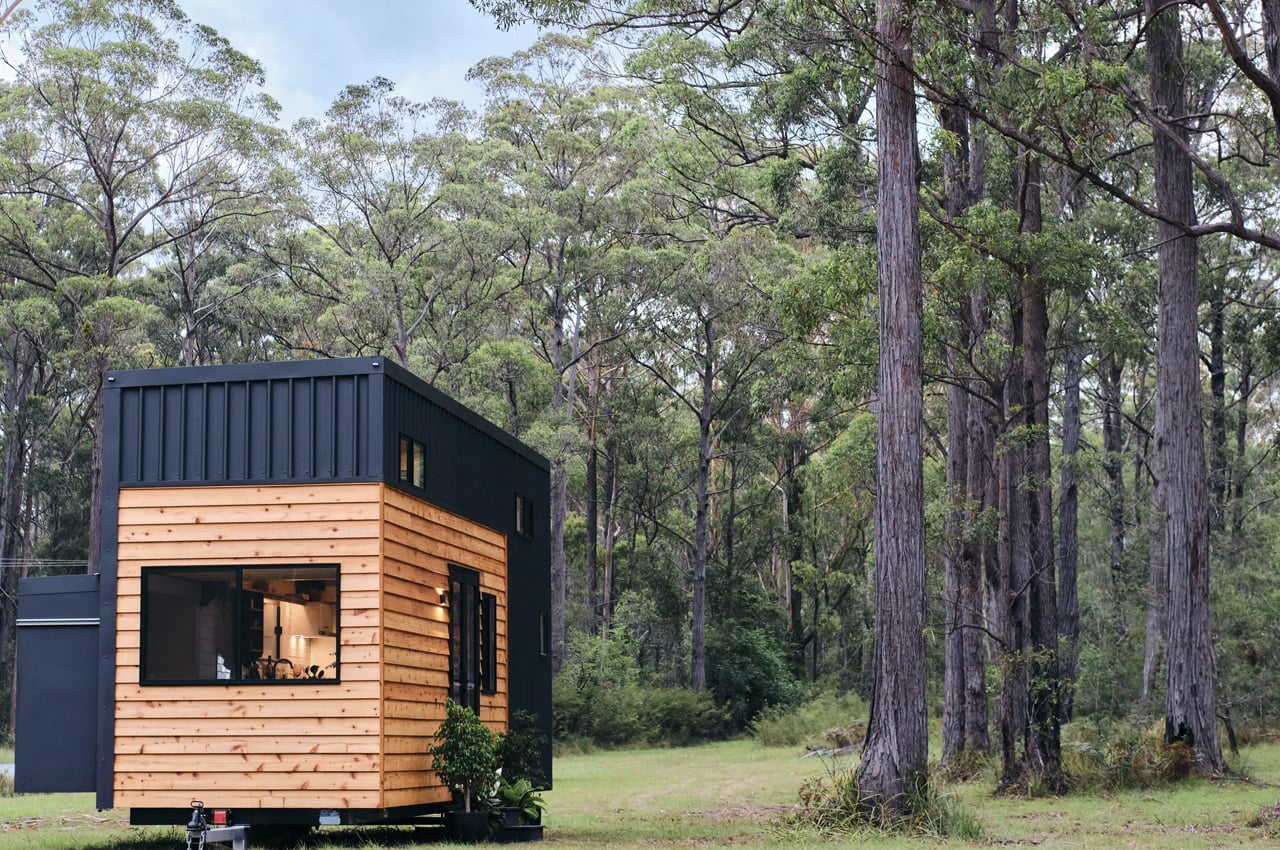

Cedar-Clad Tiny Home Expands With A Slide-Out Section & Supports A Total Off-Grid Lifestyle

Dubbed the Grand Sojourner Layout 3, this neat and quintessential little home was designed by Häuselin with a unique slide-out section that lets the owners enjoy the benefits of a compact model when towing, and a spacious and luxurious model when it is parked. This impressive tiny home maximizes its flexibility with an optional off-grid capability as well. This model is the latest in Häuslein’s Sojourner series, and it is founded on a triple axle-trailer while measuring 30 feet.

Designer: Häuslein

The tiny home is finished in red cedar and black aluminum, imparting it with a classy and minimalist exterior. The tiny home’s slide-out section is optional, but this increases the home’s width from a road-legal of 8 feet to roughly 11 feet. The slide-out section is manually operated and is based on two sets of rails. It can be pushed out by two people, and then locked into place, and does not permit any rain or wind to enter.

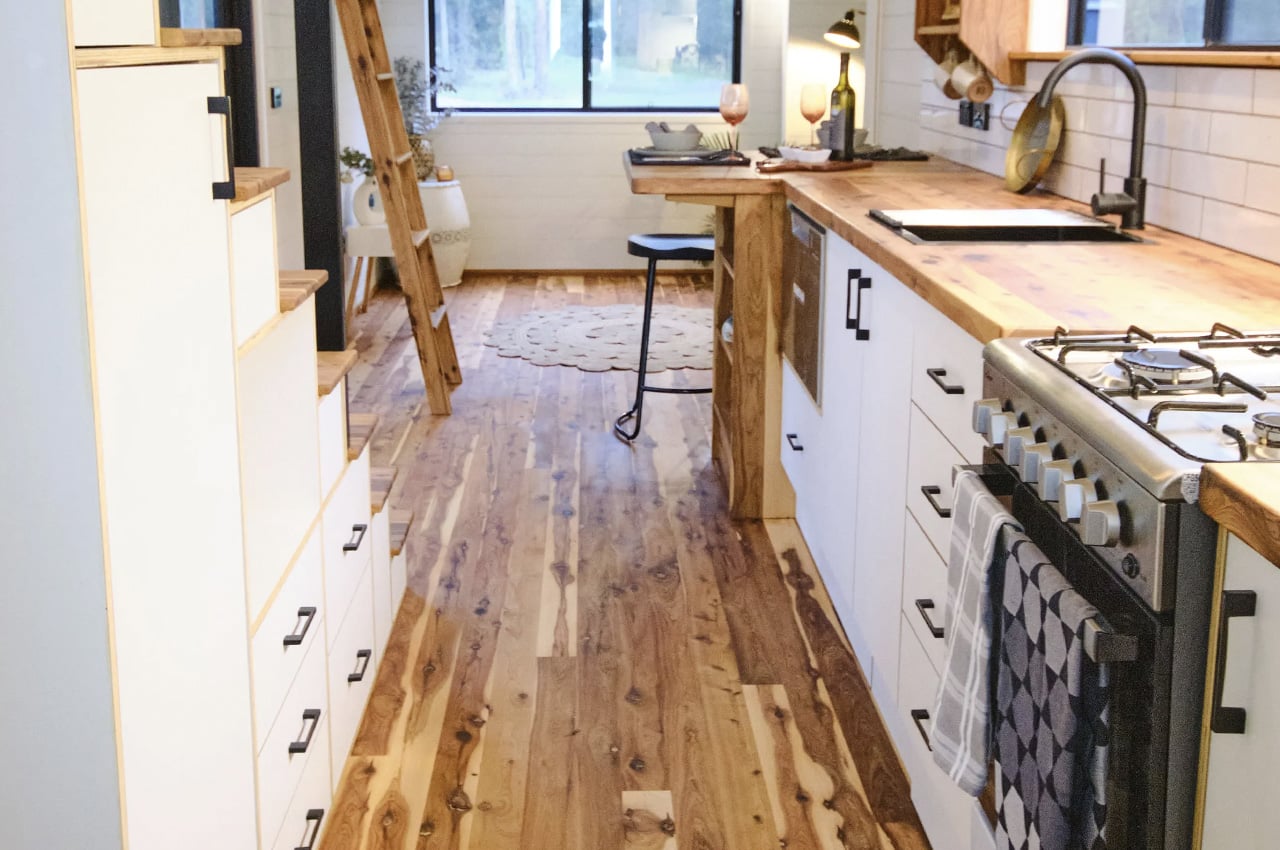
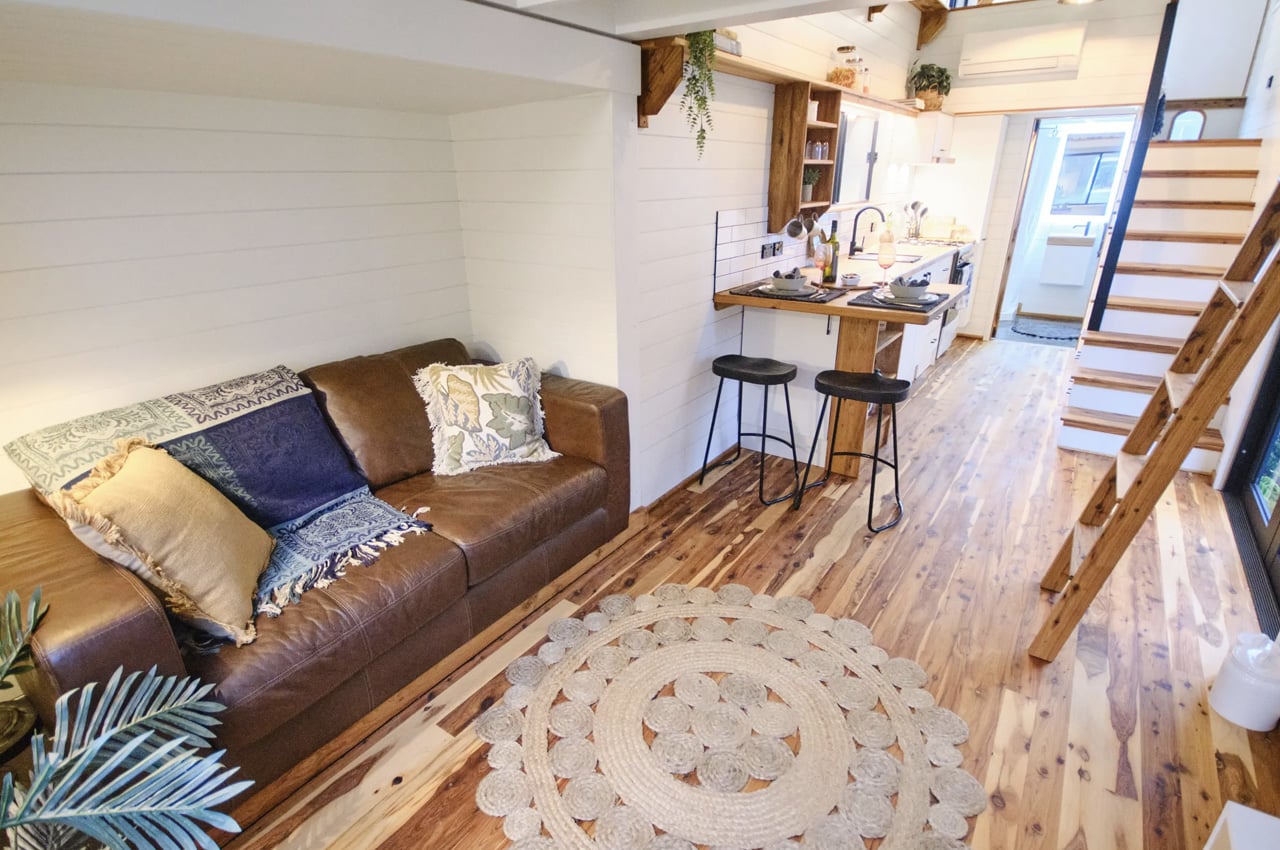
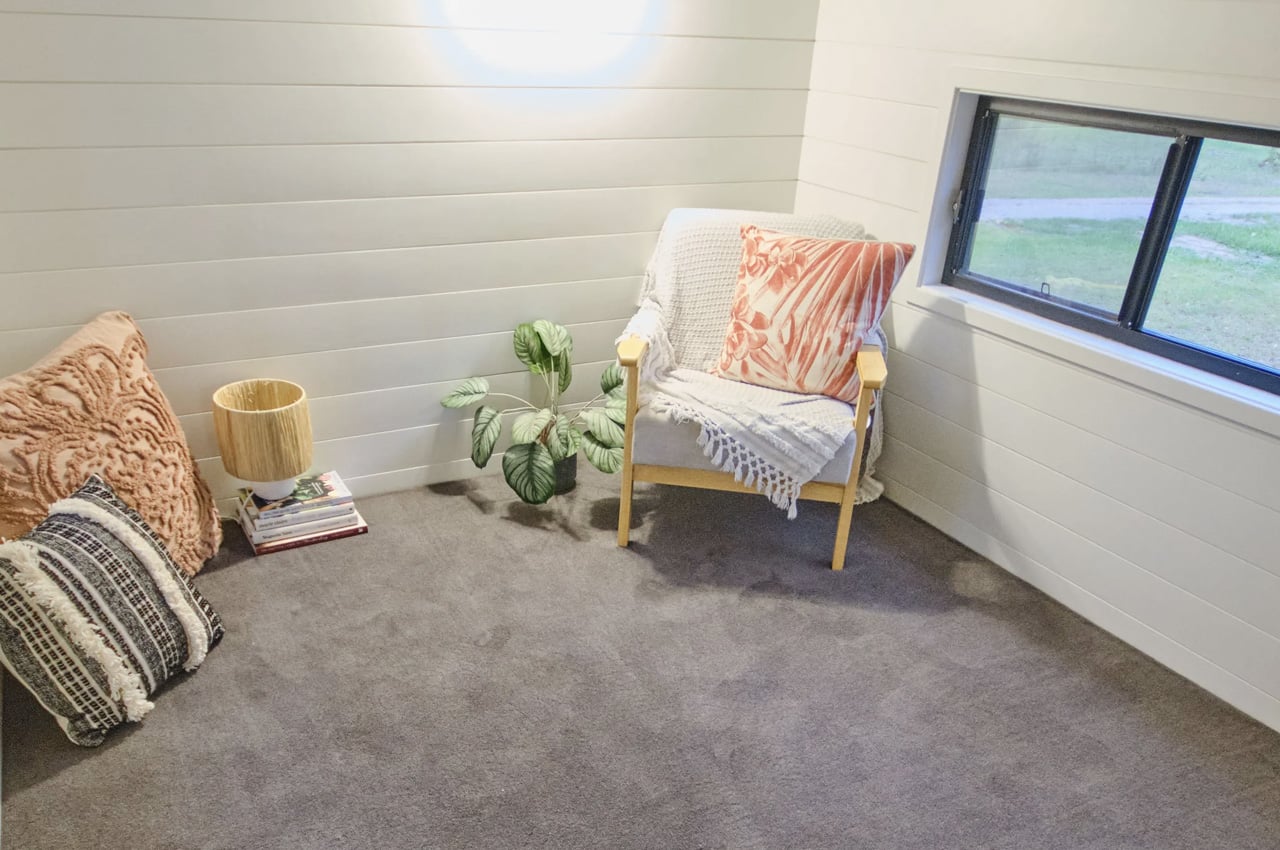
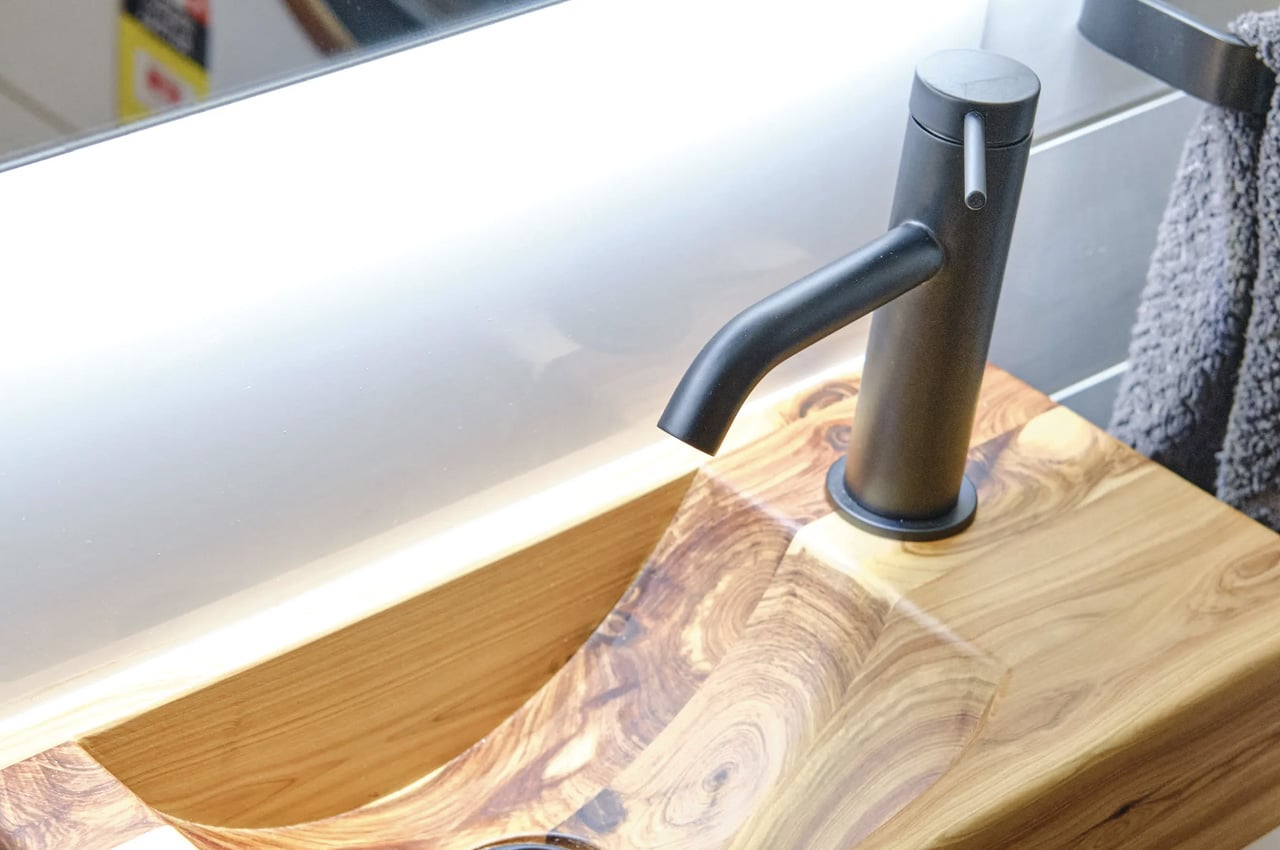
The slide-out section may sound minimal, but it does make the living room seem larger and more spacious, much like a normal fully-sized home. The living room can also be configured as an office or bedroom if needed. Next to the living room is the kitchen which accommodates a sink, cabinetry, a drawer dishwasher, fridge, full-size oven, and stove. There is also shelving and a cute breakfast bar that can seat two people. The kitchen is further connected to a bathroom which contains a vanity sink, shower, storage space, and a washer/dryer. There is an option between a traditional flushing toilet, composting toilet, and an incinerating toilet.

The Grand Sojourner Layout houses two bedrooms. The master bedroom can be accessed via a storage-integrated staircase, with a lower floor section that allows residents to stand upright. The bedroom also includes a double bed, storage, and a skylight. It has a ceiling height of 5 feet. The second loft-style bedroom can be reached via a removable ladder, and it can also be used as a storage or multipurpose room if need be. The tiny home is equipped with solar panels and a battery system, as well as a tank/pump setup, allowing it to run off-grid.

The post Cedar-Clad Tiny Home Expands With A Slide-Out Section & Supports A Total Off-Grid Lifestyle first appeared on Yanko Design.

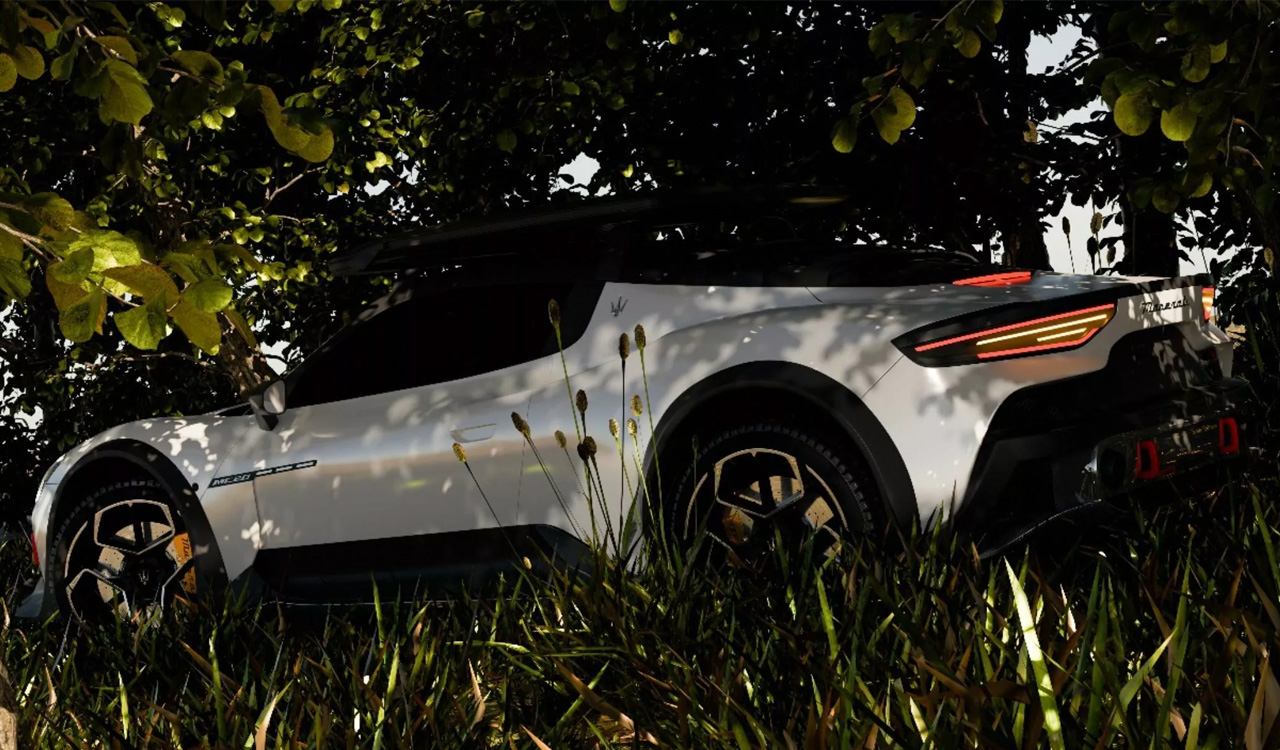
Maserati MC20 Dakar Edition is an adventurous Italian supercar challenging the Lambo Huracan Sterrato

Carmakers like Lamborghini and Porsche have made the bold move to test the viability of an all-terrain supercar with the Huracan Sterrato and 911 Dakar respectively. Interestingly, one imaginative designer has derived inspiration from such builds to come up with a concept Maserati MC20 Dakar Edition to conquer any terrain an off-roader would fancy. While one would argue that the Maserati Grecale and Levante SUVs already have a presence in the market for off-roading, this concept increases the stakes a level higher.

Destined to be a mid-engined supercar, the MC Dakar Edition rides on lifted suspension and gripper tires with additions like a pair of gripper hooks and a bespoke roof rack with front-facing lights. This fun project gives high weightage to fun and style over performance, so the conceptualizer doesn’t propose any upgrades to the mid-mounted twin-turbo V6 engine capable of generating 538 lb-ft of torque.

Designer: spdesignsest

Keeping in mind this build is a Dakar edition, so the off-road modifications will disturb the aerodynamics and add to the overall weight. This will directly impact the top speed and acceleration. But if this supercar is off-roading for most of its clocked miles, it won’t matter. Continuing with the off-roading character of the vehicle, there are satin-finish aluminum skid plates on the rear and bumper extensions for a beefier profile. No doubt this concept would look dapper compared to the modified MC20.

We are not counting on the probability of this concept making it to real life as the designer works for 7 Design House which is a tuning company that has already weaved their magic on the Maserati MC20 Coupe and Cielo for visual enhancements. If potential owners like the idea of a Maserati turned into a Dakar Edition version, we could have a real version too in the future.


The post Maserati MC20 Dakar Edition is an adventurous Italian supercar challenging the Lambo Huracan Sterrato first appeared on Yanko Design.

Fitbit’s health chatbot will arrive later this year

Like most other corners of the tech world, Google sees AI powering the next innovations in health technology. The company’s annual The Check Up event expanded on its plans to add a personal health chatbot to the Fitbit app, expand Google Lens for better skin condition searches and use a version of its Gemini chatbot in the medical field.

One of the more intriguing of Google’s announcements on Tuesday was more detail about an experimental AI feature for Fitbit users, briefly teased last year. Fitbit Labs will let owners draw correlations and “connect the dots” from health data tracked using their wearable devices. A chatbot in the mobile app will let you ask questions in natural language and create personalized charts to learn about your health.

The company hasn’t yet gone into great depth about the Fitbit chatbot, but an example it published Tuesday shows a user asking about potential connections between activity and sleep. The Fitbit assistant answered that the user’s days with higher activity scores correlated with better sleep (while cautioning not to assume that’s the only reason).

The Fitbit generative AI tool will arrive later this year. Google says it will (at least initially) only be available to Fitbit Premium subscribers with Android devices enrolled in the Fitbit Labs program.

Google screenshot of an upcoming Fitbit feature that answers personal health questions. The user's text box asks about connections between their activity and sleep, and the bot says that when they spend 58+ minutes in activity zones, their sleep score rose by nine points.
Google / Fitbit

The company sees Google Lens as filling some healthcare gaps where text-based searches fall short. It says a feature (introduced last year) that uses Lens to identify “visually similar matches from the web” for skin conditions is now available in over 150 countries. It can work even when you don’t know where to begin when describing a dermatological disorder.

In a similar light, Google has added new images and diagrams to its web results from reputable online sources to help you understand conditions like neck pain. Up next: The company sees the visual results powering its searches for more health conditions, including migraines, kidney stones and pneumonia. The visual search engine updates are expected to roll out over the next few months.

The company also mentioned that Fitbit and Google Research are partnering with health and wellness experts and other medical professionals to create a new AI model for health and wellness. The long-term goal is for the Gemini-powered large language model (LLM) to power its future AI features across Google’s various health offerings.

This article originally appeared on Engadget at https://www.engadget.com/fitbits-health-chatbot-will-arrive-later-this-year-210609008.html?src=rss

Fitbit’s health chatbot will arrive later this year

Like most other corners of the tech world, Google sees AI powering the next innovations in health technology. The company’s annual The Check Up event expanded on its plans to add a personal health chatbot to the Fitbit app, expand Google Lens for better skin condition searches and use a version of its Gemini chatbot in the medical field.

One of the more intriguing of Google’s announcements on Tuesday was more detail about an experimental AI feature for Fitbit users, briefly teased last year. Fitbit Labs will let owners draw correlations and “connect the dots” from health data tracked using their wearable devices. A chatbot in the mobile app will let you ask questions in natural language and create personalized charts to learn about your health.

The company hasn’t yet gone into great depth about the Fitbit chatbot, but an example it published Tuesday shows a user asking about potential connections between activity and sleep. The Fitbit assistant answered that the user’s days with higher activity scores correlated with better sleep (while cautioning not to assume that’s the only reason).

The Fitbit generative AI tool will arrive later this year. Google says it will (at least initially) only be available to Fitbit Premium subscribers with Android devices enrolled in the Fitbit Labs program.

Google screenshot of an upcoming Fitbit feature that answers personal health questions. The user's text box asks about connections between their activity and sleep, and the bot says that when they spend 58+ minutes in activity zones, their sleep score rose by nine points.
Google / Fitbit

The company sees Google Lens as filling some healthcare gaps where text-based searches fall short. It says a feature (introduced last year) that uses Lens to identify “visually similar matches from the web” for skin conditions is now available in over 150 countries. It can work even when you don’t know where to begin when describing a dermatological disorder.

In a similar light, Google has added new images and diagrams to its web results from reputable online sources to help you understand conditions like neck pain. Up next: The company sees the visual results powering its searches for more health conditions, including migraines, kidney stones and pneumonia. The visual search engine updates are expected to roll out over the next few months.

The company also mentioned that Fitbit and Google Research are partnering with health and wellness experts and other medical professionals to create a new AI model for health and wellness. The long-term goal is for the Gemini-powered large language model (LLM) to power its future AI features across Google’s various health offerings.

This article originally appeared on Engadget at https://www.engadget.com/fitbits-health-chatbot-will-arrive-later-this-year-210609008.html?src=rss

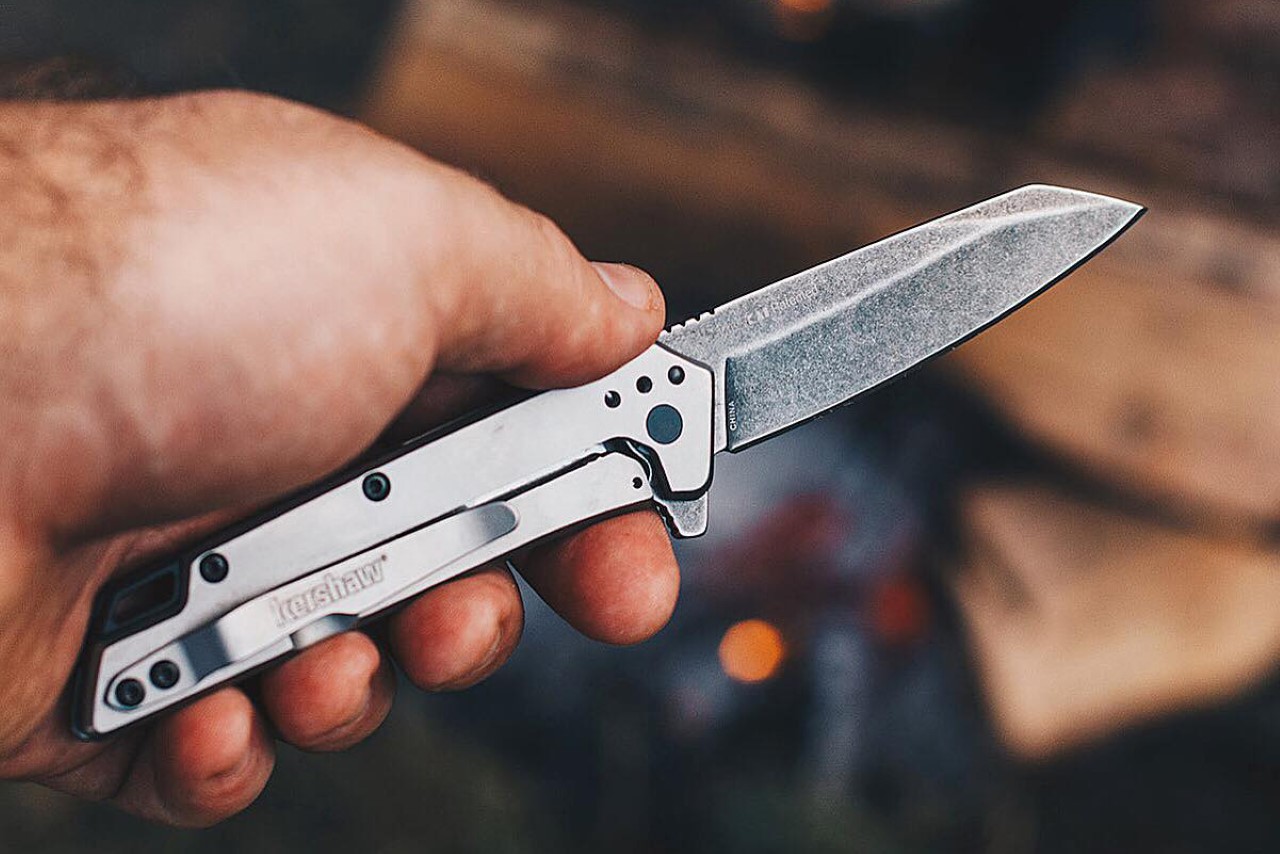
The Kershaw Misdirect is a sub-$30 Small Pocket Knife with the Attitude of a Big EDC Blade

A part of Kershaw’s ‘Starter Series’, the Misdirect is designed to be compact, affordable, and reliable, making it perfect for people looking for their first EDC blade. However, that minimalist design, stone-washed reverse tanto blade, and smooth stainless steel are sure to captivate even seasoned EDC collectors and knife aficionados. Sitting at just 4-inches when closed and weighing just 3.2 oz. (93 g), the Misdirect is a masterclass in classic knife design – it’s small, but has a larger-than-life attitude, and can handle benign tasks indoors, as well as work equally well in tactical outdoor situations.

Click Here to Buy Now

With a blade that measures just 2.9 inches, the Misdirect falls closely short of the 3-inch margin required to be called a medium-to-large blade knife. The sub-3-inch blade comes crafted from 4Cr13 steel, with a BlackWash™ stonewashed finish that bestows a rather rustic appeal upon the blade. However, the sharp, slightly curved belly, and the reverse tanto profile make the blade highly capable of all sorts of tasks, from cutting and piercing to slashing, scraping, and even chopping with a rocking motion thanks to the slightly curved edge. Meanwhile, jimping on the top of the blade gives you a nice place to comfortably rest your thumb, while the knife’s flipper acts as a nice cross-guard to keep your index finger in place.

A flipper lets you quickly and reliably deploy the blade with either your thumb or index finger, while a frame lock holds the blade in place so it doesn’t shut while in use. To disengage the blade, just pry open a cutout in the frame and the blade comfortably folds back, getting secured shut for the next time you need your EDC.

The Misdirect has a satisfyingly slim stainless steel handle that measures 0.38 inches (9.8 mm) thick, with a built-in wide lanyard holder and a pocket clip that can be arranged in three different positions. Threaded holes on either side of the handle let you place the clip in multiple orientations, giving the Misdirect a unique customizability so you can stash it in your pocket just the way you want it, deploying it in seconds as you pull it out.

Given that the knife is a part of Kershaw’s Starter Series, it boasts an incredible under-$30 price tag that makes it a compelling purchase if you’re looking to own your first EDC blade. With how good it looks and how well it performs, it might just be your last purchase too!

Click Here to Buy Now

The post The Kershaw Misdirect is a sub-$30 Small Pocket Knife with the Attitude of a Big EDC Blade first appeared on Yanko Design.

Max annual subscriptions are 40 percent off right now

You still have a few more days to save 40 percent on a year's subscription to Max. The discount is available to new subscribers (and some existing ones) and includes every plan the streaming service offers. The top tier subscription is for the ad-free, 4K plan which will now cost $140 annually instead of $240. The mid-level plan is also ad-free but doesn't support 4K content. Thanks to these Max streaming deals that level is $105 for the year, instead of $192. The cheapest Max subscription is ad-supported and now $70 yearly, which works out to $5.83 per month as opposed to the usual $10. Max will run the discounts until Tuesday, April 9th.  

Not only is the deal open to all new subscribers, existing subscribers who buy their service direct from Max.com can also take advantage. If you're a returning subscriber and previously went through Max.com, the Apple App Store or Google Play, you can also get the discount. Unfortunately, only new subscribers via Fire TV are eligible. The timing of the deal is tied to March Madness promotions, as Max will stream all 2024 Division I NCAA men's basketball championship games live, along with other live sports

For those who don't remember, Max is the name given to the streaming service that combines HBO's programming with Discovery+ content. While the name may be less memorable, the smooshing of the two services means more content to peruse — from brands like HGTV and Food Network — in addition to fine HBO fare like The Last of Us and True Detective. It's also where you can find Studio Ghibli films and A24 movies. Plus Our Flag Means Death, though canceled, was superb. There's a reason we named Max one of the best streaming services out there. 

Follow @EngadgetDeals on Twitter and subscribe to the Engadget Deals newsletter for the latest tech deals and buying advice.

This article originally appeared on Engadget at https://www.engadget.com/max-annual-subscriptions-are-40-percent-off-right-now-222339611.html?src=rss

Saudi Arabia’s New Luxurious Vacation Spot For Golf Enthusiasts

In the heart of Saudi Arabia’s expansive desert, a groundbreaking venture named Gidori is taking shape, offering a visionary escape for those seeking a blend of modern luxury, stunning landscapes, and outdoor recreation. Envisioned as a futuristic haven, Gidori stands as a testament to Saudi Arabia’s commitment to innovation and excellence in the realm of architecture and leisure.

Designers: Ignacio Gomez and Lama Al Kharboush

Gidori’s masterminds, architects from Aedas, are orchestrating a visual spectacle in the desert. With plans for 200 villas and homes seamlessly integrated into the natural surroundings, Gidori embraces the desert landscape rather than competing with it. At the heart of this ambitious project is the Monolith, an awe-inspiring beachfront complex featuring 190 cantilevering apartments adorned with glass and metallic surfaces. Drawing inspiration from the rugged beauty of natural rock formations, the Monolith is a gravity-defying structure that combines futuristic aesthetics with organic grace. Inside its embrace, residents and visitors can explore dining havens, retail spaces, and lush gardens, creating an immersive experience that blurs the lines between nature and architecture.

Beyond its architectural marvels, Gidori promises a luxurious escape with a carefully curated set of amenities. The boutique hotel, boasting 80 rooms, becomes a sanctuary of comfort and sophistication. Guests can relish the culinary delights of the hotel’s restaurants and unwind in the cozy lounges, ensuring a memorable stay. For golf enthusiasts, Gidori’s 18-hole championship golf course weaves through the low hills and rocky outcrops, challenging players with innovative design, breathtaking coastal views, and cutting-edge technology. The clubhouse mirrors this elegance, offering a refined space for hospitality, while the golf academy caters to traditional and e-sports aficionados alike, ushering in a new era of recreational engagement.

Gidori’s charm extends beyond its architectural grandeur and luxurious accommodations. The project embraces the natural beauty of the surroundings, emphasizing outdoor activities and lush landscaping. Trails for hiking wind through the terrain, offering both relaxed and challenging routes for nature enthusiasts. Cyclists, whether sticking to the road or venturing off the beaten path, will find Gidori a haven for exploration. Along the beach, a tranquil club invites guests to enjoy water sports and unwind in a serene atmosphere. As the sun sets, Gidori unveils observation platforms that provide unparalleled views of the night sky, creating an enchanting space for stargazers.

Gidori’s announcement aligns with Saudi Arabia’s ambitious vision for development, as evidenced by the progress of the 170-km-long Line project and plans for a towering 2-km skyscraper. Together, these ventures showcase the nation’s forward-thinking approach, pushing the boundaries of architectural innovation and sustainable luxury on a global stage.

The post Saudi Arabia’s New Luxurious Vacation Spot For Golf Enthusiasts first appeared on Yanko Design.

Microsoft hires DeepMind cofounder to lead its new consumer AI division

Microsoft now has a lone leader overseeing consumer AI for the first time. DeepMind cofounder Mustafa Suleyman is joining the company from rival Inflection AI. Suleyman will try to push the consumer-facing Copilot assistant into the future, preparing for what may be a long battle with Google for artificial intelligence supremacy among Silicon Valley’s Big Five companies.

Suleyman’s official title will be executive vice president and CEO of a new division called Microsoft AI, reporting directly to CEO Satya Nadella. Joining him will be fellow Inflection AI cofounder Karén Simonyan, who takes the title of chief scientist.

“Messy” could be one way to describe Microsoft’s Copilot rollout. Despite its quick jump out of the starting blocks to take the lead over Google, Bloomberg reported in January that Bing’s market share hardly moved the needle against its search rival. In addition, a Microsoft engineer raised flags earlier this year about the safety of OpenAI’s DALL-E 3 and Copilot, even taking his case to the FTC. Further complicating matters, Google’s AI efforts may be in for an enormous boost as it’s reportedly in talks with Apple to power the iPhone maker’s generative AI tools.

In announcing his move to Microsoft, Suleyman posted on X (Twitter) that “several of our amazing teammates” from Inflection AI will join him and Simonyan in Microsoft AI. But that may be an understatement. Bloomberg reported on Tuesday that Microsoft is instead “hiring most of the staff from his Inflection AI startup.” In a blog post announcing the changes, Inflection said it plans to “lean into our AI studio business” in an apparent pivot into the enterprise and away from its consumer-facing Pi chatbot.

Suleyman cofounded DeepMind in 2010, four years before Google bought the British-American AI startup for a sum reported to be between $400 million and $650 million. Suleyman left DeepMind in 2019 to join Google, and three years later, he left to cofound Inflection AI.

“I’ve known Mustafa for several years and have greatly admired him as a founder of both DeepMind and Inflection, and as a visionary, product maker, and builder of pioneering teams that go after bold missions,” Nadella wrote in a Microsoft blog post. The CEO described the incoming Inflection expats as “some of the most accomplished AI engineers, researchers, and builders in the world.”

Nadella stressed that Microsoft’s partnership with OpenAI is still a top priority. The ChatGPT maker provides the underlying generative AI models for Copilot. “Our AI innovation continues to build on our most strategic and important partnership with OpenAI,” he wrote. “We will continue to build AI infrastructure inclusive of custom systems and silicon work in support of OpenAI’s foundation model roadmap, and also innovate and build products on top of their foundation models.”

This news around Suleyman's role and the company's AI department arrives just days ahead of Microsoft's Surface event that's slated to take place on March 21st. It's titled "New Era of Work," so it's likely to be enterprise-focused, though of course the term "AI" has already made an appearance. The company says it'll show off "the latest in scaling AI in your environment with Copilot, Windows and Surface." You can watch that via livestream on Microsoft's website or just come back here as we'll be covering the announcements as they break. 

This article originally appeared on Engadget at https://www.engadget.com/microsoft-hires-deepmind-cofounder-to-lead-its-new-consumer-ai-division-190255898.html?src=rss

Microsoft hires DeepMind cofounder to lead its new consumer AI division

Microsoft now has a lone leader overseeing consumer AI for the first time. DeepMind cofounder Mustafa Suleyman is joining the company from rival Inflection AI. Suleyman will try to push the consumer-facing Copilot assistant into the future, preparing for what may be a long battle with Google for artificial intelligence supremacy among Silicon Valley’s Big Five companies.

Suleyman’s official title will be executive vice president and CEO of a new division called Microsoft AI, reporting directly to CEO Satya Nadella. Joining him will be fellow Inflection AI cofounder Karén Simonyan, who takes the title of chief scientist.

“Messy” could be one way to describe Microsoft’s Copilot rollout. Despite its quick jump out of the starting blocks to take the lead over Google, Bloomberg reported in January that Bing’s market share hardly moved the needle against its search rival. In addition, a Microsoft engineer raised flags earlier this year about the safety of OpenAI’s DALL-E 3 and Copilot, even taking his case to the FTC. Further complicating matters, Google’s AI efforts may be in for an enormous boost as it’s reportedly in talks with Apple to power the iPhone maker’s generative AI tools.

In announcing his move to Microsoft, Suleyman posted on X (Twitter) that “several of our amazing teammates” from Inflection AI will join him and Simonyan in Microsoft AI. But that may be an understatement. Bloomberg reported on Tuesday that Microsoft is instead “hiring most of the staff from his Inflection AI startup.” In a blog post announcing the changes, Inflection said it plans to “lean into our AI studio business” in an apparent pivot into the enterprise and away from its consumer-facing Pi chatbot.

Suleyman cofounded DeepMind in 2010, four years before Google bought the British-American AI startup for a sum reported to be between $400 million and $650 million. Suleyman left DeepMind in 2019 to join Google, and three years later, he left to cofound Inflection AI.

“I’ve known Mustafa for several years and have greatly admired him as a founder of both DeepMind and Inflection, and as a visionary, product maker, and builder of pioneering teams that go after bold missions,” Nadella wrote in a Microsoft blog post. The CEO described the incoming Inflection expats as “some of the most accomplished AI engineers, researchers, and builders in the world.”

Nadella stressed that Microsoft’s partnership with OpenAI is still a top priority. The ChatGPT maker provides the underlying generative AI models for Copilot. “Our AI innovation continues to build on our most strategic and important partnership with OpenAI,” he wrote. “We will continue to build AI infrastructure inclusive of custom systems and silicon work in support of OpenAI’s foundation model roadmap, and also innovate and build products on top of their foundation models.”

This news around Suleyman's role and the company's AI department arrives just days ahead of Microsoft's Surface event that's slated to take place on March 21st. It's titled "New Era of Work," so it's likely to be enterprise-focused, though of course the term "AI" has already made an appearance. The company says it'll show off "the latest in scaling AI in your environment with Copilot, Windows and Surface." You can watch that via livestream on Microsoft's website or just come back here as we'll be covering the announcements as they break. 

This article originally appeared on Engadget at https://www.engadget.com/microsoft-hires-deepmind-cofounder-to-lead-its-new-consumer-ai-division-190255898.html?src=rss